Showing posts with label Best Practices. Show all posts

Thursday, October 15, 2015

Where Durham Dawdles

While one of the most broadly acclaimed communities in America, Durham, NC where I live seems to be dawdling its way to one 15 year-old best practice only in fits and starts.

Before I get to the theory of why that is, as given to me this week by a landscaper friend of mine, let me share why even this practice requires yet another layer of best practice to be truly effective.

While Durham has dawdled, some cities are closing in on fulfilling a goal to plant 1 million new trees.  The movement stems from a goal by then Republican Vice President George Bush in 1991 encouraging Americans to plant 30 million trees.

He was bucking popular members of his party and some Democrats who had the convoluted notion that trees cause pollution.  In some cases they can, but science before and since has clarified that trees are crucial to regulating climate.

Deforestation hawks eventually undermined the initiative but it inspired many cities and states to take up the cause.  Tree hawks eventually stalled state initiatives but many cities forge ahead.

Most notable is New York City which faced much more daunting challenges than others.

Many cities were doomed when they tried to do it on the cheap using only donations and volunteers while failing to factor in ongoing maintenance.

However, NYC began with research in 2006 and 2007 to quantify both its municipal trees as well as the overall tree canopy across all five boroughs.

Then the city set an ambitious goal to plant a million new trees, 70% of which would be on city property such as along streets and right-of-ways, parks and public housing while rallying another 30% planted by homeowners, landlords, apartment complexes, businesses and non-profits.

But what makes the NY program truly stand out is that it not only incorporated caring for the trees into the initiative but worked with nurseries and growers to provide supplies of quality trees that would be sustainable in order to truly optimize long-term benefit.

An effort this strategic is only possible when elected officials and administrators weave it throughout each agency and department as well as understand the need for intensive, unrelenting data-based marketing communications.

The folks at Deep Root have calculated, in part by using i-Tree, that to plant a million trees using the right kind of trees with proper planting and maintenance will generate a $25 billion return over 50 years compared to a minus $3 billion if done improperly.

Only when leaders grasp that trees are a form of infrastructure is this type of commitment likely.

So why are so many other cities such as Durham failing to catch on or mount a concerted, strategic effort such as New York?

My landscaper friend believes it is we all in general, including elected leaders and administrators, even the one-percenters, make the same strategic mistake at home.

Even rich people put $100,000 into landscaping but then balk at paying a $100 a month for maintenance.  These same people also insist on overplanting to create a short term impression and expressing shock when it inevitably must be thinned and then, over time, ages out and must be replaced.

It isn’t just governments that often don’t get it.

While opinion polls in Durham show a high regard for tree canopy, the reality is that we don’t understand nor are we led to understand the true cost of things.

So many taxpayers complained at the $16 million cost of building the Durham Bulls Athletic Park only to be flabbergasted when it costs another $20 million to refresh it after two decades.

Part of the problem is that we, as the general public, don’t get it.

But we also don’t have leaders who deluding themselves don’t educate us.  In fact, many play into our ignorance by fostering resentment of government and taxes without revealing that we will be cutting off our nose to spite our face.

Durham leaders may eventually catch on and fully embrace its coveted tree canopy.  If and when it does, hopefully we do it right and learn from NYC.

Why is he so grumpy, some readers are probably muttering?

Hey, I spent a good share of my heart and soul defending Durham but that never stopped me from shining a light on areas where I believe we must improve.

Tuesday, January 28, 2014

Durham’s 1970s Sense of Place Revolt

During intermission last week at an incredible performance of “Once,” in the sparkling DPAC, I couldn’t help but think back forty years to the genesis of downtown Durham, North Carolina’s revitalization.

It wasn’t launched by deal makers or politicians or “heavy hitters” or development advocates, a few of whom over the years - including recently - have always seemed somewhat ambivalent about that neighborhood’s distinct sense of place.

By ambivalent I guess I include those in every community who appear so fearful of losing a project that they seem determined to surrender sense of place for the generic.

Others just seem impatient and dismissive or prone to ridicule preservationist sentiment when it suggests further reflection.

Unfortunately, this undermines far too many public facilities too whenever they get fast-tracked within the bureaucracies until it is too late to mesh them with overall sense of place.

This tension between sense of place advocates and those prone to the generic is apparent in the first studies of downtown Durham which were facilitated in the late 1950s on behalf of the then Downtown Development Association, a non-profit and the public Durham Redevelopment Commission.

One dealt with economic and demographic trends and the other, known as the Tarrant Report, with layout and transportation.

They were triggered by development of Durham’s first shopping center just less than a mile from city center at a gateway to the historic Forest Hills neighborhood.

In a panic, beginning in the 1960s, much of downtown was demolished as a well-conceived national urban renewal movement became more like an indiscriminate battering ram, seemingly unconcerned for sense of place, when in the hands of more narrow special interests at local levels.

Back then, the New York Times lamented that:

“We will probably be judged not by the monuments we build but by those we have destroyed.”

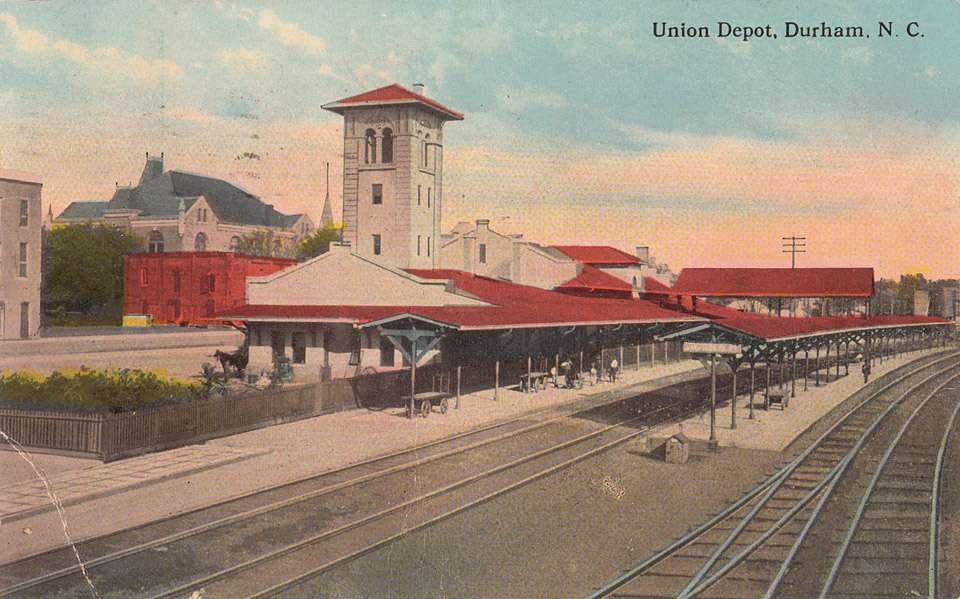
This was never more true than in Durham where iconic structures perfectly suited for what we call “adaptive reuse” today were demolished including the 1905 Union Station and the historic 1924 Washington Duke Hotel.

Swaths of structures and landmarks similar to those that are such a priceless draw for Durham today were destroyed to make room for parking lots and parking decks and a loop or noose around what we call the City Center District.

The sense-of-place carnage continued for fifteen years leaving deal makers and enablers sated, but downtown still in decline.

Finally, in the mid 1970s, they placed their sights on demolition of the 1926 Carolina Theater (Durham Auditorium,) the last remaining of Durham’s original thirteen theaters in downtown alone.

The Carolina had good bones, much better than buildings have today.  In fact, it had been the first to bring Broadway to Durham, original casts too.

But years of neglect by local officials had taken its toll.  So it faced the wrecking ball, just as its famous Durham architect too lay dying.

Defiantly, Durham residents and sense of place activists revolted, rose up, and began to reclaim what was left of their downtown’s distinctiveness.

It is upon their shoulders that downtown revitalization finally took hold.

They formed what is now called Preservation Durham.  They saved the Carolina Theater, and in the process spurred Durham’s first commercial historic inventory the basis for a unique national historic district designation.

This quickly spurred place-sensitive developers in 1980 to restore the iconic Kress building followed by the adaptive reuse of two tobacco warehouses into Brightleaf Square in 1981, along with conversion of other historic warehouses into condominiums in 1982.

However, demolitionists and dealmakers never entirely gave up nor did their fear abate of losing projects because they were out of character.

Monuments to this include an incongruous office tower and the shoehorning of a convention center into a parcel only one-third the size needed.

But by the time I arrived in 1989 to help jumpstart the community’s overall guardian for sense of place including downtown, the tide had already turned.

Our mission included fueling the marketplace and tax base by leveraging place-based assets into demand-driven, visitor-centric economic and cultural development.

A few months earlier, voters had approved bonds to overhaul the Carolina Theater which reopened that year giving Durham, once again, a dozen performance halls.

Durham had also conducted a community wide, first blush historic inventory that was invaluable.

By 1990, upper story lofts were being developed in historic buildings above restaurants on Main Street and quickly inhabited by artists and RTP executives.

By 1991, Morgan Imports had begun adaptive reuse of a huge 1926 brick laundry building with unique architectural details that planners for a suburban shopping mall emulated in 1996.

In the mid-1990s an energetic successor to the 1950s Downtown Development Association was organized to see the revitalization through to its climax and beyond.

Planning by then had already begun on adaptive reuse of tobacco warehouses into apartments which opened around 1999 as the first phase of West Village.  Nearby, about that time, Measurement Inc. also began adapting a series of historic factory buildings into office space.

These all set the stage for adaptive reuse of the old Lucky Strike factory or American Tobacco as it is known today by the name of a now defunct parent company.

The massive project, the largest of its kind in the Carolinas, was obviously already germinating in the mind of the owner of the Durham Bulls by 1996 when he asked his general manager to have me join him along with his corporate counsel in his seats along the third base line.

He wanted to discuss who owned the old factory complex towering behind the ballpark’s first base line and its potential for redevelopment.

By 2000, it seemed clear that the revitalization of downtown Durham was seemingly irreversible.  The sense of place revolutionaries in the late 1970s had ignited a transformation.

The following year, American Tobacco began undergoing redevelopment, opening in 2004.

Many involved go no further back when referring to revitalization of downtown, probably because this impeccably executed transformation required significant public investment, both direct and indirect.

It continues to evolve each day and is without a doubt a testament to the economic importance of retaining the aspect sense of place related to the built environment.

You would think that American Tobacco alone would have put to rest for good any incongruity from newer buildings but it hasn’t.

At least four public facilities erected since then stand out as anomalies to Durham’s sense of place and several private projects pushed through since then also fail to meet that test.

Maybe the tension between sense of place and “generica” is impossible to fully reconcile.  For many, the thrill of the deal and/or fear of the unknown if they push back on a project to ensure a good fit will always trump the more temporal value of sense of place.

Maybe over time, sensibilities will be fully aligned.  Maybe the anomalies are just a carryover from the past century when the focus of economic development was on “what you don’t have.”

Experts such as Edward T. McMahon, a researcher at the Urban Land Institute, note that in the 21st century, the focus is all about building upon “what you do have.”

In his outline of what makes some communities more successful than others, McMahon also notes that the 20th century model was “driven by transactions” while the 21st century model is “driven by an overall vision.”

The world needs transaction deal-makers and Durham has had among the very best.

But maybe communities are best served by those who are secure enough to say no to a deal and who listen carefully to sense of place experts when it comes to preserving this priceless attribute.

Tuesday, January 07, 2014

A Glimpse At Service Design

As I drove up to a resort in the mountains of North Carolina last weekend as the guest of a mutual friend, I pondered how difficult it must be to run a professional association such as the one for community organizations focused on visitor-centric economic development.

Of the 10 trends in that field that were recently highlighted for 2014 by one of its truly best and brightest, all but seven should have been engaged by members two decades ago and another over a decade ago.

The speed at which organizations such as this can propel members forward is lugged down by the inertia of old schoolers or worse, those so so eager to appear smart they don’t have time to get smart, which is now research-proven to be an either/or proposition.

Running associations is a tough job, perpetually hampered by the lowest or slowest common denominator.

To me, only one of trends noted, “service design,” qualifies as new, and even at that it is a nearly three-year-old concept or re-concepting of a concept that emerged from EU-funded research at the Management Center of Innsbruck, a very entrepreneurial institution of higher education.

As it somehow so often does, last year the tourism agency in Durham, where I live in retirement happened to not only be one of the first dozen destination marketing organizations in the U.S. to be exposed to “service design” but as is its culture, among the very first to start integrating it into action.

At the basis of this new way of thinking about service is mobile ethnography.

Instead of filling out comment cards or surveys, now in a way that is much much more useful and consistent than social media chatter or facility ratings, visitors with soon be empowered with an app that is now in the demo stage called “myServiceFellow.”

It empowers a traveler to rate service at every touchpoint of the entire travel experience and then upload it at the end of the trip where it can be accessed, aggregated and analyzed by individual businesses or organizations also concerned with the equally important service spaces between commercial interactions.

This goes far deeper and far broader than ratings apps and it will peel back a layer undetected by the businesses involved, but more importantly, it will be far more useful to those concerned with the entire travel experience spectrum such as community destination marketing organizations.

If I had remembered to download the app prior to my trip, or looked closely enough to see how easy it was to use the demo,  I could have noted:

  • When we stopped for breakfast in Greensboro, the desecration of a sea of billboards on that stretch of I 85/40 and that my significant other’s hash browns weren’t crispy as requested.


  • How sad it was to see on arrival that instead of celebrating foremost the iconic 100-year-old Grove Park brand as an Omni imageResort, the chain sublimated the Inn’s identity below the chain name, a source of disgust overheard several times from other guests.


  • How a misspelling made it problematic to retrieve my Jeep from valet parking.


  • How cool it was that wait staff fastidiously and subtly substituted a black napkin for a white one to avoid napkin fuzzies on dark pants.


  • How a plugged up drain marred the wonderful walk-in shower experience in the spa wing.


  • How neglecting to wipe the windows of finger prints interrupted afternoon views of Asheville in the valley below.


  • How the only one of many stores at the resort to carry batteries had apparently been out of AAAs for a couple of weeks.


  • How irritating it was at a stop for gas and coffee that a convenience store stocked flavored half and half but offered only powdered creamer to customers wanting regular half and half.


  • How arrogant Fairway Outdoor Advertising is to flaunt digital billboards, contrarian to Asheville’s unique sense of place.


  • How phenomenally beautiful and billboard free major parts of I40 are through North Carolina, and how hideous parts that aren’t have become.

“Service design” is predicated upon a deeper, more empathy-based type of research.  It is determined to understand consumer motivation not just behavior and to understand actual specifics and patterns, not just general recall.

Unfortunately though, I suspect it will still show up on lists of “new” trends for decades to come.

Friday, June 10, 2011

Reasons It’s Un-American To Obsess About “Exceptionalism”

Arguments about American exceptionalism go back to the framers.

The notion, ironically first used in the modern context by the American Communist Party in the 1920’s, is now used by political conservatives to “brick-bat” anyone who dares suggest that as Americans we aren’t the beginning and end of all things exceptional as nicely summarized a couple of weeks ago by Michael Medved.

But while reading Ron Chernow’s wonderful biography of Alexander Hamilton, I learned the notion was also used by Thomas Jefferson to endear himself as a populist while stigmatizing Hamilton’s never-ending pursuit of “best practices,” including many adapted for this nation from the British.

Although it was Hamilton who spoke fluent French and as his aide helped General and then President Washington communicate with the French including their close friend Gilbert de Motier, marquis de Lafayette, it was Jefferson who was the obsessive Francophile. Hamilton understood that having won the Revolution we needed to quickly get over any hostility. Jefferson didn’t.

Jefferson hated the British so intensely he couldn’t admit that the framers had drawn on a great deal from that country both as the foundation for Independence and the Constitution. He was blinded by his equal hatred for and envy of Hamilton and other Federalists, apparently including George Washington and John Adams.

If he had still been alive, Jefferson would have been as delighted as his followers were when Alexis de Tocqueville noted the United States as “exceptional” on page 36 of the wonderful two volume travel book he wrote entitled Democracy in America based on his visit here in 1831.

However, a reading of the books reveals that de Tocqueville also cited many ways in which this nation was not so exceptional and prophesied the American Civil War. Had Hamilton not been killed in a duel two decades before Jefferson died, he would have relished that de Tocqueville was in search of “best practices.”

We are an exceptional country but primarily because we have always sought to glean “best practices” from anywhere and everywhere and then adapt or innovate them at the margins into something uniquely American.

For decades American business has focused on “best practices” dating even before Tom Peter’s 1980s ground-breaking book entitled In Search of Excellence, co-authored by Robert H. Waterman Jr. Businesses, especially innovative businesses know that intense pursuit of “best practices” is how to ensure this nation remains exceptional.

Getting caught up as the Republicans and their pundits do so often now in making sure that we appear “exceptional” by making it mandatory that we always trumpet that we are “exceptional” is a recipe for stagnation based on studies of learning by researchers like Carol Dweck as noted both in her new book Mindset and her earlier 2000 book-of-the-year Self-Theories: Their Role in Motivation, Personality, and Development.

Dweck discovered that otherwise equal students would either learn and thrive from failure or give up and waste time appearing to be smart based on the perceptions of intelligence they inherited from their parents and family members or that were superimposed by teachers.

Students who thrived and learned from failure had an infinite view of intelligence, meaning if you worked hard enough, the sky is the limit.

Students who gave up in the face of failure had a finite view of intelligence, either you have it or you don’t. They often then spent more time appearing to be smart than learning from failure.

If as a Nation, we get to caught up in appearing to be exceptional as Republicans and related talk show hosts insist we should, I fear we’ll lose ground rapidly. As a nation we have two choices: put our energies into being smart or waste them appearing to be smart.

America has truly been exceptional. But to continue to warrant that distinction, we need to get busy and study and adapt and innovate “best practices” wherever we can find them and worry a whole lot less about appearances.

Oh, and let’s remember, it takes a truly “exceptional” and secure Nation to admit when and where we’re not so “exceptional.”

Thursday, January 27, 2011

Durham Metro Ranks 314th In “Indie” Share

Sustain A Bull has its work cut out.

Typically ranked at or near the top in nearly all rankings of metros or cities, the four-county metro area centered around Durham, North Carolina ranks a dismal 314th out of 363 metro areas in the nation when it comes to the proportion of retail activity captured by independent businesses.Capture

Mislabeled a “city” ranking, the “Indie” analysis actually studies official metropolitan statistical areas.  Raleigh-Cary, the closest metro geographically to the Durham NC MSA ranks 269h.   Asheville NC at 53rd is the highest ranking metro in the state.

Valuable to the communities in the Durham metro area, the “Indie Index” identifies 36 metro areas that far surpass others in the proportion of independent retail sales.  The report also breaks metro areas out into cohorts.

One of the benefits of scientific rankings and Durham’s status as a separate and distinct metro area is the ability to examine areas for improvement and best practice counterparts.

For other resources on the importance of independent retail, visit the New Rules Project.

For reasons to shop and ways to support local Durham independent retail, click on Sustain A Bull - Shop Independent Durham.