Showing posts with label Cultural Infrastructure. Show all posts

Tuesday, December 16, 2014

A More Inclusive Way To View Performance

Durham, North Carolina where I finished my career and still live in retirement just issued a report on how well the convention center here has been doing at erasing operating deficits.

There were some inconsistencies and misperceptions.

At both the city and county levels, Durham has always had excellent professional management during my twenty-five years here and none more so that under Tom Bonfield as city manager.

Governments at every level are not known for being able to fully account for and allot both revenues and costs to facilities. But neither are those in the free market economy.  More on that later including a new approach applicable to all sectors.

The convention center in Durham was always expected to run a deficit.

Back in the day when consultants weren’t punished for being candid with both pros and cons and most were not for sale, the consultant for the proposed Durham convention center projected a $450,000 annual deficit, which would be $1.8 million today.

But thanks to new management it now runs a $167,000 deficit and that is without fully attributing all related revenues.

For instance, if parking and ticket assessments are being used to make DPACs performance look even better, as they should, it seems the city should attribute revenues from the lease of “air rights” above it to the convention center’s bottom line.

The convention center here has always been hampered from harvesting more than its share of the out-of-town conventions and meetings drawn to Durham overall by having far too few hotel rooms in walking distance.

That is about to be more than remedied when by this summer the number of guest rooms at or within less than a block will increase nearly double to nearly 400 and another 259 within a few blocks.

A few are made feasible by revitalization but a good share are due to incessant communication, over nearly three decades now, by Durham’s marketing agency to point out downtown’s strategic location.

It is four miles from Research Triangle Park, adjacent to one Duke campus and two miles from Duke’s main campus and that of North Carolina Central University, as well as the most proximate to dining and entertainment districts.

But as the new management company has proven, the original management company back in 1989 could have closed the gap, had it not cursed the facility with a convoluted identity and a sense of entitlement.

When it opened, it not only made sense to contract management with the adjacent hotel owner but that contract was calibrated as an incentive by essentially covering all of the private hotel’s fixed costs.

But instead, the hotel company tried to brand the convention center merely as its private meeting space while still demanding preferential treatment, if not sole-sourcing to out-of-town groups selecting venues.

The city and county bear some responsibility for their own self-inflicted deficits by being passive until a few years ago with everyone except Durham’s marketing agency which it insisted must refer to the facility by it true identity while somehow dealing with the obfuscation it tolerated  elsewhere.

I cringed when news reports repeated (although in much more genteel language) an urban legend that somehow Durham’s community marketing agency felt “uncomfortable” with the arrangement inferring less had been done for the convention center back when I ran the DMO.

The cardinal rule for a DMO is to do what’s best for the community as a whole when it comes to optimizing visitation including the 10% who attend conventions, while maintaining a level playing field.

When it comes to attracting out-of-town meetings, this isn’t just about being fair to local stakeholders such as hotels and other privately-owned meeting space as well as the convention center but to be absolutely fair to meeting planners and organizers.

The job of a DMO is to draw attention to Durham and then assist while meeting planners and other site selectors make the best decision for their groups as to which venue and part of town are best for their needs.

It is up to each facility including the convention center by that point to close the deal and harvest their share while the DMO provides level platforms for information.

A few community DMOs play favorites, but it is at their peril as has been so often proven, including elsewhere in North Carolina.

However, a level playing field meant that the Durham DMO always did much more to promote downtown Durham, and thus the convention center, than it did for other facilities.

We made sure the other facilities understood why, but that this extra effort would stop short of ever “sole-sourcing” the convention center to a meeting planner which is what the management company and owner of the adjacent hotel demanded.

What did we do extra?  A special section on downtown including several pages of schematics on the convention center, dining maps to show proximity of restaurants, a walking tour, a time/distance/frequency shuttle schedule to and from other hotels and facilities to name just a few examples.

We even intervened to smooth over relations between the convention center management and planners from time to time back then when a sense of entitlement threatened to poison the site selection process.

But none of this overcame the primary reason the convention center performance was limited – the lack of nearby hotel rooms.

Of course there were market trends to blame.  The facility opened just as the nation’s meeting planners shifted preferences to hotel meeting facilities and away from downtowns and conventions centers because the number of facilities rapidly increased, while the number of conventions went into a long slow decline,

That is still underway today.

Until now, Durham’s local governments have avoided the slippery slope many communities have fallen down when they disguise deficits by creating special slush funds to pay out of town groups subsidies to use certain facilities.

Durham visitation outperforms those communities that do “pay for business” according to analyses of participation in activities such as conventions, sports and performing arts where that tactic is used.

Sadly, community marketing organizations and chambers of commerce are often the ones leading communities over this cliff.  But ultimately, the problem is not just a failure to understand the law of supply and demand.

If instead of subsidizing events, cities and counties as well as surrogates such as DMOs and chambers, where they contract other, traditional economic development services, would adopt full cost as well as full attribution accounting, they could make or recommend much better decisions.

This would be looking at the benefits as well as costs of events and facilities more holistically, like an ecosystem.

Maybe the convention center deserves partial credit for an event its existence helped intrigue even when another local facility in the community is selected.

Maybe the Museum of Life & Science deserves partial credit for increased property values in surrounding neighborhoods.  Maybe facilities and events that cannibalize underwriting, should deduct that from overall an event’s overall impact.

It isn’t as far-fetched or complicated as it sounds.

But cities and counties are not alone in the struggle to adapt accounting to be more consistent and inclusive when it comes to fully allotting costs and benefits.

The free market has long avoided “full cost accounting,” instead pushing what are called negative externalities (certain costs) off on consumers and taxpayers.

Even countries are now being challenged to move beyond merely using GDP (gross domestic product) or inputs minus subsidies in value as a measure of economic health.

An alternative to using only GDP is called IW (inclusive wealth) an approach that measures the positive change in human well-being across generations in a country by factoring in the social value of all capital assets, natural, human and produced.

It is consummately free market, just without opaque freeloading.

It has been under refinement since at least 1987 and linked here is the 2014 Inclusive Wealth Report. It doesn’t reject the value of GDP.  It just takes a much more full-accounting approach to growth, and particularly sustainable growth.

Natural capital includes fossil fuels, minerals, forests including non-timber resources and agricultural land.  Human capital involved education and health.  Produced capital includes equipment, machinery, roads etc.

Add them up and deduct things like oil capital gains and carbon damages and you have an Inclusive Wealth Index.  My interest is in natural capital so I’ve read and re-read the 2012 report with a focus on that area.

Each report gives a rating overall for 140 countries and then zeros in on one of the three areas of capital, sort of like a balance sheet is used by the private sector but far more inclusively.

Accounting and metrics such as these are important because they help individuals, communities, states and countries make decisions with a full understanding of the inherent tradeoffs.

To bring it back to subsidizing events, even when the dollars are raised privately, they didn’t just magically appear without having an adverse impact on areas including other events.

Failing to grasp subtleties such as this is how communities make decisions that gradually hollow out unique sense of place.

Inclusive Wealth is a better way of looking at deficits and surpluses as well as a far more inclusive way of measuring impact.

The sooner it filters down to the local level, the better it will be for communities still able to salvage the distinct sense of place that make them worthy of love by both those who live there but those who visit regardless of purpose.

Thursday, September 25, 2014

Edifice Envy - Questions Not Asked

A friend who was standing in a long line caught my attention recently as I exited the restroom during opening night intermission of the London musical, Dirty Dancing.

We exchanged mixed feelings about the increasing use of video in such productions and reminisced that the movie upon which the musical is based featured North Carolina as a stand-in for the Catskills.

Then, noting that some cities seem eager to replicate the Durham Performing Arts Center where I live, he asked rhetorically as we parted what I thought they might be missing.

It gave me food for thought as I returned to my seat.  In my experience of meeting over the years with scores of cities on such field trips, it isn’t what they ask but what they aren’t asking that often makes the difference.

DPAC is one of hundreds of large-scale venues that have opened in just the last decade.  Even before it opened, consortiums of consultants, funders and managers began wringing their hands about the consequences.

Many researchers have begun digging into this but it will take a decade or two for any correlations of the impact on local cultural ecosystems to be established.

Cities looking with envy to replicate performing arts, sports or convention centers usually take these field trips to reassure reluctant stakeholders.  Durham initiators took one to Greenville, South Carolina for example.

But rarely are the right questions asked that will drill down into what may be anomalies.

Durham’s new theater has been a huge success so far but the reasons often go unexamined during these field trips, especially factors that are serendipity.  For example:

1) Durham’s success is not because it lured Nederlander and the company’s equally exceptional non-profit partner PFM as operators, but because Nederlander came knocking.

The company, one of the largest owners and operators of theaters in the world, was eager to fill a geographic gap between other theaters it operates, and in the process, eliminate or undermine a competitor.

Everyone here was flattered and relieved.

2) Only 25% of the center’s patrons are local residents, give or take a point, the same percentage of Americans in the nationwide Census who take in concerts and plays, something that hasn’t changed for more than a decade.

Having more and larger facilities does not generate more participation.  It just means it is spread thinner.

In Durham as a whole, 29.8% of the adult population attends live performing arts each year compared to the 24.9% attending popular entertainment such as concerts and clubs, which is right at the national average.

The former is less than a point higher than and the latter the same as Greensboro which recently visited Durham and announced plans to emulate our large-scale venue.

Wake County, which lost its Broadway series due to the startup in Durham, still draws only 1.2% fewer residents for performing arts overall and the same percentage as Durham to popular entertainment including concerts and clubs.

3) As a result, Durham’s large-scale venue is heavily dependent on day trip visitors for patrons, something made possible because the metro area it centers is near another anchored by Raleigh, North Carolina’s second largest city, which quickly shut down its touring Broadway series after DPAC opened.

But Durham visitors beyond 50 miles still don’t participate any more in the performing arts than they did prior to the opening of a large-scale venue.  Never has having more capacity changed the percentage of visitors interested in performing arts.

For any large-scale theater to succeed, it must draw visitors, including a good share who come to a community for other purposes.  Without being so close to a another major population center, Durham would be in big trouble.

But if the hundreds of communities that just built new large-scale venues are in the same predicament, something will have to give and usually that is a hollowing out of local arts creation.

4) Durham also negotiated a very favorable revenue sharing arrangement, supplemented by seat fees and special event parking fees in decks used.  What doesn’t show on that bottom line is tens of millions of dollars to relocate prior tenants and subsidies for nearby development.

5) Durham has a highly “accredited” community destination marketing organization known to be far more successful than its well funded counterparts and willing to try and defend smaller, more indigenous but equally valuable elements from bullying or erosion. 

Visiting officials also often fail to ask what Durham could or would have done differently, for example:

1) The center was apparently built on the cheap, forcibly in part, because initiators boxed themselves in with a tax funding formula to avoid voter and state scrutiny, thus, those extraordinarily long lines for the rest rooms.   The architect performed a miracle.

2) A pivotal opportunity was missed to weave the theater into the fabric of Durham’s “built” sense of place.

While there is a great view of ingredients to Durham’s sense of place from its spectacular glass lobby, it will likely be blocked by future development. The community missed an opportunity to make DPAC more “Durham.”

At the last minute, brick was added to the exterior at the insistence of the Mayor, but the building could have been designed coherent with its setting by picking up architectural details

Look, for example, at the National Historic Landmark just across a quad or either of the two surrounding National Historic Districts.  The interior could have been made to seem more temporal by using historic images of other theaters or performances here.

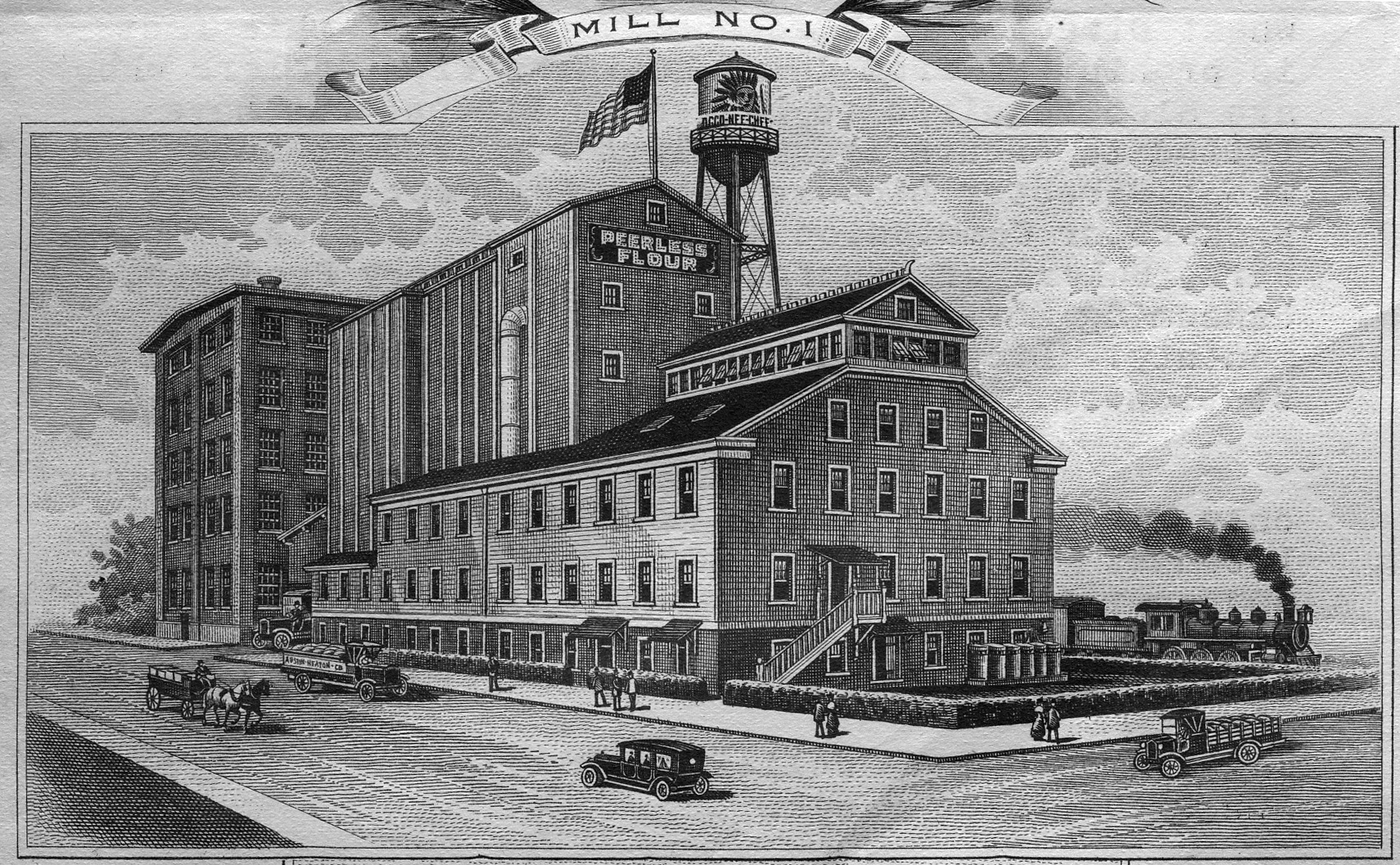
Or the new theater could have picked up the remarkable lines of the historic Austin-Heaton Flour Mill formerly on that site or evoked the beloved Durham Union Station that had stood across the track.

The design of the theater has grown on Durham residents but like the Detention and Judicial centers to the east, it isn’t coherent to its context.  As noted recently by one architectural expert:

“Cities have their own patterns of building, influenced by the pace of life, the quality of light, historic traditions or simply the materials available.

Buildings that acknowledge these patterns reinforce the sense of a particular place — they belong.”

Those on these inter-city visits, or inspection tours, also neglect to ask if the theater was a priority at the time or did it leapfrog higher cultural priorities?

They could also ask where Durham fell at the time in comparison to similar communities in the number of theaters or in overall visitor participation compared to averages.

Also questioned could be why philanthropic sources weren’t willing to fund the proportion of costs born in the other communities that were evaluated such as Greenville?  Was that a reflection of other community needs?

Was there any reason to build an additional performance hall prior to having a cultural master plan?

All of these questions go far beyond the questions usually asked during these familiarization tours and get at the overall question of “knowing what we know now, what would or could Durham have done differently” and still achieved similar or even better outcomes?

The problem, of course, is that to many people, questions are criticism.

Among those considering such a facility, anyone raising them might be ostracized as critics or naysayers because questions can be threatening to those who may have already made up their minds with very little information.

In turn, it is probably much too soon for even outspoken Durham to be introspective or if has, then forthcoming about what it would have done differently or volunteering that its success may have been been as much circumstantial as exceptional.

Regardless, history tells us that when provided such objectivity, enthusiasts have often dismissed it, even shopping around for consultants who would say yes after others concluded no.

It takes a truly exceptional community to put ego aside and pass up a challenge.

It took two or three decades after similar spates of overbuilding of other kinds of large-venue facilities before experts and researchers were able to truly and accurately assess the ramifications.

Even then there were outcries and choruses of angry denials.

Judging by studies and papers already underway such as the study “Is Bigger Better? The effect of capital facilities investment on non-profit financial vulnerability,” by Dr. Joanna Woronkowicz now under review.

Consortiums that began meeting under the aegis of Americans for the Arts nearly a decade ago, maybe those involved in the performing arts, will enlighten more quickly.

Or by then, will the devotees of such facilities as a means to achieve tangentially related but very different objectives such as “anchoring” turn to overbuilding yet another type of facility, hoping to feed what Architect Magazine columnist Aaron Betsky calls an “edifice complex?”

The history of such overbuilding over the last century suggests the latter.

Tuesday, September 16, 2014

Looking Back To A Revealing Era of Common Sense

As if on cue each year, news reports in Durham, North Carolina will headline that the convention center here ran a deficit as if there shouldn’t be one or that this wasn’t expected when it was built.

A new book I recently finished inspired me to read back through each of three feasibility studies that were conducted between 1972 to 1982 for facilities of this type on behalf of each of the three different mid-sized cities in different parts of the country.

This was the first of my now concluded four decades in visitor-centered economic and cultural development during which I would represent these three cities.

It is a span when studies such as these seemed far better grounded and realistic than many before or since.

Last reported, the annual deficit for the civic/convention center in Durham, where I still live in retirement, was $104,000.  That is without netting out tax revenues generated from related visitor activity or even parking revenues.

If they had, it would cover that amount by more than double.

Leading up to construction of the facility, consultants warned the City based on a 1977 survey of convention centers in other cities in North Carolina, to expect a deficit of around $450,000 annually or about $1.8 million in today’s dollars.

The fact is, cultural infrastructure doesn’t “pay” for itself any more than roads or other types of infrastructure.  The only difference is that communities very rarely build roads that aren’t needed.

But in-depth research going back nearly a century reveals that local officials across the country have long been pushed by business interests to build stadiums, convention centers, and increasing over the last decade, performing arts centers.

Ostensibly this is for tourism-related purposes but the real motives have been to shore up the values of surrounding private property in downtowns.

From their own public records including private papers, it is clear this has most often been done, to paraphrase their words, as a means of “shoring up” downtown property values or “insulating” them from “erosion” in nearby neighborhoods.

Other ulterior motives were to act as “anchors” to facilitate private loans or as “people generators.”

If a cultural facility is ever reported to be breaking even, it is usually a sign that ancillary revenues are being included while costs related to capital and site preparation are conveniently not.Durham Convention Center

Feasibility consultants up through the 1970s, called convention centers by the name “civic” centers because they knew that “75% of the days in a year that the civic center is in use is for local meetings, dances, banquets, [expositions] etc.”

Even today scientific surveys of residents show that more experience a civic/convention center in a given year than any other cultural facility.

Eventually renaming them convention centers, this was said to appease a handful of meeting planners seeking ego gratification, but the real reason, along with pressure to increasingly overstate performance, was to rationalize using visitor taxes as a means to avoid public referendums.

Durham dodged a bullet when it waited ten years after that 1977 feasibility study to secure voter approval to build a civic/convention center, but still at the modest size that had been originally recommended.

Consultants could see back then that far more cost/benefit accrued to centers just 9% of the size of today’s behemoths and less than half the size of centers back then.

Even then, before it ever opened, the Durham Civic Center was situated so as to fulfill its role related to surrounding private property values.

Many other cities over the next two decades, would go on a “big game hunting” binge, doubling the amount of similar space across the nation, while convention and meeting tourism began a long, gradual decline.  The proportion using these facilities plummeted to just 8%, at tops 15%.

The same thing is happening now with performing arts centers with hundreds of new facilities opening in just the last decade while Americans attending concerts as a percentage of the U.S. population has remained flat at around 22% and even down in areas such as touring Broadway.

But based on the findings of urban policy-making researchers, nearly all of these cultural facilities fulfilled their primary “real estate” purpose before they ever opened, pimping tourism merely as a means to access funding without voter scrutiny.

Though undetected yet due to systemic changes in the convention/meeting/facilities landscape, we know know that convention/civic centers were destined to become unviable by the 1980s.

But based on performance surveys of convention centers in the mid-1970s, it was estimated that, on average, these facilities should expect to harvest up to 45% of the overall convention and meeting attendance in their communities.

The overall nationwide decline in convention and meeting demand was imperceptible and unfathomable in the 1970s,  But it would soon begin to show graphs as each dip in demand began to fall slightly lower than the last and each subsequent rise peaked short of the one prior.

It has continued with few exceptions over the past four decades, still undetected by those zooming in on too tight a focus.

Unaware, consultants in the mid-1970s, as they did for Durham, would often predict that a community’s “delegate count would not increase significantly without facilities provided by a civic center.”

This mantra would prove wrong as would a pervasive amnesia about the primary use of these facilities being local.

But what also wasn’t anticipated was the sudden explosion across the country in the number of major convention hotels across the nation (with at least 150 guest rooms and at least 5,000 square feet of meeting space.)

An even bigger surprise was how much more popular they would become nationally than civic/convention centers.

It was inconceivable to consultants in the late 1970s and early 1980s that the proportion of conventions interested in convention/civic centers as a venue would soon plummet rather than skyrocket as predicted.

It is the miscalculation that haunts many cities today where sense of place has been exchanged for things bright and shiny only to find their overall appeal diminished.

Using Durham as an example, forecasts in 1977 for Durham estimated only a slight increase in the number of guest rooms over the next few years and a leveling off during the remainder of the 1980s.

Instead, by the time Durham’s convention center and an adjacent private hotel opened, there were already 10 or more convention hotels across the community vying to harvest conventions and meetings drawn here.

By the time its center opened, Durham was already drawing a third more convention attendees overall than had been projected by the consultant.

With a community destination marketing organization then in place, within three years Durham, community-wide, was drawing more than three times that amount and would soon eclipse its fair market share of that segment of visitors.

But in part because under contract it was held hostage to the priorities of the adjacent hotel, which naturally limited its availability when more lucrative visitors were available, the convention center was harvesting only 8% of Durham’s convention attendees instead of the 46% projected.

Still, as the consultant had forecast in 1977, even the existence of a very modest civic/convention center can often serve a role in a community’s marketing appeal to meeting planners even though the events are ultimately held elsewhere in Durham.

Of course, this is a very expensive way to amplify marketing, but should be credited when considering operating deficits.

One elected official obsessing a decade ago about the center’s operating deficit quipped in a moment of frustration to a group looking at data showing the local tax revenue generated by visitors who attend conventions and meetings:

“Why do we care about meetings held in other parts of town, we need to close that facility’s deficit!”

A more strategic member of the group quickly reminded the group:

That this would be “fiscally cutting off one’s nose to spite one’s face.”

Another added to the chorus of nods around the room, “more like Hara-kiri.”

This would have robbed the city coffers of millions of dollars in revenue from conventions and meetings and undermined scores of businesses just for the sake of avoiding uninformed criticism.

It varies, but the convention/civic center in Durham generally harvests about 25% of Durham’s overall convention attendance.  While not the 45% projected in 1977, this is two to three times the proportion held in convention centers nationwide.

By the time I retired five years ago, the percentage of meetings using convention centers nationwide had dropped to between 8% and 15%, depending on the report, with nearly 90% of conventions and meetings now using convention hotels or other types of lodging with meeting facilities.

During the course of my career, the proportion using convention/civic centers fell by more than 80%, by nearly a quarter in the last few years alone while the communities I represented continued to grow and exceed market share for that visitor segment.

So it isn’t likely Durham’s facility can somehow buck that trend.

Another systemic change that has occurred since the late 1970s is the proportion of day-trip to overnight attendees going to conventions and meetings.

Even today, consultants will often project that as many as 75% of attendance at conventions and meetings held in convention/civic centers will be overnight.

But even when daytrip attendees who travel less than 50 miles are excluded (and they shouldn’t be), 41% of attendees are now “local.”   Fully a third of the attendance now at major national conventions comes from within each state where the meeting is held.

Overnight delegates aren’t quite half of attendees.

But as I retired in 2009, even in major convention destinations such as New York City, only 39% of the attendees at conventions and trade shows (not exhibitions) held in its 1.8 million square foot convention center were overnight visitors and more than a fifth were local residents.

Overnight delegates attending events in the 700,000 square foot convention center in Washington D.C. represented just 4% of the community’s total.

Even as long ago as 1993, as the newly opened civic center in Durham was finding its legs, consultants for the Georgia World Congress Center in Atlanta, using historical data there, found only 45% of attendees to conventions were overnight visitors.

Still, other cities, including nearby Raleigh and Charlotte, tore down those facilities the Durham consultant found to be too large to be optimal in 1977 and erected new ones five times larger, the former out of envy for the latter according to an editorial there.

As I retired five years ago, the performance of Charlotte’s much larger center was barely measuring up to that much smaller predecessor, harvesting about what the other one did in 1991.

Cities that open huge convention centers such as these also find, if they are looking that is, that as a percentage of overall visitation they are drawing the same as cities with much more modest facilities such as Durham.

Even though it has a 3.2 million square foot (soon to be 3.7) convention center, Las Vegas draws the same proportion of its visitation to attend conventions that Durham does.

Its proportion of visitors attending conventions has been relatively unchanged through three expansions, even though 50-60% of delegates say they were more likely to attend because the convention was held there.

On top of the glacial decline in convention business nationwide, the migration of more and more to hotels and trends to lower proportions of overnight attendees, the massive oversupply of convention center space has caused these cities to shell out subsidies to secure business, adding to its deficits.

But conventions and meetings nationwide now have fallen below 9% of overall visitor person stays while the annual number of visitors being drawn to destinations such as Durham has been increased four-fold since the convention/civic center opened.

Shackled to mega-facilities, other cities are siphoning away marketing dollars that would bring a far greater return if redeployed to other visitor segments.

Durham will soon have 578 lodging guest rooms within walking`` distance of its micro-sized convention/civic center and another 145 nearby, nearly what it had back when the facility was first studied in 1977, but still fewer than what consultants had suggested would be spurred when the facility was built.

But Durham officials should question very seriously any future calls for a new or expanded center.  As it did in the 1980s, Durham should buck any effort to do so for ulterior motives such as propping up, insulating or anchoring real estate values.

The facility is doing just fine and outperforming the national average for proportion of convention attendance harvested by a convention center by nearly double.

Judging by market data and the lack of performance by larger facilities in other cities, it is highly unlikely that with more space it would be able to do any better than it is now and there are much less expensive ways to improve visitation.

Instead, officials are better advised to put the effort into better educating news outlets and the general public.

The ultimate return from cultural facilities, like that of other public infrastructure, is found strategically in a vibrant community not some narrow and arbitrary bottom line.

Thursday, September 11, 2014

There is always a tiny nugget to be gleaned. Then go shower.

Before I touch on new research supporting the importance of authentic sense of place, let me touch on one of the ironies from my four decade career as a guardian of sense of place.

It is how much time is required in that profession to defend communities from mainstream tourism interests.

Those drawn to the appeal of sense of place but then from  overbuilding and lack of differentiation brought on by ubiquity, soon begin to cannibalize it instead.

Desperately demanding more and more promotional oxygen to subsidize their responsibility to fill beds and seats, they instead begin sucking away at what is meant to promote the community at large and fuel overall visitation.

During the 1970s and 1980s, it was from convention-related hotels, and meeting or event planners demanding kick-backs or subsidies or facility-driven public officials desperate to obscure deficits when public facilities were no longer warranted.

In the 1990s, it was from mega-event “big-game hunters” intent on subsidies to secure events far too large to fit or held only at times that displaced as much or more demand than they generated.

In the 2000s, my final decade, it was from mainstream events and performing arts facilities which, desperate from overbuilding hundred more than warranted, sought to monopolize attention far disproportional to their percentage of visitor potential, at the risk to less pretentious forms.

If that isn’t enough, there are always one of two elected officials impatient for returns from leveraged visitor spending, who seek to drain away promotional resources.

So why did I love my career so much?

Because communities worth loving as places to live are places people find worthy of visiting.  They are the reason the vast majority of people travel away from their homes at all.

That “authenticity” must be protected and carefully nurtured even during the process of creating awareness and appeal.

Because guarding and leveraging sense of place is also incredibly worthwhile and rewarding.

But I still took time to listen very carefully to those who sought to undermine sense of place, even if intentionally.

Not only was there always a fragment of value to be gleaned but it made me think and reflect more deeply about my own assumptions and the data behind them.

As Dr. Robert Reich recently commented, “there is no better way to learn than to talk to someone who disagrees with you.”

The annual study of leisure travelers who now make up 3-in-4 visitor stays includes indices of areas of importance as well as travel style broken down by generation.Destination Analysts Indices

“Nature” scores above 50%, and nearly 65% for “boomers” such as me.

But “authenticity,” the desire for real destinations vs. commercial or mainstream tourism product, is more important across all generations but even more so among Millennials as is “culinary interests,”  engaging in a destination’s arts and cultural assets, and “exploration.”

“Activities,” are among the least important across all generations.

For many communities, this awareness is far too late.  Their sense of place and authenticity has already been hollowed out by preoccupation with mega-facilities and events, mainstream culture and arts, cookie-cutter lodging, formula stores and chain restaurants.

For communities still clinging desperately to their sense of place against the forces of homogenization, the lessons from this report and many others I’ve linked to in essays key-worded as “authenticity,” are clear:

  • Focus marketing efforts on unique sense of place assets such as indigenous art and festivals, green infrastructure, historic preservation, organically evolved districts, and locally-owned stores and restaurants.
  • Keep mainstream elements in their place while teaching them how to embrace the authentic characteristics of a community.
  • Be ever vigilant of the dangers that come with success such as “fear of saying no,” “churn,” “unholy alliances between policy makers and powerful special interests,” and “envy.”
  • Forsake those who claim “special knowledge” and relentlessly pursue critical and strategic thinking, differentiation, data and information-driven decision-making.
  • Beware of the incestuous deadly sins of complacency and envy of other places.
  • Eschew desecration marketing, including billboards, as well as other “yelling” forms of advertising.  Generously invest in the sharing of valuable content, earned attention and respect is the most valuable.
  • Religiously foster and protect distinctiveness and carefully guard against decisions that glitter but merely make a community one of many.

And always strive to listen, especially in the face of spittle, condescension, disrespect, anger, drama, exile, character assassinations, bribes, end-runs, betrayals, sycophants, demands and cabals.

There is always a tiny nugget to be gleaned.  Then go shower.

Be fearless.  Communities still worthy of love, still worthy of visitation, and still having a soul will always be worth fighting for.

Friday, July 18, 2014

When Cultural Facilities Become Means Not Ends

In the mid-1970s as a newly minted community marketing exec for Spokane, Washington, one of the first people to drop by my office was an ad rep named John Kelly.

We couldn’t afford what John was offering, but in the process he gave me a peek at his parent company’s new research: one of the first, if not the very first, in-depth breakdown of the entire marketplace of conventions and meetings.

The next year John joined Alaska Airlines but our paths would cross several more times.  He was head of marketing there when I was running Anchorage, my second DMO.  Shortly after I was recruited to Durham he became head of Horizon Airline and then head of Alaska Airlines.

But the day of our first meeting sticks in my mind because the sixteen subsequent reports commissioned by M & C Magazine that I utilized before I retired from that profession, were something for which I found an alternative use.

Even more important than rationalizing how to reach convention decision makers,  I somehow saw them as a way to zero in on metrics that would help us calibrate market share not only for Spokane, but for the two other community DMOs I ran during my career.

Market share is a way to set realistic goals and allocation of resources based not only on generating demand but calibrated to changes in supply.  It is also a means by which a community can assist developers and avoid the churn that comes with overbuilding.

It also helps a community avoid over-reliance on any one market segment of visitors.

As John and I talked that day, Spokane was spending $2 million to convert what had been the state pavilion during the just-concluded World’s Fair into its intended after-use as a convention center, for which it had been carefully designed.

It was also from these reports and warnings from the sentinel heads of a few major hotel chains, that a few DMO execs began to detect in the early 1980’s that the meetings market was losing steam.

But for fits and starts, it has declined now to about 10% of overall visitors potential.

A consultant isn’t needed to compute a community’s fair market share or potential. Roughly it goes as follows:

Take the gross number of meetings and attendees nationwide.  Separate corporate and small association/government meetings from the 1% that are major conventions.  Separate the groups that rotate across the nation from groups that stay within a region or state.

Take size breakdowns and calibrate them for the roughly half or more that are day trippers from those who use hotels e.g., 57% market-wide and match it against overall community capacity.

Discount for the proportion that meet in a community’s peak season for transient business or leisure leaving the percentage that meet in a given community’s “needs” seasons.

Narrow down potential by those rotating to any given region during a given year, e.g. 23% in the South Atlantic.  Separate the proportion that use convention centers e.g. 30%, from those that use hotels, broken down by downtown, suburban and airport etc.

The result will help calibrate reliable goals for that segment of visitors as well as inform any discussion about facility needs.

In the 1890s when destination marketing organizations first evolved to shape community identities as a means to leverage visitors, conventions were not only a purpose for which people traveled but the easiest to pursue.

Back then few hotels had meeting space and most meeting facilities were privately owned.  In the 1910s, cities began building public civic centers and auditoriums.

They were first a qualify of life amenity for residents and second a way to potentially appeal to conventions as value added.

Thus they were called civic centers.  That may be the last era in which convention centers truly made sense.

By the 1920s and 1930s mass leisure travel gave cities far greater and broader potential for visitation but many communities and their DMOs remained fixated on conventions, as many do today.

They imagined that segment as an ever expanding lake of potential, never making adjustments for the fact that even when and if that were true, the number of cities competing was growing far faster.

They also failed to account for the explosive growth and popularity of major convention hotels as an alternative or that improvements in transportation meant that attendance at conventions gradually began to skew based on the region and state in which they were meeting.

Failing to grasp that the genius of visitor-related economic development is that it is meant to be “demand-driven,” ironically, many cities and their DMOs have fixated on the supply side of facilities instead, emulating old-school, Industrial smoke-stack chasers.

The unfortunate result has been erosion of the sense of place and community distinctiveness that DMO’s are sworn to defend, making their communities less and less differentiating and less and less appealing or worthy of affection.

Following World War II, officeholders, downtown developers and their allies cities stopped viewing convention centers, stadiums and performing arts facilities for their inherent potential and began to coopt them as a means for the public sector to prop up private property values.

After researching nearly nine decades of documents in scores of cities, in a new book public policy expert, Dr. Heywood Sanders has followed up his controversial  2005 study for the Brookings Institution with a much more in-depth analysis of these phenomena and the history behind convention centers.

For neighborhood activists, officeholders, policy makers and expecially DMO executives, Sander’s book belongs on the shelf of required reading of this nature such as Dr. Mark Rosentraub’s Major League Losers and the follow up Major League Winners.

And out next year, Building Cultural Facilities in U.S. Communities by Drs. Joanna Woronkowicz and  Norman Bradburn, an elaboration on the study Set In Stone they authored along with five other researchers for The University of Chicago Cultural Policy Center.

Convention Center Follies is a page-turner for anyone who has witnessed or be party to the backroom processes and copy-cat techniques so often used to rationalize these facilities along with stadiums, ballparks and performing arts centers.

Some in my former profession along with feasibility consultants are quick to quibble with details of these studies but a few are having a  critical-thinking epiphany.

First, if they are half right, the problem is just as big.  Second, it DMOs and consultants want clearer information, they need to become less defensive and far more reflective and critical themselves.

The communities I served may have dodged the bullet but that doesn’t mean they have been immune to the group think that has led to so many billions of dollars of public facilities being spent less effectively than it could have.

During my career, I witnessed first hand many of the things Sanders reveals, both as other communities followed this path but to a lesser degree in my own communities as well.

The formula hasn’t varied for almost 90 years.

Hatch the plan in private.  Find a way around voter approval.  Shop for data to support proposals rather than build proposals based on data.  Avoid factoring in macro overbuilding or long term trends.

Let the ends justify the means.  Never go back and recalibrate expectations based on performance or admit things that didn’t work. Hope memory fades before the even bigger down stream costs come.

As business professor friend of mine has written.  Communities are in denial that initial constructions costs are only a tiny fraction of the ultimate cost of facilities.  Officeholders rotate off, developers flip, community memories fade.

Seldom does the outcome endure.

Sanders reminds us that in 1956 when Booz and Allen conducted the first independent feasibility assessment of a convention center in the nation, it concluded the new facility was not feasible.

Developers and officeholders insisted that the head of the DMO in that community, probably with a gun to his or her head, insisted that it crunch numbers more favorable.

Today, it happens in reverse but that is probably when the ugly business of consultant shopping was born.

As feasibility consulting rapidly grew lucrative, many acknowledged that the accuracy of the reports was made irrelevant because community’s had already made up their minds by that time they were engaged.

If a DMO’s research was felt too conservative or one consultant’s numbers didn’t work, another would hastily be contracted as happened more than once during my career.

In 1984, when a new convention center was built in Anchorage as part of Project 80s (along with a sports arena and a performing arts center) the total amount of convention center space nationwide was closing in on 32 million square feet.

By the time my career ended two and a half decades later, that amount more than doubled during a time when it was clear that demand was in a long, slow decline, especially as a proportion of overall travel.

A look at the data shows the same thing has happened with sports facilities and performing arts theaters, far outstripping demand.

Cultural facilities are important, especially when they are carefully evolved as part of a diverse ecosystem designed to differentiate communities and foster unique sense of place but built in response to demand, not as a means to create it.

As Rosentraub cautions, cities need to do a whole lot more planning and a lot less hoping.

Wednesday, April 02, 2014

Construction Is Just The Beginning

Several years ago, Dr. Dana Clark, a friend of mine who teaches in the business school at Appalachian State University penned an article warning communities bent on building mega-facilities that the initial cost will be just a fraction of the overall cost.

Partially, this is because construction since WWII, according to the Urban Land Institute, has been designed only to last 20 to 30 years.  This may be why the DBAP has just undergone another renovation that probably exceeds its original construction cost twenty years ago.

This time though, the City of Durham is on the hook for no more than $12 million with the owners of the Durham Bulls picking up about $8 million and agreeing to a lease keeping the storied team until at least 2033.

I remember glares of awkwardness I got from some when I corrected the misimpression left with Minor League Baseball officials by other economic developers during a tour many years ago that the acclaimed ballpark was a privately-held initiative.

At least now it could be argued that a fraction will be, as well as responsibility for operation and revenue-sharing, a win-win for the City.

This renovation was more than a face lift.  It included a new video board with more than 3.8 million LEDs, 8,000 linear feet of drain pipe under the field, 14 dump trucks of infield clay, 164 clusters of lights, 189 dump trucks of sand on which to lay a new field and all new seats with higher backs.

A new club level (air-conditioned restaurant/bar/event space) will be open to skybox owners, patrons and to season ticket holders who purchase a club membership for an additional fee, well worth it during hot, humid summer nights.  It is also available to groups for $45 per person.

The opening pitch this week to the new season will use one of 8,568 baseballs the Bulls will go through this season, about eight to ten dozen every home game.

The renovations were accelerated rather than phased because Durham hosts the Triple A baseball All-Star Game this year including five days of events.

Initial construction is only the beginning when it comes to cultural infrastructure, including facilities.  DBAP, it can be argued, spurred redevelopment of the historic Old Bull and Lucky Strike factories as well as construction of three new buildings.  Here again, the portion for local government increased to around $100 million.

In time, the local governments here will recoup some of the investment in increased property taxes, minus the impact of tenants dislocated from other parts of Durham.

As a baseball fan, I enjoyed watching the team in the now restored historic DAP north of city center, but given the alternative of losing the team, I think building the new ballpark just south of city center was our only option.

Built to look historic, the DBAP fits seamlessly with the historic built-scape part of Durham’s sense of place and has been leveraged through relentless community destination marketing into visitor-centric economic and cultural development that has repaid its original cost.

I’m not sure taxpayers would go along with cultural facilities like this if they knew the eventual lifetime costs, especially in destinations where it seems someone went shopping for culture one day and bought one of everything.

Cultural facilities, if tied to the indigenous distinctiveness of a community, are as important as any other type of infrastructure.

But as a friend of mine explained at the meeting of a state business lobby held in Durham last week, all too often the private sector refuses now to pay for public infrastructure because it sees it as a transfer rather than as the economic lifeblood it is.

At least the owners of the Durham Bulls seem to view it as a partnership.