Showing posts with label Green Infrastructure. Show all posts

Thursday, December 03, 2015

An Action Plan for Green Infrastructure

Once again, the U.S. Forest Service and its stakeholders such as the National Urban and Community Forestry Advisory Council have clarified something a few otherwise forward-thinking communities still don’t get.

A community’s urban forest includes “all trees in the city, on public and private property,” including homeowners’ yards as well as school and corporate campuses, 3.8 billion trees overall in America.

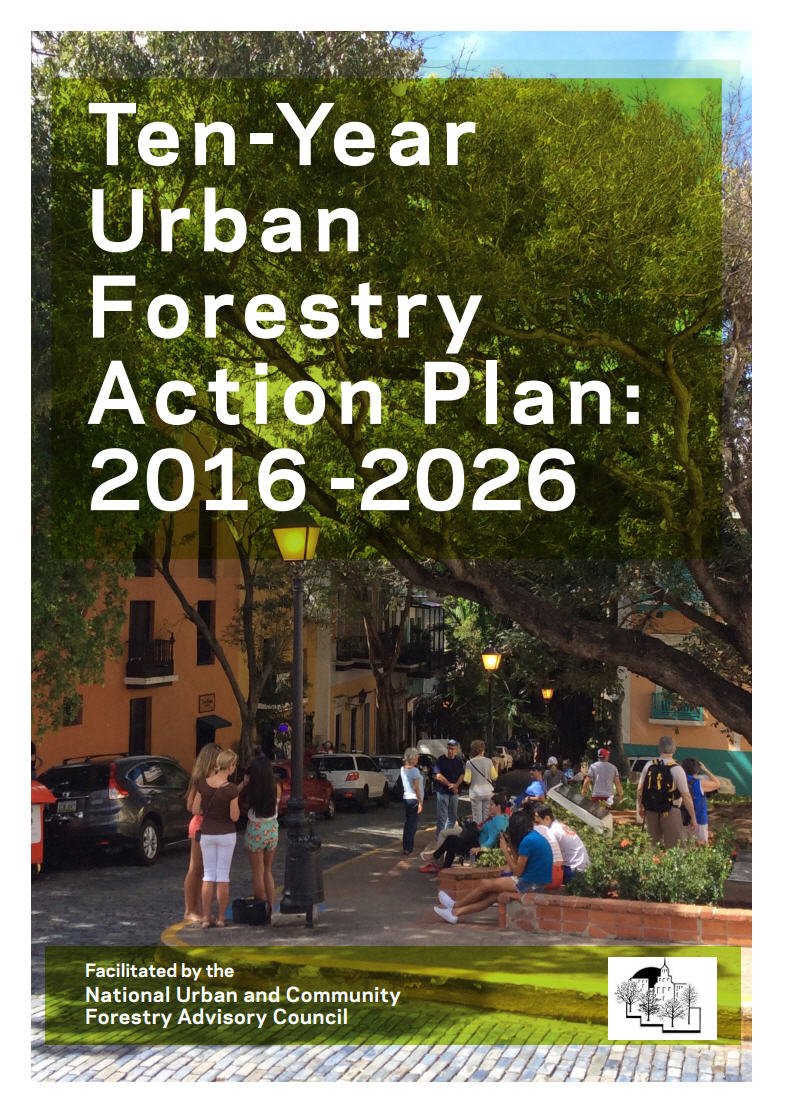
The ten year action plan issued several weeks ago includes progress made over the previous ten years as well as overarching principles, metrics, goals, strategies and steps to guide urban forestry efforts through 2026. It also includes strategies at the local level.

Management of an urban forest begins with a plan predicated on a comprehensive community wide inventory and assessment.  Many communities, such as the one in North Carolina where I have lived for more than a quarter century, have neither.

But across the South now, 649 communities have management plans, an increase of 43% in the past decade compared to 70% nationwide.

Still, less than half of Americans (47%) live in communities that have programs to plant, protect and maintain their urban forests. More than 40% feel much more needs to be done.

The report is “must reading” for people who care about their communities and should be required for anyone holding or running for elected office.

The report provides supporting metrics useful for public information and that will lessen the tendency of some to either dismiss trees merely as just “nice to have” or those who ironically knee jerk about anything environmental as a threat to their way of life.

One cannot read this report without gleaning that a community’s trees and vegetation are indeed important infrastructure.

Thursday, October 15, 2015

Where Durham Dawdles

While one of the most broadly acclaimed communities in America, Durham, NC where I live seems to be dawdling its way to one 15 year-old best practice only in fits and starts.

Before I get to the theory of why that is, as given to me this week by a landscaper friend of mine, let me share why even this practice requires yet another layer of best practice to be truly effective.

While Durham has dawdled, some cities are closing in on fulfilling a goal to plant 1 million new trees.  The movement stems from a goal by then Republican Vice President George Bush in 1991 encouraging Americans to plant 30 million trees.

He was bucking popular members of his party and some Democrats who had the convoluted notion that trees cause pollution.  In some cases they can, but science before and since has clarified that trees are crucial to regulating climate.

Deforestation hawks eventually undermined the initiative but it inspired many cities and states to take up the cause.  Tree hawks eventually stalled state initiatives but many cities forge ahead.

Most notable is New York City which faced much more daunting challenges than others.

Many cities were doomed when they tried to do it on the cheap using only donations and volunteers while failing to factor in ongoing maintenance.

However, NYC began with research in 2006 and 2007 to quantify both its municipal trees as well as the overall tree canopy across all five boroughs.

Then the city set an ambitious goal to plant a million new trees, 70% of which would be on city property such as along streets and right-of-ways, parks and public housing while rallying another 30% planted by homeowners, landlords, apartment complexes, businesses and non-profits.

But what makes the NY program truly stand out is that it not only incorporated caring for the trees into the initiative but worked with nurseries and growers to provide supplies of quality trees that would be sustainable in order to truly optimize long-term benefit.

An effort this strategic is only possible when elected officials and administrators weave it throughout each agency and department as well as understand the need for intensive, unrelenting data-based marketing communications.

The folks at Deep Root have calculated, in part by using i-Tree, that to plant a million trees using the right kind of trees with proper planting and maintenance will generate a $25 billion return over 50 years compared to a minus $3 billion if done improperly.

Only when leaders grasp that trees are a form of infrastructure is this type of commitment likely.

So why are so many other cities such as Durham failing to catch on or mount a concerted, strategic effort such as New York?

My landscaper friend believes it is we all in general, including elected leaders and administrators, even the one-percenters, make the same strategic mistake at home.

Even rich people put $100,000 into landscaping but then balk at paying a $100 a month for maintenance.  These same people also insist on overplanting to create a short term impression and expressing shock when it inevitably must be thinned and then, over time, ages out and must be replaced.

It isn’t just governments that often don’t get it.

While opinion polls in Durham show a high regard for tree canopy, the reality is that we don’t understand nor are we led to understand the true cost of things.

So many taxpayers complained at the $16 million cost of building the Durham Bulls Athletic Park only to be flabbergasted when it costs another $20 million to refresh it after two decades.

Part of the problem is that we, as the general public, don’t get it.

But we also don’t have leaders who deluding themselves don’t educate us.  In fact, many play into our ignorance by fostering resentment of government and taxes without revealing that we will be cutting off our nose to spite our face.

Durham leaders may eventually catch on and fully embrace its coveted tree canopy.  If and when it does, hopefully we do it right and learn from NYC.

Why is he so grumpy, some readers are probably muttering?

Hey, I spent a good share of my heart and soul defending Durham but that never stopped me from shining a light on areas where I believe we must improve.

Tuesday, October 06, 2015

Much More Important Than That

Last spring, after reading one of my posts referencing urban trees as a form of green infrastructure, a friend of mine in high office tried gently to break the news to me.

He emailed, “Local officials or residents generally don’t see trees as what they typically think of as ‘infrastructure.’”  My friend reassured me that “we mostly think of trees as wonderful and beautiful and necessary, but not as infrastructure.”

He’s right, unfortunately.

This reminded me of a hilarious response the editor of the now defunct Business 2.0 gave to me when I tried, in my former role, to explain that Durham and Raleigh are distinct communities and metro areas.

He quipped the oxymoron (contradictory terms appearing in conjunction) that until “Durham is better known,” his magazine would “continue to refer to it as Raleigh.”

No wonder the magazine went out of business in 2007.

Actually, opinion polls have long shown that Durham has nearly the same awareness level as Raleigh even though the latter has the advantage of being memorized as a state capital by nearly all school children.

But the role of the community marketing organization I led at the time was to raise that awareness, especially among prospective visitors for which Durham would be a good fit, while aiding those for whom it wouldn't, to seek alternatives.

Yes, community marketing is not missionary work, but I digress.

Likewise, the general public’s recognition of “green infrastructure” will take time and rely on awareness generated by local governments.

To be fair, it wasn’t until about two decades ago that the term “green infrastructure” began to be used in government circles, although it had been taught as part of planning and administration long before that.

EPA is working hard to further this understanding and I would think that Durham officials will soon catch on.  But more importantly, will they realize their responsibility to educate residents in this regard?

Equally pertinent, will they accept stewardship for not only government-owned trees here but the broader tree canopy?  Will they finally execute a study to quantify that value?

But as Washington Post science journalist, Chris Mooney, suggests, the quantification of ecosystem services (“blending concepts from ecology and economics”) may be missing the even greater benefit of trees and other forms of green infrastructure to public health.

Ecosystem services are things such as provisioning food, regulating services such as water purification, or cultural services such as sense of place or aesthetics.

National Parks, for instance, generate $10 into the economy for every $1 invested by taxpayers, including tourism, but they also pull or sequester $580 million of carbon out of the air annually.

As Mooney did in this week’s column about a proposal by Harvard’s Dr. E.O. Wilson to set aside for our own sake half of the earth’s land area and 70% of the ocean in the form of nature reserves, he often covers research that deepens the connection between health and nature.

I’ve always been healthy but I am arguably healthier now than I’ve been in more than 40 years.  Wherever I’ve lived in Durham over the last 26 of those years, I’ve been surrounded by forests, nowhere more than where I live now.

On the eve after my birthday this past July, new research was published that concluded, “Having 10 more trees in a city block, on average, improves health perception in ways comparable to an increase in annual personal income of $10,000…,” or “being 7 years younger.”

The lots where I split my time, one in Durham and one on a nearby lake each have more than 100 trees alone which obviously contribute to my feeling younger.

Lets see now, research has recently shown that tree cover, not just government-owned trees but the entire tree canopy of a community, has an impact on public health, public works, taxable property values, crime reduction, social services, economic and neighborhood vitality, mental health, air and water quality etc.

Maybe they aren’t a form of infrastructure which is defined as the basics needed for the operation of society.

They are much more important than that.

Thursday, June 11, 2015

The Well Worn Path from Penny-Wise to Pound-Foolish

Recent headlines in my local newspaper reminded me of how ironic one of the challenges was during the four-decade career I concluded more than five years ago.

The way the headline writers convey it, our City Council is divided about whether to endorse health insurance from a locally based corporation or send tax dollars off to a company in Connecticut.

Reading more closely, it is nothing more than jawboning to get a better deal, but whatever the reason, it is sending an unfortunate message to local businesses as well as universities here sure to undermine economic development.

Part of my job in visitor-centric economic and cultural development was one where mission accomplished was ever elusive.

it was challenging enough to remind both public and private sector players that a primary outcome for community destination marketing, a demand-side form of economic development, is to fuel the local business climate and the local tax base.

A corollary often lost even on economic developers on the “supply-side” is that it can be optimized only when local businesses and organizations strategically give preference to using or making purchases from other local businesses.

This has always been economic development 101.

But the reason so many in every sector don’t get it is because of a notion called siloed thinking which structurally permeates even the smallest of organizations.

I’ll use local government as an example but it is applicable to organizations as large as Duke University here, one of the state’s largest employers and even businesses that owe tax credits to their success.

Siloing especially infects the way organizations are structured.

This condition results in revenue streams being severed from how an organization conducts purchasing.

During my career, we trained in how to do economic impact analysis, in part, to help local festivals make a case to local government officials for funding but also to help deflect some in the private sector who always seem bent on “big game hunting” to bring in outside mainstream events instead, diluting sense of place.

But rarely if ever do local government officials or organizations anywhere tie their own procurement to local economic impact.

For example, any decision to ditch a locally based insurer for an out of state competitor should factor in the local property taxes paid by the local corporation, along with induced impact from its locally based payroll.

Also included should be the work-side spending of its commuter payroll, spending with local vendors and of course, the company’s local philanthropy.  Any decision to penny pinch should be informed by an economic impact analysis.

During the near decade I was in Anchorage during the 1980s, both the municipality (merged city and county) and State government would give a percentage preference to local vendors during bids, even if it meant a broker until local capacity could evolve.

During the 1990s, the ImPlan input-output model was made accessible with metrics calibrated for each county in the country.  It is the one we deployed in Durham during my former life, both through consultants and for local stakeholders through trained staff.

Rather than a percentage preference such as Anchorage had long used, it makes it possible to run an economic impact analysis to inform decisions including direct, indirect and induced effects as well as “leakage.”

Still, many organization continue to make “penny-wise and pound-foolish” decisions because siloing prevents them from being strategic when it comes to the local economy.

Unfortunately, it is endemic today across all sector.

It is why I still find myself explaining the importance of “buy local” to economic developers, sense of place to boomer developers and recently the importance of using Tar Heel artists to a state arts official.

Especially ironic is when I have to defend selective and sustainably tree cutting over clear cutting to consulting foresters, because the most accurate economic impact models in use today were first developed for the United States Forest Service.

So how did I get so smart? (smile)

I learned my former craft in the early 1970s from a generation of community destination marketing mentors who reached back before WWII.

I then watched as peers came unmoored from how economic development works, to the point that some even humorously tried to justifying imperial over-reach by arguing that it didn’t matter if the visitor spending they drew occurred in the business climate and tax base they were paid to promote.

Really?

I also saw peers over on the “supply-side” of economic development (recruiting relocating businesses) such as chamber of commerce types forgo the importance of using local vendors and local employees as metrics, to rationalize being able to poach members from other communities.

Siloing makes all of us appear stupid.

In the late 1970s, as the organizations I led as startups grew into adolescence and beyond, I began to study a new discipline of organizational structure designed to overcome the tendency of organizations and teams of individuals to silo.

If they haven’t been thrown out, there will be books I devoured on the topic of organizing like a matrix rather than a hierarchy still on the library shelves of the three DMOs I led over the decades since then until retiring at the end of 2009.

It was a theory put into practice by GE when it developed a new type of plant in Durham to assemble jet engines, just as I arrived here, structured around “teams” rather than the customary assembly line which opened in 1993.

But it was a much more difficult concept to execute in a community destination marketing organization, let alone a city, county or other large employer.  Inertia continued to rule

However, a new book I just read may be a breakthrough.

In Team of Teams, retired four-star general Stanley McChrystal and Chris Fussell, a former Navy Seal who also teamed up to form CrossLead, made the idea of a matrix much more practical and achievable for any type or size of organization.

They also provide a history of how organizations, on purpose, came to be siloed and examples of organizations who have overcome it only to have a new generation of leaders take them back to be siloed.

Team of Teams reminds us that on May 25, 1961, when President John F. Kennedy, less than four months after inauguration, announced to Congress that Americans would land on the moon before the end of the decade, our space program was a disaster.

That all turned around and this was successfully achieved less than eight years later on July 20, 1969  because George Mueller reorganized NASA into a matrix.  But during the 1970s and 1980s, NASA re-siloed, resulting in the Space Shuttle Challenger disaster in 1986.

Despite being well managed and contributing to community accolades, local governments in Durham are and have been heavily siloed for a long time.

An example other than procurement decisions being detached from from revenue streams is the sad state of urban forests.

The strategic approach to urban canopy in planning is undermined by cuts to code enforcement and isolation from urban foresters in general services where they are purposely made non-strategic.

Each of these functions is estranged from public works where trees are as more of a nuisance.

Thus Durham places little priority on green infrastructure and still has no strategic urban forest assessment or management plan of any kind, let alone one that is community-wide like the ones other leading cities began to create and implement nearly three decades ago.

In the meantime, Durham has been losing a net 18,000 trees a year not counting tens of thousands more lost to wasteful clear cutting.  All of this is estranged from local government sustainability and storm water treatment objective elsewhere.

Frustrated?  Eye-rolling?  Overly sensitive?  You aren’t alone as are many who work in local government including some of the brightest and most dedicated people I know.

Problems similar to this are endemic across the county in every sector of the economy.

But local governments can and should set an example because they are in the best place to do so strategically.  There is no better place to begin than by reading Team of Teams: New Rules of Engagement For A Complex World.

Tuesday, June 02, 2015

Discounts that Can Also Spell Doom

I shudder whenever I hear local officials announce there won’t be a property tax increase.

Since nothing is really free, and we, as property owners, are always banking on “quality of place” driving values each year, I am suspicious when someone exclaims that the value of those services stayed stagnant.

I would feel better if these “no tax increase” pronouncements were accompanied by a laundry list of what we’re not going to get next year because of it.

This would hopefully include a list of efficiencies achieved, of course, and a list of deferred maintenance, along with a list of what's being hollowed or starved out as well as a list of the things we should be doing but now won’t due to holding the line.

Of course, we’re to blame, or at least those few souls who go apoplectic whenever there is a change, such as the recent announcement where I live of a $7.50 annual rental fee on optional yard waste roll out carts for those of us who don’t own them.

Unfortunately officials spend far too much time and energy placating this tiny but vocal minority rather than listening to the overall silence among the vast majority of residents.

We all like a discount, such as the one I received at my grocery store on Thursdays for being over age 60.  But what if that discount comes with a steep price, such as lower grade produce?

Then, maybe, not so much.

It also makes them see things tactically rather than strategically, e.g. viewing curb appeal as merely planting a few flowers rather than overall appearance or viewing trees as “nice” but not as “green infrastructure.”

This is why even though it seems to have retained more than so many other places, I am not very optimistic that Durham, North Carolina where I live will do what it takes to preserve what’s left of its sense of place.

The “canary” or sentinel warning of its demise is not its “built” or even its “cultural” aspects, two in the trinity of place-based assets that when woven distinctly give a particular location its overall sense of place.

The early warning of its demise is the way local officials view its tree canopy, the most visible and distinctive element in its “natural” aspect, that completes the trinity.

“Infrastructure,” according to Webster’s Dictionary is “the substructure or underling foundation…on which the continuance and growth of a community or state depends.”

So I refer to this trinity as sense of place infrastructure, and the most fragile component is “green infrastructure.”  Trees, for instance, can convey sense of place without buildings but buildings really can’t without trees and vegetation

This isn’t new.  The term “green infrastructure” has been used in government now for more than two decades and taught in various disciplines, such as planning and public administration, long before that.

It emerged as a tool in management of urban settings some 150 years ago.

Yet it appears some in government still haven’t received the memo.  So a few months ago, the EPA connected the dots by publishing a guide to “Green Infrastructure Opportunities that Arise During Municipal Operations.”

It is written for “old schoolers” who still see infrastructure only as streets, sidewalks, curbs, parking and storm drains as well as sewer and water lines.

It reminds me that when Durham inventoried the status of its buildings not long ago, no one thought to include an assessment of the landscape surrounding each structure, including trees, signaling how endangered this aspect of sense of place is.

It is a myopia currently undermining a proposal to inventory the community’s overall urban forest canopy, by limiting it to just the trees on the property the City, itself, owns rather than a more strategic best practice “ecosystem” approach.

The former is a public works view of urban forest, a dumbed-down misuse of the term.

Urban forestry has been a discipline since the 1960s when it took on an ecological meaning, although its roots go back 100 years earlier.  It came to refer to a community-wide ecosystem in the 1970s.

It was embraced by city planners in the 1980s.  A strategic, community-wide approach was made a priority in 1990 at the Urban Forestry Research Summit.

Cities, including Durham began appointing urban foresters.  Some such as Chicago in the early 1990s took the ecosystem approach and began to develop assessments and urban forest management plans.

A few such as Durham took the less strategic approach and have yet to develop assessments and plans for “city-owned” trees until now, a quarter-century after a more comprehensive approach should have been on its radar and despite clamoring from residents.

Anything is a start, I suppose, but in the meantime, Durham’s ecosystem is losing 18,000 trees a year just to man-made destruction.  That doesn’t count tens of thousands more being clear cut just for pulp or to make shipping pallets.

It suggests a lack of urgency as well as strategic insight that leads me to wonder if Durham’s sense of place is ultimately doomed.

I suspect some in local government are prone to resist the idea of green infrastructure because it isn’t yet a perspective held by residents, but this overlooks local government’s role in community education as part of its role in the stewardship of place.

Infrastructure moved beyond streets and mains in the lexicon of public administration and planning in the early 1990s to incorporate trees and other elements of green infrastructure.

But even many officials who earned degrees more than two decades ago seem to have missed out on the coursework common then regarding green infrastructure.

It would be interesting to know if schools of government such as the one at nearby UNC-Chapel Hill teach this concept of inventory to newly elected public officials during orientation.

Not everything “green” is considered green infrastructure.  For instance, some parks, such as Rockwood down the hill from where we live, are while many others aren’t.

Of course trees are not the only sure-fire elements of green infrastructure.  It also includes constructed or restored wetlands, storm water initiatives such as rain gardens, green roofs and walls, permeable pavements, etc.

Trees are symbolic of green infrastructure because they create windbreaks and shade to reduce energy costs, eliminate air pollution, sequester carbon, slow storm run-off and erosion, increase property values, curb crime including domestic abuse, defer street maintenance costs and reduce healthcare costs.

The aesthetic and other psychological benefits - such as vitality - that they bring to entire neighborhoods and business districts as well as their economic development appeal should be enough to justify the preservation and fostering of urban forests.

But it is their role as green infrastructure that should guarantee them a much higher priority in cities including savings of billions of dollars over traditional infrastructure.

Frankly, any community that fails to safeguard them is more than likely doomed to surrender overall sense of place.

Monday, April 06, 2015

Three Reasons Anecdotes Often Distort Reports

Probably as an attempt to make an already interesting chart in a report I read last week seem even more interesting, someone penciled in the names of a few events.

The notations seemed to suggest anecdotal explanations for a change over last year in passenger growth at the airport jointly owned by Durham, North Carolina, the community where I live.

This is often done in reports made for general consumption either through a lack of understanding of data analysis, or as I will show later, due to the discomfort human beings have with randomness.

Some of the notations in the airport’s report made sense, such as when a significant number of flights were cancelled over the course of several days due to bad weather.

Some made less sense such as when a few direct west coast flights were added.

And notations attributing increases to community events made no sense at all.

While the events were significant to the communities where they were held and surely filled some airline seats, it is questionable that they were each the reason for a bump in traffic for two months.

If they were, the increase in those months would be reflected by a drop in the month following.  Instead the percentage of increase continued without the events.

An “inconvenient truth” for communities hosting the Super Bowl, the mother of all mega-events, is that sales tax collected across those dates varies little from the year prior and the year after.

There are at least three reasons mistakes such as these occur.

Often it is deliberately done as a community relations gesture to please a few stakeholders or even more often, to help justify the hyperbole they have generated around an event. 

Humorously, one community event proclaimed one year that airlines would add flights due to an event to be held shortly after a new terminal was set to open.

The news media is complicit in this hyperbole or else a follow up story would have noted that neither the number of flights nor passenger load factors increased, signaling that the event may have created displacement which would have also lessened its overall economic impact.

Seth Godin recently wrote, “Human-beings are story-making engines, and when we’re confronted with randomness, we make up an egocentric version of what happened and it involves us.”

Applicable to the explanations penciled on that chart I read, he continues with, “Here’s the truth.  There is no reason.  That’s why we define it as random.”

More on randomness as it involves analysis of data later.

I saw the fascination people have with anecdotes during some of my board meetings in my former life in community destination marketing.

Often after seeing a change in a metric that had been generated such as aggregating and comparing hotel occupancies community-wide, a member, seeking an anecdote-fix, would inevitably turn to another who operated a hotel and ask “Is that what you saw?”

Others would leap to conclusions that it was due to a major event,  even though it would take an event many times larger or a phenomenal increase in events overall that month to move that particular needle, and by doing so, would create displacement.

Of course, even in communities that also had access to this data, a community-destination organization (DMO) may be complicit if it is one of those places that subsidizes events to be held there.

Even where they should know better, this can often happen because organizations in a community want to please those excited by the event, but more often it is because they are careless with data analysis or just want to sell sponsorships.

This has happened in the last few weeks as communities hosted NCAA basketball playoff games across the country.  Often, to calculate impact, they would factor in hotels rooms used without deducting for the percentage that would have been filled anyway.

Or they would extrapolate spending estimates without factoring in the number of day-trip vs. overnight attendees and/or without factoring attrition as teams lost and fans returned home when it was too late to retrieve visitors who had been displaced by the event.

Communities are often guilty of grossing up estimates without netting out displacement and leakage when displacement pushes the impact off into nearby communities, or worse, crowds out the flow of air travelers who would have visited those communities for other purposes.

News reporters become enablers either out of enthusiasm for events or because they do not understand the nature of economic impact, unwittingly misleading officials in other communities to go down the same path without rationale based on good analytics.

The reason misattribution of impact occurs involves data analysis itself.  A white paper entitled “The 5 Common Mistakes People Make In the Name of Statistical Analysis,” is available from Mu Sigma, one of the world’s largest decision sciences and analytics firms.

One is “extracting meaning out of randomness.”  Data analysis is the process of looking for meaningful patterns.  This process involves isolating patterns from “noise” which in statistics refers to a “random phenomena” that is “beyond the control of your organization or even known external factors.”

So the penciling on that chart might be a case of what data analysts call the “Problem of Overfitting.”

This is just one observation from an otherwise excellent report that if harvested by any of the five dozen destination communities pushing and pulling traffic through the airport will be immensely valuable, especially to community-destination marketing organizations.

More than half of the airport enplanements are visitor-related.  The report breaks down the top market areas for 2014 including 610 passengers daily via the airport in Boston, 590 via New York-LaGuardia and another 330 via New York-Kennedy.

Those new flights to LA and San Francisco added to non-direct flights carried 594, probably not enough to make a dent where penciled in as the reason for a bump in numbers overall a year ago.

More than 9.5 million passengers transit through RDU International Airport during the course of a year.  That’s about 26,000 a day, 13,000 of whom are visitors either arriving or returning home.

Even for Durham which draws 33% of the visitors who arrive via RDU, a greater proportion than any other city and the equal of Wake County which includes Raleigh, air travelers represent only 8% of visitors traveling from at least 50 miles away, a point shy of the national average and double that of North Carolina.

But from the time I took my first International flight in 1967 as a college kid and when I retired in 2009 after a four-decade career in community destination marketing, the metric for passenger revenue miles worldwide has increased by 18 times.

But the metric for global air cargo miles had increased by more than 22 times.

Of just as much significance to North Carolina's brand though is that RDU represents 5,000 acres, including impeccably maintained natural areas along roadways maintains.

But half is open space unusable for any future aviation needs.

There will be incredible pressure, unfortunately some of it created by airport stewards, to convert much of that land from open space, trees, streams and park-like land into development and impervious surface instead.

Hopefully, any thinking in that direction will factor in the ecosystem services provided by that open space, giving as much consideration for green infrastructure as tarmac.

Very few cities encompass an airport.  Instead, most airports, such as RDU are surrounded by numerous, distinct cities.

The surrounding cities draw travelers through the airport doubling the size justified by their collective populations.  But on average, airports also distribute a third of the value of all of the products we consume.

RDU is at the center of an Aerotropolis, a term coined by Dr. John Kasarda who heads the Center for Air Commerce at UNC-Chapel Hill.

As such, RDU is well advised to remember that it is also the town square for this vast, multi-city Aerotropolis
Thursday, February 12, 2015

A Step Forward For Durham Trees, Maybe

My long ago adopted hometown of Durham, North Carolina justifiably prides itself on consistently garnering what is very likely the broadest range of accolades for a community of any size while also managing to cling to its sense of place.

So it has always been puzzling when officials let the community fall so far behind in areas near and dear, according to opinion polls, to Durham residents.

I suppose it is because thirty angry people haven’t shown up to meetings in orange shirts waving pitchforks (smile.)

There is an unfortunate tendency among elected bodies and executives at every level now to only move to action based on a vocal (or email) demonstration of anger (or at the request of special interests) rather than thinking strategically about what is best for everyone in the long term.

See for yourself.  Ask officials why they haven’t addressed something and you’ll be amazed how often you hear that it is because no one has brought it up or been upset about it.

One of the three areas where Durham has uncharacteristically fallen so far behind despite sentiment from a majority of residents just took the beginning of what could be a big step forward last month thanks to as request by the City Council initiated by Council member Steve Schewel.

The Joint City-County Environmental Affairs Board (EAB) issued a set of recommendations a few weeks ago that is consistent with earlier legislative priorities submitted by the Durham Appearance Advocacy Group, an independent coalition.

The report was assembled very quickly and under the circumstances is well crafted.  Though certainly not encyclopedic in scope, it is somewhat comprehensive in breadth.

From here the recommendations will hopefully be discussed in strategic meetings and then with any luck make it into the budget.  Frankly, I am heartened just to see it get attention.

I am puzzled, though, at to why the report deals only with the City portion of the tree canopy rather than county-wide as the joint city-county mandate of the EAB would have suggested.

Because it included a number, several news reports I read seemed to focus only on a recommendation that City government increase tree planting to 1,680 trees annually on its own property over the next 20 years, just to keep pace.

But that amount wouldn’t be enough to replace the trees along a tenth of a mile of the street where I live or to replace a day and half worth of the trees sacrificed each year to development here.

My calculated guess, based not only on information received from urban forestry but the average number of acres transformed each day to impervious surface,is that county-wide Durham should be planting more in the neighborhood of 8,000 to 9,000 trees a year.

But the number needed can be reconciled by implementing the first recommendation in the report, if performed holistically and according to best practices.

This seemingly far more strategic recommendation in the report is that the City adopt a proactive Urban Forest Master Plan including a city-wide inventory.

But then it seems the wording becomes contradictory to best practices for tree inventories and master plans of this type when city-wide and public property are used in the same sentence.

This inconsistent wording is reflective of differences of opinion among city administrators deep in the department responsible for urban forestry about whether to follow best practices or dumb down expectations to address only city property.

I suspect the primary author knew that inventories and master plans of this type deal with the entire tree canopy across every type of property but that a reviewer somewhere in the chain plopped in “public property” as a means to dumb down expectations.

It has been observed that this difference of opinion regarding scope among bureaucrats may be the chief reason Durham’s urban forest infrastructure has fallen into such neglect over the years.

Whether Durham finally addresses this neglect may come down to City Council members familiar with this critical difference and willing to be strategic.

Urban forestry experts at the highest level are clear:

“Comprehensive urban forest management considers all trees and associated elements across the entire jurisdiction to adequately address a heterogeneous landscape held by numerous land owners. A first step in developing a proper management plan is to assess the current composition and distribution of a community’s trees…”

The report also lists a few communities as best practices, chosen for proximity, to preempt comments such as “Durham isn’t (fill in the blank)” if truly best practice communities had been noted.

While residents overwhelmingly believe Durham is “where great things happen,” we must always remember that two our of every three people working here - including those working in local government - don’t live here, making it seem as though Durham doesn’t believe in itself or expects less than “great things.”

I say, “Bless their hearts,” to use a southern euphemism for “How pathetic!” or worse (smile.)

It is also very puzzling that the report deals only with the city, rather than the entire single-city county of Durham, the purview of the joint EAB which issued the report.

It is hard to believe the nature of the request led to a less than holistic treatment.  Urban forest exists in the county even if it doesn’t have an urban forester per se and urban forestry experts are clear that management plans need to address both the city and county.

Hopefully, members of the City Council as well as senior management will not just skim the report but will go as far as to read between the lines and reach out to include the Board of County Commissioners and County manager in the discussions.

A good inventory and master plan such as the assessment performed for Wilmington, Delaware and the surrounding county of New Castle will provide local governments, including land-use planners as well as private property owners and developers, tools such as:

  • A baseline for the number and age of trees and the percentage of each species as well as their overall health and management needs to minimize risk.
  • In-depth, ground-up augmentation that can dovetail with the more superficial, top-down satellite measures of just tree canopy, including the intriguing EPA approach for which Durham is currently a beta.
  • Quantification of the overall value of the urban forest and overall green infrastructure in a variety of ways including carbon storage, air and water purification and climate control, all calibrated to local climate and other variables.
  • Pinpointed areas for tree retention and reforestation.
  • Optimization of tree ordinances and planning decisions.
  • Information to inform residential, landowner and developer decisions as well as guide urban forestry maintenance.

As Durham has done recently with other types of neglected infrastructure, the only advantage of coming from so far down is the opportunity to truly leap frog to becoming a best practice.

One resident has even recommended a break on property taxes for upkeep and improvement of tree canopy on private property.

Friday, November 07, 2014

The Greening of Revitalization

Inertia may be the reason Durham, North Carolina, where I live, was able to dodge complete destruction during the two-decade era of so-called Urban Renewal following WWII.

This occurred to me while viewing a screening of a short but impeccable new documentary about the adaptive reuse of the old Lucky Strike factory in Durham which began ten years ago.

In December, it will be aired on WRAL, a television station with the same owner and then hopefully it will be online as a must-see.

It wasn’t the first or even the largest of the complexes now emblematic of the commercial, “built” portion of Durham’s sense of place but it may be the most impeccable job ever done anywhere.

Brightleaf Square had been brought back to life as a template twenty years earlier, followed by an early phase of West Village, historic buildings part of an even larger complex nearby, though not under one roof.

But the fact that these wonderful buildings were able to survive the indiscriminate Urban Renewal movement at all is probably because they were still operational as factories and warehouses during the period between 1949 and 1979 which was so devastating across the country to sense of place.

The movement’s intended targets were “brownfields,” areas of abandoned industrial blight.  But instead it became a virtual “wrecking ball, in the hands of officials pushed by developers bent on destruction of landmarks including entire city blocks and priceless ethnic neighborhoods.

Even as a remarkable, overlapping 15 year span of renewed concern for preservation of “sense of place” kicked off in 1965 with the Highway Beautification Act, Urban Renewal had just begun to reach down and hollow out mid-sized communities such as Durham.

The HBA was intended for scenic preservation and restoration of trees including scenic views while limiting billboards to areas already blighted and zoned commercial at the time of passage.

This resurgence of sense of place preservation also included the National Historic Registry, protection of environmental assets such as pure water, clean air and endangered species and Supreme Court validation of preservation of place as a legitimate role of government.

The capstone was an incredible essay in the early 1980s anointing the overarching importance of sense of place.

By then there had been “sense of place revolts” in communities such as Durham, an uprising hastening the end of Urban Renewal and ushering in the era of adaptive reuse and gentrification.

Maybe not by coincidence, the term gentrification was first coined more than fifty years ago at the dawn of that renewed concern for sense of place by urban sociologist Ruth Glass in her book entitled London: Aspects of Change.

There are many different forms of gentrification, even tourism gentrification, but the term essentially refers to adaptive reuse or redevelopment of urban spaces including ripple effects such that it displaces working class people in exchange for middle and upper classes.

It is the two-edge sword of gentrification to sense of place.  On one hand it preserves some aspects while on the other hollowing it out, a consequence as destructive practices of Urban Renewal.  But It isn’t just people who get displaced.

In his study of two gentrified neighborhoods from the perspective of those displaced entitled There Goes The ‘Hood, Dr. Lance Freeman describes that it is also community values and cultural norms, even more temporal aspects of sense of place, that are at risk.

I arrived in Durham to jump start the community’s first official community marketing organization fewer than 24 months after American Tobacco shuttered its 14-16 acre factory in Durham after more than 110 years of operation.

The second of two failed attempts at its adaptive reuse was underway.

The documentary focuses on the third which succeeded in part because community marketing had lowered barriers to financing and tenancy by turning around negative perceptions fostered in neighboring communities.

But even the subsequent investment of more than $100 million dollars by local governments, as well as government historic tax credits and and new market tax credits which were invested would not have tipped it into success without Duke University relocating resources in Durham to serve as an anchor.

But the outcome is also the result of extraordinary developers who with grit and determination focused on resurrecting and creating sense of place.  Even documentaries can only tell part of a story.

Today, entrepreneurial spirit is noted as a result, a value that can be traced historically back through time here to Durham’s very roots.

But the idea of entrepreneurialism as an outcome from gentrification also traces back to 1989 and a paper published by Dr. David Harvey, the author of Spaces of Hope, during the year of that founding of Durham’s community marketing agency.

But an aspect that should have dawned on me decades before reading a newly published history is the relationship of adaptive reuse and gentrification with urban open and green space including green infrastructure.

Spokane, where I began my career took a very different approach to Urban Renewal than Durham where I finished up five years ago and still live.

And we are reminded by an incredibly insightful doctoral dissertation by a BYU alumnus of mine that it didn’t begin there during my tenure with Expo ‘74, an environmental World’s Fair.

A professor now at Weber State, Dr. Jeremy Bryson wrote his dissertation is entitled, The Nature of Gentrification, using a play on the word “nature.”

The transformation in heart of Spokane actually dates to a 1907 with a report by the Olmsted brothers which was then tabled until the 1950s when community leaders sensed Spokane’s downtown too was losing steam and fear had set in that a decline in downtown property values would follow.

In the 1960s, Spokane voters turned down bonds until business leaders caught on that what resonated was not rescuing downtown but cleaning up the riverfront and removing blight that obscured the 140’ falls and islands at the heart of the community.

But voters were skeptical of downtown property owners and a third bond fell 3 percentage points short of the 60% needed for approval.

Unlike Durham which looked to visiting taxpayers, who don’t get to vote, to subsidize the public sector investments in American Tobacco, Spokane businesses voluntarily shouldered a business and occupation tax on their profits.

Still, the effort ended up displacing not only the still-operational railroads blighting the waterfront but through a gentrification ripple effect, also hundreds of low income people in an area called Skid Road.

Researchers in the 1960s and 1970s began quantifying the value or green space to real estate.  By the 1980s and 1990s, the models showed an escalation in the value added by scenic views such as green infrastructure and savvy elected officials began taking notice of the return on investment in tax revenues.

As early as 1984, Durham officials banned billboards in part to increase values followed by placing a scenic overlay over Interstate 40.  By the early 1990s, officials in many cities began to quantify the contribution to tax revenues from scenery.

Evolving a community that is true to its values, sensitive to sense of place, including being affordable for a diverse spectrum of residents will continue to be worthy of love.

Residents and officials should be wary of new development that promises jobs, fuels the local business climate and broadens the local tax base at the expense of deteriorating its sense of place or by treating it merely as an amenity for formula development.

Never be afraid to say no.

Wednesday, October 15, 2014

Reconnecting the Dots

A neighbor of mine lives along one of Durham’s most beautiful parklands but fails to see the irony whenever he complains that the city should focus less on greenways and more on funding hard services such as police.

He would be well advised to read a book, published earlier this year by a friend of mine, entitled Conservation Communities: Creating Value with Nature, Open Space, and Agriculture.

In part it details the type of development now underway in Durham by a young entrepreneur I met just I was retiring called Wetrock Farm.  Since we met he graduated from Duke and completed an MBA at the University of Miami before returning to the Bull City.

Durham is a single-city county by the same name, the fourth largest city in North Carolina and located in the 17th smallest county by land area.

Making this a tight fit is that the northern third of the county has been set aside in watershed.  Restricted this forms a sort of natural urban growth boundary but also guarantees that this part of Durham’s sense of place will remain rural and open.

Wetrock will exist in what Durham has set aside as “conservation subdivisions” (see article 6.2.4 in District Intensity Standards,) a best practice as I will describe later in this essay that belies a paradoxical failure to connect the dots overall.

These are areas designed to provide clustering of houses and structures in a way that preserves wetlands, streams, woodlands, wildlife habitat, historic and archeological sites as well as “authenticity” and sense of place.

Specifically, Wetrock Farm will develop 230 acres into 141 home sites with 2/3rds of the land preserved as forest.  It will also incorporate trails and a working farm with 140 acres permanently protected by a conservation easement.

All of this will be just 10 miles from amenities such as Duke University and the City Center District, 12 miles from North Carolina Central University and only 14 miles from Research Triangle Park just on the other side of Downtown.

Too bad this rationale wasn’t applied to every neighborhoods here as they began to take shape a hundred years ago.  In fact, even business districts such as downtowns.

The book Conservation Communities uses real estate research to quantify the dividends communities reap from developments such as Wetrock Farm:

    • Environmentally sensitive areas are protected along with water quality and urban forest canopy.
    • Property owners reap a dividend in the form of higher property values.
    • Local governments reaps a dividend in increased property taxes used to fund overall community services such as public safety.

Up through the 1970s and into the 1980s local government officials across the nation used to do a much better job of breaking dividends such as this down for residents and connecting the dots for folks like my neighbor.

Then it seems they suddenly stopped connecting the dots for themselves as well as witnessed somewhere in the first decade of my now-concluded career.

It is also how the insanity of “front end” subsidies, oh I mean incentives were born, another word for “legalized” panhandling.

In Durham for example they began very slowly hollowing out funds for basic community upkeep which in turn soon began to degrade curb appeal, which dampened property values, which slowed tax revenue, which resulted in more hollowing until a vicious cycle took root.

Of course, the intent was to restore upkeep before anyone noticed but gradually it became the new norm and then one day local governments began to whine that basic maintenance and upkeep of appearances was somehow an unfair burden.

Of course, this wasn’t a strategic decision.

If I hadn’t been a witness, it was easily gleaned from books such as The United States of Ambition that moves such as this take shape when politicians began to sense that “keeping people happy” by doling out these funds instead was far more rewarding and fun than upkeep.

But this has contributed to creation of a feedback loop where residents are frustrated and resistant to paying taxes (in reality only a tiny but vocal minority) so officials try to appease them by holding the line.

This, in turn, forced the year-to-year absorption of increases to the costs of living such as goods and services which means budgets for maintenance and upkeep get “rabbit-holed” into a downward spiral, which undermines resident confidence.

It is how communities that are otherwise seemingly vibrant and “cool” on the surface, begin to slowly and imperceptibly degrade at the margins before falling again into a cycle of decay.

Now instead of running local government like a business with 5% of budgets set aside for maintenance and upkeep along roadsides, streams and other commons, local officials are more likely to feel put-upon by this responsibility.

Soon they resort to panhandling businesses and volunteers to get by never realizing the resentment this creates because residents and businesses then silently fume because upkeep is something they feel they already shoulder in property taxers.

It has been this way in Durham for nearly three decades.  Even the increasingly depleted news media seems to have bought into this feedback loop rather than shining a light on its absurdity.

As a good friend who is a university executive mumbled under his breath, on a walk one day, when I noted a few years that had been the exception, “it won’t be enough to reverse that dysfunction has become the default.”

But this paradigm is not one in which Durham is unique.

To paraphrase the legendary “outlaw” of my time, Waylon Jennings, a fellow stoic who wrote in 1978 just before this all began, “We’ve always been crazy but its keep us from going insane.”

It seems so thoroughly embedded in the psyche of futility common among nearly all public administration professionals now that they probably never knew it was any other way.

Sadly, so many of those elected to shift the paradigm seem converted instead within a few weeks of being sworn in.

It may be left to Millennials and social entrepreneurs like the young developer of Wetrock to reconnect the dots and return us to true sanity.

In the meantime, I swear to do everything I can to never be an enabler.

Monday, July 07, 2014

Early Insight Into the Economic Value of Pathways

More than 15 years ago, just before Durham, North Carolina opened the first 3.2 miles of the American Tobacco Trail, part of a 186-mile trail system community-wide, health economists at the CDC were busy studying/quantifying any relationship to healthcare costs.

Back then, the cost of healthcare per capita as a percentage of America’s economy had multiplied to 14 times what it was in 1970, a few years before the CDC had first employed economists to study the decisions people make related to health.

It had doubled from a decade before and quadrupled since 1980.  Policy makers were desperate to find links to behavioral solutions.  Dr. Guijing Wang, a CDC economist, was leading a team investigating any possible cost benefit from trails.

The U.S. Centers for Disease Control and Prevention (CDC) had been formed in 1946 in Atlanta after government scientists had so successfully curbed malaria in 13 southern states during WWII, especially around military training bases.

By 1950, while CDC researchers were testing early versions of a Polio vaccine, a disease then crippling 35,000 people a year, a remarkable insight occurred due west of the late President Roosevelt’s retreat in Warm Springs (he had been struck with the disease when he was age 39.)

Charlie Fraser, newly graduated from the University of Georgia, was walking the pines on Hilton Head Island in that southern most tip of South Carolina while working there one summer.

Before heading off to Yale Law School, he persuaded his father, who with his partners there had begun to timber the Island acquired the year before, to only selectively cut a strand near the southern shoreline for an even greater return.

His father, a National Guard General and veteran of both World Wars, agreed.  After practicing law and a stint in the Air Force, Charlie returned in 1955 with a master plan for a development.

His father’s banker-partners balked, so Charlie persuaded him to restructure the partnership and give him a note on the tip of the island.  Thus Sea Plantation was born, followed in 1970 by Hilton Head Plantation on the north end of the island.

In the fall of 2001, Charlie and his wife relocated to the Appalachian Mountains near Brevard, North Carolina, by the entrance to Pisgah National Forest, one of the first in the east.

It is possible he had read a study by the National Association of Realtors the year before validating his mid-1950s vision before a boat explosion took his life that December.

According to the survey, nearly 6-in-10 homebuyers would be more likely to purchase close to green space and pay more near a park or protected area, validating that Fraser made a good decision in setting aside a fourth in open space.

The survey  also showed that 25 times more people use pathway systems than golf, 10 times more than those who use swimming pools, and more than those using parks and playgrounds.

Prescient, Charlie had laced his developments with what he called “leisure ways,” away from roadways, and then encouraged other developers to follow his lead.  Eventually, a town was founded so it could pursue grants for more trails.

A few months after he was gone, CDC economists published their findings.  Every $1 in trail investment leads to $3 in reduced healthcare costs.

Charles Fraser would have smiled and nodded affirmative.  He had long argued that people came to the island much more for nature than golf.  His genius was an intrinsic grasp of how to nurture authenticity.

A sea change in public opinion was taking place as those studies quantifying the ROI from trails and pathways was released.  Between 2000 and 2008, surveys showed American homebuyer preferences for traditional, walk able neighborhoods tripled to 75%.

The 2013 Home Features Survey for the National Association of Realtors shows that nearly a third of potential homebuyers would pay more for a wooded lot with many trees, double the percentage seeking an open lot with few trees.

The percentage preferring trees is nearly the equal to those seeking a water view.  It is why in the late 1980s, a Durham developer supported a scenic overlay that the community placed over I-40 as it crosses through here, even though he sacrificed $2 million dollars at today’s values.

So why then have so many developers and policy makers seemed so eager to desecrate the things Charles Fraser understood were more valuable than gold?

Sunset Beach in North Carolina is another example dating back to the mid-1950s when Fraser shaped Sea Pines, but with the opposite outcome.

Sunset Beach development is laid out like many coastal areas were at the time.  Why did the coastal developers refuse, when it comes to nature, to let “well enough alone” as we say in the North Carolina?

Partly because they weren’t listening, and partly it was about money, but probably not what you think.

The line between North and South Carolina is being resurveyed.  There are best practices on both sides of the line with the nod until recently going to NC.

But when it comes to coastal developments, we have far too many that emulate the tangle of Myrtle Beach and not enough that emulate Fraser’s on Hilton Head Island.

By talking to coastal developers back then, Charlie Fraser learned what they would do differently.  Lining homes up shoulder to shoulder  destroyed the value of interior lots.

He also learned they would have left the land as natural as possible and set more aside in open space as well as instituted design guidelines, something those whining to our State Legislature today still haven’t learned.

Visionaries like Charlie Fraser inform their insight not from those who whine about the burdens of stewardship but by listening to those who complain about what they would have done differently.

Policy-makers are better advised to study an author who holds the Charles E. Fraser Chair on Sustainability and Environmental Policy at the Urban Land Institute such as his new book entitled Conservation Communities: Creating Value with Nature, Open Space, and Agriculture.

Maybe the difference in sensibilities among developers can be explained by two new exhibits under development at the 84-acre Museum of Life and Science in Durham.

Hideaway Woods will be a two-acre, forested learning environment with tree houses, a flowing streambed, and hollowed out tree trunks, where young people can do what people my age did every day around our homes but with their parents perched above them on an observation deck.

Nearby will be Earth Moves, a one-acre place where young people can blast away with high pressure hoses to create mini-landslides, use a conveyer to build huge mounds, dig with a backhoe, feel an earthquake and observe groundwater etc.

I know – it’s sad that kids now have go to a museums to have permission to do these things, but given obsessive helicopter parents, it’s  better there than not at all.

Such play not only broadens perspective but enhances essential workplace skills, something sports alone can’t provide.

It occurs to me though, that while some developers had a healthy mix of playscapes such as this, some apparently came away with too much time on what a forester friend of mine calls “mechanized assets.”

To make sure we raise more Charles Fraser’s we need to make “Hideaway Woods” a prerequisite for any time spent in “Earth Moves.”

It’s a good thing the museum has strategically ensured that kids come to “Hideaway Woods” first (smile.)

Monday, June 30, 2014

Keeping it Real - Green is the Key to Sense of Place

The science is clear about the importance of green infrastructure.  It supports the Durham (North Carolina) City Council’s recent move to dedicate a half-cent of property tax for partial maintenance of a tiny fraction.

It was an important step but not nearly strategic enough.

Oh, it is very strategic in execution.  It will fund 12 new FTE’s (the equivalent of full time workers) to keep parks and trails in better repair, maintain clean bathrooms, keep the turf mowed (in most cases weeds,) and maintain basketball goals and ball fields in better condition.

The plan also stipulates inter-agency coordination and defines performance metrics.

On the down side, it neglects the vast majority of green infrastructure, areas even more at risk, such as urban forests.

At the same time, officials quietly axed a popular and effective summer youth litter patrol.  Why?  The grant wasn’t renewed.

Durham, like a lot of communities in the years after I first moved here, did this with the grant-inspired Durham Service Corps.  But they don’t really get what grants are for.

They aren’t intended to subsidize operations but to momentarily leverage innovations until grantee communities can make their capacity sustainable.

The problem is not only that what the City Council just did for parks and trails is woefully insufficient, but the angst by which it was forged will likely mean that expectations will be as though it were.

Rather than serve to pilot strategic scalability, far too often officials everywhere wearily turn instead to the next crises.

To be truly strategic, a move such as Durham’s for parks and trails should have comprehensively addressed overall green infrastructure as an overarching strategy (a means to spearhead and achieve many others.)

Green infrastructure, including upkeep, is correlated scientifically to:

  • Reduce crime (especially domestic violence,)
  • Improve public and mental health outcomes,
  • Invigorate neighborhoods,
  • Reduce homeowner costs and street maintenance,
  • Develop and foster workplace skills such as executive function skills,
  • Engage civic participation and organizational citizenship
  • Develop the economy from both supply and demand sides,
  • Improve curb appeal/property values, and more.

Strategic mindset, unfortunately, isn’t a requirement to run for office, although it should be for governing.  Nor is this mindset sufficiently found or exercised enough by day-to-day public servants or administrators.

This oxygen becomes even thinner at higher levels of government.

To put what the City Council did in perspective, this new tax will generate $1.2 million annually to improve one tiny corner of green infrastructure, a fifth or sixth of what local governments spend each year related to the ten-year-old American Tobacco Complex, revealed by recent news reports.

Both are key, the former strategic and the latter tactical, to retaining Durham’s status among the fewer than 1-in-3 places still considered “real and authentic.”

This core sense of place asset correlates with appeal to talent, resident passion and engagement, relocating and expanding business and visitation but belies how quickly it is eroding.

Historic and natural or green infrastructure rank highest in perception as real and authentic, according to national surveys.

Even among those drawn to attractions and entertainment - sports, performing arts (especially musical theater,) generic events and other amusements and fantasies rank least as contributing to “authentic.”

The nationwide study was conducted by PGAV Destinations which has developed or revitalized attractions visited by 75 million people each year.

When it comes to sense of place appeal, it can be both/and but as in wine parlance, always historic/natural character forward.

To get a sense of how determined officials are to keeping our community “real and authentic” or falling vulnerable to surrendering sense of place, follow the money.

Lets hope the long overdue attention given to to even a fraction of its even more crucial green infrastructure is more than a “one off.”

Thursday, June 05, 2014

Trees, Mental Outlook and Personality Disorders

A report released in Durham, North Carolina last year is often misinterpreted because the full story is just too jarring.

It notes that Durham is set to soon lose 13,000 of its hallmark street trees as they age out or finally surrender to butchering due to  anachronistic power lines.

The figure has occasionally been used as if this includes all urban canopy loss but it doesn’t come close.

Durham loses 18,000 to 36,000 trees on average every month to development.  That figure comes from taking the average number of acres per day developed over the last three decades and multiplying it by what urban forest researchers estimate as the number trees per acre.

Who cares, right?  Developers are sure to curb this desecration because research has repeatedly demonstrated the value of tree retention to home values, parking lots and commercial values, right?

Unfortunately, if some special interests have their way in the regressive-leaning state legislature here and tree ordinances are outlawed, trees may soon be something we only see in tree museums, otherwise known as public parks.

Speaking of mental illness, a recently published longitudinal study shows the remarkable ameliorating and lasting effect that more green infrastructure has on people with depressive disorders by looking at people who relocated to both more and less green areas.

The impact when people moved to a greener urban area with more trees, parks and greenways was that they experienced an immediate improvement that is sustained over the three years of the study.

Just one more justification for the societal value of tree conservation.

A similar boost occurs with marriage and other life changes, of course, but according to studies, that rapidly dissipates.  What makes green infrastructure so different is that the boost is sustainable over a much longer span of time if not permanently.

One of the tree conservation requirements a few state legislators want to outlaw are those that provide near-road buffers and screens.  An overview of their benefits was published recently,  co-authored by Dr. Rich Baldauf, a scientist doing research here in Durham.

Some in the legislature seem to only listen to whiners, unaware that the far greater number now known as “low impact” developers are far more successful because instead of whining, these developers, architects and site planners embrace and exceed these local green infrastructure conservation ordinances.

The 16-year old movement exploded more than a decade ago after a  case study was conducted on two developments south of Puyallup, Washington (southeast of Tacoma) comparing conventional development to “low impact” development” (LID.)

The LID approach saved over 20% on the cost of development while maintaining project density, reduced the size of storm retention structures and the need for eliminating catchments while preserving 62% of the site in open and green space, and lastly, achieved “zero” effective impervious surface.

One has to be pretty far along the scale for narcissism to be cool to the negative impact that wantonly sacrificing natural infrastructure creates on millions of other people.

Of course, having been a CEO for thirty-four year means that I, too, fall further along that measure than the general population.  So do politicians.

But you can spot those further up along the scale because they resist taking in new information, such as this essay, especially any information that is contrary to their prejudice.

But a new study shows that their low empathy for others “is not an inability or even disability,” it just “is not their default” response.  That their actions harm millions won’t break through that barrier.

As reviewed last Friday by Tom Jacobs in Pacific Standard – The Science of Society, the study sheds light on why some lawmakers here find empathy with one or two individuals who come to them with an isolated grievance, then seem to jump to universal solutions that instead harm millions.

Harboring petty grievances themselves, many elected officials seem to find it easier to accept anecdotal perspectives whenever presented with them.

The secret then is to help these policy makers take a more universal perspective.  Unfortunately, perspective-taking is one of the seven essential skills learned in childhood but far more difficult to grasp at later stages.

This may also be why Moral Mondays get under their skin.  The demonstrations put individual faces and stories to the large numbers of North Carolinians their actions harm.

Wednesday, April 23, 2014

The Meridian of My DNA

My western heritage is sprinkled along settlements my ancestors created in the 1800s down the length of a route that would become the 1,100 mile U.S. 89, a “Blue Highway” stretching from Montana to Arizona.

The “Ponderosa belt,” as I call it for the dominant species of pine tree found along its length, stretches from the cusp of the Northern Rockies through Yellowstone and along my native Tetons.

It crisscrosses the Idaho-Wyoming border then drops down Bear Lake Valley and across the Utah line before jumping across into Cache Valley.  From there this ancestral spine tracks against the Wasatch Mountains as they split off from the southern Rockies.

Then it shoots straight down the high plateaus, alpine meadows, forests, and valleys of central Utah before jogging around the Grand Canyon and giving out on the last reaches of the Colorado Plateau as it spills across northern Arizona.

The roots of my longitudinal DNA never strayed more than a degree after 1847 along nearly the entire length of the 111th meridian west as it dissects the continental United States.

But Mugsy, my English bulldog and I, usually weave back and forth across this route using various scenic byways on the last leg of our annual cross-country-road-trips before collecting my daughter and two grandsons for a week of reunion along the shores of a lake in the northern Rockies.

These byways often take in one or two of the dozen or so settlements my ancestors created along the length of the meridian between 1847 and 1907.  Last year we took a scenic byway along state route 14 as it slices through alpine meadows between Zion and Bryce Canyon national parks.

This year, a different byway about an hour’s drive north will give us a glimpse of one of the world’s oldest and largest living organisms which was discovered when I was in college in the late 1960s by Dr. Burton Barnes, a forest ecologist at the University of Michigan.

Christened “The Trembling Giant” or Pando, this ancient 107-acre grove of approximately 47,000 quaking aspen trees near Fish Lake (8,800 foot above sea level) all share a singular root.  DNA tests by Utah State University geneticists confirm it is one huge clone weighing nearly 7000 tons.

Essentially all one tree, the 80,000-year-old grove is now in crisis.

In fact, USU scientists are rushing to find out why aspens are suddenly dying all over the west.  Aspens don’t grow from seeds.  The grove we’ll see in a few months are all stems off the same plant.

This is because as geneticists have learned, these trees now have three genes.  My uneducated hunch is the problem will have something to do with human activity over the last 250 years and the side-effects of both the first and the second Industrial Revolution which peaked in 2008.

The question is, “Will the far more environmentally friendly third Industrial Revolution now percolating ramp up quickly enough?”

From Fish Lake we return to U.S. 89 and drop 3,000 feet as we head up the San Pete Valley through two areas first settled among Native Americans by two of my paternal ancestors before they began to explore much further north along the route.

In fact, nearly all of my ancestors along this longitude of my DNA lived long enough to see the end of the first Industrial Revolution and the emergence of the second.

As we near the place where my grandsons live nestled on the slopes of the Wasatch, the haze of pollution often visible will be a reminder that 167 years of their ancestral DNA also lies along that same meridian.

They will be in or near their 30s when we reach the tipping point for the new Industrial Revolution now underway.  If too late for the aspens, will it be soon enough to save and restore our planet?

Thursday, March 27, 2014

Reclaiming Yesterday – A Signature 1990 Cemetery Project

It was painful last month listening to a city administrator, one of the best, explain to city officials in Durham, North Carolina where I live that our community’s cemeteries have once again fallen into neglect.

The reason?  Because its funding has been short changed funded over the years similar to nearly every area related to general upkeep and appearance, so much so, that there had only been barely enough to cover burials.

It is emblematic of 75 years of neglect that is threatening Durham’s sense of place and the economic development potential it leverages.

I learned recently from Ellyn Shea, a certified arborist and urban forest activist who blogs on Green Infrastructure and Arborism that in 1825, park-like cemeteries as we know them today evolved even before urban park systems as a fusion of nature, art, reverence for the dead and education.

They are an important part of our urban forests, sequestering carbon, controlling climate, and cleansing air and storm runoff; a gift of life to those of us who remain from those who have passed on.

Cemeteries are also places to get in touch with the roots of a community, which is why we included them in inventories of things for visitors to see and do.

An element of Durham’s sense of place is not only the historic cemeteries such as Maplewood, White Rock and Geer - a slave cemetery - but hundreds of small, rural-like family cemeteries sporadically located in roadside groves throughout the city and county.

Their neglect is a lesson taught many times but never learned in any enduring way by city officials, dating back decades before my relocation here twenty-five years ago to jumpstart and lead Durham’s first official community marketing agency.

We were charged with protecting Durham’s sense of place by leveraging it into visitor-centric economic and cultural development, a career from which I retired nearly five years ago.

At that same time, Durham officials organized the Durham Service Corps (DSC,) a year-round program for young adults ages 18-23 as one of twelve across the nation to adapt lessons learned from the Civil Conservation Corps of the 1930s to help at-risk youth.

Reclaiming Yesterday -The Geer Cemetery Project was just one of a number of remarkable DSC projects before it faded a few years after from lack of funding and capacity, a victim of Durham’s fixation with grants-driven projects, an approach that leads to the thinning, if not cannibalization, of sustainability.

A summary of the DSC project survives thanks to a recap placed in the archives of the Durham Convention & Visitors Bureau (that is my handwriting when I had handwriting, asking a co-worker to place it in “backg” for backgrounders.)

It had been passed to me by a wonderful DCVB board member and City Council member at the time, Betsy Robb who is buried in Maplewood Cemetery here.  Looking down the names of DSC board members listed on the cover sheet reminds me that I worked over the years with many of these individuals.

From day one, the organization has made a practice of archiving content that would be used to deepen and enrich what is now know as “content marketing,” an array of 16 tactics that has since surpassed advertising in both use and effectiveness.

The DSC Geer Cemetery project is an excellent example of fusing community clean up with curriculum development while teaching at-risk young adults about life and career skills such as analysis, project and time management, strategy-making as well as how to interview and synthesize information.

In this project, the participants literally had to resurrect the names and backgrounds of the former slaves buried in Greer Cemetery, which isn’t on Geer Street but on Colonial Street between McGill Place and Camden Avenue.

It also exposed them to careers in landscaping, research, archiving and curation, urban forestry and data management as well as instilling a respect for heritage, community, nature and sense of place.

A deficit of the latter may be why officials before and since have failed to adequately fund upkeep of the community.  The report is very through and many today would benefit from the three lesson outlined.

The project’s success is based on several principles including that pre and post discussions surround skill building as much activities.  Once grounded, deep learning is stimulated by related activity and then writing about it as well as evaluation.

While Durham allowed being on the forefront of this movement to slip away, organizations such as DSC have continued to thrive elsewhere and their effectiveness is regularly documented.

For fifty years after the Geer Cemetery’s closure, it suffered neglect by officials.  It is painful to read just how deep that neglect had become in the DSC project recap.

Of course this was just one of many intriguing DSC projects during its brief existence including clearing urban streams, painting public facilities, building compost bins, restoring structures at state historic sites, blazing nature trails and mentoring troubled youth.

Cemetery neglect is just the most irreverent example of how neglectful Durham has been overall concerning its green infrastructure going back at least eight decades, with the exception of one stretch.

From the mid 1980s until shortly after the Geer Cemetery project when DSC was allowed to fade away and neglect once more took hold, Durham rose up against blight, banning billboards, curbing other sign blight and executing a remarkable, “best practice” scenic overlay over a major new highway.

Taken together though, urban forests, waterways, parks and open spaces, grounds around public buildings, roadsides and medians have suffered as much or more than cemeteries both before and since so much so that for many it has become a norm.

Most disturbing is that no other area of local government responsibility touches more areas of community including poverty, public safety, racism, public health, economic development, community engagement, property values and neighborhood vitality.

The most significant testament to Durham’s sense of place is that is has endured in the face of this neglect.

But for how long!

Wednesday, February 05, 2014

It Is Really A Failure To Be Strategic

There is quite a bit of neighborhood listserv chatter in Durham, North Carolina, where I live, over a proposal endorsed by administrators to amend the community’s tree coverage policy to facilitate a fourteen-acre development.

I’d like to make the case that this is a failure by public administrators to think strategically as many community’s do as well as give an example I believe Durham should follow.

Although there may be merit to the specifics of this request, amending the entire ordinance seems extreme.  Administrators admit in emails that they really aren’t resourced to do a full impact analysis in such a short time which is also usually the result of a failure to budget strategically.

Although they intended to revisit that requirement themselves in the future, I fear such a drastic approach was also influenced by the $4,000 fee attached to an amendment proposed by private interests.  Council was right to send it back for more study.

But the real problem isn’t this request.  It is symptomatic of how penny-pinching without sufficient strategic context puts a community at risk.

Of course, in Durham, the request set off alarm bells with hyper-vigilant neighborhood sentinels who have become nearly every community’s primary defense for public interest.

This became necessity after public administrators began to buy into bullying thirty years ago from special interests that those paid to gate-keep should instead always remain “neutral”

But the real problem, shared by both the city and county here and far too common in other well-managed communities is a failure to be strategic or maybe a more appropriate term is strategic neglect.

Both have so-called strategic operational plans to bring focus to day-to-day activities but in the overarching sense they have few, if any, truly strategic plans to inform decisions around requests such as this.

The stark reality is that Durham simply doesn’t have an inventory and valuation of overall green infrastructure upon which to base tree requirements or variations.

Our administrators are among the best but proposals to spend $12,500 each by the city and county to get a strategic grasp of something so crucial to our economy, sense of place and public health have been vetoed even though such a plan would have support among elected officials.

Instead, well-meaning public servants are left to do what they can piecemeal, and then only regarding trees on public property rather than  using a holistic best practice approach urban forest.

The failure to secure a comprehensive inventory and management plan saves a few thousand dollars up front but shifts huge costs to local government, residents, property owners and developers as we fly blind regarding the value of trees and vegetation.

By blind, I mean that we have no clue if we need to compensate more or less for the 3.91 acres per day that we are putting under development.  We have no idea how to measure the effectiveness of tree planting initiatives because we have no baseline.

What we do know is that land converted to development and impervious surface over the last forty years has roughly outpaced population growth by 8 to 1.

Is it still not worth $25,000 or so to get a handle on what and how much we should do and where as well as give landowners and developers cost factors to weigh with regard to tree cover?

In a holistic sense, the urban forest is a huge component of our community’s critical infrastructure and we have only cursory documentation.

An example of the plan that Durham needs is the comprehensive assessment conducted a few years ago for Wilmington/New Castle County, Delaware using i-Tree Eco, a free, open-source, peer reviewed model developed for communities by the United States Forest Service.

I’ve spoken with and blogged using the research of the lead developer before.

The data collection can be coordinated by local forestry officials using summer student interns from the Duke School for the Environment or NC State’s forestry school when they intern in northern Durham each year.

It involves the use of hand held field units which upload directly or securing licenses on smartphones such as the one the city has as a beta.  But the two hundred select 1/10th acre plots need to be measured over no more than a two year period and not just on public land.

They aren’t just any 200 plots.

They need to be taken randomly throughout the county including areas that are residential, urban, rural and commercial.  They also span forested areas, wetlands/lakes, agricultural areas, transportation corridors and parks.

I believe, like the example I linked, they should also include particularly sensitive storm run-off areas and watersheds.

The data is uploaded as it is taken and then the model calibrates details to local conditions such as weather, pollution etc.

Like Durham, the Wilmington/New Castle County area got the “cart in front of the horse” too.  They also had started tree initiatives only to realize they needed a baseline for these efforts to make any sense or be measurable.

As you would see if you read the study, it provides local governments, including land-use planners as well as private property owners and developers, tools such as:

  • A baseline for the number and age of trees and the percentage of each species as well as their overall health and management needs to minimize risk.
  • Indepth, ground-up augmentation that can dovetail with the more superficial, top-down satellite measures of just tree canopy, including the intriguing EPA approach for which Durham is currently a beta.
  • Quantification of the overall value of the urban forest and overall green infrastructure in a variety of ways including carbon storage, air and water purification and climate control, all calibrated to local climate and other variables.
  • Pinpointed areas for tree retention and reforestation.
  • Optimization of tree ordinances and planning decisions.
  • Information to inform residential, landowner and developer decisions as well as guide urban forestry maintenance.

There are many reasons not to try to do this on the cheap nor to be piecemeal.  A baseline such as this helps administrators, planners, foresters, neighborhoods and developers as well as elected officials understand the huge tradeoffs involved.

It provides a bigger picture context within which to make little picture decisions and variances.  It helps communities understand and stress the value urban forest retention but maybe even more important, it helps establish impact-based reforestation offsets for impervious surface.

It helps roadside maintenance engineers understand the value of trees before they clear cut them just to extend maintenance schedules.  It also provides much more accurate fiscal notes to lawmakers to inform any decisions to sacrifice trees for things such as billboards.

Failing to come up with $12,500 each for a joint city-county baseline inventory and analysis such as this is not the only area where local officials may be short-term frugal but long-term spendthrift.

Durham jumped on a broad brush historic inventory of historic buildings in the 1980s and 1990s but then failed to finish the job.

We have failed, with fits and starts, to do further in-depth neighborhood by neighborhood or era by era assessments commonly performed in similar sized communities.

This has put sense-of-place guardians on guard about everything while leaving developers and property owners in the dark, often at great expense.

Being strategic means that short term tactical decisions to save a penny don’t unwittingly result in huge costs down line. 

We need a strategic approach to find and maintain balance with growth.  Trying to do it on the cheap is the most expensive approach possible.

There is nothing wrong with being tightfisted when it comes to tax dollars but without strategic assessments, it may result in a huge hidden cost.