Showing posts with label Historic Preservation. Show all posts

Friday, March 20, 2015

Looking Back To Detect the Future

One of the signature artifacts of Durham, North Carolina’s past that has been lost during the eight decades of neglect since a local history museum was first proposed is a calliope.

Beginning less than a decade after the Civil War ended here 150 years ago next month, this musical instrument sat atop the now repurposed Old Bull Building and simulated the sound of a bull at each factory shift change and other special occasions.

I grew up on a cattle ranch in the Rockies so when I first read about this famous calliope, I had no trouble imagining the sound it played (click here to hear a bull.)  It celebrated Bull Durham tobacco and the “Bull City” it was soon to make world famous.

It is important to remember that in 1870 as plans were being laid to erect the Old Bull Building, now a National Historic Landmark, Durham was already very different than the rest of North Carolina.

At the time, Governor W.W. Holden was standing up against gangs of Ku Klux Klan riders who were marauding through nearby counties committing public murders and whippings while intimidating officials from doing anything about it.

Several counties were declared to be in a state of insurrection and state militia were deployed.

These gangs of terrorists were targeting “blacks who did not know their place” and whites who advocated for the rights of blacks.  In fact, maybe the sound of a Bull blaring from Durham was meant to ward them off.

Seriously, this is when Durham residents began talking privately about formation of a separate county which got its unique shape when several pieces of land were lopped off during passage of the controversial 1881 bill in the legislature, enabling voter approval.

But Durham’s industrialists and merchants were divided on another issue, bonds to build graded schools.  Republicans were opposed, arguing that education by families and in private and parochial schools was enough.

Opponents sued to overturn voter approval so voters approved the bonds again while proponents started a “moonlight school” for factory workers.

Artifacts such as the now lost “bull calliope” will be crucial to a fully-functional Museum of Durham History, should officials ever make it the priority public opinion polls have shown for decades.

The compelling essay entitled “Looking at Artifacts, Thinking About History,” notes that artifacts reflect and symbolize changes.  Had the old calliope survived, it would today serve as a clarion reminder that Durham is different, and proud of it.

There are people who dismiss the past by claiming they only want to think about the future.  This is the kind of thinking or lack of thinking that leads quickly to a surrender of sense of place in so many communities.

It is by understanding the patterns of the past that we see into the future.  It is why a class in historical analysis should be required as a prerequisite in business schools for one on strategic thinking and/or strategy making.

With each passing day, Durham loses more and more of its history in exchange for mainstream culture that can be found anywhere.

For those still puzzled about why we should care and in need of lists to check, below are just a few reasons a Museum of Durham History, stocked with both artifacts and the latest technology, is crucial:

  • Story Telling. It will give children, students, newcomers and relocating executives a place to get in touch with Durham’s story. People who grasp that stories are more inclined to be engaged as activists, volunteers and philanthropy.
  • Synergy. It will augment Durham’s historic sites by providing exhibition space to stir interest in those locations, making them more sustainable. It will complement rather than undermine other cultural facilities and programming.
  • Preservation. It will be a vigilant testimony to what makes the community distinct and unique and insulate its character and personality from the pressures of development and “generica.”
  • Future Generations. As a repository of innovations and artifacts, it will inspire future generations to build on the temporal qualities that make Durham, well, Durham…creative, entrepreneurial, caring, innovative, accepting, etc.

Maybe it is because I am something of an artifact myself, that this has now become so clear (smile.)

Thursday, December 11, 2014

A Raleigh Best Practice

There are several reasons why a community won’t seem to have or value its distinctive sense of place.

The most common is that its boosters and politicians may place emphasis not on what is unique or distinctive but instead on the promotion of mainstream venues and events, chasing after the appearance of seeming “major league.”

The reference was coined as a way to be distinctive but the reality is that a community then becomes just one of many.  For a classic essay on this, click here for a 1997 essay Garrison Keillor penned for Time Magazine.

But research reveals that even visitors, convention planners and relocating executives who may seem to be enthralled with the ubiquitous are always drawn more to authenticity in a place.

Below the surface though, while at risk of being suffocated, these communities usually have pockets of ardent “stayers” vs. “boomers” who work tirelessly to breathe oxygen into its sense of place before it really is too late.

Communities such as Durham, North Carolina can seem to have more of their sense of place remaining, because their community marketing organization hones in on distinctive ingredients and used them as leverage to outperform counterparts in other communities that don’t.

But even in these communities, sense of place remains at risk if it isn’t also embraced by other boosters and politicians.  In fact, taking it for granted, they may be in greater danger of being complacent.

Raleigh, North Carolina, a metro area distinct from Durham with which it shares a co-owned airport located in a community midway between, is one of those places that to many, has seemed to surrender its sense of place.

But below its “mainstream” hype and veneer, there is a valiant cohort fighting to save its soul and because it is so much more at risk, possibly making up with desperation and determination what the community’s distinctiveness lacks in promotional materials and visibility.

Raleigh may look generic because it often gives promotion emphasis to aspects you can find almost anywhere including mega-facilities, but below this mainstream veneer are some incredible sense of place best practices.

Far ahead of Durham, officials there have steadily funded historic assessments not only inventories by neighborhood but by period.  Of course, having a unique sense of place is about far more than just history or historic structures.

For instance, Raleigh had not done as well when it comes to growing indigenous festivals, seeming more interested in importing them or in the natural elements of sense of place, e.g. its tree canopy, which has now shrunk to just 36%.

Evidently, Raleigh failed to heed the unsolicited observations published by America’s soon-to-be foremost architect of sense of place when in the early 1850s it was a village of only 2,500 souls:

“It is hard to admire what is common; and it is, perhaps, asking too much of the citizens of Raleigh, that they should plant for ornament, or even cause to be retained about such institutions as their Lunatic Asylum, the beautiful evergreens that crowd about the town…”

These things are all emblematic of sense of place, which at its core is about values and traits that while not unique are distinctively manifest.  Unlike Durham, Raleigh has not yet plumbed that deep.

When, or if, it does, it may find that placing the ambitions of “boomers” above the values of “stayers,” to adapt the words of Wendell Berry, has always been one of its near-temporal but fatal values.

But I want to share a study just completed for Raleigh that is the envy of many communities concerned about retaining sense of place.  It is a plan unveiled a few months ago that quantifies the value of its historic assets and its cultural identity as part of its economic development, at least on the traditional supply-side.

The study quantifies the role of its historic districts as havens and magnets for creative class workers (knowledge workers) and enterprises as well as various measures of livability including walkability, property values, ownership, stability, diversity and tax base contribution.

It was conducted by a team of real estate and economic development experts led by Donovan Rypkema at PlaceEconomics.  Click here to review slides from a presentation Rypkema made on this topic a few years ago in Mississippi.

What caught my eye is how much more powerful and effective historic tax credits have been as a self-funding form of economic stimulus.

Most of the areas studied in Raleigh have undergone gentrification, yet the analysis documented that historic districts there, at least collectively, have retained a healthy mix of household incomes.

Raleigh is much less diverse than Durham, which no longer has an ethnic or racial majority.  But the historic districts there are more diverse when it comes to whites and African Americans than the Raleigh is as a whole.

For anyone seeking secondary research, a good amount can be gleaned from this report as well.  One reason Raleigh is now the second largest city in North Carolina has been its ability to sprawl out into one of the largest counties in the state, three times larger than Durham County’s footprint.

Before the recession, a friend in economic development there told me that the area surrounding and including Raleigh had been developing at a rate of an acre a minute.

That is far too fast a rate for rational decisions to be made about sense of place.  In fact, in the thirty years prior to the great recession of 2008, The county including Raleigh increased impervious surface by 7.6 acres a day.

Ironically, Durham may owe some of it sense of place to Raleigh.  A third of Durham was set aside in watershed and a huge reservoir that fueled Raleigh’s much-too-rapid growth, while incessant bad-mouthing of Durham may have also helped tap the breaks on Durham growth.

But it was interesting to note in the PlaceEconomics report that a little more than a hundred years ago, Raleigh’s population density was three times what it is today.  Development such as this puts incredible pressure on taxes.

This is not only because residential development does not pay for itself but because with sprawl, while the tax paid by individual units is higher, the tax revenue generated per square foot and per acre plummets.  Meanwhile, the cost of replacing infrastructure is much higher in newer developed areas than it is in historic districts.

Myrick Howard, a native of Durham who lives in Raleigh as head of Preservation North Carolina recently penned a very thoughtful piece entitled Ten Reasons Historic Preservation Matters for North Carolina.

He touches only briefly on tourism.  But I know from the metrics, that communities, such as Durham, that put their authenticity and distinct sense of place forward in their community marketing are outperforming those that focus instead on mainstream facilities and events.

Even more intriguing, those that do the former also outperform or at least hold their own for visitor participation in less authentic areas such as performing arts, sports and conventions.

Want the best of both?  Always lead with what’s distinctive and authentic about a community.

Tuesday, October 14, 2014

At The Altar of Shiny and New

I left off in yesterday’s essay by noting the irony that some cities sacrifice sense of place at the altar of fantasy and things “shiny and new” while others even nearby fight hard to preserve it.

Last week, while attending an awards banquet in a Winston-Salem hotel, I had pause to reflect on how emblematic that non-descript, designed to be “Anywhere, USA” 1980s structure and its 1970s twin are of that community’s struggle to hold on to sense of place.

Invariably, unless a community’s advocates succumb to the demons of the “shiny and new,” the latter will always eclipse the former because research shows that the distinct sense of a particular place is ultimately more appealing, even to those visitors and newcomers seeking fantasy.

When I arrived in Durham, NC twenty-five years ago, part of its appeal to me as its newly hired guardian was that the importance of sense of place was apparent here but even so it has been besmirched here and there by those worshipping the “shiny and new.”

Startups are incredibly intense but indispensable is taking time to interview those with ties to the founders who had helped perpetuate and protect it.

One of the questions I had learned to ask during these interviews was, “Which community in the state had done the best job leveraging sense of place?”

Invariably, during my first few months in Durham the answer always came back, “You’ve got to study Winston-Salem.”

So even before visiting nearby Raleigh, which even back then seemed intent on surrendering sense of place to the “shiny and new,” I targeted Winston-Salem for my first excursion while familiarizing myself with North Carolina.

En route, I took a swing through Greensboro, which confirmed what my sources had noted would be more in the mold of Raleigh when it came to undervaluing sense of place.

Winston-Salem’s “sense of place revolt” occurred in the wake of WWII nearly three decades before one similar in Durham, 1948 to be exact, less than two months after the first flight aboard a DC-3 of W-S’s home-grown Piedmont Airlines, now folded into American Airlines.

In April there was a union-organized civil rights protest but it was a zoning request in July for a supermarket that kindled Winston-Salem’s “sense of place revolt” (coincidentally also my birth month/year.)

Back when Durham was just emerging as a crossroads, Winston-Salem had just been “Salem,” the administrative town for a 100,000-acre tract the immigrant Moravian Church had purchased and named Wachovia in the early 1750s. This also included several other settlements, some slightly older.

For the next hundred years, the church owned the land and members owned their own structures.

But by 1849 the church transitioned away from that model, turning over administration of the town to residents and setting in motion the sale of land parcels to each respective structure-owners with some acreage remaining as community “commons.”

This was occurring just as the newly created Forsyth County was eyeing Salem as the natural county seat. Passing on that opportunity, the Moravians instead sold some land just upland for creation of the new gentile-friendly town of Winston for that purpose.

Like Durham, Winston became an industrial powerhouse, quickly tripling in size as Salem declined.

Fast forward fifty years and the U.S. Postal Service created the name Winston-Salem for as the name for newly combined postal facilities.

By 1913, just as the iconic Camel cigarette brand was created, the two towns merged but one had already become more of a neighborhood.clip_image002

Gradually over the next two decades, non-Moravians moved or established businesses in Salem including Krispy Crème Doughnuts, founded there as a wholesale operation in 1937.

Symbolic, nearby was a brothel.

To put this in context, this was the period when the Wake Forest School of Medicine, then an extension of a small Baptist college north of Raleigh, opened in Winston-Salem thanks to a trust set up by RJR executive Bowman Gray.

Some historic Salem structures had tragically been torn down and replaced by incongruent structures that certainly didn’t fit or belong. But it was plan to plop a supermarket in the midst of the old village that sparked a community-wide “sense of place revolt.”

Within a year, an architectural design overlay, only the fifth in the U.S., was created to protect Old Salem. A Boston firm whose two principals had helped create Colonial Williamsburg was commissioned to conduct a historic survey and propose a plan for preservation.

But a young WWII Navy veteran and antique collector named Frank Horton had already been busy combing through the meticulous Moravian archives to identify which buildings were truly historic.

He accompanied the survey team and in late 1949, the findings were presented to Winston-Salem leaders in the 1920s-era Robert E. Lee Hotel, a contemporary of the Washington Duke in Durham.

While even older landmark hotels are still in service in many communities across the country such as Spokane, where I served, both the Robert E. Lee and the Washington Duke would soon be imploded by the forces of “shiny and new” in favor of generic substitutes.

Mayor M.C. Kurfees had just been elected and moved quickly to form a commission to oversee preservation, headed by James A. Gray III, the scion namesake of the then head of R.J.R Tobacco and nephew of Bowman Gray.

The long-serving Kurfees is as crucial to Winston-Salem as his contemporary, the equally long-serving Mayor of Durham, E. J. “Mutt” Evans. But as sense of place advocates rallied, so did disciples of the “shiny and new” a few blocks away.

Without due process and against Kurfees’ caution, officials listening to chamber types fired the city manager there and replaced him with a relative newcomer, a former FBI agent who had recently been Police Chief.

The manager soon became a spearhead for commercial boosters of the “shiny and new” there pursuing an expressway and setting in motion destruction in the guise of urban renewal.

Significantly, not only was Gray connected to the power structure in Winston but his mother was also a Moravian with deep ancestral roots in historic Salem.

Together with Charles Babcock, a newcomer with connections, and Frank Horton as officers, Gray, a newspaper executive, founded Old Salem Inc. to implement the preservation plan.

Gray and Babcock, also related to RJR by marriage, raised the funds to implement the preservation plan for the old town of Salem, while Horton took on the challenge of buying and destroying 120 intruding structures.

In 1954, Horton was joined for two decades by another vet, Frank Albright, as director of research, who in real life was one of The Monuments Men, a special unit made famous this year in the acclaimed George Clooney film.

Already Horton had begun reclaiming Salem artifacts that had slipped away and began reconstructing the story of Old Salem. Albright, an archeologist by training, soon began excavations.

As I first walked through Old Salem in early 1990, Horton, Kurfees and Gray had retired as legends, but the results of their four decades of work on Old Salem was incredible to see including several restorations serving as museums, clearly distinguished from reconstructions.

Gardens were also being restored and Horton had founded the adjacent Museum of Early Southern Decorative Arts, populated in part with the meticulous collection he and his mother had assembled.

Making sweet irony, its home was a former Kroger Supermarket.

Within a year of my first tour of Old Salem, Hobie Cawood, with whom I would then work on state-wide tourism issues, retired from a three decade career with the National Park Service to head Old Salem for a decade.

On our morning walk after that awards banquet last week, we headed down the hill through Old Salem, my first visit in over two decades.

It is a “real” and authentic place. No Disney-ification here. It is now managed and programmed by more than 200 employees and its historical research and archeology continue.

It is clearly the temporal heart and soul of Winston-Salem and the enduring symbol of its sense of place.

The area had been re-branded before I retired from a four decade career in destination marketing as Old Salem Museums & Gardens and the village as the Historic Town of Old Salem, but at its heart remains Old Salem Inc.

The 1950s were heady times for Winston-Salem in other ways including relocating the rest of what is now Wake Forest University there. But panic set in as its manufacturing heartbeat quietly began to lose steam.

Leaders had been stung by criticism during that 1947 “sense of place revolt that the town wasn’t new and modern enough and that its flair for the fantasy arts a joke.

Next came a new convention center followed by implosion of the old Robert E. Lee to make room for two equally incongruent formula hotels without the character or the bones of the old hotel or its connection to sense of place.

Little more than a decade later Durham would make the same fatal decision, an incongruent testament to the “new and shiny” in violent contrast to the state’s first commercial district on the national historic register.

In the 1960s, in part because the first arts council had also been created there in 1949, leaders pursued the new UNC School of the Arts which protects the southern approach to the Old Salem Museums and Gardens as does green space along Salem Creek.

UNCSA saved and restored a 1929 silent movie theater from the forces of “shiny and new,” and restored it in 1983 as a 1400-seat performing arts center. Now the acclaimed school has plans to add a 3,000 seat performing arts center downtown.

Experts note that most performing arts centers are in “the assembly-line business” rather than being actual creators. But in Winston-Salem, the new center for performing arts will be both.

As such, it will leverage rather than put sense of place at risk as most large-scale venues do. But advocates for the “shiny and new” are impatient with growing indigenous festivals and culinary arts.

Downtown advocates there have sought instead to try and lure away name restaurants and festivals from other communities such as Durham, failing to recognize that sense of place would not come with them.

A new visitor’s center at Old Salem is now linked from the west by a state DOT pedestrian overpass in the form of a recreation of an old wooden bridge.

Pinned down by those obsessed more with the “shiny and new” when I visited Winston-Salem in 1989, its much longer established destination marketing organization lagged behind until recently, so beholden only to the solicitation of the 10% of national visitation drawn for conventions and meetings that it didn’t even have a visitor’s guide at the time.

So Durham was able to rapidly eclipse Winston-Salem by adopting data-driven holistic community marketing and fulfilling the customary role as guardian of sense of place.

Beginning in 1982, Durham was also first to begin adaptively reusing millions and millions of square feet of its old factories and warehouses, but still lags behind Winston-Salem and other similarly sized destinations with only an avatar of a local history museum, more than 60 years after residents and officials embraced it during its centennial in 1953.

But many community leaders in Winston-Salem have never lost sight of sense of place as a as a priority. In the 2000s, a New Winston Museum was created (a museum of local history distinct from Old Salem – get it?)

Plans are for a new facility downtown, along with a new Carolina Air & Auto Museum along the north edge of downtown. RJR buildings are now also being adaptively reused, one as the state’s first Kimpton Boutique Hotel.

But Winston-Salem has also learned from that near miss in 1947. It is careful to define districts and works hard to guide developments and architectural styles into those where they will coherently belong.

Durham has design guidelines but proponents of development often sell out for fear of losing, even with the community’s own public facilities.

Durham is better at community branding, understanding than an overarching personality is about what a place really is, not what you strive to be.

Still stung by those 60-year-old criticisms, Winston-Salem has proclaimed itself the city of arts, now adding on innovation. But this isn’t where the city is distinctive, falling far below many other cities on indices for these traits, even in North Carolina.

Communities such as Winston-Salem and Durham, where sense of place has been preserved, are still torn by the forces of fantasy lobbying incessantly for things “shiny and new” things that make them the same rather than distinct and threatening to hollow out sense of place.

The less rooted in these communities should take heed from a famous 1952 quote by Frank Horton as work on Old Salem began:

"There will be no window dressing.

We plan to restore the old town as it was and not as we imagine it should be.

Whatever is done in the name of history must be honest, authentic, and accurate.”

Communities such as Durham and Winston-Salem cling to sense of place while others long ago gave up and became merely commercial replicas in pursuit of “edifice envy”, forces from which no community is ever immune.

Thanks to those with ties to founding generations but when each community was still 90% North Carolinian, they set a standard for sense of place.

Now it falls to more recent and often unfamiliar generations as well as newcomers to take up the torch.

Hopefully Durham and Winston-Salem are still learning from one another and can tame the forces of “shiny and new.”

clip_image003

Tuesday, September 23, 2014

Prompted by an Old Playbook To Look Back on a Transformation

The desperation being felt across the country by community destination marketing organizations (DMOs) isn’t new; it is just coming from a new source.

Feeling the effects of immense overbuilding during the last decade, performing arts halls are now borrowing from a decades-old playbook used by hotels when that visitor-related industry overbuilt in the 1980s and early 1990s.

Seeing the chatter online has also piqued my interest to look back into studies conducted for the communities I served during my now concluded career.

But first a word about the side-effects of overbuilding and how data such as this can serve a preventative and also illuminate the emergence of a destination.

Overbuilding leads tourism-related organizations to demand that DMO resources meant for the community as a whole be redirected instead to their exclusive benefit.

Blinded by insecurity, they ignore that the way visitor-centered economic development is supposed to work is that a DMO’s role is to tell the overarching story to get the community as a whole on the list for visitor consideration.

First and foremost, this is to fuel the overall business climate and tax base.

As first-line beneficiaries, it is the responsibility of individual businesses, organizations and facilities such as these to then harvest their share.

Trying to monopolize and divert resources meant for the community as a whole is cannibalistic and ultimately self-destructive but it’s what happens as a result of overbuilding.

Ironically, it is cookie-cutter mainstream facilities/events which, lacking differentiation, then in desperation turn and seek to hollow out the very core of community appeal, destroying the very source of their sustenance.

Their “sameness” from community to community, whether it is formula hotels, convention centers, stadiums, and now performance halls, is at the heart of their internecine desperation.

They come to fear that only by monopolizing community assets can they survive.

This is why defending community marketing from special interests has been the singularly most important challenge for DMO executives and governing boards for more than four decades.

One of the first things we did while jumpstarting a DMO for Durham, North Carolina where I spent the last two decades of my career was to immediately challenge “conventional wisdom” by developing and analyzing data.

As had been the case in two of my previous DMO startups, we were bombarded with anecdotal opinions, e.g. “No one will come to Durham for anything but business;” “Durham will  forced to feed on the barebones after Raleigh is sated;” “Durham is just a stopover;” and my personal favorite: “There is nothing to do in Durham.”

Because I had seen this drill before, it was clear that one of the first things I needed to do was to scrounge through old studies for data while immediately engaging tourism researchers at NC State University to begin regularly mining primary research for relevant data.

One study I found published from 1976 interviews estimated that less than 5% of visitors staying in Durham hotels came here for the purpose of leisure/pleasure, or about 155,400 visitors in all.

The author projected that by 1990, which was coincidentally, the Durham marketing agency’s first full year of operation, this number would have increased less than 2% a year over that 14 year span to about 198,000.

I knew the numbers were soft because the consultant, as nearly all did back then, had only the observations of local hoteliers to rely on.  I knew from experience that few hoteliers at the local level had a handle on why their guests traveled to a location.

Instead, they often used “rules of thumb” that had by then been passed down from generation to generation of managers, especially those going to hotel schools.

Unfortunately, these had never been verified or updated with actual research.

I suspected that this 1976 number was probably over estimated and the 1990 number was underestimated, based on past research I had conducted during two previous start-ups to promote other similarly sized communities.

But the overall visitation growth rate, without destination marketing to fuel it, didn’t seem that far off.

The study was pretty good for that era, if a bit old school.  I’ve seen far worse over the years. Telling was that it didn’t make any attempt to include daytrip visitors or excursionists as they were called back then.

Of course, it had been only two years prior to that 1976 study that a group of us joined forces to get what was then the International Association of Convention Bureaus, the International body for DMOs, to add “& Visitor” to its name, something overlooked since the 1890s and overdue since the 1930s.

Those 1976 observations made more than twenty years before Durham’s DMO start-up also estimated that in 1976, 19.6% of Durham’s overnight visitor traveled here on business, 22.5% for medical purposes and 46% for conventions.

It projected that by our 1990 start up, leisure visitation would have fallen to just over 4%, business travel would have risen to 42.8%, medical travel was projected to increase to 34% and conventions - if a convention center were built - which it had been in 1989, were projected to increase from from 18.8% to 50.5%.

Something just didn’t seem right about those numbers.  Our initial inventories documented that Durham already had in place a wealth of cultural and historic visitor features above and beyond the many found on the campuses of Duke and North Carolina Central universities here.

I could hardly wait to see what the actual data revealed.

In the meantime we had our hands full teaching festivals, historic sites, performance halls and nature areas both to be visitor-ready and how to harvest their share of visitors.

Durham’s first ever visitor census, which was completed in 1990 (one of the first anywhere) could only delve into overnight visitation that first year but it gave me data to compare.

By 1992, updates included daytrip visitors of 50 miles away or more and a couple of years later, Durham became one of the first in the nation to measure daytrip visitors from closer than 50 miles.

The data collected that first year revealed that the percent coming for business (excluding conventions) was actually 29% vs. the 42.8% projected 14 years earlier.  Medical travel was 16% vs. 34%.  Those attending conventions stood at 2.9% vs. the 18.8% projected.

Instead of the 4% projected, the proportion coming here for leisure/pleasure (excluding visiting friends and relatives [VFR] and families visiting students) was actually 14%.

In just a little more than two years, as Durham ramped up community destination marketing for the first time, the proportion coming for business held even at 30.9% while conventions grew to nearly 6% and the proportion coming for medical treatment fell as a percentage to 11.2%.

Visitors to Durham for leisure/pleasure (excluding VFR and student’s families) had also grown from 14% to 16.8%.  I exclude those two groups of leisure visitors for comparison, but actually they were still important groups among whom we promoted greater circulation and spending.

We could also tell from the data, which of the visitor features were catching on to what we had been teaching them about how to harvest visitors here for other purposes.

The hardest part was to get them to accept the difference between those prompted by an activity vs. those who would take it in during the course of trips for other purposes.

Repeatedly, studies show that the destination is the first decision made when planning a trip, even if an activity is a prompt.  Even day trippers are filtering a decision through image, value/cost, how to get around and safety before getting to uniqueness, entertainment or even culinary reputation.

This all adds up to why destination marketing must never be sacrificed to fill seats.  But evaluating the percentage that are prompted by an activity vs. taking it in on trips for other purposes is also a good way to measure efforts to generate circulations.

While the pool of overall visitors had also already grown substantially, following those initial years of promotion, a closer looks showed that sports events had surged from nominal to 3.6%, festivals held even, sightseeing fell to 3.6%, shopping to 2.7%, entertainment to 2.2% and nature/outdoor recreation to 1%.

All were harvesting more visitors, but some organizations and facilities had obviously caught on faster than others, and because of turnover and development, a DMO’s work in this regard would never be done.

The data had another impact, though.  It helped slow the speculative overbuilding of hotels, because although there would continue to be a healthy annual increase, feasibility consultants were now using data to better inform development decisions.

Unfortunately, convention centers and performance halls often pushed forward with ulterior motives in mind such as propping up property value.  Many have yet to learn this crucial lesson enabled by communities that still don’t collect data.

By 1995, nearly all of Durham’s named restaurants, festivals, performance halls and stadiums were harvesting 70% or more of their patronage from visitors.

The evolution of a comprehensive community calendar, now a must-have best practice, was helping events better calibrate expectations for underwriting, attendance and volunteers, as well as optimize date selection and tempering overdevelopment of events.

By 1998, just eight years after beginning to ramp up Durham’s first promotion, the community was already exceeding its fair share for conventions and meetings, but the majority of even overnight visitors to Durham were now here for leisure/pleasure purposes.

Overall, average stay and party size were improving.

With the proportion of overall business travel - especially conventions - in obvious long term decline by then, the writing was on the wall.

It was clear that Durham had to try to maintain higher than fair market share in those declining segments while racing to keep visitation growing from year to year by tapping more and more into the proportion of travelers taking leisure/pleasure trips.

It was also clear by that time that mainstream events, formula stores and franchise architecture were beginning to hollow out or put at risk the indigenous districts, events, natural infrastructure and cultural ecosystem that gave Durham its authenticity and appeal.

The first sign was when the capacity of heretofore vibrant facilities and events began to erode while seemingly oblivious developers and creators continued to pile on more and more.

Last year, the proportion of overnight visitors here for leisure/pleasure had increased through effective community marketing many times over, to nearly 73%.

Overall by person stays, overnight visitors to Durham are now 29% for business (excluding conventions,) still above fair market share, 8% for medical treatment and 15% for conventions (also above market share and nearly twice the national average.)

Among day trip visitors, not only has participation levels quintupled for festivals and sports events has nearly tripled but nature/outdoor and performing arts have each increased six times what it was early on, by five times even before the fabulous DPAC.

Shopping participation has grown nearly 15 times over.  More telling though, is that destination marketing is also getting visitors to circulate beyond the thing that may have been their main focus.

Nearly a third of those who take in performing arts came for other purposes, as did 40% of shoppers, 20% of those taking in sports events and 60% of those attending festivals.

Even a third attending a convention or meeting did so on trips for other purposes.

Key is that the pool of overall visitation each year to Durham is quadruple what it was, and more and more facilities have learned to not only harvest their share but tap into visitors here for another purpose.

Lodging guest rooms have grown by a stable one and a half times what they were when community marketing commenced, just 40% of the speculative rate they had been before good data began to inform decisions.

However, the desperation from over development has now shifted to cultural entities such as theaters and festivals.  Some have yet to learn that lesson or when they were suppressed by the first entities to use the playbook, some are eager to use now to suppress others. 

Hopefully, here and across the country, they soon will.  People are now overwhelmingly drawn to communities with a sense of authenticity including indigenous facilities and events.

This is true even for those who ultimately take in mainstream events that can be seen almost anywhere, unaware that overdevelopment of these is putting what drew them in the first place at risk.

Ironically, once that authenticity and unpretentiousness is lost, they will go elsewhere as will the mainstream facilities and events, leaving communities not worth visiting.

Before it’s too late in more and more cities, hopefully they come to understand their desperation is of their own making and will fall back into their place in the fabric of place.

Until then, communities that rely on data and sense of place must weather another storm of special interests.

Wednesday, September 17, 2014

If A Statue Should Be Erected One Day

With all due respect to a long-time friend and contemporary of mine who led the final charge, I have a suggestion should a statue ever be erected to honor the individual most responsible for the resurgence of Downtown Durham, North Carolina.

Besides, we’ve already been memorialized (although I’m 25 pounds lighter now).  But we clearly stood on the shoulders of many others, including some with ties to Durham’s founding generation.

Having passed away earlier this year, this person was tiny and unassuming and yet a powerhouse of community activism.  She probably began in areas such as pioneering child-care for families with both parents who work.

When I arrived in Durham on a mission to jumpstart this community’s first official destination marketing organization in 1989, having helped start several others, I was under no illusion that I was coming to the rescue.

For any new DMO exec, the first order of business is research into what has been done to shape any sense of place that may remain.

Dating to its first, it was obvious generations here had shaped a community worth loving and worth visiting, but it was not without battle scares.

Asking around about who had been most passionate about Durham in the decades before my arrival led to audiences with a number of individuals.  It is a good way to learn what had worked and what hadn’t over the years.

None was more dynamic than Margaret Davis Haywood, then in her 70s.  Standing about 5’4” or so, she was unpretentious and humble but incredibly helpful and supportive.

She gave me clues on where I should start, which were echoed in meetings with George Watts Hill, Josephine Clement, Southgate Jones Jr., Mary Duke Biddle Trent Semans and Elna Spaulding, all contemporaries of Mrs. Haywood who have also now passed on.

I wasn’t so brave as to expect an interview with these people but often the people I would contact for referral's would insist on paving the way.  Each not only knew first hand several generations of Durham natives back to the very first but had been an activist for Durham.

Margaret Haywood, I would learn from others, fed up with the failed policies of urban renewal, had helped instigate what I call a “sense of place revolt” while in her 50s.

It was an insurrection sparked in defense of the 1920s-era Carolina Theater, which in the early to mid-1970s had been targeted for demolition to create a parking lot by local officials.

The “sense of place revolt” she and cohorts inspired not only saved the cultural landmark, but forged an organization as guardian of other landmarks as well as an inventory of historic treasures by state officials throughout what we call the City Center District today.

As a result, this commercial district was placed on the National Register of Historic Places, the first in North Carolina so recognized.

Often it is those who raise the funds who get the credit—as they should—while co-conspirators in “sense of place revolts” such as Mrs. Haywood, are overlooked because they take a more strategic role.

The “sense of place revolt” led by Haywood and others raged for a decade, inspiring efforts by others to safeguard other ingredients and assets that make up Durham’s sense of place.

It inspired Duke student to rally in support of a historic black neighborhood and commercial district in the path of the Durham Freeway and formation of an alliance of neighborhoods and the banning billboards.

Others simultaneously worked with landowners and developers to establish a scenic overlay along Durham’s stretch of I-40 and push for signature landscaping around the co-owned airport.

It is through the unsung grit, determination and valor symbolized by Haywood that also a new breed of developer was inspired to begin adaptation of historic structures.

Two decades before their now idolized successors, they initiated the trend of converting these sense of place assets into restaurants, residences, stores and offices rather than just grumble about them being in the way.

A decade before Margaret’s “sense of place revolt” sparked what would become a complete renaissance of Downtown Durham over the next three decades, the New York Times had, in the wake of the tragic implosion of Old Penn Station in that community to make way for an nondescript office tower, penned:

“We will probably be judged not by the monuments we build but by those we have destroyed.”

That, too, spawned a “sense of place revolt” to preserve and adaptively use other landmarks there.

Margaret Haywood is proof that the self-less determination of just a few individuals can save a community’s distinct sense of place from forces that would otherwise homogenize it.

To use a phrase coined by one of my co-workers at the time I first met Mrs. Haywood, communities really can “fast forward without saying goodbye to yesterday.”

Today, Durham’s sense of place is at risk again, but this time from a another breed of developer, who was drawn to this sense of place, but now seems eager to pollute it with “franchise architecture,” and “formula developments” that drive up rents and hollow out the authenticity of its tenants.

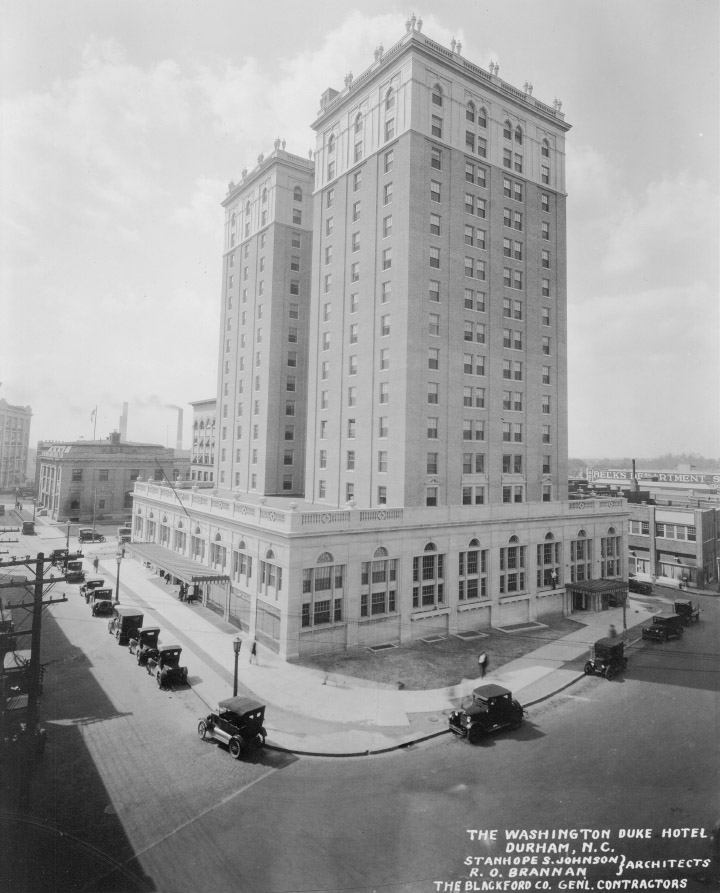
All Margaret Haywood could focus on that day we first talked was the failure to save the historic Washington Duke Hotel from implosion a year or so after the revolt.

Opening in 1925 within a year of the Carolina Theater, the hotel had cost $1.8 million, seven times the cost of the theater and nearly $25 million in today’s dollars.

It was the finest hotel in the South at the time.

A mid-century annex is being restored today as one of several hotels around the CCB Plaza where the old Washington Duke once stood, including a 21c Museum Hotel and a boutique hotel called The Durham.

More than a decade later, people in Durham that December would recall to me its implosion with descriptions of clouds of debris flooding downtown streets similar to what we saw when terrorists brought down the Twin Towers in New York, but without the horrific human tragedy.

The implosion, even more than the demolition of Union Station here a few years earlier, galvanized some—but not all—Durham residents around sense of place.

And we would see on the heels of those initiatives I mentioned earlier incredible design incongruity of public facilities such as the Civic Center, Detention Center, Performing Arts Center, Transportation Center and Human Services Building.

I’m reminded by a friend that in the early 1970s, after a Southern business and development magazine labeled Durham a “hot dog” town, Haywood and some friends formed Pride Builders of Durham.

It was a precursor to a grass-roots successor we would forge two decades later as Durham Image Watch involving hundreds of resident volunteers who rallied to help Durham’s community destination marketing fulfill its role as guardian of image, identity and sense of place.

Business and university executives, as well as most politicians and executives of other types of economic development organizations are wary of standing up so overtly on behalf of a community, although most were very supportive when DCVB did.

There were always a few exceptions during my career.  Some would join with us when asked, balancing out a far bigger number who would duck for cover, and a few more trying to pull us back for fear of rocking the boat.

But residents of Durham both in public opinion polls and through personal involvement always wanted us to do more, especially those I mentioned above and none more than Margaret Haywood and her Pride Builders.

The implosion of the old hotel in 1975 spurred local officials a few months later to launch a consultant-led study of the feasibility of a new civic/convention center for the old hotel’s site.

But its location, when erected a little more than a decade later, would be hijacked when officials tore down another full block of historic buildings across the street instead to appease the developer of an office tower.

This island of incoherence remains an inspiration for those who today seem more pursuant instead of “franchise architecture” and corrosion of of sense of place, aided by some sworn or elected to defend it.

Today, thanks in part to the community marketing that gave it oxygen and awareness beginning in 1989, Durham is now recognized as one of the country’s “foodiest” towns, including perhaps even hot dogs.

But unless repeatedly called to task by citizen activists like Margaret Haywood, Durham often seems to take two steps forward only to inexplicably take one or two back when fostering the sense of place.

In her 80s by then and more than two decades after that “sense of place revolt,” Margaret was still rallying others to step forward, this time for a Museum of Durham History to memorialize Durham’s sense of place.

The struggle continues to keep Durham distinct, both in the economic importance of being different and its worthiness of love.

It may even require another “sense of place” revolt.

Monday, June 30, 2014

Keeping it Real - Green is the Key to Sense of Place

The science is clear about the importance of green infrastructure.  It supports the Durham (North Carolina) City Council’s recent move to dedicate a half-cent of property tax for partial maintenance of a tiny fraction.

It was an important step but not nearly strategic enough.

Oh, it is very strategic in execution.  It will fund 12 new FTE’s (the equivalent of full time workers) to keep parks and trails in better repair, maintain clean bathrooms, keep the turf mowed (in most cases weeds,) and maintain basketball goals and ball fields in better condition.

The plan also stipulates inter-agency coordination and defines performance metrics.

On the down side, it neglects the vast majority of green infrastructure, areas even more at risk, such as urban forests.

At the same time, officials quietly axed a popular and effective summer youth litter patrol.  Why?  The grant wasn’t renewed.

Durham, like a lot of communities in the years after I first moved here, did this with the grant-inspired Durham Service Corps.  But they don’t really get what grants are for.

They aren’t intended to subsidize operations but to momentarily leverage innovations until grantee communities can make their capacity sustainable.

The problem is not only that what the City Council just did for parks and trails is woefully insufficient, but the angst by which it was forged will likely mean that expectations will be as though it were.

Rather than serve to pilot strategic scalability, far too often officials everywhere wearily turn instead to the next crises.

To be truly strategic, a move such as Durham’s for parks and trails should have comprehensively addressed overall green infrastructure as an overarching strategy (a means to spearhead and achieve many others.)

Green infrastructure, including upkeep, is correlated scientifically to:

  • Reduce crime (especially domestic violence,)
  • Improve public and mental health outcomes,
  • Invigorate neighborhoods,
  • Reduce homeowner costs and street maintenance,
  • Develop and foster workplace skills such as executive function skills,
  • Engage civic participation and organizational citizenship
  • Develop the economy from both supply and demand sides,
  • Improve curb appeal/property values, and more.

Strategic mindset, unfortunately, isn’t a requirement to run for office, although it should be for governing.  Nor is this mindset sufficiently found or exercised enough by day-to-day public servants or administrators.

This oxygen becomes even thinner at higher levels of government.

To put what the City Council did in perspective, this new tax will generate $1.2 million annually to improve one tiny corner of green infrastructure, a fifth or sixth of what local governments spend each year related to the ten-year-old American Tobacco Complex, revealed by recent news reports.

Both are key, the former strategic and the latter tactical, to retaining Durham’s status among the fewer than 1-in-3 places still considered “real and authentic.”

This core sense of place asset correlates with appeal to talent, resident passion and engagement, relocating and expanding business and visitation but belies how quickly it is eroding.

Historic and natural or green infrastructure rank highest in perception as real and authentic, according to national surveys.

Even among those drawn to attractions and entertainment - sports, performing arts (especially musical theater,) generic events and other amusements and fantasies rank least as contributing to “authentic.”

The nationwide study was conducted by PGAV Destinations which has developed or revitalized attractions visited by 75 million people each year.

When it comes to sense of place appeal, it can be both/and but as in wine parlance, always historic/natural character forward.

To get a sense of how determined officials are to keeping our community “real and authentic” or falling vulnerable to surrendering sense of place, follow the money.

Lets hope the long overdue attention given to to even a fraction of its even more crucial green infrastructure is more than a “one off.”

Saturday, May 24, 2014

The First Generation Kindling of Durham’s Passion for Place

It was conceived at a pivotal time in my community’s history when a population of only 8% of what it has become today was already seeking to preserve Durham, North Carolina’s history.

Whenever visitors to Durham first see Duke University Chapel, the first thing they often say once they catch their breath is, “that’s not a chapel, it’s a cathedral.”

I’m sure I even said something like that when I was given a tour of the community during my interview twenty-five years ago to become the startup executive for Durham’s marketing agency.

Today I know that tour was really an audition to see if I had an understanding enough of sense of place to truly grasp the essence of Durham’s.

But the term chapel has never been a reference to size, nor does the term cathedral always mean large.

One is a term used by many religions, especially in reference to churches embedded within universities, e.g. King’s College Chapel at the University of Cambridge.

The other refers to central as in diocese vs. parish.

What distinguishes Duke’s collegiate gothic cruciform chapel from those at other universities that seek to evoke a cathedral of the English Middle Ages is its 210 foot high tower made to seem even higher by its placement.  It’s just five feet short of the cathedral at the University of Notre Dame in Indiana.

Duke Chapel was envisioned in the mid-1920s when a prototype that still serves as a church here was built to test the use of various sources of stone during a pivotal decade in the evolution of the part of Durham’s sense of place centered around its “built” character.

This was also when Duke Forest was envisioned as a means to rehabilitate depleted tobacco fields, now a vast symbol of Durham’s broader urban forest canopy and a vaunted part of it “natural” character.

It took from between 1950 and 1960 until 2000 to establish and mature a pine forest in Duke Forest and foster an understory of hardwood trees.

The transition of parts from pines to hardwood forest began at the turn of the century and will continue until 2030.  The first hardwoods there will begin to climax from 2030 on.

All of that is to put 100 years of Durham history and its urban canopy today in context.

But by 1920, the founding generation of Durham was also already busy preserving its five decades of history.

Durham was stunned in the fall of 1921 when the original Bennett Place farmhouse where the Civil War had effectively ended here 56 years earlier burned to its foundation.

Many across North Carolina at the time preferred to remember the war only through a revisionist movement known as “the lost cause.”  But many in Durham, including Washington Duke, had been “unionists” and fought only because it was mandatory.

Samuel Tate Morgan, who had purchased Bennett Place anticipating a memorial park there, had died a few months earlier. Trust titan James Buchanan Duke, also a Durham native, served as one of his pall bearers.

Morgan’s father had died when he was eight, around the age of my grandsons now.  He was fully aware as pursuing Union cavalry caught up with Confederate units trailing through Durham resulting in a truce and culminating in the pivotal surrender at Bennett Place.

Soon, Morgan moved from his Flat River roots a few miles south, to the crossroads known as Durham where the Dukes, Carrs and Blackwells were busy earning Durham a national reputation for manufacturing. 

He founded the Durham Fertilizer Company recycling wasted stems from tobacco processing which soon became the nucleus of his huge Virginia-Carolina Chemical Co, the largest in the world.

At the time of his death, Morgan was also president of the Southern Cotton Oil Co, the Charleston Mining and Manufacturing Co and a director of the Texas and Pacific Railway, but he never lost touch with his Durham roots.

Knowing his reverence and plans for Bennett Place, his widow and heirs donated the property to the state, while Durham’s state lawmakers pushed the General Assembly to designate and maintain it as a state historic site.

To make that happen Durham Representatives Reuben Everett, an early Durham civil rights attorney and advocate, and Frank Fuller Jr., an attorney and part of a group known as the Durham Dynamos, worked with Durham state Senator Bennehan Cameron, a farmer and railroad executive.

Cameron also helped organize the First Bank of Durham, now adaptively reused as office space, across from where a 21C Hotel is doing the same to another famous Durham banking landmark.

Both are just up Main Street from where another historic bank building is being converted to restaurant, adding to Durham’s reputation for locally-owned, chef-driven facilities and a national foodie reputation.

Everett, Cameron and Fuller’s father were all contemporaries of Morgan and J.B. Duke and all shared life-long devotion to Durham and preservation of its history and other elements of sense of place.

They were working to preserve Durham history long before some of the old tobacco factories and warehouses we consider so historic today were even built, including major portions of the American Tobacco, West Village and Measurement Inc.

Much of the brick work in these buildings is distinct from that of buildings in other communities of the day.  Durham’s first generation, in thought and deed, revered its sense of place.

Frank Fuller Jr., whose historic Morehead Hills home was inhabited until recently by an acclaimed Durham architect and his jazz singer wife, was the scion of one of the founders of the Durham Buggy Company, Frank L. Fuller Sr.

Ironically, more than a decade ago a Durham developer offered to restore one of the historic buildings developed by Frank Fuller Sr. in the 1930s as Duke Chapel was being built.

It had been sitting vacant since 1992 when it last served as a clearing house for social services and then deed it back for $1 to the proposed Museum of Durham History.

The then county manager nixed the proposal, instead leaving the building vacant and decaying for another decade when it was adaptively and lovingly reused as event space only to soon close.

As foretold, the building revealed a treasure trove of Durham history and it wasn’t the first time in the past 60 years that Durham officials let pass a perfect opportunity to house the Durham history museum. 

In fulfillment of Samuel Tate Morgan’s wishes, in 1923 Durham leaders also erected the Unity Monument near the ruins of the Bennett Place farmhouse.

In part, the monument was designed by T.Y. Milburn who lived near Fuller in Morehead Hills and was also busy at that time designing many of the buildings that are signatures of Durham’s sense of place including the Carolina Theater, Durham School for the Arts and the King’s Daughter’s Inn.

Milburn’s civic engagement also spanned the era three decades later when he and other Durham leaders transformed the state’s economy once again laying its foundation as a center for research, hi-tech and healthcare.

But let me take a brief break from this story to put into context that early 1920s and 1930s era of Durham’s historical reverence and memorial at a time when the community was only a third as old as it is today.

This is the period that spurred second-generation Durham textile executive and newly minted radio entrepreneur, Mayor W.F. Carr (William Frederick) in 1934 to ask famed city engineer John Michie to lay the foundation of a Durham history museum in the months prior to Duke Chapel’s dedication.

Carr was mayor until 1948 but the movement for a museum of Durham history was tabled due to the Great Depression and then WWII.

In 1949, according to Durham historian Jim Wise, Southgate Jones Sr. offered his father’s historic mansion along with memorabilia as a site for the museum.

Instead, a few years later it became the site of a hotel and is now the site of a new transportation center that somehow eluded historic design guidelines.

The proposal as a museum was deep sixed back then by city and county managers and elected officials during a four-decade era of obsession with “holding taxes at all costs,” which compromised not only reverence for Durham’s past but nearly choked off its future.

Famously pro-Durham, Southgate Jones Jr. was one of my strongest backers when in 1989 I started the agency for Durham charged with marketing the community and championing its sense of place.

He was also a passionate advocate for a local history museum, a public priority still being hamstrung by a few officials even though the need is still held in high esteem among residents of a community that has grown many times in size.

Ostensibly it is still throttled because this long-held cultural priority would cost the equivalent of what was just spent to overall the 18-year-old Durham Bulls Athletic Park.  But that is less than half of what was spent a few years ago on a new theater.

As an organic measure of how much time has been lost in the 90 years since first proposed, the depleted soils where Duke Forest now stands have gone from crabgrass to shrubs to pine forest to emerging hardwood forest.

Just sayin’.

In the late 1950s Durham residents stirred again, hoping to replicate the old Bennett Place farmhouse in time for the Centennial of the Civil War.

Civil War buff Charles Pattishall who owned a garage on Markham Avenue just off Ninth Street was assisted by Dr. Lenox Baker, who took me on one of those orientation tours when I first moved here.

Using the pattern and materials from an identical farmhouse being torn down on Chapel Hill Road, they reconstructed the Bennett farm house where Confederate General Joe Johnston disobeyed Jefferson Davis and surrendered to Union General William T. Sherman putting an effective end to the tragic war.

A call went out for artifacts which were relocated or returned.  It was completed in time for the first reenactment of the surrender in 1965 and attended by U.S. Vice President Hubert Humphrey and newly-elected Governor Dan Moore.

In the 1970s, the state added a visitor center on the site after officially making it a state historic site.

The period bookending the preservation of Bennett Place also marks the preservation of two other state historic sites in Durham.

In 1930 Washington Duke’s granddaughter, Mary Duke Biddle, whose daughter I came to know, bought the old Duke Homestead after returning to Durham from New York City and presented it to Duke University in 1931 which began to restore it.

In 1966 it was named a National Historic Landmark by the National Park Service and became a state historic site in 1974 with a working history farm and the addition of a mini-museum and visitor center in 1977.

In 1973, Margaret Haywood, who passed away three months ago, began a crusade forming Preservation Durham, saving the Carolina Theater and igniting the reinvigoration of downtown that spanned my tenure in Durham.

She also set about to earn a designation for the 1787 Bennehan House in northern Durham near where Morgan was born to the National Register of Historic Places.

In turn, she then persuaded the owner of Liggett and Meyers Tobacco Company to put their house, outbuildings, historic barn, a yeoman farmers house of the same period and slave quarters, all of which lie along the Great Indian Trading Path in Northern Durham, to the state as a historic site and archeological resource.  It’s called Stagville State Historic Site now.

Dating to when it was younger than I am now, (65) Durham residents were already busy passionately preserving the community’s history and its green infrastructure, a lesson yet to be learned by political regressives in high office a hundred years later.

They seem to yearn for a time of desecration while Durham’s founders yearned for sense of place.

Now that more than 160 years have passed, is it time for elected officials and administrative caretakers to do the same:

Fulfill the community’s 90 year old yearning for a Museum of Durham History and develop comprehensive strategic plans for preservation of its urban forest and historic buildings.

Tuesday, May 20, 2014

Never Underestimate The Power of Artifacts

Some really cool people are making the Museum of Durham History a reality.  But from the outset, a few have been petrified of being in the “artifact” business.

Granted I am an artifact junkie.  In my former career, I kidded unmercifully the now retired head of our local science museum for giving away a very cool 1942 DC-3 to another museum.

It had been purchased from the military by Western Airlines the year before I was born and then sold to Piedmont Airlines in North Carolina and flown as the Potomac Pacemaker from 1956, when I was the age of my grandsons now, until 1965 when I was a senior in high school.

During that span, the plane most certainly flew in and out of RDU International Airport which is co-owned by Durham, but through Raleigh subterfuge (see page 6), the other co-owner had the name  switched out of alphabetical order.

In fact, in the image below, that very well could be the Potomac Pacemaker sitting in front of the RDU terminal in the late 1950s.  Piedmont few in and out of RDU from the airline’s inception in 1948 when it was founded in Winston-Salem, NC.

When I was growing up, we either took livestock for auction to Bozeman or Idaho Falls which are very roughly equidistant from our ancestral ranch in the Yellowstone—Teton nook of Idaho.

When the choice was Idaho Falls, my paternal grandfather, who was born in 1888, loved to go out to the old airport that had been built there in the 1930s by the WPA and watch Western Air Express prop planes such as the DC-3 take off and land on routes from Montana to California.

A decade after it was retired, the Potomac Pacemaker was salvaged and then donated to the Durham-based NC Museum of Life & Science in 1978 by Durham-native Dillard Teer and his family.

The Teer family has been prominent in Durham now for 125 years, having built the Blue Ridge Parkway and many of the major roads in North Carolina.

They also owned and operated the Durham & Southern railway, built airfields around the world including RDU’s in 1939, developed Research Triangle Park here, and through several generations have served on the RDU Airport Authority.

The family carefully trucked the historic aircraft to the Durham museum where it was lovingly restored and mounted for display by former employees of Piedmont.

When I moved to Durham in June of 1989, I was intrigued by Piedmont Airlines which had been founded in North Carolina the year I was born, only to be gobbled up by US Airways three months after I arrived here.

To me, that made the Potomac Pacemaker mounted at the Museum of Life and Science a valuable visitor feature as well as a significant symbol of Durham’s history.

Of course, had it been retained instead of given away in 2004, it would be too large to be displayed inside what will eventually be a full-fledged Museum of Durham History, unless hung from a vaulted ceiling.

But the old DC-3 could have been mounted at the front entrance of the eventual local history museum as an icon, much as this Mercury Redstone Rocket does today for the Museum of Life and Science.

One only has to look at the front-page news about the recent reclamation of one of Durham’s 1949 fire trucks which will join two others, one from 1902 and another from 1935, in yet another mini-museum, to see how artifacts capture the public’s enthusiasm.

Maybe my friend, the former director, who parted ways with the Potomac Pacemaker is serving penance by being a driving force in retirement for a Museum of Durham History (smile.)

Instead, the Potomac Pacemaker is now in loving hands of volunteers again who are fully restoring it for display one day at the state Transportation Museum in Spencer, NC.

It was given away ten years ago as museums fell under the spell of interactive exhibits, especially for children.  But soon it became clear even to museums created during this span, that it is the genuine artifacts that garner the most attention and create a sense of awe.

It is both/and, never either/or.

By not wanting to be in the “artifact business,” I assume some who are laying the groundwork for the Museum of Durham History (now represented by a hub-avatar) probably fear that people like me will show up with their grandfather’s collection of old National Geographic magazines (smile.)

But museums don’t need to tie themselves down by vetting potential donations.  They could use trained volunteers or contract with entities that do that sort of thing.  We’ve all seen this vetting at work on TV shows such as Antique Roadshow, American Pickers or even Pawn Stars.

The primary importance of history museums, especially local history museums, is the telling of stories.  A recent essay posted by the Smithsonian explains why artifacts are so powerful, far more powerful than just photographs or videos:

  • Artifacts tell their own stories.
  • Artifacts connect people.
  • Artifacts mean many things.
  • Artifacts capture moments.
  • Artifacts reflect changes.

The authors note that (paragraphing inserted for ease of reading):

“Artifacts are the touchstones that bring memories and meanings to life. They make history real. Moreover, it is a reality that can and should be viewed from different perspectives.

When museums choose not to enshrine and isolate an artifact but instead open it up to new interpretations and different points of view, they provide opportunities to challenge and enhance our understanding of the past.”

Anything but static, “consider each artifact with its many stories as holding diverse meanings for different people, past and present. Think of them as bits of contested history.”

The authors of the essay, National Museum of American History curator Kathleen Kendrick and Dr. Steven Lubar at Brown University, have written several books both together and separately about the legacies of artifacts and what is worth saving.

Because Durham officials have delayed what has for eight decades (half of Durham’s existence) been a top cultural priority among Durham residents as measured most recently during a cultural master planning process, thousands of invaluable artifacts have been dispersed around the world.

Many are in landfills, but many were hopefully plucked by collectors from garage and estate sales when distant decedents of Durham owners, ignorant of their significance, put them on sale or discarded them after cleaning out attics.

This means the Museum of Durham History, when finally fully enabled, will need to put out calls to collectors and pickers for invaluable but forgotten Durham heirlooms and hope they can at least be loaned to the museum.

One only has to watch and observe visitors to the three state historic sites in Durham (mini-museums) to see how significant artifacts are.  Each site has hidden away details on how to relocate hundreds more than they have room to put on display.

With each passing day, Durham loses more and more of its history.  For those still puzzled about why we should care, here are just a few reasons a Museum of Durham History, stocked with both artifacts and the latest technology, is crucial:

  • Story Telling. It will give children, students, newcomers and relocating executives a place to get in touch with Durham’s story. People who grasp that stories are more inclined to be engaged as activists, volunteers and philanthropy.
  • Synergy. It will augment Durham’s historic sites by providing exhibition space to stir interest in those locations, making them more sustainable. It will complement rather than undermine other cultural facilities and programming.
  • Preservation. It will be a vigilant testimony to what makes the community distinct and unique and insulate its character and personality from the pressures of development and “generica.”
  • Future Generations. As a repository of innovations and artifacts, it will inspire future generations to build on the temporal qualities that make Durham, well, Durham…creative, entrepreneurial, caring, innovative, accepting, etc.

My dad was notoriously unsentimental about artifacts but through the last few decades of his life he learned to ask me first before disposing of old equipment and memorabilia.

Unfortunately, this was too late to salvage tack from the ranch or my great-grandfather’s branding irons.

Never underestimate the power of artifacts.

Friday, November 15, 2013

Choice Architecture–Changing Defaults

A flashback on this, America Recycles Day, has me wondering if recycling may offer a possibility for the eventual home of a full-fledged Museum of Durham History, once it moves beyond the current avatar.

When I first visited Union Square in San Francisco, it was late September 1981.  A friend with Alaska Airlines, which had begun service to San Francisco two years earlier, had arranged for a group of us to fly from Alaska down to Oakland to see the Seahawks play the Raiders (Raiders won.)

On the way back to the airport, I asked if we could stop a few blocks west of the Square to see what was the late Bill Kimpton’s first boutique hotel, the Clarion Bedford, which six months earlier had launched a movement that is still revolutionizing lodging today.

Bill created a collection of very distinct properties, each with its own personality and its own chef-driven restaurant.  The Clarion had been a hotel owned by Lord Wedgewood (China) but essentially Bill took the idea of adaptively reusing old buildings to a new level, which is a form of recycling.

Union Square was originally just a park developed in the 1850s on the site of a huge sand dune.  But after the earthquake of 1906 there was talk of turning it into a parking lot, which then morphed into excavating an underground parking deck below the park and plaza, a form of recycling.

That idea didn’t win over voters until the late 1930s after San Franciscans had bet their homes to finance the Golden Gate Bridge.  When I visited, just as the 1980s got ready to economically boom, Union Square was being surrounded by high-end luxury stores.

A luxury hotel, now rebranded a J.W. Marriott, was erected by John Portman seven years after my visit, midway between the Square and the Kimpton’s Clarion Bedford.  That it marked the end of one era and the beginning of another was emerging during a stint there during a several months between gigs in  my field of community marketing.

Portman had started his career in the 1960s by ingeniously making adaptive reuse (a form of recycling) of a parking deck in Atlanta to create a Merchandise Mart.  In the 1970s and 1980s he made his name in hotels during the “brass and glass” era.

First it was by setting a new standard with the design of Hyatt Regencies and then in the 1980s, Marriott Marquis’, one of which kick started adaptive reuse of Times Square in New York while, regretfully, demolishing five historic theaters in the process.

Emerging out of controversy, the hotel was ultimately required to incorporate a new theater on the third floor.

It is clear in hindsight that the 1980s were bookended by the beginning of the boutique movement and the end of the era of huge atrium lobbies and rooftop restaurants.

Lodging began a transition, which is still underway, to Kimpton’s infinitely more distinctive and genuine community-connected approach now being emulated by chains.

Parking decks have evolved too.  Long viewed as uninspiring if not downright ugly necessities, many today are hidden inside retail and residential complexes or wrapped in disguise by developments like hotels or facades.

But old and new public decks are now are being adapted to feature retail or or restaurants or cultural facilities such as museums and galleries on the ground floor with rooftop residential and public spaces.

There is no reason a future new or renovated deck in Durham, North Carolina where I live can’t incorporate, on the ground floor, the 20,000 to 30,000 square feet typically needed by a local community history museum, which come to think of it is itself a form of recycling.

A good example is the State Street deck being built by local government in Sarasota, Florida as part of an agreement with a developer and rendered in the image in this blog.

A big part of getting institutions and individuals to recycle is a behavior called “choice architecture” in the book Nudge: Improving Decisions About Health, Wealth, and Happiness, written by Dr. Richard H. Thaler, a behavioral economics researcher at the University of Chicago and Cass Sunstein a professor of law at Harvard.

Getting people to recycle or adaptively reuse involves changing defaults.

One example is called “reverse recycling” which means switching up trash receptacles so trash goes in the little saddle bags once meant for recyclables and recyclables go in the much larger basket usually used for garbage.

A few years ago, I persuaded our sanitation department in Durham to replace my broken trash cart with a much smaller one since I was rarely filling the larger one after the city distributed much larger roll out carts for recycling.

Persistence paid off but I realized the department was stuck with the huge cart being the default.

But there is evidence that if the city gave every one the choice of a smaller cart along with a reduced fee, people would switch defaults and think recycling first and garbage second.  Here is a Nudge blog post showing how changing that ratio works and explaining why.

Studies show the same is true of grocery shopping carts.  Researchers at New Mexico State University found that people made healthier choices about food when carts were marked with tape showing where to put fruits and vegetables.

I love the smaller carts at Kroger and Food Lion but there are only a handful available, and usually none at Harris Teeter where I shop.  It is probably not coincidence that the smaller carts are the default at the more sustainability-focused Whole Foods in Durham.

The second call to action in the recycling slogan is “reduce.”  I bet the choices would be healthier if all stores made the smaller carts the default and the larger carts the exception.

All of these stores need to follow Whole Foods’ lead and at least reverse the ratio of large to small carts.  The first word in the slogan for recycling is “reduce.”

Thursday, September 12, 2013

The Park Legacy of An Economic Transformer – Part 1 of 3

Before the 1940s, where two forested ridgelines meet a mile from downtown Durham, North Carolina the house I live in was only a carriage house for large brick house.  The street where I live was then only a short gravel driveway off another street.

The old house is gone now, evidenced only by a remnant of its chimney next door and the ubiquitous bricks that surface when planting understory trees and shrubs.

During its time, a series of charming and sturdy duplexes had been terraced down the hillside from the driveway for the families of returning GIs after World War II and the driveway stub was extended a few feet to accommodate a parking entrance for the duplexes.

Then a returning bomber pilot and his wife extended it into a road all the way down the ridgeline to their new home overlooking a heavily wooded bottom land that Willie Carver, a veteran of an earlier World War, had deeded a to the city for a park many years before.

Today, it is Rockwood Park, one of Durham’s most popular, largely because of those towering trees along both sides of a meandering stream, its play area and a walkway around its circumference.  Mom’s commute all the way from Chapel Hill to slum there with their children (smile.)

Developers back in Willie’s day, with the exception of those building in lower socio-economic areas, understood on their own to “let floodplains be floodplains” rather than trying to finagle to build on them by encroaching on stream buffers, as many do today.William S. Carver

Carver understood the far greater value of amenities on development.

He was third-generation Durham, raised up in the very northwestern corner of the county in a historic 1850s house past where I often ride on Harley excursions, after a winding several miles north from the Little River Regional Park & Natural Area.

The old Carver house has been repurposed as the office for Tree Frog Nursery, less than a mile up NC 57 (Old Hillsborough Road) and across the line today from the pit entrance to Orange County  Speedway, a former NACAR track where, now four-time champion, Jeff Gordon was cutting his teeth shortly after I moved to Durham.

Back when Willie was born, the closest racing was further down NC 57 at a horse racing track on Occoneechee Farm, owned by “General” Carr, who after the Civil War was a partner in the production of Bull Durham tobacco and one of the leaders who around that time was bringing what would become Carver’s alma mater to Durham.

The year I was born, the old horse track was converted into one of NASCAR’s inaugural speedways where former “thunder road” driver Junior Johnson and Richard Petty famously raced and won until religious leaders shut it down in the late 1960s.

Willie’s parents, Hosea and Emma were merchants near the Durham County crossroads of Rougemont and owned a sawmill.  Before he headed down to Durham proper to attend Trinity College, which was in the process of being relocated here just as he was was born, his parents even toyed with the idea of a textile mile.

Returning from WWI, Carver finished his degree and was studying law when another Durham native, James Buchanan Duke, transformed Trinity into Duke University which in turn launched another transformation of Durham.

In 1988, after building a successful realty and insurance business, Carver passed away.  That was the year before I arrived in Durham to jump-start Durham’s transformation as a center for visitor-centric economic and cultural development.

But it was from J.B. Duke that Willie’s generation learned about the importance of continual and never-ending community economic transformation.  It is easy to see that something needs to be done when core industries are in decline.  It is quite another to anticipate transformation.

Looking down in the 1940s from his apartment atop the old Washington Duke Hotel, Carver, like George Watts Hill, who was next door in his C-suite above Central Carolina Bank, was anticipating transformation was needed even while tobacco and textile factories hummed as never before.

The 16-story hotel had been erected in 1924 while Willie was in law school.  It replaced the New Academy of Music which had stood on the site until T.Y. Milburn supervised construction nearby of the Durham Auditorium, now the historic Carolina Theatre.

In 1950, a few years after deeding Rockwood Park to the city, Carver was among the Durham Committee of 100, an organization that in twelve short years, fulfilled its mission by accomplishing three pivotal achievements that transformed Durham and North Carolina to what they are today.

The hotel where Carver first contemplated the need for transformation in the 1940s was imploded in 1975 and served as parking until recently transformed in Hill’s honor into CCB Plaza.  It is now home of a life-size bull, in honor of one of Durham’s legacy signatures, “The Bull City,” earned in part by relentless transformation.

Hill’s bank is gone now too, and the building now being transformed into the fifth 21C Museum Hotel, a response to Durham’s emergence over the past two decades as a visitor destination.  But Willie Carver’s park still lives.

No disrespect to those who take or are given well-deserved credit today, but everything being done, including the transformation of downtown Durham, rests on the shoulders of mid-century transformers such as Willie Carver and the Durham Committee of 100.

To be continued…