Showing posts with label North Carolina Department of Transportation. Show all posts

Friday, April 24, 2015

Symbols of Intergenerational Compact

In an essay a week ago, I suggested that North Carolina’s annual Interagency Report on Litter Cleanup, Education/Prevention and Enforcement was missing some information.

But I was mistaken; so maybe with this post, I can fill in some of the blanks.

Litter clean-up has many purposes including public health, achieved by reducing contaminants in storm water, but it is also to safeguard scenic character, which is a core trait in the state’s appeal for economic development.

So I questioned why programs to proactively beautify roadsides were omitted.  It turns out these are beyond the legislative scope of the report and I sense that over-delivering may not be well received.

It is too bad because North Carolinians are largely unaware of how much the NC Department of Transportation does to protect and enhance the state’s overall appeal along its roadsides.

Roadsides are the first and last impression that more than 90% of the state’s visitors receive, as well as tens of millions of potential visitors who are just passing through.

When I arrived in Durham twenty-six years ago to complete the last half of a four-decade career in visitor-centric economic and cultural development, Bill Johnson, a now retired NCDOT roadside engineer was deep into two, now award-winning, beautifications projects.

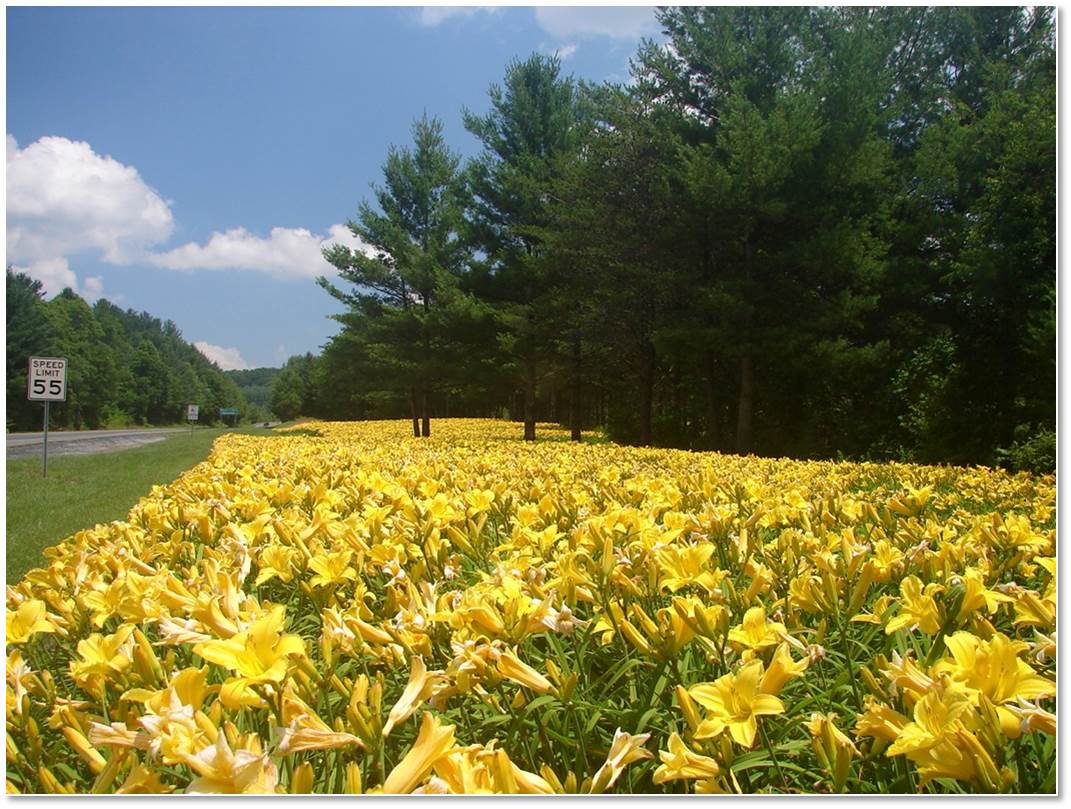
Today, North Carolinians and visitors to the state are greeted with 1,500 acres of wildflowers across the state as they drive along Interstates here.

Bill also started a program to recognize and preserve scenic byways along secondary roads across the state.

Soon the number will be increased to 58 covering more than 2,300 roadway miles showcasing every part of North Carolina including Durham, one of the few urban counties to set one aside, a favorite of mine astride a trusty Harley-Davidson Crossbones.

It is also a stated goal of NCDOT to “have well established and aesthetically pleasing forest along the highways in North Carolina.”  I haven’t seen a report for this decade but from the 1960s through the 2000s, NCDOT planted about 5 million trees along roadsides here.

A good share were planted in league with the America Treeways Program, a partnership of many agencies and volunteer organizations with the National Tree Trust established in the early 1990s by the first President Bush, a Republican.

Back then, it was also a bipartisan national policy to have well established and aesthetically pleasing forests along highways.

I will never forget a sentiment expressed by Bush I during my first few months in Durham, “Every tree is a compact between generations.”

Add that to the list of intergenerational compacts that have been shattered over the past decade.

Today, in North Carolina, many legislators inexplicably work overtime to sacrifice trees along the 14% of roadways that are part of the National Highway System here where they still remain, even though protected in the state constitution.

As a result, except whenever the Governor intervenes, Carolina’s once vaunted appeal for scenic character is rapidly falling into tatters.

Friday, April 17, 2015

Closing Gaps to Enhance North Carolina’s Curb Appeal

The comprehensive litter report for North Carolina is out.  It is required by state law and carried out by NCDOT’s Office of Beautification, a part of the Roadside Environmental Unit.

Roadside is also the unit responsible for creation of Scenic Byways and North Carolina’s award-winning wildflower program.

The annual report is assembled each spring to document interagency efforts to clean up, and in some cases even beautify, roadways and streams throughout the state.

It includes some of those performed by nonprofits and other groups of volunteers, as well, but not all.

There are many ways communities should be using the report including publishing similar reports that delve deeper into efforts at the local level for towns, cities and counties.

The report provides details each year that can and should be used to establish metrics for benchmark communities.  Some breakdowns by county are not always included which is a shame.

These are input and output averages that can be compared over time against similar sized jurisdictions, or better yet, on a per population metric that includes:

  • residents who live there
  • non-residents who commute there for work or school
  • inbound daytrip and overnight visitors

As comprehensive as the state-wide report is, there are some glaring gaps.

For instance it does not include losses due roadside deforestation including those billboard companies now permitted to clear cut huge swaths of forest, nor agency efforts related to reforestation and afforestation along roadsides as well as increase wildflower acreage.

Data such as this would be useful to calibrate related beautification efforts to shore up an important element of the North Carolina brand, but it would also illustrate a need for a roadside forest management plan.

Clear in the report is how much effort goes into picking up after people compared to proactive efforts to enhance the state’s curb appeal to a new level, as well as how little by comparison is done to police the deliberate desecration of roadsides and streams.

Knowing, for instance, that 150 tons of trash and debris were removed from 1,300 miles of streams across the state during the annual fall cleanup is impressive.  (Note that communities such as Durham where I live do this twice a year with hundreds of “little” sweeps throughout the year.)

But it doesn’t appear any forensic analysis was conducted to identify litter sources for follow up either to address ignorance if that was the cause, or to prosecute when it is being done deliberately.

Litter citations and convictions at the end of the report merely illustrate that both law enforcement agencies and cleanup efforts are failing to follow up on behavioral studies.

For instance, we know now to carefully monitor abuse of animals because it is a sign that domestic abuse of spouses and children is also likely at these locations.

Similarly, we know from national studies of littering not only what portion of the public is involved (17%) but the percentage that do it deliberately (4%.)

Furthermore, we know that not only do smokers contribute significantly to the littler stream, but even when butts are excluded, they are two times more likely to litter.

This means that educational and enforcement efforts can be more effective if focused on the 15% (13.4% daily) who smoke.  It also means that educational efforts are best focused on socio-economic groups where use of tobacco products is exceptionally high.

The findings also suggest that dealing with mental health issues such as depression is a means to reduce litter and debris in streams and along roadsides.

It is difficult to understand why Durham County with a greater ratio of commuters and visitors per 1000 residents than Wake County but with only 1/3rd the land area and resident population, issues less than 1/10th the number of annual citations for littering.

There are many ways that appearance advocates, beautification groups and policy makers can use the valuable information in this report.

But making the appearance of the state, as well as its towns, cities and counties as much a priority with lawmakers as it is with residents, visitors and newcomers, including those seeking to relocate businesses, will close the biggest gap of all.

Strategy is about alignment.  If job creation and enhancing the North Carolina brand are important objectives, we need to make appearance and beautification an overarching priority.

Friday, February 20, 2015

The Void Desecrating North Carolina

I didn’t realize until I saw one while driving cross country, that Rodeway Inns were still in existence.  One of my summer jobs in 1966 prior to college had been moving the furnishings into a brand new Rodeway Inn.

Actually there are still 150 in existence.  At one located above the Clanton Road interchange to I-77 in Charlotte, North Carolina, the owner just illegally clear-cut hundreds of publicly owned trees, ostensibly to make the aging facility more prominent.

That carnage is about 3 miles south of where we will be staying this weekend to have dinner with several friends over in Dilworth and Myers Park districts where the value of trees is made paramount.

But visibility is not that particular Rodeway’s problem.  It has been rated barely a 1.5 out of five possible stars by former guests.

It is a mistake that leads so many visitor related business to defiantly still advertise on roadside billboards, which in North Carolina, have now been given permission by the legislature to clear cut publicly owned trees with impunity, with no recompense to Tar Heels, and then to sell the wood to cover the cost of cutting them down.

It has enabled a torrent of illegal cutting by businesses across the state including Durham where we live.

Now a bill has been introduced in the State legislature to eliminate the NCDOT Roadside Division (see section 2.4 h at link), further beheading any enforcement to prevent illegal cutting and making the likelihood of reforestation nil.

In doing so, legislators would eliminate the division responsible for scenic byways and the award-winning wildflower program along Interstates.

Visitor-related businesses that defiantly use the billboards and enable desecration of the very North Carolina brand upon which they must rely are now joined in that irony by many in the legislature who seek to do likewise, while giving lip service to attracting economic development.

All of this is taking place as studies show that the percentage of consumers and businesses in America that find billboards useful has fallen to less than two-tenths of one percent while 8-out-of-10 drivers and passengers view them merely as blight.

In other words, even if traditional advertising had not fallen to a negative return on investment overall, the turn-off to turn-on ratio for billboard advertisers is tantamount to throwing money into the wind.

Of course, special interests began to deploy copious amounts of campaign donations fifty years ago to undermine highway beatification legislation in America and today even gatekeepers seem under the influence of Stockholm syndrome.

Recently, the Federal Highway Administration humorously declared that digital billboards that change every few seconds are not considered to be, well, intermittent which would make them unsafe and illegal.

The science used or lack thereof was quickly debunked by an independent peer review but it has been nearly 35 years since that agency was proactive in defense of roadside forests owned by taxpayers, having been throttled by special interest influence with lawmakers.

Durham is considering doing an inventory which, if done according to best practices, will include the city and the county and its entire urban forest canopy, not just publicly owned.

The results will give officials, residents and private property owners sticker shock when the value of this part of the community’s green infrastructure is finally appraised.

North Carolina is back in the “dark ages” when it comes to appraising the value of its roadside forests, deeming the value to be that of use as pulp.

Professionals who appraise the value of trees are about to get a much needed update when the 10th edition of The Value for Plant Appraisal is released.

A recent study documented that nationwide, 4 million trees are lost each years in urban environments.  Durham’s trees are beloved by residents but within the city, overall tree canopy has fallen now to less than 5% above the national average.

Neil Norton, who heads the Georgia Arborist Association, an organization dedicated to increasing the availability of professional arborists to Georgians, recently published a post about why accurately valuing trees is important.

He reminds us that the reason communities such as Durham have tree retention and preservation ordinances is to encourage better design of developments.  Left uninformed about the value of trees, decisions about design are driven by bankers given to cookie cutter designs.

While state officials have been busy sacrificing North Carolina’s curb appeal for not only tourism but the more than 80% of newcomers and relocating executives and business expansion scouts who secretly come as visitors first, cities have been going in the opposite direction.

As noted in The Atlantic’s Citylab last week by Deborah Snoonian Glenn, if you want your city to thrive, look to its trees.  This is not only for health and curb appeal but because they are good for business.

A gap in the otherwise incredible scientific documentation in this regard is the influence of trees on visitor-centric economic development.

Unfortunately, even that may not prevent what that Rodeway owner did in Charlotte.  Only by making the punishment truly match the crime will some businesses think twice.

When they do, rather than blaming the tree canopy for their woes, they may realize how desperately they are needed and turn attention to far more critical metrics for customer satisfaction.

Thursday, October 30, 2014

Putting A Fiscal Value On Roadside Character

Deep in the appendices of a study scientists conducted along the nation’s roadsides in 2010 is an estimate of how many acres of forestland is along roadsides in North Carolina’s portion of the National Highway System.

Not counting roadsides along forested state highways or all of the rural roads it maintains in each of the state’s 100 counties, just the 28% of the NHS portion still with roadside trees alone means the North Carolina Department of Transportation is in the forest preservation business.

Or it should be.

This is 7% of all state and local government forestland.  I suspect it is would be closer to 30% if an inventory were conducted of roadsides along all NCDOT-maintained roadways.

And that is just the point.  NCDOT has no boots-on-the-ground inventory of this asset, nor a strategic management plan of caring for this publicly-owned commons.

This is why there is typically no reality-based fiscal note provided when legislators vote to surrender this public asset free to out-of-state billboard companies, including no requirement to reforest taxpayer trees when destroyed merely for a few more seconds of face time.

It is also why there can be no cost compared to benefit when contractors with mechanized assets push to remove thousands of acres of trees unwarranted by federal maintenance guidelines.

NCOOT regulators know that merely using the miniscule value as “pulp” has long-ago been antiquated as forest service scientists over several decades have meticulously documented the far greater value of the trees to ecosystem services such as reducing harmful emissions.

Long ago state officials were given a heads up to scores of other types of valuations including the role of roadside forests as the signature asset both for tourism, a sector now adding an incredible $10 billion to the state’s GDP including its appeal to scouts for relocating or expanding businesses.

It wouldn’t be expensive for NCDOT to conduct a tree inventory using just the 200 randomly selected plots of 1/10th acre each required by i-Tree Eco technology created for this purpose by forestry researchers.

Plots selected by random would include ones in various regions of the state and population intensities as well as terrain and vegetation cover, including areas with no trees areas as well as views worthy of scenic preservation and those where blight is screened.DSC01342

Outputs would also provide a baseline for the number, age and health of trees along the roadsides including the percentage of each species and overall management needs.

It would also quantify the overall value calibrated top local climates and other variables.  Officials need only contact Dr. David Nowak, the research forester who created the process and who patiently broke it down for me during a phone conversation last year.

Here is an example done of street trees by the Virginia Tech Department of Forest Resources using i-Tree, but NCDOT might be able to add to its considerable resume for best practices by being the first agency of its type to conduct such a roadside assessment statewide.

It took the feds nearly a decade to sign agreements for implementation with all fifty states after the Highway Beautification Act was signed on October 22, 1965, a herculean effort by the agency that today rarely even lifts a finger to enforce it.

North Carolina officials like to claim that forestland acreage here today is about the same overall as was in the 1930s.

But that disguises the fact that it had been much higher when it peaked in 1964 as the HBA was being debated in Congress. Since then, forestland has also declined precipitously (p. 4) in North Carolina.

It has also declined dramatically since 1971 when business leaders helped encouraged voters here to pass an amendment to the State constitution in part meant to protect forestland such as that along public roadsides (Sec. 5, Article XIV.)

Emblematic instead, is that those sworn to uphold it simply don’t, with newly enabled sacrifices of forests along roadsides and soon interchanges, which is pushed only by lobbyists today on behalf of parasitic commercial billboards.

But following the embedding of that amendment in 1972, state officials let another million acres of public forestland disappear, prompting cities such as Durham in 1984 to enact billboard bans in self-defense, followed by protective scenic overlays along new Interstates and in 1999, ordinances to protect tree canopy in general.

Yet, here too, local officials have failed to follow up with an inventory of this signature symbol of sense of place, a powerful prerequisite of any strategic management of green infrastructure while “billboarders” and their legislative allies press to override three decades of local effort to be more appealing.

While more than 8-in-10 North Carolinians - and an even greater proportion of visitors - are reverential about forested North Carolina roadsides, they are easy to take for granted.

Much of what we see today has grown back in the last 50 years.  As the HBA was passed, there had come to be a billboard every 1500 feet nationwide along highways (imagine seeing one every city block.)

By 1984, enforcement of the HBA had removed barely half a million billboards and prevented another 200,000 but billboard companies had used loopholes, campaign donations and graft to continue to litter cities alone across America with half a million billboards.

Durham, North Carolina had had enough and enacted a Republican-led ban that year while many other communities in North Carolina and across the state succumbed to heavy-handed lobbying, graft and threats instead.

However, after the very highest courts sided with Durham, the state sided with the billboard lobbyists.

Today, the feds look the other way when it comes to enforcing the Highway Beautification Act enabling billboard companies to push through phony rezoning.

It isn’t enough that North Carolina has once again permitted enough billboards to be put up along U.S. highways here alone to be the equivalent of one per city block, but a legislative give-away recently enabled them to triple the cut zone forgoing a million or more  publicly owned trees.

And yet, there is no inventory of the forests the public owns along roadsides or any holistic estimate of the value of roadside forests’ worth, including tourism, although according to public opinion polls, they are priceless to Tar Heels.

In the meantime, as any use of billboards by consumers to buy something had fallen now to “two-tenths of one percent,” lobbyists are readying a push with legislative allies to force communities, even with those with bans to permit digital billboards.

Sound like reasonable stewardship to you?  Or maybe it is time for a moratorium to preserve North Carolina’s scenic character, while it still has some left!

Monday, May 19, 2014

A Signature Report and the Coming Primacy of Analytics

Each spring, an incredibly useful interagency report covering a comprehensive range of metrics and involving efforts all levels of government, including volunteer and non-profit efforts, is compiled and published regarding efforts to keep streams and roadways in North Carolina clean.

The heavy lifting is done each year by the the Beautification Office of the North Carolina Department of Transportation (NCDOT,) which also keeps the reports from past years on its web page.

This office falls under the department’s acclaimed Roadside Environmental Unit, headed when I arrived in Durham twenty five years ago by a close friend, the legendary Bill Johnson who spearheaded the wildflower and the scenic byway programs to name a few.

To paraphrase something once written about Durham songwriter Don Schlitz, “there are millions of people who know Bill Johnson but have never heard of him.”

There is currently a lot of talk about North Carolina’s brand, but no one has done more than Bill to shape it, although some actually given that task have enabled desecration instead.

It was as Bill retired to the tiny crossroads of Sims, NC in 2001 after thirty years as an NCDOT engineer that lawmakers mandated the Interagency Report coordinated by an office in his former Unit.

Bill still champions the preservation of North Carolina’s scenic attributes.  He passionately believes in the words of a mutual friend that our state is a truly “unique collection of qualities and characteristics” including environmental.

He understands more about branding than most of those charged with doing it for North Carolina.  There are powerful forces wanting to take it back to an era of desecration a hundred years ago when forests were seas of stumps replaced by seas of billboards.

You see, no matter what we say North Carolina’s brand is, its brand is indelibly stamped first and last by the condition of its roadsides and green infrastructure as visitors, including site selection executives for expanding or relocating businesses, arrive and depart.

The interagency report dealing with aspects of scenic preservation and protection is produced now under the leadership of George Kapetanakis.  It is invaluable to residents and policy makers.

But most of all, it is invaluable to the hundreds of groups and agencies as well as thousands of volunteers who collectively work to clean up the incredible mess that research shows is deliberately caused by just 4-every-100 people, 17% if you include those who are just careless.

In my experience, many of these groups and volunteers, sensing how overwhelming it can seem to keep roadsides and streams and communities appealing, are vulnerable to activity traps instead of carefully measuring performance against annual metrics that can be found in this report.

I do my best in the groups with which I am involved to encourage a more sustainable, strategic and scalable approach, but I get far more blank stares than nods.

I’m used to it.  Being passionate but analytically-driven during my four decade career made me highly effective but a bit of an odd duck.  I would often overhear someone say, “I like him but I don’t get him.”

Even when I arrived in Durham for the last half of my career, a community whose largest employers are in the business of being research and data-driven, I would often get complaints from detractors delivered second hand bemoaning about why I did so much research.

Showing the power of information though, few realized that only a few percentage points of our budget was devoted to research.  For all but the last decade of my career, I had to do nearly all of the analysis to convert research into action.

It seemed like more because we widely distributed analysis in hopes it would be of use to others in community as well as reinforce that we weren’t just driving community marketing by the seat of our pants.

By far, it was the most difficult position to fill.  Even people good with numbers often struggled with how to make analysis relevant and to pin point it to strategic initiatives.

Most of my peers just filed the studies away as something to check off the list.  Many DMO execs today still do.

Data, and especially now with the advent of “big data,” is prevalent everywhere but still only 1-in-8 in a recent survey conducted for SAS Institute based in nearby Cary have become “analytic innovators,” which somehow came naturally to me and also to my successor.

According to the study conducted in conjunction with the MIT Management Review, six-in-ten professionals report now feeling pressure today to become more data-driven and analytical.

While two-thirds still sense that decisions are being made the old fashioned way, based on management opinion and experience, another survey of senior marketing leaders finds that “seat of the pants” approach is fading fast.

This study commissioned by executive search and succession giant Spencer Stuart shows that while 70% of chief marketing executives consider analytics and creativity to be equally important, three times as many now rank data analysis and orientation as a top-three expertise needed for future marketers compared to those feeling that way about creativity.

It’s no surprise to me that a “strategic mindset” transcends both.  To paraphrase a Spencer Stuart blog post, tomorrow’s CMO is more likely to be “chief logic officer” than “chief magic officer.”

If they haven’t already as Appalachian State University has, business schools training tomorrow’s community destination marketing execs should take very careful note.  This is also important information for anyone just pursuing this career because they “like to travel.”

Looking over the syllabus for the annual Brandworks University, an MBA-level event held each May in Madison, Wisconsin, there is no “flash and bang,” or “shock and awe” during this premiere of all marketing events which draws the top marketers in every field.

Instead, it is all about data, analytics and science.

That’s why you could find Durham’s chief marketing executive eating it up.  The organization embedded data and analytics in its DNA from the start.

This genetic sequence helped Durham’s destination marketing leapfrog more established competition where they are still fading in the “rear view mirror.”  I predict that in the future anyone hoping to move up in a DMO will need to learn how to understand, analyze and apply data as a pre-requisite.

Unfortunately, the Spencer Stuart study found that few are doing that, forcing organizations to look far more frequently to recruit people from places such as strategic consulting firms and startups.  Fewer than 1-in-10 find the necessary affinity for analytics necessary for executive succession on existing teams.

One respondent quipped that its like “finding a few needles in a haystack.”

When I started in community destination marketing in the early to mid 1970s, many executives came up through sales.  Eventually far more came from the marketing side of which sales is an element.

Judging by my succession, analytics will be the background for leading edge DMO execs.  And note this isn’t so much about math, although statistics is useful.

Keep in mind that the dominant organizations of the future according to one of the studies above will be “analytics innovators,” a culture that is driven by sophisticated data analysis and strategic application.

Being a data-geek isn’t required as much as the ability to see patterns in the data and then translate them quickly and consistently into strategy and action.

It came natural to me.  I was never successful at training it into someone.  But I could sure see it in someone when manifested.

Wednesday, January 22, 2014

The Reciprocity Principle

Spurred by the ex-officio public-private partnership Durham Appearance Advocacy Group, city and county officials in Durham, North Carolina are crafting a plan to beautify several exits from the Durham Freeway as it skirts downtown.

The project is to serve as an aesthetic template that will eventually be applied to all interchanges on various controlled access highways as they pass through the community.

But at cross purposes is the desecration just created at an exit less than two minutes earlier where a new pedestrian bridge was intended to be a welcome to downtown.

The desecration also violates a stretch of Durham’s Pearsontown-Rocky Creek Greenway and lays bare a tree screen that had sheltered residential homes and a place of worship, all with the apparent active endorsement of the local chamber of commerce.

So, even if it has legal cover from the State General Assembly and Department of Transportation, why would a company risk the ire of residents in a community long-opposed to billboards when the billboard at that exit already had plenty of visibility through selective pruning and window-framing?

Greed plays a part but so does consumer behavior.  The company that owns the billboard understands that different than advertising placed in magazines and newspapers and on broadcast media, consumer revulsion to the roadside desecration won’t accrue to the company that owns the billboard and responsible for the clear cutting (note Charlotte example in image below.)

Negative reaction will accrue instead to the unsuspecting advertiser paying to showcase its brand on the billboard, even if just as a public service announcement.

Anyone or any organization still considering the use of a roadside billboards under these conditions has plenty of reasons to be concerned, not the least of which is what experts are calling the new “status currency,” the status and vales that consumers wish to project through their purchasing decisions and brand affiliations.

The leading indicators that this consumer behavior will be dominant in only a few years are Millennials, ages 18 to 34 years old, who already account for an estimated $1.3 trillion in direct annual spending and who within 16 years will far outnumber baby boomers such as me.

The highly regarded Boston Consulting Group also describes the two-way, mutual relationship expected by this generation from the companies and brands they use called the “the reciprocity principle.”

It is clear that in the near future, outdoor billboard companies will be unable to hide behind their dwindling number of advertisers.  In fact, Millennials prefer channels other than advertising to learn about products and brands.

Lawmaking bodies such as the General Assembly in North Carolina skew much older than the general population and are among the last to lean on advertising in general, let alone billboards, where there is no editorial other than the message on them to rationalize roadside desecration.

Regardless of political ideology, the hoof beats of obsolescence for billboards will grow louder as Millennials come to power with a sense of reciprocity that relates to sustainability vs. campaign contributions.

My guess is that Millennial lawmakers will not only return roadsides to the taxpayers by permitting only selective cutting for billboards accompanied by a requirement for replanting.

But the next generation of lawmakers will also drive a hard bargain, insisting on a percentage of revenues in return for the parasitic reliance (term used by the Courts) of billboard companies on publicly funded roadways.

Even at this vastly increased assessment, the “reciprocity principle” will also mean this new generation of lawmakers will carefully balance any gain from billboard companies with the damage they wreak on the economic and cultural brands of cities and states.

The infectious disease model that researchers apply to the lifecycle of social media has failed to account for the ability of outdoor billboards to remain virulent—while on life support—after their popularity declined early in the last century through a mix of intense political lobbying and the infusion of huge amounts of cash into campaigns.

This interference by lawmakers from both major parties has undermined the Highway Beautification Act which would have enabled the free market to allow billboards a peaceful exit of their own.

Anyone still persuaded to revive outdoor billboards through desecration of roadsides should visit studies showing that they are:

Even if those extremely low ratios somehow warrant the risk for a dwindling number of advertisers, the “reciprocity principle” among the growing majority of consumers dictates balancing the use of the huge billboards against their impact:

  • lowering property values
  • air, water and particulate pollution
  • turning off relocating businesses
  • destroying community and state curb appeal

Any use of advertising these days must be weighed carefully on return-on-investment (now in negative territory overall) rather than just the hope some awareness might be achieved.

The desperation of billboard companies to go digital at even greater costs to society is not for the benefit of the advertiser but to add more and more advertisers to each board, not matter that the visibility for each message is less.

Savvy marketers understand that at the very least a marketing channel such as advertising on a certain medium must require deeper analytics than just being seen.  It must carefully factor and avoid if possible, residual turnoff.

Thursday, October 03, 2013

A Hollowing Out of North Carolina's Brand

When I first moved to North Carolina a generation ago, there was justifiable pride in our state roads, enough to warrant the nickname, “the good roads state.”

Dating to its roots in 1915, the NC Department of Transportation (NCDOT) was, by the time of my arrival in Durham, responsible for the largest system of roadways in the nation because it includes care for all county roads.

Roads in rural northern Durham, where today I frequently ride my Harley, exhibit a level of engineering that often seems lacking on modern roadways and some background may explain why.

NCDOT and its capacity to engineer roads had been first spurred by formation of the North Carolina Good Roads Association by towns and counties following a 1902 “Good Roads Train” tour around the state sponsored by the Southern Railway Company and the national Bureau of Public Road Improvement.

The first state highway commission had been established in 1901 but lasted only for a few months.  In 1911, the legislature appointed a “central highway committee” to work in cooperation with counties, to establish a central route through the state along what is now US 70 (formerly Route 10.).

Before this, roads were solely a county function which was inconsistent at best.

But formal organization of what is today called NCDOT, and development of its vaunted engineering capacity was incentivized by a new federal matching grant program for road construction and then soon matched by a $50 million state bond issue.

In 1913, there were 10,000 motor vehicles in North Carolina or about 1 for ever 220 residents.  By 1919 there were 109,000 or more than 1 for ever 22 North Carolinians.  Over the next 10 years, the state would spend $200 million increasing total road-miles to 6,000.

But by then, North Carolinians, shocked by roadside desecration. were already clamoring for its highway agency to do more than just lay down roadbeds.

Studies had already documented tourism as the fourth largest segment of the the state’s economy and confirmed that pleasure driving and scenic sightseeing were the foremost reason for road use nationwide.

By 1930, Tar Heels were up in arms at the blight from roadside billboards, litter and other roadside blight.  Residents called for highway programs to incorporate litter removal and roadside tree planting.

Governor O. Max Garner agreed, and North Carolina lawmakers responded, but legislation similar to other states was narrowly defeated by those insistent that agency engineers focus narrowly on only roadbeds, as it seems so many still do today.

At the same time, many state and federal highway engineers including public roads chief Thomas McDonald were calling for an outright ban on roadside billboards.  A statewide survey tallied in North Carolina by a highway engineer showed there were more than 2,500 along cross-state Route 10 alone.

His report computed that at the average speed of 40 miles per hour back then, between Beaufort and Asheville, the view drivers hoped to see was blocked every 13 1/2 seconds by a billboard. 

Little did I know as I arrived here back in 1989, that North Carolina’s heralded engineering expertise at building and maintaining highways was already in the process of being systematically hollowed out in favor of private contractors.

That once vaunted source of Tar Heel pride has been all but dissipated in less than a generation.  Where once, North Carolina was regularly tapped to resolve national issues, it is now known more for “worst practices” than “best practices.

The outcome is not lost on a bewildered general public, nor is it just related to road surfaces.

In jurisdictions where expertise is still retained, roadways are now viewed holistically as ecosystems, a critical element of sense of place.

As a result, true innovation and best practices around roadway design have shifted from states to cities where roads represent 80% of public space.

Tree canopy along right-of-ways is valued not only for scenic preservation, increased property values and economic vitality, but as is scientifically validated , crucial for public health.

At the state level, it isn’t just engineering capacity that has been hollowed out.  It seems that even regulators have largely surrendered enforcement.

Often not only have the “foxes” been given charge of the proverbial “henhouse” but other “foxes” are overseeing the “foxes.”

Those who gain high office on the premise of rolling back regulations are chagrined once elected to find how much lack of enforcement and corruption, even if legal, has already made them irrelevant.

As the Revolutionary War began, there were so few engineers that General Washington hired engineers from France’s King Louis XVI.  Thus was established the mostly “French” U.S. Army Corps of Engineers.

It wasn’t until 1835 that The Rensselaer Institute offered the first engineer’s degree in America outside the U.S. Military Academy.

Environmental engineers date to Egypt around 1580 to 1200 B.C. but it wasn’t until more than 3,500 years later that in 1958 Rensselaer also became the first to offer that degree in America.

This was barely two years after President Eisenhower successfully completed hostage negotiations with members of Congress including those in his own party including the father and grandfather respectively of both Presidents Bush over construction of the Interstate Highway System.

Included was innovation of a funding mechanism called the Highway Trust Fund by Democratic Congressman Hale Boggs that helped achieve buy-in from special interests such as the trucking and automobile associations, which helped salvage the Interstate Highway System.

The highway system was actually launched in the 1930s by President Roosevelt who envisioned it as a series of toll roads, as did Eisenhower.  In 1960, when President Kennedy succeeded Eisenhower, calls to end the Interstate Highway system were once again reaching crescendo.

It was under attack on three sides, from conservative Republicans due to cost, from Democrats due to private sector graft and racism related to route selection, and from bipartisan conservationists.

To once again rescue the Interstate system, Kennedy called on North Carolina Governor Luther Hodges to head the Department of Commerce, which oversaw highways.

Hodges brought in Rex Whitton to head highways and together they took steps that required state agencies to deepen staff engineering expertise and oversight.

Kennedy moved quickly to renew Eisenhower’s Interstate legislation which was set to expire while also noting his dislike of billboards:

“The Interstate Highway System was intended . . . to enable more Americans to more easily see more of their country," not "to provide a large and unreimbursed measure of benefits to the billboards industry.”

In August 1963, Whitton, a former highway chief in Missouri, also announced the first standards requiring that federal and thus state highway construction be sensitive not only to roadbeds, but to the ecosystems through which they ran.

Following Kennedy’s assassination and stunned by the roadside desecration he witnessed during his own election campaign in 1964, President Johnson told Congress that action was needed to make highways better stewards noting that they wipe out the equivalent of a 50-acre park with every mile.

He directed the Commerce department to ensure landscaping was part of all “Interstate and Federal-aid primary and urban highways.”  The President also announced plans to introduce legislation on effective control of billboards, junkyards and other blight.

Roads chief Whitton told the annual conference of state highway officials that:

“Esthetics should be one of the basic elements in the design of highways. When an otherwise beautiful stretch of highway is spoiled by unsightly scars, let's do the necessary surgery”

He went on to call for trees to screen out visual blight, planting of vines and bushes on barren slopes, contours to blend with the land and easements for scenic preservation of roadsides boosting the profession of environmental engineer.

President Johnson organized a White House Conference on Natural Beauty and tapped North Carolina highway chief, Dr. William F. Babcock, to chair it.

Bill Babcock at the time was midway through a 12-year leave from an engineering professorship at North Carolina State University, where in the late 1970s he helped found and direct the Institute for Transportation Research and Education.

The White House Conference called for planting of “trees to screen objectionable, blight-producing areas such as junkyards, billboards, and the like.”

As a result, highway beautification legislation was passed in 1965 “to promote safety and recreational value of travel and preserve natural beauty.”  Slowed by securing letters of agreement with each state, such as this one with North Carolina, the first billboard didn’t come down until 1971.

This was when Bill Johnson began his famed career as an environmental engineer at NCDOT, serving under Democrats and Republicans alike and forging North Carolina’s famed wildflower, tree planting and scenic byways programs.

Long before smartphones did, the highway beautification act created the exit logo sign program to make billboards irrelevant.  But relentless billboarders set out immediately to circumvent the beautification act to which they had agreed.

In 1978, a report by the General Accounting Office reported that “in many States, motorists still cannot see significant improvement but despite efforts by billboard companies to undermine it, the Act was credited with reducing the number of billboards per 10 miles from 33.5 to 9.8.

But billboarders pushed through federal legislation that year tying the hands of state and local governments from using zoning ordinances to remove and dinging taxpayers to clean up billboard blight even if they weren’t on federally-aided highways.

This created a sort of gridlock over billboards that continues today.

Again, a North Carolina highways chief and former mayor, Thomas W. Bradshaw Jr. was tapped to lead another inclusive 3 year analysis but repeatedly billboard interests and tourism allies in tourism were able to hamstring the group though a thoughtful report was delivered to the Reagan Administration.

It was further proof that many in tourism failed to grasp the importance of sense of place and scenic preservation, prompting many to ask “why does tourism kill the things it loves.”

President Reagan and his successors including President Obama have failed to enforce billboard regulations although Reagan supported an amendment proposed in 1986 that would have ended the gridlock the billboard industry had pushed for and won in 1978.

By the end of 1986, 22 years after the Beautification Act and 12 years after its implementation, 114,000 billboard had been removed but 320,000 had been erected.  The Billboard lobby and its allies defeated the new measure even though it had drawn support from both Reagan and the Sierra Club.

In states such as North Carolina, billboarders stalled by repeatedly agreeing to compromises but then using campaign contributions to renege.

Today, North Carolina has lost its place of leadership and influence on the issue of billboard blight both because the capacity of its roads agency has been all but eliminated or seduced and because North Carolina lawmakers now disregard agreements and enforcement of laws meant to curb blight.

Instead lawmakers here recently ignored the wishes of 8-in-10 North Carolinians by granted out-of-state billboard companies permission, free of charge, to clear-cut $5 billion of publicly-owned roadside forests and tripling the cut zone to make the blighting even more apparent.

Adding to the injury to taxpayers, many of those sacrificed are among the 5 million trees NCDOT environmental engineers had planted since 1970.  The measure has not been extended to interchanges and measures meant to even undermine control by local communities.

Proving that roadways are ecological in nature, today roadside environment engineers for the national highways system alone oversee forest acreage that is the equivalent of 14 national forests, enough alone to sequester 91 million metric tons of climate changing carbon.

Trees along the national highway system alone are enough to counter the carbon emissions of more than 30 coal-fired power plants.  They are equal to the entire forest canopy of Pennsylvania.

Roadside engineers clearly understand they are in the forestry business.

It has been 84 years since the nation’s chief highway engineer, an Iowan, publically condemned roadside billboards as “national disgrace” and called for them to be banned.

It has been 56 years since repeated scientific national and state opinion polls including Gallup have confirmed that the engineer’s sentiments are shared by more than 7–in-10 Americans.
Monday, April 15, 2013

Mapping Why North Carolina Could Use Some Gridlock

Earlier this month, Republican Governor Pat McCrory helped distribute awards in honor of North Carolina’s popular roadside wildflower program, including one named for a friend  of mine, Bill Johnson, the 30-year roadside veteran who helped  establish it.

The Governor also inducted former Governor and Mrs. Martin into the Wildflower Hall of Fame, in which Bill was one of the first inductees two years ago.  The former First Lady inspired the wildflower program shortly before I made Durham, NC my adopted home in 1989.  I first met the legendary Mr. Johnson as he was launching the state’s Scenic Byways as a follow-up.

At the luncheon the Governor vowed to do what he can to enhance scenic programs such as this.  He has his work cut out for him.

Powerful members of his party in the General Assembly still hold views of the natural world that date to the late 1700s and 1800s.  This was a time when nature was viewed primarily as something God placed on earth for us to exploit.

More on the source of my view on this and other worldviews of the natural world later.

While less than a third of North Carolina voters are Republicans, they now control nearly 65% of the overall seats in the NC General Assembly. Regardless of whether it is due to careful gerrymandering or the resulting over-amplification of swing voters it brought about, it is interpreted by these powerful interests as a mandate to “deform.”

Prior to McCrory’s election, these powerful and unchecked legislators had brow-beaten the executive branch into enabling the sacrifice of tens of thousands of flowering dogwood and redbud trees that the state had planted along roadsides stretching between the wildflower beds the Governor honored.

For instance, over the objections of 8 out of 10 North Carolinas including by 19 to 1 members of their own party, these legislators also pushed through authorization for out-of-state billboard companies to desecrate roadside trees across the state and over ride local ordinances in communities with higher standards.

It may very well be that anything the Governor does to fulfill his vision of being transformative will be similarly over ridden by these and many other similar deformations underway in my state.

North Carolina could desperately use a little grid-lock.

Helping me understand how otherwise reasonable people would seek to deform North Carolina is an incredible article published last year in the Harvard Law Review.  It was written by Professor Jed Purdy who teaches constitutional, property and environmental law here in Durham at Duke University Law School.

He is also the author of the 2010 book entitled The Meaning of Property: Freedom, Community, and the Legal Imagination but you may want to start with one of my favorites, a book he wrote in his mid-20s and published more than a decade ago entitled For Common Things: Irony, Trust and Commitment in America.

It takes an appreciation of irony to stay engaged with what’s being perpetrated now by those in high office in North Carolina.  By stuck in the 1700s, I was implying that powerful interests who seem intent on deforming our state appear to have the perspectives Purdy describes as more relevant between 100 and 200 years ago.

This was a time dominated by a view of the natural world as “waste.”  Dismissing restraint or regulation as a “threat to liberty,” this mentality pillaged much of the country until the late 1800s. Purdy cites an 1883 debate over administration and funding of Yellowstone Park adjacent to where I was raised and spent my years on an ancestral homestead cattle and horse ranch.

Some senators at the time, according to Purdy, argued that Yellowstone should be divided up and sold, or in my opinion to use a word euphemistically used by those with the same view today about lands set aside in the public interest, “privatized.”

Just the last sixty years of that era saw two-thirds of the deforestation that has taken place in the United State during the last 400 years and by the 1890s the desecration began to shock the nation and its leaders into what Purdy describes as a new ideal of the human-nature relationship, what he calls “progressive management” or conservation.

It is  epitomized by Republican President Theodore Roosevelt and legislation such as the creation of national forests which was inspired by immense desecration right here in North Carolina.

In recent polls, more than one in five Americans still consider themselves conservationists today, more than any other label used by the more than one in three Americans overall who are deeply concerned about the state of natural environment being left for future generations.

As a moderate independent voter, it is the description with which I feel comfortable.  Three times as many people who fish and hunt in this country consider themselves conservationists than those who belong to the NRA.  Many are Conservatives and relate to the group formerly named Republicans for Environmental Protection.

Renamed ConservAmerica, the group is represented in Washington by a native North Carolinian and last fall formed a ground-breaking partnership with Audubon called the American Eagle Compact under the slogan “Because Conservation Doesn’t Have A Party.”

The early 1900s also saw the emergence of an ideal toward the natural world that Purdy calls “romantic epiphany.”  This ideal has been at the center of a key part of North Carolina’s tourism appeal since the 1930s including the inspiration for the first efforts to roll back roadside billboards in the state.

Today, this ideal is carried forward by groups such as Scenic North Carolina, an affiliate of Scenic America.

Judging by their actions, the ideals of conservation and “romantic epiphany” are despised by those Republicans in powerful positions in the NC General Assembly today. They seem determined only to roll our state back to the era of despoliation, back to the view of nature as only indicative of waste, back to the 1800s.

Tourism is a visitor-centric form of economic and cultural development.  Trees are a signature element of the natural aspect of North Carolina’s appeal to tourists which include more than 80% of relocating business executives prior to announcing their interest.

Trees along roadsides are the state’s first impression of its natural assets.  Butchering them for billboards or even just the convenience of maintenance engineers is obviously a good way of dampening tourism interest and eroding the North Carolina brand overall.

I suspect though, that anyone with a worldview of nature that has been in disrepute since since the late 1800s has little concern for tourism or relocating businesses or thousands of small businesses.

Their latest maneuver to prohibit the high standards of North Carolina’s towns and cities is further evidence of wanting to deform the state back more than a century and with it the state’s hard-won brand.

Purdy continues by describing a view of the natural world that emerged  in the early 1960s called “ecological interdependence.”  It spawned American’s deep concern for clean air and water anchored in the interdependence of nature and the moral sanctity of life.

Those bent on deforming North Carolina back into the 1700s and 1800s are even more disdainful of this ideal, even as we begin as a society to re-imagine a future ideal around the natural world spurred by scientific evidence of catastrophic climate change.

It is ironic that even scientists who were climate change skeptics now agree that this current environmental threat is nearly all the result of from human interaction with nature dating back to the 1700s and the dawn of that view of nature as wasted unless fully exploited.

Purdy is careful to note that none of these human-nature ideals have ever been monolithic even in the 1700s.  He provides evidence that often they were defined by something society was trying to avoid.

This blog is certainly not a substitute for reading and re-reading Professor Purdy’s salient overview of these various eras of the relationship between humans and nature, which I highly recommend.

His mapping of our views of nature over time has helped me not only better understand the realities and worldviews driving those so intent on deforming North Carolina, but made me even more concerned.

As valid as parts of that reality may seem, it is imperative that it once again be with other even more valid and relevant views.

When the pendulum begins to swing back from such extremism - and it surely will - hopefully we will not only seek rectify the damage, which will take generations, but re-imagine the next era of human-nature ideals in a pragmatic, moderate and less ideological sense.

Governor McCrory can get a head start on this process by following through on his comments at the Wildflower luncheon this month.  He’ll need all the support he can get from North Carolinians and courage within his party’s caucus to bring some sense to the General Assembly.

If not, instead of being transformative, the legacy of his administration will be one of deformity.

Monday, September 17, 2012

Time To Get Serious

I live on the top of a forested ridge just over a mile down a valley that runs southwest and perpendicular to another ridge straddled by downtown Durham, one that also divides the community into two distinct watersheds with streams and rivers flowing either north and east or south and east.

This gives me great access to five of the dining districts that make Durham so foodie-friendly.  It also gives me a great view of a challenge faced by the City of Durham.

Durham seems incredibly green but in the City there are now just 1.4 acres of trees remaining for every 1 acre of impervious surface compared to a ratio of 3 to 1 County-wide, and in each jurisdiction the two stats are moving in opposite directions.

The number of trees required to cleanse storm water just isn’t keeping pace with the growth of impervious surface such as roadways, sidewalks, parking lots and buildings, especially given the fact that the City is reforesting only a few hundred trees each year, net those it removes and without counting the vastly greater but untracked number surrendered to any one development.

County-wide, between 1976 and 2005, total impervious surface increased 512%, at a rate of 2.5 acres per day, outpacing population growth by 8 to 1.  It is forecast that, unabated, development will average 3.91 acres per day between now and 2040.

Overall, Durham is planting far less than an acre of trees per year, while development is subsuming nearly 4 acres per day or 1,427 acres per year.  Let me give an example for why, in my opinion, this negative 1,427 to 1 ratio matters so much.

Below a steep drop down the hill directly to the west of my house is an area where four ravines intersect and where my still-extremely active and 84-year-old neighbor tells me there have been severe drainage problems for the nearly 60 years she has lived on my street, according to her almost encyclopedia-like memory, predating when it was annexed into the City.

Down where the ravines meet, there is now a Thai restaurant and other shops where a grocery store was originally.  Thanks to one of Durham’s celebrated local chefs, a former creamery, an old service station and a mostly single-story office building have been transformed into three very different restaurants that anchor one end of Rockwood which has evolved into one of Durham’s many thriving dining districts.

But the patchwork of storm drain culverts through that area, including one that channels a branch of Third Fork Creek under one of the buildings after it drains storm runoff from 228 acres, is causing a big problem for the City because the water funnels through a crumbling concrete culvert under one of the state-owned (NCDOT) roads crisscrossing those ravines just before it flows into Rockwood Park.

This situation has already cost chef Scott Howell dearly.  He owns two of the restaurants in that area and helped inspire another and has already had to encase the culvert at great expense where it runs between two buildings he owns.

I became friends with Scott more than 20 years ago as I was jumpstarting the Durham Convention & Visitors Bureau (DCVB) and he was young pioneer working to create Nana’s, one of the signature establishments on Durham’s food scene today, which is located near one end of the crumbling culvert.

Back then he even came to my house to cook-out one night for a group of other friends, but as it turned out he was detained due to work on the new restaurant and wasn’t able to arrive until I had gone to bed, because I too, was working equally long hour (but at the other end of the clock) to get DCVB up to full steam.  Of course, he understood and carried on with the cook-out on my deck which was enjoyed by the group who remained.

Scott also went on to co-create Pop’s restaurant with two other friends of mine, Ben and Karen Barker, nationally-acclaimed chefs who only recently retired and closed the stellar Magnolia Grill in Durham, where Scott had studied as sous chef before striking out on his own.

Pop’s continues to thrive under two other current owner-chefs who are also friends, John Vandergrift and Chris Stinnett.

I also have friends on all sides of the struggle of what to do about the flow of storm water, much of it generated from impervious surface, under a collapsing culvert in the ravines below where I live in Rockwood.  I know how frustrating it must be for everyone involved.  I also have recent personal experience with how flippant a few NCDOT officials can seem about local concerns.

A few there act as though state roads and their right-of-ways are like some kind of exempt state reservation where they run through communities.  That is just bone-headed and the kind of thinking that is leading to problems similar to what we see along Erwin Creek in Charlotte where the state is permitting actions by out-of-state billboard companies that greatly exacerbate storm runoff issues.

The state recognizes local authority such as anti-litter laws and traffic enforcement along its right-of-ways.  One would also think that it can see its way clear to recognize and respect local concerns about billboards, erosion and storm runoff and preservation of the vegetation so important to slowing and cleansing it, to name only two benefits.

Nearly 60 years is a long time for a problem to persist but the parties involved in this case, especially local and state governments, need to understand that they aren’t doing a favor for private interests, they are fulfilling a responsibility to the people of Durham.

Similarly, Durham needs to get serious about urban forestation.

Wednesday, June 27, 2012

Benchmarking Roadside Appearance

By nearly 4 to 1, residents of the city and county of Durham, NC, where I live, rate appearance and physical upkeep a high community priority.  The ratio of those who feel strongly that way is 6 to 1.

The challenge of meeting this expectation is compounded by the fact that the state’s sixth most populated county swells each day with commuters who hold three out of every five jobs here (a far greater net proportion than the vast majority of other communities) along with nearly 7 million visitors each year.

While after years of neglect, residents who live within the limits of the City of Durham perceive some incremental improvements, with 2.7 to 1 satisfied with the overall appearance of the city, with 8% very satisfied and 18% or nearly 1 in 5 dissatisfied or very dissatisfied and nearly a third uncertain.

While city residents ranked cleanliness and appearance of roadsides an area to increase emphasis, in an anonymous survey last year residents of the city and county combined disagreed by more than 3 to 1 with the statement that Durham roadsides are attractive and litter free.  Those feeling very strongly disagreed by nearly 5 to 1.

There are also some other disturbing signs that tolerating neglect and failing to maintain best practice levels for appearance for so many years has been demotivating.

Durham is the 6th most populous county in North Carolina and nationally known for its volunteerism, but it ranked only ninth and very nearly fell to 11th or 12th in terms of volunteer hours devoted during the 2011 NC Big Sweep litter clean ups.

Even so, with fewer than its share of volunteers and volunteer hours compared to its share of state population, the Durham participants were able to clear away its proportion of litter at 5.5 tons compared to nearly 193 tons statewide.

While Durham is slightly less than 3% of the state’s population, enforcement agencies here issue only 1.8% of litter citations statewide and win an even lower proportion of convictions.

Though sixth in population, Durham ranks 9th out of the ten most populous counties in litter citations and convictions.

Nearby Wake County is 3.4 times Durham’s population, spread out over a geographic area nearly three times larger, but agencies issue nearly five times as many citations for litter there.

While Durham residents are as much as 15 times more passionate about their community than the benchmark for other communities, a pivotal predictor of attachment, by several measures there are indications Durham is falling well short of residents’ expectations for overall appearance.

As volunteers for Keep Durham Beautiful spread out through the community on July 12th to conduct the annual Durham roadside litter/appearance index, it is important that city and county officials take heed.

Volunteer clean up efforts are a means to supplement not substitute for a backbone of day-to-day maintenance expected of local governments here. Without that, volunteer enthusiasm wanes while it is likely that agencies have less incentive to approach enforcement with the same intensity even though the link between neglect, environmental disorder and crime is so strong.

The North Carolina Department of Transportation does an excellent job each year of documenting interagency and non-profit litter clean up and enforcement including roadside beautification.

It is an excellent template for consolidated reporting upon which cities and counties along with related non-profits would be well advised to expand so the picture is even more complete.

NCDOT manages 79,330 miles of roadside including county roads throughout the state, the second largest of any state.  Even with reductions in resources, NCDOT employees picked up litter along 150,410 shoulder miles last year filling nearly 400,000 bags.cropped 46

The State Adopt-A-Highway program leveraged 4,631 groups to adopt 9,100 road miles and deploying nearly 450,000 volunteer hours to clear 12,157 roadside miles of more than 1700 tons of litter and debris, recycling 327 tons.

Together with 33 others around the state, affiliates such as Keep Durham Beautiful rallied more than 72,000 volunteers in 258 communities to clear another 12,564 miles of roadway of 454 tons of litter and debris and another 5,497 acres of park and public land and 122 miles of shoreline.

All of this effort still falls well short of keeping state and local roadways clean enough to inhibit litterers.  In the words of the late Charles Kuralt, “Two Americas meet there: the ugly one and the beautiful one. And of course, Americans of their own free will created them both.”

The blight of litter is caused by just 4% of the population who intentionally litter and another 17% who are oblivious such as the worker at a Virginia I 85 rest area shown in the photo in this blog who, while on break, sat casually smoking cigarette after cigarette during my recent stop, throwing the butts at his feet all within five feet of a canister for that purpose.

Is it only coincidence that the percentage of people who litter is similar to the percentage who still find roadside billboards useful, even if for just a few times a month.

Those who litter intentionally may feel empowered by the fact that some in the North Carolina General Assembly still advocate on behalf of the nearly 8,000 billboards along just its major highways alone, often referred to as “litter-on-a-stick” by many of the nearly 8 of 10 North Carolinians who consider them a desecration.

But the good news about litter is how far we have come, thanks to the efforts of the dedicated agencies, organizations and volunteers in the NCDOT report.  Through their diligence and commitment we can be inspired by the words of Kuralt:

“I am persuaded of this with all my heart, ordinary Americans want a beautiful country. We are proud of the amber waves of grain and the purple mountains majesties.

And we are not powerless…”