Showing posts with label Sustainability. Show all posts

Friday, July 10, 2015

Before Adios, A Word About Engagement

Regular readers know that over the course of a year I manage to research and write one of these little essays every 1.4 days.

On average, it takes me four or five hours to research and write each one, which is about the amount of time Americans spend working and commuting each weekday.

It’s what I do in retirement; one of the things I enjoy for fun.

I take some extended breaks each year and one of them, give or take, will be over the next four weeks, as I do about this time each summer.

According to a Harris Poll, 90% of Americans take breaks this time of year, one-in-five over last week’s July 4th holiday.  Nearly a third of us (31%) take a plane and 75% of us use a car to travel.

One of ours will be in the Jeep and the other a cross-country flight.  Both will involve family in various parts of the country as will 46% of trips this summer.

Americans traveling this summer will, on average, travel 660 miles round trip.  Each of our trips will far exceed that.

Even though my career involved marketing destinations to potential visitors and then encouraging them to circulate as much as possible, it took the fun out of travel for me.

I’ve always been more of a homebody-lake-excursion person anyway, but in retirement I am now free to enjoy a trip without it feeling like work.

It is probably higher by now, but a 2012 survey found that 71% of travelers are attempting to make more environmentally-friendly choices when it comes to transportation, lodging and food sources.

While there are still some destinations and visitor features that hypocritically practice desecration marketing (such as using roadside billboards) while claiming be eco-friendly—a  few even featuring exhibitions about the environment—they are more noticeable now as exceptions.

I’ve had my eye on a UK company in particular that offers water management solutions and software to hotels and other customers called Waterscan.

The company has found that a hotel, for example, will typically use about 53 gallons of water per day for each occupied guest room.

That can be reduced 30% by harvesting rainwater which can be treated and fed back into the building for non-potable purposes such as irrigation, vehicle washing and flushing toilets.

The amount of water used can be further reduced another 40% by recycling gray water from showering and bathing.

This involves an ultra-filtration membrane system using three underground tanks.

One collects and treats the gray water and feeds it to a filtration tank while the third is a reservoir from which it is fed back into the hotel, again, for non-potable uses.

I suspect it could also be used to treat storm water.

This is especially efficient for hotels because there is an equilibrium of uses and a cost savings of 70% on water use.

For nearly a decade now, Gallup has studied what makes some customers engaged while others are indifferent or even actively disengaged such as being passive aggressive.

Fully engaged customers, researchers have found, are “emotionally attached and rationally loyal” as contrasted to those who are indifferent or neutral with a take it or leave it allegiance.

Activity disengaged customers are detached emotionally from a product or service and may become virulently antagonistic.

I believe those who actively seek out environmentally-friendly brands are likely to be fully engaged and it makes a big difference to the bottom line.

In visitor-related industries, for instance, Gallup found that fully engaged patrons of casual dining restaurants make 56% more visits per month than actively disengaged customers.

Even for fast food restaurants, it is 28% more visits per month.  In hotels, guests who are fully engaged spend 46% more per year than actively disengaged guests.

While many many brands hope to change consumer perceptions by “embarking on big traditional advertising and marketing campaigns,” even social media, according to Gallup has a great deal of influence on only 5% of purchasing decisions and no influence at all on 62%.

But it is the currency of actively disengaged consumers.   Fully engaged consumers are far more attracted by concerns that are aligned with their values.  Fully aligned brands also have double the “share of wallet.”

Communities, businesses and features such as museums, athletic teams and theaters should take note, especially those using desecration marketing such as billboards or those that flippantly cast aside sense of place seeking to be mainstream.

For hotels, as an example, only 28% of guests are fully engaged while 25% are actively disengaged.  The other 47% are indifferent.

Nearly half (45%) of economy hotels as well as 38% of those in midscale properties and 22% of those in upscale properties are actively disengaged.

Even in luxury properties where 38% of guest are fully engaged, 13% are actively disengaged.  Recently, the Ritz Carlton in Charlotte was called out for discrimination after it applied a special service charge during a tournament for a league of historically black colleges.

Some called it a “black tax.”  The hotel apologized and made a charitable contribution to the tournament when challenged.  But there, most likely the service charge was added because studies have shown that black people are notoriously poor tippers, even when holding constant for social economic factors.

While the hotel was probably trying to watch out for its service staff, many of whom were probably also minorities, it may have strayed from its values.

One way or the other, it will now have a lot of actively disengaged consumers over those dates next year.  There is only room for one person at a time to stand on principle.

It is clear that the road to differentiation and alignment begins with knowing who you are as a community, business or organization and then remaining true to that brand.  That doesn’t include paying huge subsidies to attract groups for whom that makes little or no difference.

Unfortunately, only 46% of managers and 37% of non-management employees strongly agree that they know what their organization, business or community stands for and what makes it different, or in other words, a staff that is aligned.

More on this when I get back but read Gallup’s State of the American Consumer.

Wednesday, June 10, 2015

Tracing A Selective Sensibility

One of the 31 jobs I held between the ages of 4 and 24, before beginning a career in community marketing, was working on behalf of the U.S. Forest Service.

It was right after high school in the forests in my native Yellowstone-Teton nook of Idaho.  I wasn’t fighting fires but instead, hordes of tiny beetles less than a fifth of an inch long.

It was hard work under the supervision of a contractor.  Six days a week, we worked from sunrise to sunset drenched in DDT, which would be soon banned, while sleeping in tents at night that seemed equally soaked.

The money was good and the fight was patriotic, but on the front lines of this battle the working conditions were miserable.

Outbreaks continue today but I was fighting one that had begun when I was seven years old.  The trees I was fighting to save were old growth lodgepole pines, probably 100 years old, 70-110 feet in height and two feet across.

They had been seedlings when my ancestors created the first settlement in Idaho in 1860.

All of those in the forest where I worked had been wiped out by the 1970s just as further north in the Rockies I was beginning that career in community destination marketing.

Today in western North America, the little bugs and their cousins have nearly 25 million acres of forest under attack creating seas of dead trees in the forests of Idaho, Colorado, Montana, Oregon, Utah and Washington as well as British Columbia.

While I was fighting mountain pine beetles in the Northern Rockies, another fight was taking place back east.

Two years prior, the Forest Service had approved clear-cutting back east, a practice that had dismayed westerners since the late 1800s but one that had been halted in the east since the times of President Teddy Roosevelt following a devastating 60-year period of wonton deforestation

By the early 1970s, just as I was graduating college and even as the U.S. Congress passed guidelines proposed by Senator Frank Church of Idaho, groups sued the Forest Service to stop the practice and won in Federal Court.

Clear cutting today is mostly done on private land.  Several huge swaths have occurred in and around Durham, where I live, most recently just outside of Duke Forest in adjacent Orange County and up on Mt. Tirzah in Person County north of Durham.

Both are routes I take on a Harley Crossbones.

The impact is jolting.

Portable, gasoline-powered chain saws had been invented in Germany a decade before WWII but following the war they revolutionized logging in America.

But that isn’t what’s being used to clear cut forests.

Nor are huge tree-chewing and stripping mechanized assets, as a forester friend of mine calls the heavy equipment used today to clear cut forests, necessary in order to make money from timbering.

Nor is what Apple just did in North Carolina by buying up an entire 3,600 acre forest to make it sustainable through selective cutting anything new.

Last month, a hero of mine by the name of Leo Drey (pronounced Dry) passed away near St. Louis.  He was a millionaire several times over from selective and sustainable harvesting of forests.

Beginning in 1951, when I was 3 years old, Drey bought up up tracts in the Ozarks that been depleted by tobacco or clear cut by timber companies and distillers.

He then reforested them and instituted the practice of selective and sustainable cutting.

He and his wife amassed nearly 200,000 acres stretching over five counties to the south and east of St. Louis, the largest private land holding in the state of Missouri.

They restored it into a working forest.

While making millions of dollars, Drey had also gradually increased the board feet per acre by more than 4 times.  In 2004, the Dreys donated 146,000 acres of forest as a preserve worth $180 million to a charity.

But it isn’t just hordes of beetles and tree chomping technology that threatens forests.  A study released a few months ago concludes that California’s rapid loss of old growth forests is being strongly driven by climate change.

We need more Leo Dreys.  My story is also an example of the influences that shape our sensibilities.

Friday, June 13, 2014

Empowering New Innovations Toward A Sustainable Future

One of the most spectacular ways to drive up into the Rockies of northern Idaho is a winding 140 mile stretch of US Highway 2 from Kalispell, Montana to Bonners Ferry, Idaho and then down the Idaho panhandle to Sandpoint and Lake Pend Oreille.

A unique solar energy demonstration project in a parking lot there will draw me along this route again soon, maybe after picking up US 2 west across Michigan’s Upper Peninsula near the Hiawatha National Forest.

Of course, the trip will take a detour south at the North Dakota line to collect my grandsons and daughter in Salt Lake City before heading up to the Northern Rockies.

Two local engineers there are testing road-worthy solar technology on a parking lot in Sandpoint as part of the Federal Highway Administration’s effort to accelerate innovation.

This has the promise of turning every highway, parking lot and runway into generators of renewable energy.

Germany’s dramatic “Energiewende” transition away from nuclear and carbon-sourced energy including a new grid, is already generating as much as 75% of that country’s power from renewables (up from 6.6% in 2000) so don’t be surprised to see the Autobahn system become a solar roadway first.

It’s that country’s biggest infrastructure project since post-WWII reconstruction.

Of course, the challenge with energy in this country is not only America’s antiquated, “main frame” (therefore vulnerable) grid, but the storage and transmission to and from remote areas where renewables are in abundance.

Roads may be part of the solution but so are rails.  ARES stands for “Advanced Rail Energy Storage,” and is already proven as a utility-grade, grid-scaled solution using rail car carriages.  Click here on a recent story in High Country News for a better explanation.

ARES could enable access to vast geothermal energy including from areas up in my native Yellowstone-Teton nook of Idaho that could make “fracking gas” a distant memory surfaced only by occasional news about Superfund hazardous waste cleanups.

The energy internet means at least two things from what I read.  One is patterning the distribution of energy through a grid much like how the internet works, allowing supplies to function like a network where they can be rerouted an infinite number of ways.

It also refers to smart grid technology including microgrids that would allow, for instance, households and businesses that generate excess solar or geothermal power at home to exchange it with other people and businesses in need.

This would all be without being required, as it is now, to dump the excess energy onto the archaic main frame grid that utilities use but for a fraction in return for what they resell it.

Microgrids which have rapidly evolved from use on military installations and university research facilities to adoption by cities and neighborhoods are now being commercialized.  Deployment is projected to quadruple in seven years to $40 billion by 2020.

Early adoption has been by third-world towns and villages left behind by the current grid, which, by the way, they are now entirely leapfrogging.

Beginning more than a century ago when saying it was too costly, investor-owned utilities refused to run power to many American cities and towns as well as rural areas so coops and municipally owned power generation and distribution systems evolved.

The Municipality of Anchorage had its own system in the 1980s when I lived there and as of two years ago still did.  There has been something of a resurgence in these systems since the late 1990s.

Now the hybrid think tank Rocky Mountain Institute is projecting that with microgrids, the relationship of both communities and utilities will evolve again including in some models re-municipalization.

This transformation promises to end power outages.  It also scares the bejesus out of utility companies because it not only means they become less relevant but because these changes promise to drop the marginal cost of energy to close to zero.

For more on that, a good book is The Zero Marginal Cost Society.

Jumping way out in front where I live is Solarize Durham, bringing to mind the pejorative from a state legislator who recently quipped, “whatever it is you do in Durham.”  Oh, if he only knew how inspiring his works were instead!

Ah, I guess his attempt also applies to two 40+ acre solar farms in Northern Durham, one up and running and the other under development.

I guess the two, which together generate enough to power 1,500 homes, could also be part of any microgrid in Durham’s future.  Other developments here also bode well in this regard.

Google, which is considering Durham for super-fast fiber, already has one of its tech hubs here as well as partnering in a sustainability pilot energy project with Duke Energy developed by environmental scientists in Durham to convert hog waste on a farm across the state.

The company is also going into the solar business, partnering to offer them to homeowners on affordable leases.  According to a report, Google and other tech giants have given North Carolina a reputation for server farms because Duke Energy had excess power to provide.

Duke Energy established its roots here when a Durham native, forced to divest of one of the nation’s biggest trusts, reinvested in not only education but renewable hydro power technology instead.

Now the company is better know here for its insistence on crotch cutting street trees to prop up an obsolete technology responsible for most power interruptions.

Unsightly telephone poles are the reason “more than 10% of all electricity is ultimately lost due to conversion inefficiencies.”  Central European utilities have already jumped on new technology from an American company named Transform, whose is putting words such as mini and efficient into transformers that regularly blow up.

Unfortunately utility companies don’t factor billions of dollars caused to households and businesses as well as their own losses when power is made unsalable when things like weather events cause outages because they refuse to put lines underground.

After a study showed lowered costs and enhanced benefits, Florida  slashed the cost of putting overhead lines underground instead by more than half or more.

Some energy companies brag about their sustainability achievements but spend millions lobbying bills to state legislators hoping to erase mandates to shift to renewables, ironically under the name “Electricity Freedom” acts.

It is no wonder then from the campaign donor reports that I’ve seen that the company is a heavy donor to regressive-leaning elected officials in North Carolina while at the same time hedging bets by investing in Clean Power Finance.

Mandates such as North Carolina’s are working.  Click here to see how the state’s energy will be sourced by 2050 if momentum isn’t undermined by those who are threatened.  Click here to view other states.

New research shows a side-benefit from the projection that 50% of North Carolina’s energy will eventually come from offshore wind.  Those turbines are modeled to reduce wind speeds in hurricanes by 56-92 mph, and storm surge by 6-79%.

That’s a doubled edged sword for North Carolina because drinking water supplies historically rely on hurricanes.  But by then we will have also greatly improved the recycling and use of water.

But water collection, treatment, use and reuse is undergoing its own revolution.

Monday, February 24, 2014

The Privatization of Regulations & Sustainability

According to a new report on sustainability trends by the network 2degrees, the primary aim by companies and organizations for taking a sustainable business approach is cost savings 53%, followed by regulatory compliance 46%, reputation 39% and branding 38%.

But of those businesses and organizations that put sustainability as a central, strategic focus, brand and reputation also leapfrog compliance, a signal that sustainability is considered first and foremost, just good business.

Some, as I will share below, are even privatizing regulations to establish higher standards.

This movement also leaves the “whiner economy” more transparent.  These are the special business interest lobbies who are bottom feeders.  These are the interests that feel their only way to create value is to undermine government and sustainability.

By this, I mean they hammer public servants into submission and open their wallets wider and wider to influence election campaigns as a means to secure favorable legislation at the expense of the public interest.  This includes lowering the bar as every opportunity.

Of those businesses and organizations focused on cost savings as the reason to be sustainable, 57% put energy efficiency as the top priority, 50% put reducing waste at the top and 25% want to reduce or improve water usage.

Among businesses and organizations of various types, retail is leading the way with sustainability as a central focus (41%,) ahead of telecoms/media (39%,) utilities, heavy industries and even government (37%,) and far above finance (15%,) and logistics (13%.)

Engaging management and co-workers remains the biggest hurdle to sustainability efforts including, as there is with local governments in Durham, North Carolina where I live, a huge disconnect between sustainability goals and budgets to reach them.

This is a strategic failure.

A long-time friend of mine was an executive at a major router manufacturer for many years and involved in the company’s first cross-functional teams responsible for making packaging more sustainable.

He jokes to me that when they did their first assessment, it seemed as though those responsible had set out to make the company’s product packaging as environmentally unfriendly as possible.

It made me take a close look at the environmental performance reviews and reports that Apple, now #6 on the Fortune 500, provides on each of its products including the one at this link for the iPhone 5s.

Even more telling is the company’s newest Supplier Responsibility Report.  It covers not only the environment but health and safety performance, education and empowerment of workers, labor and human rights, business ethics and most interesting, accountability and performance audit results.

In addition to the results of 451 annual audits at all levels of its supply chain, Apple released for the first time 100 pages of its comprehensive requirements for suppliers.  In other words, Apple has set up its own system of regulations as well as compliance transparency.

At the very time that the “whiner economy” is fast at work in states like North Carolina seeking to undermine regulations, high-value, global concerns like Apple are not only practicing sustainability as good business but raising the bar for the businesses in its huge, global supplier network by raising the bar with its own, tougher regulations.

Elected officials and public servants at every level who are obsessed with deregulation need to read this best practice report.  They are going in the wrong direction.  But they know that.  For many, it is purposeful.

Elected officials and regulators should also take a look at the ethics practices and systems requirements Apple requires of its suppliers including audits of business integrity, disclosure, handling of complaints and protection of intellectual property.

I suspect those with interests in roadside billboards who pushed through a sacrifice of publicly owned roadside forests would fail the test to be a supplier for Apple products such as smartphones and tablets.

Unfortunately, it is this cozy relationship with special interests that will undermine any reaction to the tragic chemical and toxic sludge spills recently in West Virginia and North Carolina.

Maybe until democracy is restored and decisions made in the public rather than private interest, we’d all be far better off under Apple management.

Just sayin’.

Friday, February 07, 2014

The Circular Economy is No Place for Whiners

Regulations aren’t designed to set the best standards, only the minimum bar for those who seek benefit at the expense of the general public.

It is typically those who are part of the “whiner” economy who make a fuss about regulations.  Everyone else cleared that regulatory bar long ago and strives instead for best practices.

One of those best practices is the movement toward the “circular economy,” as described in an article this month by McKinsey alum Markus Zils.  Those who fuss about regulations typically take more of a linear approach.

The circular approach is just better business.  It seeks to preserve the “embedded labor, material and capital costs.”  This is true of organic as well as technical materials.Screenshot 2014-02-06 09.01.42

It isn’t just about recycling by breaking down and reusing the products but also involves refurbishment.

The short term benefit is better profit margins but the long term benefit is a “decoupling of the economic growth from material intake.”

Often called the “triple bottom line” or “full-cost accounting,” the improvements aren’t just in manufacturing.  You saw it at work this week when CVS decided that selling tobacco didn’t make sense for a company in the business of providing healthcare services.

At the same time, undeterred by gridlock among nation states, fifty-nine mega-cities around the globe that have banded together to address climate change issued their annual report.

Even McDonald’s is moving toward more sustainable, antibiotic-free beef for its burgers, hopefully by 2016, a movement led many years ago in that food genre by Chipolte.

This even gives hope that marketers for the largest enabler of roadside billboards may one day connect the dots about the harm they are doing by enabling the sacrifice of the equivalent of a good size national forest as well as blighting neighborhoods and property values.

The marketplace likes sustainability.  A CDP report two months ago to inform investors, noted that nearly 30 of America’s largest global corporations - including five major oil companies - aren’t waiting for the U.S. Congress either.

They are incorporating a price for carbon emissions into their long range plans.  The free market isn’t ideological and “whiner” economics, relegated to seeking favors from lawmakers, just isn’t good business.

Friday, September 27, 2013

Using Waste To, Uh, Reduce Energy Waste

On cross-country road trips such as the one I took this summer with Mugsy, my English Bulldog, America’s energy generation is nearly always in view from windmills to oil wells to refineries to coal-fired and nuclear plants to fracking.

What wasn’t apparent on the drive is that according to this chart created to illustrate the annual analysis by Lawrence Livermore National Laboratory,  of the 95.1 quadrillion BTU’s of the energy input into the U.S. economy last year, 61% were wasted, including 36% sourced from petroleum alone.North Carolina Energy Usage

Illustrations of input/waste for each state are also provided.

As an example, North Carolina, where I live, is shown in this blog.  Apparently, we waste more than 65%.

Click here for the energy input/waste for other states.  My native Idaho wastes less than 54%  The proposed bipartisan Shaheen-Portman legislation is supposed to make us more efficient, while taking the equivalent of 22 million cars off the road.

Barry Fischer with the energy analytics start-up, Opower, notes on its Outlier blog that we would have to go back to 1970 to find a time when the U.S. actually used more energy input than it wasted.  Productivity in 2012 was the worst in a decade.

When I returned from my trip, I happened to read an article entitled “Turning Grass Into Gas” by Bruce Barcott.  It is a very thorough and even-handed overview of what shows in the input/waste chart as biomass.

This isn’t corn ethanol.  It involves cellulosic conversions of waste byproducts such as sugar cane refuse, corn stover (leaves and stalks,) Switchgrass, municipal yard waste, and even garbage into the stuff used to fuel Henry Ford’s first vehicles.  It had been invented in the 1820s.

Before full-cost accounting began to reveal petroleum’s hidden costs, it put grass gas out of business.  But now some major players such as DuPont are involved and some big, commercial-scale refineries are shipping product.

I don’t believe I had ever laid eyes on Switchgrass until my trip out west.  Growing up to six feet tall, this native American perennial grass had covered much of the country east of the Rockies until I passed through an area just west of Knoxville, Tennessee.

Just past Knoxville, running south along the Tennessee River, there are now 63 farmers raising more than 5,000 acres of Switchgrass to supply a biorefinery co-owned by DuPont.

I happened to drive past another DuPont commercial-scale biorefinery near Nevada, Iowa on the return leg of my trip.  North of Des Moines, it will be the largest in the world, producing cellulosic ethanol from the residues of corn grown in a 30-mile radius by 500 farmers.

It will take 375,000 tons of waste from corn fields and convert it into 30 million gallons of ethanol a year.

North Carolina State University has modeled growing areas for Switchgrass in the counties south and west of Durham, where I live.  It thrives on soils that have been depleted by crops such as tobacco and cotton.

Growing and turning this grass into gas would be a far less wasteful approach than “fracking” proposed near there.

Switchgrass delivers an average of 13 units of energy for every one consumed in fertilizer or fuel.  It also works great against erosion, rehabilitate depleted soils and provides a good habitat for wildlife.

If reading OnEarth gives you heartburn, try the write up on the same cellulosic potential this month in Forbes, written by Houston-based Christopher Helman.

My bet is that the 4.32 quadrillion BTU’s injected into the economy is about to get a lot bigger.

Friday, May 31, 2013

Curbside Conundrums

Durham, North Carolina has by all accounts, a very successful single-stream, curbside recycling program.  But unlike similarly-sized and inclined Madison, Wisconsin, a new contract unfortunately won’t include recycling of plastic bags used for newspapers, carry-out, produce, bread wrappers or plastic film used to cover dry cleaning.

However, this really doesn’t explain why 190 volunteers working at just 14 sites along 18 miles of urban streams recently recovered nearly 12 tons of discarded trash, much of it recyclable.  Similar efforts statewide collectively pulled 207 tons of trash from watersheds.

Plastic bags and film, as well as polystyrene such as Styrofoam, are highly visible, but only a tiny sliver of the litter or waste stream.

Even with curbside recycling up 40% in Durham annually over the same span, this week of stream clean-up still retrieved two tons more this year than was recovered during the same week in 2010 and a ton more than last year.  And this is far from the only stream clean-up here during a year.

Unfortunately Durham neglects to forensically examine the trash and litter recovered from urban watersheds or other illegal dumping grounds, so the community is unable to trace it back to its origins to make the perpetrators as visible as their litter.

But using national studies of littering, it is tossed by just 4% of the population deliberately and by 17% when you count those who were too far from a receptacle and too lazy to find one.

It is likely that a greater proportion comes from the 3 out of 5 people who work in Durham but aren’t residents.  Seeing themselves more as renters than owners, they may be more inclined to litter.

Durham itself is also a kind of renter, trucking its waste and recyclables to landfills and sites in other communities, including nearby Raleigh.  This may, in part, explain the lack of urgency here by officials to incorporate plastic bags and polystyrene in its curbside collection.

Both are recyclable, bags into products such as composite decking and pallets and polystyrene into, well, more polystyrene for packaging and products such as picture frames.

In part this has led to an offshoot group to which I’ve been invited from the Environmental Affairs Board to pursue solutions to reduce use of these materials or advocate for greater recycling.

From what I’ve learned over the years, the problem is part technology - including cost and adoption - part inertia and part consumer behavior.

Many companies that recycle on contract with places such as Durham have not done the necessary upfitting to handle plastic bags and polystyrene, some due to cost, but many due to inertia because recycling is a difficult business and many people fail to grasp the need for continuing and never-ending innovation.

A bit of this is “chicken and egg” because only 11% of the population has access to curbside recycling that accepts plastic bags and film and only a little more than 3% of communities such as Madison accept it.  This is also the problem with recycling polystyrene.

Inertia on the part of communities is big part of the problem.  Even when recycling vendors implement new technology such as they have for pizza boxes now in Durham, officials are often reticent to inform the public that they can include them in curbside bins or equivocal when asked.

Managing and influencing public behavior isn’t easy but it best done with passion and zeal, attributes that often seem lacking today among many public servants.

Plastic bags can pollute single-stream curbside collections and gum up machinery.  Even if hand-separated it takes a lot of bags and film to make up a bundle, the way retail stores and dry cleaning suppliers do from their collection bins.

One low-tech solution suggested by a company that contracts to pick up curbside recycling in Texas is to place the plastic bags and film in a clear but heavier gauge bag before placing them in curbside bins, like we do for shredded paper.  It calls the solution “bag in a bag.”

Curbside officials often fail to pursue or press for solutions such as this because they over-rely on residents remembering to hand-carry these materials to stores that recycle plastic bags and film.

Of course, if this was a truly a scalable solution, we wouldn’t have curbside collection in the first place.

The story is similar for recycling polystyrene such as Styrofoam, a brand name owned by Dow.  Many community’s now accept this material in curbside recycling.

Far more rely only on businesses that have begun to compress their shipping materials and then use the delivery trucks to “back-haul” the material where it can be recycled.

Others want residents to truck polystyrene to small packaging and shipping outlets that recycle this material, as a friend of mine’s business will do with “foam peanuts” which he reuses in Durham to ship instruments for medical diagnosis.  Again, this won’t reach scale until more communities accept post-consumer polystyrene as curbside recycling.

This brings us to consumer behavior.  Banning use by consumers has produced spotty results, actually resulting in increased use in some of the 80+ communities where items such as plastic bags have been banned.  Creating an island where they are prohibited will not inhibit entry behavior by commuters.

However, no one can argue with comprehensive banning of various items from landfills which spurred communities to aggressively embrace curbside recycling beginning two decades ago.

Unfortunately, many such as Durham have failed to see the potential of expanding on this success by including more items, other than by enlarging carts to facilitation collection of items they do.  Most have internal advocates to increase recycling participation but few have advocates pressing to find ways to expand the variety of items recycled, allowing inertia to set in.

Substitutes for plastic bags such as paper or re-useable bags have a far greater carbon footprint.  As just one of many examples it takes seven trucks to ship the same number of papers bags that one truck can carry in plastic bags.

Some studies are also now linking bans on grocery store bags with increased incidence of foodborne illnesses.  And EcoTalibans, as humorously depicted in this clip from the TV series Portlandia are well, just not consumer-viable.

That’s why it is crucial that the self-assembled group in Durham not over-focus on just plastic bags and polystyrene but keep their eye strategically on the overall objective of increasing both the content and volume of curbside pick up.

There are a lot of isolated success stories, some very nearby Durham but picking a few of these to replicate without a comprehensive, scaleable strategy will result only in exhaustive “activity traps” and fail to address the overarching objective.

Which brings us to the stickiest consumer behavior of all, littering.

Overall far too many communities, including Durham, dabble at well-meaning tactics for curbing litter but with no comprehensive, sustainable or measurable strategy.

Part of the solution to litter is education that not only begins at school but in schools.  Given to site-based management, it is not enough for school districts to supply recycling bins and arrange pick up.  Teachers and principals in each school must be educated to distribute the containers far beyond just the cafeteria.

Teaching that litter is wrong and socially and culturally unacceptable must be followed up by action by those responsible for common spaces such as roadsides, interchanges and around public facilities.  We must demonstrate a zero tolerance for littering, not just preach about it.

Toleration of litter begets more litter and creates a self-perpetuating litter feed-back loop that overwhelms episodic clean-up efforts.

Finally, like most crimes against society, curbing littlering will require forensics and follow up even with just a warning-letter.  The 4% of the public generating the majority of litter and foisting its effects and the cost for clean up on the other 96% must be held accountable.

Right now they think they are invisible if they think at all and immune from scrutiny or reputational risk.

Some human behaviors only change when more light illuminates perpetrators.

North Carolina got the attention of more than 10,000 litters last year through “warning letters” sent to registered vehicle owners after litter was reported through the Swat-A-Litterbug program.  Another 3,163 drivers received enforcement citations for littering including 1,663 who were convicted.

We’ll need to increase that number times 18 times to reach every potential litterer among the 6 million resident drivers in North Carolina before we reach the full 4%.

But then, of course, we’ll also need to shed more light on litter-prone tourism parties drivers in 480,000 (or 4%) of the vehicles  crisscrossing the state on overnight visits each year.

Through “warning letters” and citations, the North Carolina Department of Transportation may have the names and addresses of enough litters by now to be able to conduct a follow-up forensic public opinion poll to learn more about the residents and visitors most likely to litter.

Interestingly, of the nearly 3,600 tons of roadside litter collected along state roads in 2012 alone, as well as thousands of tons pulled from watersheds and parks, a substantial amount was still recyclable.

The 4% who litter, or the similar percentage who claim they “never” recycle or any who backlash purely for ideological reasons are far too expensive to ignore.

Friday, May 10, 2013

Inspirations for Sustainability and Stewardship

Some are leading the way toward a more sustainable future such as Duke University in Durham, North Carolina, my adopted home. While ideological gridlock are holding government initiatives back, entities like Duke and Harvard are forging ahead.

Rushing to become carbon neutral within a decade, as I blogged earlier, Duke has already established a pilot operation as a model for hog farms to manage waste and pollutants and develop on-farm renewable energy.

Last month, Duke began construction of large-scale reclamation ponds designed to capture 22% of the run off from its picturesque main campus and recycle it back across the campus to cool buildings, conserving 100 million gallons of city water a year.

The $9 million project will adapt the natural area around the ponds for education, research and recreation including a boardwalk, a mile-long walking path and amphitheater.

Even the trees that will be sacrificed will be reused as decking, handrails and structures as well as mulch around significant replanting and afforestation. Any surplus wood will be sold to benefit Duke Forest.

Established in 1931, Duke Forest is the university’s more than 7,000-acre research forest stretched across Durham, Orange and Alamance counties and a part of the Nicholas School for the Environment.

This spring new trails were opened near my home to an overlook at the Forest’s Rhododendron Bluffs.  Duke Forest also provides the spectacular backdrop for my frequent motorcycle excursions.

A similar research forest was established in 1907 at Harvard University. The 3,500 acre Harvard Forest is located in Worcester County, Massachusetts near Petersham about an hour and a half west of Cambridge and an hour north of where some of my ancestors were born and lived between Sturbridge and Oxford in the same county spanning from the mid-1600s through the early-1800s.

The year Harvard Forest was created, the first historical estimates of tree cover in the United States were made by Royal Shaw Kellogg who worked under Gifford Pinchot as a statistical analyst in the newly-established National Forest Service.

Reading Kellogg’s historical sketch on file at this link at North Carolina State University based in Raleigh, North Carolina, gives a fascinating glimpse into conservation as it was evolving on farms and ranches in the late 1800s.

He notes that in 1883 after migrating from his native central New York that  [as a then-8-year-old boy] – “Mother and I observed Arbor Day by going down to sandy river bed [Saline River northwest of Russell, Kansas] and pulling up willow shoots which we planted around drain from kitchen sink.  Grew well.”

Obviously Kellogg also gained an early lesson in the ability of trees to cleanse water, something seemingly lost 130 years later on many Republicans in control of the North Carolina General Assembly.

Kellogg, who later received an honorary degree from the Biltmore Forest School near Asheville, North Carolina, the nation’s first, was able to extrapolate forest cover back to 1630 including a state by state assessment.

His analysis determined that back then 93% of the land area between the Atlantic Coast and the Appalachian Mountains was forested, nearly 72% of the nation’s forests.  By the time of his calculations deforestation in America was occurring at a rate three times faster than forests could regenerate.

Three years ago, scientists at Harvard Forest published Wildlands and Woodlands, a vision of New England for the next half century and beyond.

While noting that there is currently more forest cover between Long Island Sound and the Canadian border than there has been at any time since that “summer of darkness,” the report found the canopy in decline again as it is rapidly being replaced by development and impervious surface in every New England state.

We know a lot more today about the economic and public health value of trees as a means to purify air and water, curb soil erosion and regulate climate.

To avoid the disastrous deforestation that occurred there from the 1600s through the 1800s, the report recommends as optimum that 70% of the region be set aside permanently in forestland, free from development, a three-fold increase in conserved land.

Ninety percent would be managed for wood products, water supply, wildlife habitat, recreation and aesthetics while 10% of the forestland (7% of the region) would be wildlands subject to minimal human impact.

Another 18% of New England – twice the area developed today – would be left free potentially for future development or farmland, according to the report’s vision.  The report foresees implementation of the vision by networks of landowners, private companies, governments, foundations and other non-profits such as the organization Wildlands & Woodlands.

Click here for a 2012 progress update.

It has been more than 500 years since Breton, Basque and Portuguese vessels began to sail into the Gulf of Maine from Europe to fish for Cod and began to trade with Native Americans.  Still 130 years prior to the arrival of the Mayflower, these Indians had learned how to manage forests.

I’m glad those of us Americans who followed are rediscovering the importance of sustainability, something we seem to regularly forget.

I also wonder if the ratios of managed forest to conservation areas and developable land in the Harvard report would be useful as guidelines for the City and County of Durham, North Carolina, where I live to establish more sustainable urban forest, open space and development.

Oh yeah, I forgot.  Some autocrats in the General Assembly are pushing to take away the rights of democratically-governed cities and counties in our state to establish any standards higher than those they apply to the state while at the same time defying standards set by the federal government.

Now isn’t that irony.

Tuesday, March 26, 2013

Three Overdue Steps For Durham’s Urban Forest

Judging from the unkempt landscaping around a city-owned building I frequent in Durham, NC where I live, management exhortations about appearance haven’t yet been translated into action.

Ironically, the facility houses a department responsible for not only all city facilities, but crews for roadside clean up and maintenance as well beautification efforts and urban forestry.  I sympathize, because I imagine it isn’t easy to marry care for the natural environment into a culture long-dominated by buildings and hardscape.

It is another irony that so many of those responsible for a community’s “curb appeal” seem blind to its correlation to a healthy, growing tax base. Apparently, they can’t see the forest for the trees (smile.)  At the very least, they have not pieced together that it has the very same connection as it does to the value of their own personal property.

The neighborhood association where I live was recently forced to secure private grants and other funds to landscape around a city facility where I vote.  The historic building had just been renovated using voter-approved bonds but apparently that neglected to incorporate any re-landscaping or curb appeal.

Although much hype has been given to Durham being designated a Tree City USA each of the past 30 years, much can also be read into the city’s failure to participate in an urban forestry survey conducted by the U.S. Conference of Mayors (USCOM,) the results of which were published in 2008 at the dawn of this past recession.

Durham is one of 70 cities and towns in North Carolina to earn the Tree City designation, second only to Charlotte among the state’s major cities in terms of tenure.  More than 3,400 cities and towns nationwide meet the criteria.  Indicative though of a lack of passion, is that only 135 took the time to respond to the best practices survey by USCOM.

One stipulation is that a community invest $2 per capita in managing its urban forest, a benchmark that seems hardly sufficient and in Durham results in planting only 350-400 trees a year, the number needed each and every day to just hold even.

More than 8 out of every 10 Americans live in urban areas, while more than 6 in 10 live in communities the size of Durham or larger.  But urban forestry is much more imperative for Durham, which is North Carolina’s fourth largest city shoehorned into the 17th smallest county by land area.

Already Durham has fallen below the state average of 48.2% for urban tree cover and 50.3% for the county as a whole.  This is unacceptable given the importance residents place on trees as a signature element of Durham’s sense-of-place, their importance to economic development and other documented social, health and cultural benefits.

Those responsible for Durham’s urban forest are highly trained in forest management but not necessarily in advocacy.  Because of the stoic “stiff upper lip” nature of many in that profession they may even do a disservice to their cause.

As all too common in urban forestry circles, Durham foresters narrowly restrict their accountability to trees along streets and on other city land but they know better.

As noted in the excellent 2010 report led by forest researcher Dr. David Nowak, overall urban forest management has been hampered by failing “to consider the surrounding ecosystem” including urban, mixed and rural areas in the overall community.

Nowak and his co-authors note that “comprehensive urban forest management considers all trees and associated elements across the entire jurisdiction to adequately address a heterogeneous landscape held by numerous landowners.”

Durham urban forestry is very fragmented.  It desperately needs three basic elements:

  • What the report calls a coordinated multi-jurisdictional effort that covers both the city and county of Durham including authority for foresters to operate in and address residents and commercial entities in both incorporated and unincorporated areas.


  • A complete inventory of the urban forest in both jurisdictions, not just trees located on public property.


  • A comprehensive urban forest management plan that embraces a strategy somewhere between zero-loss and regaining optimal forest levels including incentivizing private property owners.

Isolated measures such as the Parrish Street Plaza unveiled on Arbor Day or adopt-a-tree or the “water-to-trees” program that encourages city and county residents to contribute to reforestation by “rounding up” water bills are good (especially if the county grants permission for reforestation and maintenance in the unincorporated area that includes nearly all of Durham’s water supply.)

But they are somewhat futile in the absence of an urban forest management plan.  It is time for Durham to get serious about green infrastructure, before it is too late.

Thursday, January 03, 2013

A Perspective on Dual Distribution

On a road trip last month, a friend and I decided to turn due west outside of Jacksonville, Florida and take a quicker and much more scenic route to our ultimate destination bypassing Orlando and Tampa.

The route carves through cattle and horse ranches past Gainesville to our ultimate destination on a 40-mile-long peninsula that spans the 4 to 10 miles between the Gulf of Mexico and Old Tampa Bay.

The last leg of the trip dissected several huge wellfields this peninsula began to lease and develop in other counties just prior to the outbreak of World War II.  This occurred after it had first been noticed in the late 1920s that the water quality in St. Petersburg on the very southern tip of this Pinellas County peninsula was in decline.

This tiny strip of land had a permanent population of less than 60,000 people when it turned to wellfields in other counties for water.  Today, the population is nearing 1 million and everywhere you go, there are glimpses of a dual water system, one for drinking water and the other filled with treated wastewater used for irrigation.

However, this dual system with color-coded hydrants -- the first ever in a metropolitan city -- wasn’t innovated by St. Petersburg and then adopted throughout the peninsula as a means of reducing water consumption, although that certainly has been one of the benefits.

It was spurred by stiffer state regulations in 1971 pursuant to the Clean Water Act. The cities and towns and villages surrounding 2,201-square-mile Tampa Bay including the port of Tampa to the east were told they must significantly improve treatment of wastewater before discharging it into what is actually a series of four distinct and connected bays.

St. Petersburg officials weighed the costs of upgrading its treatment facilities but elected not to discharge into the bay at all.  After determining that nutrients were the most stubborn and difficult ingredients to remove, the community elected to team with the federal government through grants to develop a dual system that would utilize reclaimed water.

In this system, wastewater is treated to a point where it is all but drinkable and then redistributed through the dual system of pipes back out to golf courses, businesses, schools and homes for landscape irrigation, where it turns out the nutrients in the water create a savings and added benefit

Today, in Florida alone, more than 650 million gallons of reclaimed water is redistributed each day and used by 525 golf courses, 875 parks, 320 schools and more than a quarter of a million residential irrigation customers.

In the United States, urban reuse of water began more than 100 years ago when it was first used to irrigate the 1,017- acre Golden Gate Park in San Francisco.  Broad utilization of reclaimed water for irrigation has been around since the 1960s.  It is now as clean or cleaner than drinking water in many places and was proven safe to use on crops a quarter of a century ago.

As James Salzman points out in his new book Drinking Water – A History, some communities are now getting around the “yuck factor” by reinjecting reclaimed water back into aquifers and then pumping it back up as drinking water, although it is safe and tasty enough for direct distribution.

Salzman, who teaches at Duke University in Durham, North Carolina where I live, is not the only water-related contribution to Durham’s reputation as a place “where great things happen.”  Another example is taking place over a hundred miles to the west of Durham.

For a little more than a year, Duke University has teamed with Duke Energy to develop and operate a pilot project as part of the Durham-based school’s commitment to become carbon neutral by 2024.

Aided by federal and state grants, the project teams up with a 9,000-head hog finishing operation near Boonville, NC to capture hog waste in a huge bladder and process it into energy used at the farm and using natural processes to cleanse wastewater so that it can be used to clean out the barns and when ready to water feed crops.  The award-winning project has drawn investment from Google which will share in the offsets.

In addition to showing the way to reducing air and water pollution including odors, the pilot project shows the way for other agricultural operations to adopt full-cost accounting, also known as the triple bottom line, as a means to improve the efficiency of free-market capitalism.

While it is ironic that some lawmakers seem bent on exempting the free market from full-cost accounting, also known as the triple bottom line, it is heartening nonetheless to see communities, corporations and institutions that are continuing to pursue a more sustainable capitalism.

Wednesday, July 18, 2012

Walking The Ethical Tightrope

Everyone inadvertently has brushes with ethical issues, but it isn’t uncommon to come across people, even friends, who seem to walk that line like a tightrope.  They stand out because they are never, ever going to admit they are wrong and rather than become self-reflective when challenged they get indignant and self-righteous.

Their vehement protests remind me of a quote by Ken Blanchard in the book entitled The Power of Ethical Management that he co-wrote with Norman Vincent Peale and published 24 years ago, a year before I was recruited to Durham:

“There is never a right way to do the wrong thing.”

Dr. Rushworth Kidder, who founded the Institute for Global Ethics in 1990 a few months after I arrived in Durham to jumpstart the community’s destination marketing organization passed away earlier this year.

He was an inspiration as my colleagues and I assembled what became a “best practice” code of ethics to guide the staff and board of that highly accredited community start-up and I often used a quote he penned and eventually used in his book entitled How Good People Make Tough Choices that defined ethics as “obedience to the unenforceable.”

It is too bad so much time is spent covering corporate slime balls, especially some of those in today’s financial sector, where a recent poll revealed that 1 in 4 believe they may need to engage in unethical or illegal conduct to be successful.

The real news is that there are so many other incredible examples of corporate responsibility.

A leader in corporate responsibility is Tim Mohin (pictured in this blog) who received his Master’s Degree of Environmental Management here in Durham in 1984, the same year that my friend Mike Schoenfeld also graduated from Duke and, coincidentally,  a very forward thinking Durham City Council banned roadside billboards.

Mohin heads CR for AMD as he had done in the past for Intel and Apple and just wrote a book entitled Changing Business from the Inside Out: A Tree-Hugger's Guide to Working in Corporations. 

Two months ago Mr. Mohin returned to Durham to speak to graduates of Duke’s School of the Environment, and I’m sure he was impressed by the university’s Sustainability Policy, adopted in 2005 which continues to be integrated with the community’s values by Schoenfeld who returned to Durham four years ago to serve as Duke’s a vice president over public affairs and government relations.

Ethics and sustainability go hand-in-hand as Mohin explains in his book because corporate responsibility is “an aggregation of environmental, social, ethics, communications and other disciplines” and measured by the “triple bottom line of economic, environmental and social performance.”

Many today still try to exempt corporations from ethics even as they insist they should have free speech and freedom from transparency.  But corporate thought leaders such as Timothy Mohin may agree more with business consultant Hardin Tibbs who wrote recently in FutureProof that:

“the global industrial economy will collapse within 20 years if we don’t reinvent it to work on different technological principles.”

Or as Dr. Kidder once wrote: “We will not survive the 21st century with the ethic of the 20th Century.”

Even small community organizations such as the Durham Convention & Visitors Bureau (DCVB) where I was CEO until retiring several years ago, followed by associations such as the Durham Chamber have committed to triple-bottom-line corporate responsibility signified by achieving Green Plus Certification.

But certifications such as these are far more than a mere accolade or something to check off a to-do list.  They provide an on-going diagnostic through which to filter and evaluate an organization’s past and future policies and activities.

I smiled a week ago when, during a live concert here in Durham, the band Crosby, Stills & Nash kept a classic for last.  Unfortunately, the late Jerry Garcia wasn’t there to repose the incredible steel guitar intro on the 1970 recording but who can forget a part of that first stanza:

“You who are on the road

Must have a code that you can live by

And so become yourself”

All of this may be lost on those who ethically tightrope.  They tend to live on a one-way street where any means justifies the end of checking something off the list.

But the best advice should you ever catch them when they are receptive, maybe even reflective is to offer in friendship one of the several tips in Blanchard’s book:

“A combination of pride and humility (thinking about yourself less and others more) helps you focus on the right priorities.”

They may not immediately come down off the tightrope but hopefully they will see that, when it comes to ethics, we can all trip up on occasion.

Tuesday, June 12, 2012

A Crossbones Journey Through The Uwharrie

My best friend and I rode the Harley-Davidson Crossbones tandem (with a backrest and much better passenger seat than shown) this past weekend down and back from Durham, where we live, to Charlotte to visit mutual friends.

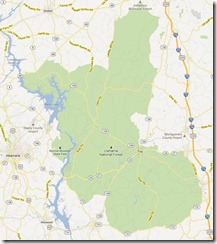
We carved a route down through the central Piedmont region of North Carolina, taking a southern route through Uwharrie National Forest on the way down and returning along the more northerly Uwharrie Scenic Byway, a little more than 300 miles round-trip.

Uwharrie is also the name of a mountain range and we were stunned at the highest crest on that route returning north and east to see a spectacular “Blue Ridge” type view of a mountain range in the direction of Durham. Uwharrie National Forest

I think it was probably the ridges of the small Cane Creek Mountain range that runs south and west from Burlington and Graham.  I kick myself for not pulling over to take a photograph but by the time it registered we were in descent.

A little known secret in state tourism promotions which are heavily weighted toward the mountains and beaches is that not only is the central Piedmont the most visited portion of North Carolina, thanks to the draw of cities such as Durham and Charlotte, but it is also incredibly scenic if you stick to state roads and especially scenic byways rather than Interstates. 

The Uwharrie is one of four national forests in North Carolina and at 51,000 acres it is the smallest.  It is an actively managed forest but it also features a primitive area in the northern portion and recreation areas.

It is also being used to reforest 100 acres of longleaf pines each year. According to the new book American Canopy, a huge arc of longleaf forests once covered 140,000 square miles stretching through nine states from southwestern Virginia to Texas, enough to cover every inch of North Carolina three times.

Beginning in the 1880s, this vast forest was “exhausted over the course of ten to twenty years” by northern capitalists.

The devastation of that period led to the establishment of forestry schools such as the first one here in North Carolina at Biltmore near Asheville.  Graduates were eventually hired by timber companies and helped usher in an era of sustainability.

The Uwharrie was purchased by the federal government during the Great Depression and made a national forest by President John F. Kennedy in 1961.  Today, longleaf reforestation already covers 800 acres in the Uwharrie.

But North Carolina’s 1.3 million acres of national forest are about much more than sustainable forestry.  Of the 7.5 million visitors to the forests each year, 48.5% go there to view scenery and 28% drive through them for pleasure, as we did last weekend, thereby adding to the renewable return on investment from these incredible  natural resources.

North Carolina’s current legislature seems bent on sacrificing the state’s natural resources, first turning the scenic roadsides over to outdoor billboard companies for clear cutting at no charge and soon for natural gas fracking.

Hopefully before it is too late North Carolina voters will intervene.

Friday, June 01, 2012

Biocapacity And Billboards

Located in Durham, North Carolina, where I live, Duke University takes sustainability very seriously, but someone hasn’t connected the dots for marketers there who are apparently still practicing desecration marketing.

As one of North Carolina’s largest private employers, Duke’s commitment to  sustainability is broadly evident from the comprehensiveness of its incredible strategic policy to “boots on the ground” elements such as the The Center for Sustainability and Commerce and The Environmental Law and Policy Clinic.

The hypocrisy of Duke’s health system marketers using static roadside billboards to promote Duke Primary Care while enabling billboard companies to circumvent Durham tree ordinances along state roadways with clear cutting may be lost on some but hopefully not on Duke officials.

The irony isn’t lost on marketoonist Tom Fishburne, whose image “eco-friendly” is shown in this blog.

Some of the most cogent alarms about sustainability are coming from the private sector including the essay by Hardin Tibbs on pages 7-10 of the current issue of FutureProof. 

Lamenting that a consumer focus is too short term and that “democratic governments seem increasingly populist rather than strategic, and wait for electoral pressure before risking policy initiatives,” Tibbs notes that this “leaves business in the hot seat.”

Tibbs provides evidence showing that we overshot the world’s biocapacity in the 1970s and by as much as 50% by 2007.  He argues that business “owns and controls the part of the economy that needs fixing.”

He illustrates that “global-scale sustainability” requires a strategic-challenge approach to turning “the three global system fundamentals” (resources, value and design) from “chains into loops” including .

I first began to follow Tibbs more than twenty years ago when he published the white paper entitled Industrial Ecology – An Environmental Agenda for Industry on behalf of Arthur D. Little Inc. a little more than a year after I relocated to Durham.

It is the first time I remember seeing the term “green corporation” and the idea of production “loops” that would incorporate environmental costs.  But my first understanding of sustainability goes back to a prediction in 1972, the year I graduated from college, which turned out to be right on the button.

Today, forty years after that initial prediction and twenty years after Tibbs’ model for industrial ecology, the widow for sustainability is rapidly closing.

He warns in the April issue of FutureProof that, if business doesn’t step in and rise to the challenge, “the global industrial economy will collapse within 20 years if we don’t reinvent it to work on different technological principles.”

As illustrated by bio-activ technology for businesses as small as the family farm, it isn’t just for the good of humanity, the environmental loop model is just good business.

Friday, May 11, 2012

Urban Timber Utilization Conference

Long before he was President of the United States, FDR used an example learned during his youth to help pass an amendment to the New York State Constitution that helped reforest that state's canopy from 25% to 60%.

NC Urban Wood Utilization
He had visited a town in Germany, whose residents, through careful management of municipal forest were able to enjoy the trees and pay for the cost of public services.  This should not be confused with the idiotic proposals recently made by a couple of state legislators to denude every roadside of North Carolina.

A workshop will be held in Durham, where I live, on June 28th to inform entrepreneurial opportunities to utilize trees from North Carolina’s 1.4 million acres of urban forest.  This is sustainable harvesting for trees that age out or fall during storms or are taken out by roadway expansion etc.

Currently such trees are simply disposed of, but expert panelists at the workshop will describe how these trees are being utilized around the country in part to help fund growth of urban forest canopy.
Click here to learn how to register.  The workshop is sponsored by the North Carolina Urban Forest Council.

Monday, April 30, 2012

A Stewardship Credit On Taxes

Ironically, I recently found myself in a conference room at the headquarters of the National Historic Trust for Historic Preservation in Washington D.C. within 40 hours of having witnessed Durham, North Carolina's Annual Tribute Luncheon last week in Bay 7 of the incredible American Tobacco Complex.

While placemaking is about much more than buildings, using several metrics, arguably no place has taken better advantage than Durham of their share of the $90 billion in federal historic tax credits that have been injected into local economies over the last 32 years to help invigorate the built environment’s contribution to sense of place across the country.

Of course, the Trust which was established back when I was born, is about much more than buildings just as “protecting and preserving scenic character,” the purpose for which I was visiting Trust headquarters is about much more than preserving trees or fighting things like outdoor billboards that blight scenic character along roadways and destroy sense of place in communities.

The Brookings Institution which is located just one building further down Massachusetts Avenue from the Trust estimates that between the time when the American Tobacco factories reopened in 2004 as a creative class center and 2030, 82 billion square feet of existing buildings in this nation will be demolished and replaced with new construction, fully 25% of the nation’s current building stock.Commercial Energy Use By Vintage

The projections have been slowed slightly by the Great Recession, but there appears to be little or no evidence that we’ve learned our collective lesson from the burst of the housing and commercial real estate bubble.

Hopefully, the rapid and broad-based embrace of sustainability as an American value will be enough to slow the churn and transform the ways we see land use and respond to growth as we understand how to incorporate both negative and positive externalities into free market decisions.

But every year, approximately 1 billion square feet of buildings are demolished and replaced with new construction even though buildings built prior to 1945 are far more energy efficient.

A few years ago, a good friend of mine who lives down in Raleigh, North Carolina confided that Wake County which includes a dozen or so separate communities there was burning an acre an hour in development which seemed to me far too fast to enable good land use decisions.

By 2030 84% of the built landscape in the South will have been constructed or adaptively reused and, 54% will be new construction built since the year 2000.  If we insist that new construction carry the true cost, maybe we can make growth far more sustainable while being better stewards of historic structures.

Until new development carries its true cost, it is crucial that Congress level the playing field by passing the “Creating American Prosperity Through Preservation Act” CAPP) which was introduced in February by Senator Ben Cardin, a Democrat from Maryland and Senator Olympia Snowe, a Republican from Maine to invigorate tax credits.

The CAPP Act will:

  • Drive development and job creation into smaller “Main Street” communities by increasing the tax credit amount to 30% for projects under $5 million.
  • Promote energy-efficiency and cost-savings by encouraging the use of energy efficient technologies.
  • Enhance the impact of the historic tax credit in low-income areas by eliminating barriers to nonprofit community-based developers.
  • Expand the 10% credit for the rehabilitation of non-historic buildings to include structures “fifty years or older.”
  • Improve to efficiency of state tax credits by eliminating the federal taxation of the state credits.

Fast Company writing, in part, this month about Durham’s adaptive reuse of several million feet of the city’s historic tobacco and textile factories using historic tax credits notes:

“One hundred fifty years ago, Durham-based entrepreneurs Washington Duke and W.T. Blackwell battled for tobacco sovereignty...Today, Durham’s innovation scene is kindled by tech giants like IBM, Lenovo, and about 140 other companies with stakes in the ground at the 7,000-acre Research Triangle Park...

Though Big Tobacco’s heyday has come and gone, Durham, you could say, is still smoking!"