Showing posts with label Utah. Show all posts

Wednesday, March 18, 2015

A Clear Difference

Maybe not in Salt Lake City which I visited over the weekend, but according to Gallup, Utah, is six points more conservative than North Carolina, where I live.

Yet last week the state legislature in Utah voted to bar discrimination against people who are LGBT, something done by individual cities such as Durham, NC but recently voted down in Charlotte, the state’s largest city.

Utah is slightly less liberal or moderate than my native Idaho, just slightly more moderate than North Carolina and more than four points less liberal but the measure passed by nearly 7-to-1 in the House of Representatives and nearly 5-to-1 in the Senate.

Yet it is unthinkable that the legislature in North Carolina, which does not mirror the state’s population when it comes to ideology, could ever reach a similar compromise as that in Utah.

I suspected the Utah law would pass when last month, during a visit to the Pacific Northwest, I saw three Mormon leaders announce the church’s support on the news, quite a turn-around from 2008.

By its actions, North Carolina’s legislature appears to be controlled by “regressives.”

Conservatives want to tap the breaks on progress, while regressives want to take society in reverse.  Nearly all regressives are conservative but only a tiny percentage of conservatives are regressives.

Here, we just happened to put them in charge.

Mormons know a thing or two about regressives too.  The church was founded as restorationist, meaning a return to the original Christian church.

From time to time, regressives have taken a toll, such as during a period in the 1850s known as the “Mormon Reformation.”

It was during this period that at least two of my ancestors who had crossed the Rockies for sanctuary against persecution and discrimination were sanctioned and forced by regressives to be re-baptized for questioning local church officials regarding civil decisions.

North Carolina, too, knows a thing or two about regressives from its past.

The state was ambivalent about the Civil War, with many areas outspoken against slavery and pro-Union until surrounded by secessionist states and threatened with economic isolation and retribution.

Next month, festivities in Durham will mark 150 years since the surrender here effectively ended the Civil War.  Within five years of the war’s end, Durham was known for Bull Durham tobacco adding warehouses to factories, and within a few years, even telephones.

But in 1870, many other parts of North Carolina had turned instead to regressives, joining the KKK which was centered one county over from Durham, while across the nation the Bull City was forging a progressive view of the Tar Heel state as the New South.

The KKK was revived at the turn of the century when a North Carolina clergyman published a book entitled The Clansman, soon adapted to film as The Birth of a Nation, and reinvigorated old racial stereotypes from slavery.

Corruption doomed that incarnation of the KKK, but a landmark Supreme Court decision in 1954 sowed the seeds of its re-emergence by 1960 among descendants of earlier regressives, fueled by rhetoric from a Raleigh TV newscaster soon-to-be U.S. Senator.

This history and more is available in a new documentary entitled Klansville, USA released this past January on the acclaimed PBS series, American Experience, and based in part on the excellent book by David Cunningham.

It is now also available via website or by streaming via Netflix.

By 1960 a few years after Durham became a center for the Civil Rights movement, descendants of earlier regressives resurrected the KKK in North Carolina vowing to stack the state legislature by playing on the fears of rural North Carolinians.

During the 1950’s Durham was busy helping to develop Research Triangle Park here, but it was also a training site for students conducting civil rights protests across the state.

Every few months, I drive up to the parking lot of Durham County Memorial Stadium to drop off e-waste such as old batteries and irreparable electric gizmos, or anything with an electric motor or charge cord.

Erected in 1959, four years after the Supreme Court desegregated public schools, the stadium was built for Durham’s “whites-only” high schools, a lasting monument to segregated schools at the very time legal action and protests were allowing black students to transfer to previously all white schools.

Desegregation such as this set off a resurgence of regressives and a third resurrection of the KKK.  One of those appearing on the documentary in footage filmed before his passing in 2005 is C.P. Ellis.

Ellis owned a Texaco station in Durham when during the early 1960s he joined the KKK and became the Exalted Cyclops for the clan here.  Membership surged across the state as school officials implemented policies to racially balance the schools.

Instead, whites, most of whom were poor, fled to private and parochial schools reducing public school enrollment in Durham by 40% during the 1960s.

The flight was even worse across the state and in less progressive communities such as Raleigh where the KKK had been instrumental in selection of a police chief in the 1920s, 5,000 KKK members rallied just months after a progressive had been governor from 1961-1965.

In the 1970s, the courts ruled that schools here must be racially rebalanced.  A committee to effect that change brought Exalted Cyclops Ellis together with Ann Atwater, a civil rights activist.

Together they each did something rare, even today. As documented in the acclaimed book, Best of Enemies by Osha Gray Davidson, they listened to each other and a friendship formed.

Regressives in North Carolina today don’t wear hoods and robes and only occasionally burn crosses, but their influence is still felt.  Helms used racially charged campaign advertising to win close reelections well into the mid-1990s.

You can hear echoes of regressives in myths perpetuated around water coolers to scare newcomers from living in progressive communities such as Durham or if they do to put their children in private or parochial schools.

Regressives are most visible behind the actions of the state legislature, abetted by peers to read only the misleading titles and subtitles on bills they submit, virtually erasing any memory of North Carolina being known as the New South.

The LGBT anti-discrimination legislation passed in Utah is a contrast and evidence of what it means to be conservative without being regressive.

North Carolina’s regressives ban the use of phrases like “climate change” in reports and meddle in local affairs, while hypocritically accusing the federal government of political correctness and meddling in state affairs.

The LGBT legislation in Utah steps forward not only in that area but pairs it with provisions granting the right of people to express religious beliefs in the workplace.

North Carolina will weather this renewed regression but it will take decades to mend all of the damage it has done including to the state’s reputation and psyche.

In the meantime, let’s just not blame their actions on true conservatives.

Monday, August 25, 2014

Retracing Touch Points Along America’s Loneliest Stretch

Nearly 30 years ago, I drove my venerable Porsche 911s Targa out across the Great Basin following a brief visit with my then 14-year-old daughter.

It was along a remarkable stretch of U.S. Route 50, a “blue highway” nicknamed “The Loneliest Highway in America,” a label proudly embraced after first used as a pejorative.

Of course, as they do on paper maps, secondary highways no longer show up as “blue” on digital GPS maps but as more of a goldenrod.  Just doesn’t have the same ring (smile.)

This is a fragment of the 1913 Lincoln Highway, the first automobile route across America, roughly following the old Pony Express/Overland Stagecoach route.

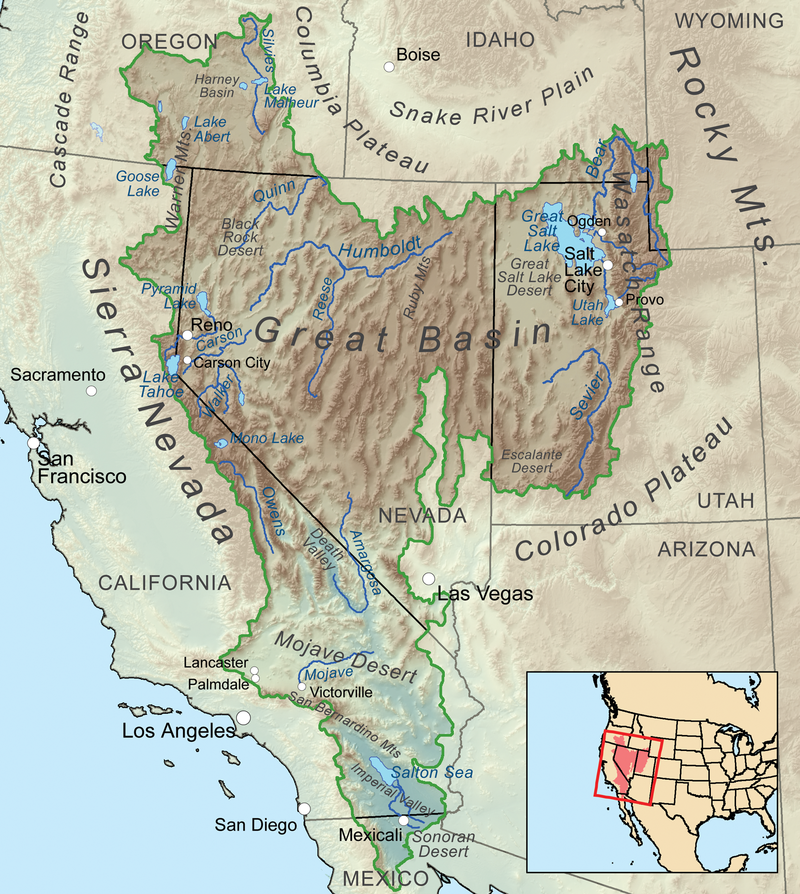
At its coarsest level, the Great Basin is a mild desert that covers western Utah and a tiny corner of Idaho, nearly all of Nevada skirting Las Vegas (Mojave Desert) into east-central California and up into eastern Oregon between the Cascades and Rockies.

The northern Nevada portion, where dissected by Route 50, is more specifically called Basin and Range because it includes a spectacular mix of steep mountain ranges, flat to rolling arid valleys and rangeland, and even alpine forests.

But the Great Basin got its name because rivers there materialize and then dead-end into lakes with no outlet or they disappear into “sinks” (dry lakes), e.g. the Great Salt Lake or the Humboldt Sink where that significant 330-mile river just disappears.

This was foreign to European explorers who understood only divides between watersheds where rivers ultimately opened into seas and oceans.

Part of my most recent cross country trip traced part of the route of an expedition led by two Franciscan priests in 1776.

It set out just as Americans along the east coast declared Independence, to find a trade route from Santa Fe to Monterrey.

They made it north as far as Utah Lake near the location of Brigham Young University but the maps drawn by expedition members reflected a misunderstanding of descriptions from Ute Indian guides.

Illustrations included massive rivers whose mouths had been earlier discovered along the Pacific Coast in what are now northern California and Oregon flowing from as far away as the Great Lakes.

Versions of these maps were in use right up until 1846 when further exploration by Captain John C. Frémont and Kit Carson learned of the existence of the Great Basin.

Accounts reached my Mormon ancestors weeks before my great (x3) grandfather Charles Shumway and his family led the way across the Mississippi in 1846 on what would be a 1,500 mile exodus to a new home in the Rockies above the Great Basin.

At the time of the Lincoln Highway’s conception in 1912, less than 9% of the roadways anywhere in America had improved surfaces such as gravel.

Many states at the time constitutionally prohibited such “internal improvements” forcing cities, towns and counties to go it alone.

Even by the 1920s, when the Federal government incentivized the states to build roads, Utah, still smarting from when a portion was lopped off in 1861 to create Nevada, refused to pave its stretch of the “Lincoln.”

To no avail, Nevada pled and even offered to pay for a portion so for a time the Lincoln Highway bypassed Utah cities.

My primary mission during that Route 50 hiatus from my career was solitude and time for reflection and forgiveness, but a secondary pursuit was to trace a portion of the lives of three ancestors.

My first stop was Fort Ruby, near the terminus of a stagecoach line that two of my great-grandparents, George and Eleanor White, operated for a time in the 1890s.

After their teamster years, my great-grandfather would landscape the upper campus of Brigham Young University which I would attend several decades later.

Fort Ruby would have looked as it does at this link, when one of my great-great grandfathers Tom Messersmith, served in the Union Cavalry there months after the fort was first established in 1862.

A fellow Missourian later joined by his friend Samuel Clemens (Mark Twain) as partner on a claim along the Comstock Lode.

But as news about the attack on Fort Sumter and secession by 11 Southern States arrived west, in October 1861, my great-great grandfather had crossed through the Sierra’s to enlist in the Union Cavalry in Stockton simply as “Tom Smith.”

When he had left his home county, an area from Jefferson City down to the Arkansas border. there were 169 slaveholders holding 987 African-Americans in slavery but few in his township.

Most of the state’s 115,000 slaves were concentrated along the Mississippi and Missouri rivers.

But Thomas Messersmith was a fourth generation German-American descended from Palatine Protestants who had fought for American freedom with the Virginia Militia as early as 1774.

German-Americans were among the small minority in Missouri who were outspoken opponents of slavery including small yeoman farmer/ranchers in the pastures and hills along the Osage River as it slices through the Ozark Highlands.

When he relinquished his claim with Twain to enlist, that area was governed by both California and Nevada, a boundary later settled by arbitration.

In the years before the Civil War, California, while voting to be a free state was staunchly Democratic.  Sympathetic to the South, Southern California had wanted to secede and join the Confederacy.

But Abraham Lincoln carried California in the Presidential election by six-tenths of a percent when the Northern and Southern Democratic candidates split the vote slightly in favor of the North.

Things were anything but settled as Tom enlisted with the Union.  A coup by Southern sympathizers to seize ports and with counterparts in Oregon to form a new “Pacific Republic” had been narrowly foiled.

Militias around the state were embattled both internally and with other militias to hold the Union together as federal troops were redeployed to the east.

A Confederate flag had even been captured flying in Sacramento two month earlier.

But as my great-great grandfather rode down out of the Sierras, Leland Stanford, a Republican was overwhelmingly elected governor over a Southern Democrat.

After enlistment in Company A of the 3rd Regiment of California Volunteers, Trooper Messersmith traveled to the Benicia Arsenal on San Francisco Bay for outfitting, then briefly deployed up to Fort Baker east of Hydesville and about 24 miles south of Eureka.

The assignment where hostilities with Chilula, Lassik,Hupa, Mattole, Nongatl, Sinkyone, Tsnungwe, Wailaki, Whilkut and Wiyot Native American peoples broke out in what is known as the Bald Hills War over disruption caused during a gold rush there.

While here, one of Twain’s letters asks his brother to forward some Spanish spurs he had left hanging in his office to my great-grandfather.

From there Company A was to join the rest of the regiment at Fort Douglas along the Wasatch Mountains above Salt Lake City but they were waylaid at Fort Ruby, Nevada where Shoshone Indian attacks and fear of Confederate militants threatened gold shipments along the Overland Stagecoach Route,  which were desperately needed to fund the Union war effort.

Then they were backtracked to Fort Churchill, Nevada to put down threats from Paiutes, finally arriving at Fort Douglas in January 1864 just as the 13th Amendment to the Constitution is proposed, ending slavery.

Fortunately, his unit did not reach Fort Douglas in Salt Lake until January 1864.

There he would have heard the details of a tragic battle (renamed massacre) on the Bear River less than 12 months earlier.

It took place ten miles north of the ranch owned by two other great-great grandparents who had helped establish the first permanent settlement in what is now Idaho and learned enough Shoshone language to interpret.

Having battled related Shoshone Indians for several months through Nevada, it isn’t clear where Tom Messersmith’s sympathies may have been as he heard about the slaughter.

Nearly 500 Northwest Shoshone men, women and children were trapped and killed by 300 troopers who lost fewer than 20 casualties.

Only after the war was it clear this was largest massacre of Native Americans in a single day ever by the U.S. Army.

But how my great-great grandfather lived the rest of his life and what he taught my great-grandfather tells me it may have bothered him much more than other troopers.

When his enlistment ended in October 1864, he had just turned 30.  He backtracked into the Great Basin along the old Pony Express route to Cedar Fort near Camp Floyd which had been dismantled when troops were called back east at the beginning of the war.

There he settled and was “persuaded” to become a Mormon.  Five months later he married my great-great grandmother “Lida” who had made the trek to Utah as a five year old.

Together they ranched sheep among the Skull Valley Indians, a Goshute band of the Western Shoshone native to the Great Basin, a band my great-grandfather would regularly take me to visit whenever we visited to take them food, something we did more frequently as I attended college along the the mountains across Utah Lake.

I wasn’t much older than my great-great grandfather had been when he settled down as I retraced that ancestral stretch along U.S. Route 50.

The landscape was foreign to anywhere I have lived and yet somehow familiar.

It may be the loneliest stretch in America but I found it ideal for reflection and rejuvenation.

As penned a decade earlier as he crossed that part of Nevada by Missourian and part Osage Indian, William Least Heat Moon, for his autobiographical book Blue Highways :

"The immensity of sky and desert, their vast absences, reduced me. It was as if I were evaporating, and it was calming and cleansing to be absorbed by the vacancy...."

Thursday, June 26, 2014

An Archaeology of Connections

While nosing around in my own history, I ran into some interesting connections that also relate to others.

In college at BYU I was named a Hinckley Scholar during my junior and senior years.  The private scholarship recognized a 3.8 grade point and “service to community.”

Many sought it for prestige, others such as me out of need.  Each grant was around $1,500 which in today’s dollars would be more than $8,000.

Among the 1,300 students the fund has recognized to date are Republican Presidential candidate Mitt Romney, a Supreme Court clerk and law school dean and three college presidents (no humblebrag intended – smile.)

But then there are a whole lot of folks like me, who also devoted their lives to community service.

Robert, the Hinckley son who, with his brothers, endowed the scholarship in 1954 in honor of their father, college professor Edwin S. Hinckley, was a “New Deal” FDR-Democrat.

What makes that particularly interesting is that Robert H. Hinckley also endowed the first of its kind bipartisan Hinckley Institute of Politics at the University of Utah where conservative-Republican-guru Karl Rove cut his teeth.

Rove is the operative currently floating rumors about Hillary Clinton’s health (one of his trademarks…remember swiftboating?)  At the Hinckley Institute he was taught to participate in politics and do it “in a decent and honorable way.”

As his mentor once lamented, Rove apparently only learned the first of those two lessons.

Bob Hinckley was a Mormon, who in his 20s cut his teeth in public service as a state legislator representing the overwhelmingly Republican Sanpete County which had been settled by my great-great-great grandparents in 1849.

Like his father, he was a liberal Democrat, but married into the family of a wealthy Republican rancher who grew Marino wool and bred Rambouillet sheep for export.

Then came the Great Depression and Bob Hinckley soon found himself appointed by President Franklin D. Roosevelt to oversee all New Deal programs in Utah.

This was at the time that some Mormon leaders, egged on by an influential former official in the ousted Hoover Administration, were bent on undermining the New Deal.

Fear-mongering about putting people on “the dole” reached such a fevered pitch in that state that Mormons eventually created their own “dole,” but during the Great Depression, it didn’t come anywhere close to relieving the need, including those of 75% of Mormons.

While Mormons are notoriously resilient and self-sufficient, Utah back then had the highest per capita use of federal welfare programs in the nation.

While Utah is about 40% active Mormon today, in the 1930s it was 65-70% Mormon.

For every tax dollar Utahans transferred up to the federal government during the New Deal, they received seven in return.

Another way to view it is that Utahans received ten times as much from federal programs between 1936 and 1940 as they did from Mormon Church welfare.

In actuality, Roosevelt's federal administrators such as Harry Hopkins hated “the dole” too, preferring work relief programs instead, according to Hinckley’s papers.

In 1934, for instance, Utah was hit by a devastating drought.  Ranchers turned stock loose and thousands of families were drinking from irrigation ditches.

Hinckley implemented a $600,000 Water Conservation and Development Program, putting Utahans to work drilling 276 wells, developing 118 springs, lining 118 miles of irrigation ditches and laying 98 miles of pipeline.

As Hinckley predicted, this saved the government several millions of dollars in relief.

It was also a year later that U.S. Forest Service research led to conversion of an old mining site into Alta Ski Area and the foundation of Utah’s reputation for snow skiing.

Robert H. Hinckley went on to serve as U.S. Assistant Secretary of Commerce and chaired the aviation administration during the construction of Washington’s National Airport and oversaw pilot training for WWII.

He was a driving force behind formation of the “Tuskegee Airmen.”

He also led a war effort to build strategic airfields around the United States.  This, along with aircraft technology fueled during the war effort, laid the groundwork for the subsequent explosion in air travel during the 1950s, 60s and 70s.

Taking his first flight in 1913 with famed female aviator Mellie Beese, he acquired a Dodge Brothers dealership in 1915 (touring car shown) which his descendants owned for four generations.

He founded Pacific Airways in 1927 and invested early in radio. Hinckley obviously had an eye for useful technology, innovation and entrepreneurship.

D.C.’s airport is now ironically renamed for conservative Republican President Ronald Reagan.

Even more ironic is that both Hinckley and Reagan would be considered moderates today while Mormons have become the most conservative faith in America.

Still more than 1-in-3 are moderate or liberal, more than 1-in-5 are Democrats or lean Democratic and 36% overall would like to see a bigger role for government while nearly 60% of Mormons overall believe environmental laws are worth the cost.

Hmm, so much for stereotypes I guess.  Why is this news to many Mormons?  Perhaps many are just softer spoken.

It was a Hinckley Institute Fellow and resident scholar at a conservative think tank who co-authored the recent bestseller entitled, It’s Even Worse Than It Looks: How the American Constitutional System Collided With the Politics of Extremism.

A quick read of this book will reveal why many otherwise reasonable people, when grouped together in control of the North Carolina General Assembly, have turned zany, mean and vindictive.

But the book’s author Dr. Jay Ornstein apparently did pay attention to the Institute’s full curriculum.

One of the easiest ways to spot today’s extremists anywhere is not only by their lack of empathy but by their serious deficit when it comes to ethics.

Two years before I was born, Bob Hinckley teamed with Ed Noble (of Lifesavers fame) in 1946 to found the American Broadcast Company, building it into what it is today, merging with Paramount and taking a 35% stake in Disneyland along the way.

Some of that ABC stock found its way into the scholarship fund from which I benefited in college.

I hope I’m able to repay that scholarship one day.  At one time it was the largest private scholarship endowment at BYU.  To return the irony, maybe Mitt would consider making it even larger, if he hasn’t already.

I have two other connections to Edwin S. Hinckley in whose name the fund was created by his sons.  He was born in Cove Fort, down by what is now Fish Lake National Forest in 1868, a contemporary of my great-grandfather Hyrum Edward Bowman.

His father Ira knew many of my earlier Mormon ancestors very well.  Those who created settlements south (most headed north where I was born) such as the Shumways and Sheltons, would have seen young Edwin playing as they repeatedly traveled through the fort.

Edwin graduated from BYU back when it was a combined high school/college academy and then took his family to Ann Arbor for graduate work in geology at the University of Michigan before returning to teach at BYU.  He retired after twenty years in 1915.

He then took charge of reforming the State Industrial Reform School for several years before returning to Provo to put his stamp on economic development.

Juvenile delinquency had reared its head among Mormons as early as 1868.  Gangs had formed by the 1870s including the “Squirter’s Squad” known for spitting tobacco juice on goods put out for sale resulting in creation of the territorial reform school in 1888.

Edwin S. Hinckley died on the eve of the Great Depression and didn’t witness his son’s role in the nation’s recovery.

He is famous for saying, "When one man says something can't be done, he is usually interrupted by someone else doing it."

His son Bob is famous for saying, “Democrats are for the people,” and “Republicans are for things…they favor property over people every time.”

A contemporary of my grandparents, he was also famous for saying, “I was just born lucky.”

Before I could say thank you, Robert H. Hinckley died just prior to beginning my final stint leading the DMO for Durham, but I’ve read and occasionally reread his autobiography, an oral history monograph.

Entitled I’d Rather Be Born Lucky Than Rich, it was published about the time I headed from Spokane to Anchorage to lead my second DMO and long before I made any connection.

I agree, and part of my luck was paid forward by him.

Friday, April 25, 2014

A Haunting Detour

Last year, after driving a spectacular 40-mile scenic byway on that leg of our road-trip out west, Mugs and I found ourselves on an unexpected detour as the sun began to set.

Apparently, a radical route revision for a restaurant we were headed to was so recent it had not yet made it to GPS.  When we finally found a place to turnaround, we lingered a bit to watch as the sun set on the the spectacular Kolob Canyons.

Where these unusual, almost crimson spires of Navaho Sandstone stretch along Ash Creek out of Zion National Park, I noticed a spot in our view where archeologists down from BYU had recently been busy excavating historic Fort Harmony.

Having turned 24 years of age a couple of months earlier, it had briefly been the home of one of my maternal great-great grandfathers, Marion Jackson Shelton, in 1857 after journey by horseback up the Old Spanish Trail.

Through the Kolobs on horseback, the fort was a few hours from where the horrific Meadow Mountain Massacre had taken place a few weeks before Shelton’s arrival after a five day siege.

Until his death two decades later from alcoholism, his brief stop along the trail at the site of the massacre would haunt him   For a few weeks, he found himself teaching the children of the only man who would eventually be executed for the murders.

Soon he was called 40 miles south back to Fort Clara and sent with other riders through the ancestral lands of Paiute, Hopi, Zuni and Navaho peoples in search for young children who may have survived the massacre.

His journey there began 4,000 miles away in west-central Illinois where he was born the year after his father’s service in the Black Hawk War after migrating there from a place in Virginia only a hour’s ride from my home in North Carolina today.

Marion Shelton’s mother died when he was two but during his early years he was given insight into Native American cultures by his grandmother’s story.

Mary Neely Spears was a friend of Abraham Lincoln’s, who, as a young woman, had spent two years in captivity by a small band of Shawnee, a story that must have weighed heavily on my great-great grandfather’s mind as he rode in search of similar captives.

In the 1840s he and his father joined a new, restorationist Christian religion, and when Marion was just 13, to escape religious persecution, they all fled for protection toward a part of the Rocky Mountains that was then a part of Mexico.

By then, coupled with the traumatic experience of his grandmother and hearing stories from Mormons who had been threatened with cultural genocide in Missouri, and now Illinois, after the murder of Joseph Smith, teenage Marion Shelton already had a firm sense of how dangerous and unjust the world could be.

But at the Missouri River his father joined the Mormon Battalion and with Marion and his new family, set off on what what would be the longest march in the annals of the U.S. infantry to fight in the War with Mexico.  At Santa Fe, however, the Sheltons were sent north to Pueblo with a sick detachment.

The next spring they set off north to follow the California-Mormon trail west, arriving a week after three of my other ancestors had arrived in Salt Lake Valley ahead of the vanguard wagon train of Mormons.

The Sheltons wintered in Salt Lake and then migrated to a fort built prior to their arrival by “mountain man” Miles Goodyear, in what is today Ogden, Utah.

But in 1849 they hit the trail again just as an effort percolated among “true believers” in the 18 year-old Mormon Church to purge it of non-conformists.

Known now as the “Mormon Reformation” it included oratorical devices that, taken literally, may have culminated in the massacre less than a decade later.

But the Sheltons may have just been drawn across Nevada, up and over the Sierras and down the Middle Fork of the American River to pan for gold by stories filtering back from fellow Battalion members there when it was first discovered.

By 1852 the Sheltons had enough to buy squatter’s rights to a ranch lying a hundred miles further southwest near Stony Point in what had been a 66,000-acre land grant ranch between the Petaluma River and Sonoma Creek and surrendered by the 1848 ratification of the Treaty of Guadalupe Hidalgo.

Judging by the diaries of Mormon missionaries who often dropped into visit, the Sheltons maintained connection, though lapsed, especially Marion who was in his early 20s.  But two things changed his world in 1857.

His father died shortly after Marion’s 24th birthday and word came that fall that all 40,000 Mormons should return to Utah to defend against an invasion of U.S. Army Dragoons.

Church leaders were also contemplating a mass exodus to the Bitterroot Valley in the Pacific Northwest, a part of what is now western Montana a hundred miles over the Bitterroots from the Mormon Fort Lemhi in what is now Idaho.

Marion Shelton turned over the ranch to a step-sibling, saddled up with a former Mormon Battalion officer and headed on horseback down California past Yerba Buena, what had once been a largely Mormon settlement recently renamed San Francisco, to Los Angeles.

The small party grew as the trail flooded with returning Mormons at San Bernardino then up Old Spanish Trail past deserted Las Vegas Springs, another Mormon settlement into southern Utah, and past the recent killing ground where 120 people from Arkansas, Oklahoma and Missouri were murdered on the route to California.

It will never be known what, if any, role was played by the paranoia of that time.  It could have been fueled by the cumulative effects of twenty years of persecution or the murder that spring near the Arkansas-Oklahoma border of Mormon Apostle, Fort Harmony founder Parley P. Pratt, or a literal interpretation of a oratorical device used by true believers.

In light of assassinations occurring today, we know the power that so-called oratorical devices have on people who take them literally, whether by radical clerics, or on talk radio, or by Tea Party partisans, or by leaders in hate groups.

There is never an excuse for this type of violence, even in war time, regardless of Old Testament lore.

And as evidenced by the memorial leaders encouraged the state to place at the site in 1990, Mormons today, some of whom who are descendants of those murdered, still mourn what happened at Meadow Mountain just as my great-grandfather must have done for the remainder of his life.

I sense his broken heart in the affidavits given to judges to things he heard subsequent to the massacre, precious because they give me a glimpse of his handwriting and the education he had gleaned during his witness of events during his ten year journey through history to that time.

He spent the next decade or more living with and teaching Hopi and Zuni people in their pueblos on the plateau of northeastern Arizona.  He worked hard, but in vain, to develop an alphabet for them.

He became fluent in Spanish as well as Hopílavayi and the Ute-Chemehuevi of the Southern Paiute people, just as two of my other great-great grandfathers did in the languages of the Shoshone and Bannock much further north. 

But the trails he blazed back and forth also in time became roads for settlers.  He eventually sought peace in the lush river bottomlands of plateaus further north in Castle Valley where my great-grandmother was born before Shelton died just six years later in Heber City, Utah, just as the Second Industrial Revolution began to take shape.

Marion Shelton was buried in Provo where I attended BYU, eight decades after his death, and where I first learned of and then visited Meadow Mountain on a cool haunting morning after spending a night with friends in the Kolobs in the late 1960s.

I hadn’t planned to return to Fort Harmony during last year’s road-trip, but I’m glad I did, if only to be reminded of Marion Shelton’s part of my heritage and to recall the remarkable history, places and events that shaped his life.

Wednesday, April 23, 2014

The Meridian of My DNA

My western heritage is sprinkled along settlements my ancestors created in the 1800s down the length of a route that would become the 1,100 mile U.S. 89, a “Blue Highway” stretching from Montana to Arizona.

The “Ponderosa belt,” as I call it for the dominant species of pine tree found along its length, stretches from the cusp of the Northern Rockies through Yellowstone and along my native Tetons.

It crisscrosses the Idaho-Wyoming border then drops down Bear Lake Valley and across the Utah line before jumping across into Cache Valley.  From there this ancestral spine tracks against the Wasatch Mountains as they split off from the southern Rockies.

Then it shoots straight down the high plateaus, alpine meadows, forests, and valleys of central Utah before jogging around the Grand Canyon and giving out on the last reaches of the Colorado Plateau as it spills across northern Arizona.

The roots of my longitudinal DNA never strayed more than a degree after 1847 along nearly the entire length of the 111th meridian west as it dissects the continental United States.

But Mugsy, my English bulldog and I, usually weave back and forth across this route using various scenic byways on the last leg of our annual cross-country-road-trips before collecting my daughter and two grandsons for a week of reunion along the shores of a lake in the northern Rockies.

These byways often take in one or two of the dozen or so settlements my ancestors created along the length of the meridian between 1847 and 1907.  Last year we took a scenic byway along state route 14 as it slices through alpine meadows between Zion and Bryce Canyon national parks.

This year, a different byway about an hour’s drive north will give us a glimpse of one of the world’s oldest and largest living organisms which was discovered when I was in college in the late 1960s by Dr. Burton Barnes, a forest ecologist at the University of Michigan.

Christened “The Trembling Giant” or Pando, this ancient 107-acre grove of approximately 47,000 quaking aspen trees near Fish Lake (8,800 foot above sea level) all share a singular root.  DNA tests by Utah State University geneticists confirm it is one huge clone weighing nearly 7000 tons.

Essentially all one tree, the 80,000-year-old grove is now in crisis.

In fact, USU scientists are rushing to find out why aspens are suddenly dying all over the west.  Aspens don’t grow from seeds.  The grove we’ll see in a few months are all stems off the same plant.

This is because as geneticists have learned, these trees now have three genes.  My uneducated hunch is the problem will have something to do with human activity over the last 250 years and the side-effects of both the first and the second Industrial Revolution which peaked in 2008.

The question is, “Will the far more environmentally friendly third Industrial Revolution now percolating ramp up quickly enough?”

From Fish Lake we return to U.S. 89 and drop 3,000 feet as we head up the San Pete Valley through two areas first settled among Native Americans by two of my paternal ancestors before they began to explore much further north along the route.

In fact, nearly all of my ancestors along this longitude of my DNA lived long enough to see the end of the first Industrial Revolution and the emergence of the second.

As we near the place where my grandsons live nestled on the slopes of the Wasatch, the haze of pollution often visible will be a reminder that 167 years of their ancestral DNA also lies along that same meridian.

They will be in or near their 30s when we reach the tipping point for the new Industrial Revolution now underway.  If too late for the aspens, will it be soon enough to save and restore our planet?

Wednesday, October 30, 2013

My Psychological and Geographic Typography

The results of an ambitious study were published two weeks ago.  It attempts to scientifically “map the psychological topography of the United States.”

I detect from the results that any creativity and innovation with which I am often credited may be the result of always living in states deemed in the analysis to be “relaxed and creative,” including California, Idaho (my native state,) North Carolina, Utah and Washington.

My near decade in Alaska is unaccounted because the analysis deals only with the “lower 48.”

An extroverted friend of mine jumped to the conclusion that North Carolina is extroverted but this state falls in a cluster identified by low extroversion, low agreeableness, average conscientiousness, very low neuroticism and very high openness.

From my experience here over almost 25 years, the description of North Carolina fits, but the General Assembly has been dominated by some outliers for the last three years, especially when it comes to neuroticism (smile.)

Read the study which was published in the Journal of Personality and Social Psychology.  It is far more enlightening than the red state-blue state typology, yet it includes political as well as economic, social and health correlations.

By the way, North Carolina is 51% extroverted like my friend and obviously half introverted.  Before retirement, I tested an “x” or right on the line between the two or about the state median.  In retirement, my truer tendency to introversion is apparent.

Of the other states in which I lived, Idaho and Washington were the most introverted in the study at nearly 60% and 70% respectively while Utah was the most extroverted at nearly 56%.  California, like North Carolina, was right on the line.

One way the difference is often explained is that both types are outgoing enough but extroverts draw energy from others while introverts are drained during the process of too much interaction and need quiet time to recharge.

I participated in a Durham Rotary Club adaptation of a progressive dinner event last weekend.  I felt drained by the large reception at stage one but rejuvenated by the smaller group of 8 in the middle which confirmed, indeed, that I am more introverted than extroverted in retirement.

If there are any vampires out on Halloween this week, it is as likely they are energy vampires as the blood sucking kind.

Introverted does not mean less open.  On that scale, Washington, which was the most introverted of the states in which I have lived scored second highest at 57% after California at 65%.

Idaho and Utah scored in the 45% and 48% on openness although the latter was far more extroverted.  I suspect Alaska would score off the charts on openness if measured.

My experience in less open states is that you have to incubate after arrival before being allowed to fully engage.  In Alaska, if you come up with a new idea the day you arrive there, you are immediately put in charge of the committee to make it happen.

That’s what I call openness.

Friday, May 17, 2013

My First Hand Guide To The Old West

Many people my age learned about the old west from Death Valley Days, a television show that ran from the time I was the age of four until I was in college.  It was hosted briefly by Ronald Reagan the future President’s last gig as an actor before he became a politician… or is that redundant?

But I had a personal guide to the old west during that span, one with first hand experience.  The youngest of my great grandparents, Ralph Messersmith, was born in 1879 just two years after Civil War hero Ulysses S. Grant was succeeded as President.  He lived until 1973 while I was in law school.

Most of my family were staunch, very conservative Republicans, but it is from Ralph, a proud F.D.R.- Democrat, that I gained an appreciation for more progressive policies, especially toward American Indians and other ethnicities.

He was a genuine progressive era progressive and very close friends with George Dern, a progressive governor of Utah and Secretary of War under Roosevelt.  Ralph pulled my sensibilities to the center, where they remain today.

He was born and lived all of his life in and around a valley where the Pony Express had skirted the sound end of the Oquirrh Mountains to head west along the edge of the Great Salt Lake Desert, a series of salt flats including Bonneville made famous since the 1930s for land speed records.

Many times Ralph drove me along the old trail, pointing out where the Express riders would change horses at the old Faust Ranch before it became a stagecoach route.

He would always describe how my great-great grandfather Thomas had passed the ranch as he rode east along the trail in 1862 as a Union Cavalry trooper in the 3rd California Volunteers, having recently saved the life of commanding General Patrick O’Connor during a skirmish with a band of Shoshoni.

Their mission was to protect the overland stage route used to ship gold east to fund the war effort to preserve the Union.  Thomas had enlisted following a not-so-successful mining venture with his soon-to-be famous friend Samuel Clemmons, pen name Mark Twain.

As his son would do, Tom went both by Messersmith and Smith, and both variations appear in Twain’s letters home.

They (and I) descend in part from German Palatines, who fleeing the frequent invasions from the French emigrated to America in the 1700s.  They settled in Pennsylvania, migrated to southwest Virginia and then to Missouri where my great-great grandfather was born and raised prior to accepting Twain’s invitation to join him out west.

Ralph brought to life his father’s memories of riding as a cavalry trooper through the adobe buildings of deserted Camp Floyd.  Until the year before it had encamped nearly a quarter of the entire U.S. Army at the time including the Second Dragoons, Fourth Artillery and Fifth, Seventh and Tenth Infantry units.

Ostensible they were deployed to put down a so-called Utah rebellion but historians now speculate that the Secretary of War at the time and namesake for the camp had sent as many federal troops as he could west because as a Virginian he anticipated the Civil War.

At Camp Floyd, the military units had been led by soon-to-be Confederate General Albert Sidney Johnston.  At the outbreak of the Civil War, these troops headed east with a third of the officers and a quarter of the troops joining the Confederacy.

By the next year when my great-great grandfather’s Union cavalry arrived, General Johnston had already fallen as a casualty at the Battle of Shiloh, a pivotal Civil War engagement along the Mississippi-Tennessee line with Union generals Grant and Sherman.

My great-great grandfather would have also ridden past Fairfield and Cedar Fort where he would eventually settle, marry, raise a family, ranch and herd sheep.  Ralph gave me a New York Times clipping describing that Fairfield, a village across the creek from the Camp Floyd, was also known as “Frogtown” because at the time it was “wholly inhabited by gamblers and “grog-sellers.”

For two generations of students, 1926-1944, Ralph had driven the first school bus from Fairfield to Cedar Fort, stopping along the five mile route to teach the kids how to properly and safely handle a rifle for target shooting and hunting.

He also shared with me his genuine affection for Skull Valley Indians, a band of Goshute, part of the Western Shoshonis indigenous to the Great Basin.  This band would bring their horses to Cedar Fort when Ralph was the age of my grandsons now and hunt in the nearby canyons.

A soon-to-be chief tragically died on one of these visits and the burial made a lifelong impression on Ralph who would always care for their graves on “Decoration Day,”  along with that of his parents.

On one trip to show me the narrow and stream-filled Skull Valley bookended by the Cedar and Stansbury mountain ranges, he stopped to point out what as he was growing up had once been the Iosepa (pronounced Youseepa) Agriculture and Stock Company.

By my visit it had become a somewhat eerie ghost town. The areas streams had also drawn herders such as my great-great grandfather.

The ranch was run by Polynesians he called Kanakas.  They had met with discrimination when as Mormon converts they had emigrated to Utah in the 1880s so the church established the ranch and nearby town for them in August of 1889.

But the harsh climate took its toll on a people native to places such as Hawaii.  It became a deserted ghost town by 1917 when most Kanakas had returned to the islands of the Pacific because the Mormons had erected a temple there.

Ralph admired their tenacity and gentleness and music.  He often used their story to reinforce upon me that discrimination such as the Kanakas and Goshute experienced was morally wrong and un-American.

It wasn’t until 1978 that the Mormon Church returned to the ethnic tolerance and acceptance of its roots.  A few weeks ago a new introduction to its scriptures notes that “records offer no clear insights into the origins” of that span when it wasn’t.

Even churches are subject to internal politics and factions. It is nice to see one that can overcome them.  However, that period may be the reason my great-grandfather was never active in the church.

Four years before he was born, his parents and other Mormons in Cedar Fort listed all of their property on a notification to the church that they were going to live the United Order, a religious collective. 

However, while many communities experimented with this approach at the time, Cedar Fort was cautioned to wait with the words – “Wait till the head moves, before the tail starts to wiggle.”  Within a few year the movement faded.

Ultra-conservative now, the Mormon Church has a long tradition of social and cultural innovation.

By the time I was in college the Skull Valley Indian families Ralph would visit a few miles from the Kanka’s ranch had dwindled from 20 families to just 2 but he continued to regale me with stories about the chiefs he had known such as Old Moon, William, Dick Mooni and Johnny Bear.

Each year when I was young, Ralph would go out before Christmas and buy several pair of beaded gloves as gifts for friends and family, one of several treasures I have lost during various moves.  He was also sure to stop and pay respects to 53 Kanakas graves on the old ranch.

Other than the kids buried in Cedar Fort during his youth, he never learned where the Skull Valley band buried their dead.

Sometime after my first year of college and one of Ralph’s final visits, more than 6,000 head of sheep mysteriously died in the area where my great-grandfather had herded his.

It turned out that the day prior, an F-4 Phantom strike fighter like the one my uncle was then flying over North Vietnam had dropped chemical weapons as an open-air test over the Dugway Proving Ground, a practice banned in 1969.

In his twenties, Ralph went up into the Oquirrah Mountains mining districts.  In Mercur he bought and managed a herd of horses for the Golden Gate Mining Company.  He also rode shipments as a sharpshooter and ran a livery stable in town.

Ralph was also elected to the City Council there and worked to run electricity to what is now a popular ghost town.  My maternal grandmother Erma Deane was born there.  It is probably also where he became close friends with soon-to-be Governor Dern.

Prior to that Ralph had served earlier in a similar capacity three miles south at Sunshine Mine where his lifelong friend Will Evans also ran the M & M Saloon.  Ralph definitely found more success in mining the old west for silver and gold than his father had with Mark Twain in Nevada.

He went on to own real estate and ranching interests.  During the Great Depression he ran the Lehi Rolling Mill, later famous as a backdrop in the 1984 movie version of Footloose with Kevin Bacon starring as a character with my first name but without the “y.”  A long way from his current roll in “The Following.”

During my great-grandfather’s time at the mill, my mother remembers her mom making underwear for her from used grain sacks with the logo of the various cereals still showing across her bum.

I gleaned even more insight from Ralph during weekend pancake breakfasts with he and and his son-in-law, my maternal grandfather Mark White while I was in college.

They were widowers and I wasn’t yet married.  Having grown up on a ranch near Yellowstone Park in Idaho, this is as close as I had lived to them.

Those times were priceless even if I had heard some of the stories countless times by then.  After breakfast we would sometimes take a ride out along the old Pony Express trail but this time I would drive.

In their 70s and 80s, Ralph and his friend Will, friends since they were seven and ten years of age respectively, would sit in their old sedan parked nose-in to “watch the girls go by” on Main Street in Lehi.

Ralph’s favorite song was The Tennessee Waltz and he often wore a black flat-brimmed, buckaroo style cowboy hat popular with Shoshoni.

During my last year in college, Ralph had to move from his tiny, one-bedroom house into a nursing home across Utah Lake in Pleasant Grove.  Will didn’t need that level of care but he asked to move into the same room to keep Ralph company.

Ralph began to fade during my last few visits, often confusing me with my mom.  My great-grandfather died a month after my daughter was born in 1973, one of his three great-great grandchildren at the time.

Unlike many who never know a great-grandparent, I got to know him for the last 25 of his 93 years on earth.  I’m fortunate to be one of the 24 great-grandchildren he had at his passing and even more fortunate for the lessons he gave me.

RIP great-grandpa – I wish I could visit on “Decoration Day.”