Showing posts with label Water Quality. Show all posts

Tuesday, July 07, 2015

The Significance of our Ephemeral Little Brook

On each morning’s walk before hiking up the slopes of what we affectionately call Mt. Rockwood in Durham, North Carolina where we live, we cross repeatedly over a small unnamed brook.

It is smaller than a stream and way smaller than a creek, or as we said growing up in Idaho, “crick.”  Seasonal or storm-fed waterways such as this make up 60% of the stream miles in America.

There are no fish that I’ve seen but it is certainly home to choruses of bullfrogs.  Similar to 53% of the stream miles in the United States, it is classified as “small, intermittent or headwater,” and like almost 60% of the stream miles in America, it is seasonal and/or depends on groundwater seeps and storms.

They are the subject of efforts in Congress right now, where, at the behest of special interests I suppose such as mining companies, frackers and maybe even developers, who want to exempt these most seminal of waterways from the Clean Water Act.

They have also enlisted more than two dozen states controlled by legislatures holding the same ideology. Here is a link to the definitions to which they object.

The one over which we zigzag each morning comes off a nearby hillside and after flowing through Rockwood Park, it feeds into Third Fork Creek, near its genesis, one of 14 watersheds in Durham.

Much of this fragile brook was protected when a developer named Willie Carver deeded the parkland to the City of Durham in the 1940s; apparently even before this area a little more than a mile from Downtown had been incorporated.

It was a time when developers innately grasped the importance of green infrastructure.  Maybe it should be named “Willie Brook.”

After joining with several other creeks, it now helps fill the 14,000-acre Jordan Lake, a drinking water reservoir south of Durham that outlets as the Cape Fear River where waters from the little brook flow another 200 miles and then into the Atlantic Ocean.

In the March issue of Scientific American, two UCLA scientists give the example that “If Earth was a fully loaded Boeing 777, then its ocean would have the mass of a single passenger.  As strange as it may seem, proportionally our planet is some 100 times drier than old bone.”

And it all starts with these small, intermittent, often epemeral trickles that originate from springs or seeps of groundwater and then combine with storm run-off to create tiny brooks that build into streams and then creeks and rivers.

Even though it is impossible for the Clean Water Act to achieve its purpose without dealing with these intermittent waterways, some in Congress today are seeking to exclude them rather than permit regulations adjusted to address a technicality.

They apparently aren’t listening to 77% of Americans including 58% of Republicans who want even stricter environmental protections.

Nor are they listening to the 155,000 members of Trout Unlimited or for that matter to the $114 billion that 33.1 million anglers such as this generate to the economy.

Many people assume sportsmen and sportswomen such as these are conservative in ideology and half are.  But overall they are all conservationists by nature.

According to surveys, nearly 40% of those who fish and/or hunt believe we have a moral obligation to confront climate change.

When the NRA speaks out against gun control, it represents only 1-in-4 hunters and even then three-out-of-four NRA households overwhelmingly support various controls such as background checks on private gun sales.

Nearly a third support bans on high-capacity clips and assault-style weapons.

Watersheds are often called basins from which various waterways collect.

Durham is divided into two major watershed that fall from each side of the ridge that runs through Downtown, along the railroad tracks.  But each of these break down into several others.

To the north they break down into six or seven watersheds, two that are intercepted to fill two Durham drinking water reservoirs. The remainder, fill Falls Lake, created here so it could be tapped for drinking water down in Raleigh, to make that city viable.

The two rivers tapped for Durham drinking water, the Flat and Little, originate from small headwaters in adjacent southern Person County and north-central Orange County respectively.

In fact, the north and south forks combine to form the Flat River just a stone’s throw from where Willie Carver was born and just before the river becomes a class I-III whitewater river in Durham after storms.

Another, the Eno originates in a 10-acre farm pond in northwest Durham, which after collecting Little River and joining with Flat River and filling Falls Lake spill down to form the 248-mile Neuse River before it flows into Pamlico Sound.

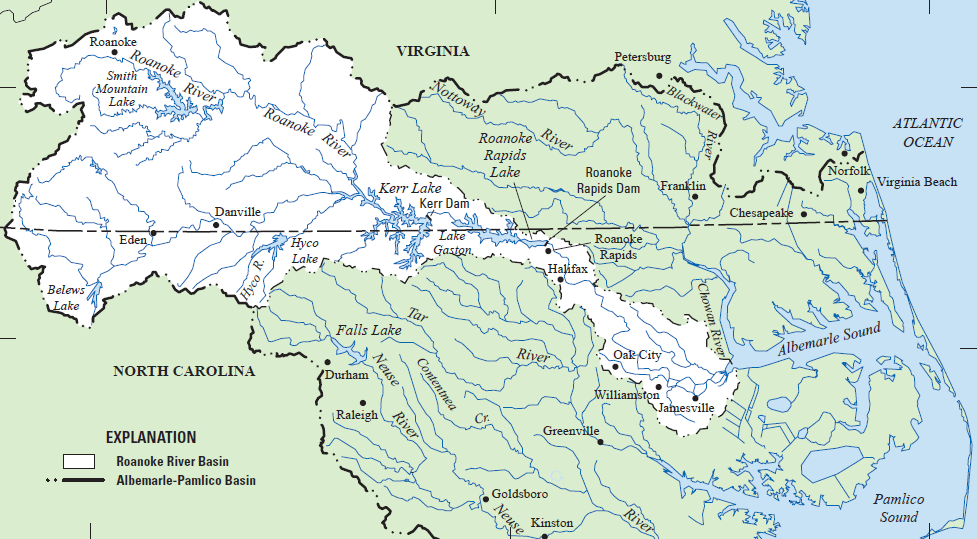
Hyco and Mayo lakes up along the border with Virginia north of Durham are part of the Roanoke River watershed.  That river originates in brooks high in the Blue Ridge Mountains of Virginia and flows down into North Carolina’s Albemarle Sound.

Headwaters are particularly vulnerable to land use changes which is why I’m guessing that special interests, and not just ideology, are behind the push to exempt them from the Clean Water Act.

Rivers are a continuum, a reference coined in a 1980 study that determined, “A river is more than a sum of its parts and that to understand what is happening at any point along the way, you must understand what is happening upstream and what is entering the watershed.”

In North Carolina, 66% of overall stream miles are in headwater streams and 38% are intermittent but because some major rivers and watersheds here are headwatered in Virginia, it is important to understand that state’s make up too.

In Virginia 62% of stream miles are headwater streams.  In the specific area where the Roanoke River begins its journey to Albemarle Sound in North Carolina, 58% of the streams are intermittent while 63% are headwaters.

Angler enthusiasts including many of the 1.5 million in North Carolina along with another 329,000 who visit have spent tens of millions of their own dollars to restore and protect these intermittent streams including 700,000 volunteer hours each year by Trout Unlimited members alone.

In many ways trout are the sentinels of clear water.  It is in these intermittent headwater brooks, streams and creeks that you find native trout such as the Yellowstone Cutthroat I marveled at as a boy growing up near the Henry’s Fork in Idaho’s the Yellowstone-Teton nook.

In North Carolina, it is the Brook trout that is native.

There are still 25 native trout species unique to regions of the country out of the 28 that once existed.  But according to the just-published State of the Trout report, thirteen occupy less than 25% of their historic habitat.

As noted by Chris Wood who is President and CEO of Trout Unlimited, “If you care about clean drinkable water, you should care about trout because they persist in only the highest quality water.”

They are also the “proverbial canary-in-the-coal mine for the effects of a changing climate.”

Monday, September 15, 2014

The Featherweight Menace

A comprehensive survey of litter across America in 2008 published a year later showed an estimate, by weight, of 5 million tons.

But that metric is less and less relevant.  Litter simply weighs less today.

That’s also why it is so difficult to believe it has been reduced by 60% since 1969 when the push intensified nationwide to curb this form of blight, including billboards, a legalized form.

Plastic overall contributed nearly a fifth of the litter stream back in 2008 but because of the proliferation of plastic bags and other types of plastic film, the next survey may need to find another metric other than weight.

That report also signaled that surveys focused primarily on roadways are no longer enough.

Other forms of litter declined by anywhere from 74% to 88%, but plastic in the litter stream has jumped an incredible 165%.

An even greater amount is now blighting areas other than roadways.

These off-road parts of the litter stream include transition areas to roadways, loading docks, construction, recreation and retail areas, urban and rural streams and other waterways (as shown below off Fish Dam Road in Durham near a tributary flowing into a reservoir here used for drinking water down in Raleigh.)

In streams and waterways is where plastic bags have become especially ubiquitous, threatening drinking water and even our oceans where they “form large, swirling, glue-like collection zones” in “gyres” comprising as much as “40% of the planet’s ocean surface.”

Having no local government agency fully accountable, places such as Durham where I live, rely instead on volunteer clean up efforts along urban and rural waterways here.Fish Dam

But no amount of volunteer passion can work without agency capacity in the interim, just as no amount of capacity can make a difference without public servant passion.

Public education efforts fail because they aren’t targeted.  Some are fearful of the apparent links between littering as a behavior, lack of education, smoking, depression, obesity, parenting style, poverty and drug use because it may reflect poorly on various groups.

This may be why those involved in cleanup steadfastly refuse to involve forensics or law enforcement to trace origins of litter.

Plastic film such as plastic bags is as light as it is ubiquitous.

This volume-to-weight ratio undermines its inclusion in far more scalable curbside recycling because judging from Madison, Wisconsin, it takes a year or more to collect enough in communities the size of Durham to have a full truckload.

Retailers such as dry cleaners, grocers and general merchandisers, 18,000 outlets in all, now provide recycling barrels for plastic bags.  They can do this because they merely back-haul them in returning delivery trucks and then forward this critical mass to recyclers specializing in turning them back into more bags and film or decking.

Still, while accessible by 70% of Americans, it represents only 18% of recycled plastic film, with curbside another 3%, as of a report on 2012 released this year.  This is only part of the 141 million pounds of consumer-returned plastic bags and wraps returned for recycling.

If the free market was efficient, the cost of cleaning up the bags that are not recycled would be built into their per unit price to recompense businesses and government units overwhelmed by the problem.

But the market isn’t that efficient and billions of dollars in costs are passed off on other businesses and taxpayers.  Because policy-makers are so fearful of anti-tax groups, as is often happening now, the bags clog storm drains, water ways, blight neighborhoods, suppress property values and threaten public health and wildlife.

Anti-tax enthusiasts are essentially believers in the idea of a free-lunch, a dole for the free market.

They tie the hands of officials to clean this sh*t up, leaving the cost of what little removal is done added to the cost of doing business, which gets passed along as higher prices for goods and services, reduced property values and public health.

The question is can we afford these zealots?

Of course, these are the folks who rolled their eyes at the news recently that policy-makers in California have prohibited much of the 14 billion plastic bags handed out by retailers there each year by banning their use in grocery stores and large pharmacies by 2015 and convenience stores by 2016.

According to USA Today, it also allows grocers to charge 10 cents for paper and reusable bags and provided $2 million in loans to help manufactures shift to a new model.

The loans make sense based on a report this summer that paper bag recyclers are moving into the recycling of plastic film such as plastic shopping bags.

The approach of banning post-consumer use is patterned after the success of similar bans by cities and counties.

Nationwide, Americans go through 110 billion single-use plastic bags a year, about 60 per family for every four trips to the store.  It has only been since 1982 that grocery chains began the shift to plastic bags.

Now we use about 60,000 every five seconds, much of which makes it into the litter stream along roadsides and in streams and waterways.

There will be some equally negative—if less visible—trade-offs.  If paper bags make their way into landfills instead of being recycled, they create more harmful greenhouse gases, breaking down faster than plastic bags which break down slowly.

Banning sales or distribution of plastic poop bags to clean up after pets will mean an increase in the toxic wastes in parks, beaches, businesses and the yards of innocent homeowners, not to mention storm runoff and contaminated drinking supplies.

No, all poop isn’t equal when it comes to microbial load.  A recent study along beaches for example have found that 1 dog “fecal event” was equal to nearly 7,000 bird “fecal events,” the next largest animal source.

America’s 83.3 million dogs (not counting those running wild) generate an estimated more than 32,000 tons of waste a day, enough to fill 285,000 fully loaded tractor trailers.

Two or three days of droppings from a hundred dogs is enough to shut down watersheds within 20 miles to swimming.  That’s a hell of a lot of microbial load.

As long ago as 1978, researchers in Massachusetts found that dog feces alone were sufficient to account for devastating closures of shellfish beds there.

A single gram of dog poop can contain more than 23 million coliform bacteria.  Even if people choose to use their own yard as a sewer, in a place such as Durham where each acre receives between 1 and 1.5 million gallons of water each year, it becomes a matter of public health concern for the entire community.

But other than making plastic bags water soluble and toxin free, what other option is there than to restrict their use?  I know they exist because I had to order them one year when we lived in an apartment and my dearly departed English Bulldog, Toady, developed Alzheimer’s.

In a fair world, only the 10% of Americans (including 15% of Republicans, 8% of Independents and 6% of Democrats) whose rabid anti-tax-ness hollows out the capacity to deal with problems such as this would suffer from the diseases and complications brought on by their shortsightedness.

Only the 17% of Americans who litter would shoulder the costs of cleanup.  Only the 15% of Americans who never clean up after their dog would step in it or have it pollute their drinking water.

But the world isn’t fair, nor is the free market sufficient until such time that it comprehensively incorporates “full-cost” accounting.

Tuesday, August 20, 2013

Revelations From An Underground Rocky Mountain Lake

The Rocky Mountain lake where my family rendezvous each summer is one of five sprinkled along the shoreline of a mammoth, 10-trillion- gallon, 800-foot deep lake that stretches more than 100 miles down the northern Idaho Panhandle between the Bitterroot and Selkirk mountain ranges and under Washington’s Spokane Valley.

Spokane, where I lived and worked for five years in the 1970s and Durham, North Carolina, where I worked for two decades (and still live) in visitor-centric economic development, are similar in size, both as communities and metropolitan areas.

Durham gets its water from surface reservoirs, but while Spokane is dissected by a large river, parts of which are free-flowing and surrounded by 75 lakes in a 50-mile radius, it pulls its water from this huge underground lake, using seven massive wells that don’t need to go down much more than a hundred feet.

What is now called the Spokane Valley-Rathdrum Prairie Aquifer was discovered by accident in 1894, five years after Spokane built a sewage system that discharged directly into the river. In 1905, engineers rediscovered the aquifer and three years later Spokane began taping it for drinking water.

It is now designated as the “sole source” of drinking water for 500,000 people.  Each day 250 million to 650 million gallons of water flow through the huge underground lake as rocks and sediment purify it.

That didn’t save the Spokane River.  Polluted by run-off from mines in northern Idaho, timber operations, manufacturing and sewage discharge, by 1938, it was deemed the “foulest” water body in that state.

By the late 1950s and early 1960s, a sea-change in concern for the environment was beginning to take shape.  The Center for the Study of the Pacific Northwest writes that this change in attitude is reflected by two international expositions, one in Seattle and one in Spokane.

The 1962 Century 21 in Seattle was a celebration of expansion and growth as had been the fashion for more than a century in the Pacific Northwest.  Little light was shed at this exposition on the costs of that expansion in terms of ecosystem capital but that was about to change.

By the time Spokane hosted Expo ‘74, twelve years later, business leaders eager to revitalize the community’s downtown through which the Spokane Falls cascade, and those seeking to clean up the river fused to give theme to a six-month, 10-nation exposition celebrating the environment and the community’s centennial.

At first I was hired to lend a hand as the fair opened, while jump-starting the community’s official marketing agency to pick up promotion after the Fair.  Its legacy would become the spectacular Riverfront Park and dozens of other visitor-related facilities.

By 1970, business owners and downtown boosters in Spokane had come to realize, even if somewhat superficially, that industrial blight along the river was an economic as well as environmental drawback.

Spokane officials and residents were beginning to fully grasp the importance of cleaning up the river, which continues today, because rivers have an interrelationship with groundwater and aquifers and that scientific realization had resulted in the federal Clean Water Act.

The area served by the Spokane Valley-Rathdrum Aquifer including my native Idaho, is as conservative and in many ways more conservative than North Carolina, where I now live.  But seemingly, instead of seeking to undermine environmental regulations as our lawmakers currently are here, both Spokane and the state of Idaho are pursuing progressive initiatives.

In-depth and ongoing scientific study of the massive aquifer began following Expo ‘74 and intensifies even today even across state boundaries.  Idaho is resource-rich but none is more valuable than water.

When I was in 10th grade and starting to frequent teen dances and sock hops featuring PNW rock groups such as the Kingsmen, the Wailers, The Sonics and Paul Revere and the Raiders, a constitutional amendment (Article XV, section 7) was passed in 1964 forming an Idaho Water Resource Board (IWRB.)

Even with 2,000 natural lakes, thousands of reservoirs including those as part of irrigation districts and 16,000 miles of rivers and streams, Idaho still draws most of its drinking water from groundwater.

As part of its mandate, the IWRB teams with federal agencies such as the Bureau of Reclamation to study river basins such as one now in draft form for the 127-mile Henry’s Fork, a world-class trout stream, along which I was born and spent my early years.

Plan objectives always center around water management, public interest, economic development, environmental quality and public safety.

In 1971, as Spokane leaders worked furiously on plans for Expo ‘74, lawmakers in Washington State passed legislation empowering cities and counties with what was called “conservation futures.”

Under the legislation, Spokane County levies a voter-approved property tax to be used solely for:

“acquisition of property and development rights to benefit wildlife, conserve natural resources, increase passive recreation and educational opportunities, and improve the quality of life for area residents.

Fifteen percent of the annual Conservation Futures levy revenue is dedicated toward maintaining, protecting and enhancing these properties in perpetuity.”

Voters repeatedly approved the assessments over the years, recently approving it without provision to “sunset.”  Over the past 20 years, the Spokane funds have been used to secure and maintain 7,000 acres in  15 areas managed by the County, 11 by the City of Spokane, one by the town of Cheney and one by the State.

I saw one of the sites during our lake trip last month.  It consisted of 421 acres of forest and wetland along 3000’ of lake shoreline, protecting ecosystem services and providing wildlife habitat and trails for hiking and horseback riding. Even a cougar sighting occurred there that week and I don’t mean one who will be playing for Washington State University.

Not all conservatives think alike.  While some in North Carolina seek to put huge landfills next to parks and refuges, surrender forests and water quality for roadside billboards and override local stream buffers, those in Spokane appear to have learned a lesson.

Economic development is never served when development is left unchecked and unregulated at the expense of trees, waterways, aquifers and quality of life.

Monday, July 01, 2013

Consuming An Olympic-Size Swimming Pool

In its annual report on water quality, Durham, North Carolina where I live included the EPA’s breakdown of how Americans use water in their households (shown in the image below,) but that represents only 4% of our per capita water footprint.

The strategic approach Durham has taken to water supply since the 1920s sets it apart from other urban communities in the state, an approach found lacking in other areas of local stewardship such as urban forests and maintenance of local roadsides.

I have enjoyed reading an excellent book published this last spring by Mark Tercek, a former Goldman Sachs investment banker, managing director and partner, co-written by science writer Jonathan Adams and entitled Nature’s Fortune – How Business And Society Thrive By Investing In Nature.

The thesis of the book is that nature, including resources such as water are a form of capital and infrastructure that must be accounted as a factor of market production.  Noted is that overall in 2004 Americans used over 655,000 gallons of water per person on average, “nearly enough to fill an Olympic-sized swimming pool.

Durham residents use 23,688 gallons of that in their homes (64.9 gallons per day,) about 11% less than the national average and nearly 20% less per capita than in the year 2000. But that isn’t how we consume 96% of the water use for which we are responsible.

The authors of Nature’s Fortune note that:

“…a liter of Coke in a plastic bottle requires a liter of water for the drink itself,

a liter for production and washing,

10 liters to make the bottle and

a whopping 200 liters to grow the sugar

– a total of 212 liters (56 gallons) of water for every liter of Coke.

This is applicable, I’m sure, to other soft drink brands.

Additionally – “Many other products have surprising footprints:  660 gallons for a cotton shirt, about 120 gallons for one pound of wheat and nearly 2,000 gallons for one pound of beef.  A typical American breakfast of two eggs, toast and coffee requires 120 gallons of water…”

In another report, entitled Wasted, scientists document that getting food to our tables swallows 80% of the freshwater consumed in the United States while using 50 percent of land and eating up 10% of the nation’s energy budget and yet 40% goes uneaten, wasted at various points in the supply chain, including our homes.

Through the way we handle food, we waste 25% of all freshwater in the United States.

Soon Mugsy, my English Bulldog and I will set out on our fifth, east-west, cross-country road-trip since I retired 3 1/2 years ago.  On thing that always stands out are the mighty rivers we crisscross including the Mississippi, Missouri, Colorado and Snake and often the Ohio and Columbia.

Iowa is one of those states that always over-delivers, not just because as a native of Idaho, I am partial to “I” states.  Iowa is dotted with streams and lakes but it is bordered on each side by the Missouri and Mississippi Rivers, both of which often visit that state with devastating floods.

It also rests at the center of a watershed that drains 41% of the United States.

Like my adopted North Carolina and native Idaho, the state of Iowa is conservative in make up, although where I’ve lived, I’ve always found a spot of “blue” or “purple” where a moderate Independent can thrive and there are one or two of those in Iowa as well.

In November 2010, by a two-thirds majority, voters in Iowa rose up in the midst of the Great Recession to amend the state constitution and approved the Natural Resources and Outdoor Recreation Trust Fund endowed with a portion of a 1% sales tax.

It stands in stark contrast to the zaniness of North Carolina’s legislature which has turned instead to trying to ripping out any conservation it can and in my opinion desecrating an amendment passed here to the state constitution in 1972:

“It shall be the policy of this State to conserve and protect its lands and waters for the benefit of all its citizenry, and to this end it shall be a proper function of the State of North Carolina and its political subdivisions to acquire and preserve park, recreational, and scenic areas, to control and limit the pollution of our air and water, to control excessive noise, and in every other appropriate way to preserve as a part of the common heritage of this State its forests, wetlands, estuaries, beaches, historical sites, openlands, and places of beauty.”

Instead of trying to redeem a reputation for being backward, as North Carolina’s current lawmakers are doing, the new progressive measure in equally conservative Iowa is being used to perpetually guarantee and increase funding for:

  • lake restoration (7%),
  • trails (ensuring Iowa stays first in the nation in multi-use trail-miles 10%),
  • augmentation of grants to enhance and protect natural and cultural resources (13%),
  • local conservation partnerships (13%),
  • watershed protection (14%),
  • soil conservation and water protection (20%) and,
  • to ensure funding of its department of natural resources (23%.)

You can already see the difference, including tile and drainage on farmland to capture and slow storm run-off, trees, and most of all in floodplains along the two huge rivers bordering each side of the state.

A study published in 2010 by researchers at Duke University here in Durham, calculated that public investments in wetland restoration along the Mississippi River’s alluvial plain, including a portion Mugs and I will traverse later this summer, pay for themselves in just two years.

These critical lands when left as or restored as wetlands are worth two and a half times what they are when converted to crops such as soybeans or cotton.  The study also found that restoration of wetlands can also be lucrative to landowners.

My Idaho-rancher dad would always mutter at what he felt was an unfair burden to taxpayers nationwide when people would rebuild after floods along these two rivers.  Very conservative for his time, he was hypocritical as many holding that ideology are because he didn’t complain when the same was done to control forest fires in Idaho.

But my dad was right about something.  We must learn to let floodplains be floodplains.

They are nature’s way of controlling flooding and ensuring water quality.  Instead, an analysis conducted for Federal Emergency Management Agency is estimating that by 2100, the number of homes in special flood hazard zones is set to double from 5.5 million today to 11.2 million,

The increased risk is not all coastal.  Check out the maps in the report showing the geographic increase every 20 years.

Proving that not all conservatives are alike, in North Carolina, Republicans controlling all three branches of government talk about the virtues of local control when it comes to shunning federal programs, but then try to lord it over truly local governments by trying their best to over-ride democratically adopted standards in cities, towns and countries.

A few years ago in Durham, where I live, developers, land owners, neighborhoods and citizens met for over a year to devise and adopt a measure to create 150’ buffers along waterways.  State lawmakers are passing a law to force Durham and any other community to reduce its buffers to the state standard of 50’.

They also want to force Durham to run water and sewer to a development that is deliberately trying to intrude where residents believe it will violate floodplain and threaten a water supply.

“I” states like Idaho, Iowa, Indiana and the vast part of Illinois may be as conservative or more conservative than North Carolina but they aren’t being stupid when it comes to water quality.

They can’t afford to be, nor can North Carolina afford the arrogance of the majority of its current lawmakers.  Iowa’s humility when it comes to nature was earned the hard way. We should follow its lead.

Monday, June 24, 2013

Peace. Frogs!

I’ve had a life-long thing for frogs and toads.  Today it is symbolized by a Peace.Frogs wheel cover on my Jeep, but it all began when my rancher father would let me catch scores of bullfrogs and salamanders.

He let me figure out on my own that I needed to punch holes in the gallon jar I kept them in for observation and eventually to “catch and release.”

My dad had a very practical matter-of-fact approach to life and death common to his generation, especially those raised on ranches.  Losing a few frogs was probably nothing to someone who had witnessed the horrors of places like the Nazi concentration camp at Dachau as it was liberated.

Shortly, I will be making an annual exploration of the shoreline of a lake with my grandsons that I also frequented beginning in the 1950s when I was their age.  Back then friends and I would fill a bucket each night with toads and enjoy a cacophony of frog sounds in the night air.

Now they are rarely if ever seen or heard along that lake in the Rockies and haven’t been since about 1980.

A scientific study published this year by the U.S. Geologic Survey found that at the current rate of decline, frogs, toads, salamanders and other amphibians that have thrived in our lakes, ponds, streams and rivers for 350 million years will disappear from half of their remaining habitats within 20 years, even on so-called protected lands.

The nine year census indicates the declines are even more alarming then thought.  Other studies point to destruction of wetlands and other habitats, drought, polluted run-off, invasive species etc., all brought about by us humans.

My wheel cover is much more than a reflection of the “the peace sign” for which I have been known all of my adult life or my 1960s bonafides.  These amphibians are a bellwether, a wake-up call for even the most jaded of cynical climate change deniers.

The declines are even greater across the globe, indicating that environmental policies and practices implemented here over the past 40+ years have moderated what may have been much worse without them.

Unfortunately, extremist lawmakers today seem bent on rolling back these protections, if not from pure hubris, then as payback to those they view as equally extreme.  The vast majority of Americans being asked to pay the price.

Many wreaking this havoc profess to be concerned about future generations.  They can begin by returning the joy of frogs and toads for my grandsons.

Thursday, March 28, 2013

The Compounding Irony Of Plastic Water Bottles

The numbers 1 through 7 inside the little recycling triangle on the bottom of plastic bottles refer to different resins.  All can go in curbside, collection center or retail recycling bins, but #1 and #2 represent 96% of all bottles produced and 98% of those recycled in the U.S.

The pounds per capita of plastic bottle consumption in the United States has tailed off in recent years to 2004 levels, just shy of 30 lbs. per person.  This isn't because we are using fewer bottles but in part due to the light-weighting by manufactures and bottlers in response to consumer concerns.  Some are using 50% less plastic than they did a decade ago.

In his excellent book published last fall entitled Drinking Water: A History, fellow-Durhamite James Salzman notes that these bottles are generally made of petroleum, an ounce for every liter bottle.

Unfortunately, the free market fails to incorporate full-cost accounting so the costs related to natural resource depletion, Naval patrolling of sea lanes, climate change, and the grinding down of highways by trucks are not factored into costs.

If these and other costs weren’t shifted onto an unsuspecting public instead, recycling would be even more attractive and 30% of consumers would possibly be much more diligent when it comes to the 30 million bottles they toss into trash cans each year instead of placing them in recycling bins.

It isn’t clear that even the use of full-cost accounting would “turn the lights on” for the 4% of Americans who consciously litter, especially those who cite being in a “bad mood” as the rationale.  However, it may inspire the 17% who litter just because they can’t be troubled to find a receptacle.

Bottles make up 3% of the litter stream in this country, far less in  states that require a deposit on bottles.  The effectiveness of these incentives was measured in a study published in a 2010, co-authored by Duke Fuqua School of Business marketing professor Dr. Joel Huber, and economics researcher Jason Bell here in Durham and led by Vanderbilt law professor W. Kip Viscusi.

The study revealed that these incentives increase recycling from 4.38 out of 10 where there is no regulation to 6.1 out of ten where there is a recycling law.  It increases to an incredible 8.34 out of 10 where there is a water bottle deposit law.

In the year 2000, Americans consumed 12 billion plastic water bottles, part of the overall 25 lbs. of plastic bottles consumed per person that year.  Within three years that more than tripled.

As of 2011, according to a Moore Recycling Associates report prepared for the American Chemistry Council and the Association of Postconsumer Plastic Recyclers,  28.9% were being recycled or 2,624 million pounds nationwide.

In my adopted home of North Carolina the rate of annual recovery for plastic containers overall is 27% or 36,046 tons with 95,377 containers improperly put in the trash or littered, a recovery loss of more than $40 million.

In 1990, less than 500 million pounds of plastic bottles were recycled nationwide.  By 2000 that had increased to 1,500 million pounds but it remained somewhat flat during the three years in which the use of plastic water bottles tripled.  Then the amount recycled began a steady climb in 2004, even continuing through the great recession.

That’s good news, but the even better news according to Salzman’s book, is that sales of bottled water have flattened since 2009, easing pressure on over-pumped aquifers.  Still, in the U.S. alone, more than 30 million bottles of water are shipped to supermarkets each year requiring as much as 17 million barrels of oil to produce.

Of the nearly 30% that are recycled, a total of 34% of all plastic bottle material of all types is exported, with 42.9% of the most frequently used resin being shipped to China.

Resin #1 is recycled into automotive use, more bottles and pallets, buckets and crates as well as plastic film and sheet plastic.  Resin #2, the second more prevalent is is recycled into non-food application bottles such as detergent, motor oil and household cleaners.

Colored #2 is repurposed for pipe, composite lumber, decking, railroad ties and non-food application bottles, but even more important than contributing to energy independence or preventing landfill and soil pollution is the contribution of plastic bottle recycling creates in terms of clean water resource conservation.

While it takes an ounce of petroleum to produce a liter plastic bottle, it takes three or four liters of water according to Salzman.  Even oil billionaires such as T. Boone Pickens see water now and into the future as our most precious resource.

Wednesday, January 16, 2013

More Than Disappearing Mountains

Last August as Mugsy, my English bulldog, and I guided our Jeep on an ascent into the Rocky Mountains for an annual lake rendezvous with family.  I wasn’t the only traveler to remark that the mountains that usually form a backdrop to Denver were invisible and apparently had been for some time.

Those of us native to the Rocky Mountain west realize that Denver is more in the High Plains than the Rockies. The only difference between there and Kansas or Nebraska is that you can usually see them from there.

The view of the mountains from Denver last August was obscured by haze from one of the 3,527 weather records broken in the US alone last year, this one for heat.

The mountains were further obscured  with smoke from a nearby forest fire.  But the view isn’t the only thing disappearing from that part of the world.

Ground water is rapidly deleting.  That means it is being pumped out faster than it can recharge.  According to a study released last year, some parts of the High Plains will be unable to support crop irrigation within the next 30 years.

Many officials tragically make the mistake of believing that because their communities rely on surface water from streams, rivers and lakes, such as Durham, North Carolina where I live, that they are immune from issues surrounding ground water.

However, ground water and surface water are interdependent.  Streams and rivers are not only the beneficiaries of ground water but they also contribute to it.  It is a mistake to believe that a process such as fracking won’t be hazardous just because a community relies primarily on surface water.Hydrologic Cycle - Jeremy Carlson

Where I grew up in the nook of Idaho framed by the Tetons, Yellowstone Park and the Continental Divide, water that has percolated for thousands of years through volcanic rock spews back out of the ground at 120 million gallons per day from a place appropriately named Big Springs, fueling the 127-mile Henry’s Fork of the Snake River.

Half way across my native Fremont County, Idaho, the famed fly-fishing river spills over both the Upper Mesa and Lower Mesa Falls, out of the mountains and down across the Snake River plain to its rendezvous with the South Fork near Idaho Falls.

The Snake River arcs just under the southern edge of Idaho’s 80 recognized mountain ranges to its rendezvous with the Columbia River and then the Pacific Ocean.  But the 10,000-square-mile Idaho aquifer the huge river dissects -- the one “famous for potatoes” -- is imperiled.  

Holding as much water as Lake Erie, since the start of this century it has been in crisis with more water being pumped out than the system can replenish.  Idaho is nearly covered by mountains, huge rivers and glacial lakes, yet 96% of the population is dependent on ground water for domestic water needs.

Ground water isn’t just at issue in the western United States.  Across the nation, ground water accounts for 22% of fresh water withdrawals, 37% of agricultural use, 37% of public water supply withdrawals and 51% of all drinking water for the total population.

More and more ground water is being depleted for industrial purposes.  Fracking is not the only industrial risk from ground water mining.

Some states such as Oregon have began to create “water banks, much as we have a national petroleum reserve.  Other communities such as Pocatello, Idaho are preparing to inject treated wastewater back to help recharge aquifers.

Every community should be looking at dual-water distribution systems such as those pioneered by St. Petersburg, Florida in the late 1970s and early 1980s. Relying on simply discharging treated wastewater back into rivers and lakes fails to grasp the full hydrologic cycle.

It is estimated that failure to act on climate change is creating an annual drag of $1.2 trillion in forgone prosperity, 1.6% of all global GDP.  Yet, the issue of desertification is not limited to the American west nor is it all about the increasing heat.

A new breed of “green” cattle rancher is riding to the rescue, using technologies practiced by wild buffalo herds to preserve grassland and reclaim land and ground water as well as reduce greenhouse emissions by using techniques that were used by my great-grandparents from both sides of my lineage.

Other westerners such as those working in the Western Wastersheds Project are working to bring free-market, full-cost (triple-bottom-line) accounting to the use of public lands for grazing as a means to do the same.

It is much too early to wonder as author Mark Binelli did last month, after witnessing disappearance of the same mountain view, “Will the West Survive?”  But it may be time for another road trip!

Thursday, January 03, 2013

A Perspective on Dual Distribution

On a road trip last month, a friend and I decided to turn due west outside of Jacksonville, Florida and take a quicker and much more scenic route to our ultimate destination bypassing Orlando and Tampa.

The route carves through cattle and horse ranches past Gainesville to our ultimate destination on a 40-mile-long peninsula that spans the 4 to 10 miles between the Gulf of Mexico and Old Tampa Bay.

The last leg of the trip dissected several huge wellfields this peninsula began to lease and develop in other counties just prior to the outbreak of World War II.  This occurred after it had first been noticed in the late 1920s that the water quality in St. Petersburg on the very southern tip of this Pinellas County peninsula was in decline.

This tiny strip of land had a permanent population of less than 60,000 people when it turned to wellfields in other counties for water.  Today, the population is nearing 1 million and everywhere you go, there are glimpses of a dual water system, one for drinking water and the other filled with treated wastewater used for irrigation.

However, this dual system with color-coded hydrants -- the first ever in a metropolitan city -- wasn’t innovated by St. Petersburg and then adopted throughout the peninsula as a means of reducing water consumption, although that certainly has been one of the benefits.

It was spurred by stiffer state regulations in 1971 pursuant to the Clean Water Act. The cities and towns and villages surrounding 2,201-square-mile Tampa Bay including the port of Tampa to the east were told they must significantly improve treatment of wastewater before discharging it into what is actually a series of four distinct and connected bays.

St. Petersburg officials weighed the costs of upgrading its treatment facilities but elected not to discharge into the bay at all.  After determining that nutrients were the most stubborn and difficult ingredients to remove, the community elected to team with the federal government through grants to develop a dual system that would utilize reclaimed water.

In this system, wastewater is treated to a point where it is all but drinkable and then redistributed through the dual system of pipes back out to golf courses, businesses, schools and homes for landscape irrigation, where it turns out the nutrients in the water create a savings and added benefit

Today, in Florida alone, more than 650 million gallons of reclaimed water is redistributed each day and used by 525 golf courses, 875 parks, 320 schools and more than a quarter of a million residential irrigation customers.

In the United States, urban reuse of water began more than 100 years ago when it was first used to irrigate the 1,017- acre Golden Gate Park in San Francisco.  Broad utilization of reclaimed water for irrigation has been around since the 1960s.  It is now as clean or cleaner than drinking water in many places and was proven safe to use on crops a quarter of a century ago.

As James Salzman points out in his new book Drinking Water – A History, some communities are now getting around the “yuck factor” by reinjecting reclaimed water back into aquifers and then pumping it back up as drinking water, although it is safe and tasty enough for direct distribution.

Salzman, who teaches at Duke University in Durham, North Carolina where I live, is not the only water-related contribution to Durham’s reputation as a place “where great things happen.”  Another example is taking place over a hundred miles to the west of Durham.

For a little more than a year, Duke University has teamed with Duke Energy to develop and operate a pilot project as part of the Durham-based school’s commitment to become carbon neutral by 2024.

Aided by federal and state grants, the project teams up with a 9,000-head hog finishing operation near Boonville, NC to capture hog waste in a huge bladder and process it into energy used at the farm and using natural processes to cleanse wastewater so that it can be used to clean out the barns and when ready to water feed crops.  The award-winning project has drawn investment from Google which will share in the offsets.

In addition to showing the way to reducing air and water pollution including odors, the pilot project shows the way for other agricultural operations to adopt full-cost accounting, also known as the triple bottom line, as a means to improve the efficiency of free-market capitalism.

While it is ironic that some lawmakers seem bent on exempting the free market from full-cost accounting, also known as the triple bottom line, it is heartening nonetheless to see communities, corporations and institutions that are continuing to pursue a more sustainable capitalism.

Wednesday, January 02, 2013

Assurance That Those Who Benefit Are Those Who Pay

I wasn’t just being snarky in a post on this blog, two and a half years ago, that called for Raleigh, North Carolina and a dozen other cities and towns in Wake County to pay the estimated $1.5 billion needed to clean up their drinking water source, located upstream in Durham, North Carolina, where I live.

Durham already made sacrifices to accommodate the creation of Falls Lake here in the late 1970s and to forgo or restrict development around the lake, making Durham County, the 17th smallest land area in the state, even smaller.

In 1905, six months after Republican President Theodore Roosevelt laid out, in his State of the Union speech, the regulatory role of government to ensure the common good, the New York State legislature passed a measure granting New York City the power to condemn land, build dams and reservoirs and regulate land use 120 miles north and west of the city in the seven counties and 70 towns and villages of the Catskill and Delaware watersheds.

Long before the release of his just published book entitled, Drinking Water – A History, I had heard Jim Salzman, a Boston area native who also lives in Durham, tell the story of how NYC came to pay for these privileges and the negative externalities created rather than just demand them through favored treatment from the state.

Jim teaches at Duke Law School, where my friend Ryke Longest runs the popular Environmental Law and Policy Clinic, but Salzman also teaches at the Nicholas School of the Environment.  In his book, he uses his background in history, engineering, law and policy to weave an excellent, fact-filled narrative in the tradition of such authors as John McPhee and Malcolm Gladwell.

In 1986, Congress passed an amendment to the Safe Drinking Water Act that meant that New York City would need to pre-treat the surface water it was accumulating and drawing from the Catskill and Delaware watersheds.  The EPA estimated the plant would cost $3 billion but NYC estimated it would cost $6 billion.

Instead, in the early 1990s, NYC tried to further tighten restrictions on development and farming in the seven counties including 70 or so towns and villages more than 100 miles upstream.

As you can imagine, “all hell broke loose.”  It might have been legal but it definitely wasn’t fair.  Like Raleigh and the dozen other cities and towns in Wake County, NYC was reaping all of the benefits but insisting that upstream cities and counties, such as Durham, shoulder the costs.

A Republican governor, George Pataki, stepped in and negotiated a memorandum of agreement between all of the parties.  NYC uses water bill assessments and bonds to pay for such things as conservation easements and to partner with improved sewage and storm water infrastructure in the upstream counties and communities.

NYC also uses the funds to incentivize ecosystem services at a cost much lower than a pre-treatment facility would have cost.

Unfortunately the free-market, unless prodded to do so, fails to incorporate the value of what are known as ecosystem services.  I first learned about the New York City watershed example in 2002, two years before Salzman moved to Durham to teach at Duke University, when I read a book called The New Economy of Nature co-written by Dr. Gretchen Daily at Stanford University.

Daily defines ecosystem services, which she had first coined as nature’s services in the late 1990s, as the natural systems that sustain human life.  Until recently, the free-market took for granted critical services such as pollination, water filtration, climate regulation, flood control, soil renewal etc.

Environmental economists have now computed the value of ecosystem services generated by trees and other natural elements.  However, many entities such as outdoor billboard companies seek instead to avoid incorporating these costs into the free market by manipulating government decisions, a tactic often identified as “legalized corruption.”

Another example of the failure to understand the free-market value of ecosystem services can be viewed by turning from the roadside desecration by outdoor billboards to the sandy mounds sprouting up every few feet along the medians dividing roadways such as the Durham Freeway.

The mounds are created by colonies of fire ants.  They could have been easily quarantined years ago and prevented from infesting the United States but companies hauling soil to construction sites lobbied to be exempt from rules about using only soil free of these costly invasive insects.

These companies didn’t want to shoulder the costs of using uninfested soil, persuading lawmakers to instead pass on the $5 billion in annual costs for medical treatment, damage and control as well as another billion dollars in annual crop and livestock loses to millions of unsuspecting property owners and businesses while cutting back on roadside maintenance along corridors the ants use to move. 

All of this is to say that the free-market is a miracle but only when it attributes full cost accounting and assurance that those who benefit are those who pay.

Friday, December 14, 2012

Vapor River Irony

Whenever a TV station in my area fails to show the weather for Durham, NC, where I live, but shows it for nearby Raleigh, it is almost always a sign that the sensor used is in neither city but at the jointly-owned airport located midway between Durham and Raleigh in Morrisville, NC.

In most cases, I realize that someone was probably tripped up by the dateline (merely the location from which the forecaster was working) used by National Weather Service’s central North Carolina office.

Of course, with numerous other weather services now available, including those that glean information at the neighborhood level such as the station I maintain for mine in Rockwood, cities and towns have been able to reclaim one more aspect of their identities.

Barrett Smith, one of the forecasters for this part of North Carolina, has written about the rivers of atmospheric vapor that were identified in 1998.  These rivers are 250 miles wide and travel about a mile high (about the height of Mount McKinley as seen from sea level in Anchorage, where I lived in the 1980s).

Vapor rivers carry as much water as 10-15 Mississippi Rivers.  Usually they impact the west coasts of continents, but one is now thought to have come up from the Gulf of Mexico to flood Nashville and other areas of Tennessee and Kentucky nearly three years ago.

My personal experience with one of these vapor rivers was while I was living during November 1967 along the mountains overlooking Los Angeles.  A vapor river trying to lift up and over the San Gabriels dumped nearly nine inches of rain within a few weeks.

It felt like someone dumped a couple of Mississippi Rivers’ worth of water directly on my neighborhood back then, and it is possible that forty-three years later North Carolina’s Blue Ridge Mountains saved my adopted home from the same fate as Nashville.

Climate change is sure to make vapor rivers more erratic and it is possible one may slip up the eastern side of the Appalachians to North Carolina at some time.  Unfortunately, even then it is unlikely to phase climate-change deniers.

Rising sea levels could inundate the coastal plain one day, turning that third of North Carolina’s geography, including Raleigh, into a “Doggerland,” recasting my hometown Durham as a coastal resort town and still, according to George Marshall, climate-change deniers would grow only more stubborn.

Marshall is the author of a humorous book entitled Carbon Detox, that makes climate change easy to understand.  He also blogs at Climate Change Denial, where he recently explained why climate disasters probably won’t influence the mind of anyone who doesn’t already have an open mind.

We human beings are horrible at detecting subtle environmental changes, and are becoming gradually inured even to less subtle changes such as blight and pollution.  It may take much more than being inundated by 15 Mississippi Rivers for some groups to open their minds to information.

I’m not persuaded that even a concern for future generations can unstick the stubbornness exhibited by climate-change deniers.  Maybe it will take another flood of biblical proportions such as the one created in Genesis 6:11 and 12 to cleanse a corrupted earth.

Now wouldn’t that be ironic!

Tuesday, November 27, 2012

When Explorers Grasped the Importance of Watersheds

Nearly a third of Americans (31%) don’t know where their water comes from, twice the proportion of places such as China and Singapore.  The proportion is apparently even higher among members of North Carolina General Assembly, in the state where I live, if you judge their flippant actions, subverting clean water for the benefit of out-of-state billboard companies.

Elected officials such as these who do not prioritize clean water fail to grasp or just don’t care that 83% of Americans are concerned about the availability of clear water for the future.

The study which indicates these facts and statistics isn’t part of any environmentalist plot.  It was conducted by the mega-corporation GE.

As illustrated in this blog, the source of our drinking water is found in the slogan for the now-150,000-member strong Trout Unlimited, formed in 1959 as I turned 11-years-old, which is “Protect – Reconnect – Restore.”

From his days as a river guide near the headwaters of the Snake River in the Yellowstone Ecosystem, where I was born and spent my early years, an elected office who is a friend of mine in Durham, North Carolina, where I have now lived for nearly 25 years, should have known better than to make the cynical comments recently attributed to him in public records and news accounts.

Administrators in Durham are wisely proposing to revert wetlands to filter 485 urban acres of urban run-off to protect water supplies for downstream communities and save the City millions of dollars in treatment.  To me this is a no-brainer and it should be to my friend too!

Early explorers always searched for the sources of mighty rivers.  The break-through that identified the ecosystem around Yellowstone as the “headwaters of the nation” came from observations by a U.S. Cavalry Trooper as he escorted and documented several survey teams there.

Then-Lt. “Gus” Doane, who had grown up in California and attended the University of the Pacific before enlisting to fight in the Civil War, learned that studying watersheds was a much quicker and more accurate way to identify the sources of waterways, according to George Black, author of a fascinating new book entitled Empire of Shadows: The Epic Story of Yellowstone.

During one expedition, Doane found himself overlooking a plateau in the heart of Yellowstone, rimmed by a perimeter formed by four incredible mountain ranges, the Absaroka (pronounced ab-soar-kah,) Teton, Madison and Gallatin.

They were broken only by the rivers that flowed in every direction and emptying basins along the Columbia-Snake, Green-Colorado and Missouri-Mississippi river systems flowing into the Pacific Ocean, the Gulf of Mexico and the Gulf of California.

Doane’s hydrological-breakthrough came from stepping back from the “trees to view the forest,” something he and others failed to do a few months earlier while conducting the Marias Massacre of an innocent band of Blackfeet Indians.

In part, federal elected officials in 1872 set aside Yellowstone Park as green infrastructure to protect water quality as New York state officials did Adirondack Park in 1892.  This took an incredible amount of foresight often found missing in elected officials today.

The several watersheds in Durham, like most places across America, are far more subtle but even more fragile.  Those who continue to dismiss the role of watersheds, wetlands, streams, and rivers as sources of clean water are what people along the Tetons in my native state of Idaho, describe as “all hat, no cattle.”

Tuesday, November 20, 2012

The Fingerprints of Change

The fingerprints of change are often evident decades before they are credited in narratives.

In the United States, concern for the environment is often traced to then-Republican President Richard Nixon’s announcement in 1970, the day after my 22nd birthday, when he laid out plans to establish the US Environmental Protection Agency, following the enactment six months earlier of landmark environmental policy legislation.

However, by then, concern for the environment at the federal level had been percolating for at least 80 years, beginning with the 1899 passage of the Harbors and Rivers Act under another Republican President William McKinley.

It was the states that pushed for central supervision of environmental matters and by 1913 the federal government began to study the health risks related to water pollution.

At the turn of the 19th century, Chicago, Illinois was seeking to stem forty years of typhoid outbreaks there, the disease that had claimed the son of Republican President and Illinois-favorite-son, Abraham Lincoln after sewage from army camps had polluted the Potomac River adjacent to the US Capitol.

Chicago rechanneled its sewage discharge away from Lake Michigan, where the city also drew drinking water, to the west and into the Mississippi River where it eventually found its way downstream and fouled drinking water for St. Louis, Missouri, creating one of the earliest environmental interstate conflicts.

According to sustainability historians such as Dr. Jouni Paavola, early in the 20th century, New York and New Jersey similarly clashed when NY objected to NJ sewage being rechanneled into upper New York Bay and NJ objected in return that garbage was washing up on NJ beaches after being dumped at sea by NY.Government and Water Infrastructure

In the 1920s, under another Republican President, Calvin Coolidge, federal agencies were first granted authority to protect migrating water fowl, regulate pesticides, study air pollution and control pollution from oil.

A week after my seventh birthday, in mid 1955, just a year after the US Supreme Court had desegregated schools and as officials were preparing the first nation-wide immunization of school children against polio, federal agencies under another Republican President, Dwight. D. Eisenhower, were first granted the responsibility to control and mitigate air pollution, 15 years before Nixon created the EPA.

Far from being a power grab, as it is stigmatized by many of today’s Republicans, the federal government centralized environmental protection only after attempts failed so miserably to incentivize control and standards at the local and state levels.

Today as many elected Republicans sabre-rattle in my adopted home state of North Carolina threatening to overturn environmental regulations including those that safeguard air and water quality, hopefully they are reminded that:


  • North Carolinians love their state and its beauty and sense of place.  The majority of voters in all three parties view what’s good for the environment as good for the economy.


  • As a North Carolina native and conservative Republican, who champions his party’s environmental legacy, wrote recently about environmental desecration: it “is as impious as it is imprudent. It is certainly not conservative.”


  • They remember the rule espoused by the late William F. Buckley, a famous conservative Republican, when he implied that anyone voting to foul the environment should first be required to similarly foul the area around their own home and family and neighborhood including the water they drink and the air they breathe.