Showing posts with label Workplace Evolution. Show all posts

Tuesday, October 21, 2014

The Engagement Elephant In The Room

People never accused me of being disengaged or uninspired during my four decade career in community marketing.

Mystifying until I began studying Gallup’s longitude studies of workplace engagement was that 70% of those with whom I had contact or tried to enlist for support were disengaged, 20% even working at odds.

Usually folks like that attack you for style but no matter how much I modulated my style or grew in my job, they remained at best a drag on community performance.

This breakdown of engagement is also roughly true of public servants and elected officials but no more or less so than among those working in large private sector organizations.

Researchers think 70% of workforce engagement can be influenced by management although it is a lot easier to hire engaged employees in the first place.

But it is a lot harder to influence the “unengaged” in corporate and public bureaucracies.  This is why I have so much admiration for those who can thrive working within large entities without losing their sanity.

Regardless of having a high level of personal passion and engagement, I had to work hard every day on learning how to manage people right up until I retired.  But I restlessly tweaked the culture of the small organization I led to compensate for my inadequacies, often achieving workplace excellence citations.

Being made a CEO in my mid-20s only meant I had a much steeper and longer learning curve as well intense pressure to continuously and never endingly improve.  I simply had to try harder than most to evolve.

In general, engagement is only slightly higher though among managers.  Females tend to be more engaged on average than males and engagement among both genders on average increases noticeably under female management.
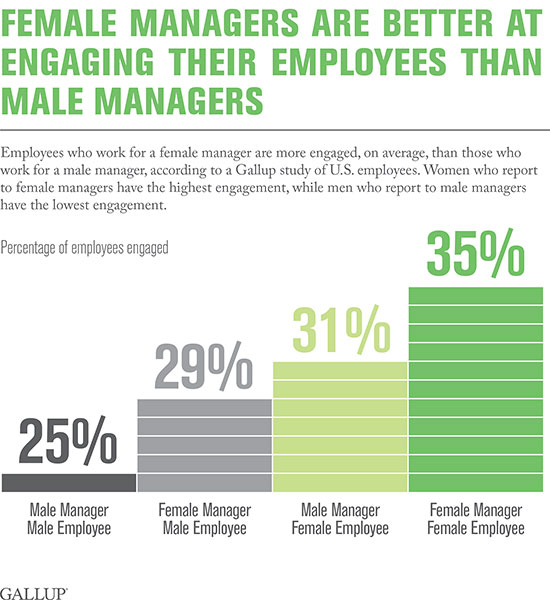
Studies also show that women are better at managing and less egocentric under stress and at avoiding risky strategies.

Equally problematic is celebrating successes in the workplace.

Engaged people tend to know how to celebrate their successes internally.  No amount of celebration seems to make a difference with those who can’t even when spoon fed.

Engagement takes shape in pre-school years when critical executive function skills are established usually as a result of parenting styles.

It is probably futile and definitely unrealistic to expect teachers, police officers, co-workers and management to somehow compensate, no matter how hard they try.

Society is greatly worried in this regard about young males and they should be.  Only 1-in-5 of this group is engaged or inspired by anything.  While more visible where poverty has taken root, this condition cuts across all socio-economic strata.

People who live in less ethnically diverse areas know that engagement/disengagement is not just about socioeconomics which is hard to accept for those intent on fostering social justice.

The roots of disengagement are put down long before society had any influence which is probably why all of the “reinventing” of management and safety nets over the years have not pushed the needle for engagement.

This is why putting all of our eggs in teacher quality or micromanaging curriculum or obsessively “helicopter” parenting will continue to have only marginal impact on engagement overall.

For a few years in the late 1990s, I worked with an educator who passed away last week.  Then at Durham Public Schools, he was a genius at mining data to spot patterns useful to understand and close gaps in student performance.

One thing that troubled him greatly was why the children of parents who had risen up from poverty or modest backgrounds to achieve degrees in higher education and who earned good household incomes, were trending downward in school performance notwithstanding these advantages.

As far as he could tell, the phenomena had been taking place for several decades, perhaps because parents assumed those conditions were enough to perpetuate student engagement.

Possibly because the condition might destabilize theories about correlations and triggers for student performance, no one seems to have unwrapped it further, at least that I’ve seen.

None of us are eager to accept where the true pressure point lies, not because becoming the greatest nation on earth has made us soft, but because it has to do with something so very personal, far more personal than even cultural or religious or political affiliation.

There simply are no requirements for having or raising children during the years when engagement is instilled.  No age requirement, no licensure or meaningful certification courses, no track record, no scorecard, no qualifications nor any kind of rating.

No amount of pressure on educators, police, courts or government can compensate for what isn’t happening during those first few years of life.

Even early intervention such as the renowned Harlem Children’s Zone can only mitigate and even then where replicated such as in Durham with the East Durham Children’s Initiative, its scalability is often hampered by lack of capacity and overarching emphasis.

In my adopted home, too many have attention deficit when it comes to being strategic which fosters grant-happy list checking and initiative-churn instead.

Where practiced with sufficient intensity, It has proven even more important to achievement than quality schools but inaccurately assumed to be important only for those in poverty.

But the problems that underlie disengagement among 70% of the workforce including managers are far more pervasive and systemic than socio-economic status.

The answers may lie in deepening and embracing research explained in books such as Mindset and Unequal Childhoods: Class, Race and Family Life.

Until we somehow deal with a parenting and pre-parenting as responsibilities not just rights, we’re just chasing our proverbial tails.

Thursday, November 14, 2013

The Supply and Demand of Workforce Engagement

Engaged employees may be especially important to economic development organizations because 7-in-10 “believe their city is a good place for people starting a new business,” according to Gallup’s recently released 2013 State of the Global Workplace report.

I suspect that is especially true of those in my former field who focus on demand-side or visitor-centric economic development such as is done by community destination marketing organizations (DMOs) vs. the more traditional supply-side form focused on business recruitment. 

Engaged employees are defined as those “who work with passion and feel a profound connection to their organization and more importantly to DMOs, their community.  They drive innovation and move the organization forward.”

Overall, that describes 30% of workers in the United States and just 13% across all 142 countries measured by not only Gallup’s extremely sophisticated Q12 metric but 18 other indices.  But before delving into the other 70%, a note of recognition is overdue.

Because Durham’s DMO just received its 5th Sloan Workplace Award since the diagnostic process was initiated 8 years ago, it is a safe bet that the organization charged with promoting and safeguarding Durham’s brand and sense of place has a much higher proportion of engaged employees, probably 70% or more.

Each year, Sloan independently surveys the employees of participants as part of the process.  The only other DMO to be awarded a Sloan this year was Dallas, among the 300 organizations in 250 communities to be recognized.

The American Institute of CPAs in Durham is also a frequent recipient.

So back to the 30% who are engaged, it must be the economy right?  Nope, that percentage has been essentially flat since the year 2000 so has the overall percentage who are not engaged (52%) and the percentage who are actively disengaged (18%.)

“Not engaged employees [52%] are essentially ‘checked out.’ They’re sleep walking through their work day, putting time – but not energy or passion – into their work.”

“Actively disengaged employees [18%] aren’t just unhappy at work; they’re busy acting out their unhappiness.  Every day, these workers undermine what their engaged co-workers accomplish.”

As he was pacing his headquarters after the Allied armies had liberated Sicily, General Dwight D. Eisenhower, who would be elected President of the United States less than a decade later, is quoted as saying:

“In any army one-third of the soldiers are natural fighters and brave; two-thirds inherently are cowards and skulkers.”

Cowards would be those who actively disengaged and skulkers, a term meaning to evade or lay back, would be the not engaged.  The British called engaged soldiers “gutful” and the actively disengaged “slinkers” but roughly agreed to the breakdown.

It appears that in even the most dire and dutiful circumstances the level of those truly and passionately engaged is about one in three.

Gallup’s breakdown today includes managers and executives, who are only slightly more engaged and 13% of whom are actively seeking to undermine those who are.

So how do some organizations manage to increase the percentage of their workforce who are actively and passionately engaged from 30% to 70%?  This also correlated to good customer service, accountability, innovation, productivity, profitability and more.

In addition to the “big three:” selecting the right people; developing employee strengths; and enhancing well-being, the report gives specifics on other best practices (in my words):

  1. Strategic Direction – A Culture of Engagement
  2. Linking Performance and Accountability
  3. Alignment and Hyper-Communication
  4. Continuous and Never-Ending Improvement

But I have a broader concern.  Of course, employers, public or private, are not really in the missionary business.  There’s only so much that can be done in the workplace to dial employees up.

But as more and more and more employers follow Gallup’s research-driven recommendations and engage in in-depth diagnostics such as Sloan, it seems the pool of engaged and engage-able employees may become increasingly tapped out.

At one end, as noted in an excellent piece in the Wall Street Journal this week about the current demand for degrees and the dangers of specialization, there is incredible anxiety among people preparing to enter the workforce.

On the other, it is clear that globalization and automation have not resulted in fewer jobs, just lower quality jobs.

As a society, we’re doing better than other countries but many in our society seem bent on dismantling upward mobility while others seem intent only to be enablers of non-engagement.

It seems we may need to become more engaged as a society overall to become more engaged at work.

Thursday, August 15, 2013

Disengagement’s Drag On Performance

It never fails.  Every summer there is a news article or two complaining about receiving work-related emails and calls when on vacation.

The real issue probably isn’t email.  It’s just a tool, in my opinion, that allows you to relax on vacation because you aren’t holding someone up or failing to address an issue that could grow into a full-blown “forest fire” if you don’t nip it in the bud.

The real issue is more likely one of lack of engagement.  Of the 100 million people in America who hold full-time jobs, 30 million are engaged and inspired at work.  That’s the good news, according to Gallup’s ongoing analysis of the American workplace.

Among the rest, 50 million are not engaged or inspired in their work and another 20 million are, well, “actively not engaged.”  I suspect the same holds true of the population in retirement or in school and may be especially true of many who run for elected office.

It is probably also true of the editors who repeatedly assign those stories.

Before you jump to the conclusion that lack of engagement must drive high turn-over, think again.  Gallup has isolated and quantified the relationship between engagement and nine different performance outcomes because engagement continues to be key to organizational performance.State of the Amercan Workplace

Lack of engagement is 2.6 times greater as a factor in “low employee turnover” than it is in “high employee turnover.”  In other words, low employee turnover can often mean employees have just “retired in place.”

Other studies show that thriving organizations strive for “continuing and never-ending improvement.”  On average, studies show that 20% or more of employees should either move on or be “moved on” each year because they have outgrown their jobs or the job just isn’t a good fit.

Low turnover can be of even more concern than high turnover to high performing organizations.  The best rule is a policy of “grow and go" for engaged employees who need to progress faster than an organization can accommodate them.  Of course, equally important is “moving employees out who are actively disengaged.”

One of the biggest drags on an organization by employees who are not engaged is absenteeism.  This is even greater than high turn-over.  Shrinkage or employee theft is also a bigger factor followed by safety incidents.

If someone complains about checking email occasionally while on vacation, that may be more an indication that they aren’t engaged in their work.  They are most likely to also complain or be unresponsive at work.

In my experience, a tell-tale sign of lack of engagement is the inability to resolve conflict.  Those who are “actively not engaged” probably also generate a fair amount of needless conflict, especially if they are passive-aggressive.

Email accounts for highly engaged people should probably be monitored by supervisors when they are on holiday until it is confirmed that they know how to limit engagement or to determine what may be creating unnecessary interruptions.

Fifty percent or more of every job is project management.  This means collaborating with other people and organizations.  It may also mean a fair amount of “putting fires out.”

Email availability is probably not be a burden, but a blessing for those engaged employees who do not want their absence to inconvenience co-workers who are “holding down the fort” while they are gone.  It also lessens the mountain of work waiting when they return.

For anyone for whom it is a strain, there are probably bigger problems to be addressed.  Engagement is also more important to employee motivation and organizational performance than perks.

Organizational size seems to make a difference.  Slightly less than half of the 100 million full-timers noted above work in organizations of fewer than 500 employees while 39% work in organizations with 10 or less.

The ratio of engaged to actively disengaged employees according to Gallup is 8 to 1 in organizations of 10 or fewer employees.  The ratio is only slightly better than 1.5 to 1 in organizations of 10-24 employees and also less in organizations of up to 99 employees.  From there, the ratio gradually increases again to a high in organizations in the 500-999 employee range before it begins to fall again.

The Gallup report also breaks down engagement by position.  Managers, executives and officials have slightly higher (6 points) engagement.  Of concern for the impact it may have on organizational engagement overall is that 51% are not engaged and 13% are actively not engaged.

At 29%, oft-maligned Government workers are only 1 point less engaged than American workers as a whole.  They are three points higher when it comes to “not engaged (53%)” but two points lower than American workers overall when it comes to being “actively not engaged (18%.)”

Longevity can be a factor.  In the first six months or less, 52% of employees are engaged.  It drops to 44% for those who stay three years or less and bumps up a couple of points for those who stay ten years or more.

Active disengagement bumps up four points between six months and three years and then another two points between three years and ten years.  The lesson is that the 8% who are actively disengaged in the first six months won’t get better given time beyond a trial period.

To me, tenure does not equate in the study with the danger of complacency but about 15% of those employees who are engaged at 6 months become disengaged or actively disengaged over time.

There are far too many organizations where disengaged employees who aren’t released during their trial period, are later made supervisors based on tenure.  The sad part is that this is where their active disengagement contaminates and demotivates others.

“Hire slow, fire fast” should be the mantra for high performing organizations.

The price to society of the people who remain unengaged or actively disengaged in their work over decades must be staggering.  Fascinating in the report is a breakdown of engaged, unengaged and actively disengaged by generational cohort.

Ironically, broken down by education, those with less than a high school degree are slightly more engaged than other educational cohorts.  The study reveals that having a college degree and higher earnings during a person’s lifetime does not guarantee engagement in the workplace.

Educational level is important to getting a good job and to earning more money but no guarantee to finding work that is personally engaging.  Part of this may be higher expectations and a sense of entitlement.

But those with a college degree are slightly less likely to be actively disengaged.  One thing is clear from the report, hiring more college graduates or paying more in salaries or indulging employees with perks is no guarantee they will be engaged and inspired in their work.

Monday, October 22, 2012

The Proven Productivity of Work From Home

Because they must try to remain operational during and after natural disasters by running lodging hot-lines and providing maps to emergency crews, community-destination marketing organizations such as the one I ran in Durham, NC, until retiring a few years ago, were among the first, at least in this community, to empower staff to be able to work from home beginning as early as the mid-1990s.

By 1999, the Durham Convention & Visitors Bureau (DCVB) was using the tool to provide workplace flexibility and to amp up already high productivity by another 20%. 

This is one of many reasons that organization has received four national Sloan Awards for Excellence in Workplace Effectiveness and Flexibility, after becoming the first DMO in the nation to be so recognized in 2005.

Between 2005 and 2010, the number of workers telecommuting in the four-county Durham metro area increased from just over 8,000 to nearly 11,000 which represents nearly 5% of the workforce.

The Durham metro area only appears to be below the national average of 10% because it provides such a large proportion of jobs for non-residents who commute in from in other metro areas.

Nationwide since 2005, the percentage of regular telecommuters has grown 66% while the workforce grew just 3%.  Half of the nation’s workforce is now able to telecommute at least part time.

I suspect the number would be even higher except that at least half of employers are ideologically conservative and not just because that group has been slower to embrace new things.

According to research done by Dr. Jonathan Haidt and others, a significant element of the moral matrix of conservatives is wrapped around the fear that people who are slackers will cheat the system.

According to the research in his new 2012 book The Righteous Mind, liberals tend to focus on fairness as equitable, while conservatives tend to focus on proportionality.

It is easy to put safeguards and monitoring in place to curb abuse, and there is evidence that there is less abuse from those that work from home than there is among those in the workplace in general.

Those who continue to deride the practice of working from home as “shirking from home” are well advised to read the results of an experiment by a major Chinese employer that was published a few months ago.

The study was led by Dr. Nicholas Bloom, an economics professor at Stanford University.

Something tells me though, that just as there are still employers who whine about receiving too many emails and instead of shifting to contemporary message platforms, still pine for the days of the snail mail in-box, there will always be executives who resist the concept of work from home.

They will be easy to spot fading away in your rear view mirror while still muttering about takers vs. makers.

Friday, August 26, 2011

Music Engages More Regions Of The Brain Than Anything

Many people who have been come to know her over her more than twenty-year career in community/destination marketing (DMO) have been surprised to learn that my successor in Durham has undergraduate and graduate degrees in music, degrees often cited as excellent preparation for admission to professional schools.

Music is obviously also a perfect preparation for running a DMO!

In her new book Now You See It, Cathy N. Davidson, notes that neuroscientist Dr. Daniel Levitin has discovered that “music makes complex circuits throughout the brain, requires all the different kinds of brain function for listening, processing, and producing in various forms and makes us think differently.”

Levitin, who wrote the book This Is Your Brain On Music,directs the McGill University Laboratory for Music Perception, Cognition, and Expertise in Montreal. He has noted that “music engages more regions of the brain than anything else.”

Additionally, in remarks at the University of Miami, he noted that “brain studies also indicate that components of expertise that contribute to superior performance include memory, attention, will power, belief in self, physical configuration and an ability to view multiple failures as necessary steps to succeed…”

One of Professor Davidson’s popular classes at Duke University substitutes the word “Internet” for the word “music.” The preparation materials for This Is Your Brain On The Internet, note that “the kind of research one does every day on the Internet helps one to think in a creative, collaborative, nonlinear fashion.”

Her new book makes the case that along with gaming, the Internet is giving us a model for how to reform public education. This month, we’re seeing the eighth class of first year students entering college who have grown up with the Internet as a given, a central part of the household, play and work.

Davidson’s new book makes a compelling case for a fresh look at the core benefits that subjects such as art and music bring to a holistic education. In the book, she also notes that the people who originated both the IQ test and the objective, multiple-choice exam, both warned against their use during their lifetimes and why.

Yet today, we find a major part of every class year devoted to taking standardized tests that measure only memorization and are largely irrelevant to the workplace. Davidson argues that the literacy skill to learn, unlearn and relearn must be added to the old three Rs of reading, writing and arithmetic.

Education according to Davidson must now include “three new Rs “rigor, relevance, and relationships.” Maybe innovation is right under our nose.

Wednesday, August 24, 2011

44% of Workplace Interruptions Are Self-Induced

I’ve spent all weekend reading and rereading an incredible new book, released just last Thursday.  It is entitled Now You See It – How the Brain Science of Attention Will Transform the Way We Live, Work, and Learn.

This book is a must-read for anyone concerned with transforming both the workplace and public education to better suit the world that has evolved so dramatically “since that fateful day in April 1993 when Mosaic 1.0, the first popular Web browser” unleashed the Internet for widespread use as the author notes. Capture

In full disclosure it is written by Cathy N. Davidson with whom I share a passion for Durham, our adopted hometown and whose work at Duke University, as co-founder of HASTAC and as an author are more reasons to believe Durham is indeed where great things happen.

This is one of those books where nearly every sentence reveals new research, information, insights and examples of why we urgently need to update both our workplaces and educational system.

Our current workplaces and the educational system meant to prepare us are both creatures of 19th century thinking.  The Internet has revolutionized the way we work and collaborate but the layout and rules of the workplace and the educational system largely remain stuck in the century before last.

Davidson humorously notes that Ichabod Crane, the schoolmaster in the classic 1820 book entitled The Legend of Sleepy Hollow, would be baffled today by electricity, moving images, computers and cell phones but he’d be right at home and find little had changed in today’s classroom since the horse and buggy days of Sleepy Hollow.

If you’re like me, you’re guaranteed to finish this book enthusiastic and optimistic about the changes we need to make.  You’ll also come away with a fuller understanding of how our brain works including the fact that it is always “on” and that 44% of workplace interruptions originate and 80% of our neural energy is consumed not from external sources but from the distractions in our own minds.

The question isn’t whether we can and must multi-task but when have we ever mono-tasked?  Researchers noted in the book have confirmed that switching from one specific task to another uses less than 5% of the brain’s normal “at rest” energy.

I really can’t do the book justice in the framework of one post but there is no one book I’d recommend more to anyone wanting to see into the near and long-term future of how we’ll live and work and learn and unlearn and relearn in this century.