Tuesday, May 06, 2014

Changes at the Margins for Local Businesses

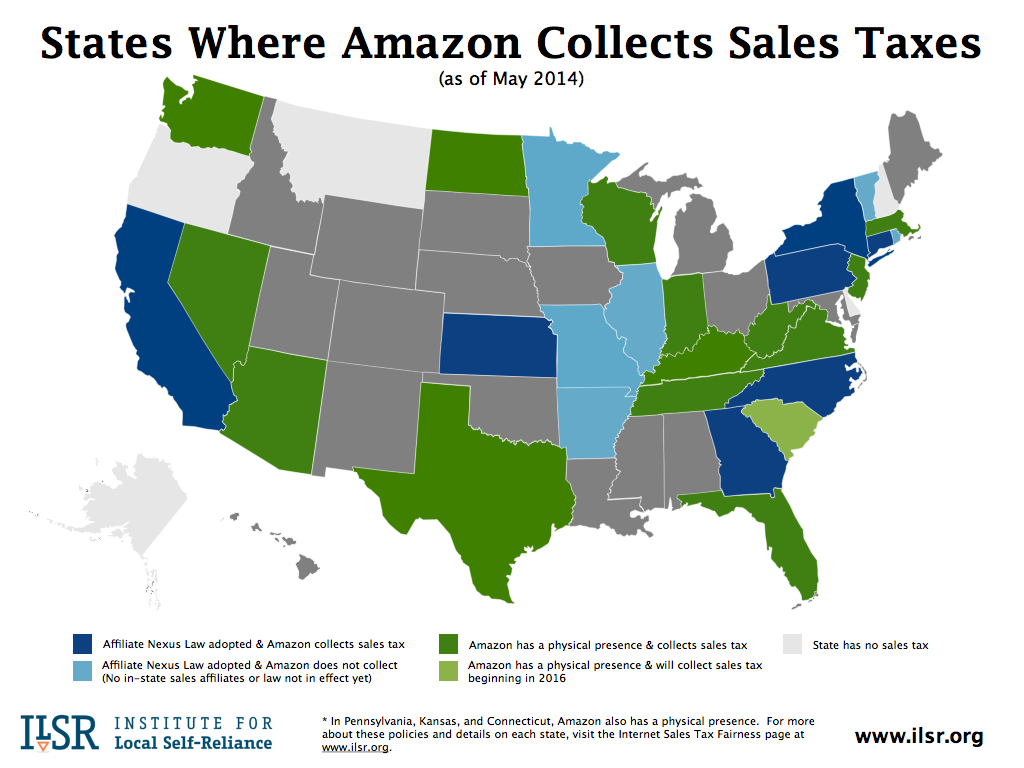
A new study published last month by researchers at Ohio State University Fisher College of Business found that finally requiring online retailer Amazon to pay state and local sales taxes in some jurisdictions results in a two percent shift in purchases back to local “brick and mortar” stores.

The study confirms several things about the effects of such taxes even at the margins.

One of my ongoing challenges during a four-decade career in community marketing representing three different areas was trying to help those in local government understand that increasing a sales tax, even by a point, is not free money.

Many elected officials were quick to grasp that at the margins even a one point increase has consequences.  It was the professional administrators preoccupied with only “pie-slicing” who were often the thickest.

Maybe price elasticity isn’t taught in public administration or public policy schools.  One manger even blew off the $40 million my organization spearheaded in annual tax revenue for local governments at the time by quipping that his job was only to worry about how it gets spent.

He went on to say to a room full of onlookers that revenue is  generated only when elected officials increase the rate of taxation.

This man was the quintessential poster child for why a fifth of small enterprises obsess about taxes and ridicule peers who support increases even when assured the expenditure will be used to offset any impact.

When I retired almost five years ago, a friend and former elected official suggested to the Sanford School of Public Policy at Duke here in Durham and the Institute of Government in nearby Chapel Hill that they seek my pro bono advice on how to better integrate revenue-generation in curriculums, but there was no response.

A momentary breakthrough in Durham, North Carolina, the last stop in my now-concluded career was when the DMO there commissioned for the benefit of local and state officials an economist to compute the impact of sales taxes on lodging, retail, foodservice, transportation and entertainment, all industries in the tourism sector.

It was beneficial and hailed as a best practice.  Some took note of recommendations on how to offset such increases.

But it was not enough to relieve the preoccupation by some elected officials and administrators with budget pie-slicing, a distraction from what should be an equal concern with revenue-generation and cost-benefit metrics.

Of course, there are also a few surprising enablers.

Ironically, the very businesses who oppose levying a tax on their own customers are often the most engaged in pushing for government incentives or tax breaks or even increased taxes to be levied on some other businesses but for their benefit.

Too often the governments paying heed to these requests can’t seem to be bothered to detail stipulations to fully benefit the local economy and ensure that these breaks aren’t used to displace business from existing concerns.

So subsidized businesses often seem to be invested instead in securing non-local vendors or formula stores that will hollow out the very local, independent concerns that make a place a place.

This isn’t the only way local and state governments seem aloof to the plight of truly local businesses, most micro businesses or entire organic districts.

Often without any strategic plan for enabling these place-based assets so critical to sense of place, they enact ordinances that often undermine them by driving up the cost of doing business such as parking and rental rates.

Recent studies show that these factors are of far greater concern to truly local businesses, more than most concerns, especially regulations.

Even leveling the playing field after granting 15 years of de facto tax advantages to online retailers, won’t be enough. While restoring tax coffers, the change has ten times the benefit to other online retailers than it will to local “brick and mortar” stores.

Local governments are the beneficiaries of local, independent businesses because when leveraged by community marketing they are far better for visitor-centric economic and cultural development than formula stores, but their ecosystem is oh so fragile.

This is why it is so bewildering when those in communities such Durham where sense of place still thrives, are so oblivious to the need for indepth strategic plans to guide the nurturing of pillars such as urban forest, local-independent retail, wayfinding and general upkeep.

One was done here for the cultural aspect at the insistence of Durham’s DMO when a new tax on visitor businesses was sought.  But plans, of course, amount to nothing without aggressive, energetic and disciplined long-term execution.

Well-meaning elected officials need to connect the dots for themselves and administrators between these factors, revenue optimization and quality and sense of place – before it is too late.

Monday, May 05, 2014

#2 – Really?

I may not be fair that travel and tourism is compared with true industries in the Harris Poll’s annual reputational ratings.

Tourism is actually considered a sector or cluster of six or seven industries that have customers in common.  Since several of these are listed separately, there must be more to the story.

But it is truly impressive that it ranks #2 right behind technology with only a few businesses ranked in the top 20 or 30, if you don’t count secondary suppliers.

More than that, it is amazing the general public isn’t nailing travel and tourism overall for the logistical hassle it is to travel, billboard blight along highways, communities that have sold their sole to be “Anywhere USA” and the crushing experience of mega-hotels and mega-cruise ships not to mention public health concerns.

The poll ranks on the basis of perceptions related to social responsibility, emotional appeal, visionary leadership, financial performance, workplace environment and products and service.2014 Harris Reputational Poll

For anyone new to the “Triple Bottom Line,” it is clearly incorporated.

Significant for travel and tourism is that  positive ratings hovered just above 50% a couple of years ago.

More to the point that Harris must use a bifurcated notion of travel and tourism when it clusters the results by so-called “industry,” is that this year the positive ratings rest at 59% for retail (the activity with most tourist participation) and 34% for airlines.

Clearly travel and tourism taken as a whole would likely fall several places lower on the list.

Making every industry or sector feel good is that they aren’t government, which receives on 13% positive.  But of course that is more a reflection of the constant flood of pejoratives perpetuated by the Republican Party in general and special interest lobbies for these industries.

Lost now on the public is that without roads, bridges, airports, forests, parks, wildlife refuges, urban forest preservation, ordinances that reduce blight, litter cleanup including rivers and streams, water, curbs on air pollution, solid waste removal, consumer protection, community and destination marketing and dozens of other things facilitated by government…

Well, there would not only be little or no travel and tourism but very little reputation left for any of these industries to coattail.

In fact, blinded by hubris and egged on by partisan extremists, this is lost on much of corporate America as well, many who argue that government provides these benefits only through transfers called taxes.

My response is “and your point is?”  Clearly for all of its merits, the market is not capable or incentivized enough to provide these benefits on its own and “TBLers” understand that.

The poll also shows that this is also not lost on an increasingly discerning public.

Saturday, May 03, 2014

Infographic - Where Amazon Now Collects Sales Tax

Friday, May 02, 2014

My “Commons Sector” Roots

I was born and spent my early years as the scion of generations of Idaho ranchers.  While I didn’t grow up to be a cowboy, both this heritage and my now concluded career will be the future.

These were homesteader entrepreneurs who had shaped small family businesses growing horses and cattle along with related feed in the coldest corner of Idaho where that state presses up against the Tetons and Yellowstone.

They were extremely independent and conservative Republicans, but  probably more moderate by the standards of today’s “wannabees.”

They practiced a hybrid form of capitalism, a fusion of government,  private market and Commons, when they formed an association in 1906 with other ranchers and farmers to dam and create Upper and Lower Arcadia Reservoirs eight miles above our ranch.

Using right-of-ways granted on public lands, and leveraging government backed market capital, these homesteaders created these impoundments in the Commons up where forests spilled out of what would in a few months become Targhee National Forest.

They also created a system to distribute the collected water over more than 2,000 acres.

Self-governed, each participant drew “shares” of water commons just like Swiss Alpine pasture commons had been run for centuries before some of my ancestors migrated to America in the 1600s and still are.

Just north in the Island Park part of that county, non-Mormon Swiss homesteaders and ranchers imported these practices as well.

But my Mormon ancestors learned to apply it to irrigation from the observations of missionaries returning from the Holy Land, Lebanon, Syria and Egypt.

Returning Mormon Battalion members also reported similar techniques being used by Mexicans as they marched passed Santa Fe during the U.S.-Mexican War.

I remember being greeted with awe on the first day of school because schoolmates were already familiar with a story of how my grandfather, using a 30-30 rifle, had fired a warning shot over the head of a church bishop.

He had been out stealing more than his share of water while members of his congregation were busy attending Sunday school.

I knew, however, that the rifle never left the rack of my grandfather’s Jeep.  He was soft-spoken and gentle and a noted horse whisperer but he was certainly no Jackass Whisperer.

The Commons are very effective at self-governing, including meting out penalties as detailed in a book published shortly after I moved to Durham by the Nobel Prize-winning economist Dr. Elinor Ostrom entitled, Governing The Commons: The Evolution of Institutions for Collective Action.

Dr. Ostrom was also an expert in incentivizing sustainability and it was her studies that confirmed for me that polycentric regions of distinct and separate communities such as the one co-anchored by Durham, where I live, can be much more productive and efficient separated than if centralized.

Ironically, it is a hybrid of governance, including the Commons similar to what those Idaho settlers used, that many experts feel will be the “Capitalism 3.0” of the Third Industrial Revolution now percolating.

Come to think of it, my entire career in community destination marketing was spent in the prototype of what economists such as  Jeremy Rifkin and others now call the “commons sector,” a term coined by the entrepreneur Peter Barnes.

They predict that instead of over-reliance on “the corporate-dominated private sector,” our evolving economic system will have two engines, “one geared to manage private profit, the other preserving and enhancing common wealth.”

Community destination marketing organizations may be a prototype for this future.  They are funded by a government levy paid by visitors, which in turn funds DMO marketing, in part to fuel the business climate and to also offset the burden on local residents for public services.

But at their heart, DMOs function to foster and preserve, as do Commons, the unique sense of place upon which genuine, place-based visitor-centric or demand-driven economic development is fully reliant.

As I understand from reading the book by Peter Barnes entitled Capitalism 3.0: A Guide to Reclaiming the Commons, hybrids such as DMOs will flourish in the coming economy as will “social entrepreneurism” for which my adopted home has also long been a center.

We see societal commons at work when we use Wikipedia or open source software, such as used by this blog.  We also experience it when we set aside our property in conservation easements to preserve forests, and especially in the infrastructure evolving to support the Internet of Things.

Many areas now monopolized by the private sector, especially after so much of the Commons was surrendered during the “privatization” movement which gave us “globalism,” are rapidly falling to where both margins and barriers to entry will be near zero.

They will then revert to Commons again.  The transition is already visible in communications but according to Rifkin, who helps cities, regions and countries prepare master plans for this transition, we will soon see it in areas such as power distribution, manufacturing and many others.

His group TIR just completed a master plan for Nord-Pas-De-Calais, the region of Normandy from which my ancestors sailed with William the Conqueror nearly a thousand years ago to change the course of history.  Remember, the nexus of our current economic system is only 130 years old.

Linked is another “Third Industrial Revolution” master plan, this time for San Antonio.  If you wonder what all the fuss is about 3D Printing (a form of manufacturing,) or micropower, microgeneration and nanogeneration plants, or the Internet of Things, I highly recommend Rifkin’s books.

I became aware of Peter Barnes in the mid 1980s when I transferred my long distance telephone service at the time to his newly formed social enterprise called Working Assets where part of my bill went to support various causes.

Little did I realize reading his book Capitalism 3.0 in 2006, that the Second Industrial Revolution would effectively end in 2008. 

Believing the sky is also a Commons, many years earlier Barnes had proposed that polluters fund a “sky trust” for the right to do so and like the Permanent Fund enacted when I was in Alaska, pay dividends to each and every American.

Of course everything from the bottoms of the oceans to the stratosphere is part of the Commons, the market-driven economy just hasn’t been paying rent.

Barnes and Rifkin tend to see a future in which “markets and the Commons operate on parallel tracks, provision each other, or collaborate on joint management structures, generally with government involved in establishing regulatory standards, codes and financial incentives.”

Think of the Internet and World Wide Web as an example.

One thing I do know, things will not be the same.

Thursday, May 01, 2014

Probing the Pluralistic Small Business Views

Having spent the better part of four decades working with local businesses, one thing I know is that they have always exhibited far more diversity of opinion than represented by the news media or associations portending to represent them.

State and national associations often give a distorted impression to policy makers and news media by disguising that their misuse of the term small business is dominated by the concerns of companies with hundred of employees and tens of millions of dollars in revenue.

Further distorting the views of small business, association legislative committees and related PACs are often hijacked by cabals of narrow viewpoints of formulaic-type businesses unrepresentative of the either the membership or businesses of that type in general.

A quick check of their membership lists or board members, which reporters and elected official seem to rarely do before giving credence to their claims, reveals that most are using the term small business only as a disguise.

What most of us think of as small businesses are now called micro businesses.  These have around 5 or fewer employees.  The majority have annual revenues of $100,000 or less and most never want to grow beyond 10 employees.

They are primarily sole proprietorships, far more likely than other businesses to be locally based with owners living in the same community as their business.  About half depend at first, on another job.  Half are based outside the home as they grow.

About a third of microbusinesses depend primarily on locals for their business but 4-on-10 rely on a mix of locals and visitors including day-trippers from surrounding areas and clients outside the community.

Micro businesses are the backbone and true drivers of local economies.

In North Carolina where I live, micro businesses represent nearly 60% of all business establishments and more than 60% of those considered small businesses overall.

Rarely are they members of local chambers of commerce which today are dominated by much larger concerns many with mid-level executives who are paid to attend meetings, many watching out for special interests.

Chambers often complain that the threshold small and micro businesses can pay to be members is too low to provide the services they need.  In desperate need of membership revenues they turn to larger businesses instead.

Truly small or micro businesses rarely find time away from the cash register for meetings of any type, let alone getting involved in the push and shove of politics.

Their voice is also not found in the positions taken by the U.S. Chamber of Commerce (no relation to local chambers) or most state chambers.

Without typically charging a fee, community marketing organizations, most of which are apolitical, usually incorporate all businesses regardless of size under their promotional umbrella.

The handful that still firewall benefits behind outdated membership models continues to shrivel.

Guess which approach is more customer-driven?  These are also the DMOs that are far more effective on behalf of the communities they serve.  Of course, most community marketing organization migrated to or were founded with self-funding models years ago.

That community marketing organizations incorporate small and micro businesses under their tent is significant because surveys show that to grow and thrive, their greatest need, outside of capital, is marketing.

Showing the diversity of opinion among small and micro businesses are two Gallup tracking polls, one with Wells Fargo as a partner which uses a cut off of $20 million in revenues and a new one focused on truly small or micro businesses with Sam’s Club as a partner.

The Wells Fargo definition captures 80% of all business establishments with employees, small to the size of a mega-bank maybe.

The definition for Sam’s Club’s new tracker captures micro business owners which, according to Gallup, represents 80% of business owners overall including the 44% that do not employ anyone other than themselves.  This excludes hobbyists or paper only businesses.

Micro business is now far more representative of the definition of small business.

Showing the pluralism of views among small business owners under either definition is a comparison of views regarding an increase to the minimum wage.

The Wells Fargo index found that nearly half of those surveyed had no problem with raising the minimum wage.  More than 4-in-10 felt it would help most small business employees and another quarter felt it would have little effect.

A similar proportion believed it would have no effect on small business or might actually help them.

Of course these findings escape those in Congress pushed to block the increase by those lobbyists who feign to represent small business there.

Another more recent poll probed much deeper down into truly small businesses, including micro businesses in the state of New York, and found that 74% support raising the minimum wage and indexing it to rise with the cost of living.

A similar percentage agreed that cities and towns should be able to set the minimum wage even higher.

By political affiliation 45% identified themselves as Republicans, 40% as Democrats and 15% as independent or other.

Republicans and Independents who lean Republican may claim they represent business but over time their numbers have included only about 4-in-10 small business owners, just a notch or two different than the ratio of those who identify themselves as Democrats.

Survey findings by associations of the political affiliations of small business members often skew differently depending on the ideology the association uses to recruit members.

But even polls of those that skew right show, for instance, that only 1-in-3 members express concern to elected officials with hopes of reducing and reforming government regulation.

This hardly makes it the hot button issue that legislators in states such as North Carolina claim to justify gutting state and local regulations.

Even polls by those in sympathy show that a far greater proportion of members just want existing regulations to be actively, fairly and evenly administered.

Polls by less ideological associations including pioneers of the micro business definition show that more than 3-in-4 members felt regulations on the books should be enforced, especially those that an even larger ratio felt were important to protect business.

While special interest “whiners” are using pretense to undermine the North Carolina Environmental Bill of Rights that voters embedded in the constitution by a vote of 7-to-1, it is clear they are not representative of North Carolinians in general or those who own small or micro businesses.

Serious members on both sides of the aisle know that any concern about regulations is only solved by energetic, passionate, fair and even enforcement by the executive branch, unfettered by interference by special interests or legislative allies.

Only 20% of micro businesses worry about regulations, a percentage similar to those who worry about taxes.  Of more concern is consumer demand and the rising cost of supplies and materials. 

It is clear that a recent op-ed by a small business owner advocating for a more livable minimum wage is representative of the majority of small and micro businesses.

More certain is that the viewpoints of small and micro businesses are far more pluralistic than the impression we're given.