Showing posts with label Scientific Generalizable Public Opinion Polling. Show all posts

Monday, November 02, 2015

Underlying Our Fear of Crime is a Paradox

The news media often rationalizes its obsession with violent crime by purporting that this is what people are interested in and/or concerned about.

A new Gallup poll once again dispels that notion.

It is true that 17% of Americans frequently or occasionally worry about getting murdered, as do 16% who worry about being sexually assaulted.

However, many times more Americans are worried about being the victim of theft, which is borne out by reactions on neighborhood listservs or increasingly now related apps.

Over the last ten years, the proportion of Americans who perceive that crime is going up has roughly climbed back to what it was in the mid-1990s.

This has been true while the violent crime rate has steadily trended downward.  The misperception disconnect is as likely among Americans who have not been victims as it is among those who have.

Puzzling is that this misperception is far higher among Republicans than Independents overall as well as Democrats, and 23 points higher among conservatives than it is among liberals.

What makes this relevant is that Republicans are more likely to be “cocooned” where they live.  The news media sees politicians in states such as where I live as pitting rural areas against cities.

But for several years, analysts have noted a “Red State – Blue City” divide.  As shown by Josh Kron in The Atlantic, “people don’t make cities liberal – cities make people liberal.”

Some of “America’s bluest cities are located in its reddest states.”

Only 37% of Americans live within a mile of an area where they would be afraid to walk alone at night which is roughly what it was in 1965, even though the proportion of Americans living in cities has increased over that span from 69.9% to 80.7%.

This is why examining the role of the news media and news outlet proliferation during that span as related to what we fear is important.

In 1999, then USC sociology researcher and now Lewis & Clark College president Dr. Barry Glassner published a book entitled, The Culture of Fear: Why Americans Are Afraid of the Wrong Things.

Using data that is even more relevant now, he took to task politicians, advocacy groups, and news media for being “peddlers of fear.”

As tragic as the circumstances were in Ferguson, MO, as well as a series of subsequent events, the rush to judgment over the past 16 months in the news and among advocacy groups regarding law enforcement is an example of what Glassner was writing about.

Many researchers too have been enablers by failing to explain in news reports that correlation is not causation nor even always very useful.

Race isn’t always a factor, but for many violent crimes it is sometimes relevant.

For example, 48% of Americans who are parents of school age children fear their children will be physically harmed at school.  This is an underreported reason “Why White Parents Won’t Choose Black Schools.”

Even among liberals, according to author Abby Norman, “They want diversity, just not too much.” 

But most school shooting are committed by white males.  That fact should naturally end up a factor while delving into solutions just as race as well as parenting should not be off limits while studying other types of crime.

Geo-studies of gun violence have found that 50% trace to just 3% of a community’s street segments and intersections.

Half of the overall crime in a community, including the break-ins that most concern Americans, traces to just 4% of street segments and intersections.

Sociological researchers such as Harvard’s Dr. Orlando Patterson, who happens to be black, have found that between 12% and 28% of the youth in neighborhood hot-spots such as these has a contempt for laws and institutions.

He notes that they are infected “with a threatening vision of blackness openly embraced as the thug life.”

He also notes that in tackling the present series of crises “it is a clear mistake to focus only on police brutality, and it is fatuous to attribute it all to white racism.”

It is, he contends, “a culture reinforced by contemporary conditions like poverty, racial discrimination, chronic unemployment, single parenting and a chemically toxic, neurologically injurious environment, like lead paint.”

But it is a culture nonetheless.  Certainly not black culture per se, but a culture fostered among a very small minority in these specific locations where a majority of inhabitants happen to be black, hard-working and lawful.

This is also why researchers who assume traffic stops or resulting fines in certain areas should reflect the overall make up of a community are misleading the general public when commenting during news reports.

Just as with whatever is leading disturbed white males to shoot up schools, the culture Dr. Patterson is citing is not evenly distributed.

News reports often not only generalize crime to an overall community, but misperceptions are often exaggerated by double coverage when the media in nearby communities jump on the same stories rather than shining a balanced light on similar issues at home.

The answer is more coverage of crime, not less.

But headlines and reports should be far more geographically specific and as quick to signal why some crimes should not be a source of generalized fear.

It would also help if editors were a eager to provide details such as property that is left unsecured or the role of underzealous parenting in addition to overzealous enforcement.

It would also help if news stories called out politicians and groups seeking to capitalize on misperceptions and geo-generalizations.

Seth Godin recently said something that could as easily be applied to this which was, “as with pollution, because no one owns the problem, no one is working very hard to solve it.”

But journalists who are concerned about this paradigm and accept some responsibility can not only set an example but begin to raise the bar for others.

Tuesday, October 13, 2015

Perceptions of Teachers and Teacher Pay

It’s funny how some people get when it comes to how much other people get paid, so I was curious when Harris polled Americans about perceptions of what school teachers make where they live.

Six in ten Americans consider teaching a prestigious occupation, with 21% holding it in high esteem compared to 10% who feel it is not prestigious at all according to an earlier Harris Poll.

Eight in ten would encourage a child to pursue teaching, double the proportion that would encourage being a member of Congress, for instance.

Perceptions of teacher pay have changed since I was in high school 50 years ago.  At that time 42% of Americans perceived their local teachers were paid too little and 2% thought it was too much.

Today, more than half of Americans believe local teachers are paid too little while 8% believe they are paid too much.

The perceptions vary by region, urban vs. rural and, of course, political philosophy, but maybe not in the way you might think based on Tea Party rhetoric or the influence they appear to have had on lawmakers in some states.

Conservatives, overall, are five times more likely to believe teachers are paid too much compared to liberals.  No surprise.

But they are also more than twice as likely as moderates to believe this, although these days ultra conservatives often seem to fail to distinguish liberals from moderates.

A greater percentage of rural Americans hold that view, but news to many lawmakers where I live is that only 2% of Southerners think their teachers are paid too much, while a national high of nearly 7 in 10 in the South think teachers are paid too little.

The stinginess is also not about resentment of institutional burdens on taxpayers vs. what individual teachers are paid.  Southerners are also more likely than Americans in other parts of the country to believe that not enough is being spent on public schools overall.

Surveys such as these illuminate the growing disconnect between the lavish news coverage of Americans who are either fiscally and cultural angry or estranged, and that given to the opinions of Americans as a whole.

Friday, June 12, 2015

The Quiet Giant - Small Businesses & Local Merchants

A survey of small and medium sized businesses by Borrell Associates shows that their use of traditional advertising declined by $58 billion since 2005.

Not counting micro businesses, the “S” in SMBs which rarely ever advertise, or SMBs whose out-of-town parent handles advertising, nearly three-quarters of this segment, which is a bellwether for economic development, has switched to online as its advertising of choice, if any at all.

This downward spiral for traditional advertising began in the late 1980s, long before the Internet, due in part to greed and over-utilization to where by 2010 researchers found it to have a negative return on investment overall.

This, according to analysts at Borrell, is clearly the end of an era.  Consumers have simply tuned out.

Some channels such as outdoor advertising, even when used on buses and kiosks and when added with billboards, is now used by only 17% of SMBs including 3% of truly small businesses, making this way of reaching consumers all but obsolete.

Now appealing to less than a fifth of one percent of consumers, billboard companies have turned instead to campaign contributions and donations as a way to ensure survival, desperately hoping to lay waste to public roadsides as a result.

Meanwhile, consumers have shifted in mass to smartphones and navigation systems as less damage-prone alternatives.

The decline in advertising doesn’t mean a decline in the need for marketing overall.  Another new survey of small businesses as part of Small Business Week shows that 66% named finding new customers as their top concern, followed by 40% who are concerned about retaining existing customers.

Nearly all now rely on a website.  A survey by Adobe shows that by the end of this year, nearly 60% of all organizations will have a website with responsive design, meaning it will reconfigure depending on the device you are using to view it.

In fact, half already generate 30% or more of their digital traffic via mobile devices but, less than a third in North America have a strategic plan for using it.

When it comes to small businesses including local merchants, only 22% are using mobile marketing although nearly half allocate a quarter or more of their ad budget to it.

According to a survey by Street Fight, more than half of local merchants cite new customer acquisition as their primary objective.

Unfortunately, many local chambers of commerce, a type of business advocacy, have now turned their backs on small businesses as too needy compared to the fees they will pay.

It makes these organizations vulnerable instead to becoming hostage to interests who pay people to attend meetings and gradually less relevant and increasingly estranged from local business climates.

Small businesses are vastly under-represented in communities because they don’t have time for meetings, committees or public hearings, even though they are the key to economic vitality.

Even though 4-in-10 rely on community destination marketing organizations to fuel visitor-customers, barely 43% even have time to take vacations themselves.

Over half worked for a large or mid-sized organization before running their own business according to the study.  Nearly 70% cite “more freedom” as the reason for going small, and half sought less bureaucracy and politics.

The things you hear politicians claim they are doing on behalf of small businesses such as the economy, taxes and healthcare, are top concerns for only 25%, 22% and 18% of small business owners.

Most small businesses are not whiners as special interests would have you believe.  Unfortunately, politicians spend far too much time listening to these special interests and become hyper-reactive to complaints or so desensitized they dismiss them.

Like the vast number of voters, small businesses can often be heard by the silence they make, not the fuss.

Friday, May 08, 2015

Nothing but the Patty and a Bun!

When my two sisters and I were growing up in the 1950s and 1960s, it was a treat when mom and dad would take us to a drive-in restaurant.

But we were on pins and needles when my middle sister would order, so much so, that we all began to harmonize with her as she ordered a burger.

“A hamburger, please, just plain.  No ketchup, no mustard, no mayonnaise, no lettuce, no onion, no tomato, no pickle, just a plain patty in a bun.”

Then for entertainment we would all wait to see what, regardless of the instructions, had invariable been added to her burger before breaking into laughter.  All but my sister, that is, although she gets a chuckle out of it today when we rib her.

Other than that, she wasn’t a picky eater and our parents applied only one overarching rule, even to their own preferences: eat what was cooked for you and eat it all.

But it turns out, according to a Harris poll taken this week, that Americans are less divided about whether picky eaters are “born” or “made,” than I would have thought.

Collectively, 71% believe picky eaters are “made” that way, not “born” that way as 29% believe. Of course, picky eaters themselves are more likely to cite nature (41%.)

Those who are not picky eaters themselves point to parenting, as do most parents with children in the house.  Telling, maybe, is that households with at least one picky adult are more likely to have a child who is picky.

I was surprised that only 26% of Americans self-identify as being a picky eater and only 28% don’t admit to knowing anyone who is a picky eater.

I became a picky eater as an adult, dancing my way around sugar and simple carbs which quickly turn to sugar, in favor of lots of vegetables.

A preference for small, “briny” olives as garnish for martinis, back before I turned to red wine only, was a source of great embarrassment to my daughter in her 20s.

I have gotten pickier with age, as have 15% of people my age.  Usually, it dwindles as you get older, but I must be an outlier.

Americans are tolerant of picky eaters until they are seven and then gradually less so until only 35% think so for adults.

When you’re younger or eating with a group, it apparently pays to keep it to yourself.  Picky eaters are less likely to get invited over for dinner by friends and single picky eaters have trouble getting a date.

Tuesday, April 14, 2015

A Promising Sign Regarding Sign Desecration

Results of a new poll of North Carolina voters shows that when it comes to provisions of a new billboard bill, legislators who have felt insulated may finally be risking support at the ballot box.

As smoothly and many feel deceptively crafted as SB 320 and HB 304 were  by the billboard lobby, North Carolinians are overwhelmingly opposed to its provisions.

But bi-partisan voter opposition to bills that favor out-of-state billboard companies isn’t new.  More telling this time is that the opposition is strong regardless of gender and geography.

Historically, men have been less protective of scenic preservation but this time they poll even more opposed to these bills than women.

Opposition to provisions such as permitting digital even where they are now prohibited runs 2 to 1 in the northeast and southeast and 3 to 1 along the mountains and metro areas where cities have already permitted them.

Of course, opposition is also high across the age groups billboarders and their remaining advertisers are trying hardest to reach.  The poll shows 5-to-1 opposed for those between age 30 and 45, increasing to 8-to-1 opposed among those age 46-65.Topless!

Of particular note to the few advertisers still using billboards is the high turn-off to turn-on ratio they have among consumers they are hoping to reach.

But most revealing is how voters plan to hold supporters accountable.

For a decade now, studies have found that elected officials are rarely held accountable at the ballot box, in part, because “the voices of American citizens are raised and heard unequally,” opening the door for special interests.

This is why a tax loophole, one of the six largest, permits billboard companies to escape paying their share of taxes by claiming their profits are only “rents.” 

Ironically, “rent-seeking” is also the word economists use to describe when companies such as these work the political system to gain favorable treatment rather than working to create economic value in the marketplace.

Similarly, this new legislation would also create another big loophole, permitting thousands of illegal billboards to become legal overnight, further desecrating the North Carolina brand.

To further assault North Carolina taxpayers, if passed and signed by the Governor, this new legislation will also guarantee billboard companies millions of dollars for each one that is removed when it comes time to widen the roadway.

This, even though the courts have ruled the billboards parasitic property because they would have no value in the first place were it not for the taxpayer funded roadways.

However, according to the poll, Tar Heel voters recognize that this is essentially a tax increase on them to benefit out-of-state billboard companies, not exactly the kind of tax-shifting voters like.

This provision in the proposed North Carolina legislation made voters overall less likely to support a legislator who votes for the bill by almost 5-to-1, including 4-to-1 among Republican voters.

If voters remember and follow through come election time, this would represent a sea-change where elected officials are held more accountable for actions they felt were safe in the past because they harmed only those who were not their constituents.

It is a mistaken calculus often used by organizations such as chambers of commerce and more passively, some tourism organizations, which align with the 1/5th of Carolinians who ally with the billboarders, including some doing so in direct opposition to the wishes of businesses and residents in their communities.

This latest poll may reveal not just overwhelming opposition but emergence of a resentment that could drive North Carolina voters to ban billboards altogether one day as voters have in some other states.

Tuesday, April 07, 2015

The Future of Wearables is More than Devices

In its February trends snapshot, Blueshift Research found that 40% of Americans made no change over the last six months when it came to living habits such as diet, exercise, sleep etc., up six points from a year ago.

The “no change” group is where I was over the last several decades despite periodically committing to do better.

Unfortunately, nearly 17% responded to the survey that their living habits had actually worsened, 3.1% significantly so over the six month span since this trend was last measured.

The good news is that during that same span 43% of us felt they had improved their living habits, 7% significantly.  A 2008 study calculated that “inactivity” costs the U.S. $76 billion in healthcare spending.

So I often wonder what finally made me shift gears 19 months ago after years of resolutions and wasted gym memberships.

Was it finally finding a spiritual connection while walking each morning?

Was it having a significant other to do that with, which has been expanded to include weight conditioning twice a week?

Was it using a fitness tracker and a linked app to track the caloric content of various foods I was eating?

Was it being confronted by a tiny belly roll when a portrait was hung to honor three of us just before I retired?

Was it that first sign of a film like build up in one of my carotid arteries?

Intrigued, I’ve been trying to reverse engineer what made me finally get serious.

It is not as though my doctor hadn’t been cautionary for several years about normalizing the level of triglycerides levels in my blood.

I always see the waiting room at the clinic where I get annual physicals full of people who are in much worse shape than I was and seemingly oblivious to the inappropriateness of yoga pants or having to lean over to see their shoes..

Medicare is now going to start holding doctors accountable for patient changes by calibrating what they are paid to outcomes.  But I am not sure how much more they can do to cajole each of us into accepting personal responsibility for our health.

Two years ago, a Pew Study found that 45% of U.S. adults are dealing with at least one chronic health condition but 7-in-10 overall keep track of a health indicator including 19% who have no chronic conditions.

But only a fifth use technological devices such as wearables with nearly half doing so only in their head.

Last year’s report by Endeavor Partners found that 1-in-10 adult Americans owned a fitness tracker, 1-in-4 between the ages of 25 and 34.  Unfortunately, more than half no longer use it and a third stopped using it within six months.

Key for sustainable use, according to the report, are 3 behavioral factors: habit formation, social motivation and goal reinforcement along with 6 other factors such as utility, design, fit, out of the box experience etc.

Fitbit, the one I have used since early 2010 when it came out, appeared to score highest overall among the eight different fitness “wearables” measured in the report.

Juniper Research projects that use of fitness devices and wearables will triple by 2018.  Some analysts project these devices will reach 48% market penetration worldwide by then.

A new Pew study shows that 64% of Americans now own Smartphones, double the proportion from just four years ago.  Smartphones have also rapidly become the means by which low income and disadvantaged Americans go online.

More than 60% of Smartphone owners use their phones to get health information, 57% to do online banking, 43% to look up job information and 30% to take a class or get educational content.

Making outdoor billboard advertising even more obsolete, more than 67% of smartphone owners use their phone for turn-by-turn navigation while driving, 32% do so frequently, compared to less than 1% of Americans who still rely on a billboard.

But wearables such as those for fitness and health are set to make “interruption” advertising such as billboards even more obsolete, according to PwC.

They will accelerate even faster the rapid transition to interest-based, content marketing but only when relevant and needed now.

Studies have shown that the three-decade decline in the effectiveness of traditional advertising has reached a negative return on investment overall.

Fitness and wellness apps are on track to more than sextuple by next year from what they were in 2010.  But a report issued last year by PwC shows plenty of reasons that businesses and organizations will soon get involved, too.

Already, 70% of consumers “say they would wear employer-provided wearable devices streaming anonymous data to a pool in exchange for a break on their insurance premiums” something that will obviously catch the attention of insurers in Obamacare exchanges.

The World Health Organization recommends that people get 30 active minutes a day.  A premium feature of the device I wear shows on a bell curve where I fall compared to men my age and weight as well as other demographics overall.

Telling is that at 30 “very” active minutes on average per day, I am in the 89th percentile for my group, or over 185% of the median. For many weeks I average over 40, over 300% of the median.

This means that, unfortunately, I am in the top 11% and regularly in the top 3%.

The center of that bell curve is only 6 “very” active minutes.  Even scarier is that I am 400% over the median for many of those people waiting in my doctor’s office.

People are nearly twice as likely to purchase and use fitness bands and smart watches if employers pay for them.  But the future of wearables goes beyond fitness.

More than half of the adults in the survey agree that automated facial recognition will replace the need to remember names, 56% say life expectancy will increase an average of 10 years and 46% believe wearables will decrease obesity.

But wearables, even for fitness, are rapidly moving beyond devices.  A report yesterday by KUED notedthat consumers are already moving to biometric clothing such as Hexoskin which report metrics beyond those done by devices.

Another by Athos is designed to help with weight and flexibility training.  Analysts project that sales of fitness device wearables will soon plateau or go down due to the overlap between smart wristbands and smart or sports watches.

But sales of smart garments such as Athos are projected to grow to 26 million units next year, up 2,600 times what they were in 2013 and more than two and a half times what they will be this year.

It will be interesting to see if they have a sustained impact on the overall health outcomes for Americans.

Monday, March 30, 2015

Anecdotal Madness

I held this post back for a few days so it wouldn’t appear to be rubbing salt into places where pride was so freshly wounded.  But this post is about more than just the Final Four or college basketball.

Sports reporters, especially in North Carolina where so many learned the basics in journalism at UNC-Chapel Hill, often repeat a myth that just has never held up to scientific scrutiny.

It found its way into several stories written last night after Duke became the fourth finalist: that Duke is the basketball team people love to hate.

It was so pronounced, that beginning in the early 1990s, Durham’s newly established community marketing organization used it as inspiration for one of a handful of markers as it set out to pin down and resolve misinformation undermining the community’s image.

Repeatedly over the years, polls showed that Duke’s highly successful men’s basketball program was not only the most popular in Durham, but a very close second in UNC’s home county.

Coincidentally, at the same time a national poll by Harris found that Duke was America’s favorite men’s basketball team, a position it has held now for 12 of the last 18 years including 2015.

In the six years when it was not America’s favorite, it was 2nd most favorite five of those years, falling to third one year, 1997.

The University of North Carolina was most favored three of those years giving the metro area centered around Durham and Chapel Hill a very unique status.  UNC has averaged just below #3 while Duke has averaged #1.

Kentucky has averaged just a bit more popular than UNC, possibly leading to a Kentucky-Duke culmination of this year’s Final Four dominating brackets across the country.

But what about here in the state of North Carolina?

I watched newcomers to Durham from Michigan stop by a table of Duke football players having breakfast this weekend to josh that Duke would be their new fav when a man nearby jumped from his chair, interrupting a phone call and a mouthful to scream, “no in North Carolina, it is the Tar Heels.”

However, he wasn’t joshing.

Walking away, the newcomers were puzzled and other patrons just looked down.  He may have been right about football, but probably not for long.

But what do metrics show regarding basketball?

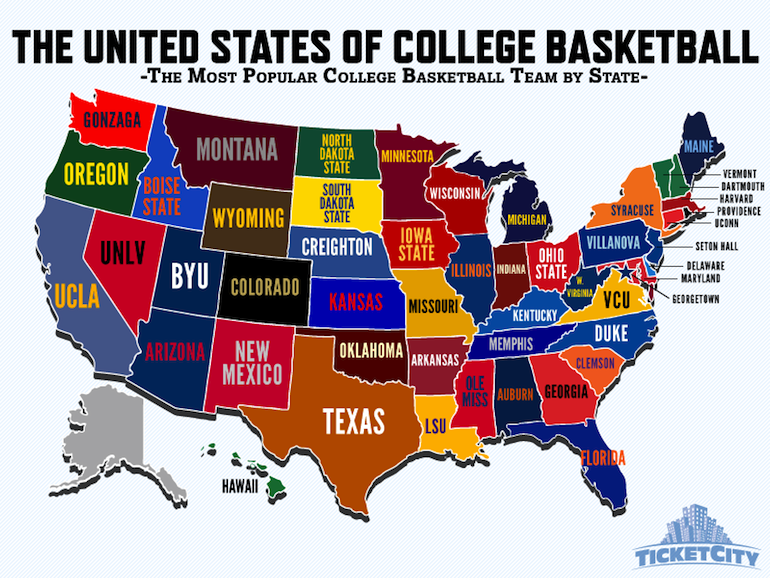
TicketCity, an agency founded in 1990 by a University of Texas grad took a look at which teams scored highest for engagement in their own state, factoring game attendance, Google search and social media over the past year.

Here Duke came out #1 too, in the North Carolina.  BYU was tops for Utah and Gonzaga for Washington, giving me an added alumnus trifecta.

All of this does not negate that Duke might also be hated, which is a different metric altogether, just that it would be irrelevant without showing it in the context of overwhelming popularity.

Sports reporters are emblematic of the challenges that face news reporters overall.  Drawing anecdotes as evidence of a more generalizabe public opinion is very tricky.

Local news in Durham has inferred that its recent population growth is due to the turnaround of downtown Durham in the last few years.  But Durham was the fastest growing city in North Carolina throughout the 1990s when its downtown had yet to emerge and its image underwent a turnaround.

How could this be?  Because Durham’s self-image and its image nationwide has always been high.  Over the 1990s is when negativity about Durham entrenched in surrounding counties was gradually reversed.

For sure, the image turnaround by 1999 lowered one of the barriers key to downtown revitalization by opening the minds of the news media, realtors, developers, financiers, as well as newcomers.

But downtown revitalization was also spurred both here and across the nation after the year 2000, not just by favorable shifts in psychographic and demographics but even more so by the innovation that year of New Market Tax Credits (NMTC.)

NMTC’s were recognized by Harvard in 2009 as one of the nation’s most innovative government programs leading to this 2010 case study of their dramatic success in downtown Durham.

Studies, scientific polls and generalizable metrics may not be as exciting as hyperbolic anecdotes for news reports or news consumers more interested in the pursuit of legends and myths, including their own.

But these tools are crucial to any community seeking a factual basis upon which to truly shift perceptions and initiate change.  Studies, polls and metrics are also important when assessing which coattails to ride or credit.

There is no institution more deserving of credit for everything Durham has achieved than Duke, and no program there more deserving of enhancing Durham’s reputation than Coach K’s Blue Devils.

Monday, January 05, 2015

Unwrapping Generalizable Transformation

Several things came to mind yesterday as I read a column written by a friend of mine who manages the news room for our local newspaper looking back on the 10 years since he returned to Durham, North Carolina in that capacity.

First was how fast ten years goes by and second, that we rarely get a chance to catch up since I ducked below the radar into retirement five years ago.

He noted several brick and mortar projects that he believes have transformed Durham during that span, but what caught my eye at the end of the column was his impression that these projects have changed how we see ourselves.

His impression from ten years ago was that Durham residents conveyed, as he put it, a much more “Eeyore-like, woe-is-us mantra.”

I don’t question that was his impression.  News executives I know tend in general to not only be overly influenced by anecdotal comments from individuals but what they get seems to be overwhelmingly negative.

I took a look back to see what Durham resident opinions were of their community to see if his impressions were generalizable.  They weren’t.  Back then, Durham residents were proud or very proud of Durham by a ratio of 5 to 1.

Even back then, as it had been a decade earlier, that was a higher community pride ratio than any other major city in North Carolina and based on a subsequent study of other cities nationwide, very positive.

Of course, 15.6% of residents were not proud of Durham back then, much lower than other communities and a proportion in Durham that is about average over the last two decades.

So why did my friend think Durham residents were woe-is-us?

One reason is because about two out of three people he encountered on the street or in meetings or emails were not from Durham.  They just commuted to work or or ran a business here, some of whom, misunderstanding they were the ones with issues, would publically lecture Durham.

A far greater percentage of these non-resident workers and business owners/managers were negative about Durham or condescending at best, and their numbers greatly amplified the relatively modest number of Durham residents who had issues.

In fact, until the late 1990s, far more of these non-residents were negative than positive about Durham.  That’s when a decade grassroots effort to reverse that ratio reached a tipping point to the positive and polls showed that Durham residents could sense it.

That’s when they began to believe Durham’s image among nearby populations who had been historically negative was improving, long before any of the brick and mortar projects given attribution in my friend’s column.

So what he heard anecdotally ten years ago obviously made an impression but scientifically, it was definitely not generalizable to Durham residents overall.

While Durham residents who are not proud of the community in any degree has dwindled by 10 percentage points in the past ten years, my journalist friend probably still hears disproportionately from those who are negative.

While the trend of commuters who work here and non-residents owning businesses becoming more positive about Durham has continued to increase since that tipping point more 15 years ago, there are still enough who are negative to amplify discontented locals who are.

My suspicion is that after ten years, my friend is also just getting better at weighting or filtering what he hears.

But he also has a point in his column that the brick and mortar projects have played a role in what he sees as a transformation at least of the area we call downtown.

Experts in the diffusion of opinions through populations would argue that reversing that image issue among residents in neighboring communities including commuters to Durham greatly contributed to making these brick and mortar projects possible, e.g. financing.

New presses don’t make journalism better, better journalism makes journalism better and that has a lot to do with perception, information and opinion, not new coats of paint.

The same is true with bricks and mortar.  It plays a role but it perpetually cycles as all “physical” transformations do.

Anyone concerned about sustainable transformation needs to be very worried that “based on the way people talk,” those who expect a negative experience in Durham has reached a 17-year high, as has the percentage who’s personal experiences here have been negative.

Transformation requires a lot more than brick and mortar.

Wednesday, October 08, 2014

I Wondered If It Would

Sunday as a friend and I walked from the neighborhood where we live in Durham, North Carolina to an annual event, I wondered if this year it would have the same powerful impact on me.

It did.

A year ago, I remember being directed to the appropriate registration line and then suddenly looking up to see hundreds of expectant faces lined up expectantly on a landing above.

Everyone there was sharply dressed in coat and tie or the female alternative even though a year ago it was 95 degrees and equally humid.

Their faces were beaming with expectation because it was “family day” at TROSA, a renowned but very difficult two-year residential treatment program in Durham.

As I wiped away the tears quickly welling up at that sight, I began looking for the brother of my closest friend who had entered the program a few weeks earlier to begin recovery from three decades of addiction.

I learned that day that not everyone’s family is supportive.  Many there come from other parts of the country and their families may not have had the means to travel here for the event.

Others that day were confronted by family members who were enablers or who whined about how tough life had been without them, even pressuring loved ones to leave the program as a handful may have.

But for the vast majority, families sat in small circles catching up while beaming at the remarkable differences they observed in their loved ones and the inspiring transformation.

I befriended the founder who arrived in Durham less than five years after I did in part because we were both involved in startups, mine the community’s first marketing arm and guardian of its sense of place, his a remarkable innovation in social entrepreneurism.

Kevin is also a neighbor of mine.  He started with two dozen residents building on the small Delancey Street program out west that had helped him into a life-long recovery.

Today, there are more than 500 residents at TROSA at no cost and it is being heralded across the nation as a “best practice.”

Long-term recovery overall is now a national movement of 23.5 million Americans.

Even though I became a customer of TROSA services a year or two after Kevin and I met, and became a sustaining monthly donor a few years after that, I was a part of the problem back then.

Click on image to see a video overview

I knew that addiction is a disease but in the back of my mind I probably still judged those not in recovery on the basis of will power. 

Even as Kevin and TROSA were honored shortly before I retired by the signature Annual Durham Tribute Luncheon, I remember wondering if I had been guilty of merely making an exception.

I remember how stunned four friends were fifteen years ago when I got all over them during a backyard cookout for being enablers after hearing them joke about casual use of drugs because I still saw drugs and alcohol misuse as a supply and demand problem.

But the real enablers are the 43% of Americans who still stigmatize drug and alcohol addiction as a personal vice or, a lack of moral character.

In a poll last week they object to treatment being included in private health insurance coverage or by an increase in public funds, clinging unsympathetically to “just say no” while nursing vulnerabilities of other kinds.

Addiction is a $600 billion annual drag on the economy.  Seven-in-ten Americans know someone among the 20 million addicted Americans who are not in recovery.

Nearly four-in-ten Americans are personally aware of addicts who unable to access publicly funded treatment, but the objections to making more available are not entirely partisan.

Republicans, Independents and Democrats all support doing more, although the latter two by greater ratios.  An easy way would be to transfer a good part of what is now spent on locking people away, where outcomes only worsen.

The Courts in Durham and North Carolina love TROSA and elsewhere the word is rapidly spreading.  It is much safer, far more cost-effective and far more efficient at creating recovery outcomes than jail time.

But society isn’t transferring any of the savings from incarceration over into recovery programs and even if it did, chances are the resources would be wasted on short term programs with little or no efficacy.

Here is a link to newly or recently published books I recommend as well as a link to a PBS Newshour Interview with one of the authors about “8 myths” regarding addiction.

For the visually inclined, click on Manyfaces1voice.org and watch the new documentary, The Anonymous People, as we did on Netflix before the event at TROSA.

As a nation, we’ve come oh so close to embracing lasting solutions to this problem, only as we did in the 1980s to slip back into directing far more treasure than it would cost back into moralistic preaching.

In the meantime, programs like TROSA are working and worthy of attention and capacity.

See for yourself.

Monday, June 09, 2014

It’s Healthy to be Skeptical, Just Not Cynical

Whenever I come across global warming/climate change deniers, I try to carefully listen or read what they have to say.

Some don’t really deny it’s happening.

They believe we’ll just overcome it somehow as we have major crises in the past without seeing that those were ultimately overcome by action, after being made worse by waiting.

I used warming/change in my opening because a new Yale University study shows that Americans feel a sense of urgency when the term global warming is used.

Which, in part, is why more than a decade ago savvy Republican researchers suggested the substitution of “climate change” to make it seem less threatening.

That warm and fuzzy approach to global warming turned out as predicted to not only divide Americans but cause 1-in-5 to be not at all worried (p. 16.)

As an Independent I may have been cynical about the motives of “professional confusers” behind today’s gridlock but now having read this memo I’m not even skeptical.

Ironically, the 2002 Republican research called for a flip-flop.

A decade earlier conservatives had teamed in a bipartisan effort under the first Republican President Bush to break a 13-year logjam by deploying market-based “cap and trade” to successfully curb another harmful emission.

In 2002 there wasn’t the overwhelming scientific consensus there is today that climate change/global warming is a real and present danger or that it is due to human actions above and beyond natural causes over the last 250 years, especially the last 60.A Sceptic's Guide

If you are a skeptic who happened to read this far, you may want to read the research by scientists at Berkley Earth who until recently were also skeptical.

It is summarized their new report entitled, Know The Facts: A Skeptic’s Guide to Climate Change.

Then again, studies of “motivated reasoning” find that in many people skepticism is really a cognitive cover used to deflect unwelcome information.

This is especially true when it is sincerely held that what ordinary people believe will not make a policy difference.

Showing irrationality is often rarely enough to “induce individuals to process information in a different way.”

There is a difference between being skeptical and being cynical.

Skeptics have reservations.  Cynics believe others are motivated by selfish concerns and don’t believe in altruism or even honesty.

If you’ve never been into reading and understanding various philosophical outlooks, a new book illustrates each one instead, entitled Philographics.

Deniers often fall into both categories though it seems more often the latter while global warming believers sometimes can get caught up in being cynical about deniers.

New science shows that cynics on both sides run a much higher risk of dementia, especially perhaps those cynical about scientific studies.  The study also shows that cynics won’t die any earlier, perhaps they just won’t remember.

That 2002 Republican research memo predicted more than a decade ago what a new Yale study confirms: use of the terms global warming and climate change are synonymous to Republicans and Conservatives (or as we Independents often joke, is that now redundant?)

But the term climate change “actually reduces engagement” among Independents, Democrats, moderates and liberals.  Fortunately, groups that will soon dominate elections such as minorities and young adults light up when global warming is used instead.

And that might be why global warming is still the most used by Americans personally, as well as in the news media, and in conversation according to the Yale study.

The Berkley Earth report meant for climate change/global warming skeptics includes a breakdown of what events are unrelated, e.g. tornados and earthquakes.

Hurricanes, droughts, forest fires and floods may change due to global warming/climate change but the amount hasn’t been established.

There is a link established to increased heat waves and coastal flooding.

New research also shows that global warming is not only reducing snow pack where water has historically been stored until released into rivers and reservoirs each spring, the means by which 1-in-6 people worldwide receive fresh drinking water.

But paradoxically, the resulting switchover to rainfall also means these water ways are less full in part because it is held in place by soil instead.

Sitting idle, we are likely to see much more rainfall but much less available for human use for drinking water.  This also mean less available for electrical power and agriculture.

Of course the use of climate science has been outlawed for the time being by the legislature in North Carolina because it was inconvenient for a few coastal land developers.

And some members of Congress are trying to do the same regarding military research which over the last 60 years has been the foundation of nearly all of the technological changes driving American innovation.

Fortunately, corporations are paying no heed and building the price of reversing global warming into strategic plans. Nor are many states.

Nine northeast states which banded together to cap emissions in 2009 have seen their economies grow faster than the other states while reducing greenhouse gas emissions nearly five times quicker.

A similar combine of five western states and two Canadian provinces fell apart after conservatives seized control in 2010.  But British Columbia in 2010 and California last year moved ahead.

Regressives such as those banning the use of studies on global warming and other research are easy to spot.

Even those who make it onto the governing boards of much smaller organizations where research is a core value are obvious by using every opportunity to demean it and to starve it of resources and focus.

All conservatives are not regressives, nor are all regressives conservatives. What they have in common is a disdain for research and resistance to progress.

In the words of the famous Brooklyn Dodgers then Yankees announcer Red Barber, “back, back, back, back (smile.)”

Regressives in the North Carolina General Assembly today are failing to head the warnings in that landmark 2002 research for Republicans, because that would, uh, be using scientific research.

It warns that while conservative attempts to negatively brand environmentalists had been successful by 2002, Americans as a whole remain overwhelmingly sensitive about the environment.

They just prefer instead labels such as pro-environment and conservationist.

The memo warns that “when we [Republicans] talk about ‘rolling back regulations’ involving the environment, we [Republicans] are sending a message Americans don’t support” and when it comes to regulations, Americans are “most comfortable with local oversight.”

The last part is lost on North Carolina regressives seeking every means possible to strip local governments of any oversight while demonizing science and regulations meant in the publics interest.

Not all narcissists in high office (found in greater proportion and much further up the spectrum than the general populace) are regressives, but uber narcissism among regressives may explain their claim “we don’t give a damn how many people this hurts.”

Oops, I hear someone banging on my door but keep the faith.  Whoever it is that thinks I’m part of a conspiracy probably won’t remember long.

Thursday, May 01, 2014

Probing the Pluralistic Small Business Views

Having spent the better part of four decades working with local businesses, one thing I know is that they have always exhibited far more diversity of opinion than represented by the news media or associations portending to represent them.

State and national associations often give a distorted impression to policy makers and news media by disguising that their misuse of the term small business is dominated by the concerns of companies with hundred of employees and tens of millions of dollars in revenue.

Further distorting the views of small business, association legislative committees and related PACs are often hijacked by cabals of narrow viewpoints of formulaic-type businesses unrepresentative of the either the membership or businesses of that type in general.

A quick check of their membership lists or board members, which reporters and elected official seem to rarely do before giving credence to their claims, reveals that most are using the term small business only as a disguise.

What most of us think of as small businesses are now called micro businesses.  These have around 5 or fewer employees.  The majority have annual revenues of $100,000 or less and most never want to grow beyond 10 employees.

They are primarily sole proprietorships, far more likely than other businesses to be locally based with owners living in the same community as their business.  About half depend at first, on another job.  Half are based outside the home as they grow.

About a third of microbusinesses depend primarily on locals for their business but 4-on-10 rely on a mix of locals and visitors including day-trippers from surrounding areas and clients outside the community.

Micro businesses are the backbone and true drivers of local economies.

In North Carolina where I live, micro businesses represent nearly 60% of all business establishments and more than 60% of those considered small businesses overall.

Rarely are they members of local chambers of commerce which today are dominated by much larger concerns many with mid-level executives who are paid to attend meetings, many watching out for special interests.

Chambers often complain that the threshold small and micro businesses can pay to be members is too low to provide the services they need.  In desperate need of membership revenues they turn to larger businesses instead.

Truly small or micro businesses rarely find time away from the cash register for meetings of any type, let alone getting involved in the push and shove of politics.

Their voice is also not found in the positions taken by the U.S. Chamber of Commerce (no relation to local chambers) or most state chambers.

Without typically charging a fee, community marketing organizations, most of which are apolitical, usually incorporate all businesses regardless of size under their promotional umbrella.

The handful that still firewall benefits behind outdated membership models continues to shrivel.

Guess which approach is more customer-driven?  These are also the DMOs that are far more effective on behalf of the communities they serve.  Of course, most community marketing organization migrated to or were founded with self-funding models years ago.

That community marketing organizations incorporate small and micro businesses under their tent is significant because surveys show that to grow and thrive, their greatest need, outside of capital, is marketing.

Showing the diversity of opinion among small and micro businesses are two Gallup tracking polls, one with Wells Fargo as a partner which uses a cut off of $20 million in revenues and a new one focused on truly small or micro businesses with Sam’s Club as a partner.

The Wells Fargo definition captures 80% of all business establishments with employees, small to the size of a mega-bank maybe.

The definition for Sam’s Club’s new tracker captures micro business owners which, according to Gallup, represents 80% of business owners overall including the 44% that do not employ anyone other than themselves.  This excludes hobbyists or paper only businesses.

Micro business is now far more representative of the definition of small business.

Showing the pluralism of views among small business owners under either definition is a comparison of views regarding an increase to the minimum wage.

The Wells Fargo index found that nearly half of those surveyed had no problem with raising the minimum wage.  More than 4-in-10 felt it would help most small business employees and another quarter felt it would have little effect.

A similar proportion believed it would have no effect on small business or might actually help them.

Of course these findings escape those in Congress pushed to block the increase by those lobbyists who feign to represent small business there.

Another more recent poll probed much deeper down into truly small businesses, including micro businesses in the state of New York, and found that 74% support raising the minimum wage and indexing it to rise with the cost of living.

A similar percentage agreed that cities and towns should be able to set the minimum wage even higher.

By political affiliation 45% identified themselves as Republicans, 40% as Democrats and 15% as independent or other.

Republicans and Independents who lean Republican may claim they represent business but over time their numbers have included only about 4-in-10 small business owners, just a notch or two different than the ratio of those who identify themselves as Democrats.

Survey findings by associations of the political affiliations of small business members often skew differently depending on the ideology the association uses to recruit members.

But even polls of those that skew right show, for instance, that only 1-in-3 members express concern to elected officials with hopes of reducing and reforming government regulation.

This hardly makes it the hot button issue that legislators in states such as North Carolina claim to justify gutting state and local regulations.

Even polls by those in sympathy show that a far greater proportion of members just want existing regulations to be actively, fairly and evenly administered.

Polls by less ideological associations including pioneers of the micro business definition show that more than 3-in-4 members felt regulations on the books should be enforced, especially those that an even larger ratio felt were important to protect business.

While special interest “whiners” are using pretense to undermine the North Carolina Environmental Bill of Rights that voters embedded in the constitution by a vote of 7-to-1, it is clear they are not representative of North Carolinians in general or those who own small or micro businesses.

Serious members on both sides of the aisle know that any concern about regulations is only solved by energetic, passionate, fair and even enforcement by the executive branch, unfettered by interference by special interests or legislative allies.

Only 20% of micro businesses worry about regulations, a percentage similar to those who worry about taxes.  Of more concern is consumer demand and the rising cost of supplies and materials. 

It is clear that a recent op-ed by a small business owner advocating for a more livable minimum wage is representative of the majority of small and micro businesses.

More certain is that the viewpoints of small and micro businesses are far more pluralistic than the impression we're given.

Monday, August 12, 2013

Hubris Is The New Tyranny

I believe regulatory reform is necessary, not because I agree with the 4% of Americans who believe they are too regulated, but because I believe any regulation needs periodic performance evaluation.

A month ago, I was listening to my grandsons play at a Washington lake, a mile as the crow flies from the border with Northern Idaho.  I read a lot and even more next to a Rocky Mountain lake.  Two things I was reading struck me that day.

One was the so-called North Carolina Regulatory Reform Act of 2013 (referred to as House Bill 74,) the second was the just-released 2013 Economic Values Survey of Americans.  One does a disservice to regulatory reform, the other sheds light on the values we as Americans have on issues such as that.

One was driven by anecdotes and special interests, the other scientific and generalizable.

The first few pages of the North Carolina bill are indeed a step toward regulatory reform.  The other 60 pages more than justify a veto of the bill by North Carolina Governor Pat McCrory.

Stuffed with gross and vindictive overreactions to petty grievances, the bill violates the values of the vast majority of members of his party and very possibly even the state constitution while aggrieving every North Carolinian.

In my opinion, as a moderate Independent,  regulatory reform should periodically ensure regulations are being robustly executed and that the enforcement is not only even-handed but nimble.

Reform should also update and streamline regulations, purge them of pollution by special interests or political corruption and embed metrics to ensure cost-effectiveness.

Of greatest need regarding regulations is establishing a much more transparent, easy to understand and non-political process.  Much of what was dumped into HB 74 was to appease whiners and special interest lobbyists whose influence continues throughout the process of re-writing regulations.

Tragically, if signed, it comes at the expense of the general public and taxpayers.

Published last month, the 2013 Economic Values Survey is a much more scientific and accurate reflection of the way Americans think about things such as regulation.  Only 4% think we are too regulated by government.  I suspect even that percentage would not approve of what special interests dumped into legislation in my state.

The hubris that polluted the regulatory reform bill in North Carolina may be reflected in the survey,  which shows that roughly one-quarter (26%) of Americans say that people like them take absolutely no benefit from government.

This percentage zooms to close to half of Tea Party members and more than a third of Republicans and 35% of white working-class Americans.  Really?  They get no benefit from even such things as roads, schools, clean air and water?  Nothing?

One thing the majority of Americans agree on (by 6-in-10) is that government should do more to reduce the gap between the rich and the poor and take care of people who can’t care for themselves.  This holds consistent across all groups including white working-class Americans.

Millennials, by 7-in-10, even support “universal” healthcare insurance.Economic Orientation

Americans have concerns about Capitalism with 9% believing it is working well and 16% not at all.  Forty-five percent see it working somewhat well and 26% not too well.

Tellingly, Democrats think capitalism is working because it provides equal opportunity, while Republicans think it is works because it encourages personal responsibility.  Faith that it works well is consistent across affiliation, 56% Democrats, 54% Independents and 52% Republicans.

A real divide in America is that 69% of Democrats and 54% of Independents believe that one of the biggest problems in the country is we do not give everyone an equal chance.  Meanwhile, 58% of Republicans and 57% of Tea Party members think that really isn’t a problem.

Another divide is that 54% of Americans in general, including 62% of Democrats and 54% of Independents, believe that hard work and determination no longer guarantee success for most people…55% of Republicans and 56% of Tea Party members disagree.

As for overall work ethic, the percentage of Americans who think they  can get ahead without working hard and making sacrifices has fallen from 63% in 1999 to 56% in 2013.

Big majorities of Americans across all political persuasions, religious affiliation and ethnicity believe that promoting freedom, liberty and to live responsibly are very important guides to economic policy.

There is a gap however between Democrats and Independents and Republicans and Tea Party members about the importance of promoting equality and fairness when it comes to economic policy.

We generally vote by districts for elected officials but all of this suggests that we all probably need to vote as well with an eye to balancing the make-up of elected bodies in keeping with opinions among the electorate.

Apparently, it no longer goes without saying that governance is of all of the people, not just narrow interests.

It seems no longer likely that we can rely on elected bodies to vote based on the make up of electors which leaves them vulnerable to special interests and narrow ideologies.

Or we can become a true democracy and cut out representatives.  To me, when they study nuances with the objectives of doing what’s right, they perform an invaluable service.  It just seems like today, representative bodies are vulnerable to being high jacked by special interests that do not represent the majority of the people.

Maybe what we have to fear is no longer tyranny but hubris. 

Friday, January 06, 2012

Adrenaline Fixes Trump Popular Will

At least at the local level, one of the great ironies of a representative democracy is that, once elected, officials seem to pay much more attention to anecdotal opinions and how angrily they are expressed than they do popular opinion.

I'd definitely be among the vaunted 1% if I had a dollar for every time I've heard a public official apathetically dismiss an issue because they claim no one had been calling them late at night to complain about it.  Partly to blame is a vicious feedback loop. Fewer and fewer people vote so local officials interpret that as a mandate to only listen to a small, vocal share of the population which leads the population, in general, to continue to ignore elections.

Sometimes a member of the governing boards of community organizations, watching the example set by elected officials, might dismiss scientific generalizable survey results by saying “that's fine but I know one or two people who are still dissatisfied,”  implying that somehow the opinions of one or two people should trump the vast majority.

It is an overstatement to say that the federal electoral college system was established because a few of the framers thought that voters would not know enough about issues to make informed decisions at the ballot box. In reality, that now antiquated and unpopular system is yet another remnant of the compromises demanded by slaveholding states fearful that they would lose influence if elections were based truly on the popular vote.

But officials today, who listen to only small groups of vehement people as a means to determine the importance of an issue, are in essence distrusting that the popular will can be truly informed.  It is probably also for the same reason that officials are often distrustful or dismissive of scientific, generalizable public opinion surveys.

As a result, issues devolve into cheap adrenaline fixes, not only taking much longer than needed to deal with, but making those who are charged with dealing them even more vulnerable to powerful special interests.  Officials are tied down with little-picture tactical decisions that suck valuable oxygen away from the strategic decisions that are the essence of governance, while also distracting public administrators from day-to-day operations.

But what do I know, I'm just a voter.

Thursday, October 06, 2011

Diminishing Social Trust and America’s Failure To Thrive

I have a friend who lives in perpetual disdain of data, probably even more so now that Brad Pitt has made statistics sexy.

While friendly on a personal level, he is at the same time publicly dismissive of people in my now concluded career of community/destination marketing because they are “paid” to convey information about their communities. My friend probably hasn’t kept up with the latest research about motivation and drive.

He’s an old-schooler, and unfortunately, from what I remember from a few destination marketing organization (DMO) execs past and present, my friend has probably come by his cynicism honestly.  For instance, years ago I knew a DMO exec with hubris enough to believe he was entitled to make up statistics out of thin air just because he was the so-called tourism expert in his community.Trust

As a whole, DMO execs are far more driven to make a difference and by a sense of purpose than they are financial incentives. But then again, maybe my friend’s exposure has been primarily to those in sales, whom the research shows can be the most vulnerable to unethical choices.

Statistics themselves don’t lie, but often people do.

A friend of mine in talk radio asked me how I knew that Durham had a level of passion, engagement and pride among its residents that is two to three times greater than other communities including those nearby that are held in seemingly high self-regard.

When I responded that it is benchmarked by scientific surveys, he quipped, “I’m glad we have them to tell us what we think.”  He’s obviously in the anecdote business and  I didn’t get an opportunity to explain to him that the anecdotes he enlists in his line of work are useless bases for decision-making unless they can be shown to be generalizable to an entire population.

Unfortunately, far too many news reports and news analyses are now the result of reporters interviewing reporters, heaping anecdote upon anecdote as though they will become reliable by sheer weight.  A fool-proof way to spot someone trapped in their own anecdotes is when someone responds to scientific research findings with a comment like, “well that’s not what I think.”

Uhhhh, ooookay!

Increasingly we hear interviewees on the news, including people seeking elected office, who indicate that individually they have queried tons of people across this state or this nation or even at a conference they attended to then bulwark their opinions.  The problem is that unless the sample was random and large enough, it is still just anecdotal and just their opinion, regardless of their personal expertise or experience.

We frequently hear how untrustworthy the news media is but surveys shows that the news media, especially at the local level, I mean truly local, not just 30,000 feet, is far more trusted (69%) than candidates running for office (29%.)  We hear how untrustworthy the federal government is at (44%) from Republicans but trust in business, a source of much of their campaign financing, is worse (41%.)

Another poll just released by 60 Minutes shows that overall more Americans trust journalists (76%) than politicians (6%.)  By 7 to 1 even Conservatives trust journalists more than politicians although they fall behind Moderates who trust journalists over politicians by 13 to 1 and Liberals trust journalists over politicians by 30 to 1.

A year ago, a survey benchmarked “social trust,” which was defined as “faith in people” or the honesty, integrity and reliability of others.  It came up with a “social trust index” based on how those surveyed responded when asked about who they trust, who they did not trust, who might take advantage of them, who is likely to be helpful or just looking out for themselves.

American adults scored 35% with high trust, 22% mid and 38% low.  Blacks and Hispanics had much higher levels of mistrust that whites.  Young people had higher levels of mistrust than older people, singles more mistrust than married people, lower income more mistrust than higher income, city dwellers more than rural dwellers, high school grads more than college grads, struggling classes more than professionals, non-military more than active military or veterans, non-voters more than voters.

People in the south had higher levels of social mistrust than in the northeast.  Moderates, Independents and Liberals scored more mistrustful than Conservatives.

However, it appears from another study that the ultra-conservative fundamentalists who are purging the Republican Party are negatively associated with social trust.  The authors of American Grace note that:

“Fundamentalist religious views are negatively associated with social trust…Social trust increases with religious attendance but decreases with fundamentalism…Religious liberals more often experience a loving God, and they are among the most socially trusting of Americans, whereas religious conservatives more often experience a judgmental God, and they are among the least trusting of Americans, especially if they are not observant.

For highly observant fundamentalist Americans, their theology inclines them toward skepticism about human nature but their frequent attendance somehow move them to a more optimistic view.”

This is the group that, although a small sliver of society, has monopolized news coverage for the last two years.  They want smaller government because they don’t trust government.  They seem callous to helping people because they fear these folks will take advantage.  They resist compromise because they don’t trust in win/win solutions.

These folks don’t just preach decline today.  They’ve preached decline since before the country was founded.    Like more than 90% of Americans, they believe in God but a judgmental God.  They are steeped in conspiracies and self-fulfilling prophesies.

They vote to cut funding for food inspection, environmental protection, pre-school education.  They are obsessed with “cut, cut, cut” at exactly t he worst time in the economic cycle.

A recent op-ed likened the excuse given by one of the 12 Republicans who voted against the most recent agreement to break a government stalemate to protest against dysfunction calling it “a little like protesting the slowness of rush-hour traffic by abandoning your car in the center lane.”

Maybe the fallacy of that official’s rationalization is also what’s at the heart of what one Conservative commentator means when he warns that “Segmented societies do not thrive, nor do ones, like ours, with diminishing social trust.”

“Without such trust, writes Mark Nepo in his book Finding Inner Courage, “we can turn blunt and cruel.”