Showing posts with label Billboards. Show all posts

Monday, October 19, 2015

Community Marketing Malpractice

My degrees were in history and political science.  I also studied law.  But my career was in marketing; or more specifically, the marketing of communities.

Fortunately, my collegiate exposure to marketing was a theoretical survey course using the provocative teachings of Harvard’s Dr. Theodore Levitt.

So I always had a much different, and many would say provocative approach to community destination marketing than my DMO peers, who over-relied on the components of traditional sales and advertising.

Results would suggest far more successful too, than those who over-relied on the components of traditional sales and advertising.

Far too many still do today, which is puzzling.  This post may help young community marketers avoid what had been termed “marketing malpractice” by the time I retired nearly six years ago.

A lot about marketing has changed during that span.  Maybe it intrigues me as to why many DMO execs aren’t keeping up because my intellectual curiosity hasn’t yet retired.

Marketing includes the elements of sales and advertising but it fundamentally differs in its overall purpose.

Myopically, to use one of Dr. Levitt favorite words, “selling” customarily has focused on the needs of the seller.

Many use the term relational “selling” today but then still pretty much focus on what “they” have to sell rather than what the customer needs.

Advertising is and has always been focused on “getting” attention.  Trying to “demand” attention is far more like it, which is why so many marketers call it a form of “yelling.”
This is confirmed in this age of waning attention spans when so many lazy practitioners desperately seem to only know how to “yell” louder and louder.

Marketing weaves these and five or so other components into a blend designed instead on creating and satisfying customers, according to Levitt, which means “un-creating” customers for your community if that means directing their attention to destinations more suited.

A longitudinal study at USC determined in 2010 that traditional advertising now has an overall negative return of investment but that its decline began three decades ago, a decade before the Internet was made available for public use.

Still, many of those who bothered to read the study theorized that the demise of advertising was due to the Internet or the fragmentation of media or even clutter, meaning a proliferation of too many ads.

But marketing historians were aware that complaints about ad “cutter” date, at least, to January 20, 1759 when a copywriter and essayist noted, “Advertisements are now so numerous that they are very negligently perused.”

Dr. Thales Teixeira (Tech-Sarah,) a contemporary Harvard marketing researcher, is an expert in what he calls the “economics of attention.” 

From various studies he has graphed that attention to even  television ads had plummeted from 97% of viewers in 1990 to fewer than 2 in 10 today, even though ads are more than 75% shorter in length.

Attention to ads was plummeting long before the Internet was an alternative and had fallen by nearly half when TiVo, the first DVR device that enabled ad-skipping was introduced in 1999.

This was also long before mobile devices divided the attention of the 44% of viewers who multitask into even thinner slices.

Illustrating the desperation of advertisers, including most that are oblivious to the drop in attentiveness, is that during that span the cost per 1,000 primetime viewers has skyrocketed from $18 to nearly $200 per view, while the quality of attention has severely degraded.

Dr. Teixeira calculates that “Attention is one of our three most valuable, scarce and fungible resources.”

Now even Levitt recognized in his 1993 treatise entitled Advertising: “The Poetry of Becoming,” that ads at the very least provides “variety and changes the pace.”

It’s not unlike the rationale one my friends argues on behalf of billboards, a long-obsolete medium.  But this calculus fails to take into account the turn-of to turn-on ratio of ads.

Yup, and a few people only buy print magazines that are purposely laden with ads.  But attention today, and for several decades now, is something you earn rather than demand.

It is about “them,” not “you” and “yelling” about your product, your community, your brand is a turn-off even when you try to be cute and entertaining.

In the words of Seth Godin, “the goal of marketing interaction isn’t to close the sales, any more than the goal of a first date is to get married.  No, the opportunity is to move foreword, earn attention and trust and curiosity and conversation.”

Trust is the key to earning attention and “you must build trust before you need it,” or want it.

Godin also explains why advertisers seem clueless and only respond by increasing clutter.  “And as with pollution, because no one owns the problem, no one is working very hard to solve it.”

“Advertising” he argues, while explaining why consumers are now “using a sledgehammer to block them all” is in “a relentless race to the bottom.”

A former classmate of mine at BYU who is now renowned Harvard business professor by the name of Dr. Clay Christensen, argued several years before I retired that the paradigms of marketing itself are broken and must be reconfigured beginning with the way we segment customer prospects.

He shows how any communication under the umbrella of marketing, including advertising, must, in the end, show consumers what “job” they need to hire your product or community to do, exposing the flaw in communities that try to be appealing at everything, only to find they have sold their soul.

Christensen, who is famous for coining the concept of disruptive innovation, would not only agree with me that many of my peers, though much younger are marketing dinosaurs but that they are committing “Marketing Malpractice.”

I will continue this primer in the next post by reviewing why techniques such as advertising, not just roadside billboards, are now so obsolete.

Unfortunately, most marketing dinosaurs probably didn’t get this far (sigh.)

Thursday, June 18, 2015

Puzzling Folly Is North Carolina’s Tragedy

It isn’t clear why a powerful North Carolina senator from Onslow County, has been relentlessly working over the past five years on behalf of the billboard lobby, but it is extremely puzzling.

Whatever the motive, this seemingly good and otherwise reasonable official, has been a highly effective at battering North Carolina’s sense of place and overall appeal, which is so essential to tourism and other forms of economic development.

Maybe it is, in part, payback for copious campaign contributions?  Makes sense.  Because he owns auto dealerships which have in the past used billboards?  Possibly.

Because billboards are so effective?  Very doubtful, unless he has been living under a rock.  Here’s why.

The automobile sector is one of the few where traditional advertising was still found to be clinging to effectiveness when a 2010 longitudinal study found that this element of marketing had fallen to a negative return on investment, following a three-decade free fall.

By 2012, two years into the senator’s push on their behalf, roadside billboards had clearly fallen out of favor with consumers, when only 2/10ths of one percent found them useful to purchase something.

That percentage climbs to only 4.6% when you take into account other types of less destructive outdoor ads such buses and kiosks but it is clear that huge roadside billboards, the focus of the senator’s zeal, are the least effective of the least, barely clinging to life support.

By 2013, when the senator set his sights on overriding popular billboard bans in some towns and cities, his own automotive industry was rapidly shifting its advertising elsewhere, online in fact.

It was clear by then that even around town, nearly two-thirds of consumers had shifted to smartphones to find products from roadside and according to analysts the trend was rapidly growing.

While traveling, this percentage is now over 75%, meaning Cracker Barrel could be saving a lot money instead of paying for the 1,600 billboards it claims to have rented as of 2014, making it one of the top source of blight among restaurants.

The chain is traveler-driven with pass-through visitors representing 40% of its business.  But it obviously hasn’t updated its marketing plan for a few years. On the road, 3-in-4 are now using smartphones instead, resulting in a conversion rate of 85% for restaurants.Empty Fairway Board on I-40 (1)

A 2012 Nielsen study found that mobile advertising and online searches reached 62% of automotive consumers before they had made a decision as well as 38% of those who knew exactly what they were looking for.

More significantly, 49% made an automotive purchase related to using their mobile device.  By year end, even dealerships such as the senator’s had shifted as much as 40% of traditional advertising to digital.

Let’s see:  use billboards and influence 2/10ths of one percent or mobile advertising and influence 49%?

No brainer.  So why are a few legislators so bent on forcing billboards down the throats of Tar Heels and their visitors while levying a hidden tax from the destruction of thousands of acres of public roadside forests?

In 2013, auto manufacturers and dealers spent more on online advertising than traditional advertising and at a rate of nearly three times the growth of overall advertising.

During 2015, they will spend $7.30 billion online.  That amount will increase to $12 billion by 2019, more than double the amount of annual spending there the year the senator’s onslaught began, at tax payer expense, to keep billboards on life-support.

The automotive industry’s online spending is 60% on direct response such as email and 40% brand advertising.  Nearly half is mobile related and half PC related.

It will be the third highest industry in mobile ad spending this year, at $3.43 billion, several positions above even the early adopting travel sector.

Online ads are considered viewable when half of the pixels are in view for one second, according to experts, only 40% as long as it takes to decipher a message on a billboard and they do not contribute to blight and deforestation.

It isn’t a coincidence that the time it takes to decipher a billboard is   the span of inattention found just prior to 80% of crashes and 65% of near-crashes.

The senator’s most recent push on behalf of billboards is to permit them to clear the view of trees along exit ramps each of which average 1,200 crashes each per year, which is already influenced by visual inattention as a contributing factor for 93% of rear-end crashes.

The most convincing evidence of the complicity of billboards on accidents came from a study of locations before and after they were removed.

Flippantly, many lawmakers dismiss the senator’s illogical obsession by testifying, in jest, that billboards will soon be entirely irrelevant, abandoned by their out-of-state owners.

What the heck, it will only take 50 to 60 years for North Carolina’s roadsides to recover.

Friday, May 15, 2015

A Price to Obsolescence Denial – Part II

This is part II of an essay posted yesterday tracing the modern history of tourism along with that sector’s seeming inability to exercise what the late Peter Drucker called “systematic abandonment” as it relates to giving obsolete layers of organizations a proper burial.

I left off yesterday just before WWII created a lull in the widespread embrace of destination marketing organizations.  States had begun to advertise in the 1930s (the only element of marketing widely understood at the time.)

But first they had to purge their roadsides of billboard blight.  They also discovered another reason that they had the “cart before the horse” when it came to marketing.

States such as North Carolina had very little idea of what they could offer tourists.  The federal government came to the rescue again, as it had when it incentivized the building of roads.

A Depression-era program designed to put people to work rallied teams of authors and artists in each state to compile and illustrate comprehensive guide books that were then left to each respective state to publish.

In January 1937, my native Idaho’s was the first of the guides to be printed.  The remote mountain state had gone from having 5 of its 2,255 miles of roadway paved in 1922 to having 2,176 miles paved or oiled by 1936.

By the end of 1937, 400 autos a day were using the segment of the North & South Highway between Boise and Coeur d’Alene alone and officials were promoting improvements as a “means of attracting more tourists to Idaho.”

When first completed in 1927, the North & South’s terminus was at Weiser, about 74 miles short of Boise.

That segment had been completed by the time the state’s guide was published, making it possible for travelers to drive to and from Bonner’s Ferry, 30 miles shy of the Canadian border.

These state guides each catalogued detailed histories, inventories of flora, fauna, geology and archeology as well as point to point descriptions of things to see and do in each community.1939 Guide to the Old North State

Published in 1939, the guide book for North Carolina showed communities what was possible and planted the seeds for the post-World War II emergence of visitor promotion as we know it today.

That first visitors guide took nearly four years to research and produce with writers working out of eight different cities across the state.

But returning GIs across the country after World War II were impatient.

Tourism entrepreneurs, fearful states would not resume tourism marketing, began to instead organize another layer of associations, hoping to apply pressure.

Had they investigated more closely, they may have understood that the paradigm was shifting to community-based destination marketing organizations.

Key to strategic thinking is to look back in order to see forward.  A few did and jumped ahead of the shift to community-based tourism promotion.

Within five to ten years, the statewide tourism associations began to struggle for membership, as the idea of community destination marketing organizations rapidly spread and then exploded in the late 1960s and 1970s.

The shift was hastened in North Carolina when one of those returning GIs, an aviator who had survived two plane crashes in the war, pioneered the local option occupancy tax as a means to self-fund community destination marketing.

By the early 1980s, even rural communities and counties were organizing DMOs.  The vast majority of travelers by the end of that decade were destined for a specific city, town or county.

That’s when meetings began to be held to determine what do with those middle-ring associations created in that span after the war.  People who were unaware of the paradigm shift that made them obsolete only a little more than a decade later were perplexed.

At a meeting in the early 1990s to decide what to do with that layer of associations created in the 1950s, a friend of mine who worked for Biltmore at the time gently explained why that layer should be laid to rest, what Nancy Lublin calls “death by success.”

He explained that tourism organizations were by then far more connected to their respective community destination marketing organization rather than statewide or even national tourism-related associations.

It was one of a half dozen such meetings I was asked to attend over the years.  But there were always a few on both sides of the paradigm shift who didn’t accept that “pulling the plug,” could be both celebratory and merciful, preferring life support instead.

It isn’t a phenomenon unique to tourism.  There are many such organizations on life support in every community, kept there by a few people who can never seem to say goodbye and forcing many times their number to pay the price of their reticence.

In my experience, those who are reticent to pull the plug are otherwise reasonable people who also often struggle with anything strategic in nature, giving them a general lack of understanding of patterns or distinctions.

I suspect that the productivity of society in general is loaded down much more than it needs to be, merely by the reluctance to shutter the obsolete.

For those who are near-sighted when it comes to recognizing paradigm shifts from either shore, they must seem so gradual as to barely even exist.

But in fact, those who do see patterns and distinctions long before they are apparent know that the tipping point can be blindingly fast when it comes.

It is why those who perpetuate roadside billboards fail to grasp that while that form of media began its march into obsolescence in the 1930s, it recently reached its rapid conclusion over just 48 months.

It explains why progressive tourism leaders pushed for them to be banned 76 years ago, while a handful today can’t bear to see them go.

But just as we kept an old typewriter stashed in the back rooms of offices as well as fax machines more than 20 years after either had been useful, we are forced to keep layers of organizations on life support for the few who can’t bear their demise.

It is the price we pay for those who are not strategic.

Wednesday, April 29, 2015

My Glacial Journey to Awareness and Aesthetic Warrior

I wasn’t always so zealous about scenic conservation.

Even though I was an early adopter in my field when it came to understanding the overall significance of sense of place, some related realizations took decades for me.

They dawned on me as more of an ooze than a lightning bolt.

So if my journey to the realization I will share in this post is still unfamiliar to anyone, especially as it seems to many in my former field, maybe my journey to awareness could be useful.

When I was recruited to North Carolina 26 years ago, I too, soon took its vaunted forests and tree canopied streets for granted, including those along roadways crisscrossing the state.

Even though they had been constitutionally banned at statehood in Alaska, my previous community marketing post, I still also really hadn’t given the desecration that billboards cause much thought back then.

It would be nearly another two decades before my conversion took hold as a passionate defender of scenic preservation and character against the forces of blight.

When I arrived in Durham to jumpstart community marketing in 1989 at the recommendation of a colleague in another community I even considered using one or two local billboards as exaggerated welcome signs.

That is until I learned that less than five years earlier, local Republicans had spearheaded a ban here too.  It was enacted just as the last billboard was removed from Maine following a ban enacted by voters there in 1977.

But North Carolina had just begun rolling out business logo signs at freeway exits here that had been authorized by the U.S. Congress in the mid-1960s.

Along with color-coded wayfinding signs for visitor centers and cultural attractions, these signs are part of what are known as TODS (tourist oriented directional signing) which are far more effective for our community marketing purposes anyway.

There is an irony to the Durham ban on huge, roadside commercial billboards.

A hundred years before Maine voters banished them, their first widespread use along wagon and horse trails and railroad tracks emanated from Durham in 1877.

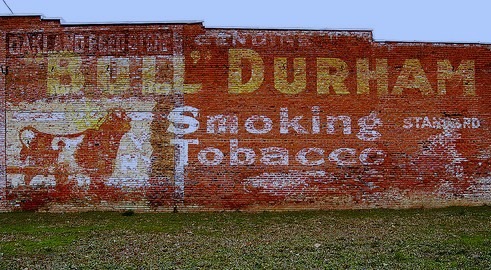
Julian Carr, a partner in “Bull Durham” smoking tobacco was ahead of his time with marketing.

The renamed product’s fame took root in 1868 when it was re-branded following its newfound popularity among Confederate and Union soldiers bivouacked here during the surrender that ended the Civil War.

Billboards were hand painted back then, often on rocks or barn roofs and siding and Carr deployed four teams of painters across the country securing the rights from property owners.

Today, “Old Bull,” the brand’s original 1874 headquarters and factory is a National Historic Landmark in Durham, adaptively reused for apartments, but as part of its authenticity, vintage billboards there have been preserved including one on its roof.

Until Carr’s innovative campaign in 1877, billboard companies had limited their desecration to cities, “brawling” with one another over telegraph poles, ash barrels and fences as well as wallpapering entire houses and blocks of commercial buildings.

In the words of Dr. Catherine Gudis, author of Buyways: billboards, automobiles, and the American landscape and a professor at UC-Riverside, back then “advertising space was not yet construed as real estate” but as “public spectacle.”

She notes that billboard companies at the time that “few paid regard to the inviolability of private and public property.”  The desecration of roadsides today is obviously in their DNA.

But 16 years after Carr sent his billboard painters across the nation and around the world, Americans rose once more in rebellion and mounted a hundred-year-long “sense of place” revolt.

It was, as documented by Professor Gudis from her research here in Durham in Duke’s outdoor advertising archives, a “battle for aesthetic rights to the roadside environment,” a picket engagement of which had been fought in Durham a few years before my arrival.

Americans fought in this rebellion, skirmishes of which continue today, to reclaim the roadsides created with their tax dollars from the forces of blight.

Meanwhile in another ironic twist, billboard companies recast themselves as simply private property owners.

Losing to aesthetic revolutionaries in the court of public opinion, they have posed as poor victims shelling out tens of millions across the country to sway lawmakers.

Lost on those who fall sway today in North Carolina is that billboard companies don’t own the property they use.  They lease it, and the laws they pursue are intended to harm the real property owners.

Only 3% of the billboards in North Carolina are locally owned by small independent companies.  More than 97% are now controlled by a handful of huge out-of-state companies, a cartel of sorts owned by REITS as vehicles to avoid paying taxes and by a revolving door of private equity firms.

They actually own property for only 3% of the thousands and thousands of billboards they have erected across the state.  Yet, they have successfully hoodwinked some lawmakers into thinking otherwise.

But it is something else that led me to join the roadside rebels.

These large out-of-state billboard companies are bullies, a realization that finally led to my belated conversion as a champion for scenic preservation and aesthetic rights as a civil right for all Americans.

Having divided up North Carolina among themselves, this billboard cartel not only bullies local communities to override the interests of their citizens, they throw their weight around to bully state regulators away from defending the public interest.

There are many reasons to despise the state laws they have recently pushed through including clear-cutting exorbitant view zones and soon even the once protected forest at interchanges.

Now they are seeking seek to overturn local zoning ordinances including democratically enacted and popular billboard controls and bans.

They also hope to transform thousands of illegal billboards to legal status as well as gaining the ability of turning them digital and capable of being relocated anywhere they please.

They also seek now to hold taxpayers hostage for millions of dollars for each billboard when roads are widened, something even the Texas Supreme Court rejected last week.

But the real reason they are bullies is what they are trying to do to the true local property owners who own the land leased by these billboard companies.

They also want to put small independent companies out of business so they can bully land lessors at will.  “Agree to our terms, or we will move one of our other billboards to block yours, rending it worthless.”

But my slow conversion to aesthetic warrior began much earlier.

Durham was forced by a large billboard company to take its right to ban billboards and remove them by providing a seven year window for the company to amortize its value all the way to the U.S. Supreme Court.

It was declared valid in 1992, less than three years after I arrived.  Over the next nine years, a grand compromise was shaped among billboard companies, public agencies and scenic character advocates regarding window-framing to protect trees, reforestation and view zones.

But within two years, the billboard companies were back at it, persuading Democrats in the legislature to outlaw the tools for removal endorsed for communities by the U.S. Supreme Court, preferring it seemed to let the forces of nature remove them.

Then five years later, just before I retired, neighborhoods in Durham were forced to defend the community’s ban as one of the out-of-state giants strapped a business organization to the bumper in an attempt to bully Durham into reversing its ban.

Unsuccessful, they turned again to the legislature as recourse, this time to Republicans for refuge in their continued war of desecration.

By then I had joined the small bands of rebels still fighting the aesthetic rights roadside revolt that began 122 years ago.

I’ve learned that this revolt has had many victories: promoting roadways as parkways, sparking the City Beautiful movement, empowering communities to establish billboard controls and pioneering community destination marketing organizations.

That rebellion as it continues today is a reaction to the road and rail-side desecration Americans saw as tourism took off after the Civil War.

The revolt was not only in defense of tourism but because tourism related businesses often fail to understand that people are drawn to destinations - not to hotels or mainstream amusements or pursuits they can do at home.

Aesthetic rebels such as me know that without this insight, tourism usually kills the very things it loves.

And that is why I have become a zealot for aesthetic rights.

Tuesday, April 28, 2015

In Just 48 Months

People who skipped over a recent post entitled 7 Truths may not have realized that they pertain to the spectacular shift Americans have made in how they access information while on the road.

Take maps for instance.  By far, the way Americans now access maps is online, and according to a survey, 90% do it on the go via a smartphone where they are useful not only for navigation but to pinpoint travel services such as restaurants, lodging and fueling stations.

According to Michelin, which has produced old fashioned static paper maps and guides for more than 100 years, 39% of Americans still keep one in the car as back up.

Less than 2% apparently continue to use roadside billboards.

Although these days, my back up to GPS is a “large print” AAA map, I still have a 1967 Michelin map of France from my first passenger airplane trip of any kind when I had just turned 19 years old.

That is also the year before Michelin started publishing maps and guides for destinations in the United States.

North Carolina first published a state highway map in 1916 when federal aid became available, and then annually or every other year since 1924.  The 1930 edition even showed motorists how to do hand signals for stopping and turning.

The first one printed in color was the 1936 edition, which included a guide to what were then considered the state’s major attractions (shown in the image below,) one of which was in Durham.

Of course settlements had been mapped here beginning in 1590.

It wasn’t until three years after I arrived in North Carolina to officially jumpstart visitor-centric economic and cultural development for Durham in 1989, that city and regional insets began to be added to the state map.

That was the year the World-Wide Web (WWW) was created to enable onramps to the Internet.  By the time the state map added those city insets, the first online maps were created by the Xerox innovation lab, PARC (Palo Alto Research Center.)

By 1994 when we began the shift to moving all Durham information to that platform, Canada and Scotland had put their entire atlases there, the latter being the first interactive maps.

Our organization was one of the first in the nation to incorporate the responsibility to determine or relay “impedance” data to online map companies.  This is what permitted these maps to recognize one-way streets and navigational turns.

Whenever your GPS misleads you - and 63% of us have had that happen - don’t blame online maps, blame the community and/or state that has neglected to update its data which is even more contaminating to static paper maps.

Even venerable Michelin is going online.

Most Americans first learned about online maps through MapQuest beginning in about 1996 but codes written and adapted by that company go back to its origins in the 1980s.

Then along came Google Maps in 2005 built on that company’s acquisition of the work of two Danish brothers in Sydney.

Apple launched the first iPhone less than 24 months later, although smartphones had been conceptualized in 1971, just before I graduated from BYU, and were offered for sale in 1993, on the heels of that first digital map created by Xerox.

Adoption of smartphones by Americans has been at a blinding rate of speed.  From just 35% four years ago, the fraction of Americans now using a smartphone has reached two-thirds, 75% of all mobile device users.

This means that within just 48 months, the percentage using these devices flip flopped to the percentage not using them.  The aftershocks of this seismic shift are just now becoming apparent.

And its substitution by users as the primary means of navigating to businesses as well as learning about new products has been even faster.

Smartphones are also the primary or only means for nearly 1-in-5 Americans to access the Internet including 13% of those making less than $30,000 per year.

Half of smartphone users have their devices to access help in emergency situations and 17% to report neighborhood problems.

Marketers, as a group, can be extremely slow to shift gears with a few even still using roadside billboards, earning a reputation for desecration marketing.

But laggards notwithstanding, it appears that devices such as these have already becoming the salvation for restoration of scenic character along our roadsides.

Monday, April 20, 2015

7 Truths

A friend of mine’s job is to make sure a mega-bank’s marketing is ethical, especially any advertising about products.

Although probably subject to regulations, it is a voice of conscience that many in my former field of community destination marketing could use when tempted to place ads for no other measurable reason than to make a stakeholder happy.

This sort of ethical compliance might also come in handy whenever a few are tempted to use ad mediums, such as billboards, that desecrate roadsides and degrade the brands and appeal of towns and states, including their own.

The latter would probably even volunteer to be strapped to the bumper as willing hostages for lawmakers trying to push a bill through in North Carolina that would legalize thousands of illegal billboards, permit their conversion to digital even where residents are overwhelmingly opposed, as well as drive up the cost of road construction.

Pushing aside that public opinion polls show North Carolinians are opposed, regardless of party, gender or geography, a sponsor pointed out that billboards “are no different than radio, TV or newspapers.”

Uh, there is at least one crucial difference.  Radio, TV and newspapers produce content in return.  Billboards destroy content when they blight their surroundings and destruct scenic character.

The legislation’s sponsor went on to use tourism as a justification because “its visibility to the traveling public must be preserved and fostered.”

Okay, let’s forget for a moment that for decades in survey after survey, scenic character and climate have been the two overarching draws for tourism here.  Billboards, eh, not so much.

Any tourism concern still using billboards in North Carolina should take heed from marketing guru Seth Godin who wrote that “Marketers need to spend less time making promises and more time keeping them.”

I’ve had some experience here and there marketing tourism including two decades in North Carolina so let’s look at whether billboards are important to tourism:

  • It is true that 1-in-10 Americans prefer to see ads on billboards, however, 90% don’t.
  • It is true that 3% of small businesses advertise on billboards, 1-in-10 when medium size businesses are included, however, 90% don’t.
  • It is true that .2% (two-tenths of one percent) of adults find billboards the most influential ad medium for purchase decisions, however, 99% don’t.
  • It is also true that nearly two-thirds of Americans now use smartphones, 67% of which use them for turn by turn navigation while driving, and 75% while traveling.
  • It is also true that beyond smartphones, 40% have other portable GPS devices and 17% have it built into their vehicles, and this is ramping up in North America to another 13 million vehicles annually.
  • It is also true that on the road, 62% use mobile devices to find restaurants, 46% to find attractions, 42% to book and research accommodations.
  • It is also true, according to Michelin, that as a backup the remaining 39% rely on old fashioned maps, guides and Internet print outs to find their way around.  Billboards fall in the 5% who use none of the above or “other.”

You do the math and decide whether it makes sense to surrender North Carolina’s brand to an obsolete advertising technology which represents a tiny number of jobs and almost no tax revenue.

Then, it might be a good idea to let your elected representative know how you feel.

Of course, tourism isn’t the only consideration.

On the other side of the ledger, not only is scenic character the reason visitors including more than 80% of newcomers and relocating visitors find North Carolina appealing but making trees and vegetation a priority yields air and water purification, carbon sequestration and of course, private property values and quality of place.

Of course, billboard companies, nearly all of them headquartered out-of-state, have obviously filled the ears of lawmakers otherwise.  Too bad they aren’t subject to greater ethical compliance regulations, too.

As for my former profession in community destination marketing or visitor-centric economic and cultural development, it is a good sign that 200 have earned accreditation which includes having a code of ethics.

But it reminds me of when employers found it wasn’t enough on applicants to ask if job applicants had a car, so they added a follow-up question, “Does it run?”

Destination Marketing Association International dropped a long standing requirement that members and their staff members sign a code of ethics about a decade ago now because some “good ‘ole boys” couldn’t see how to enforce it, especially when other “good ‘ole boys” were in violation.

Of course, the answer was easy.  Throw the bums out!

Friday, April 17, 2015

Closing Gaps to Enhance North Carolina’s Curb Appeal

The comprehensive litter report for North Carolina is out.  It is required by state law and carried out by NCDOT’s Office of Beautification, a part of the Roadside Environmental Unit.

Roadside is also the unit responsible for creation of Scenic Byways and North Carolina’s award-winning wildflower program.

The annual report is assembled each spring to document interagency efforts to clean up, and in some cases even beautify, roadways and streams throughout the state.

It includes some of those performed by nonprofits and other groups of volunteers, as well, but not all.

There are many ways communities should be using the report including publishing similar reports that delve deeper into efforts at the local level for towns, cities and counties.

The report provides details each year that can and should be used to establish metrics for benchmark communities.  Some breakdowns by county are not always included which is a shame.

These are input and output averages that can be compared over time against similar sized jurisdictions, or better yet, on a per population metric that includes:

  • residents who live there
  • non-residents who commute there for work or school
  • inbound daytrip and overnight visitors

As comprehensive as the state-wide report is, there are some glaring gaps.

For instance it does not include losses due roadside deforestation including those billboard companies now permitted to clear cut huge swaths of forest, nor agency efforts related to reforestation and afforestation along roadsides as well as increase wildflower acreage.

Data such as this would be useful to calibrate related beautification efforts to shore up an important element of the North Carolina brand, but it would also illustrate a need for a roadside forest management plan.

Clear in the report is how much effort goes into picking up after people compared to proactive efforts to enhance the state’s curb appeal to a new level, as well as how little by comparison is done to police the deliberate desecration of roadsides and streams.

Knowing, for instance, that 150 tons of trash and debris were removed from 1,300 miles of streams across the state during the annual fall cleanup is impressive.  (Note that communities such as Durham where I live do this twice a year with hundreds of “little” sweeps throughout the year.)

But it doesn’t appear any forensic analysis was conducted to identify litter sources for follow up either to address ignorance if that was the cause, or to prosecute when it is being done deliberately.

Litter citations and convictions at the end of the report merely illustrate that both law enforcement agencies and cleanup efforts are failing to follow up on behavioral studies.

For instance, we know now to carefully monitor abuse of animals because it is a sign that domestic abuse of spouses and children is also likely at these locations.

Similarly, we know from national studies of littering not only what portion of the public is involved (17%) but the percentage that do it deliberately (4%.)

Furthermore, we know that not only do smokers contribute significantly to the littler stream, but even when butts are excluded, they are two times more likely to litter.

This means that educational and enforcement efforts can be more effective if focused on the 15% (13.4% daily) who smoke.  It also means that educational efforts are best focused on socio-economic groups where use of tobacco products is exceptionally high.

The findings also suggest that dealing with mental health issues such as depression is a means to reduce litter and debris in streams and along roadsides.

It is difficult to understand why Durham County with a greater ratio of commuters and visitors per 1000 residents than Wake County but with only 1/3rd the land area and resident population, issues less than 1/10th the number of annual citations for littering.

There are many ways that appearance advocates, beautification groups and policy makers can use the valuable information in this report.

But making the appearance of the state, as well as its towns, cities and counties as much a priority with lawmakers as it is with residents, visitors and newcomers, including those seeking to relocate businesses, will close the biggest gap of all.

Strategy is about alignment.  If job creation and enhancing the North Carolina brand are important objectives, we need to make appearance and beautification an overarching priority.

Tuesday, April 14, 2015

A Promising Sign Regarding Sign Desecration

Results of a new poll of North Carolina voters shows that when it comes to provisions of a new billboard bill, legislators who have felt insulated may finally be risking support at the ballot box.

As smoothly and many feel deceptively crafted as SB 320 and HB 304 were  by the billboard lobby, North Carolinians are overwhelmingly opposed to its provisions.

But bi-partisan voter opposition to bills that favor out-of-state billboard companies isn’t new.  More telling this time is that the opposition is strong regardless of gender and geography.

Historically, men have been less protective of scenic preservation but this time they poll even more opposed to these bills than women.

Opposition to provisions such as permitting digital even where they are now prohibited runs 2 to 1 in the northeast and southeast and 3 to 1 along the mountains and metro areas where cities have already permitted them.

Of course, opposition is also high across the age groups billboarders and their remaining advertisers are trying hardest to reach.  The poll shows 5-to-1 opposed for those between age 30 and 45, increasing to 8-to-1 opposed among those age 46-65.Topless!

Of particular note to the few advertisers still using billboards is the high turn-off to turn-on ratio they have among consumers they are hoping to reach.

But most revealing is how voters plan to hold supporters accountable.

For a decade now, studies have found that elected officials are rarely held accountable at the ballot box, in part, because “the voices of American citizens are raised and heard unequally,” opening the door for special interests.

This is why a tax loophole, one of the six largest, permits billboard companies to escape paying their share of taxes by claiming their profits are only “rents.” 

Ironically, “rent-seeking” is also the word economists use to describe when companies such as these work the political system to gain favorable treatment rather than working to create economic value in the marketplace.

Similarly, this new legislation would also create another big loophole, permitting thousands of illegal billboards to become legal overnight, further desecrating the North Carolina brand.

To further assault North Carolina taxpayers, if passed and signed by the Governor, this new legislation will also guarantee billboard companies millions of dollars for each one that is removed when it comes time to widen the roadway.

This, even though the courts have ruled the billboards parasitic property because they would have no value in the first place were it not for the taxpayer funded roadways.

However, according to the poll, Tar Heel voters recognize that this is essentially a tax increase on them to benefit out-of-state billboard companies, not exactly the kind of tax-shifting voters like.

This provision in the proposed North Carolina legislation made voters overall less likely to support a legislator who votes for the bill by almost 5-to-1, including 4-to-1 among Republican voters.

If voters remember and follow through come election time, this would represent a sea-change where elected officials are held more accountable for actions they felt were safe in the past because they harmed only those who were not their constituents.

It is a mistaken calculus often used by organizations such as chambers of commerce and more passively, some tourism organizations, which align with the 1/5th of Carolinians who ally with the billboarders, including some doing so in direct opposition to the wishes of businesses and residents in their communities.

This latest poll may reveal not just overwhelming opposition but emergence of a resentment that could drive North Carolina voters to ban billboards altogether one day as voters have in some other states.

Tuesday, April 07, 2015

The Future of Wearables is More than Devices

In its February trends snapshot, Blueshift Research found that 40% of Americans made no change over the last six months when it came to living habits such as diet, exercise, sleep etc., up six points from a year ago.

The “no change” group is where I was over the last several decades despite periodically committing to do better.

Unfortunately, nearly 17% responded to the survey that their living habits had actually worsened, 3.1% significantly so over the six month span since this trend was last measured.

The good news is that during that same span 43% of us felt they had improved their living habits, 7% significantly.  A 2008 study calculated that “inactivity” costs the U.S. $76 billion in healthcare spending.

So I often wonder what finally made me shift gears 19 months ago after years of resolutions and wasted gym memberships.

Was it finally finding a spiritual connection while walking each morning?

Was it having a significant other to do that with, which has been expanded to include weight conditioning twice a week?

Was it using a fitness tracker and a linked app to track the caloric content of various foods I was eating?

Was it being confronted by a tiny belly roll when a portrait was hung to honor three of us just before I retired?

Was it that first sign of a film like build up in one of my carotid arteries?

Intrigued, I’ve been trying to reverse engineer what made me finally get serious.

It is not as though my doctor hadn’t been cautionary for several years about normalizing the level of triglycerides levels in my blood.

I always see the waiting room at the clinic where I get annual physicals full of people who are in much worse shape than I was and seemingly oblivious to the inappropriateness of yoga pants or having to lean over to see their shoes..

Medicare is now going to start holding doctors accountable for patient changes by calibrating what they are paid to outcomes.  But I am not sure how much more they can do to cajole each of us into accepting personal responsibility for our health.

Two years ago, a Pew Study found that 45% of U.S. adults are dealing with at least one chronic health condition but 7-in-10 overall keep track of a health indicator including 19% who have no chronic conditions.

But only a fifth use technological devices such as wearables with nearly half doing so only in their head.

Last year’s report by Endeavor Partners found that 1-in-10 adult Americans owned a fitness tracker, 1-in-4 between the ages of 25 and 34.  Unfortunately, more than half no longer use it and a third stopped using it within six months.

Key for sustainable use, according to the report, are 3 behavioral factors: habit formation, social motivation and goal reinforcement along with 6 other factors such as utility, design, fit, out of the box experience etc.

Fitbit, the one I have used since early 2010 when it came out, appeared to score highest overall among the eight different fitness “wearables” measured in the report.

Juniper Research projects that use of fitness devices and wearables will triple by 2018.  Some analysts project these devices will reach 48% market penetration worldwide by then.

A new Pew study shows that 64% of Americans now own Smartphones, double the proportion from just four years ago.  Smartphones have also rapidly become the means by which low income and disadvantaged Americans go online.

More than 60% of Smartphone owners use their phones to get health information, 57% to do online banking, 43% to look up job information and 30% to take a class or get educational content.

Making outdoor billboard advertising even more obsolete, more than 67% of smartphone owners use their phone for turn-by-turn navigation while driving, 32% do so frequently, compared to less than 1% of Americans who still rely on a billboard.

But wearables such as those for fitness and health are set to make “interruption” advertising such as billboards even more obsolete, according to PwC.

They will accelerate even faster the rapid transition to interest-based, content marketing but only when relevant and needed now.

Studies have shown that the three-decade decline in the effectiveness of traditional advertising has reached a negative return on investment overall.

Fitness and wellness apps are on track to more than sextuple by next year from what they were in 2010.  But a report issued last year by PwC shows plenty of reasons that businesses and organizations will soon get involved, too.

Already, 70% of consumers “say they would wear employer-provided wearable devices streaming anonymous data to a pool in exchange for a break on their insurance premiums” something that will obviously catch the attention of insurers in Obamacare exchanges.

The World Health Organization recommends that people get 30 active minutes a day.  A premium feature of the device I wear shows on a bell curve where I fall compared to men my age and weight as well as other demographics overall.

Telling is that at 30 “very” active minutes on average per day, I am in the 89th percentile for my group, or over 185% of the median. For many weeks I average over 40, over 300% of the median.

This means that, unfortunately, I am in the top 11% and regularly in the top 3%.

The center of that bell curve is only 6 “very” active minutes.  Even scarier is that I am 400% over the median for many of those people waiting in my doctor’s office.

People are nearly twice as likely to purchase and use fitness bands and smart watches if employers pay for them.  But the future of wearables goes beyond fitness.

More than half of the adults in the survey agree that automated facial recognition will replace the need to remember names, 56% say life expectancy will increase an average of 10 years and 46% believe wearables will decrease obesity.

But wearables, even for fitness, are rapidly moving beyond devices.  A report yesterday by KUED notedthat consumers are already moving to biometric clothing such as Hexoskin which report metrics beyond those done by devices.

Another by Athos is designed to help with weight and flexibility training.  Analysts project that sales of fitness device wearables will soon plateau or go down due to the overlap between smart wristbands and smart or sports watches.

But sales of smart garments such as Athos are projected to grow to 26 million units next year, up 2,600 times what they were in 2013 and more than two and a half times what they will be this year.

It will be interesting to see if they have a sustained impact on the overall health outcomes for Americans.

Wednesday, March 25, 2015

Thoughts From A Roadside

Several thoughts raced through my mind yesterday while viewing the roadside of a freeway interchange in Durham, North Carolina, where I live.

These parcels are very park-like when well-maintained, as members of a public-private coalition called Durham Appearance Advocacy Group (DAAG) is trying to do by forging alliances between local governments, businesses and groups such as garden clubs and Scenic North Carolina.

The one we discussed yesterday is meant to serve as a template for every interchange in Durham.

But ironically, regressives in the State Legislature have been working at odds, filing bills to disable state management of these roadsides and permitting out-of-state billboard companies to wantonly deforest them in order to prop up an obsolete technology few Americans use now.

Now they have even filed a bill, with an innocuous misleading intro, meant to override wildly popular democratically enacted bans on this form of desecration marketing and blight that have stood in communities such as Durham for more than three decades and ruled constitutional by the U.S. Supreme Court.

This tyranny by representatives not from Durham reminds me that revolutionaries founded our democracy not in opposition to taxes but due to corporate loopholes granted by the feudal systems of governance then in place.

In opposition at the time and ever since stood regressives trying to pull the country backwards.  One wonders, will another revolution soon be sparked?

In the 1930s, roadsides such as those I was standing alongside yesterday were already battlegrounds between the forces of blight and the forces of scenic preservations.  Jobs, jobs, jobs was the mantra then too but it was both/and when it came to scenic preservation.

Highway 100 was one of the first, if not the very first beltlines in the country.  It patched together a series of existing roads south and west of Minneapolis but included new construction of a stretch of more than 12 miles including what we now call clover leafs.

It was deemed the “Lilac Drive,” lined with 30,000 plants including 8,000 Lilac shrubs and 7 roadside parks.  It became a recreational destination and living proof that Americans are drawn to scenic character over commercial blight along their roadsides.

It was in the middle of nowhere back then but had the support of development interests and billboard companies eagerly pushing for sprawling suburbs that would soon gobble up acreage at a rate many times the rate of population growth, as it still does today in Durham.

Emily Badger reported in The Washington Post this week about a new study that that concludes that sprawl costs the U.S. economy now more than $1 trillion a year.

The reason deficit hawks are not licking their chops is that $400 billion of this is pushed off on other people, something economists call negative externalities, which is a fancy word to describe when the free market doesn’t incorporate its true costs.

Only a portion is found in inflated costs for public services.  We absorb the rest sometimes in our lungs and often while stuck in traffic, but all in all it is very similar to the tax loophole that led to the original Boston Tea Party.

Billboarders and their legislative allies aren’t the only ones who want to shift even more of those costs onto unsuspecting Tar Heels including millions of us “hard-working taxpayers” we so often hear regressives talk about.

Over the last five decades (1960s-2000s,) the NCDOT has carefully reforested and afforested more than 5 million trees along the state’s roadsides, in part, to mitigate for many times that number which had been destroyed during road constructions.

The trees were also meant to bolster a signature ingredient of North Carolina’s brand.

This included lining the state’s roadways with spectacular understory trees such as native Redbuds and Dogwoods, the state tree.  Then, without thinking, another unit enabled private maintenance contractors to destroy most of them just for their convenience.

During our cross-country road-trip a few months ago for my mom’s funeral, Mugs and I took I-64 through Saint Louis.  This included a 10 to 11 mile stretch through the heart of that area that had recently been rehabilitated.

Some even call it that community’s front door.

The area is sea of concrete and buildings leaving almost no roadside.  But the Missouri DOT has carefully carved tiny slivers of planting areas where possible along this stretch and recruited businesses and organizations as landscape sponsors.

It too, I suspect is meant as a pilot project for a more strategic approach going forward.  An example of the discreet but very visible signs erected for sponsors is shown as the image in this blog.

Research shows that less than a fraction of 1% of consumers still use billboards.  It takes less than six seconds to decipher one but consumers only give them an average of three, even when digitally flashing on and off intermittently to draw attention away from the road.

Yet billboard companies now want to deforest even interchanges in hopes that someone traveling past them or focused on exiting or merging onto the highway will have twice as long to look.

Yes, it is obscene and possibly the spark for another revolution, if not with torches, pitchforks or midnight rides, a roadside revolt.

Friday, February 20, 2015

The Void Desecrating North Carolina

I didn’t realize until I saw one while driving cross country, that Rodeway Inns were still in existence.  One of my summer jobs in 1966 prior to college had been moving the furnishings into a brand new Rodeway Inn.

Actually there are still 150 in existence.  At one located above the Clanton Road interchange to I-77 in Charlotte, North Carolina, the owner just illegally clear-cut hundreds of publicly owned trees, ostensibly to make the aging facility more prominent.

That carnage is about 3 miles south of where we will be staying this weekend to have dinner with several friends over in Dilworth and Myers Park districts where the value of trees is made paramount.

But visibility is not that particular Rodeway’s problem.  It has been rated barely a 1.5 out of five possible stars by former guests.

It is a mistake that leads so many visitor related business to defiantly still advertise on roadside billboards, which in North Carolina, have now been given permission by the legislature to clear cut publicly owned trees with impunity, with no recompense to Tar Heels, and then to sell the wood to cover the cost of cutting them down.

It has enabled a torrent of illegal cutting by businesses across the state including Durham where we live.

Now a bill has been introduced in the State legislature to eliminate the NCDOT Roadside Division (see section 2.4 h at link), further beheading any enforcement to prevent illegal cutting and making the likelihood of reforestation nil.

In doing so, legislators would eliminate the division responsible for scenic byways and the award-winning wildflower program along Interstates.

Visitor-related businesses that defiantly use the billboards and enable desecration of the very North Carolina brand upon which they must rely are now joined in that irony by many in the legislature who seek to do likewise, while giving lip service to attracting economic development.

All of this is taking place as studies show that the percentage of consumers and businesses in America that find billboards useful has fallen to less than two-tenths of one percent while 8-out-of-10 drivers and passengers view them merely as blight.

In other words, even if traditional advertising had not fallen to a negative return on investment overall, the turn-off to turn-on ratio for billboard advertisers is tantamount to throwing money into the wind.

Of course, special interests began to deploy copious amounts of campaign donations fifty years ago to undermine highway beatification legislation in America and today even gatekeepers seem under the influence of Stockholm syndrome.

Recently, the Federal Highway Administration humorously declared that digital billboards that change every few seconds are not considered to be, well, intermittent which would make them unsafe and illegal.

The science used or lack thereof was quickly debunked by an independent peer review but it has been nearly 35 years since that agency was proactive in defense of roadside forests owned by taxpayers, having been throttled by special interest influence with lawmakers.

Durham is considering doing an inventory which, if done according to best practices, will include the city and the county and its entire urban forest canopy, not just publicly owned.

The results will give officials, residents and private property owners sticker shock when the value of this part of the community’s green infrastructure is finally appraised.

North Carolina is back in the “dark ages” when it comes to appraising the value of its roadside forests, deeming the value to be that of use as pulp.

Professionals who appraise the value of trees are about to get a much needed update when the 10th edition of The Value for Plant Appraisal is released.

A recent study documented that nationwide, 4 million trees are lost each years in urban environments.  Durham’s trees are beloved by residents but within the city, overall tree canopy has fallen now to less than 5% above the national average.

Neil Norton, who heads the Georgia Arborist Association, an organization dedicated to increasing the availability of professional arborists to Georgians, recently published a post about why accurately valuing trees is important.

He reminds us that the reason communities such as Durham have tree retention and preservation ordinances is to encourage better design of developments.  Left uninformed about the value of trees, decisions about design are driven by bankers given to cookie cutter designs.

While state officials have been busy sacrificing North Carolina’s curb appeal for not only tourism but the more than 80% of newcomers and relocating executives and business expansion scouts who secretly come as visitors first, cities have been going in the opposite direction.

As noted in The Atlantic’s Citylab last week by Deborah Snoonian Glenn, if you want your city to thrive, look to its trees.  This is not only for health and curb appeal but because they are good for business.

A gap in the otherwise incredible scientific documentation in this regard is the influence of trees on visitor-centric economic development.

Unfortunately, even that may not prevent what that Rodeway owner did in Charlotte.  Only by making the punishment truly match the crime will some businesses think twice.

When they do, rather than blaming the tree canopy for their woes, they may realize how desperately they are needed and turn attention to far more critical metrics for customer satisfaction.

Tuesday, February 10, 2015

Three Take Aways From Our Time On The Road

I rarely listen to sports talk radio unless I’m on a cross-country road trip such as the one my English bulldog Mugsy, and I completed last week.

Unrelated to sports, three things stood out to me from sporadically listening to those shows besides learning that “deflategate” involved only one football, not twelve as had been widely reported. 

Sports fans love conspiracies (e.g. the Seahawks called the last play to make sure a certain player was not the MVP had the team won.)

Now there is speculation that it was the Colts who deflated the one ball found to be underinflated after it had been in that teams possession, not the Patriots as alleged (smile.)

One of the things that caught my attention was an expert who explained how many people confuse confidence and arrogance.

This is a misperception that has often been made about me since high school and one that some fans make about Patriots Quarterback Tom Brady who led his team to four Super Bowl championships after not being drafted until the199th player chosen.

One of my favorite explanations of the difference between confidence and arrogance is one I read just before I retired by Harvey Mackay, the author of Swim With The Sharks Without Being Eaten Alive:

“Confidence in one's ability is a critical element in the willingness to take risks while still steering the ship. Arrogance takes risks by assuming everyone will get on board even when the boat has a hole in it.”

The second thing that caught my attention was something I’ve rarely  heard discussed publically among people who are black.  It was when Larry Foote, a middle linebacker for the Arizona Cardinals called Marshawn Lynch, the star fullback of the Seattle Seahawks, out for antics during the Super Bowl:

“I’m from the same type of urban environment that he’s from and the biggest message that he’s giving these kids, he might not want to admit it, is the hell with authority.

‘I don’t care, fine me, I’m gonna grab my crotch, I’m gonna do it my way.’ In the real world, it doesn’t work that way. It just doesn’t.

How can you keep a job. I mean, you got these inner city kids, they don’t listen to teachers, they don’t listen to police officers, principals and these guys can’t even keep a job because they say ‘F’ authority.”

It was the kind of introspective candor that would have given the protests related to events in Ferguson, Missouri during our cross country trip last summer so much more credibility among those who were skeptical.

But enough about sports.

The last observation that caught my attention was a hint of desperation by one talk show host when, with relief in his voice, he inferred that a drop in audience was due to younger listeners time-shifting with podcasts.

I was listening to those talk shows on satellite radio but often I would stream music via Pandora from my smartphone, and I wondered just how prevalent that has become via any of the music streaming services.

At our next overnight stop, I drilled down into the details of a study of music streamers (at least monthly) and non-streamers (use it less than monthly or not at all including non-music listeners.)

Non-streamers over-index to genres like country or folk or a combination such as roots music so I am in the minority there.

Music streamers, according to the study, are only slightly (63% to 61%) more likely to listen to music in their cars but far more likely to listen to music at home and three times as likely to listen to it while traveling, as I was.

Non-streamers are only comparable when listening to music on a computer.

Interestingly, Spotify commissioned the study to learn more about how streamers vs. non-streamers connect to brands.  It turns out that streamers are nearly twice as likely to feel emotionally connected to a brand and more importantly to be an advocate.

A separate tracking study by Blueshift Research shows that among music streamers, 40.9% use Pandora Free (which includes advertising,) 25.4% use YouTube, 11.8% use Spotify Free and iHeart Radio each and 10.3% use iTunes Free.

Only 2% in my age bracket pay to a fee to avoid the ads as I do.  Indicative of how fast streaming is being adopted as a music alternative to radio, only 31.7% have yet to access it.

That is now nearly the same percentage of Americans (30.6%) who do not pay for TV in their homes.  Many Americans, 38.7% of those ages 18-29, have never had pay TV service such as cable or satellite.

Of Americans who are cord cutters, 10.4% have shifted to streaming services such as Netflix and Hulu and 7.6% have reverted to free TV using an antenna.  The average streamer uses 2.3 services.

Even more interesting is that 60.5% of cord cutters are women including 21% with children younger than 5 living with them.  Some of this is due to how costly and inflexible pay packages became but a good deal has to do with advertising.

Traditional advertising is a form of “yelling” to get your attention rather than earning it.  Savvy parents know how unpredictably inappropriate much of this yelling is for young people.

Paid television, may soon be dominated, as sports talk radio is, by advertising relevant only to some adult males.

Every form of advertising has slipped since 2008.  Even garish digital billboards have not stopped the decline of outdoor advertising use, now relevant to less than 2% of consumers and known more for clear cutting roadside forests and desecrating views.

Online advertising, though, has increased during this span nearly 300%, most of that now as content-driven advertising, delivered not as interruption but there when you need it.

According to a new report by Borrell Associates, true digital advertising such as this has now grown to the “dominance newspapers enjoyed for years, until the late 1990s.”

We look at services such as Uber as disrupting the way we access vehicles for hire but according to analysts at BIA/Kelsey, they may be signaling a revolution in how we access all goods and services at the local level (aka ODLS or On-Demand Local Services.)

Nowhere is this change more relevant than to small and medium size businesses and organizations (SMBs.)  It is not just the final nail in the coffin for traditional advertising at any level but a revolution in marketing.

Thursday, October 30, 2014

Putting A Fiscal Value On Roadside Character

Deep in the appendices of a study scientists conducted along the nation’s roadsides in 2010 is an estimate of how many acres of forestland is along roadsides in North Carolina’s portion of the National Highway System.

Not counting roadsides along forested state highways or all of the rural roads it maintains in each of the state’s 100 counties, just the 28% of the NHS portion still with roadside trees alone means the North Carolina Department of Transportation is in the forest preservation business.

Or it should be.

This is 7% of all state and local government forestland.  I suspect it is would be closer to 30% if an inventory were conducted of roadsides along all NCDOT-maintained roadways.

And that is just the point.  NCDOT has no boots-on-the-ground inventory of this asset, nor a strategic management plan of caring for this publicly-owned commons.

This is why there is typically no reality-based fiscal note provided when legislators vote to surrender this public asset free to out-of-state billboard companies, including no requirement to reforest taxpayer trees when destroyed merely for a few more seconds of face time.

It is also why there can be no cost compared to benefit when contractors with mechanized assets push to remove thousands of acres of trees unwarranted by federal maintenance guidelines.

NCOOT regulators know that merely using the miniscule value as “pulp” has long-ago been antiquated as forest service scientists over several decades have meticulously documented the far greater value of the trees to ecosystem services such as reducing harmful emissions.

Long ago state officials were given a heads up to scores of other types of valuations including the role of roadside forests as the signature asset both for tourism, a sector now adding an incredible $10 billion to the state’s GDP including its appeal to scouts for relocating or expanding businesses.

It wouldn’t be expensive for NCDOT to conduct a tree inventory using just the 200 randomly selected plots of 1/10th acre each required by i-Tree Eco technology created for this purpose by forestry researchers.

Plots selected by random would include ones in various regions of the state and population intensities as well as terrain and vegetation cover, including areas with no trees areas as well as views worthy of scenic preservation and those where blight is screened.DSC01342

Outputs would also provide a baseline for the number, age and health of trees along the roadsides including the percentage of each species and overall management needs.

It would also quantify the overall value calibrated top local climates and other variables.  Officials need only contact Dr. David Nowak, the research forester who created the process and who patiently broke it down for me during a phone conversation last year.

Here is an example done of street trees by the Virginia Tech Department of Forest Resources using i-Tree, but NCDOT might be able to add to its considerable resume for best practices by being the first agency of its type to conduct such a roadside assessment statewide.

It took the feds nearly a decade to sign agreements for implementation with all fifty states after the Highway Beautification Act was signed on October 22, 1965, a herculean effort by the agency that today rarely even lifts a finger to enforce it.

North Carolina officials like to claim that forestland acreage here today is about the same overall as was in the 1930s.

But that disguises the fact that it had been much higher when it peaked in 1964 as the HBA was being debated in Congress. Since then, forestland has also declined precipitously (p. 4) in North Carolina.

It has also declined dramatically since 1971 when business leaders helped encouraged voters here to pass an amendment to the State constitution in part meant to protect forestland such as that along public roadsides (Sec. 5, Article XIV.)

Emblematic instead, is that those sworn to uphold it simply don’t, with newly enabled sacrifices of forests along roadsides and soon interchanges, which is pushed only by lobbyists today on behalf of parasitic commercial billboards.

But following the embedding of that amendment in 1972, state officials let another million acres of public forestland disappear, prompting cities such as Durham in 1984 to enact billboard bans in self-defense, followed by protective scenic overlays along new Interstates and in 1999, ordinances to protect tree canopy in general.

Yet, here too, local officials have failed to follow up with an inventory of this signature symbol of sense of place, a powerful prerequisite of any strategic management of green infrastructure while “billboarders” and their legislative allies press to override three decades of local effort to be more appealing.

While more than 8-in-10 North Carolinians - and an even greater proportion of visitors - are reverential about forested North Carolina roadsides, they are easy to take for granted.

Much of what we see today has grown back in the last 50 years.  As the HBA was passed, there had come to be a billboard every 1500 feet nationwide along highways (imagine seeing one every city block.)

By 1984, enforcement of the HBA had removed barely half a million billboards and prevented another 200,000 but billboard companies had used loopholes, campaign donations and graft to continue to litter cities alone across America with half a million billboards.

Durham, North Carolina had had enough and enacted a Republican-led ban that year while many other communities in North Carolina and across the state succumbed to heavy-handed lobbying, graft and threats instead.

However, after the very highest courts sided with Durham, the state sided with the billboard lobbyists.

Today, the feds look the other way when it comes to enforcing the Highway Beautification Act enabling billboard companies to push through phony rezoning.

It isn’t enough that North Carolina has once again permitted enough billboards to be put up along U.S. highways here alone to be the equivalent of one per city block, but a legislative give-away recently enabled them to triple the cut zone forgoing a million or more  publicly owned trees.

And yet, there is no inventory of the forests the public owns along roadsides or any holistic estimate of the value of roadside forests’ worth, including tourism, although according to public opinion polls, they are priceless to Tar Heels.

In the meantime, as any use of billboards by consumers to buy something had fallen now to “two-tenths of one percent,” lobbyists are readying a push with legislative allies to force communities, even with those with bans to permit digital billboards.

Sound like reasonable stewardship to you?  Or maybe it is time for a moratorium to preserve North Carolina’s scenic character, while it still has some left!

Wednesday, September 17, 2014

If A Statue Should Be Erected One Day

With all due respect to a long-time friend and contemporary of mine who led the final charge, I have a suggestion should a statue ever be erected to honor the individual most responsible for the resurgence of Downtown Durham, North Carolina.

Besides, we’ve already been memorialized (although I’m 25 pounds lighter now).  But we clearly stood on the shoulders of many others, including some with ties to Durham’s founding generation.

Having passed away earlier this year, this person was tiny and unassuming and yet a powerhouse of community activism.  She probably began in areas such as pioneering child-care for families with both parents who work.

When I arrived in Durham on a mission to jumpstart this community’s first official destination marketing organization in 1989, having helped start several others, I was under no illusion that I was coming to the rescue.

For any new DMO exec, the first order of business is research into what has been done to shape any sense of place that may remain.

Dating to its first, it was obvious generations here had shaped a community worth loving and worth visiting, but it was not without battle scares.

Asking around about who had been most passionate about Durham in the decades before my arrival led to audiences with a number of individuals.  It is a good way to learn what had worked and what hadn’t over the years.

None was more dynamic than Margaret Davis Haywood, then in her 70s.  Standing about 5’4” or so, she was unpretentious and humble but incredibly helpful and supportive.

She gave me clues on where I should start, which were echoed in meetings with George Watts Hill, Josephine Clement, Southgate Jones Jr., Mary Duke Biddle Trent Semans and Elna Spaulding, all contemporaries of Mrs. Haywood who have also now passed on.

I wasn’t so brave as to expect an interview with these people but often the people I would contact for referral's would insist on paving the way.  Each not only knew first hand several generations of Durham natives back to the very first but had been an activist for Durham.

Margaret Haywood, I would learn from others, fed up with the failed policies of urban renewal, had helped instigate what I call a “sense of place revolt” while in her 50s.

It was an insurrection sparked in defense of the 1920s-era Carolina Theater, which in the early to mid-1970s had been targeted for demolition to create a parking lot by local officials.

The “sense of place revolt” she and cohorts inspired not only saved the cultural landmark, but forged an organization as guardian of other landmarks as well as an inventory of historic treasures by state officials throughout what we call the City Center District today.

As a result, this commercial district was placed on the National Register of Historic Places, the first in North Carolina so recognized.

Often it is those who raise the funds who get the credit—as they should—while co-conspirators in “sense of place revolts” such as Mrs. Haywood, are overlooked because they take a more strategic role.

The “sense of place revolt” led by Haywood and others raged for a decade, inspiring efforts by others to safeguard other ingredients and assets that make up Durham’s sense of place.

It inspired Duke student to rally in support of a historic black neighborhood and commercial district in the path of the Durham Freeway and formation of an alliance of neighborhoods and the banning billboards.

Others simultaneously worked with landowners and developers to establish a scenic overlay along Durham’s stretch of I-40 and push for signature landscaping around the co-owned airport.

It is through the unsung grit, determination and valor symbolized by Haywood that also a new breed of developer was inspired to begin adaptation of historic structures.

Two decades before their now idolized successors, they initiated the trend of converting these sense of place assets into restaurants, residences, stores and offices rather than just grumble about them being in the way.

A decade before Margaret’s “sense of place revolt” sparked what would become a complete renaissance of Downtown Durham over the next three decades, the New York Times had, in the wake of the tragic implosion of Old Penn Station in that community to make way for an nondescript office tower, penned:

“We will probably be judged not by the monuments we build but by those we have destroyed.”

That, too, spawned a “sense of place revolt” to preserve and adaptively use other landmarks there.

Margaret Haywood is proof that the self-less determination of just a few individuals can save a community’s distinct sense of place from forces that would otherwise homogenize it.

To use a phrase coined by one of my co-workers at the time I first met Mrs. Haywood, communities really can “fast forward without saying goodbye to yesterday.”

Today, Durham’s sense of place is at risk again, but this time from a another breed of developer, who was drawn to this sense of place, but now seems eager to pollute it with “franchise architecture,” and “formula developments” that drive up rents and hollow out the authenticity of its tenants.

All Margaret Haywood could focus on that day we first talked was the failure to save the historic Washington Duke Hotel from implosion a year or so after the revolt.

Opening in 1925 within a year of the Carolina Theater, the hotel had cost $1.8 million, seven times the cost of the theater and nearly $25 million in today’s dollars.

It was the finest hotel in the South at the time.

A mid-century annex is being restored today as one of several hotels around the CCB Plaza where the old Washington Duke once stood, including a 21c Museum Hotel and a boutique hotel called The Durham.

More than a decade later, people in Durham that December would recall to me its implosion with descriptions of clouds of debris flooding downtown streets similar to what we saw when terrorists brought down the Twin Towers in New York, but without the horrific human tragedy.

The implosion, even more than the demolition of Union Station here a few years earlier, galvanized some—but not all—Durham residents around sense of place.

And we would see on the heels of those initiatives I mentioned earlier incredible design incongruity of public facilities such as the Civic Center, Detention Center, Performing Arts Center, Transportation Center and Human Services Building.

I’m reminded by a friend that in the early 1970s, after a Southern business and development magazine labeled Durham a “hot dog” town, Haywood and some friends formed Pride Builders of Durham.

It was a precursor to a grass-roots successor we would forge two decades later as Durham Image Watch involving hundreds of resident volunteers who rallied to help Durham’s community destination marketing fulfill its role as guardian of image, identity and sense of place.

Business and university executives, as well as most politicians and executives of other types of economic development organizations are wary of standing up so overtly on behalf of a community, although most were very supportive when DCVB did.

There were always a few exceptions during my career.  Some would join with us when asked, balancing out a far bigger number who would duck for cover, and a few more trying to pull us back for fear of rocking the boat.

But residents of Durham both in public opinion polls and through personal involvement always wanted us to do more, especially those I mentioned above and none more than Margaret Haywood and her Pride Builders.

The implosion of the old hotel in 1975 spurred local officials a few months later to launch a consultant-led study of the feasibility of a new civic/convention center for the old hotel’s site.

But its location, when erected a little more than a decade later, would be hijacked when officials tore down another full block of historic buildings across the street instead to appease the developer of an office tower.

This island of incoherence remains an inspiration for those who today seem more pursuant instead of “franchise architecture” and corrosion of of sense of place, aided by some sworn or elected to defend it.

Today, thanks in part to the community marketing that gave it oxygen and awareness beginning in 1989, Durham is now recognized as one of the country’s “foodiest” towns, including perhaps even hot dogs.

But unless repeatedly called to task by citizen activists like Margaret Haywood, Durham often seems to take two steps forward only to inexplicably take one or two back when fostering the sense of place.

In her 80s by then and more than two decades after that “sense of place revolt,” Margaret was still rallying others to step forward, this time for a Museum of Durham History to memorialize Durham’s sense of place.

The struggle continues to keep Durham distinct, both in the economic importance of being different and its worthiness of love.

It may even require another “sense of place” revolt.