Showing posts with label Scenic Character. Show all posts

Monday, March 21, 2016

Origins of a Divide That Still Haunts Tourism Today

Once you turn off the country road toward our place on Mayo Lake there is a mile of gravel road before you reach the last stretch of pavement leading to our lakeside retreat.

It is what was called “macadam” when road surfaces in America first started to be improved in the 1820s (as depicted in the image below.) 

Many so-called paved roads in the countryside today are macadam bound together with a little asphalt tar.

By 1909, just as what is now called North Carolina Central University was founded, Durham, where we alternatively live a part of each week, was being heralded for already having laid 82 miles of macadam road.

Nationwide at the time, only 700 miles of road, about 10% of the total were as good or better than those in Durham.

By that year there were almost 306,000 cars and a few more than 6,000 trucks registered in America, up from 8,000 overall in less than a decade. 

Those known as “highway progressives” were already shifting the economic impact rationale for good roads from “farm to market” to “tourism.”

But ironically, roads had long been politically, as well as ideologically, controversial.

Other than military roads, Founding Father progressives on both sides of the isle, such as Washington and Jefferson, had only been able to push through the first “national road” along what is now I-40 as a means to open up western settlements for Revolutionary War veterans.

Conservatives argued that roads were too expensive and that they should be a state issue.

Then at the state level, such as in North Carolina, they were often able to pigeonhole roads as a county-by-county issue clear up until the eve of the Civil War.

It was about this time that pleasure driving/riding in carriages took hold, usually limited to grand city parks such as those created by Fredrick Law Olmsted or in cemeteries.

But in 1888 the re-invention of the pneumatic tire, which had been unsuccessfully introduced in 1846, galvanized a grass-roots coalition of activists to push for good roads.

The coalition was spearheaded by bicycle riders who teamed with “farmers, nature-lovers, conservationists and tourists” to spawn a national movement not only better roads but a national network of “hard-surfaced, all-weather roads.”

Soon they were joined by nascent automobile manufacturers.

The roads envisioned were a means to an end such as farm to market or home to resort but all roads were intended to be scenic along the way.

Then as the movement gained steam between 1911 and 1926 “highway progressives” were overwhelmed by commercial interests who coopted the movement.

It created a schizo-polarization of tourism that persists today.

At one end are those with a deep respect for sense of place, authenticity and scenic preservation. 

On the other is a hawker-huckster form frenetically enabling billboards, developer churn, mainstream mega-facilities and other forms of cookie-cutter architecture.

To overcome conservative opposition to a system of national roadways, “highway progressives” had begun to tout tourism as a rationale.

To enlist communities along proposed roadways they encouraged them to “manufacture” reasons for tourists to stop along these routes.

Rather than look to innate qualities, community boosters egged on by a chamber-of-commerce mentality fell instead for hyperbole, thus the manufacture of roadside amusements along with monikers such as the “Grand Canyon of the East” or the “Paris of the South.”

By 1930, many states, including North Carolina had begun to fight back against blight but the forces of blight this has fueled including a faction of tourism that had found political cover among a wing of conservatives.

This wing of conservatives, which cut across party lines, has consistently and inexplicably argued that blight is good for economic development, something still being repeated by a candidate running for governor in the last election.

Tourism, if it was more open to introspection as well as critical and strategic thinking would align in such a way that it could shift this paradigm.

But don’t hold your breath. 

It isn’t just that one side of the schizo-divide is somewhat superficial.  More problematic is that the other side lacks the moral courage and passion of those early “highway progressives.”

Wednesday, April 29, 2015

My Glacial Journey to Awareness and Aesthetic Warrior

I wasn’t always so zealous about scenic conservation.

Even though I was an early adopter in my field when it came to understanding the overall significance of sense of place, some related realizations took decades for me.

They dawned on me as more of an ooze than a lightning bolt.

So if my journey to the realization I will share in this post is still unfamiliar to anyone, especially as it seems to many in my former field, maybe my journey to awareness could be useful.

When I was recruited to North Carolina 26 years ago, I too, soon took its vaunted forests and tree canopied streets for granted, including those along roadways crisscrossing the state.

Even though they had been constitutionally banned at statehood in Alaska, my previous community marketing post, I still also really hadn’t given the desecration that billboards cause much thought back then.

It would be nearly another two decades before my conversion took hold as a passionate defender of scenic preservation and character against the forces of blight.

When I arrived in Durham to jumpstart community marketing in 1989 at the recommendation of a colleague in another community I even considered using one or two local billboards as exaggerated welcome signs.

That is until I learned that less than five years earlier, local Republicans had spearheaded a ban here too.  It was enacted just as the last billboard was removed from Maine following a ban enacted by voters there in 1977.

But North Carolina had just begun rolling out business logo signs at freeway exits here that had been authorized by the U.S. Congress in the mid-1960s.

Along with color-coded wayfinding signs for visitor centers and cultural attractions, these signs are part of what are known as TODS (tourist oriented directional signing) which are far more effective for our community marketing purposes anyway.

There is an irony to the Durham ban on huge, roadside commercial billboards.

A hundred years before Maine voters banished them, their first widespread use along wagon and horse trails and railroad tracks emanated from Durham in 1877.

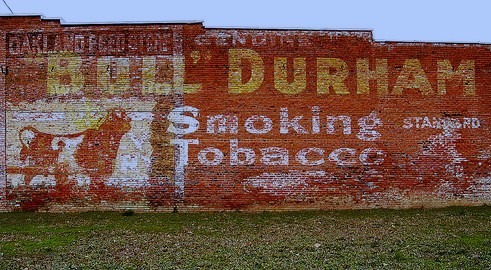
Julian Carr, a partner in “Bull Durham” smoking tobacco was ahead of his time with marketing.

The renamed product’s fame took root in 1868 when it was re-branded following its newfound popularity among Confederate and Union soldiers bivouacked here during the surrender that ended the Civil War.

Billboards were hand painted back then, often on rocks or barn roofs and siding and Carr deployed four teams of painters across the country securing the rights from property owners.

Today, “Old Bull,” the brand’s original 1874 headquarters and factory is a National Historic Landmark in Durham, adaptively reused for apartments, but as part of its authenticity, vintage billboards there have been preserved including one on its roof.

Until Carr’s innovative campaign in 1877, billboard companies had limited their desecration to cities, “brawling” with one another over telegraph poles, ash barrels and fences as well as wallpapering entire houses and blocks of commercial buildings.

In the words of Dr. Catherine Gudis, author of Buyways: billboards, automobiles, and the American landscape and a professor at UC-Riverside, back then “advertising space was not yet construed as real estate” but as “public spectacle.”

She notes that billboard companies at the time that “few paid regard to the inviolability of private and public property.”  The desecration of roadsides today is obviously in their DNA.

But 16 years after Carr sent his billboard painters across the nation and around the world, Americans rose once more in rebellion and mounted a hundred-year-long “sense of place” revolt.

It was, as documented by Professor Gudis from her research here in Durham in Duke’s outdoor advertising archives, a “battle for aesthetic rights to the roadside environment,” a picket engagement of which had been fought in Durham a few years before my arrival.

Americans fought in this rebellion, skirmishes of which continue today, to reclaim the roadsides created with their tax dollars from the forces of blight.

Meanwhile in another ironic twist, billboard companies recast themselves as simply private property owners.

Losing to aesthetic revolutionaries in the court of public opinion, they have posed as poor victims shelling out tens of millions across the country to sway lawmakers.

Lost on those who fall sway today in North Carolina is that billboard companies don’t own the property they use.  They lease it, and the laws they pursue are intended to harm the real property owners.

Only 3% of the billboards in North Carolina are locally owned by small independent companies.  More than 97% are now controlled by a handful of huge out-of-state companies, a cartel of sorts owned by REITS as vehicles to avoid paying taxes and by a revolving door of private equity firms.

They actually own property for only 3% of the thousands and thousands of billboards they have erected across the state.  Yet, they have successfully hoodwinked some lawmakers into thinking otherwise.

But it is something else that led me to join the roadside rebels.

These large out-of-state billboard companies are bullies, a realization that finally led to my belated conversion as a champion for scenic preservation and aesthetic rights as a civil right for all Americans.

Having divided up North Carolina among themselves, this billboard cartel not only bullies local communities to override the interests of their citizens, they throw their weight around to bully state regulators away from defending the public interest.

There are many reasons to despise the state laws they have recently pushed through including clear-cutting exorbitant view zones and soon even the once protected forest at interchanges.

Now they are seeking seek to overturn local zoning ordinances including democratically enacted and popular billboard controls and bans.

They also hope to transform thousands of illegal billboards to legal status as well as gaining the ability of turning them digital and capable of being relocated anywhere they please.

They also seek now to hold taxpayers hostage for millions of dollars for each billboard when roads are widened, something even the Texas Supreme Court rejected last week.

But the real reason they are bullies is what they are trying to do to the true local property owners who own the land leased by these billboard companies.

They also want to put small independent companies out of business so they can bully land lessors at will.  “Agree to our terms, or we will move one of our other billboards to block yours, rending it worthless.”

But my slow conversion to aesthetic warrior began much earlier.

Durham was forced by a large billboard company to take its right to ban billboards and remove them by providing a seven year window for the company to amortize its value all the way to the U.S. Supreme Court.

It was declared valid in 1992, less than three years after I arrived.  Over the next nine years, a grand compromise was shaped among billboard companies, public agencies and scenic character advocates regarding window-framing to protect trees, reforestation and view zones.

But within two years, the billboard companies were back at it, persuading Democrats in the legislature to outlaw the tools for removal endorsed for communities by the U.S. Supreme Court, preferring it seemed to let the forces of nature remove them.

Then five years later, just before I retired, neighborhoods in Durham were forced to defend the community’s ban as one of the out-of-state giants strapped a business organization to the bumper in an attempt to bully Durham into reversing its ban.

Unsuccessful, they turned again to the legislature as recourse, this time to Republicans for refuge in their continued war of desecration.

By then I had joined the small bands of rebels still fighting the aesthetic rights roadside revolt that began 122 years ago.

I’ve learned that this revolt has had many victories: promoting roadways as parkways, sparking the City Beautiful movement, empowering communities to establish billboard controls and pioneering community destination marketing organizations.

That rebellion as it continues today is a reaction to the road and rail-side desecration Americans saw as tourism took off after the Civil War.

The revolt was not only in defense of tourism but because tourism related businesses often fail to understand that people are drawn to destinations - not to hotels or mainstream amusements or pursuits they can do at home.

Aesthetic rebels such as me know that without this insight, tourism usually kills the very things it loves.

And that is why I have become a zealot for aesthetic rights.

Tuesday, April 28, 2015

In Just 48 Months

People who skipped over a recent post entitled 7 Truths may not have realized that they pertain to the spectacular shift Americans have made in how they access information while on the road.

Take maps for instance.  By far, the way Americans now access maps is online, and according to a survey, 90% do it on the go via a smartphone where they are useful not only for navigation but to pinpoint travel services such as restaurants, lodging and fueling stations.

According to Michelin, which has produced old fashioned static paper maps and guides for more than 100 years, 39% of Americans still keep one in the car as back up.

Less than 2% apparently continue to use roadside billboards.

Although these days, my back up to GPS is a “large print” AAA map, I still have a 1967 Michelin map of France from my first passenger airplane trip of any kind when I had just turned 19 years old.

That is also the year before Michelin started publishing maps and guides for destinations in the United States.

North Carolina first published a state highway map in 1916 when federal aid became available, and then annually or every other year since 1924.  The 1930 edition even showed motorists how to do hand signals for stopping and turning.

The first one printed in color was the 1936 edition, which included a guide to what were then considered the state’s major attractions (shown in the image below,) one of which was in Durham.

Of course settlements had been mapped here beginning in 1590.

It wasn’t until three years after I arrived in North Carolina to officially jumpstart visitor-centric economic and cultural development for Durham in 1989, that city and regional insets began to be added to the state map.

That was the year the World-Wide Web (WWW) was created to enable onramps to the Internet.  By the time the state map added those city insets, the first online maps were created by the Xerox innovation lab, PARC (Palo Alto Research Center.)

By 1994 when we began the shift to moving all Durham information to that platform, Canada and Scotland had put their entire atlases there, the latter being the first interactive maps.

Our organization was one of the first in the nation to incorporate the responsibility to determine or relay “impedance” data to online map companies.  This is what permitted these maps to recognize one-way streets and navigational turns.

Whenever your GPS misleads you - and 63% of us have had that happen - don’t blame online maps, blame the community and/or state that has neglected to update its data which is even more contaminating to static paper maps.

Even venerable Michelin is going online.

Most Americans first learned about online maps through MapQuest beginning in about 1996 but codes written and adapted by that company go back to its origins in the 1980s.

Then along came Google Maps in 2005 built on that company’s acquisition of the work of two Danish brothers in Sydney.

Apple launched the first iPhone less than 24 months later, although smartphones had been conceptualized in 1971, just before I graduated from BYU, and were offered for sale in 1993, on the heels of that first digital map created by Xerox.

Adoption of smartphones by Americans has been at a blinding rate of speed.  From just 35% four years ago, the fraction of Americans now using a smartphone has reached two-thirds, 75% of all mobile device users.

This means that within just 48 months, the percentage using these devices flip flopped to the percentage not using them.  The aftershocks of this seismic shift are just now becoming apparent.

And its substitution by users as the primary means of navigating to businesses as well as learning about new products has been even faster.

Smartphones are also the primary or only means for nearly 1-in-5 Americans to access the Internet including 13% of those making less than $30,000 per year.

Half of smartphone users have their devices to access help in emergency situations and 17% to report neighborhood problems.

Marketers, as a group, can be extremely slow to shift gears with a few even still using roadside billboards, earning a reputation for desecration marketing.

But laggards notwithstanding, it appears that devices such as these have already becoming the salvation for restoration of scenic character along our roadsides.

Friday, April 24, 2015

Symbols of Intergenerational Compact

In an essay a week ago, I suggested that North Carolina’s annual Interagency Report on Litter Cleanup, Education/Prevention and Enforcement was missing some information.

But I was mistaken; so maybe with this post, I can fill in some of the blanks.

Litter clean-up has many purposes including public health, achieved by reducing contaminants in storm water, but it is also to safeguard scenic character, which is a core trait in the state’s appeal for economic development.

So I questioned why programs to proactively beautify roadsides were omitted.  It turns out these are beyond the legislative scope of the report and I sense that over-delivering may not be well received.

It is too bad because North Carolinians are largely unaware of how much the NC Department of Transportation does to protect and enhance the state’s overall appeal along its roadsides.

Roadsides are the first and last impression that more than 90% of the state’s visitors receive, as well as tens of millions of potential visitors who are just passing through.

When I arrived in Durham twenty-six years ago to complete the last half of a four-decade career in visitor-centric economic and cultural development, Bill Johnson, a now retired NCDOT roadside engineer was deep into two, now award-winning, beautifications projects.

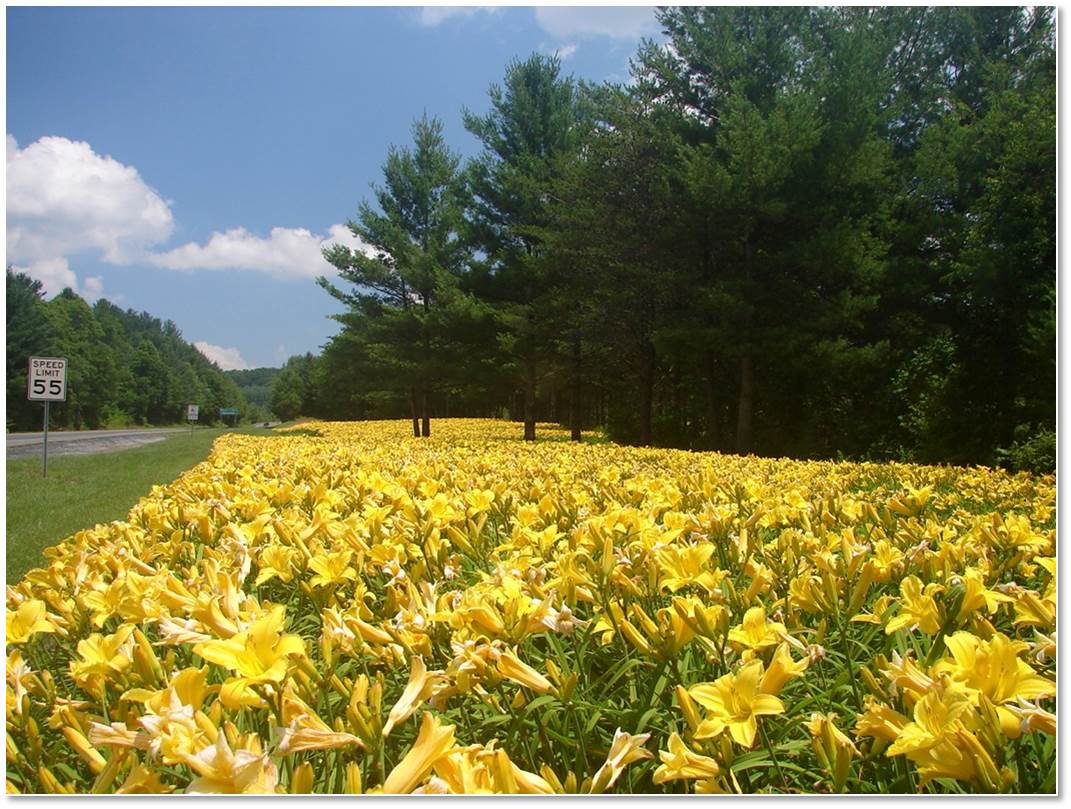
Today, North Carolinians and visitors to the state are greeted with 1,500 acres of wildflowers across the state as they drive along Interstates here.

Bill also started a program to recognize and preserve scenic byways along secondary roads across the state.

Soon the number will be increased to 58 covering more than 2,300 roadway miles showcasing every part of North Carolina including Durham, one of the few urban counties to set one aside, a favorite of mine astride a trusty Harley-Davidson Crossbones.

It is also a stated goal of NCDOT to “have well established and aesthetically pleasing forest along the highways in North Carolina.”  I haven’t seen a report for this decade but from the 1960s through the 2000s, NCDOT planted about 5 million trees along roadsides here.

A good share were planted in league with the America Treeways Program, a partnership of many agencies and volunteer organizations with the National Tree Trust established in the early 1990s by the first President Bush, a Republican.

Back then, it was also a bipartisan national policy to have well established and aesthetically pleasing forests along highways.

I will never forget a sentiment expressed by Bush I during my first few months in Durham, “Every tree is a compact between generations.”

Add that to the list of intergenerational compacts that have been shattered over the past decade.

Today, in North Carolina, many legislators inexplicably work overtime to sacrifice trees along the 14% of roadways that are part of the National Highway System here where they still remain, even though protected in the state constitution.

As a result, except whenever the Governor intervenes, Carolina’s once vaunted appeal for scenic character is rapidly falling into tatters.

Wednesday, March 25, 2015

Thoughts From A Roadside

Several thoughts raced through my mind yesterday while viewing the roadside of a freeway interchange in Durham, North Carolina, where I live.

These parcels are very park-like when well-maintained, as members of a public-private coalition called Durham Appearance Advocacy Group (DAAG) is trying to do by forging alliances between local governments, businesses and groups such as garden clubs and Scenic North Carolina.

The one we discussed yesterday is meant to serve as a template for every interchange in Durham.

But ironically, regressives in the State Legislature have been working at odds, filing bills to disable state management of these roadsides and permitting out-of-state billboard companies to wantonly deforest them in order to prop up an obsolete technology few Americans use now.

Now they have even filed a bill, with an innocuous misleading intro, meant to override wildly popular democratically enacted bans on this form of desecration marketing and blight that have stood in communities such as Durham for more than three decades and ruled constitutional by the U.S. Supreme Court.

This tyranny by representatives not from Durham reminds me that revolutionaries founded our democracy not in opposition to taxes but due to corporate loopholes granted by the feudal systems of governance then in place.

In opposition at the time and ever since stood regressives trying to pull the country backwards.  One wonders, will another revolution soon be sparked?

In the 1930s, roadsides such as those I was standing alongside yesterday were already battlegrounds between the forces of blight and the forces of scenic preservations.  Jobs, jobs, jobs was the mantra then too but it was both/and when it came to scenic preservation.

Highway 100 was one of the first, if not the very first beltlines in the country.  It patched together a series of existing roads south and west of Minneapolis but included new construction of a stretch of more than 12 miles including what we now call clover leafs.

It was deemed the “Lilac Drive,” lined with 30,000 plants including 8,000 Lilac shrubs and 7 roadside parks.  It became a recreational destination and living proof that Americans are drawn to scenic character over commercial blight along their roadsides.

It was in the middle of nowhere back then but had the support of development interests and billboard companies eagerly pushing for sprawling suburbs that would soon gobble up acreage at a rate many times the rate of population growth, as it still does today in Durham.

Emily Badger reported in The Washington Post this week about a new study that that concludes that sprawl costs the U.S. economy now more than $1 trillion a year.

The reason deficit hawks are not licking their chops is that $400 billion of this is pushed off on other people, something economists call negative externalities, which is a fancy word to describe when the free market doesn’t incorporate its true costs.

Only a portion is found in inflated costs for public services.  We absorb the rest sometimes in our lungs and often while stuck in traffic, but all in all it is very similar to the tax loophole that led to the original Boston Tea Party.

Billboarders and their legislative allies aren’t the only ones who want to shift even more of those costs onto unsuspecting Tar Heels including millions of us “hard-working taxpayers” we so often hear regressives talk about.

Over the last five decades (1960s-2000s,) the NCDOT has carefully reforested and afforested more than 5 million trees along the state’s roadsides, in part, to mitigate for many times that number which had been destroyed during road constructions.

The trees were also meant to bolster a signature ingredient of North Carolina’s brand.

This included lining the state’s roadways with spectacular understory trees such as native Redbuds and Dogwoods, the state tree.  Then, without thinking, another unit enabled private maintenance contractors to destroy most of them just for their convenience.

During our cross-country road-trip a few months ago for my mom’s funeral, Mugs and I took I-64 through Saint Louis.  This included a 10 to 11 mile stretch through the heart of that area that had recently been rehabilitated.

Some even call it that community’s front door.

The area is sea of concrete and buildings leaving almost no roadside.  But the Missouri DOT has carefully carved tiny slivers of planting areas where possible along this stretch and recruited businesses and organizations as landscape sponsors.

It too, I suspect is meant as a pilot project for a more strategic approach going forward.  An example of the discreet but very visible signs erected for sponsors is shown as the image in this blog.

Research shows that less than a fraction of 1% of consumers still use billboards.  It takes less than six seconds to decipher one but consumers only give them an average of three, even when digitally flashing on and off intermittently to draw attention away from the road.

Yet billboard companies now want to deforest even interchanges in hopes that someone traveling past them or focused on exiting or merging onto the highway will have twice as long to look.

Yes, it is obscene and possibly the spark for another revolution, if not with torches, pitchforks or midnight rides, a roadside revolt.

Thursday, October 30, 2014

Putting A Fiscal Value On Roadside Character

Deep in the appendices of a study scientists conducted along the nation’s roadsides in 2010 is an estimate of how many acres of forestland is along roadsides in North Carolina’s portion of the National Highway System.

Not counting roadsides along forested state highways or all of the rural roads it maintains in each of the state’s 100 counties, just the 28% of the NHS portion still with roadside trees alone means the North Carolina Department of Transportation is in the forest preservation business.

Or it should be.

This is 7% of all state and local government forestland.  I suspect it is would be closer to 30% if an inventory were conducted of roadsides along all NCDOT-maintained roadways.

And that is just the point.  NCDOT has no boots-on-the-ground inventory of this asset, nor a strategic management plan of caring for this publicly-owned commons.

This is why there is typically no reality-based fiscal note provided when legislators vote to surrender this public asset free to out-of-state billboard companies, including no requirement to reforest taxpayer trees when destroyed merely for a few more seconds of face time.

It is also why there can be no cost compared to benefit when contractors with mechanized assets push to remove thousands of acres of trees unwarranted by federal maintenance guidelines.

NCOOT regulators know that merely using the miniscule value as “pulp” has long-ago been antiquated as forest service scientists over several decades have meticulously documented the far greater value of the trees to ecosystem services such as reducing harmful emissions.

Long ago state officials were given a heads up to scores of other types of valuations including the role of roadside forests as the signature asset both for tourism, a sector now adding an incredible $10 billion to the state’s GDP including its appeal to scouts for relocating or expanding businesses.

It wouldn’t be expensive for NCDOT to conduct a tree inventory using just the 200 randomly selected plots of 1/10th acre each required by i-Tree Eco technology created for this purpose by forestry researchers.

Plots selected by random would include ones in various regions of the state and population intensities as well as terrain and vegetation cover, including areas with no trees areas as well as views worthy of scenic preservation and those where blight is screened.DSC01342

Outputs would also provide a baseline for the number, age and health of trees along the roadsides including the percentage of each species and overall management needs.

It would also quantify the overall value calibrated top local climates and other variables.  Officials need only contact Dr. David Nowak, the research forester who created the process and who patiently broke it down for me during a phone conversation last year.

Here is an example done of street trees by the Virginia Tech Department of Forest Resources using i-Tree, but NCDOT might be able to add to its considerable resume for best practices by being the first agency of its type to conduct such a roadside assessment statewide.

It took the feds nearly a decade to sign agreements for implementation with all fifty states after the Highway Beautification Act was signed on October 22, 1965, a herculean effort by the agency that today rarely even lifts a finger to enforce it.

North Carolina officials like to claim that forestland acreage here today is about the same overall as was in the 1930s.

But that disguises the fact that it had been much higher when it peaked in 1964 as the HBA was being debated in Congress. Since then, forestland has also declined precipitously (p. 4) in North Carolina.

It has also declined dramatically since 1971 when business leaders helped encouraged voters here to pass an amendment to the State constitution in part meant to protect forestland such as that along public roadsides (Sec. 5, Article XIV.)

Emblematic instead, is that those sworn to uphold it simply don’t, with newly enabled sacrifices of forests along roadsides and soon interchanges, which is pushed only by lobbyists today on behalf of parasitic commercial billboards.

But following the embedding of that amendment in 1972, state officials let another million acres of public forestland disappear, prompting cities such as Durham in 1984 to enact billboard bans in self-defense, followed by protective scenic overlays along new Interstates and in 1999, ordinances to protect tree canopy in general.

Yet, here too, local officials have failed to follow up with an inventory of this signature symbol of sense of place, a powerful prerequisite of any strategic management of green infrastructure while “billboarders” and their legislative allies press to override three decades of local effort to be more appealing.

While more than 8-in-10 North Carolinians - and an even greater proportion of visitors - are reverential about forested North Carolina roadsides, they are easy to take for granted.

Much of what we see today has grown back in the last 50 years.  As the HBA was passed, there had come to be a billboard every 1500 feet nationwide along highways (imagine seeing one every city block.)

By 1984, enforcement of the HBA had removed barely half a million billboards and prevented another 200,000 but billboard companies had used loopholes, campaign donations and graft to continue to litter cities alone across America with half a million billboards.

Durham, North Carolina had had enough and enacted a Republican-led ban that year while many other communities in North Carolina and across the state succumbed to heavy-handed lobbying, graft and threats instead.

However, after the very highest courts sided with Durham, the state sided with the billboard lobbyists.

Today, the feds look the other way when it comes to enforcing the Highway Beautification Act enabling billboard companies to push through phony rezoning.

It isn’t enough that North Carolina has once again permitted enough billboards to be put up along U.S. highways here alone to be the equivalent of one per city block, but a legislative give-away recently enabled them to triple the cut zone forgoing a million or more  publicly owned trees.

And yet, there is no inventory of the forests the public owns along roadsides or any holistic estimate of the value of roadside forests’ worth, including tourism, although according to public opinion polls, they are priceless to Tar Heels.

In the meantime, as any use of billboards by consumers to buy something had fallen now to “two-tenths of one percent,” lobbyists are readying a push with legislative allies to force communities, even with those with bans to permit digital billboards.

Sound like reasonable stewardship to you?  Or maybe it is time for a moratorium to preserve North Carolina’s scenic character, while it still has some left!

Wednesday, January 08, 2014

Scenic Character’s Leading Role in Sense of Place

Greensboro is the third largest city in North Carolina.  But according to friends, old and new, who live there, it is bent on mimicking the fourth largest city, Durham. 

Unfortunately, they are not mimicking Durham for its distinct sense of place.

Instead Greensboro seems drawn to mimic the corrosive influences that make communities the same, appealing, in the words of Dr. Scott Russell Sanders, only to those for whom “tourism is another form of shopping, treating the whole country as a gigantic mall.”

By this he is referring not only to shopping or malls per se, but to  generic attributes that make communities just one of many vs. distinct.

According to Sanders, in a speech I heard him deliver in 2006, the salvation for communities clutching to sense-of-place is neighborhood activism.  Durham bears Sanders out but only as long as it can withstand what he calls “Goliaths,” warning that:

“…Goliath never sleeps, never takes no for an answer, never runs out of money or political friends, and most of the time…gets its way.”

I witnessed the sacrifice of North Carolina’s distinctiveness on a cross-state road-trip last weekend.  Observing how commercial out-of-state billboard interests are sating their greed by destroying roadside trees and viewsheds caused me to think about my reading habits over the years and the pivotal role scenic character plays in appeal.

I’ve always been an avid reader, but it has been marked by streaks restricted to either fiction or non-fiction.  After law school in the mid-1970s, I couldn’t stand to read non-fiction.  In fact, I took a brief break from reading altogether.

During my near-decade in Alaska, I read mostly suspense and/or historical fiction such as written by Uris, Ludlum and Michener.  When I moved to Durham, I turned to non-fiction except for the latter 1990s when I delved into Swedish crime novellas written by Henning Mankell after they became available in English.

As a rule I avoid movies, especially made-for-television movies based on books that I have read and enjoyed, perhaps to dodge disappointment.

Ironically, this aversion proves strongest for adaptations of books such as Mankell’s where descriptions of landscape serve as a leading character vs. only as backdrop.

I have been drawn to three notable exceptions, spurred by the advent of streaming services.  The Jesse Stone series of TV-movies based on Robert Parker novels, the 2010 feature film Winter’s Bone based on the novel by Daniel Woodrell, and most recently the Wallander series based on works by Mankell.

In each production, hauntingly dramatic landscapes play featured roles alongside superb acting by casts featuring Tom Selleck, Jennifer Lawrence (in her breakout role) and Kenneth Branaugh.  These adaptations live up to the novels and give distinctiveness to plots that might otherwise have seemed similar.

Of course, distinctive soundtracks also play a pivotal role including Nostalgia by Emily Barker for Wallander, Hardscrabble Elegy by Dickon Hinchliffe in Winter’s Bone and music by Jeff Beal for Jesse Stone.

All of this is to say that the distinctive sense of place for communities and states must also give a leading role to preservation of scenic character, lest they succumb to the corrosive influences of blight that relegate them as “monotonous, ephemeral, rootless and ugly,” appealing only a form of generic shopping.

Unfortunately, as in so many ways, my adopted home of North Carolina is headed in the wrong direction.

Monday, April 15, 2013

Mapping Why North Carolina Could Use Some Gridlock

Earlier this month, Republican Governor Pat McCrory helped distribute awards in honor of North Carolina’s popular roadside wildflower program, including one named for a friend  of mine, Bill Johnson, the 30-year roadside veteran who helped  establish it.

The Governor also inducted former Governor and Mrs. Martin into the Wildflower Hall of Fame, in which Bill was one of the first inductees two years ago.  The former First Lady inspired the wildflower program shortly before I made Durham, NC my adopted home in 1989.  I first met the legendary Mr. Johnson as he was launching the state’s Scenic Byways as a follow-up.

At the luncheon the Governor vowed to do what he can to enhance scenic programs such as this.  He has his work cut out for him.

Powerful members of his party in the General Assembly still hold views of the natural world that date to the late 1700s and 1800s.  This was a time when nature was viewed primarily as something God placed on earth for us to exploit.

More on the source of my view on this and other worldviews of the natural world later.

While less than a third of North Carolina voters are Republicans, they now control nearly 65% of the overall seats in the NC General Assembly. Regardless of whether it is due to careful gerrymandering or the resulting over-amplification of swing voters it brought about, it is interpreted by these powerful interests as a mandate to “deform.”

Prior to McCrory’s election, these powerful and unchecked legislators had brow-beaten the executive branch into enabling the sacrifice of tens of thousands of flowering dogwood and redbud trees that the state had planted along roadsides stretching between the wildflower beds the Governor honored.

For instance, over the objections of 8 out of 10 North Carolinas including by 19 to 1 members of their own party, these legislators also pushed through authorization for out-of-state billboard companies to desecrate roadside trees across the state and over ride local ordinances in communities with higher standards.

It may very well be that anything the Governor does to fulfill his vision of being transformative will be similarly over ridden by these and many other similar deformations underway in my state.

North Carolina could desperately use a little grid-lock.

Helping me understand how otherwise reasonable people would seek to deform North Carolina is an incredible article published last year in the Harvard Law Review.  It was written by Professor Jed Purdy who teaches constitutional, property and environmental law here in Durham at Duke University Law School.

He is also the author of the 2010 book entitled The Meaning of Property: Freedom, Community, and the Legal Imagination but you may want to start with one of my favorites, a book he wrote in his mid-20s and published more than a decade ago entitled For Common Things: Irony, Trust and Commitment in America.

It takes an appreciation of irony to stay engaged with what’s being perpetrated now by those in high office in North Carolina.  By stuck in the 1700s, I was implying that powerful interests who seem intent on deforming our state appear to have the perspectives Purdy describes as more relevant between 100 and 200 years ago.

This was a time dominated by a view of the natural world as “waste.”  Dismissing restraint or regulation as a “threat to liberty,” this mentality pillaged much of the country until the late 1800s. Purdy cites an 1883 debate over administration and funding of Yellowstone Park adjacent to where I was raised and spent my years on an ancestral homestead cattle and horse ranch.

Some senators at the time, according to Purdy, argued that Yellowstone should be divided up and sold, or in my opinion to use a word euphemistically used by those with the same view today about lands set aside in the public interest, “privatized.”

Just the last sixty years of that era saw two-thirds of the deforestation that has taken place in the United State during the last 400 years and by the 1890s the desecration began to shock the nation and its leaders into what Purdy describes as a new ideal of the human-nature relationship, what he calls “progressive management” or conservation.

It is  epitomized by Republican President Theodore Roosevelt and legislation such as the creation of national forests which was inspired by immense desecration right here in North Carolina.

In recent polls, more than one in five Americans still consider themselves conservationists today, more than any other label used by the more than one in three Americans overall who are deeply concerned about the state of natural environment being left for future generations.

As a moderate independent voter, it is the description with which I feel comfortable.  Three times as many people who fish and hunt in this country consider themselves conservationists than those who belong to the NRA.  Many are Conservatives and relate to the group formerly named Republicans for Environmental Protection.

Renamed ConservAmerica, the group is represented in Washington by a native North Carolinian and last fall formed a ground-breaking partnership with Audubon called the American Eagle Compact under the slogan “Because Conservation Doesn’t Have A Party.”

The early 1900s also saw the emergence of an ideal toward the natural world that Purdy calls “romantic epiphany.”  This ideal has been at the center of a key part of North Carolina’s tourism appeal since the 1930s including the inspiration for the first efforts to roll back roadside billboards in the state.

Today, this ideal is carried forward by groups such as Scenic North Carolina, an affiliate of Scenic America.

Judging by their actions, the ideals of conservation and “romantic epiphany” are despised by those Republicans in powerful positions in the NC General Assembly today. They seem determined only to roll our state back to the era of despoliation, back to the view of nature as only indicative of waste, back to the 1800s.

Tourism is a visitor-centric form of economic and cultural development.  Trees are a signature element of the natural aspect of North Carolina’s appeal to tourists which include more than 80% of relocating business executives prior to announcing their interest.

Trees along roadsides are the state’s first impression of its natural assets.  Butchering them for billboards or even just the convenience of maintenance engineers is obviously a good way of dampening tourism interest and eroding the North Carolina brand overall.

I suspect though, that anyone with a worldview of nature that has been in disrepute since since the late 1800s has little concern for tourism or relocating businesses or thousands of small businesses.

Their latest maneuver to prohibit the high standards of North Carolina’s towns and cities is further evidence of wanting to deform the state back more than a century and with it the state’s hard-won brand.

Purdy continues by describing a view of the natural world that emerged  in the early 1960s called “ecological interdependence.”  It spawned American’s deep concern for clean air and water anchored in the interdependence of nature and the moral sanctity of life.

Those bent on deforming North Carolina back into the 1700s and 1800s are even more disdainful of this ideal, even as we begin as a society to re-imagine a future ideal around the natural world spurred by scientific evidence of catastrophic climate change.

It is ironic that even scientists who were climate change skeptics now agree that this current environmental threat is nearly all the result of from human interaction with nature dating back to the 1700s and the dawn of that view of nature as wasted unless fully exploited.

Purdy is careful to note that none of these human-nature ideals have ever been monolithic even in the 1700s.  He provides evidence that often they were defined by something society was trying to avoid.

This blog is certainly not a substitute for reading and re-reading Professor Purdy’s salient overview of these various eras of the relationship between humans and nature, which I highly recommend.

His mapping of our views of nature over time has helped me not only better understand the realities and worldviews driving those so intent on deforming North Carolina, but made me even more concerned.

As valid as parts of that reality may seem, it is imperative that it once again be with other even more valid and relevant views.

When the pendulum begins to swing back from such extremism - and it surely will - hopefully we will not only seek rectify the damage, which will take generations, but re-imagine the next era of human-nature ideals in a pragmatic, moderate and less ideological sense.

Governor McCrory can get a head start on this process by following through on his comments at the Wildflower luncheon this month.  He’ll need all the support he can get from North Carolinians and courage within his party’s caucus to bring some sense to the General Assembly.

If not, instead of being transformative, the legacy of his administration will be one of deformity.

Tuesday, January 29, 2013

Nudging Government to Govern

For possibly the first time in its history, this month Scenic America filed a lawsuit of its own rather than just a supportive brief.  Having tried logic, evidence, encouragement and seemingly every other alternative, Scenic America has turned to the courts in an effort to get the Federal Highway Administration (FHWA) to, well, do its job.

The Highway Beautification Act (HBA) was signed into law in late 1965, during my last year of high school and just as the now-classic California Dreamin’ was released by The Mamas & Papas following a freak September snowstorm in eastern Idaho.

However, the HBA wasn’t fully deployed until 1972, as I was graduating from college.  It had been delayed by development of state-by-state agreements such as the one signed that year by North Carolina, where I now live.  By then outdoor billboard and other sign interests had already pushed through amendments that watered the HBA down, overriding the compromise agreements they made when it was created it.

The following year, as I took my first full time job in community-destination marketing to work myself through law school at night, I learned first hand about one of the amendments from Luke Williams, one of the inventors who had built the huge American Sign & Indicator Corporation based in Spokane, Washington.

In the late 1960s, Luke, a lifelong Republican, had persuaded the powerful Democratic Senator from Washington State, Henry M. “Scoop” Jackson, to insert an amendment to the HBA.  It was designed to exempt the ubiquitous, electronic time-temperature signs the company leased from the HBA’s purpose of reducing and restricting sign and billboard clutter and blight along the nation’s roadways.

The amendment carved out an exception along roadways stipulating that “public service information such as time, date, temperature, weather or similar information may be advertised on electronic variable message signs located in commercial and industrial areas.”

By 1978, as I headed to Alaska to head the DMO in Anchorage, the FHWA’s administration of the HBA had become so politicized that the agency formed the National Advisory Committee on Outdoor Advertising and Motorist Information to make an assessment along with recommendations to improve effectiveness.

It was chaired by Thomas W. Bradshaw, Jr. a former mayor of Raleigh, North Carolina.  At the time he was secretary of the North Carolina Department of Transportation during the first terms of Governor Jim Hunt, who would again serve as governor after I arrived in Durham, NC to jump-start a DMO here in 1989.

The Committee included a balance of transportation and planning experts, tourism representatives, billboard representatives, sign manufacturers –including the senior vice president under Williams at American Sign - environmental experts, garden clubs, local officials and academicians including University of George economist Dr. Charles Floyd, now a friend of mine and retired in North Carolina.

Over several years the Committee met and conducted a wide range of public hearings.  It also broke into sub-committees to evaluate a wide range of aspects before making a final report in 1981 to the head of the FHWA, almost exactly 16 years after the HBA was first enacted.

One interesting aspect of the report is that it attempts to benchmark the improvements generated by the HBA as of 1980 including a 71% improvement in aesthetic quality by removing 542,115 signs from roadsides - including 103,000 large, unsightly billboards -  and a 33% reduction in standard-size billboards while preventing another 200,000.

In 1965 when the HBA was enacted, there had been an average of one billboard every third of a mile along primary highways throughout the nation. By 1978 when much of the act had been gutted by the allies of billboard companies, the sign blight along roadsides had been reduced to a little more than one per mile.

But the improvements were not even. The General Accounting Office reported prior to the Committee’s deliberations that residents of many areas could detect little or no improvement in their states.

What they couldn’t thwart by diluting the HBA with subsequent amendments, the billboarders effectively thwarted by starving it of funding for implementation as well as by bullying agencies, bringing the FHWA to estimate in the 1981 report that it would take another 154 years to remove non-conforming signs, a clock that today has probably reached several hundred years.

In its 1981 report the Committee laments the loopholes in the law as well as poor enforcement of the HBA.  It notes in one resolution that staff and funding for the FHWA’s Junkyard and Outdoor Advertising Branch had been slashed to skeleton only a few months into the then-notoriously anti-regulation Reagan administration.

Today, ironically, many thoughtful Republicans including former elected officials believe that the reason so many members of that political party are rabidly anti-regulation is not because they are inherently heavy-handed and excessive.

Instead, they believe regulations only got that way as lawmakers responded to the general and enduring failure by the executive branch at every level of government to execute them in the first place, setting off cycles of over-tightening and more and more complexity.

At the heart of even the watered-down HBA are three relatively straight-forward restrictions that even today, nearly 50 years after its passage, both federal and state agencies are failing to properly execute.

The law stipulates that:

1) Roadside billboards are permitted only in commercial/industrial zones but using tactics some experts call “legalized corruption,” billoarders have persuaded lawmakers in many areas to establish what was already castigated in the 1981 Committee report as “phoney zoning,” and still clearly evident today in North Carolina.

2) The act stipulated that billboards existing before 1965 could continue if they met state and local customs prior to passage of the HBA. However, billboarders have successfully pressed agencies to permit thousands of new billboards after that date. Failure to enforce this aspect is the basis of the suit now filed in U.S. District Court.

3) It also stipulates that billboards must be regulated as to lighting, size and distance. This included the prohibition of digital billboards for anything other than time and temperature or public service.  The Scenic America lawsuit asserts that the lighting provision is obviously not being enforced.

However, in late 2007, just as the “Great Recession” hit during the final months of the Bush Administration, the Federal Highway Administration, without rationale or discussion, inexplicably reversed its position on digital billboards and issued a memorandum declaring that digital billboards were not intermittent.

Failing in the years since with expert testimony to persuade the FHA that digital billboards are by their very definition, intermittent lighting, and frustrated at years of non-enforcement of the Highway Beautification Act, Scenic America has turned to the courts to force the government to govern.

Scenic America, in the suit filed on its behalf by the Georgetown University Law Center’s Institute for Public Representation, is asking the courts to require the federal agency to resume active enforcement of the provisions and intent of the 1965 Highway Beautification Act, including the original intent of intermittent.

Not so coincidentally, the origins of Scenic America date back the 1980s and a response in part to the findings of Bradshaw’s 1981 Committee Report to the FHWA.

The Committee, lamenting that amendments pushed through Congress in 1978 were interfering with local community control of roadsides as well as lax state enforcement, encouraged in one of its motions the creation of state and local advisory committees across the nation to advise and assist administrators in implementation of the HBA.

However, foretelling that the FHWA would probably continue to be grid-locked or politicized into inaction, the Committee noted that it had been divided into two opposing camps and because its motions had narrowly passed, minority reports were included in the report.

Frustrated at continued FHWA inaction, within months of the Committee’s report, a nationwide coalition formed what would be renamed Scenic America later in that decade, along with affiliates in each state and in many communities, one of which I have been involved in resurrecting for North Carolina.

The objective of these scenic entities are to safeguard the scenic qualities and character of America’s roadways, countryside and communities and foster citizen engagement in scenic conservation.  It isn’t being anti-billboard but anti-blight and pro-scenic character.

Polls continue to overwhelmingly favor beautification of roadsides.  And voter sentiment runs strongly against the blight created by billboards and any tree-cutting to make them visible.

Yet this sentiment has continued to be thwarted both in legislative bodies and in agencies by powerful billboard interests, even as consumer and business use of billboards had dramatically shrunk to less than .20%.

Economists call the tactics used by billboard companies “rent-seeking,” including campaign contributions and heavy-handed lobbying.  Think of it as renting economic value by influencing government decisions rather than creating economic value.

Other experts refer to these actions as a form of “legalized corruption.”  According to free-market advocates, entities and allies so engaged are not pro-market but seek instead to tilt the playing field to their benefit, but never to level it. Lawmakers and agencies are pawns, voters the victims.

Hopefully Scenic America will prevail in the courts and government will begin to govern by finally and fully enforcing the Highway Beautification Act.

Wednesday, December 19, 2012

A Roadside Bonus

It was during the last week of May 1965 and I had just finished my junior year of high school when the Beatles’ Ticket to Ride was giving way as the #1 song to Help Me Rhonda by the Beach Boys.

American combat deaths in Vietnam reached 1500 and ten times that many students had just marched against the war in Washington D.C.  Within two weeks I would first hear Keith Richard’s famous guitar riff on I Can’t Get No Satisfaction by the Rolling Stones.

My more-like-a-brother uncle was training to fly USAF F-4 Fighter Jets.  Within a year he would be flying his first of three tours including more than 300 missions over North Vietnam.  In just more than a year a boyhood friend and a high school friend would both be seeing combat there with the US Army.

But that last week of May 1965 was also when President Lyndon Johnson convened the White House Conference on Natural Beauty.  There LBJ challenged “panels of conservationists, industrialists, government officials and private citizens” to come up with proposals for the preservation of the scenic character of America and its states, cities and towns including:

    • “underground installation of utility transmission lines”
    • “a tree-planting program”
    • “policies of taxation which would not penalize or discourage conservation and preservation of beauty”
    • “a solution to the problems of automobile junkyards”

However, this group of businesses, residents, lawmakers and policy wonks focused even more on what they felt was the greatest threat to scenic character, huge outdoor billboards, not only in cities and towns but across the landscape of the nation.

Unfortunately, proposals from the conference were effectively gutted or circumvented in subsequent legislation and today the agenda remains unfinished.

The effort to restrict outdoor billboards to highly “commercialized areas,” while preserving “scenic areas,” had begun forty-two years earlier when it became clear “poster” companies as they were then known were moving from cities in an effort to wallpaper every inch of roadway as the age of the automobile began.

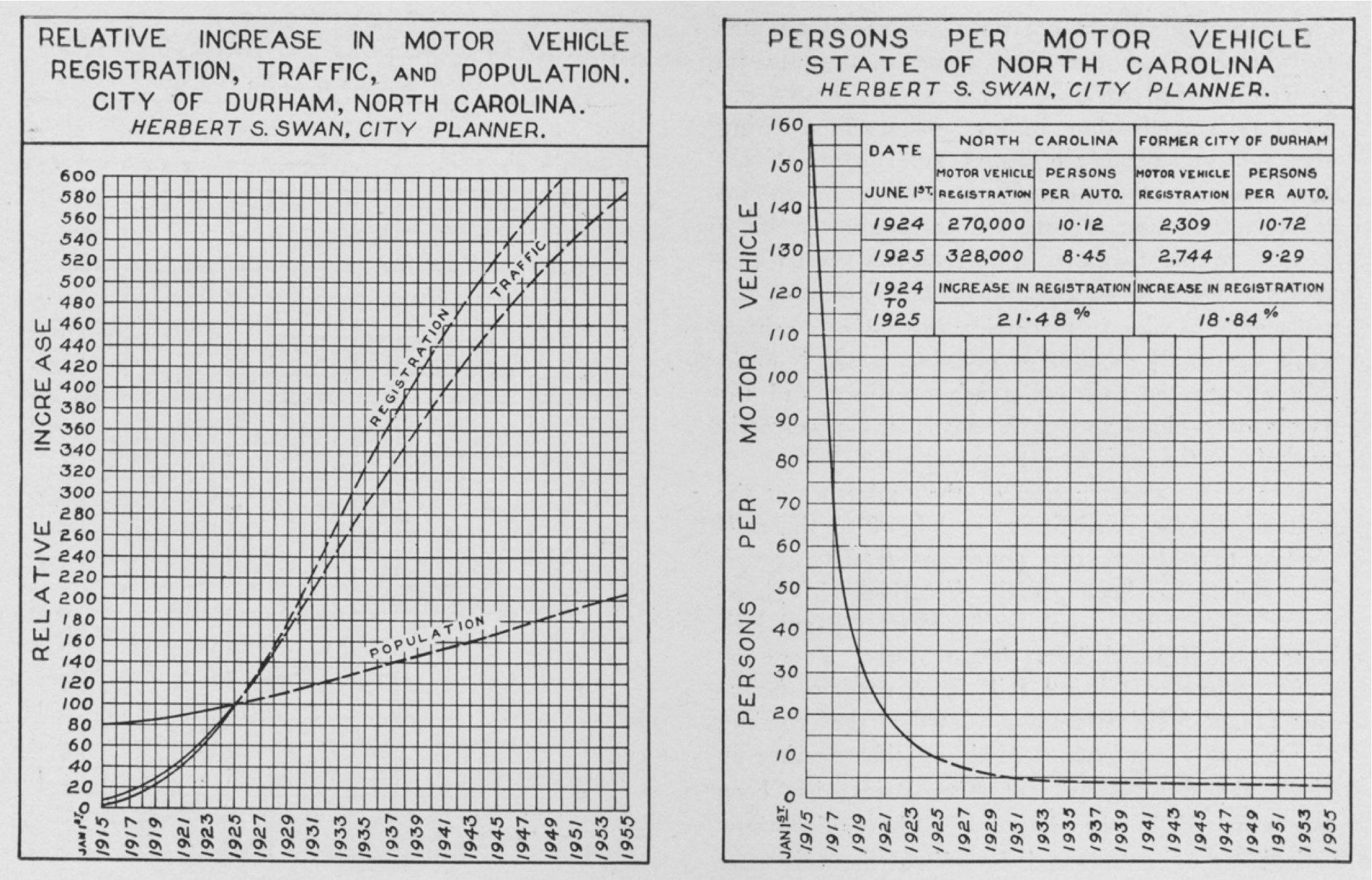
At the time, Durham, North Carolina, where I have lived for nearly 25 years had a total of only 2,309 registered motor vehicles for a population of 50,000 and the registrations statewide had already skyrocketed far higher than overall population in the less than ten years since registrations began.

Roadside audits, such as one conducted in 1930 for North Carolina, began to document the state of roadsides across the nation.  On my fourth birthday in 1952, Elizabeth B. Lawton, the architect of that roadside movement died.

However, six years later, at the launch of the Interstate Highway System in 1958 the federal government offered a bonus to states that would voluntarily adopt national standards to protect their roadsides from outdoor billboards and other forms of blight.

The 23 states participating were known as “Bonus” states and they are easily discernable today by that status alone as one travels cross-country as I have done via various routes a handful of times since my retirement from community-destination marketing several years ago.

“Bonus” states include California, Colorado, Connecticut, Delaware, Hawaii, Illinois, Iowa, Kentucky, Maine, Maryland, Nebraska, New Hampshire, New Jersey, New York, Ohio, Oregon, Pennsylvania, Rhode Island, Vermont, Virginia, Washington, West Virginia and Wisconsin. That’s very close to half of the states in the USA.

Ironically, eligibility to participate in the program expired several days after the White House Conference on Natural Beauty adjourned in 1965 although for the most part participating states must still meet the requirements of the agreement. 

Hawaii, Vermont, Alaska and Maine have constitutionally banned billboards altogether but it is interesting to note that while every state in the Northeast participated in the “bonus” program, none in the Southwest did and only five of twelve from the Midwest did, plus four of eleven from the west and a mere three of twelve in the Southeast.

In fact by some measures by regional breakdowns used today, none did in the Southeast, one of the nation’s most scenic regions.

Scenic states such as North Carolina had everything to gain and nothing to lose because this attribute is so closely linked to their economies.  Many of the most scenically spectacular states in the union stayed on the sidelines, I suspect not because they didn’t understand what would be lost or gained but because powerful outdoor billboard interests co-opted their public will.

As a results, some of our most scenic states are hidden behind billboard blighted roadways.

Government was late to recognized the importance of controlling outdoor billboards, possibly because their hands were tied by special interests.  According to research revealed in Motoring: The Highway Experience in America by John Jakle and Keith Sculle:

  • Parkways began in 1908
  • Scenic highways were declared as early at 1915
  • Roadside tree planting efforts began in 1921

In 1919, Oregon legislated to “protect standing timber and allow planting of new trees along state highways.”  The legislation also established roadside rest areas and severely curtailed outdoor advertising along the roadways.

The efforts in Oregon may have inspired Standard Oil of California, later renamed Chevron, where my great-uncle became an executive, in the 1920s to voluntarily destroy 1200 huge outdoor billboards that the company owned in California, Oregon, Washington, Nevada and Arizona.  That finished, the company mounted a wave of anti-billboard campaigns.

The western spin-off of Standard Oil understood what so many businesses fail to grasp even today: there is far more to gain from preserving the scenic roadway integrity valued in surveys by 8 out of every 10 people than there is to pandering to the less than 8% who use billboards during a given year.

The company realized that its private property and need for marketing did not trump the public’s rights along the roadways for which it had paid in tax revenue.  This is something lost on out-of-state billboard interests in North Carolina today as they ram through rules giving their so-called “right-to-be-viewed” precedence over public safety, air and water pollution control and every other public interest along its roadways.

Only when the public rises up and translates its well-documented opinions into action through the elective process will they recoup the roadway rights for which so many have fought so hard over the last hundred years.

Thursday, December 13, 2012

Legalized Corruption

In the late 1970s, about the time I headed to Alaska where roadside billboards are banned in the state constitution, the State of South Dakota tried to billboard the entire state by strip zoning as commercial every inch of their Interstate highways and primary roadways.

Fortunately, back then, businesses that sought fortune by influencing government decisions for private gain (aka rent-seeking) had not yet stripped the backbone out of federal, state and local government agencies to the degree they have today.

In 1966, after having achieved generous concessions that led to the compromise that forged the national Highway Beautification Act, billboard companies and their lobbyists immediately set out at the state and local levels to circumvent the very compromise to which they had agreed.

South Dakota obliged but it ran into Dick Moeller, then a newly-appointed Chief for the Junkyard and Outdoor Advertising Branch of the Federal Highway Administration in Washington D.C.

The Beautification Act banned new billboards nationwide except for areas zoned industrial or commercial.  This was meant to protect the scenic character as well as the environment along roadways in all areas that were not already desecrated.  The act also created the much less obtrusive, but far more effective, logo sign programs for businesses located near highway exits.

While formation of the Beautification act began in 1964 when President Lyndon Johnson challenged US Secretary of Commerce and former North Carolina Governor Luther Hodges to do something to clean up the roadsides and formation of a Task Force and the 1965 White House Conference on Natural Beauty, in the end it was all but gutted by allies of the outdoor billboard industry.

FHWA determined South Dakota’s move wasn’t bona fide under the law and assessed the state a 10% penalty to be withheld from highway funds distributed to states by the federal government.  Pushing and shoving by powerful interests as well as campaign donations had little effect and as a result more enlightened interests were able to prevail in South Dakota.

Oh, how things have changed!  Weaseling favorable treatment from government has now permeated legislative bodies, commissions and even administrators at every level.

Even those officials who might vociferously object to such a characterization are betrayed by how enthusiastically they embrace requests from special interests vs. how slowly they are to respond to popular will or to stand firm when attempts are made to circumvent or hollow out laws and ordinances.

That may not be their intent, but it has been documented in research by Vanderbilt professor Dr. Larry Bartels showing that officials are 50% more likely to react to affluent constituents in the top third of income distribution compared to those in the middle and not at all to the poor.  It is no wonder that they are perceived by the general public to be sycophants to special interests.

Financial executives may have taken the winning of favored treatment from government to a new level over the past three decades, in part, to leapfrog themselves to the head of the 1%.  But it is hardly coincidence that those who colluded a few years ago to hollow out North Carolina’s billboard legislation hail from the nation’s three least trusted professions: car dealers, lawmakers and advertising practitioners.

Americans look down on the explicit corruption such as bribery in other countries, but what has become far more prevalent here is what Daniel Kaufmann, formerly of the World Bank and Brookings Institution and now head of the Revenue Watch Institute, defines and measures as “legal corruption.” 

People (and organizations) who mine government for favorable treatment hate the term rent-seeking.  Even to those who don’t know the meaning of the term, it seems slimy and demeaning, so perpetrators instead hide behind euphemisms such as, “deregulation,” “customer service,” privatization, “streamlining” and more recently, “systemic capture.”

Roadways are where it may be easiest to view the results of “legalized corruption” or “seeking rule changes for personal gain rather than to benefit the general public.”  For instance, down-east as I-40 cuts across the North Carolina coastal plain, residents and visitors alike are suddenly treated to a forest of billboard blight.

Protected by as well as catering to powerful special interests, officials in an extremely rural area along that stretch were successful at doing what South Dakota wasn’t: strip zoning roadsides as commercial areas occupied only by a row of huge billboards.  In cases such as these, billboarders are often caught establishing phony businesses in vacant buildings as a technical hedge.

The billboards pay next to nothing in fees and less than the cost of a steak dinner in taxes and their only value is created by publicly-funded highways.  So the only reason or purpose that can be conceived for this roadway circumvention and desecration must clearly be an effort to grant special favor at the expense of the public interest.

Nothing was done because those seeking these special favors have long since used similar techniques to neutralize or tie the hands of state and federal regulators and any related-commissions who would have levied sanctions had this been the late 1970s.

Billboard companies and their operatives have become expert at neutralizing government administrators by insisting that they remain “objective” whenever a concern is raised, rather than standing up for the public interest which essentially leaves the general public befuddled.

I saw this happen a few years ago in Durham, NC, where I live, when billboard operatives made a proposal to pry open Durham’s wildly popular 1984 ban on outdoor billboards.

Citizens expected city administrators to step up immediately and emphatically make the case for the long-standing ordinance, but they waited in vein.  Lobbyists for the billboarders had already politicized the process by demanding that city officials be “objective” and labeling any comments in defense of the statute as “personal opinion.”

In reality, this meant, “sit on your hands,” while we create as much public confusion as possible in an attempt to win approval.  This included luring non-profits and even some public agencies into voicing support by offering them free space on billboards while failing to mention that the proposal was contrary to current policy which was then, and still is, favored among residents by more than 9 to 1.

A few took the bait and I was complicit when someone with whom I served on a non-profit board surprisingly gave support to changing the ban.  I sat stunned as a committee that included one or more billboard interests recommended support for the change without ever once hearing from city officials on behalf of the existing ordinance.

I was caught off guard when a friend who headed another non-profit that had been approached voiced support and pressed for a board vote with little other discussion and before any presentation of the other side of the issue by city officials.  All the while, a billboarder who was a member of the body at the time failed to recuse himself.

Although refusing to vote, I am as responsible as anyone for not finding my voice in time to vociferously oppose what occurred that day.  I tried to make up for it later but the lesson is that even non-profits can be victims, if not complicit, to the techniques used to leverage what Kaufmann calls legal corruption.

Mystified by why those thought to be paid to enforce and passionately advocate for the current policy sat mute, a grass-roots movement of citizens came to the rescue and the proposal was eventually defeated, leaving the ban in tact. Only at the very end of the process did administrators speak to the issue and even then it was done in guarded terms and flat tones assured to be deemed objective.

There may be a lot of ways for citizens to get clarifications about public policy but special interests have made it all but impossible for those to be officially broadcast.

Failing in Durham, billboard interests set about instead to push a measure through the legislature which made state roads immune from local control as they run through communities and reneging on earlier compromises that had already doubled the area beyond what is needed for them to be viewed.

It is impossible to compromise with billboard interests.

Just this year, I’ve watched as an oversight board for the state agency overseeing billboard control asked to hear from all sides regarding the legislation.  However, only billboard representatives were invited to speak until Scenic North Carolina insisted on having the same opportunity at a subsequent meeting to speak on behalf of North Carolinians who overwhelmingly object to new legislation.

A commission that fronts for the legislature in the rules-making process has worked hand-in-hand with the billboard industry and ordered a state agency to compromise with these special interests, confirming what Kauffman writes about the pervasiveness of legal corruption as a means to seek private gain from government decisions.

It’s all legal.  Legalized corruption.  Capitalism is not to blame, according to Dr. Luigi Zingales at the University of Chicago Booth School of Business, because this type of corruption is the enemy of pro-market, seeking instead to tilt the playing field in one direction or another on behalf of special interests but not to level it.

It is also the story behind the story that is rarely written or told and the question behind the question that is rarely asked at the very bottom of why democratic governments can become marginalized and alienated from the popular will.

Monday, September 10, 2012

The 1980s - Durham’s Pivotal Sense-of-Place Decade

In 1984 then-Durham Chamber of Commerce exec Bob Booth was inspired to hire Jeff Downin, who had just earned a Master’s degree from Duke Divinity School, to head up a new Chamber division, then called government affairs.

The roster of those who went on to head public policy for this business-advocacy organization in Durham, NC, where I live, is stellar and none more so than John White, who currently holds that post.

Maybe it was divine influence or maybe it was the timely board leadership of the legendary Travis Porter, a friend whose image is shown in this blog and who passed away a few years before I retired after having served as an ex-officio on the Chamber’s board for nearly two decades.

Together in 1984, Porter, Booth and Downin, who would move on a couple of years later, can be credited with the Chamber’s wise assent to Durham’s decision nearly thirty years ago to ban and remove billboards along its roadsides in defense of the community’s scenic character and I believe, in an effort to preserve the sanctity of its signature trees.

W. Travis PorterPorter was a gravel-voiced lawyer, a tough former Marine and a practical, old-school North Carolina progressive who blended business community concerns with larger-community concerns.  He understood that a chamber’s role is as much to advocate on behalf of the community to businesses, many owned or managed by non-residents, as it is to advocate on behalf of those businesses to the community.

Forward-thinking chambers back then were already eschewing the antiquated notion that nothing noteworthy happened in their communities unless the chamber was a convener.  Instead they had begun to grasp that is far better to focus on being included at the table as equals with other strategic partners in the community.

These were also the days before so many chambers began to be neutralized by billboard representatives (or their surrogates) who began, as well documented by internal correspondence, to strategically infiltrate committees and even boards of directors banking on the hope that cronyism could protect them from revealing conflict of interest and serve to divide chambers from the best interests of their communities.

Also in 1984, the Durham Chamber nodded approval as community leaders germinated two other actions that have proven equally pivotal to fostering and promoting Durham’s sense-of-place.  One of these was the formation of a committee charged with shaping community consensus for a zoning overlay to protect I-40 along its path through this community which including prohibition of billboards as well as a wide range of actions to preserve and plant trees along that roadway.

Durham also laid the groundwork back then for the 1986 passage of state legislation including a provision for formation of the Durham Convention & Visitors Bureau (DCVB) as the community’s official destination marketing organization, envisioned, in part, as the “defender of Durham’s image and brand and guardian of its unique sense of place” and the start-up of which brought me to Durham in 1989.

Coupled with the 1981 and 1985 emergence of Durham’s first adaptive reuse of historic, brick factory buildings, this troika of 1980s initiatives signal the genesis of the bedrock of sense-of-place into the reinvention of a community which has evolved to its resurgence today as one of the most highly ranked communities in the nation across a wide and diverse number of benchmarks, earning the signature “where great things happen.”

Booth continued to make inspired choices to guide the Chamber’s public policy and government affairs efforts.  When Downin moved on he was replaced by Frank Smiley, a native returning to North Carolina after serving a career as a city manager in the Great Lakes region.

Smiley, who past away down east the year I retired, made certain with the leadership of Wayne Hays, then head of the Chamber board, that DCVB, the organization I was recruited to jump-start in 1989, would be formed as an independent organization and that its mission and resources would be safeguarded and not siphoned off as they often had been in prior decades by some chambers or local governments in other parts of the country.

As the 1990s emerged, Booth also tapped another inspired choice when Smiley moved on.  Nick Tennyson, another Duke grad and a former developer headed that Chamber division for a several years before moving on to head of the homebuilders association that represents three of the four counties that make up the Durham metro area and serving two terms to end the decade as the Mayor of Durham.

No one deserves more credit than Tennyson for paving the way for the massive American Tobacco Campus, one of many successful projects which ride on the shoulders of those 1980s adaptive use pioneers including West Village, Peabody Place, the campus of Measurement Inc., Golden Belt and now several adaptive reuse projects in the City Center such as 21C and a few more in the organic but unofficial NoCo district, each fostering the “built aspect of Durham’s sense of place.

But It is important to never forget that the path for these successes along with the preservation and promotion of far more temporal aspects of Durham’s sense of place was laid in that pivotal decade of the 1980s.

Friday, August 24, 2012

Reflections On A Roadside Irony

The engineer-founder of Iowa-based Ecolotree, the headquarters of which I passed on the return leg of my recent cross-country trip, is quoted as saying that “engineers are botanically challenged” which in my experience is true of far too many at the North Carolina Department of Transportation.

But that certainly isn’t true of the engineers in the NCDOT Roadside Environmental Unit.   Over the last five decades, beginning in the 1960s, this relatively small Unit has proactively planted nearly 5 million trees along the state’s roadsides, always staying beyond the safety zone which has been scientifically defined to avoid collisions and facilitate recovery from roadway departures.

Colorful trees such as Dogwoods and Redbuds have been planted for decades along the edge of the roadside tree canopy to augment the Unit’s acclaimed wildflower and scenic byways programs and help deliver on North Carolina’s brand promise to tourists, one of the state’s most important economic sectors. A pine tree seedling was planted in memory of each of the nearly 58,000 soldiers who died in the Vietnam War.

However, most of the trees are planted in league with forestry and ecology experts to either mitigate the impact of the roadways on the environment or for phytoremediation, the same reason roadside forests are carefully protected and retained during road construction.DSC01342

So residents across the state were puzzled, if not incensed, this past winter to see maintenance crews suddenly clear-cutting entire stretches of roadside trees, further curtailing the 14% national highway system right-of-ways in this state that are lined by trees.

The cutting immediately caught the attention of North Carolinians because it went so far beyond the long-standing federal and state guidelines of 30 feet behind guardrails and otherwise 40 feet, undulating for exceptions around assets such as bridges to no more than 50 feet.

Friends of mine who work in maintenance explained to me that along I 40 in Durham NC, where I live, crews cut the tree line back another 10-20 feet beyond the long-standing policy, in part, hoping to extend the number of years before they would need to do maintenance.

However, some people wonder if the increased cutting may have violated the 1978 impact agreement by the State to “maintain plantings native to the area…alleviating the possible harm to the existing environment” created by construction of that Durham stretch of I 40 a decade later.

Fortunately, NCDOT’s plan is to come back this fall and once again plant Dogwoods and Redbuds but in a transitional area between what large canopy trees remain and the clear zone.

But one must wonder if any projected maintenance savings were weighed against the hundreds and hundreds of millions of dollars, if not billions of dollars, the slain roadside trees across the State represented in public ecosystem services alone.

To put the expanded cutting into perspective the entire roadside from pavement’s edge is only about 87 feet along each side of the Durham stretch, which was established as a best practice overlay prior to construction with community-wide support including the Durham Chamber of Commerce under its then-board president Travis Porter.

The overlay was created in cooperation with roadside landowners to establish very “effective screens including trees, setbacks, landscape standards, sign standards and other elements to also preserve and protect environmentally sensitive and historical assets.”

The effort was chaired by Barbara V. Smith, a former Duke official and later a chair of the Tourism Development Authority, the governing board of the Durham Convention & Visitors Bureau, the community’s official marketing agency, authorized by state legislation passed at that same time.

The suddenly and dramatically expanded cutting last winter wiped out fully a fifth to a third of the tree cover left as part of that overlay, leaving less than 30 feet in places.  I have been told by one engineer that Durham got off easy.  Engineers in other parts of the state were shell-shocked to witness the tree line pushed 100 feet up some hillsides, laying waste to huge trees that had existed before the roadways were built.

I truly respect and try to understand the maintenance challenge and from my friends working there, I know how much and how deeply many of them care.  However, my records show that every few years from the time I arrived in North Carolina nearly 25 years ago until I retired nearly three years ago, those original guidelines had been reiterated as policy in regular communications from various chief engineers down to division engineers across the state, stressing strict adherence.

From my reading, the original cut zones are also still clearly defined for roadway design and maintenance by AASHTO, the American Association of State Highway and Transportation Officials and adopted by the Federal Highway Administration.  But something in NCDOT has changed.

It just seems so ironic, that just as new science at the national level has even further documented the crucial role that roadside forests play in areas such as carbon sequestration, in North Carolina we would do something so seemingly contradictory as if we do not understand that trees serve as our most cost effective means of climate eco-technology.

NCDOT has a huge responsibility and is often subjected to incredible external pressure including that from special interests such as those seeking to reap parasitic value at no cost or contribution to the cost of the publicly-owned roadway.

Similar to major corporations, the department is also faced with the daunting challenge of making sure there is always cross agency, as well as inter-agency, communication and willingness to leverage knowledge and expertise from those who are not botanically-challenged.

Hopefully, there is also now even more awareness of how important roadside forests are to North Carolinians and how vigilant we are to promote, protect and preserve this signature asset to our state’s scenic character.

However well meaning or logically-conceived the expanded cutting was, it may have only reinforced for those who witnessed it why by 2 to 1 now, Americans don’t believe their government is protecting the environment.