Showing posts with label Scenic Preservation. Show all posts

Monday, March 21, 2016

Origins of a Divide That Still Haunts Tourism Today

Once you turn off the country road toward our place on Mayo Lake there is a mile of gravel road before you reach the last stretch of pavement leading to our lakeside retreat.

It is what was called “macadam” when road surfaces in America first started to be improved in the 1820s (as depicted in the image below.) 

Many so-called paved roads in the countryside today are macadam bound together with a little asphalt tar.

By 1909, just as what is now called North Carolina Central University was founded, Durham, where we alternatively live a part of each week, was being heralded for already having laid 82 miles of macadam road.

Nationwide at the time, only 700 miles of road, about 10% of the total were as good or better than those in Durham.

By that year there were almost 306,000 cars and a few more than 6,000 trucks registered in America, up from 8,000 overall in less than a decade. 

Those known as “highway progressives” were already shifting the economic impact rationale for good roads from “farm to market” to “tourism.”

But ironically, roads had long been politically, as well as ideologically, controversial.

Other than military roads, Founding Father progressives on both sides of the isle, such as Washington and Jefferson, had only been able to push through the first “national road” along what is now I-40 as a means to open up western settlements for Revolutionary War veterans.

Conservatives argued that roads were too expensive and that they should be a state issue.

Then at the state level, such as in North Carolina, they were often able to pigeonhole roads as a county-by-county issue clear up until the eve of the Civil War.

It was about this time that pleasure driving/riding in carriages took hold, usually limited to grand city parks such as those created by Fredrick Law Olmsted or in cemeteries.

But in 1888 the re-invention of the pneumatic tire, which had been unsuccessfully introduced in 1846, galvanized a grass-roots coalition of activists to push for good roads.

The coalition was spearheaded by bicycle riders who teamed with “farmers, nature-lovers, conservationists and tourists” to spawn a national movement not only better roads but a national network of “hard-surfaced, all-weather roads.”

Soon they were joined by nascent automobile manufacturers.

The roads envisioned were a means to an end such as farm to market or home to resort but all roads were intended to be scenic along the way.

Then as the movement gained steam between 1911 and 1926 “highway progressives” were overwhelmed by commercial interests who coopted the movement.

It created a schizo-polarization of tourism that persists today.

At one end are those with a deep respect for sense of place, authenticity and scenic preservation. 

On the other is a hawker-huckster form frenetically enabling billboards, developer churn, mainstream mega-facilities and other forms of cookie-cutter architecture.

To overcome conservative opposition to a system of national roadways, “highway progressives” had begun to tout tourism as a rationale.

To enlist communities along proposed roadways they encouraged them to “manufacture” reasons for tourists to stop along these routes.

Rather than look to innate qualities, community boosters egged on by a chamber-of-commerce mentality fell instead for hyperbole, thus the manufacture of roadside amusements along with monikers such as the “Grand Canyon of the East” or the “Paris of the South.”

By 1930, many states, including North Carolina had begun to fight back against blight but the forces of blight this has fueled including a faction of tourism that had found political cover among a wing of conservatives.

This wing of conservatives, which cut across party lines, has consistently and inexplicably argued that blight is good for economic development, something still being repeated by a candidate running for governor in the last election.

Tourism, if it was more open to introspection as well as critical and strategic thinking would align in such a way that it could shift this paradigm.

But don’t hold your breath. 

It isn’t just that one side of the schizo-divide is somewhat superficial.  More problematic is that the other side lacks the moral courage and passion of those early “highway progressives.”

Wednesday, April 29, 2015

My Glacial Journey to Awareness and Aesthetic Warrior

I wasn’t always so zealous about scenic conservation.

Even though I was an early adopter in my field when it came to understanding the overall significance of sense of place, some related realizations took decades for me.

They dawned on me as more of an ooze than a lightning bolt.

So if my journey to the realization I will share in this post is still unfamiliar to anyone, especially as it seems to many in my former field, maybe my journey to awareness could be useful.

When I was recruited to North Carolina 26 years ago, I too, soon took its vaunted forests and tree canopied streets for granted, including those along roadways crisscrossing the state.

Even though they had been constitutionally banned at statehood in Alaska, my previous community marketing post, I still also really hadn’t given the desecration that billboards cause much thought back then.

It would be nearly another two decades before my conversion took hold as a passionate defender of scenic preservation and character against the forces of blight.

When I arrived in Durham to jumpstart community marketing in 1989 at the recommendation of a colleague in another community I even considered using one or two local billboards as exaggerated welcome signs.

That is until I learned that less than five years earlier, local Republicans had spearheaded a ban here too.  It was enacted just as the last billboard was removed from Maine following a ban enacted by voters there in 1977.

But North Carolina had just begun rolling out business logo signs at freeway exits here that had been authorized by the U.S. Congress in the mid-1960s.

Along with color-coded wayfinding signs for visitor centers and cultural attractions, these signs are part of what are known as TODS (tourist oriented directional signing) which are far more effective for our community marketing purposes anyway.

There is an irony to the Durham ban on huge, roadside commercial billboards.

A hundred years before Maine voters banished them, their first widespread use along wagon and horse trails and railroad tracks emanated from Durham in 1877.

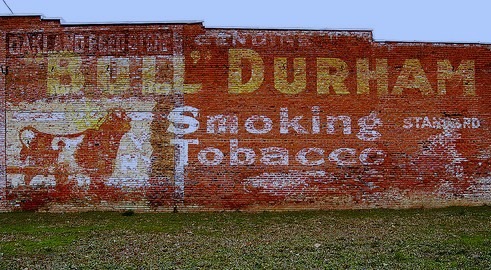
Julian Carr, a partner in “Bull Durham” smoking tobacco was ahead of his time with marketing.

The renamed product’s fame took root in 1868 when it was re-branded following its newfound popularity among Confederate and Union soldiers bivouacked here during the surrender that ended the Civil War.

Billboards were hand painted back then, often on rocks or barn roofs and siding and Carr deployed four teams of painters across the country securing the rights from property owners.

Today, “Old Bull,” the brand’s original 1874 headquarters and factory is a National Historic Landmark in Durham, adaptively reused for apartments, but as part of its authenticity, vintage billboards there have been preserved including one on its roof.

Until Carr’s innovative campaign in 1877, billboard companies had limited their desecration to cities, “brawling” with one another over telegraph poles, ash barrels and fences as well as wallpapering entire houses and blocks of commercial buildings.

In the words of Dr. Catherine Gudis, author of Buyways: billboards, automobiles, and the American landscape and a professor at UC-Riverside, back then “advertising space was not yet construed as real estate” but as “public spectacle.”

She notes that billboard companies at the time that “few paid regard to the inviolability of private and public property.”  The desecration of roadsides today is obviously in their DNA.

But 16 years after Carr sent his billboard painters across the nation and around the world, Americans rose once more in rebellion and mounted a hundred-year-long “sense of place” revolt.

It was, as documented by Professor Gudis from her research here in Durham in Duke’s outdoor advertising archives, a “battle for aesthetic rights to the roadside environment,” a picket engagement of which had been fought in Durham a few years before my arrival.

Americans fought in this rebellion, skirmishes of which continue today, to reclaim the roadsides created with their tax dollars from the forces of blight.

Meanwhile in another ironic twist, billboard companies recast themselves as simply private property owners.

Losing to aesthetic revolutionaries in the court of public opinion, they have posed as poor victims shelling out tens of millions across the country to sway lawmakers.

Lost on those who fall sway today in North Carolina is that billboard companies don’t own the property they use.  They lease it, and the laws they pursue are intended to harm the real property owners.

Only 3% of the billboards in North Carolina are locally owned by small independent companies.  More than 97% are now controlled by a handful of huge out-of-state companies, a cartel of sorts owned by REITS as vehicles to avoid paying taxes and by a revolving door of private equity firms.

They actually own property for only 3% of the thousands and thousands of billboards they have erected across the state.  Yet, they have successfully hoodwinked some lawmakers into thinking otherwise.

But it is something else that led me to join the roadside rebels.

These large out-of-state billboard companies are bullies, a realization that finally led to my belated conversion as a champion for scenic preservation and aesthetic rights as a civil right for all Americans.

Having divided up North Carolina among themselves, this billboard cartel not only bullies local communities to override the interests of their citizens, they throw their weight around to bully state regulators away from defending the public interest.

There are many reasons to despise the state laws they have recently pushed through including clear-cutting exorbitant view zones and soon even the once protected forest at interchanges.

Now they are seeking seek to overturn local zoning ordinances including democratically enacted and popular billboard controls and bans.

They also hope to transform thousands of illegal billboards to legal status as well as gaining the ability of turning them digital and capable of being relocated anywhere they please.

They also seek now to hold taxpayers hostage for millions of dollars for each billboard when roads are widened, something even the Texas Supreme Court rejected last week.

But the real reason they are bullies is what they are trying to do to the true local property owners who own the land leased by these billboard companies.

They also want to put small independent companies out of business so they can bully land lessors at will.  “Agree to our terms, or we will move one of our other billboards to block yours, rending it worthless.”

But my slow conversion to aesthetic warrior began much earlier.

Durham was forced by a large billboard company to take its right to ban billboards and remove them by providing a seven year window for the company to amortize its value all the way to the U.S. Supreme Court.

It was declared valid in 1992, less than three years after I arrived.  Over the next nine years, a grand compromise was shaped among billboard companies, public agencies and scenic character advocates regarding window-framing to protect trees, reforestation and view zones.

But within two years, the billboard companies were back at it, persuading Democrats in the legislature to outlaw the tools for removal endorsed for communities by the U.S. Supreme Court, preferring it seemed to let the forces of nature remove them.

Then five years later, just before I retired, neighborhoods in Durham were forced to defend the community’s ban as one of the out-of-state giants strapped a business organization to the bumper in an attempt to bully Durham into reversing its ban.

Unsuccessful, they turned again to the legislature as recourse, this time to Republicans for refuge in their continued war of desecration.

By then I had joined the small bands of rebels still fighting the aesthetic rights roadside revolt that began 122 years ago.

I’ve learned that this revolt has had many victories: promoting roadways as parkways, sparking the City Beautiful movement, empowering communities to establish billboard controls and pioneering community destination marketing organizations.

That rebellion as it continues today is a reaction to the road and rail-side desecration Americans saw as tourism took off after the Civil War.

The revolt was not only in defense of tourism but because tourism related businesses often fail to understand that people are drawn to destinations - not to hotels or mainstream amusements or pursuits they can do at home.

Aesthetic rebels such as me know that without this insight, tourism usually kills the very things it loves.

And that is why I have become a zealot for aesthetic rights.

Friday, April 24, 2015

Symbols of Intergenerational Compact

In an essay a week ago, I suggested that North Carolina’s annual Interagency Report on Litter Cleanup, Education/Prevention and Enforcement was missing some information.

But I was mistaken; so maybe with this post, I can fill in some of the blanks.

Litter clean-up has many purposes including public health, achieved by reducing contaminants in storm water, but it is also to safeguard scenic character, which is a core trait in the state’s appeal for economic development.

So I questioned why programs to proactively beautify roadsides were omitted.  It turns out these are beyond the legislative scope of the report and I sense that over-delivering may not be well received.

It is too bad because North Carolinians are largely unaware of how much the NC Department of Transportation does to protect and enhance the state’s overall appeal along its roadsides.

Roadsides are the first and last impression that more than 90% of the state’s visitors receive, as well as tens of millions of potential visitors who are just passing through.

When I arrived in Durham twenty-six years ago to complete the last half of a four-decade career in visitor-centric economic and cultural development, Bill Johnson, a now retired NCDOT roadside engineer was deep into two, now award-winning, beautifications projects.

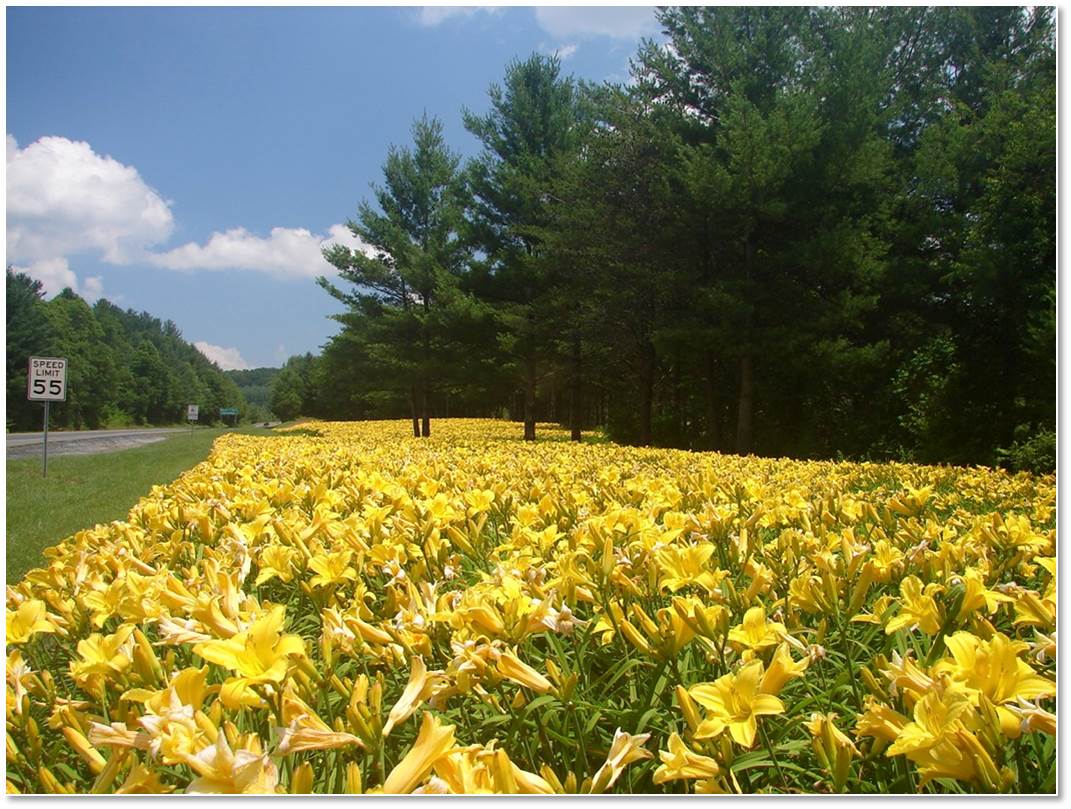
Today, North Carolinians and visitors to the state are greeted with 1,500 acres of wildflowers across the state as they drive along Interstates here.

Bill also started a program to recognize and preserve scenic byways along secondary roads across the state.

Soon the number will be increased to 58 covering more than 2,300 roadway miles showcasing every part of North Carolina including Durham, one of the few urban counties to set one aside, a favorite of mine astride a trusty Harley-Davidson Crossbones.

It is also a stated goal of NCDOT to “have well established and aesthetically pleasing forest along the highways in North Carolina.”  I haven’t seen a report for this decade but from the 1960s through the 2000s, NCDOT planted about 5 million trees along roadsides here.

A good share were planted in league with the America Treeways Program, a partnership of many agencies and volunteer organizations with the National Tree Trust established in the early 1990s by the first President Bush, a Republican.

Back then, it was also a bipartisan national policy to have well established and aesthetically pleasing forests along highways.

I will never forget a sentiment expressed by Bush I during my first few months in Durham, “Every tree is a compact between generations.”

Add that to the list of intergenerational compacts that have been shattered over the past decade.

Today, in North Carolina, many legislators inexplicably work overtime to sacrifice trees along the 14% of roadways that are part of the National Highway System here where they still remain, even though protected in the state constitution.

As a result, except whenever the Governor intervenes, Carolina’s once vaunted appeal for scenic character is rapidly falling into tatters.

Wednesday, March 25, 2015

Thoughts From A Roadside

Several thoughts raced through my mind yesterday while viewing the roadside of a freeway interchange in Durham, North Carolina, where I live.

These parcels are very park-like when well-maintained, as members of a public-private coalition called Durham Appearance Advocacy Group (DAAG) is trying to do by forging alliances between local governments, businesses and groups such as garden clubs and Scenic North Carolina.

The one we discussed yesterday is meant to serve as a template for every interchange in Durham.

But ironically, regressives in the State Legislature have been working at odds, filing bills to disable state management of these roadsides and permitting out-of-state billboard companies to wantonly deforest them in order to prop up an obsolete technology few Americans use now.

Now they have even filed a bill, with an innocuous misleading intro, meant to override wildly popular democratically enacted bans on this form of desecration marketing and blight that have stood in communities such as Durham for more than three decades and ruled constitutional by the U.S. Supreme Court.

This tyranny by representatives not from Durham reminds me that revolutionaries founded our democracy not in opposition to taxes but due to corporate loopholes granted by the feudal systems of governance then in place.

In opposition at the time and ever since stood regressives trying to pull the country backwards.  One wonders, will another revolution soon be sparked?

In the 1930s, roadsides such as those I was standing alongside yesterday were already battlegrounds between the forces of blight and the forces of scenic preservations.  Jobs, jobs, jobs was the mantra then too but it was both/and when it came to scenic preservation.

Highway 100 was one of the first, if not the very first beltlines in the country.  It patched together a series of existing roads south and west of Minneapolis but included new construction of a stretch of more than 12 miles including what we now call clover leafs.

It was deemed the “Lilac Drive,” lined with 30,000 plants including 8,000 Lilac shrubs and 7 roadside parks.  It became a recreational destination and living proof that Americans are drawn to scenic character over commercial blight along their roadsides.

It was in the middle of nowhere back then but had the support of development interests and billboard companies eagerly pushing for sprawling suburbs that would soon gobble up acreage at a rate many times the rate of population growth, as it still does today in Durham.

Emily Badger reported in The Washington Post this week about a new study that that concludes that sprawl costs the U.S. economy now more than $1 trillion a year.

The reason deficit hawks are not licking their chops is that $400 billion of this is pushed off on other people, something economists call negative externalities, which is a fancy word to describe when the free market doesn’t incorporate its true costs.

Only a portion is found in inflated costs for public services.  We absorb the rest sometimes in our lungs and often while stuck in traffic, but all in all it is very similar to the tax loophole that led to the original Boston Tea Party.

Billboarders and their legislative allies aren’t the only ones who want to shift even more of those costs onto unsuspecting Tar Heels including millions of us “hard-working taxpayers” we so often hear regressives talk about.

Over the last five decades (1960s-2000s,) the NCDOT has carefully reforested and afforested more than 5 million trees along the state’s roadsides, in part, to mitigate for many times that number which had been destroyed during road constructions.

The trees were also meant to bolster a signature ingredient of North Carolina’s brand.

This included lining the state’s roadways with spectacular understory trees such as native Redbuds and Dogwoods, the state tree.  Then, without thinking, another unit enabled private maintenance contractors to destroy most of them just for their convenience.

During our cross-country road-trip a few months ago for my mom’s funeral, Mugs and I took I-64 through Saint Louis.  This included a 10 to 11 mile stretch through the heart of that area that had recently been rehabilitated.

Some even call it that community’s front door.

The area is sea of concrete and buildings leaving almost no roadside.  But the Missouri DOT has carefully carved tiny slivers of planting areas where possible along this stretch and recruited businesses and organizations as landscape sponsors.

It too, I suspect is meant as a pilot project for a more strategic approach going forward.  An example of the discreet but very visible signs erected for sponsors is shown as the image in this blog.

Research shows that less than a fraction of 1% of consumers still use billboards.  It takes less than six seconds to decipher one but consumers only give them an average of three, even when digitally flashing on and off intermittently to draw attention away from the road.

Yet billboard companies now want to deforest even interchanges in hopes that someone traveling past them or focused on exiting or merging onto the highway will have twice as long to look.

Yes, it is obscene and possibly the spark for another revolution, if not with torches, pitchforks or midnight rides, a roadside revolt.

Thursday, October 30, 2014

Putting A Fiscal Value On Roadside Character

Deep in the appendices of a study scientists conducted along the nation’s roadsides in 2010 is an estimate of how many acres of forestland is along roadsides in North Carolina’s portion of the National Highway System.

Not counting roadsides along forested state highways or all of the rural roads it maintains in each of the state’s 100 counties, just the 28% of the NHS portion still with roadside trees alone means the North Carolina Department of Transportation is in the forest preservation business.

Or it should be.

This is 7% of all state and local government forestland.  I suspect it is would be closer to 30% if an inventory were conducted of roadsides along all NCDOT-maintained roadways.

And that is just the point.  NCDOT has no boots-on-the-ground inventory of this asset, nor a strategic management plan of caring for this publicly-owned commons.

This is why there is typically no reality-based fiscal note provided when legislators vote to surrender this public asset free to out-of-state billboard companies, including no requirement to reforest taxpayer trees when destroyed merely for a few more seconds of face time.

It is also why there can be no cost compared to benefit when contractors with mechanized assets push to remove thousands of acres of trees unwarranted by federal maintenance guidelines.

NCOOT regulators know that merely using the miniscule value as “pulp” has long-ago been antiquated as forest service scientists over several decades have meticulously documented the far greater value of the trees to ecosystem services such as reducing harmful emissions.

Long ago state officials were given a heads up to scores of other types of valuations including the role of roadside forests as the signature asset both for tourism, a sector now adding an incredible $10 billion to the state’s GDP including its appeal to scouts for relocating or expanding businesses.

It wouldn’t be expensive for NCDOT to conduct a tree inventory using just the 200 randomly selected plots of 1/10th acre each required by i-Tree Eco technology created for this purpose by forestry researchers.

Plots selected by random would include ones in various regions of the state and population intensities as well as terrain and vegetation cover, including areas with no trees areas as well as views worthy of scenic preservation and those where blight is screened.DSC01342

Outputs would also provide a baseline for the number, age and health of trees along the roadsides including the percentage of each species and overall management needs.

It would also quantify the overall value calibrated top local climates and other variables.  Officials need only contact Dr. David Nowak, the research forester who created the process and who patiently broke it down for me during a phone conversation last year.

Here is an example done of street trees by the Virginia Tech Department of Forest Resources using i-Tree, but NCDOT might be able to add to its considerable resume for best practices by being the first agency of its type to conduct such a roadside assessment statewide.

It took the feds nearly a decade to sign agreements for implementation with all fifty states after the Highway Beautification Act was signed on October 22, 1965, a herculean effort by the agency that today rarely even lifts a finger to enforce it.

North Carolina officials like to claim that forestland acreage here today is about the same overall as was in the 1930s.

But that disguises the fact that it had been much higher when it peaked in 1964 as the HBA was being debated in Congress. Since then, forestland has also declined precipitously (p. 4) in North Carolina.

It has also declined dramatically since 1971 when business leaders helped encouraged voters here to pass an amendment to the State constitution in part meant to protect forestland such as that along public roadsides (Sec. 5, Article XIV.)

Emblematic instead, is that those sworn to uphold it simply don’t, with newly enabled sacrifices of forests along roadsides and soon interchanges, which is pushed only by lobbyists today on behalf of parasitic commercial billboards.

But following the embedding of that amendment in 1972, state officials let another million acres of public forestland disappear, prompting cities such as Durham in 1984 to enact billboard bans in self-defense, followed by protective scenic overlays along new Interstates and in 1999, ordinances to protect tree canopy in general.

Yet, here too, local officials have failed to follow up with an inventory of this signature symbol of sense of place, a powerful prerequisite of any strategic management of green infrastructure while “billboarders” and their legislative allies press to override three decades of local effort to be more appealing.

While more than 8-in-10 North Carolinians - and an even greater proportion of visitors - are reverential about forested North Carolina roadsides, they are easy to take for granted.

Much of what we see today has grown back in the last 50 years.  As the HBA was passed, there had come to be a billboard every 1500 feet nationwide along highways (imagine seeing one every city block.)

By 1984, enforcement of the HBA had removed barely half a million billboards and prevented another 200,000 but billboard companies had used loopholes, campaign donations and graft to continue to litter cities alone across America with half a million billboards.

Durham, North Carolina had had enough and enacted a Republican-led ban that year while many other communities in North Carolina and across the state succumbed to heavy-handed lobbying, graft and threats instead.

However, after the very highest courts sided with Durham, the state sided with the billboard lobbyists.

Today, the feds look the other way when it comes to enforcing the Highway Beautification Act enabling billboard companies to push through phony rezoning.

It isn’t enough that North Carolina has once again permitted enough billboards to be put up along U.S. highways here alone to be the equivalent of one per city block, but a legislative give-away recently enabled them to triple the cut zone forgoing a million or more  publicly owned trees.

And yet, there is no inventory of the forests the public owns along roadsides or any holistic estimate of the value of roadside forests’ worth, including tourism, although according to public opinion polls, they are priceless to Tar Heels.

In the meantime, as any use of billboards by consumers to buy something had fallen now to “two-tenths of one percent,” lobbyists are readying a push with legislative allies to force communities, even with those with bans to permit digital billboards.

Sound like reasonable stewardship to you?  Or maybe it is time for a moratorium to preserve North Carolina’s scenic character, while it still has some left!

Tuesday, September 09, 2014

When For A Shining Moment Tourism Became Patriotic

Less than two months after the Civil War effectively came to an end in Durham, North Carolina, 150 years ago next April, a newspaper editor headed out west publishing later in 1865, that region’s first travel guidebook.

Long before that war began, every line of my ancestors back five generations, (except three who died along the way) some northerners, some southerners, along with two sets of newly arrived immigrants, (Scots and Brits) had settled in the western shadow of the Rockies, all but four a decade prior to that internal conflict.

Samuel Bowles was traveling by stagecoach with the Speaker of the House of Representatives and future Vice President, Schuyler Colfax, on a journey requested by President Abraham Lincoln the day he was assassinated.

Along the way they would pass some of the last two dozen wagon trains of Mormons still heading west.  The subsequent guidebook was entitled, Across the Continent: A Summer’s Journey to the Rocky Mountains, The Mormons, and the Pacific States.

The Civil War was over but the route Bowles and Colfax traveled was anything but peaceful.

A general uprising by thousands of Plains Indians, Sioux, Cheyenne and Arapaho had been brewing for several years due to abuses by immigrants seeking fortune rather than a homeland, but warriors sometimes failed to make a distinction.

Nor did Cavalry units protecting the Overland Route, which burst into open warfare after the tragic massacre of peaceful Native Americans a few months earlier at Sand Creek, mostly women and children.

All along the stage route ranches, wagons, stagecoaches, telegraph wires and feed had been burned across Kansas and along the front of the Rocky Mountains midway through Colorado and Wyoming.

Narratives about the transformative exodus of 80,000 Mormons between 1847 and 1868 in pursuit of religious freedom are obviously heavy on sacrifice, perseverance, suffering, faith and grit.

But ironically, a new study by researchers at Brigham Young University looking into insurance rates provides some new perspective.

The mortality rate for Mormon pioneers, while a point higher than the U.S. population in 1850 was only slightly higher for male pioneers and slightly lower for female pioneers overall.

Showing that it may have been safer out on the trail away from cities, the mortality rate for babies on Mormon wagon trains was 9% compared to the U.S. population overall at 15%.  Of course, only white mortality was measured at the time.

Soon after Bowles published his travelogue, visitors began arriving to see Mormons, much as they do the Amish today, perhaps ironic to my Bowman ancestors who arrived in America as the latter and migrated west as the former.

The first true “tourist’s guide” to the West was published as a resource five months after the first transcontinental railroad was opened in 1869, less than a decade after my ancestors settled the first permanent settlement in Idaho and forty years before they would prove up on their last homestead.

Until then, tourism in America had been regional in nature.  In the early 1800s coastal planters seeking the climate and scenery of North Carolina’s mountains were primarily motivated by fear of disease.

Organized tourism took root first in New England by the 1840s just as my ancestors headed across the Great Plains.  It was viewed as healthful scenic relief from industrial cities and factories.

By the time a modest hotel clerk in Salt Lake City, a transplanted Virginian, first coined the term See America First, as the name for a three-day conference focused on tourism promotion, the first handful of community-destination marketing organizations had already been formed beginning a decade earlier with Detroit in 1896.

Attending were 200 business leaders, governors, heads of commercial associations, agents for railroad and trails/good roads groups, including representatives from Spokane, Portland, Seattle, Tacoma, Victoria, Duluth, Denver, Vancouver, Colorado Springs and several towns in the Midwest.

The meeting venue, now on the National Historic Register (the historic Oregon Short Track Building on Pierpont behind Ruth’s Chris Steakhouse and the Hilton, kitty corner from the Salt Lake Convention Center), at least deserves a plaque.

While the movement fizzled, the slogan was soon picked up by the Great Northern Railway to promote Glacier National Park and then to promote all national parks and monuments as national assets.

We are reminded by Dr. Marguerite S. Shaffer in her book by the same title, that this was the conference where speakers formalized the notion that had been emerging since the Civil War, that the West was emblematic of the “true” America, the ideal of America as “nature’s nation” and tourism as a “ritual of citizenship.”

Watch for her new book, a co-edited collection of essays entitled Entangled Environments: New Perspectives on Rendering Nature in American Culture, due out this year.

Scenic preservation and “nature” tourism took hold before, during and after WWI.  From 1897-1915, most tourism was in the form of conventions and expositions because the idea of leisure travel would not emerge as mainstream until the late 1920s and early 1930s.

Good road coalitions argued for a system of highway routes true to the historic pioneer routes such as those my ancestors blazed to honor them as emblematic of what it means to be American.

Unfortunately, some cities didn’t get the memo when the proportion related to conventions and meetings began to rapidly decline by the 1930s, even battling until the early 1970s to prevent “visitor” from being added to the name of community marketing agencies.

Some still obsess with conventions today when meetings of any type now represent only 7% of business and 4% of leisure visitor stays and 10% of travel overall about the same as attending performing arts, not insignificant but hardly worth the high risk of over building for.

Increasingly after WWII, cookie-cutter development, franchise architecture, formula businesses and facilities, desecration marketing such as billboards, facility envy and mainstream culture have combined to demean tourism appeal, destroy sense of place and enable blight across the country.

But as I was growing up in the 1950s, kids collected stickers about the destinations they visited and often displayed them on the rear corner window.

Many reflected the colorized photographs made famous beginning in 1901 by Fred Kiser who was during his lifetime, the premier scenic landscape photographer in his day.   He called them “artographs.”

Along with others commissioned from artists such as the postcards at this link by railroads, then road associations, and for a time by airlines, they were used to promote tourism destinations.

Little did I know in the 1970s as I backed my way into a life-long career in community-destination marketing in Spokane where businesses put on an exposition to celebrate nature that much of tourism across the nation had or was rapidly becoming anything but patriotic.

Thursday, June 12, 2014

Taking A Unique Opportunity To Evaluate Safety & Billboards

For several decades I’ve found useful research conducted at Ben-Gurion University in Israel.  The main campus is in Be’er Seva where Dr. David Shinar runs a research lab devoted to driver safety.

Be’re Seva (Beersheba) is significant to three of the world’s major religions as the home of the prophet Abraham 4,000 years ago.  But from even earlier it had long been a cross-roads for the spread of knowledge.

It has only been a university town for 45 years.

Dr. Shinar happens to be a graduate of Hebrew University from where I first gleaned research confirming that advertising is impotent as a tool for changing image because, unlike publicity, ads which now have an overall negative ROI, have the effect of equally entrenching both positive and negative views.

But Shinar’s expertise (beginning with a Ph.D. from Ohio State University) is at the nexus of both industrial engineering (human factors engineering or ergonomics) and behavioral phycology.

His award-winning work has delved into whether in-vehicle technology is distracting (pros far outweigh any cons) and what makes people pass aggressively even when the car they are passing is traveling faster (inability to hold a constant speed.)

Now he has produced ground-breaking research about the effect of roadside billboards on safety. Interestingly, he didn’t come at it from the usual, “how long were they glanced at” approach.

Thanks to a Supreme Court ruling that removed billboards from the freeway that dissects the Gush Dan/Tel Aviv area, Dr. Shinar was able to compare accidents rates over three years both before and after using 8 sites where billboards were removed compared to six other control sites.

He studied both the number of investigated crashes overall and those resulting in significant injuries and/or fatalities.  He also controlled for traffic volume.

An opportunity like this is very rare, similar to a ten year period where the value of tourism marketing was studied when the state of Colorado dismantled their state tourism office and “went dark” while other states continued promotion.

The results are visualized in the image in this blog and in a power point presentation Dr. Shinar was asked to make to his peers at the International Conference on Traffic and Transportation Psychology ICTTP.)

It isn’t as easy to study the impact of billboards are you might think. This is because they are viewed for only a few seconds—half as long as they take to discern—and because even fleeting or subliminal glances can have lethal consequences when billboards are placed in areas where optimum concentration is required on the roadway.

Dr. Shinar is an expert on overall driver capacity and when spare capacity is available.  Little is available along city streets or urban highway corridors where “the gap between driver expectation and reality” is razor thin.

This is why crashes happen so often on freeway exits, where North Carolina lawmakers recently made it legal for out-of-state billboard companies to mow down trees so they could be more distracting.

No science was behind that move, only a few whiners with misleading information falling on sympathetic ears, deaf to any other information, especially anything scientific.

This myopia to the consequences of billboards over the years has been bipartisan in nature, correlated to campaign contributions as much as whining special interests.

Israel is also not a place where scenic preservation, conservation and character are often at issue.  They are central to North Carolina’s brand and quality of place.

North Carolina would be better off without any billboards, but especially in urban areas.  Durham banned them just as I came here twenty five years ago to jumpstart the community’s official marketing agency.

Those that still remain have been repeatedly enabled by the state steadily trying to undermine “whatever it is we do in Durham!”

Tuesday, May 27, 2014

Sense of Place Concern Spawned Community Marketing

Tourism in the United States began as early as the 1830s as a way to get away from cities and towns, but the 1893 World’s Fair in Chicago, attended by 1-in-4 Americans, changed all of that.

These massive, six-month long exhibitions, when popular, had many purposes over the years including showcasing new technology, cultural exchanges or to demonstrate best practices such as the one put on in 1974 by business leaders to create environmental protection in the community where I began my community marketing career.

Ostensibly to celebrate the 400th anniversary of Columbus landing in the Americas, the one in 1893, as designed by Frederick Law Olmsted and Daniel Burnham, was a prototype of what cities could and should become.

It came near the end of six decades when the countryside had been turned into vast seas of tree stumps.  Two-thirds of the deforestation since colonization began occurred during this brief period.

America the Beautiful had been America the Desecrated.

The prototype in Chicago spurred the Progressive Era’s grass roots’ “City Beautiful Movement” that would transform cities and towns across the country beginning with aesthetics.

Coupled with President Theodore Roosevelt’s movements for conservation and then ecology, these evolutions brought America the Beautiful back from the grave.

Two years following the 1893 World’s Fair and 285 miles east, the surging City Beautiful Movement also spawned in Detroit the formation of the nation’s first community destination marketing organization (DMO.)

Initially intended to leverage the new appeal being created into visitor-centric economic and cultural development, soon these organizations became the guardians of sense of place.

Insight for this revolutionary city-centric marketing approach was innovated based on observations that travelers are primarily drawn by overall destination appeal rather than by individual facilities or events.

It is for the same reason that while North Carolina remains focused on attributes such as mountains and beaches, it is the overall appeal of its cities and towns that for decades now has generated more than 80% of the state’s revenue from tourism.

Rather than as mere stops coming to and from the mountains and beaches, cities and towns are driving the vast majority of this visitation for other reasons now with these areas as an add on.

The 1893 event and the City Beautiful Movement was also at the root of why cities discovered renewal and appeal from fostering green infrastructure including urban forests, parks and open space as well as classical architecture.

That era was also the origin of the modern planning movement along with the idea of zoning land use, improved sanitation and cleaner water.  But at its heart, the movement was about aesthetics and sense of place.

It soon resonated with cities large and small across the nation.  The first city plan in North Carolina was created in 1913 for Raleigh, the state capital, by its Woman’s Club, but because they lacked the vote it went nowhere.

Olmsted Brothers created a plan for Duke West Campus in Durham.  Mill towns were also among the first to employ planning, and business associations began pushing the idea of planning to cities and counties.

In the meantime, planning was employed for neighborhoods in Durham, Charlotte, Greensboro and Raleigh that are still among the most vibrant and popular in these cities today.

By the end of the 1920s, Asheville (1922), Durham (1927) and High Point were the first cities in North Carolina to create comprehensive plans.  Keep in mind this is also the period when Durham’s first generation began historic preservation and massive reforestation.

An earlier sign that the City Beautiful Movement resonated almost immediately among first generation Durham industrialists is their prompt and prolific application of Romanesque Revival and other forms of classical architecture on warehouses, factories, homes and churches.

Repurposed as performance halls as well as residential, offices, research labs, restaurants and stores today, these distinctive buildings are symbolic of the “built” part of Durham’s vaunted sense of place.

Unfortunately, back then many other cities and towns in the old south used the planning movement not to encourage aesthetics or sense of place but to further perpetuate a then-legalized form of racism.

The area surrounding Asheville had been entirely deforested by the time of the City Beautiful Movement.  George Vanderbilt reforested the estate around his Biltmore House and used a plan influenced by the movement for its village.

It is symbolic that Asheville stepped up with the state’s first comprehensive plan even though, still to this day, the surrounding county has no zoning.

It speaks volumes that this county and others around the state who failed to learn or came late to the lessons of the City Beautiful Movement are working today on behalf of special interests to outlaw its embrace by cities and counties that did, perhaps hoping to regress to that era of desecration.

It is ironic that with some exceptions such as the exec of Durham’s DMO, which was only founded in 1989, those today with careers spawned from the City Beautiful Movement seem often apathetic about their role as guardian of sense of place.

Many are now even enablers of its destruction, such as when they utilize roadside billboard and other forms of blight while hypocritically giving lip service to more than a string of increasingly anemic but valiant scenic preservation successors to the City Beautiful Movement.

Hopefully, on the upcoming hundredth anniversary of the creation of a trade association for DMOs back during the heyday of the City Beautiful Movement, its members will take a long hard look in the mirror.

Do they regain the spirit of the City Beautiful Movement that spawned their first predecessors as guardians of sense of place or do they continue to sit back while it is destroyed?

Monday, May 19, 2014

A Signature Report and the Coming Primacy of Analytics

Each spring, an incredibly useful interagency report covering a comprehensive range of metrics and involving efforts all levels of government, including volunteer and non-profit efforts, is compiled and published regarding efforts to keep streams and roadways in North Carolina clean.

The heavy lifting is done each year by the the Beautification Office of the North Carolina Department of Transportation (NCDOT,) which also keeps the reports from past years on its web page.

This office falls under the department’s acclaimed Roadside Environmental Unit, headed when I arrived in Durham twenty five years ago by a close friend, the legendary Bill Johnson who spearheaded the wildflower and the scenic byway programs to name a few.

To paraphrase something once written about Durham songwriter Don Schlitz, “there are millions of people who know Bill Johnson but have never heard of him.”

There is currently a lot of talk about North Carolina’s brand, but no one has done more than Bill to shape it, although some actually given that task have enabled desecration instead.

It was as Bill retired to the tiny crossroads of Sims, NC in 2001 after thirty years as an NCDOT engineer that lawmakers mandated the Interagency Report coordinated by an office in his former Unit.

Bill still champions the preservation of North Carolina’s scenic attributes.  He passionately believes in the words of a mutual friend that our state is a truly “unique collection of qualities and characteristics” including environmental.

He understands more about branding than most of those charged with doing it for North Carolina.  There are powerful forces wanting to take it back to an era of desecration a hundred years ago when forests were seas of stumps replaced by seas of billboards.

You see, no matter what we say North Carolina’s brand is, its brand is indelibly stamped first and last by the condition of its roadsides and green infrastructure as visitors, including site selection executives for expanding or relocating businesses, arrive and depart.

The interagency report dealing with aspects of scenic preservation and protection is produced now under the leadership of George Kapetanakis.  It is invaluable to residents and policy makers.

But most of all, it is invaluable to the hundreds of groups and agencies as well as thousands of volunteers who collectively work to clean up the incredible mess that research shows is deliberately caused by just 4-every-100 people, 17% if you include those who are just careless.

In my experience, many of these groups and volunteers, sensing how overwhelming it can seem to keep roadsides and streams and communities appealing, are vulnerable to activity traps instead of carefully measuring performance against annual metrics that can be found in this report.

I do my best in the groups with which I am involved to encourage a more sustainable, strategic and scalable approach, but I get far more blank stares than nods.

I’m used to it.  Being passionate but analytically-driven during my four decade career made me highly effective but a bit of an odd duck.  I would often overhear someone say, “I like him but I don’t get him.”

Even when I arrived in Durham for the last half of my career, a community whose largest employers are in the business of being research and data-driven, I would often get complaints from detractors delivered second hand bemoaning about why I did so much research.

Showing the power of information though, few realized that only a few percentage points of our budget was devoted to research.  For all but the last decade of my career, I had to do nearly all of the analysis to convert research into action.

It seemed like more because we widely distributed analysis in hopes it would be of use to others in community as well as reinforce that we weren’t just driving community marketing by the seat of our pants.

By far, it was the most difficult position to fill.  Even people good with numbers often struggled with how to make analysis relevant and to pin point it to strategic initiatives.

Most of my peers just filed the studies away as something to check off the list.  Many DMO execs today still do.

Data, and especially now with the advent of “big data,” is prevalent everywhere but still only 1-in-8 in a recent survey conducted for SAS Institute based in nearby Cary have become “analytic innovators,” which somehow came naturally to me and also to my successor.

According to the study conducted in conjunction with the MIT Management Review, six-in-ten professionals report now feeling pressure today to become more data-driven and analytical.

While two-thirds still sense that decisions are being made the old fashioned way, based on management opinion and experience, another survey of senior marketing leaders finds that “seat of the pants” approach is fading fast.

This study commissioned by executive search and succession giant Spencer Stuart shows that while 70% of chief marketing executives consider analytics and creativity to be equally important, three times as many now rank data analysis and orientation as a top-three expertise needed for future marketers compared to those feeling that way about creativity.

It’s no surprise to me that a “strategic mindset” transcends both.  To paraphrase a Spencer Stuart blog post, tomorrow’s CMO is more likely to be “chief logic officer” than “chief magic officer.”

If they haven’t already as Appalachian State University has, business schools training tomorrow’s community destination marketing execs should take very careful note.  This is also important information for anyone just pursuing this career because they “like to travel.”

Looking over the syllabus for the annual Brandworks University, an MBA-level event held each May in Madison, Wisconsin, there is no “flash and bang,” or “shock and awe” during this premiere of all marketing events which draws the top marketers in every field.

Instead, it is all about data, analytics and science.

That’s why you could find Durham’s chief marketing executive eating it up.  The organization embedded data and analytics in its DNA from the start.

This genetic sequence helped Durham’s destination marketing leapfrog more established competition where they are still fading in the “rear view mirror.”  I predict that in the future anyone hoping to move up in a DMO will need to learn how to understand, analyze and apply data as a pre-requisite.

Unfortunately, the Spencer Stuart study found that few are doing that, forcing organizations to look far more frequently to recruit people from places such as strategic consulting firms and startups.  Fewer than 1-in-10 find the necessary affinity for analytics necessary for executive succession on existing teams.

One respondent quipped that its like “finding a few needles in a haystack.”

When I started in community destination marketing in the early to mid 1970s, many executives came up through sales.  Eventually far more came from the marketing side of which sales is an element.

Judging by my succession, analytics will be the background for leading edge DMO execs.  And note this isn’t so much about math, although statistics is useful.

Keep in mind that the dominant organizations of the future according to one of the studies above will be “analytics innovators,” a culture that is driven by sophisticated data analysis and strategic application.

Being a data-geek isn’t required as much as the ability to see patterns in the data and then translate them quickly and consistently into strategy and action.

It came natural to me.  I was never successful at training it into someone.  But I could sure see it in someone when manifested.

Thursday, April 17, 2014

Economic Angioplasty

A new report on the nation’s road infrastructure, including bridges and mass transit, reveals that nearly 17,000 miles of paved roadway through National Forests, National Parks and Wildlife Refuges are suffering from a backlog of more than $11 billion in deferred maintenance.

Many people think of airports when they think about travel and tourism, but 80% of domestic leisure trips and 2-out-of 3 business trips including 1-in-23 for the purpose of attending a convention or meeting, actually travel by car.

Cities that believe they can disguise billboard blighted roadsides by tidying up the drive from the airport to their Downtown are delusional, as are elected officials and private sector businesses opposed to transferring funds (taxes) to keep the nation’s economic arteries healthy.

Overall economic vitality in this country has always been enabled by public sector infrastructure. 

The report documents that revenues to build and maintain roadways include general funds (27%), per gallon taxes on fuel (26%), vehicle taxes (12.2%), bonds (15%), tolls (4%) and “other” (16%.)

So we can’t lay the lack of funding for this type of infrastructure solely on the fact that a combination of fuel efficiency, inflation and fuel prices is eroding road revenue from per gallon taxes on fuel.

Bonds such as those used recently by my adopted hometown to catch up on years of neglect are expensive and the “dues” many communities across the nation must pay for decades of neglect. Nearly 78% of highway road mileage is locally owned roads including half of all bridges.

States are responsible for 19% of overall road mileage and 48% of bridges, with North Carolina an exception because the state is also responsible for county roads as well as highways that become local roads as they pass through cities and towns.

The low rating residents gave roads in Durham on a recent survey is likely due to the relatively poor condition of state roads that run through here now that city streets are up to par.

The national report also documents how road funds are expended nationwide.  The 49% that goes for capital outlay (not including the 11% for debt service) includes only 60% which is used for rehabilitation (resurfacing or replacing existing pavement and bridges.)

Laying pavement is only part of keeping the nation’s economic arteries flowing including 80% of all domestic tourism.

There is also the matter of traffic control, public safety and forested roadsides to soak up storm runoff, along with air pollution and scenic views that are so crucial to tourism and business appeal.

In fact, scenic roadsides are the first and last impressions given relocating or expanding businesses during site selection.  Blight along roadsides, including billboards and other litter, create a brand no amount of marketing and promotion can overcome.

Manicured and tree-lined roadsides and respect for scenic vistas signal to decision makers something far more important than incentives or tax breaks.  They signal whether a state or community has self-respect and whether they grasp what it takes to grow and attract talent.

No amount of branding and other marketing can offset the first and last impressions created by roadside neglect and blight.

The reason shifting to a per mile assessment for roads, which Oregon has been testing for a decade, is that 90% of vehicle miles traveled in the United States are for freight compared to just 10% for passenger travel.

Trucks are also disproportionately harder on pavement.  By tonnage, nearly 70% of freight shipments were by truck in 2010, and that amount will grow by two-thirds by 2040.

As consumers we are going to pay one way or the other because taxes on freight travel will be passed on in the prices of products.

But an added plus to going to a per mile assessment is that it may make commercial enterprises re-think and re-engineer supply chains to minimize distance, something that will be better for our health and for our local economies.

Private sector businesses or their allies who are resistant to paying more to bring roadways up to par are in effect pushing costs off on the general public.

This is something economists call an “externality” when the full costs of products are pushed off on the public sector and taxpayers rather than being incorporated through full-cost accounting.

A study shows that Americans pay noticeably lower charges for our roads than other countries.  This is lost though on regressive members of Congress who are hamstringing the federal highway trust fund.

By working through the details over the past decade, Oregon, which also pioneered the per gallon fuel tax in 1919, has already adopted a per mile approach after beta testing it in cooperation with residents and business owners, some of whom agreed to provide access to GPS systems.

GPS is increasingly common in passenger vehicles and driver smartphones as well as freight trucks, but the Oregon per mile system is being first phased in beginning with a cap of 5,000 drivers willing to opt in to paying 1.5 cents per mile driven vs. 30 cents per gallon on fuel there.

Until privacy issues are resolved (apparently some people don’t want to divulge their secret destinations) it will be based on the miles traveled each year and measured during state safety inspections.

That works out to $150 a year for someone driving 10,000 miles a year.  It meets the fairness test by shifting more of the burden for roads to heavy users and freight haulers.

A trial in Iowa of the per mile approach showed 40% in favor beforehand and 70% positive after it.  A Nevada report provides some excellent examples comparing the current per gallon tax with a miles traveled fee.

It isn’t yet clear how VMT, as it is called, will scale up to include interstate tourists.  Nor is it clear how interstate transfers will occur unless the GPS approach is eventually implemented, which will make it even fairer by eliminating private driveways and facilitating out of state transfers.

The Institute for Transportation Research is recommending a shift to miles traveled in North Carolina.

I’m ready and I don’t mind if it tracks via my GPS.  Being able to readily find a vehicle that is missing or overdue is a bonus far more significant to me than privacy.

But I do see why it shouldn’t be accessible to the press so that confidential corporate merger discussions or bipartisan political initiatives have privacy.

Pulling the wool someone’s eyes, though, may be a thing of the past.

Wednesday, January 08, 2014

Scenic Character’s Leading Role in Sense of Place

Greensboro is the third largest city in North Carolina.  But according to friends, old and new, who live there, it is bent on mimicking the fourth largest city, Durham. 

Unfortunately, they are not mimicking Durham for its distinct sense of place.

Instead Greensboro seems drawn to mimic the corrosive influences that make communities the same, appealing, in the words of Dr. Scott Russell Sanders, only to those for whom “tourism is another form of shopping, treating the whole country as a gigantic mall.”

By this he is referring not only to shopping or malls per se, but to  generic attributes that make communities just one of many vs. distinct.

According to Sanders, in a speech I heard him deliver in 2006, the salvation for communities clutching to sense-of-place is neighborhood activism.  Durham bears Sanders out but only as long as it can withstand what he calls “Goliaths,” warning that:

“…Goliath never sleeps, never takes no for an answer, never runs out of money or political friends, and most of the time…gets its way.”

I witnessed the sacrifice of North Carolina’s distinctiveness on a cross-state road-trip last weekend.  Observing how commercial out-of-state billboard interests are sating their greed by destroying roadside trees and viewsheds caused me to think about my reading habits over the years and the pivotal role scenic character plays in appeal.

I’ve always been an avid reader, but it has been marked by streaks restricted to either fiction or non-fiction.  After law school in the mid-1970s, I couldn’t stand to read non-fiction.  In fact, I took a brief break from reading altogether.

During my near-decade in Alaska, I read mostly suspense and/or historical fiction such as written by Uris, Ludlum and Michener.  When I moved to Durham, I turned to non-fiction except for the latter 1990s when I delved into Swedish crime novellas written by Henning Mankell after they became available in English.

As a rule I avoid movies, especially made-for-television movies based on books that I have read and enjoyed, perhaps to dodge disappointment.

Ironically, this aversion proves strongest for adaptations of books such as Mankell’s where descriptions of landscape serve as a leading character vs. only as backdrop.

I have been drawn to three notable exceptions, spurred by the advent of streaming services.  The Jesse Stone series of TV-movies based on Robert Parker novels, the 2010 feature film Winter’s Bone based on the novel by Daniel Woodrell, and most recently the Wallander series based on works by Mankell.

In each production, hauntingly dramatic landscapes play featured roles alongside superb acting by casts featuring Tom Selleck, Jennifer Lawrence (in her breakout role) and Kenneth Branaugh.  These adaptations live up to the novels and give distinctiveness to plots that might otherwise have seemed similar.

Of course, distinctive soundtracks also play a pivotal role including Nostalgia by Emily Barker for Wallander, Hardscrabble Elegy by Dickon Hinchliffe in Winter’s Bone and music by Jeff Beal for Jesse Stone.

All of this is to say that the distinctive sense of place for communities and states must also give a leading role to preservation of scenic character, lest they succumb to the corrosive influences of blight that relegate them as “monotonous, ephemeral, rootless and ugly,” appealing only a form of generic shopping.

Unfortunately, as in so many ways, my adopted home of North Carolina is headed in the wrong direction.

Wednesday, September 04, 2013

An Achingly Slow Epiphany to Blight

I’ve only met one person who likes roadside billboards.  Ironically, he’s a friend of mine.  Still, I wonder if he might be pulling my chain, but he says it is because he has trouble reading the “logo signs” alerting travelers to businesses located at exits.

Like many of my former colleagues in community destination marketing, including several who have been counseled by my friend, he may need stronger glasses so he can see the blight created by billboards.

Of course, truth be known, I didn’t really see it myself until the last decade of my nearly four-decade career in community destination marketing.

In Spokane, where my career formally began, I was too busy cutting my teeth on destination marketing to notice billboard blight, or possibly I was just too focused on transforming industrial blight to even notice.

After all, wasn’t the Highway Beautification Act which was passed as I finished high school supposed to limit billboards to only commercial areas already blighted at the time?    Little did I know lobbyists had already corrupted enforcement.

In Anchorage, where I spent the second decade of my career as a DMO exec, billboards had been constitutionally banned at statehood two decades earlier, so they weren’t an issue.

Billboards didn’t begin to come into focus for me until I arrived in Durham, North Carolina in 1989, but it took another dozen years for me to truly “get it.”

During my initial due diligence to understand Durham values, always a core element of a community’s brand, I learned that not only had Durham banned outdoor billboards five years earlier, but the community had also won a decision in the United States Court of Appeals, Fourth Circuit a four years later after Fairway Advertising (then named Naegele) sued.

Rejecting claims that the billboard prohibition infringed on free speech, the Court held that it “advances legitimate city interest in aesthetics.”  In other words, the Justices recognized that scenic preservation is a crucial element of sense-of-place and economic development.

So naturally, I nixed inclusion of billboards in any Durham marketing efforts, especially when public opinion polls used to monitor internal stakeholders showed them growing even more unpopular with residents, including newcomers.

But across most of the state, I stood alone on this issue.  What is now the North Carolina Restaurant & Lodging Association, whose members are predominantly chains, had submitted a brief against Durham on behalf of Fairway during the lawsuit.

And our state’s division of tourism gladly used complimentary billboards across North Carolina to promote the state’s brand to residents.  Interesting juxtaposition…promoting the state’s brand while simultaneously desecrating it.

Learning to dodge “friendly fire” while promoting Durham became a career skill.  Even counterparts who marketed communities which had also placed curbs on billboards seemed oblivious at best to being out of synch with their community’s values.

Having lost at every level in the courts, Fairway went to work on state legislators where campaign contributions can be influential.  My job often involved joining together with others to help educate state officials and lawmakers about the impact of tourism.

In doing so I became aware that given their lack of success in the courts, Fairway and other billboard companies were investing huge amounts of campaign contributions along with other favors – all legal at the time - to influence the legislative process.

But admittedly, my focus in rejecting them in marketing plans was based on being consistent with community values.  Even the use of them to appeal to prospective visitors from communities that encourage billboards seemed hypocritical.

As I began the last decade of my career, I was forced to think more deeply about billboards.  An supply side economic development counterpart, who narrowly fancied himself a marketer instead, never missed an opportunity to refer someone to me who advocated the element of advertising.

This brought a socialite and philanthropist to my office often over a period of many months in an effort to persuade me to use billboards to promote Durham.  Unfazed by my logic or Durham’s prohibition, the person even tried to corral me by lobbying governing board members and elected officials.

That is when I began a deeper investigation into all sides of the issue of roadside billboards.  This included those passionately pro- and anti-billboard and a deep evaluation of the metrics on their effectiveness or, as it turned out, lack thereof.

Everything I studied seem to validate my decision not to use billboards.  But then something happened that turned me passionately against the huge roadside distractions.

In 2004, out-state billboard companies reaped a huge a return on their “investment” when Democratic lawmakers pushed through a law to deny cities and counties the right to use amortization to remove billboards which had been ruled fair and lawful by the courts.

The Democrat who spearheaded the legislation was clear in news reports that he wanted to make it “too expensive” for cities and counties to prohibit new billboards and/or remove those that were non-conforming as Durham had.

Many people including some of the nation’s founders misused the theory of “states’ rights.”  Often it has been perverted to enable travesties such as slavery and then later for denying of civil rights which continues even today.

I believe in the concept because to me as long as they  are consistent with the U.S. Constitution and the laws of the land, the closer governance is to where people actually live and work, the closer it comes to being truly representative.

This seems especially true at the local level which is the only one shown in polls as highly regarded by the public.

Taking away amortization was a sleazy tactic to end run local governments and the democratically-expressed will of their residents. That one act turned me from avoiding billboards to becoming a passionate opponent.

Hoping Durham had somehow forgotten, Fairway was back in Durham the year before I retired at the end of 2009 with a clever, but thinly-veiled proposal to trade the removal of some billboards for the right to make others digital.

Quickly stacking a committee of the Chamber of Commerce with supporters and then chilling discussion by its board, Fairway won endorsement there, stunning many who recalled that organization’s support of the prohibition.

The executive of the downtown organization felt confident enough in his personal endorsement of the proposal to make the organization’s website homepage a billboard but the downtown board refused to take a stand.

The organization I led polled residents to better inform the debate and neighborhood activists took up the prohibition’s defense when city officials were told they had to be neutral after a complaint by Fairway.

The result of the poll showed residents were overwhelming against the proposal and in support of the 25-year-old prohibition.  Durham had grown 36% larger since the ban was put in place but its population even more adamantly valued aesthetics over billboards.

Officials voted a few months before I retired.  I heard that some Fairway executives were overheard to say they had enough voted for a favorable outcome. They were stunned.  The vote was 7-0 against any change to the billboard prohibition.

In a rage, billboarders turned statewide again.  Finding sympathetic Republicans now in power,  they leveraged the power of campaign contributions even more.  To those suspicious, they claimed the proposed changes that would undermine communities were “minor technical fixes.”

With others, they fueled mutual resentment of North Carolina’s cities and towns.  Behind closed doors and in print it was crowed this was done to “teach Durham a lesson.”

In two sessions now, legislation has passed that essentially overrides local community values and concerns statewide.  Even the Governor, now also a Republican has backed away from campaign statements that billboards should be left to local control.

I guess states’ rights for these particular Republicans is a one-way street. Good as a defense when they consider any federal action as over-reaching but quickly brushed aside when they want to lord it over local communities.

So there it is, the story of how I came to see billboards for what they are and become a passionate defender of scenic preservation.  Hopefully, my former colleagues in community and destination marketing won’t take as long as I did to see through this obsolete and destructive form of advertising.

But I am not holding my breath.  Many may be even slower than I was to grasp that wherever blight is tolerated it becomes your community’s brand. Others have the same chip on their shoulder that billboards do.  Some don’t seem to have a clue.

Nothing short of a voter-approved constitutional amendment embedding the overwhelming anti-billboard sentiment of North Carolinians as shown in public opinion polls will stem an enablement of blight that will only get more egregious.

My pessimism is born by the fact that until such a amendment occurs, billboard interests are voting each and every day in the halls of the legislature both by arm twisting and through copious amounts of strings-attached cash to underwrite election campaigns.

It isn’t how democracy is supposed to work.  As experts write, it may literally be a corruption of democracy and a subversion of public sentiment and will, but it is legal, legal corruption.

Chillingly, Lisa Margonelli, a senior research fellow at the New America Foundation writes in the current issue of Pacific Standard that social norms about what is okay are less defined than they were just five years ago, the last year of my career.

It is no wonder then that trust is so low and concern about corruption is so high on polls of Americans.

Wednesday, December 19, 2012

A Roadside Bonus

It was during the last week of May 1965 and I had just finished my junior year of high school when the Beatles’ Ticket to Ride was giving way as the #1 song to Help Me Rhonda by the Beach Boys.

American combat deaths in Vietnam reached 1500 and ten times that many students had just marched against the war in Washington D.C.  Within two weeks I would first hear Keith Richard’s famous guitar riff on I Can’t Get No Satisfaction by the Rolling Stones.

My more-like-a-brother uncle was training to fly USAF F-4 Fighter Jets.  Within a year he would be flying his first of three tours including more than 300 missions over North Vietnam.  In just more than a year a boyhood friend and a high school friend would both be seeing combat there with the US Army.

But that last week of May 1965 was also when President Lyndon Johnson convened the White House Conference on Natural Beauty.  There LBJ challenged “panels of conservationists, industrialists, government officials and private citizens” to come up with proposals for the preservation of the scenic character of America and its states, cities and towns including:

    • “underground installation of utility transmission lines”
    • “a tree-planting program”
    • “policies of taxation which would not penalize or discourage conservation and preservation of beauty”
    • “a solution to the problems of automobile junkyards”

However, this group of businesses, residents, lawmakers and policy wonks focused even more on what they felt was the greatest threat to scenic character, huge outdoor billboards, not only in cities and towns but across the landscape of the nation.

Unfortunately, proposals from the conference were effectively gutted or circumvented in subsequent legislation and today the agenda remains unfinished.

The effort to restrict outdoor billboards to highly “commercialized areas,” while preserving “scenic areas,” had begun forty-two years earlier when it became clear “poster” companies as they were then known were moving from cities in an effort to wallpaper every inch of roadway as the age of the automobile began.

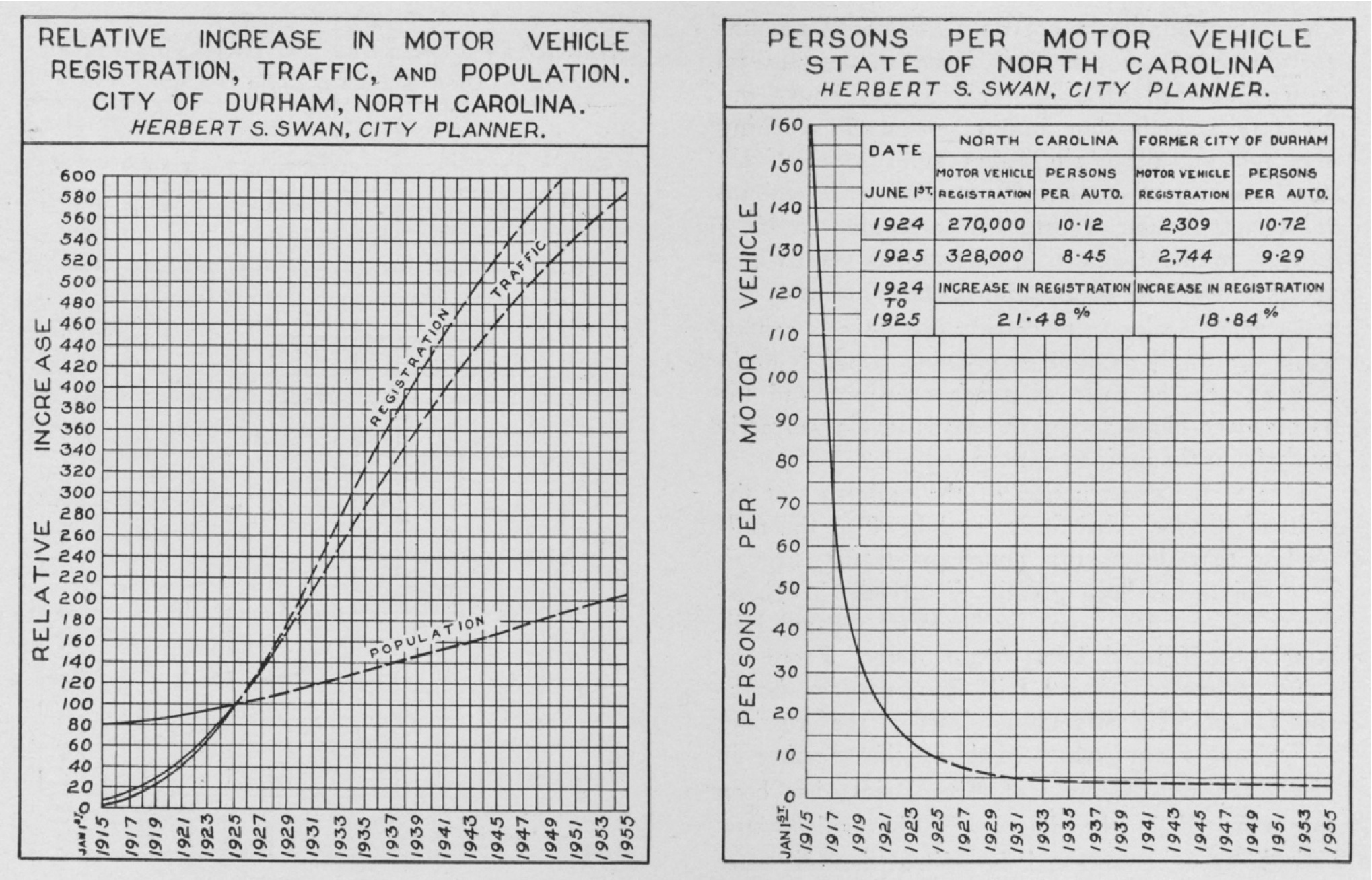
At the time, Durham, North Carolina, where I have lived for nearly 25 years had a total of only 2,309 registered motor vehicles for a population of 50,000 and the registrations statewide had already skyrocketed far higher than overall population in the less than ten years since registrations began.

Roadside audits, such as one conducted in 1930 for North Carolina, began to document the state of roadsides across the nation.  On my fourth birthday in 1952, Elizabeth B. Lawton, the architect of that roadside movement died.

However, six years later, at the launch of the Interstate Highway System in 1958 the federal government offered a bonus to states that would voluntarily adopt national standards to protect their roadsides from outdoor billboards and other forms of blight.

The 23 states participating were known as “Bonus” states and they are easily discernable today by that status alone as one travels cross-country as I have done via various routes a handful of times since my retirement from community-destination marketing several years ago.

“Bonus” states include California, Colorado, Connecticut, Delaware, Hawaii, Illinois, Iowa, Kentucky, Maine, Maryland, Nebraska, New Hampshire, New Jersey, New York, Ohio, Oregon, Pennsylvania, Rhode Island, Vermont, Virginia, Washington, West Virginia and Wisconsin. That’s very close to half of the states in the USA.

Ironically, eligibility to participate in the program expired several days after the White House Conference on Natural Beauty adjourned in 1965 although for the most part participating states must still meet the requirements of the agreement. 

Hawaii, Vermont, Alaska and Maine have constitutionally banned billboards altogether but it is interesting to note that while every state in the Northeast participated in the “bonus” program, none in the Southwest did and only five of twelve from the Midwest did, plus four of eleven from the west and a mere three of twelve in the Southeast.

In fact by some measures by regional breakdowns used today, none did in the Southeast, one of the nation’s most scenic regions.

Scenic states such as North Carolina had everything to gain and nothing to lose because this attribute is so closely linked to their economies.  Many of the most scenically spectacular states in the union stayed on the sidelines, I suspect not because they didn’t understand what would be lost or gained but because powerful outdoor billboard interests co-opted their public will.

As a results, some of our most scenic states are hidden behind billboard blighted roadways.

Government was late to recognized the importance of controlling outdoor billboards, possibly because their hands were tied by special interests.  According to research revealed in Motoring: The Highway Experience in America by John Jakle and Keith Sculle:

  • Parkways began in 1908
  • Scenic highways were declared as early at 1915
  • Roadside tree planting efforts began in 1921

In 1919, Oregon legislated to “protect standing timber and allow planting of new trees along state highways.”  The legislation also established roadside rest areas and severely curtailed outdoor advertising along the roadways.

The efforts in Oregon may have inspired Standard Oil of California, later renamed Chevron, where my great-uncle became an executive, in the 1920s to voluntarily destroy 1200 huge outdoor billboards that the company owned in California, Oregon, Washington, Nevada and Arizona.  That finished, the company mounted a wave of anti-billboard campaigns.

The western spin-off of Standard Oil understood what so many businesses fail to grasp even today: there is far more to gain from preserving the scenic roadway integrity valued in surveys by 8 out of every 10 people than there is to pandering to the less than 8% who use billboards during a given year.

The company realized that its private property and need for marketing did not trump the public’s rights along the roadways for which it had paid in tax revenue.  This is something lost on out-of-state billboard interests in North Carolina today as they ram through rules giving their so-called “right-to-be-viewed” precedence over public safety, air and water pollution control and every other public interest along its roadways.

Only when the public rises up and translates its well-documented opinions into action through the elective process will they recoup the roadway rights for which so many have fought so hard over the last hundred years.