Showing posts with label Durham NC. Show all posts

Thursday, May 12, 2016

The Fallacy of Trading Sense of Place for Density

In May of 1989 I accepted an offer to relocate to Durham, North Carolina and jumpstart the community’s destination marketing organization.

It was clear during my interview visit that Durham had good bones as well as deeply held traits and values that would be appealing visitors.

By good bones, I mean that many of its indigenous, core commercial districts retained the smaller, people scale, historical blocks of buildings that a majority of travelers are drawn to because they reflect a distinctive sense of place.

This is the “there” there of a particular place that so very many places long ago surrendered. 

It is a term that was coined in the 1930s by Gertrude Stein that over time has come to describe anywhere that “sense of character or coherence has eroded,” as so eloquently noted by Scott Russell Sanders in his essay The Geography of Somewhere.

Of course there is a lot more to having a “there” there than just architectural setting.

It was also clear back then that Durham had given in every now and then to the temptation during the 80s to throw up a skyscraper or two, as it is currently doing.

But different than those prior to WWII, apparently both developers and local officials (as illustrated by their own buildings) have forgotten a crucial tenet noted by Witold Rybczyski in How Architecture Works.

New buildings, according to Rybcyski (Rib-chin-ski,) a noted architect, professor, critic and author, should foremost seek coherence with place and setting.TrustBuilding_pcard

When I mentioned a need for “coherence” to an official during deliberations for this newest and tallest building underway in Durham, I received only a look of bewilderment and something mumbled about the need for density.

More on density that later but studies show that, too, is a fallacy when used as a justification for towering structures that violate sense of place.

At year-end I will be seven years retired from that career, but last week the staff there invited me a personal tour of the new headquarters for the organization I led for 21 years in Durham.

Including the ground floor Durham Visitor Info Center, it occupies the first two floors of the six story 1905 Trust Building, Durham’s first skyscraper and one perfectly coherent with place.

It was the tallest building in the state when it was erected.  It also had the first elevator in Durham and was a little more than twice the height of surrounding buildings.

There is no record of controversy at the time but there is evidence three years later when the 47-story Singer Building opened in New York as the tallest building in the world that these structures were taking a toll on sense of place.

For several decades people had complained of the canyons these buildings created, along with the wind tunnel effect and the deep shadows they cast shortening the amount of daylight for blocks in at a time.

Now, 100 years after Jane Jacobs published launched a conversation in The Death and Life of Great American Cities, a new study across a wide range of metrics finds that blocks of older, smaller builders perform better than districts with larger, newer structures.

By comparison, these blocks generate more jobs per square foot, a greater diversity of businesses, more non-chain local businesses, more small business vitality and greater density, more character, walkability and a broader socio-economic residential mix.

The answer isn’t either/or.  It is about mix, fit and especially coherence.

Communities that have surrendered to forces who told them they had to sell out their sense of place in order to be major league still have pockets or fragments they can salvage.

Communities such as Durham that turned the corner with sense of place in tact but may be unprepared for how quickly out of town “buyer/flippers” as well as franchise architecture developer/lenders can hollow out sense of place.

They may need to shift gears even more quickly.

Reading this study is a good start.   Begin by dissuading planners and officials of any notion that coherence of place must be sacrificed for density.

Thursday, October 15, 2015

Where Durham Dawdles

While one of the most broadly acclaimed communities in America, Durham, NC where I live seems to be dawdling its way to one 15 year-old best practice only in fits and starts.

Before I get to the theory of why that is, as given to me this week by a landscaper friend of mine, let me share why even this practice requires yet another layer of best practice to be truly effective.

While Durham has dawdled, some cities are closing in on fulfilling a goal to plant 1 million new trees.  The movement stems from a goal by then Republican Vice President George Bush in 1991 encouraging Americans to plant 30 million trees.

He was bucking popular members of his party and some Democrats who had the convoluted notion that trees cause pollution.  In some cases they can, but science before and since has clarified that trees are crucial to regulating climate.

Deforestation hawks eventually undermined the initiative but it inspired many cities and states to take up the cause.  Tree hawks eventually stalled state initiatives but many cities forge ahead.

Most notable is New York City which faced much more daunting challenges than others.

Many cities were doomed when they tried to do it on the cheap using only donations and volunteers while failing to factor in ongoing maintenance.

However, NYC began with research in 2006 and 2007 to quantify both its municipal trees as well as the overall tree canopy across all five boroughs.

Then the city set an ambitious goal to plant a million new trees, 70% of which would be on city property such as along streets and right-of-ways, parks and public housing while rallying another 30% planted by homeowners, landlords, apartment complexes, businesses and non-profits.

But what makes the NY program truly stand out is that it not only incorporated caring for the trees into the initiative but worked with nurseries and growers to provide supplies of quality trees that would be sustainable in order to truly optimize long-term benefit.

An effort this strategic is only possible when elected officials and administrators weave it throughout each agency and department as well as understand the need for intensive, unrelenting data-based marketing communications.

The folks at Deep Root have calculated, in part by using i-Tree, that to plant a million trees using the right kind of trees with proper planting and maintenance will generate a $25 billion return over 50 years compared to a minus $3 billion if done improperly.

Only when leaders grasp that trees are a form of infrastructure is this type of commitment likely.

So why are so many other cities such as Durham failing to catch on or mount a concerted, strategic effort such as New York?

My landscaper friend believes it is we all in general, including elected leaders and administrators, even the one-percenters, make the same strategic mistake at home.

Even rich people put $100,000 into landscaping but then balk at paying a $100 a month for maintenance.  These same people also insist on overplanting to create a short term impression and expressing shock when it inevitably must be thinned and then, over time, ages out and must be replaced.

It isn’t just governments that often don’t get it.

While opinion polls in Durham show a high regard for tree canopy, the reality is that we don’t understand nor are we led to understand the true cost of things.

So many taxpayers complained at the $16 million cost of building the Durham Bulls Athletic Park only to be flabbergasted when it costs another $20 million to refresh it after two decades.

Part of the problem is that we, as the general public, don’t get it.

But we also don’t have leaders who deluding themselves don’t educate us.  In fact, many play into our ignorance by fostering resentment of government and taxes without revealing that we will be cutting off our nose to spite our face.

Durham leaders may eventually catch on and fully embrace its coveted tree canopy.  If and when it does, hopefully we do it right and learn from NYC.

Why is he so grumpy, some readers are probably muttering?

Hey, I spent a good share of my heart and soul defending Durham but that never stopped me from shining a light on areas where I believe we must improve.

Friday, September 04, 2015

New Discoveries Related to An Excursion 26 Years Ago

It crossed my mind recently as I commuted the short distance from a lakeside retreat in northeastern Person County back down to Durham, NC which has been my home since 1989, that it was horses and a good steak that caused me to first make the journey up there 26 years ago.

I wanted to see a pasture full of Percheron, a breed of draft horses.  Back then these teams spent a good deal of time on the road, pulling an old 1900s farm wagon through small town parades on behalf of Southern States, a farmer’s coop.

By the time I was born, a fifth generation Idaho horse and beef cattle rancher, the bottom was falling out of the market for horses.

When my great grandparents had homesteaded and assembled that spread along the Henry’s Fork in the Yellowstone-Teton nook of Idaho, there were more than 22 million horses in the United States.

By the time I came along four decades later the number had dropped from nearly 12 million at the end of World War II to just 7.6 million in the late 1940’s.  By the time I turned 12 years old there were barely 3 million nationwide including our three working saddle horses.

My paternal grandfather who had bred and trained draft horses back when there was a market for them also had a reputation earned as a trainer for saddle horses.

He kept three teams of draft animals for nostalgia while I was coming up playing among them and my favorite had been a beautiful, black and gray speckled, purebred Percheron named Dolly.

By the time I arrived in Durham in mid-1989, recruited to establish my fifth community destination marketing startup (two from scratch) in my now long concluded career, the community was already well on its way to earning a national reputation for great restaurants.

In fact, most people where were here by then agree with Dr. Nathan Vandergrift, the head of Duke University’s Biostatistics and Bioinformatics Center, who once noted regarding that era”:

"…what's put Durham back on track is food…"

I hate to burst anyone’s bubble but Durham’s re-emergence including the resurrection of Downtown began in the late 1970s and early 1980s.

My subsequent arrival and the founding of DCVB to distill Durham’s personality and manage the community’s reputation as well as foster and leverage Durham’s sense of place, including its food scene, into demand-side economic development certainly played a role.

But revitalization was firmly underway more than two decades before the founding of Downtown Durham Inc. to champion the supply-side and three decades before tax incentives spawned newer developments often credited today.

I definitely wasn’t the second coming for Durham, nor was anyone who followed.  That designation belongs to sense of place preservationists including the late 1970s DNA that spawned its reputation for great chefs.

So what was I doing at a steak place clear up in Person County so soon after my arrival?  Northern Durham County and much of adjacent Person County remind me of my rural roots.

Anywhere I’ve lived, it is settings such as this that still ground me when I gravitate to them.  It may be why I am also so intrigued by Person County’s Sunset Ridge Buffalo Farm and the fact that as late as 1728, Buffalo still inhabited the bottoms of what is today’s Hyco Lake. across the from our retreat on Lake Mayo.

On the way back from seeing those Percheron back in 1990, we stopped at a restaurant in outer Timberlake that had been opened by the Cash’s three years earlier now called the Homestead Steakhouse and Country Store, one of two notable steakhouses in Person County.

By the time I arrived or soon after, the Cash’s had also opened a great breakfast diner I frequented in uptown Roxboro called Farmers Supply which, unfortunately, a subsequent owner took under by not remitting sales taxes.

Our lakeside retreat is in Holloway Township but it is within a nice drive through countryside to Roxboro, a town of between 8,000 and 9,000 or a fifth of  Person County’s population.

Yanni, a chef-friend of ours in Durham recently put us onto a great new restaurant up in little ‘ole Roxboro named Brookland Eats.

It was recently founded by two Northern Durham High School classmates after returning to North Carolina, one with roots up there, who opened in a restaurant space in a restored 113-year-old building at the intersection of Old Durham and Allensville roads.

They lured a well-known chef with them back to his native Person County.

Technically, Brookland Eats is in Brooksdale, a township of Person County that is incorporated into the Roxboro town limits.  The old building used to be a Fox & Co. general merchandise store back in the day.

The proprietor, G.M. Fox, married a Brooks, the family for whom the now neighborhood is named.  The name Brookland Eats is a nod to Brooksdale I suspect and sense of place.

Good restaurants understand the monetary value of accenting authentic sense of place.

Designations, including postal and statutory, but not authentic sense of place.

More in the next post on the earlier DNA of Durham’s 1980s era culinary reputation that is so evident in its chef driven restaurants of today.

Tuesday, August 25, 2015

Durham Outranks State and Peer Cities for Small Business

Thumbtack conducts a survey of small businesses and uses the results to rank states and cities on a series of aspects.  North Carolina overall falls in the middle compared to other states with an overall friendliness rating of B-.

The biggest challenge faced by small businesses statewide is apparently access to credit.  Taxes fall #7 and regulations a distant #11, cited by only 1.7% of respondents.

In fact, small businesses gave NC a B- for environmental and a B for regulations.  Not bad compared to the overall rating of B- but surely news to regressives in the General Assembly.

But in results released today, Durham, NC, where I happen to live, is given an A- overall, highest among the state’s larger cities and towns.  The Bull City, where great things happen, earned As on six criteria including regulations and an A+ for tax code and training programs.

Durham also ranks 14th out of 95 cities rated nationwide.

An area for improvement is the ease of starting a business.  Small businesses gave Durham an A- for regulations and a B+ for environmental.

Durham’s overall rating is up from a B in 2012 while North Carolina’s has improved from a C+ to a B-.

A major take-away for North Carolina policy makers is focus on making credit easier to obtain and to not be distracted by the relative few small businesses concerned about regulations.

Another take-away is that some of the state’s larger cities, which some lawmakers seem determined to undermine wherever possible are doing a much better job for small businesses than the state as a whole.

Sentiment is gleaned annually from 18,000 truly small businesses, of which 90% have five or fewer employees.  These are the independent businesses that make up 20% of the workforce and lead the way in job creation.

Yet they are often overlooked because they don’t have time to attend meetings or hire lobbyists or testify at public hearings.  Nor are they any longer on the radar of business advocacy groups such as most chambers of commerce.

Much of that void has been filled by community destination marketing organization where they aren’t still trapped in a membership model and by Thumbtack, which in part provides a marketplace where businesses bid on consumers.

Thursday, July 09, 2015

The Origin of Poverty and Our Biases Today

The four-county area centered around Durham, where I live, along with Chapel Hill, North Carolina is possibly the most highly acclaimed in the nation when you take into the breadth of the accolades it has earned as an MSA and those of its individual cities.

It also has the distinction of being the 20th MSA with the widest gap between rich and poor, according to the blog 24/7 Wall St.  The wealthiest half of households earn more than half (53.5%) of all income earned here while the poorest 20% earn just 3%.

The wealthiest 5% have one of the highest household incomes in the nation for that percentile.

In the book I mentioned yesterday about the history of capital and related inequality, French economist Thomas Piketty notes that worldwide, the poorest half of the population still owns nothing, while the middle class now owns between a quarter and a third of total wealth.

He continues to explain that “the wealthiest 10% now own two-thirds of what there is to own.”  Apparently, it was even worse a century ago.  Anyone interested in closing this gap needs to read Capital in the Twenty-First Century.

It may not sound like a page-turner but it is.  In a very easy to understand way, Dr. Piketty weaves historical events and data with paradigm shifts.

In part, income equality is rooted in the shift from land to things like profits, dividends, interest, rents.

In other words, income generated from capital and what Piketty calls “the  long-term evolution of the relative roles of inheritance and savings in capital formation.”

When inheritance rather than work and savings begins to predominate, “the past tends to devour the future.”

I’ve written before that Durham’s poverty rate took root in the late 1940s and early 1950s when the number of jobs plateaued but the community continued its rapid growth, in large part, due to it historical role as a magnet for those looking for work.

This was also a period when Durham economy began to rapidly transform from tobacco and textile manufacturing to education, research and development and high tech industries.

Despite efforts to re-educate the workforce, many who had come here for blue collar work and failing to see the paradigm shift, merely went home and waited for the next call-back to the factories as they had done for generations during layoffs.

Some have now become disconnected from society altogether while those who did shift gears found primarily low-wage jobs.  By 1960, 1-in-3 Durham County residents lived in poverty as did 40% of North Carolinians overall.

All the while, Durham’s economy skyrocketed but with jobs requiring far more education.  While much lower now than in 1960 when the economic transformation took hold, poverty still haunts nearly one-in-five residents in the City of Durham.

Last year a scientific opinion poll of Americans asked, “When people are poor, do you think that’s more likely to be because they had fewer opportunities or because of individual failings?”

Overall, 30% said “personal failings,” including 17% of Blacks and 30% of Hispanics, as did 48% of Republicans and Conservatives as well as 41% of those with household incomes over $100,000.

But 44% of Americans said “fewer opportunities,” including well more than half of minorities and those making under $40,000 as a household and including 36% of households making $100,000 plus, 28% of Conservatives and 23% of Republicans.

Americans were also asked, “When people are poor, do you think that’s more likely to be because good jobs aren’t available, or because they have a poor work ethic?”

Overall, 28% cited poor work ethic including 21% of Blacks and 33% of Hispanics as well as 49% of Republicans, 44% of Conservatives, 35% of those with household incomes over $100,000 and 24% of those making $40,000 or less.

But 47% of Americans said it is because good jobs weren’t available including 33% of Conservatives, 21% of Republicans and 42% of households making over $100,000.

When asked how some people became wealthy, 52% of Americans chalked it up to having more opportunities compared to 31% who believed they worked harder including 50% of Republicans but only 36% of Conservatives and 33% of those with incomes over $100,000.

Nearly 60% of Republicans believe unemployed people could find jobs if they really wanted to, a view also held by 51% of Conservatives as well as 53% with incomes over $100,000 and 35% of those making less than $40,000.

Interestingly a new study in Germany finds that more-trusting people on average have an increase in income over those who are cynical.

No community that I know of is more determined or does more to eliminate poverty than Durham. Hopefully, this will be useful perspective, both macro and micro, for those on the front lines.

Tuesday, July 07, 2015

The Significance of our Ephemeral Little Brook

On each morning’s walk before hiking up the slopes of what we affectionately call Mt. Rockwood in Durham, North Carolina where we live, we cross repeatedly over a small unnamed brook.

It is smaller than a stream and way smaller than a creek, or as we said growing up in Idaho, “crick.”  Seasonal or storm-fed waterways such as this make up 60% of the stream miles in America.

There are no fish that I’ve seen but it is certainly home to choruses of bullfrogs.  Similar to 53% of the stream miles in the United States, it is classified as “small, intermittent or headwater,” and like almost 60% of the stream miles in America, it is seasonal and/or depends on groundwater seeps and storms.

They are the subject of efforts in Congress right now, where, at the behest of special interests I suppose such as mining companies, frackers and maybe even developers, who want to exempt these most seminal of waterways from the Clean Water Act.

They have also enlisted more than two dozen states controlled by legislatures holding the same ideology. Here is a link to the definitions to which they object.

The one over which we zigzag each morning comes off a nearby hillside and after flowing through Rockwood Park, it feeds into Third Fork Creek, near its genesis, one of 14 watersheds in Durham.

Much of this fragile brook was protected when a developer named Willie Carver deeded the parkland to the City of Durham in the 1940s; apparently even before this area a little more than a mile from Downtown had been incorporated.

It was a time when developers innately grasped the importance of green infrastructure.  Maybe it should be named “Willie Brook.”

After joining with several other creeks, it now helps fill the 14,000-acre Jordan Lake, a drinking water reservoir south of Durham that outlets as the Cape Fear River where waters from the little brook flow another 200 miles and then into the Atlantic Ocean.

In the March issue of Scientific American, two UCLA scientists give the example that “If Earth was a fully loaded Boeing 777, then its ocean would have the mass of a single passenger.  As strange as it may seem, proportionally our planet is some 100 times drier than old bone.”

And it all starts with these small, intermittent, often epemeral trickles that originate from springs or seeps of groundwater and then combine with storm run-off to create tiny brooks that build into streams and then creeks and rivers.

Even though it is impossible for the Clean Water Act to achieve its purpose without dealing with these intermittent waterways, some in Congress today are seeking to exclude them rather than permit regulations adjusted to address a technicality.

They apparently aren’t listening to 77% of Americans including 58% of Republicans who want even stricter environmental protections.

Nor are they listening to the 155,000 members of Trout Unlimited or for that matter to the $114 billion that 33.1 million anglers such as this generate to the economy.

Many people assume sportsmen and sportswomen such as these are conservative in ideology and half are.  But overall they are all conservationists by nature.

According to surveys, nearly 40% of those who fish and/or hunt believe we have a moral obligation to confront climate change.

When the NRA speaks out against gun control, it represents only 1-in-4 hunters and even then three-out-of-four NRA households overwhelmingly support various controls such as background checks on private gun sales.

Nearly a third support bans on high-capacity clips and assault-style weapons.

Watersheds are often called basins from which various waterways collect.

Durham is divided into two major watershed that fall from each side of the ridge that runs through Downtown, along the railroad tracks.  But each of these break down into several others.

To the north they break down into six or seven watersheds, two that are intercepted to fill two Durham drinking water reservoirs. The remainder, fill Falls Lake, created here so it could be tapped for drinking water down in Raleigh, to make that city viable.

The two rivers tapped for Durham drinking water, the Flat and Little, originate from small headwaters in adjacent southern Person County and north-central Orange County respectively.

In fact, the north and south forks combine to form the Flat River just a stone’s throw from where Willie Carver was born and just before the river becomes a class I-III whitewater river in Durham after storms.

Another, the Eno originates in a 10-acre farm pond in northwest Durham, which after collecting Little River and joining with Flat River and filling Falls Lake spill down to form the 248-mile Neuse River before it flows into Pamlico Sound.

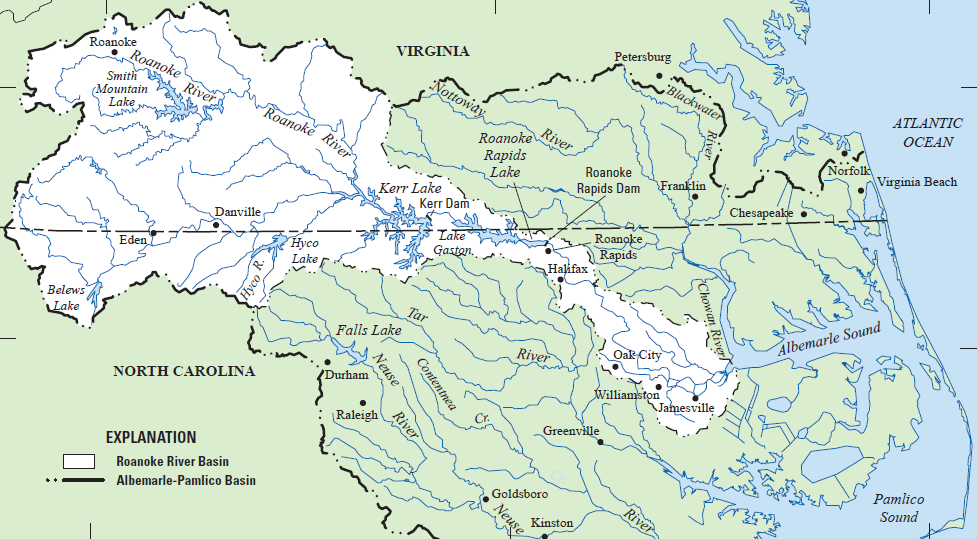
Hyco and Mayo lakes up along the border with Virginia north of Durham are part of the Roanoke River watershed.  That river originates in brooks high in the Blue Ridge Mountains of Virginia and flows down into North Carolina’s Albemarle Sound.

Headwaters are particularly vulnerable to land use changes which is why I’m guessing that special interests, and not just ideology, are behind the push to exempt them from the Clean Water Act.

Rivers are a continuum, a reference coined in a 1980 study that determined, “A river is more than a sum of its parts and that to understand what is happening at any point along the way, you must understand what is happening upstream and what is entering the watershed.”

In North Carolina, 66% of overall stream miles are in headwater streams and 38% are intermittent but because some major rivers and watersheds here are headwatered in Virginia, it is important to understand that state’s make up too.

In Virginia 62% of stream miles are headwater streams.  In the specific area where the Roanoke River begins its journey to Albemarle Sound in North Carolina, 58% of the streams are intermittent while 63% are headwaters.

Angler enthusiasts including many of the 1.5 million in North Carolina along with another 329,000 who visit have spent tens of millions of their own dollars to restore and protect these intermittent streams including 700,000 volunteer hours each year by Trout Unlimited members alone.

In many ways trout are the sentinels of clear water.  It is in these intermittent headwater brooks, streams and creeks that you find native trout such as the Yellowstone Cutthroat I marveled at as a boy growing up near the Henry’s Fork in Idaho’s the Yellowstone-Teton nook.

In North Carolina, it is the Brook trout that is native.

There are still 25 native trout species unique to regions of the country out of the 28 that once existed.  But according to the just-published State of the Trout report, thirteen occupy less than 25% of their historic habitat.

As noted by Chris Wood who is President and CEO of Trout Unlimited, “If you care about clean drinkable water, you should care about trout because they persist in only the highest quality water.”

They are also the “proverbial canary-in-the-coal mine for the effects of a changing climate.”

Thursday, July 02, 2015

Cooling Pond Futures - Hyco and Mayo

Along the north shore of Hyco Lake, near the border with Virginia north of Durham where I live is a dock with a roof covered by solar panels.

That’s seemingly incongruous only because Hyco is one of a pair of lakes created on each side of the small town of Roxboro to serve as gigantic cooling ponds for coal-fired steam generation power plants.

In fact, an astonishing 38% of the nation’s fresh water goes to cooling power plants.

Recreation on Hyco and Mayo lakes, including cabins, lake houses, as well as houses on the two lakes (there is a difference) have become byproducts from the water needed for their respective power plants.

But as I will note, changes are underway that may soon elevate these to the primary purpose of these lakes.

Of personal interest is Mayo, the lake on the east side of the 8,000 person town.  The lakes differ greatly and so do the steam plants for which they were created.

Mayo Lake not only has 25% less surface, it has 52% of the shoreline of Hyco Lake.  On Mayo, the northern third around the plant is undeveloped, making it rarely, if ever, in view.

Technically, Duke Energy owns up to the 420’ mark around each lake, but while on Hyco there are little or no restrictions, Mayo reflects the concern for the environment that later emerged in the 1970s.

Around Mayo Lake, according to observers this buffer is protected natural vegetation as habitat for “black bear, white-tailed deer, red fox, opossum, skunk, beaver, and bobcat as well as hundreds of bird species such as grebes, herons, ospreys, red-tailed hawks and owls.”

Motorized watercraft are permitted on both but Hyco Lake seems more “recreational” in nature, as in amusements.  Kind of like “camp” vs. nature preserve.

Mayo does not permit “permanent” docks, while Hyco has elaborate docks and boat houses that cost as much as some lake houses.  Both have public parks to launch boats and swim.

The power plants are much different, too.  The one for which Hyco, known as the Roxboro Steam Plant was created is a couple of decades older and is more than three times larger than the Mayo Plant shown in the image in this essay.

Both are now equipped with “scrubbers” required by the EPA to cut down on air pollution and first mandated by Congress in 1977.

They each burn a lot of coal including about 5.5 million tons annually at Hyco and 1.8 million tons at Mayo.

To put that in perspective, the Hyco plant burns between a 100-car train and a half to two and a half trains of coal a day, each coal car carrying about a 100 tons. A 45-60 day supply or so is kept in reserve.

Mayo uses a third as much.

Occasionally, some coal supply may come from as far away as northeastern Wyoming, but primarily, both plants are supplied from mines in Southern West Virginia and Eastern Kentucky via routes through Virginia.

Remember the haunting song You’ll Never Leave Harlan Alive?

Both lakes have coal ash stored on site, Mayo’s stretching up toward South Boston, Virginia, while Hyco’s stretches toward Roxboro.

The Mayo plant sells about a quarter of its 160,000 tons of annual coal ash for use in road and building construction.

The Hyco plant generates around 500,000 tons of coal ash.  It is one of the largest in the country and for the past six years, the remaining coal ash from Mayo has been trucked over there.

A year ago, a state of the art, special landfill with groundwater monitoring was opened downstream from the Mayo Plant which will eventually grow to 100 acres.

The solution, though, is more than tougher limits on emissions and conversion of the plants to natural gas.  Natural gas is now used to generate more than 30% of electricity compared to less than 37% generated by coal.

But while natural gas generation uses four times less water for cooling than coal, a savings of nearly 20 trillion gallons of water since 2005, fracking, the technology used to source the natural gas uses 28 times more water than it did 15 years ago.

An even better alternative is a new patented closed-loop process pioneered here in Durham by NetPower called the Allam Cycle which eliminates all air emissions including carbon dioxide from fossil fuels.

NetPower’s technology is not equipment to control pollution but an entirely new combustion process called oxy-combustion.  It has turned a major problem into a recyclable solution, in part, utilizing carbon capture.

In effect, it eliminates the entire steam process, which wastes 30% to 40% of its energy, and all of the associated equipment.

Ironically, it very well may be this Durham-inspired innovation that will finally bring Republican skeptics onboard regarding climate change, turning their pejorative “Whatever else they do in Durham,” into an accolade.

As noted by local journalist Alex Dixon, it is a phenomenon of behavioral change identified in a recent study conducted here at Duke entitled, “Solution Aversion: On the Relation Between Ideology and Motivated Disbelief.”

NetPower’s new technology also means that power plants such as Hyco and Mayo can be greatly downsized as they convert, while also lowering the cost of the power generated.

They also probably won’t be needing those “cooling ponds,” leaving Hyco and Mayo lakes as a lifestyle legacy.

Monday, June 22, 2015

Far From Being Mainstream

When I arrived in Durham in 1989, the farm to table movement was well underway, pioneered earlier in the decade by chefs such as Barker and Bakatsias who were already spawning a nationally recognized colony here with similar sensibilities.

My job was to weave this aspect into overall sense of place and give it prominence as a point of Durham differentiation, the essence of the community destination marketing which I was brought here to jumpstart.

Durham was one of the first destinations anywhere to do so but an attribute now claimed by even the smallest hamlets in North Carolina, making it seem that it has become mainstream.

But it hasn’t.  In fact, it’s far from it.

I’ll come back to the farm aspect of Durham’s farm to table in a minute but a new report entitled Farm Factory Nation documents the incredible growth, between 1997 and 2012, of what those intimately involved prefer to call “concentrated animal feeding operations.”

It has been due to consolidation, little or no environmental oversight and especially the powerful influence given special interests by Congress over food policy.

As a result, factory-farmed livestock now annually generate 13 times as much sewage as the entire U.S. population.

Unlike sewage in towns and cities where most of us live, this animal waste doesn’t undergo any wastewater treatment, passing along huge hidden costs to other taxpayers downstream, so to speak.

While my most conservative friends have an uncanny way of making every societal ill the fault of government, in this case, according to the report, they may be right.

While many of us became drawn to locally sourced foods, the U.S. Congress was doing the bidding of huge agribusinesses and as a result, shifting the food chain away from small, family producers to factory farms.

This is evident when you look at hog production, which is big business in sections of North Carolina.  During the 12 year span in the study, the number of hog farms fell by half, while the number of hogs sold each year increased by 39%.

During just the latter half of the study period, the number of hog farms in North Carolina decreased from 2,836 to 2,217 while the number of hogs in production increased from roughly 8.9 million to 10.1 million.

Another way to look at it is that the number of hog growers fell by 90% over the last three decades but the number of hogs produced remained about the same.

North Carolina’s share of national hog sales declined during the second half of the study period but it remained the second largest producer.  One county, Duplin, was the source of three percent of the hog sales in the United States.

Just one producer there generates more manure than all of the people in North Carolina put together.  Duplin, with a population of just 60,000 people, generates more sewage than the entire metro area surrounding New York City.

Another way to look at the transition to factory farms is that just 8 corporations and 7 huge partnerships now control 57% of all hog sales in the United States.

Of course, conservatives would spin this by saying the result of attempts by the EPA to deal with the issue of hog waste drove small producers out of businesses.

If that view has any merit at all it is because the protective regulations were drawn too broadly because small pasture producers don’t create a problem.  It is more likely that large producers insisted on a “one size fits all” approach to eliminate competition.

While the investigative analysis has a liberal bent, that doesn’t mean it doesn’t make an excellent point.

It is the very nature of how factory farming is done that concentrates and intensifies the pathogens.  From farrow-to-finish, a 1,000 lb. hog generates an average of 9.3 lbs. of manure a day including 2 lbs. of solids that never degrade.

Most are sold before reaching that weight but you get the point.

Hog waste consists of 13 essential plant nutrients that are used by plants that originate in the feed, water and some supplements ingested by each animal.

Small scale, pasture production naturally regulates the waste in amounts that can be productive for soil and vegetation.

Even in a county where the state’s fourth largest city takes up more than two-thirds of its relatively very small land area, Durham is fortunate to have 232 farms averaging about 90 acres each.

The number of farms in Durham fell rapidly from the 1600 in 1910 to a low of just over 100 by 1950.  During several of those decades the city was the fastest growing in the state.

Since then, the number of farms has stabilized and even inched back above 200.

Meanwhile, the city, though constrained the county’s small land area, has continued to be one of the fastest growing in the state, including #1 again in the 1990s following my arrival.

Today on 45% of Durham’s farms, the primary occupation of the operator is “farmer.  Farmers on 133 of these operations work elsewhere for about a third of the year.

Durham County has a farmland protection program as part of its strategic approach to open space including voluntary agricultural districts in three priority areas.

Nine Durham farms are preserved now under conservation easements.

Even as one of the state’s most dynamic and nationally recognized communities and the center for one of its most appealing metro areas, Durham farms remain an essential ingredient of its sense of place.

They are also unsung contributors to Durham’s “foodie” reputation and appeal for the visitor-centric economic cultural development which has been so successfully leveraged by the community’s destination marketing organization over the past 26 years.

Many Durham farms either raise livestock and crops for sale to local restaurants and/or at various Durham farmers markets including the big on downtown.

Others raise feed such as hay and corn for those who do.  Around 38 use irrigation while for the most part the farmland is protected as a means of protecting the watershed.

Durham farms includes 46 that grow cattle for beef, 15 that grow sheep and lambs and only 5 that grow hogs.  But there is nothing remotely close to factory farms here.

In 1997, the animal waste scorecard showed Durham farms generating 32,000 tons of livestock waste, making it 84th out of 100 counties and less than any other urban county.

To put this in perspective, Duplin County, which is about an hours drive southeast of Raleigh, generated 4.5 million tons of animal waste. They are one of four counties that generated more than a million tons each in 1997.

Overall that year, livestock generated 31 million tons of animal waste in North Carolina, ranking in the top 10% nationwide for hog and poultry waste and nitrogen expelled into the atmosphere.

Waste is a fact of life but our widely dispersed, factory-driven food supply chain is not sustainable.  Powerful special interest lobbies stand in the way.  But this is one area where we need to return to a better way.

Friday, June 19, 2015

The Overlooked Sense of Place Ingredient

When I was recruited to Anchorage, where I spent most of the 1980s, I hadn’t yet given much thought to the “commons,” including the spectacular views in every direction.

But it was clear someone there had by the time I arrived in July of 1978.

Often, as a hobby and for my work in community marketing I would snap photos from the tops of tall buildings - the Alaska Range across Cook Inlet, Mt. McKinley to the north, the Chugach Mountains backdrop or Mt. Saint Augustine, up inlet to the southwest.

It wasn’t necessary to be on top of a building to see these views but something else struck me from up there, just how long a shadow they cast.

So I wasn’t surprised to learn recently that towers being erected today in Midtown Manhattan will cast a shadow nearly a half mile long, enough to block out the sun in Central Park.

A few towers in Anchorage of 14 stories or so had been built in the 1950s.  Hotels of 15 or more were built in the 1960s, followed by several others, some as high as 18 stories in the 1970s.

But several office building of 20 or more stories were going up just as I arrived.  So it is in this context that I first became aware of viewsheds as part of the commons and a community’s sense of place, a term just coined back then by Wallace Stegner.

From comments in passing, I get the feeling that officials in Durham, North Carolina weren’t too worried about either viewshed, sense of place or blocking much of this district from the morning sun when they approved a new 26-story City Center tower here.

Renderings were careful, it seemed, to show only the angles from where the sun was setting.

Officials and developers here have been sensitized to the importance of Durham’s sense of place by the community’s destination marketing organization but currently boomers seem to have more sway than stayers and boomers seem rarely concerned with the “commons.”

Unfortunately, friends of mine in high office has a few months earlier slapped down those who wanted to preserve even the skyline, let along viewsheds.

Maybe this lack of concern for commons is because most boomers fall under the spell of building icons when they should be concerned with creating settings, according to acclaimed architectural expert Witold Rybczynski (pronouned Vi-told Rib-shin-skee) in his book Makeshift Metropolis: Ideas About Cities.

In another book entitled, How Architecture Works: A Humanist’s Toolkit, former Penn dean of architecture Rybczynski reminds us, as well as developers and architects, that new buildings should seek coherence with place not personality cult.

It isn’t just blight such as roadside billboards that rob us of viewsheds.  I don’t actually have anything against billboards, I am just very pro scenic character and preservation.

So I try to read not only from the viewpoint of developers and architects but also from those who are concerned about the privatization and surrender of the commons.

Important to preserving a community’s sense of place is the ability to hold contradictory viewpoints and perspectives.  Leveraging a community’s sense of place requires differentiation and differentiation of place requires continuity.

But according to researchers at the University of Michigan and Georgia State, we have a natural defense mechanism to avoid cognitive dissonance or having to admit we may be wrong.

The study concluded that it is far more comfortable for many of us to be close-minded than to endure the ambiguity and uncertainty of being open-minded.

What makes me pessimistic that Durham may be on the slippery slope to surrendering its sense of place is an increasing unwillingness to engage in discourse about attributes such as viewsheds for fear it may result in losing a project.

Researchers led by social ecologist Dr. Paul Piff at the University of California, Irvine have found that things that inspire “awe,” such as gazing up at a grove of huge trees, significantly more than say a tall building, have the effect of lessening our self-absorption.

They encourage us to forgo self-interest, be more ethical and take action to improve the lives of others, our neighborhoods and communities, what the researchers call prosocial behavior.

This gives me reason to believe that community discussions of the commons is worthwhile, including developers, regardless of whether they are incentivized with public funds or have so-called “air rights.”

Anyone concerned with preserving a community’s distinctiveness is well advised to include viewsheds as an ingredient and the subtle “awe” created by these settings.

Monday, June 08, 2015

The Poor Side of Town

In North Carolina, it is a generalization that on maps prior to desegregation in the 1950s, poorer neighborhoods seem to have been located primarily in the eastern part of its cities with Charlotte being the exception.

It has found its way into popular mainstream culture such as singer-songwriter Lucinda Williams current alt country hit, East Side of Town.

There is a theory that this occurred because winds come from the southwest during all but two months, waterways generally trend southeast and people of means lived where air and water pollution are less likely.

Poor neighborhoods had actually become more segregated in the 1960s when a decade after segregation was declared unconstitutional, Johnny Rivers took Poor Side of Town, a song he had co-written with Lou Adler, to #1, “doot do do ah shube dube.”

Cities overall actually became even more segregated into the 1970s before gradually becoming more integrated.  It is still unfinished business holding America back.

But it has always been more complicated than that.  In all but the most segregated communities, pockets of working class and working poor were always interspersed among socio-economically better off neighborhoods.

This has certainly been true of each of the four Durham neighborhoods in which I have lived over the past 26 years.  While integrated, they were also never far from highly segregated pockets of poverty.

During that two decade transition to integration, even poor neighborhoods segregated, leaving tracts today in every urban area throughout the state with not only a greater percentage of poverty but the least integration.

Conditions in these neighborhoods may also be why the most distinctive cause of death in North Carolina is “other nutritional deficiencies,” along with higher rates of obesity and smoking.

Inexplicably, while smoking among non-Hispanic white male Americans has fallen from 60% in 1965 to less than 20% today, the percent of males who smoke in poor neighborhoods today remains as high or higher than it was 50 years ago.

Worse, cigarette marketers target more dangerous menthol brands to black Americans.  Recent studies have shown that low income smokers spend a quarter of their income on cigarettes.

Dating to the 1980s with a famous study in Durham, smoking is associated with mental issues such as anxiety and alcohol dependence but not with mild depression.  But it was significantly associated with major depression and drug dependencies.

It is also significantly associated with the tendency to litter even when cigarette butts are excluded.  This may be because depression is about a loss of vitality, leading those who suffer from it to simply not care.

This is why proposals to address littering behavior using social media including an otherwise excellent report by some graduate students at Duke are probably misguided because at its essence, littering is due to not caring, including about what other people think.

Social media is a tactic, not a strategy.

Don’t get me wrong.  Peer pressure is what has driven the percentage of Americans who smoke down to 20%.

But as I mentioned earlier, in poor neighborhoods, especially among the 25% there who are male and “disconnected” it remains at the level it was 50 years ago.

Studies support that it is with this group that efforts to reduce litter should focus, along with efforts to reduce violence and root out poverty.  But while they are masters at peer pressure themselves, they are also highly immune to it.

It may be more productive to look at studies that show how emotions such as anger among this segment are found to make people far more likely to distrust or disregard advice from others.  Remember the adage “mad is sad and sad is mad.”

This was brought home to me recently while taking a morning walk through a wooded park near where I live.  It is encompassed by three highly integrated middle class neighborhoods with one corner touching a highly segregated poor neighborhood.

It is a wonderful park with towering trees, a walkway, basketball court, play area and several picnic tables with places to cookout including one under shelter.

Each morning when we walk there before maintenance crews arrive,  we observe litter such as drink cups left right where people were sitting and trash receptacles that have been deliberately over turned and the contents scattered about.

One morning, I asked a young African American worker who was cheerfully picking up litter where he thought it was coming from and he seemed to nod, disgustedly, toward the corner of the park adjoining the poor neighborhood.

But as I pointed out recently, in an essay about the new book Cultural Matrix, this and other anti-societal behavior is perpetuated by only a very small minority of residents in any poor community.

They are also activists seeking recruits to a value system where it is cool not to work and reject education while perpetuating a perverted sense of masculinity and violent behavior just for the sake of it.

They also talk the talk when it comes to American values but fail to walk the walk according to studies in Cultural Matrix.

It is not far-fetched to suggest that the majority there who work and seek to become educated in order to escape these surroundings may suffer a form of post-traumatic stress disorder, not from violence but from the constant threat of it.

Otherwise, they would be much more effective than law enforcement at curbing the 25% who cause or threaten trouble there according to Patterson.

I smiled as I read the response by police in the local paper about why there is a racial disparity in traffic stops.  It is very difficult to answer questions when it should be obvious.

They make more stops in segregated poor neighborhoods in an effort to target high crime rates there.  Duh!

It isn’t as much about painting this small sliver of society as victims, to note in the words of Patterson than it is a “legacy of discrimination and slavery.”

Too often we are puzzled about why subjugated populations embrace violence or bribery or corruption when freed, but those who do are merely mimicking the perverted notion of power they witnessed among those who had held them down.

But it might be more effective to send in a much larger army of social and mental health workers instead.

Judging by experience in the workplace, it may be impossible to change those in these neighborhoods who are actively disengaged, meaning they try to undermine those who are engaged.

But this intervention, if intense and prolonged enough, could help the 75% there who want something better and perhaps prevent the 25% from perpetuating the effects of their disassociation on future generations.

Chances are that addressing mental health issues it would also be accompanied by a reduction in both smoking and littering there and elsewhere.

There are some really smart and dedicated people trying to address poverty.  Unfortunately, many closed their minds to causes and solutions decades ago.

For anyone who is serious about that endeavor including reporters and editors assigned to news coverage, Cultural Matrix should be required reading.

Doot do do ah shube dube.” is something my brain will keep repeating over and over today.  But it a verse from East Side of Town that bears repeating:

You think you're mister do-good
But you don't know what you're talking about
When you find yourself in my neighborhood
You can't wait to get the hell out
You wanna see what it means to suffer
You wanna see what it means to be down
Then why don't you come over to the east side of town?

The author’s father, Miller Williams, who you may remember delivered a poem at President Clinton’s second inauguration, passed away last January four days before my mother did, one of his contemporaries.

So you just don’t think I am just a hard-ass profiler who spouts statistics, I’ll end with a few lines from his 1997 poem entitled, Compassion, a favorite I often read from his collection The Ways We Touch to get centered each morning:

Have compassion for everyone you meet,

even if they don’t want it. What seems conceit,

bad manners, or cynicism is always a sign

of things no ears have heard, no eyes have seen.

You do not know what wars are going on

down there where the spirit meets the bone.”

Tuesday, June 02, 2015

Discounts that Can Also Spell Doom

I shudder whenever I hear local officials announce there won’t be a property tax increase.

Since nothing is really free, and we, as property owners, are always banking on “quality of place” driving values each year, I am suspicious when someone exclaims that the value of those services stayed stagnant.

I would feel better if these “no tax increase” pronouncements were accompanied by a laundry list of what we’re not going to get next year because of it.

This would hopefully include a list of efficiencies achieved, of course, and a list of deferred maintenance, along with a list of what's being hollowed or starved out as well as a list of the things we should be doing but now won’t due to holding the line.

Of course, we’re to blame, or at least those few souls who go apoplectic whenever there is a change, such as the recent announcement where I live of a $7.50 annual rental fee on optional yard waste roll out carts for those of us who don’t own them.

Unfortunately officials spend far too much time and energy placating this tiny but vocal minority rather than listening to the overall silence among the vast majority of residents.

We all like a discount, such as the one I received at my grocery store on Thursdays for being over age 60.  But what if that discount comes with a steep price, such as lower grade produce?

Then, maybe, not so much.

It also makes them see things tactically rather than strategically, e.g. viewing curb appeal as merely planting a few flowers rather than overall appearance or viewing trees as “nice” but not as “green infrastructure.”

This is why even though it seems to have retained more than so many other places, I am not very optimistic that Durham, North Carolina where I live will do what it takes to preserve what’s left of its sense of place.

The “canary” or sentinel warning of its demise is not its “built” or even its “cultural” aspects, two in the trinity of place-based assets that when woven distinctly give a particular location its overall sense of place.

The early warning of its demise is the way local officials view its tree canopy, the most visible and distinctive element in its “natural” aspect, that completes the trinity.

“Infrastructure,” according to Webster’s Dictionary is “the substructure or underling foundation…on which the continuance and growth of a community or state depends.”

So I refer to this trinity as sense of place infrastructure, and the most fragile component is “green infrastructure.”  Trees, for instance, can convey sense of place without buildings but buildings really can’t without trees and vegetation

This isn’t new.  The term “green infrastructure” has been used in government now for more than two decades and taught in various disciplines, such as planning and public administration, long before that.

It emerged as a tool in management of urban settings some 150 years ago.

Yet it appears some in government still haven’t received the memo.  So a few months ago, the EPA connected the dots by publishing a guide to “Green Infrastructure Opportunities that Arise During Municipal Operations.”

It is written for “old schoolers” who still see infrastructure only as streets, sidewalks, curbs, parking and storm drains as well as sewer and water lines.

It reminds me that when Durham inventoried the status of its buildings not long ago, no one thought to include an assessment of the landscape surrounding each structure, including trees, signaling how endangered this aspect of sense of place is.

It is a myopia currently undermining a proposal to inventory the community’s overall urban forest canopy, by limiting it to just the trees on the property the City, itself, owns rather than a more strategic best practice “ecosystem” approach.

The former is a public works view of urban forest, a dumbed-down misuse of the term.

Urban forestry has been a discipline since the 1960s when it took on an ecological meaning, although its roots go back 100 years earlier.  It came to refer to a community-wide ecosystem in the 1970s.

It was embraced by city planners in the 1980s.  A strategic, community-wide approach was made a priority in 1990 at the Urban Forestry Research Summit.

Cities, including Durham began appointing urban foresters.  Some such as Chicago in the early 1990s took the ecosystem approach and began to develop assessments and urban forest management plans.

A few such as Durham took the less strategic approach and have yet to develop assessments and plans for “city-owned” trees until now, a quarter-century after a more comprehensive approach should have been on its radar and despite clamoring from residents.

Anything is a start, I suppose, but in the meantime, Durham’s ecosystem is losing 18,000 trees a year just to man-made destruction.  That doesn’t count tens of thousands more being clear cut just for pulp or to make shipping pallets.

It suggests a lack of urgency as well as strategic insight that leads me to wonder if Durham’s sense of place is ultimately doomed.

I suspect some in local government are prone to resist the idea of green infrastructure because it isn’t yet a perspective held by residents, but this overlooks local government’s role in community education as part of its role in the stewardship of place.

Infrastructure moved beyond streets and mains in the lexicon of public administration and planning in the early 1990s to incorporate trees and other elements of green infrastructure.

But even many officials who earned degrees more than two decades ago seem to have missed out on the coursework common then regarding green infrastructure.

It would be interesting to know if schools of government such as the one at nearby UNC-Chapel Hill teach this concept of inventory to newly elected public officials during orientation.

Not everything “green” is considered green infrastructure.  For instance, some parks, such as Rockwood down the hill from where we live, are while many others aren’t.

Of course trees are not the only sure-fire elements of green infrastructure.  It also includes constructed or restored wetlands, storm water initiatives such as rain gardens, green roofs and walls, permeable pavements, etc.

Trees are symbolic of green infrastructure because they create windbreaks and shade to reduce energy costs, eliminate air pollution, sequester carbon, slow storm run-off and erosion, increase property values, curb crime including domestic abuse, defer street maintenance costs and reduce healthcare costs.

The aesthetic and other psychological benefits - such as vitality - that they bring to entire neighborhoods and business districts as well as their economic development appeal should be enough to justify the preservation and fostering of urban forests.

But it is their role as green infrastructure that should guarantee them a much higher priority in cities including savings of billions of dollars over traditional infrastructure.

Frankly, any community that fails to safeguard them is more than likely doomed to surrender overall sense of place.

Tuesday, May 26, 2015

Restoring “Collective Efficacy” within Poor Neighborhoods

The extraordinary violence or at least the constant threat of it that plagues impoverished neighborhoods is perpetuated by a tiny minority .

It is nothing new.

It was first documented by Dr. W.E.B. Du Bois in the mid-1890s while doing a survey of poor neighborhoods in Philadelphia as a post doctorate fellow at the University of Pennsylvania.

This was more than a decade before he would help found the NAACP and in 1899, his findings were published as a book by Penn entitled, The Philadelphia Negro: A Social Study.

Born at the end of the Civil War, William Edward Burghardt Du Bois was perplexed by the enduring aftereffects of slavery which were deepened by the defacto racial segregation that replaced the “Black Codes” put in place as he was born.

Known as Jim Crow laws, they had even been declared constitutional by the Supreme Court during the time of his observations of black on black violence in neighborhoods that were segregated by both race and poverty.

In part, for contrast, Du Bois also went on to analyze enclaves of middle class and affluent blacks as he did in 1912 in Durham, North Carolina where I live, pointing to the influence of a more “tolerant and helpful community” even then one of the Bull City’s overarching traits.

It was the 50th anniversary of emancipation but Durham then, as it is now in so many other ways, was an outlier. Within months, the Ku Klux Klan was resurrected in Georgia and rapidly spread across the nation.

It has now been six decades since segregation was declared unconstitutional and nearly that long since he passed away at age 95 but the problems Du Bois first traced to slavery and then racial segregation still inhabit areas of deep poverty.

A new book I mentioned last week entitled, Cultural Matrix: Understanding Black Youth, is a series of sociological overviews longitudinally weaving together hundreds of studies such as Du Bois’s.

It is edited, as well as mostly written by Dr. Orlando Patterson, another black sociologist with roots at Harvard.

Patterson notes that the black homicide rate documented by Du Bois in the mid-1890s was “more than five times that of the white population.”

In the late 1980s, social historian, researcher and Haverford College professor Dr. Roger Lane took these metrics back to 1860 and then forward to the 1980s making the connection to what he referenced as a “cultural of violence long nurtured by exclusion and denial.”

By the 1960s, according to Patterson, the black homicide rate had grown to be “11.46 times that of the white rate.”  This discrepancy “peaked at 39.4 times in 1991 and has stabilized today at still about “seven times that of whites.”

Today the discrepancy among teens is more “eight times.”

The homicide offending rate today is also higher among black teenagers, “eight times the white teen rate of murders,” giving rise to awareness of black on black crimes.

While significant, Patterson does not see poverty alone as the cause although it is poor neighborhoods where both victimization and offending is highest, perpetrated by a razor thin proportion of people there.

While racism and stereotyping among police may play a role, the findings in Cultural Matrix suggest to me that a far greater possibility is that both the officers involved and the victims in these neighborhoods may have been experiencing post-traumatic stress disorder (PTSD.)

Patterson explains that “By a socially and culturally toxic environment we mean three things: the pervasive culture of violence and threat of physical danger already existing in a community of upbringing; weak neighborhood efficacy; and institutional neglect and incarceration.”

He explains neighborhood efficacy by citing studies defining “collective efficacy” such as “social cohesion among neighbors combined with their willingness to intervene on behalf of the common good.”

It can be more effective at instilling social controls than formal mechanisms such as police and courts, something the late Dr. John Hope Franklin, another social historian often pointed out.

According to Patterson, “Growing up in the presence of pervasive violence tends to make one violent…Black children in the inner cities perceive their world as a violent, threatening place….”

Studies show that “environmental trauma” leads to “fear conditioning” which leads to “anxiety disorders,” and “chronic anxiety” that can disrupt “the developing architecture of the brain.”

Our brains are wired to profile but if profiling is useful at all as a tool to solve this conundrum, it would not involve race or socio-economics at all.  It would go something like this:

Look for animal abuse to find abusers of children and domestic partners.  That will also be a predictor of violent offenders in the neighborhood.

For anyone truly concerned about social justice, this would also be a far more effective way to get involved.

Other “eyes and ears” should include solid waste collectors, water meter readers, cable and utility installers as well as animal control officers and of course, neighbors.

Earlier this month, Brookings published “10 facts about child well-being and health in America.”

One is that “In 2013, nearly 680,000 children were reported to states to be the victims of abuse or neglect” and “1,520 died from maltreatment…80% at the hands of their own parents.

Another is that “An estimated 13 percent of all U.S. children and 21 percent of black children will experience confirmed maltreatment at some time between birth and adulthood.”

Police need to be accountable but it is clear, according to Patterson’s book of studies, that so do parents and neighborhoods.

Poor neighborhoods must seem capable of being a war zone at time but it is crucial to remember that the vast majority living there are “friendlies.”

This even includes the vast majority of the between one and two-in-10 who are totally disconnected from society.

Repeat after me:

Look for animal abuse to find abusers of children and domestic partners.  That will also be a predictor of violent offenders in the neighborhood.

Thursday, May 21, 2015

Just Missing By A Hair A Monumental Shift

Our local paper speculated this week that the downtown “loop” has been a matter of “civic discourse for at least a couple of decades.”

Actually, it has been more like six decades if you count the discourse leading up to creating it in the mid-1950s.

It took a couple of decades to create it but after a little more than a decade in use, the same group that pushed for it, now under a different name, began advocating its demise, ironically using the same rationale used to create it.

Tragically, it’s too late for the hundreds and hundreds of historic structures that were destroyed to create the “loop,” including the iconic Durham Union Station (shown in a County Library photo below).

But the story of the “loop” is not only the story of a near miss but that of an era.

More than three decades before the early 1990s founding of today’s Downtown Durham Inc., a predecessor was formed, first as a committee of the Merchant’s Association, then as the Downtown Development Association.

When I arrived in 1989 to jumpstart Durham’s first community destination marketing agency, I gathered intelligence by interviewing many of those earlier bygone commercial activists.

Refreshingly, they were willing to look back on regrets as well as achievements.

The “loop” was meant to save downtown Durham when it was envisioned in 1958.

Forest Hills Shopping Center had just opened on the southern outskirts and by the next year, even the increasingly “Black” neighborhood to the east would have a new shopping center, Wellons Village.

Rumors, soon founded, were that the Rand family was planning another to the north.

Of course, we know now that it was television that was changing the retail landscape by promoting to viewers the misperception that vast regions were centric.

This included the notion of driving a hundred miles to buy something consumers could easily find at home, thereby robbing their own local business climate and tax base.

But it wasn’t just competition that worried downtown advocates in the mid-1950s.

Durham had been the fastest growing county in North Carolina during the 1930s and second fastest during the 1940s, just behind Mecklenburg.

But what had Durham leaders worried was how fast Durham still continued to grow into the 1950s, while the number of jobs hadn’t grown since the end of World War II, more than a decade.

Poverty had first taken root in Durham in a neighborhood now called Edgemont in 1938 after a mill closing there brought on by the Great Depression.

But Durham continued to grow economically during the war years, thanks in some part I supposed to four cigarettes including Lucky Strikes and Chesterfields being included in each WWII ratio kits.

However, that growth abruptly ended in 1947, while the flood of people moving here didn’t.

There is evidence that this imbalance is the root of Durham’s generational poverty rate today.

By 1960, when downtown advocates formally proposed creation of the “loop” to local officials, 1-in-3 Durham residents lived in poverty, as did 1-in-4 North Carolinians and about the same proportion of Americans.

One rationale used for the “loop” back then was that it would make the Research Triangle Park more attractive to tenants.

It was a new project carved out of southeast Durham pinelands just four miles from downtown that Durham leaders such as George Watts Hill and Yancey Milburn, members of the downtown group, had been furiously working to create.

The report was shaped in the immediate aftermath of a transition from federal grants for Urban Redevelopment, which had been pushed in the late 1930s, finally passed in 1949 and then re-branded as Urban Renewal in 1954.

The program, which had to overcome opposition from rural lawmakers, incentivized communities to tear down old buildings to make way for parking lots and then sell surrounding parcels to private sector developers.

However, Urban Renewal was already in disrepute by 1956, when architectural journalist Jane Jacobs gave a presentation at a Harvard conference leading up to creation of a new discipline.

It was called urban design, a fusion of architecture and planning that would focus on overall settings rather than icons.

As downtown Durham advocates began meeting to plot its salvation in 1958, they should have been reading a new book based on a series of articles that Jacobs and others had been writing in Fortune Magazine.

Entitled The Exploding Metropolis; A study of the assault on urbanism and how our cities can resist it, the essays in the book might have helped Durham not only avoid a huge mistake but leapfrog to a new paradigm.

Economic development was just beginning a transition from the 20th century’s obsession with “what you don’t have” to what urban researcher Edward T. McMahon calls the 21st century model of focusing on “what you do have,” a transition even today that so many communities have failed to make.

Instead, Durham’s downtown advocates issued a report in November, 1960 based on the falling-out-of-favor Urban Renewal, just as Jane Jacobs was putting the finishing touches on a book that would be published a year later entitled, The Death and Life of American Cities.

It rewrote the book on rebuilding cities.  In fact, Durham’s Downtown Development Association members would have had access to excerpts published months earlier in Harper’s and the Saturday Evening Post which were very popular at the time.

Jacobs advocated an organic understanding of how districts evolve, the way Ninth Street evolved in Durham during the 1970s and the way downtown Durham evolved before WWII.

She articulated the importance of innate character and what would two decades later be christened as sense of place in an essay by Wallace Stegner.

By a matter of days if not hours, Durham was caught instead on the far side of the paradigm shift and soon set about destroying vast swaths of its organic character only to discover that Durham was able to populate RTP and become an economic engine again without it.

But a decade later, what I term a sense of place revolt dramatically slowed the destruction and birthed historic preservation here, just as the movement swept across America, as much in reaction the carnage of Urban Renewal as the nation’s upcoming bicentennial.

Within a few years a new breed of private developer including a couple who taught business at Duke emerged and began to adapt historic structures to new uses rather than destroy them.

By the 1980s they were populated with offices, galleries, restaurants, artists studios, apartments, music venues and stores.

The last Durham project predicated on the destruction enabled by Urban Renewal was a convention center and adjoining hotel, which opened in 1989 just as I arrived.  They looked as though they just didn’t fit and still do.

As a seeming nod to that bygone era, every decade or so since, Durham has continued to erect an icon that doesn’t fit.  It is as though the developers, often the local governments that should know better, are still defiantly objecting to sense of place.

They seem to forget, to quote from Witold Rybczynski in Makeshift Metropolis: Ideas About Cities, that “The real challenge for cities today is not to create more icons, but rather to create more such settings.”

But as downtown advocates regrouped in the early 1990s to complete the task of revitalization, they were still plagued by the same inertia faced by predecessors nearly forty years earlier.

Back then a survey found that 76.9% of Durham residents community-wide supported the redevelopment of downtown including 57.7% who would support a new tax levy to do it.

But ironically only 41.8% of the merchants and property owners downtown were positive in regard to either redevelopment or a tax to fund it.

Fast forward four decades and the biggest suppressant to bringing downtown fully alive were landowners who didn’t have the means or interest to do so but were sitting on properties hoping others would.

This time, fortunately, the federal government came to the rescue with a new secret weapon, New Market Tax Credits, which when joined with historic tax credits and tens of millions of dollars in local government funds, created the turnaround.

Even as this second renaissance of downtown Durham took root, many were clearly still under the spell of outmoded Urban Renewal thinking such as the need for icons and very slow to grasp what Jacobs saw so clearly about the importance of sense of place and organic evolution.

In a twist of irony, Durham ended up preserving the highest proportion of its historical assets and converting them to adaptive reuse of any of North Carolina’s urban areas and most nationwide.

Yet officials, even today, seem prone to fixate on big projects rather than the little things that facilitate organic revitalization and sense of place such as the upkeep and overall community appearance noted in that 1960 downtown report.

They fail to understand that Americans, regardless of age, prefer protecting neighborhoods to revitalizing them.

Wednesday, May 06, 2015

Why Do We Call Them Water Bills?

Averaging 38.6 inches annually, Seattle has always been a little defensive about its reputation as a rainy place.  It gets ten inches less than Atlanta and about a little more than 9 inches less than Durham where I live each year.

As a native of the Pacific Northwest, I know that much of Seattle’s rain is in the form of mist and drizzle, while in the Southeast, it tends to fall in more concentrated doses.

But there is another difference that explains, in part, why Seattle has the highest rates for consumption of municipal water even if it doesn’t explain why Atlanta is a close second.

In Durham, the rate for 50 gallons a day is less than $10 a month, while in Seattle, water in that amount is $55 a month, and $42.64 in Atlanta.

Circle of Blue is a Seattle-based news/science source about water that I follow and highly recommend.  Journalist Brett Walton there, who also writes for the Federal Water Tap is fond of explaining that cities don’t charge for water.

They charge for the system to collect, treat and distribute water.  It only makes sense that water bills often include a charge for sewer as well as a fee for managing and rehabilitating storm runoff.

In Durham, those charges related to that amount of water come to another $48.52 compared to $116.23 in Seattle.  But anyone making these comparisons needs to read the fine print.

Durham is on a tiered rate system, with 50 gallons a day being the limit of the lowest tier.  So does Seattle.  But Seattle is way ahead the game when it comes to undergrounding the reservoirs it uses for treatment and distribution (not collection.)

In North Carolina, cities such as Durham, rely on surface water from streams and rivers to fill collection reservoirs, while half of the state’s population still relies on groundwater wells.

Of course, these two sources are interdependent because precipitation recharges groundwater which is then discharged to feed streams which fills reservoirs.

There are 37,662 miles of flowing surface water in North Carolina but half are assessed as impaired, meaning unsuitable for one or more uses, which in turn is why stream clean-up and protection should be an even higher priority here.

Seattle and other Pacific Northwest cities face a different problem.  Not only has snowpack diminished, it is projected to get much worse as climate change intensifies.

In the past, these cities would let their collection reservoirs draw down so they could accommodate the spring thaw.  Now they are trying to keep them at a higher level year around.

But Seattle and now Portland are leading the way in “undergrounding” their distribution and treatment reservoirs to meet federal mandates. 

For those of us in Durham, Little River Lake and Lake Michie are collection reservoirs while what was originally called the Durham Reservoir along Hillandale is one of two treatment and distribution reservoirs.

In the early 1900s, the latter was promoted by the Durham Traction Company (trolley system) as a recreation area.

One of the reasons that Seattle’s water rate is so high is that it has been a leader in converting reservoirs to another form of recreation.  It is undergrounding them and converting the tops to sports and recreation facilities such as softball and soccer fields.

These huge underground storage facilities will reduce evaporation and leakage and make the city’s water supply safer and more secure including the ability to withstand earthquakes.

Portland is not far behind.

One of my nephews earned an advanced degree from Utah State University in the science of horticulture with a specialization in water-efficient landscaping.

It is a discipline at the intersection of biology, design, engineering, politics, law, natural resources, history, psychology, economics, communications and social science.

His work has been helping municipal water utilities in Northern California and the Pacific Northwest instill conservation practices among residents and businesses.

Much of this is best done one on one.

It has always been interesting to me how little time municipalities spend on public outreach to help new residents understand norms and values related to recycling, yard waste, blowing clippings and leaves out of the street, picking up dog waste, etc.

It is because administrators and elected officials have trouble understanding that communication is a critical part of execution and compliance with codes.

Per capita water withdrawals peaked in the United States about 30 years ago, stabilized through 2005 and then began to decline.  By 2010, in the U.S. we withdrew about the same amount we did in 1970.

Public water supplies withdrew 42,000 million gallons per day or 12% of the total in 2010, 63% from surface sources, 57% of which was for domestic use including landscaping.  Of course, there are other demands on public water including commercial, industrial and institutional.

Those in the latter three categories that are withdrawing water from the Durham municipal supply include millions of visitors, university students and non-residents holding down two out of every three jobs here.

In 2010, Durham was using nearly 103 gallons per day per capita while Seattle was using 52 gallons compared to the national average of 89 gallons.  But these numbers can be misleading because this includes more than residential use.

Durham residential water use is projected to increase from 13.24 million gallons per day in 2010 to 22.92 in 2060 even though the population is projected to nearly double.

Seattle’s residential use peaked in 2004 and declined to 32.7 million gallons per day in 2010 and is projected to decline until leveling out in the 2030s and then increasing to 36.8 million gallons per day by 2060 (page 11.)

But hemmed in, its population is expected to increase by only 20% through 2040 by which time Durham will have become the same population that Seattle was in 2010 (page 13.)

Projections, such as these, are very difficult to make.  I smiled as developers along the coast in North Carolina lauded a new report that projects a smaller increase in sea levels by merely shortening the time horizon.

Cities can do so much more in water conservation.  In Durham we have yet to even mandate low-flow toilets in multi-family dwellings or recycling, for that matter.

We can beat these projections.  We must.  Shortening time horizons is shortchanging our children and grandchildren.