Showing posts with label Tree Canopy. Show all posts

Thursday, December 03, 2015

An Action Plan for Green Infrastructure

Once again, the U.S. Forest Service and its stakeholders such as the National Urban and Community Forestry Advisory Council have clarified something a few otherwise forward-thinking communities still don’t get.

A community’s urban forest includes “all trees in the city, on public and private property,” including homeowners’ yards as well as school and corporate campuses, 3.8 billion trees overall in America.

The ten year action plan issued several weeks ago includes progress made over the previous ten years as well as overarching principles, metrics, goals, strategies and steps to guide urban forestry efforts through 2026. It also includes strategies at the local level.

Management of an urban forest begins with a plan predicated on a comprehensive community wide inventory and assessment.  Many communities, such as the one in North Carolina where I have lived for more than a quarter century, have neither.

But across the South now, 649 communities have management plans, an increase of 43% in the past decade compared to 70% nationwide.

Still, less than half of Americans (47%) live in communities that have programs to plant, protect and maintain their urban forests. More than 40% feel much more needs to be done.

The report is “must reading” for people who care about their communities and should be required for anyone holding or running for elected office.

The report provides supporting metrics useful for public information and that will lessen the tendency of some to either dismiss trees merely as just “nice to have” or those who ironically knee jerk about anything environmental as a threat to their way of life.

One cannot read this report without gleaning that a community’s trees and vegetation are indeed important infrastructure.

Thursday, October 15, 2015

Where Durham Dawdles

While one of the most broadly acclaimed communities in America, Durham, NC where I live seems to be dawdling its way to one 15 year-old best practice only in fits and starts.

Before I get to the theory of why that is, as given to me this week by a landscaper friend of mine, let me share why even this practice requires yet another layer of best practice to be truly effective.

While Durham has dawdled, some cities are closing in on fulfilling a goal to plant 1 million new trees.  The movement stems from a goal by then Republican Vice President George Bush in 1991 encouraging Americans to plant 30 million trees.

He was bucking popular members of his party and some Democrats who had the convoluted notion that trees cause pollution.  In some cases they can, but science before and since has clarified that trees are crucial to regulating climate.

Deforestation hawks eventually undermined the initiative but it inspired many cities and states to take up the cause.  Tree hawks eventually stalled state initiatives but many cities forge ahead.

Most notable is New York City which faced much more daunting challenges than others.

Many cities were doomed when they tried to do it on the cheap using only donations and volunteers while failing to factor in ongoing maintenance.

However, NYC began with research in 2006 and 2007 to quantify both its municipal trees as well as the overall tree canopy across all five boroughs.

Then the city set an ambitious goal to plant a million new trees, 70% of which would be on city property such as along streets and right-of-ways, parks and public housing while rallying another 30% planted by homeowners, landlords, apartment complexes, businesses and non-profits.

But what makes the NY program truly stand out is that it not only incorporated caring for the trees into the initiative but worked with nurseries and growers to provide supplies of quality trees that would be sustainable in order to truly optimize long-term benefit.

An effort this strategic is only possible when elected officials and administrators weave it throughout each agency and department as well as understand the need for intensive, unrelenting data-based marketing communications.

The folks at Deep Root have calculated, in part by using i-Tree, that to plant a million trees using the right kind of trees with proper planting and maintenance will generate a $25 billion return over 50 years compared to a minus $3 billion if done improperly.

Only when leaders grasp that trees are a form of infrastructure is this type of commitment likely.

So why are so many other cities such as Durham failing to catch on or mount a concerted, strategic effort such as New York?

My landscaper friend believes it is we all in general, including elected leaders and administrators, even the one-percenters, make the same strategic mistake at home.

Even rich people put $100,000 into landscaping but then balk at paying a $100 a month for maintenance.  These same people also insist on overplanting to create a short term impression and expressing shock when it inevitably must be thinned and then, over time, ages out and must be replaced.

It isn’t just governments that often don’t get it.

While opinion polls in Durham show a high regard for tree canopy, the reality is that we don’t understand nor are we led to understand the true cost of things.

So many taxpayers complained at the $16 million cost of building the Durham Bulls Athletic Park only to be flabbergasted when it costs another $20 million to refresh it after two decades.

Part of the problem is that we, as the general public, don’t get it.

But we also don’t have leaders who deluding themselves don’t educate us.  In fact, many play into our ignorance by fostering resentment of government and taxes without revealing that we will be cutting off our nose to spite our face.

Durham leaders may eventually catch on and fully embrace its coveted tree canopy.  If and when it does, hopefully we do it right and learn from NYC.

Why is he so grumpy, some readers are probably muttering?

Hey, I spent a good share of my heart and soul defending Durham but that never stopped me from shining a light on areas where I believe we must improve.

Tuesday, June 02, 2015

Discounts that Can Also Spell Doom

I shudder whenever I hear local officials announce there won’t be a property tax increase.

Since nothing is really free, and we, as property owners, are always banking on “quality of place” driving values each year, I am suspicious when someone exclaims that the value of those services stayed stagnant.

I would feel better if these “no tax increase” pronouncements were accompanied by a laundry list of what we’re not going to get next year because of it.

This would hopefully include a list of efficiencies achieved, of course, and a list of deferred maintenance, along with a list of what's being hollowed or starved out as well as a list of the things we should be doing but now won’t due to holding the line.

Of course, we’re to blame, or at least those few souls who go apoplectic whenever there is a change, such as the recent announcement where I live of a $7.50 annual rental fee on optional yard waste roll out carts for those of us who don’t own them.

Unfortunately officials spend far too much time and energy placating this tiny but vocal minority rather than listening to the overall silence among the vast majority of residents.

We all like a discount, such as the one I received at my grocery store on Thursdays for being over age 60.  But what if that discount comes with a steep price, such as lower grade produce?

Then, maybe, not so much.

It also makes them see things tactically rather than strategically, e.g. viewing curb appeal as merely planting a few flowers rather than overall appearance or viewing trees as “nice” but not as “green infrastructure.”

This is why even though it seems to have retained more than so many other places, I am not very optimistic that Durham, North Carolina where I live will do what it takes to preserve what’s left of its sense of place.

The “canary” or sentinel warning of its demise is not its “built” or even its “cultural” aspects, two in the trinity of place-based assets that when woven distinctly give a particular location its overall sense of place.

The early warning of its demise is the way local officials view its tree canopy, the most visible and distinctive element in its “natural” aspect, that completes the trinity.

“Infrastructure,” according to Webster’s Dictionary is “the substructure or underling foundation…on which the continuance and growth of a community or state depends.”

So I refer to this trinity as sense of place infrastructure, and the most fragile component is “green infrastructure.”  Trees, for instance, can convey sense of place without buildings but buildings really can’t without trees and vegetation

This isn’t new.  The term “green infrastructure” has been used in government now for more than two decades and taught in various disciplines, such as planning and public administration, long before that.

It emerged as a tool in management of urban settings some 150 years ago.

Yet it appears some in government still haven’t received the memo.  So a few months ago, the EPA connected the dots by publishing a guide to “Green Infrastructure Opportunities that Arise During Municipal Operations.”

It is written for “old schoolers” who still see infrastructure only as streets, sidewalks, curbs, parking and storm drains as well as sewer and water lines.

It reminds me that when Durham inventoried the status of its buildings not long ago, no one thought to include an assessment of the landscape surrounding each structure, including trees, signaling how endangered this aspect of sense of place is.

It is a myopia currently undermining a proposal to inventory the community’s overall urban forest canopy, by limiting it to just the trees on the property the City, itself, owns rather than a more strategic best practice “ecosystem” approach.

The former is a public works view of urban forest, a dumbed-down misuse of the term.

Urban forestry has been a discipline since the 1960s when it took on an ecological meaning, although its roots go back 100 years earlier.  It came to refer to a community-wide ecosystem in the 1970s.

It was embraced by city planners in the 1980s.  A strategic, community-wide approach was made a priority in 1990 at the Urban Forestry Research Summit.

Cities, including Durham began appointing urban foresters.  Some such as Chicago in the early 1990s took the ecosystem approach and began to develop assessments and urban forest management plans.

A few such as Durham took the less strategic approach and have yet to develop assessments and plans for “city-owned” trees until now, a quarter-century after a more comprehensive approach should have been on its radar and despite clamoring from residents.

Anything is a start, I suppose, but in the meantime, Durham’s ecosystem is losing 18,000 trees a year just to man-made destruction.  That doesn’t count tens of thousands more being clear cut just for pulp or to make shipping pallets.

It suggests a lack of urgency as well as strategic insight that leads me to wonder if Durham’s sense of place is ultimately doomed.

I suspect some in local government are prone to resist the idea of green infrastructure because it isn’t yet a perspective held by residents, but this overlooks local government’s role in community education as part of its role in the stewardship of place.

Infrastructure moved beyond streets and mains in the lexicon of public administration and planning in the early 1990s to incorporate trees and other elements of green infrastructure.

But even many officials who earned degrees more than two decades ago seem to have missed out on the coursework common then regarding green infrastructure.

It would be interesting to know if schools of government such as the one at nearby UNC-Chapel Hill teach this concept of inventory to newly elected public officials during orientation.

Not everything “green” is considered green infrastructure.  For instance, some parks, such as Rockwood down the hill from where we live, are while many others aren’t.

Of course trees are not the only sure-fire elements of green infrastructure.  It also includes constructed or restored wetlands, storm water initiatives such as rain gardens, green roofs and walls, permeable pavements, etc.

Trees are symbolic of green infrastructure because they create windbreaks and shade to reduce energy costs, eliminate air pollution, sequester carbon, slow storm run-off and erosion, increase property values, curb crime including domestic abuse, defer street maintenance costs and reduce healthcare costs.

The aesthetic and other psychological benefits - such as vitality - that they bring to entire neighborhoods and business districts as well as their economic development appeal should be enough to justify the preservation and fostering of urban forests.

But it is their role as green infrastructure that should guarantee them a much higher priority in cities including savings of billions of dollars over traditional infrastructure.

Frankly, any community that fails to safeguard them is more than likely doomed to surrender overall sense of place.
Friday, April 24, 2015

Symbols of Intergenerational Compact

In an essay a week ago, I suggested that North Carolina’s annual Interagency Report on Litter Cleanup, Education/Prevention and Enforcement was missing some information.

But I was mistaken; so maybe with this post, I can fill in some of the blanks.

Litter clean-up has many purposes including public health, achieved by reducing contaminants in storm water, but it is also to safeguard scenic character, which is a core trait in the state’s appeal for economic development.

So I questioned why programs to proactively beautify roadsides were omitted.  It turns out these are beyond the legislative scope of the report and I sense that over-delivering may not be well received.

It is too bad because North Carolinians are largely unaware of how much the NC Department of Transportation does to protect and enhance the state’s overall appeal along its roadsides.

Roadsides are the first and last impression that more than 90% of the state’s visitors receive, as well as tens of millions of potential visitors who are just passing through.

When I arrived in Durham twenty-six years ago to complete the last half of a four-decade career in visitor-centric economic and cultural development, Bill Johnson, a now retired NCDOT roadside engineer was deep into two, now award-winning, beautifications projects.

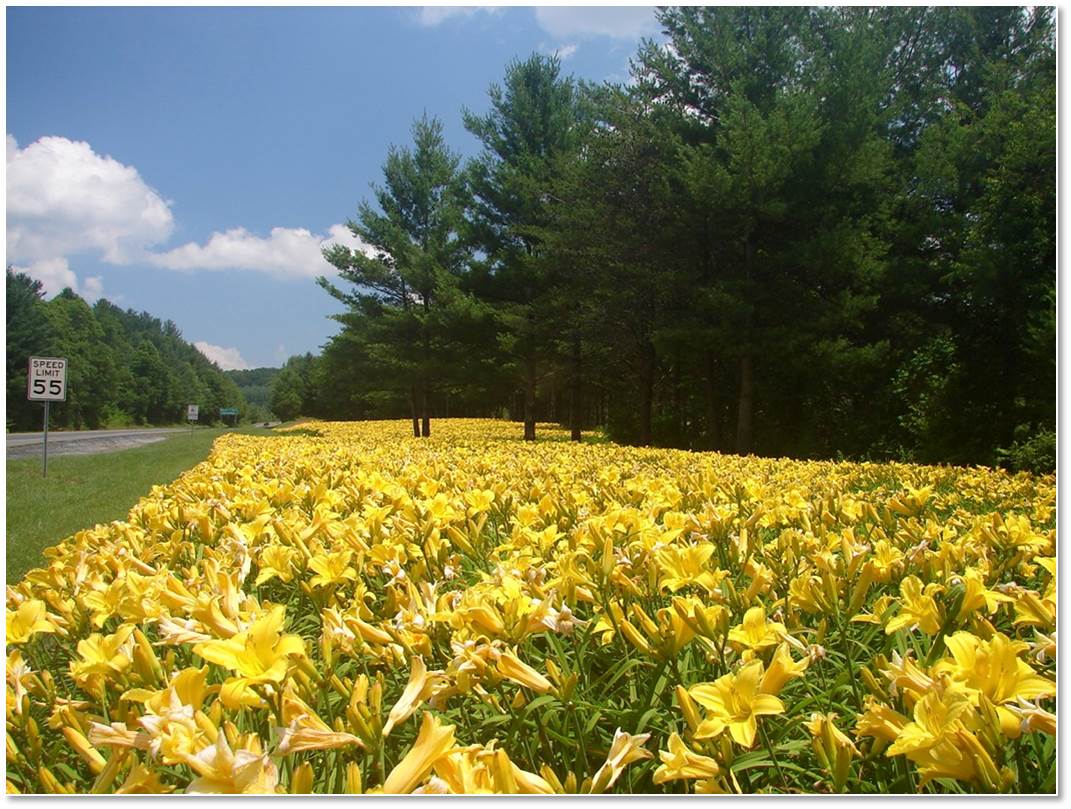
Today, North Carolinians and visitors to the state are greeted with 1,500 acres of wildflowers across the state as they drive along Interstates here.

Bill also started a program to recognize and preserve scenic byways along secondary roads across the state.

Soon the number will be increased to 58 covering more than 2,300 roadway miles showcasing every part of North Carolina including Durham, one of the few urban counties to set one aside, a favorite of mine astride a trusty Harley-Davidson Crossbones.

It is also a stated goal of NCDOT to “have well established and aesthetically pleasing forest along the highways in North Carolina.”  I haven’t seen a report for this decade but from the 1960s through the 2000s, NCDOT planted about 5 million trees along roadsides here.

A good share were planted in league with the America Treeways Program, a partnership of many agencies and volunteer organizations with the National Tree Trust established in the early 1990s by the first President Bush, a Republican.

Back then, it was also a bipartisan national policy to have well established and aesthetically pleasing forests along highways.

I will never forget a sentiment expressed by Bush I during my first few months in Durham, “Every tree is a compact between generations.”

Add that to the list of intergenerational compacts that have been shattered over the past decade.

Today, in North Carolina, many legislators inexplicably work overtime to sacrifice trees along the 14% of roadways that are part of the National Highway System here where they still remain, even though protected in the state constitution.

As a result, except whenever the Governor intervenes, Carolina’s once vaunted appeal for scenic character is rapidly falling into tatters.

Thursday, February 12, 2015

A Step Forward For Durham Trees, Maybe

My long ago adopted hometown of Durham, North Carolina justifiably prides itself on consistently garnering what is very likely the broadest range of accolades for a community of any size while also managing to cling to its sense of place.

So it has always been puzzling when officials let the community fall so far behind in areas near and dear, according to opinion polls, to Durham residents.

I suppose it is because thirty angry people haven’t shown up to meetings in orange shirts waving pitchforks (smile.)

There is an unfortunate tendency among elected bodies and executives at every level now to only move to action based on a vocal (or email) demonstration of anger (or at the request of special interests) rather than thinking strategically about what is best for everyone in the long term.

See for yourself.  Ask officials why they haven’t addressed something and you’ll be amazed how often you hear that it is because no one has brought it up or been upset about it.

One of the three areas where Durham has uncharacteristically fallen so far behind despite sentiment from a majority of residents just took the beginning of what could be a big step forward last month thanks to as request by the City Council initiated by Council member Steve Schewel.

The Joint City-County Environmental Affairs Board (EAB) issued a set of recommendations a few weeks ago that is consistent with earlier legislative priorities submitted by the Durham Appearance Advocacy Group, an independent coalition.

The report was assembled very quickly and under the circumstances is well crafted.  Though certainly not encyclopedic in scope, it is somewhat comprehensive in breadth.

From here the recommendations will hopefully be discussed in strategic meetings and then with any luck make it into the budget.  Frankly, I am heartened just to see it get attention.

I am puzzled, though, at to why the report deals only with the City portion of the tree canopy rather than county-wide as the joint city-county mandate of the EAB would have suggested.

Because it included a number, several news reports I read seemed to focus only on a recommendation that City government increase tree planting to 1,680 trees annually on its own property over the next 20 years, just to keep pace.

But that amount wouldn’t be enough to replace the trees along a tenth of a mile of the street where I live or to replace a day and half worth of the trees sacrificed each year to development here.

My calculated guess, based not only on information received from urban forestry but the average number of acres transformed each day to impervious surface,is that county-wide Durham should be planting more in the neighborhood of 8,000 to 9,000 trees a year.

But the number needed can be reconciled by implementing the first recommendation in the report, if performed holistically and according to best practices.

This seemingly far more strategic recommendation in the report is that the City adopt a proactive Urban Forest Master Plan including a city-wide inventory.

But then it seems the wording becomes contradictory to best practices for tree inventories and master plans of this type when city-wide and public property are used in the same sentence.

This inconsistent wording is reflective of differences of opinion among city administrators deep in the department responsible for urban forestry about whether to follow best practices or dumb down expectations to address only city property.

I suspect the primary author knew that inventories and master plans of this type deal with the entire tree canopy across every type of property but that a reviewer somewhere in the chain plopped in “public property” as a means to dumb down expectations.

It has been observed that this difference of opinion regarding scope among bureaucrats may be the chief reason Durham’s urban forest infrastructure has fallen into such neglect over the years.

Whether Durham finally addresses this neglect may come down to City Council members familiar with this critical difference and willing to be strategic.

Urban forestry experts at the highest level are clear:

“Comprehensive urban forest management considers all trees and associated elements across the entire jurisdiction to adequately address a heterogeneous landscape held by numerous land owners. A first step in developing a proper management plan is to assess the current composition and distribution of a community’s trees…”

The report also lists a few communities as best practices, chosen for proximity, to preempt comments such as “Durham isn’t (fill in the blank)” if truly best practice communities had been noted.

While residents overwhelmingly believe Durham is “where great things happen,” we must always remember that two our of every three people working here - including those working in local government - don’t live here, making it seem as though Durham doesn’t believe in itself or expects less than “great things.”

I say, “Bless their hearts,” to use a southern euphemism for “How pathetic!” or worse (smile.)

It is also very puzzling that the report deals only with the city, rather than the entire single-city county of Durham, the purview of the joint EAB which issued the report.

It is hard to believe the nature of the request led to a less than holistic treatment.  Urban forest exists in the county even if it doesn’t have an urban forester per se and urban forestry experts are clear that management plans need to address both the city and county.

Hopefully, members of the City Council as well as senior management will not just skim the report but will go as far as to read between the lines and reach out to include the Board of County Commissioners and County manager in the discussions.

A good inventory and master plan such as the assessment performed for Wilmington, Delaware and the surrounding county of New Castle will provide local governments, including land-use planners as well as private property owners and developers, tools such as:

  • A baseline for the number and age of trees and the percentage of each species as well as their overall health and management needs to minimize risk.
  • In-depth, ground-up augmentation that can dovetail with the more superficial, top-down satellite measures of just tree canopy, including the intriguing EPA approach for which Durham is currently a beta.
  • Quantification of the overall value of the urban forest and overall green infrastructure in a variety of ways including carbon storage, air and water purification and climate control, all calibrated to local climate and other variables.
  • Pinpointed areas for tree retention and reforestation.
  • Optimization of tree ordinances and planning decisions.
  • Information to inform residential, landowner and developer decisions as well as guide urban forestry maintenance.

As Durham has done recently with other types of neglected infrastructure, the only advantage of coming from so far down is the opportunity to truly leap frog to becoming a best practice.

One resident has even recommended a break on property taxes for upkeep and improvement of tree canopy on private property.