Showing posts with label Destination Marketing Organization. Show all posts

Sunday, May 08, 2016

Lessons From An Era’s Promise Unfulfilled

The rumble of our more than thirty year old inboard when it fires to life in our runabout most weekends is a reminder of my own passing into “vintage” years.

Not only because starting up at all, regardless of how well maintained, should never be taken for granted after all these years, but because the powerful 4-cylinder's technology actually dates to the early 1970s.

Coincidentally, that was when I was first cutting my teeth on what became a lifelong career in community destination marketing.

The early 1970s was an era, such as now, filled with transformational promise in that field.

So during frequent guest lectures for today’s college students in destination marketing I encourage them to look back at what they can learn.

In fact, the lessons I hope they will glean might help them understand why so many destination marketing organizations (DMOs) today still function much as they did in the late 1960s/early 1970s albeit under a thin veneer of “digital window dressing.”

Let me touch very briefly on two huge paradigm shifts that gave so much promise and opportunity to DMO execs as the 1970s opened up.

One involved the emergence of a new technology for marketing intelligence and the other dealt with the near simultaneous rise of a range of nationwide sense of place policies.

In the late 1960s while unwrapping for airlines why some people were resistant to flying, Dr. Stanley Plog developed a data model for understanding, segmenting and then appealing to travelers based on the type of leisure destinations that fit their travel interests.1985-century-boats-mustang-jjxxlx

This had the effect of making accessible the vastly greater tourism potential beyond the 10% or so related to conventions and meetings that had been the limited focus of nearly every destination for the previous seven decades.

At virtually the same time, a range of national sense-of-place policies were rapidly beginning to transform communities.

In the wake of 1960s battles that brought disrepute to urban renewal/destruction to make way for mega-facilities such as convention centers, a slate of new policies greeted the 1970s.

Instead, they were intended to make communities more appealing by fostering historic preservation, waterway restoration, natural area protection, cultural endowment and highway beautification by eliminating sign and billboard blight.

Strategic thinkers christened the 1970s as an era when destination marketing, too, would broaden its approach.  Across the land many DMOs even added “and visitor” to their organizational names in anticipation, as did the professional association in 1974.

So what happened?  Why did most stop with just a change in nomenclature?

Why did so few 1970s era DMO execs grasp or embrace these lucrative shifts even as strategic foresights came to fruition?

Or for that matter, why did so few of those who they mentored in subsequent decades ever seem to move beyond the same 1960s style destination marketing?

Don’t get me wrong. There have been some significant strides in destination marketing since that time and there have always been best practitioners and strategic thought leaders.

Even the vast majority who have remained 1960s retro at their core typically try some new elements when they come along.

What is noteworthy, however, is that many often mistake a strategic change as something tactical, e.g. the Internet, and a tactical change as a strategy, e.g. social media and these elements always remain peripheral to a 1960s era core. 

We know now that as strategists projected in the early 1970s, by the early 1990s leisure travel overall eclipsed business travel (including conventions,) which both tipped into gradual, though turbulent, decline in the late 1980s.

Last month it was announced that even among the 9 or 10% of person-trips taken by Americans via commercial airlines, leisure trips have now eclipsed business/convention trips as the pre-eminent reason for US air travel.

And still, generation after generation among DMO execs remain stuck in the late 1960s throwing up look alike mega-facilities, then paying subsidies to get enough groups to fill them.

All of this while then proclaiming, seeming without any sense of irony as one did recently, that this dwindling segment is somehow “the heart of any major city.”

This sense of denial, too, dates to the 1960s.  When the first feasibility studies were conducted as prerequisites for public mega-facilities in the latter 1950s, they came back negative.

Proponents (not all of whom were DMOs) quickly learned the tactic of shopping for studies until they got what they wanted and then stoked hyperbole as justification.

Thus one I suspect was born the “the heart of any major city.”

But this introspection is not about shaming my generation of DMO execs or as you will read sparing myself.

There are several lessons for today’s DMO aspirants to take away from an examination of the failed hopes of the early 1970s if they are to ever hope to help destinations emerge from this quicksand in the future and go on to fulfill the promises of their own era:

First, it may be helpful to understand that in the field of destination marketing, we’re all shaped to a some extent, by the destinations we each have the honor to serve.

This includes the time period when we serve them and especially the foresight of each boards that governs the DMO during those particular spans.

A few people are quick to credit me with fulfilling the promise of that 1970s era but as I will explain, it is far more complicated than that.

Much of any credit goes not only to the nature of the three destinations I led but the unique time frames and especially the unusually farsighted and fearless boards who governed those DMOs during those spans.

I led the first during the 1970s.  I was a voracious reader and had the benefit of some strategic mentors, but it was all just starting to sink in when I moved on.  Within a few years that DMO was and remains, in essence, a 1960s model.

Together with the board, I definitely took the second destination to a fulfillment of the 1970s era promise over stiff opposition from 1960s stalwarts.  Once I moved on though, and the board rotated, it all but reverted to a 1960s model.

It is probably from my third and final destination that any reputation for fulfilling that 1970s era promise is more deserved, but there were always a handful trying to pull us back to the 1960s.

Long after I’ve retired, the destination perseveres but regression is always a threat I’m sure.

So as far as my own record goes, batting .300 is pretty good if I were hitting fastballs or 3-pointers, I guess, but just so so measured against the promise of we felt inspired to accomplish when I started my DMO career in the 1970s. 

Frankly, had I not been the beneficiary of being in these three places when I was, given my nature, it is doubtful I would have been drawn to make destination marketing a career.

Another take-away from examining why more DMO execs didn’t rise to the promise of that 1970s era is that there is an incredible inertia that traps tourism in general in its 1960s past.

In part, this inertia is fostered by at least four conditions:

  1. A “circle the wagons” mentality when it comes to change, reflection on the past or even introspection such as this.
  2. A powerful industrial complex of entrenched interest groups, feasibility consultants, developers and old-school elected officials.
  3. An impatience with discussing concepts, ideas and anything controversial which stymies strategic thinking.
  4. A stubbornness or failure to grasp the importance of improvements to nomenclature, e.g. referring to tourism as an industry instead of a sector (which is a combination of many industries such as lodging, transportation, foodservice, entertainment etc.)

There are many other strategic lessons to be learned by looking back at that earlier 1970s era not the least of which is the importance of seeking out those DMO execs today whose DNA traces back to 1970s era execs that somehow, someway, were able to realize some of its promise.

Destination marketing, at its very essence, is about differentiation and that includes, among others, strategic differentiation, marketing differentiation and destination differentiation.

But it all begins with a broader understanding of the arc of where destination marketing has been, where it could have and should have been as well as where it should go in the future to remain relevant.

Few of us in that 1970s era could piece together a picture of the sweeping changes that were underway like we can by looking back in hindsight.

Even strategic thinkers at the time were not connecting the dots for us and maybe that is one of the lessons for students to take away that will help them pull so many DMOs out of the 1960s quicksand and leapfrog to this era’s transformational promise.

Thursday, October 29, 2015

Parting Ways and New Beginnings

I parted ways with an good friend yesterday.

We had only been together for a little more than six years.

It may be a sign of how tightly I firewalled my professional life from my personal life that when we first became acquainted many people seized on the relationship as part of my identity.

Or was it just that people found us seemingly such an odd couple, a community marketer and a biker.

My departed friend is a Harley-Davidson Cross Bones.Reyn_on_Bike_1

I had always wanted to learn to ride a motorcycle so at the age of 61 I went at it with purpose, learning to ride and enjoy what are called heavy bikes.

The curb weight of a Cross Bones when outfitted like mine is just north of 750 pounds.  That means with my weight and gear and occasionally a passenger, I had to learn to balance and maneuver as much a half ton.

The urge to learn to ride was instilled while riding behind a close boyhood friend on his mini-Honda Trail 50 in the early 1960s.

Having said goodbye to the “Bones,” we have a new challenge now, or better said an old one.

It is a well-maintained 1985 Century Mustang II inboard-outboard bow-rider roundabout boat that we keep at the nearby lake where we spend a few days each week.

When I was about 9, I first learned to water ski behind an old plywood boat that was powered by a little 35 horse power Evinrude.  The one we have now is closer to the one my parents had in the late-1970s.

It came to me while writing this bit of memoir that I often left activities behind during my career.

I don’t know about you but I’ve often wondered about the seeming association of activities such as this with place and time and why we leave some behind and take up others.

For instance, I left downhill skiing skiing, tennis and water skiing behind when I moved from Spokane to Anchorage in 1978 although there was ample opportunity for both in each city.

Downhill and Nordic skiing were actually more accessible in Anchorage with several areas right in the municipality including Alyeska, a resort 40 miles from downtown that has been ranked among the top 25 destinations.

Big Lake lies a few miles across Knik Arm from downtown Anchorage but 60 minutes by highway skirting that waterway.  The “bridge to nowhere,” would have actually had a destination.

Similarly I carried on a love of nature photography when I moved from Spokane to Anchorage but then left it behind when I moved to Durham in 1989.

Part of the reason, I guess, could be that a person’s career tends to intensify over time, at least the way I went about mine.   Or is it just that our leisure pursuits become more ambitious?

Another reason is that my job in community marketing meant that when I wasn’t showcasing activities such as these, I was spending my time thinking about how to do it better.

But about five years before I retired when I gave notice to my governing board and the community, my mind opened to what I would be able to do when that time came.

I started going down the list of what I had been postponing doing such as learning to ride a motorcycle, learning to fly an airplane, digging into family history and researching and writing essays such as these.

During my four decade career and into retirement has been the overarching dream of spending time lakeside.

Now that that time has come, for as long as I’m able my leisure, physical and intellectual activities will revolve around the lake, which is just fine with me.

I can always rent a bike from time to time.

Tuesday, September 29, 2015

A Feeding Frenzy Lesson for Community Image

Some of my former peers in visitor-centric economic and cultural development seemed relieved to learn something that became clear to me nearly a decade ago.

Less than four years before I retired after nearly four decades in that profession, a year-long firestorm of negative news coverage erupted.

Fortunately, the community marketing organization (DMO) I led at the time was already far more savvy than most about reputation management.

More on that lesson learned later but some of my colleagues seem to be drawing a mistaken conclusion from visitor surveys that negative news obsessions - even when local - are harmless to a community’s potential to draw visitors.

A few clarifications are in order:

  • There is no such thing as local news.  News outlets measure audience by huge swaths of counties including dozens and dozens of cities and towns, based on where they hope to have influence.

Durham, North Carolina, where I live is part of a so-called media market that stretches over 22 counties and parts of two states.

It is an archaic, obsolete model in a digital world where businesses and consumers now have truly hyper local alternatives.

  • Even when periodic resident surveys show a community’s self-image is high and relatively immune from negative “local” news, there is another consideration.

It can still contaminate the views of not only potential daytrip visitors from surrounding communities but if, like Durham, a community generates so many jobs that 2 in 3 are held by commuting non-residents it results in the perpetuation of negative water-cooler myths.

When these non-residents hold hospitality-related jobs and interface with visitors at airports and in hotels, restaurants, stores and features, the impact can be hugely negative.

So management of a community’s reputation and defense of its brand or personality is broader than just what populations of potential visitors think or how immune they may be to negative “local” news.

Of course, all of this requires a DMO to continually monitor the opinions of residents, commuters and nearby, statewide, regional and national populations.

There are other uses of this information.  Local stakeholders, including businesses owned or operated by non-residents and especially elected officials and local governments, often fall under the misconception that a community can build its way to prominence.

There are a lot of good reasons for a community to continually augment its visitor-related product, especially if it freshens place-based assets that truly differentiate a community without selling its soul to generica.

Regular opinion surveys such as those I mention above will not show any linkage of opinion to new developments.

I say “any” because after studying scores of these, there is little or no linkage to perception.  Buzz created around new developments, even when and if sustained, just can’t reach enough people to dent misimpression, which are fueled by much more pervasive influences.

The DMOs I led used image surveys dating back to the very early 1980s so I’m not basing these observations on just one community or a particular building splurge or series of developments over time.

I was always intrigued that new development had little or no impact on perceptions but, as I promised, I will delve into what we learned from that year-long news frenzy from March 2006 until April 2007.

Because it a DMOs role to deal with news coverage, promoting and facilitating stories and making clarifications as well as serving the needs of journalists and editors whether they be “local,” state, regional, national or global, a byproduct of this event is that a lot of local stakeholders became more cognizant and appreciative of our role.

The coverage was regarding allegations of rape by some lacrosse team members at Duke.

Both the Durham Police and truly local news media were confident the allegations, while troubling, were without merit.

But then the newspaper in nearby Raleigh began to fan the flames which in turn reignited listserv chatter, especially among well-meaning social justice activists.

I happened to be on one such listserv during that re-ignition.

Thanks to amplification by the state AP office based in Raleigh, we were soon besieged by news trucks and a feeding frenzy of inaccurate information, innuendo, pejorative and speculation.

The Durham Police were forced to reopen the investigation and a lot of individual reputations and careers were ultimately destroyed by the time the Attorney General’s office came to the same conclusion made initially by investigators.

The experience has forever made me skeptical that during news frenzies we are really getting full and balanced information.

Well-meaning chamber types here, failing to understand or respect roles and always eager for a parade to lead, called meetings and began to reinvent the wheel about Durham’s image.

This gave us the opportunity to explain what was being done by the Durham DMO and an innovative coalition it created and facilitates called the Durham Public Information & Communications Council.

Made by those unaware that advertising has long been proven ineffective when it comes to reputation management, the suggestion was made to place full-page ads in national newspapers to set the record straight.

The Durham DMO responded that first we should probably see if perceptions had changed due to the intense and frenzied coverage and ran one of its periodic surveys.

We learned that nationwide, Durham’s positive rating was up and its negative rating down but that some people who didn’t know before had moved to neutral.

By the year after the frenzy, Durham’s image was higher than ever and its negative rating at an all-time low.  Awareness was at an all time high.

The community’s image as a place to visit reached an all-time high with a 16-to-1 positive to negative ratio.  Its image as a place for new business and growth potential was also higher than ever.

Many credited the opportunity Durham’s DMO took during the crisis to better familiarize reporters and editors and lay the seeds for future stories still being reaped today.

The lesson, of course, is not to go out and manufacture negative news frenzies as a means to boost awareness. 

The take-away is that reputation is the product of a lot of very subtle but manageable influences, not just the news.  Covering news is a very difficult profession but at its best a blunt instrument when it comes to getting the “full story” about something.

This is especially true, now that so many national news outlets, rather than take time to investigate, often just quote other news including reporters and editors.

It has been made even more difficult by the fact that as a nation we seem to expect every issue to be viewed as scripted, reality television, even, it appears, our elections for higher office.

I still shake my head at how many communities when faced by a similar frenzy, push their DMOs into wasting millions in advertising not just because ads have long been shown ineffective but because they haven’t even benchmarked perceptions through scientific polling.

Ads, by the way, are scientifically proven to be ineffective because they far too blunt a marketing tactic.  Studies show that they merely harden existing perceptions both negative and positive.

Yelling about yourself as a community, which is what ads are, is not the way to build credibility with external audiences although they may give boosters and officials a false but expensive sense of solace.

Being authentic, honest and persistently earning the respect of national news channels over time is far more effective.  Standing up to inaccuracies and injustice is better done one on one and by equipping grass-roots movements to intervene.

This isn’t to take news media off the hook.  Time has proven the validity of Dr. Barry Glassner’s research in his excellent book entitled, The Culture of Fear: Why Americans Are Afraid of the Wrong Things, something lost on a business journal tactic of stirring up what we should fear from restaurants with an A health rating.

As traditional media collapses, except for those with steadied and principled news management, we will see more and more news outlets manufacturing fear and ruining reputations, if not to stir up ratings, then to blackmail reluctant advertisers.

Tuesday, September 15, 2015

All Trends Worthy of Strategy Have Historic Roots

I smiled as I read a report of a new study showing that “advanced” DMOs are leveraging their community’s intellectual capital to draw meetings and conventions.

In my personal experience that strategy has been used for at least 45 years.  Only the terminology is new.

That’s when I signed on with my first destination marketing startup, an office at Brigham Young University, in part for the purpose of marketing the campus for summer youth conferences.

In part, the objective was to keep housing and foodservice staff employed through the summer months as well as to tap into faculty expertise as a means to draw the attention of future students.

It was a part-time job for me,  When I moved on to law school at Gonzaga, which I attended full-time at night while working full time during the day to help start the new Spokane Area Convention & Visitors Bureau.

We borrowed an idea from Hartley Krueger and Dave Heinl in Seattle.  They were producing monthly breakfasts called GABFAST which stood for “Get A Boost Fast” in an effort to help Seattle recover from a horrible recession brought on by Boeing layoffs.

Remember the famous billboard near SEATAC with the now iconic message put up by two real estate agents for 15 days in April 1971 that read, “Will the last person leaving SEATTLE – turn out the lights?” 

We called our adaptation “AM Spokane,” but it had the same function.  We would invited business and university talent from a particular sector each month, say medical, and rally their support to help SACVB bring meetings to which they belonged back to meet in Spokane.

Soon we learned that site decision makers were as drawn to the local expertise this approach revealed as they were due to local connections with the association or corporation sponsoring the meeting.

We just didn’t use the terms talent or intellectual capital back then.

Even as more cost effective means of communication evolved, this continued to be a one-on-one group sales strategy I would go on to use in two subsequent startups, a completion in Anchorage and one from scratch in Durham, NC before finishing my career.

The new study by DMAI’s empowerMint initiative finds that it is very important for a DMO’s sales staff to alert a planner of relevant “local knowledge clusters” during the selection process.

Over half considered the existence of this local expertise a “competitive advantage.”

We know now that meetings and conventions as a segment of visitation tipped into a long slow decline back in the early 1980s but it still represents 10% of all person visits nationwide.

Recruiting meetings where attendees will have exposure to local talent is also a good means of drawing the interest of relocation scouts who are seeking areas for businesses, often to expand.

Of course, today, an even more strategic approach is to weave that information into communication to leisure visitors.

More than 8-in-10 executives looking to relocate  or expand a business visit a potential destination as a leisure visitor before making official contact.

I am using this trip down memory lane to show that trends we view as relevant today can almost always be found much earlier by “looking back to see forward” as a means of gleaning strategic intuition.

Hidden in the semantics of today’s trends is “strategic rootedness.”  But a DMO doesn’t need to wait.  Strategic intuition gleaned from looking back to see forward is most fruitful if done before trends become trendy.

Wednesday, August 26, 2015

How a Startup DMO Reached the Pinnacle of Advertising

No one involved ever expected it to endure - let alone be acclaimed -but as it occurred this month, I still get a call about it every year or so over the more than three decades since our little campaign launched.

When concepted in 1980 and launched in 1981, the campaign was intended to last only a few years at best.  Those were the days before testing was feasible and we were just glad it worked.

It remains the only campaign by a community destination marketing organization (DMO) to win a full-blown CLIO award in the overall travel category.

Clio is the preeminent international award competition for the creative business.

The campaign, originally designed to run only as a public service announcement when there were only three TV stations was also recognized as one of the hundred best TV commercial that year.

Advertising Age, a magazine for marketing and media cited it as “A Significant Milestone in the use of Television Technics for Marketing Success.

More than half a lifetime ago, I was only 32 years old at the time and in the first decade of what would be a four-decade career as a DMO exec.  It didn’t sink in until years later how rare what we had achieved actually was.

Friends at Seattle-based Alaska Airlines had won a CLIO award a year earlier and seeing our little campaign’s potential encouraged its submission.

Of course, “I Love New York” as a state tourism campaign had won a CLIO three or four years earlier as did Michigan tourism a few years later.

Two other community DMOs have reached the short list or received bronze or silver recognition in the years since.

DMOs are nonprofit organizations with the in-house skillsets of commercial advertising, marketing and public relations agencies.

But instead of being generalists about a lot of different products and services, DMOs are established to specialize, day in and day out, in the safeguarding and leveraging of the brand of a particular location.

They are a means to draw and optimize visitor centric economic and cultural development for the communities they serve.

Think of DMOs as an inch wide and a mile deep compared to agencies-for-hire which, by nature, must be a mile wide and an inch deep in order to be relevant to many different types of businesses.

Another DMO I subsequently led before retiring went on to garner more than 100 other awards for marketing and best practices.  Still, none quite reached the acclaim achieved by that little spot we produced for Anchorage, Alaska in 1981.

Here is the story of how Wild About Anchorage came to be,  To my wonder, it still resonates there more than three decades later based on online comments.

When I arrived in mid-1978 to complete a three-year-old DMO start up for Anchorage, two of the major obstacles we faced were internal.

Statewide Alaskans backhanded Anchorage with the compliment that that “the best thing about Anchorage was that it was 15 minutes from Alaska.”

Yet research was showing that the amenities offered by Anchorage were important to potential visitors.

At the same time, Anchorage residents were skeptical toward tourism because having divided the state into stereotypes traditional long-haul tourism interests had pegged Anchorage as the overnight between Mt. McKinley and Prince William Sound.

Yet surveys and inventories had shown that Anchorage offered virtually every Alaskan experience in a shorter, less logistical and expensive trip without diverting travelers interested in some of those traditional itineraries.

We needed a communications vehicle that would illuminate Anchorage’s personality and serve to give voice to community pride, while establishing a platform from which we could build awareness of the community’s role in tourism.

During 1979, we tinkered with some print tourism ads headlined Anchorage & Anchorage juxtapositioning two side by side images, one featuring something iconic about Alaska such as wildlife and the other featuring an Anchorage amenity such as great dining.

While we knew it was too “straight up” or serious for the PSAs we wanted to run locally which would also reach the majority of Alaskans, we felt we could build on that positioning.

We were working with a small boutique agency at the time in Seattle which until we could develop organizational capacity was the only entity willing to produce our annual visitors guide including selling the advertising.

One day while discussing the campaign we wanted to create, I mentioned a Chevron commercial that had been created by Kurtz And Friends as an example that might work.

We knew straight up imagery wouldn't be as effective because Alaskans were over exposed to incredible photography.  We also needed something that wouldn’t take the community too seriously.

Tom Bardeen, one of the principles in the boutique, was familiar with Bob Kurtz, who had earned fame doing the titles for The Pink Panther and offered to see if he was interested in producing an animated spot for us on behalf Anchorage.

He was, and either Tom or Bob or maybe both fell on the idea of a chorus line of animals to convey the message that Anchorage & Anchorage had only in an animation format.

The spot took off instantly with not only Anchorage residents but Alaskans as a whole.  Still a decade before the worldwide web would be viable, I guess you could say it went viral.

Within weeks we knew the moose in the center of the chorus line would work as the graphic symbol in our branding of Anchorage for external audiences as would the tagline Wild About Anchorage.

Linda Chase, an event organizer, agreed to do costumes for an actual chorus line we could take on the road at promotions as well as use at local events and during welcome ceremonies for conventions.

A contest in schools gave the moose a name – Seymour of Anchorage – get it?

Tennys Owens, a local art gallery owner, arranged for sales of the original celluloids and residents lined up around the block to buy and frame them. I still have one the board gave me when I moved on.

A statuette of Seymour was created to give to awardees at award dinners.

I left Alaska in late 1987, but Wild About Anchorage remained in use for another 20 years.  In 2007 the Anchorage DMO successfully launched a new brand signature and the tagline “Big Wild Life.”

In 2011, after the Anchorage Daily News pined for Wild About Anchorage in a column, Seymour the Moose, himself, penned an open letter assuring readers that he was still working as a mascot of sorts for the new slogan (smile.)

Coming up with a magical campaign such as this is always a bit serendipitous by nature.

Testing can measure a lot of things including potential popularity, but usually not deep and enduring engagement over more than three decades.

Nor do DMO marketers or should I say DMO governing boards have the patience to let a campaign play out like Anchorage obviously did.  About the time it seems everyone on the planet must be heard of it is when a campaign is just starting to penetrate.

Little did we know then that by the end of that decade traditional advertising overall would begin a three decade decline in effectiveness.

In today’s marketing environment where ads now have a negative return on investment and channel fragmentation makes a PSA campaign impractical, it wouldn’t be possible to do what we achieved in 1981.

I am humbled that people still embrace Wild About Anchorage as a legacy campaign.  We were very lucky and I was blessed to play a part as the producer.

Hats off to Tom Bardeen who wrote the lyrics and Dale Case (101 Dalmatians and Fatherhood) and Pam Cooke (Family Guy and Simpsons) who did the animation and especially Bob Kurtz who designed and directed Wild About Anchorage.

How a Startup DMO Reached the Pinnacle of Advertising

No one involved ever expected it to endure - let alone be acclaimed -but as it occurred this month, I still get a call about it every year or so over the more than three decades since our little campaign launched.

When concepted in 1980 and launched in 1981, the campaign was intended to last only a few years at best.  Those were the days before testing was feasible and we were just glad it worked.

It remains the only campaign by a community destination marketing organization (DMO) to win a full-blown CLIO award in the overall travel category.

Clio is the preeminent international award competition for the creative business.

The campaign, originally designed to run only as a public service announcement when there were only three TV stations was also recognized as one of the hundred best TV commercial that year.

Advertising Age, a magazine for marketing and media cited it as “A Significant Milestone in the use of Television Technics for Marketing Success.

More than half a lifetime ago, I was only 32 years old at the time and in the first decade of what would be a four-decade career as a DMO exec.  It didn’t sink in until years later how rare what we had achieved actually was.

Friends at Seattle-based Alaska Airlines had won a CLIO award a year earlier and seeing our little campaign’s potential encouraged its submission.

Of course, “I Love New York” as a state tourism campaign had won a CLIO three or four years earlier as did Michigan tourism a few years later.

Two other community DMOs have reached the short list or received bronze or silver recognition in the years since.

DMOs are nonprofit organizations with the in-house skillsets of commercial advertising, marketing and public relations agencies.

But instead of being generalists about a lot of different products and services, DMOs are established to specialize, day in and day out, in the safeguarding and leveraging of the brand of a particular location.

They are a means to draw and optimize visitor centric economic and cultural development for the communities they serve.

Think of DMOs as an inch wide and a mile deep compared to agencies-for-hire which, by nature, must be a mile wide and an inch deep in order to be relevant to many different types of businesses.

Another DMO I subsequently led before retiring went on to garner more than 100 other awards for marketing and best practices.  Still, none quite reached the acclaim achieved by that little spot we produced for Anchorage, Alaska in 1981.

Here is the story of how Wild About Anchorage came to be,  To my wonder, still resonates there more than three decades later based on online comments.

When I arrived in mid-1978 to complete a three-year-old DMO start up for Anchorage, two of the major obstacles we faced were internal.

Statewide Alaskans backhanded Anchorage with the compliment that that “the best thing about Anchorage was that it was 15 minutes from Alaska.”

Yet research was showing that the amenities offered by Anchorage were important to potential visitors.

At the same time, Anchorage residents were skeptical toward tourism because having divided the state into stereotypes traditional long-haul tourism interests had pegged Anchorage as the overnight between Mt. McKinley and Prince William Sound.

Yet surveys and inventories had shown that Anchorage offered virtually every Alaskan experience in a shorter, less logistical and expensive trip without diverting travelers interested in some of those traditional itineraries.

We needed a communications vehicle that would illuminate Anchorage’s personality and serve to give voice to community pride, while establishing a platform from which we could build awareness of the community’s role in tourism.

During 1979, we tinkered with some print tourism ads headlined Anchorage & Anchorage juxtapositioning two side by side images, one featuring something iconic about Alaska such as wildlife and the other featuring an Anchorage amenity such as great dining.

While we knew it was too “straight up” or serious for the PSAs we wanted to run locally which would also reach the majority of Alaskans, we felt we could build on that positioning.

We were working with a small boutique agency at the time in Seattle which until we could develop organizational capacity was the only entity willing to produce our annual visitors guide including selling the advertising.

One day while discussing the campaign we wanted to create, I mentioned a Chevron commercial that had been created by Kurtz And Friends as an example that might work.

We knew straight up imagery wouldn't be as effective because Alaskans were over exposed to incredible photography.  We also needed something that wouldn’t take the community too seriously.

Tom Bardeen, one of the principles in the boutique, was familiar with Bob Kurtz, who had earned fame doing the titles for The Pink Panther and offered to see if he was interested in producing an animated spot for us on behalf Anchorage.

He was, and either Tom or Bob or maybe both fell on the idea of a chorus line of animals to convey the message that Anchorage & Anchorage had only in an animation format.

The spot took off instantly with not only Anchorage residents but Alaskans as a whole.  Still a decade before the worldwide web would be viable, I guess you could say it went viral.

Within weeks we knew the moose in the center of the chorus line would work as the graphic symbol in our branding of Anchorage for external audiences as would the tagline Wild About Anchorage.

Linda Chase, an event organizer, agreed to do costumes for an actual chorus line we could take on the road at promotions as well as use at local events and during welcome ceremonies for conventions.

A contest in schools gave the moose a name – Seymour of Anchorage – get it?

Tennys Owens, a local art gallery owner, arranged for sales of the original celluloids and residents lined up around the block to buy and frame them. I still have one the board gave me when I moved on.

A statuette of Seymour was created to give to awardees at award dinners.

I left Alaska in late 1987, but Wild About Anchorage remained in use for another 20 years.  In 2007 the Anchorage DMO successfully launched a new brand signature and the tagline “Big Wild Life.”

In 2011, after the Anchorage Daily News pined for Wild About Anchorage in a column, Seymour the Moose, himself, penned an open letter assuring readers that he was still working as a mascot of sorts for the new slogan (smile.)

Coming up with a magical campaign such as this is always a bit serendipitous by nature.

Testing can measure a lot of things including potential popularity, but usually not deep and enduring engagement over more than three decades.

Nor do DMO marketers or should I say DMO governing boards have the patience to let a campaign play out like Anchorage obviously did.  About the time it seems everyone on the planet must be heard of it is when a campaign is just starting to penetrate.

Little did we know then that by the end of that decade traditional advertising overall would begin a three decade decline in effectiveness.

In today’s marketing environment where ads now have a negative return on investment and channel fragmentation makes a PSA campaign impractical, it wouldn’t be possible to do what we achieved in 1981.

I am humbled that people still embrace Wild About Anchorage as a legacy campaign.  We were very lucky and I was blessed to play a part as the producer.

Hats off to Tom Bardeen who wrote the lyrics and Dale Case (101 Dalmatians and Fatherhood) and Pam Cooke (Family Guy and Simpsons) who did the animation and especially Bob Kurtz who designed and directed Wild About Anchorage.

Thursday, August 13, 2015

Community Marketing In The Future

A business professor-friend of mind recently asked me to write about the long-term outlook for community destination marketing organizations, my four-decade career that ended at the dawn of 2010.

It will be a fun exercise.  Even though these organizations overall have continued to evolve over the last five years, the answer to his query can be found in the past, which is the primary source of all strategic insight.

When I reference this as “looking back to see forward,” I am not talking about the regressive propensity by some of my former DMO peers to react to changes in the tourism ecosystem by futilely trying to put humpty dumpty back together.

It is true, as some pundits predict, that “some” DMOs are already becoming irrelevant but not just because of technological advances.

Communities that have surrendered authenticity and sense of place while opting instead for mainstream mega-events and facilities are already obsolete.

Rather than differentiate, this approach homogenizes identity and character so that sooner rather than later there will be little need for a DMOs in these communities.

Those DMOs in communities that that still have and safeguard a unique sense place woven from distinctive cultural, built and natural place-based assets are and will still be highly relevant far into the future.

But to paraphrase futurist and analyst Brian Solis, in the future the marketing these community destination marketing organizations deploy will have little resemblance to marketing as it has been.

This isn’t and won’t just be about “keeping your knees bent” or better yet balancing for absorption as in the “bump method, aka, mogul skiing” to use metaphors from downhill skiing.

Interestingly, in the book forward to Share This Too, where Solis made that statement about “The future of marketing [having] little to do with marketing,”  he uses a comparison of the difference between surfing and skateboarding with snowboarding.

Describing that while they may look familiar, with the first two you lean back and use your back foot as a rudder.  But with snowboarding, you lean forward.

Change, even when it seems evolutionary requires not only “perseverance” but an “open mind” to doing things differently.

That said, marketing as most DMOs practice it began to rapidly change three decades ago, more than a decade before the Internet was made available commercially and nearly two decades before it was employed by even the most forward thinking DMOs.

While much of what a typical DMO does today will continue to be replaced in the future by technology, you can see what those that will still be relevant will be up to instead by looking at what all but the most strategic DMOs have long been neglecting.

Here is my take on eight (in no particular order) community destination marketing foci there that will always be a need for “boots on the ground” to optimize visitor-centric economic and cultural development even as more traditional elements of marketing continue to be commoditized by new technologies.

Serving as the vigilant conscience and guardian for the distinctive sense of place of a particular destination community – Perpetually justifying the unique value proposition: what’s special, what’s different.

Defending community reputation as a means of lowering barriers to visitation e.g. proactive fact-checking, ensuring accuracy even if troubling, protecting image, challenging negative stereotypes, drilling down to distill and celebrate inherent brand values, traits, positioning.

Conducting intensive and never-ending front line training about the community to optimize visitor satisfaction and circulation as well as training local stakeholders to optimize economic value added by “buying local.”

Leading the process for distilling strategic insight into what McKinsey’s Hugh Courtney identifies as the four levels of uncertainty including the “clear enough” near-term, “alternative futures” or scenarios a little further out, “a range of potential futures” in the distance and finally, patterns of evolution.

Most so-called strategic thinking stops at level one – the obvious.

Creating and curating content/context communications including perpetually freshened graphic imagery that draws attention by providing valuable knowledge and insight as well as appealing to only those visitors for whom the community can deliver on its brand.

Maintaining and providing databases that update GPS data as well as making certain that all stakeholder businesses and organizations have “claimed their online real estate.”  Monitoring search engine optimization for the destination and all stakeholders.

Mining and harvesting data and analytics, including primary research, to inform the leverage of private development capital, calculating location specific economic impact and providing and interpreting destination-specific metrics for all stakeholders.

Analyzing, shaping and articulating the visitor experience as well as advising stakeholders on how it can be improved.  Deeply aggregating, trafficking and providing event data to optimize exposure and limit dislocation as well as cannibalization of underwriting and volunteers.

There are others but no more advertising.  Sales will be more like data mining, performed by data analysis rather than glad-handing.  All media attention will be earned.  Official community websites will be comprehensive and capable of being harvested by intermediaries.

Staffs will be larger because these marketing foci of the future are more labor intensive and require quick reactions.  Skills sets that will be prized are analytics, design and backbone.

In my experience only one DMO in a thousand has made even a token shift to a few of these areas that will be the foci of community marketing going forwards.

If you hear a consultant (or DMO exec for that matter) claim his or her clients already do these things, grab your wallet and run.  They are full of, well you know.

Those DMOs that are not trapped in Jurassic Marketing by poor and often regressive or lethargic leadership are usually slowed by “fax thinking.”

By this I mean the tendency to always try to keep “plates spinning” long after they have become obsolete. 

Or in the words of Brian Solis, “stuffing promise into familiarity.”

Tuesday, July 28, 2015

Humpty Dumpty Marketers

This post does not mark the end of my annual hiatus which will run into August.

I’ve been mulling over a future post that a business school professor-friend of mind asked me to write about what I see as the future for community destination marketing organizations, my former profession.

It will be an opportunity for me to practice what I preach about looking back to see forward for strategic insight.

It pains me to admit that many in my former profession don’t seem to be the brightest bulbs in some respects or there would be far more than 200+ of these organizations that are accredited.

Maybe I resemble that remark in some respects (smile.)

But even accreditation, which is essentially a diagnostic to identify areas for continuing improvement, isn’t a guarantee against a proclivity common among far too many DMO execs.

This is the regressive tendency of a few tenacious but well-meaning and otherwise reasonable execs to waste everyone’s time trying to put the proverbial “Humpty Dumpty back together again.”

What these folks fail to grasp is that forms of organizational structure and marketing strategy along with various tactics become obsolete because essentially the “ecosystem” of tourism has rapidly and perpetually evolved.

They could easily spot these paradigm shifts in SWOTS analysis if they were not in such a hurry to check that process of the list rather than mine it for insight.

Brian Solis, a strategic analyst, futurist and principal for Altimeter Group, now a Prophet Company, has a great line.  “The future of marketing has little to do with marketing.” He is referring to traditional marketing and especially advertising.Cleansville Billboard in Durham

Some businesses and organizations in the various industries that make up travel and tourism are guilty of hypocritically keeping roadside billboards on life support.

I call their use “desecration marketing” because they underwrite no content other than the advertiser “yelling at you” while blighting the communities and scenic assets that motivate travel.

All of this to reach 2/10th of 1 percent of people who are motivated to buy something in a given year based on that form of message.

If you have read some earlier posts, you will see the irony in the message on the image captured of a billboard in this essay.  It was posted on one of the 80 or so remaining in Durham, North Carolina where I live and where billboards were banned in the early-1980s.

For those new to this blog, between smart devices and in-vehicle navigation systems, eight times the percentage of Americans who aren’t turned off by billboards in general have already shifted to navigation systems for both directions and to find points of interest such as gas stations.

The advertiser on that billboard shown above is proud of its efforts at conservation and environmental restoration but that apparently doesn’t extend to scenic preservation including eliminating sense-of-place pollution such as sign blight.

It is not the first company where company marketers apparently feel exempt from social responsibility policies when it comes to where they advertise or oblivious to metrics such as turn-off ratios.

Traditional advertising overall (in newspapers and on radio, television and billboards) began an overall decline in effectiveness three decades ago that by 2010 had reached a negative return on investment.

When adjusted for inflation, ad revenues for newspapers today have fallen below where they were in 1950.  Even when digital and other revenues are included they are essentially where they were 65 years ago.

Other traditional advertising mediums are or will be following suit.  Analysts now project that newspapers are poised to replace local television when it comes to local video content within the next ten years.

The rapid shift to online advertising instead has created what experts such as Mathew Ingram, a senior writer for Fortune, described as an “arms race” this month between advertisers who still don’t get it and viewers determined to block out ad content.

Marketers engaged in this arms race have failed to notice that even online, where ad blocking has grown 7 times just over the past five years, that the ecosystem for advertising period has changed.

If you want to reach consumers, it no longer works to yell at them which is essentially what advertising is. There is no use trying to put that obsolete “Humpty Dumpty” back together again.

It isn’t the nature of advertising that changed; it is the overall consumer ecosystem.  It is long overdue for communicators to also evolve.

But many marketers, including more than a few in my former profession of community destination marketing simply won’t.  That’s apparent by their steadfast refusal to evolve or perhaps due to stakeholders who won’t let them or peers who keep pulling them into futile schemes to reassemble old “Humpty.”

Billboards are an example.  The first one was erected in the United States in the 1830s.  They had become a pariah to consumers by the 1880s when billboard owners turned to out-of-step lawmakers to keep them on life support.

Oblivious or lacking a strategic bone in their body, many advertisers who are obviously also very bad at math still insist on using them today, even though eight consumers are turned off by their use for every one who isn’t.

Like I said, not the sharpest knives in the drawer.  But hey, neither was “Humpty Dumpty.”

Monday, May 18, 2015

The Origin of All Too Rare Sensibilities

You could fit nearly 182 Durham’s in the land area of North Carolina.  In land area, it is the smallest urban county in the state, yet home to the fourth largest city.

So it is surprising to visitors that there are 232 working farms here, many supplying meats, dairy and vegetables to Durham’s nationally-recognized foodie scene.                                  

This may not seem like many given that North Carolina is still a largely rural state with 50,218 farms and livestock operations according to a census regularly conducted by the US Department of Agriculture.

Throughout the four-county metro area centered around Durham, there are about 2,410 farms and livestock operations, nearly half in Chatham County.

Unlike Durham, its metro counterparts have not set aside a third of their land area in watershed and areas where working farms are safeguarded.

This area is an important part of Durham’s sense of place, which in any place where it is still preserved and fostered, always includes not only “built” and “cultural” place-based assets but “natural” as well.

Durham “farms” include 46 livestock operations raising nearly 1,000 head of beef cattle.  The ancestral ranch where I was born and spent my early years in the 1950s in the shadow of the Tetons along the Henry’s Fork raised about that same number of cattle.

In that Fremont County nook, ours was not a large operation but still more than twice the size of the average farm or ranch there today and 8 times the median for operations there.

There are still 181 ranches there growing more than 9,000 head of cattle.  But many operations have turned to farming instead using the pivot irrigation common in northeastern North Carolina now.

As an adult, I spent four-decades in a field tasked as the guardian for sense of place in three different parts of the country, including Durham, but I trace my sensibilities for that work back to our ranch.

I was reminded a month ago of a time when my daughter helped bring this into focus for me when I read of the passing of Ivan Doig a month ago.

Doig was a native Montanan who was born about two hours north across the Centennials and nine years earlier from my roots in the Teton-Yellowstone nook of Idaho.

After earning degrees at Northwestern and the University of Washington (PhD.), he worked for The Rotarian, a magazine, which is where I first read his byline.

My daughter’s Dad #2 passed Doig’s memoir, This House of Sky: Landscapes of a Western Mind to her and she, in turn, passed it to me knowing how closely it paralleled some of my early influences on the ranch.

It had been written in 1978 when she was five but I was half way through my career when she passed it on to me. It was when I was going on a decade past when I became one of the first in my field to incorporate sense of place as a foundational strategy.

But it wasn’t until I read This House of Sky that I realized how early my sensibilities for sense of place had been shaped.

I have the DNA of five generations of Idaho cowboys and horsemen.

But Doig grew up a sheepherder, along the Rocky Mountain Front, just south of the Blackfeet Indian Reservation, an area I’ve crossed while crisscrossing the country with Mugs and which I wrote about a few months ago.

We both shared the 1950s under the big sky of the Mountain States before migrating to urban surroundings.  But one of the reasons Doig’s memoir resonates is that it more accurately portrays the reality behind what has become the cowboy mythology of the West.

It is tempting to think of This House of Sky as a true-story Lonesome Dove, written a few years later by Larry McMurtry, a contemporary of Doig’s who can also capture landscape, but in my opinion House is far more nuanced and relatable.

I still dust off the copy my daughter gave me and read it for inspiration.  It is also a reminder that there may be no greater gift than a child who, while it is foreign to her own background, truly grasps the essence of a parent’s.

As I conclude this essay, my finger fell on a quote from House, “Memory, the near neighborhood of dream, is almost casual in its hospitality.”

And so it seems with sense of place.

Tuesday, April 28, 2015

In Just 48 Months

People who skipped over a recent post entitled 7 Truths may not have realized that they pertain to the spectacular shift Americans have made in how they access information while on the road.

Take maps for instance.  By far, the way Americans now access maps is online, and according to a survey, 90% do it on the go via a smartphone where they are useful not only for navigation but to pinpoint travel services such as restaurants, lodging and fueling stations.

According to Michelin, which has produced old fashioned static paper maps and guides for more than 100 years, 39% of Americans still keep one in the car as back up.

Less than 2% apparently continue to use roadside billboards.

Although these days, my back up to GPS is a “large print” AAA map, I still have a 1967 Michelin map of France from my first passenger airplane trip of any kind when I had just turned 19 years old.

That is also the year before Michelin started publishing maps and guides for destinations in the United States.

North Carolina first published a state highway map in 1916 when federal aid became available, and then annually or every other year since 1924.  The 1930 edition even showed motorists how to do hand signals for stopping and turning.

The first one printed in color was the 1936 edition, which included a guide to what were then considered the state’s major attractions (shown in the image below,) one of which was in Durham.

Of course settlements had been mapped here beginning in 1590.

It wasn’t until three years after I arrived in North Carolina to officially jumpstart visitor-centric economic and cultural development for Durham in 1989, that city and regional insets began to be added to the state map.

That was the year the World-Wide Web (WWW) was created to enable onramps to the Internet.  By the time the state map added those city insets, the first online maps were created by the Xerox innovation lab, PARC (Palo Alto Research Center.)

By 1994 when we began the shift to moving all Durham information to that platform, Canada and Scotland had put their entire atlases there, the latter being the first interactive maps.

Our organization was one of the first in the nation to incorporate the responsibility to determine or relay “impedance” data to online map companies.  This is what permitted these maps to recognize one-way streets and navigational turns.

Whenever your GPS misleads you - and 63% of us have had that happen - don’t blame online maps, blame the community and/or state that has neglected to update its data which is even more contaminating to static paper maps.

Even venerable Michelin is going online.

Most Americans first learned about online maps through MapQuest beginning in about 1996 but codes written and adapted by that company go back to its origins in the 1980s.

Then along came Google Maps in 2005 built on that company’s acquisition of the work of two Danish brothers in Sydney.

Apple launched the first iPhone less than 24 months later, although smartphones had been conceptualized in 1971, just before I graduated from BYU, and were offered for sale in 1993, on the heels of that first digital map created by Xerox.

Adoption of smartphones by Americans has been at a blinding rate of speed.  From just 35% four years ago, the fraction of Americans now using a smartphone has reached two-thirds, 75% of all mobile device users.

This means that within just 48 months, the percentage using these devices flip flopped to the percentage not using them.  The aftershocks of this seismic shift are just now becoming apparent.

And its substitution by users as the primary means of navigating to businesses as well as learning about new products has been even faster.

Smartphones are also the primary or only means for nearly 1-in-5 Americans to access the Internet including 13% of those making less than $30,000 per year.

Half of smartphone users have their devices to access help in emergency situations and 17% to report neighborhood problems.

Marketers, as a group, can be extremely slow to shift gears with a few even still using roadside billboards, earning a reputation for desecration marketing.

But laggards notwithstanding, it appears that devices such as these have already becoming the salvation for restoration of scenic character along our roadsides.

Monday, March 30, 2015

Anecdotal Madness

I held this post back for a few days so it wouldn’t appear to be rubbing salt into places where pride was so freshly wounded.  But this post is about more than just the Final Four or college basketball.

Sports reporters, especially in North Carolina where so many learned the basics in journalism at UNC-Chapel Hill, often repeat a myth that just has never held up to scientific scrutiny.

It found its way into several stories written last night after Duke became the fourth finalist: that Duke is the basketball team people love to hate.

It was so pronounced, that beginning in the early 1990s, Durham’s newly established community marketing organization used it as inspiration for one of a handful of markers as it set out to pin down and resolve misinformation undermining the community’s image.

Repeatedly over the years, polls showed that Duke’s highly successful men’s basketball program was not only the most popular in Durham, but a very close second in UNC’s home county.

Coincidentally, at the same time a national poll by Harris found that Duke was America’s favorite men’s basketball team, a position it has held now for 12 of the last 18 years including 2015.

In the six years when it was not America’s favorite, it was 2nd most favorite five of those years, falling to third one year, 1997.

The University of North Carolina was most favored three of those years giving the metro area centered around Durham and Chapel Hill a very unique status.  UNC has averaged just below #3 while Duke has averaged #1.

Kentucky has averaged just a bit more popular than UNC, possibly leading to a Kentucky-Duke culmination of this year’s Final Four dominating brackets across the country.

But what about here in the state of North Carolina?

I watched newcomers to Durham from Michigan stop by a table of Duke football players having breakfast this weekend to josh that Duke would be their new fav when a man nearby jumped from his chair, interrupting a phone call and a mouthful to scream, “no in North Carolina, it is the Tar Heels.”

However, he wasn’t joshing.

Walking away, the newcomers were puzzled and other patrons just looked down.  He may have been right about football, but probably not for long.

But what do metrics show regarding basketball?

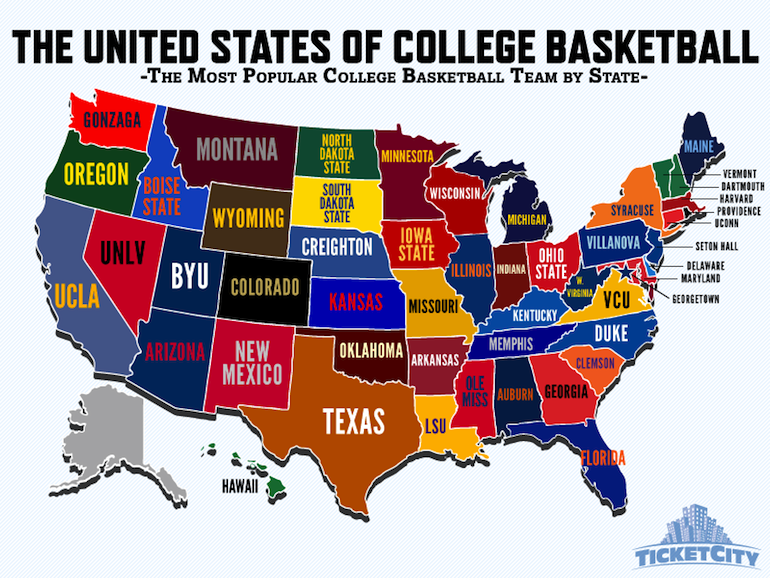
TicketCity, an agency founded in 1990 by a University of Texas grad took a look at which teams scored highest for engagement in their own state, factoring game attendance, Google search and social media over the past year.

Here Duke came out #1 too, in the North Carolina.  BYU was tops for Utah and Gonzaga for Washington, giving me an added alumnus trifecta.

All of this does not negate that Duke might also be hated, which is a different metric altogether, just that it would be irrelevant without showing it in the context of overwhelming popularity.

Sports reporters are emblematic of the challenges that face news reporters overall.  Drawing anecdotes as evidence of a more generalizabe public opinion is very tricky.

Local news in Durham has inferred that its recent population growth is due to the turnaround of downtown Durham in the last few years.  But Durham was the fastest growing city in North Carolina throughout the 1990s when its downtown had yet to emerge and its image underwent a turnaround.

How could this be?  Because Durham’s self-image and its image nationwide has always been high.  Over the 1990s is when negativity about Durham entrenched in surrounding counties was gradually reversed.

For sure, the image turnaround by 1999 lowered one of the barriers key to downtown revitalization by opening the minds of the news media, realtors, developers, financiers, as well as newcomers.

But downtown revitalization was also spurred both here and across the nation after the year 2000, not just by favorable shifts in psychographic and demographics but even more so by the innovation that year of New Market Tax Credits (NMTC.)

NMTC’s were recognized by Harvard in 2009 as one of the nation’s most innovative government programs leading to this 2010 case study of their dramatic success in downtown Durham.

Studies, scientific polls and generalizable metrics may not be as exciting as hyperbolic anecdotes for news reports or news consumers more interested in the pursuit of legends and myths, including their own.

But these tools are crucial to any community seeking a factual basis upon which to truly shift perceptions and initiate change.  Studies, polls and metrics are also important when assessing which coattails to ride or credit.

There is no institution more deserving of credit for everything Durham has achieved than Duke, and no program there more deserving of enhancing Durham’s reputation than Coach K’s Blue Devils.

Friday, March 20, 2015

Looking Back To Detect the Future

One of the signature artifacts of Durham, North Carolina’s past that has been lost during the eight decades of neglect since a local history museum was first proposed is a calliope.

Beginning less than a decade after the Civil War ended here 150 years ago next month, this musical instrument sat atop the now repurposed Old Bull Building and simulated the sound of a bull at each factory shift change and other special occasions.

I grew up on a cattle ranch in the Rockies so when I first read about this famous calliope, I had no trouble imagining the sound it played (click here to hear a bull.)  It celebrated Bull Durham tobacco and the “Bull City” it was soon to make world famous.

It is important to remember that in 1870 as plans were being laid to erect the Old Bull Building, now a National Historic Landmark, Durham was already very different than the rest of North Carolina.

At the time, Governor W.W. Holden was standing up against gangs of Ku Klux Klan riders who were marauding through nearby counties committing public murders and whippings while intimidating officials from doing anything about it.

Several counties were declared to be in a state of insurrection and state militia were deployed.

These gangs of terrorists were targeting “blacks who did not know their place” and whites who advocated for the rights of blacks.  In fact, maybe the sound of a Bull blaring from Durham was meant to ward them off.

Seriously, this is when Durham residents began talking privately about formation of a separate county which got its unique shape when several pieces of land were lopped off during passage of the controversial 1881 bill in the legislature, enabling voter approval.

But Durham’s industrialists and merchants were divided on another issue, bonds to build graded schools.  Republicans were opposed, arguing that education by families and in private and parochial schools was enough.

Opponents sued to overturn voter approval so voters approved the bonds again while proponents started a “moonlight school” for factory workers.

Artifacts such as the now lost “bull calliope” will be crucial to a fully-functional Museum of Durham History, should officials ever make it the priority public opinion polls have shown for decades.

The compelling essay entitled “Looking at Artifacts, Thinking About History,” notes that artifacts reflect and symbolize changes.  Had the old calliope survived, it would today serve as a clarion reminder that Durham is different, and proud of it.

There are people who dismiss the past by claiming they only want to think about the future.  This is the kind of thinking or lack of thinking that leads quickly to a surrender of sense of place in so many communities.

It is by understanding the patterns of the past that we see into the future.  It is why a class in historical analysis should be required as a prerequisite in business schools for one on strategic thinking and/or strategy making.

With each passing day, Durham loses more and more of its history in exchange for mainstream culture that can be found anywhere.

For those still puzzled about why we should care and in need of lists to check, below are just a few reasons a Museum of Durham History, stocked with both artifacts and the latest technology, is crucial:

  • Story Telling. It will give children, students, newcomers and relocating executives a place to get in touch with Durham’s story. People who grasp that stories are more inclined to be engaged as activists, volunteers and philanthropy.
  • Synergy. It will augment Durham’s historic sites by providing exhibition space to stir interest in those locations, making them more sustainable. It will complement rather than undermine other cultural facilities and programming.
  • Preservation. It will be a vigilant testimony to what makes the community distinct and unique and insulate its character and personality from the pressures of development and “generica.”
  • Future Generations. As a repository of innovations and artifacts, it will inspire future generations to build on the temporal qualities that make Durham, well, Durham…creative, entrepreneurial, caring, innovative, accepting, etc.

Maybe it is because I am something of an artifact myself, that this has now become so clear (smile.)

Thursday, January 22, 2015

The Trait Shared By “Big Game Hunters”

Community destination marketing organizations that fall into the trap of “big game hunting” share a cultural trait dating back to before the 1920s when leisure travel emerged as mainstream.

They are generally marketing organizations in name only, having untethered sales from its constraints as an element of marketing along with any focus on distinctiveness, differentiation, sense of place or fit.

“Big game hunters” are individuals or groups of enablers who, lacking awareness or patience with fostering the sense of particular place, seek instead to import it by going shopping for culture and bringing back one of everything.

They also have in common a sales focus in the traditional sense (e.g., I have produced something to sell and need to convince you to buy it even if it requires subsidies) as it was when community destination marketing organizations first evolved in the 1890s and was being taught in colleges by 1904.

Marketing thought and practice (e.g.,what do you need and maybe I have something that will fit that need) including a customer-focused integration of sales was already rapidly evolving.

Some community marketing organizations began to adopt marketing including a different focus to sales in the 1920s and especially during the 1930s, while many never made the shift.

Many still remained glued to old fashioned sales by the time marketing theory and practice really took immediately after WWII.

This is also when marketing became scientific as documented by authors such as Wroe Alderson in his co-authored 1948 book Towards a Theory of Marketing, the year I was born.

It was followed by his 1957 book, Marketing Behavior and Executive Action, still in use as a textbook when I entered college a decade later.  But many community marketing organizations as they are today remained stuck in the 1890s.

Nor did they budge when in 1960, Harvard professor Theodore Levitt published a paper, later expanded into a book by the same name entitled Marketing Myopia, describing the difference between untethered sales and integrated marketing.

My four decade career leading community destination marketing organizations didn’t consciously begin until 1973, the year after I graduated, but reading that paper as a class assignment while helping to jumpstart an office to market the BYU campus for youth conferences, as a part-time job, had made me aware of what marketing meant.

Even as I began my career in earnest helping to create a community marketing organization for Spokane, peer organizations still stuck in the 1890s sales mindset mounted furious opposition to even changing the name of these organizations to add the word visitor after conventions, my first exposure to “big game hunters.”

Though mine had allowed me to escape being trapped, I can easily trace the DNA of the organizations today that remain stuck in the 1890s by tracing those influential in their background.

It is hard to say if I just happened to choose communities eager to avoid that trap or they found me, but I was dogged throughout my career by “big game hunters” in each of the three communities I served, all of whom were eager to pull us back into the past, several coming close to having me fired.

Communities that forgo sense of place and authenticity to “big game hunt” instead for mega-facilities or events that make them the same as other communities and then resort to subsidies to underwrite their appeal appeal, are still practicing sales as it was well more than a hundred years ago.

Marketing a community requires finesse by appealing to visitors who will find a particular place a good fit in return for their time and treasure while pursuing groups and events only when they meet these criteria:

  • Occur during time periods where they won’t distract from homegrown events
  • Won’t displace existing visitors
  • Won’t siphon away underwriting, audience and volunteers from homegrown events
  • Are complimentary with a community’s unique stature

Untethered from marketing, a sales-dominant focus superimposes these criteria with quotas and winning new accounts against a far too narrow metric such as just filling hotel rooms.

Surveys across all kinds of organizations show that only 18% of sales teams are held accountable for minimizing churn and only 30% are accountable for maintaining margins and avoiding discounts and subsidies, the hallmarks of “big game hunters.”

By using myopic metrics, they also fail to be accountable for a return that even replenishes the dollars used as subsidy.  Had they not untethered from marketing they would be seeing returns closer to 6-to-1 in tax revenues to the community overall.

The battle to protect sense of place from the forces of mainstream entertainment and fantasy dates at least to April 7. 1858 when two Democrats (the conservatives of that day) appointed to the Central Park Board tried to pollute, a week after it had been approved, the plan by Fredrick Law Omsted and his partner.

“Big game hunting” by communities hoping to import sense of place rather than foster it indigenously by intensified in the 1940s in the immediate aftermath of WWII.

Most communities in the 1920s and 1930s had broadened to a marketing focus when leisure travel achieved mass appeal but this was coopted when after WWII, developers inured to destruction of historic buildings during that conflict and settling for churn began to gain influence over public expenditures.

Beginning in the mid to late 1940s, many cities stopped viewing facilities such as convention centers, stadiums and performance halls for their inherent potential.

Instead, pushed by “big game hunters,” elected officials began to build them instead, with tax dollars, as a way to shore up private property values, something still very common today.

It should be no surprise that this is also when the owners of sports teams, emerging as a form of mainstream entertainment, began to shop for cities under the spell of “big game hunters.” 

While the owners of the NFL’s Boston Braves may have been the first to do so, changing to Redskins and relocating to Washington D.C. in 1937, they were quickly followed after WWII by the Buffalo Bisons of the NBA, moving first to Moline as the Blackhawks then in 1951 to Saint Louis as the Hawks, then to Atlanta in 1968 for a new arena.

In Major League Baseball, it began in 1953 when the Boston Braves moved to Milwaukee before relocating again in 1966 to Atlanta, lured by a community built on “big game hunting.”

When in 1955 the owner of the Dodgers moved to LA, persuading the owner of the cross-town Giants to move to San Francisco, he was lured by LA’s “big game hunters.”

Both marketing and the element of sales have continued to evolve but many community marketing organizations, even if they wanted to move away from sales as it was practiced more than a hundred years ago are trapped by the undue influence of “big game hunters” in their communities.

Those that long ago shifted are never entirely safe when local officials fall under the spell of “big game hunters” who see marketing as a threat to their main stream fixations and relentlessly push behind the scenes to gain control of the community marketing organizations in their communities.

Communities that value the higher performance gained by fostering and preserving the things that make them distinct vs. “big game hunting” must not only make sure their community marketing organization isn’t trapped in the past but relentlessly protect local officials from undue influence by “big game hunters.”

All of this is not to suggest that sales isn’t an important element of marketing for community marketing organizations.  Those that have made the shift as revealed in this study illustrate the difference between high performing sales teams and others, in part, because they practice a much higher level of accountability.

These high performers are also much more focused on the quality of sales, such as avoiding discounts and especially subsidies.

“Big game hunters” hate these constraints, preferring myopic metrics rather than information driven decision-making and the “who’s asking” approach to decision-making.

Some communities still have a choice about whether to cave in to these powerful interests or instead foster an indigenous sense of place ecosystem protected by a community marketing organization with that as its focus.

For far too many, it no longer matters what century their community marketing is in.

Friday, December 12, 2014

The Folkloric Key to Telling a Community’s Story

My former field of community marketing is storytelling that involves weaving the history and culture as well as the inherent and distinctive traits and values of a place into a coherent narrative.

The objective is to safeguard a community’s unique sense of place by giving it prominence while helping prospective visitors, which includes more than 8-in-10 newcomers and relocating executives decide if it is a good fit for them while secretly shopping a community.

The trick is not just to be appealing but appealing to the right prospects.  There are several reasons a grasp of folklore comes in handy.

Folklore involves much more than legends and myths.  It begins orally but a good deal of folklore eventually makes it into news stories and sometimes even contaminates any official record before being re-injected back into folklore once again.

This process may be the result of our need as humans to, adapting the words of journalist Bill Moyer, harmonize or re-harmonize our lives from time to time with our stories.

Shaping a community’s story requires not only understanding this process but then relentlessly drilling down through layers of modifications and contemporized revisions to get at the most authentic roots of the story of a particular place, an almost temporal strain.

At about 10 p.m. on October 27th, a mutual friend emailed me with the news that former Durham City Council member, Chuck Grubb, had passed away unexpectedly a few hours earlier.

Chuck and I were only eight months apart in age in 1989 when he was elected to office a few months after I came here to jump start the community’s official marketing organization.

We continued to work on projects from time to time for another two decades during which he repeatedly made me promise that one day I would tell the real story of how Durham saved the Bulls.  More recently, our contact was via social media.

I could never find a time that was right but it will have to come soon.

Now there are only two of us left who really know how much that narrative has been truncated over the years, who know the full story first hand.

Over the years, It always gnawed at him when accounts including those in news reports would neglect to mention this essential piece of the story or when some who were only later involved would have so much to say.

But we also knew that, in part, we were to blame.

Once the turnaround had been achieved, the three of us agreed that first and foremost, it was vital to moving forward for us to help people save face.

Each of the three of us took an assigned role and mine was to absorb any fallout or retribution but we didn’t realize that wouldn’t be entirely possible or how long those resentments would last.

Keeping my promise to Chuck is for another essay.

Patti Sanchez, who graduated from college about that same time, has spent the last 25 years helping organizations such as Apple, Adobe and Oracle tell their stories.

Last summer, she blogged on Harvard Business Review that like the storytelling organizations I led on behalf of three different communities, all businesses and organizations need a designated folklorist on staff.

She describes folklore “in a cultural sense” as “the sum total of anecdotes, artifacts, and rituals that unite a group of people – the common language that creates shared meaning.”

As you can tell, I am not much of a storyteller myself but during my now-concluded career, I led organizations officially tasked with that mission and I had a knack for how to ferret out a community’s story.

In January of 1972, I took an upper level English course in folkloric research at BYU where I studied, in depth, and documented a specific seven month period in 1969 and 1970 and how variations of a story had flowed through a society in the west, even migrating into news reports and back again.

It also works the other way around.  When editors establish a premise before assigning a reporter, even when the facts don’t seem to fit, the story and subsequent headline will still echo the original premise leaving only the few consumers who read in-depth to ferret out the full story.

When I studied folklore, I had my sights on being a lawyer, but it is a course I would highly recommend for anyone who by intent or serendipity finds themselves in a career in community marketing as I did.

There are many ways an understanding of folklore is useful in that career besides finding the common threads that tie contemporary community traits back to their distinctive roots.

One example where understanding folklore came in handy in Durham was unwrapping image issues driven by word of mouth in rival communities or water-cooler myths dispensed by commuters.

These people were literally hijacking Durham’s story and holding it hostage.

A decade before I took that course, a folklore researcher named William Hugh Jansen coined the term “Esoteric-Exoteric” factor.

Esoteric refers to the mystical, subjective conception we have of ourselves [or our community] vs. the exoteric or objective, external conception we have of others.

Another influence in that class were some writings by Joseph Campbell who was just then retiring from Sarah Lawrence College and would continue until his death the year before I came to Durham to write about mythology, the human impulse to create stories.

By the way, last summer Sanchez posted a series of interviews with Christopher Vogler, the author of The Writer’s Journey: Mythic Structures for Writers and Memo from the Story Dept.

He is a Hollywood veteran and disciple of Campbell who lectures and consults on organizational stories.  The videos are approximately 2 to 6 minutes each and a great introduction to consistent elements in folklore.

Sanchez would probably point to a documentary commemorating the 10th anniversary of the adaptive re-use of the old Lucky Strike Factory in Durham, which aired last week on the Raleigh TV station owned by the same company.

It is an excellent example of a firm that fully understands the importance of folklore.

I am amused now from the vantage point of retirement as I read or hear of things that happened long before being repurposed and attributed to contemporary actors, events or developments.

It is very natural for people to reweave narratives to fit current perceptions.  An example is when the story of Yankee soldiers writing back for resupplies of the tobacco they had used while waiting for the culmination of the surrender here that effectively ended the Civil War.

The story about the letters was later rewoven into the story of a person who later came to prominence.  That is an example of one generation reweaving a legend to give contemporary meaning to events and people.

The era we’re in now isn’t the first time this has happened during the course of Durham’s history, nor will it be the last.  But I remember how confusing it could make distilling the community’s narrative.

Maybe that’s why, occasionally with these essays, I try to leave “bread crumbs” for future Durham generations trying to drill down through these conflicting narratives for a longer view.