Showing posts with label Idaho. Show all posts

Tuesday, June 16, 2015

Living On The Cusp of Climate Change

Another summer job I had in high school was shoveling grass seed.  I even got to take turns driving the truck once it had been filled alongside the combine, over to where it was emptied and back again.

It was in the Northern Rockies of Idaho near where a lakeside rendezvous with family now takes place most summers. Yup, Idaho is a lot more than potatoes or even mountains.

Nearly half of the Kentucky Bluegrass seed in the nation is grown there as well as about 84 tons of fescue, a grass seed that is also used to create turf in North Carolina where I live.

Kentucky may have bragging rights for Bluegrass sod but the majority of it is seeded with grass seed grown in the mountains of Idaho.

By comparison, Idaho only grows 29% of the nation’s potatoes but more than 70% of its food-sized trout.  State slogans can be very misleading.

With 26,000 overall, the state of Idaho has only 1% of the nation’s 2.1 million farms and ranches, but still ranks in the top 10 for production of 26 different types of livestock and crops.

But these pale in comparison to the dominance of its mountains, forests, lakes and streams.
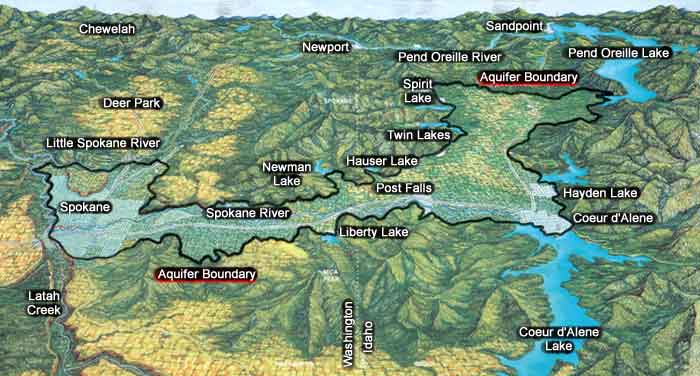
Northern Idaho is nicknamed the Idaho Panhandle.

It is 21,000+ square miles of spectacular, forested mountains, about a quarter of the land area of Idaho.  It includes 324 square miles covered by water, including many of America’s most scenic rivers and lakes.

Stretching between eight or nine of those lakes is the Rathdrum Prairie, part of a 370 square mile trench gouged out between the Selkirk and Bitterroot ranges and planed flat by a glacier.

About a dozen miles long and a dozen wide, it then elbows west across the border to Spokane, Washington.

But this Prairie, which discovered in the 1950s as the perfect place to grow grass seed, had been created 15,000 years ago by a series of floods after the 3,000 sq. mile Lake Missoula broke through an ice sheet dam sending a wall of water 2,000 feet high gushing down its length and beyond, clear to California.

The Cordilleran Ice Sheet, which held one and a half times what Antarctica does today or did until recently, also melted very fast leaving Northern Idaho’s spectacular, natural mountain lakes as remnants, 75 overall within 50 miles of Spokane.

I was reminded of that sweaty, dusty, round-the-clock work harvesting grass seed when I recently learned by trial and error that the ridgeline where I live a mile and a fourth from Downtown Durham, NC is apparently on the cusp of climate change.

Kentucky Bluegrass seed such I harvested is used to grow turf up in the mountains here.  But until recently, it has been fescue that ruled around Durham, including 10% of my city lot covered by four strips of lawn to slow runoff from my house and natural areas.

The battle lines for climate change apparently run between Durham and Raleigh, where the Piedmont falls away to the Coastal Plain, which has also been, until recently, a sort of demarcation line as well between “cool” and “warm” season grasses.

The year before last when heat and fungus overwhelmed my turf, I tried to jump ahead of the curve by replacing the fescue with what was touted as a cold tolerant Zoysia turf, as a few institutions and homeowners did.

Of course, grass is not always grown from seed even in North Carolina.  Tall fescue and Kentucky Bluegrass began and still are pasture grasses.

Back when I was a teenager, as the tall grass ripened,  big swathers, (aka windrowers) were used to cut the grass where it lay drying in the field for about a week or more.

Then several staggered combines ran down the rows without stopping while processing the seed into trucks.  Outgrowing teenagers, all of the equipment used today seems two or three times larger than back then.

Zoysia, which is primarily grown from plugs, is purely ornamental.

And as it seems the case with everything, there are now heritage or heirloom varieties of seed being grown.

But sod growers have a varied clientele.  In North Carolina, tall fescue sod is grown by 40% of sod growers compared to 25% who grow Kentucky Bluegrass.  Warm season grasses such as Bermuda and Zoysia are grown by 75% and 80% respectively.

Only 12.3% overall goes to homeowners while 63% goes to landscape contractors, 9% to golf courses, 7.6% to athletic fields and 4% to retail garden centers.

Lawns didn’t begin with the invention of the lawn mower.  They moved from pasture to homes in the 1500s during the Renaissance in France and England.

Both U.S. Presidents Washington and Jefferson had lawns.  They became fixtures around ranches and later farms for the same reason they had in Europe.

But it was the leisure activity of lawn bowling that had brought lawns to America by 1650.  By the 1850s, lawns were used to create meadows in urban parks, followed by golf courses by the 1870s.

The first lawnmower was invented in 1830 in England.  A reel mower was patented in the U.S. in 1868.  By 1890, they were a fixture of landscapes and by 1914 gasoline-powered mowers were available.

Even riding lawn mowers date to 1922.

But the lawn mower became truly mainstream in 1946 when soldiers returned from WWII and bought homes created for them in the suburbs.

That year, two years before I was born, 140,000 mowers were sold.  By the time I was three years old, 1.2 million mowers a year were sold in the U.S and lawns had become a fixture around farm and ranch houses as well.

By the time I turned ten in 1958, 4.2 million were sold annually, and using ours to cut neighbors lawns became one of my first part time jobs away from home.

Still, the majority of grass seed is for non-residential use.  There are nearly 50,000 square miles of lawn across America, about the equivalent of the entire state of North Carolina and more than irrigated crops such as corn and wheat.

When I worked part time to combine it in Idaho during the mid-1960s, grass seed was dry farmed.  Back then, as it had been since the 1950s, the stubble was burned after harvesting.

There are other ways to manage stubble including baling and selling it for feed but since 2007 but due, in part, to burning the number of Kentucky Bluegrass farms in Idaho has fallen by 55% and fescue growers by 40% as they have nationwide.

That practice came under increased scrutiny for air pollution until 2007 when as a result of a court case, the state of Idaho began to regulate burning of harvested grass fields except on tribal lands.

This involved permitting, burn management training and a $2 per acre fee to burn, as well as identification of no-burn days calibrated to atmospheric conditions especially near population centers such as Spokane.

Apparently Americans now spend $40 billion a year on lawn care.  However, NASA scientists believe that under conditions such as recycling grass clippings, lawns are a carbon sink, meaning they sequester harmful gases causing climate change.

But the real issue is water.  Over half (56) of North Carolina’s 100 counties are at risk for water shortages which nation-wide studies show will be aggravated by climate change.

Unlike Durham which began to invest heavily to build its own reservoirs in the late 1920s when the population was fewer than 50,000 people, less than 20% the size it is today, many counties waited for state and federal assistance, which dried up long ago.

In Idaho, which relies on melting snow, the percentage of counties at risk for water shortages is 64%, in part, due to overuse of the Snake River aquifer.  In other mountain states such as Utah it is 72%.

In Texas, it is 98%.  A quick calculation suggests there is a correlation between red states and water shortages.

But climate change, as it already has in North Carolina, is shifting growing zones north and west while creating drier, less arable micro-climates in some parts of the country.

This will also increase pest and noxious weed populations, all of which will create more pressure for burning as a crop management tool.  It will also lead to a return to dry farming rather than irrigation, resulting in more burning.

Dry farming is natural to one-third of the earth’s land surface.  Mormons heading west in 1847 learned it from Native Americans who had been practicing it in that region for hundreds of years.

At Fort Laramie, a stop on the trail, they also saw it being experimented with to grow wheat for provisioning along the Oregon-Mormon trail.  It is how we grew feed crops on our ancestral cattle and horse ranch west of the Henry’s Fork in the Yellowstone nook of Idaho.

Following a fifty year period when irrigation technology has depleted aquifers across the nation, 12 million acres of cultivation in the West has reverted to dry farming.

It was the technique that was used where I was harvesting grass seed forty-eight years ago even though Northern Idaho sits atop an aquifer, it has twice as much rainfall as Southern Idaho.

Look for dry farming to continue its comeback. 

Thursday, June 04, 2015

Relational Relativity

I recently learned that Orville and Wilbur Wright are my 7th cousins 4 times removed.  We share English ancestors in the early 1500s.

While I am name dropping, I am also a 5th cousin 5 times removed to Henry David Thoreau with whom I share my 9th great grandmother who immigrated to America in 1638.

Neither connection is probably all that uncommon.  Statisticians and geneticists have determined that everyone in the world traces back to a common set of ancestors about 3,000 years ago.

For anyone of European decent, those ancestors in common only go back about a thousand years.

When I was recruited to Durham, North Carolina 26 years ago, I believed I was the first in my family to settle here.

Then slowly I began to uncover that by the 1700s at least six ancestors created settlements within 150 miles of what would become Durham, six within a 60 mile radius and four as Tar Heels, before all migrating west and eventually into my native Rockies.

My cross-country move was, in fact, a reverse migration and homecoming 200 years later.

Now I learn that I am related to the brothers who put North Carolina on the map as “First In Flight,” 86 years before my arrival.

Both the Wrights and Thoreau are related to me through my relatives who created the first permanent settlement in what is now Idaho and from whom I draw my 5th generation Idaho roots.

It is probably more coincidence than genetic expression that I share traits such as innovator and naturalist.

Reading about them, including the phenomenal new biography by David McCullough entitled The Wright Brothers, reminded me that while my paternal grandfather had only a 2nd grade education, it was not unusual for his time.

He was a natural innovator.

My three other grandparents, one with an 8th grade education and the other two having graduated from high school were far above the national average for their time.

Even by the time my dad graduated from high school in 1941, only 23% of Americans had a completed a high school or higher level of education.

Around 1840, there were 100 colleges in America when Thoreau and one of my great-great grandfathers earned degrees.

But Americans at the time averaged just less than a year of schooling, with southern states a third or less of that.

Those who were enslaved were banned from learning to read and it was rare for even Presidents of the United States to have attended college.

By 1845 when Thoreau was building a small home on Walden Pond, nearly all of my ancestors had gathered on the Mississippi, and within a few months began a 2,000 mile exodus across the Great Plains and into the Rockies to make a homeland.

They were conservationists and innovators by temperament and necessity who enthusiastically embraced the “commons.”

During his two year observations around Walden Pond, it is Thoreau who may have been the first urban forester.  He wrote during his two year experiment living there that:

“Each town should have a park, or rather a primitive forest, of 500 or a thousand acres, where a stick should never be cut for fuel, a common possession forever, for instruction and education.”

Thoreau’s writings inspired Fredrick Law Olmsted, who put them into practice a few years later with New York Central Park and later the Biltmore Estate in North Carolina.

It is also Thoreau, rather than my later ancestors whom I most emulate when it comes to finding God and spirituality in nature.

Even by the era of the Wright brothers, whose father had taken some courses and whose sister had graduated from Oberlin, it was still extremely rare for Americans to graduate from college.

By 1910, only 2.7% held a Bachelor’s degree or higher.  By the time I was born nearly four decades later, it was 6.2% and by the time I earned a Bachelor’s, 11% of Americans over the age of 25 held a college degree.

Today, slightly fewer than 1-in-3 Americans have a college degree or higher but over 88% now have a high school education or higher.

Knowing these things gives me perspective and context for embracing how small the world is and how the past holds solutions to any present or future problems.

It is also humbling.  The next time I see you, I’ll remember that we’re related, Y’all.

Monday, May 18, 2015

The Origin of All Too Rare Sensibilities

You could fit nearly 182 Durham’s in the land area of North Carolina.  In land area, it is the smallest urban county in the state, yet home to the fourth largest city.

So it is surprising to visitors that there are 232 working farms here, many supplying meats, dairy and vegetables to Durham’s nationally-recognized foodie scene.                                  

This may not seem like many given that North Carolina is still a largely rural state with 50,218 farms and livestock operations according to a census regularly conducted by the US Department of Agriculture.

Throughout the four-county metro area centered around Durham, there are about 2,410 farms and livestock operations, nearly half in Chatham County.

Unlike Durham, its metro counterparts have not set aside a third of their land area in watershed and areas where working farms are safeguarded.

This area is an important part of Durham’s sense of place, which in any place where it is still preserved and fostered, always includes not only “built” and “cultural” place-based assets but “natural” as well.

Durham “farms” include 46 livestock operations raising nearly 1,000 head of beef cattle.  The ancestral ranch where I was born and spent my early years in the 1950s in the shadow of the Tetons along the Henry’s Fork raised about that same number of cattle.

In that Fremont County nook, ours was not a large operation but still more than twice the size of the average farm or ranch there today and 8 times the median for operations there.

There are still 181 ranches there growing more than 9,000 head of cattle.  But many operations have turned to farming instead using the pivot irrigation common in northeastern North Carolina now.

As an adult, I spent four-decades in a field tasked as the guardian for sense of place in three different parts of the country, including Durham, but I trace my sensibilities for that work back to our ranch.

I was reminded a month ago of a time when my daughter helped bring this into focus for me when I read of the passing of Ivan Doig a month ago.

Doig was a native Montanan who was born about two hours north across the Centennials and nine years earlier from my roots in the Teton-Yellowstone nook of Idaho.

After earning degrees at Northwestern and the University of Washington (PhD.), he worked for The Rotarian, a magazine, which is where I first read his byline.

My daughter’s Dad #2 passed Doig’s memoir, This House of Sky: Landscapes of a Western Mind to her and she, in turn, passed it to me knowing how closely it paralleled some of my early influences on the ranch.

It had been written in 1978 when she was five but I was half way through my career when she passed it on to me. It was when I was going on a decade past when I became one of the first in my field to incorporate sense of place as a foundational strategy.

But it wasn’t until I read This House of Sky that I realized how early my sensibilities for sense of place had been shaped.

I have the DNA of five generations of Idaho cowboys and horsemen.

But Doig grew up a sheepherder, along the Rocky Mountain Front, just south of the Blackfeet Indian Reservation, an area I’ve crossed while crisscrossing the country with Mugs and which I wrote about a few months ago.

We both shared the 1950s under the big sky of the Mountain States before migrating to urban surroundings.  But one of the reasons Doig’s memoir resonates is that it more accurately portrays the reality behind what has become the cowboy mythology of the West.

It is tempting to think of This House of Sky as a true-story Lonesome Dove, written a few years later by Larry McMurtry, a contemporary of Doig’s who can also capture landscape, but in my opinion House is far more nuanced and relatable.

I still dust off the copy my daughter gave me and read it for inspiration.  It is also a reminder that there may be no greater gift than a child who, while it is foreign to her own background, truly grasps the essence of a parent’s.

As I conclude this essay, my finger fell on a quote from House, “Memory, the near neighborhood of dream, is almost casual in its hospitality.”

And so it seems with sense of place.

Thursday, April 16, 2015

Idaho’s “Red Dirt” Inspirations

I was reminded while streaming the movie Soda Springs, just how much Oklahoma meant to me growing up where the Middle and Northern Rockies of Idaho intersect.

For a few years, KOMA 1520 was the only way kids like me who were coming of age between the late 1950s and 1960s in the Mountain region of the west could hear the Beatles, the Rolling Stones and Wolfman Jack.

Atmospheric conditions late at night made the Oklahoma City station seem like the center of our cultural universe.

But the movie reminded me of an even stronger connection between Idaho and the part of Oklahoma around Stillwater, which is the center of “Red Dirt,” a genre of Country rock where indie rock and alt-country intersect into Americana.

Many people think “Red Dirt” emerged in the 1990s but for me it is the sound heard on the bootleg Basement Tape cut in early 1967 by Bob Dylan and what became the group The Band.

Long before they were officially released, Wolfman made many of the songs hits such as I Shall Be Released and Quinn the Eskimo.  You can also hear its influence on music Dylan recorded a few years later with Leon Russell.

Red Dirt music transcends geography.

Today you can hear its influence on Garth Brooks and Miranda Lambert.  The movie Soda Springs reminded me of an Idaho connection to the stars who have remained true to the genre such as Mickey and the Motorcars and Reckless Kelly.

The ancestral ranch where I was born rests where the Bitterroots and Tetons meet along the 5,259 foot Yellowstone Highlands.

A six day ride by horseback from the back of the ranch west of Ashton takes you down across sagebrush valleys and back up to Challis at 5,253 feet in the drier mountains of central Idaho.

About the same population of around 1,000, Ashton and Challis, until recently were also rivals in sports until put in different divisions.

Challis has spawned two of the top Red Dirt bands founded by brothers in the Braun family who are now Austin-based.  They come home to Challis and Idaho each year for a Red Dirt music festival in August that I hope to catch one year on my way to an annual lakeside rendezvous.

The movie features two of my Red Dirt favorites Rock Springs to Cheyenne and Carolina Morning, both of which prominently feature mentions of Idaho, one written by an Idaho native and the other by a transplant and both performed by a band formed in Idaho.

The former was written in 1982 by Kip Attaway based on his seminal trip to Idaho in the “winter of ‘72,” at a time when a few months from graduating at BYU, I was experiencing my own bad stretch.

The latter was written in 1988 by Idaho rancher-songwriter Pinto Bennett but I enjoy the versions performed by the current day Red Dirt band Mickey and the Motorcars.

They predate the song Idaho written in 2006 by Americana artist Josh Ritter.  All three songs emote the Country Rock sound of the early 1970s pioneered by Gram Parsons and Emmylou Harris and made famous by the Byrds, Linda Ronstadt, Jackson Browne and the Eagles.

Soda Springs the movie, like Red Dirt country, is unpretentious like the state it depicts.  It is an hours drive north of where my fifth generation Idaho roots first took hold before it was a territory, long before it was a state.

My maternal grandparents lived in and around Soda from the time I was born until I was in high school.  The mountains are softer there than in my native nook but have their own story to tell.

It is a simple story set in Idaho, unmistakably filmed in Idaho, written and produced and sound-tracked by Idahoans who, like me see it far more for its mountains, rivers, lakes and range land than the corner where world famous potatoes grow.

For anyone unable to discern distinctions, you may find the first few lines of Red Dirt pioneer Tom Skinner’s song Nickels Worth of Difference useful solace.

For anyone needing a country genre scorecard, click here.

If you’ve Never Been Out West or to Idaho, it is true “the mountains touch the sky.” But its subtleties are best experiences on horseback.

Tuesday, March 03, 2015

Our Hubris As Relative Newcomers

It always seems a bit odd to hear some Americans berate immigrants who are struggling to learn English as a second language.

After all, English isn’t the first language of Americans.

As the grandfather of two 8th generation westerners and 18th generation Americans, I found a chart on page 5 of the current issue of High Country News fascinating.

It maps 60 American languages that long preceded English and are still in use in the contiguous West along with the number of speakers remaining for each.

Three of my great-great grandparents learned two or more of these languages enough to be interpreters including Shoshone, Northern and Southern Paiute, Navaho, Zuni and Hopi.

The latter three are still fairly widely spoken but the number speaking Shoshone has dipped near 2,500 and there are only 12 people remaining who speak Northern Paiute.

There are only 20 people remain who speak Spokane, the language of the Indian nation for whom the city along the Northern Rockies is named.

This is also where I started my now concluded career in community destination marketing and where my only child was born.

There are only 174 who speak Coeur d’Alene, the nation for whom the famous lake in the north of my native Idaho is named more than four decades ago.

The article by journalist Jeremy Miller that accompanies the chart in High Country News notes that one of the world’s 7,000 distinct languages vanishes every 14 days, meaning “between half and 90 percent” will disappear by the end of this century.

“Of the 176 known languages once spoken in the U.S., 52 are thought to be dormant or extinct.”

A January article in National Geographic provided updated archeological and genome research on The First American that reminds us that even those of us who go back 16 generations here are relatively new arrivals.

The first Americans crossed over into what is now Alaska 15,500 years ago.  Genetically, they were two-thirds East Asian and one-third Eurasian.  There, their DNA mutated into unique markers found today in Native Americans but not Asians.

Deglaciation permitted these first Americans to migrate over the next two thousand years into what is now the continental United States and clear to the tip of South America.

To put this time period in perspective, though, fossils show that the pine trees they passed were 130 million years old.  Pines are the ecologically the most important trees in the world making human inhabitation of northern climates bearable.

Spear points found southeast of Salmon just below the ridgeline of the Continental Divide in my native Idaho date the earliest humans in that state to 11,000 years ago.

My ancestors who are credited with helping to establish the first permanent settlement in that state and served as interpreters with Shoshone Native Americans were under no illusion that they were first.

They accepted as Christian scripture, along with the the Bible, The Book of Mormon which chronicles the writings of ancient prophets on this continent beginning more than 4,000 years ago.

Maybe we should all just lighten up on those learning English.

Monday, March 02, 2015

The Native Home of Hope

Authenticity is not a fad when it comes to sense of place,  but use - or should I say misuse – of the word has become one.

This will pass, and when it does the attributes of authenticity of place will remain by definition nearly temporal.

My personal story begins as the only son of an only son, born at the tail end of five generations of Rocky Mountain ranchers who gradually migrated during the hundred years before I was born from the Central to the Northern Rockies.

Our ancestral ranch is where I learned sense of place, e.g. the smell of sage brush, new mown hay, and rain on a dirt road, as well as the sound of a Meadowlark and the colors of Yellowstone Cutthroat in the Henry’s Fork.

But it is also where I first learned about myths: including myths about rugged individualists, the cowboy errant Knight and other stereotypes of the West that I see fleeting across the eyes of people who want to hear my story.

I didn’t read Wallace Stegner until I came across his incredible essay in my early 30s entitled, Sense of Place.  This is where he coined that term and I still recommend to anyone seeking an understanding of authenticity.

It was my daughter, then in her third year of college, who brought me to Stegner in more depth.  Having heard my story, she knew that the breadth and depth of his writings would resonate.  It is such a gift to be understood.

One of my favorites is a book of essays written over a span that covered my first two decades entitled, The Sound of Mountain Water.  The first was published the year before I was born, the last in the collection as I turned 21.

The namesake essay in the book is a lyrical description about my native Yellowstone-Teton nook of Idaho and its famed Henry’s Fork including this resonate memoir from his first visit there in 1920:

“I gave my heart to the mountains the minute I stood beside this river…”

It is a myth though that the west was settled by rugged individualists.

While that characteristic was prevalent, in several of his books, Stegner supports, as he does in one of the essays in The Sound of Mountain Water, that “cooperation, not rugged individualism, is the quality that most characterizes and preserves” the American West.

When all but two lines of my ancestors crossed the Rockies, to be followed by the remaining two within a decade, there were fewer than 90,000 people inhabiting 750,000 square miles (twice the area of Western Europe.)

There were fewer than 70,000 along the Rockies, nearly all living in what are now New Mexico and Arizona.

Even after the Gold Rush and the arrival of 11,000 Mormons by 1850, the entire West when my ancestors settled there was less than 1% of the US population at the time.

Ranches required an average of four square miles or 2,500 acres, so to avoid isolation and provide safety and shared resources, much of the West was settled on what is called a “village and square model.”

It’s also why early jurisdictions for governance there relied more on river basins and watersheds for boundaries.

Predominately, during the fifty years prior to 1890 as the West was won ranchers lived in settlements near craftsmen, artisans, granaries and supply depots and commuted out to their land and livestock.

Sometimes historians also refer to this as a “village-farm system.”

Much of what is depicted in novels and movies about the West as well as that depicted by many of those who profess to be westerners today is synthetic.

Pure and simple, the West evolved to what it is today through a sense of commons that revolutionized the sense of land and water ownership.

The myth of rugged self-reliance became evident during the 1930’s Great Depression.

Groups such as Mormon leaders felt their recently evolved welfare program would be sufficient and pressed by partisans expressed that somehow the new federal program which emulated it would create sloth and dependency.

But the Mountain states where Mormons were then centered became the largest per capita users of the federal aid program.  Mormon leaders marveled at the public works projects completed by those receiving it as a condition.

Given their history, they shouldn’t have been at all surprised.

Apparently, they had forgotten that it is trust that led to economic development of the West, just as a new study has found in a study of survivors of Atomic bombs that trust enabled them to rebuild from that trauma.

Today, a small group of regressives in the West are pushing to let special interests get their hands on public lands for mining and drilling, backed quietly by Wall Street interests who have over the decades, raped the West in similar fashion.

They are dismissing economic analysis, which I have written about previously, showing that rural counties adjacent to public lands have outperformed others and that counties where resource exploitation occurs ultimately fall much lower.

But it was not the various gold, silver and copper strikes in the early west that provided sustainable growth.

It was grass.

In part, it was this unique, resilient, drought tolerant wild grass that led my ancestors who had settled in 1860 along each side of the Utah-Idaho border to relocate to the northern extreme of the Upper Snake River plain to create new homesteads along the Henry’s Fork.

Famously framed by the Continental Divide, Yellowstone and the Tetons, this area of my origin is the culmination of a hundred mile stretch that is no more than 70 miles wide at its widest narrowing to 20 or 30 miles where I was born.

The sides of this valley range to 10,000’ framed by the Lost River and Lemhi ranges stretching down from the Sawtooths and on the east by the Caribou, Snake River and Teton ranges.

My ancestors were following an old stagecoach supply route between Utah and the mines in Montana which, beginning in the late 1870s, was becoming the path of a slowly emerging railroad eventually to supply tourists to Yellowstone.

But above where the Henry’s Fork joined the South Fork to form the Snake River, settlers such as my ancestors were surprised to find the landscape covered not by sage brush, but waist high, wild bluegrass from the river to the Tetons and north to forests of the Centennial range.

The area had already been transited by trappers and then a cattle company but it was still available to homestead.  But they still followed the modified “village-farm and ranch” model adapted from when their parents cross the Rockies in the mid-1840s.

My ancestors found that the western side of the Henry’s Fork was even better adapted to ranching.  They had modified the village-ranch model but settled this new area as they had others in the West through cooperation.

Together, they marked off land, built bridges and roads, created reservoirs and irrigation canals, established granaries for the poor, created cemeteries and erected school houses.

Tough, independent and self-reliant – certainly – but with an even greater commitment to cooperation, the commons, public education and the welfare of those less fortunate.

By the time I was born in 1948, a hundred years after ancestors began settling the Rocky Mountain west,  rich potato farms had replaced the bluegrass in our nook of Idaho, as they have the ranchland on the west side now thanks to pivot irrigation systems.

The West is always changing.  Although I haven’t lived there since the 1970s, I travel along the Rockies each summer on road trips with my grandsons and daughter. 

Much more dramatic than the subtle land use changes since my youth are the demographic and psychographic changes.  Much of Idaho has been inhabited by in migration that seemingly seeks to replace the real Idaho by making it a refuge for the synthetic West.

I don’t mean the Aryan Nation which was expelled fifteen years ago.  Places in Idaho are exurbs such as Coeur d’Alene.  While whites represent only 8% of the population growth in the past decade, they represent 73% of the flight to exurbs.

Most seem to be chasing myths created when misinformation is re-harmonized to fit worldview.

It is complicated but emblematic.  The best way to understand why my homeland now seems foreign, click to watch an episode of the phenomenal PBS America By The Numbers program entitled Our Private Idaho.

As a fellow North Carolinian once wrote, “You Can Never Go Home Again,” and that is sad.  But the West will keep changing.

But as Stegner wrote, the West is also “the native home of Hope.”  My hope is that it will once again claim its authentic roots.

Wednesday, January 21, 2015

Prosperity Linked to Proximity to Protected Lands

News headlines about my native Intermountain West always seem limited to a few angry white extremists with guns or elected officials pandering to campaign contributors eager to exploit its natural resources.

Rarely, by the time news gets back to Durham, North Carolina where I live, does it provide more nuanced coverage of this complicated region including news of studies that run counter to those narratives.

Studies I’ve been reading, including one that analyzes the 284 non-metro counties in the west as a whole where there are substantial amounts of protected federal lands, are fascinating.

One study zeroed in on those with lands protected for conservation and analyzes non-metro, county-level economic performance in these places from the present to, in some cases, back as far as the 1970s.  Others analyze the performance of a all 413 counties in the 11 contiguous western states.

The current wave of anti-regulation rhetoric dates not to the 1960s regulations to protect water, air and the food supply or when the EPA was created as many assume or the anti-government rhetoric used by the Reagan administration but not shared by the American public in the 1980s.

The anti-regulation chant of today has its roots in 1947, when partisan post-WWII Republicans resumed the drumbeat of how regulations are a burden regulations are on business, while dismissing that without them an even greater burden is shouldered by individual Americans.

I was born and spent my early years during this period in a million acre- Idaho county wedged into that nook between Montana and Wyoming.  Only 31% of the land area was in private hands such as our ancestral ranch just west of the Henry’s Fork.

More than 58% of Fremont County is under federal protection on behalf of all Americans including a portion of Yellowstone National Park and the Targhee National Forest.

To put this in perspective, the amount of federal lands in my native Fremont County, Idaho is 3.6 times the land area of Durham County, North Carolina where I live but with only 3% of the population.

Only 67,642 acres of the more than of Fremont County is protected for conservation purposes and relevant to the study of all 284 non-metro counties in the west with such lands.

The studies were done by the independent, non-profit, non-partisan Headwaters Economics based in Bozeman, Montana, up and over the Continental Divide and 150 miles north of our ranch where my parents eloped as my dad headed off to WWII.

The study was conducted to determine if these projected lands were associated with decreased or increased economic performance.  The numbers show that performance is higher for every 10,000 acres of protected federal land a county has.

It turns out that the economic performance in non-metro western counties with protected federal lands is as much as 345% on average compared in some areas compared to 83% for non-metro lands in the west with no protected federal land.

Between my junior and senior years of high school, I read A Wilderness Bill of Rights by Supreme Court Justice William O. Douglas, who grew up along the eastern slopes of the Cascade Mountains in Washington State.

Appointed when he was just 40 years of age, his time on the highest court spanned from when my dad was in high school until my law school days.

His words transformed my spiritual and restorative feelings about nature into an entitlement for all Americans, as important as freedoms of speech and religion.

It had a profound impact.

Five years after Douglas retired from the high court, as President Ronald Reagan was elected, the news media, made the mistaken assumption that his popularity meant that his anti-government rhetoric must be widely shared, amplifying partisan news releases.

But both the news media and publicists were mistaken.  Polls following the election showed that only 21% of Americans shared that notion, about the same percentage as in 1976, possibly contributing to approval ratings for Reagan that several years later dipped into the 30% range.

It is the same today.  Americans don’t share anti-regulation rhetoric when the consequences become clear even though the term regulation has been sequestered and demonized my entire lifetime .

Campaign strategists then and now were brilliant, seeking not to sway public opinion but to make certain words radioactive such as environmentalist, federal government and taxes, creating a political correctness that distorted the self-perception of Americans.

It still gridlocks us today.

I much prefer to look at analysis of the actual numbers, not because they will change anyone’s mind but because they provide relief.

Oh, and by the way, studies show that non-rural counties in the west that are exploited for natural resources, actually in the long term suffer economically.

Just sayin’.  Too bad facts don’t have lobbyists.

Monday, December 29, 2014

A List of Names Never Forgotten

I wonder, “For how many decades can useful DNA cling to an old horseshoe?”

In the early 1970s, when she sold the house my grandfather had relocated from a parcel that they had assembled as part of our ancestral ranch down, she had one last thing to do before living in shifts with her four children.

The old house had originally belonged to my great-grandparents.  Moving it down to Main and Third in Saint Anthony, Idaho and fitting it above a new basement probably cost more than a new house but it had been where my great-grandmother died during the Great Influenza.

As she packed possessions to move, my Grandmother Adah made sure a heavy box of artifacts was shipped to me where I was just completing college.

In the box were pairs of horseshoes that had been worn by favorite horses trained and bred by my great grandfather and grandfather.  Each had been mounted on a beam in the basement etched with the names of the horses, Darby, Baby Queen, Bill, Thousand Springs and Senator Dubois.

Unfortunately, my grandmother didn’t keep them in any order, nor did she write down the names,  but they were made indelible in my memory from hearing and seeing my grandfather use them to tell the story of the long line of horsemen and horsewomen from which we are descended.

I remember when I was age 8 or so, helping grandpa add a pair while he held me up to print the name Dolly above them, the name of one of the five draft horses he had kept on the ranch after turning it over to my parents to operate after dad returned from WWII.

Not all of the horses named along the beam were work horses such as Gypsy had been, a pure black hand me down quarter horse, given to me as my first horse when I was age five.

Some were used for breeding quarter horses and/or raced and paraded as thoroughbreds at surrounding community celebrations.

The fame of some of those horses extended beyond their mythical esteem in my eyes.  Darby had been ridden in the parade in Salt Lake City for Theodore Roosevelt and his Roughriders.

Queen was trained by my great grandfather and given to my grandfather as a boy.   Bill was the first horse my grandfather trained and raced in community celebrations and rodeos.  Bill ran a quarter mile in 24 seconds once.

My great grandfather bought Senator Dubois as a retired racehorse.  Even at 20 years old, Senator turned in a quarter mile in 22.5 seconds when ridden by my grandfather in one of the early War Bonnet Roundups down in Idaho Falls.

Winning the 3/8ths mile event, it was the last for both of them.  Newly married, my grandmother, who would work right alongside my grandfather while training horses as well as mules, felt it was too dangerous.

Or to hear his version, at age 25, he was getting too heavy to race.

The War Bonnet started in 1911, and they were married in 1914, to give an idea of the timeframe.

One of my great grandfather’s contemporaries was the real Senator Fred Thomas Dubois (pronounced in Idaho and Wyoming with heavy emphasis on DEW followed by a quick tailing boys,) rather than the way his French Canadian parents had intended.

There is a tiny town named for him about 50 miles west of our ranch and another about 160 miles east in Wyoming. I suspect they were named for him because he broke with his party to support conservation and not because he did everything possible to disenfranchise Mormons prior to statehood.

Dubois first came to Idaho as the US Marshall for the territory about three decades after my ancestors settled along the Rockies.  At the time he was first appointed Senator of the territory, Mormons began settling up in the furthest nook of the Upper Snake.

He was not reappointed after his second term and left Idaho for good about the time our ancestral ranch was forged a mile west of the Henry’s Fork River, the closest you can be to Montana and Wyoming and still be in Idaho.

I suspect the irony was not lost on tiny Mormon settlements along the Tetons as my great grandfather and grandfather rode Senator Dubois at celebrations and in parades.

I doubt that being able to see the names along the beam in that 1915 house, which is still in use at 3rd and Main, would not help me specifically tie the shoes back to their owners.

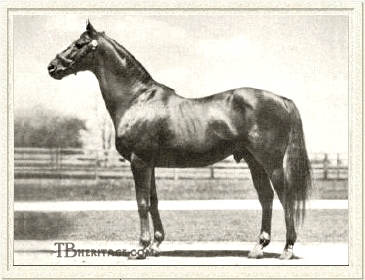
But one set could probably be identified by DNA as belonging Thousand Springs.  He was a grandson of Man o’ War (shown in the image in this post,) arguably the greatest horse to ever race.

When he was 30 years old, Man o’ War died of heart failure seven months before I was born in mid-1948 but more than fifty years later, horsemen in a poll still ranked him America’s “Horse of the Century.”

In the era between WWI and the 1930s, horseracing, along with track and field, were the most popular sports in America; the NFL, NBA and MLB of that period.  In the wake of WWI, Man ‘ War inspired the entire nation.

I never knew his grandson Thousand Springs and my family’s tie to the great horse.  My grandfather felt he was a bit temperamental and mean,  but he is still legend enough in that Teton-Yellowstone nook of Idaho to be mentioned in books alongside my great grandfather who died in late 1936.

Thousand Springs is a cousin to Seabiscuit, made famous in the early 2000s in a book, documentary and movie including a memorable Randy Newman soundtrack.  Seabiscuit inspired Americans during the Great Depression as his grandfather had done after WWI.

With a two car garage in place of my grandmother’s famous flower garden, the Saint Anthony house is still there at 249 W. Main Street a block equitant from the Catholic Church and the Henry’s Fork.

So I suspect I could track down the current owners and learn if there are any names etched on that beam that I may have forgotten.

At age 31, Gypsy, horse I inherited as a hand-me-down from my father when I was five years old, died not long after I left for college.

Grandpa had passed away two years before and I never had the heart to check during visits home with grandma to see if a pair of Gypsy’s shoes were up on that beam.

I suspect not, although my Bowman side was pretty stoic except when it came to horses.   Whenever that big black cross between a Belgian draft horse and possibly one of those thoroughbreds crosses my mind so does her scent when I would blow into her nostrils as a sign of affection.

When she moved out of her house in the early 1970s and began rotating her time with each of her four children including my dad, her youngest and only son, Grandma Adah made certain a set of artifacts made its way to me at college.

They were pairs of horseshoes my grandfather had nailed to a beam in the basement of their home in St. Anthony, Idaho and that he used as I was coming up to repeatedly tell me the story behind each pair and about the long line of horsemen from which I descended.

They are priceless even without the specifics because they were the means by which my grandfather would tell me our family’s story, the same reason they are so pivotal to history museums.

One set belonged to Thousand Springs, a grandson of Man o’ War, arguable the greatest thoroughbred racehorse of all time and familiar to fans of books, movies, musicals and documentaries as the grandfather of a cousin, Seabiscuit.

At the age of 30, Man o’ War died of heart failure, seven months before I was born in mid-1948 a few years after horseracing slipped in decline except for the Triple Crown.

But more than five decades later, a poll that included horsemen declared him the American race “horse of the century.”

I descend from a long line of horsemen but even as the only son of an only son and the end of that line in both talent and name.

Already my eye had been caught by the cool 1950s cars St. Anthony Motors would then showcase right on the street where we turned off the old Yellowstone Highway for the two blocks to Grandpa and Grandma’s house, by backing them in at an angle.

That heritage today is carried on in the Pacific Northwest by my niece Megan, a stalwart at REI, who learned her lifelong love for horses when very young while going to the racetrack with her grandpa.

I can bet they spent most of their time in the stables and saddling paddock where accompanies by escort ponies, horses and riders warm up before a race.

Monday, December 08, 2014

A Backdoor Influence on Sensibilities

When they learn that I grew up just outside of Yellowstone Park in the Idaho shadows of the Tetons, people usually ask me when the best time is to visit.

Views of those icons were readily available literally from the front yard because our ranch house, a log home built by my grandfather’s brother, faces that direction,

They mesmerized me each morning as I waited out by the mail box for the school bus.

But early influences on my appreciation of sense of place were just as likely to be to the west of the ranch which had a strikingly different landscape.  But before I get to that, let me respond with two answers to that question about the best time to visit Yellowstone.

My top-of-mind answer about the best time to visit is “fall” which was my favorite season to go there growing up.  But possibly the very best time of year to see wildlife now such as moose, bear, buffalo, elk and wolves, is in the winter.

Until 1948, the year I was born, there had been only a few snowshoe tourists in Yellowstone.  But that year the first snow planes entered the park.  Our neighbor and father of one of my schoolmates had one similar to the one shown in this video.

By the time I was in second grade, visitors toured Yellowstone in the winter aboard Bombardier R12s, mini-buses with skis (instead of tires) in front and tracks in back. 

Very cool and yes, this is the very same company that makes very cool business, and commercial jets and high-speed trains.

It took root back in the 1930s when 15-year-old J.A. Bombardier began invention of these vehicles in the years before snowplowing of rural roads was mandated in his native Quebec, Canada.

I was that age before the first snowmobiles entered the park which soon became a problem that has led to limitations, in part, to preserve tourism quality for all concerned.

Snowcoaches today are much quieter and far more comfortable but not far removed from those old R12s.

My earliest roots in Idaho go back to 1860 and creation of the first permanent settlement there.  This was more than a decade before Yellowstone Park was created and before Idaho was even a territory.

How we came to be located much further north in that nook of Idaho even traces to that period, when one of my great-great grandfathers was a “freighter” to the gold fields in Montana, meaning he drove a stage coach designed to carry supplies up that 250 mile route.

But that is for another post.  Lets just say I am as Idaho as it gets.

Many of my sense of place influences there were also formed when I ventured west out the back of that ranch house during unstructured exploration and play time on old buggies, a deserted Power-Wagon and in abandoned ancestral houses including treasure-filled landfills.

I was also drawn further along a nearly hundred mile stretch to the west beyond the hills and meadows of our rangeland, through a landscape that was much more subtle but just as dramatic as the much closer Tetons and Yellowstone were to the east.

The ranch lies along the cusp of a sagebrush steppe west of the Tetons.  Eight miles west just and beyond our rangeland was the northern reach of a towering range of sand dunes that stretched southwest parallel to the Henry’s Fork River, past St. Anthony where my grandparents lived to the Egin Bench.

By towering, I mean that some of the dunes reach 250+ feet.  They are a mini-Sahara.  There was even a resort and swimming pool at the time but I think they got buried as the sand dunes migrated up against a series of mini-volcanoes called the Juniper Buttes.

Between the ranch and those dunes is the refuge for Elk I have written about.  They winter there before migrating past the ranch and back into a remote Idaho corner of Yellowstone to summer.

On the other side of the dunes lies the Camas National Wildlife Refuge, created in 1937 as a resting place for 50,000 migratory ducks and 3,000 geese.

Basalt columns underlie this entire region.  Our ancestral ranch lies at the intersection of where the Northern Rockies and the Teton Range of the Central Rockies meet.

The steppes slope gently down before rising in elevation past the refuge to meet other fingers of the Northern Rockies stretching southeast out into Snake River Plain.

One of those fingers is the Lost River Range, about a hundred miles west of the ranch and midway to one up between Stanley and Challis, owned until recently by singer-songwriter Carole King.

Two namesake rivers, the Big Lost River and the Little Lost River run down each side of this range, which contains the highest peaks in Idaho.

They are named “lost” because they abruptly disappear into a “sink,” recharging the vast Snake River Aquifer, a giant underground river.  Opposite 12,668 ft Borah Peak on the east side of this “sink” is a pre-historic archeological site called Wasden.

Here, when I was beginning my senior in high school just 29 miles east and more interested in music such as Satisfaction, Help and California Dreamin , Idaho archeologists uncovered thousands of prehistoric artifacts in caves created by collapsed lava tubes.

All I knew is that we had a record early snowfall that September but scientists now date the finds at the Wasden caves as between 10,000 and 12,000 years B.P. (before the present.)

Sixty miles southwest of the caves along American Falls Reservoir, archeologists from ISU just uncovered the skeleton of a 70,000-year-old Mammoth.

Just to the southwest of that “sink” along the mountains and stretching down to just above the reservoir, for nearly 15,000 years, there have been eight eruptive periods or lava flows that lasted anywhere from a few years to a few hundred years and spaced between by 2,000 years of calm.

This area lies along an alternative route that wagons along the Oregon Trail took called Goodale’s Cutoff beginning a few years after my Idaho roots were first established and almost two decades after my ancestors settled west along the Rockies.

Wagon trains didn’t end with the completion of the first transcontinental railroad in 1869.  They continued along that route until 1900 when they finally gave way to the motor vehicle era.

In 1926, Republican President Calvin Coolidge set this eerie tract of eruption aside as the Craters of the Moon National Monument and Preserve.  In preparation for landing on the moon, Apollo astronauts visited the area in 1969 to study its mosaic of flows, splatter cones, craters, monoliths and other Moon-like geologic features.

It wasn’t the first time the area would be used for research.  The area immediately northwest of the monument had been used during WWII as a proving ground by the Navy to sight-in battleship guns and by the Army for testing munitions and for bombing practice.

Then after the war, it was chosen as a site for research on the first atomic submarine including a prototype for the USS Nautilus.  This is also where crews for atomic subs were sent for training until the mid-1990s.  Yup, in Idaho.

In fact, that isn’t the full extent of land-locked Idaho’s naval prowess.

Further north in the Idaho Rockies, the Navy also had a training station for other ships during WWII at Farragut on Lake Pend Oreille.

By then a state park, the year I started my community marketing career in Spokane and my only child was born, Farragut was the site of the 1973 National Boy Scout jamboree.

But even today, at a more remote part of that huge lake, the Navy tests acoustics down 1,000 feet or more using huge scale models of submarines.  Yup, in Idaho.

Sorry to get sidetracked onto research but you can see what I mean when I say that the influence my native state has on my appreciation for sense of places, goes far beyond its spectacular rivers, mountains, lakes and parks.

So anytime you cut through that part of Idaho on I-15 running north-south between Idaho Falls and Dillon, midway between the Teton and the Lost River ranges, if you find yourself complaining that it just seems like miles and miles of sage brush, take a detour for a closer look.

Friday, November 14, 2014

Rootedness

It took me a while to remember why his name was familiar when a new friend my daughter’s age reached out recently to have coffee.

It wasn’t because he is the accomplished lead singer for the highly regarded group The Old Ceremony, although that should have been enough.  I often start writing each morning to the group’s song Wither on the Vine, Pt. 2.

I remember now when I first saw his name, not on a CD cover, but tucked into a remarkable photo essay about Durham that he authored for Design Sponge which I quickly forwarded to my community marketing team a few months before I retired from that field five years ago.

It makes sense that Django Haskins and I share a sense of rootedness and a passion for sense of place,  particularly in Durham.

As activities go, researchers cite music as a form of fantasy but for me at least it is at its most appealing when it reflects authenticity.

This explains my preference for the “roots” genre as we call it today and why even what researches find is the least authentic of the performing arts, touring Broadway musicals, that Once resonated so much more than others when I saw it on tour.

Authenticity is not only a spectrum, but there is even a spectrum  within activities that fall on the least authentic end.

But during incessant performance touring, a form of “extreme” tourism, Haskins began to pick up on what gave those rare places a “there” there, a “realness,” unlike the majority of others places where it was impossible to tell where you are.

A few years ago, my daughter and only offspring surprised me when she suggested we travel up through Stanley, Idaho, a remote area high in the mountains of my native state, on our annual pilgrimage to a family lake-side rendezvous in the Northern Rockies.

As she and my grandsons lay sleeping a few doors down, I arose early and was driving west looking for coffee.  Stanley is more than 6200’ above sea level and even in August the early morning temperature was barely 40 degrees.

The town’s population of around 60 had swelled just before our arrival with nearly 500 Forest Service firefighters working in shifts to battle the Halstead blaze lighting the pre-dawn sky over the ridge behind Stanley.

I had to settle for service station coffee when the song So Far Away came on the satellite radio station I was listening to.

Released as a b-side single just before my daughter was born, it became a favorite anthem for us during long stretches between visits as she was growing up.

Carole King, the anthem’s singer-songwriter had retreated to the Robinson Bar Ranch, the cut-off to which we would pass that morning on our way to Challis, a couple of years after I took the place-marketing post in Anchorage, my second of three.

After thirty years there and just before I retired, she moved just a hundred miles south into the town of Ketchum near Sun Valley which has an airport for private and charter jets.

On drives to and from her ranch, King would climb up out of the thirty-mile long valley of ranchland lying between the Sawtooth and White Cloud ranges.

Just before crossing over the 9,000’ Galena Pass she would have passed by an overlook dedicated to Senator Frank Church and his wife Bethine.

Bethine was the daughter of the former Governor of Idaho who also became a federal judge, named Chase Clark, who in 1917 with his wife had homesteaded the Robinson Bar Ranch.

It was across the broad Snake River plain from where my grandparents and great-grandparents had earlier homesteaded ranches along the Tetons and where both my father and I and my two sisters were born.

Judge Clark, who had spent much of his life in Idaho Falls, 50 miles below our ranch, died just a few months after I graduated from high school there in 1966.

But he, Senator Church and my great-grandfather Messersmith were an inspiration for me growing up, confirming that there was more to being Idahoan than being Republican like most of family were.

Carol King started writing hits such as Will You Still Love Me Tomorrow in 1960, when I was a rising 7th Grader, preparing to transcend the rivalry between my native Ashton Huskies and the Challis Vikings by starring on the junior varsity football team for the Greenacres Cubs.

Ok, subbing, on the practice squad but I lettered.

As an aside, the lead singer for the Shirelles thought the song was too country but the group’s 1961 version (with strings added) became the first #1 hit by an all-girl group, followed the next year by Soldier Boy and Baby It’s You.

It is a wonder I ever made it out of puberty, which didn’t start for most boys until the age I was back then.

At the time of her first hit as a songwriter, King was still a New York City teenager.  By my early 20s she released Tapestry, singing her own songs, one of the biggest selling albums of all time.

Just after I turned 30, she sought refuge and found her rootedness in my native Idaho, where its “there” there is most prominent.

In all, she has written far more than 400 songs which have been recorded by an astounding 1,000 artists.

“So far away

Doesn’t anyone stay in one place anymore”

A subsequent sequence also had special meaning for me because my chosen career was spent encouraging people to travel to particular places.

“One more song about moving along the highway

Can’t say anything of much that’s new”

As noted in his incredible essay, “The Geography of Somewhere,” Dr. Scott Russell Sanders explains that for many who travel, it is just a “far flung form of shopping,” merely another form of attention deficit consumption where any “there” there is immaterial.

But for the overwhelming proportion of travelers, researchers have learned that even those drawn to this and other forms of fantasy, places with a realness, an authenticity are preferable.

Community destination marketing organizations are supposed to be the guardian of sense of place but the great majority of places and their DMO executives have misplaced their bets instead on fantasy.

What these places and executives now have in common is a sense of rootlessness.

Worthy community marketing instead appeals to rootedness in travelers including those in search of places worthy of love as new residents or for relocating businesses. 

In his essay, Sanders uses the term “civic” to describe this place-based approach to tourism because the vast majority of travelers are in pursuit not for escape but paradoxically, to reinforce their rootedness and bring back a sense of home.

It is why a propensity for “rootedness” and not just a lust for travel should be a core competency sought for communities looking for someone to forge visitor-centric economic and cultural development.

Tony Knowles, a local restaurateur and friend in Anchorage who served on the Assembly and became Mayor and then Governor, would often kid me that he “trusted me to be that community’s tourism guy because I didn’t like to travel.”

Coincidentally, Tony had served in Vietnam with the 82nd Airborne which is based in North Carolina, where I would go next and where I remain.

What he also sensed while kidding me is that I was rooted, a job characteristic that helped me help the three communities I served during my career leapfrog those places that surrendered to fantasy instead.

It was in the early 1980s that I first read Dr. Wallace Stegner’s incredible essay coining the term sense of place.  It made me value my rootedness in a field where that was rare at the time and even more rare now.

He also turned my attention to Wendell Berry, one of his former institute fellows before retiring from Stanford, whom he mentions in the essay.

Berry is often compared to Thoreau in his uncanny grasp of and ability to eloquently capture the essence of place.

Stegner, Berry and Sanders should be required study for aspiring DMO execs as a means to get their heads around the more noble aspects of tourism.

Writing recently about rootedness, author, entrepreneur and road warrior Courtney Martin wrote in an essay on On Being that “Ultimately, life is made up of great conversations.  Whom do you want to have them with?  Some strangers, to be sure, but mostly with old friends, neighbors and family.”

Her essay reminded me of some wisdom on rootedness and perspective on travel written by Wendell Berry:

“And the world cannot be discovered by a journey of miles, no matter how long, but only by a spiritual journey, a journey of one inch, very arduous and humbling and joyful, by which we arrive at the ground at our own feet, and learn to be at home.”

As long as my adopted home is worthy of love from people such as Django Haskins, there is hope for its sense of place.

Friday, September 12, 2014

Reflections on The Landscape of A Heritage

As I noted recently, I am the only son of an only son, born midway between my dad and his first granddaughter but as hard on him as he was on his father.

If he were still with us or if he is looking down now, he would be even more proud of her than he was at her birth, now a single mother, lawyer and chief privacy officer for a major healthcare concern spread over dozens of cities and towns across our ancestral landscape.

I was the end of the line of more than a hundred years of ranching but in the late 1840s, these ancestors didn’t begin as ranchers.  They came to the Rockies as carriage makers, saw mill operators, molasses manufacturers, cavalry troopers, miners even a dirt farmer or two (smile – rancher humor.)

But collectively they understood that settling and homesteading and building communities from scratch involved commons such as that where his granddaughter ranges in another way.

He’d also be the first to remark at what a perfect blend she is of each of her parents, but equally important would be what she has done to express those equal sets of genes including molding a career blending law, management, technology and innovation.

My dad also would give a smiling nod at the pride my urbanite grandsons and daughter take in our Idaho ranch heritage.

On our final leg to an annual lakeside family rendezvous in the northern Rockies last month at the hospitality of my youngest sister and her family, they took delight when a cowboy hat they picked out for me turned out to be identical to one their great-great grandfather wears in family photographs.

Already with enough cowboy hats and boots to last several lifetimes, I couldn’t help but wear it as we rode up into the Bitterroots that day, smiling at how frustrated my dad—their great-grandfather—appears in that same photograph at having to dismount.

Not yet 30, in an act of defiance, he refused to keep his hat on, revealing a rancher tan and a look of disgust I’ve seen in the mirror from time to time.  I see far more diverse evidence of his nervous system in his grandchildren and great-grandchildren.00085_p_10aeuyf6sw0449

I wish I could tell him every day how much I love and miss him and how I know I was hard on him.  We both eased up as I turned 30 years old, but we didn’t really clear the air until I was nearly 40 and he was a year younger than I am now.

My emotions were ambushed a few day ago when I first heard a new hit single by Garth Brooks interpreting a brilliant composition co-written by Marc Beeson and Allen Shamblin entitled “Send ‘Em On Down The Road” as I recalled that day when we too “…just threw that baseball back and forth till dark…:”

“he wanted to protect me but somehow my father knew

that you can cry for, live and die for,

you can let them find their wings but you can’t fly for

cause if they are not free to fall

then they are not free at all

and though you just can’t bear the thought of letting go

pick ‘em up, dust ‘em off and send ‘em on down the road”

Some of my favorite Garth Brooks’ songs include references to rodeos such as the iconic “Much Too Young (To Feel This Damn Old),” echoing a variation of a quip my dad would repeat in the 1950s whenever he was greeted with, “How are you?”

It was co-written with a friend and rodeo rider Randy Taylor in Stillwater, Oklahoma where Brooks first performed it in 1986 at a club called Bink’s with his band Santa Fe.

Less than three years later, it was the singer’s debut hit single, just as I relocated to Durham, North Carolina in 1989 and where I still live in retirement.

But historically, true cowboys, aka Bedouins of the American West, were fast fading when Prescott, Arizona staged the first rodeo in 1888, inspired in part by the success of the Wild Bill Cody shows.

Until then, westerners viewed tourism as a way to recruit settlers and investment.  But Cheyenne, inspired by the “potato days” celebration just south in Greeley, created its Frontier Days Celebration in 1897.  By 1901, Denver added one to its local celebration.

By the time Pendleton, Oregon created its famous rodeo in 1910 and Idaho’s first rodeo, the War Bonnet Roundup, was organized in 1911 fifty miles south of our ranch, a circuit was forming.

When Tucson started its rodeo during the Prohibition, it was a tourist event, and when Old Tucson Daze began the year before I was born, it was, ironically, held on an old movie set.

The father of one of my classmates in high school is hall of famer Deb Copenhaver, a contemporary of my father, who won back to back world championships in bronc riding in the mid-1950s when I was 7 and 8 years old just younger than my grandsons now.

Rodeos are emblematic of the time when Westerners began to reflect what visitors from the East expected.  By the time I was born, it had become firmly embedded in Western identity, reinforcing that authenticity is a negotiation.

My parents married young at just ages 22 and 16, eloping over the Bitterroots to Bozeman, as my dad left to join a tank battalion propelling across France.  Initially, his dad had held him out of the war as an only son so the ranch could aid the war effort.

But when his same-age cousin and best friend, a tail gunner in a B-26, was shot down over northern Italy, my grandpa finally relented and allowed the ranch to go fallow as my grandparents put their only son in harms way.

Dad’s unit was part of Patton’s third army sweeping into southern Germany, liberating Dachau, the first concentration camp established leading up to the war, then changing to horses and spotter planes to patrol for Nazis fleeing into the Alps.

Coincidentally, one of the prisoners liberated there handed a young soldier from North Carolina what looked like a rock, and told him never to forget what happened there.

It was actually molten ashes from human beings incinerated in the huge ovens used by the Nazis to cremate prisoners who died or were gassed because they were unfit,

The day before this past Memorial Day, those ashes were laid to rest in a Hebrew Cemetery here in Durham where I live, which dates to the 1800s.

By the time I came along, my parents were still kids too at just 25 and 19, and they had grown incompatible in some ways while apart.

They were still “two hearts on fire,” to borrow a line from a Shenandoah song written by Hugh Prestwood, but researchers now know that what held them together for more than thirty years was a shared style of parenting.

Its something researchers have just found in successful parents that is “distinct from their romantic relationship.”

In the typology of four parenting styles, my parents were “authoritative,” the mix of “authoritarian and responsive” practiced by 32% of parents.

I know now that researchers find that this style correlates to the “concerted cultivation” common to middle class parents or parents who successfully keep or move their children up into the middle class.

More wealthy parents are often negligent or permissive including many so-called “helicopter parents” today who mistake over controlling and frenetic hyperactivity with cultivation.

Researchers have pinpointed that a natural or more free-range style or permissive style of parenting found among many who are poor is one of factors that perpetuates poverty in their children and differentiates them from poor parents intent on breaking that cycle.

One of my siblings seems only to recall my parents as “authoritarian,” perhaps because she didn’t witness the differences two of us saw in the parenting styles of parents who truly were.

Regardless, I am incredibly grateful and credit my parents for any success I enjoy as well as the legacy I see in their grandchildren and great grandchildren.

Wednesday, September 10, 2014

The Face of the Earth Moved like the Waves of the Sea

As the only son of an only son of Idaho ranchers stretching back to its territory days and a decade earlier in Utah, after 116 years, I was the end of that line.

Beginning in 1850, most had raised, trained and traded horses with only a few head of cattle for personal consumption, but some were in the cattle business.

But beginning in the 1870s, those raising horses also began adding herds of cattle they would sell commercially.  By the time I came along, my parents raised mostly cattle and only a few horses, many to work the ranch but some purely for nostalgic reasons because of the famous genetic lines they symbolized.

In his incredible 1990s book entitled, Beyond Beef: The Rise and Fall of the Cattle Culture, Jeremy Rifkin who writes and lectures on a broad range of economic, social and technological issues, reminds us that at one time what is known as Western Rangeland actually covered 40% of the continental United States.

It stretched up from that remarkable part of northwest Texas I traversed during a cross-country road-trip last month into Oklahoma and Kansas over across parts of New Mexico and Arizona, up across half of Colorado, into Wyoming and parts of Montana and the Dakotas, then west across parts of Idaho and most of eastern Oregon nipping a part of northern California.

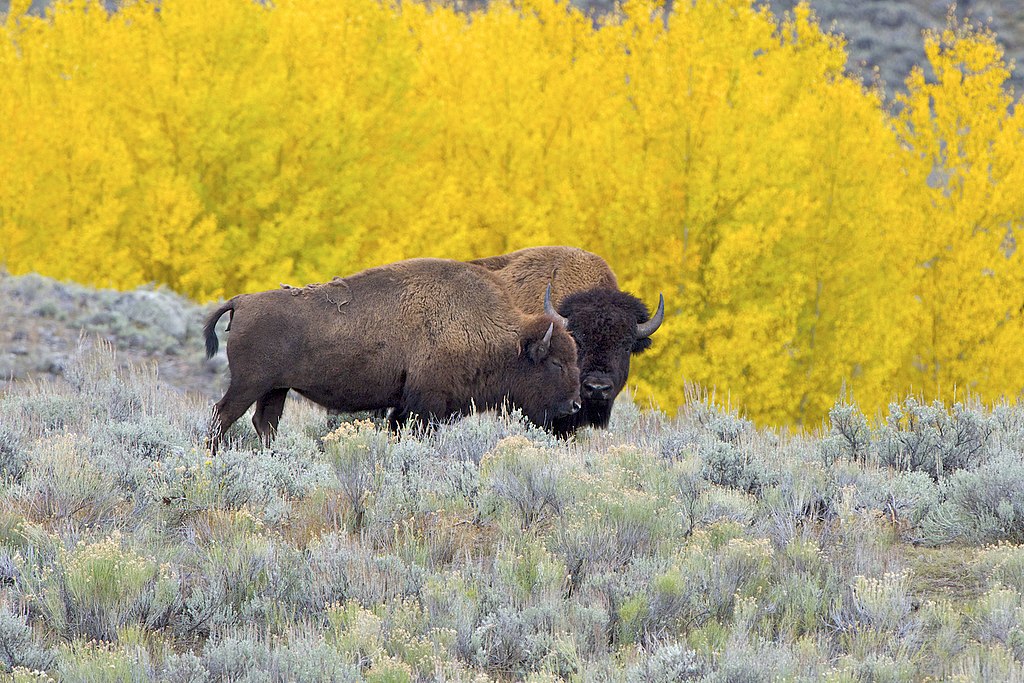
We think of this as being the range for Buffalo, a bovine relative of cattle.  But this rangeland, while perfectly suited, is just where vast herds of these feral creatures had been pushed by the 1840s when all of my ancestral lines headed into the Rockies.

But at one time the range of Plains Buffalo stretched to Durham, North Carolina where I concluded my career, and up to Anchorage where I had spent a decade in the 1980s prior to being drawn here.

Before he headed west to blaze a road over the Cumberland Gap into what is now Kentucky on behalf of the Transylvania Company, Daniel Boone worked for a month while being outfitted in what is now northern Durham County for its secretary William Johnston at his Little River store.

When Boone headed over the Blue Ridge Mountains, it was along trails previously blazed by Buffalo.  Other Americans also followed further north in the Appalachians into the Ohio River Valley and then all the way to the Pacific along routes my pioneer ancestors followed.

My great-great grandfather, one of three ancestors on the vanguard wagon train heading west in 1847, was one of ten men assigned to hunt Buffalo along the way being careful not to take more than needed.

At the time, Kansas, Nebraska, Wyoming and Montana didn’t exist even as territories, and their destination was still part of Mexico.  During the second month of that 1,100 mile trailblazing effort, they began to see seas of Buffalo in what is now west-central Nebraska.

Near what would become Gothenburg, one member wrote that “the prairie on both sides of the river is literally black with Buffalo.”  Another wrote that it was as if “the face of the earth was alive and moving like the waves of the sea.”

There were days when they passed herds of Buffalo stretching for 20 or more miles.

Twenty years later, naturalists, based on range carrying capacity, estimated there were 60 million buffalo on the Western Range, a number experts now believe was closer to 30 to 40 million.

But in the 1860s after the Civil War, Wall Street colluded with the railroads, cattlemen and the U.S. Army to exterminate the Buffalo from the Western Range, replacing them with hundreds of thousands of head of cattle and scores of Native American people with cowboys.

All that tells me that my ancestors thought differently; that several were interpreters with Shoshone, Bannock, Paiute and Hopi and their policy to feed them rather than fight them.  But by shifting more and more to cattle, they were obviously enablers.

Telling is that in 1864, Idaho’s territorial legislature became the first to pass laws protecting Buffalo, but it was already too late there.

By around 1880, 30-40 million Buffalo had been replaced on Western Rangeland by 600,000 cattle, and by 1879, Idaho ranchers alone had driven 100,000 head to railheads there for shipment.

But those same railroads brought settlers and the open range succumbed to barb-wire fencing by the 1880s.  Ranchers had also saved 100 Buffalo from extinction.

Today there are about half a million head on non-public lands including those served as a beef alternative in restaurants such as Ted’s Montana Grill here in Durham, one of 44 across 16 states.

Bison meat is naturally lean, tender, and protein and nutrient rich.  About 60,000 a year now make it to restaurants and stores, double since 2002.

Another 30,000 find sanctuary on public preserves including Yellowstone Park adjacent to our ancestral ranch.

This includes a herd of 350-500 on the National Bison Range set aside by President Theodore Roosevelt in 1908, and then populated with private funds.  It’s northwest of Missoula, Montana at the base of the Bitterroots where they form the line with Idaho.

There are still about 15,000 Buffalo that conservationists estimate roam wild.  There are 2,564 operations raising Buffalo commercially, bringing the number in the U.S. and Canada now to 340,000.

Nationwide, ranches like the one in Idaho where I was born and spent my early years now hold 87.99 million head of cattle, the fewest since I was a rising three year old in 1951.

Seventy-percent of the land area of the Intermountain West (Montana, Idaho, Wyoming, Colorado, New Mexico, Arizona, Nevada and Utah) is still rangeland used for grazing livestock even though today it is for only for six months instead of the years it did when I was growing up.

It was only 12 years ago that there were only 50 grassfed cattle operations in the U.S, now there are thousands.  Still, nearly all of our beef comes from cattle “finished,” a euphemism for fattened in feed lots.

While the feed-lot technique was pioneered in Chicago in 1876.

Before then fattening was done for only a week or two at the railhead to prepare them for the ardors of shipping.  But then came refrigerated railcars and gradually the fattening was done not to compensate for weight loss during shipping but to make them fatter faster.

This took off very slowly though until veterinary antibiotics converged with federal policies during the Nixon administration to fuel corn and grain production in the early 1970s.

There is a feedlot in Idaho, just southeast of Boise that fattens 150,000 head of cattle at a time, a third more than was driven to railheads by my ancestors and others in an entire year in that state in 1879.

That company has another closer to Boise that holds 250,000 head but they don’t hold a candle those two in Amarillo, Texas that fatten 800,000 or one between Denver and Fort Collins that handles more than that alone.

The number of head in my native Idaho as of last year was up slightly to 2.3 million, while the number of head in my adopted home of North Carolina increased to 820,000.

This due in part to a trend back toward local family stock growers supplying local residents as well as locally-owned restaurants in foodie counties such as Durham with grass-fed beef.

But as, author, food journalist and son of the founder of Baskin-Robins, John Robbins details in his book entitled No Happy Cows: Dispatches from the Frontlines of the Food Revolution, there are no easy solutions.