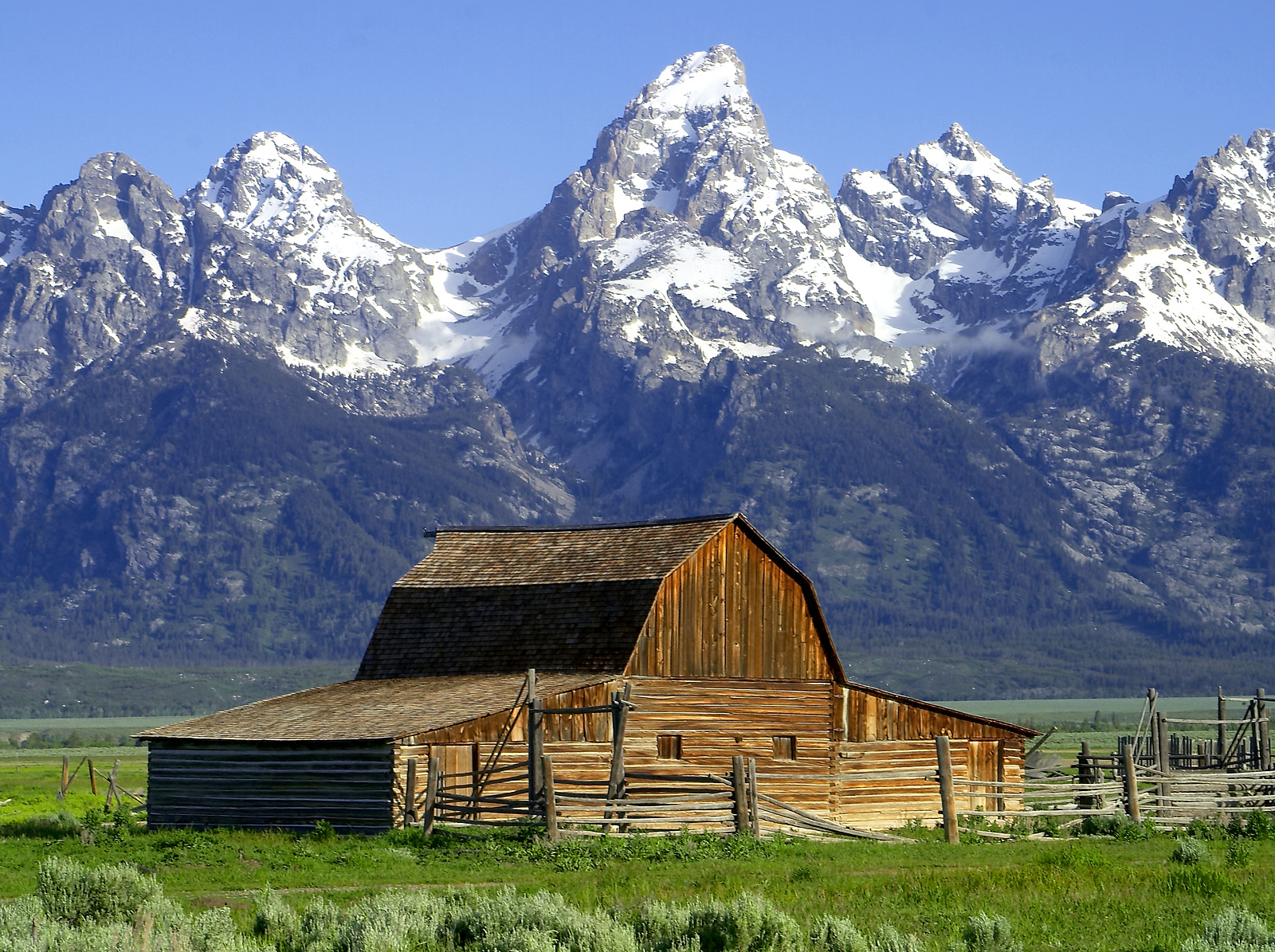
Showing posts with label Teton-Yellowstone Nook of Idaho. Show all posts

Wednesday, February 25, 2015

The Two-Edge Sword of Drive and Passion

My Dad was discharged from the Army by 1946 and returned from Germany to reunite with my Mom and resume ranching.  Two years later they had me.

Ranching never really slows down but during the winters he found time each week to head 20 miles from our ancestral ranch in the Yellowstone-Teton nook of Idaho up into Targhee National Forest to snow ski at Bear Gulch.

He continued to ski into his 70s.

Bear Gulch is long gone now, but in 1938 when my Dad was in high school and just two years after the creation of Sun Valley, it became Idaho’s second ski area.

While I was growing up, there were remnants of one of two old chair lifts there,  which had been two big, 5’ x 16’ flat-bottomed sleds that together carried up to 14 skiers seated side-ways.

Very cool but by the time I was coming up “the Bear” only had a T-bar and a Rope Tow, at least until I was in high school.  When I was 10 years old, a day pass cost $2.50 and a full season no more than a good steak dinner does now.

By the time I was two or three years of age, so I am told, I began appealing to him to take me along.  So the winter after I turned 4 years old he insisted that if I was to go I had to learn to snowplow first.

Late one afternoon, after we had used a huge, horse-drawn sleigh to take feed out to our cattle, Dad took me to the steep hill that abruptly rose across Sand Creek just behind our horse barn.

Across a narrow gully, I could see the Ora Cemetery where many of my ancestors are buried, an inhold-commons carved out and given by my great-grandparents to the county.

Until well after dark, I remember marching repeatedly up that hill, skis and poles bundled in my arms, and then repeatedly trying to learn to snowplow down to the bottom.

It didn’t go very well.

My Dad, who was still in his 20s at the time, only knew one reaction to a range of emotions, whether fear, sadness, frustration, or anger.

And that was intensity.

I learned to ski that day and got my wish, but it would be ten more years before I would finally learn to love it like he did.

My mom, who was not yet 25 years old, was furious that night when we finally stomped the snow off our boots on the back porch after that first lesson out behind the barn.

Both parents had good reason to try and breathe fire into me.  Food allergies after birth had meant moths of projectile vomit and crying. Doctors feared my condition was failure to thrive.

I weighed less than I did when I was born a healthy 8+ pounds, when during a vicious snowstorm, my parents couldn’t find my formula and soon discovered that whole milk agreed with me.

But I am sure the trauma of those first six months lingered and may have led them to become intense whenever it came to teaching me to work through challenges.

My youngest sister, who came along when I was six, still kids me that as she was growing up, I would often put her through the lessons I had learned in R.M. Bowman boot camp (smile.)

This may be one of the reasons my middle sister retreated to her room so often when we were growing up.

The ability or willingness to work through challenges may have been my parent’s greatest gift to me, although I often gave them reason to worry well into my 20s.

It is one of the handful of skills known as “executive functions,” which act as an air traffic control system for others. They are crucial to learn by the time you are five or six and one of the hallmarks researchers have found that separate achievers from those who struggle or give up.

It is also one of the five attributes that Gallup, after more than 15 years of study, finds that distinguish those in the workforce who are more engaged from those who are less engaged:

  • loyal to the organization
  • willing to put forth discretionary effort
  • willing to trust and cooperate with others
  • willing to work through challenges
  • willing to speak out about problems and offer constructive suggestions for improvements

Based on my four decades as a CEO and a few prior as a supervisor, it would be impossible to argue with this research or to rank them in any order.  They are also very hard to teach to adults, although the organizations I led had some success inculcating the last attribute into our culture.

Working through challenges includes the ability to persevere through disappointments.  My parents may have breathed a bit too much fire into me as a preschooler because one of the things I had to work hardest to hone during my career was how to convey disappointment to coworkers.

At my most proficient, I doubt I reached more than a 5 or 6 on a scale of 1 to 10 but I did learn to hire a second who had that gift.

Throughout nearly my entire career, the consultants I found most useful to both me and the organizations I led were specialists in organizational behavior.

Dr. Wes Harper, then an RHR consultant based in Portland, was an organizational behavior psychologist we used during my 1980s stint in Alaska.

Then in my mid-30s, he gave me an invaluable insight: to be more aware of the impact I had on people in my presence.

Still striving as though I was that 4 year old going up and down that hill behind our barn, I was unaware that my incredible drive could be a two-edge sword.

Peter Bergman is a similar consultant whose writings I find enlightening, even in retirement.  He posted on HBR.org this week that, “If you’re a high-performing, impatient leader, supporting others during tough times can be particularly hard for you to do.”

He continues, “It’s hard because your natural, knee-jerk response to underperformance is anger, directed at yourself and others.”  Read the post, but his point is that while accountability is important, if these employees are high performers, “awareness and accountability aren’t their problems.

“What is?  Regaining enough confidence to take necessary risks to succeed after failure.”  When addressing “underperformance,” one of the four tips by Bergman, is to do what is important to any crucial conversation and “decide on the outcome you want” as well as the relationship going forward.

As tough as my Dad seemed through the eyes of a cold and wet 4-year-old on that makeshift ski hill, he and my Mom obviously also understood how to help me regain enough confidence to take the necessary risks to succeed after failure.

Unfortunately, 70% of adults at any stage in the workforce are simply disengaged, nearly 20% of whom are actively disengaged according to Gallup.  This also applies to managers.

Good management can tweak engagement but it can’t overcome mindset.  Even praise can cause someone with a “fixed” mindset to freeze up even more.

But the real answer is good parenting about two decades before they reach the workforce.

I never had the opportunity to be much of a parent but I sure had two incredible examples and I see one in my daughter.  As a society, if we really want to instill those five Gallup attributes above, the point of intervention is not school, but in those first five years of parenting.

I was lucky.

Monday, December 08, 2014

A Backdoor Influence on Sensibilities

When they learn that I grew up just outside of Yellowstone Park in the Idaho shadows of the Tetons, people usually ask me when the best time is to visit.

Views of those icons were readily available literally from the front yard because our ranch house, a log home built by my grandfather’s brother, faces that direction,

They mesmerized me each morning as I waited out by the mail box for the school bus.

But early influences on my appreciation of sense of place were just as likely to be to the west of the ranch which had a strikingly different landscape.  But before I get to that, let me respond with two answers to that question about the best time to visit Yellowstone.

My top-of-mind answer about the best time to visit is “fall” which was my favorite season to go there growing up.  But possibly the very best time of year to see wildlife now such as moose, bear, buffalo, elk and wolves, is in the winter.

Until 1948, the year I was born, there had been only a few snowshoe tourists in Yellowstone.  But that year the first snow planes entered the park.  Our neighbor and father of one of my schoolmates had one similar to the one shown in this video.

By the time I was in second grade, visitors toured Yellowstone in the winter aboard Bombardier R12s, mini-buses with skis (instead of tires) in front and tracks in back. 

Very cool and yes, this is the very same company that makes very cool business, and commercial jets and high-speed trains.

It took root back in the 1930s when 15-year-old J.A. Bombardier began invention of these vehicles in the years before snowplowing of rural roads was mandated in his native Quebec, Canada.

I was that age before the first snowmobiles entered the park which soon became a problem that has led to limitations, in part, to preserve tourism quality for all concerned.

Snowcoaches today are much quieter and far more comfortable but not far removed from those old R12s.

My earliest roots in Idaho go back to 1860 and creation of the first permanent settlement there.  This was more than a decade before Yellowstone Park was created and before Idaho was even a territory.

How we came to be located much further north in that nook of Idaho even traces to that period, when one of my great-great grandfathers was a “freighter” to the gold fields in Montana, meaning he drove a stage coach designed to carry supplies up that 250 mile route.

But that is for another post.  Lets just say I am as Idaho as it gets.

Many of my sense of place influences there were also formed when I ventured west out the back of that ranch house during unstructured exploration and play time on old buggies, a deserted Power-Wagon and in abandoned ancestral houses including treasure-filled landfills.

I was also drawn further along a nearly hundred mile stretch to the west beyond the hills and meadows of our rangeland, through a landscape that was much more subtle but just as dramatic as the much closer Tetons and Yellowstone were to the east.

The ranch lies along the cusp of a sagebrush steppe west of the Tetons.  Eight miles west just and beyond our rangeland was the northern reach of a towering range of sand dunes that stretched southwest parallel to the Henry’s Fork River, past St. Anthony where my grandparents lived to the Egin Bench.

By towering, I mean that some of the dunes reach 250+ feet.  They are a mini-Sahara.  There was even a resort and swimming pool at the time but I think they got buried as the sand dunes migrated up against a series of mini-volcanoes called the Juniper Buttes.

Between the ranch and those dunes is the refuge for Elk I have written about.  They winter there before migrating past the ranch and back into a remote Idaho corner of Yellowstone to summer.

On the other side of the dunes lies the Camas National Wildlife Refuge, created in 1937 as a resting place for 50,000 migratory ducks and 3,000 geese.

Basalt columns underlie this entire region.  Our ancestral ranch lies at the intersection of where the Northern Rockies and the Teton Range of the Central Rockies meet.

The steppes slope gently down before rising in elevation past the refuge to meet other fingers of the Northern Rockies stretching southeast out into Snake River Plain.

One of those fingers is the Lost River Range, about a hundred miles west of the ranch and midway to one up between Stanley and Challis, owned until recently by singer-songwriter Carole King.

Two namesake rivers, the Big Lost River and the Little Lost River run down each side of this range, which contains the highest peaks in Idaho.

They are named “lost” because they abruptly disappear into a “sink,” recharging the vast Snake River Aquifer, a giant underground river.  Opposite 12,668 ft Borah Peak on the east side of this “sink” is a pre-historic archeological site called Wasden.

Here, when I was beginning my senior in high school just 29 miles east and more interested in music such as Satisfaction, Help and California Dreamin , Idaho archeologists uncovered thousands of prehistoric artifacts in caves created by collapsed lava tubes.

All I knew is that we had a record early snowfall that September but scientists now date the finds at the Wasden caves as between 10,000 and 12,000 years B.P. (before the present.)

Sixty miles southwest of the caves along American Falls Reservoir, archeologists from ISU just uncovered the skeleton of a 70,000-year-old Mammoth.

Just to the southwest of that “sink” along the mountains and stretching down to just above the reservoir, for nearly 15,000 years, there have been eight eruptive periods or lava flows that lasted anywhere from a few years to a few hundred years and spaced between by 2,000 years of calm.

This area lies along an alternative route that wagons along the Oregon Trail took called Goodale’s Cutoff beginning a few years after my Idaho roots were first established and almost two decades after my ancestors settled west along the Rockies.

Wagon trains didn’t end with the completion of the first transcontinental railroad in 1869.  They continued along that route until 1900 when they finally gave way to the motor vehicle era.

In 1926, Republican President Calvin Coolidge set this eerie tract of eruption aside as the Craters of the Moon National Monument and Preserve.  In preparation for landing on the moon, Apollo astronauts visited the area in 1969 to study its mosaic of flows, splatter cones, craters, monoliths and other Moon-like geologic features.

It wasn’t the first time the area would be used for research.  The area immediately northwest of the monument had been used during WWII as a proving ground by the Navy to sight-in battleship guns and by the Army for testing munitions and for bombing practice.

Then after the war, it was chosen as a site for research on the first atomic submarine including a prototype for the USS Nautilus.  This is also where crews for atomic subs were sent for training until the mid-1990s.  Yup, in Idaho.

In fact, that isn’t the full extent of land-locked Idaho’s naval prowess.

Further north in the Idaho Rockies, the Navy also had a training station for other ships during WWII at Farragut on Lake Pend Oreille.

By then a state park, the year I started my community marketing career in Spokane and my only child was born, Farragut was the site of the 1973 National Boy Scout jamboree.

But even today, at a more remote part of that huge lake, the Navy tests acoustics down 1,000 feet or more using huge scale models of submarines.  Yup, in Idaho.

Sorry to get sidetracked onto research but you can see what I mean when I say that the influence my native state has on my appreciation for sense of places, goes far beyond its spectacular rivers, mountains, lakes and parks.

So anytime you cut through that part of Idaho on I-15 running north-south between Idaho Falls and Dillon, midway between the Teton and the Lost River ranges, if you find yourself complaining that it just seems like miles and miles of sage brush, take a detour for a closer look.

Tuesday, October 28, 2014

A Mucking Memoir

My musical sensibilities were fostered not only by my mother’s wonderful voice and piano playing but by my paternal grandfather’s tenor as he sang along with an old ratio in the horse barn on our ancestral ranch along the Tetons in Idaho.

It is there at age six, while helping him muck out the barn that I first heard a song that has served as a backdrop to my life over six decades now, although recorded and sung by many different artists along the way.

My musical tastes are eclectic but penned by Jimmy Work, the country song-standard, Making Believe I realize now in reflection, has been one of my constants.

Or maybe it is that old radio that set the tone.  The old horse barn is gone now, preserved only in family photos (behind my dad in the image shown further down in this memoir.)

I wonder what became of family artifacts such as that old radio or my great-grandfather’s “HB” branding irons that hung there by the door, remnants of which are preserved in the state of Idaho’s archives.

The one with just the initials went on the left thigh of our horses.  The other including an underscore went on the right rib of our cattle, perhaps foretelling my career one day branding communities.

As family heirlooms, I wish I had that old radio and especially those branding irons.  As all artifacts do, they would sure tell some stories.00083_p_aaeuyfyqe0638_z

When I first heard Making Believe sung by Kitty Wells, my then six year old ears had also recently been kindled to doo-wop.

I had caught a few bars of Earth Angel one day as my grandfather was tuning the radio back to country from listening to opera arias, then sponsored by Texaco, as we did each week.

Yup, that’s where I first heard one of my favorites, O Soave Fanciulla with my grandfather, who had barely finished second grade, singing along at the top of his lungs as we shoveled horse manure, a reflection that came to me a few weeks ago as my mind wandered during Phantom Of The Opera recitatives.

The old barn radio is also where I first remember hearing the voice of Vin Scully calling the 1955 World Series won that year by the then Brooklyn Dodgers over my favorite New York Yankees.

My dad and I watched a year later on our new television while still listening on the radio as Don Larson pitched a perfect game for the Yankees in a rematch which Scully also called.

It is why even today I listen, if only while changing channels to Dodger games, which he still calls, and why the World Series has always been more enjoyable for me as a backdrop on the radio.

By 1955, it had already been 16 years since my grandfather had been able to work the ranch he had homesteaded and then assembled by incorporating purchases of those of my great-uncles and great-grandparents.

My dad started running this ancestral spread while finishing high school.  The years he had been away at war, the ranch fell fallow with my grandparents only keeping some prized horses.

When my dad returned from WWII, my grandparents turned the ranch house as well over to my parents and moved a dozen miles south down the Henry’s Fork into St. Anthony, population 2,600.

But after I was born in 1948, my grandfather resumed being a daily fixture around the ranch, volunteering words of wisdom to my parents and paling around with me each day or me with him.

He passed away in the fall of 1964 a few months after he and my grandmother gave me their old WWII-era Jeep for my 16th birthday.

The Beatles first charted U.S. album Meet The Beatles had come out that year, a month after, I Want To Hold Your Hand,” hit the charts as a single.  His passing was less than two months after the conclusion of the group’s first tour in America.

By the time of his funeral, we were already eagerly singing Anna, This Boy and Till There Was You, both in glee club at school and when used by my mom as a form of bribery to get two friends and me to sing in the church youth choir she conducted.

She was quick to remind us that Till There Was You had been written for a musical back when I had first caught that glimpse of rock and roll out in our barn.

My mom wasn’t musically defensive though.  A few years earlier when with these same friends we eagerly directed her attention to the Marcel’s doo-wop new hit Blue Moon, we even joined in with “dip di dip di dip” and all.

Only after they had left did she drop in passing that Blue Moon dated back to a musical three decades earlier when she had been younger than I was when first catching a few bars of doo-wop on the barn radio.

It seemed like music had changed forever and from the 1960s until the early-1970s I turned away from country music, but that all changed when I first heard Gram Parsons and Emmylou Harris introduce a genre called country rock.

In 1977, when I was a newly minted community marketing exec, Emmylou brought me back to my roots when she revived Making Believe, followed a year later by a version by Merle Haggard  as I took on my second community marketing agency in Anchorage.

When I headed to Durham in 1989, a duet version of Making Believe by Loretta Lynn and Conway Twitty was on the charts.  Another duet version followed by Patty Loveless and Vince Gill, whose voice my grandfather’s most resembles in timbre.

In part, it may be why I selected Gill’s Go Rest High On That Mountain for my father’s funeral in 2001, just as one day (sooner than I think), I may be recommending for my mother’s, a duet version of Sarah McLachlan’s Angel in duet with Emmylou Harris.

It reminds me of my mother’s voice and piano style now in her mid-80s before her fingers became are too twisted to play.

Making Believe continues to be a soundtrack for my life now in a new stage, most recently sung in duet by Willie Nelson and Brandi Carlisle, who is young enough to be his great-granddaughter.

Nelson’s first song writing credits and demos stretch clear back to 1955 when I was listening to that old radio in our horse barn. Of course so does his career as a sales manager for encyclopedias, perhaps an early influence?

Making Believe isn’t my signature song: that would be Desperado, which a co-worker in Anchorage set to calligraphy and framed for me.

But it sure has been an old and familiar friend all these years.

Friday, August 15, 2014

Unique Provinces

My just concluded cross-country Jeep trip with Mugs was 300 miles shorter than last year but still close to 7,000 miles round trip.

This was because we parted company with my daughter and two grandsons after a farewell breakfast at a favorite diner in Lima (pronounced like the bean,) Montana.

Within a few miles as we crested the (western) Continental Divide, they continued their descent down across the Snake River Plain and back to Salt Lake City where they live high on the slopes of the Wasatch.

Mugs and I then cut sharply east via country roads along the Idaho slopes of the 30 + mile Centennials, a uniquely west-east trending range of the Bitterroots, where much further north we had spent a week on a lake in the Northern Rockies as we do each year.

This short but dramatic range ends at my native Henry’s Fork River where the southwestern corner of Yellowstone Park noses between the Centennials and the 40-mile north-south trending Teton range.

When I travel, I consult maps of ecosystem provinces and regions as much as I do roadmaps.  You can view them at the national level and/or then drill down to see more distinctions at the state and even county level.

Their respective states treat them as separate, but both the Montana and Idaho sides of the Centennials and the Idaho and Wyoming side of the Tetons share an ecosystem distinct from other parts of their respective states called the “Middle Rockies.”

In the nook of Idaho that points up into those two states, the “Middle Rockies” ecosystem is a narrow crescent, thinnest below Monida and I-15 on the west, deepest from the Continental Divide to Ashton and then thinning out again between Tetonia and Driggs at a point where a break in the foothills provides a spectacular close up view of the three Grand Tetons.

Down below this crescent stretches the broad flat arch of the Snake River Plain, the only impression of Idaho visible from Interstates 84, 86 and 15.

In my opinion, the ecosystem maps are far more relevant than tourism maps which appear to have been arbitrarily manipulated to appease powerful population centers or make them more relevant.

I assume this is why the tourism map of South-central Montana, divides the Middle Rockies by running a narrow 15 mile wide shaft down the west side of Yellowstone giving it to Bozeman while nudging historic Virginia City under Butte.

Similarly, Idaho’s arbitrary tourism partitions give the misimpression that Idaho Falls down on the Snake River Plain is somehow up in the Yellowstone-Teton nook I just described.

Ecosystem maps such as the one at this link of the Greater Yellowstone Ecosystem are far more useful and relevant to travelers because they are organic vs. political.

Tourism maps may even trip up journalists from time to time.

An otherwise excellent High Country News report I read during the trip is entitled “Idaho’s sewer system is the Snake River.”

It cites Ashton as where the Henry’s (or North) Fork joins the South Fork which had run parallel down the Jackson Hole or eastern side of the Tetons.

But Ashton is actually located less than half way down the Henry’s Fork which doesn’t merge with the South Fork until nearly to Rigby, nearly 70 river miles downstream and just north of Idaho Falls.

Minor distinction, I suppose, for anyone unfamiliar with the area and related only tangentially to a story set more than two hundred miles south and west in Magic Valley where apparently a shift from potatoes to dairy herds is creating problems downstream.

Maybe having spent the final two decades of a career in community marketing helping people grasp that Durham and Raleigh are distinct cities and that the two metro areas that just happen to co-own an airport, I may be sensitive to locations and geography.

If anything though, one would think the report would have pointed out that stakeholders along the Henry’s Fork have shaped a “best practice” plan for its management.

The report was written out of Montana and another condition worth exploring is why, and how so many towns there and in northwestern Wyoming seemed to have caught on to sense of place and the importance and value of being congruous.

While those on the Idaho side seem anything but, seemingly poster children for a statement by sense of place and land use expert, Edward T. McMahon:

“We sometimes forget that every building has a site, every site has a neighborhood, and every neighborhood is part of a community.” (And I would add, every community is part of a setting or landscape).

It is as if, to paraphrase Seth Godwin, that these property owners want to spite the spectacular mountains at their backdrop or they conceive a world where there is only two kinds of stuff, theirs and not-theirs.

More on this later, but this may be at the root of all litter.

Thursday, February 13, 2014

The Rocks of My Ages

Just west of Rawlins, Wyoming is where most modern day travelers first cross the Continental Divide which stretches from Alaska’s Bering Strait in the Arctic Ocean to the Straits of Magellan off the southern tip of South America.

It is a hydrological designation, where water flows west on one side and east on the other.

Geologists believe rock outcroppings west of Rawlins cover a greater spread of time than any other between the two coasts, well over half the existence of the earth.  This translates to twenty-six hundred years, ten times older than those exposed in the Grand Canyon.

These outcroppings break like waves from the end of the Wind River Range, where all but one of my sixteen great-great grandparents banked southeast through a break in the Rockies on wagon trains in the late 1840s and early 1850s.

Several were among the first Mormons along that route but by then 2,500 others had preceded them in what would become the western migration of some 300,000 who would follow.

What distinguished my ancestors is that they stopped along the trail to make it easier for those who followed by building ferry crossings and supply depots.

Half of my great-grandparents colonized settlements along mountains, framing each side of the Salt Lake and Utah valleys as well as west-central Nevada and northern and central Arizona.

The other half turned north to settle Cache Valley where it straddles what is now the Utah and Idaho border before eventually migrating north to homestead and ranch the upper reaches of the Henry’s Fork along the Idaho side of the Tetons in a nook between Montana and Wyoming.

The northern branches could have saved a lot of time if they had cut 200 miles northwest along the Wind River Range to Jackson Hole and then over the Tetons.  Both areas were shown on maps and in pamphlets published by Congress a few years earlier to share the results of expeditions led by John C. Frémont.

Frémont’s route up the Wind River Range and then across the Tetons to my homeland is one of my favorite drives.  The iconic Tetons are only 40 miles long and less than ten miles wide.

This is only 13 miles longer than the distance from my long-time home of Durham, North Carolina southeast to Raleigh and a width similar to the distance from Durham southwest to Chapel Hill.

Yet the Tetons are not only the backdrop to my origins but by far the most frequently used image to symbolize the west.  They are used more than any other backdrop, often shown on the horizon of movie depictions of the 1,500 mile route my ancestors took west as the great migration began.

Several ancestors, I have learned doing family history research, became interpreters to various nations of Native Americans along the route, including the Shoshone, who are believed to have evolved from solitary family units to bands when they moved to horseback by 1700.

Having traded with Spanish explorers for their mounts, by 1700 they were trading with the Comanche near those ancient outcroppings.  Then the Shoshone traded horses to other Shoshone in Cache Valley and north with the Bannock, a Paiute-speaking nation living among the Shoshone in what is now eastern Idaho.

The Shoshone had also traded horses to the Blackfeet nation in Montana by 1751, a tribe that then used their mounts to drive the Shoshone back over the mountains framing the place of my birth in that nook of Idaho.

By the time, my ancestors moved among the Shoshone as interpreters, the horse-mounted bands had extinguished vast Buffalo herds in eastern Idaho from that Teton nook down to Cache Valley.

Trappers from the east often used the term “hole” to refer to a valley rimmed by mountains, e.g. Jackson Hole, Henry’s Hole and Pierre’s Hole.  The term was picked up by outlaws, cattlemen and homesteaders.

The forty-mile valleys on each side of the Tetons are remarkably flat in contrast to the explosive 7,000 foot sheerness of that range rising abruptly on each side from the valley floors, which are already a mile above sea level.

On the Idaho side, the valley was leveled out by volcanic lava flows.  On the Wyoming side, the valley was scoured flat by a glacier a half a mile thick.  On the Idaho side, springs feed the North Fork of the Snake River.  On the Wyoming side, they feed the South Fork.

Together the two forks join downstream to form the powerful Snake River near Idaho Falls.

Geologists, according to John McPhee in his book Rising from the Plains, believe that the Teton landscape provides not only the most complete geologic history in North America but the most complex.

For me, they symbolize my roots.  Along with Mt. McKinley, which I could view from my office in Anchorage, Monument Valley and the Grand Canyon, the Tetons are known as America’s scenic climax.

To me, they symbolize my beginning.

Monday, May 14, 2012

The Full Circle of Smoke Jump Dreams

As Mugs and I, joined briefly by a friend, dropped down from Lolo Pass into Missoula, Montana on a cross-country road trip last summer, I glanced across the valley and over the Clark Fork to see if the Smokejumper Base was still there.

It was but the Missoula base with 85 smokejumpers now has been joined by nearly 10 others across the intermountain and coastal west including Alaska, all but two operated by the National Forest Service.

As we had tracked the 75-mile Clearwater River up across the north-central Idaho Rockies that day, I recalled how often I had dreamed of fighting forest fires, as I was growing up yet another day’s drive to the southeast along the Continental Divide in the shadow of the 1.6 million acre Targhee National Forest established in 1908.

More specifically I dreamed then of becoming a “smokejumper” and I could think of nothing more worthy in those early years than risking my life to save trees.Young Men and Fire  It seemed as noble as the work of any of the super-heroes evolving at that time such as Captain Comet, The Fly and Flash.

Growing up just west of the Ashton/Island Park Ranger District,  I had often heard the tragic story of how 13 jumpers died in another national forest two hundred miles north of that nook where the Centennial and Grand Teton ranges meet.

Much later, just a few years after I moved to Durham in 1989, where I now live and home to The Forest History Society, a 1978 forensic analysis of the Mann Gulch tragedy was published entitled Young Men and Fire.

The book’s posthumous publication was spurred by the huge popularity a year earlier of the movie A River Runs Through It, adapted from an autobiographical novella by author Norman Maclean and starring actor Brad Pitt in one of his breakout roles and directed by Robert Redford.

Growing up, as I did, in the Mormon culture of homesteaders along the famed Henry’s Fork of the Snake River where it drops out of the Targhee gave special resonance to a memorable line from the book and the movie:

“In our family, there was no clear line between religion and fly fishing.”

While I didn’t grow up to be a smokejumper or to fight forest fires, I did spend nearly 40 years as a community-destination marketing exec which involves putting out fires far more frequently than people might think.

And now as if to come full circle to that dream of my youth, one of my issue-based passions in retirement involves “saving trees” not from fire but from the blight of roadside billboards and the careless disregard and indifference of a few state legislators.

Author and screenplay writer William Hjortsberg, a friend of Maclean’s once described A River Runs Through It as reaching “into that dark area where you don’t know how to help somebody you love until it’s too late.”

I hope it isn’t too dramatic to think about saving North Carolina’s signature tree canopy and what better place to start than along its roadsides.

Thursday, August 25, 2011

Lessons From Birth

It wasn’t clear I was going to make it during my first six months of life.

While I have no real memory, it’s all there in my wiring. Experts have identified this period and what I overcame at the beginning of life as the source of some of the traits that helped me succeed in my now-concluded nearly-four-decade career as a community/destination marketing exec.

But I’ve also had to learn to moderate the downside of those very same strengths.

I was conceived in October of 1947, more than a year after my Dad returned from Europe and got out of the U.S. Army. My parents had eloped three years earlier and my Mom had lived and worked off-base as Dad went through basic training at Camp Roberts near Paso Robles, California before shipping out to Europe.

After the separation of war, they were eager to start a family.reg6-eastern

I was a bit overdue and born in 1948 in the midst of the hottest and busiest time of year on the 1200 acre cattle and horse ranch and related farmland that my paternal grandparents and great-grandparents had homesteaded and then assembled just a mile from the upper Henry’s Fork in the Yellowstone-Teton nook of Eastern Idaho.

My Dad rushed my Mom 50 miles south to the nearest hospital in Idaho Falls on a very hot July afternoon in a 1949 Ford that had come out the month before. I was delivered before he could park the car and make it to the delivery room. The pregnancy was a surprise because specialists didn’t think it was possible for Mom to have children.

But my parents were very determined. I was followed by two sisters, each of us spaced three years apart but, sadly, they also suffered three miscarriages.

I got off to a great start, weighing more than 8 lbs. at delivery but it all went downhill from there. My immediate reaction over the first few months of life was to projectile vomit regardless of whether it was my Mom’s milk or any number of formulas including the “tried and true” Mead’s Dextri-Maltose, developed nearly forty years earlier in 1911.

I’m not talking about the usual baby spit-up but vomit that shoots out six or more feet in a gush, often showering my Dad or grandfather.

At three-months, older women on nearby ranches and farms worried that I wouldn’t make it much longer. I was barely gaining any weight and nothing would stay down and crying was non-stop. In early January, as I turned six months old, the ranch was buried in one of the huge blizzards common during the winter there, erasing every visible sign that any roads had ever existed.

But this blizzard was epic, even for that part of the country, drifts were high enough to bury some telephone poles and they completely blocking roads and even trains for a month.

My Dad went down in the cellar to get a can of powder formula and couldn’t find any, although my parents remembered stocking up the week before the storm. Desperate, they gave me some of the whole milk that we sold to the creamery in nearby Ashton along with the even more valuable cream when we separated a portion.

Whole cow’s milk was believed to be the worst thing possible to give any baby but especially with this condition.

The “miracle of the blizzard of 1949” has been recounted at nearly every family gathering I can remember. Once I drank the whole milk I stopped crying for the first time in six months and began to immediately gain weight. They found that formula, by the way, hiding in plain sight the next morning; but from then on, whole, incredibly rich, cow’s milk was the centerpiece of my diet.

I was fortunate enough to dodge most the negative side-effects that can result from what medical professionals term “faltering growth” or a half century earlier by the myth-enshrouded term “failure to thrive.”

But specialists, including management consultants, have credited that adversity with honing several traits that were conditioned by my parents, teachers and mentors into strengths that helped me succeed in my school work, in athletics and in my career.

I’m living proof, however, that each of those strengths could also be liabilities had I not learned from them and adapted.

Here are a handful:

  • A passion for life and learning. My system had to kick-start so many times in those first few months that I have innately anticipated every day as though it would be my last. Life is not taken for granted. But I had to learn to moderate intensity.

  • An indefatigable drive and resilience to achieve both short-term milestones and long term goals while overcoming setbacks or obstacles. I’ve had to learn to appreciate and work with people who move more slowly and appear less motivated.

  • A hyper-vigilance that helps me see strategically and quickly identify threats which has been key to my work responsibilities. But I’ve had to learn that everything isn’t a matter of life or death and to be more trusting at one level and maybe a little less overall.

  • An ability to tolerate a certain amount of ambiguity and inconsistency that probably comes from a pretty ambiguous first six months but opened my mind up to new data,fresh ideas, innovation and growth. But I’ve had to learn to listen carefully to those who harden positions without backup for both/and alternatives.

  • An empathy for the underdog, the underprivileged, the disabled, the stigmatized and an intolerance for condescension, racism, sexism, misogynists and BMOCs. But I’ve had to learn not to tell myself stories and to listen beyond the messenger.

Of course, I’m grateful that I lived but I’m especially grateful for those who helped me condition the traits imbued by that early struggle into strengths.

In turn, I also appreciate what I learned from adapting and managing those strengths and I’m thankful for everyone who has been so tolerant and forgiving during this journey.

This bit of history may be of interest one day to my grandsons, who started 1st and 2nd grade yesterday and maybe their children or children’s children.

But I dedicate it to my Mom and Dad, just 19 and 24 years old at the time, who never gave up on me, even when covered in projectile vomit and sleepless through six months of constant crying.