Showing posts sorted by relevance for query fish. Sort by date Show all posts

Wednesday, October 31, 2012

Truly Conservationists

Durham NC, the community where I live is not the only place struggling with a damaged culvert, the pipe that permit waterways including those that allow stormwater to pass under roadways instead of over them which leads to flooding, etc.

However, poorly designed, placed or maintained culverts can also create hurdles.  Earlier this month, Trout Unlimited (TU) and Orvis jointly announced an ambitious plan to replace or repair poorly constructed culverts across the United States over the next 10 years to reconnect 1,000 miles of fishable streams and wetlands.

Orvis is a 150-year-old, family-owned, mail order business selling and often innovating outdoor adventure and sporting clothing and equipment, especially fishing, hunting and birding.  The company has long partnered with conservation groups such as TU, a 53-year-old, 140,000 member conservation organization for fishing enthusiasts.  A 2011 study showed that 91.1 million Americans over the age of 16 fish, hunt or watch wildlife.  More people fish and hunt than play golf and tennis combined.

Growing up along the banks of the famed Henry’s Fork(voted the best trout stream in America by TU members) on the Idaho side of the Teton mountains  I naturally learned to fly fish and hunt, although I was never much of a hunter, preferring to reach first for a camera or to just target shoot.

During college I still fished up a canyon along the Lower Provo River (voted one of the top ten trout streams in the Rockies) but left those interests behind when I graduated.  Today it is a joy to watch my grandsons fish off the dock, with Orvis rods of course.

Research today shows more people who fish and hunt live in the South than in the East and West combined.  Half are either ideological moderates such as me or liberals.  More than half are Independents such as me or Democrats by party affiliation.

Nearly 60% of fishing and hunting enthusiasts live in cities and towns and nearly 40% are now women.  But perhaps the most impressive fact is that more than 8 out of 10 self-identify as conservationists.  Those who are strongly so outnumber those who aren’t by 3 to 1.  Those who are conservationists also outnumber NRA members by more than 3 to 1.

Even though half are conservatives and 42% are Republicans, hunters and anglers want their needs on public lands to be given consideration before oil and gas leases.  The majority want mining royalties to be used to clean up abandoned mines.  Predominantly they believe we should confront global warming and restore Clean Water Act protections to wetlands and waterways.

Overall, those who hunt and fish believe that conservation is as important or more important than gun rights.  Clear air and water isn’t just a top three trait that liberals, moderates, conservatives and libertarians share for the places they select to live.

Ideologues and partisan politicians should study the moderate undertones shared by the 33 million people sixteen and older who fish each year and the 13.7 million people who hunt as well as the even more moderate positions held among the 71 million Americans who engage in wildlife viewing each year.

So how can so many in Congress seem dismissive of or oblivious to more than 80% of the US population who fall in that age group?  The answer is political rent-seekers.

Rent-seekers is a term describing special interests with powerful lobbyists who while they may be representative of those who vote during periodic elections, are sure to walk the legislative halls each day misrepresenting or seeking to subvert the popular will for their own pecuniary gain.

To me they should be fair game for anyone who believes in a return to truly representative government.

Monday, January 13, 2014

A Lifetime Lesson - Sense of Place is Either/Or

I can’t remember why, when in my thirties I suddenly stopped fly- or even spin-fishing, but it probably had to do with worsening of a condition that first manifested itself in grade school called “essential tremor.”

It was the end of a long line of rivers I frequented wherever I lived with names such as Provo, Spokane and Ship Creek but it all began on the Henry’s Fork.

Well into retirement now, following a four-decade career in community marketing, I sometimes wonder about the origins of my sense-of-place sensibilities in that career and the realization reached late in my career that “you can’t have it both ways” when it comes to that attribute.

I suspect my sensibilities trace to when I first began to fly-fish the Henry’s Fork of the Snake River (aka North Fork or Upper Snake) as a young boy.  It ran less than a mile from our ancestral horse and cattle ranch.

The prized trout species on the Henry’s Fork, acclaimed as one of the best in the world for fly-fishing, is not the invasive Rainbow but the native Yellowstone Cutthroat.

It is one of at least fourteen subspecies of cutthroat, each native to a separate geographic area of the Rocky Mountain West.  While it was the first type of trout encountered by Spanish explorers in 1541 near Santa Fe, New Mexico, cutthroats evolved millions of years ago in the Snake River basins such as the iconic Henry’s Fork.

They had become rare in their native Henry’s Fork by the time I caught my first Yellowstone Cutthroat in 1954 or so.  They had fallen victim to commercial fisheries about the time my great-grandparents homesteaded in that nook of Idaho.

That’s also about the same time invasive, non-native species of trout such as the Rainbow were introduced and began to overrun the native Yellowstone Cutthroat.

It wasn’t until 1958 that efforts began in earnest to protect and foster Yellowstone Cutthroats as well as repair their native ecosystem.  By the time I was heading to Alaska in 1978 for the decade prior to coming to Durham, North Carolina, Idaho Fish & Wildlife forsook non-native trout planting.

After nearly seventy years of stocking lakes and rivers with the use of fish trains, fish trucks, fish helicopters etc., Idaho adopted a wild or native trout management policy eventually including a plan now for Yellowstone Cutthroat.

Still, until recently, the state tried to have it both ways, stocking 100,000 Yellow Cutthroat annually in the 1980s and 1990s while also flooding its population over that period with 44 million rainbows, polluting not only the gene pool but the ecosystem.

Yellowstone Cutthroat is the only native species on the Henry’s Fork, but reestablishing this incredible trout has also relied on organizations such as the Henry’s Fork Foundation, founded in 1984 and the forging of partnerships with ranchers, farmers, towns and hydroelectric projects along the river.

Much of the credit for the realization of the importance of geographically-specific native trout species is due to the work of Dr. Robert Behnke, who in his 80s, passed away a few months ago a few years after authoring the spectacularly illustrated and encyclopedic, Trout And Salmon of North America.

In tribute, this winter’s issue of Trout Magazine, a publication for members of the conservation group Trout Unlimited, features mini-essays by scientists Behnke influenced entitled Why Natives?

While learning about the corrosive influence of non-native or invasive species of trout may have planted a seed in me as a six year old, during the first three decades of my career in community marketing for visitor-centric economic and cultural development I labored under the hubristic fallacy that somehow a community can juggle both.

Only in the fourth and final decade of my career did I come to grips with the truth that no matter how hard a destination marketer tries to balance the real and fake attributes of place while guiding venturers who seek the former, in the end the two cannot coexist.

Just as with trout, the invasive, non-native or fake attributes are corrosive and by their nature, even as hybrids, erode sense of place.  This epiphany is also at the root of my strong belief now that no amount of accommodation for sign blight such as roadside billboards can be tolerated when it comes to preserving sense of place.

While this epiphany came to me in the year 2000, I heard it prophesized so eloquently a few years later by Dr. Scott Russell Sanders at a groundbreaking conference held in the Southern Rockies but attended by only a handful of professionals responsible for preserving, promoting and protecting sense of place.

For some communities, it is too late.  But they can become reservations for that shrinking layer of tourism that is more like shopping, where people seek out the familiar in settings that are either simulations or the backdrop for zip lining.

In time, as the 1973 movie Westworld foretold, maybe one day there will be regions of what some call fake places.  Ironically, it was the last release by Metro-Goldwyn-Mayer Studios (MGM) before transforming as a centerpiece in simulated places such as Las Vegas where the “real” no longer exists except in film.

Others such as Durham, where I have now lived nearly forty percent of my life, are still riding the fence.

Belying well deserved credit for preserving sense of place, such as that published last week by the uber-hip Virgin Atlantic airline from Jason Frye on its Our Places blog post, is that Durham does not have a comprehensive over-arching strategy when it comes to preserving and fostering sense of place.

Just because unique sense of place is in Durham’s DNA, something fully embraced by the community marketing organization responsible for leveraging visitor-centric economic and cultural development, doesn’t mean corrosive influences aren’t at work.

Often these influences are enabled by those who think they can ride the fence by also fostering things that make the community the same as hundreds and thousands of other places.

It took me an entire career to realize it can’t be done.

Just as Idaho came to value its wild and native trout as unique to specific geographic locations such as my native Henry’s Fork, Durham is in a struggle for its soul, drawn as often to the “new and shiny” as it is to sense of place, often planting one next to the other as if to tempt fate.

Instructors such as Dr. Dana Clark at Appalachian State University in the northwestern mountains of my state, are valiantly attempting to embed respect for sense of place in a new generation of community marketing executives, often using Durham’s as a role model.

But judging by how long it took me to come to the realizations expressed in this essay, it may not be possible.

This may be why we experience the awe of a genuine and authentic place in our youth but come to appreciate what it means and what it  takes to sustain only with age.

I so hope I am wrong.

Monday, October 14, 2013

A Lesson in Collaboration

Fall has always been my favorite time of year, anchored in my psyche during my early years.  On the ancestral cattle ranch of my family, chores seemed to taper off as the air grew thin and a haze settled in as the snow line drifted lower and lower along the Rockies.

Thanks to his generosity, with permission I have included in this post an image taken by Glenn Oakley from the ranch side of the Henry’s Fork showing the view of the Tetons framed by sagebrush and Lodgepole pine forests.Henry's Fork in North Fremont County, Idaho by Glenn Oakley

This time of year, the forests there are ribboned and blotched with yellow bursts of Larch and Aspen trees.

Fall is also when the water level made it easier to wade the river fly-fishing and when the trout, including native Cutthroat and Rainbow, grew more aggressive.  There was also a hell of lot less competition from insects.

It occurred to me streaming Foyle’s War recently (remember, a year ago I cut the cord on subscription television entirely so I now surf Netflix and Hulu) where the lead character in this crime drama set along the coast of England during World War II often fly-fishes, that during my lifetime, I’ve tended to compartmentalize activities to certain places I’ve lived.

Even though fly-fishing fulfills my need for solitude and regeneration, I never picked up a fly rod again after college even though there was more than enough opportunity during the three decades I lived in Alaska and here in North Carolina.

Same with downhill skiing, which I left in Spokane when I went to Alaska and cross country skiing, which I only did during my decade there, even though there are places enough to do both in North Carolina.

While I’ve lived now in Durham, North Carolina much longer than I did in my native state and it is so heavily forested and I can “leaf-peep” from the nook where I write, it is much more difficult to see the “forest for the trees” here.

The Henry’s Fork flows a mile from the ranch as it dissects Fremont County, Idaho north to south in that Yellowstone nook of Idaho about 40-50 miles above where the river finally merges with the South Fork in Madison County to form the incredible Snake River just south of Rexburg, at 25,000, the only “big” town along the Henry’s Fork.

Ranchland including that used to raise forage also divides the northern part of Fremont County from the rich potato farmland down in the southern half, as does the type of fly-fishing.

But growing up we didn’t have any idea the Henry’s Fork was famous.  It was just the river.

Its fame wasn’t brought to my attention until I was in my 20s as I was forging a now–concluded forty-year career in community marketing that began in Spokane, nearly 500 miles further north along the Rockies.

I was working to land a future annual convention of the Outdoor Writers Association of America for that community when the local OWAA contact working with me on the bid learned that I had grown up along the Henry’s Fork.

He pulled out the May 1975 issue of the now 125-year-old Sports Afield, to show me an article by Dr. Ernest Schwienbert.  Prounounced SHVEE-bert, the author was already known to me by then as one of the founders of the now 140,000-volunteer Trout Unlimited, a conservation partnership founded when I was 10 or 11 years old.

In the article, Dr. Schwienbert declared the Henry’s Fork one of the best fly-fishing streams.  It was news to me but the river was already legendary to enthusiasts worldwide.

Protecting this north source of the Snake River had also been part of the rationale for setting aside the 1.8 million acre Targhee National Forest in 1908.

It’s all part of what is now known as the 12-million acre Greater Yellowstone Ecosystem which is centered around the world’s first national park established in 1872.  The ecosystem protects the source of three of the nation’s mighty river systems emptying basins that cover 80% of America.

Also unknown to me until an excellent article appeared in the Fall issue of Trout Magazine was that three years after Schwienbert’s article the Idaho Fish and Game Department (IDFG) started to change its approach to managing Henry’s Fork trout moving from fish hatcheries to wild fish management.

Dams were built on the Henry’s Fork beginning a hundred years ago a couple of decades after my great-grandparents and grandparents began to homestead ranches along the river.  This was also about the time the Idaho legislature first authorized the use of fish hatcheries as a work around to dams used for irrigation and hydroelectricity.

A decade after I was born IDFG started to conduct in-depth research, and by 1978 as I left Spokane to head community destination marketing for Anchorage, Alaska, Idaho was taking a different approach with a “wild” trout management policy along the Henry’s Fork.

By the new millennium, Idaho ceased using hatcheries to manage fish populations in the Henry’s Fork.  About the same time, the US Bureau of Reclamation began began establishing agreements with irrigation districts such as the one jointly for Fremont and Madison counties.

Conservation interests were included at the “table” where policy was calibrated among the various interests along the river.  People who call themselves “power-brokers” fear cooperative approaches such as this where everyone is at the table as equals.

Feeling they have unique vision and insight, they fear “collaboratives” as a place where “anyone can say no but no one can say yes.”  But as you can read at this link to an article in Trout Magazine, it has worked along the Henry’s Fork.

The river today is as healthy and abundant as it has been since settlement began in the late 1800s.

Too important for any one user group’s vision alone, according to the updated Henry’s Fork Basin Study, the river provides irrigation for 280,000 acres, $100 million in ranch and farmland sales and drinking water for tens of thousands of Idahoans.

The river’s tiny basin generates about 20% of the state’s productivity.

It also annually sustains $29 million in tourism/recreation spending such as fly-fishing (potentially, $49 million with proper management of the river) including jobs, before ultimately contributing approximately one-third of the Snake River’s flow in eastern Idaho as it archs toward the Columbia River and the Pacific Ocean.

Makes me almost want to pick up a rod, get off the shoreline and wade in with my grandsons.

Friday, December 17, 2010

Fly-Fish-Hooky On The Henry’s Fork

Growing up, my Dad wasn’t into fishing so in the years before heavy chores began I hid my old hand-me-down fly-fishing rod near the low-lying Ora Bridge between our ranch and where I went to school in the town of Ashton, Idaho. Photographer Daryl L. Hunter’s image below shows a sunrise over the Teton Mountains taken from Ashton.

The tiny bridge crosses the Henry’s Fork of the Snake River in the shallow tailwaters, just below the century-old Ashton Power Dam and Reservoir as that North Fork winds its way from the mountains down to a rendezvous on the plain 50 miles south and a bit west with the South Fork flowing out of Wyoming.

I’ve learned as an adult that the the Henry’s Fork including the half mile of riffles and runs just above the Ora Bridge down through the deeper, spring-fed portion a couple of miles downriver to the Vernon Bridge (and even a bit further to the Chester Bridge) reportedly yields some of the best for trout fly-fishing in the world. There is even a lodge now a short distance from there.

To me it was just convenient. Each bridge was just a mile from the ranch homesteaded by my paternal grandparents and great grandparents then run by my parents.

Teaming with a friend who lived one ranch north, we talked the bus driver into dropping us at the bridge on the way home, fish for a while, stow our gear again in the rocks and walk the mile home in time for chores. Even back then we all knew to catch and release and besides, growing up on a horse and cattle ranch we were steak and potatoes people.

I didn’t think my Dad ever knew about my fish-hooky but in his belongings sent to me a few months after his funeral in 2001 was my little metal fly- box.

In the months after I turned age 15 I drifted away from fishing after nearly losing an eye when I was run over by a frightened pack horse during a Boy Scout fishing trip into the Bob Marshall Wilderness Area along the border of Idaho and Montana. Or maybe as I got my learners permit and then drivers license, I just got too busy with cars, girls and sports, I guess.

It all came back to me as I gave my 7 year old grandson his first fly-fishing rod and reel for his birthday last month. I’ll do the same for my then-to-be 6 year old grandson in July along with a small pouch chocked full of flies and accessories for both of them to use. I fished off a dock with them last summer during a lake trip and the utter joy they exhibited flooded me with memories.

I’m primarily an introvert by nature. I was able to succeed in the highly extrovert career of community destination marketing but in this year of retirement, I’ve learned just how much more natural and relaxed I am with hobbies like reading, writing this blog, riding my Harley Cross Bones, and spending time with my Bulldog Mugsy.

I enjoy having more time with family and of course I still enjoy enjoy friends but just one or two at a time.

Fly-fishing too is ideal for introverts. They are doing repairs on the Ashton Dam over the next year or so to remedy a sediment issue but when they are complete, maybe I’ll run the boys and my daughter, their Mom, up from their home in Utah to experience fly-fishing from the Ora Bridge and the Henry’s Fork to see if it is just as much fun for them now that I’m aware the river is in the fly-fishing hall of fame.

One thing I know for sure is that this old introvert relishes his time with two little chatty boys who never stop bubbling over with the joys of living.

Wednesday, March 05, 2014

The Uncertainty of Choice

In the back of my mind as I recently delved into why there is so much concern over GMO’s, or genetically-modified-foods, was the climbing disaster on Mt. Everest one afternoon in 1996.

A popular account of the disaster is Jon Krakauer’s Into Thin Air. but my favorite is a later and more insightful book by business management professor D. Christopher Kayes at George Washington University entitled, Destructive Goal Pursuit: The Mt. Everest Disaster.

Kayes concludes that the tragedy occurred because the climbers attempted to extinguish their uncertainty by perpetually upping their investment in their decision to continue, essentially making the goal a part of their identity.

Fear of uncertainty can make us disregard important cues.  In her classic book Beyond Fear, Dr. Dorothy Rowe, a clinical psychologist, argues that more than death itself, we fear uncertainty.

These writers have given me a perspective through which I now read and try to see through all sides of the issue while attempting to understand fear-based concerns such as those over GMOs.

I have to admit that my friends on the left can get as crazy as those who are tea partiers, which can make them easy to dismiss unless you try hard to hear over their fear of uncertainty.  Each end of the ideological spectrum can go overboard in their zeal to avoid uncertainty.

GMOs (the “o” is for organisms) were introduced in 1996, about the time I realized my hometown of Durham, North Carolina had become the center for biotechnology in the state.  I was born and spent my early years on a cattle ranch so I am no stranger to where the food supply chain begins.

Genetic modification should not be confused with how ranchers and farmers have hybridized breeds and crops for centuries  It involves re-engineering the DNA in crops, livestock, hogs and even fish, using bacteria, viruses or other plants and animals; even whiskey.

It is very controversial, but despite studies that have made other developed countries be extremely cautious and protective of their food supplies, in the US, we’ve been “flying extremely fast and loose and too low to the ground.”

We haven’t even addressed proper labeling, which is supported by more than 9-in-10 Americans.  According to NDP Group, as consumers we Americans are more conflicted in another way with half saying they wouldn’t buy GMO foods and nearly 7-in-10 unwilling to pay more for non-GMO foods.

Only 11% are aware and concerned about GMOs enough to pay more, a percentage that increases to half of those who primarily shop at specialty stores.  This is probably why the Whole Foods chain is going through its own labeling process to sort out GMOs in its stores.

Overall, according to another NDP market study, we’re split on the benefits with 44% seeing benefit to GMOs, 25% seeing no benefit and 31% who don’t know.  It’s confusing for many and an op-ed in New Republic recently asked “why do liberals tolerate pseydoscience?”

This may be partially to blame for why nearly 4-in-10 grocery shoppers are “not” interested in learning more, probably failing to grasp that the regulators we believe should be protecting the food supply were long ago undermined by special interests who have blocked legislation and depleted resources. 

Only 29% of American grocery shoppers are highly interested in learning more about GMOs, 34% are somewhat interested as I was until lately, possibly suspicious of what seemed like an over reaction to too little information and research.

But it does seem that at the very time scientists are learning more about the importance of protecting native species of fish, wildlife and vegetation, including trophic cascades, we’re allowing our food supply to be contaminated to the point where it may soon be too late to have any choice about whether we want to consumer GMOs or not.

It makes a difference.  While there are benefits to GMOs, it seems prudent to keep them separate from non-GMO foods and to allow consumers the choice.  It is also a no-brainer that far more independent research needs to be done.

It isn’t just cross contamination of wild, natural or organic stocks that is at risk.  There is evidence that by design, GMO engineering could increase the use of pesticides, herbicide and  antibiotics which contaminate water and lower resistance once they are inside us.

It seems freedom of choice and consumer awareness should rule. That requires protecting non-GMO foods from cross contamination and at the very least aggressive labeling.

GMOs may not be the end of the world and as I will show in another blog, when used properly biotechnology is restoring keystone species.

But I get suspicious these days anytime special interests interfere with policy makers.  Sure they may be just protecting their investments or maybe running from their own uncertainty, but it smells fishy.

Monday, September 15, 2014

The Featherweight Menace

A comprehensive survey of litter across America in 2008 published a year later showed an estimate, by weight, of 5 million tons.

But that metric is less and less relevant.  Litter simply weighs less today.

That’s also why it is so difficult to believe it has been reduced by 60% since 1969 when the push intensified nationwide to curb this form of blight, including billboards, a legalized form.

Plastic overall contributed nearly a fifth of the litter stream back in 2008 but because of the proliferation of plastic bags and other types of plastic film, the next survey may need to find another metric other than weight.

That report also signaled that surveys focused primarily on roadways are no longer enough.

Other forms of litter declined by anywhere from 74% to 88%, but plastic in the litter stream has jumped an incredible 165%.

An even greater amount is now blighting areas other than roadways.

These off-road parts of the litter stream include transition areas to roadways, loading docks, construction, recreation and retail areas, urban and rural streams and other waterways (as shown below off Fish Dam Road in Durham near a tributary flowing into a reservoir here used for drinking water down in Raleigh.)

In streams and waterways is where plastic bags have become especially ubiquitous, threatening drinking water and even our oceans where they “form large, swirling, glue-like collection zones” in “gyres” comprising as much as “40% of the planet’s ocean surface.”

Having no local government agency fully accountable, places such as Durham where I live, rely instead on volunteer clean up efforts along urban and rural waterways here.Fish Dam

But no amount of volunteer passion can work without agency capacity in the interim, just as no amount of capacity can make a difference without public servant passion.

Public education efforts fail because they aren’t targeted.  Some are fearful of the apparent links between littering as a behavior, lack of education, smoking, depression, obesity, parenting style, poverty and drug use because it may reflect poorly on various groups.

This may be why those involved in cleanup steadfastly refuse to involve forensics or law enforcement to trace origins of litter.

Plastic film such as plastic bags is as light as it is ubiquitous.

This volume-to-weight ratio undermines its inclusion in far more scalable curbside recycling because judging from Madison, Wisconsin, it takes a year or more to collect enough in communities the size of Durham to have a full truckload.

Retailers such as dry cleaners, grocers and general merchandisers, 18,000 outlets in all, now provide recycling barrels for plastic bags.  They can do this because they merely back-haul them in returning delivery trucks and then forward this critical mass to recyclers specializing in turning them back into more bags and film or decking.

Still, while accessible by 70% of Americans, it represents only 18% of recycled plastic film, with curbside another 3%, as of a report on 2012 released this year.  This is only part of the 141 million pounds of consumer-returned plastic bags and wraps returned for recycling.

If the free market was efficient, the cost of cleaning up the bags that are not recycled would be built into their per unit price to recompense businesses and government units overwhelmed by the problem.

But the market isn’t that efficient and billions of dollars in costs are passed off on other businesses and taxpayers.  Because policy-makers are so fearful of anti-tax groups, as is often happening now, the bags clog storm drains, water ways, blight neighborhoods, suppress property values and threaten public health and wildlife.

Anti-tax enthusiasts are essentially believers in the idea of a free-lunch, a dole for the free market.

They tie the hands of officials to clean this sh*t up, leaving the cost of what little removal is done added to the cost of doing business, which gets passed along as higher prices for goods and services, reduced property values and public health.

The question is can we afford these zealots?

Of course, these are the folks who rolled their eyes at the news recently that policy-makers in California have prohibited much of the 14 billion plastic bags handed out by retailers there each year by banning their use in grocery stores and large pharmacies by 2015 and convenience stores by 2016.

According to USA Today, it also allows grocers to charge 10 cents for paper and reusable bags and provided $2 million in loans to help manufactures shift to a new model.

The loans make sense based on a report this summer that paper bag recyclers are moving into the recycling of plastic film such as plastic shopping bags.

The approach of banning post-consumer use is patterned after the success of similar bans by cities and counties.

Nationwide, Americans go through 110 billion single-use plastic bags a year, about 60 per family for every four trips to the store.  It has only been since 1982 that grocery chains began the shift to plastic bags.

Now we use about 60,000 every five seconds, much of which makes it into the litter stream along roadsides and in streams and waterways.

There will be some equally negative—if less visible—trade-offs.  If paper bags make their way into landfills instead of being recycled, they create more harmful greenhouse gases, breaking down faster than plastic bags which break down slowly.

Banning sales or distribution of plastic poop bags to clean up after pets will mean an increase in the toxic wastes in parks, beaches, businesses and the yards of innocent homeowners, not to mention storm runoff and contaminated drinking supplies.

No, all poop isn’t equal when it comes to microbial load.  A recent study along beaches for example have found that 1 dog “fecal event” was equal to nearly 7,000 bird “fecal events,” the next largest animal source.

America’s 83.3 million dogs (not counting those running wild) generate an estimated more than 32,000 tons of waste a day, enough to fill 285,000 fully loaded tractor trailers.

Two or three days of droppings from a hundred dogs is enough to shut down watersheds within 20 miles to swimming.  That’s a hell of a lot of microbial load.

As long ago as 1978, researchers in Massachusetts found that dog feces alone were sufficient to account for devastating closures of shellfish beds there.

A single gram of dog poop can contain more than 23 million coliform bacteria.  Even if people choose to use their own yard as a sewer, in a place such as Durham where each acre receives between 1 and 1.5 million gallons of water each year, it becomes a matter of public health concern for the entire community.

But other than making plastic bags water soluble and toxin free, what other option is there than to restrict their use?  I know they exist because I had to order them one year when we lived in an apartment and my dearly departed English Bulldog, Toady, developed Alzheimer’s.

In a fair world, only the 10% of Americans (including 15% of Republicans, 8% of Independents and 6% of Democrats) whose rabid anti-tax-ness hollows out the capacity to deal with problems such as this would suffer from the diseases and complications brought on by their shortsightedness.

Only the 17% of Americans who litter would shoulder the costs of cleanup.  Only the 15% of Americans who never clean up after their dog would step in it or have it pollute their drinking water.

But the world isn’t fair, nor is the free market sufficient until such time that it comprehensively incorporates “full-cost” accounting.

Tuesday, July 07, 2015

The Significance of our Ephemeral Little Brook

On each morning’s walk before hiking up the slopes of what we affectionately call Mt. Rockwood in Durham, North Carolina where we live, we cross repeatedly over a small unnamed brook.

It is smaller than a stream and way smaller than a creek, or as we said growing up in Idaho, “crick.”  Seasonal or storm-fed waterways such as this make up 60% of the stream miles in America.

There are no fish that I’ve seen but it is certainly home to choruses of bullfrogs.  Similar to 53% of the stream miles in the United States, it is classified as “small, intermittent or headwater,” and like almost 60% of the stream miles in America, it is seasonal and/or depends on groundwater seeps and storms.

They are the subject of efforts in Congress right now, where, at the behest of special interests I suppose such as mining companies, frackers and maybe even developers, who want to exempt these most seminal of waterways from the Clean Water Act.

They have also enlisted more than two dozen states controlled by legislatures holding the same ideology. Here is a link to the definitions to which they object.

The one over which we zigzag each morning comes off a nearby hillside and after flowing through Rockwood Park, it feeds into Third Fork Creek, near its genesis, one of 14 watersheds in Durham.

Much of this fragile brook was protected when a developer named Willie Carver deeded the parkland to the City of Durham in the 1940s; apparently even before this area a little more than a mile from Downtown had been incorporated.

It was a time when developers innately grasped the importance of green infrastructure.  Maybe it should be named “Willie Brook.”

After joining with several other creeks, it now helps fill the 14,000-acre Jordan Lake, a drinking water reservoir south of Durham that outlets as the Cape Fear River where waters from the little brook flow another 200 miles and then into the Atlantic Ocean.

In the March issue of Scientific American, two UCLA scientists give the example that “If Earth was a fully loaded Boeing 777, then its ocean would have the mass of a single passenger.  As strange as it may seem, proportionally our planet is some 100 times drier than old bone.”

And it all starts with these small, intermittent, often epemeral trickles that originate from springs or seeps of groundwater and then combine with storm run-off to create tiny brooks that build into streams and then creeks and rivers.

Even though it is impossible for the Clean Water Act to achieve its purpose without dealing with these intermittent waterways, some in Congress today are seeking to exclude them rather than permit regulations adjusted to address a technicality.

They apparently aren’t listening to 77% of Americans including 58% of Republicans who want even stricter environmental protections.

Nor are they listening to the 155,000 members of Trout Unlimited or for that matter to the $114 billion that 33.1 million anglers such as this generate to the economy.

Many people assume sportsmen and sportswomen such as these are conservative in ideology and half are.  But overall they are all conservationists by nature.

According to surveys, nearly 40% of those who fish and/or hunt believe we have a moral obligation to confront climate change.

When the NRA speaks out against gun control, it represents only 1-in-4 hunters and even then three-out-of-four NRA households overwhelmingly support various controls such as background checks on private gun sales.

Nearly a third support bans on high-capacity clips and assault-style weapons.

Watersheds are often called basins from which various waterways collect.

Durham is divided into two major watershed that fall from each side of the ridge that runs through Downtown, along the railroad tracks.  But each of these break down into several others.

To the north they break down into six or seven watersheds, two that are intercepted to fill two Durham drinking water reservoirs. The remainder, fill Falls Lake, created here so it could be tapped for drinking water down in Raleigh, to make that city viable.

The two rivers tapped for Durham drinking water, the Flat and Little, originate from small headwaters in adjacent southern Person County and north-central Orange County respectively.

In fact, the north and south forks combine to form the Flat River just a stone’s throw from where Willie Carver was born and just before the river becomes a class I-III whitewater river in Durham after storms.

Another, the Eno originates in a 10-acre farm pond in northwest Durham, which after collecting Little River and joining with Flat River and filling Falls Lake spill down to form the 248-mile Neuse River before it flows into Pamlico Sound.

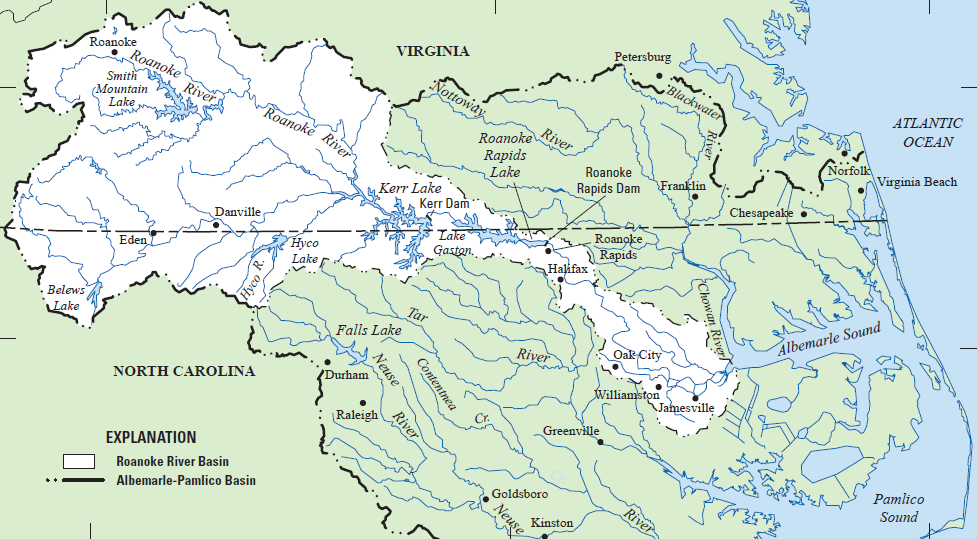
Hyco and Mayo lakes up along the border with Virginia north of Durham are part of the Roanoke River watershed.  That river originates in brooks high in the Blue Ridge Mountains of Virginia and flows down into North Carolina’s Albemarle Sound.

Headwaters are particularly vulnerable to land use changes which is why I’m guessing that special interests, and not just ideology, are behind the push to exempt them from the Clean Water Act.

Rivers are a continuum, a reference coined in a 1980 study that determined, “A river is more than a sum of its parts and that to understand what is happening at any point along the way, you must understand what is happening upstream and what is entering the watershed.”

In North Carolina, 66% of overall stream miles are in headwater streams and 38% are intermittent but because some major rivers and watersheds here are headwatered in Virginia, it is important to understand that state’s make up too.

In Virginia 62% of stream miles are headwater streams.  In the specific area where the Roanoke River begins its journey to Albemarle Sound in North Carolina, 58% of the streams are intermittent while 63% are headwaters.

Angler enthusiasts including many of the 1.5 million in North Carolina along with another 329,000 who visit have spent tens of millions of their own dollars to restore and protect these intermittent streams including 700,000 volunteer hours each year by Trout Unlimited members alone.

In many ways trout are the sentinels of clear water.  It is in these intermittent headwater brooks, streams and creeks that you find native trout such as the Yellowstone Cutthroat I marveled at as a boy growing up near the Henry’s Fork in Idaho’s the Yellowstone-Teton nook.

In North Carolina, it is the Brook trout that is native.

There are still 25 native trout species unique to regions of the country out of the 28 that once existed.  But according to the just-published State of the Trout report, thirteen occupy less than 25% of their historic habitat.

As noted by Chris Wood who is President and CEO of Trout Unlimited, “If you care about clean drinkable water, you should care about trout because they persist in only the highest quality water.”

They are also the “proverbial canary-in-the-coal mine for the effects of a changing climate.”

Wednesday, April 23, 2014

The Meridian of My DNA

My western heritage is sprinkled along settlements my ancestors created in the 1800s down the length of a route that would become the 1,100 mile U.S. 89, a “Blue Highway” stretching from Montana to Arizona.

The “Ponderosa belt,” as I call it for the dominant species of pine tree found along its length, stretches from the cusp of the Northern Rockies through Yellowstone and along my native Tetons.

It crisscrosses the Idaho-Wyoming border then drops down Bear Lake Valley and across the Utah line before jumping across into Cache Valley.  From there this ancestral spine tracks against the Wasatch Mountains as they split off from the southern Rockies.

Then it shoots straight down the high plateaus, alpine meadows, forests, and valleys of central Utah before jogging around the Grand Canyon and giving out on the last reaches of the Colorado Plateau as it spills across northern Arizona.

The roots of my longitudinal DNA never strayed more than a degree after 1847 along nearly the entire length of the 111th meridian west as it dissects the continental United States.

But Mugsy, my English bulldog and I, usually weave back and forth across this route using various scenic byways on the last leg of our annual cross-country-road-trips before collecting my daughter and two grandsons for a week of reunion along the shores of a lake in the northern Rockies.

These byways often take in one or two of the dozen or so settlements my ancestors created along the length of the meridian between 1847 and 1907.  Last year we took a scenic byway along state route 14 as it slices through alpine meadows between Zion and Bryce Canyon national parks.

This year, a different byway about an hour’s drive north will give us a glimpse of one of the world’s oldest and largest living organisms which was discovered when I was in college in the late 1960s by Dr. Burton Barnes, a forest ecologist at the University of Michigan.

Christened “The Trembling Giant” or Pando, this ancient 107-acre grove of approximately 47,000 quaking aspen trees near Fish Lake (8,800 foot above sea level) all share a singular root.  DNA tests by Utah State University geneticists confirm it is one huge clone weighing nearly 7000 tons.

Essentially all one tree, the 80,000-year-old grove is now in crisis.

In fact, USU scientists are rushing to find out why aspens are suddenly dying all over the west.  Aspens don’t grow from seeds.  The grove we’ll see in a few months are all stems off the same plant.

This is because as geneticists have learned, these trees now have three genes.  My uneducated hunch is the problem will have something to do with human activity over the last 250 years and the side-effects of both the first and the second Industrial Revolution which peaked in 2008.

The question is, “Will the far more environmentally friendly third Industrial Revolution now percolating ramp up quickly enough?”

From Fish Lake we return to U.S. 89 and drop 3,000 feet as we head up the San Pete Valley through two areas first settled among Native Americans by two of my paternal ancestors before they began to explore much further north along the route.

In fact, nearly all of my ancestors along this longitude of my DNA lived long enough to see the end of the first Industrial Revolution and the emergence of the second.

As we near the place where my grandsons live nestled on the slopes of the Wasatch, the haze of pollution often visible will be a reminder that 167 years of their ancestral DNA also lies along that same meridian.

They will be in or near their 30s when we reach the tipping point for the new Industrial Revolution now underway.  If too late for the aspens, will it be soon enough to save and restore our planet?

Tuesday, July 08, 2014

Remembering Ott’s Place

The old Jeep my paternal grandparents gave me fifty years ago a month before I turned 16 was already nearly as old as I was.  We had grown up together.

It didn’t have a radio or turn signals, which weren’t common until 1955, or seat belts, which were only becoming common place at the time, and it predated side view mirrors, which were not yet common even on the driver’s side.

Anyone riding in the passenger seat had to use a handle to manually operate their windshield wiper from side to side.

The original paint had worn off so my grandmother Adah hand-painted it the original red leaving brush strokes as a reminder.  Honest…you can’t make this stuff up!

It had plenty of torque, but the top end was between 45 and 50 mph. Marketed as the MC “war wagon,” it was before the “sport” was put in SUV. 

Purely “utility.”

But I loved that Jeep, and even with years of wear and tear around the ranch and the smell of fumes from the gas tank, it was a hit at school, although not the “chick magnet” my daughter called Jeeps of this type when she reached that age.

My first-ever memories of riding in it are with either my dad or my grandfather on quick trips to and from our ancestral ranch and town usually to pick something up from the blacksmith or the coop or if with my grandfather, a quick stop at an old bar called Ott’s Place (smile.)

Apparently, my mom read him the riot act when she learned, but Ott had twice been mayor of Ashton, and besides, my uncle Louie was probably downstairs playing poker.

Slot machines and gaming tables games had been outlawed in Idaho when I was born but in my early years I would still see slots in the entrances of old cafes in remote areas such as ours.

Idaho voters banned both again during my early years but in places such as Ott’s that just meant they were placed out of sight.

Waiting for my grandfather, I would sit on a barstool next to the big picture window in front thumbing through the town calendar with everyone’s birthday on it including surrounding ranch and farm families.

After a little less than a mile on the trip to town, the narrow gravel road dropped steeply down from a bluff to the Henry’s Fork of the Snake River, then crossed over the old Ora bridge beside which I learned to fly-fish long before that river became world-famous.

As the road climbed back up the other side it was suddenly as though you could reach out and touch the Grand Teton Mountains 15 miles to the east.

Ashton, Idaho, then not quite 50 years old, was at its peak population of 1,200 residents.  Its founders had a real estate business along with a drug store and fountain a couple of doors west of Ott’s where we would stop next.

Out front, my grandfather would “kick the tires” with an old friend, Charles C. Moore, who he always called “governor” because a few decades earlier he had been elected from that remote Yellowstone-Teton nook to two terms as the Governor of Idaho.  This was in the 1920s.

Any prescriptions had to be dispensed by Dr. Hargis though, a friend of my grandmother’s who had also been there since the founding and still made house—or in our case ranch—calls, and would for many years hence, although my parents made a mid-summer dash 50 miles downriver to the nearest hospital for my birth.00160_p_10aeuyf6sw0292

On each trip, we would drive past the Hummel Motel where a few months after it opened our family took a respite with our friends the Long’s, from cabin fever when our ranch was snowed in much of the winter.

That’s me in one of the images in this essay showing off some of my moves while stealing my first kiss.  Actually, that day my friend Shawna did the stealing (smile.)

Re-clad in logs and river stone, it is the famed Angler’s Inn today.

Back then schools didn’t close when the road closed to buses after a huge snow storm, so my dad would drive that Jeep through the drifts picking up four or five other schoolmates we collected along the way.

Dad hated school when he was that age attending a two-room school house just north of the ranch.  Back then my grandmother, who served on the school board for more than twenty years, also boarded eight school teachers in our small ranch house.

If the buses still weren’t able to run when school let out, I would wait at my aunt Deon’s until dad could pick me up.

I always thought my old Jeep had been selected because my dad saw them used during in WWII by the Army, but I’ve since pieced together that my grandparents had been partial to Willys-Overland vehicles in the 1920s.

J.N. Willys was a serial entrepreneur who parlayed a bicycle distributorship into ownership of a firearms store called the Elmira Arms Co. which was also a manufacturers rep (wholesaler–go-between to dealerships) for cars such as the Pierce Arrow and the Overland Motor Companies Runabout.

When Overland ran into financial trouble, Willys bought it in 1908, scooped up some related technology suppliers, and renamed it Willys-Overland which was soon the largest manufacturer behind Ford, increasing annual output from 400 cars to 200,000 in eight years while relocating manufacturing to Toledo where Jeeps are still made today.

In 1926, Willys-Overland launched a very advanced touring car branded the Whippet.

My homesteading grandparents had done pretty well during WWI providing draft horses to agents who came through on behalf of the British and American armies.

They had switched to cattle during the roaring ‘20s and that’s when my grandfather fell in love with the Whippet and bought one of the Model 96 touring cars.

That’s my dad sitting on the hood in the image in this essay so that Whippet is probably a model year 1927.

By the time I was first taking rides in our Willy’s Jeep, I had discovered that Whippet abandoned in a grove of trees south of our meadow next to an old buckboard buggy.

At first I mistook it for a Ford Model A.  But my grandfather quickly filled me in on the difference.  The two cars were contemporaries but the Whippet came first and was in some ways technologically advanced, although the Ford Model A was far more prolific.

Linked is a Whippet the same vintage as my grandparent’s on display in a Pennsylvania antique car museum today.  It cost $750 before upgrades when they bought it.  His was probably closer to $1,000 with the larger engine.

Seating five, it was still the most compact of American cars back then, setting speed and endurance records during a 24-hour race at the Indianapolis Speedway when the track was truly brick.

I still manifest those Willys’ roots today.

Tuesday, September 03, 2013

Two Wheel Calculus

I happened onto an accident scene two weeks ago at the base of the ridgeline where I live in Durham, North Carolina.  Moments before I headed down to grab lunch, a car had turned right in front of a scooter, giving no time to react.

As I drove my Jeep slowly past the scene, a paramedic seemed to shake his head almost imperceptibly.   Later I learned that the rider, a cook and a young Durham native in his prime, did not survive.  The driver was charged for not yielding the right of way and misdemeanor death by vehicle.

I returned home and took my much heavier Harley-Davidson Cross Bones out for a spin to shake off the effects from seeing that fatal accident scene and to remind myself how defensively you must ride, anticipating that drivers don’t see you or may do the unexpected at anytime.

Raw statistics show fatalities on motorcycles are 30 times that of cars but that drops 48% by not speeding, another 42% by avoiding alcohol and 37% more if you have antilock brakes.   That puts it far below the average for cars, especially for riders in my age group and when you religiously practice defensive driving.

Also wearing a helmet, especially when it is full face, helps a great deal.  Any DOT-approved helmet helps.  Research shows that riders without a helmet are 40% more likely to suffer a fatal head injury in a crash, 60% of which are the fault of drivers not riders.

Texas gave into special interests who successfully argued for repeal of that state’s helmet law and by doing so validated the research with lives when that state saw a 31% increase in motorcycle fatalities.

Accidents happened in the blink of an eye and ones such as the one near my house may not be avoidable no matter what you do, even if you are in a car.  It is a reminder to live every minute as though it was your last.

As a young boy I learned to ride Honda 50s and 125s across range and farmland.  But I first learned to ride defensively 46-years-ago last week when I purchased a 1967 VeloSolex 3800 from Cycles Pithioud (ad in image below) in what is now yuppified Voltaire quarter of Lyon, France.

Solex was launched in 1946 and I bought No. 4,111,740.  Lyon is a city in east-central France that was founded by Romans in 43 BC.

The dealership in that location which now sells Hondas was about five minutes from the incredible Renaissance and Gothic-laden Vieux Lyon district across the bridges over the Saone and Rhone rivers where they straddle a narrow peninsula through the city where I lived a week or so.

The VeloSolex dealer was also 8 minutes down the Saone from another one of the places where I stayed for a few weeks overlooking the Place du Marechal Lyautey and midway down to where the two rivers merge.

My new Solex was essentially a bicycle powered by a 49 cc engine that you lowered onto the tire where a ceramic roller then powered the front tire through friction.

It was a very cool way to tool around town even given the hard-earned craziness of French drivers, who nonetheless always seemed aware of those of us on two wheels.

My favorite jaunts were over the rivers to the Cathedral of Saint-Jean-Baptiste in historic section or up the hill there to the Basilica of Notre-Dame de Fourvière, places where this Idaho-ranch-boy would regularly sneak in to listen quietly in the near darkness to incredible music.

The little Solex would also chug its way up just northwest of town onto the nearly 300,000-acre Les Dombes.  This is where ancient fish farmers and then later Trappist Monks sculpted 1,500 ponds and lakes out of wetlands.  The rain-filled ponds would also be regularly drained and the clay bottoms mined for bricks or sediment planted with crops and then allowed to refill.

Today Les Dombes is an incredible sanctuary for migratory birds.  It was also easy enough to truck north or south 20 miles through quaint villages to wine vineyards villages.

But the little Solex was certainly not sufficient to get me the two hours up into the gorges of the Alps such as those around Grenoble which hosted the Winter Olympics a few months after my time there and were dominated by the unorthodox Jean-Claude Killy.

A Harley such as I ride today, would have been perfect for the Alps.  In fact, federal Gendarmes, a unit originated at 15th century cavalry, patrolled French highways on huge motorcycles by 1967.

I was never able to master the French-bump method of skiing moguls that Killy popularized.  However, my bother-in-law Rick is a master.  Leaning over and carving around moguls, which is called sculling, was too ingrained in me by then.

By contrast, a “bump” skier like Rick stays just as low but not as far forward and much more relaxed.  Instead of sculling the mogul, “bump” skiers ski the tops, pulling up their knees to absorb it and then using their knees to pivot off.

It was very radical at the time.  Seventeen years after my visit to the Alps along the French border with Italy, as a community marketer for Anchorage, I was part of a small group that won that city the honor as America’s choice to host the 1992 Winter Games.

We lost out to Albertville, France in that same part of the Alps.  Anchorage tried again and lost the bid to host in 1994.  Now a similar committee there is exploring a bid for the 2026 Winter Games.

I prefer to ride a Harley sitting back and relaxed and shifting with my heel rather than crouched forward and toe-shifting as many riders do on other styles of motorcycles.  Young riders may see my style as old-fashioned or traditional.  But hell, what is riding a Harley all about if it is not tradition.

VeloSolex is still manufactured and sold on that same street in Lyon, a nine minute walk from where I bought the one in 1967.  But today they have sleek designs by Pininfarina, a famous Italian industrial design firm that has also collaborate with Alfa Romeo, Ferrari, Fiat and Maserati to create many classic sports car designs.

They even have a very cool fold-up version and an electric version.  Unfortunately, lawmakers have failed to pass legislation to make this type of vehicle safer in North Carolina leaving it possible for people as young as 16 to ride them without a license or insurance.

One dealer who opposed the bill was quoted as saying that he thinks “everybody should be responsible for their own actions…I really think they just can’t demand it all of a sudden and take everybody as a group and make them pay.”

I understand that conservatives worry about losing various liberties.  As a moderate Independent, so do I.  But it astonishes me that they seem to fail to grasp that requirements like carrying insurance etc. whether on a two-wheeler or for personal healthcare isn’t about losing freedom.

Requirements such as these are to prevent the costs of our actions and/or our accidents from being shifted onto other taxpayers and consumers.

The damage to vehicles and to lives is just the tip of the iceberg when it comes to full-cost accounting for accidents.  There is also the cost to families, the cost of investigation, the cost of adjudication as well as the costs to other consumers left by the uninsured.

It seems like requirements like insurance are to preserve freedom, not take it away.  Just sayin’.

I’ll stick with my the Harley, but you won’t hear me whining about requirements to carry insurance, get a license and wear a helmet.  It is as much for others as it is for me.

Wednesday, April 16, 2014

My Second Choice – Still Sense of Place

Growing up, my ambitions were tied to sense of place, first as a cowboy on our ancestral ranch in the Yellowstone nook of Idaho, then in grade school as either a uniformed Forest Ranger or a Fish and Wildlife Officer.

Both were easy to spot in Ashton, the small, nearby town where I started school and provided an inspiration to attend college (as though my parents ever gave me a choice (smile.)

I have always loved wildlife, so running up Ashton-Flag Ranch Road and veering off into the remote Idaho corner of Yellowstone Park was always a spectacular option.

In the early 1900s, my paternal grandfather, Mel Bowman, then 22 years old, helped pioneer the 40-mile route that slices between Yellowstone and the north end of the Tetons.

During the dead of winter between 1910 and 1911, while my grandparent’s ranch lay buried in snow drifts, my grandfather and his brother ran wagon loads of cement along the dirt and gravel road using teams of four draught horses each.

Each trip took four days over and two days back in below freezing weather.  In return they received $80 each not including provisions, horse feed or overnight stays in tepees along the way.

The objective was construction of a concrete dam in order to raise Jackson Lake by thirty feet for the purposes of supplying irrigation water, and eventually along with six other dams along both sides of the Tetons, a source of hydroelectric power.

A view down the Tetons from a ridgeline at the beginning of the road is one of my favorite views of the 40-mile Teton Range.  But this was only one option for viewing wildlife during my early years.

Two other favorite trips including going a mile or two across the Henry’s Fork to the hatchery to see native Cutthroat trout fingerlings and riding horseback into the Sand Creek Elk Refuge that ran down the west side of the ranch including Moose in the wetlands down near Chester.

Less than fifty miles due west of the ranch, the 10,000-acre historic Camas National Wildlife Refuge (shown in this image) is one of nearly 600 nationwide.

Filled each spring and fall with tens of thousands of migratory waterfowl including Trumpeter Swans, the Camas NWR is now at risk.

Center-pivot irrigation technology (the circular farm land you see from an airplane) not only pushed farming out that way in the 1960s and 1970s but it soon began to deplete ground water that kept the refuge’s wetlands wet.

So ironically, the refuge has had to also pump water from the aquifer in order to sustain places for the big birds to stop for rest flying south and returning north.

Probably gone are the days when we could see more than 50,000 ducks and geese in flight all at the same time.  Now the Refuge must be selective about what habitat it can keep viable.

Thinking I might want to be a lawyer, I didn’t turn back to my love of sense of place until part way through law school in Spokane, Washington.

In the 1970s, when I was helping to start the community-destination marketing organization there, we included the huge Turnbull National Wildlife Refuge which was 25 miles southwest in our inventory of nearby things to see and do.

Spectacular flights of huge Trumpeter Swans is what I remember there.  The largest of North American native waterfowl, Trumpeters (for the sound they make) stand about four feet tall but stretched out in flight they measure 6 feet from bill to feet and another 6 to 8 feet in wingspan.

They had become almost extinct before I turned six years old in the 1950s.

When I was recruited to Anchorage to complete another start up, I lived on a steep bluff along the southern edge of the city between Kincaid Park and Discovery Bay overlooking Turnagain Arm, with a spectacular view down Cook Inlet.

The glass wall and front door of my ground floor condo was less than a dozen steps from the bluff’s mid-point along the 33,000-acre Anchorage Coastal Wildlife Refuge that runs along the south side of the municipality from the airport to Potter Marsh, a wildlife area created in 1917 when construction of the Alaska Railroad isolated a wetland.

Our organization lobbied successfully for the bird refuge at Potter Marsh to be interpreted for visitors along a 1,500 foot boardwalk, now one of Alaska’s most popular wildlife viewing areas.

Potter Marsh isn’t just for the birds, including an occasional Trumpeter.  When I lived there in the 1980s, more than 1,100 Moose in Anchorage used the mountain to sea greenways as their highways.

In the spring, the Marsh is where they calved just a few miles from where I lived and worked.

Just around a corner, while still in the municipality of Anchorage you can see Dall sheep (which look similar to mountain goats) climbing a rocky slope just above the roadway, and a bit further, a lookout to see Beluga whales.

There are ten wildlife refuges in North Carolina including Roanoke River which was created the year I moved here, but most are a good ride east from Durham where I finished my career after building yet another community start up with natural place based assets included.

A friend and I may visit one refuge in particular the next time we take the Harley Crossbones to visit friends in Charlotte.  As we cut down across the “heart” of North Carolina and under Uwharrie National Forest this time, the Pee Dee National Wildlife Refuge is on our way just outside Wadesboro.

We forget how much tourism overall relies on infrastructure, including green infrastructure such as the National Wildlife Refuges.  They weren’t created for the sake of tourism, but like much of the nation’s green infrastructure, that is a huge economic byproduct.

Even in cities, natural assets are among the most productive of place-based assets essential to both quality of life and quality of place.

Wednesday, July 02, 2014

Differentiating a Community’s Marketing

I mentioned in yesterday’s essay that part of a start up community marketing organization’s (DMO’s) work should be finding ways to differentiate both the community and the way it conducts marketing.

To this end, in Durham, twenty-five years ago we tried to do as much as possible different from the status quo at the time including:

A magazine size far more comprehensive visitors guide, thorough pre-qualification of leads prior to distribution, in-house graphics for consistency and nimbleness, metrics on everything, earned media over paid advertising, technology, and research to mine data to drive decision and strategy making.

And because we had a much smaller budget, this included reliance on extensive content marketing including the weaving of data into narratives that, in turn, were widely distributed to inform and activate core prospects by differentiating Durham from more established competitors.

Seth Godwin, the foremost wizard of the school of differentiation marketing, wrote recently while pointing out the mistakes Broadway promoters make:

“Just about every organization doesn’t have enough cash to run enough ads to do what ads are best at…so that means…find an arena where you can reach fewer people, more often.”

A t-shirt available in Durham’s organic Ninth Street District reads, “Durham – It’s Not for Everyone.”

Nothing is, so the goal even back then, and even more so now that ubiquity has pushed the effectiveness of advertising into negative territory, is how to identify and communicate directly to the “tribe” for whom it is.

Being different means adapting to change and perpetually recalibrating without losing authenticity.

But it isn’t necessarily about being original as much as what Where Good Ideas Come From author, Steven Johnson, calls the reshuffling, repurposing, and reimaging of things that have worked into a different context.

Many of the differences we deployed in that Durham DMO start up were only meant to give us what I used to call a “20-minute head start,” but I am always amazed to find many that are only now becoming mainstream.

A trend beginning in the mid-1990s and full-blown today is that buyers using “self-education,” are able to go deeper and deeper into the purchasing process before revealing themselves as documented in a benchmark study by Demand Metric.

This is why “content marketing,” a competitive advantage used by community destination marking innovators/early-adopters 25 to 30 years ago, is now clearly mainstream.

It is an efficient, cost-effective and unobtrusive way to draw interest, engage, and inform a purchase decision by members of the external audience for which a community is likely to be most appealing.

Three out of four buyers now wait to reveal themselves until at least midway through the journey when options have already been narrowed.

Nearly 1-in-4 wait until very late in the purchase decision.

As it has been since at least the late 1990s when marketing to leisure travelers, now even site selection decisions by meeting planners, known as business to business marketing, are as much 90% and no less than 66% concluded before any personal contact is made.

This means that people involved in “sales” can no longer be a silo within marketing.  Integrated marketing is now the imperative because the trend of going deeper into the purchasing journey is a trend that will only accelerate.

Content has long ago replaced advertising, (a form of yelling) public relations, (earned media is publicity) and now direct sales, as the most effective way to influence decision-making early in the process.

Long gone are the days when content was something you staged after inquiry or after interest gained while prospecting, when today two-thirds would be ineffective.

Unfortunately for extroverts needing an energy-fix, it is now content first, second and third, with personal contact—if needed at all—is on the tail end.

Marketing software company Marketo, in its “Definitive Guide to Lead Nurturing,” helps map out content strategy to create awareness and deepen understanding and knowledge in early stages before sorting out preference and finally inspiring engagement.

Think of marketing not as a fish net but as selective self-study program that tells the story that matches your community’s “worldview” appealing to those visitors including newcomers and relocating executives who share it.

To paraphrase Godwin’s advice to Broadway promoters, shift to building relationships between and among the core audience, expressing your community’s inherit appeal to its tribe, rather than finding audience for your appeal.

Using content as an overarching strategy to integrate marketing and differentiate communities as visitor destinations relies more on re-thinking, re-organizing and re-allocating existing resources.

This will also mean that not only must every piece of marketing be as deep and comprehensive and useful as possible but they must all be integrated, mutually supportive and objective.

Nearly 6-in-10 marketing organizations devote 15% or less to content marketing, many trying only to stick their toe in the water (oh yeah, that too) or attempting to straddle strategies while appeasing old-schoolers.

Transition to content marketing should be easier for destination marketing organizations than generalist marketers because they should already be an “inch wide and a mile deep” vs. a “mile wide and an inch deep.”

This observation was first made to me nearly 40 years ago by a young F. Richard “Dick” Geist, the then-creative director for Wessels and Associates when it was based in Spokane, just as I was getting my feet wet as a DMO exec there.

But when integrated, content-driven marketing also means previously siloed non-sales marketers in DMOs need today to become intimate with and effective at each stage of the purchasing journey.

They must to learn to rely less on schmoozing and become more savvy as marketers overall, especially the utilization of analytics.

Analysis by Demand Metrics concludes that interactive content is perceived as more interesting and better at generating attention.  It also produces better engagement and is perceived to be better quality.

A predictor of internal or external stakeholders who will respond “who cares” is whether or not they are among the 6-in-10 who think of marketing as an expense compared to the third who see it as a revenue center.

The quickest way to predict which mindset someone has is their resistance to analytics.  Nearly 9-in-10 of those who see marketing as a revenue center aggressively use analytics for decision and strategy-making.

Friday, September 20, 2013

An $11 Trillion Diet Deficit Hawks Can Munch On

A friend and I have recently started walking an additional 12-15 miles a week up and down the many hills in my neighborhood in Durham, North Carolina.  Coupled with eating out half as much, it not only feels great but researchers note it should be expanding my hippocampus.

This is the part of the brain thought to be the central processing area for memory and learning which gets a workout during the 6 or so hours a day I spend researching and writing essays to post on this blog.

At the risk of offending my Tea Party friends who still can’t seem to come to grips with the fact that health insurance is not only for their benefit but to prevent uninsured costs from being shifted on to other people, I recommend a report published last month entitled The $11 Trillion Reward.

That is how much would be saved each year if Americans just increased their consumption of fruits and vegetables and yes, it would ultimately lower the deficit.  No, I don’t just mean those living in Red States which tend toward higher rates of obesity.

I was only saved from the genetic tendency toward being overweight by the fact that doctors discovered in my early 20s that I can’t metabolize sugar very well, including refined carbohydrates.

If they didn’t make me sick, I’d still be binging on my mom’s homemade cinnamon rolls and a big bag of glazed Spudnuts.

But all my life I’ve eaten way too much red meat, not just because I grew up on a cattle ranch, but because a high-protein diet suits me.  But recently I began to substitute poultry or fish four or more times a week.  I know, not very Idahoan.

The report is not only about quantifying savings if Americans increased our individual fruit and vegetable daily intake on average by 1/12 cups of fruit and a mere cup of vegetable, although just that change would save 127,261 lives a year and public savings of $54 billion a year in medical costs.

The scientists and public policy experts who authored the report include proposals for overhauling our entire public farm and food assistance policies by things like:

  • Recalibrating programs to increase R & D and production of fruits and vegetables by shifting incentives to help diversify growers and gearing them to local markets.


  • Grants to spur greater availability of farmers markets and grocery stores in low-income neighborhoods including moving “helping hand” food programs to more healthy choices.

Don’t go all “nanny state.”

This is simply about protecting innocent Americans from the hidden costs related to the actions of others.

Edmund Burke, considered the father of modern conservatism and a mentor to our founding fathers wrote that “whatever each man can separately do, without trespassing upon others, he has a right to do…”

I agree, and I suppose that means that anyone should be free to binge on whatever foods they wish, and businesses should be free to cater to those binges with junk.

But other Americans should not have to shoulder the costs of healthcare consequences of these binges or their binge enablers nor should my tax dollars be used to subsidize either the binging or the creating of the foods that are binged upon.

According to Joseph Thorndike, head of the Tax History Project and author of a book published this year entitled Their Fair Share: Taxing the Rich in the Age of FDR:

The original Tea Party “was a protest not against taxes but against tax loopholes.”

Shifting costs onto innocent Americans because you are too stubborn to have health insurance or to eat what is good for you, is a huge tax loophole.

Friday, April 20, 2012

Growing Up Environmental

Growing up just a half dozen clicks from Yellowstone Park in the shadow of the Idaho side of Grand Tetons wasn't enough to fully awaken my sensitivity for the environment.

That didn’t truly happen until the Christmas Eve of my 20th year when the first images of Earth were beamed back from Apollo 8, the first manned mission to reach and then orbit the Moon.

As the three astronauts aboard that Apollo spacecraft reappeared from the dark side of the Moon, Bill Anders captured the first image of planet Earth taken from Space.

Six and a half months after that Earthrise image was viewed around the world and just a week after I turned 21, Apollo 11 landed on the Moon.  The memories all flood back to me this time each year because it was only eight months later that Americans celebrated the first Earth Day on April 22, 1970.

It was more a demonstration than the festival it has become today, but back then demonstrations were very much like festivals.  The event where I live now in Durham NC, will be in the Downtown Central Park District this coming Sunday, but you can click here to find events where you live.

Fittingly, the day before marks the beginning of National Park Week which will be commemorated in part by the re-airing of the phenomenal Ken Burns documentary series beginning the night of the 21st on public television where I live.  This is a must-see!

I experienced a revelation last summer during a 6000-mile cross-country trip that renewed my acquaintance with six national parks, Roosevelt, Glacier, Yellowstone, Grand Teton, Rocky Mountain and Great Smoky, in that order.

The images of Glacier National Park in the video at this link  provide a glimpse into why a visit there for an SBNR (Spiritual But Not Religious) like me is such a powerful confirmation of the existence of a Greater Power and our responsibility of stewardship to this planet.

These images also kindle an outrage at many things happening today.  But outrage over the environment during my lifetime didn’t begin with the first Earth Day.Fish Dam  The trajectory of that outrage can be traced as follows:

Legislation was passed a week before I was born to set the first national water quality standards in 1948.

Lethal smog episodes first received media attention that fall and by the week after I turned seven air quality standards were first established.

As astronaut Alan Shepard arched briefly into space on May 5th 1961 aboard Freedom 7 during my 7th grade school lunch break, the health effects of nationwide carbon dioxide and other vehicle emissions were becoming a serious concern.  Thirty months later the first clean air act was passed.

During my first year of high school, weeks after a multi-state tour to highlight the importance of conservation and the environment, President John F. Kennedy was assassinated.

My last year of high school was bookended by the first emission standards for cars and recognition of the nation’s symbol, the American Bald Eagle, as endangered.

Ironically, that summer before entering college, when many of us headed up into the Targhee National Forest to assist crews fighting to save towering Lodgepole Pines from a massive outbreak of mountain pine beetles, we were spraying DDT which would be banned six years later as science revealed it as a culprit in killing those Eagles.

Today, just as they were at the first-ever event 42 years ago, many Earth Day attendees will be as outraged at current efforts at the state and federal level to dismiss or undermine what they distrustfully label as “regulatory science” and roll back or gut environmental protections and the agencies that safeguard them.

Many celebrating Earth Day here in Durham may be also outraged if made aware of how lukewarm efforts are to properly fund maintenance of roadsides and parks and other open spaces or to restore, protect and expand urban forests -- all vital elements of scenic character so critical to sense-of-place and quality of life.

The outrage was personal for the 190 volunteers during the recent Creek Week in Durham who witnessed the inadequacies of year-round maintenance efforts as they pulled nearly 12 tons of trash accumulated along just 18 miles of streambeds and shoreline, much of it the result of illegal commercial dumping, though there were also examples of household cast offs.

Any official who still dares to underestimate or dismiss the inadequacies of Durham’s year-round maintenance of the community  will become equally outraged to see the extent of illegal dumping as captured in the image shown above in this blog or by clicking here.

The images were taken in the weeks running up to Earth Day during clean ups undertaken by Durham County General Services waste reduction crews often working with Keep Durham Beautiful.

What is captured in these images are not isolated instances and far outstrip the resources of valiant teams such as these and the City’s Neighborhood Services Rapid Response Impact Team.

Any state or local official tempted to disregard or undermine concerns for the environment should be required to wade through this pollution and I guarantee they will share the outrage and sense of stewardship we should all renew during Earth Day along with a revived regard for “regulatory science.”