Showing posts with label Recycling. Show all posts

Thursday, October 23, 2014

Durham’s 1982 Recycling Social Entrepreneur

I hate playing cards, in part because of the childhood essential tremor manifest in my hands.  Even if that wasn’t the case, I’d be lousy at it.  My facial expressions instantly give away what I’m thinking.

Recently I overheard a friend explain that when the surrounding county rolled expanded pilot curbside recycling out to nearly all of the 11,000 households outside of the City of Durham, not enough was budgeted for roll-out carts.

So a stop-gap was to identify which households didn’t immediately use theirs and then scoop them back up for redistribution elsewhere.

Not exactly results-based accountability but it reminded me that the history of Durham’s acclaimed city-wide curbside recycling dates back to a social entrepreneur in 1982.

Just as I retired he was recognized with several others for social innovation during Durham’s Annual Tribute Luncheon, but unfortunately not for that one.

Dave Kirkpatrick is a serial social entrepreneur who upon graduation here in 1982 from Duke University, locally founded the non-profit SunShares, an early pioneer in both recycling and solar power.

With training in both physics and history analysis, he also saw business model potential in grassroots sustainability, as we would call it today.

His social enterprise was one of the first handful in the nation to incubate the practice of scalable curbside pickup of recyclables, a first using subscriptions.

A year before I arrived in Durham, Kirkpatrick’s quiet intensity had spurred the same City Council members who had spearheaded a billboard ban as part of a broader effort to roll back corrosive blight to set their sights on reducing other types of litter and waste.

In 1988, SunShares teamed with the City to ramp up curbside pick-up of recyclable community wide.

Dave looks more like an economist than a missionary, but he has made his life’s work in enterprise a testament to his faith that waste, including the blessing of natural resources, is sacrilege.

In 1994, five years after I first met him, he moved on to other social enterprises including SJF Ventures, a series of funds for clean tech.  Three years later and a year after Dave was nationally recognized, Durham, where he still lives, made it unlawful to place certain items in trash.

I thought of Dave when a few years ago a local government coordinator let it slip that 80% of Durham’s nearly 70,000 households actively use curbside recycling.  According to some studies that is more than twice the rate nationwide.

Understanding a little about the real value in community benchmarks, I quickly asked, “How do we follow up with the 20% who don’t.”  The answer came back simply, “We don’t.” 

Nor did there seem to be any curiosity to do so even after it was suggested a personal visit might be useful to explain how it works and the benefit to them and their neighbors as well as to gather intelligence.

Just maybe they were newcomers or from areas without recycling or from countries that don’t yet value the practice?  It can’t just be assumed they are all dolts.

Many public servants, about 7-in-10 based on national and sector-wide surveys of workplace engagement, fail to embrace the importance of continuing public education or worse, or just don’t care enough to practice the philosophy of “each one, teach one.”

They may also fail to grasp that the 80/20 principle works both ways.

It could be that the 20% who are not recycling in Durham may also be generating a far disproportionate share of the waste still going into landfills, just as this is approximately the same percentage responsible for littering roadsides and businesses.

Regardless, telling themselves a story that those who don’t recycle; just don’t care, is a huge mistake.  Sure, its 14,000 households but a dozen or so interviews would help shape an effectively targeted direct communications strategy.

Non-profits and local governments deserve credit for scaling up recycling from those early beginnings making feasible private-sector involvement such as Sonoco, which began more than a hundred years ago as the Southern Novelty Company.

It made its name creating packaging for products, but starting in the 1920s very gradually moved into the recycling of that packaging.  Now it operates 40 materials recovery facilities around the country serving 125 cities and towns such as Durham.

Sonoco also consults now with more than 15,000 retailers on how to lessen their waste footprint.

But it was experimentation by non-profit social enterprises such as Dave’s that finally bridged the gap between recycling and what was needed to make it scalable for governments and businesses as a public-private venture.

We’ve come a long way since Dave’s pioneering 1982 startup at a time when even in cities, only between 7 and 9% of Americans were recycling.

But while passionate proactive public advocacy is seemingly in short supply, the job is far from finished with prolific waste stream ingredients such as plastic grocery bags and food scraps yet to be widely incorporated.

Once again, passionate social entrepreneurs may be needed to provide the bridge.

Monday, September 15, 2014

The Featherweight Menace

A comprehensive survey of litter across America in 2008 published a year later showed an estimate, by weight, of 5 million tons.

But that metric is less and less relevant.  Litter simply weighs less today.

That’s also why it is so difficult to believe it has been reduced by 60% since 1969 when the push intensified nationwide to curb this form of blight, including billboards, a legalized form.

Plastic overall contributed nearly a fifth of the litter stream back in 2008 but because of the proliferation of plastic bags and other types of plastic film, the next survey may need to find another metric other than weight.

That report also signaled that surveys focused primarily on roadways are no longer enough.

Other forms of litter declined by anywhere from 74% to 88%, but plastic in the litter stream has jumped an incredible 165%.

An even greater amount is now blighting areas other than roadways.

These off-road parts of the litter stream include transition areas to roadways, loading docks, construction, recreation and retail areas, urban and rural streams and other waterways (as shown below off Fish Dam Road in Durham near a tributary flowing into a reservoir here used for drinking water down in Raleigh.)

In streams and waterways is where plastic bags have become especially ubiquitous, threatening drinking water and even our oceans where they “form large, swirling, glue-like collection zones” in “gyres” comprising as much as “40% of the planet’s ocean surface.”

Having no local government agency fully accountable, places such as Durham where I live, rely instead on volunteer clean up efforts along urban and rural waterways here.Fish Dam

But no amount of volunteer passion can work without agency capacity in the interim, just as no amount of capacity can make a difference without public servant passion.

Public education efforts fail because they aren’t targeted.  Some are fearful of the apparent links between littering as a behavior, lack of education, smoking, depression, obesity, parenting style, poverty and drug use because it may reflect poorly on various groups.

This may be why those involved in cleanup steadfastly refuse to involve forensics or law enforcement to trace origins of litter.

Plastic film such as plastic bags is as light as it is ubiquitous.

This volume-to-weight ratio undermines its inclusion in far more scalable curbside recycling because judging from Madison, Wisconsin, it takes a year or more to collect enough in communities the size of Durham to have a full truckload.

Retailers such as dry cleaners, grocers and general merchandisers, 18,000 outlets in all, now provide recycling barrels for plastic bags.  They can do this because they merely back-haul them in returning delivery trucks and then forward this critical mass to recyclers specializing in turning them back into more bags and film or decking.

Still, while accessible by 70% of Americans, it represents only 18% of recycled plastic film, with curbside another 3%, as of a report on 2012 released this year.  This is only part of the 141 million pounds of consumer-returned plastic bags and wraps returned for recycling.

If the free market was efficient, the cost of cleaning up the bags that are not recycled would be built into their per unit price to recompense businesses and government units overwhelmed by the problem.

But the market isn’t that efficient and billions of dollars in costs are passed off on other businesses and taxpayers.  Because policy-makers are so fearful of anti-tax groups, as is often happening now, the bags clog storm drains, water ways, blight neighborhoods, suppress property values and threaten public health and wildlife.

Anti-tax enthusiasts are essentially believers in the idea of a free-lunch, a dole for the free market.

They tie the hands of officials to clean this sh*t up, leaving the cost of what little removal is done added to the cost of doing business, which gets passed along as higher prices for goods and services, reduced property values and public health.

The question is can we afford these zealots?

Of course, these are the folks who rolled their eyes at the news recently that policy-makers in California have prohibited much of the 14 billion plastic bags handed out by retailers there each year by banning their use in grocery stores and large pharmacies by 2015 and convenience stores by 2016.

According to USA Today, it also allows grocers to charge 10 cents for paper and reusable bags and provided $2 million in loans to help manufactures shift to a new model.

The loans make sense based on a report this summer that paper bag recyclers are moving into the recycling of plastic film such as plastic shopping bags.

The approach of banning post-consumer use is patterned after the success of similar bans by cities and counties.

Nationwide, Americans go through 110 billion single-use plastic bags a year, about 60 per family for every four trips to the store.  It has only been since 1982 that grocery chains began the shift to plastic bags.

Now we use about 60,000 every five seconds, much of which makes it into the litter stream along roadsides and in streams and waterways.

There will be some equally negative—if less visible—trade-offs.  If paper bags make their way into landfills instead of being recycled, they create more harmful greenhouse gases, breaking down faster than plastic bags which break down slowly.

Banning sales or distribution of plastic poop bags to clean up after pets will mean an increase in the toxic wastes in parks, beaches, businesses and the yards of innocent homeowners, not to mention storm runoff and contaminated drinking supplies.

No, all poop isn’t equal when it comes to microbial load.  A recent study along beaches for example have found that 1 dog “fecal event” was equal to nearly 7,000 bird “fecal events,” the next largest animal source.

America’s 83.3 million dogs (not counting those running wild) generate an estimated more than 32,000 tons of waste a day, enough to fill 285,000 fully loaded tractor trailers.

Two or three days of droppings from a hundred dogs is enough to shut down watersheds within 20 miles to swimming.  That’s a hell of a lot of microbial load.

As long ago as 1978, researchers in Massachusetts found that dog feces alone were sufficient to account for devastating closures of shellfish beds there.

A single gram of dog poop can contain more than 23 million coliform bacteria.  Even if people choose to use their own yard as a sewer, in a place such as Durham where each acre receives between 1 and 1.5 million gallons of water each year, it becomes a matter of public health concern for the entire community.

But other than making plastic bags water soluble and toxin free, what other option is there than to restrict their use?  I know they exist because I had to order them one year when we lived in an apartment and my dearly departed English Bulldog, Toady, developed Alzheimer’s.

In a fair world, only the 10% of Americans (including 15% of Republicans, 8% of Independents and 6% of Democrats) whose rabid anti-tax-ness hollows out the capacity to deal with problems such as this would suffer from the diseases and complications brought on by their shortsightedness.

Only the 17% of Americans who litter would shoulder the costs of cleanup.  Only the 15% of Americans who never clean up after their dog would step in it or have it pollute their drinking water.

But the world isn’t fair, nor is the free market sufficient until such time that it comprehensively incorporates “full-cost” accounting.

Tuesday, April 15, 2014

The Value of Coming In Third

I didn’t remember that my adopted home of Durham, North Carolina is only one of 150 communities it serves, when SONOCO awarded it a Bronze-tier Sustainability Star Award this month.

Durham is no stranger to accolades, especially in the sheer breadth of areas recognized, but in my former career as a community marketer, I would usually breeze past one like this to immediately dig down into the rating scheme and how the community could improve.

Beyond validation, accolades serve as a vanity metric for some but the true value of any ranking, if scientifically done, is as an extremely useful diagnostic to shed light on areas for improvement.

More later in this blog on why accolades are a double-edged sword when it comes to community marketing.

In this case though, it was apparent that Durham was one of the few—if not the only—community awarded at any of the three tiers and that in addition, Energy Digital has named Durham a “Top 10 Recycling Community in the US.”

Durham was the only city in the Southeast to make the list, falling right after Madison, Wisconsin, which hopefully it will soon emulate at recycling plastic film such as shopping bags.

Making its appearance in the top ten even more remarkable, North Carolina as a whole ranks 41st at recycling.

Durham recycles 1,000 tons of material a month (2 million lbs. – 8 lbs. per capita) so it is easy to fall into the trap of thinking this must be the norm everywhere until you read about some other pretty cool cities that really struggle with recycling.

It is also important for Durham to remember that SONOCO Recycling alone now collects 292,000 tons of material a month or 3.5 million tons a year.  If they aren’t already doing so, SONOCO could help us establish a per capita benchmark for which to strive.

Beyond their diagnostic value, community accolades are a signal of quality.  But care must be taken when using them to leverage awareness through community marketing for visitors including the more than 8-in-10 who secretly shop a community as a visitor first.

The accolades provide reasons to believe in Durham’s deep-rooted values and personality traits but a study published last year shows The Paradox of Publicity.

Community marketing is about helping people make decisions that are best for them, and Durham is not for everyone, no community is, but especially one such as this with a strong sense of place and identity.

The study shows there may be more enduring value in not being first in a ranking or accolade, which according to the researchers, if not used carefully, can lead to adoption by audiences who would not have been attracted otherwise.

This can lead to a backlash and disgruntled individuals.  This is why community marketing arms must do their best to provide a full range of content that will help potential visitors, newcomers and relocating executives find the right fit, even if it isn’t your community.

In other words, don’t be quick to discount missing out on first place.

An example is another recent ranking of metro areas by a series of indices that rate sprawl.  When I first looked at the work of researchers at the University of Utah, I questioned if they had been careful to look at variables such as whether the region is polycentric.

Fortunately, they also provided the measure by county, which in a polycentric area, more accurately reflects how people live and perceive where they live.

At this level, the indices reflected accurately what I know to be the differences between Durham and other counties in North Carolina (pages 33-34.)

Sometimes, using rankings or accolades requires digging more deeply into the metrics before publicizing them as a means to help prospective residents, as well as officials, make decisions.

I was shocked recently to hear two people, one in my former profession, question the value of undergoing an in-depth organizational diagnostic for accreditation or reaccreditation.

Communities have very different personalities unless they have surrendered theirs to emulate others.

But I can’t imagine a community that would tolerate having representatives that aren’t accredited or eager to seek any diagnostic that would ensure they are proficient.

Don’t give me the bunk that you are too busy, or in my mind, you better be busy looking for a new line of work.

Tuesday, March 18, 2014

A Best Practice Quasi-City

On October 27, 1969, my parents met my plane as it landed at Seattle-Tacoma International Airport.  Except for one or two weeks, I had been away from home for more than two years.

The world had changed.  I had changed too, and it was good to set foot again in the Pacific Northwest.

That day I was one of fewer than 14,000 people to pass through that airport compared to the nearly 100,000 who pass through it each day now.  By contrast, 24,000 people pass each day through RDU, the airport co-owned by Durham, North Carolina where I have lived the last 25 years.

In arrival greetings and other communication and marketing materials, airlines often confuse cities and the airports that serve them.  Airports are merely portals, and as it was for me that day in 1969, the final destination for most arrivals lies well beyond their primary cities.

But hosting 100,000 people a day and providing them with water, food, shopping, entertainment and security, not to mention solid waste and other sanitary disposal, makes a facility like SEA-TAC much like a city.

Most airports don’t make it convenient to recycle but SEA-TAC has been a leader in recycling over more than two decades, not just on the passenger side but also behind the scenes for its restaurants and what is called off-aircraft - the trash, food waste and other recyclables cleaned out of aircraft before they continue on.

Seattle, one of the cities the airport serves, is well known for coffee and not just as the home of Starbucks.  SEA-TAC collects more than 12 tons of coffee grounds each month from more than 60 airport shops using special bins.

The grounds are mixed with yard waste and sent to a composter, the results of which are then used on the airport’s landscape.  Cooking oil is collected and sold to convert to biodiesel.  More than 20,000 unopened meals are donated annually, and the scraps captured from passengers, shops and aircraft are recycled.

Airlines and concessionaries are charged for trash but recycling is free.  SEATAC is not only meeting the expectations of residents along the Puget Sound but they are saving nearly $200,000 annually in fees.

Since 1993 when the airport collected 112 tons, the amount of recycles collected annually has grown to 1,706 tons while solid waste sent to landfills is now only only 1,444 pounds more than it was in 2001.

The recycling rate at the nation’s best practice airport has increased from 9% to 30% in the past decade with a goal of 50% by the end of this year.  This will exceed the 34.5% of municipal solid waste now being recycled nationwide.

Most Americans have now learned to recycle at home.  The challenge is getting them to do so when they are at school, work, shopping, eating out and/or traveling.

Communities such as Durham, where residents have an extraordinary level of pride in their community, are lulled into complacency by resident values.  But 2-out-3 people working here don’t live here and another 9 million annually are visitors.

Studies such as those I have linked in this blog suggest that just as residents are less diligent about recycling away from home, non-residents may be even less so.  Strategies in communities must take the entire street population into account, not just residents.

More than 1-in-4 Americans make no effort to recycle including 1-in-3 Southerners.  Apart from home, 60% of Americans recycle often at work.  But the percentage who rarely or never recycle increases to 35% along town or city streets, 38% when out shopping and over 50% when dining out.

Over 60% of Americans try at least sometimes to recycle when they are traveling, 18% rarely do and nearly 1-in-5 Americans never do.  SEA-TAC has learned that the challenge is not just providing receptacles or making them ubiquitous (as shown in the image above) but also making them obvious.

The ones I see along city streets where I live seem far too subtle.  Even the ones being positioned in the new Diamond View III building that walls off the last remnant of the Durham Bulls Athletic Park from the Durham skyline may still be way too subtle.

SEA-TAC International Airport has found the right balance of integration, aesthetics, placement and communication with its receptacles but its success comes from a strategic commitment to sustainability overall including related infrastructure.

In fact, cities interested in studying this airport as though it were a community could find no better example to visit.

Monday, March 10, 2014

A Long View of Disposable vs. Recyclable

A few weeks ago, during a brief visit with family in the Pacific Northwest, my brother-in-law showed me a fascinating 1937 Sears, Roebuck and Co. catalogue he had purchased at a benefit.

According to a new study of the near term changes in retailing produced by IBM and the NYU Stern School of Business, Sears, along with Montgomery Ward and J.C. Penny, used books such as these in the early 1900s to create modern retailing.

Fragmentation in retailing began in 1975 and by the year 2000, consumers took increasing control.  By 2020, the already $1.3 trillion Millennial market will be fully in charge.

A benchmark report by Retail Systems Research released last month notes that 60% of “product selection” now occurs before shoppers leave home.  Mobile influences will skyrocket from 50% of purchases today to 75% in three years.

But the report also predicts that mobile use will eventually become the “glue that ties the physical and digital shopping experiences together.”

This is because, the report notes, “People like to shop.  Shopping is entertaining and fun.”  Retailers that will thrive are those that integrate mobile into that in-store experience as well as use it to empower employees.

But digital isn’t the only condition that will revolutionize retail. 

The IBM-NYU report notes one huge condition that will impact communities is that physical retail space doubled between 1980 and 2010, far faster than warranted by retail sales.

Contraction of that space is accelerating, while much of what will be slower growth in retail sales overall will be online.

Empty retail space flooding back on the market will make it even harder for traditional “brick and mortar” retailers, especially independent, locally owned stores so crucial to quality of life and distinguishing community sense-of-place.

We’ve already heard analysts call for retail giant Wal-Mart to close 100 of its stores as the company moves to smaller footprints half as big in urban stores as noted in this article by a friend, Ed McMahon, who holds the Charles Fraser Chair for Sustainable Development and Environmental Policy at the Urban Land Institute.

According to ULI, there is now more than 1 billion square feet of vacant retail space in America, (mostly in empty big box stores,) largely because the developer-driven churn expanded retail space 5 to 6 times faster than growth in retail sales.

Local governments who haven’t already are well advised to start thinking strategically about how to help locally-owned retailers survive while surviving the upheaval in property values vacant retail space will create.  It begins by stopping the insidious practice of subsidizing developers that cater to chains.

The contraction of physical retail space won’t be pretty and the consequences of years of developer-enabled churn will collapse back on communities, neighborhoods and residents.  On the bright side, much of this space is disposable.  The buildings weren’t made to last anyway, compared to historic structures undergoing adaptive re-use.

As noted in the book entitled Retrofitting Suburbia: Urban Design Solutions for Redesigning Suburbs, by Ellen Dunham-Jones and June Williamson, professors respectively at Georgia Tech and City College of New York, communities are being left with millions of acres of “underperforming asphalt” including dead or dying strip malls. 

This may also be an opportunity for communities to greatly expand the ratio of open space and green infrastructure such as urban forest, reminiscent of the early 1800s when so much farmland was vacated in the east as people migrated westward.

It is also an opportunity for communities to become more sustainable, replacing retail innovations such as the disposable economy which  began in the mid-1800s with paper shirt fronts and cheap watches according to a fascinating book by Giles Slade entitled Made to Break: Technology and Obsolescence in America.

This occurred about the time Singer and McCormick began “branding” products.  The advertising industry was born to sow the seeds of consumer dissatisfaction and by the turn of the century, retailers were incorporating the ideas of obsolescence and disposableness into products.

By 1920, for instance, “55% of American families - nearly every family that could afford a car – already owned one.”  So General Motors innovated the “new model year” with incremental and mostly superficial changes.

Retailers had even used disposable products to undermine calls for frugality to aid the war effort during WWI but by WWII, the ethic of recycling took its first toehold among consumers.

Following WWII, buildings, too, were built on the “cheap,” purposely designed not to last or to ultimately be repurposed as earlier buildings have been but to be cookie-cutter and generic and to be torn down and replaced.  This purposeful churn has induced sprawl, and in many places, all but extinguished sense of place.

Today, public opinion polls in the United States show that 82% of Americans “feel a sense of pride” when they recycle and the feeling extends to historic preservation and adaptive reuse of those buildings not built to be disposable.

Troubling is that according to Harris Interactive this feeling is lower among men and younger generations.  But overall, the ratio of those who feel strongly about this sense of pride in recycling is 5.5-to-1 positive.

More than 6-in-10 Americans feel a sense of guilt when they don’t.

Today, 3-in-4 Americans make an extra effort to recycle outside of their homes with 58% doing so at work, 22% as they walk along city streets and only 16% when they dine out.

Only 22% do so when they are traveling, where airports, train and bus stations, as well as hotel rooms, lag far behind in making recycling convenient.   A few hotels now have two in-room waste receptacles with one green for recyclables.

Seattle-Tacoma International Airport is a best practice example of how to make recycling easy in airports and other public transportation facilities.  Nearly half of all travelers never or rarely make an effort to recycle.

Harris surveyed only adults, but another area of disconnect for recycling outside the home is in public and private schools.  All of this is to say that communities engaged only in getting residents to recycle curbside are missing many other areas in which they should be concerned.

Another huge loophole are apartment complexes and their renters.

Something confirmed in studies of littering is that 54% will trash a recyclable if a recycling bin is not nearby and 17% will throw it on the ground from where it eventually threatens water supplies.  This percentage is significantly higher in the South.

Significantly, nearly half of Americans now think explicitly about disposal when they look at buying something.  That percentage falls to 41% in the South, though.

Most troubling is that a full third of adults in the South make no extra effort to recycle, according to an enlightening book published last year entitled, The New Mind of the South, by reporter and essayist Tracy Thompson.

Noting that individual rights—including property rights—are a central American value, the book concludes that in the South we take them to an extreme, blinding us to the rights of groups such as those seeking the right to have clean air and water and scenic beauty.

This often lies at the heart of struggles that seemingly make no sense, such as reactionary legislation in my state seeking to make North Carolina known for huge, mega-landfills and desecration of roadsides as well as the state’s reputation for scenic beauty..

I assume this same mentality will argue against sustainability and in favor of disposable consumerism and developer churn as well as urban forests and green infrastructure.

I suspect some will respond to the strategic issues in this blog with “good, we don’t need quality of life and sense of place anyway.”

We’ve got a ways to go.

Wednesday, March 05, 2014

Channeling More Recyclables Into The Circular Economy

With the exception of the footprint of my house and five strips of lawn for accent, 83% of my .3 acre lot on a forested ridge two miles from Durham, North Carolina’s city center is natural area.

However, this doesn’t mean it requires less upkeep.

We share this space with a grove of 100+ trees, a combination of mature hardwoods and pines, with about another 100 understory trees, shrubs and bushes.  Each year at this time, about 3 tons of leaves, needles and cones are scooped up from the 86% that is not densely ivy covered and taken for composting.

This is followed by redistribution of about 8 to 9 tons of fresh hardwood mulch.  I love working this landscape but I obviously leave a task of this magnitude to professionals.  It is my contribution to Durham’s urban forest.

I wish my community’s yard waste was composted but it is hauled several miles away northwest to another county where a company converts it into enzymes.  There are more progressive communities in this area such as Goldsboro, which is about 78 miles southeast, that do this kind of composting.

There, about about 9 dry tons a day is fed into a biosolids composting facility where after 30 days followed by 40 days of curing time, the output is screened in two sizes of mulch.

Some is sold to landscapers and golf courses with the remainder resold by garden centers as well as used in parks.

After visiting this facility in 2004, Mont-de-Marsan, a similar-size community in southwest France, built a similar facility that processes five times more or about 48 tons per day.  I hope Durham officials paid a visit as they hoped when I brought Goldsboro’s facility to their attention.

According to this EPA fact sheet that describes the process, it includes yard waste, wastewater solids, residential and commercial food scraps and agricultural by-products.  Before the recession, more than 3,500 cities and counties in the US were composting.

A national survey by Harris Interactive released last December found that 7-in-10 Americans are not composting food waste, but two-thirds would if it was more convenient in their community.  A quarter strongly agreed compared to 13% who strongly disagreed.

More telling, among Millennials (ages 18-39,) that proportion increased to 3-in-4 with 8-in-10 saying they would use the resulting products compared to two-thirds of the general population.

Policy-makers should use this generation when planning to recycle food waste.  Even in the South which has the lowest level of composting, 8-in-10 residents understood the importance of recycling food and yard waste, higher than the general population.

Unfortunately, three in five Americans don’t want to pay for it, the result, I believe, of the reluctance of elected officials to link public services with costs over the last four decades, gradually reducing services instead.

In Seattle, a city two and a half times the size of Durham, residents are offered curbside recycling of food scraps, by placing the food scraps in approved paper bags and then in their yard waste cart.

Durham currently has an RFP out on something related, but unlike Durham, Seattle requires this and other types of recycling by apartment dwellers as well.

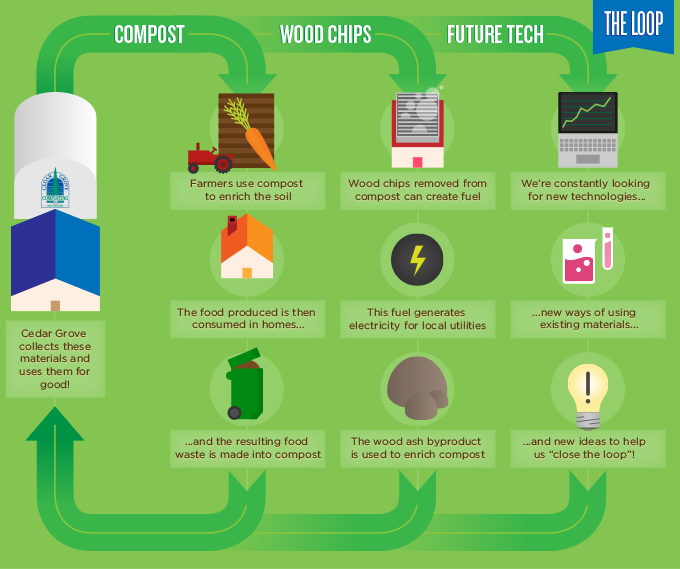
Seattle sends the yard waste and food scraps from curbside and alley collections to two composting facilities operated by Cedar Grove in Everett and Maple Valley which collectively compost 350,000 tons of residential and commercial yard and food waste annually.

Branded, Cedar Grove resells the recycled materials by the bag or in bulk for gardens, potting, top soil, lawn and mulch to farmers, residences, landscapers and other users.

The family-owned business expanded into composting in 2003 and uses the GORE™ Cover System rather than the in-vessel approach used by Goldsboro.

Hopefully, Durham will soon move toward curbside collections of food scraps along with aggressive composting of these items along with yard waste, waste water solids etc.

Based on the Harris survey, Americans increasingly understand the importance of the “circular economy.”

Friday, January 17, 2014

The Recycling Conspiracy

In a downpour last Saturday, my Jeep was one of nearly 900 personal vehicles snaking through the County Stadium parking lot in my long-adopted home of Durham, North Carolina.

Collectively, souls driving these vehicles dropped off 14 tons of electronics and another 36,000 pounds of paper.  It is one of several events held each year to make it convenient for residents to recycle e-waste, items not accepted curbside for bi-weekly pick-up nor in garbage disposal.

That’s an average of 32 tons per vehicle, obviously considerably less in my two-door Rubicon.   I had begun assembling items to take for collection a few months earlier and still forgot several items.

In a community northwest of Durham, the waste is stripped down and each element, including precious metals recovered, are returned to manufacturers to be made into more products of this type.

If we lived in a world with “full-cost” accounting the components of every product we buy including food would go full circle like this.  Then there would be zero waste and the built in financial incentives would result in zero litter, for that matter.

This would be both because the cost of waste, litter removal and recycling would be built into the marketplace and because the value and cost would be built into the product instead of shifted onto the general public, more specifically taxpayers.

Today in the U.S., only 27% of e-waste (anything that plugs in or runs on batteries or a motor) is being recycled, 19% if you go by items vs. tonnage.  This includes 40% of computers, 33% of monitors and copy devices and only 17% of televisions and mobile devices.

In other terms, Americans generate 4.41 tons of e-waste each year and of this only 850,000 tons or one quarter is being recycled.  The rest ends up in landfills or incinerators rather than being captured and reused by the marketplace.

The good news is that we are recycling nearly two and a half times as much as we were a dozen years ago but as of 2012 on average, each American household was spending $1,312 on new electronics annually, accumulating an average then of 24 distinct products.

Different than other appliances, the the vast proportion of the environmental impact from electronics is in their production, not their use.   Using one ingredient – aluminum - as an example, recycling reduces that impact by 90%.

On top of that, reuse compared to disposal, using computers as an example, creates 296 jobs for every 10,000 tons disposed each year.

Cost is often given as the reason these items can’t just be placed in curbside, single-stream recycling.  The prohibitive cost is apparently separating them from other recyclables.

You would think that curbside administrators would be working furiously to resolve this just as they have had to do with every other recyclable item, but there is more than bureaucratic inertia slowing that process.

You probably have to be my age to remember The John Birch Society, but the ultra-conservative group is still around.  They made everything a Communist conspiracy beginning in 1958, when I was ten years old.

Before it became popular within the Republican Party, this society sought to purge moderate and liberal Republicans from that political party, even labeling moderate Republican President Dwight D. Eisenhower a tool of Communists.

The group lost influence, credibility and membership after the 1970s but it still exists and its ideology is promoted by other groups less tainted or rebranded.

About a year and a half ago, the Society’s bi-weekly publication The New American that curbside recycling is a conspiracy to undermine American values, this time by environmentalists.

It doesn’t take much to suspect the group’s finger-prints were on so-called regulatory reform legislation passed recently by North Carolina lawmakers, giving new life to landfills - mega-landfills – and surrendering public roadsides to billboard blight, eroding the state’s brand as “Beauty Amplified.”

When I relocated to Durham in 1989, nationwide there were already 1,000 curbside recycling programs.  Within two years there were 4,000 and now there are more than 10,000 in addition to tens of thousands of recycling centers.

But curbside recycling began in 1874 in Baltimore, Maryland, nearly two decades before the founding of The Sierra Club, a connection ripe for conspiracists I suppose.

Trash became a national policy issue for Congress in 1965, the year after the all-aluminum can was introduced and four decades after landfilling became popular, ironically promoted as a way to reclaim wetlands.

Obviously conspiracists would see linkage, although municipal dumps date to 500 B.C.

Recycling, beginning with paper, dates at least to the first century of 1000 A.D..  Patriots and American Revolutionary War soldiers were big recyclers.  Recycling peddlers in the 1840s were among America’s earliest entrepreneurs.

The Salvation Army made recycling philanthropic in 1865 and materials recovery became a municipal function in New York City in 1897, at the dawn of the Progressive Era when recycling and reuse programs shot up, ah, definitely a conspiracy then!

Recycling became a patriotic duty in America during the two World Wars and there you have it, recycling comes full circle as a Communist conspiracy.

Friday, December 13, 2013

Durham’s Food Scrap Entrepreneurs

A few months ago, a start-up in Durham, North Carolina where I live began Tilthy Rich Compost, a business that picks up food scraps from subscribers on a weekly basis, then turns it into compost a few miles from downtown.

Currently, the service area is approximately a five mile radius of downtown and expanding.  Pick up is mostly by bicycle for neighborhoods and a truck service for commercial clients.

The company will even return the finished compost to you if you wish, for use in your garden or landscape.  They also offer the service to restaurants, commercial kitchens and cafeterias.Tilthy Rich Compost

At our house, we only eat at home a few days a week, but they have a smaller bucket for people like us and a larger bucket for families that eat at home regularly.

The new company is emblematic of Durham’s distinctive entrepreneurial personality, in particular social entrepreneurship.

Forty percent of the nation’s food supply goes to waste and I am sure Durham is no exception.  Residential food scraps alone make up 12.4% of municipal waste across America, a greater percentage than plastic.

In restaurants, according to the report Wasted, analysts at the Natural Resources Defense Council calculate that 4% to 10% of food becomes waste during preparation before it gets to the consumer.  Another significant portion is served but not eaten.

Approximately 10% of fast food is discarded because it has been prepared but not purchased within safe time limits.  At home, Americans throw out approximately 25% of the food and beverages they buy.

Often, if you are like us, food products are discarded either because  plans change and they spoil or because I in particular am one of those people perpetually confused by “use by” and “best by” date labels.

Even before consumers buy groceries, a food industry consultant estimates that up to one in seven truckloads of perishables delivered to supermarkets has to be thrown away.

Analysis in the United Kingdom estimate that if food scraps were removed from landfills there, greenhouse gas abatement would be the equivalent of removing a fifth of all cars in that country from the roads.

By the time I retired four years ago, 90 cities and towns in the U.S. had begun offering food waste collection, double from two years before.  North Carolina composts below the average for the Southeast.

I suspect though, that a personalized and scalable service such as Tilthy Rich Compost will always be in demand.  In our part of the country, as a developer-friend of mine jokes, soil so easily becomes compacted that it almost qualifies as impervious.

We need all of the compost we can get.

Monday, November 25, 2013

Adapting “Broken Windows” to Big Sweep

I have always wondered about something, and I’m afraid the answer is again, no.

Each year, residents in Durham, North Carolina, where I live, participate in NC Big Sweep.  This program dates back to 1987 when it became the nation’s first statewide clean up of waterways.  This year 411 volunteers participated here, five fewer than last year.

Over the course of 15 miles of waterways on 23 different sites in Durham, these volunteers picked up 436 bags of debris, about 18% of which was recyclable.

There was less mileage covered this year, but twice the number of bags of trash retrieved.

This year they picked up 960 lbs. of bulk items that can’t be bagged, down from 13,533 lbs. last year but still this included 45 tires or 3-per-mile as well as items such as these:

toilet – radio – cane – plywood – sign - bike frame - 2 vacuum cleaners – rug - 4 florescent light tubes - 1 plastic crate - 5 bed mattresses/box springs - roll of wire fencing - carpet & padding - 6 TVs - 7 shopping carts - one newspaper stand – large road closure sign - 2 blankets - metal pole from street sign - wooden boards – plastic shelving unit two shelves high - 3 bicycle frames - a long metal strap (six feet) - wooden stool/furniture - orange cone - car tailpipe – signage - scrap iron – large rusted metal piece – planter - 2 basketballs - 1 basketball hoop base - one exercise ball - one door to a kids playhouse - 2 five gallon drums

My question this year, as it has been for the last four, is “will forensics be conducted on any of this material to identify perpetrators or at the very least understand some patterns that will inform strategies to curb the junking of these waterways in the future?

Things such as addresses, serial numbers, manufactures, as well as GPS tagging can help trace this litter back to perpetrators or close enough to send a signal that they aren’t invisible.  The information could also be used to help position better lighting and even portable, wireless cameras to help with future identification.

Whenever I ask, both body language and comments from those involved portray a sense of futility that I am certain is common to other counties.

Crime overall (and what was found in these waterways is a crime)suffered from this phenomena until the mid-1970s when sociologists such as George L. Kelling persuaded law enforcement agencies to put “order” back in “law and order.”

Kelling, a professor emeritus at Rutgers and the late James. Q. Wilson coined the term “Broken Windows” in 1982 that has been largely responsible for the dramatic reduction in crime in many cities.  It was based on the success they had in rejuvenating the New York Subway System by focusing on “appearance” as an overarching strategy.

Essentially, it involves eliminating minor crimes as a means to reduce major crime.  Some police departments are dusting it off again as a way to reduce traffic accidents including those involving bicycles.

But it is astonishing to me how stubbornly resistant other agencies seem about adapting this now well-proven approach to the reduction of litter including the intentional pollution of waterways.

A friend told me recently that the parks and recreation department where I live has given up on repairing rest room fixtures because they will just be vandalized again.  Another indicated that solid waste is reluctant to put blue recycling barrels (with two holes in the lid) in parks because they think people will put trash in them instead.

This makes little sense.  About 10% of the stuff people put in recycling carts is trash anyway but recyclers have long ago figured out that it is easier to remove it than to let up on the effort to educate people to recycle.

The sense of futility that underlines this lack of determination to overcome the problems in parks is understandable at some level but infuriating at another.

We’re just going to give up and retreat or ask volunteers to slog out once a year and clean up a few miles?  The answer is counterintuitive as it was for reducing major crime,  but they both start with forensics to understand both the problem and the solution.

Kelling and Wilson were able to turn around the subway problem by persuading the authority that ran the system to focus on two things, a adopting zero tolerance for graffiti on cars and cracking down on people jumping turnstiles.

They did that by forensics.  It turned out the people jumping turnstiles had outstanding warrants.  I’ll bet there will be a linkage between criminal pollution of waterways and more serious crime here too.

It is worth a try, even if just to give hope and encouragement to volunteers trying to put a small dent in the mess along waterways.

Friday, November 15, 2013

Choice Architecture–Changing Defaults

A flashback on this, America Recycles Day, has me wondering if recycling may offer a possibility for the eventual home of a full-fledged Museum of Durham History, once it moves beyond the current avatar.

When I first visited Union Square in San Francisco, it was late September 1981.  A friend with Alaska Airlines, which had begun service to San Francisco two years earlier, had arranged for a group of us to fly from Alaska down to Oakland to see the Seahawks play the Raiders (Raiders won.)

On the way back to the airport, I asked if we could stop a few blocks west of the Square to see what was the late Bill Kimpton’s first boutique hotel, the Clarion Bedford, which six months earlier had launched a movement that is still revolutionizing lodging today.

Bill created a collection of very distinct properties, each with its own personality and its own chef-driven restaurant.  The Clarion had been a hotel owned by Lord Wedgewood (China) but essentially Bill took the idea of adaptively reusing old buildings to a new level, which is a form of recycling.

Union Square was originally just a park developed in the 1850s on the site of a huge sand dune.  But after the earthquake of 1906 there was talk of turning it into a parking lot, which then morphed into excavating an underground parking deck below the park and plaza, a form of recycling.

That idea didn’t win over voters until the late 1930s after San Franciscans had bet their homes to finance the Golden Gate Bridge.  When I visited, just as the 1980s got ready to economically boom, Union Square was being surrounded by high-end luxury stores.

A luxury hotel, now rebranded a J.W. Marriott, was erected by John Portman seven years after my visit, midway between the Square and the Kimpton’s Clarion Bedford.  That it marked the end of one era and the beginning of another was emerging during a stint there during a several months between gigs in  my field of community marketing.

Portman had started his career in the 1960s by ingeniously making adaptive reuse (a form of recycling) of a parking deck in Atlanta to create a Merchandise Mart.  In the 1970s and 1980s he made his name in hotels during the “brass and glass” era.

First it was by setting a new standard with the design of Hyatt Regencies and then in the 1980s, Marriott Marquis’, one of which kick started adaptive reuse of Times Square in New York while, regretfully, demolishing five historic theaters in the process.

Emerging out of controversy, the hotel was ultimately required to incorporate a new theater on the third floor.

It is clear in hindsight that the 1980s were bookended by the beginning of the boutique movement and the end of the era of huge atrium lobbies and rooftop restaurants.

Lodging began a transition, which is still underway, to Kimpton’s infinitely more distinctive and genuine community-connected approach now being emulated by chains.

Parking decks have evolved too.  Long viewed as uninspiring if not downright ugly necessities, many today are hidden inside retail and residential complexes or wrapped in disguise by developments like hotels or facades.

But old and new public decks are now are being adapted to feature retail or or restaurants or cultural facilities such as museums and galleries on the ground floor with rooftop residential and public spaces.

There is no reason a future new or renovated deck in Durham, North Carolina where I live can’t incorporate, on the ground floor, the 20,000 to 30,000 square feet typically needed by a local community history museum, which come to think of it is itself a form of recycling.

A good example is the State Street deck being built by local government in Sarasota, Florida as part of an agreement with a developer and rendered in the image in this blog.

A big part of getting institutions and individuals to recycle is a behavior called “choice architecture” in the book Nudge: Improving Decisions About Health, Wealth, and Happiness, written by Dr. Richard H. Thaler, a behavioral economics researcher at the University of Chicago and Cass Sunstein a professor of law at Harvard.

Getting people to recycle or adaptively reuse involves changing defaults.

One example is called “reverse recycling” which means switching up trash receptacles so trash goes in the little saddle bags once meant for recyclables and recyclables go in the much larger basket usually used for garbage.

A few years ago, I persuaded our sanitation department in Durham to replace my broken trash cart with a much smaller one since I was rarely filling the larger one after the city distributed much larger roll out carts for recycling.

Persistence paid off but I realized the department was stuck with the huge cart being the default.

But there is evidence that if the city gave every one the choice of a smaller cart along with a reduced fee, people would switch defaults and think recycling first and garbage second.  Here is a Nudge blog post showing how changing that ratio works and explaining why.

Studies show the same is true of grocery shopping carts.  Researchers at New Mexico State University found that people made healthier choices about food when carts were marked with tape showing where to put fruits and vegetables.

I love the smaller carts at Kroger and Food Lion but there are only a handful available, and usually none at Harris Teeter where I shop.  It is probably not coincidence that the smaller carts are the default at the more sustainability-focused Whole Foods in Durham.

The second call to action in the recycling slogan is “reduce.”  I bet the choices would be healthier if all stores made the smaller carts the default and the larger carts the exception.

All of these stores need to follow Whole Foods’ lead and at least reverse the ratio of large to small carts.  The first word in the slogan for recycling is “reduce.”

Friday, September 06, 2013

Uncommon Bag Sense

Trex is a Virginia-based company that was formed in 1996 through the buy-out of a former division of Mobil Oil three years before it became ExxonMobil division.

The company now annually recycles over 1.3 billion plastic shopping bags and film into composite decking, porches, trim, outdoor furniture and fencing.

In the U.S., we use about 100 billion of these bags a year.  Headquartered in the Shenandoah Valley, Trex leads an industry that now repurposes 55% of the postconsumer plastic film recycled in this country.

The company runs a challenge each year beginning on November 15—America Recycles Day—where schools and communities compete for prizes such as wood benches, by collecting plastic bags from cereal, salt, produce, bubble wrap, Ziploc type bags, ice bags, newspaper sleeves, dry cleaning bags, bread bags and grocery bags.

Over the past six years alone, Trex has salvaged and kept more than 2.5 billion pounds of plastic and wood scrap out of landfills.  Most plastic film like grocery bags are recycled in the U.S. when consumers take them back to collection points in more than 12,000 retail outlets including dry cleaners.

It is fairly simple to do curbside collection of plastic bags and film by asking residents to place them altogether in a plastic bag.  According to places such as Madison, Wisconsin where they are collected curbside, it is also not that cumbersome to sort them.

But it takes a long time to collect 20 million tons of plastic bags, the weight needed to fill a truck when baled on pallets.  When new, it takes 1 million unused plastic bags to make a truck load. 

Curbside collection is not as effective as retail collection because so much is contaminated, but worst case, it is worth it just to help keep them out of streams and waterways.

The dilemma needs a both/and solution, but unfortunately only 3% of communities collect curbside, making it accessible to just 11% of Americans.  But Trex is not the only use of recycled plastic film and bags.  Click here to watch a company in Indiana turn them back into more bags.

Thurston County where my Mom lives on Puget Sound in the Pacific Northwest, is about the population of Durham County, North Carolina, where I live.  That community is suspending curbside collection in a few weeks ostensibly because China’s Green Fence has left them sitting on 60 tons—or three truck loads—of plastic film such as grocery bags.

There has to be more to the story because only 1.5% of what Thurston County collects is contaminated beyond what China will now accept.  Also, Trex now has a west coast manufacturing facility just 11 hours south in Fernley, Nevada.

Inertia is often the more likely reason more communities aren’t collecting plastic film and bags curbside or because the private sector partners they use for materials recovery are resistant to change.

Nobody ever said recycling would be easy but many communities and recovery businesses had grown lackadaisical, having shipped nearly 45% of recyclables to China in 2011.  It was that country’s largest import.

Last February, China launched “Operation Green Fence",” a 10-month effort to prevent contaminated shipments from entering the country.  Only 1.5% of each bale can be allowable contaminant now, ironically, the same percentage Thurston County cited as contaminated in curbside collections of plastic film and bags.

Before we get all indignant about China, contaminants in plastic film and bags come from those among us who are too lazy to remove food and liquids or receipts before putting them in our recycling bin.

The Chinese admit the fence is more psychological than anything, designed to get shippers to be more diligent.  They will need to get material recovery facilities and communities to be more diligent, who will in turn need to get all of us to be diligent.

All of this diligence may be lost on the 17% of Americans who are too lazy to properly dispose of plastic bags or the 4% who deliberately toss them on streets and parking lots where storm water washes them into streams.

Judging by how fast huge islands of plastic bags form where urban streams outlet, volunteer clean ups are also not sufficient and need to be augmented by much more frequent clean outs by local government agencies.

I’ve mentioned recycling but the 3 “R” mantra of sustainability begins with “reuse.”  An excellent “reuse” of a plastic bag is to pick up after pet dogs.  By my observation, the majority of dog owners are oblivious to picking up the toxin-filled droppings.

Reusing grocery bags won’t keep them out of the landfills but it will keep both the poop and the bags out of storm run off where they both pollute urban streams and end up back in the water supply.

Placing a deposit on plastic bags is well proven when used on other types of recyclables to greater increase recovery.  It is also a lot more market-friendly than a tax or a ban, neither of which has proven effective.

We seemed stalled as a country when it comes to facilitating waste disposal. I’m not referring to the recent effort by North Carolina lawmakers to brand the state for mega-landfills.

Readily available aesthetic containers that provide for sorted disposal of paper, food, plastic, glass and cans are still very rare in airports, schools, public buildings, theaters etc.

In Durham, containers such as these found at newer libraries and around Duke University are far too rare exceptions for something that by now should be retrofitted in all public and private facilities. They should also be available along sidewalks.

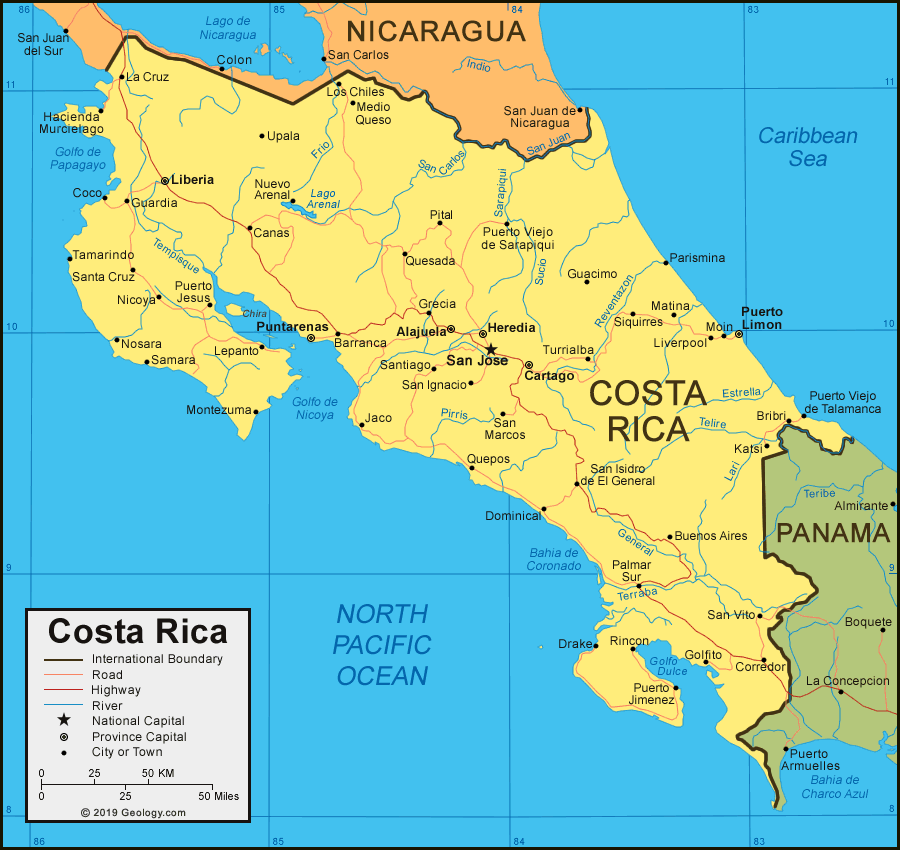
Other countries may have started later than the U.S. did but they are rapidly leapfrogging us in this area.  Tiny Costa Rica in Central America is an example.

This beautiful Central American country is about the size of Vermont and New Hampshire combined.  The population, a little less than that of Louisiana and a little more than that of Kentucky, is about 40% rural and 60% urban.

Prior to 2010 when it passed the comprehensive Law for an Integrated Management of Residues,  Costa Rica had a waste management problem.

Over 60% of its 2,400 tons of daily waste was going into open dumps while 15% was put into sanitary landfills.  Less than 10% was recycled and 250 tons of waste was illegally dumped into streams and along roadsides.

On my recent visit, integrated color and symbol-coded bins were appearing throughout the country, labeled Organico, Vidrio, Aluminio and Plastico.  They could be found in rural villages, resort towns and cities and were visible in every public and private sector facility I saw.

Here, I think we Americans have grown complacent about stewardship as we have about so many things.

Friday, June 21, 2013

Composting Conundrums

I was told recently that Durham, North Carolina where I live, ships its yard waste collections to a landfill, but that isn’t true.  Nor are they composted.

Durham grinds the yard waste and ships it to a Danish biotech company with its North American headquarters in Franklinton, North Carolina near where I commuted by Harley one fall a few years ago to learn to fly an airplane.  At Novozymes, Durham’s yard waste (including mine) is recycled into useful enzymes.

Solid waste officials in Durham are also working on a pilot program to turn some of the yard waste into compost.  North Carolina composts about 7% of its municipal solid waste overall, which is below the 8% average for the South and less than the 10% in the Midwest and 11% along the coastal West.

Nationwide, yard trimmings make up 12.9% of municipal waste while residential food scraps another 12.4%.  Both exceed the percentage composed of various plastics.  Nationwide, the percentage of yard waste that is composted is several times greater than the percentage of food that is composted.

At the time I retired from community-destination marketing a few years ago, more than 90 cities and towns in the U.S. were already offering food waste collection and the number continues to rapidly increase.

Composting and food waste recycling are commercially viable at a scale well beyond what is being done in backyards because scientists estimate that 40% of the nation’s food supply goes to waste.  As individuals, we focus on household waste but the real economies of scale for composting are at the commercial level including restaurants, hotels, schools and grocery stores.

Hopefully, when it is launched, Durham’s pilot program, if successful, will move beyond yard waste.  Composting done on a commercial scale began as an alternative way of dealing with waste biosolids.

In Durham, those from city facilities will undergo a thoroughly-regulated but not without controversy treatment process in partnership with Synagro, before being utilized by local farms.

Biosolids from the county facility go through “in-vessel” composting by companies such as McGill and are made back into branded products used by professional turf managers and landscapers, a process also used on food scraps.  Some municipalities such as Goldsboro, NC have built their own “in-vessel” facilities.

Another example of a commercial compost approach to waste biosolids and food scraps is Earth Farms Organics based in Dallas, North Carolina, not far from Charlotte, the state’s largest municipality.  The company uses windrowing to recycle food waste and biosolids including the use of B2B agreements into 40 tons of commercially viable and branded compost products each year such as top soil.

This prevents decomposition into Methane in landfills, a greenhouse gas 21 times more harmful than carbon dioxide and a source of global warming.  Left in landfills, food waste is never reused by the environment.

Landfills are not composts and there is a very good argument that food waste is a far greater threat to public health than plastics.

The promise of bioplastics is not post-consumer, where without expensive upgrades its mixed-use in products such as Coca-Cola’s plant bottles pollutes the recyclable stream, but in commercial and agricultural applications.

Backyard composting is useful, but problematic in urban environments where human inconsistency and improper use and neglect can lead to health problems and even lure migratory turkey vultures to lay over.  But well-regulated commercial composting with worms or in windrows or in-vessel is a rapidly growing and commercially viable and scalable alternative.

The company that processes Durham’s curbside recycling reports that 5% of what it receives is actually trash but it doesn’t complain nor do savvy local officials because it is better to error on the side of recycling than trash.  In fact, Durham is very close to a paradigm shift.

Instead of posting the growing list of what can be recycled, residents may be better served now by promotion of the shrinking list of things that still must go in the trash cart for pick up.  Hopefully, in the near future that list for Durham will no longer include food scraps.

I am not a scientist, but I grew up on a ranch homesteaded by my great-grandparents in the shadow of the Tetons.  They were not as educated as most members of North Carolina’s legislature are today but they appear a lot smarter.

Not content with surrendering tens of thousands of trees along the state’s roadsides to whining out-of-state billboard companies, including vegetation protecting residents from particulates, noise, water pollution and toxic waste the same senate sponsor is now trying to please whining out-of-state trash haulers by undermining North Carolina’s landmark legislation regarding landfills.

The proposed changes would reduce or eliminate buffers between landfills and state parks, game lands, national wildlife refuges and wetlands and permit them to be built up higher than North Carolina’s iconic Cape Hatteras lighthouse even though the state has already authorized a 30% increase in overall landfill capacity.

I can only assume this extremist arrogance is self-justified in some respect in contrast to eco-Talibans who find fault wherever possible at the other extreme often inhibiting commercial alternatives.  It is funny to hear some of my friends argue to exclude use of the word “organic” to a relatively new and very narrow use of that term.

My great-grandparents knew better than to lean toward either extreme.  My parents and grandparents as I grew up were proud to point out how careful my ancestors were to plant trees along waterways, to create and protect wetlands and meadows, to plant trees to intercept wastewater before septic systems were developed and from the horse barns and corrals.

One of my first archeological discoveries were ancestral landfills which had been strategically placed and kept thin enough to regularly turn and aerate and dry.  Family artifacts from those explorations are among my most prized possessions today.

Among my first chores on the ranch was not only the annual cattle roundup but the much less romantic job of pulling a manure spreader across fields and meadows after the livestock waste had dried in piles, a form of composting.

Managing waste is much more complicated in cities, towns and states today than it was on our family ranch in the 1950s.  The technologies are improved but the underlying science goes back to my ancestors who different than many lawmakers today understood that it just made good sense.

Tuesday, June 04, 2013

The Dilemma of Foam Take Out Containers

Durham, North Carolina currently generates 14,500 tons of recyclable material.  When 4,500 tons more is recycled, it will warrant its own material recovery facility (MRF,) something being strongly encouraged by Steve Schewel, a friend and member of the City Council here.

The fact that recycling is measured by the ton is one of the reasons so many municipalities haven’t moved to recycling plastic film and bags as well as polystyrene or foams such as Dow Chemical’s trademark Styrofoam.LA

These tiny though highly visible and troublesome slivers of the waste stream weigh hardly anything but they are recyclable, and in the case of foam or polystyrene, infinitely so.

They are also many times more effective and foam is as much as 1/10th the cost of alternatives, an important consideration for small independent restaurants.

Polystyrene or plastic foam is #6 in the triangles on materials that signify content.  Here is a white paper about how communities can recycle it, prepared by the polystyrene brand Dart, a foodservice container supplier that began experimenting with the material in the 1950s.

The white paper encourages communities such as Durham to begin recycling plastic foam and lays out the process and some of the challenges as well as solutions.  In a full-cost accounting sense, the costs involved would be built into the costs of the product.

Until then, places such as Durham need to join the many others that divert polystyrene foam from landfills into curbside and other recycling.  The process is simple and uses a minimal amount of resources but a full pallet of densified foam will weight only approximately 1,000 lbs.

Packaging peanuts are made from a variety of materials so the overview notes they should be kept in their current form and resold or put back into use.

Peanut recycling is done by American LAbor, another friend’s company in Durham that supplies equipment for medical diagnostics as well as by thousands of small packaging and shipping stores.

Foam polystyrene is already being picked up as trash or in many cases by curbside recycling because Durham residents have learned to understand the meaning of the triangle recyclable symbol but not the meaning of all of the various numbers.

Unfortunately, recycling including inclusion of this material curbside is only part of the solution and may have little impact on the 4% of the general public who intentionally litter or the 17% who do because a container is not close by.

I find the cost/benefit analysis at this link that was conducted for Seattle a few years ago very enlightening for those predisposed to seek bans as an alternative.

Just as full-cost accounting should include the costs of recovery for these materials, life-cycle assessments are being used now to assess alternatives.  Many such studies have comparing the impact of various drinking cups have found that reusable cups have the higher negative impact on the environment.

One thing is certain, when Durham warrants its own MRF, eliminating the need of a transfer station, it will become even simpler to recycle plastic foam.

Monday, June 03, 2013

First Step Toward Appearance As Overarching

Communities such as Durham, North Carolina, where I live are well advised to create a local inter-agency and inter-organization counterpart to the report assembled each year to meet state statute by the Office of Beautification of the North Carolina Department of Transportation (NCDOT.)

Durham’s localized version could be more comprehensive and include collected data related to the composition and tonnage of solid waste and recycling as well as roadside mowing, litter removal and indexing, urban forestry, stream clean up, advocacy and beautification efforts, as well as annual public opinion surveys of internal and external stakeholders related to appearance.

It could be coordinated by Keep Durham Beautiful (KDB,) a non-profit embedded in City General Services, but also serving the County.

KDB could gather data from City and County agencies and various commissions, Research Triangle Park, NCDOT, the Durham Appearance Advocacy Group and the Downtown Business Improvement District.

It would also glean information from the Durham Convention & Visitors Bureau, public, private and charter schools, universities, Preservation Durham, vintage clothing stores, watershed and neighborhood associations and the courts and various law enforcement agencies.

The purpose of aggregating the data would be to help focus benchmarks, illuminate progress as well as inform an overarching strategy. It would also be valuable to overcome fragmentation and to inform progress toward sustainability goals.

Should the City and County strategic plans ever include an overarching strategy, no better case could be made than appearance and clean up. It touches nearly every aspect of these plans including public safety and health, economic development, tax base and valuation, poverty reduction, community pride and image, neighborhood vitality, asset stewardship, quality of life and place, wayfinding and traffic management and much more.

Sure doesn’t sound superficial to me but I probably subscribe to a more holistic view of community appearance.  If there is bureaucratic resistance or inertia, the report could be assembled by the Durham Convention & Visitors Bureau as part of its State of Durham’s Image.

Of course, I’ve lent voice to this viewpoint many times over the years with little or no success. The case only becomes stronger with no rival in sight.  Maybe we can start with the report.

Friday, May 31, 2013

Curbside Conundrums

Durham, North Carolina has by all accounts, a very successful single-stream, curbside recycling program.  But unlike similarly-sized and inclined Madison, Wisconsin, a new contract unfortunately won’t include recycling of plastic bags used for newspapers, carry-out, produce, bread wrappers or plastic film used to cover dry cleaning.

However, this really doesn’t explain why 190 volunteers working at just 14 sites along 18 miles of urban streams recently recovered nearly 12 tons of discarded trash, much of it recyclable.  Similar efforts statewide collectively pulled 207 tons of trash from watersheds.

Plastic bags and film, as well as polystyrene such as Styrofoam, are highly visible, but only a tiny sliver of the litter or waste stream.

Even with curbside recycling up 40% in Durham annually over the same span, this week of stream clean-up still retrieved two tons more this year than was recovered during the same week in 2010 and a ton more than last year.  And this is far from the only stream clean-up here during a year.

Unfortunately Durham neglects to forensically examine the trash and litter recovered from urban watersheds or other illegal dumping grounds, so the community is unable to trace it back to its origins to make the perpetrators as visible as their litter.

But using national studies of littering, it is tossed by just 4% of the population deliberately and by 17% when you count those who were too far from a receptacle and too lazy to find one.

It is likely that a greater proportion comes from the 3 out of 5 people who work in Durham but aren’t residents.  Seeing themselves more as renters than owners, they may be more inclined to litter.

Durham itself is also a kind of renter, trucking its waste and recyclables to landfills and sites in other communities, including nearby Raleigh.  This may, in part, explain the lack of urgency here by officials to incorporate plastic bags and polystyrene in its curbside collection.

Both are recyclable, bags into products such as composite decking and pallets and polystyrene into, well, more polystyrene for packaging and products such as picture frames.

In part this has led to an offshoot group to which I’ve been invited from the Environmental Affairs Board to pursue solutions to reduce use of these materials or advocate for greater recycling.

From what I’ve learned over the years, the problem is part technology - including cost and adoption - part inertia and part consumer behavior.

Many companies that recycle on contract with places such as Durham have not done the necessary upfitting to handle plastic bags and polystyrene, some due to cost, but many due to inertia because recycling is a difficult business and many people fail to grasp the need for continuing and never-ending innovation.

A bit of this is “chicken and egg” because only 11% of the population has access to curbside recycling that accepts plastic bags and film and only a little more than 3% of communities such as Madison accept it.  This is also the problem with recycling polystyrene.

Inertia on the part of communities is big part of the problem.  Even when recycling vendors implement new technology such as they have for pizza boxes now in Durham, officials are often reticent to inform the public that they can include them in curbside bins or equivocal when asked.

Managing and influencing public behavior isn’t easy but it best done with passion and zeal, attributes that often seem lacking today among many public servants.

Plastic bags can pollute single-stream curbside collections and gum up machinery.  Even if hand-separated it takes a lot of bags and film to make up a bundle, the way retail stores and dry cleaning suppliers do from their collection bins.

One low-tech solution suggested by a company that contracts to pick up curbside recycling in Texas is to place the plastic bags and film in a clear but heavier gauge bag before placing them in curbside bins, like we do for shredded paper.  It calls the solution “bag in a bag.”

Curbside officials often fail to pursue or press for solutions such as this because they over-rely on residents remembering to hand-carry these materials to stores that recycle plastic bags and film.

Of course, if this was a truly a scalable solution, we wouldn’t have curbside collection in the first place.

The story is similar for recycling polystyrene such as Styrofoam, a brand name owned by Dow.  Many community’s now accept this material in curbside recycling.

Far more rely only on businesses that have begun to compress their shipping materials and then use the delivery trucks to “back-haul” the material where it can be recycled.

Others want residents to truck polystyrene to small packaging and shipping outlets that recycle this material, as a friend of mine’s business will do with “foam peanuts” which he reuses in Durham to ship instruments for medical diagnosis.  Again, this won’t reach scale until more communities accept post-consumer polystyrene as curbside recycling.

This brings us to consumer behavior.  Banning use by consumers has produced spotty results, actually resulting in increased use in some of the 80+ communities where items such as plastic bags have been banned.  Creating an island where they are prohibited will not inhibit entry behavior by commuters.

However, no one can argue with comprehensive banning of various items from landfills which spurred communities to aggressively embrace curbside recycling beginning two decades ago.

Unfortunately, many such as Durham have failed to see the potential of expanding on this success by including more items, other than by enlarging carts to facilitation collection of items they do.  Most have internal advocates to increase recycling participation but few have advocates pressing to find ways to expand the variety of items recycled, allowing inertia to set in.

Substitutes for plastic bags such as paper or re-useable bags have a far greater carbon footprint.  As just one of many examples it takes seven trucks to ship the same number of papers bags that one truck can carry in plastic bags.

Some studies are also now linking bans on grocery store bags with increased incidence of foodborne illnesses.  And EcoTalibans, as humorously depicted in this clip from the TV series Portlandia are well, just not consumer-viable.

That’s why it is crucial that the self-assembled group in Durham not over-focus on just plastic bags and polystyrene but keep their eye strategically on the overall objective of increasing both the content and volume of curbside pick up.

There are a lot of isolated success stories, some very nearby Durham but picking a few of these to replicate without a comprehensive, scaleable strategy will result only in exhaustive “activity traps” and fail to address the overarching objective.

Which brings us to the stickiest consumer behavior of all, littering.

Overall far too many communities, including Durham, dabble at well-meaning tactics for curbing litter but with no comprehensive, sustainable or measurable strategy.

Part of the solution to litter is education that not only begins at school but in schools.  Given to site-based management, it is not enough for school districts to supply recycling bins and arrange pick up.  Teachers and principals in each school must be educated to distribute the containers far beyond just the cafeteria.

Teaching that litter is wrong and socially and culturally unacceptable must be followed up by action by those responsible for common spaces such as roadsides, interchanges and around public facilities.  We must demonstrate a zero tolerance for littering, not just preach about it.

Toleration of litter begets more litter and creates a self-perpetuating litter feed-back loop that overwhelms episodic clean-up efforts.

Finally, like most crimes against society, curbing littlering will require forensics and follow up even with just a warning-letter.  The 4% of the public generating the majority of litter and foisting its effects and the cost for clean up on the other 96% must be held accountable.

Right now they think they are invisible if they think at all and immune from scrutiny or reputational risk.

Some human behaviors only change when more light illuminates perpetrators.

North Carolina got the attention of more than 10,000 litters last year through “warning letters” sent to registered vehicle owners after litter was reported through the Swat-A-Litterbug program.  Another 3,163 drivers received enforcement citations for littering including 1,663 who were convicted.

We’ll need to increase that number times 18 times to reach every potential litterer among the 6 million resident drivers in North Carolina before we reach the full 4%.

But then, of course, we’ll also need to shed more light on litter-prone tourism parties drivers in 480,000 (or 4%) of the vehicles  crisscrossing the state on overnight visits each year.

Through “warning letters” and citations, the North Carolina Department of Transportation may have the names and addresses of enough litters by now to be able to conduct a follow-up forensic public opinion poll to learn more about the residents and visitors most likely to litter.

Interestingly, of the nearly 3,600 tons of roadside litter collected along state roads in 2012 alone, as well as thousands of tons pulled from watersheds and parks, a substantial amount was still recyclable.

The 4% who litter, or the similar percentage who claim they “never” recycle or any who backlash purely for ideological reasons are far too expensive to ignore.