Showing posts with label Food Waste. Show all posts

Friday, December 05, 2014

Food for Thought

Reading a new McKinsey analysis of the most effective ways to fight obesity made me remember that if it weren’t for an inability to metabolize sugar, I would probably be struggling with a weight problem, if not on my way up the first wrung of obesity.

The study quantifies the effectiveness of interventions including areas of personal responsibility as well as education and environmental factors such as labeling, portion control and subsidies and taxes, all of which have spawned a huge “sugar” lobby.

I first felt the hypoglycemic reaction that my body has to the levels of sugar in foods, mostly added, when I was 11 years old, going on 12 and weighed about 84 pounds on a 4’8” frame.

But it wasn’t fully diagnosed for another ten years when by that time I touched the scales at 150 pounds and nudging 6 foot tall.

I descended from a long line of “white food” eaters on both sides, who when they weren’t drawn to sweets and foods that quickly convert to sugar such as mashed potatoes, macaroni and milk, corn, fruit salad laced with whipped cream and bread, even bread and milk.

To my mom, who was a great cook having learned from her mother-in-law, even oatmeal wasn’t right without a layer of sugar across the top.  Maybe it is little wonder that my parents struggled with weight and sought comfort from these foods their entire lives.

Actually, our weight and happiness are on opposite “u” curves during our lives, one with the u bending upward and the other bending downward, but looking at how sugar affects the brain, they seem related.

Our relationship with food is apparently linked to both.

One of the interesting findings in the McKinsey analysis is that obesity is a condition shared now by 30% of the global population.  It is projected to increase to 41% by 2030, but already has the same economic drag as tobacco and armed conflict.

It is far more costly than alcoholism, for instance.

The interventions McKinsey finds most effective can lower obesity by 20% within a five year period when deployed together.

Portion control and reformulation of foods have the greatest impact followed by limiting access to high calorie foods, weight management programs and parental and school education.

A high-sugar tax can also play a role.

In the United States, obesity is the second most significant social burden.

In 1750, sugar consumption was about 3-4 kg or less per person.  It took off in the United States in the late 1800s and then skyrocketed about the time I was born.

About the time I retired five years ago, Americans were powering down 28 kg of “added” sugar alone or about 60 pounds per person.

The obesity epidemic is no surprise.

Normal weight, according to the McKinsey study means keeping the body mass index below 25.  My doctor tries to get me to stay below 19.  Overweight is between 25 and 29.

Obesity comes in three stages beginning at 30% and ranging to more than 40.

Those of us who are overweight push medical costs up 31%, and obesity, depending on the level, pushes costs up anywhere from 58% to 86%.  Click here for the latest pie chart showing where America’s $2.9 trillion health dollars go.

I’ve learned to limit my intake of added sugar to between 6 and 9 grams (about two teaspoons) per day and stay away from foods naturally high in sugar.

Still I am not deprived.  My diet averages around 30-40 grams a day.

One of the advantages to logging my meals, often vetting them in advance using an app called myfitnesspal, is being far more aware of foods high in sugar.

Whenever we eat breakfast at Bob Evans, I like the Border Scramble, substituting a fruit plate instead of potatoes and without bread.

But even without the fruit, that dish has 7 grams of sugar.  The fruit plate has another 13.  Way over my threshold and even with the protein involved risking where, for me anyway,a hypoglycemic reaction would kick in.

My sweet tooth is fed by two glasses of wine with dinner - only red - and on the more “minerally” side.  Each glass has only 1.8 grams of sugar each but is much weightier in calories overall.

But the apple a day I snack on later has 11 grams which is possibly why even when I was young, I learned to eat this fruit as my dessert after dinner, a time of day when any adverse reaction would occur only while I am asleep.

Also being certain to drink two quarts of water a day on top of the water in about 60 oz. of coffee is crucial in my case.  But my point is that even religiously avoiding foods with added sugar, I get a lot in my diet.

Obesity increases in countries along with prosperity.  In in the U.S., the CDC finds it at the same levels for men regardless of income level but in women it affects 42% of low income vs. 29% at high income levels.

This may give finger-waggers more ammunition to lecture the poor about personal responsibility, but it is clear the correlation is to only being able to afford or easily access unhealthy foods and eating leftovers while caregiving, I suspect.

This is another reason that making certain low income people have healthcare insurance is smart.  When it comes to healthcare costs we’re in this together when it comes to our pocketbook regardless of partisan leanings or feelings of superiority.

So whenever someone asks for the mashed potatoes to be passed during holiday meals, we need to be aware of just how incredibly powerful the “white food” lobby is in this country and give thanks if we are less impacted, but less judgmental of those who are.

New research shows that it is more than with fitness and caloric diary apps that smartphones are impacting the way we buy food.  A study shows that 79% of women alone now use their smartphones in stores.

Of those, 35% do it in grocery stores alone, 23% to check barcodes to learn more about products than may be revealed on labels.  By the way, the same percentage use GPS via smartphones to find the store greatly reducing any tiny remnant of rationale remaining for billboards.

I suspect, without my reactive hypersensitivity to blood sugar level, I would be among those judged.  I love mashed potatoes and not just because I’m from Idaho where it is patriotic or because “red states” are more prone to obesity.

Retirement agrees with me.  Although I seem to be getting shorter, I also dropped about 25 pounds (intentionally) over the past six months, more a credit to walking daily and cutting calories, not just a diet low in refined carbohydrates (smile.)

Now for some comic relief about the determination of the sugar lobby, click here to see John Oliver propose that all food labeling regarding sugar added be put in terms of “circus peanuts” (which have 5 grams each.)

Actually, a Gallup poll showing what Americans spent on average for this past Thanksgiving week reveals that it certainly isn’t peanuts nor is it just on food.

Happy Holidays!

Thursday, September 18, 2014

Ingredient Missing from Restaurant Sustainability

I found interesting in a new survey by the National Restaurant Association: that only 39% of restaurants overall recycle plastic, cans or glass.

This includes nearly half of all full service restaurants, but only a third of quick service restaurants (fast food.)  The percentage that recycle cardboard and paper goes up to 67% and 66% respectively.

Around 61% use products made from recycled materials but only 4-in-10 use products that could be composted.

In fact, only 17% compost food waste, although 75% regularly track the amount of food waste.

A 2012 report noted that food serve operations alone lost 86 billion pounds of food in 2008 or 19% of the U.S. retail supply.

Between 4 to 10 percent of food loss in restaurants is lost during kitchen preparation.  Diners waste, on average, 17% percent of meals or more only 45% is taken home as leftovers.

Only 22%, including 20% of full service restaurants, donate leftover food to food banks or other groups.

This contributes to the fact that 40% of the nation’s overall food supply is going to waste each year.

On average, each American wastes 209 to 254 pounds of edible food each year.  In the Eco Pulse survey last year, 39% of Americans felt the “most green guilt” over wasting food.

One area of “sustainability” conspicuously missing from the NRA survey is the number of restaurants paying at least a “living wage.”

For nearly two decades now, how businesses treat people has been one of the three pillars of the “Triple Bottom Line” of sustainability.

In a poll of small businesses this year, 61% of those in the restaurant or retail industries supported raising the minimum wage.  Of course the minimum wage is nowhere near the livable wage which is computed specifically by areas of the country.

The restaurant business is tough, especially for locally-owned chef-driven restaurants that give places such as Durham, North Carolina where I live a “foodie” reputation nationwide with visitors, a characteristic now cited as important on “intensity” indices by leisure travelers including 71% of Millennials.

But so is sensitivity to prices.

As noted by the Durham News Service, a new breed of local chef-restaurant owners in Durham are now leading the charge across the nation to voluntarily pay their co-workers a living wage.

It is based on the sound business principles such as paying people a living wage and a sense of fairness resonate just as much with residents and visitors here as using locally sourced foods.

Polls by both Gallup and Harris Interactive, show that among the several industries in the tourism sector, restaurants are viewed well above average with a net positive of 60 points and 53 points on public opinion polls respectively.

But that doesn’t mean this handful of distinct industries shouldn’t work on improving outdated business models to be fairer when it comes to treatment of employees.

By nearly 4 to 1, Americans are now more likely than in the past to investigate business behavior before buying including 6-in-10 who decide not to do business with an entity based on how it conducts itself and 7-in-10 who talk about it in conversations with others.

If you think that won’t matter, just ask the NFL.

Wednesday, March 05, 2014

Channeling More Recyclables Into The Circular Economy

With the exception of the footprint of my house and five strips of lawn for accent, 83% of my .3 acre lot on a forested ridge two miles from Durham, North Carolina’s city center is natural area.

However, this doesn’t mean it requires less upkeep.

We share this space with a grove of 100+ trees, a combination of mature hardwoods and pines, with about another 100 understory trees, shrubs and bushes.  Each year at this time, about 3 tons of leaves, needles and cones are scooped up from the 86% that is not densely ivy covered and taken for composting.

This is followed by redistribution of about 8 to 9 tons of fresh hardwood mulch.  I love working this landscape but I obviously leave a task of this magnitude to professionals.  It is my contribution to Durham’s urban forest.

I wish my community’s yard waste was composted but it is hauled several miles away northwest to another county where a company converts it into enzymes.  There are more progressive communities in this area such as Goldsboro, which is about 78 miles southeast, that do this kind of composting.

There, about about 9 dry tons a day is fed into a biosolids composting facility where after 30 days followed by 40 days of curing time, the output is screened in two sizes of mulch.

Some is sold to landscapers and golf courses with the remainder resold by garden centers as well as used in parks.

After visiting this facility in 2004, Mont-de-Marsan, a similar-size community in southwest France, built a similar facility that processes five times more or about 48 tons per day.  I hope Durham officials paid a visit as they hoped when I brought Goldsboro’s facility to their attention.

According to this EPA fact sheet that describes the process, it includes yard waste, wastewater solids, residential and commercial food scraps and agricultural by-products.  Before the recession, more than 3,500 cities and counties in the US were composting.

A national survey by Harris Interactive released last December found that 7-in-10 Americans are not composting food waste, but two-thirds would if it was more convenient in their community.  A quarter strongly agreed compared to 13% who strongly disagreed.

More telling, among Millennials (ages 18-39,) that proportion increased to 3-in-4 with 8-in-10 saying they would use the resulting products compared to two-thirds of the general population.

Policy-makers should use this generation when planning to recycle food waste.  Even in the South which has the lowest level of composting, 8-in-10 residents understood the importance of recycling food and yard waste, higher than the general population.

Unfortunately, three in five Americans don’t want to pay for it, the result, I believe, of the reluctance of elected officials to link public services with costs over the last four decades, gradually reducing services instead.

In Seattle, a city two and a half times the size of Durham, residents are offered curbside recycling of food scraps, by placing the food scraps in approved paper bags and then in their yard waste cart.

Durham currently has an RFP out on something related, but unlike Durham, Seattle requires this and other types of recycling by apartment dwellers as well.

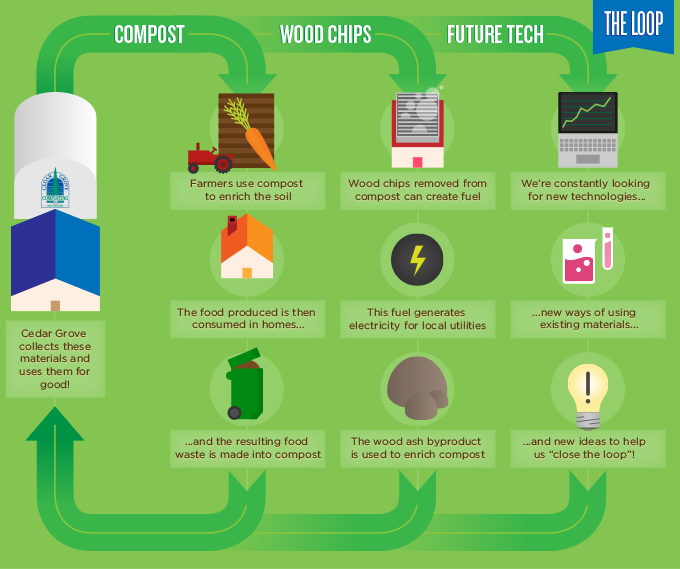
Seattle sends the yard waste and food scraps from curbside and alley collections to two composting facilities operated by Cedar Grove in Everett and Maple Valley which collectively compost 350,000 tons of residential and commercial yard and food waste annually.

Branded, Cedar Grove resells the recycled materials by the bag or in bulk for gardens, potting, top soil, lawn and mulch to farmers, residences, landscapers and other users.

The family-owned business expanded into composting in 2003 and uses the GORE™ Cover System rather than the in-vessel approach used by Goldsboro.

Hopefully, Durham will soon move toward curbside collections of food scraps along with aggressive composting of these items along with yard waste, waste water solids etc.

Based on the Harris survey, Americans increasingly understand the importance of the “circular economy.”

Friday, December 13, 2013

Durham’s Food Scrap Entrepreneurs

A few months ago, a start-up in Durham, North Carolina where I live began Tilthy Rich Compost, a business that picks up food scraps from subscribers on a weekly basis, then turns it into compost a few miles from downtown.

Currently, the service area is approximately a five mile radius of downtown and expanding.  Pick up is mostly by bicycle for neighborhoods and a truck service for commercial clients.

The company will even return the finished compost to you if you wish, for use in your garden or landscape.  They also offer the service to restaurants, commercial kitchens and cafeterias.Tilthy Rich Compost

At our house, we only eat at home a few days a week, but they have a smaller bucket for people like us and a larger bucket for families that eat at home regularly.

The new company is emblematic of Durham’s distinctive entrepreneurial personality, in particular social entrepreneurship.

Forty percent of the nation’s food supply goes to waste and I am sure Durham is no exception.  Residential food scraps alone make up 12.4% of municipal waste across America, a greater percentage than plastic.

In restaurants, according to the report Wasted, analysts at the Natural Resources Defense Council calculate that 4% to 10% of food becomes waste during preparation before it gets to the consumer.  Another significant portion is served but not eaten.

Approximately 10% of fast food is discarded because it has been prepared but not purchased within safe time limits.  At home, Americans throw out approximately 25% of the food and beverages they buy.

Often, if you are like us, food products are discarded either because  plans change and they spoil or because I in particular am one of those people perpetually confused by “use by” and “best by” date labels.

Even before consumers buy groceries, a food industry consultant estimates that up to one in seven truckloads of perishables delivered to supermarkets has to be thrown away.

Analysis in the United Kingdom estimate that if food scraps were removed from landfills there, greenhouse gas abatement would be the equivalent of removing a fifth of all cars in that country from the roads.

By the time I retired four years ago, 90 cities and towns in the U.S. had begun offering food waste collection, double from two years before.  North Carolina composts below the average for the Southeast.

I suspect though, that a personalized and scalable service such as Tilthy Rich Compost will always be in demand.  In our part of the country, as a developer-friend of mine jokes, soil so easily becomes compacted that it almost qualifies as impervious.

We need all of the compost we can get.

Monday, December 09, 2013

The Illusion And Unhealthy Paradox of Choice

Fifty years ago, when I first went to work in grocery store as a teenager in the Pacific Northwest, on average they stocked around 4,000 items.  Today’s supermarkets stock an average of 50,000 items.

Yet the top selling 1,000 items generate half of the sales revenue.  Further, the average household buys only 150-200 items regularly and about 400 distinct items a year.  Dropping 25,000 items would decrease sales only 5%.

Conventional consumer theory is that breadth of choice trumps, but research shows that too much choice suppresses sales.  Many suppliers such as Procter & Gamble have increased sales 10% by cutting choice in half.

I must admit, that the primary reason I find myself shopping online for some items is that when I go out shopping, either I can’t remember where I purchased the item I need to restock, or it seems that even big-box stores increasingly won’t have many items in stock.

What’s more important is that much of the “choice” to which we seem drawn as consumers, especially when it comes to groceries, is increasingly concentrated in the hands of a very few suppliers.  The cost of all of this choice is climate change.

On average, conventional food products travel 1,500 miles before we see them on the shelves.  It takes 9 calories of fossil fuels to produce each calories of the food in supermarkets or about 232,000 per week for the average American.

Adding to the toll of hidden costs, 26 cents of every food dollar is spent on packaging.  Some reports estimate the industrial food system is responsible for a third of greenhouse gases.

For example, just one quarter-pound hamburger patty requires 6.7 pounds of grain and forage, 53 gallons of water, 74.5 square feet of land and 1,036 BTUs of fossil fuel energy to bring to market.  According to an NPR report, that doesn’t count greenhouse emissions from animal waste.

But a new report entitled Grocery Goliaths shows that while Americans now spend $603 billion on grocery products each year, half (53.6%) is spent in just four chains: Wal-Mart, Kroger, Target and Safeway.  Most types of grocery products are also dominated by three or four suppliers.

Rapid supermarket consolidation began when Wal-Mart, which now controls nearly 30% of overall supermarket spending, entered the grocery business in the 1990s, which is more than the entire top four retailers controlled in 1997 (20.8%.)

But independent grocery stores and local and regional chains have been fighting off consolidation since the 1920s when thousands banded together in cooperatives such as IGA, including the store in the small Idaho town near where I was born and spent my early years.

At nearly the same time, another coop of grocers called URM formed.  It still has 160 stores across northern Idaho, eastern Washington and western Montana, an area called the Inland Northwest.

There are still 1,750 IGA stores across the nation including one in Durham.  A few are over 10,000 sq. ft., about a third the size of the average supermarket.  Most IGAs are are 7,000-12,000 and many are convenience store size.

Coops such as these coops permit independents to share the costs of distribution and marketing.

There is still a vibrant, neighborhood Red & White food store in Durham, where I live, a remnant of another co-op of independent stores with distribution based out of Chicago.  They were established in the 1920s and thrived after WWII, but independent grocery stores like these seem all but extinct.

Independent grocery stores were squeezed from both ends beginning in the 1930s.  At one end, convenience stores began to chip away at their business until the concept really took off in the 1970s when they were fused with gas stations.

At the other end, supermarkets also grew out of the 1930s and tracked with the growth rate of the automobile.  The supermarket chains really took off after WWII as an unintended consequence of the Interstate Highway System, which made long-haul distribution more efficient.

The profit margin for grocery stores was a penny on the dollar when I worked in the grocery business during high school in the mid-1960s.  Today, it is still only 1.3%.  Wal-Mart smelled blood in the water when many grocery chains became employee-owned in the late 1980s and early 1990s.

Some like Harris Teeter tried to go the route of acquisition and expansion beginning when the 1930s Charlotte, North Carolina chain emerged from its local roots in the mid-1980s after watching North Carolina-born Food Town expand and then be acquired by a Belgium company a few years earlier and renamed Food Lion.

In 1988, the year before I arrived in Durham, Harris Teeter entered the Durham market by acquiring the Big Star chain.  By the time they were assimilated by Kroger twenty-five years later, the company had grown to more than 230 stores in eight states.

Kroger astutely maintains the local and regional appeal of its acquisitions by retaining their names.  In the meantime, Food Lion has grown to be a part of the 9th largest supermarket chain including Sweetbay, Harveys, Hannaford and Bottom Dollar Food.

In 231 metro areas such as the one centered around Durham,  just four big grocery retailers make up more than 80% of sales.  Wal-Mart alone now makes up half of all grocery sales in 35 metros, according to the report.

Today, we have bigger and bigger stores owned by fewer and fewer companies carrying product categories produced by a handful of suppliers creating the illusion of choice.  Soon they will be supplanted by online stores such as Amazon Fresh.

In the meantime, the hidden costs to consumers and the planet are immense, and in the United States, we still have 1.4 million households in poverty including 2.8 million children surviving on $2 or less per day in a given month.

Friday, June 21, 2013

Composting Conundrums

I was told recently that Durham, North Carolina where I live, ships its yard waste collections to a landfill, but that isn’t true.  Nor are they composted.

Durham grinds the yard waste and ships it to a Danish biotech company with its North American headquarters in Franklinton, North Carolina near where I commuted by Harley one fall a few years ago to learn to fly an airplane.  At Novozymes, Durham’s yard waste (including mine) is recycled into useful enzymes.

Solid waste officials in Durham are also working on a pilot program to turn some of the yard waste into compost.  North Carolina composts about 7% of its municipal solid waste overall, which is below the 8% average for the South and less than the 10% in the Midwest and 11% along the coastal West.

Nationwide, yard trimmings make up 12.9% of municipal waste while residential food scraps another 12.4%.  Both exceed the percentage composed of various plastics.  Nationwide, the percentage of yard waste that is composted is several times greater than the percentage of food that is composted.

At the time I retired from community-destination marketing a few years ago, more than 90 cities and towns in the U.S. were already offering food waste collection and the number continues to rapidly increase.

Composting and food waste recycling are commercially viable at a scale well beyond what is being done in backyards because scientists estimate that 40% of the nation’s food supply goes to waste.  As individuals, we focus on household waste but the real economies of scale for composting are at the commercial level including restaurants, hotels, schools and grocery stores.

Hopefully, when it is launched, Durham’s pilot program, if successful, will move beyond yard waste.  Composting done on a commercial scale began as an alternative way of dealing with waste biosolids.

In Durham, those from city facilities will undergo a thoroughly-regulated but not without controversy treatment process in partnership with Synagro, before being utilized by local farms.

Biosolids from the county facility go through “in-vessel” composting by companies such as McGill and are made back into branded products used by professional turf managers and landscapers, a process also used on food scraps.  Some municipalities such as Goldsboro, NC have built their own “in-vessel” facilities.

Another example of a commercial compost approach to waste biosolids and food scraps is Earth Farms Organics based in Dallas, North Carolina, not far from Charlotte, the state’s largest municipality.  The company uses windrowing to recycle food waste and biosolids including the use of B2B agreements into 40 tons of commercially viable and branded compost products each year such as top soil.

This prevents decomposition into Methane in landfills, a greenhouse gas 21 times more harmful than carbon dioxide and a source of global warming.  Left in landfills, food waste is never reused by the environment.

Landfills are not composts and there is a very good argument that food waste is a far greater threat to public health than plastics.

The promise of bioplastics is not post-consumer, where without expensive upgrades its mixed-use in products such as Coca-Cola’s plant bottles pollutes the recyclable stream, but in commercial and agricultural applications.

Backyard composting is useful, but problematic in urban environments where human inconsistency and improper use and neglect can lead to health problems and even lure migratory turkey vultures to lay over.  But well-regulated commercial composting with worms or in windrows or in-vessel is a rapidly growing and commercially viable and scalable alternative.

The company that processes Durham’s curbside recycling reports that 5% of what it receives is actually trash but it doesn’t complain nor do savvy local officials because it is better to error on the side of recycling than trash.  In fact, Durham is very close to a paradigm shift.

Instead of posting the growing list of what can be recycled, residents may be better served now by promotion of the shrinking list of things that still must go in the trash cart for pick up.  Hopefully, in the near future that list for Durham will no longer include food scraps.

I am not a scientist, but I grew up on a ranch homesteaded by my great-grandparents in the shadow of the Tetons.  They were not as educated as most members of North Carolina’s legislature are today but they appear a lot smarter.

Not content with surrendering tens of thousands of trees along the state’s roadsides to whining out-of-state billboard companies, including vegetation protecting residents from particulates, noise, water pollution and toxic waste the same senate sponsor is now trying to please whining out-of-state trash haulers by undermining North Carolina’s landmark legislation regarding landfills.

The proposed changes would reduce or eliminate buffers between landfills and state parks, game lands, national wildlife refuges and wetlands and permit them to be built up higher than North Carolina’s iconic Cape Hatteras lighthouse even though the state has already authorized a 30% increase in overall landfill capacity.

I can only assume this extremist arrogance is self-justified in some respect in contrast to eco-Talibans who find fault wherever possible at the other extreme often inhibiting commercial alternatives.  It is funny to hear some of my friends argue to exclude use of the word “organic” to a relatively new and very narrow use of that term.

My great-grandparents knew better than to lean toward either extreme.  My parents and grandparents as I grew up were proud to point out how careful my ancestors were to plant trees along waterways, to create and protect wetlands and meadows, to plant trees to intercept wastewater before septic systems were developed and from the horse barns and corrals.

One of my first archeological discoveries were ancestral landfills which had been strategically placed and kept thin enough to regularly turn and aerate and dry.  Family artifacts from those explorations are among my most prized possessions today.

Among my first chores on the ranch was not only the annual cattle roundup but the much less romantic job of pulling a manure spreader across fields and meadows after the livestock waste had dried in piles, a form of composting.

Managing waste is much more complicated in cities, towns and states today than it was on our family ranch in the 1950s.  The technologies are improved but the underlying science goes back to my ancestors who different than many lawmakers today understood that it just made good sense.

Wednesday, May 08, 2013

One of the Most Dangerous Occupations is Wasteful

Yesterday was the day in the Durham, North Carolina neighborhood where I live, for “getting it up” as sanitation workers often refer to the weekly pick up of garbage and recyclables.

A sleek, newer model, Leach rear-loader came up the street interrupting an exchange with my neighbor about food waste and his past as an underwear model and Broadway musical performer.

That line of work (picking up garbage and recyclable, not modeling underwear/musicals) was the fourth most dangerous line of work in 2011.  It varies slightly each year but it is always more dangerous than law enforcement or firefighting.

Our neighborhood is usually served by one of those one-person trucks with a long arm that reaches out and empties the container.  A crew of three operated the rear-loader yesterday, reminding me of my job as a summer vacation replacement working on a a much earlier rear-loader model out west in 1967 between my first and second year of college.

Back then the waste stream for food was proportionately 50% less than it now.  Even so, my parents may not have known the danger I was in.

Or maybe they knew that work on a ranch or a farm such as the one where I was born and spent my early years in the nook of Idaho just outside Yellowstone Park ranks during most years just ahead of or slightly behind refuse and recyclable collectors as the most dangerous.

Maybe they were just glad that my stint spraying Lodgepole Pines to fight an infestation of Mountain Pine Beetle in the northern reaches of Targhee National Forest lasted only a month.  Logging is almost always the second most dangerous occupation, although I’m sure inhaling DDT overspray had its risks, too.

Picking Up is a new book by anthropologist Dr. Robin Nagle at NYU.  Focused on New York City, it is an informative and funny history of sanitation work over the last several hundred years, including a time when people who picked up the garbage were celebrated even more than doctors as lifesavers doctors.Food Waste

Discarding unused food may be one of the most wasteful behaviors in America.  A recent report by food and agriculture scientist Dana Gunders, entitled Wasted: How America is Losing Up to 40% of Its Food from Farm to Fork to Landfill, is fascinating.

In the U.S. food eats up 10% of energy, uses 50% of land and 80% of all freshwater consumed here.  According to the analysis, “Americans are throwing out the equivalent of $165 billion of food each year,” fueling a significant portion of greenhouse gases and climate change.

It hasn’t always been this way.  In the 1970s, a few years after my stint on a sanitation truck, Americans were wasting half as much food. Currently, throughout the supply chain and in places such as our homes and restaurants, we’re wasting 38% of the grain, 50% of the seafood, 52% of the fruits and vegetables, 22% of the meat and 20% of the milk produced.

Part of the solution is eating food grown closer to home.  The number of farmer’s markets have more than doubled to more than 6,000 in just the last 10 years.  Unfortunately, in supermarkets up to one in seven perishables delivered is thrown away.

Losses such as these are also a problem in conference hotels and convention centers.  Within a couple of years from when we launched the community-destination marketing organization for Durham in 1989, that organization became one of the first in a network called “Food for the Hungry.”

Coordinated by Profession Convention Management Association (PCMA,) it launched one of the first programs to coordinate the donation of unused perishable or prepared food from banquets to organizations here serving people in need.

The issue of food waste has also spawned worldwide growth in a phenomena known as “Freeganism” including a reality TV show called Waste Cooking, not to be confused with the episode of Seinfeld where the character George Constanza gets caught rescuing an éclair from the trash at a dinner party.

A report in the U.K. estimates removing food scraps there from landfills would abate the equivalent in greenhouse gases of a fifth of all the cars in that country.

Hopefully, I haven’t used any semantics that a new study shows can turn off many Conservatives.  But at least I know they may be attentive from the perspective of sanitation workers.  Conservatives are nearly twice as likely to watch TV shows about blue-collar jobs as Liberals.

Only slightly less likely are Independents such as me!

Thursday, February 02, 2012

Portion Distortion

I'm not part of the 68% of adults in the US who are overweight or obese, but in the past, members of my family have struggled with weight.  I probably would have too, by now, except that in my early 20s I learned that I am hypoglycemic (reactive not diabetic) and swore off eating or drinking anything that had more than two or three grams of sugar including refined carbohydrates.

Don't get me wrong, I'm no paragon of fitness, but when it comes to weight I'm only about 11 pounds heavier than I was when I started high school. It just needs to be firmed up and moved around here and there.  My reason for blogging recently about the movement Halfsies was motivated more by my concern about food waste and poverty.

The reinvigorated concern about portion sizes was spurred when I downloaded an iPhone app titled The Eatery by Massive Health, a start up.  I've been following it during the four months since I shattered my wrist and arm in a fall (no, it didn't happen when I was riding my Harley.)

portion distortion
Oh, good news is that yesterday my surgeon cleared me, even though it will be another 8 months before I know just how much ability I will fully recover but the bones are growing nicely around the 14 screws which anchors a long metal plate running from my wrist down my arm and the nerves in my fingers are coming back.

Massive Health intends to help people by giving them access to better data.  If you're interested even during the ramp up there is a blog at this link that is extremely useful.  I was particularly intrigued by one that was posted earlier this month about portion sizes even before I had learned about Halfsies, a philanthropy model that permits patrons of participating restaurants to order a half portion while contributing the remainder of the full price for a full serving to help those in need.

The blog post on “portion distortion” includes a fascinating infographic that illustrates just how portions have increased since the late 1970s to where today's studies show we are actually consuming 30% more.  Also included at the bottom the infographic are some handy references about what constitutes the proper serving in some easy ways to regain control.

If you are not someone who needs this information, please forward it on to the nearly 7 out of 10 Americans who apparently do.

Thursday, January 26, 2012

Going Halfsies – A New And Improved Model

With a 56-pound English Bulldog as my companion, I can't really say that I live alone or in solitude.  As my youngest sister said recently, Mugsy is the perfect dog for a man because he makes all of the typical noises.

I assume she was referring to my brother-in-law, not me but she's right, this breed of Bulldog isn't stealth.  If they aren’t snoring, they are typically snorting, licking, slurping, purring, etc.

But I do eat out a lot, both because I don't really cook and because I enjoy good food and because it's simply my favorite way to socialize.  I learned recently from an article by Nona Willis Aronowitz, an Associate Editor for GOOD that “almost half the food produced in the United States today is thrown away-including $44 billion worth in the retail industry.”

This means that even though 50 million people in this country experience food insecurity or malnutrition, half of all the food produced in this country either becomes part of the 250,000,000 tons of garbage generated in this country each year or the 2%-3% composted annually in backyards.

GOOD has made me aware of a remarkable solution that I hope will be embraced by the many restaurants where I eat in Durham, North Carolina – rightfully ranked one of America's foodiest cities.

Go Halfsies with the slogan “eat less – give more” is a movement that encourages restaurants to give their restaurant-goers, such as me or you, a year around way to simultaneously eat a healthier meal portion, reduce food waste and support the fight against hunger.

Participating restaurants give patrons the option of ordering a meal and while paying the full price receive a half portion.  The restaurant then donates the other half of the price of that meal on behalf of the patron to the Halfsies organization where it is used to fight hunger.

Even better, 60% of the donated funds are redistributed to local nonprofits in the community where the participating restaurant customers and employees work and live, while 30% of the donated funds are used to address issues of poverty and hunger globally and the remaining 10% is used to cover the administrative and operating costs.

To me this seems like a major evolution of and improvement on the “restaurant week” model that often occurs at this time of year in many parts of the country, typically promoted by a private concern and where participating restaurants offer a prefix meal. 

Halfsies is a 501(c)(3) nonprofit organization based in Austin, Texas.  To learn more how this works and to encourage the participation of restaurants you might frequent to participate click on this link to open and print a short flyer.

This model for eating smaller portions while making it easier to give more to help those in need is as innovative as it is worthy and deserves our immediate time and attention to broaden awareness and generate participation.

Tuesday, July 05, 2011

Per Capita Food Use & Waste

This excellent infographic appears in the July 2011 issue of National Geographic.  It illustrates not only the most recent figures on amounts of various food groups purchased per capita in the USA, but also the amount wasted.

Capture