Showing posts sorted by relevance for query jobs. Sort by date Show all posts

Monday, September 05, 2011

My First 31 Jobs

The number of jobs listed below doesn’t seem extraordinary to me but people are always amazed at the number of variety of jobs I held prior to settling into my now-concluded, nearly four-decade career in community/destination marketing.

So just for fun, I’ve tried to catalogue them for family history purposes. There are 31 in all. Only the first 9 were on behalf of family. The other 22 were paid jobs.

Overall I held these 31 jobs during the span between when I turned 4 years old and 24 years old. After that I began my career in community marketing, spanning 37 years (with a 20 month hiatus) in three different cities, the last 21 and 1/2 of which were on behalf of my adopted hometown of Durham.

If you’re wondering, yes, that longevity is unusual. Last I checked the average for an exec in a Destination Marketing Organization is 5 years, primarily due to the intensity of the work and political meddling or interference or retribution all too common to such partnerships, sometimes from the private sector, sometimes from the public sector and sometimes from both.

Both in my career and with the exception of one of the prior jobs below, I loved each job and found the work meaningful and challenging, something reinforced when I read an op-ed piece yesterday by the authors of a book that came out during my cross-country trip this summer entitled The Progress Principle: Using Small Wins to Ignite Joy, Engagement, and Creativity at Work.

However I really have no idea if holding 31 other jobs before settling into a career is that unusual. I was lucky to come of age during a span when people seemed more willing to “give” opportunities to work to young people. I owe a great deal to each of the employers below for the things I learned and the confidence I gained.

On this Labor Day, as I make the list below, I’m thinking of each of those folks who had confidence in me and taught me about work and all of those Americans anxious for jobs to return:

From age 4 until 9:

  • Drying dishes
  • Washing dishes
  • Saturday housecleaning
  • Yard and barn chores
  • Milk cow herder/milker
  • Cattle roundup
  • Livestock branding assistant
  • Horse groomer
  • Tractor/plowing

From age 10 until 15

  • Newspaper delivery boy
  • Lawn mowing/yard care laborer
  • Sprinkler pipe mover
  • Irrigation siphon setter
  • Hay bale bucker/stacker
  • Pick-up truck camper-top manufacturing assistant
  • House exterior scraper and painter
  • Asparagus harvester

From age 16 until College

  • Grain/'seed truck driver
  • Grocery bagger/stocker/check-out clerk
  • Gas station attendant/oil and tire changer
  • Forest service pine beetle sprayer
  • Motel pre-opening laborer
  • Mayonnaise vat mixologist/delivery truck driver

During College

  • County garbage truck loader/driver
  • Valet parking attendant
  • Campus facilities inventory taker
  • Taxi driver
  • Youth conference coordinator/supervisor
  • Holiday department store stocker

After graduation from college until law school*

  • Engineering die-cut assistant
  • Aluminum mill plate inspection supervisor

*Note: I began what turned out the career of a lifetime in community/destination marketing while attending law school at night.

Thursday, September 19, 2013

The Costly 20% Left Behind

Talk shows are sure to disproportionately draw callers who disparage public servants, but a Gallup tracking study shows that the proportion of these workers that are fully engaged in their jobs is the same as those in the private sector.

This is a workforce problem, not one unique to government.

Learning this, some would sputter that public servants are different because they are paid with tax dollars, but economists point out that as consumers, we in fact shoulder a hidden tax from private sectors workers who are no more or less engaged in their work.

Alarmingly, a new study co-authored by Dr. Peter Ubel at Duke’s Fuqua School of Business here in Durham reveals that one-fifth of the participants in his research study which was conducted with Dr. David Comerford at the University of Stirling, ”preferred boring but easy” tasks to “engaging but demanding” tasks.

My forty years of experience as an executive tells me those with what Ubel calls “effort aversion” probably coincide with those in the Gallup study who are “actively disengaged” across both the public and private sectors.

In the latest ranking of global competitiveness, America has climbed back to fifth in the world based on twelve measures related to institutions, infrastructure, higher education and training, health, technological readiness, innovation etc.

One measure is labor market efficiency.  This includes such things as the ability to to get the “best effort” from people in their jobs, “meritocracy in the workplace” and the “flexibility to shift workers from one economic activity to another” without social interruption.

The United States ranks fourth in the world on labor efficiency but I doubt this plumbs the price we are paying by having 2-in-3 workers disengaged and 1-in 5 actively disengaged and effort adverse, two areas that in my opinion require serious attention.

Unfortunately, a majority of Americans have lost faith that working hard and determination pay off.  Only a little more than 4-in-10 now believe that capitalism works, even somewhat.

Fifty-seven percent of employed U.S. adults say the work they do does not require a college degree, unchanged from 2005. Even four in 10 employed college grads say a degree isn't necessary for what they do. 

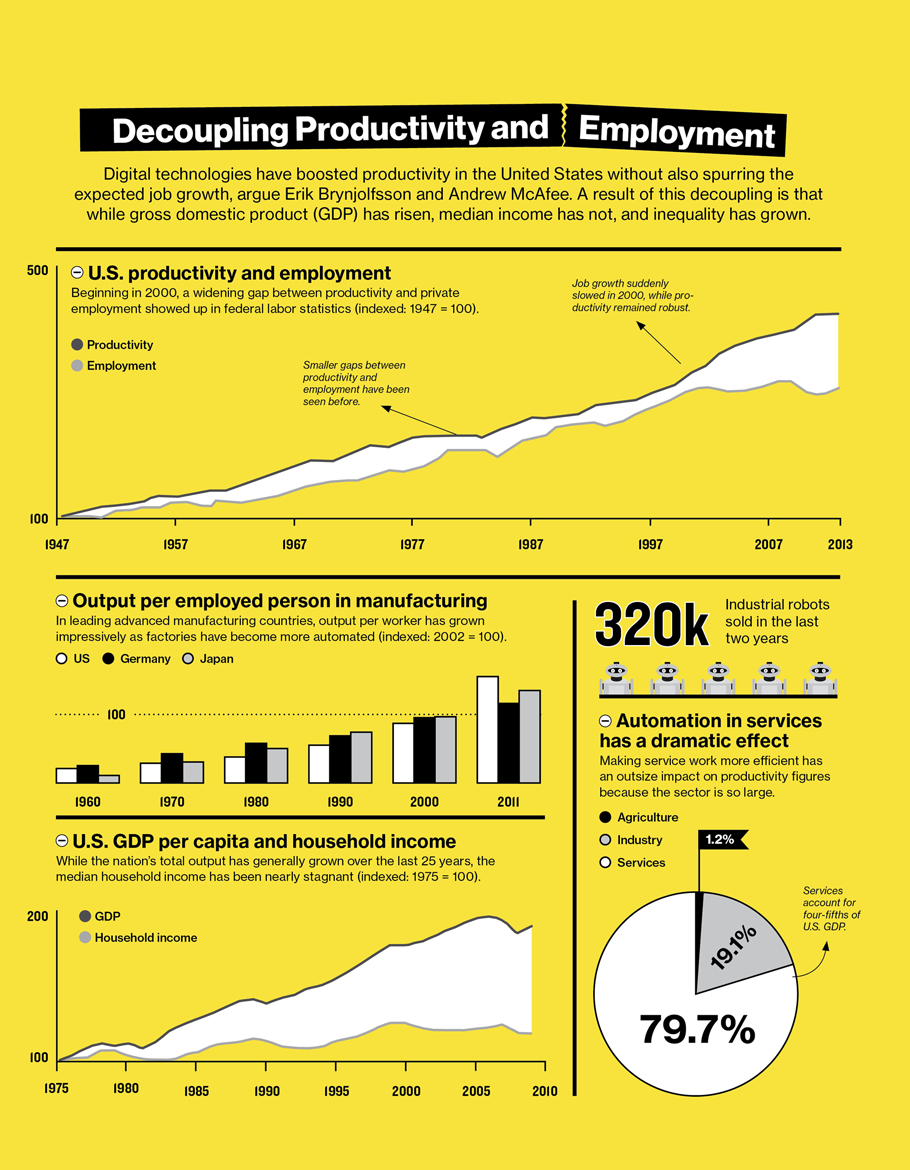
A report this summer entitled How Technology Is Destroying Jobs was published in the MIT Technology Review.  It confirmed that while technology improves productivity, it now creates a net loss in jobs. 

It has also polarized the workforce and hollowed out the middle class.

While technology has created workforce upheaval ever since the Industrial Revolution in the 1700s, through the 1990s the result was still a net positive in the number of jobs.

With the technology fueled during WWII, non-farm job growth was nearly 38% during the 1940s when I was born.  It fell to less than 20% in the 1990s and minus 1% in the 2000s.

Since 2007 when the Great Recession began, we have been obsessed with the devastation wrought by the financial industry on the economy .  But the more strategic issue is that our troubles in the longer term relate to technology.

It isn’t just a question of training or re-training.  If the jobs don’t disappear entirely, at the very least they will be dumbed down.

For example, one of the reasons the economic stimulus didn’t work better than it did was not only because it was too small but because much of the work it fueled is increasingly done by machines.

At the conclusion of that report an expert is quoted as saying , “technology progress does grow the economy and create wealth but there is no economic law that says everyone will benefit.

Gallup’s “payroll to population” metric is not much higher than when I retired nearly four years ago even though the unemployment rate is several points lower.  There are positive signs, but underemployment is still between 17% and 18% of the workforce.

With half of all adults employed today, it is no surprise that nearly 6-in-10 say that their work does not require a college degree including nearly 7-in-10 Americans who make between $30,000 and $74,999 who also agree as do more than 8-in-10 who make less than $30,000.

The belief that jobs no longer require a degree includes a third of those in professional, executive and managerial positions and nearly half white collar jobs.

Maybe most telling of the “dumbing down” is that four in ten college grads and 13% of those with a postgraduate degree now say the work they are doing does not require a degree.

Studies show that the most important thing employers expect people to learn in college is how to think critically and analyze and solve complex problems.  It seems that employees, though, are feeling those skills are less and less significant due to technology.

For an excellent and entertaining overview of why college is worth the cost including time and effort, click here to watch a quick “Question Tuesday” video by author John Green, where he makes the case that a person only has to make a $1.75 more per hour to make college worth it.

The U.S. Census just released an update about the 19.9 million students who are attending college this year, nearly 7% of the population over the age of 3.

Impressive is that they spend $117 billion on discretionary items (car, clothes, cellphones, entertainment, personal care etc.) They spend another $287 billion on non-discretionary things like room and board and tuition for a total of $409 billion.

That’s a significant part of the economy in itself.

Those attending college by ethnicity are Hispanics 3.4 million (up nearly half a million this year) Blacks just over 3 million, Asian Americans 1.45 million and Non-Hispanic whites 11.65 million.  Another way to look at this is by percent within each group, 6.8% of Hispanics, 8% of Blacks, 9.4% of Asian Americans and 6.2% of Non-Hispanic whites.

Only 5.5% of white males are enrolled.  Overall, nearly 8-in-10 college students are between the ages of 18 and 24. 

One could assume that the 7% of the population enrolled in college are predisposed to be engaged and willing to take on tough assignments when they enter the workforce but there are far too many other factors at play.

In my opinion, just as important as learning to critically think, and analyze and solve complex problems are to the workforce is social and emotional learning, including the ability to resolve conflict, which some states such as Illinois are wisely making a part of the K-12 school curriculum.

This is also something conservative columnist David Brooks synthesized from many studies as crucial to achievement in his Rousseau-styled 2011 book The Social Animal.  

The issue of education and job creation is far more complicated than what some politicians relate.  The solution isn’t just for everyone to be good at math or become engineers and computer scientists.  Nor is it about shortchanging liberal arts subjects which employers see as crucial.

It isn’t as easy as buying local or focusing on manufacturing jobs or rolling back globalization and technology in a return to isolationism.  Nor is this as simple as everyone having two parents or being home schooled or embedding certain values.

This is an extremely challenging conundrum, but whatever the solution, it will involve doing something about the 1-in-5 workers who are actively disengaged and effort averse across every sector of the economy.

Thursday, July 09, 2015

The Origin of Poverty and Our Biases Today

The four-county area centered around Durham, where I live, along with Chapel Hill, North Carolina is possibly the most highly acclaimed in the nation when you take into the breadth of the accolades it has earned as an MSA and those of its individual cities.

It also has the distinction of being the 20th MSA with the widest gap between rich and poor, according to the blog 24/7 Wall St.  The wealthiest half of households earn more than half (53.5%) of all income earned here while the poorest 20% earn just 3%.

The wealthiest 5% have one of the highest household incomes in the nation for that percentile.

In the book I mentioned yesterday about the history of capital and related inequality, French economist Thomas Piketty notes that worldwide, the poorest half of the population still owns nothing, while the middle class now owns between a quarter and a third of total wealth.

He continues to explain that “the wealthiest 10% now own two-thirds of what there is to own.”  Apparently, it was even worse a century ago.  Anyone interested in closing this gap needs to read Capital in the Twenty-First Century.

It may not sound like a page-turner but it is.  In a very easy to understand way, Dr. Piketty weaves historical events and data with paradigm shifts.

In part, income equality is rooted in the shift from land to things like profits, dividends, interest, rents.

In other words, income generated from capital and what Piketty calls “the  long-term evolution of the relative roles of inheritance and savings in capital formation.”

When inheritance rather than work and savings begins to predominate, “the past tends to devour the future.”

I’ve written before that Durham’s poverty rate took root in the late 1940s and early 1950s when the number of jobs plateaued but the community continued its rapid growth, in large part, due to it historical role as a magnet for those looking for work.

This was also a period when Durham economy began to rapidly transform from tobacco and textile manufacturing to education, research and development and high tech industries.

Despite efforts to re-educate the workforce, many who had come here for blue collar work and failing to see the paradigm shift, merely went home and waited for the next call-back to the factories as they had done for generations during layoffs.

Some have now become disconnected from society altogether while those who did shift gears found primarily low-wage jobs.  By 1960, 1-in-3 Durham County residents lived in poverty as did 40% of North Carolinians overall.

All the while, Durham’s economy skyrocketed but with jobs requiring far more education.  While much lower now than in 1960 when the economic transformation took hold, poverty still haunts nearly one-in-five residents in the City of Durham.

Last year a scientific opinion poll of Americans asked, “When people are poor, do you think that’s more likely to be because they had fewer opportunities or because of individual failings?”

Overall, 30% said “personal failings,” including 17% of Blacks and 30% of Hispanics, as did 48% of Republicans and Conservatives as well as 41% of those with household incomes over $100,000.

But 44% of Americans said “fewer opportunities,” including well more than half of minorities and those making under $40,000 as a household and including 36% of households making $100,000 plus, 28% of Conservatives and 23% of Republicans.

Americans were also asked, “When people are poor, do you think that’s more likely to be because good jobs aren’t available, or because they have a poor work ethic?”

Overall, 28% cited poor work ethic including 21% of Blacks and 33% of Hispanics as well as 49% of Republicans, 44% of Conservatives, 35% of those with household incomes over $100,000 and 24% of those making $40,000 or less.

But 47% of Americans said it is because good jobs weren’t available including 33% of Conservatives, 21% of Republicans and 42% of households making over $100,000.

When asked how some people became wealthy, 52% of Americans chalked it up to having more opportunities compared to 31% who believed they worked harder including 50% of Republicans but only 36% of Conservatives and 33% of those with incomes over $100,000.

Nearly 60% of Republicans believe unemployed people could find jobs if they really wanted to, a view also held by 51% of Conservatives as well as 53% with incomes over $100,000 and 35% of those making less than $40,000.

Interestingly a new study in Germany finds that more-trusting people on average have an increase in income over those who are cynical.

No community that I know of is more determined or does more to eliminate poverty than Durham. Hopefully, this will be useful perspective, both macro and micro, for those on the front lines.

Monday, June 16, 2014

Fewer Working As Adolescents Means Many Are Ill Prepared

Something crossed my mind while reading both a McKinsey report and a recent op-ed in the New York Times.  We seem to have forgotten the importance of working to ready adolescents for the workforce as adults.

It polishes skills learned from the time we are age 3 in a way that classroom learning can only augment.  In fact the root of not nearly as many adolescents working today may be an over-reaction to what progressives had to overcome to mandate education.

Before I get to the science, it occurs to me that I honestly don’t remember my parents needing to push me to start working for people other than family starting when I was 10 years old.

I held down 14 or so jobs working for an even greater number of employers before heading off to college.  It was a far more forgiving route workforce readiness as an adult than many kids take today.

Workforce readiness has nothing to do how well or how far you go in school.

I’m sure my parents kept close watch on where and for whom but they seemed far more concerned that I just learn to enjoy working hard.

My mom’s only word of advice when I took my first job away from home was - “If you aren’t busy, grab a broom and make yourself busy.”

Taking heed of that advice made me stand out to more than one employer and later left me puzzled when doing the hiring myself that so many candidates seemed unready and lacking work ethic.

Today, many kids are well into college before they get workplace experience, when the the expectations are less conducive to learning your way around a workplace or how to work in general.

Since 1981, the percentage of 12th graders working 16 hours or more a week during the school year has fallen from 44% to only 25% while the percentage volunteering once a month or more has risen from 23.6% to 35.5%.

A recent survey of employers by the Chronicle of Higher Education found that they ranked employment during college much more valuable than extracurricular activities, a specific major, college reputation or volunteer experience.

This was even more true among those working in HR and in upper management.

Working at a younger age helps polish “executive function skills” and are found most important by employers.  These include focus, working memory, cognitive flexibility, inhibitory control, critical thinking, self-directed learning and making connections and perception taking.

If you missed it, read the recent NY Times Op-ed by Dr. Gordon Marino at St. Olaf College entitled, A Life Beyond ‘Do What You Love’.

The essay also introduced me to a much discussed article in Jacobin magazine early this year, where Miya Tokumitsu” argues that this “cultural mantra of our time” in fact “disguises its elitism as noble self betterment.”

In his 2012 manifesto entitled “Stop Stealing Dreams (what is school for?)”, famous entrepreneur and author Seth Godwin reminds us that 150 years ago people were incensed about child labor but the outrage wasn’t just moral.

He points out that the “economic rationale was paramount.”  Kids were taking jobs away from adults because industries could get them to work for much less in the decades before education became compulsory in 1918.

At the time corporations and other businesses fought restrictions on child labor and mandatory education while fueling conservative rhetoric that “losing child workers would be catastrophic.”

“Professional confusers” back then used the same arguments they do today to stymie efforts to address climate change.

In fact, Godwin reminds us, that the rationale that finally weaned industrialists off child labor and in support of compulsory education was the argument that “educated kids would actually be more compliant and productive workers.”

Thus our schools today are still organized much like assembly lines with “scale much more important than quality.” 

“Education,” he argues, was “not developed to motivate kids or to create scholars. It was invented to churn our adults who will then work well within the system.”

Beginning several decades ago, surveys of American workers have revealed that 7-in-10 are not engaged at work and nearly 2-in-10 were actively disengaged, e.g. trying to undermine others.

But conditions such as engagement and being in the “flow” aren’t about doing what you love but learning to love what you do.

In my experience people can find purpose in any work.

Mike Rowe agrees.

He is the producer and host of the TV show Dirty Jobs where he played an apprentice for a variety of jobs, now more than 200 over its eight seasons which are now available online through various services.

While preparing for a sequel series by a different name coming later this year on CNN, he has taken a lot of grief recently for a commercial he narrates for Wal-Mart entitled “I Am A Factory.”

I’m far more often a critic of big box formula stores and a proponent of paying a “living wage” but even for the 3.3 million Americans still being paid minimum wage or less, it is the practice, not the work, that we should condemn, something advocates miss.

I was intrigued at how nimble Seattle’s daring experiment is with raising its minimum wage to twice the national level, including a provision to keep teenagers employed.

That all work can be purposeful and meaningful appears to be the point of Rowe’s “Works” foundation where in part he has raised millions of dollars for scholarships in the skilled trades by selling memorabilia from his “Dirty Jobs” days.

Far too many of us have these wires crossed.

In a TED talk, Rowe argues that “follow your passion” may be the worst advice ever given.  He finds that the people he encounters filming Dirty Jobs are decent, hard working, balanced people.

But they didn’t just follow their passion or wait around for work they could love.

We live now in a risk adverse society that makes it harder—but not impossible—for kids to get a job.

We’re robbing kids of the learning and character traits that can only be forged by early exposure to the work place.

Of course, I’m not talking about truly hazardous work such as tobacco fields where a report shows workers absorb dangerous levels of toxins.

A grim report by Human Rights Watch may overstate the dangers of farm work in general while trying to put a spotlight on abuses in a four state area that includes North Carolina.

Unfortunately, many of the parents denying their children a chance to work until well into college or even later may be the same parents who won’t let their kids ride the school bus or explore nature along the street where they live.

Judging from McKinsey research conducted mid way through the recovery from the current recession, we’re getting on track to regain full employment again by 2020 or soon after, about 20 million jobs more than we have today.

By then the recovery will have taken 14-20 years.

The great recession wasn’t just a recession, it marked a paradigm shift and not just because visitor-centric industries will be one of the top three drivers of job recovery by 2020.

Job growth after the new millennium has been at half the rate it was in previous decades.  Business creation fell during the recession too, 23% in the first three years alone.

The labor market is plateauing while we’re generating a million and a half fewer college graduates than we need to meet the 2020+ goal.

But it isn’t just college they will need.

All of this is to say that work experience is as valuable as education for young people.  We need to recalibrate to both/and.

Sunday, July 27, 2014

Unsticking Poverty

Preceded by textiles during WWII, tobacco manufacturing in Durham, North Carolina peaked in 1958, twenty years before manufacturing jobs peaked nationwide.

By the time I arrived here in 1989, all but one factory was gone and that closed a decade later.

The poverty rate nationwide back when Durham’s manufacturing peaked was close to 23%.  But it was 40% in North Carolina at the time and 33% in Durham.

Research shows that communities lose 1.6 other jobs when they lose a manufacturing job.

Poverty in Durham officially took root in the mid 1930s with the closing of the Durham Hosiery Mill nestled within the Edgemont neighborhood.

Soon surrounding businesses also collapsed and unemployed workers were evicted or indebted by speculators who took over the mill housing.

Only two decades before, that hosiery mill had been the largest in the world.  Sociologists here at Duke University, led by activist Dr. Howard Jensen, not only rushed to study the emerging poverty there but initiated a number of solutions still in use today.

Among many of the initiatives, Jensen initiated the precursor to United Way, spearheaded a community center and did much more.

Thanks to strategic foresight nearly four decades earlier,  Durham had already begun adapting its overall economy to research, higher education, healthcare and hi-tech, but these were very different kinds of jobs.

Following the Civil War, people could easily transfer skills from agriculture to working in Durham’s factories with little or no change in education.

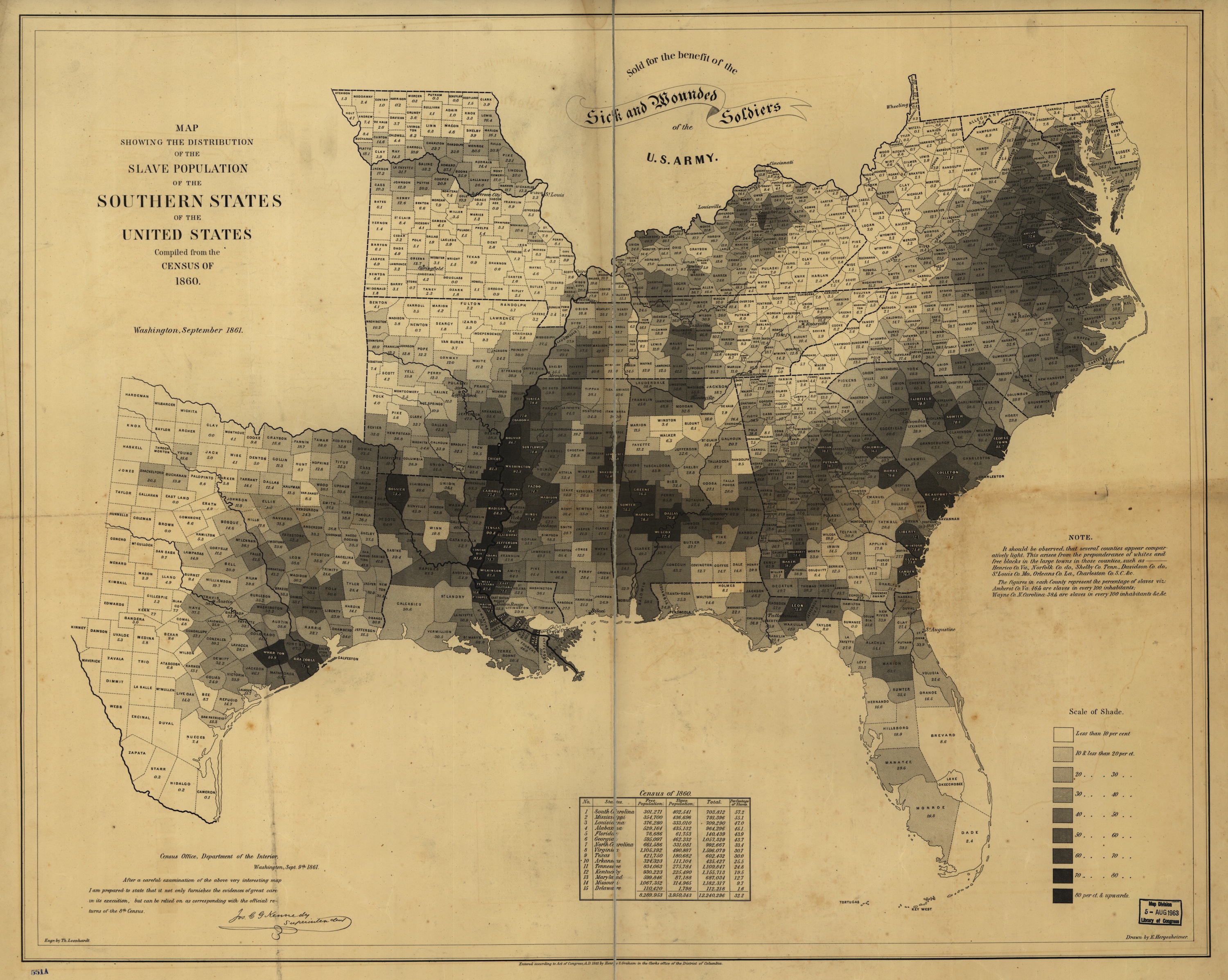
In 1860, on the eve of the Civil War, the area surrounding Durham was 30% African-American, a mix of free and enslaved.

That proportion grew to what is today, 4-in-10, when after emancipation and war’s end, African-Americans relocated to Durham to work in its booming tobacco and textile factories, giving it 50% more diversity than the state as a whole.

Today, that proportion is double what it is statewide, one of the reasons Durham is known for being “accepting,” and why it is still a beacon for new talent and the corporations relocating in pursuit.

Many African-Americans drawn to Durham also started service businesses by the 1880s that accompanied each increase in manufacturing, eventually spawning Black Wall Street and a thriving African-American middle class here.

While manufacturing had drawn African-Americans to Durham for jobs after the Civil War, the poor created by that benchmark mill closing in the mid-1930s were predominantly white.

Dr. John Rodman Larkin is remarkable for many reasons.

One is the valuable study he conducted in his native North Carolina based on data collected just four years after that mill closing in Durham entitled, “The Negro Population of North Carolina: Social and Economic.”

Larkin was African-American himself, and in the study he concludes something researchers at Harvard and UC-Berkley recent also concluded in another study published this summer entitled, “Where Is the Land of Opportunity? – The Geography of Intergenerational Mobility in the United States.”

Poverty, especially among African-Americans, settled into specific pockets in communities because unlike other groups they were less likely to relocate or have the means to do so.

Larkin’s observation in North Carolina was that in the wake of that first mill closing here.

These new researchers agree and also find a link to income equality and segregation of the poor.

Anecdotally, Joe Queenan, a conservative commentator and critic who is Caucasian and grew up very poor in Philadelphia projects, agrees.

In a Rotary Magazine article entitled, “The Inconvenient Truths About Poverty,” he cautions the “industriously empathetic” and “professionally compassionate” people such as myself and many others in Durham.

He writes that poverty in pockets where it is especially stubborn can become rooted in an “interlocking series of self-fulfilling prophecies,” where from generation to generation and neighbor to neighbor “the poor become architects of their own destruction.”

He would point, I’m sure, to the fact that more than half of the poor residents of Durham come from families where no one worked and all but 2% of those who did, only worked part-time.

Forever waiting for a “call back” to mill work can filter down for generations.

But Queenan also cautions, that this should never be interpreted that poverty is a “lifestyle choice” and gives a hint as to why poor people walked out of a session where a Durham task force was delving into poverty.

“People who have grown up poor always feel a proprietary attitude toward poor people in general, even when they themselves have migrated to a more congenial economic class.” (paragraph break mine)

“They don’t like to hear well-born outsiders presume to discuss the unexplored charms of slumming. It’s like listening to people who have never left Nebraska rhapsodize about the thrill of sailing the high seas.”

Since its high of 30% in 1960, Durham’s poverty rate dropped by nearly two-thirds to barely above the state average (actually below when weighted for ethnicity,) only to bounce back up during the Great Recession again to around 19%.

Weighted for differences in ethnic diversity, it really isn’t any higher than other urban areas in the state, including those nearby, but it is still vexing to Durham, long identified as an extremely “caring” community.

Several times in the 26 years I’ve lived here some of the very smartest people I’ve ever known have wrestled with the problem, including many globally recognized experts at Duke who have followed in Dr. Jensen’s footsteps.

Even after opponents in high office perpetually tried to starve it of funding, the War On Poverty worked wonders through the ‘60s and ‘70s and intermittently during the ‘80s and ‘90s after being gutted.

But it was never enough, nor was it meant to be a panacea.  Education is a piece because mobility is higher and unemployment lower among college and high school graduates than it is for dropouts.

This is why in his new book entitled The New Geography of Jobs, economic researcher Dr. Enrico Moretti suggests a “relocation voucher” as a means to reduce unemployment.”

The idea was also included a year ago last spring in economist Dr. Michael Strain’s report entitled, “A New Jobs Agenda” in his report for the American Enterprise Institute, a conservative think tank. I think it was one of his better ideas.

The voucher is now part of the bi-partisan American Worker Mobility Act.

Dating from the late ‘60s, researchers suggested the value of mixing the unfortunate in with better off neighborhoods, but Moretti and other believe this is now more a matter of relocation to communities better matched for skill levels.

He suggests the “relocation voucher” as part of the unemployment insurance safety net that was devised back in the 1930s around the time Durham’s poverty took root.

It could be coupled with the federal government’s shift of job training and re-training from just the classroom to apprenticeships and on-the-job training.

It isn’t clear to me if the vouchers will motivate people who are poor to move.  Nearly 40% of Americans overall have never left their hometowns.  But even if some won’t, the fact that others do, experts think will open up more jobs for those who stay.

Durham would be hard to leave.  More than 70% of native-born North Carolinians still live here, making it the second most “sticky” city in the nation according to Gallup.

However, those working hard to reduce Durham poverty might do well to consider these options rather than hoping to somehow restore the magic of days gone by.  Poverty is complex and there is no “silver bullet.”

While we’re at it, we need to look at what the impact will be of Durham’s next economic adaptation and begin preparing residents well before its arrival.

Tuesday, December 16, 2008

WHY CUT TRAVEL NOW?

While we’re obsessing about economic stimulus, some businesses and governments are arbitrarily cutting travel at a time when we're also pumping billions into stimulus. Doesn't make sense.

Travel fuels 7.7 million jobs nationwide and many more millions of small businesses. That's more than double the number of auto jobs in the U.S. inlcuding supplier and spin off. Are we certain, eliminating many of these jobs by cutting travel is such a smart idea?

As Congress and President-elect Obama consider emergency measures to stimulate jobs and the flow of commerce, shouldn’t encouraging travel be obvious?

Travel isn’t a luxury as Adobe self-servingly trumpeted in a full page ad in the New York Times Thursday while hawking an alternative to face-to-face meetings. I love adobe products and I’m sure their marketing people didn’t mean to insinuate the loss of millions of travel related jobs just to make a buck on software.

Obviously, business travel, conventions and meetings are being revolutionized by technological alternatives to travel. As a proportion of overall travel, business travel is in long-term decline and destination marketers are in a mad dash to replace them with leisure travelers just to hold even. But there will always be a need for travel and face-to-face communication. Even holograms will only go so far.

These are difficult times but let’s not be so quick to shoot ourselves in the foot.

Saturday, June 18, 2011

Start-Ups +3 Existing Firms -1

People collaborating on innovations, whether at the core or at the margins, find it almost impossible to later unwrap the specific DNA of the magic that results.

That’s why Michael Goodmon, the VP-Real Estate over the American Tobacco Complex and his father Jim Goodmon, who spearheaded the public-private, adaptive-reuse of the historic Lucky Strike Factory in Durham, North Carolina, may not be able to readily disaggregate the full story of the resourcefulness and passion behind the revolutionary American Underground.

A subsequent study released last week by the Kaufmann Foundation isn't the source but it certainly is validation. The 12-page report reveals that start-ups such as those for which American Underground has been created, are the nation’s true job creation engine.Capture

New firms nationwide add an average of 3 million jobs in their first year, while older companies lose 1 million jobs annually. The finding is based on an analysis of existing and start-up businesses from 1977 to 2005 and the averages indicated in the study hold up for all but seven years in that span.

Maybe even more remarkable is what happens during recessionary cycles. During downturns, the job creation in start-ups remains stable while existing firms are highly sensitive to the business cycle.

The job generation decline at existing firms occurs as they age. On average, one-year-old firms create one million jobs annually, while ten-year-old firms generate only an average of 300,000. The study upends conventional wisdom that businesses bulk up in the aggregate as they age.

The study further supports an earlier Federal Reserve Report published in 2007 citing that the net job impact of recruiting large corporations is close to zero.

The report describes that the impact of traditional economic development, known as industrial recruitment or “smokestack chasing” from a time when most relocations were manufacturing-oriented, has long been exaggerated because it wasn’t realized there are negative spillovers to relocation of large employers as well as positives.

A study of U.S. Census data reveal that between 1990 and 2003, 80% of jobs were created in firms of less than 20 employees. The large firms, often coveted by communities, generated less than 8% of the net new jobs.

The revolution this new information is having on this particular form of economic development, traditionally reliant on recruitment and incentives, has not been lost on the City of Durham or the County of Durham which contracts with the Durham Chamber of Commerce or Downtown Durham Inc., an advocacy organization funded in part by both local governments.

The findings are also validation for Bull City Forward, a collaborative to encourage social entrepreneurship, and the Durham-based Council for Entrepreneurial Development now relocated Downtown to American Underground.

They also validate the efforts of the organizations involved in “place-making” such as the Durham Convention & Visitors Bureau, Preservation Durham and the Durham Arts Council. By protecting and shaping and sustaining the unique identity, organic attributes, values and traits of this community, in essence, its unique-sense-of-place they draw the creative class workers so crucial to start-ups.

The reports also strengthen the calls by leaders such as Bob Ingram of Hatteras Venture Partners for a concerted effort to expand the sources of available venture capital for start-ups.

Thursday, April 15, 2010

My Fav Job (s)

I don’t know whether the term then was garbage man or garbage collector but it remains my favorite job (other than obviously the last 40 years in community marketing.)LEA106

I realize looking back that I had a lot of very different jobs growing up:

  • My first at 5 years old when I graduated from drying the dishes to washing the dishes.  My Mom was very determined I wouldn’t grow up with any of those “rancher” stereotypes for inside and outside work.


  • At six I worked digging post holes with my Grandfather and went on my first cattle round-up (and got lost.)


  • I had my first newspaper route at 9 years old in a small town of 1,000 and even fewer actually households.  This was my first job working for non-family. I still remember the sights and smells and darkness of early morning and there weren’t many street lights then.


  • I went on to “moving” sprinkler pipe twice a day at 10.  I also had a lawn mowing business and that included moving sprinklers but a different kind.


  • Then baling hay which was more like loading and unloading bales during junior high.  And getting up very early before track practice to cut asparagus before the sun came up.


  • When I could drive, I did a stint driving grain truck only it was actually grass seed and they worked three shifts.


  • And I also worked in a salvage store where we took goods from fires and floods and resold them.


  • My senior year in high school I worked in a service station (gas stations before the era of convenience stores.)  Did a brief stint as a flagman for highway construction.


  • And during the summer spraying trees in the Targhee National Forest which involved getting drenched in DDT and bathing only once a week and sleeping in tents.  Definitely not a favorite.


  • I worked construction on a new hotel and then got a my fav job working as summer replacement on the crew of a garbage truck for the county.  It was in the days of back loaders where you loaded a big bin in the back, then when it was full ran a big scoop that compressed it up into the bed.  Then went to the dump when it was full and emptied it like a dump truck.

It took several loads a day to do a route.  I only got to work on the back end.  People had metal garbage cans in those days and often more than one.  I learned the skill of reaching down as the driver slowed, picking up a can without getting off the truck and while it was still moving, tossing it behind my back to the other hand, flipping it upside down to empty and then reversing it to put it down on the grown just a few feet from where I picked it up.

Great skill to have and obvious no OSHA in those days.

  • And college I worked in and eventually managed the Office of Tours and Conferences and then start up with a convention and visitors bureau,  launching my 40 year career in destination marketing.

I’m sure I left a few jobs out.  I regret that today, kids don’t appear to get the opportunity to work through jobs like this.  Many don’t never even have to do chores.  They have to be missing something that can’t be replaced with other activities.

Maybe it’s why, as I read recently, that “Millennials” are the first generation of Americans ever not to list work ethic as a top value in surveys.  But maybe that’s because they haven’t had jobs and the fulfillment of a day’s work.

Monday, March 16, 2009

So Why Trivialize Rehabbing The National Mall?

Why did a Republican official who, I assume, wanted to politicize the stimulus package, trivialize the long overdue expenditure to rehabilitate the National Mall? Because he could; and it worked. Taking shots at the expense of Washington played on people’s stereotypes. Not the greatest motive but it worked. Or maybe I’m being too harsh and he’s just against grass or the color green.

What isn’t clear is why proponents caved and took it out of the stimulus bill. Is creating landscaping, architectural and planning jobs any less significant than creating jobs to construct bridges?

A job is a job. Why not create a bunch of them restoring America’s front yard which has suffered through a decade of neglect?

After all, we want to restore America’s image abroad, so why not start with some curb appeal for those currently making the effort to visit and see what we’re all about?

Same thing comes to mind as we see governmental departments bullied by politicians and news stories into slashing conventions and meetings. Do we really think the thousands of jobs this will cost retail stores, hotels, meeting facilities, theaters, ballparks and restaurants will take the economy in the right direction? Not to mention that most conventions and meeting delegates are visitors and by definition visitors are a stimulus.

One TV station even went out of its way recently to term a story about a meeting by a state agency as an “undercover investigation.” Believe me the only reason it would be “undercover” is to keep another media outlet from scooping the idea. But we all know why the insinuation was made. And viewers are suckers for intrigue.

But in each of these instances, are we really doing the country and the public a service by politicizing issues in such a way that they create more job losses?

Wholesale cutting of travel including conferences is as dumb as suggesting that because there is a downturn we shouldn’t pay our taxes this year or watch television.

And let’s find a way to get busy rehabilitating and restoring the National Mall to something American’s can point to with proud. Washington D.C. belongs to all of us. And those jobs are every bit as important as mine or yours.

Monday, January 27, 2014

Poverty’s Genesis & Possible Resolution For Durham

Durham, North Carolina, where I live, was the fastest growing of the state’s major cities from 1930 to 1940, second during the decade dominated by WWII and fastest growing even through the 1990s, for that matter.

This may relate to its stubborn poverty problem, although when indexed to ethnic make up and an entrepreneurial bent among the poor here that fuels an underground economy, it may not be as high as many other major cities in North Carolina.

A clue to the genesis of Durham’s poverty is that while the population here skyrocketed by nearly 20% in the 1930s, during the same period, known as the Great Depression, the number of jobs in Durham’s long-vaunted manufacturing sector fell by nearly 20%.

But this disconnect wouldn’t really be pinpointed statistically for another two decades.

Durham had dramatically transformed North Carolina’s economy following the Civil War, which effectively ended here with Johnston’s surrender to Sherman, first with value-added manufacturing of tobacco and then with textiles.

Overall, North Carolina fell into the throws of white supremacists who rallied North Carolinians by re-spinning the Civil War as the “Lost Cause,” a movement that gained steam especially once the Republican Party gave in to Wall Street and pulled the plug on Reconstruction.

Durham became a workforce beacon, soon earning a national reputation for leading the way to a New South.

But in the 1920s, a few Durham leaders, foreseeing the eventual decline of tobacco and textiles, had already begun perusing a new model of economic development for North Carolina based on higher education, healthcare and research and development (image shown in this blog is of Duke West Campus under construction, linked from the exceptional blog Open Durham.)

Long a beacon for those of various ethnicities who were willing to work side by side, Durham’s population continued to soar well after the first factory closed down in 1938 which signaled a long-term loss of jobs including those in the business service sector and a dramatic decline in retail sales.

This was not detected by most who labored on factory floors because they had become accustomed to periodic and temporary lay-offs.  Little did they, or as manifested in generations after them, realize that call backs were gradually becoming extinct.

The percentage of blacks in and surrounding Durham, both free and enslaved, had been more than 30% of the population in 1860.  With Durham’s emergence as a manufacturing center after the Civil War, that percentage increased to 4-in-10 residents by 1890 as people of all backgrounds flooded to Durham for work.

However, by 1940 with manufacturing in decline, that percentage had fallen by 11 points even though the overall population of Durham kept swelling with newcomers deserting subsistence farmland for factory jobs.

Poverty certainly was not limited to blacks even back then but as it does today, it has disproportionately affected blacks and now Hispanics.

If they were able to detect the calamity they faced with a swelling population but a dwindling manufacturing workforce, Durham leaders put reactions on hold during World War II.

However, within a few years of its conclusion, Durham established:

  • A community fund (a precursor to United Way) to rally donations to help the poor -
  • The Committee of 100 to pursue economic development and jobs -
  • A public housing authority and its first complex
  • Better pay for public teachers and a series of educational innovations -
  • A hospital care cooperative (a precursor to Blue Cross)
  • Coalitions to pursue equal rights, political inclusiveness and social justice  -
  • An Industrial Training Center, now known as Durham Tech
  • A public-private Durham Industrial Development Corporation to facilitate relocating and expanding business -
  • Its first Downtown Association to revitalize the core area
  • A spearhead for development of a Research Triangle Park four miles from downtown

Durham’s economy transformed, as it has done five times now throughout the history of this land area being populated.  Most communities are lucky to re-engineer once or maybe twice but this attribute wasn’t enough when it came to addressing poverty.

Even Durham’s transformation since the 1950s into a center for creativity including research, hi tech, healthcare and higher education, including emerging as one of the most widely and highly acclaimed communities in the nation has not yet been able to erase poverty here.

By 1960, 1-in-3 Durham residents had fallen into poverty, as had 4-in-10 North Carolinians.  The generation of Americans who fought and won World War II, including many from or who passed through Durham, emerged committed to building a middle class, securing equal rights and reducing poverty.

Within little more than a decade they were able to make incredible strides.

Durham was on the forefront of each of these changes, but like nearly all ethnically-diverse communities, it has never been able to totally eliminate the poverty that took root in the 1930s.

Many assume because Baby Boomers such as me made more racket, that this generation was responsible for the dramatic socio-economic changes of the 1960s and 1970s.  But these changes in America are a credit to the two generations that came before.

If anything, it is today’s lawmaking bodies - dominated by Baby Boomers - that are responsible now for holding us back, even regressing.

We would all be wise to look back on that remarkable period as well as to listen more carefully to people who have experienced poverty.  According to acclaimed conservative critic and author Joe Queenan, himself raised in poverty:

“The philosophical infrastructure of poverty is rooted in an interlocking series of self-fulfilling prophecies. Poor people eat bad food, drink bad beverages, and ceaselessly make bad decisions, and these counterproductive activities are then used as an indictment of their moral character.”

Durham is a highly integrated community now except for one class of people, the poor.  In Durham, we are well-advised to read a study released last week entitled “Where Is The Land Of Opportunity?”  by economists at Harvard and the University of California, Berkeley.

It geographically ranks consolidated metro areas for upward mobility.  The one including Durham is mislabeled as Raleigh but it is a ranking  for two distinct metro areas taken together, Durham and Raleigh-Cary.

Together, the scores of cities and towns and counties - including Durham - is ranked 48th out of 50.  Ominous for North Carolina, the area including Charlotte is 50th.  Atlanta is 49th.

The area labeled as Salt Lake City, which apparently takes in nearly all of the cities and counties along 100 miles of the Wasatch Front and more than a third of that state’s population, is taken together ranked 1st according to the metrics used.

But the reason to read this new study is not to see that Durham falls near the bottom in this ranking, contrasted to how highly ranked it is in nearly every other area where these scientific analyses are conducted.

The new study notes that “both blacks and whites living in areas with large African-American populations have lower rates of upward income mobility.

Segregation plays a role according to the study but not just because bands of the country where upward mobility is stymied seem to track states that had significant slave populations in 1860.

For nearly 130 years, Durham has been widely noted for having a strong black middle class forged by entrepreneurs.  The community’s neighborhoods are integrated today except where poverty is entrenched.

The link communities like Durham have is a different type of segregation.

The researchers note that (paragraphing is mine for ease of reading):

The results suggest that it is the isolation of low-income families rather than the isolation of the rich that may be most detrimental for low income children's prospects of moving up in the income distribution.

One explanation of this correlation is that the separation of the middle class from the poor reduces beneficial peer effects or funding for local public goods (e.g., schools) for children from low-income families.

In contrast, the separation of the affluent from the middle class may not directly harm low income individuals.

There is much more to this analysis.  But let’s start there.  Durham’s poverty today is anchored just where it took hold with that first mill closing in 1938.

Geographic isolation within a community is part of the problem and addressing it may be a solution possibly including a much broader application of affordable housing models that mix incomes.

Read the study.

Monday, September 29, 2008

WILL EVERYTHING GO SELF SERVE?

With half of all adults having worked in restaurants during their lives and 1 in 3 having their first job in one, you would think we’d have a better sense of the of the following projections in the 2008 Restaurant Industry Forecast:
  • Culinary arts are already a key part of why Durham is distinct.

  • Restaurant jobs are growing at three times overall the rate of all jobs nationwide.

  • Restaurants will add 2 million new jobs by 2018.

  • Demand for chefs and head cooks will increase by 16% over 10 years.

  • Restaurants account for 1 in 5 jobs added to the economy annual.

  • Foodservice managers will increase 11% in the next 10 years.
So it is great that a portion of the proposed prepared food tax on the referendum will go to hospitality workforce training if it passes in November. Things like the award winning Durham Careers In Hospitality program in Durham Public Schools and NCCU’s newly accredited Hospitality Degree Program are already up and prepared to expand. Restaurants will need to be competitive for labor because the labor pool coming of age will shrink by 7%.

Friday, June 17, 2011

“It’s Like Giving Your Wife A Fire Extinguisher For Her Birthday!”

Wow, the City of Durham is really cranking this year on repaving projects.  Just as manager Tom Bonfield and his team promised, not only have more projects been jump-started simultaneously but there is more intensity to complete each step and phase of each project much more quickly.

While fixing potholes is important, the author of a new book explains why unfortunately “it will do nothing to create affection or even gratitude in the minds of the citizens…”

…"Fixing potholes is the equivalent of a clean knife and fork in a restaurant. You don’t get a good review for clean cutlery – but you can get a negative review for a dirty spoon...”  Peter Kageyama, author, For The Love of Cities.

He describes fixing potholes as “the functional equivalent of giving your spouse a fire extinguisher for her birthday.” - “It is the stuff cities are supposed to do.”

Thus, long before spittled-tea-party angst, this has been the dilemma faced by public servants whether local, state or federal: they are easy to take for granted, invisible when everything is fine and conspicuous only by messing up.

Often much less burdened by that paradigm, the private sector is singled out by Conservatives as the only sector capable of creating jobs – that is until it becomes suddenly more politically expedient to trash government for not creating them, ironically while demanding never-ending cuts that will result in the loss of more jobs while refusing to raise taxes or let temporary cuts expire because that might, “well” cost jobs.

Of course there are grains of truth to each of those seemingly conflicting positions.  Balance is the key and timing.  There may be some truth to the dictum that the business of government is business, but lets face it, businesses wouldn’t get around the block without governments of every level.

The discussions among business owners in which I have frequently been involved mistakenly assume everyone present was a Republican and those who were most outspoken often parroted that Gordian knot of half-truths and inconsistencies.

Overall, however, business owners, especially the 99.7% that are small businesses which generate 13 times more patents per employee and include start-ups which apparently drive virtually all of the job growth in this country are evenly split in studies when it comes to political affiliation, Republican (33%), Democrat (32%) and even, like me, Independents (29%).

Conversations among business people always seem dominated by those with nothing good to say about government until business in general is brought to its knees by calamities such as when storm drains erupt or levees break or drought overtakes reservoirs or roads and bridges collapse, or food becomes unsafe or  educators fail to turn on a dime to generate a never-ending, always evolving workforce or air and water are polluted or investments devastated by unregulated greed or negligence or both.

It is time for large businesses, in particular, to stop whining, to show a little less arrogance about the need for government and to willingly shoulder a fair share of the costs for public services rather than exploiting every little loophole devised by lobbyists, the closing of which would be the easiest, quickest and most painless way to reduce the deficit.

To paraphrase the author and book I cited and linked earlier, “no one falls in love with a city or state or nation or business, for that matter, because of ‘maintenance’ issues.”

To further adapt the words of the author, while it is true that we may “fall in love with places and give high reviews to businesses based more on emotional connections, it is time we all showed more respect and gratitude for those in the background on whom we rely to keep “the cutlery clean.”

Wednesday, March 25, 2015

Thoughts From A Roadside

Several thoughts raced through my mind yesterday while viewing the roadside of a freeway interchange in Durham, North Carolina, where I live.

These parcels are very park-like when well-maintained, as members of a public-private coalition called Durham Appearance Advocacy Group (DAAG) is trying to do by forging alliances between local governments, businesses and groups such as garden clubs and Scenic North Carolina.

The one we discussed yesterday is meant to serve as a template for every interchange in Durham.

But ironically, regressives in the State Legislature have been working at odds, filing bills to disable state management of these roadsides and permitting out-of-state billboard companies to wantonly deforest them in order to prop up an obsolete technology few Americans use now.

Now they have even filed a bill, with an innocuous misleading intro, meant to override wildly popular democratically enacted bans on this form of desecration marketing and blight that have stood in communities such as Durham for more than three decades and ruled constitutional by the U.S. Supreme Court.

This tyranny by representatives not from Durham reminds me that revolutionaries founded our democracy not in opposition to taxes but due to corporate loopholes granted by the feudal systems of governance then in place.

In opposition at the time and ever since stood regressives trying to pull the country backwards.  One wonders, will another revolution soon be sparked?

In the 1930s, roadsides such as those I was standing alongside yesterday were already battlegrounds between the forces of blight and the forces of scenic preservations.  Jobs, jobs, jobs was the mantra then too but it was both/and when it came to scenic preservation.

Highway 100 was one of the first, if not the very first beltlines in the country.  It patched together a series of existing roads south and west of Minneapolis but included new construction of a stretch of more than 12 miles including what we now call clover leafs.

It was deemed the “Lilac Drive,” lined with 30,000 plants including 8,000 Lilac shrubs and 7 roadside parks.  It became a recreational destination and living proof that Americans are drawn to scenic character over commercial blight along their roadsides.

It was in the middle of nowhere back then but had the support of development interests and billboard companies eagerly pushing for sprawling suburbs that would soon gobble up acreage at a rate many times the rate of population growth, as it still does today in Durham.

Emily Badger reported in The Washington Post this week about a new study that that concludes that sprawl costs the U.S. economy now more than $1 trillion a year.

The reason deficit hawks are not licking their chops is that $400 billion of this is pushed off on other people, something economists call negative externalities, which is a fancy word to describe when the free market doesn’t incorporate its true costs.

Only a portion is found in inflated costs for public services.  We absorb the rest sometimes in our lungs and often while stuck in traffic, but all in all it is very similar to the tax loophole that led to the original Boston Tea Party.

Billboarders and their legislative allies aren’t the only ones who want to shift even more of those costs onto unsuspecting Tar Heels including millions of us “hard-working taxpayers” we so often hear regressives talk about.

Over the last five decades (1960s-2000s,) the NCDOT has carefully reforested and afforested more than 5 million trees along the state’s roadsides, in part, to mitigate for many times that number which had been destroyed during road constructions.

The trees were also meant to bolster a signature ingredient of North Carolina’s brand.

This included lining the state’s roadways with spectacular understory trees such as native Redbuds and Dogwoods, the state tree.  Then, without thinking, another unit enabled private maintenance contractors to destroy most of them just for their convenience.

During our cross-country road-trip a few months ago for my mom’s funeral, Mugs and I took I-64 through Saint Louis.  This included a 10 to 11 mile stretch through the heart of that area that had recently been rehabilitated.

Some even call it that community’s front door.

The area is sea of concrete and buildings leaving almost no roadside.  But the Missouri DOT has carefully carved tiny slivers of planting areas where possible along this stretch and recruited businesses and organizations as landscape sponsors.

It too, I suspect is meant as a pilot project for a more strategic approach going forward.  An example of the discreet but very visible signs erected for sponsors is shown as the image in this blog.

Research shows that less than a fraction of 1% of consumers still use billboards.  It takes less than six seconds to decipher one but consumers only give them an average of three, even when digitally flashing on and off intermittently to draw attention away from the road.

Yet billboard companies now want to deforest even interchanges in hopes that someone traveling past them or focused on exiting or merging onto the highway will have twice as long to look.

Yes, it is obscene and possibly the spark for another revolution, if not with torches, pitchforks or midnight rides, a roadside revolt.

Wednesday, January 29, 2014

Nothing’s Really New

A friend of mine from my Alaska days in the 1980’s, having read this blog, emailed recently that I haven’t changed a bit.

He reminded me that on an airplane trip we took together over the North Pole to harvest potential business from Europe early in that decade, I did something I often do today in this blog.

He had watched me go through a huge brief case of reading materials, tearing pages from periodicals and using a handheld Epson device (regarded as the first laptop) to create notes and then print them out on ticker tape to staple to clippings for routing or mailing after I got home.

Running a community destination marketing organization requires gathering marketing intelligence wherever possible but my friend observed that in most cases, I was routing the clippings to other people in community, most unrelated to my former visitor-centric career.

A best practices consultant who interviewed several hundred community leaders hypothesized that this habit of circulating information was one of the reasons our organization was considered so much more relevant than peer organizations were in other communities.

I do enjoy it so I guess it is no surprise that I do something similar in retirement now with these essays.

Marketers for any enterprise should be on the forefront of trends and changes but far too many lag behind even within their own organization.  This is clear in the USA report from the “Annual Global CEO Survey” by PwC.

CEOs were the only members of the C-suite to cite technological advances as the trend that will be most disruptive in the future.  In the US, only 36% of CEOs believed that those responsible for their marketing and brand management were prepared to make the changes necessary.

I suspect this is why you often see marketing departments so out of touch with their organization’s sustainability efforts, such as when they use roadside billboards which require huge amounts of deforestation, ultimately reducing carbon sequestration and fostering pollution.

Of even more concern to CEOs may be that only 20% believed their R&D divisions were prepared for the coming changes that will be wrought by technology.

Looking at the verbatims, those surveyed have very large concerns. These are the ones pursued by those I refer to as “big game hunters” on the supply-driven side of economic development (as opposed to those working on the demand-side such as tourism) which they hope to land in their communities of states.

Even though small and medium sized businesses (SMBs) were hit much harder during the recession, they remain where the action is.  The 23 million SMBs in America (fewer than 100 employees) generate 54% of the sales, provide 55% of the jobs and fill up 30-50% of all commercial space.

Since the 1970s, SMBs have accounted for 66% of all net new jobs.  About 98% or 22.5 million are independent, locally owned concerns that account for 54% of all U.S. sales.

They are under threat from chains for which 600,000-plus franchised small businesses in the U.S. account for 40% of all retail sales and provide 8 million jobs.

It isn’t just technological trends where big business marketers are unprepared.  Studies show big business often doesn’t understand small and medium-size businesses which for 70% are their customers.

The battle ground for this misunderstanding is on Main Street.  Part of the solution is better exchange and sharing of marketing intelligence and data.

Many local organizations that represent small businesses eschew strategy plans in favor of frenetically running around in an attempt to find a “parade” and then desperately seeking to be at the head or at least be the convener.

They have no patience for being at a table of equals if they can’t dominate the conversation.  They fail to see that a strategic plan is merely a pathway to make it easier to spot and react to trends as they arise.

They especially fail to grasp that today’s new breed of strategic thinkers see into the future by analyzing the past, sometimes referred to as “temporal planning,” something I stumbled onto decades ago by virtue of fusing my college major into my eventual four-decade career in community marketing.

But the aversion to strategic thinking among many organizations portending to represent business is why businesses of all sizes - but especially small businesses - have lost patience with and increasingly find these organizations irrelevant, leaving them to devolve into places where only “whiners” congregate.

Identifying and responding to trends is best done when organizations share and treat each other not only as equals but with a deeply respected division of effort and expertise.

Strategic partnering such as this works best when all eyes are trying to spot trends regardless of relevance to one partner or another but then quickly to shuttle them to the partner for which they are most relevant.

I realize this is annoying for generalists, who having been successful at one thing assume they are now expert at everything, dismissing organizations with expertise specifically suited.

In parting, I’ll forward 2014 trends by Sparks & Honey which takes an ecosystem approach to 80 areas of trend and culture.  If you find this amazing, you should see one of their custom reports.

Share them with strategic partners at a table of equals and assign which organizations will take point based on expertise and focus.

My favorite?  I’m retired.  My expertise now is narrowed to sharing.

Call it “content marketing.”  Just don’t refer to it as part of the new “sharing/collaborative economy.”

That isn’t new.  Nothing really is.

Monday, November 09, 2009

Green Infrastructure Is Critical to Creative Class Communities!

(not to be confused with green technologies)

Durham is already widely recognized as a center for the creative class, a contemporary name for “knowledge” workers. These aren’t just jobs for artists, but all jobs that require thinking and/or creating for a living, e.g. researchers, doctors, lawyers, etc.

A new study by the Michigan State University Land Institute indicates that one of the key ways to stay that way is for Durham to invest as much in “green infrastructure” as it does traditional infrastructure like downtown areas, streets, water, sewer, etc.

Green infrastructure is different than green technologies. Green infrastructure is an umbrella term for cropland, trails, local and state parks, rangeland, rails-to-trails, private and public forests and water amenities like wetlands, rivers, lakes, streams and related activities like fishing, hiking, canoeing, marinas, etc.

Durham has a bigger challenge than most because it is a good size city located in a very small county in terms of land area. So planning to create and accommodate residential, office, commercial uses as well as green infrastructure is more complex here. But one thing in Durham’s favor is that more than a third of the land area is already set aside in watershed including rivers, lakes, cropland, etc.

People in economic development need to take note that places with great green infrastructure are associated with seven to eight times more metro job growth and those with water amenities in particular translate into 13 to14 times more jobs. Hopefully people in visitor centric economic development already sensed that.

Oh, another thing the report makes clear to economic developers who often bemoan taxes is that lower taxes may mean more population but not job creation or income growth. It also indicates that the old strategy of tax-based job attraction may only attract population but not employment or income.

Friday, July 03, 2015

How Small Business Comes To Be So Misrepresented

There is one discovery I find especially intriguing when I drill down into surveys of businesses such as Bloomberg’s, which goes deep enough to reveal the sentiments of truly small businesses.

These are the concerns that make up 90% of small businesses nationwide, those that employ 5 or fewer employees including all startups.  Seventy percent are owned and operated by a single person.

Three-quarters, according to other polls, rely on locals for all or most of their business, making them the very backbone of economic development.

These so-called micro businesses, according to Gallup, make up an incredible 80% of all businesses in the United States.  Some calculations go as high as 92% by expanding the definition to include those that employ 10 or fewer employees.

Don’t even ask why the so-called Small Business Administration still defines small businesses in general by metrics as large as 500 employees.

But I have a hunch, that similar to the way official dietary recommendations were originally established, it was originally superimposed by special interests and politicians, not science.

However, these truly small businesses generate 7 of every 10 new jobs.

Fostering and fueling the retention and growth of these micro businesses is the “low-hanging fruit of economic development” overlooked by communities firmly addicted to providing incentives to larger but less fruitful concerns.

A study in 2012 found that micro businesses of 5 or fewer employees directly employed 26 million Americans and indirectly supported another 1.9 million jobs while inducing 13.4 million other jobs.

But these concerns don’t often show up on the radar or in the actions of self-described business advocacy organizations such as chambers of commerce.

Neither do they typically show up in any representative sample during public hearings regarding pending legislation.

While they are claimed as a cause celeb by many along the spectrum of political ideology, the sentiment that tells me these small businesses are not being accurately represented is how they regard government regulations.

In fact, in North Carolina, the political party now in power, often uses this group as an excuse to unravel these public protections.

However surveys such as the one conducted for Bloomberg, show that only 2.2% of these concerns rank complying with government regulations as one of their top problems, making it 10th on the list of concerns among small businesses in North Carolina.

The percentage with this view nationwide is 2.6%.

So what segment of business are Republicans really representing when they seek to undermine public protections in the name of being business friendly?

Well it isn’t large employers in North Carolina where it is a top concern for only 4.7%, making it 7th on their list of concerns and hardly emblematic for what partisan elected officials claim.

Nationwide, the view is held by only 4.3% of large employers, making it 9th on the list.

Taxes aren’t much of a concern either, ranking a top concern among only 7% of small businesses and 4.7% of large employers in North Carolina.

Of far more concern to small businesses are issues such as access to capital where studies show they are largely reliant on small, local banks which are being squeezed out of business by mid-sized and large banks.

Small, community-based financial institutions now have just 24% of overall banking assets and yet they make 60% of all small business loans while giant banks now control 59% of all banking assets and yet make only 23% of small business loans.

The reason is so-called regulation reform and the silence among the elected officials responsible is deafening.  This is in part because of the feed-back loop they helped create.

For instance, while only 2% of small businesses have regulations as an issue, nonetheless for having been caught for years in an echo chamber, this is one of the top two issues that Republicans say will influence their vote.

Just don’t blame small businesses.

So what is really forcing concerns of far less concern to small and large businesses alike, such as taxes and regulations, to the very top of the list for the Republican majority now dominating North Carolina’s three branches of government?

How does an ideology, any ideology, so often find itself so narrow in its representation?

I have witnessed personally, that in some cases, this happens when elected officials come to think it is their opinions they should push rather than those of their constituents.

I have also been privy to how large blocks of elected officials begin to view their constituency more as the special interests that financed their campaigns rather than all voters.

It doesn’t take much to form a vacuum-sealed feedback loop, especially when special interests have lobbyists that seemingly vote their opinions every single day at the state capitol while voters, in general, officially only get to weigh in every few years.

Cities that have taken the lead to require a livable wage aren’t just avoiding these feedback loops, they are fully disaggregating and examining the sentiments of employers rather than just listening to those who pay people to attend meetings.

This is an idea still novel to many officials.  But it is more complicated than that.

An understanding of how an entire political party or ideology can become out of step with business owners and other voters can be found in a paper published by Duke University business and psychology researchers.

It is entitled “Solution Aversion: On the Relation Between Ideology and Motivated Disbelief”, and weaves together a series of behavior studies.

“Solution aversion” explains a lot about how organizations such as business advocacy groups and elected officials can become so estranged from the views of their constituents.

It isn’t just because very few constituents have time to attend meetings or the patience to deal with the games played by those who do.

It is because we can all form cherished beliefs and then ideologically align with people who share those same beliefs based on biases rather than information in such a way that we are led to pair solutions and problems, not based on empirical and generalizable information, but on fear.

For anyone caught in an ideology or belief system that seems averse to solutions or trapped in positions where the same old worn out solutions are recycled with the same disappointing results, whether it be in business or politics or religion, this paper is an extremely worthwhile read.

Tuesday, March 24, 2015

Looking Out 35 Years From Now

Frankly, I was always a bit puzzled, back in the day, to hear myself introduced as innovative or strategic.  I still am whenever I guest lecture college students, including many who are pursuing my former career.

On reflection, I have probably always been more of a “repurposer.”  Studies show that less than 14% of Americans are strategically inclined. 

However, according to experts who study strengths, inclinations such as this, otherwise known as talents, are “naturally occurring patterns of thought, feeling and behavior.”  They are building blocks that can be refined and amplified through education and skill development.

For the rest of us, talents such as being strategic don’t come as naturally but we can still develop a certain level through practice and study.

Studies show that learning to see things strategically is also the secret to why some people can juggle multiple priorities making it is just as relevant to working through a daily list of assignments.

My first brush with thinking strategically probably began in 1970 when a history professor recommended that I read a newly published book entitled, Future Shock.

A quote that has stuck with me through the years is, “The illiterate of the future will not be the person who cannot read.  It will be the person who doesn’t know how to learn.”

But it is the co-author’s second book entitled, The Third Wave which I refer to students today who are serious about learning to think strategically, more than 35 years after I read it for the first time.

It isn’t just because so many of the possibilities the authors concluded have come or are coming to pass today.  It is because it is written to show how they arrived at those conclusions by understanding the patterns of the past.

For instance, the book foretold the “collapse of consensus” we are experiencing today but it also sheds light on where we might go from here.

The revolutionaries who founded this country revolted against the feudal systems of governance then in place.

Societal headlines today reflect those who want to move forward to a more sustainable path and those who are trying to pull us back into another era or at the very least keep one foot in the past.

By looking at past patterns, the authors of The Third Wave, Alvin and Heidi Toffler, were also able to predict the change in how we will view being employed or unemployed in a world with more and more people but fewer and fewer jobs.

A blog I enjoy reading is Carolina Demography.  A recent post noted that of the nearly 4.5 million North Carolinians (age 16 and older,) 3.3 million or nearly three-quarters are of prime working age (25-64.)

That definition is slightly more broad than the norm.

Experts who have suggested that unemployment analysis would be much more relevant if it focused on the prime working age population, generally use ages 25 to 54 for this cohort.

A poll published three months ago by the Kaiser Family Foundation with the New York Times and CBS found that a little more than half of the U.S. population age 18 and older falls in the prime working age.

About 18% are prime working age but unemployed.  This group includes 26% homemakers but able to work outside the home, 34% disabled and unable to work and 24% unemployed and able to work.

Of the 24% who are unemployed but able to work, 5% don’t want a job now or in the future, 8% will want a job in the future, leaving 19% who want a part-time job and 67% who want a full-time job.

When this group is asked which factors are a major or minor reason they aren’t working, 52% cite family responsibilities, 32% cite health problems (although they are not disabled,) 38% note lack of education or skills, and 34% say their job was replaced by technology.

Other factors listed are 32% jobs because jobs are going overseas, 28% because of discrimination and 35% apparently don’t need the income.

Of the 78% who are unemployed, able to work, and have looked in the last year, 86% are open to entry-level in another field, 81% are willing to return to school or job training, 77% are open to non-traditional hours, 64 would take minimum wage, 45% would move to another city, 46% would commute more than hour each way, 69% would take 10% less than the last job and 37% would take 25% less.

There are some smart people across the full length of the ideological spectrum who are noodling about what we do as it becomes more and more a privilege to have a job.

One is called a universal basic income that would replace the myriad of safety net programs and a better option for the 25% of all workers including 40% of those in restaurants or food service who need public assistance on top of what they earn.

Ben Schiller makes a good argument that this is also a better way to eliminate poverty.

People who dismiss the ability to look ahead any more than three years if that, including many serving on governing and elected boards, as well as far too many executives are well advised to read or reread The Third Wave, but for process rather than content.

The exercise may be not only be inspiration to look back for clues to the possibilities lying beyond the horizon – perhaps another 35 years.