Showing posts with label Education. Show all posts

Friday, June 05, 2015

As Important or More Important Than Upbringing

When I graduated from high school in 1966, my senior class was larger than my home town.

Yet the number of us who took either the SAT or ACT could fit in a portion of the library.  The number who took both, as I did, was even smaller.

No prep in those days: you took these tests “cold-turkey.”

In 1966, I was one of 2.6 million students graduating from high school and that fall, I became one of 1.3 million enrolling in colleges including 709,000 who were male.

Back then, the proportion of Americans earning a high school education or higher was less than half what it is today but twice what it was when my dad graduated from high school on the eve of WWII.

But it really wasn’t just what I learned in school that gave me a leg up.

From the patterns I read about, there is reason to believe that the obsessive pressure we place on educators today is misplaced as a means to increase upward socio-economic mobility.

When that metric ground to a halt in the late 1970s and early 1980s, less than 1-in-5 Americans had a college degree and only about 60% had a high school or higher education level.

Part of the reason is that we drank the cool-aid conservatives were serving about smaller government which turned out to be investing far less in upward mobility.

But there is another reason.

I realize now that the grooming that motivated me to take those college entry exams in 1966 came not just from school teachers or parents or even grandparents, aunts, uncles and older cousins.

It was slowly incubated and nurtured by scout masters, church members, neighbors, coaches, friend’s siblings and parents, part-time workplaces, and even somewhat from reading the newspaper and watching television.

This is what sociologists, such as Dr. Orlando Patterson at Harvard call a “procedural education,” a nuanced socialization that is at the root of how the middle class reproduces itself.

In his new book, Cultural Matrix, which he co-edits and contributes, Patterson notes that the environment of procedural education I experienced “is as important as how parents bring up their children.”

It, or the lack thereof, is also, he notes, at the heart of why the black middle class overall is not reproducing itself, even though the parenting, even among single parents is just as good, even stricter.

A friend and I worked closely together in the mid-1990s to bring attention to officials in Durham, North Carolina where I have lived for two and half decades now, the closing achievement gaps among various groups as a metric.

We worked with a researcher to look at socio-economic status as a factor.  One day he shared something that didn’t make sense.  On average, the test scores of back students in well-educated middle class homes were falling off.

Patterson quotes studies that support the conclusion that “the reproduction of middle-class status is not simply a product of cultural capital” and “good upbringing” which he finds is comparable in both black and white middle class homes.

But studies show that “the hard cultural work of middle-class childrearing and socialization is not enough.”

Rather, the environment I describe above is equally if not more pivotal.

But it can’t be delegated to schools either.  Everyone, regardless of socio-economic level, learns these “rules and procedures” for success in school grades K through 12.

While schools can teach them, it is the surrounding environment including neighborhoods, extra-curricular activities, places of worship, endeavors such as scouting as well as friends and their siblings and parents that make the difference.

Mainstream media today imparts these values as well but they are overwhelmed by so-called scripted reality shows, even sports.

More often, news media merely reinforces the notion that somehow institutions are the problem, making us less responsible as individuals.

Institutions are important but by nature too brittle to provide a nuanced and interactive “procedural education.”

Patterson notes that ethno-segregation can work somewhat for whites, it isn’t as effective as integrated neighborhoods.

But studies reveal that it backfires on black middle and working class families, even when have moved to more integrated neighborhoods.

According to studies, this is due to the long reach of “disconnected” peers, a tiny sliver who avow a “street culture.”  It is this cultural but perverted peer pressure, glamorized by mainstream media, that perpetuates poverty and perpetuates violence.

I can’t recommend enough the book Cultural Matrix. 

The late Dr. John Hope Franklin, a friend, is quoted as saying that “the past could lead America to a new future.”  So in addition to his classic book entitled, From Slavery to Freedom, I recommend it be read in tandem with the following books.

One option but with a political analyst’s viewpoint is entitled, Acting White: The Curious History of a Racial Slur by Ron Christie.  It is in the black conservative tradition of The Content of Our Character by Dr. Shelby Steele.

But having just put it down, I believe a good book to read in tandem with Cultural Matrix is the just published book by Dr. Scott Ellsworth, a Duke alumnus, entitled, The Secret Game: A Wartime Story of Courage, Change, and Basketball’s Lost Triumph.

The game took place in Durham but the book offers insight into the era between Jim Crow and Desegregation, a period when the cultural influences of segregation extended and even deepened the impact of slavery.

It is no mistake that except for Ellsworth, these recommended books are authored by people who happen to also be black and span the diverse ideological spectrum and history of African Americans.

Nor is it a mistake that two are sociological and the others historical in nature.

Thursday, June 04, 2015

Relational Relativity

I recently learned that Orville and Wilbur Wright are my 7th cousins 4 times removed.  We share English ancestors in the early 1500s.

While I am name dropping, I am also a 5th cousin 5 times removed to Henry David Thoreau with whom I share my 9th great grandmother who immigrated to America in 1638.

Neither connection is probably all that uncommon.  Statisticians and geneticists have determined that everyone in the world traces back to a common set of ancestors about 3,000 years ago.

For anyone of European decent, those ancestors in common only go back about a thousand years.

When I was recruited to Durham, North Carolina 26 years ago, I believed I was the first in my family to settle here.

Then slowly I began to uncover that by the 1700s at least six ancestors created settlements within 150 miles of what would become Durham, six within a 60 mile radius and four as Tar Heels, before all migrating west and eventually into my native Rockies.

My cross-country move was, in fact, a reverse migration and homecoming 200 years later.

Now I learn that I am related to the brothers who put North Carolina on the map as “First In Flight,” 86 years before my arrival.

Both the Wrights and Thoreau are related to me through my relatives who created the first permanent settlement in what is now Idaho and from whom I draw my 5th generation Idaho roots.

It is probably more coincidence than genetic expression that I share traits such as innovator and naturalist.

Reading about them, including the phenomenal new biography by David McCullough entitled The Wright Brothers, reminded me that while my paternal grandfather had only a 2nd grade education, it was not unusual for his time.

He was a natural innovator.

My three other grandparents, one with an 8th grade education and the other two having graduated from high school were far above the national average for their time.

Even by the time my dad graduated from high school in 1941, only 23% of Americans had a completed a high school or higher level of education.

Around 1840, there were 100 colleges in America when Thoreau and one of my great-great grandfathers earned degrees.

But Americans at the time averaged just less than a year of schooling, with southern states a third or less of that.

Those who were enslaved were banned from learning to read and it was rare for even Presidents of the United States to have attended college.

By 1845 when Thoreau was building a small home on Walden Pond, nearly all of my ancestors had gathered on the Mississippi, and within a few months began a 2,000 mile exodus across the Great Plains and into the Rockies to make a homeland.

They were conservationists and innovators by temperament and necessity who enthusiastically embraced the “commons.”

During his two year observations around Walden Pond, it is Thoreau who may have been the first urban forester.  He wrote during his two year experiment living there that:

“Each town should have a park, or rather a primitive forest, of 500 or a thousand acres, where a stick should never be cut for fuel, a common possession forever, for instruction and education.”

Thoreau’s writings inspired Fredrick Law Olmsted, who put them into practice a few years later with New York Central Park and later the Biltmore Estate in North Carolina.

It is also Thoreau, rather than my later ancestors whom I most emulate when it comes to finding God and spirituality in nature.

Even by the era of the Wright brothers, whose father had taken some courses and whose sister had graduated from Oberlin, it was still extremely rare for Americans to graduate from college.

By 1910, only 2.7% held a Bachelor’s degree or higher.  By the time I was born nearly four decades later, it was 6.2% and by the time I earned a Bachelor’s, 11% of Americans over the age of 25 held a college degree.

Today, slightly fewer than 1-in-3 Americans have a college degree or higher but over 88% now have a high school education or higher.

Knowing these things gives me perspective and context for embracing how small the world is and how the past holds solutions to any present or future problems.

It is also humbling.  The next time I see you, I’ll remember that we’re related, Y’all.

Wednesday, May 20, 2015

The Solution to Poverty is Both/And

I didn’t see his name on the program, but I wonder if the buzz among those attending the ecumenical and bipartisan-intended poverty summit held at Georgetown was regarding the new book edited and mostly written by Dr. Orlando Patterson at Harvard.

The Cultural Matrix: Understanding Black Youth, published several weeks earlier is not for the casual reader, not only because it is a little pricey but because it is dense with data and scientific findings associated with poverty.

It should be required reading for anyone who is serious about this issue or who gives it news coverage or those who flippantly betray their cynicism.

But be sure to have a fresh highlighter ready.

Black himself, Patterson is what is called a historical and cultural historian.  He is one of those sociologists who having unwrapped the intricacies of poverty believes in a mix of structural and cultural solutions to poverty.

One of the unfortunate obstacles to eliminating poverty is that people in general have divided into two camps advocating for what have become stereotypical and simplistic avatars for not having to delve into more nuanced and integrated solutions.

On one side are “structuralists” who view the solutions to poverty around structural improvements to society such as jobs, housing, addressing institutional racism, and improved access to food, education and healthcare.

Lately, this is the camp that has been all about pointing the finger at law enforcement as the impediment.

On the other side are “culturalists” who have closed their minds to anything but improved values and rooting out learned behaviors and traditions.

This, I think, is what some people are trying to say when they use those judgmental fighting words - “a culture of poverty,” which is a perversion from what this description meant when coined in 1970.

Of course, as Patterson points out, there is no such thing. That doesn’t mean that unwrapping and eliminating poverty shouldn’t involve a deeper understanding of cultural as well as structural and social justice influences, though.

Moderates like me are probably capable of irritating both camps.

The well-intended but underfunded “War on Poverty” was structural in nature.  Conservative opposition dating to the Great Depression and earlier was given stereotypes to cling too during the 1980s by President Reagan’s non-existent, “Welfare Queen” have been a brittle form of culturalist by nature.

Dr. Martin Luther King Jr. and several Presidents since - both Republican and Democrat - including Barack Obama have tried to weave together both structural and cultural solutions.

I read Dr. Patterson’s new book after reading a fascinating op-ed he penned in the New York Times just days before this month’s poverty summit convened at Georgetown.

Entitled, The Real Problem With America’s Inner Cities, it reminded me of when I first arrived in Durham to jumpstart community marketing here.  I was still inventorying the community when I was appointed to the board of the chamber of commerce.

Having heard some disparaging remarks both about Downtown and a blighted inner city neighborhood to the East, I invited a long-time Durham resident on a field trip.  It is an area planners have re-christened North East Central Durham by planners, although it is not really north or central, to distinguish it from those further east.

My counterpart who headed the chamber accepted my invitation to drive through both neighborhoods.  My point was to show him how bustling Downtown was at night in 1990 but to also disavow him of the impression that disadvantaged neighborhoods nearby were composed entirely of jobless poor people.

We drove down several streets with well maintained for homes and lawns.  Patterson points out twenty five years later that on average, 20 to 25 percent of residents of neighborhoods such as these are “solidly working class or working poor” who are for the most part conservative when it comes to values.

In his book, Patterson notes that another 25% of disadvantaged neighborhoods are comprised of people he classifies as “ghetto middle class,” though constantly exposed to what he calls the toxicity of a core “problem minority” that varies from 12 to 28 percent.

It is a small group, whose influence often reaches into surrounding middle class neighborhoods, spawning downward mobility among youth.

This ratio explains why in surveys more than 40% of people living in or near poverty cite a decline in the desire to work among their neighbors, a view consistent with the majority of Americans.

The remarkable advantage of the book Cultural Matrix is how Patterson and co-editor/contributor and doctoral student/researcher Ethan Fosse weave longitudinally the findings of hundreds and hundreds of studies, both quantitative and observational into a readable narrative.

There are also very practical tidbits in this extraordinary book.  For instance, those hoping to unwrap the opinions of the poorest of the poor may be misled when they espouse the importance of education and work.

This minority in the poorest minority poor neighborhoods can appear to resemble conservatives as most of them espouse values such as individual effort, personal responsibility, the American Dream and being a good parent.

They also similarly express and demonstrate negative views toward government, business and institutions (especially criminal justice,) even hip-hop.

Studies show that these normative values come from a vastly higher consumption overall of media including television and contrast greatly to a reality of “structural disconnection and cultural divergence” that results in even greater suffering.

We are all vulnerable to espousing values disconnected from our actions, regardless of where we fall on the ideological spectrum, especially it seems those who claim to be the most conservative.

It is just that our hypocrisy, but for the grace of God, does not result in our own suffering.

Thursday, April 09, 2015

Capacity for Managing

Having just read a report entitled, The State of the American Manager, I’m reminded of a retort from Elder Cunningham, a character in the touring Broadway musical, Book of Mormon.

Reminded before leaving by his father to just do whatever his companion tells him to do, Cunningham humorously declares:

“Right, I am a follower.”

I won’t be a “spoiler” for anyone who has yet to see it, but researchers at Gallup find that only 1-in-10 people have the innate talent to lead and another two-in-10 manifest some of the talents necessary.

A talent by this definition is a “natural capacity for excellence.”  We can “learn skills, develop knowledge and gain experience” but we cannot “acquire talent.”

I must divulge that for several years beginning in the late 1980s, I was a mentee of the late Don Clifton, who did a lot of research on talent and strengths.

The company Gallup, which was acquired by his company during that span, has continued to delve deeper and deeper into the psychology of strengths and workplace engagement.

I kept a copy of an assessment he and an associate did of me in November 1986 which had been requested by my governing board to serve as a template for selecting a successor.

We stayed in touch off and on until the early 1990s but based on my spotty track record at vetting individual contributors who would also be good managers, I needed much more of his tutelage.

The just-released report lists five talent “dimensions” for good managers that have evolved from his work: “motivator,” “assertiveness,” “accountability,” relationships” and “decision-making.”

These “dimensions” have evolved only slightly from those Clifton noted in November 1986 on a profile my governing board would use to select my successor.

Two areas highlighted in Clifton’s assessment of me proved cautionary and useful during the remainder of my four-decade career as an executive.

I “attracted and worked best,” he noted, with “talented, bright, aggressive individuals” whom I could develop and grow but a “duality” in my nature led me to be conservative, introspective—and at times, even insecure” when it came to building and trusting relationships.

In small organizations, such as those that I led, with a workforce of no more than two dozen, it is hard not to want and need individual contributions to take on management roles in order to keep good talent.

But without the required talents for management, this backfires, leading to managers who are half as engaged as those with the talents noted in the report, and who often when compared to when they were individual contributors become disengaged, or even actively disengaged.

The report notes that the top two reasons people are typically made managers are because they were successful in a previous non-management role or because they had a lot of experience and tenure.

This is even more typical in a small organization.  But as the report notes, “managers should be grown not promoted” and that should start with an assessment of whether they have the natural capacities.

Subsequent analysis of why previously successful organizations often fail cite a decline in capacity, which even more than sustainable funding, is identified by a gradual decline in management capacity.

The landscapes of communities are littered with the corpses of broken organizations, not because they were obsolete or ineffective but because officials and governing boards failed to give them the capacity to endure, including good leadership.

The only thing worse than a “glass ceiling” is placing people in positions of management who lack the talent, interest or engagement.

On the upside, someone with management talent will have “a profound impact on engagement [within an organization’s workforce], and that engagement has a profound impact on just about everything that matters to an organization’s long-term viability.”

The report is well worth reading and re-reading.

Training is a must, but may not be the answer.  It is far better to do a talent assessment of an individual for management before investing in training.

A recent report by McKinsey & Company based on a survey of executives around the world last year shows a high level of frustration over the lack of metrics tying training to business performance.

The 14% of organizations that identified capability building as on of their top-three strategic priorities, appear more confident that learning programs that “use a range of qualitative and quantitative measures were generally better at meeting the stated targets.”

Gallup appears to have a model worth investigating which first identifies the talents and strengths of individuals and then tailors learning to build on those foundations.

The consummate individual contributors are sales people.  Based on his research, Steve W. Martin who teaches at USC Marshall noted What Separates the Strongest Salespeople from the Weakest in an article in Harvard Business Review.

Some talents such as verbal acuity, achievement oriented personality and situational dominance were not surprising based on my experience nor was the fact that only 46% agreed that their sales manager had an impact.

But nearly 70% of the higher performers rated their sales manager as excellent or above average.  But high performers and low performers identified different attributes for a great sales manager.

Standing out was leadership, management and coaching skills.

A key to selecting high performing individual contributors as sales people is an “inward pessimism” that drives them to ask prospects tougher qualifying questions and seek out true decision-makers.

Key for a high performing sales organization overall is super-accountability, one of the five talent “dimensions” identified for managers in general in the Gallup report.

Don Clifton would be smiling.

Friday, April 03, 2015

The Inverse Drop In Questions

It is of great concern to educators that the percentage of students who ask questions during plummets from near 100% when they are 2 years of age to only 25% by the time they are 18 and finishing high school.

It is the inverse of the percentage who gain the ability to read and write during those years and parallels the decline in the number of students who are engaged in learning.

It isn’t coincidence that it also parallels engagement in the American workforce, including those in management and policy-making.

Somewhere in that decline, the majority of Americans lose their ability to be creative and innovative because they focus almost solely on answers rather than asking questions.

Sometimes it is cultural.  In the South, where I have lived for 26 years now, it seems that questions are often interpreted as criticism.  From there it is only a short hop to avoiding crucial confrontations and/or conversations.

Polluting the process even more in the workplace is the tendency of some people to make statements that should be in the form of questions.

Or another gimmick is to appear to be asking a question at a public gathering, but in essence, doing so only to toot your own horn or score brownie points.

The Right Question Institute is working to help educators focus on teaching how to inquire rather than just memorizing answers.

This includes publishing a primer entitled, Make Just One Change.

For the workplace, an excellent article just appeared in Harvard Business Review entitled, Relearning the Art of Asking Questions.

This could also be used to help teach how to ask questions in the workplace or among stakeholders in community endeavors, even on List Serves.

The authors, who work for Mu Sigma, provide a model for asking better questions as well as taking them in stride.  In my experience, I agree that far too many meetings fail because people “talk past each other.”

The model divides questions into those seeking a wider view of the issue under discussion vs. those that seek to narrow or deepen the discussion.  In both instances, there are questions meant to affirm what we know and those meant to discover something new.

Questions are divided into those that are adjoining or elevating to the topic at hand (think strategic) and those that are clarifying or seek to drill down deeper into the topic.

With some of the groups with which I am involved in retirement, it would probably be useful if we each prefaced our questions using with one of these four purposes (smile) or places a notation on the agenda signifying which kind of questions are in order.

Questions are not criticism or challenges.  They are gateways to learning, enlightenment, alignment, creativity and innovation.

They are as important to adults as they were when we asked an average of 40,000 questions between the age of 3 and 5.

Tuesday, March 24, 2015

Looking Out 35 Years From Now

Frankly, I was always a bit puzzled, back in the day, to hear myself introduced as innovative or strategic.  I still am whenever I guest lecture college students, including many who are pursuing my former career.

On reflection, I have probably always been more of a “repurposer.”  Studies show that less than 14% of Americans are strategically inclined. 

However, according to experts who study strengths, inclinations such as this, otherwise known as talents, are “naturally occurring patterns of thought, feeling and behavior.”  They are building blocks that can be refined and amplified through education and skill development.

For the rest of us, talents such as being strategic don’t come as naturally but we can still develop a certain level through practice and study.

Studies show that learning to see things strategically is also the secret to why some people can juggle multiple priorities making it is just as relevant to working through a daily list of assignments.

My first brush with thinking strategically probably began in 1970 when a history professor recommended that I read a newly published book entitled, Future Shock.

A quote that has stuck with me through the years is, “The illiterate of the future will not be the person who cannot read.  It will be the person who doesn’t know how to learn.”

But it is the co-author’s second book entitled, The Third Wave which I refer to students today who are serious about learning to think strategically, more than 35 years after I read it for the first time.

It isn’t just because so many of the possibilities the authors concluded have come or are coming to pass today.  It is because it is written to show how they arrived at those conclusions by understanding the patterns of the past.

For instance, the book foretold the “collapse of consensus” we are experiencing today but it also sheds light on where we might go from here.

The revolutionaries who founded this country revolted against the feudal systems of governance then in place.

Societal headlines today reflect those who want to move forward to a more sustainable path and those who are trying to pull us back into another era or at the very least keep one foot in the past.

By looking at past patterns, the authors of The Third Wave, Alvin and Heidi Toffler, were also able to predict the change in how we will view being employed or unemployed in a world with more and more people but fewer and fewer jobs.

A blog I enjoy reading is Carolina Demography.  A recent post noted that of the nearly 4.5 million North Carolinians (age 16 and older,) 3.3 million or nearly three-quarters are of prime working age (25-64.)

That definition is slightly more broad than the norm.

Experts who have suggested that unemployment analysis would be much more relevant if it focused on the prime working age population, generally use ages 25 to 54 for this cohort.

A poll published three months ago by the Kaiser Family Foundation with the New York Times and CBS found that a little more than half of the U.S. population age 18 and older falls in the prime working age.

About 18% are prime working age but unemployed.  This group includes 26% homemakers but able to work outside the home, 34% disabled and unable to work and 24% unemployed and able to work.

Of the 24% who are unemployed but able to work, 5% don’t want a job now or in the future, 8% will want a job in the future, leaving 19% who want a part-time job and 67% who want a full-time job.

When this group is asked which factors are a major or minor reason they aren’t working, 52% cite family responsibilities, 32% cite health problems (although they are not disabled,) 38% note lack of education or skills, and 34% say their job was replaced by technology.

Other factors listed are 32% jobs because jobs are going overseas, 28% because of discrimination and 35% apparently don’t need the income.

Of the 78% who are unemployed, able to work, and have looked in the last year, 86% are open to entry-level in another field, 81% are willing to return to school or job training, 77% are open to non-traditional hours, 64 would take minimum wage, 45% would move to another city, 46% would commute more than hour each way, 69% would take 10% less than the last job and 37% would take 25% less.

There are some smart people across the full length of the ideological spectrum who are noodling about what we do as it becomes more and more a privilege to have a job.

One is called a universal basic income that would replace the myriad of safety net programs and a better option for the 25% of all workers including 40% of those in restaurants or food service who need public assistance on top of what they earn.

Ben Schiller makes a good argument that this is also a better way to eliminate poverty.

People who dismiss the ability to look ahead any more than three years if that, including many serving on governing and elected boards, as well as far too many executives are well advised to read or reread The Third Wave, but for process rather than content.

The exercise may be not only be inspiration to look back for clues to the possibilities lying beyond the horizon – perhaps another 35 years.

Monday, January 12, 2015

The Pivotal First 36 Months

Studies I’ve been reading on “rearing” have made me reflect on my own as well as how much they should inform solutions to problems in today’s headlines.

I was destined to be a fifth generation Idaho rancher and based on the fact that my mother dropped out of school when she was 16, it wasn’t likely I would go to college.

A mother’s education level is usually a strong predictor of a child’s educational aspiration, attainment and occupational success.  Still in her mid-twenties my mother taught herself to type and worked her way up to managing the practices of two doctors and two dentists.

She is a bit of an anomaly as that predictor goes, because she dropped out of high school to elope with my dad as he headed into WWII, staying near Camp Roberts, while he was training for a tank battalion and then spending the time he was overseas working in Denver.

I got off to a rocky start when I came along three years after the war due to an allergic reaction to formula that wasn’t resolved until I was six months old when during a blizzard my parents gave me whole milk.

It was an inauspicious start for my then fifth-generation rancher destiny as the only son of an only son.

So maybe that is why my fourth generation rancher father tried so hard from then through my preschool years to “breathe fire into me,” something I would also futilely try to do during my now concluded career for some co-workers.

Throughout my career, no one ever accused me of not having enough fire, but trying to “breathe fire” into someone never works, regardless of the education level.

People who aren’t ambitious or passionate or growth-oriented by then, also lack what the Japanese call Kaizen, a drive for continuous and never-ending improvement that may trace to their first 36 months of life.

Still in his 20s, my dad - whether he realized it or not – was trying in his own intense way to give me the “scaffolding” necessary to instill the handful of life-skills that must be largely inculcated during those first 36 to 60 months including rising to challenges and learning from mistakes.

My mom, who was in her early 20s, had a different type of intensity but in her own way also helped erect this “scaffolding,” especially through music.

It is clear that my parents incorporated many things into their parenting style.  The examples they set offset my mother’s lack of educational attainment, including a relentless focus on effort over talent and perseverance in the face of obstacles.

They weren’t what today we call “helicopter parents,” preferring a balance of unstructured play, especially in nature, to organized activities.  Nor did they ever tolerate a second of entitlement.

I can see now how much attention they also gave to learning from criticism, persistence, and embracing challenges.  All of these factors have now been confirmed by researchers in psychology to lead to high performance.

I am not aware of a statistical breakdown of adults in society with executive function and self-regulatory deficits (beyond attention-deficit) but I’ll bet kindergarten and elementary school teachers could give an educated guess.

Regardless of class status, today’s parents spend far too much time either making excuses for their children’s educational or work performance or greatly overestimating and placing too much emphasis on their intelligence vs. their effort and performance.

K-12 teachers are slightly more “engaged” and slightly less “actively disengaged” than Americans as a whole, but parenting may be partially responsible for why those who are not engaged miss 2.3 million more workdays annually than teachers who are.

As an aside, officials concerned with creating jobs such as Governor Pat McCrory in North Carolina, where I live, would do well to study Gallup’s reports on worker engagement.

Engaged workers report twice as much job creation as well as good customer ratings, profitability and productivity as well as lower turnover, fewer safety incidents, less theft, absenteeism and defects.

North Carolinians are not as engaged as we think we are.  Unfortunately, the Governor must deal with the fact that engagement among members of the General Assembly is no better than workers overall, fewer than 1-in-3 there with nearly 1-in-5 at cross-purposes even within his own party.

In my mother’s lifetime (my dad passed away shortly after 9/11,) she has seen her children and seven grandchildren leap from the working class backgrounds of my grandparents to middle and upper middle class.

Three have undergraduate college degrees, one a law school degree and another just accepted into top tier law schools, one with a Master’s and another with a PhD, and one who leapt directly from community college to a career in IT administration for the world’s largest video game concern.

More importantly, they are all hard workers and thrive in the workplace, engagement that is never guaranteed by educational attainment.

Americans believe in the individual-centered American Dream.  It is rooted in the belief that “all men [and women] are created equal” but science shows that there are many other more powerful influences that shape individual aspiration, none more important than those detailed in the book Unequal Childhoods: Class, Race, and Family Life.

According to the study, “two-thirds of society ultimately reproduce their parents’ level of educational attainment while about one-third take another path.”

But it is purely arrogant for those of us who transcended to delude ourselves into believing that it is due to our own willfulness.

A few months after I retired, researchers at the University of Illinois at Urbana-Champaign identified something of a paradox regarding willfulness and willpower.

As an aside, nearly all of the campus is located in Urbana but Champaign was added to placate Champaign boosters-sound familiar?  A toxic sense of entitlement can invade communities as well (smile.)

It turns out that people willing to ask questions and those who question whether they will succeed, perform better than those who are convinced they will or who spend too much time on self-affirmation.

By the time we reach the ages of 3 to 5 years old, we learn the handful of building blocks needed for success in life known as “executive function and self-regulation skills.”

Dimensions of these skills include:

  • “The ability to hold information in mind and use it.
  • The ability to master thoughts and impulses so as to resist temptations, distractions, and habits, and to pause the think before acting.
  • The capacity to switch gears and adjust to changing demand, priorities and perspectives.”

Self-regulation is the ability to override one response or behavior and replace it with a less common but more desired response.

The researchers who discovered the paradox of will power have already turned to the study of how what we say to ourselves “shapes the course of our behaviors,” the essence of self-regulation.

Parents such as mine gave me the “scaffolding” for developing these skills by challenging me and then stepping back and letting me try to manage things on my own and learn from my mistakes as well as helping me talk and think through what worked and what didn’t work.

I owe them everything.  We may all be “created equal” but those of us who think we are living the American Dream were fortunate enough to have these influences in those first few years.

We have an obligation to help those who didn’t, but the real solution is to focus society on remediation for kids between the years of 3 and 5 before it is too late.

I ran into more than a few people in responsible positions during my career with deficits or even dysfunction in one or more of the three skills noted above, some with high IQs.

Other than being irritating to those who had to work with them, they imposed a lot of lost productivity and long-term contributed to some very poor outcomes, but they were functional nonetheless.

None of us demonstrate mastery of executive function skills 100% of the time.  But our jails and prisons are populated by individuals who never learned them or were never given the chance to learn them because their parents never learned them.

A meta-analysis of studies published a few months ago by neuropsychology and criminology researchers in Amsterdam and led by Jesse Meijers found “a robust relationship between antisocial behavior and executive function deficits.”

In studies published in 2004 and 2008, researchers have determined that “impoverished rearing conditions” actually alter brain functions responsible for executive functions.  To many, we should be looking at rearing and parenting for solutions rather than law enforcement or the justice system.

For children in that 36 month window, reading this simple little 16-page guide is a way today’s new parents can learn how to teach them.  However, the guide won’t teach someone how to show by example or instill them in parents who missed out when they were young.

The more I live and learn, the more I realize how lucky I am and how unfortunate many are.

Maybe the American Dream is really about humility.

Monday, December 01, 2014

Much Bumpier Than Remembered

My mom only remembers that I graduated from college with honors.

Mothers are like that but, perhaps to keep me humble, she kept each of my report cards from grade school through high school.

As I took the helm of my first community marketing organization forty years ago she passed them on to me with that characteristic twinkle in her eye.

Over the years, as I came across them I would thumb through them, and come back down to earth, especially whenever I got too pleased with myself or frustrated with others.

Mrs. Bratt, my first grade teacher, wrote in the periodic notes for my parents on my report card that year, “slow to adjust at first,” “capable of doing good average work,” “reasoning poor in workbooks,” and her last entry as I moved on to second grade, “changeable.”

Whew!

By the third grade, I was getting mostly B grades with one A- and a troubling C, ironically knowing one of my lifelong interests, “Nature Study.”  My only “very good” was for “personal cleanliness,” a relief for my mom for sure.

All A and B grades in fourth including a B in nature study.

Good grades in fifth but check marks for accuracy, effort and study habits, meaning “improvement would probably follow if attention were given to matters checked below.”

Little work over the summer and in sixth grade, I got check marks for “high quality work” for “study habits” and “personal growth,” but only a “enjoys participation” for P.E., of concern I am sure to my dad.

That summer, as I shot up in height but not weight, I was all elbows and knees and got cut from my little league baseball team.  Something wasn’t right and it would get worse before it got better.

My dad struggled with school but by the time he graduated from high school he was a star in four sports.  I didn’t have his build but I made up for it by eagerly jumping into every sport I could.

I lettered in two sports in seventh grade and got my share of As and Bs but received a D one quarter in science and falling from an A to a C in arithmetic pretty much cancelled those out.Report Card

But in eighth grade I disappointed both of my parents, bringing home all As and Bs again, except for one term with a C in each of the areas where my mom and dad excelled, music and P.E.

I still remember my dad’s face as he looked up incredulously after reading my report card across the dinner table.

“How do you get a C in P.E.” he said incredulously.

“In P.E,” he repeated, still in misbelief.

I didn’t have an answer, but the incredible growth spurt I had gone through for 18 months was beginning to moderate when I suddenly quit the football team.

I had lost both my confidence and my enthusiasm for sports, but what would soon become clear is that by trying much too hard, I had ruptured my Achilles tendon.

By the end of that year I had a B in both music, my mom’s passion, but I was failing miserably at filling my dad’s shoes, going into school early instead for whirlpool as my recovery was monitored.

It is then that my dad suddenly started to emphasize college like never before, like there was never an option.  Oh boy.

The next year, with my body’s coordination restored and the tendon healed, I set a record that stood for a few weeks in the 440.  Apparently, the forward kick I had developed to protect it paid off.

By the end of my Junior High tenure I had all As and Bs, except for a stubborn C in science, but a relief for all, I was also awarded a certificate in front of the entire student body for “Outstanding P.E. Improvement” and a standing ovation.

Not exactly the one I had hoped.

But I kept my parents guessing all the way through high school.  Honor Roll one semester, while acing geometry, followed by inexplicable slips such as a C in French.

My senior year began with a C in typing and physics but a B overall. Then, right after taking both the ACT and the SAT, my grades took a nosedive as I found other interests.

I finished with a four Cs, and the timing couldn’t have been worse.

I was accepted by several colleges including BYU, probably thanks to doing well on the ACT or because someone realized that my last semester of high school had to be an anomaly.

Continuation of my inauspicious, interscholastic athletic career had tanked after partially tearing the patellar tendon in my left knee while coming down awkwardly with a pass and taking the full force of a low tackle there.

I stubbornly delayed surgery until that summer so I entered college on crutches.  There were no ADA back then so it was with irony that a couple of times each week I had to take several hundred stair steps down and back again to the old Smith Fieldhouse, ironically for adaptive P.E. (therapy.)

No complaints here.  I knew just how close I came to blowing getting admitted anywhere, let alone BYU.  I had learned my lesson.

I stayed at or above a 3.6 throughout college, finishing well above.  But to give my parents one last jolt perhaps, I got a C+ my final semester in an upper level microbiology course during a period of personal turmoil.

However, I also got an A that term in Beginning Tennis (smile.)

My parents always focused on being resilient.  To them that was the final test, foretelling studies now that show that grit and learning from setbacks are better markers than grades.

They followed the ups and downs of my chosen career in community marketing, never regretting that I chose it over law.  What mattered to them was that I was excelling at meaningful work for which I had passion.

They probably also know that I continued to get my share of Cs along the way but no one ever doubted my relentless desire for continuous learning and improvement.

And I always had those old report cards to help keep me grounded.

It is also why I am always so impressed at how resilient my daughter has been throughout her life and when I see how hard my grandsons bounce back from setbacks academically or in sports.

Wednesday, December 11, 2013

An Inspiration For Our Collective Sense

The local newspaper in my hometown of Durham, North Carolina has seemed obsessed for several months with trying to act as the school board by trying to fire the superintendent, whose apparent slip ups have made that an easy news story to sustain.

In a just world where all news would be in full perspective, this obsessive coverage would have instead, been about one of Durham’s newest magnet and year-round lottery schools, The School for Creative Studies, serving students grades 6-12.

I mean, the school deserved to be front page day after day, with editorials and blaring headlines rather than just the couple of stories that ran before the school opened.  That would be far more emblematic of our community.

Unfortunately, it isn’t just in tabloids where the news seems to cater to our obsession as human beings with the sensational, and not just yesterday’s mainstream national media coverage of a man locked overnight in an airliner or a jogger hit by a flying deer.

Fortunately, this is rare under the paper’s current management.  The “cheap shot-comeuppance” and sensationalized coverage seemed de rigor in our local paper when I first moved here in mid-1989. The paper down in Raleigh preferred back then to pile on rather than cover disturbing issues there.

That is the dilemma of news coverage.  Negative news always gets more attention no matter how hard editors try to give balance.

As futurist Steven Johnson notes in Future Perfect: The Case for Progress in a Networked Age, “---the subtle bias of being more interested in bad news, [i.e.] ‘if it bleeds, it leads,’ might be a good strategy for selling papers, but it necessarily skews our collective sense of how well we are doing as a society.”

He makes the case in general that “the media are heavily biased toward extreme events, and are slightly biased toward negative stories and trend stories.”  I agree with Johnson that the former may be the more damaging.

I often ride past The School for Creative Studies which opened a few months ago along one of my favorite Harley routes through northern Durham.

The ride always includes a stop at Red Mill Nursery, another phenomenal local institution less than a half mile from the new school.

The school is unique because students there learn all of the basics but through the lens of coursework that includes:

- Creative Entrepreneurship & Marketing,

- Digital Media & Design,

- Video Technology & Communications,

- Design for Living: Architectural Design,

- Music & Audio Production,

- Visual Arts, and

- Healthful Living/Outdoor Education, as well as Spanish.

I am particularly impressed with the coursework about nature.  The studies are virtually legion over the past few years about the link between nature and the health and learning of children.  Hopefully, a core element is finding its way into all schools here.

It hasn’t taken long for students at The School for Creative Studies to connect the dots.  Soon you’ll read that Keep Durham Beautiful has been selected by 7th grade students for the “Halls of Giving” campaign.

I can also imagine a relationship between the school and the nursery, both for walking “field trips” and as a real-life nature lab.  It is a 50-year-old family-owned business where many people have made lifelong careers.

The Red Mill Nursery also lies roughly midway between the school and a disturbing site the students should see at the point where Ellerbee Creek begins to flow into Falls Lake.

Witnessing or reading news about troubling sights such as these is useful, as long as they are in perspective.

Friday, October 04, 2013

A Puzzling Resistance To Change

Dating to the late 1800s, communities began to use so-called non-traditional school years which varied from a tradition established to serve the lifestyles and seasons of the 43% Americans still involved back then in agriculture.

The so-called traditional school calendar is predominantly still in use today even though now only 2% of Americans live on the nation’s 2.2 million farms or ranches with 1% claiming it as an occupation.

Most are still family operations including 96% of crop farms, 700,000 cattle growers like as my parents were during my early years, and more than 80% of poultry growers.  Many of these operations are now part-time occupations and nearly all are much less reliant on the labor of children during summer.

Today, when polls show that the majority of Americans and businesses favor year-round schools, a tiny but extremely vocal minority in tourism stand out as the most outspoken in defense of the traditional school calendar.

This, even though the volume of domestic person-trips taken during June, July and August has fallen to only 17% of overall tourism and 22% of leisure tourism. It’s lower than the monthly average in the dominant spring and fall months.

I could never really understand why so many in tourism began to get so worked up about the length of the school year during the last decade of my career in community marketing. I’ve studied the realities involved more than most, including reading studies commissioned in support.

The arguments are clear enough.  But the downside risks to tourism in terms of lost political and social capital seem to far outweigh any benefits.  I lost that argument here in North Carolina where changes to the school year have been restricted by lawmakers.

Of far greater risk to tourism are threats to sense-of-place such as roadside billboard blight which some defend with similar rabidity even though few tourism businesses and and even fewer destinations still use them in what is now called “desecration marketing.” 

Of greater danger to tourism are small cabals that seem to exist in every community, usually limited to three or fewer individuals.  They typically seek to hijack funds meant for overall promotion to instead offset their own facility or event expenses even though these represent a tiny sliver of why people travel or what they do on trips.

Other than the tiny fraction of tourism businesses involved in purely seasonal tourism, most businesses now support longer and/or non-traditional school calendars because they make employing youth more practical.

Businesses also find longer school calendars are more convenient for the 40.4% households with school age children where women are the primary providers, including 63% headed by single moms for whom juggling day-care and camps during the long summer break a logistical challenge.

Many in tourism seem aloof to these issues or maybe are unaware that even year-round schools are not really year-around.  Families with student-age children still get 40% of the traditional summer free for vacations and travel.

While only 10% of students are in year-round schools, the number of these schools ranges from five in Durham, where I live all way up to 50 in Wake County, North Carolina’s largest system and the 16th largest in the U.S.  In Wake and other places, they have been used to relieve overcrowding.

Nearly 3,200 schools across America are now year-round. This is an increase of 544% since 1987 when measurement first began, following increased adoption by many cities 1970s.  They are typically in session the same number of days with shorter, more frequent breaks than just summer and usually the same number of holidays.

Overall though, according to the National Center on Time & Learning, there are another 1,000 districts in 36 states experimenting with expanding the traditional school day and year as a means of improving outcomes.

Nationwide, polls show that 3-in-4 Americans believe more learning time will better prepare students.  By nearly 3-to-1, Americans “strongly agree” this would be a benefit particularly in high-poverty schools.   The case for expanding the school year is pretty compelling.

There are good points on all sides but is this really where tourism wants to make a stand, rather than make adjustments?  To me, tourism has always been better off adjusting to societal norms rather than trying to obstruct them.

In my experience, far too many in tourism are predisposed to defensively “circle the wagons” over external issues anyway, when the far greater threats lie inside under its own tent or at least closer to home.

Take for example the summer staple of “going to the beach.”  While 39% of the U.S. population lives along coastal shorelines, only 26% of Americans visit a beach in a given year with only 2.4% doing so once a month.  This means they aren’t even drawing from close in.

The length of the school year is certainly not to blame for this under-tapped potential for beach excursions.  But the answer can be found in the fact that a similar percentage of Americans bake food in a given year or frequent a theater to see a concert as go to the beach.

For some time now leisure pursuits, with no thought to over-supply, have been cannibalizing one another, which is a far greater threat than school start dates.

The obstacle that restricts leisure activity participation either at home or on holiday is not some public policy or a failure to make converts but simply competition for time from other leisure activities.  Participation also declines in proportion to what behavioral researchers and economists call increased “access to opportunity.”

This is all to say that the more access people have to an activity, the less urgency they feel to partake.  Beaches and theaters face competition not just from other beaches and theaters but from activities like baking and reading a book.

The time and effort that some in tourism place on telling school districts what they can and cannot do, would in my opinion, be far better spent on innovation, more research and better customer service.

The time would also be better spent on ferreting out those “wolves” within who seek to cannibalize promotional resources and sense-of-place to merely benefit their own narrow interests.

Thursday, September 19, 2013

The Costly 20% Left Behind

Talk shows are sure to disproportionately draw callers who disparage public servants, but a Gallup tracking study shows that the proportion of these workers that are fully engaged in their jobs is the same as those in the private sector.

This is a workforce problem, not one unique to government.

Learning this, some would sputter that public servants are different because they are paid with tax dollars, but economists point out that as consumers, we in fact shoulder a hidden tax from private sectors workers who are no more or less engaged in their work.

Alarmingly, a new study co-authored by Dr. Peter Ubel at Duke’s Fuqua School of Business here in Durham reveals that one-fifth of the participants in his research study which was conducted with Dr. David Comerford at the University of Stirling, ”preferred boring but easy” tasks to “engaging but demanding” tasks.

My forty years of experience as an executive tells me those with what Ubel calls “effort aversion” probably coincide with those in the Gallup study who are “actively disengaged” across both the public and private sectors.

In the latest ranking of global competitiveness, America has climbed back to fifth in the world based on twelve measures related to institutions, infrastructure, higher education and training, health, technological readiness, innovation etc.

One measure is labor market efficiency.  This includes such things as the ability to to get the “best effort” from people in their jobs, “meritocracy in the workplace” and the “flexibility to shift workers from one economic activity to another” without social interruption.

The United States ranks fourth in the world on labor efficiency but I doubt this plumbs the price we are paying by having 2-in-3 workers disengaged and 1-in 5 actively disengaged and effort adverse, two areas that in my opinion require serious attention.

Unfortunately, a majority of Americans have lost faith that working hard and determination pay off.  Only a little more than 4-in-10 now believe that capitalism works, even somewhat.

Fifty-seven percent of employed U.S. adults say the work they do does not require a college degree, unchanged from 2005. Even four in 10 employed college grads say a degree isn't necessary for what they do. 

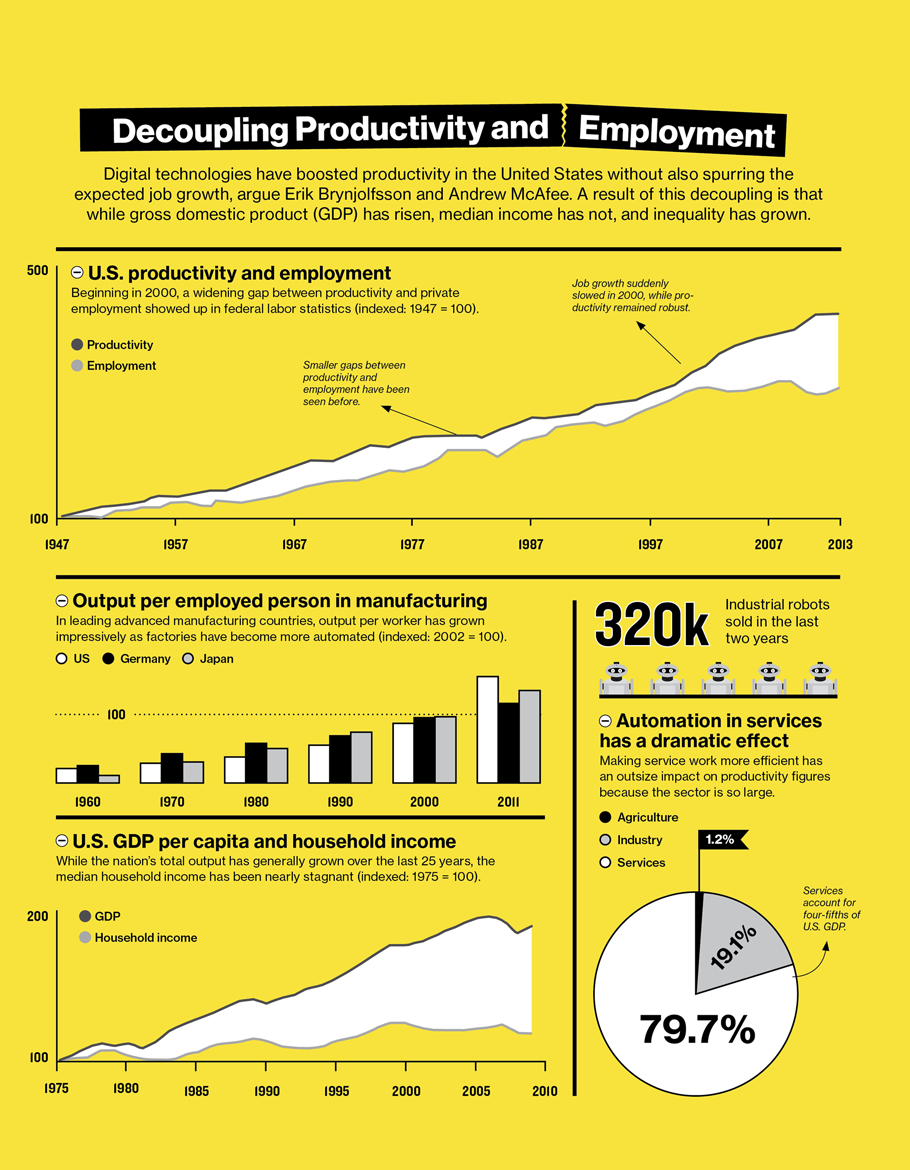
A report this summer entitled How Technology Is Destroying Jobs was published in the MIT Technology Review.  It confirmed that while technology improves productivity, it now creates a net loss in jobs. 

It has also polarized the workforce and hollowed out the middle class.

While technology has created workforce upheaval ever since the Industrial Revolution in the 1700s, through the 1990s the result was still a net positive in the number of jobs.

With the technology fueled during WWII, non-farm job growth was nearly 38% during the 1940s when I was born.  It fell to less than 20% in the 1990s and minus 1% in the 2000s.

Since 2007 when the Great Recession began, we have been obsessed with the devastation wrought by the financial industry on the economy .  But the more strategic issue is that our troubles in the longer term relate to technology.

It isn’t just a question of training or re-training.  If the jobs don’t disappear entirely, at the very least they will be dumbed down.

For example, one of the reasons the economic stimulus didn’t work better than it did was not only because it was too small but because much of the work it fueled is increasingly done by machines.

At the conclusion of that report an expert is quoted as saying , “technology progress does grow the economy and create wealth but there is no economic law that says everyone will benefit.

Gallup’s “payroll to population” metric is not much higher than when I retired nearly four years ago even though the unemployment rate is several points lower.  There are positive signs, but underemployment is still between 17% and 18% of the workforce.

With half of all adults employed today, it is no surprise that nearly 6-in-10 say that their work does not require a college degree including nearly 7-in-10 Americans who make between $30,000 and $74,999 who also agree as do more than 8-in-10 who make less than $30,000.

The belief that jobs no longer require a degree includes a third of those in professional, executive and managerial positions and nearly half white collar jobs.

Maybe most telling of the “dumbing down” is that four in ten college grads and 13% of those with a postgraduate degree now say the work they are doing does not require a degree.

Studies show that the most important thing employers expect people to learn in college is how to think critically and analyze and solve complex problems.  It seems that employees, though, are feeling those skills are less and less significant due to technology.

For an excellent and entertaining overview of why college is worth the cost including time and effort, click here to watch a quick “Question Tuesday” video by author John Green, where he makes the case that a person only has to make a $1.75 more per hour to make college worth it.

The U.S. Census just released an update about the 19.9 million students who are attending college this year, nearly 7% of the population over the age of 3.

Impressive is that they spend $117 billion on discretionary items (car, clothes, cellphones, entertainment, personal care etc.) They spend another $287 billion on non-discretionary things like room and board and tuition for a total of $409 billion.

That’s a significant part of the economy in itself.

Those attending college by ethnicity are Hispanics 3.4 million (up nearly half a million this year) Blacks just over 3 million, Asian Americans 1.45 million and Non-Hispanic whites 11.65 million.  Another way to look at this is by percent within each group, 6.8% of Hispanics, 8% of Blacks, 9.4% of Asian Americans and 6.2% of Non-Hispanic whites.

Only 5.5% of white males are enrolled.  Overall, nearly 8-in-10 college students are between the ages of 18 and 24. 

One could assume that the 7% of the population enrolled in college are predisposed to be engaged and willing to take on tough assignments when they enter the workforce but there are far too many other factors at play.

In my opinion, just as important as learning to critically think, and analyze and solve complex problems are to the workforce is social and emotional learning, including the ability to resolve conflict, which some states such as Illinois are wisely making a part of the K-12 school curriculum.

This is also something conservative columnist David Brooks synthesized from many studies as crucial to achievement in his Rousseau-styled 2011 book The Social Animal.  

The issue of education and job creation is far more complicated than what some politicians relate.  The solution isn’t just for everyone to be good at math or become engineers and computer scientists.  Nor is it about shortchanging liberal arts subjects which employers see as crucial.

It isn’t as easy as buying local or focusing on manufacturing jobs or rolling back globalization and technology in a return to isolationism.  Nor is this as simple as everyone having two parents or being home schooled or embedding certain values.

This is an extremely challenging conundrum, but whatever the solution, it will involve doing something about the 1-in-5 workers who are actively disengaged and effort averse across every sector of the economy.

Monday, August 19, 2013

Even More Important than Innovative

Earlier this month, I spent a week in a villa overlooking the northern Pacific coast of the Central American Republic of Costa Rica where the tropical-forested mountain range of the Nicoya Peninsula begins its 3,000’ assent above pastoral cattle and horse ranches.

I was tagging along with a friend, her daughter, and two of her daughter's friends, all three of whom are college aged.  Their majors are architecture, psychology and International Relations.

In part, when I wasn’t mesmerized by the spectacular ocean view, I took respite reading a newly published survey of employers entitled “It Takes More Than A Major.”

The survey samples “executives at private sector and nonprofit organizations, including owners, CEOs, presidents, C-suite level executives, and vice presidents.”Costa Rica Trip

More than 9-in-10 agreed that “a candidate’s demonstrated capacity to think critically, communicate clearly, and solve complex problems is more important than their undergraduate major.”

Eight-in-ten employers agreed that “regardless of their major, every college student should acquire a broad knowledge in the liberal arts and sciences.”

Tellingly, a similar ratio felt it was important that “those they hire demonstrate ethical judgment and integrity; intercultural skills; and a capacity for new learning,”  things I also wish were minimum requirements to run for elected office.

When it comes to “ethical judgment and integrity,” 76% of employers believed this is “very important.”

By more than 2-to-1, employers believe colleges should place more emphasis on the “ability to connect choices and actions to ethical decisions” as an outcome, a greater ratio than those who want more emphasis on science and technology.

More than 8-in-10 say that more emphasis should be placed by colleges on critical thinking and analytical reasoning skills and the ability to analyze and solve complex problems.

Double the ratio of employers want more emphases on critical thinking and reasoning than those seeking more emphasis on the ability to innovate and be creative.

Is it possible that employers see the high correlation of critical thinking to innovation?  Apparently so.  Oh, and 83% believe it is very important or fairly important for students to learn the ability to research problems and analyze solutions.

By 8.5-to-1, employers believe the concept of a liberal education is “very important” compared to “only somewhat important.” Tellingly, three in four would unequivocally recommend the concept of liberal education to their own child.

Coincidentally, Dr. Dick Brodhead who also lives and works in my adopted hometown of Durham, North Carolina, recently co-chaired a report to guide public policy in this regard entitled “The Heart of the Matter.”

Those who know Dick as a friend, as I do, were not at all surprised at his quick wit on last Thursday’s edition of The Colbert Report.  When finished with his gig as president of Duke University, in the tradition of Steven Wright, Dick would be a great stand-up comedian.

Monday, May 13, 2013

Lifetime Lessons From Synchrony

Watching a young friend perform recently for the last time as part of her talented high school chorus in Durham, North Carolina where I live reminded me of a 1995 book by Dr. William H. McNeil, now a professor emeritus from the University of Chicago.

Entitled Keeping Together in Time : Dance and Drill in Human History,  McNeil wrote about the “emotion aroused by the prolonged movement in unison…” as a “cultural ritual” and “muscular bonding.”

Both were demonstrated as I watched last week but I am sure there was plenty of typical high school drama going on behind the scenes.  A 2009 organizational behavior analysis by researchers at Stanford University shed light on the relationship of this type of synchrony and cooperation.

Dr. Scott Wiltermuth is now at the University of Southern California and Dr. Chip Heath at Stanford but formerly at Duke University here in Durham, is with his brother Dan the co-author of several books including the just-published Decisive: How to Make Better Choices in Life and Work.

In their joint study entitled Synchrony and Cooperation, Wiltermuth and Heath concluded that “people acting in synchrony with others [such as the highly-choreographed chorus I saw] cooperated more…even in situations requiring personal sacrifice.”

The study also confirms why this cooperation did not entirely mitigate negative behind-the-scenes’ emotions that night such as shunning, bullying and cliquishness common in every high school and far too common in life as well.

The synchrony learned in chorus, athletics, orchestra, marching band, drama and many other endeavors at elementary and secondary schools are teaching skills as important as any of the AP and Honors classes many of the performers last week were completing prior to graduation.

Learning how to work together as a team, to synchronize, even with people you may not like or who may not like you on a personal level, is an incredibly vital workplace skill.  Synchronous activities in school also foster creativity and collaboration with people who have different styles.

The conflict I am characterizing as drama may be hurtful in high school but overall it is also a vital experience for the workplace as illustrated so eloquently in a TED presentation by Willful Blindness author and former CEO Margaret Heffernan entitled Dare To Disagree.

The inability to engage and resolve the conflict of ideas and concepts is often at the root of the inability of so many organizations to be effective.

But feeling “part of a whole” as New York University Business School ethics researcher Dr. Jonathan Haidt explains in his book The Righteous Mind: Why Good People are Divided by Politics and Religion, doesn’t always require being in a festival atmosphere.

For much of the population it is one of the awe-inspiring by-products of nature.

Tuesday, January 15, 2013

Education Entitlement Imperative

In March of 1867, during battles with ultra-conservative-Democratic President Andrew Johnson over how to re-organize the South following the Civil War, the Republican Congress, controlled by liberals and moderates, managed to pass, and the President subsequently signed, new legislation establishing a national department of education to collect statistics.

Conservatives had long opposed compulsory public education.  Fearing even the collection of statics, the department was soon-after demoted from cabinet level to the status of office.  However, in 1870, under the new act and the new administration of President and Civil War hero U.S. Grant, the government began to conduct statistical surveys.  In 1872, Congress authorized the hiring of the first statistician.

This is how we now know that between 1870, around the time many of my great-grandparents were born and 1952, two years after I was born, “every decade was accompanied by an increase in 0.8 years of education.”

Unfortunately, that annual bump in the level of education stopped thirty years ago.  It probably isn’t coincidental that this was also when the middle-class went into decline and about the time conservatives -- by this time mostly Republicans -- took power as well as aim at government and education policy.Seven distinct youth segments - Mckinsey Survey '12

Ironically, it was conservatives who, in 1642, first put compulsory education into law.  The Puritans of the Massachusetts Bay Colony were ultra-conservatives, but they believed education was a moral and social imperative.

However, it would be another 210 years before Massachusetts established compulsory attendance, which reminds me of a hotelier-friend of mine in Durham, NC where I live, who found that asking prospective employees if they had a car was insufficient, so added the question, “and does it run?” 

By 1900, pressed by the Progressive Movement, 34 states including four in the South had legislated compulsory schooling if even for as little as a few weeks a year.  This included my native Idaho, first settled by my great-grandparents in 1860, which embedded education in its pre-statehood constitution in 1887. 

By 1907, North Carolina, my adopted home now for nearly 25 years, followed suit and finally, Mississippi became the last state to do so in 1917.  By 1910, 72 percent of American children were attending school.

Back then, half the nation's children attended one-room schools as my father did during the 1920s and 1930s in the Yellowstone-Teton nook of Idaho.  By 1918, near the end of the Progressive Era, every state required students to at least complete elementary school.

It isn’t clear why conservatives have so often opposed education.  You almost need a scorecard to keep track of when conservatives have been in control of each of the major political parties in the US.

When I need a break from writing essays such as these, I often pick up a small book entitled The Good Of This Place, a collection published by Dick Brodhead, a friend of mine in Durham, who is currently President of Duke University.

Before ascending to become president of Duke, Dick had been the long-time Dean of Yale College.  One of my favorites in the book, which was published just as I retired, is entitled Taking Democracy to School, a 2001 pre-9/11 lecture he made as part of the De Vane series to mark Yale’s 300th anniversary.

Here, Dick tells the story of an 1778-80 public education legislative proposal made by Thomas Jefferson entitled “Bill for the More General Diffusion of Knowledge” during the time he was elected Governor of Virginia while the American Revolution was in full swing.

To me, Jefferson and James Madison were the conservative Republicans of their time, resisting change, especially when it came to proposals by other founding fathers to abolish slavery.

The bill was repeatedly submitted by each of these men and a watered-down version was finally passed by the Virginia Commonwealth in 1796, well after formation of the United States of America and a constitutional compromise that would leave slavery in place until the Civil War triggered passage of the Fourteenth Amendment.

In this speech, Dr. Brodhead points out several “paradoxes of democratic education” contained in Jefferson’s proposal:

  1. “It failed partly because Virginia voters were unwilling to entrust their local schools to a statewide system…largely because they refused to assume the tax burden…”
  2. “Jefferson would make the school the great equalizer, the tool for neutralizing differences of income and family standing [except slaves.]
  3. His whole three-tier apparatus is an elaborate sorting device, a mechanism for separating the persons of superior parts and blessing him with further advancement.”

I can imagine the characteristic twinkle in Dick’s eye as he dryly notes that – “When Jefferson speaks of best geniuses being “raked from rubbish,” the limits of his egalitarianism comes clear.”

Today, education is an entitlement but a sense of “entitlement” is not limited by socio-economic status or level of education or privilege.  In 2011, while summarizing some of his research, Ed O’Brien, phd candidate in psychology at the University of Michigan noted that – “For some, a dull moment can seem like an eternity, whereas for others there is no such thing as a dull moment.

Fortunately, for the most part, I have always been more like the latter but especially now in retirement.  The study found that, unfortunately, for people who feel entitled, time passes oh, so slowly.

According to a 2012 McKinsey Global Institute survey, there are 75 million unemployed youth around the world, one in eight between the ages of 15 and 24.  For them, time is excruciatingly slow. The figure increases to 225 million when counting those who are underemployed.

Yet, paradoxically, only 43% of the employers surveyed in nine countries including the United States could find enough skilled entry-level workers.

Of those of student-age who didn’t attend post-secondary school, 57% are “too cool” (in my opinion, a form of entitlement) and 43% are “too poor.”  Another 18% are “disengaged” and 26% are “struggling.”

The McKinsey report analyzes three “critical intersections” for students, educators and employers: 1) enrolling in post-secondary education, 2) building skills, and 3) finding a job.

“Cost” is the top barrier to enrolling in college, denying nearly a third of high-school graduates access.  Among those who go on, only “46% are convinced they made the right choice as far as selecting institution or field of study.”

For those who do go on, there is a big disconnect at “building skills,” the second intersection, with 60% citing on-the-job training and hands-on learning as the most effective instructional techniques, “but fewer than half of that percentage are enrolled in curricula that prioritize those techniques.”

In my experience, many of the students in the surveys seem to feel “entitled” as do many prospective employers which are as much impediments as any failure by educational institutions to make adjustments.  At the third intersection, a quarter of youth fail to make a smooth transition to work.

The report proposes some improved models and in the United States, a Career Readiness Partner Council coalesced just a few months ago to evolve a new model between employers, policy-makers, educators, students and families.

However, I am more persuaded that a critical part of the answer is to be found by expanding the social and moral imperative for education into pre-school years.

Programs such as Smart Start, which brings together all the people involved in a pre-schooler’s life— “families, teachers, doctors, caregivers, social workers, and many others” as well as the More at Four program, have been proven effective by researchers at Duke University.

A recent Gallup survey of students reveals that student engagement with learning and education is highest during elementary school at 76%, falling to 61% by middle school and 44% in high school.  Fixation on standardized testing is one of the culprits.

I am convinced that even early intervention, well before elementary school is the answer to creating a lifetime enjoyment of learning.