Showing posts with label Race. Show all posts

Wednesday, August 19, 2015

Racism Metrics Among Americans

Once you read up on research by those who study racism, it is a little annoying when the term is applied too broadly especially as has been common over the past year both to individuals and institutions.

I always felt my father was racist but having come in contact with true racists while turning Durham, North Carolina’s image around in my past professional life, I now realize he wasn’t.

He was born in 1923 just as the first studies were launched to determine attitudes toward various groups among Americans.   Back then Americans readily expressed their racial prejudice.

But before I get into how prevalent racism was back then, let me touch on what was happening in America during my father’s formative years.

In fact, in the review of this research in the book Blindspot: Hidden Biases of Good People, the authors note that in the 1930s it “may have been as politically incorrect to express tolerance as it is to express intolerance” today.

Keep into mind that even into the 1930s Black Americans were being lynched at an average of fifty to one hundred per year.

Those occurred primarily in the South, but even in my father’s native Pacific Northwest, this was also the heyday of nativism which included a resurgence of groups such as the KKK.

Nativism was an anti-immigrant movement spearheaded by politicians such as Congressman and Attorney General Mitchell Palmer, newspaper editor and Congressman Albert Johnson of Washington state as well as Presidents Coolidge and Hoover.

As an aside, Johnson coined the phrase “Keep America American” which was picked up by the Klan.  Coolidge rephrased it as “America must be kept American.”

In fact, a 1930s survey of lodging establishments across the country just as travel and tourism became mainstream found that 90% would not accept Chinese as guests.

Germans and Eastern Europeans were the primary targets of nativism back then but it appears to be essentially the same play book that Republican hopeful Donald Trump’s campaign strategy has resurrected today only targeting Latino immigrants this time.

Today, surveys show that only 10 to 15 percent of Americans harbor explicit prejudice against Black Americans compared to about 60% from the 1930s up through the 1950s.

I suspect there may be the same percentage of blacks who are openly prejudiced toward whites.

But racism or prejudice or should I say acceptance of other groups occurs on a spectrum and there is evidence that 7% of Americans are truly virulent racists.

During the 1990s, the organization I led mounted a grassroots effort that reversed the negativity toward Durham manifest by a majority of those living in nearby communities.

But researchers who were helping us told us not to bother when those who continued to be very negative was reduced to single digits.

From reading verbatims, reports from mystery shops and especially online comments to news stories, it was abundantly clear they fell among those remaining were hard core, virulent racists.

Having always been more diverse, Durham was merely a surrogate for their animosity.

We succeeded in the image turn around by inoculating those who were uncertain and reinforcing those who were positive about Durham while appealing to those who were “milder” negatives with better information.

This is why we were wise not to launch a big ad campaign.  Far too blunt as a marketing tactic, traditional ads merely reinforce existing opinions (positive and negative.)

In the wake of Supreme Court rulings on the unconstitutionality of segregation, by the dawn of the 1960s Americans were gradually becoming much more egalitarian and self-conscious about intolerance.

So by the 1970s scientific surveys to determine prejudice had to become more covert as attitudes toward explicit prejudice changed.

By then my dad was turning 50 was apparently too ingrained to make the shift or maybe he just liked pushing my buttons during during lively debates on visits home.

However, I had noticed growing up that while he seemed explicitly prejudiced toward some groups, at least in rhetoric, he wasn’t at all when it came to individuals.

You often hear something similar voiced by regressive politicians and some celebrities who when caught making insensitive or racist remarks are quick to rationalize that Black people are some of their best friends.

Studies show that 75% of Americans - including some who are Black -have an implicit preference for white vs. black racial groups.  It often results in institutional bias where studies show that even a percentage point or two of discrimination on an individual level can add up to a disadvantage for Black Americans overall.

It is reflected in the analysis of tipping practices where patrons, on average, including those who are Black are found to give higher tips to Caucasian servers.

It is why studies also find that many Americans are favorable to leveling the playing field based on gender but not ethnicity, betraying an implicit bias.

But about 40% of Americans have what researchers call aversive racism, a term coined in the 1980s, which means they avoid interaction with other racial and ethnic groups.

Americans who fall into these groups today probably don’t self-identify as racists.

Nor are police officers using stereotypes to make lightning quick life or death decisions protecting neighborhood where less than 25% of the residents, according to Harvard Sociologist Orlando Patterson are structurally disconnected and/or mimicking a street culture that is often itself racist and misogynist as well as defiant of authority and laws.

This all crossed my mind recently while driving home from a lakeside retreat in the county north of Durham.

I was mulling over how a heavy-set white woman had been loudly pontificating up and down the isles of a Walmart to anyone who would listen characterizing Durham as a cesspool, albeit one which provided her with job when a pickup flew past in the opposite direction.

Speeding north along Dirgie Mine Road through Allensville it was streaming two huge, 4’ x 6’ Confederate flags on each side of the truck’s bed.

Doing a little stereotyping of my own, I wondered if the occupants were just trying to intimidate the fourth of the residents there who are black.

Or maybe they were returning from one of the demonstrations of support for that bygone symbol or maybe they just proud albeit insensitive and shallow good ole Southern boys.

Researchers use the term disassociation to describe how our minds operate at two levels, one automatic and the other reflective.

This is how so many Americans can profess to be egalitarian but their automatic responses are clearly biased.

My dad was very egalitarian but reflecting the norms of his youth also very biased when it came to blacks as a group.  Pushing back against his attitudes while growing up I’m sure played a role in propelling me to be much more tolerant and accepting of other groups.

But wondering if I also absorbed an implicit bias when it comes to race, during my summer hiatus from these posts I took the test related to race at Project Implicit.

It was devised in the late 1990s by researchers at the University of Washington, Harvard and the University of Virginia including the two authors of Blindspot, which I also highly recommend.

The test is ingenious for many reasons including that test-takers can’t “game it.”  I suspect that may be because it also measures hesitation.

There are also tests to measure implicit biases based on age, gender, sexuality, weight and religion to name a few.

I turned out to be neutral when it comes to race.  In other words, I am not biased toward or against others on the basis of race.  I have yet to take the other tests but I suspect I may be implicitly biased on the issue of weight.

Take it for yourself, regardless of your ethnicity and especially if you feel or get the impression from others that you may be racist, even somewhat.

It should be require of elected officials seeking to undermine voter rights.  

Monday, June 29, 2015

“Get Over It and Move On”

I’ve tried to shake it but I can’t -- for long anyway -- get a comment I heard three days ago in a news report from a small town in South Carolina, less than three miles along US Route 176 from the North Carolina line.

It is along this route, nearly 475 years ago to the day that I heard this quote, that Hernando de Soto marched up into the Blue Ridge Mountains, becoming the first European to explore inland across the Southeast.

It would be another 220 years before European settlers reached this area, a few bringing or obtaining enslaved African Americans, some as status symbols.

It wouldn’t be until 15 years after the Civil War that the little town was established, the year that a white supremacist organization called the Ku Klux Klan began to terrorize African Americans and white sympathizers along both sides of the border here.

Until now, I’ve only known the area from its reputation as a spectacular motorcycle route.  But the statement by a resident there last week ruined that impression.

It was a reaction to calls by the legislator representing the area to remove the Confederate battle flag from where it flies above the state capitol in the wake of a murder of nine African Americans 228 miles southeast along US Route 176.

He is also a former city council member and mayor of the little town and a close friend and colleague of one of those slain.

The quote from a constituent objecting to the flag’s removal from state property was:

Is it hurting anyone?  No. If somebody has poor feelings about it, get over it and move on.”

Germany has many monuments honoring soldiers who were killed during WWII, including many in the areas my father’s American Tank battalion overran at the end of the war and then dismounted to search for pockets of resistance while liberating Dachau, first of the concentration camps established by the Nazis.

Remembrances for the victims is why places such as Dachau are now monuments.

I know people who lost their German fathers and husbands in that war before immigrating to America.  It is clear that many were caught up in that war without being part of its cause.

But Germany doesn't fly the Nazi flag anywhere, although it makes appearances in museum exhibitions.  In this country, while some collectors may have one that was brought back as a souvenir of war, it is viewed in disrepute, a symbol of white supremacist extremists.

Although, they too might rationalize it by saying “If somebody has poor feelings about it, get over it and move on.”

A far more thoughtful interview last week was with John A Powell, an African American law professor at UC Berkley and author of Racing to Justice: Transforming our Concepts of Self and Other to Build an Inclusive Society.

From parents who were sharecroppers in the South, Powell reminds us on the program On Being with Krista Tippett that “race is deeply relational.”  Any discussion is about whiteness as much as about color. 

In her blog, Courtney E. Martin writes that “Black people, people of color in general, don’t have the luxury of forgetting, especially as long as white people, particularly the “good ones,” remain so fragile.  She’s referring to our inability to discuss race.

Professor Powell, in his interview, states that “race is in the DNA of this country…it is like gravity.”   Any history of slavery, such as From Slavery to Freedom by the late Dr. John Hope Franklin, Powell would assert is really a history of America told through that institution.

To illustrate that point, he notes that when he taught white students at the University of Minnesota about the history of Native Americans, it was just a lens into the history of America.

He repeats an observation by the African American author Tony Morrison that any discussion of the effects of slavery should include what it’s done to mark the white identity as well.

Powell noted in the On Being interview last week, “The human condition is one about belonging…how we define the other affects how we define ourselves.”

“And so when we define the other as extreme, it means we have to cut off large parts of our self.”

Powell, when he explains that the notion of being American is and has historically been an ever evolving and expanding “we” would agree with the opinion read a few days later by Supreme Court Justice Anthony Kennedy.

The conservative Justice reminds us that the notion of freedom in the Constitution has been forever evolving.  It was first limited to property-owning white men and has been expanded ever since to include all Americans including now the freedom of gay and lesbian Americans to marry.

Kennedy wrote for the majority, “The past alone does not rule the present.  The nature of injustice is that we do not always see it in our own time.  The generations that wrote and ratified the Bill of Rights and the Fourteenth Amendment did not presume to know the extent of freedom in all its dimensions…”

He continues, “…and so they entrusted future generations to a charter protecting the right of all persons to enjoy liberty as we learn its meaning.”

Honoring war dead such as ancestors who fought to preserve a way of life called slavery is to respect their sacrifice without condoning the injustice requiring it of them.

But flying their flag is an insult, just as flying the Nazi flag is an insult, just as flying the flag of ISIS is an insult to freedom and justice.

The Confederate flag as an artifact of history is important to preserve.  But not when flown, as it has been in South Carolina beginning in the 1960s, to signal refusal to accept the end of desegregation.

But what’s far more important, in my opinion, than all of the energy we spend pushing and pulling over symbols such as a flag, is the need for us to discuss race, white as much as black or brown, beginning with implicit bias.

A wonderful start is to read or listen to the words spoken by John A. Powell.

Friday, June 05, 2015

As Important or More Important Than Upbringing

When I graduated from high school in 1966, my senior class was larger than my home town.

Yet the number of us who took either the SAT or ACT could fit in a portion of the library.  The number who took both, as I did, was even smaller.

No prep in those days: you took these tests “cold-turkey.”

In 1966, I was one of 2.6 million students graduating from high school and that fall, I became one of 1.3 million enrolling in colleges including 709,000 who were male.

Back then, the proportion of Americans earning a high school education or higher was less than half what it is today but twice what it was when my dad graduated from high school on the eve of WWII.

But it really wasn’t just what I learned in school that gave me a leg up.

From the patterns I read about, there is reason to believe that the obsessive pressure we place on educators today is misplaced as a means to increase upward socio-economic mobility.

When that metric ground to a halt in the late 1970s and early 1980s, less than 1-in-5 Americans had a college degree and only about 60% had a high school or higher education level.

Part of the reason is that we drank the cool-aid conservatives were serving about smaller government which turned out to be investing far less in upward mobility.

But there is another reason.

I realize now that the grooming that motivated me to take those college entry exams in 1966 came not just from school teachers or parents or even grandparents, aunts, uncles and older cousins.

It was slowly incubated and nurtured by scout masters, church members, neighbors, coaches, friend’s siblings and parents, part-time workplaces, and even somewhat from reading the newspaper and watching television.

This is what sociologists, such as Dr. Orlando Patterson at Harvard call a “procedural education,” a nuanced socialization that is at the root of how the middle class reproduces itself.

In his new book, Cultural Matrix, which he co-edits and contributes, Patterson notes that the environment of procedural education I experienced “is as important as how parents bring up their children.”

It, or the lack thereof, is also, he notes, at the heart of why the black middle class overall is not reproducing itself, even though the parenting, even among single parents is just as good, even stricter.

A friend and I worked closely together in the mid-1990s to bring attention to officials in Durham, North Carolina where I have lived for two and half decades now, the closing achievement gaps among various groups as a metric.

We worked with a researcher to look at socio-economic status as a factor.  One day he shared something that didn’t make sense.  On average, the test scores of back students in well-educated middle class homes were falling off.

Patterson quotes studies that support the conclusion that “the reproduction of middle-class status is not simply a product of cultural capital” and “good upbringing” which he finds is comparable in both black and white middle class homes.

But studies show that “the hard cultural work of middle-class childrearing and socialization is not enough.”

Rather, the environment I describe above is equally if not more pivotal.

But it can’t be delegated to schools either.  Everyone, regardless of socio-economic level, learns these “rules and procedures” for success in school grades K through 12.

While schools can teach them, it is the surrounding environment including neighborhoods, extra-curricular activities, places of worship, endeavors such as scouting as well as friends and their siblings and parents that make the difference.

Mainstream media today imparts these values as well but they are overwhelmed by so-called scripted reality shows, even sports.

More often, news media merely reinforces the notion that somehow institutions are the problem, making us less responsible as individuals.

Institutions are important but by nature too brittle to provide a nuanced and interactive “procedural education.”

Patterson notes that ethno-segregation can work somewhat for whites, it isn’t as effective as integrated neighborhoods.

But studies reveal that it backfires on black middle and working class families, even when have moved to more integrated neighborhoods.

According to studies, this is due to the long reach of “disconnected” peers, a tiny sliver who avow a “street culture.”  It is this cultural but perverted peer pressure, glamorized by mainstream media, that perpetuates poverty and perpetuates violence.

I can’t recommend enough the book Cultural Matrix

The late Dr. John Hope Franklin, a friend, is quoted as saying that “the past could lead America to a new future.”  So in addition to his classic book entitled, From Slavery to Freedom, I recommend it be read in tandem with the following books.

One option but with a political analyst’s viewpoint is entitled, Acting White: The Curious History of a Racial Slur by Ron Christie.  It is in the black conservative tradition of The Content of Our Character by Dr. Shelby Steele.

But having just put it down, I believe a good book to read in tandem with Cultural Matrix is the just published book by Dr. Scott Ellsworth, a Duke alumnus, entitled, The Secret Game: A Wartime Story of Courage, Change, and Basketball’s Lost Triumph.

The game took place in Durham but the book offers insight into the era between Jim Crow and Desegregation, a period when the cultural influences of segregation extended and even deepened the impact of slavery.

It is no mistake that except for Ellsworth, these recommended books are authored by people who happen to also be black and span the diverse ideological spectrum and history of African Americans.

Nor is it a mistake that two are sociological and the others historical in nature.

Wednesday, April 22, 2015

Profiling May Not be the Problem

In a recent NYT op-ed, Northeastern University researcher, Dr. Lisa Feldman Barrett suggested something that made me realize that our brains are wired to profile.

She describes our brains as predictive organs that make thousands of “neural ‘guesses’” at a time that “largely shape what you see, hear and otherwise perceive.”

Profiling in and of itself is not racially biased but, she contends, for some it may be “one pernicious way in which racial bias expresses itself.”

But those who seek to curb racism by curbing profiling seem misguided to me, especially when our brains are wired to subconsciously profile.

This is probably why so many people rolled their eyes when a law was pushed through in New York City prohibiting the running of credit checks on job applicants.

As justification, in part, advocates pointed out that the percentage of people with scores of 700 or above is less than half among blacks what it is among whites.

A recent Illinois study found that the average credit score in minority neighborhoods was 107 to 130 points lower than in other neighborhoods but so was the percentage who made late payments, by three to six times.

Poverty is more likely the cause than racism.

In the process, people seeking social justice on behalf of others often make unfortunate and inaccurate stereotypes in the process such as linking race to poverty when as the excellent blog Breaking Brown points out “the real welfare queen is uneducated, single and white.”

Of course, I agree that bad credit should not be used to disqualify a candidate before allowing them an opportunity to explain.  A check of existing employees in most workplaces should be enough to warrant credit counseling as a benefit.

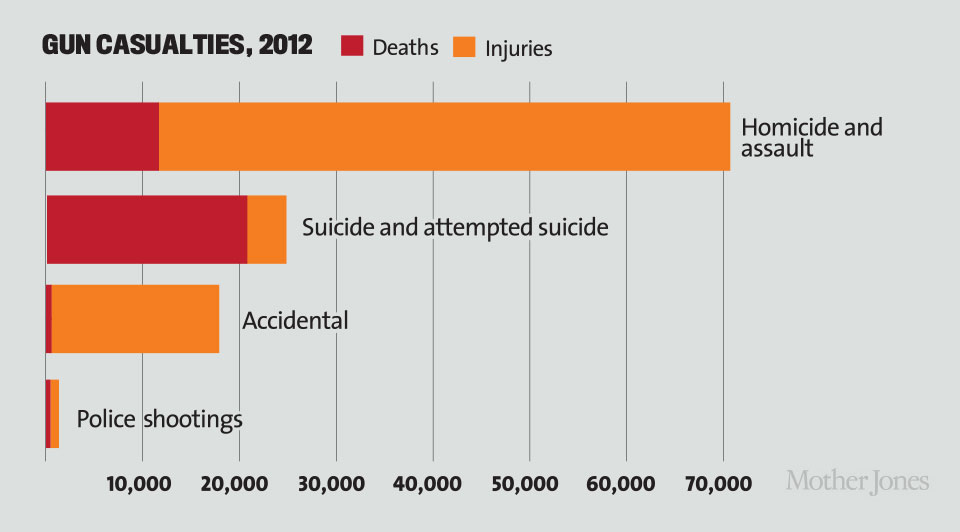
On a related subject, an excellent investigative report in Mother Jones this month incorporates research done at the Pacific Institute for Research and Evaluation.

It documents the horrific cost of gun violence, $229 billion each year.

Much of it, nearly $13 million a day is passed on to taxpayers.

To put this in perspective, this will soon eclipse the cost of smoking on society.

The report points out that while 93% of gun suicide victims are white, 57% of gun homicide victims are black.  So are the majority of offenders according to FBI statistics.

In a separate but related piece, the researchers point out the huge disparity in the percentage of homicides solved when there is a white victim compared to case involving black victims.

Police shootings are a tiny sliver of the gun violence in America.  Based on the way our brains work, it makes sense that they will concentrate resources in minority neighborhoods on behalf of minority victims, in pursuit of minority offenders.

But essayist Tim Wise calculates from FBI data that only about 1% of African Americans including 2% of black males will commit a violent crime in a given year.

He continues that “No more than .7 percent (seven-tenths of one percent) of African Americans will commit a violent crime against a white person in a given year, and fewer than .3 percent (three-tenths of one percent) of whites will be victimized by a black person in a given year.”

He concludes, “Whites are 6 times more likely to be murdered by another white person as by a black person.”

It seems to me that profiling isn’t the problem nor is the use of statistics which can be a useful way of predicting crime.

Racism is the problem and it is people who are racist.

Tuesday, December 02, 2014

Through A Different Lens

Secretly, journalists had to be asking themselves why more people weren’t up in arms in Ferguson, Missouri last week as “lookie-there” reports circulated about the tiny number that were torching the private property of neighbors in response to a grand jury report.

I don’t mean to be cynical.

Virtually no one on the front lines in that highly competitive and breaking news-obsessed line of work has the luxury of mindfulness or even personal accountability when it comes to fueling the “rush to judgment” these story feeding frenzies create.

Nor do they seem to ever go near the issue of personal responsibility unless it is white collar crime and related to a fall from grace.

Take away the relatively small number among us on either side of that tragedy that made up their minds with far too little information and then further subtract those of us who seemed to have formed an opinion just to reinforce a larger point and we’re left with the vast majority of us who simply have compassion fatigue.

From the beginning, even after I passed through there at the height of turmoil last summer, none of the narratives in the Ferguson case fully made sense to me.

Not even the incredible job ProPublica did on crunching data seemed to go anywhere near deep enough to draw conclusions beyond better policing.  The topic of race seems to inhibit any effort to look for deeper social influences.

I’ve always got the impression I am slightly progressive leaning as an Independent because of my concern for social justice but it is increasingly clear at times like this that I may be among the 10% of voters who truly are straight up Independents.

Part of the reason is compassion fatigue brought on, in part, by well-meaning folks who want to do right but pile on seemingly without a clue.

Are there rogue cops?  Yes, but not nearly as many as there are on TV shows or in movies where the predictable narratives skew either that way or to superhuman.

Is everyone who acts out in response to authority, guilty of something?  Not unless you throw in those with mental disabilities and those who are just being jerks.

I’ve sat in enough rooms over the years with very well-meaning people, including those who are or have been underprivileged, to know that the latter have compassion fatigue too, but more so, they hate to be patronized.

I remember having a discussion about adopting a metric to measure closing gaps in school achievement when a county manager began to lecture me that studying and publicizing gaps would be racist.

A friend among one of the groups we were discussing quipped, “Are you kidding?  Do you really think we aren’t fully aware of the problem and want to do everything possible to close it?”

No one deserves to die but everyone involved plays a role when these things occur.  Focusing only on police restraint or latent racism by either party seems to fall short.

More than a decade ago, a friend of mine in education would often explain to groups that closing the achievement gap in schools had to take place between kindergarten and third grade because some children started out already more than a thousand books behind.

Unspoken though, because no one wanted to go there, was why were they so behind and how do we change that?

The seminal influence begins before birth (no pun intended.)

During the events in Ferguson, I reread a updated edition of a book I had read back then entitled, Unequal Childhoods: Class, Race and Family Life by Dr. Annette Lareau.

It is based on in-depth observations over time of 88 African-American and white families across the spectrum from middle class, working class and poor families with children ages 9 and 10, of which twelve are discussed in the book.

There were families of each race in each class but the definition of class was a combination of both household income and education level.

Lareau and her researchers also did a follow up ten years later.

She found that all of the parents wanted their children to be happy and to thrive but they fell along a spectrum of parenting about how to do that.

At one end, there is extreme “natural” parenting and at the other extreme “concerted cultivation” parenting.  In the extreme, both styles have pros and cons.

For example, during my pre-school years, my parents had a natural style but as I grew up, it evolved more toward concerted cultivation. But either way they were probably always more to the center of the spectrum.

I also had a number of friends raised at each end of the spectrum. Looking back now, my parents, one of whom did not complete high school and both of whom worked more than one job at times to pull themselves barely into the middle class, did a very good job.

Lareau wasn’t looking for an either/or answer but a correlation to what would predict an upwardly mobile trajectory for those in poor or working class households and what links there might be for keeping middle class children from downward mobility.

For a quick video overview of the times per week the researchers spent observing the children both in school and within the home as well as the follow up ten years later click here.

I have found that many people talk about this study without ever having read either edition of the book so I definitely recommend reading it cover to cover more than say an overview such as the one linked here.

The positive links she found to upward mobility or sustaining middle class status once achieved vs. cycling downward didn’t relate to race as much as they did social class and parenting style.

A third of Americans raised as middle class (income) fall out of the middle as adults including 38% of black men and a somewhat lower proportion of Hispanic men.  Achievement gaps on test scores play a role.

A lot of things can affect how things turn out for us as adults but Lareau’s studies are particularly fascinating because they provide insight into the interplay of parenting, neighborhood and institutional influences.

For parents who are poor or working class, a natural style of parenting becomes the default because the logistics of housing safety, clothing, doctors appointments, getting to bed and ready for school, not to mention putting food on the table often take precedence.

The natural parenting style tends toward directives and completely unstructured and undirected play time.  But it isn’t just less intensity about organized leisure or learning activities that differentiates the natural style.

There more likely isn’t the time to interact by answering questions with questions and exploring options such as certain behaviors or coaching on how to deal with authority and institutions or how to question adults….or reading books.

Clearly the boys in Ferguson not only knew how to blow off authority and social norms but apparently may have also over reacted.  It doesn’t excuse shooting them either, but there has to be some accountability on both sides.

Police restraint is not the panacea.

Of course, many of us see when the concerted cultivation style goes awry, e.g. domineering helicopter parents, a sense of entitlement that it is the job of parents to make sure a child is never bored and far too little unstructured time.

But the true value of the concerted cultivation style is having conversations with children where they explore feelings, thoughts and options as well as learn to learn by reading books well in advance of formal schooling.

Any effort to ensure social justice, including addressing poverty, needs to be informed by Dr. Lareau’s research and others.  She talks about race and distrust of the police regardless of class.  But she sees more potential solutions looking at class.

My friends on the left often point to the robotic, lockstep manifest by many on the right and they are right to be concerned.  But even among those deeply concerned with social justice it is important to guard against becoming brittle, rigid and kneejerk in its pursuit.

And those who react forcefully to the notion that poverty can become a culture need to come to the realization that not everything is about race.