Showing posts with label Stereotypes. Show all posts

Wednesday, August 19, 2015

Racism Metrics Among Americans

Once you read up on research by those who study racism, it is a little annoying when the term is applied too broadly especially as has been common over the past year both to individuals and institutions.

I always felt my father was racist but having come in contact with true racists while turning Durham, North Carolina’s image around in my past professional life, I now realize he wasn’t.

He was born in 1923 just as the first studies were launched to determine attitudes toward various groups among Americans.   Back then Americans readily expressed their racial prejudice.

But before I get into how prevalent racism was back then, let me touch on what was happening in America during my father’s formative years.

In fact, in the review of this research in the book Blindspot: Hidden Biases of Good People, the authors note that in the 1930s it “may have been as politically incorrect to express tolerance as it is to express intolerance” today.

Keep into mind that even into the 1930s Black Americans were being lynched at an average of fifty to one hundred per year.

Those occurred primarily in the South, but even in my father’s native Pacific Northwest, this was also the heyday of nativism which included a resurgence of groups such as the KKK.

Nativism was an anti-immigrant movement spearheaded by politicians such as Congressman and Attorney General Mitchell Palmer, newspaper editor and Congressman Albert Johnson of Washington state as well as Presidents Coolidge and Hoover.

As an aside, Johnson coined the phrase “Keep America American” which was picked up by the Klan.  Coolidge rephrased it as “America must be kept American.”

In fact, a 1930s survey of lodging establishments across the country just as travel and tourism became mainstream found that 90% would not accept Chinese as guests.

Germans and Eastern Europeans were the primary targets of nativism back then but it appears to be essentially the same play book that Republican hopeful Donald Trump’s campaign strategy has resurrected today only targeting Latino immigrants this time.

Today, surveys show that only 10 to 15 percent of Americans harbor explicit prejudice against Black Americans compared to about 60% from the 1930s up through the 1950s.

I suspect there may be the same percentage of blacks who are openly prejudiced toward whites.

But racism or prejudice or should I say acceptance of other groups occurs on a spectrum and there is evidence that 7% of Americans are truly virulent racists.

During the 1990s, the organization I led mounted a grassroots effort that reversed the negativity toward Durham manifest by a majority of those living in nearby communities.

But researchers who were helping us told us not to bother when those who continued to be very negative was reduced to single digits.

From reading verbatims, reports from mystery shops and especially online comments to news stories, it was abundantly clear they fell among those remaining were hard core, virulent racists.

Having always been more diverse, Durham was merely a surrogate for their animosity.

We succeeded in the image turn around by inoculating those who were uncertain and reinforcing those who were positive about Durham while appealing to those who were “milder” negatives with better information.

This is why we were wise not to launch a big ad campaign.  Far too blunt as a marketing tactic, traditional ads merely reinforce existing opinions (positive and negative.)

In the wake of Supreme Court rulings on the unconstitutionality of segregation, by the dawn of the 1960s Americans were gradually becoming much more egalitarian and self-conscious about intolerance.

So by the 1970s scientific surveys to determine prejudice had to become more covert as attitudes toward explicit prejudice changed.

By then my dad was turning 50 was apparently too ingrained to make the shift or maybe he just liked pushing my buttons during during lively debates on visits home.

However, I had noticed growing up that while he seemed explicitly prejudiced toward some groups, at least in rhetoric, he wasn’t at all when it came to individuals.

You often hear something similar voiced by regressive politicians and some celebrities who when caught making insensitive or racist remarks are quick to rationalize that Black people are some of their best friends.

Studies show that 75% of Americans - including some who are Black -have an implicit preference for white vs. black racial groups.  It often results in institutional bias where studies show that even a percentage point or two of discrimination on an individual level can add up to a disadvantage for Black Americans overall.

It is reflected in the analysis of tipping practices where patrons, on average, including those who are Black are found to give higher tips to Caucasian servers.

It is why studies also find that many Americans are favorable to leveling the playing field based on gender but not ethnicity, betraying an implicit bias.

But about 40% of Americans have what researchers call aversive racism, a term coined in the 1980s, which means they avoid interaction with other racial and ethnic groups.

Americans who fall into these groups today probably don’t self-identify as racists.

Nor are police officers using stereotypes to make lightning quick life or death decisions protecting neighborhood where less than 25% of the residents, according to Harvard Sociologist Orlando Patterson are structurally disconnected and/or mimicking a street culture that is often itself racist and misogynist as well as defiant of authority and laws.

This all crossed my mind recently while driving home from a lakeside retreat in the county north of Durham.

I was mulling over how a heavy-set white woman had been loudly pontificating up and down the isles of a Walmart to anyone who would listen characterizing Durham as a cesspool, albeit one which provided her with job when a pickup flew past in the opposite direction.

Speeding north along Dirgie Mine Road through Allensville it was streaming two huge, 4’ x 6’ Confederate flags on each side of the truck’s bed.

Doing a little stereotyping of my own, I wondered if the occupants were just trying to intimidate the fourth of the residents there who are black.

Or maybe they were returning from one of the demonstrations of support for that bygone symbol or maybe they just proud albeit insensitive and shallow good ole Southern boys.

Researchers use the term disassociation to describe how our minds operate at two levels, one automatic and the other reflective.

This is how so many Americans can profess to be egalitarian but their automatic responses are clearly biased.

My dad was very egalitarian but reflecting the norms of his youth also very biased when it came to blacks as a group.  Pushing back against his attitudes while growing up I’m sure played a role in propelling me to be much more tolerant and accepting of other groups.

But wondering if I also absorbed an implicit bias when it comes to race, during my summer hiatus from these posts I took the test related to race at Project Implicit.

It was devised in the late 1990s by researchers at the University of Washington, Harvard and the University of Virginia including the two authors of Blindspot, which I also highly recommend.

The test is ingenious for many reasons including that test-takers can’t “game it.”  I suspect that may be because it also measures hesitation.

There are also tests to measure implicit biases based on age, gender, sexuality, weight and religion to name a few.

I turned out to be neutral when it comes to race.  In other words, I am not biased toward or against others on the basis of race.  I have yet to take the other tests but I suspect I may be implicitly biased on the issue of weight.

Take it for yourself, regardless of your ethnicity and especially if you feel or get the impression from others that you may be racist, even somewhat.

It should be require of elected officials seeking to undermine voter rights.  

Tuesday, April 21, 2015

A 35 Year Decline in the Desire to Work

Some of my progressive friends don’t like to hear this, even from a moderate Independent such as me.

But there is something to the concern that laziness may play a role in why a certain amount of poverty seems impervious despite societal safety nets.  More than 4-in-10 people who are poor seem to think so.

So do most progressives I suspect.  They are just less prone to stereotype the poor than many at the other end of the spectrum.

They also reject remedies from the far right that seek to starve out the small number of poor who are lazy with solutions that undermine millions of children in those homes along with the working poor, who as I will show, are among the most industrious Americans.

Only 26% of drug and alcohol treatment centers are residential and only a handful of those go beyond a few weeks or months.  Even fewer are centered on instilling a work ethic, as are the most successful, some of which also happen to be at no charge.

But ask the latter what the biggest reason is for washing out within the first months or so, regardless of socio-economic level and you’ll learn that it is an unwillingness to work.

Of course, this is a very small portion of those in poverty but while the question hasn’t been asked recently, in opinion polls 40% of those in that circumstance believe some of their peers are not doing enough and don’t really want to work.

This may also explain why many who are addicted prefer to panhandle along roadsides, which seems like it would be much harder than holding down a job.

But refusing to get clean, not lack of access, is why those who are panhandling aren’t able to access shelters and related workforce training.

Take away those who suffer from mental health issues and those who are crooks and you’ll find many who just refuse to work.

By the way, it hasn’t been posted yet but there is an excellent overview of the state of rehab in America in the investigative Mother Jones Magazine this month entitled Hung out to Dry by John Hill.

Apparently, of the 18.7 million Americans who needed alcohol treatment in 2010, only 1.7 million received it.

In a recent nationwide study of Americans, only 24% felt they had achieved the American Dream while 36% felt it unlikely including 21% who no longer give it much thought.

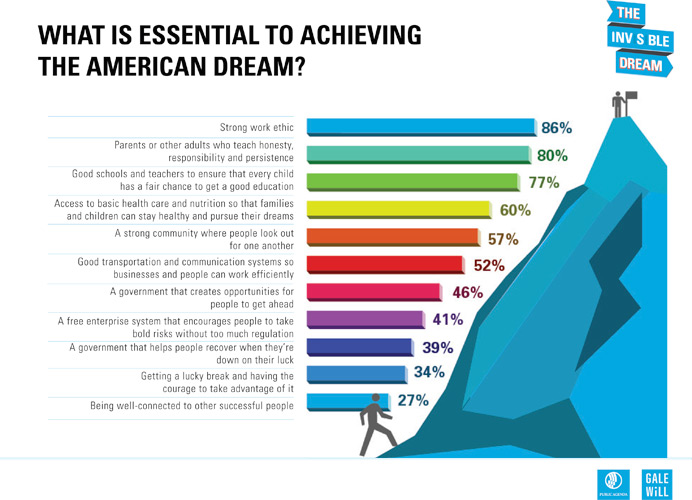
But 86% cited a strong work ethic as essential to achieving the American Dream.  Close behind that was parents or other adults who instill honesty, responsibility and persistence, followed by good schools.

Telling is that 42% felt the answer is individual effort compared to 39% who saw it being aided by society.  Disturbing is that 19% didn’t believe that either was the answer.

Equal percentages (43%) felt that the American Dream was endangered by a decline in work ethic and hard workers being shut out.  The fact that 14% felt that neither reflected their views may shed light on the number who are lazy among all socio-economic strata.

Since 1967, the Current Population Survey has been measuring among other things, the desire among individuals for work, last updated in 2014.

This is analyzed in a paper published last month.

My friends on the right have one answer for every societal ill: government.  Government undermines values, government caused the Great Depression and the Great Recession, government causes pollution, government caused the BP spill in the Gulf and on and on.

Ironically, the study documents that the 35 year decline in the desire to work started just as let ‘em “sink or swim” conservatives launched an all out attack on the safety-net, dramatically cut taxes for the rich and began to harangue and stereotype the poor.

The fraction of non-workforce participants reported as “wanting a job” trended up during the 1970s, then began a decades long slide beginning at the dawn of the 1980s just when the so-called Reagan Revolution promised the opposite.

The study entitled, Declining Desire to Work and Downward Trends in Unemployment and Participation is fascinating because it unwraps why the desire to work went into strong decline in the mid-1990s just after the government moved to “end welfare as we knew it.”

A report last year in the Wall Street Journal noted, using results from a joint survey by that paper and NBC News, how much the opinions of Americans has changed since 1995 regarding the causes of poverty.

In 1995, “Americans were twice as likely to believe poverty resulted from people not doing enough to help themselves out than to attribute it to external forces.”

Today, “Americans are as likely to blame poverty on circumstances beyond people’s control…,” although the majority of those holding power in Congress appear to remain stuck in the 1990s.

The percentage of Americans still holding to the view that it is because of laziness has plummeted, less among Republicans than Democrats and Independents and white Americans overall.

This hasn’t stopped the promotion of failed solutions across the ideological spectrum.  Personally, I favor a national living wage calibrated to localities, more affordable education and a return to a more progressive tax rate to fuel aspirations to achieve the American Dream.

But from my four decades as a chief executive, I feel we need to also find solutions that will address the 2-in-10 Americans who appear a bit lazy without, as many do today, stereotyping the poor.

Even the controversial white paper by the libertarian right Cato Institute, a follow up to one in 1995, acknowledges that “there is no evidence that people on welfare are lazy or do not wish to work.”

Studies also show there is no evidence that people who are poor value education any less or are any less involved with their children or are more addicted to substances than Americans overall.

Nor is there any evidence they are lazier.  In fact, many of these things correlate to incomes as they rise.

Laziness cuts across the entire spectrum, regardless of pocketbook size.  So should any solutions.

Monday, February 09, 2015

Grieving and Other Stereotypes

I didn’t drive cross country to my Mom’s funeral and back during the last two weeks to save money.  It costs a third or more than just flying and renting a car.

We all grieve differently and I knew the three and a half day drive out would give me time to do that before I got to Spanish Fork, Utah where she was buried.  It also provided as well, a chance to think through the overview of her life I would deliver at graveside.

In breadth, this essay will resemble our frequent conversations.

She was a few days short of 86 years old when she died.  Mom had battled the last couple of decades through macular degeneration in both eyes, a broken pelvis, hip and wrist as well as constant pain and/or feeling loopy from pain patches.

Always cheery, she had frequently told me she was ready to go, and in retrospect, for the past year there were signs she was coming in for a landing.

She had skipped the annual lakeside family rendezvous last summer and then let her apartment go to move north along Puget Sound to live with my youngest sister and brother-in-law.

She studiously used a “reader” to sort through all of her papers and mementos so they would be in order.

The first night of our trip out, Mugs and I stayed in Paducah, located in that far western tip of Kentucky pointed into a nook between Tennessee, Missouri and Illinois.

Mugs and I drove north the next morning up across the Ohio River as dawn began to break from just over my right shoulder.

I recalled reading Mom’s great-grandfather’s journal about a trip he made in 1840 up that river to visit his Quaker mother one last time before then heading west another 1,100 miles into the Rocky Mountains.

Also crossing my mind was my Mom’s parenting and love dating to my first memories of her singing ad reading to me,  Suddenly, my numbness gave way to tears that didn’t let up for several hours until we were well past St. Charles, Missouri.

The emotion was a mixture of sadness at her passing, joy remembering her life and relief that she was no longer in pain.  I also wondered if she was mad as hell to get to the afterlife and see my Dad there because he didn’t have to sit through all of those meetings at church (smile.)

I had driven the route before but never from the direction we travelled that morning nor at that time of day nor when I was so much in the moment.

Before stopping for the night in Salina, Kansas, I had been marveling at the stereotypes we are often given of various states and how some over deliver while others under deliver on those expectations.

The vast majority of Kansas over delivers.

Many people stereotype it as flat and ultra conservative including being rabidly anti-choice when it comes to a woman’s personal control over decisions about her body.

But those are just the aspects given the most exposure in news reports.

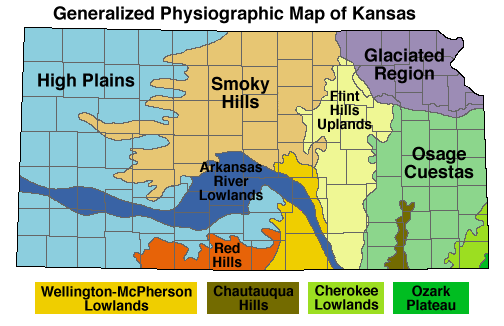
Of course, there is always some truth to stereotypes.  About a third of Kansas is indeed comprised of high plains, much like half of adjoining Colorado as well as a majority of Montana which escape that stereotype and a large corner of Wyoming, part of Nebraska and South Dakota and the panhandles of Texas and Oklahoma which don’t.

Stereotypes are never even handed.

Salina lies where the Flint Hills Uplands give way to the Smoky Hills region of Kansas, just north of the Arkansas River Valley.  It was an incredible 70 degrees the January evening I stopped there to overnight.

We drove west another two hours the next morning before getting into the high plains where they continued along our route for another four hours, mostly in Colorado before cutting north along the Rocky Mountain Front and then west to cross the Continental Divide at South Pass after our final outbound overnight in Rawlins, Wyoming.

Speaking of stereotypes, we’re also given to believe by the news media and politicians that Wyoming is incredibly conservative at 41.6%, the third highest in the nation.  But overlooked is that 40.2% of residents there self-identify as moderate and 13% as liberal.

Does a tiny 1.4% differential warrant a stereotype?  Jackson and Laramie certainly aren’t large enough for the majority of Wyomans, who in fact aren’t conservative, to be sequestered only there.

South Pass is a relatively low spot between the central and southern Rockies where beginning in 1847 in little more than a decade every line of ancestors on both my Dad and Mom’s side passed before becoming a union in our ancestral Yellowstone-Teton nook of Idaho where the central and northern Rockies meet.

Kansas also isn’t as conservative politically as politicians as well as those who plant those annoying little abortion signs along the freeway there hope to make you believe.

It is the 22nd most conservative state at 38.4% but the full story is that 36.3% of Kansans self-identify as moderate and more than a fifth as liberal, ranking it as average overall, just above North Carolina.

The signs along the Interstate there shout out warnings about abortion and call for stricter policies but surveys show that those messages represent the views of a minority of Americans and probably Kansans, too.

Even 19% of Republicans want them to be the same or less strict but a combined 45% of Independents and Democrats also feel that way.  Overall, only 24% of Americans support making them stricter.

Neither Salina nor Kansas existed in 1847 when three ancestors of my Mom’s marched just south of where that town would be founded a half dozen years later and just north of what would become Durham, Kansas, (smile) down along the old Santa Fe Trail with the Mormon Battalion  destined for the War with Mexico.

They exited what is now Kansas near what would later be named Liberal, Kansas which in that era meant “kind.”

Places and physiography as well as stereotypes get politicized over time.  Kansas for instance has a rate of 30% obesity among adults.  Is it found more commonly among those who are conservative or moderate?

Not sure what all of this has to do with my Mom who self-identified as a conservative, but in reality she was more moderate, except that this essay closely resembles the vast range of topics we would touch on during frequent phone calls.

Intellectual curiosity is a family trait.  So is a stiff upper lip.  So is grieving the way we do.

Miss you MomRed heart.  Please tell Dad hey.

Thursday, September 04, 2014

Risk Factor Ruminations on the Road to Casper

By the time the events surrounding the shooting in Ferguson, Missouri began to dominate news reports last month, Mugsy and I had just turned onto a segment on the return leg of our most recent cross-country road trip that was new to us.

As it almost always does during a feeding frenzy when far too many news outlets resort to speculation and grasping at anecdotes and dichotomies such as saint and sinner, those with agendas tend to usurp attention.

Running Durham’s organization responsible for serving the news media at the time, I had a front row seat to this formulaic pattern during the the now infamous claims of a stripper against some Duke Lacrosse players.

The police and the local newspaper had rightly closed the case, but the paper in nearby Raleigh threw gasoline on the embers, inflaming listserv advocates in Durham anew and within a day, a similar national frenzy ensued making it very difficult year to be in the “calm down business.”

Predictably, racism had become the storyline in Ferguson and I wondered as we cut southeast from Dubois, Wyoming along the Wind River Range if any of those producing stereotypical reports that day had ever read the report I did before I left home entitled Being Black Is Not A Risk Factor.

It’s being poor but it is even more complicated than that, which came to me the next day when my thoughts turned to another study on the stretch from Lincoln to Nashville including an unexpected stop.

The report is the kind of analysis of African-Americans by African-Americans that seems to quickly divide those eager to show progress in the struggle to overcome stereotypes from those who won’t let them go for fear of losing leverage to continue the struggle.

I first witnessed this in the early 1990s when an African-American, Dr. Shelby Steele, now a fellow at Stanford’s Hoover Institute, first published a remarkable book entitled The Content of Our Character: A New Vision of Race in America.

It was also made apparent a few years later when a series of essays were published entitled, The House That Race Built, including a favorite of mine by Nobel Prize-winning Toni Morrison.

There is a coarseness in news coverage surrounding race that for me is at the root of why 80% of blacks think Ferguson raises important issues about race while nearly 50% of whites think it got more attention than it deserved.

It isn’t because these whites are all racist, although plenty of both blacks and whites are.  It is due to the fatigue that stereotypical and anecdotally-frenetic news coverage creates reminding me somehow of a verse in Paul Simon’s Me and Julio Down by the School Yard:

In a couple of days they're gonna take me away
But the press let the story leak
When the radical priest come to get me released
We was all on the cover of Newsweek

Apparently the BBC refused to lay it because it mentioned Newsweek by name.

That stretch I was driving that day of US Route 26 crosses the reservation for Eastern Shoshone and Arapaho people along its way to Casper near where two of my great-great grandfathers and a great (x3) stopped to build a ferry across the North Platte River in 1847.

This is Longmire country for fans of the acclaimed A&E series and/or the Craig Johnson novels upon which it is based (although the area around Santa Fe is used as a stand-in.)

When I watch television, it is entirely via streaming now and I find I am drawn to shows and movies where the landscape also serves as a character such as Longmire, The Killing, Wallander, Endeavor, Night Train to Lisbon, etc.

This part of Wyoming is a gently rolling sagebrush steppe of the Great Plains filling a gap between the fingers of the Middle and Southern ranges of the Rockies.

I have always been on the least intolerant end of that spectrum but still within a few hours that afternoon, I was able to catch fleeting glimpses of my own prejudice, one while crossing the reservation and one during dinner that night during a layover in Casper.

Until the end of the 1850s, a decade or so after all but two of my sixteen fifth generation ancestors had made the cross-country trek from various parts of America to settle along the western slopes of the Rockies, news coverage simply reported events.

Oh, there was plenty of vitriol and opinion too, but in July 1859, a new dimension was added when the first-ever news “interview” was conducted by Horace Greeley of Brigham Young during a stop in Salt Lake City by the New York Tribune publisher.

In Manhattan, Kansas, in route from New York to San Francisco, the then 48-year-old Greeley had caught up with Tribune journalist Albert Richardson to take a new, quicker route just opened with partners by the founder of the Pony Express.

As Richardson had earlier passed by what would become Ferguson, Missouri, land had just been donated to the Wabash Railroad coming down from Toledo on the condition that a station be built there.

At the time, nearby St. Louis had a population of around 160,000.  But the surrounding county, including around Ferguson, was still very rural.

While Richardson notes that city streets there were filled with debates between pro and anti-slavery residents, out in the county, including where the Ferguson Train Depot would soon rise, there were still 1,156 slaveholders holding 3,346 African-Americans in slavery.

The Leavenworth and Pikes Peak Express Company ran its stagecoaches along part of the route one of my great-great grandfathers had captained a wagon train five years earlier, but then along a much faster route through just-founded Denver and then up and over the Southern Rockies.

Not only states, but towns within states such as Kansas, were divided as free or pro-slavery at the time and a fascinating read is the book entitled Beyond the Mississippi written by Richardson two decades later from notes in his journal.

Downloadable free including into a Kindle app, Richardson’s narrative, a first-hand snapshot of Missouri, Kansas, Colorado, Utah and California in the pivotal years just before the Civil War, is a great cross country travel companion.

The news interview is rapidly becoming a thing of the past when it comes to news reports.  There are still quotes and sound bites but mostly anchors now interview other reporters who respond to questions by substituting opinion and conjecture as stand ins for others who were directly involved or with direct knowledge.

Tomorrow, more about those fleeting insights into my own stereotypes and the real risk factor.