Showing posts with label Work. Show all posts

Monday, April 27, 2015

The Significance of Understanding Your Natural Rhythm

I am what researchers call a “lark,” someone who, because of the way their circadian rhythms shifts, is genetically a “morning person.”

This is why I still get up around 6 a.m. even though I am retired.  It is why I work out and write these posts early in the morning.  Other people are genetically night “owls” or what researchers call “undifferentiated.”

A researcher at BYU, my alma mater, found in a study that 44% of people are “larks” like me, another 32% are “owls” and 24% are undifferentiated.

Dr. Jeffry H. Larson, who graduated a year before I did, also found that people whose rhythms are mismatched are far more likely to argue and to do so more often.

Researchers at Harvard and the University of Utah found that this can also impact when people are most likely to lie.

Further, researchers at the University of Washington, Johns Hopkins and Georgetown have found that when energy wanes, as it does later in the day for “larks” and earlier for “owls,” is also the time of day overall when people are more likely to be unethical.

For some time now, researchers have studied what they call “social jetlag” and found correlations to our chronology.  This is what some people feel when they go back to work on Monday or after a vacation.

It is also something that many college graduates are about to experience as they shift into the workforce.

Studies of “presenteeism” (present in body but not in mind,) note that it costs nearly $80 billion in annual lost productivity.

Human performance decreases at night by 5%-15%.  Interestingly, turnover drops by more than half when employees are able to modify a select a schedule compared to when mandated.

Some research has found links between “owls” and smoking and obesity.  Other research has found that “owls” are also potentially more creative and possibly have slightly higher IQs.

It isn’t likely that a person can change their chronology, and there are some well documented health reasons for why we sleep and fast at night.

Flex time is a solution but so is encouraging people in the workforce to be more conscious and respectful of the ebb and flow of their own energy as well as that of others so that they take on big projects when they are operating with high energy.

It may be that teams should be assembled, in part, using compatibility in this regard as criteria.

Years ago, during my four-decade career as a community marketing executive, I set a rule that people who helped me protect my calendar could set no more than one meeting for me in the morning and one in the afternoon without first clearing an exception.

This is what Dr. Christine Carter at UC-Berkley, the author of the new book The Sweet Spot: How to Find Your Groove at Home and Work, calls the “minimum effective dose” strategy.

For me, that rule about meetings was one of those “micro-habits” she writes about which, to paraphrase, channel our brain’s natural ability to run on “autopilot” so our habits can “relieve overreliance on willpower.”

I can also see in hindsight, how some people who are unethical and savvy at manipulation, probably took care to select meeting times where the potential for unethical outcomes was most probable.

They may have innately understood what researchers have observed.  Due to the “psychological depletion” people experience as the days wear on, “in the afternoon, the moral slope gets slipperier.”

Tuesday, April 21, 2015

A 35 Year Decline in the Desire to Work

Some of my progressive friends don’t like to hear this, even from a moderate Independent such as me.

But there is something to the concern that laziness may play a role in why a certain amount of poverty seems impervious despite societal safety nets.  More than 4-in-10 people who are poor seem to think so.

So do most progressives I suspect.  They are just less prone to stereotype the poor than many at the other end of the spectrum.

They also reject remedies from the far right that seek to starve out the small number of poor who are lazy with solutions that undermine millions of children in those homes along with the working poor, who as I will show, are among the most industrious Americans.

Only 26% of drug and alcohol treatment centers are residential and only a handful of those go beyond a few weeks or months.  Even fewer are centered on instilling a work ethic, as are the most successful, some of which also happen to be at no charge.

But ask the latter what the biggest reason is for washing out within the first months or so, regardless of socio-economic level and you’ll learn that it is an unwillingness to work.

Of course, this is a very small portion of those in poverty but while the question hasn’t been asked recently, in opinion polls 40% of those in that circumstance believe some of their peers are not doing enough and don’t really want to work.

This may also explain why many who are addicted prefer to panhandle along roadsides, which seems like it would be much harder than holding down a job.

But refusing to get clean, not lack of access, is why those who are panhandling aren’t able to access shelters and related workforce training.

Take away those who suffer from mental health issues and those who are crooks and you’ll find many who just refuse to work.

By the way, it hasn’t been posted yet but there is an excellent overview of the state of rehab in America in the investigative Mother Jones Magazine this month entitled Hung out to Dry by John Hill.

Apparently, of the 18.7 million Americans who needed alcohol treatment in 2010, only 1.7 million received it.

In a recent nationwide study of Americans, only 24% felt they had achieved the American Dream while 36% felt it unlikely including 21% who no longer give it much thought.

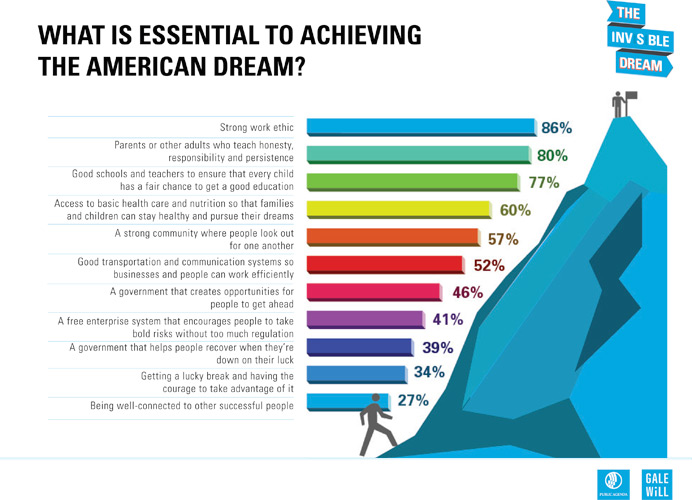
But 86% cited a strong work ethic as essential to achieving the American Dream.  Close behind that was parents or other adults who instill honesty, responsibility and persistence, followed by good schools.

Telling is that 42% felt the answer is individual effort compared to 39% who saw it being aided by society.  Disturbing is that 19% didn’t believe that either was the answer.

Equal percentages (43%) felt that the American Dream was endangered by a decline in work ethic and hard workers being shut out.  The fact that 14% felt that neither reflected their views may shed light on the number who are lazy among all socio-economic strata.

Since 1967, the Current Population Survey has been measuring among other things, the desire among individuals for work, last updated in 2014.

This is analyzed in a paper published last month.

My friends on the right have one answer for every societal ill: government.  Government undermines values, government caused the Great Depression and the Great Recession, government causes pollution, government caused the BP spill in the Gulf and on and on.

Ironically, the study documents that the 35 year decline in the desire to work started just as let ‘em “sink or swim” conservatives launched an all out attack on the safety-net, dramatically cut taxes for the rich and began to harangue and stereotype the poor.

The fraction of non-workforce participants reported as “wanting a job” trended up during the 1970s, then began a decades long slide beginning at the dawn of the 1980s just when the so-called Reagan Revolution promised the opposite.

The study entitled, Declining Desire to Work and Downward Trends in Unemployment and Participation is fascinating because it unwraps why the desire to work went into strong decline in the mid-1990s just after the government moved to “end welfare as we knew it.”

A report last year in the Wall Street Journal noted, using results from a joint survey by that paper and NBC News, how much the opinions of Americans has changed since 1995 regarding the causes of poverty.

In 1995, “Americans were twice as likely to believe poverty resulted from people not doing enough to help themselves out than to attribute it to external forces.”

Today, “Americans are as likely to blame poverty on circumstances beyond people’s control…,” although the majority of those holding power in Congress appear to remain stuck in the 1990s.

The percentage of Americans still holding to the view that it is because of laziness has plummeted, less among Republicans than Democrats and Independents and white Americans overall.

This hasn’t stopped the promotion of failed solutions across the ideological spectrum.  Personally, I favor a national living wage calibrated to localities, more affordable education and a return to a more progressive tax rate to fuel aspirations to achieve the American Dream.

But from my four decades as a chief executive, I feel we need to also find solutions that will address the 2-in-10 Americans who appear a bit lazy without, as many do today, stereotyping the poor.

Even the controversial white paper by the libertarian right Cato Institute, a follow up to one in 1995, acknowledges that “there is no evidence that people on welfare are lazy or do not wish to work.”

Studies also show there is no evidence that people who are poor value education any less or are any less involved with their children or are more addicted to substances than Americans overall.

Nor is there any evidence they are lazier.  In fact, many of these things correlate to incomes as they rise.

Laziness cuts across the entire spectrum, regardless of pocketbook size.  So should any solutions.

Friday, March 20, 2015

Looking Back To Detect the Future

One of the signature artifacts of Durham, North Carolina’s past that has been lost during the eight decades of neglect since a local history museum was first proposed is a calliope.

Beginning less than a decade after the Civil War ended here 150 years ago next month, this musical instrument sat atop the now repurposed Old Bull Building and simulated the sound of a bull at each factory shift change and other special occasions.

I grew up on a cattle ranch in the Rockies so when I first read about this famous calliope, I had no trouble imagining the sound it played (click here to hear a bull.)  It celebrated Bull Durham tobacco and the “Bull City” it was soon to make world famous.

It is important to remember that in 1870 as plans were being laid to erect the Old Bull Building, now a National Historic Landmark, Durham was already very different than the rest of North Carolina.

At the time, Governor W.W. Holden was standing up against gangs of Ku Klux Klan riders who were marauding through nearby counties committing public murders and whippings while intimidating officials from doing anything about it.

Several counties were declared to be in a state of insurrection and state militia were deployed.

These gangs of terrorists were targeting “blacks who did not know their place” and whites who advocated for the rights of blacks.  In fact, maybe the sound of a Bull blaring from Durham was meant to ward them off.

Seriously, this is when Durham residents began talking privately about formation of a separate county which got its unique shape when several pieces of land were lopped off during passage of the controversial 1881 bill in the legislature, enabling voter approval.

But Durham’s industrialists and merchants were divided on another issue, bonds to build graded schools.  Republicans were opposed, arguing that education by families and in private and parochial schools was enough.

Opponents sued to overturn voter approval so voters approved the bonds again while proponents started a “moonlight school” for factory workers.

Artifacts such as the now lost “bull calliope” will be crucial to a fully-functional Museum of Durham History, should officials ever make it the priority public opinion polls have shown for decades.

The compelling essay entitled “Looking at Artifacts, Thinking About History,” notes that artifacts reflect and symbolize changes.  Had the old calliope survived, it would today serve as a clarion reminder that Durham is different, and proud of it.

There are people who dismiss the past by claiming they only want to think about the future.  This is the kind of thinking or lack of thinking that leads quickly to a surrender of sense of place in so many communities.

It is by understanding the patterns of the past that we see into the future.  It is why a class in historical analysis should be required as a prerequisite in business schools for one on strategic thinking and/or strategy making.

With each passing day, Durham loses more and more of its history in exchange for mainstream culture that can be found anywhere.

For those still puzzled about why we should care and in need of lists to check, below are just a few reasons a Museum of Durham History, stocked with both artifacts and the latest technology, is crucial:

  • Story Telling. It will give children, students, newcomers and relocating executives a place to get in touch with Durham’s story. People who grasp that stories are more inclined to be engaged as activists, volunteers and philanthropy.
  • Synergy. It will augment Durham’s historic sites by providing exhibition space to stir interest in those locations, making them more sustainable. It will complement rather than undermine other cultural facilities and programming.
  • Preservation. It will be a vigilant testimony to what makes the community distinct and unique and insulate its character and personality from the pressures of development and “generica.”
  • Future Generations. As a repository of innovations and artifacts, it will inspire future generations to build on the temporal qualities that make Durham, well, Durham…creative, entrepreneurial, caring, innovative, accepting, etc.

Maybe it is because I am something of an artifact myself, that this has now become so clear (smile.)

Monday, June 16, 2014

Fewer Working As Adolescents Means Many Are Ill Prepared

Something crossed my mind while reading both a McKinsey report and a recent op-ed in the New York Times.  We seem to have forgotten the importance of working to ready adolescents for the workforce as adults.

It polishes skills learned from the time we are age 3 in a way that classroom learning can only augment.  In fact the root of not nearly as many adolescents working today may be an over-reaction to what progressives had to overcome to mandate education.

Before I get to the science, it occurs to me that I honestly don’t remember my parents needing to push me to start working for people other than family starting when I was 10 years old.

I held down 14 or so jobs working for an even greater number of employers before heading off to college.  It was a far more forgiving route workforce readiness as an adult than many kids take today.

Workforce readiness has nothing to do how well or how far you go in school.

I’m sure my parents kept close watch on where and for whom but they seemed far more concerned that I just learn to enjoy working hard.

My mom’s only word of advice when I took my first job away from home was - “If you aren’t busy, grab a broom and make yourself busy.”

Taking heed of that advice made me stand out to more than one employer and later left me puzzled when doing the hiring myself that so many candidates seemed unready and lacking work ethic.

Today, many kids are well into college before they get workplace experience, when the the expectations are less conducive to learning your way around a workplace or how to work in general.

Since 1981, the percentage of 12th graders working 16 hours or more a week during the school year has fallen from 44% to only 25% while the percentage volunteering once a month or more has risen from 23.6% to 35.5%.

A recent survey of employers by the Chronicle of Higher Education found that they ranked employment during college much more valuable than extracurricular activities, a specific major, college reputation or volunteer experience.

This was even more true among those working in HR and in upper management.

Working at a younger age helps polish “executive function skills” and are found most important by employers.  These include focus, working memory, cognitive flexibility, inhibitory control, critical thinking, self-directed learning and making connections and perception taking.

If you missed it, read the recent NY Times Op-ed by Dr. Gordon Marino at St. Olaf College entitled, A Life Beyond ‘Do What You Love’.

The essay also introduced me to a much discussed article in Jacobin magazine early this year, where Miya Tokumitsu” argues that this “cultural mantra of our time” in fact “disguises its elitism as noble self betterment.”

In his 2012 manifesto entitled “Stop Stealing Dreams (what is school for?)”, famous entrepreneur and author Seth Godwin reminds us that 150 years ago people were incensed about child labor but the outrage wasn’t just moral.

He points out that the “economic rationale was paramount.”  Kids were taking jobs away from adults because industries could get them to work for much less in the decades before education became compulsory in 1918.

At the time corporations and other businesses fought restrictions on child labor and mandatory education while fueling conservative rhetoric that “losing child workers would be catastrophic.”

“Professional confusers” back then used the same arguments they do today to stymie efforts to address climate change.

In fact, Godwin reminds us, that the rationale that finally weaned industrialists off child labor and in support of compulsory education was the argument that “educated kids would actually be more compliant and productive workers.”

Thus our schools today are still organized much like assembly lines with “scale much more important than quality.” 

“Education,” he argues, was “not developed to motivate kids or to create scholars. It was invented to churn our adults who will then work well within the system.”

Beginning several decades ago, surveys of American workers have revealed that 7-in-10 are not engaged at work and nearly 2-in-10 were actively disengaged, e.g. trying to undermine others.

But conditions such as engagement and being in the “flow” aren’t about doing what you love but learning to love what you do.

In my experience people can find purpose in any work.

Mike Rowe agrees.

He is the producer and host of the TV show Dirty Jobs where he played an apprentice for a variety of jobs, now more than 200 over its eight seasons which are now available online through various services.

While preparing for a sequel series by a different name coming later this year on CNN, he has taken a lot of grief recently for a commercial he narrates for Wal-Mart entitled “I Am A Factory.”

I’m far more often a critic of big box formula stores and a proponent of paying a “living wage” but even for the 3.3 million Americans still being paid minimum wage or less, it is the practice, not the work, that we should condemn, something advocates miss.

I was intrigued at how nimble Seattle’s daring experiment is with raising its minimum wage to twice the national level, including a provision to keep teenagers employed.

That all work can be purposeful and meaningful appears to be the point of Rowe’s “Works” foundation where in part he has raised millions of dollars for scholarships in the skilled trades by selling memorabilia from his “Dirty Jobs” days.

Far too many of us have these wires crossed.

In a TED talk, Rowe argues that “follow your passion” may be the worst advice ever given.  He finds that the people he encounters filming Dirty Jobs are decent, hard working, balanced people.

But they didn’t just follow their passion or wait around for work they could love.

We live now in a risk adverse society that makes it harder—but not impossible—for kids to get a job.

We’re robbing kids of the learning and character traits that can only be forged by early exposure to the work place.

Of course, I’m not talking about truly hazardous work such as tobacco fields where a report shows workers absorb dangerous levels of toxins.

A grim report by Human Rights Watch may overstate the dangers of farm work in general while trying to put a spotlight on abuses in a four state area that includes North Carolina.

Unfortunately, many of the parents denying their children a chance to work until well into college or even later may be the same parents who won’t let their kids ride the school bus or explore nature along the street where they live.

Judging from McKinsey research conducted mid way through the recovery from the current recession, we’re getting on track to regain full employment again by 2020 or soon after, about 20 million jobs more than we have today.

By then the recovery will have taken 14-20 years.

The great recession wasn’t just a recession, it marked a paradigm shift and not just because visitor-centric industries will be one of the top three drivers of job recovery by 2020.

Job growth after the new millennium has been at half the rate it was in previous decades.  Business creation fell during the recession too, 23% in the first three years alone.

The labor market is plateauing while we’re generating a million and a half fewer college graduates than we need to meet the 2020+ goal.

But it isn’t just college they will need.

All of this is to say that work experience is as valuable as education for young people.  We need to recalibrate to both/and.

Thursday, November 14, 2013

The Supply and Demand of Workforce Engagement

Engaged employees may be especially important to economic development organizations because 7-in-10 “believe their city is a good place for people starting a new business,” according to Gallup’s recently released 2013 State of the Global Workplace report.

I suspect that is especially true of those in my former field who focus on demand-side or visitor-centric economic development such as is done by community destination marketing organizations (DMOs) vs. the more traditional supply-side form focused on business recruitment. 

Engaged employees are defined as those “who work with passion and feel a profound connection to their organization and more importantly to DMOs, their community.  They drive innovation and move the organization forward.”

Overall, that describes 30% of workers in the United States and just 13% across all 142 countries measured by not only Gallup’s extremely sophisticated Q12 metric but 18 other indices.  But before delving into the other 70%, a note of recognition is overdue.

Because Durham’s DMO just received its 5th Sloan Workplace Award since the diagnostic process was initiated 8 years ago, it is a safe bet that the organization charged with promoting and safeguarding Durham’s brand and sense of place has a much higher proportion of engaged employees, probably 70% or more.

Each year, Sloan independently surveys the employees of participants as part of the process.  The only other DMO to be awarded a Sloan this year was Dallas, among the 300 organizations in 250 communities to be recognized.

The American Institute of CPAs in Durham is also a frequent recipient.

So back to the 30% who are engaged, it must be the economy right?  Nope, that percentage has been essentially flat since the year 2000 so has the overall percentage who are not engaged (52%) and the percentage who are actively disengaged (18%.)

“Not engaged employees [52%] are essentially ‘checked out.’ They’re sleep walking through their work day, putting time – but not energy or passion – into their work.”

“Actively disengaged employees [18%] aren’t just unhappy at work; they’re busy acting out their unhappiness.  Every day, these workers undermine what their engaged co-workers accomplish.”

As he was pacing his headquarters after the Allied armies had liberated Sicily, General Dwight D. Eisenhower, who would be elected President of the United States less than a decade later, is quoted as saying:

“In any army one-third of the soldiers are natural fighters and brave; two-thirds inherently are cowards and skulkers.”

Cowards would be those who actively disengaged and skulkers, a term meaning to evade or lay back, would be the not engaged.  The British called engaged soldiers “gutful” and the actively disengaged “slinkers” but roughly agreed to the breakdown.

It appears that in even the most dire and dutiful circumstances the level of those truly and passionately engaged is about one in three.

Gallup’s breakdown today includes managers and executives, who are only slightly more engaged and 13% of whom are actively seeking to undermine those who are.

So how do some organizations manage to increase the percentage of their workforce who are actively and passionately engaged from 30% to 70%?  This also correlated to good customer service, accountability, innovation, productivity, profitability and more.

In addition to the “big three:” selecting the right people; developing employee strengths; and enhancing well-being, the report gives specifics on other best practices (in my words):

  1. Strategic Direction – A Culture of Engagement
  2. Linking Performance and Accountability
  3. Alignment and Hyper-Communication
  4. Continuous and Never-Ending Improvement

But I have a broader concern.  Of course, employers, public or private, are not really in the missionary business.  There’s only so much that can be done in the workplace to dial employees up.

But as more and more and more employers follow Gallup’s research-driven recommendations and engage in in-depth diagnostics such as Sloan, it seems the pool of engaged and engage-able employees may become increasingly tapped out.

At one end, as noted in an excellent piece in the Wall Street Journal this week about the current demand for degrees and the dangers of specialization, there is incredible anxiety among people preparing to enter the workforce.

On the other, it is clear that globalization and automation have not resulted in fewer jobs, just lower quality jobs.

As a society, we’re doing better than other countries but many in our society seem bent on dismantling upward mobility while others seem intent only to be enablers of non-engagement.

It seems we may need to become more engaged as a society overall to become more engaged at work.

Thursday, August 15, 2013

Disengagement’s Drag On Performance

It never fails.  Every summer there is a news article or two complaining about receiving work-related emails and calls when on vacation.

The real issue probably isn’t email.  It’s just a tool, in my opinion, that allows you to relax on vacation because you aren’t holding someone up or failing to address an issue that could grow into a full-blown “forest fire” if you don’t nip it in the bud.

The real issue is more likely one of lack of engagement.  Of the 100 million people in America who hold full-time jobs, 30 million are engaged and inspired at work.  That’s the good news, according to Gallup’s ongoing analysis of the American workplace.

Among the rest, 50 million are not engaged or inspired in their work and another 20 million are, well, “actively not engaged.”  I suspect the same holds true of the population in retirement or in school and may be especially true of many who run for elected office.

It is probably also true of the editors who repeatedly assign those stories.

Before you jump to the conclusion that lack of engagement must drive high turn-over, think again.  Gallup has isolated and quantified the relationship between engagement and nine different performance outcomes because engagement continues to be key to organizational performance.State of the Amercan Workplace

Lack of engagement is 2.6 times greater as a factor in “low employee turnover” than it is in “high employee turnover.”  In other words, low employee turnover can often mean employees have just “retired in place.”

Other studies show that thriving organizations strive for “continuing and never-ending improvement.”  On average, studies show that 20% or more of employees should either move on or be “moved on” each year because they have outgrown their jobs or the job just isn’t a good fit.

Low turnover can be of even more concern than high turnover to high performing organizations.  The best rule is a policy of “grow and go" for engaged employees who need to progress faster than an organization can accommodate them.  Of course, equally important is “moving employees out who are actively disengaged.”

One of the biggest drags on an organization by employees who are not engaged is absenteeism.  This is even greater than high turn-over.  Shrinkage or employee theft is also a bigger factor followed by safety incidents.

If someone complains about checking email occasionally while on vacation, that may be more an indication that they aren’t engaged in their work.  They are most likely to also complain or be unresponsive at work.

In my experience, a tell-tale sign of lack of engagement is the inability to resolve conflict.  Those who are “actively not engaged” probably also generate a fair amount of needless conflict, especially if they are passive-aggressive.

Email accounts for highly engaged people should probably be monitored by supervisors when they are on holiday until it is confirmed that they know how to limit engagement or to determine what may be creating unnecessary interruptions.

Fifty percent or more of every job is project management.  This means collaborating with other people and organizations.  It may also mean a fair amount of “putting fires out.”

Email availability is probably not be a burden, but a blessing for those engaged employees who do not want their absence to inconvenience co-workers who are “holding down the fort” while they are gone.  It also lessens the mountain of work waiting when they return.

For anyone for whom it is a strain, there are probably bigger problems to be addressed.  Engagement is also more important to employee motivation and organizational performance than perks.

Organizational size seems to make a difference.  Slightly less than half of the 100 million full-timers noted above work in organizations of fewer than 500 employees while 39% work in organizations with 10 or less.

The ratio of engaged to actively disengaged employees according to Gallup is 8 to 1 in organizations of 10 or fewer employees.  The ratio is only slightly better than 1.5 to 1 in organizations of 10-24 employees and also less in organizations of up to 99 employees.  From there, the ratio gradually increases again to a high in organizations in the 500-999 employee range before it begins to fall again.

The Gallup report also breaks down engagement by position.  Managers, executives and officials have slightly higher (6 points) engagement.  Of concern for the impact it may have on organizational engagement overall is that 51% are not engaged and 13% are actively not engaged.

At 29%, oft-maligned Government workers are only 1 point less engaged than American workers as a whole.  They are three points higher when it comes to “not engaged (53%)” but two points lower than American workers overall when it comes to being “actively not engaged (18%.)”

Longevity can be a factor.  In the first six months or less, 52% of employees are engaged.  It drops to 44% for those who stay three years or less and bumps up a couple of points for those who stay ten years or more.

Active disengagement bumps up four points between six months and three years and then another two points between three years and ten years.  The lesson is that the 8% who are actively disengaged in the first six months won’t get better given time beyond a trial period.

To me, tenure does not equate in the study with the danger of complacency but about 15% of those employees who are engaged at 6 months become disengaged or actively disengaged over time.

There are far too many organizations where disengaged employees who aren’t released during their trial period, are later made supervisors based on tenure.  The sad part is that this is where their active disengagement contaminates and demotivates others.

“Hire slow, fire fast” should be the mantra for high performing organizations.

The price to society of the people who remain unengaged or actively disengaged in their work over decades must be staggering.  Fascinating in the report is a breakdown of engaged, unengaged and actively disengaged by generational cohort.

Ironically, broken down by education, those with less than a high school degree are slightly more engaged than other educational cohorts.  The study reveals that having a college degree and higher earnings during a person’s lifetime does not guarantee engagement in the workplace.

Educational level is important to getting a good job and to earning more money but no guarantee to finding work that is personally engaging.  Part of this may be higher expectations and a sense of entitlement.

But those with a college degree are slightly less likely to be actively disengaged.  One thing is clear from the report, hiring more college graduates or paying more in salaries or indulging employees with perks is no guarantee they will be engaged and inspired in their work.

Monday, May 13, 2013

Lifetime Lessons From Synchrony

Watching a young friend perform recently for the last time as part of her talented high school chorus in Durham, North Carolina where I live reminded me of a 1995 book by Dr. William H. McNeil, now a professor emeritus from the University of Chicago.

Entitled Keeping Together in Time : Dance and Drill in Human History,  McNeil wrote about the “emotion aroused by the prolonged movement in unison…” as a “cultural ritual” and “muscular bonding.”

Both were demonstrated as I watched last week but I am sure there was plenty of typical high school drama going on behind the scenes.  A 2009 organizational behavior analysis by researchers at Stanford University shed light on the relationship of this type of synchrony and cooperation.

Dr. Scott Wiltermuth is now at the University of Southern California and Dr. Chip Heath at Stanford but formerly at Duke University here in Durham, is with his brother Dan the co-author of several books including the just-published Decisive: How to Make Better Choices in Life and Work.

In their joint study entitled Synchrony and Cooperation, Wiltermuth and Heath concluded that “people acting in synchrony with others [such as the highly-choreographed chorus I saw] cooperated more…even in situations requiring personal sacrifice.”

The study also confirms why this cooperation did not entirely mitigate negative behind-the-scenes’ emotions that night such as shunning, bullying and cliquishness common in every high school and far too common in life as well.

The synchrony learned in chorus, athletics, orchestra, marching band, drama and many other endeavors at elementary and secondary schools are teaching skills as important as any of the AP and Honors classes many of the performers last week were completing prior to graduation.

Learning how to work together as a team, to synchronize, even with people you may not like or who may not like you on a personal level, is an incredibly vital workplace skill.  Synchronous activities in school also foster creativity and collaboration with people who have different styles.

The conflict I am characterizing as drama may be hurtful in high school but overall it is also a vital experience for the workplace as illustrated so eloquently in a TED presentation by Willful Blindness author and former CEO Margaret Heffernan entitled Dare To Disagree.

The inability to engage and resolve the conflict of ideas and concepts is often at the root of the inability of so many organizations to be effective.

But feeling “part of a whole” as New York University Business School ethics researcher Dr. Jonathan Haidt explains in his book The Righteous Mind: Why Good People are Divided by Politics and Religion, doesn’t always require being in a festival atmosphere.

For much of the population it is one of the awe-inspiring by-products of nature.

Monday, October 22, 2012

The Proven Productivity of Work From Home

Because they must try to remain operational during and after natural disasters by running lodging hot-lines and providing maps to emergency crews, community-destination marketing organizations such as the one I ran in Durham, NC, until retiring a few years ago, were among the first, at least in this community, to empower staff to be able to work from home beginning as early as the mid-1990s.

By 1999, the Durham Convention & Visitors Bureau (DCVB) was using the tool to provide workplace flexibility and to amp up already high productivity by another 20%. 

This is one of many reasons that organization has received four national Sloan Awards for Excellence in Workplace Effectiveness and Flexibility, after becoming the first DMO in the nation to be so recognized in 2005.

Between 2005 and 2010, the number of workers telecommuting in the four-county Durham metro area increased from just over 8,000 to nearly 11,000 which represents nearly 5% of the workforce.

The Durham metro area only appears to be below the national average of 10% because it provides such a large proportion of jobs for non-residents who commute in from in other metro areas.

Nationwide since 2005, the percentage of regular telecommuters has grown 66% while the workforce grew just 3%.  Half of the nation’s workforce is now able to telecommute at least part time.

I suspect the number would be even higher except that at least half of employers are ideologically conservative and not just because that group has been slower to embrace new things.

According to research done by Dr. Jonathan Haidt and others, a significant element of the moral matrix of conservatives is wrapped around the fear that people who are slackers will cheat the system.

According to the research in his new 2012 book The Righteous Mind, liberals tend to focus on fairness as equitable, while conservatives tend to focus on proportionality.

It is easy to put safeguards and monitoring in place to curb abuse, and there is evidence that there is less abuse from those that work from home than there is among those in the workplace in general.

Those who continue to deride the practice of working from home as “shirking from home” are well advised to read the results of an experiment by a major Chinese employer that was published a few months ago.

The study was led by Dr. Nicholas Bloom, an economics professor at Stanford University.

Something tells me though, that just as there are still employers who whine about receiving too many emails and instead of shifting to contemporary message platforms, still pine for the days of the snail mail in-box, there will always be executives who resist the concept of work from home.

They will be easy to spot fading away in your rear view mirror while still muttering about takers vs. makers.

Tuesday, September 27, 2011

The Artificial Boundary Between Work and Play

At age 5, work for me meant also looking the part. After helping my grandfather dig postholes and repair fence line on the now-100-year-old Idaho ranch he had homesteaded but back then had turned over to my parents, my face didn’t show how hard I had been working.

So while my grandfather was reloading tools, I flipped the windshield visor down in the Jeep I was to inherit as my first car a decade later and, using both hands, transferred the dust I found there to my forehead and cheeks.

Even though my Dad would come in from working the ranch each night “feelin’ about half past dead” to borrow the great line penned by country-rocker Robbie Robertson, it was never lost on me, as we all gathered around to watch him eat “bread and milk” from a glass, that as we did we could see in his face how much he thoroughly loved working livestock along the Henry’s Fork in that Yellowstone-Teton nook of Eastern Idaho.

I was surrounded by adults for whom the boundaries between work and play were clearly artificial, something researchers later documented just after I came of age, yet it remains an area where business still lags behind science today. It is part of the fascinating story about motivation in Daniel Pink’s 2009 book Drive: The Surprising Truth About What Motivates Us.

Back while I was working at “looking the part,” I was also working up to getting to ride in my first cattle round-up at age 6 while also learning the lesson that researchers have since documented: For people who find passion and engagement, work can be even more fun than play.

I was also a little puzzled as an adult by people who only worked as a means to go play when I was having as much or more enjoyment in my work.

At an early age, I experienced what Pink adapts from the groundbreaking work of Dr. Mihaly Csikszentmihalyi (mee-hy cheek-sent-mÉ™-hy-ee) about the three pillars of passionate and engaged work:

  • “autonomy - the desire to direct our own lives,”
  • “mastery - the urge to get better and better at something that matters” and,
  • “purpose - the yearning to do what we do in the service of something larger than ourselves.”

Most were seasonal, some for only a few weeks or months but these pillars were reinforced during nearly every one of the 31 jobs I held in the years before starting my now-concluded four-decade career in community/destination marketing.

Ironically, two hundred years ago early pioneers in tourism may have contributed to the notion that is still so deeply embedded in today’s workforce that work and play are polar opposites. These people are easy to spot because they see work only as something you have to do and play as something you want to do.

Today there are many, even members of younger generations, who seem to work so incredibly hard at taking vacations, often requiring a “sick day” to recuperate before they return and then complaining mightily that they have fallen so far behind. They can’t fathom how people like me get as much or more pleasure from our work as we do from leisure or how 46% of us now can find peace of mind by occasionally checking in via email while we’re on vacation.

In her 1999 book Working At Play, Dr. Cindy Aron, a professor at the University of Virginia which is a three-hour drive north of where I live, chronicles the history of vacations in America.

Over the initial objections of religious leaders, early marketers first promoted vacations “from” work for health reasons beginning in the late 1700s to mid-1800s. When vacations accelerated after the Civil War, especially between 1870 and 1900 with the emergence of the middle class, they expanded to include recreation (amusements were still considered wicked) and then for self-improvement and education and then sightseeing for scenery, history and culture or to rusticate.

Even the dawning of large meetings, conventions, congresses and assemblies were rationalized as “working” family vacations and spurred the formation of the first community/destination marketing organization (DMOs) in 1896 to draw visitors to Detroit.

By 1914, the idea of community/destination marketing had caught on the what is now Destination Marketing Association International was formed. Now evolved to pursue every type of visitor-centric economic and cultural development DMOs exist in more than a thousand communities in North American and several thousand more worldwide.

Today, within the United States alone, each year Americans log 1.5 billion leisure person-trips over and above the 448 million person-trips taken for business purposes each year (including conventions and meetings,) and 62% try to also tie leisure into at least one trip a year with two-thirds bringing family or friends.

Increasingly though, an economy driven by the Creative Class is beginning the long-overdue upgrade of what Pink terms the “operating system” for work and leisure to “motivation 3.0.”

In her new book Now You See It: How The Brain Science of Attention Will Transform The Way We Live, Work, and Learn, Cathy N. Davidson traces the origins of the now-dated “operating system” that still artificially segregates work and play.

She also makes a compelling argument that, in order to be relevant and effective both public education and the workplace must transform by rapidly adapting to the Internet.