Showing posts with label Engagement. Show all posts

Friday, November 06, 2015

My “Fortunate Son” Myth

While delving into family history I am often reminded that I am the only son of an only son who was a fourth generation Idaho horse and cattle rancher.

This meant that I also carried the weight of what I came to call being the “Fortunate Son,” by my 21st year after the late ‘69 Creedance Clearwater Revival hit.

It’s an “anti-war” anthem, a cause I wouldn’t embrace for another two years yet.

For me though, the feeling of being a fortunate son began almost as soon as my parents brought me home to the ranch in 1948.  I grew up with the sense that I was treated differently.

By that, I mean that my patriarchal grandparents treated me differently, as did my aunts on both sides.

It was different than how it seemed they treated cousins who were both older and younger, male and female and different too than my two sisters when they came along.

Maybe it was just a response to the patriarchal ranching culture along the Rockies but to me the feeling came to symbolize getting things I didn’t deserve.

It is a feeling that revisits whenever I receive recognition as I did a few days ago with an award named for Charles Kuralt.

He was from North Carolina where I’ve lived for going on 27 years but his heart was along the Big Hole River in Montana, just across the Centennial Mountains from the ancestral Idaho ranch where I spent my early years.

Through his One the Road series, Kuralt happens to also be one of my influences  to follow a four-decade career in community destination marketing.

The sense that I was a fortunate son also meant that to me people expected things I couldn’t deliver, such as being a three sport standout in school like my father.

To their credit, my parents -- especially my mother – worked hard to instill humility in me but that came soon enough with the embarrassment, if not shame, of failure.

I failed to have my father’s bone structure or speed for that matter.

I was also left-handed which presents some learning challenges beginning with tying my shoelaces or lasso a moving steer from horseback.

These and many other tasks were complicated by an essential tremor in both hands which, in and of itself, was embarrassing enough.

Still, it took a while before I fully grasped that “fortunate son” was a myth.

Failure was an option with my parents but giving up and especially not trying were not.

In retrospect, I look back at my life through a lens of grit, determination, perseverance and success because it felt that way and people have reinforced those qualities and outcomes.

But closer examination reveals an incredible number of failures, including failed relationships, but they were not for want of trying.

But for fortune and luck, there would have been more I am sure.

But as an exercise in memory and to reinforce humility and empathy for my less fortunate, from the safety of distance I look back at the failures now.

Failure and shame seem closely associated for me.  Each one played a role in propelling me forward just as for many others they seem a permanent disability.

Having been invited by third graders to play tackle football during recess, I picked a fumble up as a first grader and ran the wrong way.

I was called out as a fourth grader by my teacher for using my finger on each word as I read.

I was cut from my little league baseball team as a fifth grader.  I got a C in P.E. as an eighth grader and quit the football team only to come back as a ninth grader.

I screwed up as a senior and let my grades slide and flunked my renewal drivers license exam test for using my left foot on the brake.

I’ve lost any reliable count of how many times I disappointed my parents.

I failed my military draft physical due to a football injury, and then failed five different times over the next four years as I relentlessly attempted end-runs to enlist in other branches of service.

I got fired from three different jobs before I turned 40.  Oh, and then there were those failed marriages.  As I retired in 2009, I read a great book by essayist and poet David White entitled, The Three Marriages.

The book’s subtitle is “Reimaging Work, Self and Relationship.”  It is not a book about balancing the three but for me especially it explained why I was so successful at the first and until late in life a failure at the third.

My take away was that only when I understood the marriage to self was I able to transfer my success at work over a four-decade career to an enduring relationship, which now seems so effortless.

One of Whyte’s most memorable metaphors is that “We are each a river with a particular abiding character, but we show radically different aspects of our self according to the territory we travel.”

In his book of essays entitled, “WHAT ARE People FOR?” Wendell Berry wrote about solitude that “Human beings are creatures of belonging, though they may come to that sense of belonging only through long periods of exile and loneliness.”

I needed a lifetime of relationship-“exile and loneliness” as a part of consummating my marriage to self.  I simply had two of Whyte’s marriages in the wrong order.

He observes that “We often enter a marriage with images of how it will enhance our sense of self, increase the happiness we already possess and end a sense of loneliness.”

But, Whyte continues, “After the initial euphoria, we just as often find that in the marriage itself our sense of self is obliterated, our previous sources of happiness disappear and our sense of isolation is made more acute…”

Those failures of relationship were at most, a failure to know and understand myself enough.

Work was another matter for me but again fortune played a role.

I set out to be a lawyer and backed into the perfect career: community destination marketing.

I was always highly “engaged” in my work, as is 30% of the workforce according to Gallup, give or take a point or two depending on the year. 

But I believe much of that engagement was due to being and finding a line of work that was “purpose-oriented.”

This is the good fortune currently shared by 28% of the American workforce according to a study by Imperative, a company founded by Aaron Hurst, author of The Purpose Economy.

It is probably part of what made me so much more successful than many peers.

Purpose-oriented employees who pursue work as fulfillment and as a means to help other people are found distributed across the workforce and in every occupation.

I feel it is a mistake for those who aren’t to see themselves as a victim and look to management to fill them with purpose and engagement.

Tom Rath, a best-selling author and senior scientist for Gallup has written a new “must-read” entitled Are You Fully Charged?

He concludes that if you seek engagement or purpose directly you may not find it.  But if you seek meaning you will find happiness and engagement.

As in a sentiment my daughter forwarded recently, “Do what you love, love what you do.”

Find meaning and purpose in whatever job you do and you will find engagement, something I realize was one of the early values embedded by my parents.

For me the stars just aligned more closely than for many not because of the “fortunate son” myth but thanks to parents who put the emphasis on trying.

Wednesday, June 03, 2015

Jurassic Marketing

I couldn’t help but smile recently by a headline in my email reading “Digital Pushes PR and Marketing Closer.”

Actually, tactical activities such as PR as well as other forms of promotion such as sales and advertising were tucked under the heading of marketing nearly 60 years ago.

But someone a lot younger than I am obviously still hasn’t received the memo.

Social historians, such as Dr. James Stoddard, a marketing professor at Appalachian State University where I will guest lecture on strategy next week for one of his colleagues, gives us insight into how marketing evolved over the last 150 years.

The period from the end of the Civil War until the 1920s, is known as the “production era.”   Then the Great Depression ushered in the “sales era” where promotion became a tool to unload products.

That all changed after WWII, but many marketers, including far too many in my former profession of community destination marketing, are still stuck in the 1930s.

These DMO’s are made obvious by their obsession and that of the communities they represent with mega-facilities, mega events and then paying subsides in order to get visitors to come.

This creates a never-ending cycle guaranteed to hollow out any sense of place in these communities, robbing them of their innate appeal.

Marketing had turned the corner from these techniques by 1960 when Dr. Theodore Levitt published Marketing Myopia in the Harvard Business Review, which was expanded into a book during the first decade of my now concluded career.

That means my former peers have had more than three decades to shift gears.

So why are so many marketers, though much younger, still stuck so far back in the past including those hoping to be enabled by a handful of legislators in North Carolina eager to facilitate long since obsolete forms of “desecration marketing” along roadsides?

Shortly after I landed my final marketing gig for Durham, North Carolina, Dr. Levitt famously wrote in another article entitled Advertising: The Poetry of Becoming:

“People don't take vacations to get away from it all but to escape from modern commercialism.  And the chief culprit is advertising.”

We know now from longitudinal studies that this was five years after the effectiveness of traditional advertising tipped into its long slow decline to where it now has a negative return on investment.

Urban Institute researcher and friend of mine, Ed McMahon put it another way in an article published last month in Virginia Town & City entitled Responsible Tourism:

“To understand mass market tourism, think about mega hotels, theme parks, chain stores and the new generation of enormous (4,000 to 5,000 passenger) cruise ships.

Mass market tourism is about quantity.  Mass market tourism is also about environments that are artificial, homogenized, generic and formulaic.

To understand responsible tourism, think about unspoiled scenery, locally-owned businesses, historic small towns and walkable urban neighborhoods.”

Gallup not only conducts research into workforce engagement but also “customer engagement,” which is a primary objective of marketing.

Across a variety of industries, Gallup finds a “powerful link between customer engagement and key business outcomes.”  Fully engaged customers represent a 23% premium over the average.

On the other hand, actively disengaged customers who work against you represent a 13% discount.

The three areas Gallup finds as key to customer engagement are:

  • Company [organization or community] always delivers on what they promise.
  • I feel proud to be a customer.
  • Company [organization or community] is the perfect one for people like me.

In his new white paper entitled Contextual Marketing and the New Marketing Contract, analyst Brian Solis teases out that “empathy makes engagement personal” and when paired, it is “context that makes things relevant,” regardless of the marketing technology used.

Beginning decades before the Internet, marketing became not just a way to follow customer orientation. according to Stoddard, but the means to guide an organization’s direction.

For a community destination marketing organization that isn’t stuck in the distant past, this means that marketing is a tool not just for promotion but the means to safeguard a community’s distinctiveness.

The road to marketing empathy for a community begins with being comfortable in your own skin and seeking not the masses but only those for whom you strike a chord.

It is this overarching strategy that has enabled Durham, a relative latecomer, to leap frog much more established destinations in North Carolina, most of which are trapped in the pre-WWII sales driven world.

It is a world that exchanges distinctiveness of place and empathy for pure mass and homogenization, trading authenticity for mainstream until there will be no reason to go there or no one left in that dwindling market segment.

Sales obsession is what leads some communities to sacrifice soul for envy, build structures that draw fewer than those they replace, recruit events that displace more tourism than they bring.

In other words, a river of no return.

In the words of Solis, various technologies such as email, social media, digital advertising or creative content are a means to engagement but they can “miss the potency of context and empathy.”

The folks at StrongView define context in a marketing sense as “the unique combination of the consumer’s disposition and situation, coupled with the business’s disposition and situation.”

It is part of the continuing evolution from the product focused marketing of the early 1900s to the customer-centric marketing that emerged after WWII.

In a community marketing sense, it begins by not trying to be something you community isn’t but seeking appeal instead to paraphrase McMahon in urban forests, historical context, locally-owned businesses and organic districts, history and people-scaled settings.

In the words of McMahon, it is focusing economic development on what you have rather than what you don’t have even if in tourism it means “ lower volume, lower impact, but higher yield.”

In other words, context.

Friday, April 10, 2015

The Centrifugal Forces of Identity and Inequality

Short memories recently heralded the news of Durham, North Carolina’s population growth by attributing it to a revitalized downtown.

But that doesn’t explain why Durham was the fastest growing city in the state over the decade of the 1990s, a decade before downtown’s reawakening.

We forget that the Census of 2010 identified 178 million square miles in the U.S. where no one lives, meaning that around 47% of the America is unoccupied.

Carolina Demography reminds us that a decade ago, 40% of the nation’s counties had lost population between 2000 and 2004 including 10 in North Carolina.

But in the period between 2010 and 2014, 53% of the nation’s counties lost population including more than half of those in the South and half of the 100 counties in North Carolina, one of the nation’s fastest growing states.

Some of this is due to out-migration and some because the remaining population is aging out.

Rather than seeking to study and emulate places such as Durham as a “best practice, a few, very frustrated regressives in state legislatures here and across the country are pushing through repeated legislation to defile cities.

Otherwise reasonable people, they fit the definition Gallup uses in studies to identify those who seek to undermine any work environment, as “actively disengaged.”

But this relatively small group of regressives isn’t the reason this ongoing defilement of places is taking place in states such as North Carolina.

The enablers are those peers who are merely disengaged, roughly half, according to studies.

Just putting in time, these enablers fail to study or even read legislation trading the input of constituents for that of special interests paying for access or hoping for reciprocity.

An eventual sea-change when it inevitably comes will be when voters begin to hold accountable this latter group.

People often wonder if cities and towns really matter to people, in part, because it seems so many are in such a hurry to destroy what makes them distinct and marketable.

But surveys which I repeated in a former life after seeing confidential results of polling by news outlets show that individual cities not only matter but so do the neighborhoods and streets where dwellers live.

Since the 1950s, when broadcast licenses were issued for television, those meant to serve Raleigh, Durham, Chapel Hill and more than 20 surrounding counties, used their airwaves instead to try and erase the identities of individual communities.

The reason, of course, was that they could charge more to advertisers if they could hoodwink them into believing consumers would commute long distances to buy something readily available closer by.

Repeatedly, however, opinion polls showed that overwhelmingly, people preferred to characterize where they live by the name of a specific city, town or county.

Next in characterization came specific neighborhoods and streets and a very distant fourth came the notion of region so desperately pushed by broadcasters.

Rather than castrating cities and towns or trying to stamp out their identities, or pit rural and urban areas against one another, we should look at where the problems intersect.

A good start might be to carefully read a Brookings Institution report released last summer entitled The Growth and Spread of Concentrated Poverty, 2000 to 2008-2012 when the number of people living in distressed neighborhoods grew by 5 million.

Secondly is recommended a study of Complete Streets, particularly as they relate to economic development.  Don’t get too literal as you read this.  Strategically, it is relevant to rural areas as urban.

Third is a book entitled, The Vanishing Neighbor and its explanation of the importance of networks, especially those involving the less intimate “middle rings.”

Tying these resources together, a reading is recommended of a new book entitled Our Kids: The American Dream in Crisis by renowned sociological researcher Dr. Robert Putnum who also wrote Bowling Alone and co-wrote American Grace.

Putnam traces the roots of today’s inequality and lack of upward mobility through towns, neighborhoods, families, parenting, schooling and community and proposes remedies in each area.

What he calls the centrifugal dispersion that altered cities and towns creating economic and class disparities, especially racial, probably also created a vacuum and related suction, as centrifugal forces do in a pump, that similarly also impacted rural areas.

We need to work together not against one another to resolve both.

It must begin, I believe, by electing truly engaged public officials at every level and in every district.

I am referring to representatives who are willing to stand up against special interests and who hear the voices of all citizens equally, even if they are not raised equally.

Monday, March 30, 2015

Anecdotal Madness

I held this post back for a few days so it wouldn’t appear to be rubbing salt into places where pride was so freshly wounded.  But this post is about more than just the Final Four or college basketball.

Sports reporters, especially in North Carolina where so many learned the basics in journalism at UNC-Chapel Hill, often repeat a myth that just has never held up to scientific scrutiny.

It found its way into several stories written last night after Duke became the fourth finalist: that Duke is the basketball team people love to hate.

It was so pronounced, that beginning in the early 1990s, Durham’s newly established community marketing organization used it as inspiration for one of a handful of markers as it set out to pin down and resolve misinformation undermining the community’s image.

Repeatedly over the years, polls showed that Duke’s highly successful men’s basketball program was not only the most popular in Durham, but a very close second in UNC’s home county.

Coincidentally, at the same time a national poll by Harris found that Duke was America’s favorite men’s basketball team, a position it has held now for 12 of the last 18 years including 2015.

In the six years when it was not America’s favorite, it was 2nd most favorite five of those years, falling to third one year, 1997.

The University of North Carolina was most favored three of those years giving the metro area centered around Durham and Chapel Hill a very unique status.  UNC has averaged just below #3 while Duke has averaged #1.

Kentucky has averaged just a bit more popular than UNC, possibly leading to a Kentucky-Duke culmination of this year’s Final Four dominating brackets across the country.

But what about here in the state of North Carolina?

I watched newcomers to Durham from Michigan stop by a table of Duke football players having breakfast this weekend to josh that Duke would be their new fav when a man nearby jumped from his chair, interrupting a phone call and a mouthful to scream, “no in North Carolina, it is the Tar Heels.”

However, he wasn’t joshing.

Walking away, the newcomers were puzzled and other patrons just looked down.  He may have been right about football, but probably not for long.

But what do metrics show regarding basketball?

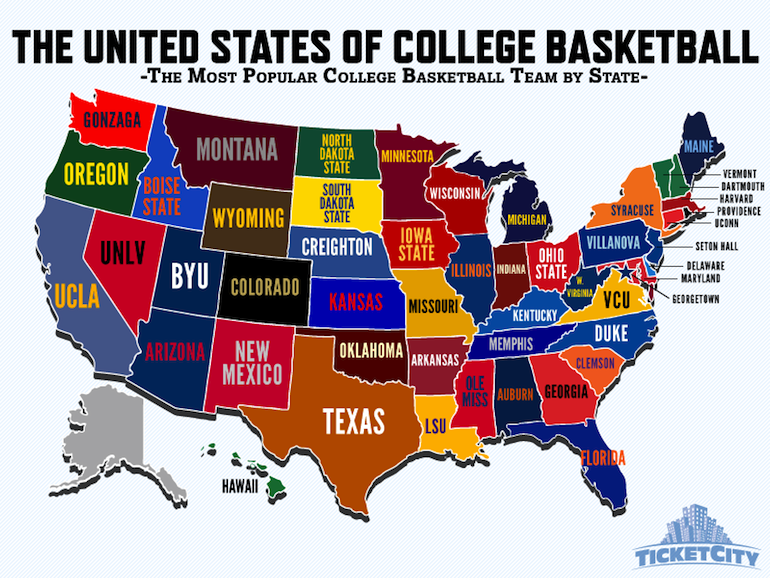
TicketCity, an agency founded in 1990 by a University of Texas grad took a look at which teams scored highest for engagement in their own state, factoring game attendance, Google search and social media over the past year.

Here Duke came out #1 too, in the North Carolina.  BYU was tops for Utah and Gonzaga for Washington, giving me an added alumnus trifecta.

All of this does not negate that Duke might also be hated, which is a different metric altogether, just that it would be irrelevant without showing it in the context of overwhelming popularity.

Sports reporters are emblematic of the challenges that face news reporters overall.  Drawing anecdotes as evidence of a more generalizabe public opinion is very tricky.

Local news in Durham has inferred that its recent population growth is due to the turnaround of downtown Durham in the last few years.  But Durham was the fastest growing city in North Carolina throughout the 1990s when its downtown had yet to emerge and its image underwent a turnaround.

How could this be?  Because Durham’s self-image and its image nationwide has always been high.  Over the 1990s is when negativity about Durham entrenched in surrounding counties was gradually reversed.

For sure, the image turnaround by 1999 lowered one of the barriers key to downtown revitalization by opening the minds of the news media, realtors, developers, financiers, as well as newcomers.

But downtown revitalization was also spurred both here and across the nation after the year 2000, not just by favorable shifts in psychographic and demographics but even more so by the innovation that year of New Market Tax Credits (NMTC.)

NMTC’s were recognized by Harvard in 2009 as one of the nation’s most innovative government programs leading to this 2010 case study of their dramatic success in downtown Durham.

Studies, scientific polls and generalizable metrics may not be as exciting as hyperbolic anecdotes for news reports or news consumers more interested in the pursuit of legends and myths, including their own.

But these tools are crucial to any community seeking a factual basis upon which to truly shift perceptions and initiate change.  Studies, polls and metrics are also important when assessing which coattails to ride or credit.

There is no institution more deserving of credit for everything Durham has achieved than Duke, and no program there more deserving of enhancing Durham’s reputation than Coach K’s Blue Devils.

Tuesday, February 24, 2015

Attributes For Serving On Governing Boards

I became a CEO in my mid-20s, at a very young age, albeit for an organization still in start-up.

Friends have always kidded me that it must have been nice not having a boss for all but a handful of years during my long ago concluded four-decade career.

But I always had bosses.  They were governing boards of rotating directors to whom I was accountable that always included a member or two who didn’t understand or accept that a board only gives direction as a whole, not as individuals.

Even a chair person couldn’t give direction without direction provided by the board as a whole.  Often the most difficult transition for some board members is from the managerial or owner role in their own organizations to one of oversight as part of a group.

Unfortunately, few of us are vetted for even minimal attributes and skills, such as critical and strategic thinking or how to run a meeting before being appointed or elected to governing boards.

An article in the current issue of Harvard Business Review about where boards in general fall short, made me think back to how fortunate I was to have so many great board members given the agendas of some individuals and how and why they were appointed.

Only 16% of the directors surveyed thought the boards they served on understood the dynamics of the industries in which their organizations were involved and only 22% believed their boards knew how their organizations created value.

The community destination marketing organizations (DMOs) that I served were especially complex because they function as intermediaries between external stakeholders and internal stakeholders including a whole sector of different industries.

That a board member comes from one of the front line stakeholder industries is no guarantee they will understand the overall sector, let alone the transcendent purpose of visitor-centric economic and cultural development: to broaden the local tax base while guarding unique sense of place inherent to the communities they serve.

This is why being teachable is an important attribute for potential governing board members.

As the authors note, the two codified core aspects of fiduciary responsibilities of board members include loyalty to the organization, “placing the organization’s interest ahead of one’s own,” which includes outside special interests.

The other is prudence, ensuring that “the proper care, skill and diligence is applied to business decisions.”  The authors note that there is nothing to suggest that the “role of loyal and prudent directors” is to pressure management to maximize” short term interests.

Yet, in my experience, this is what special interests relentlessly seek.   Examples of this in community destination marketing organizations are when elected officials or facility managers try to pressure a DMO to substitute short term objectives such as subsidizing groups to use certain facilities or to fill hotel rooms or and seats near term.

The far more valuable strategic purpose of a DMO is to safeguard a communities indigenous sense of place and to fuel the overall local business climate so as to broaden the tax base.

This generates far greater overall revenues than if used instead to merely close the short term operating deficits of a few public or private facilities.

Organizations with self-appointed boards, unless the nomination process is truly democratic, as in the first two organizations I led, can still be rife with directors there to serve their own interests or those of cronies or cabals.

But publicly appointed boards, such as those I worked under the last half of my career, have their own set of challenges, especially as happened to several of the boards to which I answered, when an elected official or two deliberately pushed the appointment of a board member they hoped would undermine the organization from within.

What would lead a public official to do this?  Avarice.

Unfortunately, very little attention is paid in government to generating revenue, which many officials believe comes only by raising the rate of taxation.  Instead, they spend nearly all of their time focused on spending, or dividing up the pie or even worse shell games.

This is how elected officials or administrators can come to see the short term, such as eliminating the operating deficit on a facility that was always expected to run a deficit as more important than spending that amount on marketing the overall destination which would generate a return of six times that amount.

But short term thinking is not unique to elected governing boards.  It is the same strategic failure that forces many publicly traded companies to sacrifice long term value for short term payouts.

The authors of “Where Boards Fall Short” contend that board members must focus on long term strategy.  They further state that “what matters most is the quality and depth of the strategic conversations that take place.”

Unfortunately, being strategically inclined is rarely, if ever, given consideration when appointing members to governing boards probably because fewer than 14% of Americans are strategically inclined.

The word inclined is used because this is a talent, a propensity, more than a skill, making it difficult to learn or teach.  I suspect, when they are strategically inclined, CEOs spend far more than the 1% to 3% of the time most CEOs do on average with strategy.

Unfortunately, the same is probably true of many governing boards, where members arrive late, leave early and complain about prep time to read materials and reports prior to the meetings, let along delve into strategic conversations.

Appointing or electing governing board members is as great a responsibility as serving on one.  Here are a handful of important attributes to keep in mind:

  • 30% of the entire workforce in America is truly engaged.  Half just show up and go through the motions.  Nearly 20% are troublemakers.

Rarely is someone who is disengaged in other areas of their life going to suddenly become engaged as a member of a governing board.  Make being engaged a pre-requisite to appointment.

Beware of organizations who seek benchwarmers.  Appoint board members who are strategically inclined and who will be eager students of the organization’s mission and environment.

  • Recalibrate the size of governing boards.  Experts now believe the size of a non-profit board functions best with five members.  Poor governance increases with board size.
  • Appoint board members who reflect the values of the organizations.  If that is fund-raising, appoint fund-raisers.  If that is volunteerism, appoint activists.  If that is being information driven, appoint members who understand and appreciate analytics.
  • Appoint members who understand and embrace ethics and compliance not people who see ethics only as a boundary to be skirted.  There is a reason compliance is no longer housed in legal departments in corporations.

Most importantly, appoint people to governing boards who are or can be in synch with an organization’s culture, values and mission, who want to move it forward, not pull it back, and who know how to resist special interests including their own individual interests.

Wednesday, February 11, 2015

The Hardest Workplace Challenge

Hiring the right people is the hardest part of management.

Many people who are disengaged or actively disengaged at work are great at crafting a resume and interviewing.  Many are even able to get past case studies and batteries of tests.

It is crucial to remember that 30% or less of the entire workforce is engaged.  So a hiring process must determine if a candidate is:

  • Among the 50-60% of the workforce overall that is not engaged.
  • Among the 18-20% of the workforce that is actively disengaged, or
  • A high performer that is “grow and go” or trying to escape an organization that has become a haven for disengaged workers.

Studies over more than 15 years now have shown that breakdowns of engagement in the workforce have varied very little, even among management.

Cities face this challenge as well when they seek to develop or attract “talent,” now well proven to be the best way to grow economically.

It is interesting that 150 years after the Civil War effectively ended here in Durham, and more than 60 years since officials from Durham began to lay the groundwork for its evolution as a center for the creative class, the state of North Carolina has only now closed the workforce gap created by that conflict.

But the talent that drives organizations of any size as well as entire local economies is entrepreneurial and studies by Gallup show that about 5 in every 1000 working age adults possess the talents that underlie entrepreneurship.

Of those Americans who do not already own a business, only 2.5% have very high-level entrepreneurial talent.

Gallup researchers estimate that among the 30 million U.S. students now in middle and high schools, there are 150,000 future “blue-chip” entrepreneurs.

Training, support such as hubs and venture capital funding, as well as educational development are important, but experts find that they won’t create talents such as these where it doesn’t exist, merely foster them where they exist.

Talents and skillsets shouldn’t be confused.

Key to attracting and retaining talent at any level or size of organization is also about understanding and managing turnover.

I finally learned during the last part of my career to break turnover down into preventable and unpreventable, voluntary and involuntary and by tenure and performance level.

Turnover alone is far too broad a metric.  Having a low turnover rate can be indicative of even greater problems than a high turnover rate.  It is important to zero in on positive turnover, e.g.

  • “Grow and go” policies for talented high performers when there aren’t positions to move up
  • “Firing Fast” when new hires turn out not to be as self-advertised
  • Making quick changes when any employee disengages or is found to be “actively disengaged” such as working to undermine others

That’s why it is important to hire slow and then fire fast.  Rarely is an employee going to become truly engaged if this hasn’t occurred in the first six months.

One of the hardest lessons to learn is that failing to discharge low performers in a very timely manner is a sure fire way to dishearten, burn out and lose high performers, who on average are 400% more productive.

There are studies that show what high performers want from a workplace, but at the very nitty-gritty, they want to be rewarded, which includes with a workplace free of those who would undermine or hold them back.

This is the element most workplace consultants never plumb but something anyone who reads between the lines of in-depth exit interviews is bound to uncover.  Remediation attempts are fine but nothing works as well as hiring the right people.

This is also true of CEOs and governing board members.  I worked under some incredible boards of directors but it was always clear when individual members were engaged or just putting in the time.  And there was always one it seemed who was actively disengaged or trying to undermine the organization and me.

But one weakness of governing boards as it is for elected bodies is the reluctance to “fire,” discharge or call out unproductive and actively disengaged members.  Most governing boards are reluctant to internally self-govern.

This is also at the heart of why it is so hard to get good candidates to run and when they are elected to keep them.

Look at any elected body and I guarantee you will find the same breakdown of engaged, disengaged and actively disengaged - or worse -that is found in the American workforce.

Of course, just as smaller organizations have a higher level of engagement, so do elected bodies as they come down to the local level.

Unfortunately, the way we finance and conduct elections in America makes it almost impossible for voters to make decisions based on the performance and levels of engagement among candidates for office.

But when it comes to society at large, we have yet to come to grips with engagement in the population.  Officials and the news media seem eager to assign responsibility to school systems and workplaces but engagement begins at the personal level and with parenting.

Dating to records when settlers first immigrated to this continent, including legends and stories passed down by Native Americans; there has always been a concern over the part of society that seems disengaged, or worse, actively disengaged.

Our nature as human beings is to try to “breathe fire” into these individuals.  You can see a denial about this reality today among those who fear that safety nets are an excuse to land rather than bounce back leading some to try to to restore work requirements and volunteerism as a qualification.

A lot of what we call gridlock is a refusal to deal with the same realities in society that are found in the workplace and have inhabited our population from our first settlements.

There is simply a portion of society that is or chooses to be disengaged or worse, actively disengaged.

And believe me; they are certainly far from all being poor.

A business approach would be to carefully distinguish those who just need a hand up from those who refuse lifelines and those who are mentally or physically disabled.

Like businesses do with leakage of goods to theft, maybe for the sake of those who are engaged, we need as a society to come to grips with the fact that a portion of society never will be and simply incorporate it as the cost of doing business, as the cost of society.

If this sounds un-empathetic, those of us who believe they are empathetic need to be aware of research finding that the more empathetic managers are, the more egocentric they tend to become.

The problem with this is that instead of paying attention to scientific, generalizable data, they begin projecting their own values on those they are trying to help.  I stand guilty as charged.

As much as cities and states talk about attracting talent, they focus too much on granting incentives or “big game hunting” that would be better invested in fostering talent at home and becoming places talented people want to live and put down roots.

This begins with placing a premium on:

  • tree canopy, technology and other infrastructure,
  • scenic preservation and elimination of blight,
  • clean air and water,
  • distinctive communities with ample natural space,
  • well-resourced secondary schools,
  • continuous workforce training collaborations including competency-based learning as well as
  • universal day care.

Monday, January 12, 2015

The Pivotal First 36 Months

Studies I’ve been reading on “rearing” have made me reflect on my own as well as how much they should inform solutions to problems in today’s headlines.

I was destined to be a fifth generation Idaho rancher and based on the fact that my mother dropped out of school when she was 16, it wasn’t likely I would go to college.

A mother’s education level is usually a strong predictor of a child’s educational aspiration, attainment and occupational success.  Still in her mid-twenties my mother taught herself to type and worked her way up to managing the practices of two doctors and two dentists.

She is a bit of an anomaly as that predictor goes, because she dropped out of high school to elope with my dad as he headed into WWII, staying near Camp Roberts, while he was training for a tank battalion and then spending the time he was overseas working in Denver.

I got off to a rocky start when I came along three years after the war due to an allergic reaction to formula that wasn’t resolved until I was six months old when during a blizzard my parents gave me whole milk.

It was an inauspicious start for my then fifth-generation rancher destiny as the only son of an only son.

So maybe that is why my fourth generation rancher father tried so hard from then through my preschool years to “breathe fire into me,” something I would also futilely try to do during my now concluded career for some co-workers.

Throughout my career, no one ever accused me of not having enough fire, but trying to “breathe fire” into someone never works, regardless of the education level.

People who aren’t ambitious or passionate or growth-oriented by then, also lack what the Japanese call Kaizen, a drive for continuous and never-ending improvement that may trace to their first 36 months of life.

Still in his 20s, my dad - whether he realized it or not – was trying in his own intense way to give me the “scaffolding” necessary to instill the handful of life-skills that must be largely inculcated during those first 36 to 60 months including rising to challenges and learning from mistakes.

My mom, who was in her early 20s, had a different type of intensity but in her own way also helped erect this “scaffolding,” especially through music.

It is clear that my parents incorporated many things into their parenting style.  The examples they set offset my mother’s lack of educational attainment, including a relentless focus on effort over talent and perseverance in the face of obstacles.

They weren’t what today we call “helicopter parents,” preferring a balance of unstructured play, especially in nature, to organized activities.  Nor did they ever tolerate a second of entitlement.

I can see now how much attention they also gave to learning from criticism, persistence, and embracing challenges.  All of these factors have now been confirmed by researchers in psychology to lead to high performance.

I am not aware of a statistical breakdown of adults in society with executive function and self-regulatory deficits (beyond attention-deficit) but I’ll bet kindergarten and elementary school teachers could give an educated guess.

Regardless of class status, today’s parents spend far too much time either making excuses for their children’s educational or work performance or greatly overestimating and placing too much emphasis on their intelligence vs. their effort and performance.

K-12 teachers are slightly more “engaged” and slightly less “actively disengaged” than Americans as a whole, but parenting may be partially responsible for why those who are not engaged miss 2.3 million more workdays annually than teachers who are.

As an aside, officials concerned with creating jobs such as Governor Pat McCrory in North Carolina, where I live, would do well to study Gallup’s reports on worker engagement.

Engaged workers report twice as much job creation as well as good customer ratings, profitability and productivity as well as lower turnover, fewer safety incidents, less theft, absenteeism and defects.

North Carolinians are not as engaged as we think we are.  Unfortunately, the Governor must deal with the fact that engagement among members of the General Assembly is no better than workers overall, fewer than 1-in-3 there with nearly 1-in-5 at cross-purposes even within his own party.

In my mother’s lifetime (my dad passed away shortly after 9/11,) she has seen her children and seven grandchildren leap from the working class backgrounds of my grandparents to middle and upper middle class.

Three have undergraduate college degrees, one a law school degree and another just accepted into top tier law schools, one with a Master’s and another with a PhD, and one who leapt directly from community college to a career in IT administration for the world’s largest video game concern.

More importantly, they are all hard workers and thrive in the workplace, engagement that is never guaranteed by educational attainment.

Americans believe in the individual-centered American Dream.  It is rooted in the belief that “all men [and women] are created equal” but science shows that there are many other more powerful influences that shape individual aspiration, none more important than those detailed in the book Unequal Childhoods: Class, Race, and Family Life.

According to the study, “two-thirds of society ultimately reproduce their parents’ level of educational attainment while about one-third take another path.”

But it is purely arrogant for those of us who transcended to delude ourselves into believing that it is due to our own willfulness.

A few months after I retired, researchers at the University of Illinois at Urbana-Champaign identified something of a paradox regarding willfulness and willpower.

As an aside, nearly all of the campus is located in Urbana but Champaign was added to placate Champaign boosters-sound familiar?  A toxic sense of entitlement can invade communities as well (smile.)

It turns out that people willing to ask questions and those who question whether they will succeed, perform better than those who are convinced they will or who spend too much time on self-affirmation.

By the time we reach the ages of 3 to 5 years old, we learn the handful of building blocks needed for success in life known as “executive function and self-regulation skills.”

Dimensions of these skills include:

  • “The ability to hold information in mind and use it.
  • The ability to master thoughts and impulses so as to resist temptations, distractions, and habits, and to pause the think before acting.
  • The capacity to switch gears and adjust to changing demand, priorities and perspectives.”

Self-regulation is the ability to override one response or behavior and replace it with a less common but more desired response.

The researchers who discovered the paradox of will power have already turned to the study of how what we say to ourselves “shapes the course of our behaviors,” the essence of self-regulation.

Parents such as mine gave me the “scaffolding” for developing these skills by challenging me and then stepping back and letting me try to manage things on my own and learn from my mistakes as well as helping me talk and think through what worked and what didn’t work.

I owe them everything.  We may all be “created equal” but those of us who think we are living the American Dream were fortunate enough to have these influences in those first few years.

We have an obligation to help those who didn’t, but the real solution is to focus society on remediation for kids between the years of 3 and 5 before it is too late.

I ran into more than a few people in responsible positions during my career with deficits or even dysfunction in one or more of the three skills noted above, some with high IQs.

Other than being irritating to those who had to work with them, they imposed a lot of lost productivity and long-term contributed to some very poor outcomes, but they were functional nonetheless.

None of us demonstrate mastery of executive function skills 100% of the time.  But our jails and prisons are populated by individuals who never learned them or were never given the chance to learn them because their parents never learned them.

A meta-analysis of studies published a few months ago by neuropsychology and criminology researchers in Amsterdam and led by Jesse Meijers found “a robust relationship between antisocial behavior and executive function deficits.”

In studies published in 2004 and 2008, researchers have determined that “impoverished rearing conditions” actually alter brain functions responsible for executive functions.  To many, we should be looking at rearing and parenting for solutions rather than law enforcement or the justice system.

For children in that 36 month window, reading this simple little 16-page guide is a way today’s new parents can learn how to teach them.  However, the guide won’t teach someone how to show by example or instill them in parents who missed out when they were young.

The more I live and learn, the more I realize how lucky I am and how unfortunate many are.

Maybe the American Dream is really about humility.

Tuesday, October 21, 2014

The Engagement Elephant In The Room

People never accused me of being disengaged or uninspired during my four decade career in community marketing.

Mystifying until I began studying Gallup’s longitude studies of workplace engagement was that 70% of those with whom I had contact or tried to enlist for support were disengaged, 20% even working at odds.

Usually folks like that attack you for style but no matter how much I modulated my style or grew in my job, they remained at best a drag on community performance.

This breakdown of engagement is also roughly true of public servants and elected officials but no more or less so than among those working in large private sector organizations.

Researchers think 70% of workforce engagement can be influenced by management although it is a lot easier to hire engaged employees in the first place.

But it is a lot harder to influence the “unengaged” in corporate and public bureaucracies.  This is why I have so much admiration for those who can thrive working within large entities without losing their sanity.

Regardless of having a high level of personal passion and engagement, I had to work hard every day on learning how to manage people right up until I retired.  But I restlessly tweaked the culture of the small organization I led to compensate for my inadequacies, often achieving workplace excellence citations.

Being made a CEO in my mid-20s only meant I had a much steeper and longer learning curve as well intense pressure to continuously and never endingly improve.  I simply had to try harder than most to evolve.

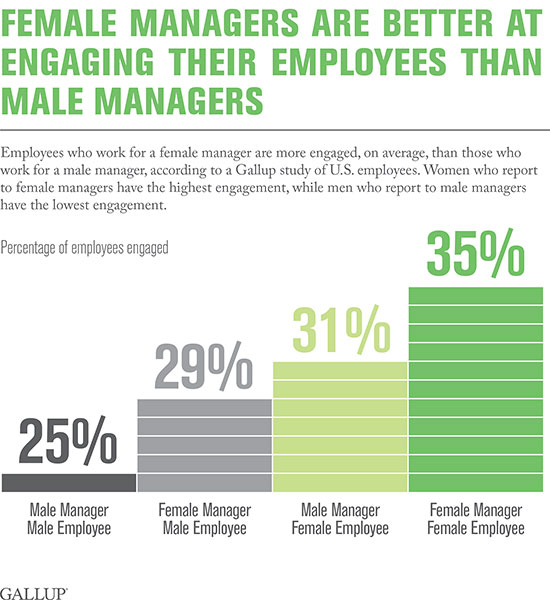
In general, engagement is only slightly higher though among managers.  Females tend to be more engaged on average than males and engagement among both genders on average increases noticeably under female management.

Studies also show that women are better at managing and less egocentric under stress and at avoiding risky strategies.

Equally problematic is celebrating successes in the workplace.

Engaged people tend to know how to celebrate their successes internally.  No amount of celebration seems to make a difference with those who can’t even when spoon fed.

Engagement takes shape in pre-school years when critical executive function skills are established usually as a result of parenting styles.

It is probably futile and definitely unrealistic to expect teachers, police officers, co-workers and management to somehow compensate, no matter how hard they try.

Society is greatly worried in this regard about young males and they should be.  Only 1-in-5 of this group is engaged or inspired by anything.  While more visible where poverty has taken root, this condition cuts across all socio-economic strata.

People who live in less ethnically diverse areas know that engagement/disengagement is not just about socioeconomics which is hard to accept for those intent on fostering social justice.

The roots of disengagement are put down long before society had any influence which is probably why all of the “reinventing” of management and safety nets over the years have not pushed the needle for engagement.

This is why putting all of our eggs in teacher quality or micromanaging curriculum or obsessively “helicopter” parenting will continue to have only marginal impact on engagement overall.

For a few years in the late 1990s, I worked with an educator who passed away last week.  Then at Durham Public Schools, he was a genius at mining data to spot patterns useful to understand and close gaps in student performance.

One thing that troubled him greatly was why the children of parents who had risen up from poverty or modest backgrounds to achieve degrees in higher education and who earned good household incomes, were trending downward in school performance notwithstanding these advantages.

As far as he could tell, the phenomena had been taking place for several decades, perhaps because parents assumed those conditions were enough to perpetuate student engagement.

Possibly because the condition might destabilize theories about correlations and triggers for student performance, no one seems to have unwrapped it further, at least that I’ve seen.

None of us are eager to accept where the true pressure point lies, not because becoming the greatest nation on earth has made us soft, but because it has to do with something so very personal, far more personal than even cultural or religious or political affiliation.

There simply are no requirements for having or raising children during the years when engagement is instilled.  No age requirement, no licensure or meaningful certification courses, no track record, no scorecard, no qualifications nor any kind of rating.

No amount of pressure on educators, police, courts or government can compensate for what isn’t happening during those first few years of life.

Even early intervention such as the renowned Harlem Children’s Zone can only mitigate and even then where replicated such as in Durham with the East Durham Children’s Initiative, its scalability is often hampered by lack of capacity and overarching emphasis.

In my adopted home, too many have attention deficit when it comes to being strategic which fosters grant-happy list checking and initiative-churn instead.

Where practiced with sufficient intensity, It has proven even more important to achievement than quality schools but inaccurately assumed to be important only for those in poverty.

But the problems that underlie disengagement among 70% of the workforce including managers are far more pervasive and systemic than socio-economic status.

The answers may lie in deepening and embracing research explained in books such as Mindset and Unequal Childhoods: Class, Race and Family Life.

Until we somehow deal with a parenting and pre-parenting as responsibilities not just rights, we’re just chasing our proverbial tails.

Wednesday, June 11, 2014

Calculating The Value of Serial Volunteers

I sometimes tease a friend of mine, a micro business owner and a fellow-motorcycle enthusiast in Durham, North Carolina, about being a serial volunteer.

He is one of more than 1-in-4 American adults over the age of 25 who volunteer.  According to an article in the journal Democracy, my friend and other volunteers across the nation “provide the equivalent of nine million full-time workers, or 6 percent of the U.S. labor force.”

This does not mean 9 million new jobs would be created if volunteering was outlawed.  Volunteers such as my friend are providing services found unaffordable by the marketplace or abandoned by local governments.

Overall, including other age groups, 49% of Americans volunteer to charitable causes, with 94% of that proportion doing so on behalf of their religion.  This is up from 43% previously when we fell just behind Sri Lanka in volunteerism across the globe.

Utah is one of the highest states for the percentage of people who volunteer.  I wonder if that is due in part to active or returned Mormon missionaries (who undertake two-year volunteer assignments,) but that wouldn’t explain why Minnesotans are in second place.

North Carolina, where I live, is fifth from the bottom at 36%, but much higher where I live because of “whatever it is we do in Durham.”

Dr. Clive Belfield, a professor of economics and researcher at Queens College, recently took a stab at quantifying both the costs and benefits associated with volunteer programs at the national level.

You may know him as the North Carolina project leader for research into employment and earnings outcomes from community college education.

First, the cost of national volunteer programs is estimated at $1.4 billion in direct public funding with another $600 million of in-kind resources and other sources of funding for a total of $2 billion annually.

In monetary terms, the volunteers generate $7.9 billion in benefit to society, a net gain or return on investment each year of $5.9 billion.  That’s a return of 4 to 1.

For any fiscal conservatives reading, that is a return of $4 for every tax dollar spent on national service.

Not everyone gives sweat and blood.  Overall, philanthropic giving in American comes to more than $300 billion each year.  Professor Belfield finds the idea of an expanded national service program appealing.

There are 40 million Americans between the ages of 16 and 24 in America, and judging from their experience since since the church’s inception in the 1830s his argument is bolstered by the superior life skills the experience has given over a million Mormon Missionaries.

Wherever I’ve lived, some very impressive friends have been former members of the Peace Corps, each one a contributor to community, state and country.

At a budget of only $379 million annually, no group is more cost effective.

Americans operate under the misimpression that they work too hard, but as a country we’re working less than we did even in the 1960s and 1980s.  Read the report at this link from The Atlantic, especially the chart over forty years of the hours of leisure time by gender and age.

Working moms, especially single working moms, may have reason to feel they are working more, even with modern conveniences, but even there the amount on housework and other chores had dropped 35%.

Men—especially married men—are hardly working compared to a few decades ago.

Maybe It just feels different to many because they haven’t updated the term leisure to mean more than just not being at work.

Volunteers understand that in the words of Ken Matos who handles research for the Families and Work Institute, leisure is “time you can actually do the things you want.”

Maybe the key to not feeling overwhelmed is to learn to shed the 75% of distractions at work that are self-interruptions unrelated to work, and to learn to redirect when we aren’t at work.

The six or seven hours I spend each day on these essays is pure leisure to me.  Sitting in occasional meetings of groups with which I am involved and where many people seem disengaged, however, can be pure hell!

Any organization which has been through a thorough workplace diagnostic as part of the selection process for the Sloan Awards for Business Excellence will recall that “autonomy” is one of the six secrets to engaged employees.

Many employees throw this term out when really they are trying to resist working and networking as a team or resist following protocols or object to accountability.  But those things aren’t what workplace autonomy means.

In fact, workplaces such as Google understand that it doesn’t require much time at all to fuel a sense of workplace autonomy.

There it involves only a few hours on occasion to work through a innovation a worker has been noodling or to reflect and think through strategy or…a couple of hours to volunteer for a mission-related cause they are passionate about.

True volunteers fuel their sense of engagement and autonomy by volunteering during their leisure time.

Monday, May 12, 2014

Cultivating Engagement & Flow

Looking back on my involvement in startups, I often wince at some aspects.

I realize that what some credited as drive or described as focus, creativity, resilience, intensity and a sense of urgency are descriptions more of how consistently I was to be in the “flow.”

It took me years of trying to unsuccessfully breathe fire, passion and urgency into teams of various co-workers to finally understand that this rarely works.

It turns out that I was not alone.  A study by McKinsey shows that “few executives have mastered generating it reliably in the workplace.”

It was difficult for me to accept that everyone isn’t as naturally capable of being in a state of “flow,” which is defined as a state of concentration and consciousness so focused that “every thing else falls away” and “time slows.”

The answer also was not for me to dial down as a few were always trying to make me do.

The study of executives over 10 years found that someone in the “flow” can essentially do in one day what often takes others five days to accomplish.

According to Steven Kotler, the co-founder and director of research for the Flow Genome Project, whose definition is in quotes above, this is a state where “Action and awareness merge.  Our sense of self and our sense of self-consciousness completely disappear…time slows down.”

Most of all it was hard for me to learn that everyone doesn’t want to reach that state and that I had to work harder to select employees who did, especially those who already grasped what it meant and thrived on challenge.

Because everyone, though, cannot always be in the flow, Kotler blogs in Harvard Business Review that what is crucial to flow is finding the right ratio of challenge and skills.

He cites a finding that “4% appears to be a loose rule of thumb” meaning that a challenge given to less engaged or inspired employees must be no more than 4% greater than the skills he or she brings to it.”

In other words, continually challenge people in increments just beyond their comfort zone.  But it may not be possible to “stair step” all disengaged employees into a state of “flow.”

Many seem not only lost in but content to be in a near-constant state of “frazzle,”  including manufacturing un-work related distractions that go far beyond the 75% on average of all workplace distractions that have nothing to do with work.

But if they respond to getting the challenge/skills ratio right and practice a few tricks to improve concentration they just might find themselves in a state of “flow” where “their “sense of self and self-consciousness disappear.”

It is a “sweet spot” according to Kotler.  Researchers who are part of “The Good Project” have found that only 1-in-5 workers who are engaged get there once a day or more.

Productivity goes through the roof if you can get everyone on a team into a state of “flow” once or twice a week.  For those who are high motivation-performers that challenge is teaching them to modulate so they don’t overshoot “flow” and risk burnout.

Of course challenge/skills ratio is just one of seventeen triggers to flow noted in Kotler’s new book entitled The Rise of Superman: Decoding the Science of Ultimate Human Performance.

Part of Kolter’s new book reviews scientific findings about the drivers of motivation.

After basic survival needs, they include autonomy - the desire to direct our own life, mastery – the desire to learn, explore and be creative, and purpose – the desire to matter, to contribute to the world.

“Flow feels like the meaning of life for good reason.  The neurochemicals that underpin that state are among the most addictive drugs on earth…Flow forces you to evaluate life through a different lens.”

“It gives you reason to live – but live this way long enough and those reasons become more important than dying.”  Kolter warns that being fully alive and deeply committed can become a risky business if not managed.

T.S. Elliot wrote in his Harvard doctoral dissertation, “It is obvious that we can no more explain passion to a person who has never experienced it than we can explain light to the blind.”

Learning to manage it is as important as reaching it.  All of this of course comes too late for my now concluded career.

But it does help me understand that the flow that still inhabits me during the six or so hours I spend researching and writing for this blog each day is a gift that, while rare, can still be cultivated.

Hopefully this one breathes a little fire.

Friday, February 21, 2014

Intangibles

The secret to having motivated employees is to hire motivated employees.  As a friend who had a long career in education told me, “people don’t really change much after they are 16.”

Even an award-winning workplace such as they have at DCVB, where I worked until retirement many years ago, is not really the place for social engineering, especially if a worker is among the 20% nationwide who are “actively disengaged (which is on purpose.)”

If you are giving employees slack or the benefit of the doubt along with some counseling regarding counterproductive behaviors,  you’re probably missing the point that these behaviors are plaguing other employees, who are fully engaged and productive, to a degree exponentially greater than you are ever detecting.

The rest of your workforce won’t give you points for being flexible or tolerant or caring when it comes to disengaged employees.  They just think you don’t get it, or worse, don’t care.

For every employee we were able to turn around or who needed time to fit in, there were many more who exacted too heavy a toll on those around them before moving on.

Lesson #1, put your time and focus into your truly engaged employees. This includes protecting their work environment from co-workers who aren’t engaged.

As I learned far too late in my career from a consultant named David Camner, “hire slow, fire fast.”  That was after he dramatically transformed our selection process.

My blind spot was probably that I had briefly worked in a couple of places where I wasn’t engaged and I’m as engaged as workers get.

Unfortunately, what I took away from those experiences was a blind spot for leniency instead of, as I was in those two instances, that some people just aren’t the right fit for the pace and work they are doing and no amount of leniency or retraining will pay off.

In the 1980s, when I was marketing Anchorage, Alaska, we won the bid over Salt Lake City as America’s choice to host the 1992 Winter Olympics. The games were eventually awarded to a non-US destination, Albertville, France.

When I learned in 2002 that O.C. Tanner had designed the medals for the Winter Games when they were finally held in and around Salt Lake City, it struck me that we had denied the company’s founder, Obert  Clark Tanner, the opportunity to see the Olympics in 1992, the year before he died at age 89.

As a teen he had begun selling jewelry out of his trunk and founded O.C. Tanner while an undergraduate at the University of Utah.  He kept the company going while earning a masters at Stanford and a law degree at Utah.

O.C Tanner specializes in jewelry such as they made for the Olympics and motivational items for corporations but they have also always funded research, including a study I used when I was working, that documented the five employee skills that result in “great work.”

Later confirmed by Forbes in a 360 survey, the skills include the ability to ask the right questions, to see the changes or improvements that would be loved by co-workers and customers, to explore solutions outside their team, to continually improve the mix by experimenting with ideas and persistence to see the work through to the desired result.

Last year, O.C. Tanner published a study on the impact of performance recognition, which is summarized at this link in Slideshare.  It is clear that recognition can accelerate drive and determination, increase organizational connection, enhance work relationships and personal understanding and improve organization-wide innovation.

But it probably can’t light a fire in someone who is disengaged or worse actively disengaged and it has little effect if the employee won’t allow themselves to actually hear and accept the recognition when given, which is much more common than thought.

Recognition can fuel engagement.  It isn’t clear if it can create engagement or that it can reverse active disengagement.  For example, moving from weak recognition to strong recognition makes only a 6 point difference in drive and determination.

In my experience, no amount of recognition can turn work that is a bad fit into a good fit.  Research by Dr. Carol Dweck has identified mindset in youth as a critical component to achievement.  Her finding show that people have either a “fixed” mindset or a “growth” mindset, often instilled or cultivated by their parents.

Praise alone can be tricky, especially if an employee has a fixed mindset.  The praise must focus on the effort, not the results.  Otherwise, those with a fixed mindset can respond even to success by getting stuck.

Worse are leaders and managers who have a “fixed” mindset, categorizing themselves and others as either having what it takes or not.  These individuals are particularly egotistical and become wedded to their goals and beliefs as though they were possessions.

They are bullies at their worst, or manipulators at their best.  They are the reason 50% of the U.S. workforce believes their senior leaders are not effective even though many of them are held in high esteem by officials or the news media.

Counter intuitively, low turnover is also often an indicator of fixed vs. growth mindsets in leadership.  A growth mindset focuses on “grow and go” because there often isn’t space to accommodate them.

These fixed mindset leaders are unable to see alternatives or adapt to new information.  They see the world in terms of winners or losers. Underlying the bravado of fixed mindset leaders is a desperation when it comes to facing uncertainty.

Sometimes I realize just how much of my success has been luck or due to the growth mindset fostered by my genes.  I now realize how little I knew and understood about leadership even though I was a CEO practically all of my career.

I hope young people just starting out come to realize quickly just how much their success relies on intangibles.

Thursday, February 20, 2014

The Anxiety Inherent In True Strategy-Making

A day late, because snow had closed RDU, I dashed out to the Pacific Northwest and back again over the long weekend to rendezvous with family and toast my mom’s 85th birthday, which occurred  a couple of weeks ago.

I takes nine to ten hours each way including waiting at the gate and a layover, this time at Chicago’s O’Hare.  With noise cancelling headphones, I can use the time for what Nicholas Carr, author of The Big Switch: Rewiring the World, from Edison to Google, calls “deep reading.”

Even when highly focused like I was then, “a reader’s mind typically wanders anywhere from 20 to 40 percent of the time according to one of the books I read en route entitled, Focus: The Hidden Driver of Excellence, by Daniel Goleman.

Gallup’s State Of The American Workplace shows that only 30% of the workforce in the United States is truly engaged.

Goleman cites researchers at Harvard and Stanford who found that that these employees experience “flow,” which is keyed “when we align what we do with what we enjoy.” But even then only 20% of people have these moments “at least once a day” and 15% less often.

Aligning these studies, it appears that a large number of workers are daydreaming during the day, a state that when not over-indulged can incubate “creative discovery.”

The 20% who are actively disengaged may be “stuck in the state neurobiologists call ‘frazzle’…where their attention fixates on their worries, not their jobs.”

In fact, half of our thoughts are daydreams.  During the half day I spent with just my two sisters in the time between my departure and that of my daughter and grandsons, they shared something they had learned recently.

Our decisions are ruled either by fear or by love.  I suspect those preoccupied by their worries are ruled by the former.

As you can tell from reading this blog, I have a rich memory of events that occurred between the ages of three and eight, memories my sisters often say they don’t have from that span in their lives.

According to a new study published in the Journal Memory in November by researchers at Emory, this was probably because my parents let me repeat unaided recall of memories, only connecting them to the age I was at the time the events occurred.

They may have become too busy to be that patient as their family grew.  The researchers found that at the ages of 5, 6 and 7, kids were able to remember 63 to 72 percent of the events they had at age 3.

Following ages 8 or 9, that recall falls to 35% and the “narratives were less complete.  This is because our lives also become more complex at those ages.

Apparently as we get older, if we do happen to remember these events, they have more details, but for many childhood amnesia prevails.

On the return leg of my trip I re-read an article I had skimmed last month by Roger Martin in the current issue of Harvard Business Review entitled, The Big Lie of Strategic Planning.

It reminded me of a book I read in the early 1990s while I was shaping a strategic blueprint for Durham, North Carolina’s visitor-centric economic and cultural development.  It was an elaboration on a paper I read as I was headed to Anchorage, Alaska in a similar capacity in 1978.

A key takeaway from both the paper and the book entitled, The Rise and Fall of Strategic Planning, was “emergent strategy,” the ultimate objective of a strategic plan.

The author, Dr. Henry Mintzberg of McGill University, argues that strategy cannot be planned because planning is about analysis and strategy is about synthesis.

Far too many executives, in fear of uncertainty, hardwire a strategic plan down to nothing more than a tactical plan.  As Martin notes, today the term emergent strategy has been perverted into nothing more than being a “fast follower” of competitor’s choices.

These executives restrain the process with a cost-focus when according to Martin, strategic planning is about revenue, not cost.  Obsession with cost destroys strategy-making by forcing it to be too perfect.

Martin, who is the former dean and now academic director of the Martin Prosperity Institute (centers of creativity) at the University of Toronto’s Rotman School of Business, argues that demands for certainty in strategy-making turns them into mere “plans stead of strategy.”

I’ve blogged before about “strategic intuition,” which involves freeing yourself from goals and objectives.  A strategic plan should not be an excuse to turn off strategic thinking.

Strategy-making relies on the recall some have of events before we were 5 or 7 because from that retrospection springs a curiosity to see the future through the lens of the past.

Maybe being strategic requires being comfortable with uncertainty and the ability to make decisions not from fear but from love.

Thursday, November 14, 2013

The Supply and Demand of Workforce Engagement

Engaged employees may be especially important to economic development organizations because 7-in-10 “believe their city is a good place for people starting a new business,” according to Gallup’s recently released 2013 State of the Global Workplace report.

I suspect that is especially true of those in my former field who focus on demand-side or visitor-centric economic development such as is done by community destination marketing organizations (DMOs) vs. the more traditional supply-side form focused on business recruitment. 

Engaged employees are defined as those “who work with passion and feel a profound connection to their organization and more importantly to DMOs, their community.  They drive innovation and move the organization forward.”

Overall, that describes 30% of workers in the United States and just 13% across all 142 countries measured by not only Gallup’s extremely sophisticated Q12 metric but 18 other indices.  But before delving into the other 70%, a note of recognition is overdue.

Because Durham’s DMO just received its 5th Sloan Workplace Award since the diagnostic process was initiated 8 years ago, it is a safe bet that the organization charged with promoting and safeguarding Durham’s brand and sense of place has a much higher proportion of engaged employees, probably 70% or more.

Each year, Sloan independently surveys the employees of participants as part of the process.  The only other DMO to be awarded a Sloan this year was Dallas, among the 300 organizations in 250 communities to be recognized.

The American Institute of CPAs in Durham is also a frequent recipient.

So back to the 30% who are engaged, it must be the economy right?  Nope, that percentage has been essentially flat since the year 2000 so has the overall percentage who are not engaged (52%) and the percentage who are actively disengaged (18%.)

“Not engaged employees [52%] are essentially ‘checked out.’ They’re sleep walking through their work day, putting time – but not energy or passion – into their work.”

“Actively disengaged employees [18%] aren’t just unhappy at work; they’re busy acting out their unhappiness.  Every day, these workers undermine what their engaged co-workers accomplish.”

As he was pacing his headquarters after the Allied armies had liberated Sicily, General Dwight D. Eisenhower, who would be elected President of the United States less than a decade later, is quoted as saying:

“In any army one-third of the soldiers are natural fighters and brave; two-thirds inherently are cowards and skulkers.”

Cowards would be those who actively disengaged and skulkers, a term meaning to evade or lay back, would be the not engaged.  The British called engaged soldiers “gutful” and the actively disengaged “slinkers” but roughly agreed to the breakdown.

It appears that in even the most dire and dutiful circumstances the level of those truly and passionately engaged is about one in three.

Gallup’s breakdown today includes managers and executives, who are only slightly more engaged and 13% of whom are actively seeking to undermine those who are.

So how do some organizations manage to increase the percentage of their workforce who are actively and passionately engaged from 30% to 70%?  This also correlated to good customer service, accountability, innovation, productivity, profitability and more.

In addition to the “big three:” selecting the right people; developing employee strengths; and enhancing well-being, the report gives specifics on other best practices (in my words):

  1. Strategic Direction – A Culture of Engagement
  2. Linking Performance and Accountability
  3. Alignment and Hyper-Communication
  4. Continuous and Never-Ending Improvement

But I have a broader concern.  Of course, employers, public or private, are not really in the missionary business.  There’s only so much that can be done in the workplace to dial employees up.

But as more and more and more employers follow Gallup’s research-driven recommendations and engage in in-depth diagnostics such as Sloan, it seems the pool of engaged and engage-able employees may become increasingly tapped out.

At one end, as noted in an excellent piece in the Wall Street Journal this week about the current demand for degrees and the dangers of specialization, there is incredible anxiety among people preparing to enter the workforce.

On the other, it is clear that globalization and automation have not resulted in fewer jobs, just lower quality jobs.

As a society, we’re doing better than other countries but many in our society seem bent on dismantling upward mobility while others seem intent only to be enablers of non-engagement.

It seems we may need to become more engaged as a society overall to become more engaged at work.