Showing posts with label American Dream. Show all posts

Tuesday, April 21, 2015

A 35 Year Decline in the Desire to Work

Some of my progressive friends don’t like to hear this, even from a moderate Independent such as me.

But there is something to the concern that laziness may play a role in why a certain amount of poverty seems impervious despite societal safety nets.  More than 4-in-10 people who are poor seem to think so.

So do most progressives I suspect.  They are just less prone to stereotype the poor than many at the other end of the spectrum.

They also reject remedies from the far right that seek to starve out the small number of poor who are lazy with solutions that undermine millions of children in those homes along with the working poor, who as I will show, are among the most industrious Americans.

Only 26% of drug and alcohol treatment centers are residential and only a handful of those go beyond a few weeks or months.  Even fewer are centered on instilling a work ethic, as are the most successful, some of which also happen to be at no charge.

But ask the latter what the biggest reason is for washing out within the first months or so, regardless of socio-economic level and you’ll learn that it is an unwillingness to work.

Of course, this is a very small portion of those in poverty but while the question hasn’t been asked recently, in opinion polls 40% of those in that circumstance believe some of their peers are not doing enough and don’t really want to work.
This may also explain why many who are addicted prefer to panhandle along roadsides, which seems like it would be much harder than holding down a job.

But refusing to get clean, not lack of access, is why those who are panhandling aren’t able to access shelters and related workforce training.

Take away those who suffer from mental health issues and those who are crooks and you’ll find many who just refuse to work.

By the way, it hasn’t been posted yet but there is an excellent overview of the state of rehab in America in the investigative Mother Jones Magazine this month entitled Hung out to Dry by John Hill.

Apparently, of the 18.7 million Americans who needed alcohol treatment in 2010, only 1.7 million received it.

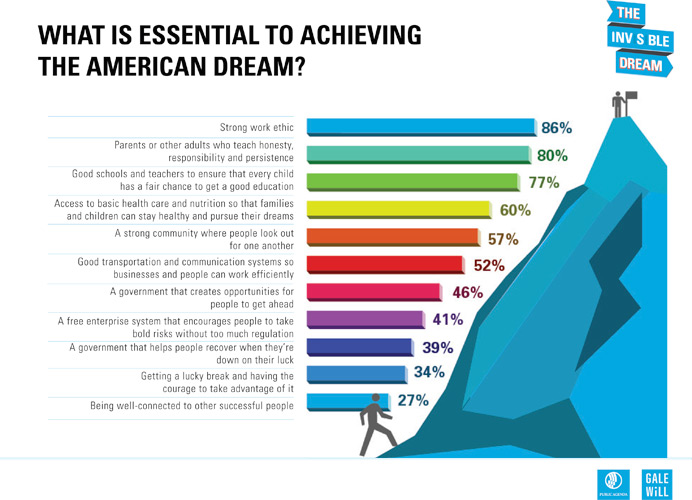
In a recent nationwide study of Americans, only 24% felt they had achieved the American Dream while 36% felt it unlikely including 21% who no longer give it much thought.

But 86% cited a strong work ethic as essential to achieving the American Dream.  Close behind that was parents or other adults who instill honesty, responsibility and persistence, followed by good schools.

Telling is that 42% felt the answer is individual effort compared to 39% who saw it being aided by society.  Disturbing is that 19% didn’t believe that either was the answer.

Equal percentages (43%) felt that the American Dream was endangered by a decline in work ethic and hard workers being shut out.  The fact that 14% felt that neither reflected their views may shed light on the number who are lazy among all socio-economic strata.

Since 1967, the Current Population Survey has been measuring among other things, the desire among individuals for work, last updated in 2014.

This is analyzed in a paper published last month.

My friends on the right have one answer for every societal ill: government.  Government undermines values, government caused the Great Depression and the Great Recession, government causes pollution, government caused the BP spill in the Gulf and on and on.

Ironically, the study documents that the 35 year decline in the desire to work started just as let ‘em “sink or swim” conservatives launched an all out attack on the safety-net, dramatically cut taxes for the rich and began to harangue and stereotype the poor.

The fraction of non-workforce participants reported as “wanting a job” trended up during the 1970s, then began a decades long slide beginning at the dawn of the 1980s just when the so-called Reagan Revolution promised the opposite.

The study entitled, Declining Desire to Work and Downward Trends in Unemployment and Participation is fascinating because it unwraps why the desire to work went into strong decline in the mid-1990s just after the government moved to “end welfare as we knew it.”

A report last year in the Wall Street Journal noted, using results from a joint survey by that paper and NBC News, how much the opinions of Americans has changed since 1995 regarding the causes of poverty.

In 1995, “Americans were twice as likely to believe poverty resulted from people not doing enough to help themselves out than to attribute it to external forces.”

Today, “Americans are as likely to blame poverty on circumstances beyond people’s control…,” although the majority of those holding power in Congress appear to remain stuck in the 1990s.

The percentage of Americans still holding to the view that it is because of laziness has plummeted, less among Republicans than Democrats and Independents and white Americans overall.

This hasn’t stopped the promotion of failed solutions across the ideological spectrum.  Personally, I favor a national living wage calibrated to localities, more affordable education and a return to a more progressive tax rate to fuel aspirations to achieve the American Dream.

But from my four decades as a chief executive, I feel we need to also find solutions that will address the 2-in-10 Americans who appear a bit lazy without, as many do today, stereotyping the poor.

Even the controversial white paper by the libertarian right Cato Institute, a follow up to one in 1995, acknowledges that “there is no evidence that people on welfare are lazy or do not wish to work.”

Studies also show there is no evidence that people who are poor value education any less or are any less involved with their children or are more addicted to substances than Americans overall.

Nor is there any evidence they are lazier.  In fact, many of these things correlate to incomes as they rise.

Laziness cuts across the entire spectrum, regardless of pocketbook size.  So should any solutions.

Monday, January 12, 2015

The Pivotal First 36 Months

Studies I’ve been reading on “rearing” have made me reflect on my own as well as how much they should inform solutions to problems in today’s headlines.

I was destined to be a fifth generation Idaho rancher and based on the fact that my mother dropped out of school when she was 16, it wasn’t likely I would go to college.

A mother’s education level is usually a strong predictor of a child’s educational aspiration, attainment and occupational success.  Still in her mid-twenties my mother taught herself to type and worked her way up to managing the practices of two doctors and two dentists.

She is a bit of an anomaly as that predictor goes, because she dropped out of high school to elope with my dad as he headed into WWII, staying near Camp Roberts, while he was training for a tank battalion and then spending the time he was overseas working in Denver.

I got off to a rocky start when I came along three years after the war due to an allergic reaction to formula that wasn’t resolved until I was six months old when during a blizzard my parents gave me whole milk.

It was an inauspicious start for my then fifth-generation rancher destiny as the only son of an only son.

So maybe that is why my fourth generation rancher father tried so hard from then through my preschool years to “breathe fire into me,” something I would also futilely try to do during my now concluded career for some co-workers.

Throughout my career, no one ever accused me of not having enough fire, but trying to “breathe fire” into someone never works, regardless of the education level.

People who aren’t ambitious or passionate or growth-oriented by then, also lack what the Japanese call Kaizen, a drive for continuous and never-ending improvement that may trace to their first 36 months of life.

Still in his 20s, my dad - whether he realized it or not – was trying in his own intense way to give me the “scaffolding” necessary to instill the handful of life-skills that must be largely inculcated during those first 36 to 60 months including rising to challenges and learning from mistakes.

My mom, who was in her early 20s, had a different type of intensity but in her own way also helped erect this “scaffolding,” especially through music.

It is clear that my parents incorporated many things into their parenting style.  The examples they set offset my mother’s lack of educational attainment, including a relentless focus on effort over talent and perseverance in the face of obstacles.

They weren’t what today we call “helicopter parents,” preferring a balance of unstructured play, especially in nature, to organized activities.  Nor did they ever tolerate a second of entitlement.

I can see now how much attention they also gave to learning from criticism, persistence, and embracing challenges.  All of these factors have now been confirmed by researchers in psychology to lead to high performance.

I am not aware of a statistical breakdown of adults in society with executive function and self-regulatory deficits (beyond attention-deficit) but I’ll bet kindergarten and elementary school teachers could give an educated guess.

Regardless of class status, today’s parents spend far too much time either making excuses for their children’s educational or work performance or greatly overestimating and placing too much emphasis on their intelligence vs. their effort and performance.

K-12 teachers are slightly more “engaged” and slightly less “actively disengaged” than Americans as a whole, but parenting may be partially responsible for why those who are not engaged miss 2.3 million more workdays annually than teachers who are.

As an aside, officials concerned with creating jobs such as Governor Pat McCrory in North Carolina, where I live, would do well to study Gallup’s reports on worker engagement.

Engaged workers report twice as much job creation as well as good customer ratings, profitability and productivity as well as lower turnover, fewer safety incidents, less theft, absenteeism and defects.

North Carolinians are not as engaged as we think we are.  Unfortunately, the Governor must deal with the fact that engagement among members of the General Assembly is no better than workers overall, fewer than 1-in-3 there with nearly 1-in-5 at cross-purposes even within his own party.

In my mother’s lifetime (my dad passed away shortly after 9/11,) she has seen her children and seven grandchildren leap from the working class backgrounds of my grandparents to middle and upper middle class.

Three have undergraduate college degrees, one a law school degree and another just accepted into top tier law schools, one with a Master’s and another with a PhD, and one who leapt directly from community college to a career in IT administration for the world’s largest video game concern.

More importantly, they are all hard workers and thrive in the workplace, engagement that is never guaranteed by educational attainment.

Americans believe in the individual-centered American DreamIt is rooted in the belief that “all men [and women] are created equal” but science shows that there are many other more powerful influences that shape individual aspiration, none more important than those detailed in the book Unequal Childhoods: Class, Race, and Family Life.

According to the study, “two-thirds of society ultimately reproduce their parents’ level of educational attainment while about one-third take another path.”

But it is purely arrogant for those of us who transcended to delude ourselves into believing that it is due to our own willfulness.

A few months after I retired, researchers at the University of Illinois at Urbana-Champaign identified something of a paradox regarding willfulness and willpower.

As an aside, nearly all of the campus is located in Urbana but Champaign was added to placate Champaign boosters-sound familiar?  A toxic sense of entitlement can invade communities as well (smile.)

It turns out that people willing to ask questions and those who question whether they will succeed, perform better than those who are convinced they will or who spend too much time on self-affirmation.

By the time we reach the ages of 3 to 5 years old, we learn the handful of building blocks needed for success in life known as “executive function and self-regulation skills.”

Dimensions of these skills include:

  • “The ability to hold information in mind and use it.
  • The ability to master thoughts and impulses so as to resist temptations, distractions, and habits, and to pause the think before acting.
  • The capacity to switch gears and adjust to changing demand, priorities and perspectives.”

Self-regulation is the ability to override one response or behavior and replace it with a less common but more desired response.

The researchers who discovered the paradox of will power have already turned to the study of how what we say to ourselves “shapes the course of our behaviors,” the essence of self-regulation.

Parents such as mine gave me the “scaffolding” for developing these skills by challenging me and then stepping back and letting me try to manage things on my own and learn from my mistakes as well as helping me talk and think through what worked and what didn’t work.

I owe them everything.  We may all be “created equal” but those of us who think we are living the American Dream were fortunate enough to have these influences in those first few years.

We have an obligation to help those who didn’t, but the real solution is to focus society on remediation for kids between the years of 3 and 5 before it is too late.

I ran into more than a few people in responsible positions during my career with deficits or even dysfunction in one or more of the three skills noted above, some with high IQs.

Other than being irritating to those who had to work with them, they imposed a lot of lost productivity and long-term contributed to some very poor outcomes, but they were functional nonetheless.

None of us demonstrate mastery of executive function skills 100% of the time.  But our jails and prisons are populated by individuals who never learned them or were never given the chance to learn them because their parents never learned them.

A meta-analysis of studies published a few months ago by neuropsychology and criminology researchers in Amsterdam and led by Jesse Meijers found “a robust relationship between antisocial behavior and executive function deficits.”

In studies published in 2004 and 2008, researchers have determined that “impoverished rearing conditions” actually alter brain functions responsible for executive functions.  To many, we should be looking at rearing and parenting for solutions rather than law enforcement or the justice system.

For children in that 36 month window, reading this simple little 16-page guide is a way today’s new parents can learn how to teach them.  However, the guide won’t teach someone how to show by example or instill them in parents who missed out when they were young.

The more I live and learn, the more I realize how lucky I am and how unfortunate many are.

Maybe the American Dream is really about humility.

Tuesday, November 06, 2012

May God Bless America To Be Less Partisan

Not all Independents, such as I, self-identify as ideological moderates but according to Pew Research Center 47% do, and so do 24% of Republicans and 41% of Democrats.

In my opinion, that should be enough to one day soon reclaim our country from it’s paralyzed state of partisan gridlock, but according to some who analyze them, moderates don’t fashion themselves to be like sporting event refs or officials responsible for breaking up fights between rival teams or their fanatic followers.

Key to any eventual resurrection of the influence of moderates will be the findings in a new study entitled Partisan Sorting and Behavioral Polarization in the American Electorate by Lilliana Mason, a doctoral candidate and researcher in political psychology at Stoney Brook University.

Mason found that extreme positions on issues have “an effect that is less than half the size” of what sorting by political identity, such as party affiliation, does on polarization.  She notes the finding that “…partisan identity increases thermometer bias [strength of emotion] by about 43 percent” of in-group bias, concluding that:

“This psychological and emotional sense of attachment to a party, an ideology, a religion or a race, and the extent to which those attachments overlap, is powerfully capable of driving behavioral polarization, even when the presumptive reasons for choosing a party - issue positions - are held constant.”

According to the study, “The strength of a person’s identification with his or her party determines how biased, active and angry that person is, even if that person’s issue positions are moderate…The moderation of issue positions cannot moderate the effect of identity on behavioral polarization…”

Moderates have their work cut out for them, especially the 47% among those who self-identify as unaffiliated with either major political party, approximately half of all moderates, because as Mason states in an article by Tom Jacobs for Pacific Standard, “There is no way to educate people into being less polarized.”

According to columnist David Brooks, who may be moderate but is definitely conservative, moderates like “mixing and matching from columns A, B and C. They try to create harmonious blends of policies that don't, at first glance, go together.”

Moderates tend to avoid both “confirmation bias” and “hindsight bias” which were clearly described last week in the Health Section of the New York Times by Benedict Carey:

“Confirmation bias” describes a condition where individuals or groups start off with an assumption and then pay attention only to information that is supportive.

“Hindsight bias” describes a condition where individuals and groups “retrofit their opinions and judgments” to fit the evidence.

Political parties, before, during and after campaigns, try to exploit both conditions to keep those who are faithful in line as well as to create doubt in the minds of partisans on the other side.  Campaign rhetoric aside, reaching across the isle as true moderates do is something partisans find problematic.

In another study published last summer along with Dr. Phoebe Ellsworth, Ed O’Brien a doctoral candidate in social psychology at the University of Michigan conducted experiments to determine empathy across the political isle and concluded that -- “Perceived dissimilarity – even in an incidental domain such as political values – may expose deep constraints on people’s ability to appreciate the experiences of those who may be in greatest need of their consideration.”

However, the political party partisans may be powerless to influence incumbent-halo linkages such as is noted in a study reported in a Style Section article by Paul Farhi in the Washington Post.

"Research shows that voters in a college team’s home county tend to reward the incumbent presidential candidate after the local team wins” in the 10 days leading up to the election, with an average bump of 1.61 percent of the vote, and as much as 3.35 percentage points if the team is a powerhouse.

In a parallel experiment involving college basketball fans, the researchers found that the further a team advanced in the Final Four tournament, the higher they rated the President’s job performance.  “Another study found a relatively high correlation between sports teams’ success and mayoral reelection.”

Republicans in particular will probably be heard muttering that “correlation does not equal causation,” that is unless their candidate wins.

The “tribalness” of political affiliation is called “groupishness” when applied to religion and other parts of society by psychological researchers such as Dr. Jonathan Haidt at NYU’s Stern School of Business.

Soon-to-be Dr. Mason’s claim that realigning political affiliations is as difficult as changing someone’s religion reminded me of a recent post on this blog about the findings of a scientific poll updated two weeks ago by university researchers on behalf of The Associated Press, which shows that Americans are as divided today as they were at the time of independence by issues of race:

“More than half of all Americans now express explicit anti-black and anti-Hispanic attitudes, 79% among Republicans; but when tested implicitly, the anti-black sentiments are also held by 55% of Democrats and 49% of Independents, much of it refueled, in my opinion, by uncivil discourse and coded rhetoric stoked after the election of the first black President of the United States.”

Mason pointed out to journalist Jacobs the “cleavages” during our history that have resulted in political realignment usually over a period of decades.  Far too many it seems, if not all, have been over race, such as the struggle among the founders during the writing of the Constitution that intensified after its adoption during the presidency of George Washington in the guise of so-called “state’s rights” as a counter to a vigorous federal government.

Another occurred over the same issue, slavery, with the election of President Abraham Lincoln which resulted in secession and all-out Civil War.

Another cleavage occurred with the rise of the Progressive Movement in 1890 to reform the ills of another gilded age and which southern states adulterated with “separate but equal.”  And the most recent realignment which was spurred by race as well occurred when Democratic Party leaders forged the 1964 Civil Rights Act.

Only time will tell when realignment will break up the current polarization, but the AP’s survey findings lead me to believe that it will once again be over issues related to race, which are thinly veiled in campaign rhetoric about poverty and immigration including one of the worst examples, the “Food Stamp President,” even though 1 in 3 are white and only 1 in 5 are black.

If race as an issue remains unresolved throughout the nation’s third hundred years, then another cleavage may certainly be forced by climate change and the environment as Mason speculates in Jacobs’ Pacific Standard piece.

Regardless of who wins election as President or to Congress today, may God Bless America and especially moderates in hope that they may finally get it right.

Monday, June 06, 2011

Signs A New Generation Will Finally Shift Two Paradigms

Even as the 150th anniversary of the Civil War brings reflection on a time when our founding principles legitimized slavery, it is heartening to note the studies showing that African-Americans today are more optimistic about the future of the American Dream than other groups, even those who give it lip service.Capture

Another study reveals that African-Americans are also significantly more likely than Caucasians to value and be involved with causes -- meaning they “walk the talk.”

I’m going to dig next into a fascinating new book, The End of Anger: A New Generation’s Take on Race and Rage by Ellis Cose, but from what I’ve read this book gives hope even though many in my generation and the generation before me remain trapped in a “tangle of racial stereotypes” as clearly evidenced by radio talk show callers, whether it be national audiences like Rush Limbaugh’s or any afternoon that Durham is a topic on nearby Raleigh’s WPTF Bill LuMaye show.

According to Cose, for generations my daughter’s age and younger, born between 1970 and 1995, especially those who are African-American, “race is no big deal.” Maybe it will also take these younger generations to also shift another, but related, paradigm.

In his newly published book, The Social Animal, conservative commentator David Brooks makes a compelling case for the fact that over the last several decades, “whether on the left or right, we’ve focused too much on individualism to the exclusion” of what he describes as “society, social obligations, communal bonds” and “invisible norms.”

As an Independent voter, I can also see myself in his descriptions.

I think he’s right to describe the two major political movements of the last 50 years, one in the 1960s and the other in the 1980s as both being far too much about “individualism.” To paraphrase:

- Liberals have been obsessed with anything that threatened individualism in social areas such as the role of women and matters of life and death, marriage and family structure.

- Conservatives have been obsessed with anything that threatens individualism in economic areas such as lower taxes, privatization of things like social security and now Medicare and vouchers.

Brooks calls out both liberals and conservatives for gravitating toward “economic explanations for any social problems and generally coming up with solutions to this problem that involved money.”

In the book, he makes a solid case for the fact that both ends of the political spectrum have neglected matters of “character, culture, and morality.”

I didn’t realize it until Brooks pointed out that Adam Smith is not only famous for authoring The Wealth of Nations, but he also wrote The Theory of Moral Sentiments.

Brooks believes both liberals and conservatives have split Smith right down the middle giving too much attention to the first book and “not knowing what to make” of the second.

Including a citation of Phillip Blond, Brooks a truly dissects today’s political conundrum.

… “these two individualist revolutions did not create loose free societies. They produced atomized societies in which the state grows in an attempt to fill the gaps created by social disintegration…

…without healthy social fabric, politics become polarized. One party came to represent the state. The other came to represent the market…both neglected and ignored the intermediary institutions of civil life…

…Politicians, and media polemicists took advantage of the psychic vacuum and turned [political] parties into cultures, demanding and rewarding complete loyalty to the tribe…

…Amongst this partisan ugliness, public trust in government and political institutions collapsed…

…Instead of being bound by fraternal bonds and occasionally responding to a call for joint sacrifice, a cynical ‘grab what you can before the other guy steals it’ mentality prevails..

…Without social trust, the political system devolved into a brutal shoving match.”

This not only makes so much sense to me, but Brooks is equally eloquent and insightful about the road map back to the American Dream we all should seek to merit.

I’m very optimistic about future generations of leaders.