Showing posts with label Republican Party. Show all posts

Monday, December 07, 2015

This Ongoing War 150 Years Later

In North Carolina, it’s no surprise to learn that “since 1960, one third of the world’s arable land has been lost to erosion.”  Nor, according to scientists, that “46-58 thousand square miles of forest are lost each year – equivalent to 36 football fields every minute.”

Tar Heels have witnessed the link between depleted soils and deforestation in the decades before the Civil War when more than a third of North Carolinians moved away.

By 1850, 31% of native North Carolinians then living in the United States resided in some other state.

Backwardness regarding slavery and race relations as well as resistance to public education and infrastructure played a big role in the out migration as did poor land use practices by plantations.

It’s well documented by unapologetic historians such as the late Dr. William S. Powell.

I’ve been reading or rereading two others recently, one written the year I was born (1948) entitled From Slavery to Freedom and another just released entitled, The Old North State at War: The North Carolina Civil War Atlas.

Both shed new light.

The latter shows the population breakdown by race and freedom-status broken down by county just prior to the Civil War, as well as the vote by county for or against succession.

You can see a divide back then running down between what is now Durham and Wake/Raleigh with 5 points more slave-holders in Wake.

Wake/Raleigh also had twice the number of slaves as Durham/Orange and nearly three times the number of free Blacks out of 30,463 statewide.

There were a little more than 125,000 households in North Carolina in 1860 and 28.2% owned slaves.

Yet in 1861, Durham/Orange voted by more than 3 to 1 against succession from the Union while Wake/Raleigh voted for it by a few hundred votes.

As the rhetoric heated, the state as a whole was almost evenly split on the issue with a slight nod against.  People’s minds back then were more focused on the wealthy paying more in taxes here.

Within weeks though, secessionists won out both because of a general sentiment of “you can’t tell us what to do” and being surrounded by states that had or were succeeding.

The North won the Civil War that resulted, which effectively ended with a surrender in Durham.  Thanks to resistance by Southern Generals Lee and Johnston there wasn’t the subsequent guerilla war Southern leaders wanted.

But that didn’t mean war was over.

Another war erupted almost immediately between Democrats who were controlled by white supremacists and Republicans.

Just as a small percentage of the population had monopolized power in North Carolina and kept it backward, then pushed it into a war to defend slavery as a way of life for a few, a similarly small percentage held power in this follow up war.

Political rhetoric is powerful as we still see today.  It can close minds more easily than open them, something given comprehensive coverage a few days ago in an On the Media radio show entitled Lies, Lies, Lies.  

Republicans lost this follow up war and soon became all but extinct across the South because the party had became divided into an increasingly conflict-weary faction seeking social justice leading to a takeover by its Wall Street wing.

Just as Democrats had become divided into factions over slavery leading up to the Civil War, resulting in President Lincoln’s election, factionalized Republicans lost the follow up-struggle.

Following the South’s defeat and preservation of the Union in the Civil War, reunited Democrats fell sway to the rhetoric of a small fraction of white supremacists who this time sought not only to reinstate limitations on civil liberties, but to virtually annihilate the Republican Party in the South, which they did.

As a result, civil rights in the reunified country were put on hold for another hundred years and even today, seem lodged between ongoing institutionalized bias on one hand and a futile obsession with effacing racist symbols on the other.

The two political parties have switched roles today.

It began gradually in the decades leading up to the 1930s on issues of social and environmental justice, then became increasingly apparent after WWII and symbolized by the 1960s.

As someone who was raised a staunch Republican which I remained until nearly 25, I have been particularly interested in the history of the Republican and Democratic parties.

My Republican roots go back to the party’s founding.  But many of those ancestors would no longer be welcome there.  People who sense I lean Progressive probably don’t realize that it is the Republican Party that has shifted.

Understanding how the parties have evolved helps me understand how I briefly moved to the left in my mid-20s before finding my comfort zone as an Independent except wherever forced to briefly sign up so I could vote in primaries.

Today it is Republican ideology that seems to view everything as a threat to way of life, dominated by a few who seem to want to annihilate not only Democrats but anyone who dares to be moderate.

We see it in the refusal to negotiate or reach bipartisan agreement, even when Democrats sign on to Republican-generated innovations such as carbon credits or healthcare overhaul using exchanges that emulate the requirement for car insurance.

Further evidence is research showing that the root of Republican opposition to addressing climate change is the knee-jerk stereotyping of anyone concerned about the environment as a “watermelon,” green on the outside, red (as in Commie for you Millennials) on the outside.

The one thing that remains constant is that just as a tiny minority held North Carolina back after the U.S. was founded and the Civil War was fought to preserve the way of life lived by only 28% of Tar Heels, policies here are still driven by a small percentage in power.

The only thing certain is that the pendulum will swing yet again, but not the problem.

The parties may reverse roles yet again one day and apologists, as always, will try to smooth everything over like propagandists did between 1866 and 1966 by transforming the issue of slavery into “states’ rights.”

Democracy truly exists only when a majority of people vote, not just when the vote is a majority of those showing up.   Maybe similar to governing boards, popular elections should be valid only when there is a quorum?

As a moderate Independent who more and more has a little “time on him” as they say in my native Idaho, I am more and more aware of the dangers of failing to admit to myths when in pursuit of greatness as a nation or perpetuating a way of life.

I know far too many reasonable Republicans and far too many crazy Democrats to believe the rhetoric when one or the other party gives in to zero sum thinking.

But as President George Washington lamented in 1795, the problem may be in the nature of political parties, meant as a means to help people make decisions but then used as a reason not to think:

“However [political parties] may now and then answer popular ends, they are likely in the course of time and things, to become potent engines, by which cunning, ambitious, and unprincipled men will be enabled to subvert the power of the people and to usurp for themselves the reins of government, destroying afterwards the very engines which have lifted them to unjust dominion.”

Lament indeed!

Monday, July 21, 2014

The Pivotal Bitterroot Event That Still Shapes America

Today I’m headed up to Appalachian State University (ASU) nestled near North Carolina’s border with Virginia on the western slopes of its namesake range.

Durham, where I live, lies in the foothills of the Appalachians which gives way to the Eastern Coastal Plain just east of Raleigh.  Whoever wrote on Wikipedia that Durham is flat doesn’t walk much.

In just a quarter of our two and a half mile walks each morning, we climb up and down the equivalent of nearly a 15 story building.  I kid my friends down in Raleigh that based on what the legislature is doing there, Durham will be beachfront in a couple of hundred years (smile.)

Invariably, I gravitate to Southern Rock during this twice yearly three hour drive (with stops) up and over the Eastern Continental Divide to ASU where rivers run west toward the Mississippi.

It is a fusion of rock, country and blues, with gospel and jazz that falls under the genre of Americana or “roots” music. East of Blue Ridge, think Marshall Tucker Band and Allman Brothers.

Knowing I am the only son of an only son descending from generations of Idaho ranchers with roots back to before it became a territory may hint at the country music in my genes.

But the truly common thread through my seemingly eclectic taste in music is “roots” music.

On arrival, I’ll be speaking for two hours about strategic thinking and insight to seniors completing a “capstone” course in the ASU business school, with majors evenly divided into accounting, management, marketing and hospitality.

Road construction will prevent a jog in my route along a portion of the Pisgah National Forest set aside in 1912 three years before it was given that name and just two years after a horrible calamity ignited public opinion.

When I arrived here in 1989, less than 30% of its trees dated to that time because industrialists had logged it so heavily before the 1891 act creating forest preserves was finally adjusted to allow set asides in the east.

By then they were forests in name only on lands nobody wanted.  In photographs taken two decades later to document construction of the Blue Ridge Parkway, the devastation is still apparent.

Forestry education first took root further south along these ranges in North Carolina, but conservation didn’t.

President Theodore Roosevelt and Gifford Pinchot, who got his start working on the Biltmore Estate near Asheville, made Conservation a national overarching strategy.

But strategic preservation of forests is an idea that took shape in 1876, a year before the dawn of the “Gilded Age” and four years after Yellowstone was created as the first national park during a fifty year period dating from the Civil War when Republicans were in control.

Things weren’t gilded for 9-in-10 Americans getting by on less than $1,200 a year and most had a sense that deforestation beyond clearings required to make a home didn’t make sense.

John Muir echoed this sentiment that year with one of his first op-ed newspaper essays entitled “God’s First Temples: How Shall We Preserve Our Forests” but scientists were also worried and sounded alarms to Congress based on a paper by Dr. Franklin Hough.

“On the Duty of Governments in the Preservation of Forests,” outlined a case for government action based on a study of the fate of countries that ignored the overuse of forests.

Three years later, a month after dispatch riders reached my ancestor’s Idaho settlement and telegraphed word of Custer’s Last Stand, Congress finally responded.

Hough was embedded as a government researcher where he would conduct five more years of forest and timbering analysis.  It would take another another ten years before the forest preserve act would be enacted.

President Benjamin Harrison, the great-grandson of one of the signers to the Declaration of Independence, showed his independence from powerful special interests in his party by setting aside the first 12 million acres of national forest, including a portion of Yellowstone Park.

The same year, John Muir and some friends formed the Sierra Club, modeled after the Appalachian Mountain Club which in 1876 had been formed in the northern reaches of the range I will cross today by vacationers seeking to preserve forests.

The time of Harrison’s bold move was also when Gifford Pinchot went to work for a branch of the Vanderbilt's at their vacation estate in the North Carolina mountains tasked with rehabilitating deforested land following earlier advice from Fredrick Law Olmstead.

Teddy Roosevelt was serving as Governor but a naturalist by inclination he had already cut his teeth on conservation as a New York State Assembly member during the mid-1880s debating the Adirondacks as a forest preserve.

Today’s trip across the Blue Ridge is a warm-up for a cross-country trip I will soon take with Mugs, my English Bulldog.  The route each year is different, with one segment always in common.

After collecting my grandsons and daughter we all head up into the Bitterroot Mountains, an iconic northern Idaho range that suddenly cuts east behind our ancestral ranchland to touch the Tetons.

Regardless of where we cut through these forests, I can’t help but think about the fact that 104 years ago next month, it would have been a scene similar to the aftermath of an Atomic bomb blast.

In 1910, 3,000 fires combined into one and burned 3 million acres, an area the size of Connecticut including a fifth of the entire forest area of northern Idaho.

In the aftermath, the image shown in this essay was taken along Idaho’s St. Joe River, depicting the devastation across the state’s panhandle leading to the destruction of several towns and killing nearly 90 people.

Led by a Republican Idaho senator, Congress had been trying to decapitate the fledgling National Forest Service by starving it of funding.

This forced Rangers to pay for their own supplies including firefighters out of their own paychecks.  Adding insult, special interests and their Republican allies blamed these public servants for the devastation, a tactic often deployed today when funding cuts results in dysfunction.

As a final insult they even stiffed those who were grievously injured but not killed their medical costs and then denied a proper burial for the nearly 90 who died.

A recent book about the event is The Big Burn, written by journalist Timothy Egan, but it’s more than a riveting account of the massive fire. (For any non-readers who made it this far or those who want to see images click here for a documentary.)

Egan’s book weaves accounts of the event with its impact on the American public and a turning point in public policy. As he documents, “conservation was no longer an abstract debate.”

Outraged, Americans turned against the Republican Party and its special interest wing, many leaving for the Democratic Party which found its voice for social justice.

The forest I see carpeting the Bitterroots today began to come back three decades later later after persistent nurturing and experimentation by the Forest Service.

But the impact was still clearly visible in my early years.

Forest products today are turning more and more to commercially grown forests, leaving National Forests for recreation and tourism.

But urban and roadside forests which are even more crucial to tourism, especially in states such as North Carolina, are now under threat of desecration from a different set of special interests

These include insatiable clear-cutting-enabled Billboard companies and developers who are too lazy too lazy to get off their mechanized assets to bother with sustainability.

It isn’t clear when enough will be enough and the American public will rise up again.

Friday, March 28, 2014

Unmoored

Members of the Republican Party often repeat an old saw - “If you’re young and not a Democrat, you’re heartless. If you grow up and you’re not a Republican, you’re stupid.”

This quip though, was first uttered with quite a different meaning by the mid-nineteenth century French historian and statesman François Guizot when he stated, “Not to be a republican at 20 is proof of want of heart; to be one at 30 is proof of want of head.”

Today, some former Republicans argue that the party has become anything but “republican.”

Between the ages of 20 and 30, I went from Republican to Democrat to Independent.  A new Pew study refers to that as becoming “unmoored” as I did from several institutions during that period including organized religion.

According to the study, 50% of Millennials, a generation now ranging in age from 18 to 33, are political Independents and about 3-in-10 are religiously unaffiliated.  However, they also stand out as voting heavily Democratic and for liberal views.

They are also far less trusting than other generations, especially boomers, my generation, but also more upbeat about the future.

The study sheds light on why Republicans are so desperate to take away privileges they see as benefiting Democrats such as early voting, funding check offs on tax returns, voter ID requirements, etc.  The party is losing ground even faster with Millennials than Democrats.

The study charts the rise of Independents among every generation in recent years and the dramatic drop in every generation except the very oldest for Republicans.

Boomers, for instance, are now 37% Independent, 32% Democrat and 25% Republican, although a new survey shows Americans who are 65 and older now leaning slightly Republican, unfortunately because they are more white the analysis finds.

In North Carolina, where I live, Independents are now the fastest growing group, and consultants project these voters are likely to outnumber registered Republicans in most counties by 2016.

Independents leaning Republican are also in decline among younger generations, flat among boomers and up only among the very oldest of Americans, giving thought that those using the old saw mentioned above should adjust the age of transition by several decades.

After years of nomenclature demonization, more than a little of it self-inflicted, it is interesting to note in the study that the percentage identifying themselves as liberal has trended up in every generation during this century while favorable views of the major parties have trended down.

Maybe Republican demonization of government has had unintended consequences.  Millennials are much less patriotic than other generations as well as less likely to consider themselves religious or environmentalist and far less loyal to employers.

They are becoming “unmoored” from Republicans as well.

Monday, September 02, 2013

Affirmative Fairness

I was astonished to learn from a public opinion survey last month for CBS News that 7% of whites and 6% of blacks believe that Dr. Martin Luther King Jr. didn’t make a difference for blacks in this country, in fact, 2% of whites and 1% of blacks believe he actually made things worse.

Since 1986, a huge anthology of his writings and speeches has been a favorite of mine whenever I need a respite for my soul, but I didn’t learn until yesterday that the soaring “I Have A Dream” segment at the end of his speech in 1963, 50-years ago last week, was improvised.

Like me, Dr. King was a political Independent and a moderate.  I was an adherent to “affirmative action” when in 1989 I was recruited to Durham, North Carolina to jump-start the community’s official marketing agency.  But I was quickly disillusioned by the way many obsessively used or more often misused it.

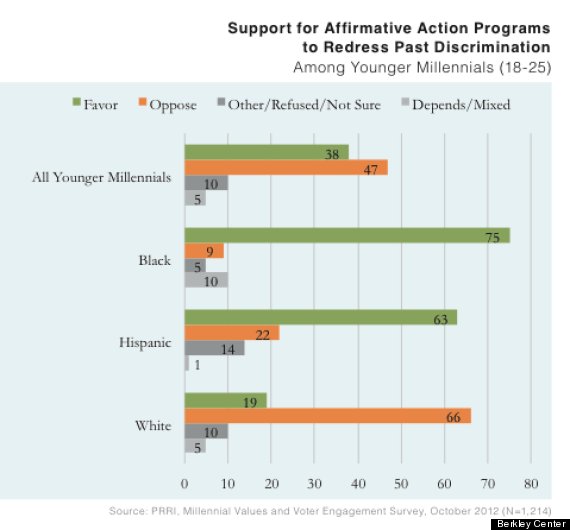
Today, nearly 6-in-10 Americans still favor the concept but when it comes to college admissions, nearly 7-in-10 believe they should be based solely on merit, including 44% of blacks and 59% of Hispanics.  The percentage has been remarkably consistent over the last dozen years, with “solely merit” at 87% in 2001 and 84% in 2003.

I believe the college experience is more productive for all students if they are exposed to a broad cross-section of ethnicities and cultures but reluctantly, I’ve come to agree that rigging admission process, however well-intended, isn’t the way to achieve that.

A poll was conducted of parents of pre-college age children a few months ago by Gallup on behalf of Inside Higher Ed. When asked if Affirmative Action hurts their children’s chances of admission, 33% agreed or strongly agreed it would, including 36% of whites, 23% of blacks and 34% of Hispanics.

But more than a fifth were neutral including 15% of blacks.  Another 42% disagreed that it would hurt their children’s chances, including 40% of whites, 62% of blacks and 41% of Hispanics.  I have friends from varying ethnicities for whom it turned out to be “reverse discrimination” and others for whom it provided a “fair shot.”

King didn’t coin the term “affirmative action.”  That was done by President John F. Kennedy a decade before it was made into law under a conservative Republican President with bipartisan support.  But from what I read in his writings and speeches Dr. King viewed it as warranted in the sense that special treatment for GIs returning from WWII was warranted.

I tend to agree with Ethan Case, a young, moderate New Jersey Republican, who blogged an essay on Millennial-driven “PolicyMic” a few months back making the case that Dr. King (paragraph breaks added to make it easier to read in this format):

“…if he were alive today and given the opportunity to rewrite our affirmative action and social justice policies, would have championed all of the poor, equally.

He would not have seen a difference between a poor white kid, and a poor black kid, with the same low economic status, from the same rough inner-city neighborhood.

Nor would he have supported a law that gives preference to wealthy black students from the suburbs over a poorer white students from the inner city.”

Rather than wasting time playing offense and defense over “affirmative action” we need to retool it to enhance “best practices” and curb abuses.

Support among Americans has been remarkably stable over the past two decades with only a third being opposed, but opinions have been split since the new millennium about the program’s application to racial minorities.

The concept’s strength comes when it is applied to gender or socio-economic standards.  Overall, in this country, a slim majority of Americans believe that one of the biggest problems is that we do not give everyone an equal chance in life.

Less than half of whites think that, compared to nearly 8-in-10 blacks and six-in-ten Hispanics.  However, nearly 6-in-10 Republicans and the same ratio of Tea Party members disagree that it is a problem.

Where we definitely agree, across racial, educational and class distinctions is that the government has a responsibility and should do more to care for people who cannot take care of themselves and to reduce the gap between rich and poor.

But there is a 30-point partisan gap on these opinions between Democrats and Republicans when it comes to helping people in need and a 57-point gap regarding the need to address economic inequality.

In my experience, Democrats are often far too slow to experiment or jettison when programs don’t work or to continually tweak programs that do work.  Republican are often captives of a stale narrative that racially stereotypes poverty and further stigmatizes it in discussions as if it were a lifestyle choice or an absence of character.

It isn’t.

The Republican narrative is one conservatives used long before embracing the stereotyping the party found so effective in the 1980s.  This is also the 50th anniversary of the 16th Street Baptist Church bombing that killed four little girls, only weeks following the “I Have A Dream” speech.

In denial that it was the Ku Klux Klan, a month later conservatives opined that it must have been the work of a “Communist or a crazed Negro” in a story that ran in their national bi-weekly journal, views that conservatives disavow today.

But As Jonathan Chiat wrote last week, while they seem far less overtly racist today, back then “conservatives and libertarians didn’t just ‘miss’ the logic of the civil-rights movement, the way you might miss the housing bubble.  They got it wrong for reasons that continue to be blindingly obvious today.”

In the words of President Bill Clinton in 1995 – “A lot has changed, and it did not happen as some sort of random evolutionary drift.”  He didn’t and still doesn’t view affirmative action as “either/or.” In the speech, Clinton called for affirmative action to be “changed to take care of those things that are wrong, and retired when its job is done.”

Unfortunately, locked in partisan gridlock, it hasn’t been changed and improved often enough. The way it is executed on a day-to-day basis is often blunt and discriminatory, and can be as harmful as it is helpful.

To me, affirmative action is a tactic and we should be guided more by our overall strategy.  Americans should avoid “telling ourselves stories” and strive to live up to the vision of Dr. King when he exhorted us all 50 years ago to shape a nation that will “live out the true meaning of its creed…”

To paraphrase, the objective is to be a nation where we are all judged not by the color of our skin but by the content of our character.

Friday, August 09, 2013

The Flood That Reshaped America

When months and months of torrential rain and heavy snows soaked the vast watershed of the Mississippi River in 1927, including more than 1.2 million sq. miles, 31 states and hundreds of rivers draining 41% of America, it created a great flood of truly Biblical proportions.

It was natural for many to view it as cleansing America of the second coming of the Ku Klux Klan and its influence over elections and policy.  In the Presidential election of 1924, the first in which women and Native Americans were permitted to vote, KKK members represented a percentage of voters 50% greater than the percentage who affiliate with the Tea Party today.

KKK members probably attributed the flood to the fact that 1924 was the first Presidential election in which women and Native Americans were eligible to cast ballots.  Like the Tea Party, the KKK was resurrected in 1915 in response to an era of progressiveness, only they were predominantly affiliated with Democrats while Tea Party members are predominantly Republican.

They have something else in common.  People who dominated each of these movements are those seeking to legislate ways to make it harder for minorities to vote.  They each obsess about immigrants and they despise government.

In 1924, blacks were overwhelmingly Republican, north and south.  In the previous Presidential election, 95% voted Republican.  It was slightly less in 1924 but by a ratio of 3 to 1, those who didn’t, voted for the Progressive candidate, not the Democrat.

In 1904 the Republican Party platform even called for reducing congressional representation for states that did not allow blacks to vote while the Democratic convention voted down a condemnation of the KKK.

According to historian and researcher John Barry, “in 1927, Senate Republicans threatened to investigate disenfranchisement of southern blacks” after the party had deserted blacks and reconstruction of the south nearly fifty years before.  Yet black voter loyalty remained with the party of Lincoln.

Even as the great flood of 1927 began to inundate and cleanse the heartland of America, the Republican-dominated Supreme Court of the United States outlawed whites-only primaries.  Republicans of that era had grown to see the black vote as belonging to that party by default.

So, what changed?

Why today, are blacks affiliated predominately with the Democratic Party?  Why has the Republican-dominated Supreme Court overturned provisions of the Voting Rights Act, signaling free reign for Republican-dominated legislatures passing laws making it harder to register and vote?

After reading Barry’s excellent book “Rising Tide,” I’ve drawn the conclusion that it may have been brought about most by events manifest just before, during and subsequent to the great flood of 1927.

The greatest flood disaster in U.S. history changed everything.  Below Memphis, the river spread 60 miles wide.  Overall, it affected 27,000 sq. miles, about the size of the entire New England region.

It destroyed 130,000 homes and displaced 700,000 people in a nation of only 119 million at the time.  Nearly 250 deaths were reported, but many probably never were.  It generated $350 million in property damage ($5 billion today,) and severely weakened the nation’s the economy.

Culturally, politically and socially, America matured overnight.

  • The myth that self-help and philanthropy is sufficient without government assistance was shattered.
  • When asked, the federal government assumed full responsibility for the Mississippi River, the largest project in the nation’s history other than war.
  • More than half of the blacks in the region headed north, a labor supply that spelled the end of the feudal south.
  • In the next Presidential election blacks began to dramatically desert the Republican Party.
  • The economy began to lurch, collapsing two years later.
  • The KKK receded into history again.
  • Republican strategists seduced the south by driving a wedge between blacks and whites.
  • The disaster marked the end of the Progressive Era.  Southern whites who supported the KKK began moving to the Republican Party after the Democratic Party nominated a Catholic in 1928.
  • Republicans became the party of “no” and embraced its laissez-faire big business wing.  Southern left-wing populists took root in the south while Democrats formed a new and diverse coalition of activism.

The great flood of 1927 spawned a shift among African-Americans from the Black Wall Street economic philosophies of Tuskegee and Booker T. Washington to the activism of the NCAAP of W.E.B Debois.

Blacks who had been free from slavery for decades had been forced into concentration camps along the river’s massive levees as they were inundated by the flood.  There they were surrounded by armed guards and forced to sandbag and even act as human sandbags while most whites rode out the flood like an inconvenient vacation.

When food aid arrived, whites refused to distribute many types of food to blacks because they would become “spoiled.”  Latent racism ran rampant.  Every myth of the “Southern Redeemers” was exposed and the reality set in motion changes in the understanding of civil rights that would reverberate for forty years and culminate in the Civil Rights Act.

Beginning in the 1970s, the pendulum has swung hard right again, and  many things once washed away by the great flood - while more subtle  – have been re-entrenched.

It may take another great flood to cleanse America.

Wednesday, May 22, 2013

Tracing Partisanship

Moderates are nearly extinct in the Republican Party.  In an interview today (28.25 mark) on the Diane Rehm Show, Olympia Snowe, a Republican moderate who has just retired from the U.S. Senate seemed to date the divide only to President Obama’s administration.

But a recently published study shows that the partisanship that gridlocks Congress today actually began during the first President Bush, also a moderate Republican, after gradually growing during the the terms of conservative President Ronald Reagan.

It really picked up steam during the so-called Conservative Republican Revolution of 1994 and its subsequent attempt to remove from office a moderate-Democrat, President Bill Clinton.

Present-day partisanship reached its zenith under the second President Bush, a conservative, and has actually moderated under President Obama, considered a liberal but who by many measures has actually governed more from the center.

My take comes from an analysis that was mapped senator by senator, session by session from 1975 through 2012 by two researchers. One is Dr. James Moody a sociology researcher and leader of the Duke Network Analysis Center here in Durham, North Carolina.

He teamed up with research mathematician Dr. Peter Mucha at the main campus of the University of North Carolina, several miles south in Chapel Hill, North Carolina which is part of the same metro area north and east of one centered around North Carolina’s capital city, Raleigh (just to be non-partsian.)

To my eye, the analysis, published last month, also appears to reveal that while endangered, moderate Republicans as of 2012 may even be more apparent today than moderate Democrats, a party home to a far greater proportion of moderate voters.

The mapping also seems to reveal that the 2003 invasion of Iraq was far more divisive than the 2010 overhaul of healthcare.  It also shows that during the prior event Congress was more polarized than a previous high in 1910 but fell below that benchmark during and after the latter.

It also revealed to me more about the relatively new discipline of network science which cuts across social and physical sciences to study relationships and interactions in areas like health, culture, organizations, science and politics.

Maybe it just because I am a moderate, independent of either political party, but this statistical and behavioral analysis has certainly given me a much better appreciation of the depth and breadth of political partisanship.

Monday, February 18, 2013

And Time Goes By So Slowly, And Time Can Do So Much

Late last fall, I decided to read three newly released books, all in the course of a week, to find relief from political campaigns.

Each was on a different topic but came together in a way that has crossed my mind many times since:

I haven’t written about them until now because a few days after I completed Steven Pinker’s book, a twenty-year-old man killed his mother and then gunned down twenty school children, mostly first graders and six elementary school officials in Sandy Hook, Connecticut.

That tragic event doesn’t undermine the thesis of Pinker’s book.  He made an insightful distinction about violence in an interview last month with Rotarian magazine when he stated that:

“Violence is not a hydraulic urge, like hunger, thirst, or sexual desire that has to be discharged through one outlet or another.  It is more like shivering or jealousy – a response to particular triggers in the environment.”

My sixteen great-great grandparents were all of the same generation as U.S. Grant.  They were born during a period of great awakening but by the time they entered adulthood, the nation had begun to unravel. 

When the Civil War broke out Grant was only 39.  By the time he reached 46, he has saved the Union and been elected President of the United States.

There is evidence that profiteering during the war, e.g. black marketeers following behind Union lines to exchange gold for southern cotton which was in turn used to by the Confederacy to buy weapons and supplies.  You get the feeling from the book on Grant that he felt this extended the war by several years.

In his January essay for Our State magazine, Dr. Philip Gerard of UNC-Wilmington provides evidence that when the war turned against the South, religious leaders did not rethink their biblical rationalization of slavery, but chalked it up to God’s displeasure with merchants who were “price-gouging customers for scarce commodities.”

There are many things in Durham, North Carolina, where I have lived for nearly 25 years, that remind us of the generosity Grant and Sherman planned as the huge surrender was negotiated here to effectively end the Civil War.  But that was all reversed when interrupted by President Lincoln’s assassination.

The ink was hardy dry on documents formally ending the war when Southern apologists effectively rewrote the history of the war as one merely about state’s rights.  Many times during his two terms as President, Grant had to send troops back into Southern states to quell violence and safeguard elections.

As soldiers from both sides fraternized during the surrender in Durham, they developed a taste for tobacco that had been cured and stored here.  They wrote letters seeking more once they got home, which help launch factories that saved Durham from much – but not all - of the destitution and violence that inhabited the south after the war.

Economic opportunity here also spawned a Black Wall Street and made Durham a beacon for racial diversity, which it remains today.

When I arrived in 1989 to jumpstart the community’s destination marketing arm, my first business road trip took me eventually south on US 1 where I was stunned to see a huge NCDOT highway sign heralding a small town along the route as the home of the KKK Grand Wizard.

Within a few years Dr. Cunningham started his masters degree at the University of North Carolina in Chapel Hill just south of Durham.  His book in many respects helps me understand why that unusual highway marker was not only permitted to exist but enabled.

According to Cunningham’s research, during the Civil Rights movement of the 1960s, the Klan’s stronghold was North Carolina, with more members than the rest of the South combined.

Writing and presenting editorials for a Raleigh TV station at the time, the soon-to-become Republican Senator Jesse Helms was possibly the first in that party to discover how to inflame angry white men, and by the time I moved here, his campaign commercials even in the 1990s still seemed overtly racist.

As Helms was readying his first campaign for the US Senate in Raleigh in 1971, CP (Claiborne Paul) Ellis, the head of the KKK in Durham, was joining forces with Ann Atwater, a poor African American civil rights activist, to put aside differences and improve public schools.  Their story was published a half dozen years after my arrival here.

North Carolina’s complicated journey toward racial tolerance is epitomized for me by a young North Carolinian of the same generation as U.S. Grant and my great-great grandparents by the name of Hinton Rowan Helper (shown in the image in this blog.)

He was born just off the route of what is I-40 today, about midway between Winston-Salem and Statesville and just west of Mocksville.  He was apprenticed to a printer in Salisbury and in 1857 published a book with charts and graphs showing why slavery didn’t make sense for the South as an economic institution.

His book The Impending Crisis of the South: How to Meet It was distributed by the Republican Party as a campaign document and it branded Helper a traitor in the South.  But in the end Helper too was still a white separatist as many were at the time who disavowed slavery.

His book panicked the planter elite for fear this tiny fraction, who held power, would not only face a slave insurrection, a fear of which had spawned the Second Amendment right to bear arms, but an uprising of white yeoman farmers who opposed slavery but ultimately were destined to sacrifice the most blood in its defense.

Ironically though, the right to bear arms also ended up as a protection for free and now freed Blacks who armed themselves following the Civil War and emancipation against the continuing tyranny when following Grant’s terms as President, the Republican Party turned a blind eye to the atrocities and became solely captive to its Wall Street wing.

Today, it is the Republican Party that is more prone to try to manipulate voter rights.  In fact, it may be the Party that saved the Union that is now ironically fostering another era of unraveling which cyclical historians project will lead to another another turn of crisis such as the Civil War or WWII by my mid to late 70s.

It may have a happy ending as WWII did, or it may result in preservation of the Union but decades of unfinished business as the Civil War did.

The cycle is predictable but there are no guarantees of the outcome as time can do so much.

Tuesday, November 20, 2012

The Fingerprints of Change

The fingerprints of change are often evident decades before they are credited in narratives.

In the United States, concern for the environment is often traced to then-Republican President Richard Nixon’s announcement in 1970, the day after my 22nd birthday, when he laid out plans to establish the US Environmental Protection Agency, following the enactment six months earlier of landmark environmental policy legislation.

However, by then, concern for the environment at the federal level had been percolating for at least 80 years, beginning with the 1899 passage of the Harbors and Rivers Act under another Republican President William McKinley.

It was the states that pushed for central supervision of environmental matters and by 1913 the federal government began to study the health risks related to water pollution.

At the turn of the 19th century, Chicago, Illinois was seeking to stem forty years of typhoid outbreaks there, the disease that had claimed the son of Republican President and Illinois-favorite-son, Abraham Lincoln after sewage from army camps had polluted the Potomac River adjacent to the US Capitol.

Chicago rechanneled its sewage discharge away from Lake Michigan, where the city also drew drinking water, to the west and into the Mississippi River where it eventually found its way downstream and fouled drinking water for St. Louis, Missouri, creating one of the earliest environmental interstate conflicts.

According to sustainability historians such as Dr. Jouni Paavola, early in the 20th century, New York and New Jersey similarly clashed when NY objected to NJ sewage being rechanneled into upper New York Bay and NJ objected in return that garbage was washing up on NJ beaches after being dumped at sea by NY.Government and Water Infrastructure

In the 1920s, under another Republican President, Calvin Coolidge, federal agencies were first granted authority to protect migrating water fowl, regulate pesticides, study air pollution and control pollution from oil.

A week after my seventh birthday, in mid 1955, just a year after the US Supreme Court had desegregated schools and as officials were preparing the first nation-wide immunization of school children against polio, federal agencies under another Republican President, Dwight. D. Eisenhower, were first granted the responsibility to control and mitigate air pollution, 15 years before Nixon created the EPA.

Far from being a power grab, as it is stigmatized by many of today’s Republicans, the federal government centralized environmental protection only after attempts failed so miserably to incentivize control and standards at the local and state levels.

Today as many elected Republicans sabre-rattle in my adopted home state of North Carolina threatening to overturn environmental regulations including those that safeguard air and water quality, hopefully they are reminded that:


  • North Carolinians love their state and its beauty and sense of place.  The majority of voters in all three parties view what’s good for the environment as good for the economy.


  • As a North Carolina native and conservative Republican, who champions his party’s environmental legacy, wrote recently about environmental desecration: it “is as impious as it is imprudent. It is certainly not conservative.”


  • They remember the rule espoused by the late William F. Buckley, a famous conservative Republican, when he implied that anyone voting to foul the environment should first be required to similarly foul the area around their own home and family and neighborhood including the water they drink and the air they breathe.

Monday, November 12, 2012

“Rewarding Pragmatism, Compassion, Working Together, Compromise and Sincerity”

As even casual observers of this blog know, I truly am a moderate Independent when it comes to political ideology.  I voted both for Republican Pat McCrory for Governor of North Carolina, where I have lived for nearly 25 years, and to re-elect President Barack Obama.

To me, they are both moderate realists, a group that could be credited with making a significant difference in their election victories.

I frequently read commentary on both the right and the left to keep informed, but I personally identify with one published last week by Rob Ellsworth, a moderate and former Republican.

We share links with my native state of Idaho and adopted home of North Carolina as well as a love of English bulldogs and I too have been disturbed by hyperbole on both the left and right following the outcome of the Presidential election but more so with that coming from the right.

Exasperated with his former colleagues Ellsworth lamented that:

“Your inability to reason, compromise, or let new facts and evidence challenge your predetermined outcomes led millions of moderates to no longer be able to stand on stage with you.”

But he also cautioned that “there isn’t a mandate for Democrats in this election. Liberalism wasn’t rewarded in this election. However, calm pragmatism, compassion, working together, compromise and sincerity were rewarded.”

Nor was there a mandate for Republicans in 2000 when they lost the popular vote and only won the White House via the electoral vote aided by a determination from the US Supreme Court that split along party lines.  Liberals then may have only been slightly less disrespectful than conservatives are today who are now as they fly the American flag upside down to demonstrate their dissatisfaction with last week’s election.

I have no doubt that Mitt Romney, who was a college classmate of mine, would have made an excellent President. Both he and President Obama are moderate realists.

In the end, I was ultimately swayed not by any particular difference between these two gentlemen but by the fact that I just felt less comfortable with extremely partisan forces surrounding Romney.  I doubt that even the seemingly more resolute Presidents Reagan and George W. Bush could have survived the drag created by these “wackanoodles,” to use the term used by a Republican operative attributed to their ilk.Middle Class - Pew Center

I grew up a Republican when a moderate Republican, Dwight D. Eisenhower, was President, but in the 1960s I supported both a Democrat, John F. Kennedy, and a Republican, Barry Goldwater, both of whom were more moderate than either is often portrayed.

In the 1972, the first election in which I was eligible to vote,  I supported the late Democrat George McGovern because I thought he was more sensible and moderate, especially about the war in Viet Nam.

There is some substance to the perception that I became Independent because, in my 40-year career in community-destination marketing, it was a wise career choice and a way to avoid the ebb and flow of local partisanship, even in communities where elected office is supposed to be non-partisan.

Once or twice over the years, in places where registered Independents were not eligible to vote in primary elections, I’ve even briefly changed my affiliation so that I could vote.  I’ve probably supported as many Republicans as Democrats, with moderates always being the common denominator.

I truly wish the value political parties bring to the electoral process could be supplanted by a “No Labels” approach to which I subscribe, but that paradigm-shift will take decades if ever it occurs.

Voting itself, which was one of the first moves by government to be participative (the creation of trial juries by England’s King Henry II being the first) is too slow and infrequent.  Social networking initiatives such as crowdsourcing is being used by the US Patent office and may provide a window into what to expect in the future.

Moderates dating from George Washington, our first President, have cautioned about the dangers of hyper-partisanship.  I am persuaded by pieces such as one posted by Dr. Robert Reich a day before last week’s election and entitled “We the People, and the New American Civil War.”

While America is known as “the land of opportunity,” the emergence of the middle class is a relatively recent phenomena as shown in this Pew Research Center graph published last summer in The Atlantic.

The middle class emerged in the 1950s and 1960s during a time of moderation and bipartisan cooperation.  During the 1970s, it sputtered for a decade, fueled by the inflation created by the war in Viet Nam and two oil crises.

During the 1980s and 1990s, tax cuts and technology fueled the markets and the growth of the investment class but not the recovery of the middle class.

I agree with Reich who summarizes his election eve assessment by writing that:

“So we come to the end of a bitter election feeling as if we’re two nations rather than one. The challenge – not only for our president and representatives in Washington but for all of us – is to rediscover the public good.”

However, I am even more persuaded by a post-election assessment by conservative columnist David Brooks.  After a wonderful job of giving historical context to the obsessive suspicions many Americans have over the size of government, Brooks makes an observation about the values of some Americans who made a significant difference in last week’s election:

“The Pew Research Center does excellent research on Asian-American and Hispanic values. Two findings jump out. First, people in these groups have an awesome commitment to work. By most measures, members of these groups value industriousness more than whites.

Second, they are also tremendously appreciative of government. In survey after survey, they embrace the idea that some government programs can incite hard work, not undermine it; enhance opportunity, not crush it.

Moreover, when they look at the things that undermine the work ethic and threaten their chances to succeed, it’s often not government. It’s a modern economy in which you can work more productively, but your wages still don’t rise. It’s a bloated financial sector that just sent the world into turmoil. It’s a university system that is indispensable but unaffordable. It’s chaotic neighborhoods that can’t be cured by withdrawing government programs.”

Numerous sensible and moderate solutions (many by Governor Romney such as capping tax deductions) have been proposed to each of the problems and challenges our country faces if as Americans we can rise above the only obstacle, partisanship.

Maybe we should also listen very carefully to some of our newer Americans who made the difference in this election.

Tuesday, November 06, 2012

May God Bless America To Be Less Partisan

Not all Independents, such as I, self-identify as ideological moderates but according to Pew Research Center 47% do, and so do 24% of Republicans and 41% of Democrats.

In my opinion, that should be enough to one day soon reclaim our country from it’s paralyzed state of partisan gridlock, but according to some who analyze them, moderates don’t fashion themselves to be like sporting event refs or officials responsible for breaking up fights between rival teams or their fanatic followers.

Key to any eventual resurrection of the influence of moderates will be the findings in a new study entitled Partisan Sorting and Behavioral Polarization in the American Electorate by Lilliana Mason, a doctoral candidate and researcher in political psychology at Stoney Brook University.

Mason found that extreme positions on issues have “an effect that is less than half the size” of what sorting by political identity, such as party affiliation, does on polarization.  She notes the finding that “…partisan identity increases thermometer bias [strength of emotion] by about 43 percent” of in-group bias, concluding that:

“This psychological and emotional sense of attachment to a party, an ideology, a religion or a race, and the extent to which those attachments overlap, is powerfully capable of driving behavioral polarization, even when the presumptive reasons for choosing a party - issue positions - are held constant.”

According to the study, “The strength of a person’s identification with his or her party determines how biased, active and angry that person is, even if that person’s issue positions are moderate…The moderation of issue positions cannot moderate the effect of identity on behavioral polarization…”

Moderates have their work cut out for them, especially the 47% among those who self-identify as unaffiliated with either major political party, approximately half of all moderates, because as Mason states in an article by Tom Jacobs for Pacific Standard, “There is no way to educate people into being less polarized.”

According to columnist David Brooks, who may be moderate but is definitely conservative, moderates like “mixing and matching from columns A, B and C. They try to create harmonious blends of policies that don't, at first glance, go together.”

Moderates tend to avoid both “confirmation bias” and “hindsight bias” which were clearly described last week in the Health Section of the New York Times by Benedict Carey:

“Confirmation bias” describes a condition where individuals or groups start off with an assumption and then pay attention only to information that is supportive.

“Hindsight bias” describes a condition where individuals and groups “retrofit their opinions and judgments” to fit the evidence.

Political parties, before, during and after campaigns, try to exploit both conditions to keep those who are faithful in line as well as to create doubt in the minds of partisans on the other side.  Campaign rhetoric aside, reaching across the isle as true moderates do is something partisans find problematic.

In another study published last summer along with Dr. Phoebe Ellsworth, Ed O’Brien a doctoral candidate in social psychology at the University of Michigan conducted experiments to determine empathy across the political isle and concluded that -- “Perceived dissimilarity – even in an incidental domain such as political values – may expose deep constraints on people’s ability to appreciate the experiences of those who may be in greatest need of their consideration.”

However, the political party partisans may be powerless to influence incumbent-halo linkages such as is noted in a study reported in a Style Section article by Paul Farhi in the Washington Post.

"Research shows that voters in a college team’s home county tend to reward the incumbent presidential candidate after the local team wins” in the 10 days leading up to the election, with an average bump of 1.61 percent of the vote, and as much as 3.35 percentage points if the team is a powerhouse.

In a parallel experiment involving college basketball fans, the researchers found that the further a team advanced in the Final Four tournament, the higher they rated the President’s job performance.  “Another study found a relatively high correlation between sports teams’ success and mayoral reelection.”

Republicans in particular will probably be heard muttering that “correlation does not equal causation,” that is unless their candidate wins.

The “tribalness” of political affiliation is called “groupishness” when applied to religion and other parts of society by psychological researchers such as Dr. Jonathan Haidt at NYU’s Stern School of Business.

Soon-to-be Dr. Mason’s claim that realigning political affiliations is as difficult as changing someone’s religion reminded me of a recent post on this blog about the findings of a scientific poll updated two weeks ago by university researchers on behalf of The Associated Press, which shows that Americans are as divided today as they were at the time of independence by issues of race:

“More than half of all Americans now express explicit anti-black and anti-Hispanic attitudes, 79% among Republicans; but when tested implicitly, the anti-black sentiments are also held by 55% of Democrats and 49% of Independents, much of it refueled, in my opinion, by uncivil discourse and coded rhetoric stoked after the election of the first black President of the United States.”

Mason pointed out to journalist Jacobs the “cleavages” during our history that have resulted in political realignment usually over a period of decades.  Far too many it seems, if not all, have been over race, such as the struggle among the founders during the writing of the Constitution that intensified after its adoption during the presidency of George Washington in the guise of so-called “state’s rights” as a counter to a vigorous federal government.

Another occurred over the same issue, slavery, with the election of President Abraham Lincoln which resulted in secession and all-out Civil War.

Another cleavage occurred with the rise of the Progressive Movement in 1890 to reform the ills of another gilded age and which southern states adulterated with “separate but equal.”  And the most recent realignment which was spurred by race as well occurred when Democratic Party leaders forged the 1964 Civil Rights Act.

Only time will tell when realignment will break up the current polarization, but the AP’s survey findings lead me to believe that it will once again be over issues related to race, which are thinly veiled in campaign rhetoric about poverty and immigration including one of the worst examples, the “Food Stamp President,” even though 1 in 3 are white and only 1 in 5 are black.

If race as an issue remains unresolved throughout the nation’s third hundred years, then another cleavage may certainly be forced by climate change and the environment as Mason speculates in Jacobs’ Pacific Standard piece.

Regardless of who wins election as President or to Congress today, may God Bless America and especially moderates in hope that they may finally get it right.

Friday, February 17, 2012

Behind North Carolina's Scenic Byways

People may be surprised to learn that Durham County where I live, is the only one of North Carolina’s urban counties that is home to one of the state’s Scenic Byways.

This is because Durham is not only home to the state’s fifth largest city, which is also the core anchor for a four-county metropolitan area, but it is the 17th smallest land area of the state's 100 counties. Durham even rivals the county where the town of Asheville is located in North Carolina’s mountain region for scenic byways.

Little did I know when I was first recruited to Durham in 1989 to jumpstart the community’s official marketing agency that within days I would be sitting next to then-Governor Jim Martin behind plate at a Durham Bulls baseball game in the Historic Durham Athletic Park.

Nor did I realize at the time that this Republican governor, only the second since Reconstruction, had just set in motion the development of what would become the state’s award-winning Scenic Byways program.  

People such as Martin with a PhD in Chemistry have become increasingly rare in the Republican Party, an affiliation claimed by only 6% of today's scientists, 12% counting the portion of political Independents who lean that way.  Blinded by the lack of empirical voice and research-based decision-making, members of that party are now trying to eliminate the National Scenic Byways program as well as grants to enhance roadsides.

It was a few years after that evening with Governor Martin that I first  became acquainted with the name Bill Johnson, who was the State Roadside Environmental Engineer and one of the driving forces in developing and evolving the byways program.  As the head of the Durham Convention & Visitors Bureau I had been asked by the then-chair and vice-chair of the Durham County Board of Commissioners  to identify and help qualify potential byway routes here.

The state accepted two of several potential routes we identified including a spectacular 27 mile loop through the northern part of  Durham County including rural parts of the City.  We identified another through Duke Forest which was accepted as the terminal segment for the 92-mile Colonial Heritage Byway that begins near the border between Guilford and Rockingham counties, cutting across and up through Caswell County to within view of Hyco Lake along the Person County line before dropping down through Orange County and then over into Durham and through Duke Forest before terminating very near where I live.

During his tenure as the state’s roadside executive Bill also had a hand in implementing the beautification of North Carolina's roadways with spectacular beds of wildflowers, an idea spurred by Governor Martin’s wife Dottie.

Bill understood research showing that when it comes to maintaining roadsides, removing litter is a short-term inhibitor to littering behavior but coupling it with beautification creates a shared sense of responsibility and a longer term and more sustainable fix.

A good friend now, Bill’s retired and lives “down east”, as we call it, where he has a business and does some farming but his passion remains the overall scenic beauty of North Carolina, especially as viewed from the state’s roadways, that is, except where easements to block that scenery as well as clear-cut football-field sized swaths of trees and vegetation on each side have been gratuitously granted to more than 8,000 huge, stationary outdoor billboards.

Now also in retirement, it is my honor and privilege to continue to work with Bill in a renewed statewide grassroots effort to preserve, protect and restore the state’s scenic character including what is evident along its roads and highways.

Bill and his wife have driven every one of North Carolina's Scenic Byways and on my Harley Crossbones I'm trying to do the same.  Anyone wishing to join us can:


  • Using the interactive map shown, select one of the three regions of the state to view the Byways then click on the icon next to a Byway of interest for a pop-up with a brief description and a link for more information.


  • Download a PDF of all of the Byways by clicking this link or use the information on the website to request the booklet.

Thursday, October 27, 2011

The Fire That Ignited Environmentalism!

Heading west on a cross-country trip a few months ago, Mugs (my English Bulldog) and I took our first drive on historic turnpikes beginning with a slice up through western Pennsylvania and then across Ohio and Indiana.  These roads seemed refreshingly free of the blight of outdoor billboards.

Even though our trip was routed to include National Parks such as Theodore Roosevelt, Glacier, Yellowstone and Grand Teton, for some reason it hadn’t dawned on me until I was there on the Ohio Turnpike  that I would first cross through the tiny but sixth most visited Cuyahoga Valley National Park (CVNP) which embraces 22 spectacular miles of that famous river once traversed by Johnny Appleseed.

Crossing the Cuyahoga River that day, as it winds between Akron and Cleveland on its way to emptying into Lake Erie, brought back memories of when it caught on fire further downstream in 1969, the ninth time it had done in the previous hundred years dating back to 1868.

The news media latched onto the 1969 event as though it were the first occurrence, just as the news media mistakenly identified a Civil Rights event nine years earlier in Greensboro NC as the first sit-in when many had been held years earlier, such as the many held in Durham where I have lived since 1989.

However, while far from the first, the 1969 fire on the Cuyahoga River as it passed through Cleveland, a city known for its parks and open spaces, served to reignite nation-wide concern about protecting the environment and spawned guardians such as the United States Environmental Protection Agency (EPA) and a host of other environmental protections defamed today by hundreds of attempts to roll them back by Republican-led votes in Congress and state legislatures across the country.

Efforts to establish the Cuyahoga Valley National Park date back to 1910. While it gained some Federal protection just five years after the infamous pollution-fueled fire just downstream, CVNP didn’t become a complete reality until 2000.  However, plans were intensified by the shame of the river being branded in the news and by late-night-talk-show comics by references to the 1969 fire in the river as it passed through Cleveland.

Belying the fact that a Republican President spawned the conservation movement more than a hundred years ago and another the EPA only 17 months after that emblematic fire on the Cuyahoga, ultra-conservative members of that party have long-loathed parks and open spaces as well as environmental protection and dismissed them as “nature socialism.”

In his now-prescient 2007 book Free Lunch: How the Wealthiest Americans Enrich Themselves at Government Expense (and Stick You With the Bill,) investigative journalist David Cay Johnson notes that advisors to 1964 Republican presidential candidate Barry Goldwater lobbied for elimination of all national parks.

He also notes that in 1981, the libertarian-ultra-conservative think-tank Cato Institute argued for eliminating all public parks and in 2007 an institute named for the mentor to Republican-Libertarian cult-economist F.A. Hayek denounced parks.

To me, as a moderate-Independent, Republican opposition to conservation, public parkland and clean air and water has been as consistent as it is incomprehensible.  Based on the current votes in Congress and in our state legislature, it is more than fringe support in that party.

Fortunately, many Republicans eventually come to their senses as Goldwater did when in 1996 when, at age 89, he joined the newly-formed Republicans for Environmental Protection.  In the meantime, we just need to protect the environment from those still on the other side of the issue.

Republicans today, all but purged of anything except conservative and ultra-conservative viewpoints, need to heed that organization’s slogan “Conservation is Conservative® !”

Wednesday, September 28, 2011

America’s Future Relies on the Radical Center

There is probably only one group more lonely than the 10% of Mormons who are “liberal," American’s most politically conservative religious denomination and that’s the remaining 3% of Republicans who are liberal. 

So the Democratic base must be all liberals, right?  After all, that’s what’s pounded into our brains from the superficial, conflict-driven news reports that mold this as public perception.

Nope, analysis shows that the true numeric base of the Democratic Party are moderates, not liberals, which must be why Republicans have become pathologically adverse to compromise or any sort of “third-way,” moderate solution.Moderates

They fear it will benefit Democrats but in reality this aversion may be isolating that party more and more from the ideology of the largest segment of Americans, “moderates.”

The reality that conservative Ronald Reagan understood and rode to victory on in 1980 has been the key to winning every election since then.  It is all about winning over moderates and by nature moderates are less concerned about political power and more concerned about what works and understand that what works is compromise and bipartisanship.

Remember, only a 5 point swing among “moderates” saved George W. Bush from being a one-term president.

Jon Huntsman Jr. gets it and so do the 24% of Republicans who are moderates.  But Mitt Romney and Rick Perry are playing first to the nearly three out of four Republicans who are far to the right of Reagan, let alone the American mainstream, and predominantly driven only by orthodoxy.

A poll earlier this month revealed that Democrats view both themselves as individual voters and their party as “moderate.”  Independents also predominantly view themselves as moderates although they view other Independents as a group as a little more conservative.

Republicans?  They view themselves to the right of their party and Democrats as all liberals.  They are cocooned in this misperception by devotion to myside-biased-news consumption and marooned in an inflexible closed-loop view of their beliefs as possessions.

A positive sign for moderation was the 23 point decline in favorability for Republican leadership among extreme Tea Partiers following the debt ceiling agreement and a 37 point decline in opinion for the Tea Party faction among Republicans overall.

Unleashed, maybe the Congressional Super Committee will be more open to a bipartisan deficit-reduction proposal by the moderate Third Way organization.

But even if a faction of that group chooses to remain isolated, cocooned and marooned, Republicans aren’t doomed as long as they remember that moderates also represented the largest share of the electorate in 13 of the last 14 congressional election cycles.

The 2012 elections will all come down to three things in the opinion of many:

1) economic despair blinded to its origins by rhetoric and memory loss,

2) whether the mainstream news media can see past its obsession with balance to distinguish fact from fiction, and

3) how susceptible my fellow moderates are to memory loss and massive doses of distortion-laced attack adds by 527-organizations and other anonymous groups that thanks to an extremely narrow Supreme Count decision can be anonymously funded by corporations.

Regardless of whether the final outcomes of next year’s presidential and congressional elections ultimately favor Republicans, Democrats or Independents, the final arbiters will be moderates, not conservatives or liberals.

Un-grid-locking America will depend on electing people open to a third-way, regardless of political affiliation.

Sunday, September 04, 2011

Why Moderates Matter

6029423550_253c9d182b_o large

Friday, September 02, 2011

Referendum On Racism & Sense of Fairness

To me and I believe confirmed by studies, “fairness” is a central American value. That belief has been tested since 2008.

It may be sleazy but marketers for the Republican Party have been extremely effective in framing negative messages and behaviors that tap into racism, without being overtly racist.

Being overtly racist runs counter to current American norms but substituting other types of condescension and intolerance is apparently acceptable and just as effective.

Studies have shown that negative framing is much more powerful than positive but also that negative framing results in less cooperation such as bipartisanship.

Because President Obama is African-American, condescension about his birthplace, his education, his faith and sudden disregard for long-standing protocols of respect, e.g. calling him a liar, rebuffing requests for speeches, suddenly becoming hawks after sitting quietly while Republicans ran up 7 of every 10 dollars of deficit is a way to play a “coded” race card.

Republicans in denial about their party’s behavior toward the President over the last three years must remember that one of the definitions of racism is “a belief that there are inherent differences in people’s traits and capabilities used to justify treating those people differently.”

But how can this be tolerated in a party now dominated by the 20% of Americans who score highest on the “religiosity index” and who researchers Drs. David E. Campbell and Robert D. Putnam describe as having “an ideological commitment that values authoritativeness and obedience,” otherwise termed “authority-mindedness.”

As noted in their incredible book American Grace, which details scores of studies including their own, Campbell and Putnam note that when asked the question, “what is more important for a child to be taught: obedience or self-reliance?” …religious people emphasize ‘obedience’ and secular people emphasize ‘self-reliance’.”

The answer, noted below is that the:

“…fundamental correlation between religiosity and intolerance has been confirmed in dozens of studies over the last half century. It is true even with many other background factors held constant – age, race, religion, education, income, gender, political ideology, homeownership, marital and parental status and general civic engagement.”

“Unchurched conservatives are more tolerant of difference and dissent than devout conservatives, churchgoing liberals are less tolerant than secular liberals.”

…”Religious tradition or denomination seems to play a very small role…frequent church attendance is associated with less tolerance across the board…

In an op-ed piece last month the book’s authors went further based on new research to be included in a paperback edition of the book next winter, noting:

“So what do Tea Partiers have in common? They are overwhelmingly white, but even compared to other white Republicans, they had a low regard for immigrants and blacks long before Barack Obama was president, and they still do.”

Well I guess we’re about to find out just how dear a sense of fairness and a revulsion to racism are with American voters.

Nationwide, there are now as many self-proclaimed Independent voters (34%) as Democrats and far more than the 28% who are Republicans, which remains flat since 2008.

Independent is good. I’m a moderate Independent although many conservatives would say I'm “progressive-leaning.” Today's Republican orthodoxy appears to have moved the center so far to the right that many conservative friends will often now deny that even famed-conservative columnist and "thinker" David Brooks is really a conservative.

But the percentage of Republican-leaning Independents has increased since 2008 from 11% to 16%, pulling that party within four points of Democrats and Democrat-leaning Independents.

Troubling though and possibly another reflection of the effectiveness of Republican strategists in “coding” racism in the framing of messages is that the 2 point lead that party held with white voters in 2008 has now swelled to 52% compared to 39% who affiliate with the Democratic Party or lean Democratic.

American Grace makes a compelling case about "…what has changed in American religion over the past half century…the most noticeable shift is how Americans have polarized along religious lines….the highly religious at one pole, and the avowedly secular at the other. The moderate religious middle is shrinking.”

Unfortunately, while more vast in numbers, moderates and Independents are also less likely to vote.

The election of 2012 may be setting up to be a referendum on race in America and a test of our vaunted sense of fairness and treating people of different ethnicities as equals. As usual, it may all come down to turnout.

Tuesday, August 09, 2011

One Republican’s Object Of Deep Spiritual Significance

A powerful, popular, independent Republican President was on my mind as I started my third cross-country road trip in less than a year, driving up the Shenandoah Valley of Virginia and crossing bits of Maryland and West Virginia before cutting across Pennsylvania to carve my way around the Great Lakes.

My route took me near a route of then-desolation in Pennsylvania that Theodore Roosevelt viewed from the train as he made his way from Buffalo to Washington D.C. after the assassination of President McKinley.

A hundred years ago, Roosevelt probably wasn’t aware that settlement and development had by that time eliminated one of every three trees (210 million) from the billion acres of forest that had covered America in the mid-1600s.

Roosevelt also didn’t have access to the economics involved. Today we know that “over the course of 50 years, a single tree can generate $31,250 worth of oxygen, provide $62,000 worth of air pollution control, recycle $37,500 worth of water, and control $31,500 worth of soil erosion” according to the Arbor Day Foundation.

What Roosevelt did have according to his biographer, Edmund Morris was a firm belief, even as a city boy that “trees were objects of deep spiritual significance.” He also viewed conservation as good for business, good for development and in the best interests of the American people.

He bucked his own powerful political party and, as noted at this link, by the end of his term he had “established the United States Forest Service, signed into law the creation of five National Parks, and signed the 1906 Antiquities Act, under which he proclaimed 18 new U.S. National Monuments.

He also established the first 51 Bird Reserves, four Game Preserves, and 150 National Forests, including Shoshone National Forest, the nation's first.

The area of the United States that he placed under public protection totaled approximately 230,000,000 acres.” And yes, he was a Republican.

Today, more than half of the earth’s forests are in Russia, Brazil, Canada, the United States and China. Forests cover less than 1/10th of the earth’s surface and about 30% of its land area. Degrading forests are driving 17% of greenhouse emissions.

America’s tree cover has remained at 747 million acres for the last 100 years. According to the national atlas, this includes 384 million acres in the East and 363 million in the West. In the East, 74% are broadleaf trees, in the West 78% are conifer.

In the East 83% of forest is privately owned but in the West 57% is publicly owned. This may explain why I saw far fewer outdoor billboards in the Midwest and West.

This may also explain why public officials in North Carolina are so slow to protect trees from outdoor billboards, oversimplifying it as a private property issue rather than as a degradation of view-shed and sense—of-place as the general public here overwhelmingly does.

Once heavily forested, North Carolina is now less than 60% tree covered or less than the tree canopy in the City of Durham, the state’s fifth most populous city. North Carolina has also become less forested than either of its two neighboring states, Virginia and South Carolina.

We need more Republicans like Teddy Roosevelt. Especially in North Carolina.