Showing posts with label Civil War. Show all posts

Tuesday, March 29, 2016

A Legendary Journey

From a vista in the center of San Francisco known as Twin Peaks, you can look down on a spot in the Mission District with the Bay glimmering to the east.

For a few years in the early 1860s this was known as Camp Alert, a race track-turned-Union Cavalry training facility.

I’ve always wondered how Thomas K. Messersmith, one of my maternal great-great grandfathers, who was a fourth-generation Southerner and native Missourian came to enlist to fight for the Union and train there, so far from home.

Tracing genealogy is a journey, often beginning by tracking down documentation for family legends.  But even when found, each revelation usually still leaves a loose end or two, that once tied open yet another revelation.

By the 1860 census, my great-great grandfather, a few weeks shy of 26 years old, was bunking with two other miners who were well into their 30s, T.H. Wilson from Virginia and N.F. Scott from Maryland.

They were living in a boarding house in Virginia City, Nevada which was then a part of Utah Territory and the site of the Comstock silver discovery only a few months earlier.

I doubt he came out to the California Gold Rush a decade earlier because the census then shows him still at home in Missouri.

But Virginia City had not only been named by Southerners, it was a hotbed at the time for secessionists who were gloating at having defeated a proposal for statehood because it included a prohibition of slavery.

My great-great grandfather had somehow formed a friendship with Samuel Clemens, who was a year younger and yet to adopt his famous pen name “Mark Twain,”

Because they were born and raised in very different parts of Missouri, I suspect they had formed a bond once Twain arrived in Virginia City with his brother, probably as much over as shared prowess for playing cards as briefly sharing a mining claim.

These fragments can be pieced together from references in collections of Twain’s letters from that time, which also confirm that my great-great grandfather would often be referred to be “Smith,” a truncation of his last name, Messersmith, just as my great-grandfather Ralph would later do.

This discredits another family legend that the truncation was the result of discrimination during World War I. 

My great-great grandfather gave up on mining around the time he crossed paths with Twain or shortly thereafter and headed up and over the Sierra Nevada’s and down to Stockton to enlist for the Union on October 3, 1861.

Interestingly, Twain had already served a two week stint with a Confederate militia back in Missouri and still had Southern sympathies at the time.

This and the dissention back in their home state must have led to some interesting conversations between the two Missourians.

The California into which my great-great grandfather rode had been in deep turmoil since a deep spit the year before in the Democratic Party, which had resulted in the election of President Abraham Lincoln with just a third of the vote.

Rampant secessionist conspiracies had compromised local militias and more than a few law enforcement official, especially in Southern California, leading to public demonstrations by both sides.

At the same time, regular Union Army units were being withdrawn to the east and several new Union regiments of California Volunteers were being enlisted to protect communications and critical ore shipments needed to fund the war effort from sabotage and attack.

My great-great grandfather made a conscious decision which to my prior understanding was contrary to his both native state and his friends.

But digging further I have learned that it was me that was very much misinformed.

It took me a while to track down that he initially enlisted in Company A of the Third Regiment which was an Infantry unit, but that didn’t jive with family legend that he was Cavalry.

Nor did the date of that unit’s arrival in Salt Lake and its various assignments align with the date and place he eventually mustered out of the army at the end of his tour.

Finally, I found a small reference in one military citation that read, “see Company L Second Regiment Cavalry.”

After being outfitted at the Benicia Arsenal, he may or may not have participated with Company A in the Bald Hills uprising that ended at Fort Baker before being transferring to Cavalry.

It is more probable that he was moved to Cavalry training in San Francisco almost immediately.

A hint is provided in one of Twain’s letters, dated May 17, 1862, where he asks another friend to send a pair of Spanish spurs hanging back in his office out to my great-great grandfather.

Between late that summer and early fall, with Cavalry training at Camp Alert behind him, at least a part of my great-great grandfather’s company in detachment with another had joined Col. Patrick Conner in Stockton.

From there, along with 1,000 other Cavalry and Infantry, they moved in phases over the Sierra Nevada’s and out into the Great Basin along the Overland Trail.

They rode first to Fort Churchill about 30 miles east of Virginia City and then proceeded on to secure Fort Ruby, near, coincidentally, where two other of my great-grandparents would drive stagecoach a few decades later.

Eventually, they based at Camp Douglas (later re-named Fort Douglas,) a newly created installation on a bench of the Wasatch Mountains above Salt Lake City, where, again coincidentally, my father would be inducted into the army during WWII.

From there, my great-great grandfather’s Cavalry company would deploy to protect wagon routes in mountain valleys to the west where they were under constant attack.

This was all during the period when the Pony Express was phasing out and the first Transcontinental Telegraph was being completed along a major freighting corridor to the east carrying bullion and supplies for the war effort.

It is hard to relate just how broadly and intensely these facilities were under attack during the Civil War from warring bands of Paiutes and Shoshone-Bannock peoples, stretching in a “T” up the Upper Snake River Valley to what would become my birthplace eight decades later.

So I will insert this link as background.

Because so much of the family legend surrounding my great-great grandfather’s Union Cavalry experience has now been documented, I have no doubt that one day I will find verification of another part.

As the story has been passed down, the scar through his trademark mustache was the result of deflecting a Shoshone arrow that would have struck Colonel Connor.

My initial skepticism, at least of this particular hand-me-down family legend, has repeatedly proven groundless so far.

When digging into family history it helps to remember that legends are traditional stories regarded as historical but unauthenticated, usually because those details have been lost as the stories were passed down.

My great-great grandfather was notoriously quiet and solitary, spending weeks at a time herding sheep up into several of valleys along the Oquirrh Mountains where he had once patrolled near the end of his stint as a Cavalry trooper, including Rush Valley where attacks were especially frequent.

(Another, Cedar Valley, where he settled, is shown above.)

He became a Mormon and spent the remainder of his days alongside the very Overland Trail he had help protect as a means to hold the Union together never revealing what I now know of how he came to choose that side.

But in researching this blog, I think that has become clear.

Missouri, it turns out, may have had a very vocal population who had migrated from slaveholding states but by the time of the Civil War, while a neutral border state, it was firmly Unionist in sentiment.

It had its share of secessionist scheming.

But given the opportunity to vote for secessionist candidates to a convention, it overwhelmingly instead voted for Unionist representatives who voted 99-1 against secession and 70-23 against solidarity with Southern slave states.

Most telling about my great-great grandfather’s decision is that those fellow Missourians who enlisted to fight for the Union outnumbered those who enlisted to fight for the Confederacy by nearly 4-1 (110,000 to 30,000.)

Mystery solved at least for my great-great grandfather.

Unfortunately, far too many Americans are still fighting that war.

Monday, December 07, 2015

This Ongoing War 150 Years Later

In North Carolina, it’s no surprise to learn that “since 1960, one third of the world’s arable land has been lost to erosion.”  Nor, according to scientists, that “46-58 thousand square miles of forest are lost each year – equivalent to 36 football fields every minute.”

Tar Heels have witnessed the link between depleted soils and deforestation in the decades before the Civil War when more than a third of North Carolinians moved away.

By 1850, 31% of native North Carolinians then living in the United States resided in some other state.

Backwardness regarding slavery and race relations as well as resistance to public education and infrastructure played a big role in the out migration as did poor land use practices by plantations.

It’s well documented by unapologetic historians such as the late Dr. William S. Powell.

I’ve been reading or rereading two others recently, one written the year I was born (1948) entitled From Slavery to Freedom and another just released entitled, The Old North State at War: The North Carolina Civil War Atlas.

Both shed new light.

The latter shows the population breakdown by race and freedom-status broken down by county just prior to the Civil War, as well as the vote by county for or against succession.

You can see a divide back then running down between what is now Durham and Wake/Raleigh with 5 points more slave-holders in Wake.

Wake/Raleigh also had twice the number of slaves as Durham/Orange and nearly three times the number of free Blacks out of 30,463 statewide.

There were a little more than 125,000 households in North Carolina in 1860 and 28.2% owned slaves.

Yet in 1861, Durham/Orange voted by more than 3 to 1 against succession from the Union while Wake/Raleigh voted for it by a few hundred votes.

As the rhetoric heated, the state as a whole was almost evenly split on the issue with a slight nod against.  People’s minds back then were more focused on the wealthy paying more in taxes here.

Within weeks though, secessionists won out both because of a general sentiment of “you can’t tell us what to do” and being surrounded by states that had or were succeeding.

The North won the Civil War that resulted, which effectively ended with a surrender in Durham.  Thanks to resistance by Southern Generals Lee and Johnston there wasn’t the subsequent guerilla war Southern leaders wanted.

But that didn’t mean war was over.

Another war erupted almost immediately between Democrats who were controlled by white supremacists and Republicans.

Just as a small percentage of the population had monopolized power in North Carolina and kept it backward, then pushed it into a war to defend slavery as a way of life for a few, a similarly small percentage held power in this follow up war.

Political rhetoric is powerful as we still see today.  It can close minds more easily than open them, something given comprehensive coverage a few days ago in an On the Media radio show entitled Lies, Lies, Lies.  

Republicans lost this follow up war and soon became all but extinct across the South because the party had became divided into an increasingly conflict-weary faction seeking social justice leading to a takeover by its Wall Street wing.

Just as Democrats had become divided into factions over slavery leading up to the Civil War, resulting in President Lincoln’s election, factionalized Republicans lost the follow up-struggle.

Following the South’s defeat and preservation of the Union in the Civil War, reunited Democrats fell sway to the rhetoric of a small fraction of white supremacists who this time sought not only to reinstate limitations on civil liberties, but to virtually annihilate the Republican Party in the South, which they did.

As a result, civil rights in the reunified country were put on hold for another hundred years and even today, seem lodged between ongoing institutionalized bias on one hand and a futile obsession with effacing racist symbols on the other.

The two political parties have switched roles today.

It began gradually in the decades leading up to the 1930s on issues of social and environmental justice, then became increasingly apparent after WWII and symbolized by the 1960s.

As someone who was raised a staunch Republican which I remained until nearly 25, I have been particularly interested in the history of the Republican and Democratic parties.

My Republican roots go back to the party’s founding.  But many of those ancestors would no longer be welcome there.  People who sense I lean Progressive probably don’t realize that it is the Republican Party that has shifted.

Understanding how the parties have evolved helps me understand how I briefly moved to the left in my mid-20s before finding my comfort zone as an Independent except wherever forced to briefly sign up so I could vote in primaries.

Today it is Republican ideology that seems to view everything as a threat to way of life, dominated by a few who seem to want to annihilate not only Democrats but anyone who dares to be moderate.

We see it in the refusal to negotiate or reach bipartisan agreement, even when Democrats sign on to Republican-generated innovations such as carbon credits or healthcare overhaul using exchanges that emulate the requirement for car insurance.

Further evidence is research showing that the root of Republican opposition to addressing climate change is the knee-jerk stereotyping of anyone concerned about the environment as a “watermelon,” green on the outside, red (as in Commie for you Millennials) on the outside.

The one thing that remains constant is that just as a tiny minority held North Carolina back after the U.S. was founded and the Civil War was fought to preserve the way of life lived by only 28% of Tar Heels, policies here are still driven by a small percentage in power.

The only thing certain is that the pendulum will swing yet again, but not the problem.

The parties may reverse roles yet again one day and apologists, as always, will try to smooth everything over like propagandists did between 1866 and 1966 by transforming the issue of slavery into “states’ rights.”

Democracy truly exists only when a majority of people vote, not just when the vote is a majority of those showing up.   Maybe similar to governing boards, popular elections should be valid only when there is a quorum?

As a moderate Independent who more and more has a little “time on him” as they say in my native Idaho, I am more and more aware of the dangers of failing to admit to myths when in pursuit of greatness as a nation or perpetuating a way of life.

I know far too many reasonable Republicans and far too many crazy Democrats to believe the rhetoric when one or the other party gives in to zero sum thinking.

But as President George Washington lamented in 1795, the problem may be in the nature of political parties, meant as a means to help people make decisions but then used as a reason not to think:

“However [political parties] may now and then answer popular ends, they are likely in the course of time and things, to become potent engines, by which cunning, ambitious, and unprincipled men will be enabled to subvert the power of the people and to usurp for themselves the reins of government, destroying afterwards the very engines which have lifted them to unjust dominion.”

Lament indeed!

Thursday, April 23, 2015

The End That Marked A Beginning

I wonder as re-enactors, history buffs and other visitors gather in Durham, North Carolina this weekend if they will realize the even greater symbolism Bennett Place has to this community.

The otherwise tranquil setting is not only where the Civil War ended 150 years ago this week, it marks the place where Durham began to gather a realization of its sense of place.

One of the surprises in the new book entitled, To the Bitter End: Appomattox, Bennett Place, and the Surrenders of the Confederacy, is not only how much of it is new information but that author Robert M. Dunkerly includes a number of essays in the appendix.

One is entitled The Long Road Home from Appomattox by another Park Ranger and interpreter, Ernie K. Price, who has been researching the journey home of Confederate soldiers for many years.

After Appomattox, people who would be giants among Durham’s founding generation were on their way home, having been paroled as part of Lee’s surrender of his much smaller Army of Virginia including several North Carolina units such as the 3rd Cavalry.

Most, traveling on foot, would have reached here in time to hear intense picket battles raging across southern Durham as Union Cavalry chased the remnants of Confederate troopers in the hours before a ceasefire took effect.

As Price notes, while returning Confederate soldiers would have traveled in small groups, the last few miles to home were often alone.  I suspect that if it wasn’t surreal enough to find the war still winding down as they were greeted, then they heard the news was of President Lincoln’s assassination.

I have learned since first penning this essay that next month Durham will be the culmination of another reenactment entitled, A Soldier’s Walk Home, in recognition of the even longer walk home another Durham Confederate soldier made from the coast.

The legacy of Bennett Place is not only that Confederates resisted calls to continue a guerilla war, although several units tried.  By 1868 and only 18 miles west of Bennett Place, gangs of KKK riders were terrorizing the countryside.

That is also the year that tobacco, rebranded as Genuine Bull Durham, was being mailed to fulfill requests from former Union and Confederate soldiers who had helped themselves to it during the truce, marking the genesis of the New South.

Bennett Place remained a working farm until purchased by Brodie Duke in 1890, twenty-five years after the surrender there that ended the Civil War.  Duke saw it as an enterprise and tried to sell it as a novelty during the 1893 Chicago World’s Fair.

Coincidentally, this is also when two of those returning Confederate soldiers, Julian Carr and Washington Duke, helped Trinity College relocate to Durham which later became Duke University.

At its former location in Randolph County, Trinity College had been one of several places stretching from Greensboro to Salisbury where Confederate units awaited the outcome of the surrender negotiations in Durham.

In 1908, 43 years after the surrender, Bennett Place was purchased by another of Durham’s founding generation, industrialist Samuel Tate Morgan, who hoped to see it preserved as an historical park.

It was also the period when another North Carolinian, Thomas Dixon, wrote The Clansman (1905) glorifying and rebranding the KKK from terrorists to saviors and forming the basis of D.W. Griffith’s movie The Birth of a Nation in 1915 and the second coming of the Clan.

Many former Confederates in Durham were staunch segregationists but instead of dawning white robes and burning crosses, they were lending a helping hand during this span to evolution of an “entrepreneurial enclave” of black owned enterprises including the founding of a university.

But before Morgan’s dream could be realized, he died in 1921, a few months before membership in the KKK nationwide peaked.  His family and friends in Durham took up the cause.

It is fitting that as KKK membership reached 4 million, on October 12, 1923 Durham leaders including many former Confederate soldiers were instead erecting the Unity Monument at Bennett Place.

His vision about the importance of honoring place inspired other at the time and while they may not realize it, continues to generations here still working to promote and shape Durham’s distinctive sense of place.

Hopefully, in a few years, we remember to recognize the 150th anniversary of so much that makes Durham distinctive and appealing.  Hopefully, we will not instead be mourning its demise.

http://www.durham-nc.com/things-to-do/features/soldiers-walk-home/

Monday, August 25, 2014

Retracing Touch Points Along America’s Loneliest Stretch

Nearly 30 years ago, I drove my venerable Porsche 911s Targa out across the Great Basin following a brief visit with my then 14-year-old daughter.

It was along a remarkable stretch of U.S. Route 50, a “blue highway” nicknamed “The Loneliest Highway in America,” a label proudly embraced after first used as a pejorative.

Of course, as they do on paper maps, secondary highways no longer show up as “blue” on digital GPS maps but as more of a goldenrod.  Just doesn’t have the same ring (smile.)

This is a fragment of the 1913 Lincoln Highway, the first automobile route across America, roughly following the old Pony Express/Overland Stagecoach route.

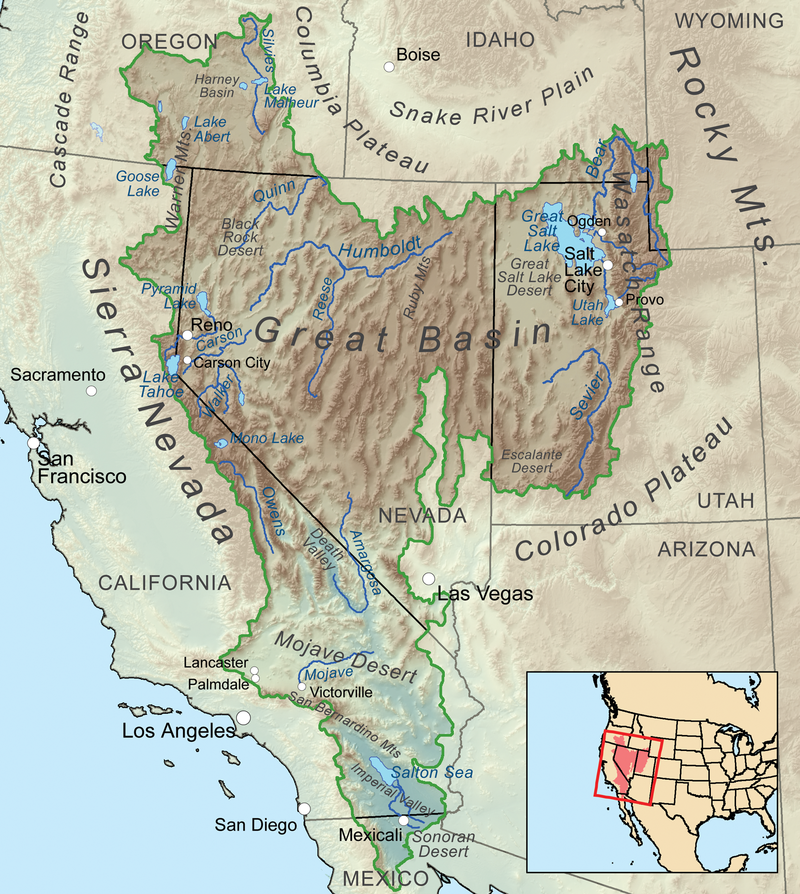
At its coarsest level, the Great Basin is a mild desert that covers western Utah and a tiny corner of Idaho, nearly all of Nevada skirting Las Vegas (Mojave Desert) into east-central California and up into eastern Oregon between the Cascades and Rockies.

The northern Nevada portion, where dissected by Route 50, is more specifically called Basin and Range because it includes a spectacular mix of steep mountain ranges, flat to rolling arid valleys and rangeland, and even alpine forests.

But the Great Basin got its name because rivers there materialize and then dead-end into lakes with no outlet or they disappear into “sinks” (dry lakes), e.g. the Great Salt Lake or the Humboldt Sink where that significant 330-mile river just disappears.

This was foreign to European explorers who understood only divides between watersheds where rivers ultimately opened into seas and oceans.

Part of my most recent cross country trip traced part of the route of an expedition led by two Franciscan priests in 1776.

It set out just as Americans along the east coast declared Independence, to find a trade route from Santa Fe to Monterrey.

They made it north as far as Utah Lake near the location of Brigham Young University but the maps drawn by expedition members reflected a misunderstanding of descriptions from Ute Indian guides.

Illustrations included massive rivers whose mouths had been earlier discovered along the Pacific Coast in what are now northern California and Oregon flowing from as far away as the Great Lakes.

Versions of these maps were in use right up until 1846 when further exploration by Captain John C. Frémont and Kit Carson learned of the existence of the Great Basin.

Accounts reached my Mormon ancestors weeks before my great (x3) grandfather Charles Shumway and his family led the way across the Mississippi in 1846 on what would be a 1,500 mile exodus to a new home in the Rockies above the Great Basin.

At the time of the Lincoln Highway’s conception in 1912, less than 9% of the roadways anywhere in America had improved surfaces such as gravel.

Many states at the time constitutionally prohibited such “internal improvements” forcing cities, towns and counties to go it alone.

Even by the 1920s, when the Federal government incentivized the states to build roads, Utah, still smarting from when a portion was lopped off in 1861 to create Nevada, refused to pave its stretch of the “Lincoln.”

To no avail, Nevada pled and even offered to pay for a portion so for a time the Lincoln Highway bypassed Utah cities.

My primary mission during that Route 50 hiatus from my career was solitude and time for reflection and forgiveness, but a secondary pursuit was to trace a portion of the lives of three ancestors.

My first stop was Fort Ruby, near the terminus of a stagecoach line that two of my great-grandparents, George and Eleanor White, operated for a time in the 1890s.

After their teamster years, my great-grandfather would landscape the upper campus of Brigham Young University which I would attend several decades later.

Fort Ruby would have looked as it does at this link, when one of my great-great grandfathers Tom Messersmith, served in the Union Cavalry there months after the fort was first established in 1862.

A fellow Missourian later joined by his friend Samuel Clemens (Mark Twain) as partner on a claim along the Comstock Lode.

But as news about the attack on Fort Sumter and secession by 11 Southern States arrived west, in October 1861, my great-great grandfather had crossed through the Sierra’s to enlist in the Union Cavalry in Stockton simply as “Tom Smith.”

When he had left his home county, an area from Jefferson City down to the Arkansas border. there were 169 slaveholders holding 987 African-Americans in slavery but few in his township.

Most of the state’s 115,000 slaves were concentrated along the Mississippi and Missouri rivers.

But Thomas Messersmith was a fourth generation German-American descended from Palatine Protestants who had fought for American freedom with the Virginia Militia as early as 1774.

German-Americans were among the small minority in Missouri who were outspoken opponents of slavery including small yeoman farmer/ranchers in the pastures and hills along the Osage River as it slices through the Ozark Highlands.

When he relinquished his claim with Twain to enlist, that area was governed by both California and Nevada, a boundary later settled by arbitration.

In the years before the Civil War, California, while voting to be a free state was staunchly Democratic.  Sympathetic to the South, Southern California had wanted to secede and join the Confederacy.

But Abraham Lincoln carried California in the Presidential election by six-tenths of a percent when the Northern and Southern Democratic candidates split the vote slightly in favor of the North.

Things were anything but settled as Tom enlisted with the Union.  A coup by Southern sympathizers to seize ports and with counterparts in Oregon to form a new “Pacific Republic” had been narrowly foiled.

Militias around the state were embattled both internally and with other militias to hold the Union together as federal troops were redeployed to the east.

A Confederate flag had even been captured flying in Sacramento two month earlier.

But as my great-great grandfather rode down out of the Sierras, Leland Stanford, a Republican was overwhelmingly elected governor over a Southern Democrat.

After enlistment in Company A of the 3rd Regiment of California Volunteers, Trooper Messersmith traveled to the Benicia Arsenal on San Francisco Bay for outfitting, then briefly deployed up to Fort Baker east of Hydesville and about 24 miles south of Eureka.

The assignment where hostilities with Chilula, Lassik,Hupa, Mattole, Nongatl, Sinkyone, Tsnungwe, Wailaki, Whilkut and Wiyot Native American peoples broke out in what is known as the Bald Hills War over disruption caused during a gold rush there.

While here, one of Twain’s letters asks his brother to forward some Spanish spurs he had left hanging in his office to my great-grandfather.

From there Company A was to join the rest of the regiment at Fort Douglas along the Wasatch Mountains above Salt Lake City but they were waylaid at Fort Ruby, Nevada where Shoshone Indian attacks and fear of Confederate militants threatened gold shipments along the Overland Stagecoach Route,  which were desperately needed to fund the Union war effort.

Then they were backtracked to Fort Churchill, Nevada to put down threats from Paiutes, finally arriving at Fort Douglas in January 1864 just as the 13th Amendment to the Constitution is proposed, ending slavery.

Fortunately, his unit did not reach Fort Douglas in Salt Lake until January 1864.

There he would have heard the details of a tragic battle (renamed massacre) on the Bear River less than 12 months earlier.

It took place ten miles north of the ranch owned by two other great-great grandparents who had helped establish the first permanent settlement in what is now Idaho and learned enough Shoshone language to interpret.

Having battled related Shoshone Indians for several months through Nevada, it isn’t clear where Tom Messersmith’s sympathies may have been as he heard about the slaughter.

Nearly 500 Northwest Shoshone men, women and children were trapped and killed by 300 troopers who lost fewer than 20 casualties.

Only after the war was it clear this was largest massacre of Native Americans in a single day ever by the U.S. Army.

But how my great-great grandfather lived the rest of his life and what he taught my great-grandfather tells me it may have bothered him much more than other troopers.

When his enlistment ended in October 1864, he had just turned 30.  He backtracked into the Great Basin along the old Pony Express route to Cedar Fort near Camp Floyd which had been dismantled when troops were called back east at the beginning of the war.

There he settled and was “persuaded” to become a Mormon.  Five months later he married my great-great grandmother “Lida” who had made the trek to Utah as a five year old.

Together they ranched sheep among the Skull Valley Indians, a Goshute band of the Western Shoshone native to the Great Basin, a band my great-grandfather would regularly take me to visit whenever we visited to take them food, something we did more frequently as I attended college along the the mountains across Utah Lake.

I wasn’t much older than my great-great grandfather had been when he settled down as I retraced that ancestral stretch along U.S. Route 50.

The landscape was foreign to anywhere I have lived and yet somehow familiar.

It may be the loneliest stretch in America but I found it ideal for reflection and rejuvenation.

As penned a decade earlier as he crossed that part of Nevada by Missourian and part Osage Indian, William Least Heat Moon, for his autobiographical book Blue Highways :

"The immensity of sky and desert, their vast absences, reduced me. It was as if I were evaporating, and it was calming and cleansing to be absorbed by the vacancy...."

Monday, March 17, 2014

The Roots of Our Cussedness

On a cross-county plane trip 25 years ago to interview for a job in Durham, North Carolina, I happened to read Dr. David Hackett Fischer’s then-newly published book Albion’s Seed: Four British Folkways in America.

One chapter in particular, “Borderlands to the Backcountry,” turned out to be an insightful introduction to my soon-to-be adopted home just as reading John McPhee’s Coming Into The Country had been a decade earlier as I relocated to Anchorage, Alaska in a similar capacity.

Having read books such as this allowed me to grasp the deep cultural influences in the DNA of these places, years before I would have otherwise, something crucial to my now-concluded career in community visitor-centric economic and cultural development.

Reading Albion’s Seed also ignited a passion for family history, something I had only tinkered with prior.

This all came to mind again a few weeks ago while reading “The Great Adventure of the Outlaw Blalocks,” Professor Philip Gerard’s installment in this month’s Our State magazine’s North Carolina’s Civil War history series.

The true story is about a marriage on Grandfather Mountain between members of two Scots-Irish families, one unionist and the other secessionist who had been feuding since before the families had immigrated to America.

They came here from along the border lands or marches that stretch southwest between Scotland and England down from Durham, England through the hills, valleys, lakes and uplands.

The culture of their homeland also jumps across the Irish Sea to include Ulster where many had earlier been forcibly moved.  Nearly a quarter of a million immigrated here between 1717 and the outbreak of the American Revolution, two-thirds in the last decade.

Here they were called by the Americanism “Scots-Irish” but these immigrants would have called themselves either Scots or English or Anglo-Irish or Saxon-Scotch. The majority spoke English.

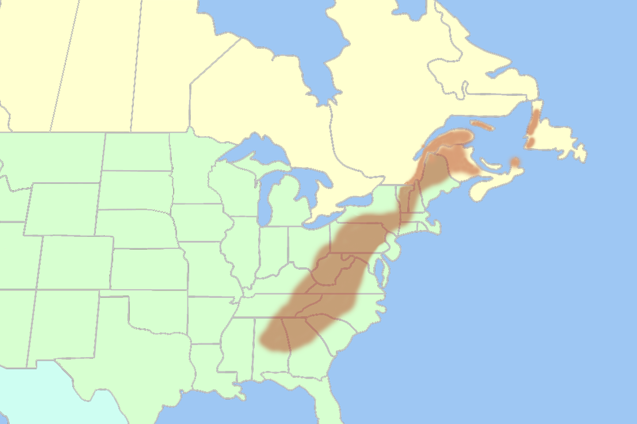
They settled along the Appalachian Mountains stretching from New England in an arch down through North Carolina and across the “old” southwest of Alabama, Mississippi, Arkansas and then parts of Oklahoma, Missouri and Texas.

They came primarily as families.  Most were skilled or semiskilled but had primarily worked as tenants or renters on land held by absentee landlords.

These homelands had been seared by seven centuries of wars between Scotland and England only to be marauded by large gangs of rustlers.

Different than the branches of my family who came to America two hundred years earlier, most Scots-Irish other than the early Quakers did not come for religious reasons.

Like my Scots-Irish family branches with names such as Harper, Buzby, Neeley, Crawford, Martin, McCrory, Laughlin, Gilmore, Bradford, Montgomery and Lowrie, these immigrants were proud, independent and resentful of being subordinate.

Mostly the Scots-Irish immigrated for land and opportunity but their border land origins gave them what we affectionately refer to as a “cussedness” in North Carolina including an aversion to assimilation.

This also included a distrust of governments, institutions and clergy, a reformist-dissenter sense of faith, a legacy of families that unified into clans for support and a belligerence toward other ethnicities including a xenophobic outlook in general that remains embedded in many today.

This legacy also included a sense of freedom and liberty interpreted for individuals and private property but not applied to groups, something apparent today among gun rights adherents who insist on interpreting an amendment meant for militias as personal, no matter what harm guns do to society.

Ninety percent of the back-settlers as David Hackett Fischer calls them were either from North England, the Scottish Lowlands or Ulster.  We hear their influence today in Country Music and architectural vernacular such as “cabin” and “log cabin.”

In the 1840s, prior to the Civil War, nearly all of my Scots-Irish ancestors became Mormons and headed west past the Rocky Mountain “front” to settle along the “back-side” of that iconic mountain range.

But they took with them many of the traits described above including pronunciations I heard in Eastern Idaho growing up, such as “deef” for deaf, “harse” for horse, “card” for cord and “wandered” for wondered, a deviation you can hear clearly in the iconic “He Stopped Loving Her Today” by the late George Jones.

We owe it to Scots-Irish influences every time we use the endearment “honey” or hear it from a waitress, same with “man” as a reference for husband or significant other, as in classic country song “Stand by Your Man.”

I returned east of the Appalachians a milder version, possibly because my Scots-Irish lines of ancestors had gradually selected out the more positive traits while retaining more than a little “cussedness.”

Today, nearly 6 million Americans have this heritage but as I have noted from reading Albion’s Seed, its cultural influence is felt much more broadly, especially in states such as North Carolina where even today you can still see it shaping otherwise seemingly inscrutable public policy.

It is why a state that is well aware that its brand is its scenic beauty can give out-of-state billboard companies free reign to blight first and last impressions along roadsides by clear cutting billions of dollars of publicly-owned roadside forest.  It’s why it will soon earn a reputation for mega-dumps.

It seems illogical and self-destructive until realized that this springs from a resentment of restrictions on use of property even if the value of that property is parasitic to tax-payer funded roads and even though any benefit will go to a few narrow interests at great expense and harm levied on the overall population in terms of air and water pollution, global warming, etc.

This is also the cultural source of resentment of zoning regulations, design guidelines for neighborhoods, historic preservation, open space and urban forests all crucial to sustain unique sense of place, a “cussedness” that doesn’t even flinch at “cutting off one’s own nose off to spite one’s face.”

When I moved to North Carolina in 1989, I was aware that the state had been conflicted during the Civil War and that Scots-Irish, including many living in the South, fought valiantly on both sides or against both sides.

Here were people represented both by those who truly embrace what it means to be American and those who remain a world apart, no matter how many generations their ancestors have lived here.

This has been extremely well documented in a new book entitled, The New Mind of the South, by journalist and author Tracy Thompson. She traces how and why this region of the country seems to be divided by new and old cultural influences.

The book reminded me that I had been aware that the month I interviewed here that it had only been ten years since Ku Klux Klan members had murdered five protestors sixty miles away in Greensboro.

My interview had also been preceded just eight years earlier by the lynching of a black man by members of the Ku Klux Klan in Alabama, something common across the South for many decades following the Civil War.

A few months after I relocated in 1989, I drove past a highway sign erected by the North Carolina State DOT on a U.S. Highway that signaled that a town 47 miles south of Durham was the home of a KKK Grand Dragon.

A state official told me at a luncheon that my newly-adopted home town had always been a “black town” because it had a reputation as accepting of different ethnicities, cultures and lifestyles.

Many I initially encountered who had been born in my newly adopted state before the mid-1970s were still eager to persuade me that the Civil War was not fought over slavery at all but rather because the South didn’t want to be told what to do as they had learned in school from propagandized texts.

They were shocked and angered by what I had learned in school including irrefutable evidence that not only was the war fought over slavery, but only a decade following its end, Southern, white-supremacist Democrats had cut a secret deal.

They would not dispute the one electoral vote election of Republican President Rutherford B. Hayes in return for the withdrawal of all federal troops from the south.  What resulted was the evolution of 80 years of Jim Crow laws reversing much of the freedoms earned by that war.

It isn’t hard to draw a line from there to the efforts by Republicans, this time in states such as North Carolina, now to roll back the progress that has been made since the 1960s.

In many ways, there are two South’s today, one having taken the best from that Border Land culture, and one holding on to its most regressive influences more than two centuries after being transplanted to America.

I may differ with many of those influences as they are manifest today, but along with a dose of Puritanism from other branches of my family history, I definitely sense those traits that are Scots-Irish within me, including more than a little “cussedness.”

Monday, February 18, 2013

And Time Goes By So Slowly, And Time Can Do So Much

Late last fall, I decided to read three newly released books, all in the course of a week, to find relief from political campaigns.

Each was on a different topic but came together in a way that has crossed my mind many times since:

I haven’t written about them until now because a few days after I completed Steven Pinker’s book, a twenty-year-old man killed his mother and then gunned down twenty school children, mostly first graders and six elementary school officials in Sandy Hook, Connecticut.

That tragic event doesn’t undermine the thesis of Pinker’s book.  He made an insightful distinction about violence in an interview last month with Rotarian magazine when he stated that:

“Violence is not a hydraulic urge, like hunger, thirst, or sexual desire that has to be discharged through one outlet or another.  It is more like shivering or jealousy – a response to particular triggers in the environment.”

My sixteen great-great grandparents were all of the same generation as U.S. Grant.  They were born during a period of great awakening but by the time they entered adulthood, the nation had begun to unravel. 

When the Civil War broke out Grant was only 39.  By the time he reached 46, he has saved the Union and been elected President of the United States.

There is evidence that profiteering during the war, e.g. black marketeers following behind Union lines to exchange gold for southern cotton which was in turn used to by the Confederacy to buy weapons and supplies.  You get the feeling from the book on Grant that he felt this extended the war by several years.

In his January essay for Our State magazine, Dr. Philip Gerard of UNC-Wilmington provides evidence that when the war turned against the South, religious leaders did not rethink their biblical rationalization of slavery, but chalked it up to God’s displeasure with merchants who were “price-gouging customers for scarce commodities.”

There are many things in Durham, North Carolina, where I have lived for nearly 25 years, that remind us of the generosity Grant and Sherman planned as the huge surrender was negotiated here to effectively end the Civil War.  But that was all reversed when interrupted by President Lincoln’s assassination.

The ink was hardy dry on documents formally ending the war when Southern apologists effectively rewrote the history of the war as one merely about state’s rights.  Many times during his two terms as President, Grant had to send troops back into Southern states to quell violence and safeguard elections.

As soldiers from both sides fraternized during the surrender in Durham, they developed a taste for tobacco that had been cured and stored here.  They wrote letters seeking more once they got home, which help launch factories that saved Durham from much – but not all - of the destitution and violence that inhabited the south after the war.

Economic opportunity here also spawned a Black Wall Street and made Durham a beacon for racial diversity, which it remains today.

When I arrived in 1989 to jumpstart the community’s destination marketing arm, my first business road trip took me eventually south on US 1 where I was stunned to see a huge NCDOT highway sign heralding a small town along the route as the home of the KKK Grand Wizard.

Within a few years Dr. Cunningham started his masters degree at the University of North Carolina in Chapel Hill just south of Durham.  His book in many respects helps me understand why that unusual highway marker was not only permitted to exist but enabled.

According to Cunningham’s research, during the Civil Rights movement of the 1960s, the Klan’s stronghold was North Carolina, with more members than the rest of the South combined.

Writing and presenting editorials for a Raleigh TV station at the time, the soon-to-become Republican Senator Jesse Helms was possibly the first in that party to discover how to inflame angry white men, and by the time I moved here, his campaign commercials even in the 1990s still seemed overtly racist.

As Helms was readying his first campaign for the US Senate in Raleigh in 1971, CP (Claiborne Paul) Ellis, the head of the KKK in Durham, was joining forces with Ann Atwater, a poor African American civil rights activist, to put aside differences and improve public schools.  Their story was published a half dozen years after my arrival here.

North Carolina’s complicated journey toward racial tolerance is epitomized for me by a young North Carolinian of the same generation as U.S. Grant and my great-great grandparents by the name of Hinton Rowan Helper (shown in the image in this blog.)

He was born just off the route of what is I-40 today, about midway between Winston-Salem and Statesville and just west of Mocksville.  He was apprenticed to a printer in Salisbury and in 1857 published a book with charts and graphs showing why slavery didn’t make sense for the South as an economic institution.

His book The Impending Crisis of the South: How to Meet It was distributed by the Republican Party as a campaign document and it branded Helper a traitor in the South.  But in the end Helper too was still a white separatist as many were at the time who disavowed slavery.

His book panicked the planter elite for fear this tiny fraction, who held power, would not only face a slave insurrection, a fear of which had spawned the Second Amendment right to bear arms, but an uprising of white yeoman farmers who opposed slavery but ultimately were destined to sacrifice the most blood in its defense.

Ironically though, the right to bear arms also ended up as a protection for free and now freed Blacks who armed themselves following the Civil War and emancipation against the continuing tyranny when following Grant’s terms as President, the Republican Party turned a blind eye to the atrocities and became solely captive to its Wall Street wing.

Today, it is the Republican Party that is more prone to try to manipulate voter rights.  In fact, it may be the Party that saved the Union that is now ironically fostering another era of unraveling which cyclical historians project will lead to another another turn of crisis such as the Civil War or WWII by my mid to late 70s.

It may have a happy ending as WWII did, or it may result in preservation of the Union but decades of unfinished business as the Civil War did.

The cycle is predictable but there are no guarantees of the outcome as time can do so much.

Tuesday, June 05, 2012

Surprising Wisconsin Detour – A Convergence of Three Passions

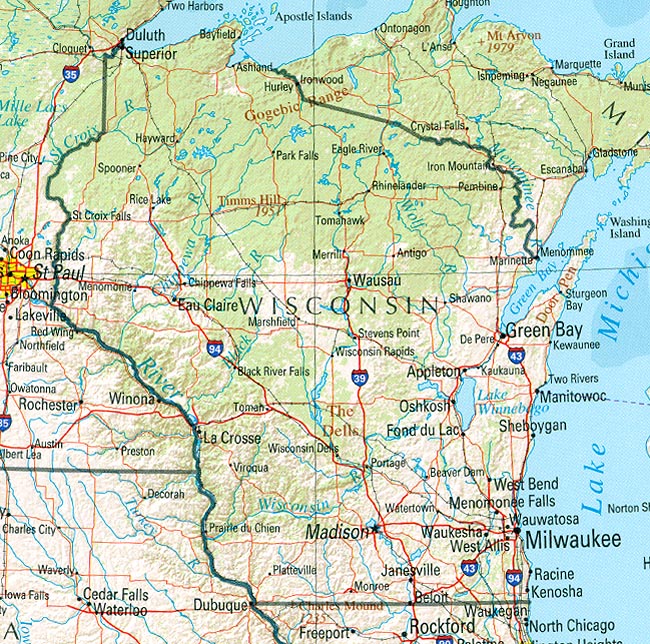
I was drawn up through Wisconsin for my first visit to that state during the west-bound leg of a 6000-mile cross-country road trip last year with Mugsy, my English bulldog, as we leisurely made our way to meet up with family at a lake along the border of Washington and the Idaho panhandle.

As we drew closer to the Wisconsin-Illinois border we had a choice of two alternative routes of interest.  Satellite radio news from Wisconsin at the time, as it still is today, was all about recall elections.

I toyed with veering slightly northeast up through Governor Scott Walker’s hometown of Delavan, now with a renewed reputation as circus capital of the world, then on to see the spectacular new Harley-Davidson Museum in Milwaukee and then five minutes further to the site of the 126-year-old historic Bay View Massacre which occurred during another misguided period of union-busting in that state.

But for several reasons related to Durham, North Carolina, where we live and began our journey, I decided instead to cut northwest up through the prairie and savannahs of the western uplands, past the four lakes of Madison (even though we would miss seeing my friend and fellow blogger Bill Geist who was also on the road) and then up through the Dells and across the valley of the 285-mile long Chippewa River.

All three reasons for selecting that route relate to passions of mine including the Civil War, the story of trees and family history .

The Civil War effectively ended at Durham with the largest surrender of the war by Confederate General Johnston to Union General Sherman (at Appomattox, Lee had surrendered only what remained of the Army of Northern Virginia.)

Several Wisconsin units had fought with Sherman through the South from Vicksburg to Chattanooga, down across Georgia, up through South Carolina ending in North Carolina and Durham including the 25th Wisconsin which was drawn from counties along the Chippewa.

The 25th was part of approximately 80,000 Wisconsinites who fought in the war against slavery and to save the union including 12,000 of whom died.

But 36 years before that war ended in Durham, as a young Lieutenant in the U.S. Army, eventual-Confederate president Jefferson Davis led a party up the Chippewa and made what newspapers reported as the first “sound of a white man’s ax heard in the pine forests of Wisconsin.”

Today, only 46% of Wisconsin is covered by forest but back what would become Wisconsin was 86% covered by forests.

As Jefferson Davis paddled his birch bark canoe, the Chippewa River Valley alone held one-sixth of all of the pine timber west of the Appalachians according to the New York Times and 34% of the pinery in what would become the Wisconsin Territory seven years later.

Davis swung that ax along the Chippewa three years before US Government-contracted surveyors began detailing the area on maps to be used by timber companies, settlers and speculators as well as portions granted to the railroads.

It was also about the year two of my ancestors, Lewis and Elizabeth Neeley migrated north to try to help settle Dane County, Wisconsin several years before Madison was founded there only to find themselves in the middle of the Black Hawk War and were driven south again after the 1832 attack on Fort Blue Mounds, leaving two children buried there.

The Neeleys relocated back to Vermillion, IL in 1833, the same year future president Abraham Lincoln volunteered to fight in the Black Hawk War.  Eventually the Sac (Sauk) Chief Black Hawk sought refuge along the river with the Chippewa Indians (Ojibwa) where he was persuaded to surrender and was escorted by Lt. Davis to Fort Crawford.

For a time, the Neeleys relocated near Vermillion, IL during the time when the Treaty of St. Peters between the U.S. and representatives from various Ojibwa bands which granted full access to exploit the Chippewa River Valley.  But the Neeleys had headed west by the time Lincoln arrived to practice law in Vermillion.

By 1850, two years after Wisconsin became a state and just as logging was ramping up along the Chippewa, my great-great-great grandfather Lewis, having lost his wife in Winter Quarters, Nebraska, was heading further west still with my great-great grandfather Armenius, up and over the Continental Divide.

Logging the Chippewa would intensify after the Civil War as the soldiers of the 25st Wisconsin returned home two years before Laura Ingalls Wilder, author of the Little House series was born along that river, the inspiration for her first book Little House in the Big Woods.

The commander of the 25th Wisconsin, Jeremiah McLain Rusk went on to serve in the U.S. Congress then as the governor of Wisconsin when his order to the National Guard led to the tragedy at Bay View.

By the 1890s logging along the Chippewa had peaked after a billion feet of logs had been harvested annually through the 1880s.  Only 5% of the spectacular White Pines and 0.5% of the Hemlock trees remained.

Long before sustainable logging, people with names such as Weyerhaeuser had denuded the Chippewa of 46 billion board feet of timber and by the 1920s the timber companies were trying to sell the barren land to farmers.

But once cut over, the land remained “unrehabilitated for generations.”  Gradually by World War II the area reforested but not the way it had been.

An hour west from Eau Claire WI, where Mugsy and I crossed the Chippewa, and a half hour north off the Interstate as it nears the Wisconsin border with Minnesota is the little town of Clear Lake WI.

It is the hometown of the late U.S. Senator Gaylord Nelson, who served two two-year terms as governor of Wisconsin beginning in 1958 before his 18 years in the Senate.

Nelson grew up at a period when the devastation left by unsustainable lumbering practices around Clear Lake had left it poor, polluted and denuded compared to what it had been when his grandparents had homesteaded there from Norway in the 1870s.

Nelson was a progressive and eventually a Democrat but in the Wisconsin before he returned home from fighting in World War II to practice law he might have easily been a Republican.

Wisconsin progressives were Republicans dating back to the legendary Robert M. La Follette, Jr. a native of Madison and a longtime Senator and candidate for President or maybe to the party’s founding in 1854 with progressive antislavery roots

But progressives were driven out of the Wisconsin Republican Party when La Follette was defeated by the now infamous Joseph McCarthy of 1950s “Red Scare” notoriety when he used extremism and unsubstantiated charges to purge political enemies not dissimilar to the tactics pursued against unions today by Tea Partiers fueling support for Governor Walker.

During the early 1960s Nelson was known as the “conservation governor” and the popularity for those initiatives catapulted him to the U.S. Senate where he helped Wisconsin regain credibility on the national stage by founding Earth Day and spearheading conservation legislation throughout the 1970s as part of his fervent advocacy on behalf of small business.

The 288 mile detour we took last summer through Wisconsin was enlightening as well as memorable and Mugs and I definitely hope to see more of that state on future trips.

Wednesday, October 26, 2011

The Populist Heroes Of America

I live in a state that was ambivalent during the Civil War. One of the very last of the Southern States to secede, North Carolina lost many more lives in that war than others such as Virginia, which is often given more notoriety.

To understand why North Carolinians were ambivalent and/or resistant to the Civil War, it helps to know that in 1860, there were 69,000 farms here, 7 out of 10 of which were 100 acres or less and only 300 plantations owned by just 121 planters.

There were more than 700 farmers for every one planter.  While in general, farmers did not own slaves, planters argued that their profits relied on a third of a million enslaved African Americans.

And yet, the interests of just 121 power-brokers pulled North Carolina into secession and war where 125,000 of its citizens would fight and more than 40,000 would die, more than any other state.

The ambivalence here was not concentrated just along the Appalachian Mountains as it was in Virginia where West Virginia broke away in order to stay in the Union.  Nor did the ambivalence and resistance to the war end when a North Carolinian became the first to fall for the Confederacy.

Pick up a copy of the November issue of Our State Magazine which is just hitting newsstands.  It includes an article in the magazine’s eight part series that runs through next May about North Carolina and the Civil War entitled A Separate Peace.

This month’s piece is about another pocket of resistance stretching across 5,000 square miles from Durham (then part of Orange County) through nine counties to the west across what the author Philip Gerard calls the “Quaker Belt.”

Eventually, a secret resistance called Heroes of America spread through Durham and south and east through the State Capital of Raleigh, population 5,000, and all the way to the coast.

Gerard, who also writes historical novels, chairs the creative writing faculty at the University of North Carolina – Wilmington and his articles in the series are each eventually posted at this link.

He refers to Heroes of America as a “rebellion within a rebellion” and one that appears to me to have been a truly populist union of pacifists and small yeoman farmers, who abhorred slavery.

In Durham that demographic schism as well as the war are interpreted at three state historic sites: Historic Stagville, Duke Homestead and Bennett Place where the Civil War ended.

Reading  A Separate Peace is also a reminder that moderates today must not be ambivalent as other factions become more extreme.

Saturday, June 11, 2011

An Ashokan Reminisce

As I read an excellent retrospective on Slate by Sacred Heart University professor and Civil War lecturer James M. Lundberg, I was reminded that I had lived in my current hometown, Durham, North Carolina only just over a year when Ken Burns epic documentary, The Civil War, first aired on PBS, as it did again month before last.

I was one of the 40 million viewers who turned in but little did I know at the time that Burn’s epic would soon signal two elements of significance during the first of my two decades as chief of Durham’s marketing agency, a position from which I am retired after nearly four decades in that field.

The haunting centerpiece of that documentary’s soundtrack, Ashokan Farewell, composed by Jay Unger eight years before the documentary was made, masterfully evokes that tragic conflict and it has often played across my mind in the years since.

For me the song captures the melancholy of the Civil War, as the late historian and novelist,Shelby Foote (click here to hear his wonderful voice in interview) notes in the documentary, a hinge between the time when as a Nation we went from referring to the “United States are” in the plural to the “United States is” as one. It is also another reason I find myself Listening To The Civil War during this 150th anniversary year.

Less than eight years later, that seminal Burns work would do much to inspire the founding of one of Durham’s signature events and what has become one of the most, if not the most, important annual showcases in the world for documentary film, the Full Frame Documentary Film Festival, which is held here over four days each April. Along with the Southern Documentary Fund, it has literally put Durham and the State of North Carolina at the center of this creative endeavor.

Even as a Westerner who hadn’t lived east of the Great Continental Divide let alone the Mississippi until I was drawn to Durham, I had nonetheless grown up fascinated by the Civil War, almost always electing to be a Union soldier during our frequent school-boy re-enactments.

This was long before I learned that my great-great maternal grandfather, Thomas K. Messersmith, had served in the Union Cavalry during the war protecting the overland stage routes, mostly from indigenous Indian tribes, through the Intermountain West to and from the gold fields that he had previously worked along side his boyhood Missouri-friend Samuel Clemens, who, of course, went on to be better known as Mark Twain.

The Burns documentary preceded by six years a letter I received and to which I was copied from an expert on that conflict which confirmed and documented, to a doubtful member of Durham’s Bennett Place staff, the accuracy of our references to the surrender commemorated at that historic site as not only the largest but the one that effectively ended that war.

Successfully correcting the misperception still fostered recently by the Associated Press that the conflict ended when General Lee surrendered what was left of his much smaller army at Appomattox was just part of reclaiming Durham’s story, a pivotal part of my job at the time as chief of Durham’s community/destination marketing.

While the AP is still not up-to-date, Bennett Place has been recognized shortly after the turn of the new Millennium in books like Mark Bradley’s This Astounding Close: The Road to Bennett Place, Durham journalist and historian Jim Wise’s On Sherman’s Trail and as was rerun recently one part of the History Channel’s excellent series the last days of the war entitled, April 1865 – The Month That Saved America.

Counting those who were no longer capable of fighting, General Lee surrendered fewer than 29,000 troops at Appomattox but the war wasn’t over, although the North propagandized that event, much as a former President infamously did eight years ago when he proclaimed “mission accomplished” for a war that is still ongoing today.

However, much is inspirational about how both Generals handled that earlier surrender, including General Grant’s prohibition of any celebration among Union troops, stating “the rebels are our countrymen again” and when Union Brigadier General and Medal of Honor-winner Joshua Chamberlain ordered his troops to “come to attention and carry arms” as a sign of respect as the Confederate troops marched past them to lay down their arms and colors.

Nearly three weeks later, near Durham, after disobeying an order from his commander-in-chief Jefferson Davis to disband his ground infantry and continue a guerilla war with mounted troops, General Joseph E. Johnston surrendered to General Sherman more troops than Lee and the other commanders combined and effectively ended the War.

Upon that agreement (the word surrender isn’t used in the document), the CSA government took flight from Charlotte and ceased to function, another reason experts say the war effectively ended in Durham at Bennett Place.

As much as the intent of both surrenders was to reunite and heal the country, we know the events precipitated after President Lincoln’s assassination ensured a tension-filled aftermath still evident, 100 years later in the 1960s and many think evident in our Legislatures today.

In South Carolina today, where the Civil War began 150 years ago, 30% of Republicans, the party of Lincoln, wish the Confederacy had prevailed compared to 36% of Republicans and 46% statewide who favor the Union and 24% who don’t.

Still, it is comforting and to me tells more about the American character to read this documented narrative about a healing gesture by Robert E. Lee a month after the Civil War ended in Durham and two months after the fall of Richmond as taken from April 1865: the Month that Saved America :

“It’s a warm spring Sunday at Saint Paul’s Episcopal Church in Richmond. As the minister is about to present Holy Communion, a tall well-dressed black man sitting in the section reserved for African Americans unexpectedly advances to the communion rail; unexpectedly because this has never happened here before.

The congregation freezes. Those who have been ready to go forward and kneel at the communion rail remain fixed in their pews. The minister stands in his place stunned and motionless. The black man slowly lowers his body, kneeling at the communion rail.

After what seems an interminable amount of time, an older white man rises. His hair snowy white, head up, and eyes proud, he walks quietly up the isle to the chancel rail.

So with silent dignity and self-possession, the white man kneels down to take communion along the same rail with the black man.”

Lee’s noble wish for reconciliation and fervent wish to move on is belied by evidence that for more than 50 after that war, veterans groups on both sides had committees but especially in the South, struggling to control the way the story of the war was told in text books, as many legislators and groups still seek to do today for different and related ideologies.

Thursday, June 09, 2011

Listening To The Civil War

While I’m not ready yet for the latest manifestation of Durham’s personality traits as a loving and caring and activist community, called “Seniors Staying Put” (SSP), Duke University president Dick Brodhead may be surprised that in my retirement I have begun attending his alma mater, Yale University.

No, I’m not leaving Durham but thanks to a post on one of my blogs, I’ve been listening via iTunes to a free course on the Civil War by Dr. David W. Blight. Click here to join me.

In this 150th anniversary year of the beginning of that war, launched month before last, I started learning more via Dr. Blight’s fascinating voice to the sections entitled “A Southern View of the World” and “A Northern View of the World”, pre-war.

They are must-listening for anyone still in denial that the war was about slavery. When I hear the term states’ rights, it rings as a euphemism for slavery. Slaveholding states artificially controlled the first decades of this Nation by demanding, in return for their support of the Constitution, that their considerable slave populations be counted as 3/5th a person each.

The section on “The Southern View of the World” is fascinating as Blight wonderfully brings to life excerpts from what at the time of the war had already been volumized as 900 page anthology of just excerpts from pro-slavery writings and the view in the south that only “nature” could create societal change as epitomized in the “cornerstone speech” given by the then Vice President of the newly formed Confederate States of America, Alexander H. Stephens 150 years ago this past March:

“Our new government [The Confederate States of America] is founded upon exactly the opposite idea; its foundations are laid, its corner- stone rests, upon the great truth that the negro is not equal to the white man; that slavery subordination to the superior race is his natural and normal condition.”

I recommend a through reading of Stephens speech in its entirety, not just the excerpt above. Before being elected VP of the CSA, he had been a Whig and a unionist, an associate of Durham’s Senator Willie Preston Mangum and Abraham Lincoln. After the war he was re-elected to the Senate and then the House of Representatives and even served as Governor of Georgia.

But in the section on “The Northern View of the World” Dr. Blight really brings to life the significant changes in this country that panicked people in the South, even the many in states like mine who were unionists, such as incredible technological change, women in the workplace, migration to the cities, foreign immigration, a doubling of population, unbelievable faith in growth and expansion west and revolutions in the market and transportation.

Think about people who are fearful of rapid and never-ending technology and change today and you have an inkling of the fear in the South back then.

As a Senior who is staying put, I can’t say enough to encourage listening to this course online and I appreciate the comment by “Brett” to an earlier post that brought it to my attention.

Monday, May 02, 2011

More Than A Marker

There is no more beautiful place to ride a motorcycle than through the hills and dales and forests and farms and across the rivers and lakes of northern Durham on sweet, winding two-laners.

My route often passes a historic marker noting the life and death there of U.S. Senator Willie Preston Mangum (1792-1861) but it makes no mention that next to his grave, not far from there and just off the roadway, lies that of his son and only child, Lt. William Preston Mangum.williemangum_grave_031009

Mangum was elected to the U.S. House for three years in 1823 and then as U.S. Senator from North Carolina (next to last to ratify the U.S. Constitution) from 1831 to 1836 and then again from 1840 to 1853.  Elected to the State Legislature in his 20’s, he devoted his life to public service.

His experience in governing was dominated by issues that were euphemisms for slavery, the “elephant in the room” left unresolved during the nation-making that followed the Revolutionary War.  In a way that still typifies people who live in Durham today, Mangum was iconoclastic.

Some examples surrounding issues that sound familiar today:


  • Mangum also bucked the State legislature and opposed Jackson’s destruction of the National Bank in part on grounds it was unfair to slave (agrarian) states, a move that threw the nation into a deep and long recession, much as threats about the debt ceiling could do today.


  • He was deeply involved in shaping compromises to preserve the Union, yet Mangum sided with South Carolina’s insistence then, as it would again thirty years later, that it could opt-out of any law passed by the Federal Government to which it didn’t agree, much as some want to do with healthcare reform today.


  • While representing a slave state, Mangum was a constant friend of the Eastern Cherokee during the struggles following Jackson’s Indian Removal Act that relocated five settled and civilized Southern tribes to lands west of the Mississippi River.


Following retirement from public life, Mangum’s health deteriorated as he watched former fellow-Whig, Abraham Lincoln, struggle to hold the Union together, the secession of South Carolina 150 years ago this month, followed by the secession of next-to-last North Carolina a month later.

I can imagine what was running through the old Senator’s mind as his only child enlisted as one of 50 members of the Flat River Guard under Captain Robert Webb and then deployed two months later under then Colonel Stonewall Jackson in Prince William County, Virginia at the First Battle of Manassas (aka Bull Run to the North) as part of the 6th North Carolina and the Third Brigade of then Brigadier General Joseph E. Johnston’s Army of the Shenandoah.

Young Lt. William Preston Mangum was cut down on July 21, 1861 taking Henry House Hill, a key Federal artillery position.  He died on the 30th, one of 5,000 casualties in that fist major land battle and one of the first casualties from a state that would suffer more than any other.

It must have broken the old Senator’s heart both for the loss of his son and the apocalyptic nature of things to come.  He died of a stroke two months later.

Fast forward four years and the same General Joseph E. Johnston who had commanded young Lt. Mangum at the First Battle of Manassas met in Durham at what is now called Bennett Place. This was just a few miles south of the twin Mangum graves where he negotiated with Union General William Tecumseh Sherman the surrender that effectively ended the Civil War and restoration of the Union.

Durham quickly led North Carolina into each of the nation’s three Industrial Revolutions and beyond, first with manufacturing and then today with an economy centered around research and development, technology, biotech, pharma-manufacturing and higher education.

Now 150 years since his passing, Senator Mangum would smile as we celebrate the first anniversary of Bull City Forward and Durham’s prominence as a center for social innovation and entrepreneurship.

But he would also shake his head at some of the issues that threaten the Union, even today.

Wednesday, April 20, 2011

States Rights’ Was Really About The Elephant In The Room!

I’m deep into an excellent biography of Alexander Hamilton, the only founder of this nation who was emphatically and unequivocally opposed to slavery.  Born and raised in the West Indies, he had witnessed the inhumanity first hand.

The war that began 150 years ago last week has intrigued me from my youth and often been reframed as being a struggle over states’ rights and manufacturing vs. agrarian economies.  A Westerner until moving to Durham, North Carolina more than two decades ago, I do understand the cultural differences ( I know, to Southerners, anyplace else is the North.)logo-resized

But it is clear from reading biographies of the founders of this nation that slavery was the “elephant in the room” and the unfinished business that festered for another seventy-four years after the Constitution was ratified. States’ Rights and debates about agrarian vs. manufacturing economies, while important discussions, were in the end euphemisms.

But just as the Revolutionary War did not complete the task of nation-making, the Civil War did not complete the task of emancipation.

African-Americans were horrifically victimized by slavery but the issues that still hold so many back cannot be resolved by reinforcing a culture too often centered on enabling people to hide behind that history.  Nor will just the threadbare-safety nets suffice as so many on the right condescendingly leave dangling.

Slavery is still permitted and enabled today as much through unlivable wages as through prostitution and other forms.  The indignation about the size of government is misplaced by tea partiers.  Even liberals, both the nation’s founders and those today, are defiant about limited government.

Hamilton was not only the chief architect of the Constitution but he parlayed his close war-time friendship with George Washington to persuade him to stand for election as the nation’s first President.

As the biographer I’m reading notes, Hamilton though, didn’t create America’s market economy as he is often credited, so much as he almost single-handedly “fostered the cultural and legal setting in which it flourished.”

But Hamilton also viewed a strong government as a means to balance the dangerous potential of capitalism devolve into greed and to “promote self-fulfillment, self-improvement, and self-reliance,” something the programs of the left have forgotten and the “I did it my way” right fails to acknowledge.

I’m highly recommending the biography of Alexander Hamilton and I’m glad I read it after reading A. Lincoln and before moving on to the author’s now Pulitzer-prize winning biography of George Washington.

And for detailed information on the role of my adopted hometown in the Civil War, click here.