Showing posts with label Partisanship. Show all posts

Monday, December 07, 2015

This Ongoing War 150 Years Later

In North Carolina, it’s no surprise to learn that “since 1960, one third of the world’s arable land has been lost to erosion.”  Nor, according to scientists, that “46-58 thousand square miles of forest are lost each year – equivalent to 36 football fields every minute.”

Tar Heels have witnessed the link between depleted soils and deforestation in the decades before the Civil War when more than a third of North Carolinians moved away.

By 1850, 31% of native North Carolinians then living in the United States resided in some other state.

Backwardness regarding slavery and race relations as well as resistance to public education and infrastructure played a big role in the out migration as did poor land use practices by plantations.

It’s well documented by unapologetic historians such as the late Dr. William S. Powell.

I’ve been reading or rereading two others recently, one written the year I was born (1948) entitled From Slavery to Freedom and another just released entitled, The Old North State at War: The North Carolina Civil War Atlas.

Both shed new light.

The latter shows the population breakdown by race and freedom-status broken down by county just prior to the Civil War, as well as the vote by county for or against succession.

You can see a divide back then running down between what is now Durham and Wake/Raleigh with 5 points more slave-holders in Wake.

Wake/Raleigh also had twice the number of slaves as Durham/Orange and nearly three times the number of free Blacks out of 30,463 statewide.

There were a little more than 125,000 households in North Carolina in 1860 and 28.2% owned slaves.

Yet in 1861, Durham/Orange voted by more than 3 to 1 against succession from the Union while Wake/Raleigh voted for it by a few hundred votes.

As the rhetoric heated, the state as a whole was almost evenly split on the issue with a slight nod against.  People’s minds back then were more focused on the wealthy paying more in taxes here.

Within weeks though, secessionists won out both because of a general sentiment of “you can’t tell us what to do” and being surrounded by states that had or were succeeding.

The North won the Civil War that resulted, which effectively ended with a surrender in Durham.  Thanks to resistance by Southern Generals Lee and Johnston there wasn’t the subsequent guerilla war Southern leaders wanted.

But that didn’t mean war was over.

Another war erupted almost immediately between Democrats who were controlled by white supremacists and Republicans.

Just as a small percentage of the population had monopolized power in North Carolina and kept it backward, then pushed it into a war to defend slavery as a way of life for a few, a similarly small percentage held power in this follow up war.

Political rhetoric is powerful as we still see today.  It can close minds more easily than open them, something given comprehensive coverage a few days ago in an On the Media radio show entitled Lies, Lies, Lies.  

Republicans lost this follow up war and soon became all but extinct across the South because the party had became divided into an increasingly conflict-weary faction seeking social justice leading to a takeover by its Wall Street wing.

Just as Democrats had become divided into factions over slavery leading up to the Civil War, resulting in President Lincoln’s election, factionalized Republicans lost the follow up-struggle.

Following the South’s defeat and preservation of the Union in the Civil War, reunited Democrats fell sway to the rhetoric of a small fraction of white supremacists who this time sought not only to reinstate limitations on civil liberties, but to virtually annihilate the Republican Party in the South, which they did.

As a result, civil rights in the reunified country were put on hold for another hundred years and even today, seem lodged between ongoing institutionalized bias on one hand and a futile obsession with effacing racist symbols on the other.

The two political parties have switched roles today.

It began gradually in the decades leading up to the 1930s on issues of social and environmental justice, then became increasingly apparent after WWII and symbolized by the 1960s.

As someone who was raised a staunch Republican which I remained until nearly 25, I have been particularly interested in the history of the Republican and Democratic parties.

My Republican roots go back to the party’s founding.  But many of those ancestors would no longer be welcome there.  People who sense I lean Progressive probably don’t realize that it is the Republican Party that has shifted.

Understanding how the parties have evolved helps me understand how I briefly moved to the left in my mid-20s before finding my comfort zone as an Independent except wherever forced to briefly sign up so I could vote in primaries.

Today it is Republican ideology that seems to view everything as a threat to way of life, dominated by a few who seem to want to annihilate not only Democrats but anyone who dares to be moderate.

We see it in the refusal to negotiate or reach bipartisan agreement, even when Democrats sign on to Republican-generated innovations such as carbon credits or healthcare overhaul using exchanges that emulate the requirement for car insurance.

Further evidence is research showing that the root of Republican opposition to addressing climate change is the knee-jerk stereotyping of anyone concerned about the environment as a “watermelon,” green on the outside, red (as in Commie for you Millennials) on the outside.

The one thing that remains constant is that just as a tiny minority held North Carolina back after the U.S. was founded and the Civil War was fought to preserve the way of life lived by only 28% of Tar Heels, policies here are still driven by a small percentage in power.

The only thing certain is that the pendulum will swing yet again, but not the problem.

The parties may reverse roles yet again one day and apologists, as always, will try to smooth everything over like propagandists did between 1866 and 1966 by transforming the issue of slavery into “states’ rights.”

Democracy truly exists only when a majority of people vote, not just when the vote is a majority of those showing up.   Maybe similar to governing boards, popular elections should be valid only when there is a quorum?

As a moderate Independent who more and more has a little “time on him” as they say in my native Idaho, I am more and more aware of the dangers of failing to admit to myths when in pursuit of greatness as a nation or perpetuating a way of life.

I know far too many reasonable Republicans and far too many crazy Democrats to believe the rhetoric when one or the other party gives in to zero sum thinking.

But as President George Washington lamented in 1795, the problem may be in the nature of political parties, meant as a means to help people make decisions but then used as a reason not to think:

“However [political parties] may now and then answer popular ends, they are likely in the course of time and things, to become potent engines, by which cunning, ambitious, and unprincipled men will be enabled to subvert the power of the people and to usurp for themselves the reins of government, destroying afterwards the very engines which have lifted them to unjust dominion.”

Lament indeed!

Wednesday, January 21, 2015

Prosperity Linked to Proximity to Protected Lands

News headlines about my native Intermountain West always seem limited to a few angry white extremists with guns or elected officials pandering to campaign contributors eager to exploit its natural resources.

Rarely, by the time news gets back to Durham, North Carolina where I live, does it provide more nuanced coverage of this complicated region including news of studies that run counter to those narratives.

Studies I’ve been reading, including one that analyzes the 284 non-metro counties in the west as a whole where there are substantial amounts of protected federal lands, are fascinating.

One study zeroed in on those with lands protected for conservation and analyzes non-metro, county-level economic performance in these places from the present to, in some cases, back as far as the 1970s.  Others analyze the performance of a all 413 counties in the 11 contiguous western states.

The current wave of anti-regulation rhetoric dates not to the 1960s regulations to protect water, air and the food supply or when the EPA was created as many assume or the anti-government rhetoric used by the Reagan administration but not shared by the American public in the 1980s.

The anti-regulation chant of today has its roots in 1947, when partisan post-WWII Republicans resumed the drumbeat of how regulations are a burden regulations are on business, while dismissing that without them an even greater burden is shouldered by individual Americans.

I was born and spent my early years during this period in a million acre- Idaho county wedged into that nook between Montana and Wyoming.  Only 31% of the land area was in private hands such as our ancestral ranch just west of the Henry’s Fork.

More than 58% of Fremont County is under federal protection on behalf of all Americans including a portion of Yellowstone National Park and the Targhee National Forest.

To put this in perspective, the amount of federal lands in my native Fremont County, Idaho is 3.6 times the land area of Durham County, North Carolina where I live but with only 3% of the population.

Only 67,642 acres of the more than of Fremont County is protected for conservation purposes and relevant to the study of all 284 non-metro counties in the west with such lands.

The studies were done by the independent, non-profit, non-partisan Headwaters Economics based in Bozeman, Montana, up and over the Continental Divide and 150 miles north of our ranch where my parents eloped as my dad headed off to WWII.

The study was conducted to determine if these projected lands were associated with decreased or increased economic performance.  The numbers show that performance is higher for every 10,000 acres of protected federal land a county has.

It turns out that the economic performance in non-metro western counties with protected federal lands is as much as 345% on average compared in some areas compared to 83% for non-metro lands in the west with no protected federal land.

Between my junior and senior years of high school, I read A Wilderness Bill of Rights by Supreme Court Justice William O. Douglas, who grew up along the eastern slopes of the Cascade Mountains in Washington State.

Appointed when he was just 40 years of age, his time on the highest court spanned from when my dad was in high school until my law school days.

His words transformed my spiritual and restorative feelings about nature into an entitlement for all Americans, as important as freedoms of speech and religion.

It had a profound impact.

Five years after Douglas retired from the high court, as President Ronald Reagan was elected, the news media, made the mistaken assumption that his popularity meant that his anti-government rhetoric must be widely shared, amplifying partisan news releases.

But both the news media and publicists were mistaken.  Polls following the election showed that only 21% of Americans shared that notion, about the same percentage as in 1976, possibly contributing to approval ratings for Reagan that several years later dipped into the 30% range.

It is the same today.  Americans don’t share anti-regulation rhetoric when the consequences become clear even though the term regulation has been sequestered and demonized my entire lifetime .

Campaign strategists then and now were brilliant, seeking not to sway public opinion but to make certain words radioactive such as environmentalist, federal government and taxes, creating a political correctness that distorted the self-perception of Americans.

It still gridlocks us today.

I much prefer to look at analysis of the actual numbers, not because they will change anyone’s mind but because they provide relief.

Oh, and by the way, studies show that non-rural counties in the west that are exploited for natural resources, actually in the long term suffer economically.

Just sayin’.  Too bad facts don’t have lobbyists.

Wednesday, January 07, 2015

Yellowstone As Metaphor

Because I am representative of both sides, I am eager to read a book due to be released this summer entitled, The Battle for Yellowstone: Morality and the Sacred Roots of Environmental Conflict.

It is a study of old west belief systems such as those held by my great grandparents, grandparents and parents who forged ancestral ranchland where I was born along the Idaho edge of Yellowstone.

It also concerns the overlapping “new west” concern for protecting and restoring habitat and wildlife.

But while the data is both quantitative and qualitative, Yellowstone is used as a spiritual metaphor for how Americans approach moral disputes overall.

My Idaho roots stretch back to territorial days a dozen years before the creation of Yellowstone as America’s first national park, straddled a few decades later, when my my ancestors who began settling the Rockies in 1847, forged the horse and cattle ranch of my youth along the park’s western border.

By the time I came along the Bowmans had pushed large populations of Grizzlies back into the park and equally proximate Targhee National Forest, almost eliminating wolves and subduing the resulting over populations of beaver. 

But ranchers back then had an innate grasp of ecological balance, and most were early conservationists, if not considered early environmentalists.  Today those camps have become tribes who see the other as enemies.

In my experience, the battle there is not between old west and new west but sterilized, extremist versions of each who refuse to listen to one another.

In other words a microcosm of what’s gone wrong with America.

In a quote in The Economist recently, Dr. Jeff Hardin a devout Christian and zoologist at the University of Wisconsin-Madison put it succinctly while noting that “Many partisans subscribe to the post-Enlightenment idea that giving people lots of facts ought to be enough to convince people.”

Guilty as charged.

But today and maybe always according to Hardin, “most of us hold our beliefs in a tangled ball of yarn.”  “Tug on one thread, and people fear that their very identity is under attack.”

I don’t have much patience for some of today’s ranchers who see the rebalancing of populations of wolves, Grizzlies and bison as surrogate agents of the federal government.

But environmentalists can also fail to accept or inform opinions with new information, such as this report in High Country News, revealing that reintroduction of wolves is not a panacea in Yellowstone and that some ecosystems once altered may never recover.

Last month, a jury in my native Fremont County, Idaho convicted a hunter of illegally killing a Grizzly bear and it reminded me that in the 1840s when most of my ancestors settled in the Rockies, the historic population outside of Alaska of 50,000 Grizzlies between the Pacific coast and the Mississippi River had already been pushed back into what are now the plains states.

Settlements back then required hunters such as my great (x3) grandfather Thomas Graham to protect against Grizzlies.

He was killed by one in November 1864 while protecting another ancestor and livestock in Northern Utah about 28 miles from the Idaho border.

But until recently, the last known Grizzly in Utah were seen in 1923, the year my father was born.  Today, they no longer exist in six western states, including California the “Golden Bear” state, where they had been driven out by 1922.

By the time I was graduating from BYU in 1972, only a few hundred were in existence with a concentration in and around Yellowstone including Targhee National Forest near our ranch.

There were several hundred verified sightings in our nook of Idaho between 1965 and 2000.  Male Yellowstone Grizzlies can range more than 300 square miles, far more widely than other populations.

Between 1974 and 1979 when I was marketing Spokane, scientists tracked Grizzlies in and around my native nook of Idaho along the border of Yellowstone to document clashes with livestock such as cattle and sheep.

It was a lot less than ranchers believed but it only takes one encounter to inflame fears.  The truth is that raising livestock on rangeland is inherently risky for many reasons and predators such as wolves and Grizzlies are easy scapegoats as is the fear of disease from bison.

But thanks to endangered species protection, Grizzlies in and around Yellowstone are now back to a sustainable high of 700 or more Grizzlies.  Nor do they stay put, ranging five times the distance our ranch was from Yellowstone.

It may be time for delisting and based on the recent conviction turning the species over to state management, at least in Idaho where a management plan has long been in place.

In my native Fremont County nook of Idaho, ranchers, farmers, conservationists, settlements and sportsmen also have a proven track record of reaching compromises to protect the famed Henry’s Fork River, from which Grizzlies scoop up their share of native Yellowstone Cutthroat Trout.

But environmentalists are distrustful, giving too much credibility to the relatively small group of vocal ranchers who refuse to accept the importance of ecological balance or even sit down to listen even if to agree to disagree.

There are solutions but just as with the innovations of the Affordable Care Act, they come from admitting that some parts of alternative views are with merit, while acknowledging that something one might have disagreed with is actually working.

Our way out of gridlock is to put those with extreme either/or views on the sidelines and to return to the practical middle ground that is part of what made this country so exceptional.

Friday, December 05, 2014

Food for Thought

Reading a new McKinsey analysis of the most effective ways to fight obesity made me remember that if it weren’t for an inability to metabolize sugar, I would probably be struggling with a weight problem, if not on my way up the first wrung of obesity.

The study quantifies the effectiveness of interventions including areas of personal responsibility as well as education and environmental factors such as labeling, portion control and subsidies and taxes, all of which have spawned a huge “sugar” lobby.

I first felt the hypoglycemic reaction that my body has to the levels of sugar in foods, mostly added, when I was 11 years old, going on 12 and weighed about 84 pounds on a 4’8” frame.

But it wasn’t fully diagnosed for another ten years when by that time I touched the scales at 150 pounds and nudging 6 foot tall.

I descended from a long line of “white food” eaters on both sides, who when they weren’t drawn to sweets and foods that quickly convert to sugar such as mashed potatoes, macaroni and milk, corn, fruit salad laced with whipped cream and bread, even bread and milk.

To my mom, who was a great cook having learned from her mother-in-law, even oatmeal wasn’t right without a layer of sugar across the top.  Maybe it is little wonder that my parents struggled with weight and sought comfort from these foods their entire lives.

Actually, our weight and happiness are on opposite “u” curves during our lives, one with the u bending upward and the other bending downward, but looking at how sugar affects the brain, they seem related.

Our relationship with food is apparently linked to both.

One of the interesting findings in the McKinsey analysis is that obesity is a condition shared now by 30% of the global population.  It is projected to increase to 41% by 2030, but already has the same economic drag as tobacco and armed conflict.

It is far more costly than alcoholism, for instance.

The interventions McKinsey finds most effective can lower obesity by 20% within a five year period when deployed together.

Portion control and reformulation of foods have the greatest impact followed by limiting access to high calorie foods, weight management programs and parental and school education.

A high-sugar tax can also play a role.

In the United States, obesity is the second most significant social burden.

In 1750, sugar consumption was about 3-4 kg or less per person.  It took off in the United States in the late 1800s and then skyrocketed about the time I was born.

About the time I retired five years ago, Americans were powering down 28 kg of “added” sugar alone or about 60 pounds per person.

The obesity epidemic is no surprise.

Normal weight, according to the McKinsey study means keeping the body mass index below 25.  My doctor tries to get me to stay below 19.  Overweight is between 25 and 29.

Obesity comes in three stages beginning at 30% and ranging to more than 40.

Those of us who are overweight push medical costs up 31%, and obesity, depending on the level, pushes costs up anywhere from 58% to 86%.  Click here for the latest pie chart showing where America’s $2.9 trillion health dollars go.

I’ve learned to limit my intake of added sugar to between 6 and 9 grams (about two teaspoons) per day and stay away from foods naturally high in sugar.

Still I am not deprived.  My diet averages around 30-40 grams a day.

One of the advantages to logging my meals, often vetting them in advance using an app called myfitnesspal, is being far more aware of foods high in sugar.

Whenever we eat breakfast at Bob Evans, I like the Border Scramble, substituting a fruit plate instead of potatoes and without bread.

But even without the fruit, that dish has 7 grams of sugar.  The fruit plate has another 13.  Way over my threshold and even with the protein involved risking where, for me anyway,a hypoglycemic reaction would kick in.

My sweet tooth is fed by two glasses of wine with dinner - only red - and on the more “minerally” side.  Each glass has only 1.8 grams of sugar each but is much weightier in calories overall.

But the apple a day I snack on later has 11 grams which is possibly why even when I was young, I learned to eat this fruit as my dessert after dinner, a time of day when any adverse reaction would occur only while I am asleep.

Also being certain to drink two quarts of water a day on top of the water in about 60 oz. of coffee is crucial in my case.  But my point is that even religiously avoiding foods with added sugar, I get a lot in my diet.

Obesity increases in countries along with prosperity.  In in the U.S., the CDC finds it at the same levels for men regardless of income level but in women it affects 42% of low income vs. 29% at high income levels.

This may give finger-waggers more ammunition to lecture the poor about personal responsibility, but it is clear the correlation is to only being able to afford or easily access unhealthy foods and eating leftovers while caregiving, I suspect.

This is another reason that making certain low income people have healthcare insurance is smart.  When it comes to healthcare costs we’re in this together when it comes to our pocketbook regardless of partisan leanings or feelings of superiority.

So whenever someone asks for the mashed potatoes to be passed during holiday meals, we need to be aware of just how incredibly powerful the “white food” lobby is in this country and give thanks if we are less impacted, but less judgmental of those who are.

New research shows that it is more than with fitness and caloric diary apps that smartphones are impacting the way we buy food.  A study shows that 79% of women alone now use their smartphones in stores.

Of those, 35% do it in grocery stores alone, 23% to check barcodes to learn more about products than may be revealed on labels.  By the way, the same percentage use GPS via smartphones to find the store greatly reducing any tiny remnant of rationale remaining for billboards.

I suspect, without my reactive hypersensitivity to blood sugar level, I would be among those judged.  I love mashed potatoes and not just because I’m from Idaho where it is patriotic or because “red states” are more prone to obesity.

Retirement agrees with me.  Although I seem to be getting shorter, I also dropped about 25 pounds (intentionally) over the past six months, more a credit to walking daily and cutting calories, not just a diet low in refined carbohydrates (smile.)

Now for some comic relief about the determination of the sugar lobby, click here to see John Oliver propose that all food labeling regarding sugar added be put in terms of “circus peanuts” (which have 5 grams each.)

Actually, a Gallup poll showing what Americans spent on average for this past Thanksgiving week reveals that it certainly isn’t peanuts nor is it just on food.

Happy Holidays!

Tuesday, December 02, 2014

Through A Different Lens

Secretly, journalists had to be asking themselves why more people weren’t up in arms in Ferguson, Missouri last week as “lookie-there” reports circulated about the tiny number that were torching the private property of neighbors in response to a grand jury report.

I don’t mean to be cynical.

Virtually no one on the front lines in that highly competitive and breaking news-obsessed line of work has the luxury of mindfulness or even personal accountability when it comes to fueling the “rush to judgment” these story feeding frenzies create.

Nor do they seem to ever go near the issue of personal responsibility unless it is white collar crime and related to a fall from grace.

Take away the relatively small number among us on either side of that tragedy that made up their minds with far too little information and then further subtract those of us who seemed to have formed an opinion just to reinforce a larger point and we’re left with the vast majority of us who simply have compassion fatigue.

From the beginning, even after I passed through there at the height of turmoil last summer, none of the narratives in the Ferguson case fully made sense to me.

Not even the incredible job ProPublica did on crunching data seemed to go anywhere near deep enough to draw conclusions beyond better policing.  The topic of race seems to inhibit any effort to look for deeper social influences.

I’ve always got the impression I am slightly progressive leaning as an Independent because of my concern for social justice but it is increasingly clear at times like this that I may be among the 10% of voters who truly are straight up Independents.

Part of the reason is compassion fatigue brought on, in part, by well-meaning folks who want to do right but pile on seemingly without a clue.

Are there rogue cops?  Yes, but not nearly as many as there are on TV shows or in movies where the predictable narratives skew either that way or to superhuman.

Is everyone who acts out in response to authority, guilty of something?  Not unless you throw in those with mental disabilities and those who are just being jerks.

I’ve sat in enough rooms over the years with very well-meaning people, including those who are or have been underprivileged, to know that the latter have compassion fatigue too, but more so, they hate to be patronized.

I remember having a discussion about adopting a metric to measure closing gaps in school achievement when a county manager began to lecture me that studying and publicizing gaps would be racist.

A friend among one of the groups we were discussing quipped, “Are you kidding?  Do you really think we aren’t fully aware of the problem and want to do everything possible to close it?”

No one deserves to die but everyone involved plays a role when these things occur.  Focusing only on police restraint or latent racism by either party seems to fall short.

More than a decade ago, a friend of mine in education would often explain to groups that closing the achievement gap in schools had to take place between kindergarten and third grade because some children started out already more than a thousand books behind.

Unspoken though, because no one wanted to go there, was why were they so behind and how do we change that?

The seminal influence begins before birth (no pun intended.)

During the events in Ferguson, I reread a updated edition of a book I had read back then entitled, Unequal Childhoods: Class, Race and Family Life by Dr. Annette Lareau.

It is based on in-depth observations over time of 88 African-American and white families across the spectrum from middle class, working class and poor families with children ages 9 and 10, of which twelve are discussed in the book.

There were families of each race in each class but the definition of class was a combination of both household income and education level.

Lareau and her researchers also did a follow up ten years later.

She found that all of the parents wanted their children to be happy and to thrive but they fell along a spectrum of parenting about how to do that.

At one end, there is extreme “natural” parenting and at the other extreme “concerted cultivation” parenting.  In the extreme, both styles have pros and cons.

For example, during my pre-school years, my parents had a natural style but as I grew up, it evolved more toward concerted cultivation. But either way they were probably always more to the center of the spectrum.

I also had a number of friends raised at each end of the spectrum. Looking back now, my parents, one of whom did not complete high school and both of whom worked more than one job at times to pull themselves barely into the middle class, did a very good job.

Lareau wasn’t looking for an either/or answer but a correlation to what would predict an upwardly mobile trajectory for those in poor or working class households and what links there might be for keeping middle class children from downward mobility.

For a quick video overview of the times per week the researchers spent observing the children both in school and within the home as well as the follow up ten years later click here.

I have found that many people talk about this study without ever having read either edition of the book so I definitely recommend reading it cover to cover more than say an overview such as the one linked here.

The positive links she found to upward mobility or sustaining middle class status once achieved vs. cycling downward didn’t relate to race as much as they did social class and parenting style.

A third of Americans raised as middle class (income) fall out of the middle as adults including 38% of black men and a somewhat lower proportion of Hispanic men.  Achievement gaps on test scores play a role.

A lot of things can affect how things turn out for us as adults but Lareau’s studies are particularly fascinating because they provide insight into the interplay of parenting, neighborhood and institutional influences.

For parents who are poor or working class, a natural style of parenting becomes the default because the logistics of housing safety, clothing, doctors appointments, getting to bed and ready for school, not to mention putting food on the table often take precedence.

The natural parenting style tends toward directives and completely unstructured and undirected play time.  But it isn’t just less intensity about organized leisure or learning activities that differentiates the natural style.

There more likely isn’t the time to interact by answering questions with questions and exploring options such as certain behaviors or coaching on how to deal with authority and institutions or how to question adults….or reading books.

Clearly the boys in Ferguson not only knew how to blow off authority and social norms but apparently may have also over reacted.  It doesn’t excuse shooting them either, but there has to be some accountability on both sides.

Police restraint is not the panacea.

Of course, many of us see when the concerted cultivation style goes awry, e.g. domineering helicopter parents, a sense of entitlement that it is the job of parents to make sure a child is never bored and far too little unstructured time.

But the true value of the concerted cultivation style is having conversations with children where they explore feelings, thoughts and options as well as learn to learn by reading books well in advance of formal schooling.

Any effort to ensure social justice, including addressing poverty, needs to be informed by Dr. Lareau’s research and others.  She talks about race and distrust of the police regardless of class.  But she sees more potential solutions looking at class.

My friends on the left often point to the robotic, lockstep manifest by many on the right and they are right to be concerned.  But even among those deeply concerned with social justice it is important to guard against becoming brittle, rigid and kneejerk in its pursuit.

And those who react forcefully to the notion that poverty can become a culture need to come to the realization that not everything is about race.

Tuesday, October 08, 2013

Seeking To Understand a Puzzle

At least one “gamer” agrees with the Speaker of the House of Representatives that the strategy by a small cadre of his members is not a game.  Instead, it’s a puzzle.

Negotiating in a political sense has always been the work of moderates, but the problem today,  according to Pew Research, may be that the majority of moderates are Democrats or swing Independents such as me.

This breakdown is based on how people identify themselves in surveys.

Moderate doesn’t mean squishy as those on the right mean when they use it as a pejorative.  To adapt a description used by Micah Sifry, co-founder of Personal Democracy Media, I prefer to think of moderate as being willing “to find a way forward.”

An analysis posted on “Third Way” found that on average over the past thirty years, nearly half of American voters have been moderates, close to the proportion of conservatives and liberals combined.

This probably means the mayor of Blount County, Tennessee took a moderate position last week.  Blount County lies on the Tennessee side between Knoxville and the Great Smoky National Park, due west across the amazing national treasure from Asheville, NC.

Last Friday, the mayor sent a request to the Federal Government, which was shut down, not by a majority of lawmakers but by a very few using parliamentary maneuvers, asking if the county could pay on its own to reopen the national park, a key part of the economy there.

That’s one way forward.

The four House members representing districts along the Tennessee-North Carolina line that dissects the Great Smoky Mountains are among the 18% of the House of Representatives responsible for the shut-down strategy.

I didn’t vote for any of them, nor did the overwhelming majority of Americans, and thus is the flaw in the “representative” form of democracy.  Due to partisan redistricting, those in that tiny group feel ensured re-election and thus willing to put a proverbial gun to the nation’s head.

A fascinating study released this month provides a glimpse into the mindset of not only this estranged minority but the political party that harbors them.  It notes that Republican moderates (1-in-4) want no part of the small group responsible for the shut-down, but they also don’t want to be ostracized as “illegitimate.”

Worse, word is they are blackmailed with threats from within their party to unseat them.  Many are speaking out anyway.

This means that while those holding the nation hostage demand negotiation the Republican moderates likely to pursue a way forward are reluctant to be at their table, robbing Democrats of those who would truly negotiate.

Ostensibly this is all about the Affordable Care Act, and the story this small group tells themselves, but that claim is largely symbolic.  Ironically, many of those creating the shutdown in hopes of defunding the program represent parts of the ten states with the worst healthcare.

These folks seem to be telling themselves a story that the Act is a conspiracy to expand government and ensure Democratic majorities by expanding Medicaid.  Ah, attributing motive is one way fuel confrontations.

This worry has repeatedly proven unfounded since the 1930s.

But an analysis for Wall Street investors notes that Medicaid actually plays a very small role, not to mention the Affordable Care Act is based on a Republican idea.  True, but half of Republicans according to the recent study are either Evangelicals or Tea Party partisans.

According to experts quoted in the report, the real problem is that the private insurance provided by employers and relied upon by 65% of Americans is no longer sufficient.

“All of the ten states with the lowest overall health insurance coverage rates had among the lowest rates of employer provided insurance.”

I wonder if Republicans actually understand this but oppose it because, as the study notes, many have convinced themselves that Affordable Care will become another way Democrats build up constituencies, ones they tell themselves are grounded on dependencies.

There is a kernel of truth about the issue of dependencies and safety nets, but I believe, deep down, if they have actually studied the Affordable Care Act they understand it is truly an attempt to control hidden healthcare costs.

The costs from leaving so many Americans uninsured are ultimately shifted onto taxpayers as well as increasing premiums for those who have insurance, something no longer sustainable.  It isn’t a problem resolved by “shoulds,” it is simply a business issue.

No, there must be much more to the hostage taking debacle.  But one thing is for sure, telling stories and attributing motive which in turn creates a lack of trust are at its foundation.

Years of research into organizational and individual behavior has shown this is usually at the basis of all confrontations.

I know from experience, it is nearly impossible to negotiate with people who are telling themselves stories.  I am also pretty good at telling myself stories and attributing motive.

A way to understand the current dilemma is to view it through the Doonesbury lens on a state where the hostage takers are now in control of all three branches of government, such as North Carolina.

Then, apparently “negotiation” suddenly becomes a one way street.

I want to believe those holding a gun to the nation’s head are well meaning but regardless of intent, I keep remembering that the first time this was done, we ended up embedding slavery in the U.S. Constitution.

Tuesday, October 01, 2013

Because We Let Them

My memory was jogged when two residents of the Carolinas were charged with trafficking firearms last month in New York City’s biggest illegal gun bust.  One of the men lives in a town less than an hour southwest of where I live in North Carolina,

Soon after being recruited to Durham in 1989, I was called for jury duty in Federal Court in Greensboro, about an hour’s drive west.  The charge was illegal firearm trafficking, and the defendant may have had ties to the same town, if memory serves me.

My memory is that the defendant’s attorneys in the trial, where I was serving two decades ago, argued that the purpose for crates of grenade launchers kept in his mother’s basement were merely collector’s items.

Fortunately, a plea bargain was reached before the trial actually began.

When voters turned control of North Carolina lawmaking over to Republicans in 2010, its leaders quickly used some unorthodox ways to propose and pass a constitutional amendment designed to ban same-sex marriages, a measure that overwhelmingly failed in diverse and accepting cities such as Durham, where I live.

Through the lens of many subsequent actions in the General Assembly such as those designed to overturn prohibitions on billboards and guidelines to protect neighborhoods and sense of place,  thin buffers along streams, strip local governance of airports etc. their actions seem quite anti-city.

In the 1970s, more than 50% of North Carolinians lived in rural areas. Today only about a third do.  Two-thirds live in urban areas and 43% live in the ten most populous counties alone.  It seems Republican strategists are adopting anti-urban policies using a coalition around issues like tolerance.

One way to describe the divide by workforce is a hierarchy defined last year by Dr. Richard Florida.  Rural means more machinists and makers while urban means more executives, scientists and engineers.

But Journalist Emily Badger wrote this month for The Atlantic Cities that across the nation, “The rural-urban divide is increasingly a point of political conflict.”  Badger had previously written about why cities are growing more democratic.

How ironic if the Republicans exploiting this divide actually have the last word on the “class warfare” they decry.  I missed it but apparently they put it in their party platform during their national convention in Tampa.

Before federal emergency crews helped rescue it from devastating flash floods earlier this month, officials in the northern Colorado’s Weld County placed a Tea Party-backed resolution on the ballot for this fall to secede and form a new state.

South of Denver, in the hours before floods devastated El Paso County and Colorado Springs, rural voter turnout narrowly recalled the Colorado Senate leader and former law enforcement officer who had introduced successful gun control legislation.

If not humbled by the storm, those obsessed with gun-rights at all costs may be sobered to know that a recent analysis of hospital costs associated with injuries due to firearms shows that 52% falls on the general public, most of which is then passed on as a hidden tax on premiums those who are insured.

The study also finds that regionally, a higher rate of household gun ownership correlates with a higher rate of visits to hospital emergency rooms, costs that should be borne by gun enthusiasts and manufacturers, not unsuspecting tax payers.

From personal experience, many gun-rights hardliners tell themselves a story that gun violence is all about black people and that accidents involving children 12 years old and younger (which happens at a rate of one every two days) are also somehow a reflection of socio-economic issues.

I assume they mean poor people.

Those I know who feel strongly about gun control are distracted by the absurd, such as large magazines for rifles, when the real problem has always been handguns, especially those sold without background checks.

There needs to be a balance, but in my opinion, gun rights are way out of balance with public health concerns.

Stigmatization around issues such as this may be what inspired a Montana Kleagle of the United Klans of America and former hotelier to recently call for five Pacific Northwest states including, I assume, my native state of Idaho, to be set aside exclusively for white people.

Of course, I can only assume he means only non-Hispanic white people.

Remember, the UKA has its roots in the resurgence of KKK activity in the wake of the Supreme Court’s 1954 Brown vs. Board of Education desegregation decision.  KKK membership quickly grew to 50,000 when I was a teenager in the early 1960s.

Racism today is far more subtle, not just because racists of every color are more subtle, but because so many use claims to justify a bad attitude or a sense of entitlement, possibly including being anti-city

More persuasive to me that it is still prevalent is in a study published last year.  It reveals a bias among those in the medical field that Blacks and Hispanics feel less pain and therefore require less pain medication.

Representative democracy doesn’t seem very representative these days, when a small faction of the country controls nearly half or more of the representatives.  But I agree with Badger that re-segregation isn’t the answer nor is dividing the country up in tiny pieces where we only live with people who look and think just like us.

We live in a time when we are letting tiny groups with extreme opinions on isolated issues control public policy.  They do because they can, and they can only because the rest of us let them.

Monday, September 02, 2013

Affirmative Fairness

I was astonished to learn from a public opinion survey last month for CBS News that 7% of whites and 6% of blacks believe that Dr. Martin Luther King Jr. didn’t make a difference for blacks in this country, in fact, 2% of whites and 1% of blacks believe he actually made things worse.

Since 1986, a huge anthology of his writings and speeches has been a favorite of mine whenever I need a respite for my soul, but I didn’t learn until yesterday that the soaring “I Have A Dream” segment at the end of his speech in 1963, 50-years ago last week, was improvised.

Like me, Dr. King was a political Independent and a moderate.  I was an adherent to “affirmative action” when in 1989 I was recruited to Durham, North Carolina to jump-start the community’s official marketing agency.  But I was quickly disillusioned by the way many obsessively used or more often misused it.

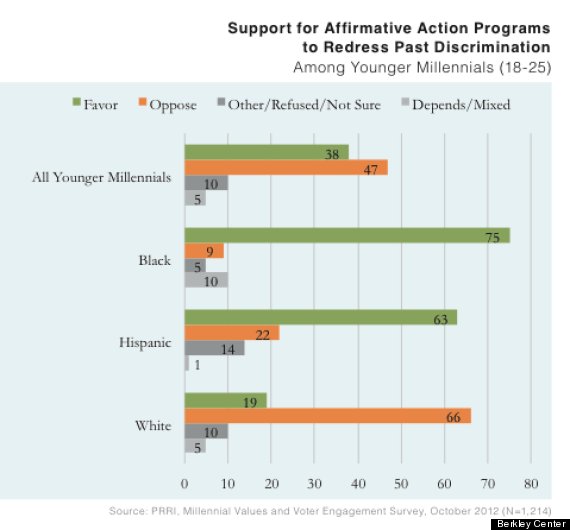
Today, nearly 6-in-10 Americans still favor the concept but when it comes to college admissions, nearly 7-in-10 believe they should be based solely on merit, including 44% of blacks and 59% of Hispanics.  The percentage has been remarkably consistent over the last dozen years, with “solely merit” at 87% in 2001 and 84% in 2003.

I believe the college experience is more productive for all students if they are exposed to a broad cross-section of ethnicities and cultures but reluctantly, I’ve come to agree that rigging admission process, however well-intended, isn’t the way to achieve that.

A poll was conducted of parents of pre-college age children a few months ago by Gallup on behalf of Inside Higher Ed. When asked if Affirmative Action hurts their children’s chances of admission, 33% agreed or strongly agreed it would, including 36% of whites, 23% of blacks and 34% of Hispanics.

But more than a fifth were neutral including 15% of blacks.  Another 42% disagreed that it would hurt their children’s chances, including 40% of whites, 62% of blacks and 41% of Hispanics.  I have friends from varying ethnicities for whom it turned out to be “reverse discrimination” and others for whom it provided a “fair shot.”

King didn’t coin the term “affirmative action.”  That was done by President John F. Kennedy a decade before it was made into law under a conservative Republican President with bipartisan support.  But from what I read in his writings and speeches Dr. King viewed it as warranted in the sense that special treatment for GIs returning from WWII was warranted.

I tend to agree with Ethan Case, a young, moderate New Jersey Republican, who blogged an essay on Millennial-driven “PolicyMic” a few months back making the case that Dr. King (paragraph breaks added to make it easier to read in this format):

“…if he were alive today and given the opportunity to rewrite our affirmative action and social justice policies, would have championed all of the poor, equally.

He would not have seen a difference between a poor white kid, and a poor black kid, with the same low economic status, from the same rough inner-city neighborhood.

Nor would he have supported a law that gives preference to wealthy black students from the suburbs over a poorer white students from the inner city.”

Rather than wasting time playing offense and defense over “affirmative action” we need to retool it to enhance “best practices” and curb abuses.

Support among Americans has been remarkably stable over the past two decades with only a third being opposed, but opinions have been split since the new millennium about the program’s application to racial minorities.

The concept’s strength comes when it is applied to gender or socio-economic standards.  Overall, in this country, a slim majority of Americans believe that one of the biggest problems is that we do not give everyone an equal chance in life.

Less than half of whites think that, compared to nearly 8-in-10 blacks and six-in-ten Hispanics.  However, nearly 6-in-10 Republicans and the same ratio of Tea Party members disagree that it is a problem.

Where we definitely agree, across racial, educational and class distinctions is that the government has a responsibility and should do more to care for people who cannot take care of themselves and to reduce the gap between rich and poor.

But there is a 30-point partisan gap on these opinions between Democrats and Republicans when it comes to helping people in need and a 57-point gap regarding the need to address economic inequality.

In my experience, Democrats are often far too slow to experiment or jettison when programs don’t work or to continually tweak programs that do work.  Republican are often captives of a stale narrative that racially stereotypes poverty and further stigmatizes it in discussions as if it were a lifestyle choice or an absence of character.

It isn’t.

The Republican narrative is one conservatives used long before embracing the stereotyping the party found so effective in the 1980s.  This is also the 50th anniversary of the 16th Street Baptist Church bombing that killed four little girls, only weeks following the “I Have A Dream” speech.

In denial that it was the Ku Klux Klan, a month later conservatives opined that it must have been the work of a “Communist or a crazed Negro” in a story that ran in their national bi-weekly journal, views that conservatives disavow today.

But As Jonathan Chiat wrote last week, while they seem far less overtly racist today, back then “conservatives and libertarians didn’t just ‘miss’ the logic of the civil-rights movement, the way you might miss the housing bubble.  They got it wrong for reasons that continue to be blindingly obvious today.”

In the words of President Bill Clinton in 1995 – “A lot has changed, and it did not happen as some sort of random evolutionary drift.”  He didn’t and still doesn’t view affirmative action as “either/or.” In the speech, Clinton called for affirmative action to be “changed to take care of those things that are wrong, and retired when its job is done.”

Unfortunately, locked in partisan gridlock, it hasn’t been changed and improved often enough. The way it is executed on a day-to-day basis is often blunt and discriminatory, and can be as harmful as it is helpful.

To me, affirmative action is a tactic and we should be guided more by our overall strategy.  Americans should avoid “telling ourselves stories” and strive to live up to the vision of Dr. King when he exhorted us all 50 years ago to shape a nation that will “live out the true meaning of its creed…”

To paraphrase, the objective is to be a nation where we are all judged not by the color of our skin but by the content of our character.

Friday, August 23, 2013

“Liberty” Angles And Passing The Torch

The research I did for an essay earlier this week about “fairness” and the related value of “equality” was something I found particularly interesting because it shed light on much more than just differences in political ideology.

It also helps explain why family members, spouses, co-workers, neighbors and business associates so often view and practice these values from such different perspectives.

Related and just as telling, is how we think of “liberty.”  Researchers such as Dr. Jonathan Haidt of NYU’s Stern School of Business have found that Republicans, mostly conservative, think in terms of what is called “negative liberty,”  the freedom to be left alone, freedom from interference.

Democrats who are mostly moderate with a faction that is liberal,  think in terms of what researchers call “positive liberty,” or having the power and resources to choose one’s path and fulfill one’s potential.

They believe government has to the obligation to remove or lower barriers to full political participation and to enable success.

Republicans view government as a threat, which makes them prone to be stubborn and obstinate, even about things to which they otherwise tend to be open.

The Republican view, Haidt explains, is the more traditional view of liberty.  They seek freedom from oppression and often view government as oppressive.  Democrats believe government has an obligation to remove barriers and “enable previously oppressed groups to succeed.”

As a moderate Independent, this explains a lot and helps clear away the obfuscation when “true believers” of each viewpoint tend to demonize the other.  It also explains why Republicans think I am Republican and progressives think I am a Democrat.

It also explains why my conservative father and I, despite a deep love and respect for each other, had such a difficult time understanding one another yet agreed on so many things.

It explains why, in my now-concluded career as an executive in public authorities and non-profits charged with generating economic improvement, so many were so frustrated that I wouldn’t bend the rules to tip the “playing field” in their favor or in support of their agenda.

It also explains why so many of us who came of age -in our 20s -primarily over the course of the 1970s, took such polarized viewpoints from the same set of life experiences, while others of us glean some validity from both world views. 

Some emerged from that era blaming the Vietnam War as government at its worst, others blamed government for giving up, for making what they stood for seem futile.

Some viewed new social policies such as civil rights and integration as worthy of extremes to achieve balance, others viewed the ways in which it was implemented as taking away their liberty.

Some viewed new environmental, safety and health regulations as improving quality of life and productivity, while others saw them as getting in their way and holding them back.

Some viewed run-away inflation as a reason for government intervention, while other blamed government for letting it occur and an inability to curb it.

This may all soon be moot.  Surveys and studies are revealing a new generation gap.  Millennials, the generation in their 20s and 30s today, do not buy the stale anti-government narrative that has dominated public discourse since the late 1970s and early 1980s.

In fact, they are substantially pro-government.  They are more ethnically diverse and even among those who are working class they are less susceptible to class divisions.  Even those who are conservative are less anti-government.

Overall, Millennials are much less about “them vs. us,” much more savvy about “agendas” and keen to spotting manipulation.  They are more capable than older generations of holding two seemingly contradictory values.

In a word, they tend to be more “moderate,” open to ideas across the ideological spectrum, open to what works, open to fixing government rather than bashing or starving it, and open to a balance of both views of “liberty.”

As often noted by political strategist Andrew Levison, being moderate isn’t just a “find the middle of everything centrism,” it is common sense open-mindedness based on “one hand but on the other hand” analysis.”

It is time for those of us forged by the ‘70s to give way.  The anti-government narrative has run its course with mixed results, mostly self-defeating.  It has evolved to become more a rationalization to justify divergence, corruption and special interests.

It is time to hand America over to a new generation.  It is time for a middle way, a third way, a middle-out way.  It a time for a better-not-smaller, more nimble and more robust public-interest driven government.

It is simply time to reboot.

God bless Millennials, God bless America.

Wednesday, August 21, 2013

Different Views of “Fairness”

One of the arguments given by Republicans in North Carolina for new legislation that rolls back “early voting” is to make it more “fair,” because people who voted early tended to favor one political party over another.

Apparently, Democrats were more successful than Republicans at getting voters to vote early and this new law is meant to erase that advantage through power rather than hard work.

Generally, in Republican lexicon, success such as this is the reward for initiative but apparently not when it comes to politics.

Sounds a bit socialist to penalize success and initiative in this way until you look at how differently Democrats (predominately moderate) and Republicans (predominately conservative) view fairness as well as equality.

I’ll explain, but first…

To me, as a moderate Independent, It seems important to bone up on these differences, because even if voters throw out those members of the General Assembly who are clearly sleaze balls, the way voting districts have been draw to their party’s advantage is probably going to guarantee that Republicans are in power for some time to come.

Even if the Independents who brought them to power swing away, the best case scenario is that we can replace sleaze balls with more honorable, thoughtful Republicans in many districts.  And believe me, they do exist.

A role model is Representative Chuck McGrady, a moderate Republican and former Henderson County Commissioner who also served a stint as national president of the Sierra Club.

Moral psychology researcher, ethicist and author of the book The Righteous Mind, Dr. Jonathan Haidt explains the different ways people along the ideological spectrum view what’s fair and what’s not fair.  But he provided a “short course” on these differences a few months ago in a quarterly issue of Democracy, a journal I read to keep abreast of how progressives think.

Don’t panic conservatives!  If anything, he seems to lean right in his book while ideological moderates keep up with thoughtful analysis at all points of the spectrum.

Even more than I remember from reading his book, In the Democracy article, Haidt zeros in more on research about the varying views of what’s “fair.”

There are two views of “fairness;” procedural and distributive (benefits and burdens.)  Democrats and Republicans hold both definitions to heart but Republicans seem a bit hung up on “procedural.”

Thus they can rationalize cutting back on early voting in some areas so it is the same across the board, even though that penalizes early-adopters and innovators in the other party.

It also explains their obsession with photo IDs, even though it is discriminatory to many who vote Democratic and what voter fraud truly exists is in absentee voting, an area where Republicans benefit.

There are two subtypes of distributive “fairness,” equality (everyone gets the same) and  proportionality (all receive rewards in proportion to inputs.)  Democrats, Independents and Republicans all endorse proportionality but those on the left simultaneously endorse equality.

According to Haidt’s research, “the right has no interest in equality for its own sake.  Conservatives prefer proportionality, even when it leads to massive inequalities of outcome.”

To put this in context, this is why Republicans felt comfortable requiring voter IDs but making no concerted effort to help those who have difficulty obtaining one, many because they don’t have birth certificates or there are inconsistencies on their birth certificates, or because they don’t trust the government not to misuse it.

For most Americans, “equality” means a “fair shot.”  To conservatives, however, “fair shot” is procedural, a belief that - “If you work hard, you’ll succeed.  If you don’t, you deserve to fail.”  Unfortunately, some elected officials are special interest “ne’er-do-wells” who seek to rig government as a means to gain success.

Democrats see a “fair shot” as not just procedural, but also a question of distributive fairness.  In my experience, some don’t worry enough about procedural fairness or how much fraud or laziness undermines whether the distribution itself is fairly administered.

In the just published 2013 Economic Values Survey, a majority of Americans believe one of the biggest problems in this country is that we do not give everyone an equal chance.

This includes nearly 69% of Democrats and 54% of Independents but nearly 60% of Republicans and Tea Party members think this really isn’t a problem.

This is a real divide in America and it strikes at the heart of the American Dream.  By ethnicity, white voters are split 47% to 44% on the issue but 77% of black Americans and more than 6-in-10 Hispanic Americans think equal opportunity is a big problem.

Related is that more than half of Americans now don’t believe that hard work and determination are any longer a guarantee of success.  More worrisome is that 56% of Americans, including 63% of whites, 39% of blacks and 36% of Hispanics, now think they can get ahead without working hard and making sacrifices.

Apparently, this includes special interests, lobbyists and elected officials who seek to rig the system in their favor.

Partisan politics aside, for anyone who ran for elected office to truly govern and to represent all of the people, not just self or petty or special interest, this has to be alarming.

If we are going to collaborate across partisan divides, we need to have a dictionary of terms handy.

Monday, August 12, 2013

Hubris Is The New Tyranny

I believe regulatory reform is necessary, not because I agree with the 4% of Americans who believe they are too regulated, but because I believe any regulation needs periodic performance evaluation.

A month ago, I was listening to my grandsons play at a Washington lake, a mile as the crow flies from the border with Northern Idaho.  I read a lot and even more next to a Rocky Mountain lake.  Two things I was reading struck me that day.

One was the so-called North Carolina Regulatory Reform Act of 2013 (referred to as House Bill 74,) the second was the just-released 2013 Economic Values Survey of Americans.  One does a disservice to regulatory reform, the other sheds light on the values we as Americans have on issues such as that.

One was driven by anecdotes and special interests, the other scientific and generalizable.

The first few pages of the North Carolina bill are indeed a step toward regulatory reform.  The other 60 pages more than justify a veto of the bill by North Carolina Governor Pat McCrory.

Stuffed with gross and vindictive overreactions to petty grievances, the bill violates the values of the vast majority of members of his party and very possibly even the state constitution while aggrieving every North Carolinian.

In my opinion, as a moderate Independent,  regulatory reform should periodically ensure regulations are being robustly executed and that the enforcement is not only even-handed but nimble.

Reform should also update and streamline regulations, purge them of pollution by special interests or political corruption and embed metrics to ensure cost-effectiveness.

Of greatest need regarding regulations is establishing a much more transparent, easy to understand and non-political process.  Much of what was dumped into HB 74 was to appease whiners and special interest lobbyists whose influence continues throughout the process of re-writing regulations.

Tragically, if signed, it comes at the expense of the general public and taxpayers.

Published last month, the 2013 Economic Values Survey is a much more scientific and accurate reflection of the way Americans think about things such as regulation.  Only 4% think we are too regulated by government.  I suspect even that percentage would not approve of what special interests dumped into legislation in my state.

The hubris that polluted the regulatory reform bill in North Carolina may be reflected in the survey,  which shows that roughly one-quarter (26%) of Americans say that people like them take absolutely no benefit from government.

This percentage zooms to close to half of Tea Party members and more than a third of Republicans and 35% of white working-class Americans.  Really?  They get no benefit from even such things as roads, schools, clean air and water?  Nothing?

One thing the majority of Americans agree on (by 6-in-10) is that government should do more to reduce the gap between the rich and the poor and take care of people who can’t care for themselves.  This holds consistent across all groups including white working-class Americans.

Millennials, by 7-in-10, even support “universal” healthcare insurance.Economic Orientation

Americans have concerns about Capitalism with 9% believing it is working well and 16% not at all.  Forty-five percent see it working somewhat well and 26% not too well.

Tellingly, Democrats think capitalism is working because it provides equal opportunity, while Republicans think it is works because it encourages personal responsibility.  Faith that it works well is consistent across affiliation, 56% Democrats, 54% Independents and 52% Republicans.

A real divide in America is that 69% of Democrats and 54% of Independents believe that one of the biggest problems in the country is we do not give everyone an equal chance.  Meanwhile, 58% of Republicans and 57% of Tea Party members think that really isn’t a problem.

Another divide is that 54% of Americans in general, including 62% of Democrats and 54% of Independents, believe that hard work and determination no longer guarantee success for most people…55% of Republicans and 56% of Tea Party members disagree.

As for overall work ethic, the percentage of Americans who think they  can get ahead without working hard and making sacrifices has fallen from 63% in 1999 to 56% in 2013.

Big majorities of Americans across all political persuasions, religious affiliation and ethnicity believe that promoting freedom, liberty and to live responsibly are very important guides to economic policy.

There is a gap however between Democrats and Independents and Republicans and Tea Party members about the importance of promoting equality and fairness when it comes to economic policy.

We generally vote by districts for elected officials but all of this suggests that we all probably need to vote as well with an eye to balancing the make-up of elected bodies in keeping with opinions among the electorate.

Apparently, it no longer goes without saying that governance is of all of the people, not just narrow interests.

It seems no longer likely that we can rely on elected bodies to vote based on the make up of electors which leaves them vulnerable to special interests and narrow ideologies.

Or we can become a true democracy and cut out representatives.  To me, when they study nuances with the objectives of doing what’s right, they perform an invaluable service.  It just seems like today, representative bodies are vulnerable to being high jacked by special interests that do not represent the majority of the people.

Maybe what we have to fear is no longer tyranny but hubris. 

Thursday, August 08, 2013

Telling Religious Progressives Apart From Religious Conservatives

To me, two of America’s core beliefs have always been “freedom of religion” and “separation of church and state.”  This influenced my selection of three of the books I read during my now-concluded 7,000-mile cross-country road-trip

It’s personal.  Many of my ancestors suffered religious persecution, some fleeing to America 375 years ago to escape it, others fleeing America 167 years ago to escape it.

These issues are not just historical.  Even today, “75% of the world’s population lives under high or very high legal restrictions on religious freedom,”  and as I departed a month ago lawmakers where I live were bent on superimposing religious beliefs on my adopted state of North Carolina, as has often been tried in various states since the 1970s.

On my trip, I read these:  If you are open to learning more about freedom of religion from both a sides of the coin, I highly recommend reading:

“Roger Williams and the Creation of the American Soul” by John M. Barry

“The First Muslim” by Lesley Hazleton

“Zealot: The Life and Times of Jesus of Nazareth” by Dr. Reza Aslan

The book about Mohammad is coincidentally written by a woman who is Jewish, the one on Jesus by a religious scholar and former Muslim turned Christian, turned Muslim.Economic Orientation

It is clear that Mohammad had alliances with Jewish tribes.  Late in life, he also had a Jewish wife and was grateful to Christians who gave Muslims safe harbor at the beginning during times of persecution by Arabs.

Cast out of Mecca for his beliefs, Mohammad was sensitive to official persecution.  It is also clear that six hundred years earlier, Jesus was very disturbed by the close connection between religion and government during his lifetime.

The Puritan cleric Roger Williams first brought to America the values of religious freedom and tolerance as well as English Common Law.

His influence on England regarding those issue extends many years after his immigration to America and both before and after the English Civil War.  Incredibly, he spans King James, Edward Coke, Roger Bacon, Oliver Cromwell. King Charles and John Locke.

The colony Williams established and nurtured in America was plausibly the first in the world to outlaw slavery in 1652.  An interesting example in the book dealt with Quakers, a belief we associate today with pacifism but whose members when they first arrived in America in the 1600s were confrontational activists and demonstrators.

The Puritans of the Massachusetts Bay Colony cracked down hard on Quakers, whipping and deporting them.  Williams was no fan of Quakers but he truly believed in not only freedom and tolerance for all religious beliefs but that government and religion should be very separate.

The book also delves into the impact of Williams on the issue of liberty.  Even under the U.S. Constitution, Americans still seem to struggle today between the Puritan view of liberty as a group vs. Roger Williams’ concept of individual liberty.

It seems that whenever the influence of religion on society is perceived to wane, those who see that as negative are alarmed and try all the harder to embed it in laws and government.

A Gallup tracking poll this year shows that 77% of Americans see the influence of religion on society as decreasing while 20% see it as increasing.

Many of those seeing the decrease as a bad thing seem to seek in desperation to embed it in laws and government, while many of those who see it on the increase fear a blurring the lines between church and state.

America seems to work best when the two perceptions are in check as they were in 1963, 1978, 1988 and 2003. Either way, many seem conflicted about the separation of church and state.

Interestingly, another newly published study documents that 19% of Americans are religious progressives, 38% religious moderates, 28% religious conservatives and 15% nonreligious (which does not mean they are not spiritual.)

Moderates outnumber progressives and conservatives combined but telling is the survey finding that:

“Nearly 8-in-10 (79%) of religious progressives say being a religious person is mostly about doing the right thing, compared to 16% who say it is about holding the right beliefs…

By contrast, a majority (54% of religious conservatives say being a religious person is primarily about having the right beliefs, while less than 4-in-10 (38%) say it is mostly about doing the right thing.”

More than 80% of religious conservatives believe that if enough people had a personal relationship with God, social problems would take care of themselves.  Nearly 7-in-10 religious progressives disagree.

Blacks are often presumed to be overwhelmingly religious conservatives but the study shows that more than half are religious moderates (30%,) religious progressives (14%) or nonreligious (7%.)  Only 28% of Hispanics and 40% of whites are religious conservatives. 

Republicans may misjudge the level of overall religious moderation or religious progressivism in this country because they are twice as likely as Independents or Democrats to be religious conservatives.

Religious progressives are also younger and more diverse and far more heterogeneous when it comes to religious affiliation.

Belying the gridlock among lawmakers today, only 25% of Americans are economic conservatives compared to 42% who are economic moderates and 34% who are economic liberals.  However, four times as many white Americans are economic conservatives as black Americans and Hispanic Americans.

Also different than what is reflected in the media or by lawmakers, only 29% of Americans are social conservatives compared to 46% who are social moderates and 24% who are social liberals.  Democrats and Independents are primarily social moderates as are 43% of Republicans and even 41% of Tea Party followers.

All of this is masked, it seems to me, by the fact that America is only representative when it comes to democracy and that representation is gerrymandered by politicians and political parties.

As a moderate Independent, it seems to me that the preponderance of social and economic moderates and liberals compared to conservatives on those issues should be of far more concern to Republicans than views on immigration.

It may also explain why so many Republicans, when they are in the majority as they are in North Carolina, appear so desperate, un-statesmanlike and prone to menace and mischief rather than seeking to govern on on behalf of all of the people of the state.

Doing a great disservice to other members of that party, they forget that it because of Independents, mostly moderate that they were elected at all.

To the issues of religious freedom and separation of church and state which came down to the founders through Locke from Roger Williams, nearly 9-in-10 religious progressives believe religion is a private matter and should be kept out of public debates while only 49% of religious conservatives hold that view.

I find this information fascinating and a useful context in which to understand the extreme actions of lawmakers today and how far out of synch they seem to be with public sentiment or democracy.

Unfortunately, far too many people are not open to information and as found in research reviewed by Dr. Keith Stanovich in his book “What Intelligence Tests Miss”, seem to “hold their beliefs like possessions.”

Wednesday, July 03, 2013

Green Infrastructure Is By Definition Moderate

Friends and readers of this blog often kid me that based on some of the topics in this blog, I often appear more progressive than moderate, as I claim.

I can see their point.  Moderates are eclectic in their views by nature.  But reading closely they will see that while I am passionate about green infrastructure, I often kid “eco-Talibans.”  I prefer bans such that result in recycling and recovery to those on consumer use.

I also believe biotech, or genetically modified, foods (GMO) can be extremely beneficial and not just because I live in Durham, NC, a center for biotechnology research, development and entrepreneurs.

I am also wary of mainframe solutions or one-size-fits all approaches institutionalized by regulations, uninformed by or restricted from practicality and inflexible to the spirit in which they were created.

I am particularly intrigued with solutions forged across seemingly ideological divides such as the case made for green infrastructure over gray infrastructure in a white paper published last month by scientists for The Dow Chemical Company, Shell, Swiss Re and Unilever in conjunction with The Nature Conservancy.

These organizations have unique histories.  About the time Dow was founded in Michigan in 1897, the business that pioneered bulk oil tankers in 1892 was being renamed Shell.  Swiss Re, a wholesale reinsurance pioneer against catastrophes, took on the hazards of operating railroads, following insuring the conveyance of visitors to the World’s Fair in Chicago.

At the time, Unilever had just created Lifebuoy Soap and was launching Sunlight flakes to revolutionize household cleaning.  Two decades later The Nature Conservancy (TNC) found roots first as a society for ecologists to “publish research and pursue an agenda to preserve natural areas.”

World War I had started and baseball slugging legend Babe Ruth began his career as a pitcher in Boston.  Officials in New York State had protected the Adirondacks and Cornell professor Liberty Hyde Bailey published The Holy Earth, elevating conservation stewardship to an ethical imperative.

Bailey had been born on the shores of Lake Michigan, 168 miles west and south of where Dow was founded - and is still headquartered - near Saginaw Bay on Lake Huron.  In 1908, he headed President Theodore Roosevelt’s national Country Life Commission.

L.H. Bailey died in 1952 when I was shy of four years old,  two years after The Ecological Society of America had been renamed The Nature Conservatory and less than three years before the organization founded the first “land preservation fund.”

Seadrift, Texas lies roughly midway between Houston and San Antonio, encompassed by the Aransas National Wildlife Refuge which protects it from the Gulf of Mexico.  Dow’s 4,700 acre plant in North Seadrift was established in 1954 by Union Carbide which it assumed as a subsidiary in 2001.

The two companies had been founded a year apart but Dow took a special interest in the Seadrift plant not because it makes plastics for wiring and drip irrigation or glycols for antifreeze and fabrics, but for its use of green infrastructure.

To expand in 1996, regulations required expanded water treatment facilities that would cost $40 million.  But an engineer, possibly inspired by witnessing the power of wetlands in the surrounding wildlife refuge, staked his career on an unconventional solution, construction of a wetland next to the plant.

At $1.4 million, it was far less expensive and now treats 5 million gallons of water per day while meeting all regulatory standards.  As a bonus it provides habitat for wildlife.  One of the few downsides, as noted in the white paper, is that it first required a 1 to 2 year pilot project and it covers 110 acres as opposed to 4-5 acres for a treatment plant.

Dow is currently taking this tactical success to a strategic level and re-evaluating the feasibility of green infrastructure substitutes to a number of its gray infrastructure practices.  The paper also discussed a project in Oman where Shell is using commercial wetlands to treat water from oil drilling.

The white paper also gives a SWOT analysis (strengths, weaknesses, opportunities, threats) of green infrastructure, an overview of risk management solutions, as well as recommendations for how to make green infrastructure alternatives scalable.

Experts from Swiss Re have a special purpose for their involvement.  The company is in the business of managing risks, including that from global climate change, for which it has been a harbinger.  While many in high office hold solutions to that issue hostage, the free market is taking it very seriously.

Officials in my adopted home of Durham are working hard to deploy green infrastructure by taking a page from its past.  As can be seen by torrential downpours here of late, the city’s park, many of which were created on floodplains, also serve as giant retention ponds to slow and cleanse run-off.

Now in an effort to purify two of Durham’s urban streams, Ellerbe and South Ellerbe creeks, as well as a Durham lake created in the 1970s as a water supply for Raleigh located further downstream, storm water officials are proposing to create a wetland where an abandoned fitness center sits in the floodplain.

The proposed site sits at a low spot that drains nearly 480 acres of storm water runoff from Downtown and the lower part of the historic Trinity Park neighborhood.  It would cleanse this water of pollutants gathered from the impervious surface of the urban core and then slowly release them to control flooding.

Hopefully, when complete, The Dow Chemical Company’s strategic assessment of a holistic, company-wide application of green infrastructure applications will include full-cost accounting.  To fully address sustainability, it will have to not only offset the company’s footprint on the environment but give back.

As its founder, Herbert H. Dow. once remarked – “If you can’t do it better, why do it?”  Companies may never be able to outperform nature, but there is a stewardship obligation to first, do no harm.”

As disheartening as it is to see those in high office try to undo stewardship, I am heartened by what may become the full embrace of the marketplace.