Showing posts with label Equal Opportunity. Show all posts

Friday, December 20, 2013

“Habits Of The Heart”

In some ways I can understand why 3-in-5 Republicans responded “no” when asked in a nation-wide poll last week if “the federal government should pursue policies that try to reduce the gap between wealthy and less well-off Americans (select party ID in drop down.)”

While decidedly out of step with the majority of other Americans, including Independents like me, I suspect most of those who responded that way are not wealthy.

While they may tell themselves another story today, like me, most were beneficiaries of policies such as this that greatly expanded the middle class between the end of WWII and the 1970s.

However, many Americans all along the political spectrum believe the safety net is in need of an overhaul to deal with “cheats.”  But the numbers who fit that category are few and it will take more money - not less - to ferret them out.

Just trying to starve them out is inhumane to the vast majority in true need.  It hasn’t worked anyway.  Failing to distinguish “cheats” from others in the safety net who may just have a bad attitude or an irritating sense of entitlement robs us of our humanity.

If shunning those with these attributes were a condition of receiving a hand up, we’d need to first purge the far greater numbers who display them while in positions of leadership at every level of our society where they are far more costly in both treasure and productivity.

Over the years, friends of mine in Durham, NC have participated in a joint-venture called Share Your Christmas, that for more than three decades has connected needy families (including 2200 children) in our community with families who want to provide presents.

Individuals or families who sponsor a needy family are given a list of items each member would wish to receive for Christmas.  The stories are heart warming.

Even though they may qualify more as “compassion by anecdote,” to use a phrase coined by conservative commentator Joe Queenan who was raised in poverty, if for only a moment they also clear away the ambiguity of virtue to borrow the title of a forthcoming book.

One year I was taken aback to see that one of the adults on one of the lists had asked for a flat screen television. This stood out because on the same list it only asked for socks and underwear for the children of that household.

It is probably narratives like this that underlie the negative responses to that question in the poll.

The forthcoming book I cited earlier is one of several recently, including Countrymen, that tell the story of what happened in Denmark during WWII.  Denmark was one of several countries where ordinary citizens stood united and refused to surrender Jewish countrymen to the Gestapo.

Bulgaria was another while neutral Switzerland, by contrast, turned away tens of thousands of Jewish refugees at its border to face certain execution.  The story of “what the rescue of the Danish Jews teaches us” is told in an incredible article in this month’s issue of “The New Republic,” entitled “How Decency Happens.”

One lesson is the huge difference between cooperation and collaboration.

The author, Dr. Michael Ignatlieff (shown in this blog,) a former member of the Canadian Parliament who now teaches at the Kennedy School of Government at Harvard, notes that:

“It is a story that reinforces an old truth: solidarity and decency depend on a dense tissue of connection among people, on long-formed habits of the heart, on resilient cultures of common citizenship, and on leaders who marshal these virtues by their example.”

Maybe instead, prior to enacting policies that once again re-hydrate the middle class by closing the gap in wealth inequality, we need to revive policies that thicken the dense tissue of connection, form habits of the heart and engender resilience among those of us with bounty.

We need to ensure that the safety net is meant only for an occasional bounce, but to do that we must heed Qweenan’s first hand advice that poverty “is a pathologically enduring, immutable condition. Not a lifestyle choice.”

Poverty must also be incredibly depressive and when addressing it, we are also well advised to remember a statement by Dr. Andrew Solomon, an author and lecturer at Cornell Medical College as well as TEDMet this past October:

“The opposite of depression is not happiness, but vitality.”

I hope you and your families are blessed this holiday season with heart-warming exchanges.  I’ll be taking a short break from blogging next week.  Thank you for reading.

Monday, September 02, 2013

Affirmative Fairness

I was astonished to learn from a public opinion survey last month for CBS News that 7% of whites and 6% of blacks believe that Dr. Martin Luther King Jr. didn’t make a difference for blacks in this country, in fact, 2% of whites and 1% of blacks believe he actually made things worse.

Since 1986, a huge anthology of his writings and speeches has been a favorite of mine whenever I need a respite for my soul, but I didn’t learn until yesterday that the soaring “I Have A Dream” segment at the end of his speech in 1963, 50-years ago last week, was improvised.

Like me, Dr. King was a political Independent and a moderate.  I was an adherent to “affirmative action” when in 1989 I was recruited to Durham, North Carolina to jump-start the community’s official marketing agency.  But I was quickly disillusioned by the way many obsessively used or more often misused it.

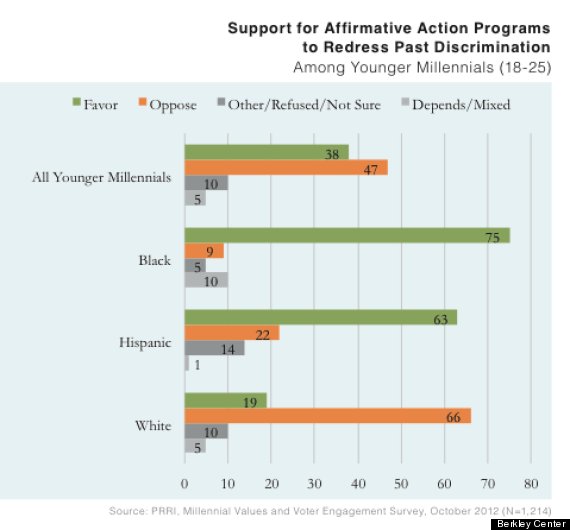
Today, nearly 6-in-10 Americans still favor the concept but when it comes to college admissions, nearly 7-in-10 believe they should be based solely on merit, including 44% of blacks and 59% of Hispanics.  The percentage has been remarkably consistent over the last dozen years, with “solely merit” at 87% in 2001 and 84% in 2003.

I believe the college experience is more productive for all students if they are exposed to a broad cross-section of ethnicities and cultures but reluctantly, I’ve come to agree that rigging admission process, however well-intended, isn’t the way to achieve that.

A poll was conducted of parents of pre-college age children a few months ago by Gallup on behalf of Inside Higher Ed. When asked if Affirmative Action hurts their children’s chances of admission, 33% agreed or strongly agreed it would, including 36% of whites, 23% of blacks and 34% of Hispanics.

But more than a fifth were neutral including 15% of blacks.  Another 42% disagreed that it would hurt their children’s chances, including 40% of whites, 62% of blacks and 41% of Hispanics.  I have friends from varying ethnicities for whom it turned out to be “reverse discrimination” and others for whom it provided a “fair shot.”

King didn’t coin the term “affirmative action.”  That was done by President John F. Kennedy a decade before it was made into law under a conservative Republican President with bipartisan support.  But from what I read in his writings and speeches Dr. King viewed it as warranted in the sense that special treatment for GIs returning from WWII was warranted.

I tend to agree with Ethan Case, a young, moderate New Jersey Republican, who blogged an essay on Millennial-driven “PolicyMic” a few months back making the case that Dr. King (paragraph breaks added to make it easier to read in this format):

“…if he were alive today and given the opportunity to rewrite our affirmative action and social justice policies, would have championed all of the poor, equally.

He would not have seen a difference between a poor white kid, and a poor black kid, with the same low economic status, from the same rough inner-city neighborhood.

Nor would he have supported a law that gives preference to wealthy black students from the suburbs over a poorer white students from the inner city.”

Rather than wasting time playing offense and defense over “affirmative action” we need to retool it to enhance “best practices” and curb abuses.

Support among Americans has been remarkably stable over the past two decades with only a third being opposed, but opinions have been split since the new millennium about the program’s application to racial minorities.

The concept’s strength comes when it is applied to gender or socio-economic standards.  Overall, in this country, a slim majority of Americans believe that one of the biggest problems is that we do not give everyone an equal chance in life.

Less than half of whites think that, compared to nearly 8-in-10 blacks and six-in-ten Hispanics.  However, nearly 6-in-10 Republicans and the same ratio of Tea Party members disagree that it is a problem.

Where we definitely agree, across racial, educational and class distinctions is that the government has a responsibility and should do more to care for people who cannot take care of themselves and to reduce the gap between rich and poor.

But there is a 30-point partisan gap on these opinions between Democrats and Republicans when it comes to helping people in need and a 57-point gap regarding the need to address economic inequality.

In my experience, Democrats are often far too slow to experiment or jettison when programs don’t work or to continually tweak programs that do work.  Republican are often captives of a stale narrative that racially stereotypes poverty and further stigmatizes it in discussions as if it were a lifestyle choice or an absence of character.

It isn’t.

The Republican narrative is one conservatives used long before embracing the stereotyping the party found so effective in the 1980s.  This is also the 50th anniversary of the 16th Street Baptist Church bombing that killed four little girls, only weeks following the “I Have A Dream” speech.

In denial that it was the Ku Klux Klan, a month later conservatives opined that it must have been the work of a “Communist or a crazed Negro” in a story that ran in their national bi-weekly journal, views that conservatives disavow today.

But As Jonathan Chiat wrote last week, while they seem far less overtly racist today, back then “conservatives and libertarians didn’t just ‘miss’ the logic of the civil-rights movement, the way you might miss the housing bubble.  They got it wrong for reasons that continue to be blindingly obvious today.”

In the words of President Bill Clinton in 1995 – “A lot has changed, and it did not happen as some sort of random evolutionary drift.”  He didn’t and still doesn’t view affirmative action as “either/or.” In the speech, Clinton called for affirmative action to be “changed to take care of those things that are wrong, and retired when its job is done.”

Unfortunately, locked in partisan gridlock, it hasn’t been changed and improved often enough. The way it is executed on a day-to-day basis is often blunt and discriminatory, and can be as harmful as it is helpful.

To me, affirmative action is a tactic and we should be guided more by our overall strategy.  Americans should avoid “telling ourselves stories” and strive to live up to the vision of Dr. King when he exhorted us all 50 years ago to shape a nation that will “live out the true meaning of its creed…”

To paraphrase, the objective is to be a nation where we are all judged not by the color of our skin but by the content of our character.