Showing posts with label Conservative. Show all posts

Wednesday, May 20, 2015

The Solution to Poverty is Both/And

I didn’t see his name on the program, but I wonder if the buzz among those attending the ecumenical and bipartisan-intended poverty summit held at Georgetown was regarding the new book edited and mostly written by Dr. Orlando Patterson at Harvard.

The Cultural Matrix: Understanding Black Youth, published several weeks earlier is not for the casual reader, not only because it is a little pricey but because it is dense with data and scientific findings associated with poverty.

It should be required reading for anyone who is serious about this issue or who gives it news coverage or those who flippantly betray their cynicism.

But be sure to have a fresh highlighter ready.

Black himself, Patterson is what is called a historical and cultural historian.  He is one of those sociologists who having unwrapped the intricacies of poverty believes in a mix of structural and cultural solutions to poverty.

One of the unfortunate obstacles to eliminating poverty is that people in general have divided into two camps advocating for what have become stereotypical and simplistic avatars for not having to delve into more nuanced and integrated solutions.

On one side are “structuralists” who view the solutions to poverty around structural improvements to society such as jobs, housing, addressing institutional racism, and improved access to food, education and healthcare.

Lately, this is the camp that has been all about pointing the finger at law enforcement as the impediment.

On the other side are “culturalists” who have closed their minds to anything but improved values and rooting out learned behaviors and traditions.

This, I think, is what some people are trying to say when they use those judgmental fighting words - “a culture of poverty,” which is a perversion from what this description meant when coined in 1970.

Of course, as Patterson points out, there is no such thing. That doesn’t mean that unwrapping and eliminating poverty shouldn’t involve a deeper understanding of cultural as well as structural and social justice influences, though.

Moderates like me are probably capable of irritating both camps.

The well-intended but underfunded “War on Poverty” was structural in nature.  Conservative opposition dating to the Great Depression and earlier was given stereotypes to cling too during the 1980s by President Reagan’s non-existent, “Welfare Queen” have been a brittle form of culturalist by nature.

Dr. Martin Luther King Jr. and several Presidents since - both Republican and Democrat - including Barack Obama have tried to weave together both structural and cultural solutions.

I read Dr. Patterson’s new book after reading a fascinating op-ed he penned in the New York Times just days before this month’s poverty summit convened at Georgetown.

Entitled, The Real Problem With America’s Inner Cities, it reminded me of when I first arrived in Durham to jumpstart community marketing here.  I was still inventorying the community when I was appointed to the board of the chamber of commerce.

Having heard some disparaging remarks both about Downtown and a blighted inner city neighborhood to the East, I invited a long-time Durham resident on a field trip.  It is an area planners have re-christened North East Central Durham by planners, although it is not really north or central, to distinguish it from those further east.

My counterpart who headed the chamber accepted my invitation to drive through both neighborhoods.  My point was to show him how bustling Downtown was at night in 1990 but to also disavow him of the impression that disadvantaged neighborhoods nearby were composed entirely of jobless poor people.

We drove down several streets with well maintained for homes and lawns.  Patterson points out twenty five years later that on average, 20 to 25 percent of residents of neighborhoods such as these are “solidly working class or working poor” who are for the most part conservative when it comes to values.

In his book, Patterson notes that another 25% of disadvantaged neighborhoods are comprised of people he classifies as “ghetto middle class,” though constantly exposed to what he calls the toxicity of a core “problem minority” that varies from 12 to 28 percent.

It is a small group, whose influence often reaches into surrounding middle class neighborhoods, spawning downward mobility among youth.

This ratio explains why in surveys more than 40% of people living in or near poverty cite a decline in the desire to work among their neighbors, a view consistent with the majority of Americans.

The remarkable advantage of the book Cultural Matrix is how Patterson and co-editor/contributor and doctoral student/researcher Ethan Fosse weave longitudinally the findings of hundreds and hundreds of studies, both quantitative and observational into a readable narrative.

There are also very practical tidbits in this extraordinary book.  For instance, those hoping to unwrap the opinions of the poorest of the poor may be misled when they espouse the importance of education and work.

This minority in the poorest minority poor neighborhoods can appear to resemble conservatives as most of them espouse values such as individual effort, personal responsibility, the American Dream and being a good parent.

They also similarly express and demonstrate negative views toward government, business and institutions (especially criminal justice,) even hip-hop.

Studies show that these normative values come from a vastly higher consumption overall of media including television and contrast greatly to a reality of “structural disconnection and cultural divergence” that results in even greater suffering.

We are all vulnerable to espousing values disconnected from our actions, regardless of where we fall on the ideological spectrum, especially it seems those who claim to be the most conservative.

It is just that our hypocrisy, but for the grace of God, does not result in our own suffering.

Wednesday, March 11, 2015

Really, Pretty Centrist

I am a self-described moderate but people who know me say I can sound “pretty liberal.”

But a core of regressives in our state legislature as well as in the U.S Congress make moderates and even true conservatives sound liberal.

In truth, I get exasperated with a tendency by some liberals to sound as though they are always trying to absolve groups and individuals of personal accountability.

An example is a story last week on New Republic by Dana Goldstein entitled, Inexcusable Absences about some truancy laws that hold parents accountable.

My concern as I read the recent DOJ report on the police department in Ferguson, Missouri, is that as a society we have an obsession now with institutional accountability.  That blinds us to an even more significant underlying problems in neighborhoods and homes.

In fact, there is ample evidence that even the problems of some individuals within institutions can be traced back to the homes and neighborhoods where they were raised.

But if you get “bleeding heart” beginning of Goldstein’s story, she makes several very valid data-driven points about how we can institutionally deal better deal with truancy institutionally, but few to enlighten societal interventions at home.

Okay, am I sounding moderate enough now?

I may have dismissed the article too soon had I not read Goldstein’s phenomenal book recently entitled The Teacher Wars, a well-written and documented overview of 175 years of American education.

It was particularly enlightening when read, as I did, in tandem with the just published revision of The Libertarian Mind written by David Boaz.  There is actually more agreement than people who only judge them by their titles might think.

This country was founded by liberals and libertarians who did not see those outlooks as incompatible.

The Teacher Wars illustrates just how old, tired and ineffective the polices are that are now being rehashed by regressives elected to high office across the country.  The far right still fails to grasp that we are not all born equal.

The book also illustrates how misguided teacher unions have been to shield unengaged teachers from consequences.

The Libertarian Mind brought to mind a friend I see on occasion frequenting a restaurant in our neighborhood.  Get him started and he will spend all the time you have and more explaining how the federal government is to blame for the collapses that brought about the Great Recession.

He has a point but fails to grasp that it is the free market that fails to incorporate the full cost of its actions into a fully sustainable cycle, instead pushing what are called negative externalities off onto society.

Taking responsibility for consequences is also a theme in The Libertarian Mind whose adherents would probably agree with the right of Michael Brown’s parents to sue the Ferguson Police Department as a rightful consequence.

But it is much more complex when consequences are enforced on poor parenting or neglectful neighbors and landlords or on personal behavior regardless of circumstances.

This is also an area today’s liberals avoid, seeming instead to absolve consequences by viewing personal responsibility through the lens of victims of circumstance such as objecting to work requirements for safety net benefits even though those were required when the nets were first erected, ironically by liberals.

Everything seems to revolve around that pesky little issue of free will.  Libertarians seem to reject any other influence and liberals often seem to sweep away free will altogether.

The sticky wicket seems to be what is blameworthy.

But none of us has been held entirely responsible for each of our actions so criminalizing poor or inadequate parenting may not ensure personal accountability either and certainly doesn’t seem fair or consistent with any of the world’s spiritual cultures.

Consequentialism and Communitarianism, are to me at the opposite ends of a spectrum, one seeming to view the world only through individual responsibility and the other viewing responsibility as a result of community interactions rather than personal behavior.

So there too, I find myself clinging as a centrist, though as I get older liberals probably see me as “pretty conservative” and my more conservative friends see me as “pretty liberal.”

Monday, June 09, 2014

It’s Healthy to be Skeptical, Just Not Cynical

Whenever I come across global warming/climate change deniers, I try to carefully listen or read what they have to say.

Some don’t really deny it’s happening.

They believe we’ll just overcome it somehow as we have major crises in the past without seeing that those were ultimately overcome by action, after being made worse by waiting.

I used warming/change in my opening because a new Yale University study shows that Americans feel a sense of urgency when the term global warming is used.

Which, in part, is why more than a decade ago savvy Republican researchers suggested the substitution of “climate change to make it seem less threatening.

That warm and fuzzy approach to global warming turned out as predicted to not only divide Americans but cause 1-in-5 to be not at all worried (p. 16.)

As an Independent I may have been cynical about the motives of “professional confusers” behind today’s gridlock but now having read this memo I’m not even skeptical.

Ironically, the 2002 Republican research called for a flip-flop.

A decade earlier conservatives had teamed in a bipartisan effort under the first Republican President Bush to break a 13-year logjam by deploying market-based “cap and trade” to successfully curb another harmful emission.

In 2002 there wasn’t the overwhelming scientific consensus there is today that climate change/global warming is a real and present danger or that it is due to human actions above and beyond natural causes over the last 250 years, especially the last 60.A Sceptic's Guide

If you are a skeptic who happened to read this far, you may want to read the research by scientists at Berkley Earth who until recently were also skeptical.

It is summarized their new report entitled, Know The Facts: A Skeptic’s Guide to Climate Change.

Then again, studies of “motivated reasoning” find that in many people skepticism is really a cognitive cover used to deflect unwelcome information.

This is especially true when it is sincerely held that what ordinary people believe will not make a policy difference.

Showing irrationality is often rarely enough to “induce individuals to process information in a different way.”

There is a difference between being skeptical and being cynical.

Skeptics have reservations.  Cynics believe others are motivated by selfish concerns and don’t believe in altruism or even honesty.

If you’ve never been into reading and understanding various philosophical outlooks, a new book illustrates each one instead, entitled Philographics.

Deniers often fall into both categories though it seems more often the latter while global warming believers sometimes can get caught up in being cynical about deniers.

New science shows that cynics on both sides run a much higher risk of dementia, especially perhaps those cynical about scientific studies.  The study also shows that cynics won’t die any earlier, perhaps they just won’t remember.

That 2002 Republican research memo predicted more than a decade ago what a new Yale study confirms: use of the terms global warming and climate change are synonymous to Republicans and Conservatives (or as we Independents often joke, is that now redundant?)

But the term climate change “actually reduces engagement” among Independents, Democrats, moderates and liberals.  Fortunately, groups that will soon dominate elections such as minorities and young adults light up when global warming is used instead.

And that might be why global warming is still the most used by Americans personally, as well as in the news media, and in conversation according to the Yale study.

The Berkley Earth report meant for climate change/global warming skeptics includes a breakdown of what events are unrelated, e.g. tornados and earthquakes.

Hurricanes, droughts, forest fires and floods may change due to global warming/climate change but the amount hasn’t been established.

There is a link established to increased heat waves and coastal flooding.

New research also shows that global warming is not only reducing snow pack where water has historically been stored until released into rivers and reservoirs each spring, the means by which 1-in-6 people worldwide receive fresh drinking water.

But paradoxically, the resulting switchover to rainfall also means these water ways are less full in part because it is held in place by soil instead.

Sitting idle, we are likely to see much more rainfall but much less available for human use for drinking water.  This also mean less available for electrical power and agriculture.

Of course the use of climate science has been outlawed for the time being by the legislature in North Carolina because it was inconvenient for a few coastal land developers.

And some members of Congress are trying to do the same regarding military research which over the last 60 years has been the foundation of nearly all of the technological changes driving American innovation.

Fortunately, corporations are paying no heed and building the price of reversing global warming into strategic plans. Nor are many states.

Nine northeast states which banded together to cap emissions in 2009 have seen their economies grow faster than the other states while reducing greenhouse gas emissions nearly five times quicker.

A similar combine of five western states and two Canadian provinces fell apart after conservatives seized control in 2010.  But British Columbia in 2010 and California last year moved ahead.

Regressives such as those banning the use of studies on global warming and other research are easy to spot.

Even those who make it onto the governing boards of much smaller organizations where research is a core value are obvious by using every opportunity to demean it and to starve it of resources and focus.

All conservatives are not regressives, nor are all regressives conservatives. What they have in common is a disdain for research and resistance to progress.

In the words of the famous Brooklyn Dodgers then Yankees announcer Red Barber, “back, back, back, back (smile.)”

Regressives in the North Carolina General Assembly today are failing to head the warnings in that landmark 2002 research for Republicans, because that would, uh, be using scientific research.

It warns that while conservative attempts to negatively brand environmentalists had been successful by 2002, Americans as a whole remain overwhelmingly sensitive about the environment.

They just prefer instead labels such as pro-environment and conservationist.

The memo warns that “when we [Republicans] talk about ‘rolling back regulations’ involving the environment, we [Republicans] are sending a message Americans don’t support” and when it comes to regulations, Americans are “most comfortable with local oversight.”

The last part is lost on North Carolina regressives seeking every means possible to strip local governments of any oversight while demonizing science and regulations meant in the publics interest.

Not all narcissists in high office (found in greater proportion and much further up the spectrum than the general populace) are regressives, but uber narcissism among regressives may explain their claim “we don’t give a damn how many people this hurts.”

Oops, I hear someone banging on my door but keep the faith.  Whoever it is that thinks I’m part of a conspiracy probably won’t remember long.

Monday, September 02, 2013

Affirmative Fairness

I was astonished to learn from a public opinion survey last month for CBS News that 7% of whites and 6% of blacks believe that Dr. Martin Luther King Jr. didn’t make a difference for blacks in this country, in fact, 2% of whites and 1% of blacks believe he actually made things worse.

Since 1986, a huge anthology of his writings and speeches has been a favorite of mine whenever I need a respite for my soul, but I didn’t learn until yesterday that the soaring “I Have A Dream” segment at the end of his speech in 1963, 50-years ago last week, was improvised.

Like me, Dr. King was a political Independent and a moderate.  I was an adherent to “affirmative action” when in 1989 I was recruited to Durham, North Carolina to jump-start the community’s official marketing agency.  But I was quickly disillusioned by the way many obsessively used or more often misused it.

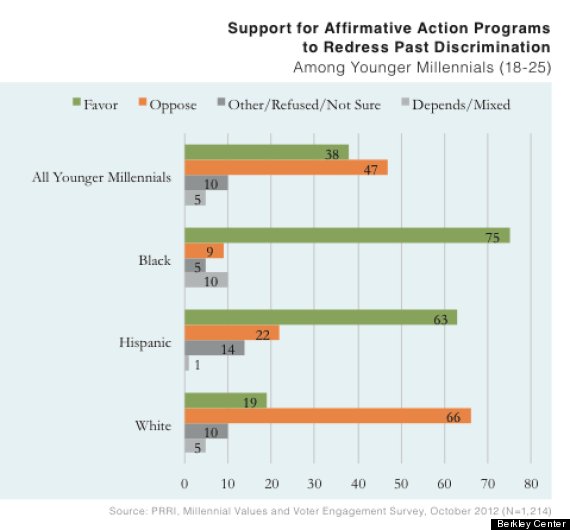
Today, nearly 6-in-10 Americans still favor the concept but when it comes to college admissions, nearly 7-in-10 believe they should be based solely on merit, including 44% of blacks and 59% of Hispanics.  The percentage has been remarkably consistent over the last dozen years, with “solely merit” at 87% in 2001 and 84% in 2003.

I believe the college experience is more productive for all students if they are exposed to a broad cross-section of ethnicities and cultures but reluctantly, I’ve come to agree that rigging admission process, however well-intended, isn’t the way to achieve that.

A poll was conducted of parents of pre-college age children a few months ago by Gallup on behalf of Inside Higher Ed. When asked if Affirmative Action hurts their children’s chances of admission, 33% agreed or strongly agreed it would, including 36% of whites, 23% of blacks and 34% of Hispanics.

But more than a fifth were neutral including 15% of blacks.  Another 42% disagreed that it would hurt their children’s chances, including 40% of whites, 62% of blacks and 41% of Hispanics.  I have friends from varying ethnicities for whom it turned out to be “reverse discrimination” and others for whom it provided a “fair shot.”

King didn’t coin the term “affirmative action.”  That was done by President John F. Kennedy a decade before it was made into law under a conservative Republican President with bipartisan support.  But from what I read in his writings and speeches Dr. King viewed it as warranted in the sense that special treatment for GIs returning from WWII was warranted.

I tend to agree with Ethan Case, a young, moderate New Jersey Republican, who blogged an essay on Millennial-driven “PolicyMic” a few months back making the case that Dr. King (paragraph breaks added to make it easier to read in this format):

“…if he were alive today and given the opportunity to rewrite our affirmative action and social justice policies, would have championed all of the poor, equally.

He would not have seen a difference between a poor white kid, and a poor black kid, with the same low economic status, from the same rough inner-city neighborhood.

Nor would he have supported a law that gives preference to wealthy black students from the suburbs over a poorer white students from the inner city.”

Rather than wasting time playing offense and defense over “affirmative action” we need to retool it to enhance “best practices” and curb abuses.

Support among Americans has been remarkably stable over the past two decades with only a third being opposed, but opinions have been split since the new millennium about the program’s application to racial minorities.

The concept’s strength comes when it is applied to gender or socio-economic standards.  Overall, in this country, a slim majority of Americans believe that one of the biggest problems is that we do not give everyone an equal chance in life.

Less than half of whites think that, compared to nearly 8-in-10 blacks and six-in-ten Hispanics.  However, nearly 6-in-10 Republicans and the same ratio of Tea Party members disagree that it is a problem.

Where we definitely agree, across racial, educational and class distinctions is that the government has a responsibility and should do more to care for people who cannot take care of themselves and to reduce the gap between rich and poor.

But there is a 30-point partisan gap on these opinions between Democrats and Republicans when it comes to helping people in need and a 57-point gap regarding the need to address economic inequality.

In my experience, Democrats are often far too slow to experiment or jettison when programs don’t work or to continually tweak programs that do work.  Republican are often captives of a stale narrative that racially stereotypes poverty and further stigmatizes it in discussions as if it were a lifestyle choice or an absence of character.

It isn’t.

The Republican narrative is one conservatives used long before embracing the stereotyping the party found so effective in the 1980s.  This is also the 50th anniversary of the 16th Street Baptist Church bombing that killed four little girls, only weeks following the “I Have A Dream” speech.

In denial that it was the Ku Klux Klan, a month later conservatives opined that it must have been the work of a “Communist or a crazed Negro” in a story that ran in their national bi-weekly journal, views that conservatives disavow today.

But As Jonathan Chiat wrote last week, while they seem far less overtly racist today, back then “conservatives and libertarians didn’t just ‘miss’ the logic of the civil-rights movement, the way you might miss the housing bubble.  They got it wrong for reasons that continue to be blindingly obvious today.”

In the words of President Bill Clinton in 1995 – “A lot has changed, and it did not happen as some sort of random evolutionary drift.”  He didn’t and still doesn’t view affirmative action as “either/or.” In the speech, Clinton called for affirmative action to be “changed to take care of those things that are wrong, and retired when its job is done.”

Unfortunately, locked in partisan gridlock, it hasn’t been changed and improved often enough. The way it is executed on a day-to-day basis is often blunt and discriminatory, and can be as harmful as it is helpful.

To me, affirmative action is a tactic and we should be guided more by our overall strategy.  Americans should avoid “telling ourselves stories” and strive to live up to the vision of Dr. King when he exhorted us all 50 years ago to shape a nation that will “live out the true meaning of its creed…”

To paraphrase, the objective is to be a nation where we are all judged not by the color of our skin but by the content of our character.

Monday, July 01, 2013

Consuming An Olympic-Size Swimming Pool

In its annual report on water quality, Durham, North Carolina where I live included the EPA’s breakdown of how Americans use water in their households (shown in the image below,) but that represents only 4% of our per capita water footprint.

The strategic approach Durham has taken to water supply since the 1920s sets it apart from other urban communities in the state, an approach found lacking in other areas of local stewardship such as urban forests and maintenance of local roadsides.

I have enjoyed reading an excellent book published this last spring by Mark Tercek, a former Goldman Sachs investment banker, managing director and partner, co-written by science writer Jonathan Adams and entitled Nature’s Fortune – How Business And Society Thrive By Investing In Nature.

The thesis of the book is that nature, including resources such as water are a form of capital and infrastructure that must be accounted as a factor of market production.  Noted is that overall in 2004 Americans used over 655,000 gallons of water per person on average, “nearly enough to fill an Olympic-sized swimming pool.

Durham residents use 23,688 gallons of that in their homes (64.9 gallons per day,) about 11% less than the national average and nearly 20% less per capita than in the year 2000. But that isn’t how we consume 96% of the water use for which we are responsible.

The authors of Nature’s Fortune note that:

“…a liter of Coke in a plastic bottle requires a liter of water for the drink itself,

a liter for production and washing,

10 liters to make the bottle and

a whopping 200 liters to grow the sugar

– a total of 212 liters (56 gallons) of water for every liter of Coke.

This is applicable, I’m sure, to other soft drink brands.

Additionally – “Many other products have surprising footprints:  660 gallons for a cotton shirt, about 120 gallons for one pound of wheat and nearly 2,000 gallons for one pound of beef.  A typical American breakfast of two eggs, toast and coffee requires 120 gallons of water…”

In another report, entitled Wasted, scientists document that getting food to our tables swallows 80% of the freshwater consumed in the United States while using 50 percent of land and eating up 10% of the nation’s energy budget and yet 40% goes uneaten, wasted at various points in the supply chain, including our homes.

Through the way we handle food, we waste 25% of all freshwater in the United States.

Soon Mugsy, my English Bulldog and I will set out on our fifth, east-west, cross-country road-trip since I retired 3 1/2 years ago.  On thing that always stands out are the mighty rivers we crisscross including the Mississippi, Missouri, Colorado and Snake and often the Ohio and Columbia.

Iowa is one of those states that always over-delivers, not just because as a native of Idaho, I am partial to “I” states.  Iowa is dotted with streams and lakes but it is bordered on each side by the Missouri and Mississippi Rivers, both of which often visit that state with devastating floods.

It also rests at the center of a watershed that drains 41% of the United States.

Like my adopted North Carolina and native Idaho, the state of Iowa is conservative in make up, although where I’ve lived, I’ve always found a spot of “blue” or “purple” where a moderate Independent can thrive and there are one or two of those in Iowa as well.

In November 2010, by a two-thirds majority, voters in Iowa rose up in the midst of the Great Recession to amend the state constitution and approved the Natural Resources and Outdoor Recreation Trust Fund endowed with a portion of a 1% sales tax.

It stands in stark contrast to the zaniness of North Carolina’s legislature which has turned instead to trying to ripping out any conservation it can and in my opinion desecrating an amendment passed here to the state constitution in 1972:

“It shall be the policy of this State to conserve and protect its lands and waters for the benefit of all its citizenry, and to this end it shall be a proper function of the State of North Carolina and its political subdivisions to acquire and preserve park, recreational, and scenic areas, to control and limit the pollution of our air and water, to control excessive noise, and in every other appropriate way to preserve as a part of the common heritage of this State its forests, wetlands, estuaries, beaches, historical sites, openlands, and places of beauty.”

Instead of trying to redeem a reputation for being backward, as North Carolina’s current lawmakers are doing, the new progressive measure in equally conservative Iowa is being used to perpetually guarantee and increase funding for:

  • lake restoration (7%),
  • trails (ensuring Iowa stays first in the nation in multi-use trail-miles 10%),
  • augmentation of grants to enhance and protect natural and cultural resources (13%),
  • local conservation partnerships (13%),
  • watershed protection (14%),
  • soil conservation and water protection (20%) and,
  • to ensure funding of its department of natural resources (23%.)

You can already see the difference, including tile and drainage on farmland to capture and slow storm run-off, trees, and most of all in floodplains along the two huge rivers bordering each side of the state.

A study published in 2010 by researchers at Duke University here in Durham, calculated that public investments in wetland restoration along the Mississippi River’s alluvial plain, including a portion Mugs and I will traverse later this summer, pay for themselves in just two years.

These critical lands when left as or restored as wetlands are worth two and a half times what they are when converted to crops such as soybeans or cotton.  The study also found that restoration of wetlands can also be lucrative to landowners.

My Idaho-rancher dad would always mutter at what he felt was an unfair burden to taxpayers nationwide when people would rebuild after floods along these two rivers.  Very conservative for his time, he was hypocritical as many holding that ideology are because he didn’t complain when the same was done to control forest fires in Idaho.

But my dad was right about something.  We must learn to let floodplains be floodplains.

They are nature’s way of controlling flooding and ensuring water quality.  Instead, an analysis conducted for Federal Emergency Management Agency is estimating that by 2100, the number of homes in special flood hazard zones is set to double from 5.5 million today to 11.2 million,

The increased risk is not all coastal.  Check out the maps in the report showing the geographic increase every 20 years.

Proving that not all conservatives are alike, in North Carolina, Republicans controlling all three branches of government talk about the virtues of local control when it comes to shunning federal programs, but then try to lord it over truly local governments by trying their best to over-ride democratically adopted standards in cities, towns and countries.

A few years ago in Durham, where I live, developers, land owners, neighborhoods and citizens met for over a year to devise and adopt a measure to create 150’ buffers along waterways.  State lawmakers are passing a law to force Durham and any other community to reduce its buffers to the state standard of 50’.

They also want to force Durham to run water and sewer to a development that is deliberately trying to intrude where residents believe it will violate floodplain and threaten a water supply.

“I” states like Idaho, Iowa, Indiana and the vast part of Illinois may be as conservative or more conservative than North Carolina but they aren’t being stupid when it comes to water quality.

They can’t afford to be, nor can North Carolina afford the arrogance of the majority of its current lawmakers.  Iowa’s humility when it comes to nature was earned the hard way. We should follow its lead.

Wednesday, June 26, 2013

Tracing the Roots of A Sensibility

I found a scribbled note of condolence recently written by my literature teacher during first semester of my high school sophomore year.

I had learned of the assassination of President John F. Kennedy (JFK) on November 22, 1963 from friends as I was walking up the hall from my biology class to the literature class where we were reading To Kill A Mockingbird and discussing its relationship to past and current events.

In my native Pacific Northwest it was still morning.

A month earlier, the Judiciary Committee of the U.S. House of Representatives had just passed the JFK’s Civil Rights Act (CRA) out of committee after a series of hearings, giving us plenty of context for class discussion around the prize-winning book that Alabama-native Harper Lee had published a few months before Kennedy’s election three years earlier.

It was in this literature class with its focus on “Mockingbird” that I first felt the powerful resonance from Dr. Martin Luther King Jr.’s “I have a Dream Speech,” delivered three months earlier, and a poignant contrast to the hate expressed during coverage of the debate of the CRA.

I can’t recall when the semester began if was aware that civil rights leader Medgar Evers had been gunned down in Jackson, Mississippi within hours of when President Kennedy had announced his intent to submit CRA legislation to Congress, or that federal marshals had integrated the University of Alabama only hours earlier.

Even without today’s hyperactive attention deficit fueled by 24/7 news at the time, these events seemed distant and siloed as we were coming of age in the Northwest when interspersed with rights of passage such as drivers training.

But we were all in shock following news of the assassination as we settled into our desks to pick up continued discussion of “Mockingbird” and the CRA, which even more personal from that day forward.

Then, very subtly, the grief expressed by a few whose parents opposed both Kennedy and the Act gave way to sickening relief-tinged inferences that the country had somehow been saved, similar to a few my conservative-Republican father made at dinner that night before being shushed by my equally conservative but more sensitive mom.

My Dad always had difficulty with grieving.

This is when my political ideology began a move toward the center, away my family’s and away from party affiliation.  Six weeks later and just 13 days after the U.S. release of “I Want To Hold Your Hand” by The Beatles,  the House passed the CRA.

People forget that while 96 representatives voted against it, only 34 were Republicans.  Racism and intolerance were far more open and blatant back then but they were also more bipartisan than they seem today.

By March of 1964, as the Senate moved the bill to the floor for debate, the rank of Eagle Scout was pinned to my uniform.  I remember being revolted by the racist rhetoric in the national news and how hollow it seemed to make the Scout Oath sound.

I didn’t feel comfortable with President Johnson, probably because I was still mourning JFK’s murder.  As the Senate voted to close off nearly three months of filibuster and then pass the CRA, I was high in the Rockies on a ten-day, 60-mile hike with friends using pack-horses to march through the Bob Marshall Wilderness in northwestern Montana.

As we heard the news on our return, conservative Republican Senator Barry Goldwater was wrapping up that party’s nomination for President.  I had been leaning toward Goldwater because he was a westerner but then I heard the rhetoric he used to appeal to southern states and learned he had been one of six Republicans along with 21 Democrats to vote against the CRA in the Senate.

Controversy raged for several years over the CRA, much as it has the Affordable Healthcare Act, because it applied to private businesses as well as public agencies.  Goldwater’s opposition was ostensibly not about race but about states’ rights, an argument that had also been used to justify more than 250 years of slavery, subsequently perpetuated by peonage and then Jim Crow laws.

His candidacy marked the beginning of the purge of liberal and moderate Republicans from that party to the degree that near the end of his life in 1998, Goldwater appeared very moderate, even liberal, by comparison.

His campaign loss launched Ronald Reagan’s political career.  The CRA and that party’s transformation also launched an exodus of entire neighborhoods from southern California up into Idaho, marking the beginning of the end of my native state’s progressive, moderate and bipartisan heritage.

My own ideology stayed center through graduation from high school and into college at BYU, which was much more moderate itself in those years.  I was initially hawkish on the war in Vietnam and leaned more progressive on issues such Civil Rights.

Through the late 1960s my support for the war waned and significant levels of student concern about civil rights and the war (even small protests) took hold even at BYU in the late 1960s and early 1970s.

The CRA continued to be an issue through the 1968 Presidential election.  We know now from memoirs and other documents that the Republicans led by soon-to-be elected President Richard Nixon had learned to code images and appeals to those who were racially intolerant by racializing references and images as crime.

We know from his chief counsel’s 1970 book, Witness To Power, that the campaign “went after the racists” as supporters while Democratic candidate and CRA-spearhead Hubert Humphrey’s campaign was marginalized by “Yippie-led” protests at the Democratic Party convention in response and outrage to the tragic events of 1968.

It can be argued that this movement still haunts progressives more than 40 years later but America still underwent a major shift toward greater racial acceptance during the 1970s due to the CRA and subsequent voting rights act.

Maybe it is always less painful to view events through literature.  The writers of last year’s hit HBO TV-series The Newsroom gave an excellent and concise summary of the impact of the “Yippes” on Democratic Party politics in 1968.

More relevant to today, the clip contrasts this with the way ultra-conservatives and racists have coopted the Tea Party and its influence on Republicans today, only as the dialogue clarifies, Democrats wouldn’t have nominated or elected “Yippies.”

This literary analysis is an excellent lens through which to understand the zaniness of the Republican-led legislature in my adopted North Carolina today, where each day brings a new outrage, marginalizing legitimate issues.

Maybe literature has always had a tremendous influence on events.  Remember, President Lincoln’s quip in 1862 upon being introduced to Harriet Beecher Snow, the author of Uncle Tom’s CabinHe stated, “So you are the little woman who wrote the book that started this great war!"

Similarly, in my opinion, the influence of the Academy Award-winning 1962 adaptation of To Kill A Mockingbird on the passage of the CRA cannot be overstated.

My preferences for insight today are biographies and historical analysis. Two books have provided me a clearer lens through which to view how racism in this country has moved between bigotry by individuals and groups to structural racism still so evident today although much harder to detect.

Making it even harder, ironically I was at this point in writing this post when it was announced that in a 5 to 4 vote, the Supreme Court had struck down portions of the Voting Rights Act, which had stood since 1965 until they can be updated by our dysfunctional Congress, which is gridlocked by representatives of the offending states who make up half of the Republicans in congress.

The Man Who Saved the Union by H. W. Brands was published last year, at the time another great book published in 2010, The New Jim Crow, by Michelle Alexander was updated.

They also provide a lens through which to see the realignment of today’s political parties through different eras.

The Democrats of that day were forced to compromise with Republicans on the issue of slavery to get the Constitution adopted.  By the time of the Civil War, southern Democrats defended slavery and Republicans opposed it.

After the Civil War, Republican-President Ulysses S. Grant  had to repeatedly send federal troops into the South to thwart attempts to intimidate blacks and find alternatives to slavery as a means to undermine civil rights, including amendments to the U.S. Constitution.

However, when he was succeeded by Republican-President Rutherford B. Hayes, the Republicans gave in to its business/financial wing of the party and withdrew troops from the South, abandoning it along with their support of civil rights to the so-called “redeemers” of the Democratic Party who were rabidly intent on finding alternative ways to enslave.

This enabled various surrogates for slavery that only began to give way after WWII, first to watered-down civil rights legislation passed after being proposed by Republican-President Dwight. D. Eisenhower and then the landmark legislation in 1964 and 1965, which unfortunately many in the Republican Party are trying to undermine today.

It is the World War II generation, shamed by our own country’s hypocrisy while defeating the Nazis, that came home passed those bills, not hippies or yippies and definitely not John Birchers.

Alexander’s book gives an excellent overview of attempts to undermine racial tolerance and equality from the advent of slavery through colonial times, and up to the CRA and after but its thesis supports the view that a form of structural racism was substituted by Republicans in the early 1980s through policies and racialized images of crime in a reiteration of another war on drugs.

More in a subsequent blog on my personal observation of Alexander’s thesis at work when I relocated to North Carolina in 1989 and how her book has helped me to audit my own stereotypes.

Wednesday, May 08, 2013

One of the Most Dangerous Occupations is Wasteful

Yesterday was the day in the Durham, North Carolina neighborhood where I live, for “getting it up” as sanitation workers often refer to the weekly pick up of garbage and recyclables.

A sleek, newer model, Leach rear-loader came up the street interrupting an exchange with my neighbor about food waste and his past as an underwear model and Broadway musical performer.

That line of work (picking up garbage and recyclable, not modeling underwear/musicals) was the fourth most dangerous line of work in 2011.  It varies slightly each year but it is always more dangerous than law enforcement or firefighting.

Our neighborhood is usually served by one of those one-person trucks with a long arm that reaches out and empties the container.  A crew of three operated the rear-loader yesterday, reminding me of my job as a summer vacation replacement working on a a much earlier rear-loader model out west in 1967 between my first and second year of college.

Back then the waste stream for food was proportionately 50% less than it now.  Even so, my parents may not have known the danger I was in.

Or maybe they knew that work on a ranch or a farm such as the one where I was born and spent my early years in the nook of Idaho just outside Yellowstone Park ranks during most years just ahead of or slightly behind refuse and recyclable collectors as the most dangerous.

Maybe they were just glad that my stint spraying Lodgepole Pines to fight an infestation of Mountain Pine Beetle in the northern reaches of Targhee National Forest lasted only a month.  Logging is almost always the second most dangerous occupation, although I’m sure inhaling DDT overspray had its risks, too.

Picking Up is a new book by anthropologist Dr. Robin Nagle at NYU.  Focused on New York City, it is an informative and funny history of sanitation work over the last several hundred years, including a time when people who picked up the garbage were celebrated even more than doctors as lifesavers doctors.Food Waste

Discarding unused food may be one of the most wasteful behaviors in America.  A recent report by food and agriculture scientist Dana Gunders, entitled Wasted: How America is Losing Up to 40% of Its Food from Farm to Fork to Landfill, is fascinating.

In the U.S. food eats up 10% of energy, uses 50% of land and 80% of all freshwater consumed here.  According to the analysis, “Americans are throwing out the equivalent of $165 billion of food each year,” fueling a significant portion of greenhouse gases and climate change.

It hasn’t always been this way.  In the 1970s, a few years after my stint on a sanitation truck, Americans were wasting half as much food. Currently, throughout the supply chain and in places such as our homes and restaurants, we’re wasting 38% of the grain, 50% of the seafood, 52% of the fruits and vegetables, 22% of the meat and 20% of the milk produced.

Part of the solution is eating food grown closer to home.  The number of farmer’s markets have more than doubled to more than 6,000 in just the last 10 years.  Unfortunately, in supermarkets up to one in seven perishables delivered is thrown away.

Losses such as these are also a problem in conference hotels and convention centers.  Within a couple of years from when we launched the community-destination marketing organization for Durham in 1989, that organization became one of the first in a network called “Food for the Hungry.”

Coordinated by Profession Convention Management Association (PCMA,) it launched one of the first programs to coordinate the donation of unused perishable or prepared food from banquets to organizations here serving people in need.

The issue of food waste has also spawned worldwide growth in a phenomena known as “Freeganism” including a reality TV show called Waste Cooking, not to be confused with the episode of Seinfeld where the character George Constanza gets caught rescuing an Ă©clair from the trash at a dinner party.

A report in the U.K. estimates removing food scraps there from landfills would abate the equivalent in greenhouse gases of a fifth of all the cars in that country.

Hopefully, I haven’t used any semantics that a new study shows can turn off many Conservatives.  But at least I know they may be attentive from the perspective of sanitation workers.  Conservatives are nearly twice as likely to watch TV shows about blue-collar jobs as Liberals.

Only slightly less likely are Independents such as me!

Tuesday, May 07, 2013

Gun-Loving, Tree-Hugging, HOG-Driving and Flag-Waving

I love guns, so imagine my surprise last Friday when the Governor of Texas labeled me as among those “who hate guns, hate gun owners.”  It reminded me of a time shortly after I moved to Durham, North Carolina to jumpstart the community’s destination marketing organization.

Part of my job was to defend Durham, which I did every day.  Not long after I got here, I received word from a colleague that a law enforcement official in a nearby county noted that I had best careful if ever traveling through there.  Gulp!

Guns were a part of life where I was born.  I spent my early years on a horse and cattle ranch along the Henry’s Fork on the Idaho side of the Tetons, but it wasn’t my grandfathers or even my rancher father who first taught me to shoot.

They all viewed guns as useful tools around ranch and farmland to protect livestock or occasionally to harvest a head as food, usually including one or two for neighbors or friends.  Occasionally they would hunt with friends, but my father who was a 35th Tank Battalion veteran, always seemed ambivalent about firearms.

It was my substitute 4th grade teacher who first taught me to handle a rifle and enjoy target shooting, along with her son and our mutual best friend.

Similarly, I learned that my proud Roosevelt Democrat great-grandfather would famously stop the school bus he drove for years along the route out to Cedar Fort, Utah and teach the kids how to handle and shoot a rifle.  Earlier in life he had been a sharpshooter atop trains transporting gold from the mines at nearby Mercur.

My brush with a kindler, gentler and far more reasonable and collaborative NRA was while obtaining a marksmanship merit badge on my way to earning Eagle Scout in the years before that organization was hijacked by the gun hardliners.

With all due respect to Governor Perry and the NRA, a lot of people who love guns also believe that more thorough background checks are reasonable and won’t “take them out of the hands of those who use them properly and legally” as he threatens.

Based on the views of my 84-year-old conservative Republican mom who sees the universal background checks as reasonable, maybe the Governor was just playing to the narrative to which his NRA audience has been restricted.

My mom could easily ascertain that the checks were designed not to enable a registry which the legislation prohibited or to stop criminals but to make illicit sales more difficult and illegal trade in firearms easier to trace.  We are both among the 86% of Americans who support the extension of background checks to those buying online and at gun shows.

To be fair, one should listen to the Governor’s speech in context.  He and his audience are equally well-advised to read the now-tabled legislation and its failed bi-partisan amendment rather than rely on paid lobbyists and special interests.

As a political independent, I’m disgusted when people pander to any ideology at the expense of good policy, regardless of their party affiliation or where they fall on the political spectrum.

I lose patience for those who want to make it harder to vote but easier to have firearms.  Or those who want safety-net recipients checked for drug use but want to protect the illicit gun trade or those who resent federal interference but make every attempt to override democracy at the local level.

There are reasonable arguments for all of these each issues but this inconsistency and hypocrisy undermines them.

It is easy to demonize opposing views as many speakers have at the recent NRA event.  To better understand both gun “lovers” and “haters,” I recommend a humorous new book entitled Gun Guys: A Road Trip, by journalist and gun guy Dan Baum.

My gun guy cred is limited to family keepsakes but I found that Baum put a more human face on people involved with guns than does the NRA.  He also gives a much better perspective on views across the ideological spectrum on the issue.

Unfortunately though, it seems that far too many on the right are now making decisions not in the tradition of intellectual curiosity championed by the late William F. Buckley Jr., but on semantics.

A just-published study co-authored by Dr. Rick Larrick at the Duke Fuqua School of Business here in Durham, reveals that many conservatives reject projects marketed as “green” merely because they see it as a liberal agenda.

Really?  Of course, along with being a gun-lover, you can count me as a tree-hugger. While you’re at it count me also a card-carrying, HOG-driving, Eagles-for-Equality, trout-protecting, flag-waving all-American who supports better regulatory management of firearms.

Tuesday, January 15, 2013

Education Entitlement Imperative

In March of 1867, during battles with ultra-conservative-Democratic President Andrew Johnson over how to re-organize the South following the Civil War, the Republican Congress, controlled by liberals and moderates, managed to pass, and the President subsequently signed, new legislation establishing a national department of education to collect statistics.

Conservatives had long opposed compulsory public education.  Fearing even the collection of statics, the department was soon-after demoted from cabinet level to the status of office.  However, in 1870, under the new act and the new administration of President and Civil War hero U.S. Grant, the government began to conduct statistical surveys.  In 1872, Congress authorized the hiring of the first statistician.

This is how we now know that between 1870, around the time many of my great-grandparents were born and 1952, two years after I was born, “every decade was accompanied by an increase in 0.8 years of education.”

Unfortunately, that annual bump in the level of education stopped thirty years ago.  It probably isn’t coincidental that this was also when the middle-class went into decline and about the time conservatives -- by this time mostly Republicans -- took power as well as aim at government and education policy.Seven distinct youth segments - Mckinsey Survey '12

Ironically, it was conservatives who, in 1642, first put compulsory education into law.  The Puritans of the Massachusetts Bay Colony were ultra-conservatives, but they believed education was a moral and social imperative.

However, it would be another 210 years before Massachusetts established compulsory attendance, which reminds me of a hotelier-friend of mine in Durham, NC where I live, who found that asking prospective employees if they had a car was insufficient, so added the question, “and does it run?” 

By 1900, pressed by the Progressive Movement, 34 states including four in the South had legislated compulsory schooling if even for as little as a few weeks a year.  This included my native Idaho, first settled by my great-grandparents in 1860, which embedded education in its pre-statehood constitution in 1887. 

By 1907, North Carolina, my adopted home now for nearly 25 years, followed suit and finally, Mississippi became the last state to do so in 1917.  By 1910, 72 percent of American children were attending school.

Back then, half the nation's children attended one-room schools as my father did during the 1920s and 1930s in the Yellowstone-Teton nook of Idaho.  By 1918, near the end of the Progressive Era, every state required students to at least complete elementary school.

It isn’t clear why conservatives have so often opposed education.  You almost need a scorecard to keep track of when conservatives have been in control of each of the major political parties in the US.

When I need a break from writing essays such as these, I often pick up a small book entitled The Good Of This Place, a collection published by Dick Brodhead, a friend of mine in Durham, who is currently President of Duke University.

Before ascending to become president of Duke, Dick had been the long-time Dean of Yale College.  One of my favorites in the book, which was published just as I retired, is entitled Taking Democracy to School, a 2001 pre-9/11 lecture he made as part of the De Vane series to mark Yale’s 300th anniversary.

Here, Dick tells the story of an 1778-80 public education legislative proposal made by Thomas Jefferson entitled “Bill for the More General Diffusion of Knowledge” during the time he was elected Governor of Virginia while the American Revolution was in full swing.

To me, Jefferson and James Madison were the conservative Republicans of their time, resisting change, especially when it came to proposals by other founding fathers to abolish slavery.

The bill was repeatedly submitted by each of these men and a watered-down version was finally passed by the Virginia Commonwealth in 1796, well after formation of the United States of America and a constitutional compromise that would leave slavery in place until the Civil War triggered passage of the Fourteenth Amendment.

In this speech, Dr. Brodhead points out several “paradoxes of democratic education” contained in Jefferson’s proposal:

  1. “It failed partly because Virginia voters were unwilling to entrust their local schools to a statewide system…largely because they refused to assume the tax burden…”
  2. “Jefferson would make the school the great equalizer, the tool for neutralizing differences of income and family standing [except slaves.]
  3. His whole three-tier apparatus is an elaborate sorting device, a mechanism for separating the persons of superior parts and blessing him with further advancement.”

I can imagine the characteristic twinkle in Dick’s eye as he dryly notes that – “When Jefferson speaks of best geniuses being “raked from rubbish,” the limits of his egalitarianism comes clear.”

Today, education is an entitlement but a sense of “entitlement” is not limited by socio-economic status or level of education or privilege.  In 2011, while summarizing some of his research, Ed O’Brien, phd candidate in psychology at the University of Michigan noted that – “For some, a dull moment can seem like an eternity, whereas for others there is no such thing as a dull moment.

Fortunately, for the most part, I have always been more like the latter but especially now in retirement.  The study found that, unfortunately, for people who feel entitled, time passes oh, so slowly.

According to a 2012 McKinsey Global Institute survey, there are 75 million unemployed youth around the world, one in eight between the ages of 15 and 24.  For them, time is excruciatingly slow. The figure increases to 225 million when counting those who are underemployed.

Yet, paradoxically, only 43% of the employers surveyed in nine countries including the United States could find enough skilled entry-level workers.

Of those of student-age who didn’t attend post-secondary school, 57% are “too cool” (in my opinion, a form of entitlement) and 43% are “too poor.”  Another 18% are “disengaged” and 26% are “struggling.”

The McKinsey report analyzes three “critical intersections” for students, educators and employers: 1) enrolling in post-secondary education, 2) building skills, and 3) finding a job.

“Cost” is the top barrier to enrolling in college, denying nearly a third of high-school graduates access.  Among those who go on, only “46% are convinced they made the right choice as far as selecting institution or field of study.”

For those who do go on, there is a big disconnect at “building skills,” the second intersection, with 60% citing on-the-job training and hands-on learning as the most effective instructional techniques, “but fewer than half of that percentage are enrolled in curricula that prioritize those techniques.”

In my experience, many of the students in the surveys seem to feel “entitled” as do many prospective employers which are as much impediments as any failure by educational institutions to make adjustments.  At the third intersection, a quarter of youth fail to make a smooth transition to work.

The report proposes some improved models and in the United States, a Career Readiness Partner Council coalesced just a few months ago to evolve a new model between employers, policy-makers, educators, students and families.

However, I am more persuaded that a critical part of the answer is to be found by expanding the social and moral imperative for education into pre-school years.

Programs such as Smart Start, which brings together all the people involved in a pre-schooler’s life— “families, teachers, doctors, caregivers, social workers, and many others” as well as the More at Four program, have been proven effective by researchers at Duke University.

A recent Gallup survey of students reveals that student engagement with learning and education is highest during elementary school at 76%, falling to 61% by middle school and 44% in high school.  Fixation on standardized testing is one of the culprits.

I am convinced that even early intervention, well before elementary school is the answer to creating a lifetime enjoyment of learning.

Thursday, October 25, 2012

The Priority Place-based Trait Across the Political Spectrum

A fascinating new study asked thousands of people who are ideological liberals, moderates and conservatives to rank the attributes and traits important to judging a city or town or area in which to live.

The results confirmed why two North Carolina cities such as Durham and Raleigh, even though they are separated by only two other towns, continue to diverge culturally because they appeal to different groups of people.

But to me, it boils down to what a reporter for a large city daily newspaper once remarked to me, “one of these towns just as well be Tulsa and the other Kuala Lumpur.”Place Traits by Ideology  In other words, their difference was like night and day!

However, what was interesting from this survey is that “clean air and water” rank not just first out of 47 attributes for liberals but also second for moderates and third for conservatives and libertarians. (click on the image and scroll down to the second chart.)

More often than not, the challenge is to “connect the dots” for people when it comes to things that threaten clean air and water.  People see a roadside billboard and may or may not even notice the inherent blight it creates, but if they could see or equate it with the fact that, in order for the billboard to be seen, the destruction of trees and vegetation that clean our air and water is necessary, and in addition, soil erosion and stream pollution will be direct results, we would most likely want to become truly billboard-free.

Billboards have continued to pollute roadsides long after all but 8% of the population has ceased to find them useful even over the course of an entire year because that industry is not only very effective at political rent-seeking through heavy contributions to political campaigns and arm-twisting of elected officials, but also because the billboard industry is effective at shaping the pro or against debate as positioning them as the underdog.

In reality, the debate is actually over defense of clean air and water and freedom from blight, values held by more than 7 out of 10 North Carolinians today and even protected by a constitutional amendment in the early 1970s.

I’ve witnessed first hand recently that support instead for an increasingly obsolete and increasingly destructive mode of advertising in the current North Carolina General Assembly such as roadside billboards is more a signal that elected officials, appointees and even some administrators seem far more responsive to special interests than public opinions.

I am not sure if moderates, like me, were studied but psychological research noted in this post by Dr. Brittany Liu at the University of California Irvine shows that conservatives are drawn to cognitive coherence while liberals are better able to handle cognitive complexity.

As a moderate myself, I relate to fact that moderates are probably more mixed.  I was immediately drawn to Durham more than two decades ago by its diversity and authenticity, but I am often puzzled when we seem to take fragmentation to new levels such as the incoherent way we’ve approached urban forestry and way finding signs along roadways which by its very nature must be coherent to mean anything.

Yet remarkably, even though three or four individuals tried their best to undermine it and still refuse to embrace it, Durham is one of the few communities where diverse groups across the community are able to work together to distill an overarching brand to communicate the personality, values and traits distinctive to the community to external audiences.

Regardless of who is elected or re-elected President of the United States, I am persuaded by this post by Dr. Ravi Iyer, a postdoctoral researcher at the University of Southern California VIMLab, that we have more in common across the political spectrum than we are led to believe.

We just need to pay more attention to our common values and less to labels.

Monday, October 15, 2012

Choices and Entitlement

The sentiment has been expressed before in many variations but none better than how it was phrased by CBS Television Studios’ writer Sarah Byrd (credited in part to supervising producer Adam Targum) for an episode of CSI: New York two weeks ago in lines delivered by Det. Mac Taylor played by actor Gary Sinise:

“The events of our lives shape us. But it’s our choices that define us.”

That, and in my personal experience, an awful lot of luck.

As Wall Street Journal conservative columnist and humorist Joe Queenan once wrote for another publication referring to his own upbringing in poverty - “It is a pathologically enduring, immutable condition.  Not a lifestyle choice.”

When some of the first government social safety nets emerged during the Great Depression in the mid-1930s, they were accompanied by volunteer and work requirements to ensure dignity, self-reliance and self-respect.

With common roots in Chicago’s Hull House, the vaunted welfare program of The Church of Jesus Christ of Latter-Day Saints (Mormons) was launched in 1936 and is structured even today around a recipient volunteer program.

But for the entire 400 years since colonization of this continent began, we as a society have worried, as phrased by business professor and ethics researcher Dr. Jonathan Haidt in his book The Righteous Mind, that people might “rely upon the safety net for more than an occasional lifesaving bounce.”

Who knows how much better safety net programs would be today if partisan hostility had not stripped funding out of the government programs that enabled associated oversight of conditional volunteer and “pay it forward” programs.  The Mormon welfare program is as successful as it is because of the more than 870,000 of associated volunteer-days on welfare farms and in storehouses and distribution centers.

Mormon officials report that individual recipients typically receive aid for three to six months while they volunteer, but my experience growing up in that culture tells me there is a small percentage of recipients, some multi-generational, who, just as is seen in government programs, never seem to be able to fully escape the vicious cycle of poverty described by Queenan.

Entitlement is no more common among the poor than it is with people who are educated or middle class or rich or in parasitic, rent-seeking corporations such as billboard companies.  A classic example appeared in a news story last week from Raleigh, which is near Durham, where I live.  A person quoted in the story questioned, while noting she had a PhD, why she should have to refrain from interrupting her boss and I suspect other forms of social and business etiquette?

It seems that both liberals and conservatives are too caught up in playing offense and defense over the condition of entitlement and other issues and have been for more than 20 years.

While more willing to join moderates in compromise, liberals have been far too dismissive of concerns raised by economists and sociologists, both White and African-American, about the troubling by-products of safety net programs, many of which these experts helped devise.

These included The Rediscovery of Character: Private Virtue and Public Policy by the late Dr. James Q. Wilson, The Moral Quandary of the Black Community by Dr. Glenn C. Lowry, now at Brown University or The Content of Our Character by Dr. Shelby Steele, now a senior fellow at Stanford University’s Hoover Institution, all penned between 1985 and 1990.

As noted by researchers at the non-partisan Center for Evidence-Based Policy and the Brookings Institution in a Washington Post op-ed last April written by Daniel Stid a partner in The Bridgespan Group, since 1990 rigorous government evaluations of 10 overarching social programs using randomized trials found “9 out of 10 yielded weak or no positive effects.”

Gridlock, primarily forced by conservatives, has made a more nimble and entrepreneurial approach impossible; although to his credit, President Obama has found ways to fuel program innovations anyway, often by end-running the bureaucratic process.

Economic conservatives, having abandoned half of their “intellectual ammunition,” to paraphrase New York Times columnist David Brooks, have forgotten a founding principle of that movement that it is “best to reform steadily but cautiously” and turned instead to fiscal strangulation and a social mobility Dance of Death.

As Thomson Reuters Digital editor Chrystia Freeland wrote in yesterday’s New York Times in an article entitled The Self Destruction of the 1 Percent, adapted from her book published last week entitled Plutocrats: The Rise of the New Global Super Rich and the Fall of Everyone Else, today’s conservatives seem to be following the playbook of Venetians at the turn of 13th century.

And that didn’t turn out too well.

Tuesday, October 02, 2012

Making It Hard To Remain A Moderate

I subscribe to a quote, written by the conservative icon William F. Buckley Jr., as a litmus test for anyone I encounter who still purports that there is any value in increasingly obsolete, outdoor, roadside billboards.

To anyone still advocating for billboards, I suspect the acerbic Buckley would quip, oh, “do you have one in your front yard?”, as he wrote in an essay in his 1968 collection entitled The Jeweler's Eye: A Book of Irresistible Political Reflections.”

Buckley, who passed away in 2008, famously wrote in that same essay, “billboards are acts of aggression, against which the public is entitled, as a matter of privacy, to be protected.”

In the essay entitled “The Politics of Beauty,” Buckley challenges anyone owning or advertising on roadside billboards “to construct (one) facing his own homestead rather than the public highway, in order to remind him, every time he looks out his window…certainly should be left free to do so.”

There may be an exception, but billboard company execs don’t like to live in neighborhoods with or near billboards.  Fearing backlash from neighbors they usually reserve the big boards for poorer neighborhoods instead.

In the essay, Buckley also challenged Libertarians, the most conservative of conservatives to take on what he saw as an abuse of the argument for the principle of private property by billboard companies.  Often billboard companies buy or lease property to erect a billboard that is behind a grove of pre-existing roadside trees and then apply for a permit to cut them down, arguing the right to be seen.

In my opinion, billboard companies are not really free marketers, they are more like freeloaders, paying little in fees and less than the cost of a couple of steak dinners in annual property taxes.  They weasel out of compensating the public for the trees they destroy, if not exempted entirely such as was done for them by recent legislation passed in North Carolina.

Most egregious is the fact that they pay nothing for the scenic easements they destroy.  Economists view these companies as rent seeking because rather than creating value, they use campaign contributions and lobbying to secure gratuities along public roadways that they didn’t pay to create.

Courts call this parasitic, but lawmakers seemingly blinded by cash and strong-armed in the hallways of the legislature, have yet to prioritize the electorate’s right to a view of nature along public roadways.

I am a moderate and an Independent but I miss Buckley and the thought-provoking stimulation of his essays in the National Review as well as the wit he exhibited during interviews on his long-running television talk show, Firing Line.

To me Buckley represented the now nearly extinct traditional conservatives so eloquently described a few days ago in a column in the New York Times by David Brooks entitled The Conservative Mind.

Brooks laments that “conservatism has lost the balance between economic and traditional conservatism. The Republican Party has abandoned half of its intellectual ammunition. It appeals to people as potential business owners, but not as parents, neighbors and citizens.”

Ironically, Buckley and Russell Kirk, who are credited with giving form to modern conservatism following World War II, and the late President Reagan who also represented a more diverse and thoughtful conservatism, might be excommunicated by today’s conservatives.

One thing is for sure: Locked in “polarized political conflict with liberalism” as Brooks writes and with seeming disdain for mutual respect or the common good, those who dominate today’s conservatism make it incredibly difficult to remain a moderate.

However, whenever I find myself tempted to tune out today’s robotic conservatives and shift away from my moderate comfort zone, I reread the Ten Conservative Principles by the late Russell Kirk, who lived in Durham, NC, where I now live, in the 1940s as a graduate student at Duke University and whose 1953 Ph.D. dissertation “The Conservative Mind – From Burke to Eliot” was published as a book.

If you are a liberal or a moderate like I am, or a conservative who is dismayed by today’s robotic brand of conservatism, reading Buckley and Kirk is a way to regain perspective and appreciation and understanding for the best in that ideology.

Wednesday, May 16, 2012

Innovating Social Welfare

As I was growing up in the Yellowstone-Teton nook of the Book of Mormon belt that arched from southern Alberta, Canada to Mexico and sweeping over Las Vegas to San Bernardino, a claim was often heard among the million adherents at that time that the federal Government had copied the Mormon welfare system.

That has never been substantiated, but both systems did both tap into some common lineage before coming of age during the mid-1930s and the Great Depression.

While they may not have crossed paths, within a little more than a year the entrepreneurs behind each plan had volunteered at Chicago’s Hull House, a turn-of-the century outcome of the Progressive movement and were mentored by its founder Jane Addams.

Amy Brown Lyman, who would go on to lead the Relief Society, a Mormon women’s auxiliary, stopped in Chicago during the summer of 1902 on her way east during her husband’s sabbatical and not only took a class at the University of Chicago in the relatively new subject of sociology but also volunteered at Hull House.

After accepting a teaching position in 1904 in Lake Forest, Illinois, Frances Perkins volunteered for Addams at Hull House before becoming a cabinet officer through all four terms of the Roosevelt administration and championing the Social Security Act of 1935.

Thanks to written and oral histories left by a slightly younger contemporary, my great aunt Vera White Pohlman, the full story of Amy Brown Lyman’s contributions have re-emerged and informed scholarship such as that by Dr. David R. Hall of Cal State Fullerton.

The lifetime contributions of Lyman support a claim often made today by Dr. Mathew B. Bowman (no relation), a professor at Hampden-Sydney College north of Durham where I now live, that Mormonism is as much a “community” as a church and that while it is the most conservative of all faiths today, its members have a “surprisingly deep affinity for Progressive politics.”

When she returned to Utah from that sabbatical, Lyman lobbied passionately for creation of a social welfare department in the Mormon Church which she led for many years after its creation in 1919.

She even won election to the state legislature in 1922 to champion Utah’s participation in a nationwide program to promote infant and maternity care as well as establishing a hospital and a training school for the mentally disabled.

The common struggle shared by Perkins and Lyman was how to scale up social welfare to the size needed to truly address the magnitude of the challenges.  Republicans then as now opposed any role of government, hoping instead that disparate private agencies would somehow suffice.

Lyman was famous for reaching out to both non-profit agencies as well as local and state agencies to leverage efforts by the Mormon Church until behind-the-scenes lobbying among male leaders finally forbid it.  The mastermind behind that move was a former Hoover administration official, J. Rueben Clark.

Perkins succeeded and so did Lyman in a way.  Mormon leaders who disparaged Roosevelt programs as the “dole” when they were launched in 1935, created an “inversed projection” by creating a “dole” of their own in 1936 by gathering, standardizing, centralizing and reinventing a number of programs including Lyman’s while freezing her out of the process.

Unfortunately, the program was hampered by politics, both gender and ideological, including a condition that can lead “individuals or groups to subconsciously rationalize a contradiction in their own self-conception by painting themselves as the victim instead,” something hardly unique to Mormons and often witnessed in news stories today.

But as effective as the 1936 Mormon welfare program was back then and as remarkable as it has evolved into today, it was no match for the scale of hardship during the Great Depression.

Statistical reports by federal officials at the time document that the by-then isolationist Mormon welfare program didn’t come anywhere close to making Mormons along the Rockies self sufficient from the federal programs nor were pioneers such as Lyman unaware of the problems associated with the inevitability of increased government involvement.

Overwhelmingly Mormon back then, Utah had among the highest per capita use of federal welfare programs during the Great Depression, yet, the church program stubbornly insisted it was “taking care of our own.”

Church members weren’t officially reauthorized to leverage efforts with those of other public and non-profit agencies until approximately 1991.

What is increasingly apparent to many experts today is that far too many social welfare programs are not cost/effective.  They have lost the nimble and innovative characteristics with which they were inaugurated and long ago it became too expensive to provide recipients to work volunteer in return.

Too much time is wasted on attacking or defending rather than just cutting ineffective programs, trimming waste, eliminating fraud while also increasing funding for innovation and research for those programs that are effective.

All of this should be informed by the growing scientific evidence about human interactions with incentives including sense of entitlement.