Showing posts with label Foodie. Show all posts

Thursday, September 18, 2014

Ingredient Missing from Restaurant Sustainability

I found interesting in a new survey by the National Restaurant Association: that only 39% of restaurants overall recycle plastic, cans or glass.

This includes nearly half of all full service restaurants, but only a third of quick service restaurants (fast food.)  The percentage that recycle cardboard and paper goes up to 67% and 66% respectively.

Around 61% use products made from recycled materials but only 4-in-10 use products that could be composted.

In fact, only 17% compost food waste, although 75% regularly track the amount of food waste.

A 2012 report noted that food serve operations alone lost 86 billion pounds of food in 2008 or 19% of the U.S. retail supply.

Between 4 to 10 percent of food loss in restaurants is lost during kitchen preparation.  Diners waste, on average, 17% percent of meals or more only 45% is taken home as leftovers.

Only 22%, including 20% of full service restaurants, donate leftover food to food banks or other groups.

This contributes to the fact that 40% of the nation’s overall food supply is going to waste each year.

On average, each American wastes 209 to 254 pounds of edible food each year.  In the Eco Pulse survey last year, 39% of Americans felt the “most green guilt” over wasting food.

One area of “sustainability” conspicuously missing from the NRA survey is the number of restaurants paying at least a “living wage.”

For nearly two decades now, how businesses treat people has been one of the three pillars of the “Triple Bottom Line” of sustainability.

In a poll of small businesses this year, 61% of those in the restaurant or retail industries supported raising the minimum wage.  Of course the minimum wage is nowhere near the livable wage which is computed specifically by areas of the country.

The restaurant business is tough, especially for locally-owned chef-driven restaurants that give places such as Durham, North Carolina where I live a “foodie” reputation nationwide with visitors, a characteristic now cited as important on “intensity” indices by leisure travelers including 71% of Millennials.

But so is sensitivity to prices.

As noted by the Durham News Service, a new breed of local chef-restaurant owners in Durham are now leading the charge across the nation to voluntarily pay their co-workers a living wage.

It is based on the sound business principles such as paying people a living wage and a sense of fairness resonate just as much with residents and visitors here as using locally sourced foods.

Polls by both Gallup and Harris Interactive, show that among the several industries in the tourism sector, restaurants are viewed well above average with a net positive of 60 points and 53 points on public opinion polls respectively.

But that doesn’t mean this handful of distinct industries shouldn’t work on improving outdated business models to be fairer when it comes to treatment of employees.

By nearly 4 to 1, Americans are now more likely than in the past to investigate business behavior before buying including 6-in-10 who decide not to do business with an entity based on how it conducts itself and 7-in-10 who talk about it in conversations with others.

If you think that won’t matter, just ask the NFL.

Wednesday, September 10, 2014

The Face of the Earth Moved like the Waves of the Sea

As the only son of an only son of Idaho ranchers stretching back to its territory days and a decade earlier in Utah, after 116 years, I was the end of that line.

Beginning in 1850, most had raised, trained and traded horses with only a few head of cattle for personal consumption, but some were in the cattle business.

But beginning in the 1870s, those raising horses also began adding herds of cattle they would sell commercially.  By the time I came along, my parents raised mostly cattle and only a few horses, many to work the ranch but some purely for nostalgic reasons because of the famous genetic lines they symbolized.

In his incredible 1990s book entitled, Beyond Beef: The Rise and Fall of the Cattle Culture, Jeremy Rifkin who writes and lectures on a broad range of economic, social and technological issues, reminds us that at one time what is known as Western Rangeland actually covered 40% of the continental United States.

It stretched up from that remarkable part of northwest Texas I traversed during a cross-country road-trip last month into Oklahoma and Kansas over across parts of New Mexico and Arizona, up across half of Colorado, into Wyoming and parts of Montana and the Dakotas, then west across parts of Idaho and most of eastern Oregon nipping a part of northern California.

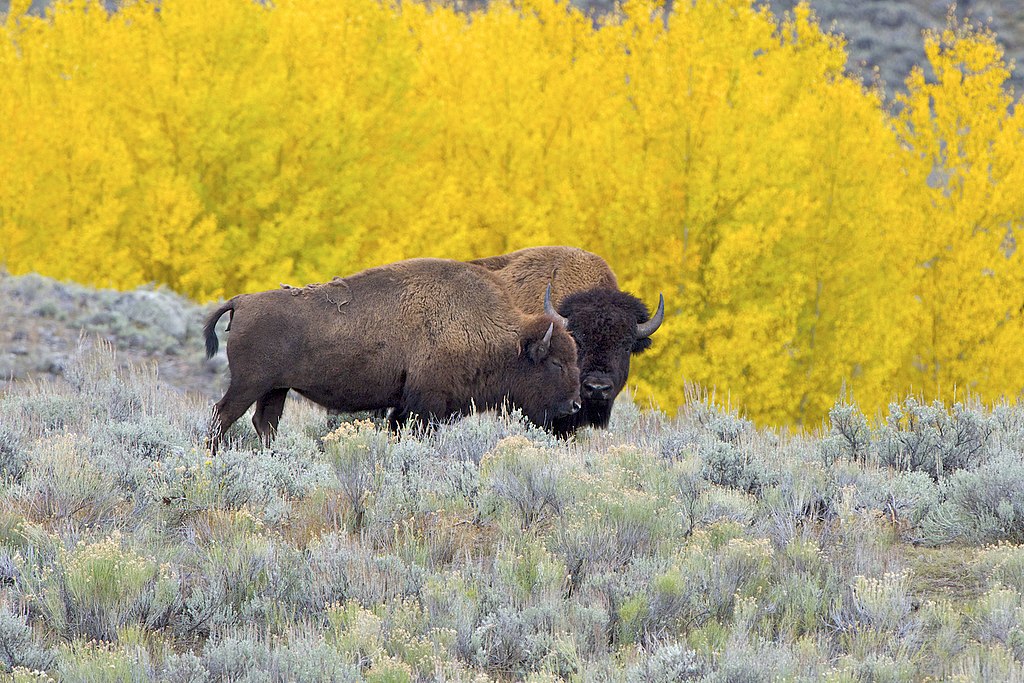
We think of this as being the range for Buffalo, a bovine relative of cattle.  But this rangeland, while perfectly suited, is just where vast herds of these feral creatures had been pushed by the 1840s when all of my ancestral lines headed into the Rockies.

But at one time the range of Plains Buffalo stretched to Durham, North Carolina where I concluded my career, and up to Anchorage where I had spent a decade in the 1980s prior to being drawn here.

Before he headed west to blaze a road over the Cumberland Gap into what is now Kentucky on behalf of the Transylvania Company, Daniel Boone worked for a month while being outfitted in what is now northern Durham County for its secretary William Johnston at his Little River store.

When Boone headed over the Blue Ridge Mountains, it was along trails previously blazed by Buffalo.  Other Americans also followed further north in the Appalachians into the Ohio River Valley and then all the way to the Pacific along routes my pioneer ancestors followed.

My great-great grandfather, one of three ancestors on the vanguard wagon train heading west in 1847, was one of ten men assigned to hunt Buffalo along the way being careful not to take more than needed.

At the time, Kansas, Nebraska, Wyoming and Montana didn’t exist even as territories, and their destination was still part of Mexico.  During the second month of that 1,100 mile trailblazing effort, they began to see seas of Buffalo in what is now west-central Nebraska.

Near what would become Gothenburg, one member wrote that “the prairie on both sides of the river is literally black with Buffalo.”  Another wrote that it was as if “the face of the earth was alive and moving like the waves of the sea.”

There were days when they passed herds of Buffalo stretching for 20 or more miles.

Twenty years later, naturalists, based on range carrying capacity, estimated there were 60 million buffalo on the Western Range, a number experts now believe was closer to 30 to 40 million.

But in the 1860s after the Civil War, Wall Street colluded with the railroads, cattlemen and the U.S. Army to exterminate the Buffalo from the Western Range, replacing them with hundreds of thousands of head of cattle and scores of Native American people with cowboys.

All that tells me that my ancestors thought differently; that several were interpreters with Shoshone, Bannock, Paiute and Hopi and their policy to feed them rather than fight them.  But by shifting more and more to cattle, they were obviously enablers.

Telling is that in 1864, Idaho’s territorial legislature became the first to pass laws protecting Buffalo, but it was already too late there.

By around 1880, 30-40 million Buffalo had been replaced on Western Rangeland by 600,000 cattle, and by 1879, Idaho ranchers alone had driven 100,000 head to railheads there for shipment.

But those same railroads brought settlers and the open range succumbed to barb-wire fencing by the 1880s.  Ranchers had also saved 100 Buffalo from extinction.

Today there are about half a million head on non-public lands including those served as a beef alternative in restaurants such as Ted’s Montana Grill here in Durham, one of 44 across 16 states.

Bison meat is naturally lean, tender, and protein and nutrient rich.  About 60,000 a year now make it to restaurants and stores, double since 2002.

Another 30,000 find sanctuary on public preserves including Yellowstone Park adjacent to our ancestral ranch.

This includes a herd of 350-500 on the National Bison Range set aside by President Theodore Roosevelt in 1908, and then populated with private funds.  It’s northwest of Missoula, Montana at the base of the Bitterroots where they form the line with Idaho.

There are still about 15,000 Buffalo that conservationists estimate roam wild.  There are 2,564 operations raising Buffalo commercially, bringing the number in the U.S. and Canada now to 340,000.

Nationwide, ranches like the one in Idaho where I was born and spent my early years now hold 87.99 million head of cattle, the fewest since I was a rising three year old in 1951.

Seventy-percent of the land area of the Intermountain West (Montana, Idaho, Wyoming, Colorado, New Mexico, Arizona, Nevada and Utah) is still rangeland used for grazing livestock even though today it is for only for six months instead of the years it did when I was growing up.

It was only 12 years ago that there were only 50 grassfed cattle operations in the U.S, now there are thousands.  Still, nearly all of our beef comes from cattle “finished,” a euphemism for fattened in feed lots.

While the feed-lot technique was pioneered in Chicago in 1876.

Before then fattening was done for only a week or two at the railhead to prepare them for the ardors of shipping.  But then came refrigerated railcars and gradually the fattening was done not to compensate for weight loss during shipping but to make them fatter faster.

This took off very slowly though until veterinary antibiotics converged with federal policies during the Nixon administration to fuel corn and grain production in the early 1970s.

There is a feedlot in Idaho, just southeast of Boise that fattens 150,000 head of cattle at a time, a third more than was driven to railheads by my ancestors and others in an entire year in that state in 1879.

That company has another closer to Boise that holds 250,000 head but they don’t hold a candle those two in Amarillo, Texas that fatten 800,000 or one between Denver and Fort Collins that handles more than that alone.

The number of head in my native Idaho as of last year was up slightly to 2.3 million, while the number of head in my adopted home of North Carolina increased to 820,000.

This due in part to a trend back toward local family stock growers supplying local residents as well as locally-owned restaurants in foodie counties such as Durham with grass-fed beef.

But as, author, food journalist and son of the founder of Baskin-Robins, John Robbins details in his book entitled No Happy Cows: Dispatches from the Frontlines of the Food Revolution, there are no easy solutions.

Wednesday, January 15, 2014

The Hyper-Localness of Sense of Place

One thing you quickly learn growing up on a family cattle ranch, such as I did in the 1950s, is that beefsteak has a distinctive taste based on the geographic region where the cattle are raised and grass-fed.

Judging by the number of people in the nook of Idaho between Montana and Wyoming that specifically sought a side of beef only from my dad, that taste varies even within a locality.

I suspect the flavors specific to our ranch came from volcanic soils and spring-fed waters that had gathered tastes as they filtered for hundreds of years through rhyolite lava flows.

That water bubbled up from Big Springs (image shown below by Robert English) to form the Henry’s Fork of the Snake River and recharge groundwater where it was again filtered down through the nestled calderas of Henry’s Fork and Island Park created by past supervolcanic eruptions.

It then emerges from the slopes of Big Bend Ridge onto the ranchland and meadows along its base such as ours.

Further south, these same waters contribute a distinctive flavor and texture to seed potatoes which are then replanted much further south again giving Idaho its famous Russets, heralded on restaurant menus nationwide.

Both our cattle and those potatoes are taste- and sense of place-distinct, just as are the Jersey Beef grown on Bull City Farm in Durham, North Carolina, long identified as one of the “foodiest” towns in the nation and where I have lived since the 1980s.

Long before these terms were coined, “foodie” and “local-sourcing” emerged in Durham’s DNA.  Newbies may misattribute their notoriety here to Downtown Durham’s resurgence, but quite the opposite, Durham’s long pre-existing restaurant culture, when transplanted, fueled that revitalization.

“Local” plays a role in six of the top ten national culinary trends for 2014, including specifically ranch- and farm-branded produce, dairy and meats.

Altering Durham’s DNA, beginning more than thirty years ago, Durham chefs led by Georgio Bakatsias (Bok-i-shaw,) Ben and Karen Barker and Mary Bacon began relying on local-sourcing and even hyper-locally sourcing meats, dairy, produce and seafood either grown in Durham or nearby including their own gardens.

As they mentored, they also passed the importance of locally-sourcing foods to generations of other now-acclaimed Durham chefs such as Scott Howell, Amy Tornquist, Chris Stinnett, Phoebe Lawless, Matt Kelly and Billy and Kelli Cotter.

But going back even further, locally-sourced food products can be traced back in Durham more than two hundred years to locally-grown grains milled at Cole Mill and West Point, as well as famed dairies such as Croasdaile and livestock growers such as Quail Roost.

From the time it was formed twenty-five years ago, this uber-organic food scene was woven into every fiber of Durham’s overarching personality and appeal by its community marketing agency, and today it is viewed as much a part of North Carolina’s brand as its vaunted scenic beauty.

Communities began to lose their distinctive taste when transportation enhancements resulted in food products traveling now an average of 1,500 miles before they reach our grocery stores or restaurants.

One must also be extremely wary when the term “local” is used today which is often attributed to sources in a 500 mile radius.

More than just semantics or attempts to encourage more sustainable practices, locally-sourced foods have tastes that differ even within a community.  Foods sourced from northern Durham, for example, where many of its farms are located, will have gleaned the much older taste of slate.

Any foods gleaned to the south of downtown are more likely to exhibit the influences of shale, accented by Trilobites, extinct marine arthropods.  Yum, yum!

Both Durham tastes are distinct from flavors elsewhere even within the same poly-centric sub-region such as those locally-sourced in nearby Raleigh or Wake County.

Dining out is one of the two most frequented activities overall by visitors in the United States.  Recent surveys show that 83% of travelers make it a point to experience foods specific to a destination.

A destination’s locally-sourced food products will influence even the taste of recipes that aren’t distinct to a location.

Food may not be exclusive to a community, but the way it is manifest can be as much a part of a community’s distinct personality and brand as its building materials or architecture or species of trees or heritage or indigenous events or scenic character.

In the end, all local is hyper-local.

Monday, October 07, 2013

Rural Character & Destination Farmland Heritage

Fall in Durham is heavenly on a Harley.  Much of this single-city county (fourth largest) is still rural and being re-populated now with small “farm-to-table” farms that Durham’s marketing organization leverages to fuel its nationally-renowned foodie reputation.

This scenic farmland was recently used as a “hook” for a publication that recently capitulated Durham to one of the five great US destinations to visit.

One of my all-time favorite routes is southeast along South Lowell Road, which I played a role working in partnership with the legendary Bill Johnson to qualify as one of North Carolina’s Scenic By-ways, one of the few located in an otherwise urban county.

From there, I jog down past Green Button Farm, then east again across Lake Michie and up past Bull City Farm and Elodie Farms.  The roads are winding and forested recalling a time when engineers really knew how to make a road contour to its surrounding landscape.

Bull City Farm would be called a ranch in my native Idaho, as they are livestock growers including lamb and “grass-fed Jersey beef cattle.  Where I was born and spent my early years on an ancestral ranch, we didn’t know any other means to raise cattle than “grass fed.”

Where I turn south again toward the part of Durham where I live is a stone’s throw from North Carolina State University’s “Beef Cattle Field Laboratory.”

Many folks over in Raleigh where NCSU is located have always seemed a bit geographically challenged.  Even though many at that noted university have Phd.’s they misidentified the facility’s location as “Butner,” a town in the next county over, although it is in Durham.

When the mistake was brought to their attention, they changed the description as being on the Durham line but not the name.  Lost on whoever made the mistake was the very cool “alignment” of having the “bull testing” facility in the same county with the “Bull City.”

Mislabeling like this has consequences.  Raleigh was recently named the third best city in which to start a business, an accolade I think well deserved.  But all the announcement in Forbes could find noteworthy is what Raleigh is near:

“This North Carolina city is close to Durham and Chapel Hill, which are both home to major research universities… (and) Research Triangle Park” [which by the way is also in Durham.]

Truth in labeling then would be that greatness is nearby but thanks to the diligence over the years of Durham’s marketing agency, at least Forbes and the researchers conducting the analysis mention the locations as non-Raleigh assets rather than just attributing Durham features to Raleigh as they once did.

In far too many communities this problem can usually be traced back to a self-centeredness that can contaminate news articles and confuse researchers as well as undermine the ROI from “buy local.” 

Bull City Farms is one of 700,000 family-owned cattle-growing operations in the United States representing 35% of all farms.  But this operation is part of only a third that raise their calves after weaning and continue to graze them such as we did in the 1950s along the Henry’s Fork in the Idaho shadow of the Tetons.

By 2008 as the great recession reached crisis level, cattle production accounted for only 40% of average farm product value on best cow-calf farms in the U.S., much of which is in the Southeast.  By then more than a third of the people operating these operations worked off-farm.

About 6 million head of America’s beef cattle are raised in the Southeast but the operations are much smaller in size.  Here they average 453 acres including 200 acres of pasture and about 59 head.  Nationwide, ninety percent of cattle growers use private pasture for grazing.

As an article reported recently on Mother Jones, the perception of corporate farming fueled by the news media is a bit more complicated.  It exists, but “barely.”

According to a new report entitled Apples to Twinkies, authored by healthcare policy analysts, 75% of those farm subsidies the House of Representatives left in place when it moved instead to deprive millions of working families from food stamps, goes to just 3.8% of farms nationwide.

The tiny minority who finagled the House into this move to ostensibly cut government spending is the same group that a few weeks later shut government down entirely, costing taxpayers $300 million per day.  But I digress.

Between 1995 and 2011, this included $18.2 billion in tax subsidy for junk food additives while very little went to healthier agricultural products.  In other words, about $7.58 per tax payer was spent to subsidize junk food vs. 27 cents on apples.  North Carolinians alone subsidizes 89.8 million Twinkies but only 2.4 million apples.

Rates of obesity are an outcome.

Federal policy to guide food production is hijacked by huge special interests rather than incentivizing healthy eating and small slow-food operations such as Bull City Farms.

The good news, according to Nielsen, is that we are going about shopping differently than we did before the recession.  Globally, the average shopping trips per person was 158 back then and it has fallen to 144 today, although we spend much more per trip.

Underlying this trend is that while 80% of global consumers cite spending more time with friends and family as a priority, 49% of online consumers make purchases online.

Even though Durham is now the fourth largest city in North Carolina and shoehorned into the 17th smallest county by land area, setting aside so much of its land in watershed is also paying other dividends.

Not only does it safeguard the rural part of Durham’s personality, but coupled with Durham’s dramatic emergence as a visitor destination since 1989, its foodie reputation is fueling a resurgence of small, sustainable farms.

The number of farms in Durham fell from 1,600 in 1910 to fewer than 200 two years after I was born in 1948, where it hovered for many decades.  Today, the number has rapidly increasing, probably past the 300 mark.

In no small part this resurgence is due to Durham’s farmland preservation program established in 1996.  But it can also be traced to Durham’s launch of community marketing a few years earlier.

Farmland is not only about scenic preservation, it is about preserving sense-of-place and heritage which is so central to visitor-centric cultural and economic development. 

But the nature of farms in Durham has changed.  According to a Durham friend of mine who blogs at Science Time, all but gone are those that raised tobacco, which thanks to the 1998 tobacco settlement has fallen to half of what it was in 1910 and a fraction of what it was in 1992.

Today, 50% is devoted to raising hay or forage which is better for the soil and the environment as well, as public health.

Growing is the percentage devoted to food crops and livestock and most of this resurgent farming is supported by Durham’s foodie culture which in turn has grown in tandem with its reputation with visitors.

FYI, for information on Durham farms you can visit, click here.  For farms in other nearby communities, click here.  Triangle Grown, by the way, is one of many ways destination marketing organizations in this “family of communities cooperate as a means to facilitate intra regional day-trip visitors.

Wednesday, May 08, 2013

One of the Most Dangerous Occupations is Wasteful

Yesterday was the day in the Durham, North Carolina neighborhood where I live, for “getting it up” as sanitation workers often refer to the weekly pick up of garbage and recyclables.

A sleek, newer model, Leach rear-loader came up the street interrupting an exchange with my neighbor about food waste and his past as an underwear model and Broadway musical performer.

That line of work (picking up garbage and recyclable, not modeling underwear/musicals) was the fourth most dangerous line of work in 2011.  It varies slightly each year but it is always more dangerous than law enforcement or firefighting.

Our neighborhood is usually served by one of those one-person trucks with a long arm that reaches out and empties the container.  A crew of three operated the rear-loader yesterday, reminding me of my job as a summer vacation replacement working on a a much earlier rear-loader model out west in 1967 between my first and second year of college.

Back then the waste stream for food was proportionately 50% less than it now.  Even so, my parents may not have known the danger I was in.

Or maybe they knew that work on a ranch or a farm such as the one where I was born and spent my early years in the nook of Idaho just outside Yellowstone Park ranks during most years just ahead of or slightly behind refuse and recyclable collectors as the most dangerous.

Maybe they were just glad that my stint spraying Lodgepole Pines to fight an infestation of Mountain Pine Beetle in the northern reaches of Targhee National Forest lasted only a month.  Logging is almost always the second most dangerous occupation, although I’m sure inhaling DDT overspray had its risks, too.

Picking Up is a new book by anthropologist Dr. Robin Nagle at NYU.  Focused on New York City, it is an informative and funny history of sanitation work over the last several hundred years, including a time when people who picked up the garbage were celebrated even more than doctors as lifesavers doctors.Food Waste

Discarding unused food may be one of the most wasteful behaviors in America.  A recent report by food and agriculture scientist Dana Gunders, entitled Wasted: How America is Losing Up to 40% of Its Food from Farm to Fork to Landfill, is fascinating.

In the U.S. food eats up 10% of energy, uses 50% of land and 80% of all freshwater consumed here.  According to the analysis, “Americans are throwing out the equivalent of $165 billion of food each year,” fueling a significant portion of greenhouse gases and climate change.

It hasn’t always been this way.  In the 1970s, a few years after my stint on a sanitation truck, Americans were wasting half as much food. Currently, throughout the supply chain and in places such as our homes and restaurants, we’re wasting 38% of the grain, 50% of the seafood, 52% of the fruits and vegetables, 22% of the meat and 20% of the milk produced.

Part of the solution is eating food grown closer to home.  The number of farmer’s markets have more than doubled to more than 6,000 in just the last 10 years.  Unfortunately, in supermarkets up to one in seven perishables delivered is thrown away.

Losses such as these are also a problem in conference hotels and convention centers.  Within a couple of years from when we launched the community-destination marketing organization for Durham in 1989, that organization became one of the first in a network called “Food for the Hungry.”

Coordinated by Profession Convention Management Association (PCMA,) it launched one of the first programs to coordinate the donation of unused perishable or prepared food from banquets to organizations here serving people in need.

The issue of food waste has also spawned worldwide growth in a phenomena known as “Freeganism” including a reality TV show called Waste Cooking, not to be confused with the episode of Seinfeld where the character George Constanza gets caught rescuing an éclair from the trash at a dinner party.

A report in the U.K. estimates removing food scraps there from landfills would abate the equivalent in greenhouse gases of a fifth of all the cars in that country.

Hopefully, I haven’t used any semantics that a new study shows can turn off many Conservatives.  But at least I know they may be attentive from the perspective of sanitation workers.  Conservatives are nearly twice as likely to watch TV shows about blue-collar jobs as Liberals.

Only slightly less likely are Independents such as me!

Friday, May 03, 2013

Calibrating A Foodie Culture

“The average person eats no more than thirty foods on a regular basis,” according to the new book Gulp by Mary Roach.  That is also the number of restaurants I frequent in Durham, North Carolina where I live.

In retirement, I know I eat out too much.  However, Durham’s reputation with foodies was established long before that term was coined and more than thirty years before Southern Living recently crowned us the “The South’s Tastiest Town.”

Durham is no stranger to accolades, even related to its foodie ecosystem, but it didn’t take news reporters here long to turn the newest “feather” into a story about our resurgent Downtown area.The South's Tastiest

Long before Downtown Durham’s reawakening, the Ninth Street, Rockwood and Brightleaf districts were earning Durham nationwide restaurant accolades.  Even before revitalization efforts were launched, this reputation was spilling over into  the City Center district.

I remember making a bet with a friendly local newspaper reporter over dinner one night in 1995, that Brightleaf was part of Downtown.  He lost the bet but continued to argue that since several other old tobacco factories separated Brightleaf from the center of Downtown back then, it didn’t count.

Now even those historic factories he saw as a demarcation have become repopulated by numerous restaurants, bars, offices, public services, shops and condos.

Today, while fawning over Downtown, news reporters often forget or have no memory that Durham was a thriving restaurant community long before the reawakening of its central business district.

Nor was “zero sum” ever a factor in its long slumber.  Just as American Tobacco is assumed to have spurred Downtown’s current renaissance, it is likely that spillover from districts outside of Downtown deserve some of the credit as well.

A study released this week by the NPD Group found that 42% of diners frequent their favorite restaurants regardless of promotions.  Only 9% “go where it is cheapest while 26% “switch around based on promotions.  Surprising to me was that 19% seldom eat out and 4% rejected any of these choices.

Quality, a combination of food and customer services, is the key driver of restaurant loyalty. An earlier NPD report showed a decrease in deal-driven consumers and that specials offered over a length of time are perceived as regular pricing.

Durham’s appeal as a dining destination was already emerging when the community’s first official destination marketing organization (DMO) was launched two dozen years ago and that reputation was quickly made a promotional centerpiece.

In the last few years though, food-related visitors were made one of a handful of focus areas and the results are clear. Visitors generate a third of foodservice revenue nationwide and the percentage is even higher in destinations such as Durham.

A billion visitors will stay this year in hotels and other lodging properties worldwide.  Nearly four billion will frequent restaurants.

However, the challenge for Downtown and other dining districts is to refocus on helping existing dining establishments become sustainable.  I fear that the “a more the merrier” frenzy fails to grasp how incredibly delicate survival is in the dining business. 

Each year, Nielsen computes a Restaurant Growth Index (RGI.)  The RGI charts restaurant openings and sales by metro area.  Nationwide last year, $472.4 billion in overall restaurant sales declined by $3.8 billion, while new restaurant openings surged by 47,161.

The year before, sales grew by $17.5 billion but the number of restaurants fell by 16,000.  The linkage is undeniable.  Churn is the scourge of a community’s dining reputation.

The four-county metro centered around Durham and including Chapel Hill, also known for its food reputation, is indexed at 109 points.  The higher the score over 100, the better the opportunities for additional restaurants.

“The RGI score is calculated on a metro’s total restaurant sales, sales as a percent of capita income, compared to the nation as a whole.”  If it isn’t, growth in tourism should be factored.

Boone, North Carolina, a tenth the size of the Durham metro but home to the 17,000-student Appalachian State University and one of the nation’s best hospitality degree programs, has an RGI of 460 and ranks 4th in the nation for restaurant opportunities.

In Durham’s cohort, Greensboro-High Point is indexed at 153, Asheville 130, Fayetteville 119, Charlotte-Gastonia 118, Winston-Salem 118, and Raleigh-Cary 112.

While still in positive territory as a location for new restaurants, Durham RGI is lowest among these metro peers, meaning we need to start focusing on making the restaurants we have more sustainable rather than just facilitating more competition, especially from chains.

Visitor-centric economic and cultural development works on the principle of generating “demand” for existing businesses and letting the marketplace determine when more are needed.

Unfortunately, entities involved in traditional economic development, such as chambers and downtown development organizations are more often “supply-driven.”

Focused on new developments, too often these groups can be insensitive or blind to the delicate issues of sustainability in the existing business climate, until it is too late.

Restaurants in particular must be viewed as more than just tangential to development as they were considered by traditional economic developers as recently as the 1990s.

It is also important to protect organic districts from chains.  Unfortunately, this will be put to the test if a new development along Ninth Street includes chain restaurants as rumored.  Hopefully, the developers are aware of what a chain store did to destroy Franklin Street in nearby Chapel Hill.

When making decisions or fostering a business climate communities are well-advised to adopt an index approach, taking the RGI down to the community and district level to ascertain when it is optimal or cannibalistic to grow an industry such as restaurants.

Wherever possible, the index must also factor in visitor and commuter populations to illuminate the sales per capita element.  It must also take into account the research showing that fostering local, independent businesses is preferable to generic, chain development.

Tuesday, October 30, 2012

At The Core Of Bringing Durham Back

Small businesses make up 99.7% of the US economy but more than half are home-based and only a quarter are employers.  Those that do employ others have generated 64% of all net new jobs since 1993 and 67% since the latest recession.

Many in that category are the local, independently-owned, non-franchise, non-chain restaurants that contribute so much to sense-of-place in communities rated as “foodie” such as Durham, NC, where I live.

As stated in an Indy article last week by Dr. Nathan Vandergrift, head of Duke Medicine’s Biostatistics and Bioinformatics Center and whose brother John is now a chef-owner and even founder of several Durham restaurants:

"…what's put Durham back on track is food…"

He definitely has a point but I believe it all began much further back, especially downtown, than he may have meant or knows, back before there was a Durham Convention & Visitors Bureau to fuel consumer demand and long before there was a Downtown Durham Inc. to nurture supply.

Many restaurants inhabit historic structures, some are there long enough to become historic landmarks themselves, but as described recently by Barry Newman in the Wall Street Journal, “Restaurants are show business. When one flops, you strike the set, build new scenery and hope for a hit.”

Restaurants are what Carlo Caccavale, an associate director for the American Institute of Architects in Los Angeles described to Newman as “disposable spaces,” so to see the impact of chef-driven restaurants on the resurrection of Durham, one has to go back at least 30 years.

Durham’s renaissance can be traced to when chefs such as Bakatsias (pronounced bah-kah-SHAH,) Bacon, Ferrell, Ball and Barker first planted the roots for what would become a colony of acclaimed Durham chefs and restaurants first in what was then Loehmann’s Plaza, then throughout the Ninth Street District and by the dawn of the 1980s in downtown’s Brightleaf District.

Early in the 1980s, this colony also planted the seeds for locally-sourced and organic cheeses, meats and vegetables and gourmet retail outlets such as Fowlers and the Ghirardelli Ravioli Factory in downtown Durham’s Brightleaf and City Center districts.

As the 1980s turned to 1990s the Durham colony had attracted, inspired and even mentored chefs such as Foster, Howell, Day and Royal who populated acclaimed restaurants in the Rockwood District and even more than 20 years ago along Main Street in downtown Durham’s City Center.

These chefs further inspired and mentored many of the other chefs about whom Dr. Vandergrift was probably referring such his brother John and partner Chris Stinnett, who grew up in Durham, and other natives, some returning, such as Cotter, Brooks and Tornquist as well as some who emerged earlier in the 2000s such as Kelly, Hanna and many more.

Restaurants are disproportionately represented among the 10-12% of small businesses with employees that open and close within a year or the half that survive less than five years.  It is not without irony that alternatives such as “pop-up” restaurants and food trucks have evolved.

Small businesses generate 16 times more patents per employee than larger enterprises and this would be even higher if it was realistic for chefs to patent innovations.  Instead, chefs are more likely to share innovations, spawn new ideas and colonize.

Food trucks are an example.  Spotting football players in a training camp in Texas eating burgers from a truck, Tom Ferguson ran the idea of a Durham food truck by fellow-chef Sam Posey.

Both had trained under the original colony of Durham chefs and Poley had owned a restaurant which featured a different burger every month among the nouveau items on his menu in between stints with the Durham Convention & Visitors Bureau.

Within two weeks in the fall of 2008, the first dedicated food truck in all of North Carolina was spawned in Durham – aptly named “Only Burger” and now wholly-owned by one of the partners, Brian Bottger, whose roots also trace back to that original colony of chefs.

This community rapidly became a haven for food trucks and an inspiration for many other communities.  Many in Durham have not only served as incubators and test kitchens and Twitter-followed pop-ups but ultimately as inspiration for many stand-alone restaurants.

Now they have inspired another Durham native and historic preservationist Nick Hawthorne-Johnson and his partner, Rochelle Johnson, a graphic designer to innovate The Cookery by renovating a brick warehouse located on the western fringe of downtown Durham that had been the home of the Durham Food Co-op since the 1970s.

The team carefully restored the building, milling floors from tobacco warehouses here into the bar top and creating ironwork railings and accents from materials taken from the old Heart of Durham Hotel and Liggett and Meyers tobacco factory.

The facility serves as a state-of-the-art culinary incubator for commercial food production, for culinary workshops and for events and true pop-up restaurants for visiting chefs or those wanting to test market concepts.

Dr. Vandergrift may have put his finger on the type of businesses that have ignited the renaissance of not only Durham but the groundwork for a reignited downtown.

Following demographic and consumer trends, downtowns nationwide are undergoing rapid revitalization, but two things are responsible for the fact that Durham’s has also retained its unique-sense-of-place: historic preservation and place-based small businesses led by restaurants, breweries and food-related retail.

Whatever success we bask in today, is due to pioneers in each of these arenas, and a credit those who laid the groundwork for each of these types of food-related businesses over the last 25 to 30 years, even downtown, even in the city center.

This has also taken decades of reinvestment in “the commons” by local government, something upon which even global corporations are now realizing they depend and in which they should also invest.

A smorgasbord of local chef/owner driven independent businesses is also at the core of Durham emergence, two decades ago, as a center for knowledge-based workers so in demand by global concerns and start-ups alike and often classified as the creative class.

Success is never easy and it never comes overnight and it is always oh, so fragile especially for food-related businesses which are demand-driven and extremely sensitive to supply, unlike other types of development including office-related, so they depend as much on a steady stream of visitors as they do residents.

Just ask the chef/owners of Durham’s small, independent restaurants and the next time you frequent one, be sure to say, “thanks for helping to bring Durham, including downtown, back to what it is today.”