Showing posts with label Western Rangeland. Show all posts

Monday, March 02, 2015

The Native Home of Hope

Authenticity is not a fad when it comes to sense of place,  but use - or should I say misuse – of the word has become one.

This will pass, and when it does the attributes of authenticity of place will remain by definition nearly temporal.

My personal story begins as the only son of an only son, born at the tail end of five generations of Rocky Mountain ranchers who gradually migrated during the hundred years before I was born from the Central to the Northern Rockies.

Our ancestral ranch is where I learned sense of place, e.g. the smell of sage brush, new mown hay, and rain on a dirt road, as well as the sound of a Meadowlark and the colors of Yellowstone Cutthroat in the Henry’s Fork.

But it is also where I first learned about myths: including myths about rugged individualists, the cowboy errant Knight and other stereotypes of the West that I see fleeting across the eyes of people who want to hear my story.

I didn’t read Wallace Stegner until I came across his incredible essay in my early 30s entitled, Sense of Place.  This is where he coined that term and I still recommend to anyone seeking an understanding of authenticity.

It was my daughter, then in her third year of college, who brought me to Stegner in more depth.  Having heard my story, she knew that the breadth and depth of his writings would resonate.  It is such a gift to be understood.

One of my favorites is a book of essays written over a span that covered my first two decades entitled, The Sound of Mountain Water.  The first was published the year before I was born, the last in the collection as I turned 21.

The namesake essay in the book is a lyrical description about my native Yellowstone-Teton nook of Idaho and its famed Henry’s Fork including this resonate memoir from his first visit there in 1920:

“I gave my heart to the mountains the minute I stood beside this river…”

It is a myth though that the west was settled by rugged individualists.

While that characteristic was prevalent, in several of his books, Stegner supports, as he does in one of the essays in The Sound of Mountain Water, that “cooperation, not rugged individualism, is the quality that most characterizes and preserves” the American West.

When all but two lines of my ancestors crossed the Rockies, to be followed by the remaining two within a decade, there were fewer than 90,000 people inhabiting 750,000 square miles (twice the area of Western Europe.)

There were fewer than 70,000 along the Rockies, nearly all living in what are now New Mexico and Arizona.

Even after the Gold Rush and the arrival of 11,000 Mormons by 1850, the entire West when my ancestors settled there was less than 1% of the US population at the time.

Ranches required an average of four square miles or 2,500 acres, so to avoid isolation and provide safety and shared resources, much of the West was settled on what is called a “village and square model.”

It’s also why early jurisdictions for governance there relied more on river basins and watersheds for boundaries.

Predominately, during the fifty years prior to 1890 as the West was won ranchers lived in settlements near craftsmen, artisans, granaries and supply depots and commuted out to their land and livestock.

Sometimes historians also refer to this as a “village-farm system.”

Much of what is depicted in novels and movies about the West as well as that depicted by many of those who profess to be westerners today is synthetic.

Pure and simple, the West evolved to what it is today through a sense of commons that revolutionized the sense of land and water ownership.

The myth of rugged self-reliance became evident during the 1930’s Great Depression.

Groups such as Mormon leaders felt their recently evolved welfare program would be sufficient and pressed by partisans expressed that somehow the new federal program which emulated it would create sloth and dependency.

But the Mountain states where Mormons were then centered became the largest per capita users of the federal aid program.  Mormon leaders marveled at the public works projects completed by those receiving it as a condition.

Given their history, they shouldn’t have been at all surprised.

Apparently, they had forgotten that it is trust that led to economic development of the West, just as a new study has found in a study of survivors of Atomic bombs that trust enabled them to rebuild from that trauma.

Today, a small group of regressives in the West are pushing to let special interests get their hands on public lands for mining and drilling, backed quietly by Wall Street interests who have over the decades, raped the West in similar fashion.

They are dismissing economic analysis, which I have written about previously, showing that rural counties adjacent to public lands have outperformed others and that counties where resource exploitation occurs ultimately fall much lower.

But it was not the various gold, silver and copper strikes in the early west that provided sustainable growth.

It was grass.

In part, it was this unique, resilient, drought tolerant wild grass that led my ancestors who had settled in 1860 along each side of the Utah-Idaho border to relocate to the northern extreme of the Upper Snake River plain to create new homesteads along the Henry’s Fork.

Famously framed by the Continental Divide, Yellowstone and the Tetons, this area of my origin is the culmination of a hundred mile stretch that is no more than 70 miles wide at its widest narrowing to 20 or 30 miles where I was born.

The sides of this valley range to 10,000’ framed by the Lost River and Lemhi ranges stretching down from the Sawtooths and on the east by the Caribou, Snake River and Teton ranges.

My ancestors were following an old stagecoach supply route between Utah and the mines in Montana which, beginning in the late 1870s, was becoming the path of a slowly emerging railroad eventually to supply tourists to Yellowstone.

But above where the Henry’s Fork joined the South Fork to form the Snake River, settlers such as my ancestors were surprised to find the landscape covered not by sage brush, but waist high, wild bluegrass from the river to the Tetons and north to forests of the Centennial range.

The area had already been transited by trappers and then a cattle company but it was still available to homestead.  But they still followed the modified “village-farm and ranch” model adapted from when their parents cross the Rockies in the mid-1840s.

My ancestors found that the western side of the Henry’s Fork was even better adapted to ranching.  They had modified the village-ranch model but settled this new area as they had others in the West through cooperation.

Together, they marked off land, built bridges and roads, created reservoirs and irrigation canals, established granaries for the poor, created cemeteries and erected school houses.

Tough, independent and self-reliant – certainly – but with an even greater commitment to cooperation, the commons, public education and the welfare of those less fortunate.

By the time I was born in 1948, a hundred years after ancestors began settling the Rocky Mountain west,  rich potato farms had replaced the bluegrass in our nook of Idaho, as they have the ranchland on the west side now thanks to pivot irrigation systems.

The West is always changing.  Although I haven’t lived there since the 1970s, I travel along the Rockies each summer on road trips with my grandsons and daughter. 

Much more dramatic than the subtle land use changes since my youth are the demographic and psychographic changes.  Much of Idaho has been inhabited by in migration that seemingly seeks to replace the real Idaho by making it a refuge for the synthetic West.

I don’t mean the Aryan Nation which was expelled fifteen years ago.  Places in Idaho are exurbs such as Coeur d’Alene.  While whites represent only 8% of the population growth in the past decade, they represent 73% of the flight to exurbs.

Most seem to be chasing myths created when misinformation is re-harmonized to fit worldview.

It is complicated but emblematic.  The best way to understand why my homeland now seems foreign, click to watch an episode of the phenomenal PBS America By The Numbers program entitled Our Private Idaho.

As a fellow North Carolinian once wrote, “You Can Never Go Home Again,” and that is sad.  But the West will keep changing.

But as Stegner wrote, the West is also “the native home of Hope.”  My hope is that it will once again claim its authentic roots.

Friday, January 16, 2015

A Spiritual and Economic Dividend

I was too distracted by the magnificence of the peaks towering ahead to pay much attention a few years ago when with Mugs, my English Bulldog and travel companion, we twice crossed the Two Medicine River.

So too, has most of the mainstream media, failed to notice two remarkable developments there recently.

That afternoon, Mugs and I were on one of our annual cross-country road trips to rendezvous with family lakeside in the Northern Rockies.  The 60-mile Two Medicine River spills out of mountain lakes on the east side of the Continental Divide in Glacier National Park.

But it quickly cuts a deep valley, creating cliffs as it goes through the southwest part of the Blackfeet Reservation, a tiny fragment of the ancestral lands for that people in Canada and the U.S.

Where the Two Medicine drops out of the mountains to create its valley is known as the Rocky Mountain Front, which marks the meeting of the Rockies and the Plains.

As an aside, had it not been for the influence of gold interests in Congress, the front was meant to be the border between northern Idaho and Montana, denying the latter its distinctive western Indian Chieftain-like face and making it more Dakota in shape.

I was born and spent my early years on an ancestral ranch about three hundred miles south just on the western side of the Divide in that Yellowstone nook where Idaho, Montana and Wyoming meet.

This nook is also where several Indian cultures met long before Mountain Men would rendezvous there including the Blackfeet, Shoshone and Crow peoples.

These three groups from my youth really did fit the stereotypes applied to Native Americans in the late 1800s by Dime Westerns and Wild West shows including being great horsemen, living in teepees, and wearing deerskin, war bonnets and beads.

I was most familiar with Northern Shoshone, for whom one of my great-great grandfathers had been an interpreter in the early 1860s during a time of intense misunderstanding.  Tragically, he was unable to prevent a massacre by U.S. Cavalry a few miles from my grandparents place.

These ancestors lived in territorial days along the Cub River and an old Shoshone trail between winter and summer grounds, later also used by the Pony Express.  It was about 175 miles south of the ancestral ranch of my youth.

It has long been thought that around the mid-to-late 1700s while in meeting places such as where I grew up along the Tetons, that Shoshone introduced horses to bands of Blackfoot.

The Shoshone had been introduced to these transformative animals by Cheyenne coming up from what is now Kansas after having first adopted them in 1745.

Of course these are Anglicized names for these peoples.

Blackfoot is the name for the tribe in Canada, Blackfeet is the name given in the United States, which bothers many members.  I grew up taught to use “feet” for the group and “foot” for an individual member or band.

But the name comes from a loose translation in English describing the dark moccasins worn by this nation, a confederation of several groups connected by language.

The group along the Two Medicine would have called themselves Piikáni or Piegan, as they do today.

Until a few months before Mugs and I crossed the Two Medicine, prevailing theory was that individual families and bands organized into larger groups when they came into possession of the horse.

But when oil and gas leasing created an urgency about cultural sites long revered by the Blackfeet, archeologists from the University of Arizona were led to dig into a site along the cliffs above the Two Medicine.

They learned that organizational social changes began not with the horse, but as early as A.D. 900, when a dramatic increase in precipitation along the plains resulted in high grass and led to a dramatic increase in Buffalo populations.

Something remarkable occurred along the Two Medicine by around A.D 1500, still two hundred years before they had the horse, just after Europeans established permanent settlements along America’s eastern shores, and 300 years before the Blackfeet would encounter members of the Lewis & Clark expedition.

Ancestors of the Piegan Blackfoot developed a sophisticated system of coordination and planning needed to develop a series of cairns, which are stacks of stones creating chutes through which they would drive Buffalo over the cliffs as a means to harvest food and hides.

They devised not just one but nearly a dozen of these along a 20-mile stretch of the Two Medicine, roughly bookended by the two westerly routes we traversed across the Rocky Mountain front that day.

Except for those in my native Yellowstone nook, Buffalo were extinguished from Idaho by the 1840s when my ancestors began to settle in the Rockies.  They were gone from Blackfeet country by 1881.

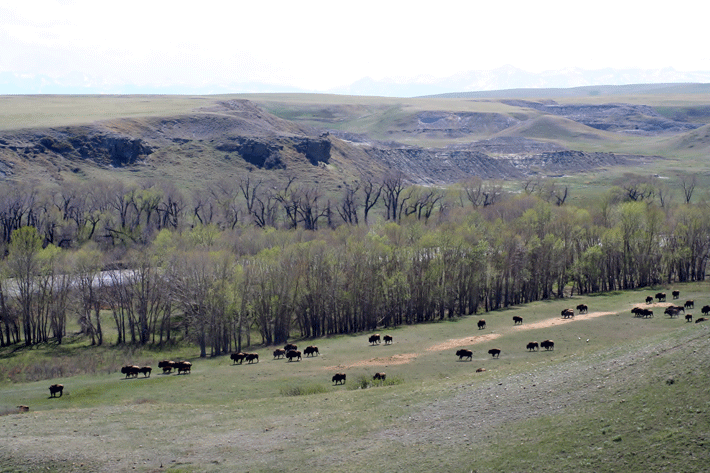
But their preservation on tribal lands is as much spiritual as economic.  Along one of our crossings of the Two Medicine that summer was a tribal herd of 250 Buffalo, part of 20,000 on tribal lands in the U.S. today.

A few months ago, near that crossing, the Blackfeet were among many to sign the Northern Tribes Buffalo Treaty, committing to the preservation and conservation of Buffalo.

A few miles south of my crossings of the Two Medicine, another significant development has escaped the mainstream media.  In December, Congress passed and President Obama signed into law, the Rocky Mountain Front Heritage Act.

It was the result of 37 years of passion and advocacy including a law that was passed in the early 1980s, after the Forest Service began leasing every acre of the Front for oil and gas development, only to be vetoed by President Reagan.

Along a hundred miles of Front I drove that day, the new bipartisan legislation designates 67,000 acres of National Forest as part of the Bob Marshall Wilderness and the Scapegoat Wilderness.   It protects another 208,000 acres in a conservation management area.

The conservation area prevents the expansion of motorized use, prohibits new roads and protects horse, foot and cycling trails as well as what biologists consider among the top 1% of wildlife habitat in America.

An average of nearly 70% of the private land use in the three counties most involved is still used for pasture, rangeland and cropland.  The legislation had the support of many ranchers including Dusty Crary near Choteau.

Tourism and recreation, along this stretch of Rocky Mountain Front, now generates 19% of employment and growing.

In the West overall, areas such as this along federally protected lands are associated with higher rates of job growth, 345% between 1970 and 2010, compared to 83% in non-metro counties with no protected federal lands.

There is definitely a dividend from conservation.

Wednesday, September 10, 2014

The Face of the Earth Moved like the Waves of the Sea

As the only son of an only son of Idaho ranchers stretching back to its territory days and a decade earlier in Utah, after 116 years, I was the end of that line.

Beginning in 1850, most had raised, trained and traded horses with only a few head of cattle for personal consumption, but some were in the cattle business.

But beginning in the 1870s, those raising horses also began adding herds of cattle they would sell commercially.  By the time I came along, my parents raised mostly cattle and only a few horses, many to work the ranch but some purely for nostalgic reasons because of the famous genetic lines they symbolized.

In his incredible 1990s book entitled, Beyond Beef: The Rise and Fall of the Cattle Culture, Jeremy Rifkin who writes and lectures on a broad range of economic, social and technological issues, reminds us that at one time what is known as Western Rangeland actually covered 40% of the continental United States.

It stretched up from that remarkable part of northwest Texas I traversed during a cross-country road-trip last month into Oklahoma and Kansas over across parts of New Mexico and Arizona, up across half of Colorado, into Wyoming and parts of Montana and the Dakotas, then west across parts of Idaho and most of eastern Oregon nipping a part of northern California.

We think of this as being the range for Buffalo, a bovine relative of cattle.  But this rangeland, while perfectly suited, is just where vast herds of these feral creatures had been pushed by the 1840s when all of my ancestral lines headed into the Rockies.

But at one time the range of Plains Buffalo stretched to Durham, North Carolina where I concluded my career, and up to Anchorage where I had spent a decade in the 1980s prior to being drawn here.

Before he headed west to blaze a road over the Cumberland Gap into what is now Kentucky on behalf of the Transylvania Company, Daniel Boone worked for a month while being outfitted in what is now northern Durham County for its secretary William Johnston at his Little River store.

When Boone headed over the Blue Ridge Mountains, it was along trails previously blazed by Buffalo.  Other Americans also followed further north in the Appalachians into the Ohio River Valley and then all the way to the Pacific along routes my pioneer ancestors followed.

My great-great grandfather, one of three ancestors on the vanguard wagon train heading west in 1847, was one of ten men assigned to hunt Buffalo along the way being careful not to take more than needed.

At the time, Kansas, Nebraska, Wyoming and Montana didn’t exist even as territories, and their destination was still part of Mexico.  During the second month of that 1,100 mile trailblazing effort, they began to see seas of Buffalo in what is now west-central Nebraska.

Near what would become Gothenburg, one member wrote that “the prairie on both sides of the river is literally black with Buffalo.”  Another wrote that it was as if “the face of the earth was alive and moving like the waves of the sea.”

There were days when they passed herds of Buffalo stretching for 20 or more miles.

Twenty years later, naturalists, based on range carrying capacity, estimated there were 60 million buffalo on the Western Range, a number experts now believe was closer to 30 to 40 million.

But in the 1860s after the Civil War, Wall Street colluded with the railroads, cattlemen and the U.S. Army to exterminate the Buffalo from the Western Range, replacing them with hundreds of thousands of head of cattle and scores of Native American people with cowboys.

All that tells me that my ancestors thought differently; that several were interpreters with Shoshone, Bannock, Paiute and Hopi and their policy to feed them rather than fight them.  But by shifting more and more to cattle, they were obviously enablers.

Telling is that in 1864, Idaho’s territorial legislature became the first to pass laws protecting Buffalo, but it was already too late there.

By around 1880, 30-40 million Buffalo had been replaced on Western Rangeland by 600,000 cattle, and by 1879, Idaho ranchers alone had driven 100,000 head to railheads there for shipment.

But those same railroads brought settlers and the open range succumbed to barb-wire fencing by the 1880s.  Ranchers had also saved 100 Buffalo from extinction.

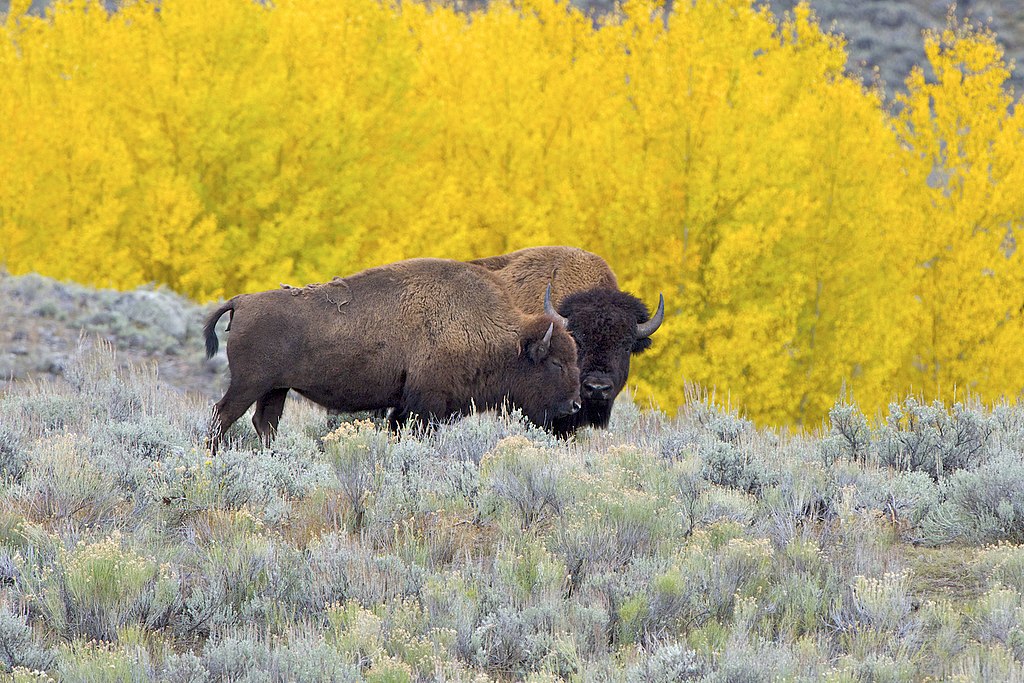
Today there are about half a million head on non-public lands including those served as a beef alternative in restaurants such as Ted’s Montana Grill here in Durham, one of 44 across 16 states.

Bison meat is naturally lean, tender, and protein and nutrient rich.  About 60,000 a year now make it to restaurants and stores, double since 2002.

Another 30,000 find sanctuary on public preserves including Yellowstone Park adjacent to our ancestral ranch.

This includes a herd of 350-500 on the National Bison Range set aside by President Theodore Roosevelt in 1908, and then populated with private funds.  It’s northwest of Missoula, Montana at the base of the Bitterroots where they form the line with Idaho.

There are still about 15,000 Buffalo that conservationists estimate roam wild.  There are 2,564 operations raising Buffalo commercially, bringing the number in the U.S. and Canada now to 340,000.

Nationwide, ranches like the one in Idaho where I was born and spent my early years now hold 87.99 million head of cattle, the fewest since I was a rising three year old in 1951.

Seventy-percent of the land area of the Intermountain West (Montana, Idaho, Wyoming, Colorado, New Mexico, Arizona, Nevada and Utah) is still rangeland used for grazing livestock even though today it is for only for six months instead of the years it did when I was growing up.

It was only 12 years ago that there were only 50 grassfed cattle operations in the U.S, now there are thousands.  Still, nearly all of our beef comes from cattle “finished,” a euphemism for fattened in feed lots.

While the feed-lot technique was pioneered in Chicago in 1876.

Before then fattening was done for only a week or two at the railhead to prepare them for the ardors of shipping.  But then came refrigerated railcars and gradually the fattening was done not to compensate for weight loss during shipping but to make them fatter faster.

This took off very slowly though until veterinary antibiotics converged with federal policies during the Nixon administration to fuel corn and grain production in the early 1970s.

There is a feedlot in Idaho, just southeast of Boise that fattens 150,000 head of cattle at a time, a third more than was driven to railheads by my ancestors and others in an entire year in that state in 1879.

That company has another closer to Boise that holds 250,000 head but they don’t hold a candle those two in Amarillo, Texas that fatten 800,000 or one between Denver and Fort Collins that handles more than that alone.

The number of head in my native Idaho as of last year was up slightly to 2.3 million, while the number of head in my adopted home of North Carolina increased to 820,000.

This due in part to a trend back toward local family stock growers supplying local residents as well as locally-owned restaurants in foodie counties such as Durham with grass-fed beef.

But as, author, food journalist and son of the founder of Baskin-Robins, John Robbins details in his book entitled No Happy Cows: Dispatches from the Frontlines of the Food Revolution, there are no easy solutions.