Showing posts with label Values. Show all posts

Thursday, September 24, 2015

Imprinting Values - Hope From Another Era of Regression

Only in retrospect am I able to pinpoint when I was imprinted with the value of conservation.

It was during my early years as the scion of five generations of Idaho ranchers.  In the early 1950s, horse and cattle ranchers not only practiced - but were respected - as conservationists.

But it wasn’t until my mid-20s in my second year as the CEO of my first community destination marketing organization that I learned from a sociologist and marketing professor how values are formed.

In 1976, Dr. Morris Massey of the University of Colorado was giving presentations on his theory of values formation entitled, What You Are Is Where You Were When.

Up to the age of 7, I was imprinting values such as conservation from my parents and grandparents, especially my paternal grandfather with whom I spent a part of nearly every day doing light chores on the ranch, until I reached school age.

That’s when we “learn a sense of right and wrong, good and bad,” and in the Mormon culture of my native Rockies, reach the “age of accountability.”

Massey believed that people modeled not only family members but other people between the ages of 8 and 13, including teachers.  There is then a “socialization period” between 13 and 21 when we turn more to peers and the media.

This is why experts note that people rarely change much after age 15 or 16.

Coincidentally, people born after 1976 when Dr. Massey laid down those three periods of value formation, are likely to have imprinted controversial and partisan notions of conservation, especially the now-politicized label of environmentalist.

My first DMO was formed by grants from Spokane Unlimited and the City of Spokane in hopes of leveraging the community’s notoriety from producing Expo 74, a World’s Fair for the Environment.

It is mind-boggling to most people when I explain today that the origins of that theme came from the local business community.

Being concerned about the environment and being business friendly like being an environmentalist and a rancher weren’t considered mutually exclusive values back then.

My very conservative ancestors would seem moderate by today’s standards, not because they would have changed their views but because conservatives in general seem to have moved so far right.

It is probably why, as an Independent, I am called liberal by my friends on the right and conservative by my friends on the left.  I even get holiday cards from both former governor and Republican Presidential hopeful Jeb Bush and President Barack Obama, a somewhat liberal Democrat.

Conservation as a movement long pre-dates President Teddy Roosevelt who gave it prominence when he declared it a national duty in 1908 in a speech delivered on my grandfather’s 10th birthday and well into that second phase of values formation.

By necessity, before and after that time nearly all ranchers considered themselves conservationists, because it was just good business, something that had impressed Roosevelt during the time he spent ranching prior to his political career.

So the value my grandfather imprinted on me prior to turning 10 had been imprinted on him too by that age.

A second era of conservation began in 1948, when eight days before I was born, Congress passed the Federal Water Pollution Control Act which was then broadened in ‘56, ‘65, ‘72 and ‘87 as it was this year by President Obama in implementation.

North Carolina, where I’ve lived most of my life, appears to have dodged a bullet this month when conservatives, moderates and progressives in the General Assembly rejected a proposal by construction special interests and regressives in the Senate to narrow vegetation buffers along streams and creeks.

By the way, the term regressive is not a pejorative.  Today it is most often used to describe those few who, when disguised as conservatives, seek not to merely tap the breaks on progress but roll it back.

But regressives have long existed at both ends of the political spectrum.

This includes a wing of progressives.  While giving regressives power is almost always a mistake, it is important to listen to them because so-called progress in some instances turns out to be problematic when taken to extremes.

This crossed my mind as we took our old runabout for a spin up Mayo Lake this past weekend.  Experts have remarked at how clear that lake is, the clearest in North Carolina, they claim.

Some credit is due to a unique vegetation buffer that is protected between homes and the lake shore.  But even more important is that wetlands at the mouth of the primary stream that fills the lake are fully intact and ecologically functional.

Wetlands such as this scrub the water of pollutants including sediment which is the number one source of pollution in our state, impairing the overwhelming majority of our waterways.

North Carolina passed a law to control sediment in 1973 and defined it as “solid particulate matter, both mineral and organic, that has been or is being transported by water, air, gravity, or ice from its site of origin.”

For the first time, I noticed a pasture of cattle along a stretch of shoreline on spin around the lake last weekend, north of the Triple Springs boat ramp.

It was primarily, but not totally buffered by trees, and was probably grandfathered as an exception when the lake was created in the late 1970s/early 1980s. 

Cattle can be a source of contamination to waterways too, even when pasture-raised and especially when nitrogen is over applied and then washes into waterways.

But don’t jerk that knee quite so fast.

A technique called holistic management of pastures has shown that cattle grazing actually helps the land store 25% more carbon, and that for “each 1% of carbon stored in the soil, an additional 60,000 acres of water per acre can be retained on the land.”

Click here for an excellent video on why soil is so critical to solving our climate change threat.  Click here for an excellent Washington Post essay on the issue of “grass-fed” cattle and whether they are good for you, the animal and the planet.

Grass-fed is a form of regression, a roll-back from today’s massive feedlots where cattle are “finished” using anything but grass.  When I was coming up in the 1950s it was the predominant way cattle were raised, including our 500 head.

But for anyone dismayed by the havoc regressives have created the last few years in the legislature, it may give hope to look back two hundred years to another era when they held sway in North Carolina.

Following the American Revolution and creation of a new system of government, North Carolina spent the first four or five decades of the 1800s in the control of regressives.

Throughout the nation, as other states perpetuated the progressivism upon which America was founded, North Carolina earned a reputation as the “Rip Van Winkle” state.

As a result, land values plummeted as more than a third of North Carolinians moved away.

Between 1830 and 1840 alone, nearly half of the counties lost population according to a superbly documented book entitled North Carolina Through Four Centuries.

The 1850 census revealed that 31% of all native North Carolinians then living in the United States resided in some other state.”  Backwardness had driven away more than 400,000 Tar Heels, two-thirds of whom were white.

This was equivalent to half the state’s population in that census.

For the first half of the 1800s, the legislature was controlled by less than 10% of the population, including slave-holding planters living down east who were adamantly opposed to public education, roads, government in general and taxes.

Fast forward two hundred years.  Sound familiar?

The thing to remember is that during much of that period of regression, a handful of deeply concerned and resilient North Carolinians were persistently advocating progressive ideas that would put “the state on a totally new course,” following the Civil War.

They were named Yancey, Caldwell, Fisher, Swain, Gaston, Morehead and Graham.  But their architect was Judge Archibald DeBow Murphey who was born in Red House, which is now called Semora, a crossroads just northwest of Hyco Lake, a twin lake just west of Mayo Lake.

It is now a part of Caswell County, but when Murphey was born it was a part of Orange County.  He eventually practiced law down in Hillsborough a few miles west from Durham and established a residence in Hawsfield (southwest of Mebane.)

Here Judge Murphey crafted his plan for North Carolina’s salvation including “establishment of a public education system, construction of canals and turnpike roads, as well as a general public welfare system,” and eventually railroads.

In fact, North Carolinians weren’t paying much attention to succession leading up to the Civil War.

Instead they were focused on constitutional reform and a struggle over ad valorem taxes as a means for wealthy plantation owners to pay their fair share to fund Murphey’s vision.

Many of Durham’s founding generation were heavily influenced by Murphey’s ideas including his close friends the Camerons, who encouraged others in what would become Durham to push for statewide progress such as railroads and a strong banking system.

They were living proof of Dr. Massey’s theory of value development that “what you are is where you were then.”

My value for conservation was obviously imprinted by my family but I am also a product of a twenty-eight year period when conservation, ecology and environmentalism were bipartisan values.

The partisan demonization of those values over the past 40 years has taken a toll, and yet polls today show that 77% of Americans support stricter environmental protections including 58% of Republicans, the party primarily responsible for their demonization.

People who point instead to another recent poll showing that 49% of Americans view government as an immediate threat, need to read more closely the reasons given. 

Too big 19%, gun control 12%, law enforcement 4%, surveillance of citizens 4%, overregulation 3%, taxes 3%, illegal immigration 3%, and environmental regulation just 1%.

You sure wouldn’t know it from the obsessions in news headlines or by partisan statements by lawmakers.

There are even more Americans who are concerned that government isn’t doing its job.  Inconvenient to journalists and reporters and bloggers for that matter is that people can hold contradictions.

In fact, news stories miss an important point.  When people disagree, it usually isn’t about a specific issue, such as being for or against billboards or trees.

They just hold different values.

Thursday, September 17, 2015

Corruption Rarely Begins As Corruption And Other Lessons

I have a friend who just completed his 24 months as a resident of TROSA in Durham, a best practice treatment center for substance abuse.

Now he is a post grad for a month or two before he walks the stage in their next quarterly graduation ceremony.  As is true for many graduates, the program has had a profound impact on the life of this individual.

I’ve known about TROSA and been friends with its founder from its inception, but I’ve observed even more about why the program has been so successful as I have participated in some events over the past two years.

It takes two years, not just to kick bad habits, but to drill down to the triggers behind them, and most of all, to inculcate values and coping mechanisms including not just work ethic but how to work with others.

These include techniques for conflict resolution and emotional control.  One that is particularly important in the program is zero tolerance for failing to disclose something that is awry, even if you weren’t involved, even if was for a good reason.

TROSA understands that corruption rarely begins as corruption.

It may even be a means to a good end as United Airlines executives recently learned the hard way.

As Dr. Dan Ariely who also calls Durham home, along with his colleagues including Harvard’s Dr. Francesca Gino have shown, “simply seeing another person cheat can lead us to cheat, even if we care about being honest.”

TROSA understands that even omission of acknowledgment is contagious and leads to a slippery slope.

The organization is famous for its entrepreneurial approach.  It’s is too bad one of them isn’t offering workforce and leadership training to businesses and agencies on accountability and the importance of speaking up.

But as Dr. Gino notes in a Harvard Business Review post this week, “Behavior can be contagious even when it’s simply described in a story.”

Stories of people, especially low-level employees, who uphold organizational values is a particularly effective means of “onboarding” new hires especially when it comes to orientations regarding ethics.

In my former life, I saw otherwise good people in each of the communities I represented who always seemed to be dogged by stories of corruption.

What they had in common was the way they made decisions, usually based on “who was asking” for something rather than a strategy of fairness and consistency.

I never felt this shadow on their reputation was deserved but the behaviors that brought it about often made it difficult to work with them as strategic partners because they were always asking me to subtly cross the line.

They never saw themselves that way.

But really, none of us do.

As Dr. Gino wrote in here excellent book entitled, Sidetracked: Why Our Decisions Get Derailed, we all have “a rose-colored view of who we are and what we do, and we aim to behave in ways that are consistent with our self-image as capable, competent, helpful, and honest individuals.”

The book deals with forces from within, forces from our relationships and forces from the outside, “factors that characterize the context in which we operate and make decisions.

It’s a good book, as is Ariely’s entitled, The (Honest) Truth About Dishonesty.

I always found myself considered a pariah by the “who’s asking” types who would in each of the communities I represented, ultimately make it their objective to recruit as many others around me to their way of thinking, hoping that the isolation would make me give in, or at the very least get me fired.

While holding firm to strategic decision-making about what was best for these communities, I always made doubly certain that our organization gave them every service we were capable of giving while remaining authentic.

But I also owe becoming a better and better leader over the years to these people.  Just because they were wrong doesn’t make them stupid or wrong about everything.

I became the CEO of a destination marketing organization at a very young age, twenty-six, so until the day I retired I viewed myself as a work in progress.

Trying to be rigidly authentic or true to yourself can, if you are not careful, also keep you from evolving.

This all made more sense to me looking back as I read an article a few months ago by Dr. Herminia Ibarra, formerly of Harvard, now professor of organizational behavior at Instead, The Business School for the World, entitled The Authenticity Paradox.

The reputation I earned over four decades was all about change.  I may have led three DMOs but they literally evolved weekly - if not daily - so in essence I led about 1,700 different organizations.

My personal “authenticity paradox” was learning that building consensus for ideas and values among stakeholders in a community can feel, well, more than a bit slimy and political but it can still be data-driven and strategic.

During my career I was intrigued when I was frequently credited with grit, resilience and perseverance so when I come across research into those traits, I try to read carefully.

Based on recent research at The Ohio State University, grit and perseverance in the face of repeated obstacles and even failure arise when an individual is able to generalize from successful past success while still learning from failures.

People who can learn to do this stand out from those who have the appearance of grit but are betrayed by perpetually needing to self aggrandize, making them particularly vulnerable to “who’s asking” decision makers.

The latter may have learned grit but their perseverance masks an otherwise negative self-image, thus the self aggrandizement.

Researchers have found that losing is actually good for us.  People who self aggrandize are put off or threatened by participating in “post mortems” after a projects, something which I adapted from EST training or a Ken Blanchard seminar in the early 1980s.

During post mortems, some people literally can’t or won’t shift gears from “what worked” to “what didn’t work,” no matter how safe and blameless you make them.

Often this is because they have issues with accountability or accepting responsibility but it can also be because they have never learned the values of introspection and curiosity which research by the authors of The Innovator’s DNA found are indicative of a rare blend of humility and confidence.

Possibly this is due to the stories they were told as children, which in the words of Seth Godin, “matter far more than we imagine.”

Values imprint by observation or patterning from birth to age 7, then from modeling or identification until age 13, including making our own value decisions, then from socialization with peers until we’re age 20.

People who can’t admit, let alone learn from failure or even admit “what didn’t work” in an otherwise successful transaction were probably told stories along the way that led them to believe that success came from fixed states, making them vulnerable to “who’s asking.”

Learning from failure and even success, on the other hand, are investments in continuing and never ending improvement rather than chalking it up to fixed states.

The difference is between looking good and actually being good, the essence of authenticity.

These are things TROSA understands – teaches and applies – so beautifully.

New values can be learned after the age of 20 but it is very hard and usually occurs with a significant emotional crisis such as facing up to addiction.

Wednesday, May 20, 2015

The Solution to Poverty is Both/And

I didn’t see his name on the program, but I wonder if the buzz among those attending the ecumenical and bipartisan-intended poverty summit held at Georgetown was regarding the new book edited and mostly written by Dr. Orlando Patterson at Harvard.

The Cultural Matrix: Understanding Black Youth, published several weeks earlier is not for the casual reader, not only because it is a little pricey but because it is dense with data and scientific findings associated with poverty.

It should be required reading for anyone who is serious about this issue or who gives it news coverage or those who flippantly betray their cynicism.

But be sure to have a fresh highlighter ready.

Black himself, Patterson is what is called a historical and cultural historian.  He is one of those sociologists who having unwrapped the intricacies of poverty believes in a mix of structural and cultural solutions to poverty.

One of the unfortunate obstacles to eliminating poverty is that people in general have divided into two camps advocating for what have become stereotypical and simplistic avatars for not having to delve into more nuanced and integrated solutions.

On one side are “structuralists” who view the solutions to poverty around structural improvements to society such as jobs, housing, addressing institutional racism, and improved access to food, education and healthcare.

Lately, this is the camp that has been all about pointing the finger at law enforcement as the impediment.

On the other side are “culturalists” who have closed their minds to anything but improved values and rooting out learned behaviors and traditions.

This, I think, is what some people are trying to say when they use those judgmental fighting words - “a culture of poverty,” which is a perversion from what this description meant when coined in 1970.

Of course, as Patterson points out, there is no such thing. That doesn’t mean that unwrapping and eliminating poverty shouldn’t involve a deeper understanding of cultural as well as structural and social justice influences, though.

Moderates like me are probably capable of irritating both camps.

The well-intended but underfunded “War on Poverty” was structural in nature.  Conservative opposition dating to the Great Depression and earlier was given stereotypes to cling too during the 1980s by President Reagan’s non-existent, “Welfare Queen” have been a brittle form of culturalist by nature.

Dr. Martin Luther King Jr. and several Presidents since - both Republican and Democrat - including Barack Obama have tried to weave together both structural and cultural solutions.

I read Dr. Patterson’s new book after reading a fascinating op-ed he penned in the New York Times just days before this month’s poverty summit convened at Georgetown.

Entitled, The Real Problem With America’s Inner Cities, it reminded me of when I first arrived in Durham to jumpstart community marketing here.  I was still inventorying the community when I was appointed to the board of the chamber of commerce.

Having heard some disparaging remarks both about Downtown and a blighted inner city neighborhood to the East, I invited a long-time Durham resident on a field trip.  It is an area planners have re-christened North East Central Durham by planners, although it is not really north or central, to distinguish it from those further east.

My counterpart who headed the chamber accepted my invitation to drive through both neighborhoods.  My point was to show him how bustling Downtown was at night in 1990 but to also disavow him of the impression that disadvantaged neighborhoods nearby were composed entirely of jobless poor people.

We drove down several streets with well maintained for homes and lawns.  Patterson points out twenty five years later that on average, 20 to 25 percent of residents of neighborhoods such as these are “solidly working class or working poor” who are for the most part conservative when it comes to values.

In his book, Patterson notes that another 25% of disadvantaged neighborhoods are comprised of people he classifies as “ghetto middle class,” though constantly exposed to what he calls the toxicity of a core “problem minority” that varies from 12 to 28 percent.

It is a small group, whose influence often reaches into surrounding middle class neighborhoods, spawning downward mobility among youth.

This ratio explains why in surveys more than 40% of people living in or near poverty cite a decline in the desire to work among their neighbors, a view consistent with the majority of Americans.

The remarkable advantage of the book Cultural Matrix is how Patterson and co-editor/contributor and doctoral student/researcher Ethan Fosse weave longitudinally the findings of hundreds and hundreds of studies, both quantitative and observational into a readable narrative.

There are also very practical tidbits in this extraordinary book.  For instance, those hoping to unwrap the opinions of the poorest of the poor may be misled when they espouse the importance of education and work.

This minority in the poorest minority poor neighborhoods can appear to resemble conservatives as most of them espouse values such as individual effort, personal responsibility, the American Dream and being a good parent.

They also similarly express and demonstrate negative views toward government, business and institutions (especially criminal justice,) even hip-hop.

Studies show that these normative values come from a vastly higher consumption overall of media including television and contrast greatly to a reality of “structural disconnection and cultural divergence” that results in even greater suffering.

We are all vulnerable to espousing values disconnected from our actions, regardless of where we fall on the ideological spectrum, especially it seems those who claim to be the most conservative.

It is just that our hypocrisy, but for the grace of God, does not result in our own suffering.

Wednesday, March 04, 2015

When We Were Only 4,646

In mid-1989 I flew across the country to take on destination marketing for Durham, North Carolina.  As a lifelong 6th generation westerner I was unaware that my roots as a Tar Heel go back more than 200 years before I was born.

When one of my 6th great grandfathers, David Miller, was born in what would later become Orange County, barely more than a tenth of North Carolina’s 100 counties had been formed.

At the time the future state’s population had grown to about 30,000 people, about the size today of the town of Sanford or Cornelius, a village along the shores of Lake Norman.

North Carolina at the time stretched beyond the Appalachians clear to the Mississippi River.

But apparently, it soon became too crowded for my earliest roots here.  My 5th great grandparents, who had also been born in what by then was Orange County, may have been the first to move west, settling Pickens County, Alabama with Revolutionary War veterans along the Tombigbee River.

By 1847, the progeny of those Tar Heel roots were headed up and over the Rockies, more than a thousand miles beyond the frontier.

I find it fascinating not only to dig back into family history but to put the lives of my ancestors in context.

My American roots go back to 1630 long before any permanent settlement of North Carolina had occurred and when there were only 4,646 settlers in all of what would become the United States.

These 10th great grandparents William and Goditha Learned settled in Charlestown and were quickly followed within a decade by several others.  Many ancestral lines had arrived at a time when the future U.S. population was around 300,000, a little more than Durham County today, where I live.

Within a few years, most began small migrations west until by the late 1820s, when many such as the Sheltons and Neeleys migrated to points along the western frontier just as my North Carolina roots had.

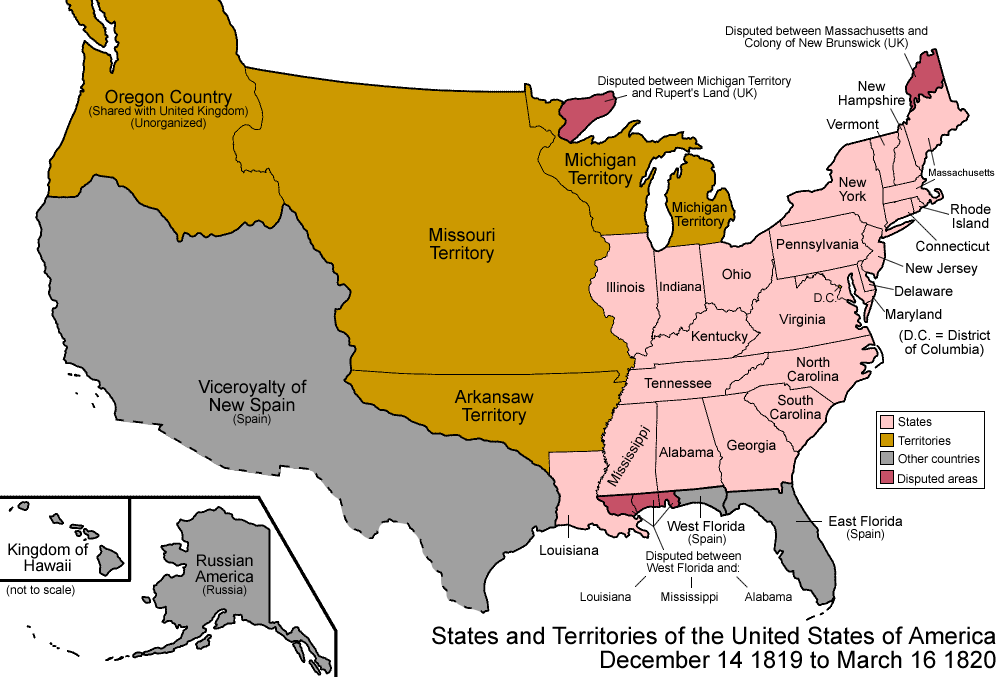
Back then the map of America looked as it does in the map shown in this essay.

When three of my ancestors became some of the first settlers to ride down into Salt Lake Valley in 1847 there were fewer than 90,000 non-Indians living in what would become the contiguous Western states (an area nearly twice the size of Western Europe.)

This was less than the population of Arkansas at the time and about 78% of westerners lived in what are now New Mexico and Arizona.  What are now Montana, Idaho, Utah and Nevada were completely unsettled when my ancestors crossed the Rockies.

Stretching behind them for 1,100 miles was territory yet to be organized in any way except for a few isolated military forts.

All of my ancestors but two lines had crossed over the Rockies by 1850 when a compromise in Congress over slavery created the map at this link.

The remaining two joined them by 1857 and 1862 directly from England and Scotland, respectively.

By then, one of my great-great grandfathers, Charles Harper, who was on the vanguard wagon train west, had returned several times to guide others across, making at least four round trips over the 1,100 mile route.

Each of these ancestral lines went on to create many other settlements, all within a few miles of the 111th Meridian West, including at the most northern end, my native land where ultimately all of these DNAs converged.

I have no way to know if I am the first person created by the convergence of all those ancestral lines to fully reverse the migration 142 years later, living in North Carolina now for nearly 26 years.

Many were crafts men and women before crossing the Rockies to become frontiersmen including carriage makers, tailors, seamstresses and business owners, but once over the Rockies they all became experts at economic development, which became my career.

They mined sufficient gold to create currency, learned to “buy local” even if the goods were inferior because to buy from back east not only robbed local economies of their full value added, but local because it gave local manufacturers the opportunity and resources to improve.

None were wealthy and some could not afford the trip west without needs-based loans from the Perpetual Immigrating Fund (PEF) which they inaugurated in October 1849, just over 24 months after the first arrivals west of the Rockies.

It was capitalized by wealth transfers from donors and tithes paid to the Mormon Church and repaid once recipients made their way west from as far as Europe and other countries before being re-loaned.

Precedent was given to those with needed skills as well as the relatives of donors who paid into the PEF.  In all, more than 30,000 people used the fund to get a hand up over the nearly 40 years it was in existence before it was outlawed by reactionaries in the U.S. Congress.

Repayments were forgiven if they were keeping people in poverty.

Fourteen years ago this Spring, the Mormon Church resurrected the idea but as the Perpetual Education Fund to help members in need who are under 30 years of age and committed to repayment to get training and education that leads to employment or self-employment.

Unfortunately, today many Mormons who pride themselves on not speaking ill about others are, by insinuation nonetheless insensitive to the poor unless they happen to be Mormon. This is especially true of those who have fled diverse cities for exurbs.

Gallup surveys find that a greater proportion of Mormons are conservative than any other U.S. religion, 59% compared to 31% moderate and 8% liberal.

Largely due to the migration from more diverse areas to exurbs, this is also true in places along the 111th Meridian where Mormons fled for religious freedom.

It is even more true of those who are active in the church, with 65% conservative, 29% moderate and 5% liberal.

But the views of those in white flight may have cost more than diversity of thought and discourse.

The 6-in-10 (here and abroad) such as me whose participation has lapsed are half as conservative as those who are active, far more moderate and four times more liberal than active Mormons although many remain positive about the culture in general.

A tiny percentage now trace back to the migration over the Rockies in search of new homelands but unfortunately, it is clear that some of the values and lessons from that period may becoming equally rare.

The white flight of today is different than that which occurred in the late 1950s and 1960s.  Across the country, it seems to have more to do with what some term as racial politics than with poverty or transfers to provide a hand up.

But that is for another essay.

Tuesday, January 06, 2015

A Rare Pedigree of Orneriness

My father and paternal grandfather shared the same middle name, Melvin but the name is in honor of my great-great grandmother, Amanda Melvina Poorman.

In America, her first and middle names were popular in the late 18th and early 19th century among descendants from Ireland, Scotland and England due to their literary use.

But I was intrigued recently to learn that her father, John Poorman had been only the 31st person baptized into the Mormon Church barely two months after it was organized as the Church of Christ and nearly two years before Brigham Young.

He was baptized by immersion on June 9, 1830 at the northern end of Seneca Lake a few miles from his farm by his neighbor David Whitmer famed as one of the witnesses who had actually laid eyes on the ancient “golden plates” from which the Book of Mormon was translated.

Whitmer had been baptized a year earlier and was one of the six founders of the new restorationist Christian religion, today the third largest by affiliation in America.

But those first eight years from mid-1830 to mid-1838 were tumultuous as much internally as from external persecution including several name changes as the new church rapidly grew to nearly 18,000 members, up to half in Great Britain.

My great (x3) grandfather Poorman followed church leaders to the area around Kirtland (northeast) Ohio in early 1831, fighting off a mob of 40-50 men a year later who tarred and tried to suffocate church founder and prophet Joseph Smith.

By 1833, Poorman was among the first  couple of hundred Mormons who settled in northwestern Missouri along the western banks of the (Big) Blue River which at the time was the edge of the American frontier, long before the existence of Kansas City.

Mormons including my ancestors there were defending themselves from mobs of vigilantes.  These Mormons were from the northeast, with abolitionist sensibilities, when it came to slavery.

The mobs were from the upper south and worried that voting as a block Mormons would threaten Missouri’s status as a slave state.  Little did they know the discord and internal friction among Mormons at the time.

The battle took place in an area along the I-435 beltway, an alternative route from I-70 around downtown Kansas City and one to which I will pay much more attention whenever future cross-country road trips with Mugs (my English Bulldog) take us along that route.

The Blue River flows out of Kansas and just before it flows into the Missouri River near Independence, Missouri is where Poorman was involved in the Battle of the Blue in November of 1833 to fight off mobs of vigilantes.

A few miles north, across the Missouri River in Liberty is where Poorman married my great (x3) grandmother Nancy Botkin Davis three years later, apparently four or five months after my great-great grandmother was born (ahem) and help to raise her children by a previous marriage.

However, internal strife and power struggles were beginning to take a toll.  Two years later, in 1838, his friend David Whitmer, who had headed the church in Missouri, suddenly resigned.

Refusing to defend himself, Whitmer was then excommunicated ostensibly as part of a coup to topple Joseph Smith over the then secret practice of polygamy as well as the word of wisdom.

But many times subsequent to parting ways, including on his deathbed, Whitmer reaffirmed his witness of the “golden plates.”

My Poorman ancestors had lived in the same Kaw Township settlement with Whitmer.  While there is no record they were involved, I am sure it distressed them to see their long-time friend ostracized.

Politics had taken a toll.

Ironically, a little more than fifty years later and thirteen years after Whitmer’s death in Missouri, Mormon leaders would disavow polygamy but without reinstating those who had resisted it from the beginning.

That fall of 1838 the Mormons were expelled from Missouri after the governor signed an extermination order.  But my great (x3) grandparents were among a few who stayed, relocating about fifty miles north and a bit west to Washington Township, a few miles west of St. Josephs.

Until then, this “nose” of Missouri had been set aside in treaty as Indian lands but by just as my Poorman ancestors sought sanctuary there, the area was being annexed into the United States as part of Missouri with Platte Purchase.

Records show that the Mormon church lost track of the Poormans after 1840 so they would not have met many of my other ancestors then gathering in Nauvoo, Illinois as recent converts.

But as the Mormons were also driven out of Illinois after the murder of Joseph Smith in 1844 and across Iowa in very early 1846, it is possible the Poormans were contacted by Mormon agents sent into Missouri to buy supplies.

They may have also met members of the Mormon Battalion including several other ancestors as it marched through St. Joseph in route from Iowa to Fort Leavenworth in preparation for marching southwest into the war with Mexico.

Mormons talk as if its members had all gathered in Winter Quarters, Nebraska or back across the Missouri River in Council Bluffs but these places were only major staging areas for the nearly half of all members preparing to head west beginning in 1847 when three of my ancestors paved the way.

Approximately 15,000 members who were gathered along the river were scattered in 90 settlements, some only 20 miles from the Missouri border and only 60 miles from where the Poormans lived.

Sometime around 1853, my great-great grandmother Amanda Melvina Poorman traveled up the Missouri and caught a wagon train west to join Mormons gathering in the Rockies, probably upon the death of her father.

Her mother died the following year, just as Amanda, out west, was marrying George Washington Kent, someone with whom she had played during her early years in Missouri.

She died in her early 40s and was buried in Richmond, Utah near the Idaho border, less than four years before her daughter Margaret would marry Hyrum Edward Bowman, two decades before they would head up into the Yellowstone-Teton nook of Idaho to a ranch where I was born and where they are buried.

When my ancestors established the first settlement in my native Idaho, the Mormon Church had just surpassed 61,000 members.  When great-great grandmother Amanda died, it has just surpassed 100,000 members.

It reached 180,000 when my paternal grandfather Mel was born and 231,000 when my grandmother Adah was born.  It crested 300,000 before they and my great grandparents homesteaded our ancestral ranch along the Henry’s Fork.

Mormon membership reached 576,000 the year my dad was born on that same ranch and 664,000 when my mom was born.  By the time I was born it had just passed 1 million.

When my daughter was born and involvement lapsed more than forty years ago, membership was well past three million.  When my grandsons were born it was surpassing 12 million and today there are more than 15 million, counting the 40% who are lapsed.

It not only gives me pause to think my great-great-great grandfather was among the first 31 but I can empathize that the internal politics took their toll.

The same occurred to my great-grandfather who married into that line when a Mormon Apostle and neighbor refused to take back a defective piece of equipment he had bought and then refused to let my great grandfather be buried in the clothing in which he had married my great-grandmother.

Their son, my grandfather, famously caught a church Bishop stealing water while others were in church services.   As the story is told, using he old Winchester hanging on my wall, he fired into the air as a warning.

By the time I entered grade school, classmates had exaggerated the story giving me a reputation for toughness.

My dad tried to be active as we were growing up but politics intervened when he was released after insisting there be no swearing during church ball games.

Yet we have all lived lives intertwined with that culture and its values.

I have other ancestors who joined shortly after John Poorman, most by 1840, and all had become Mormons by 1855 when there were fewer than 64,000 members.

For several years after the Mormons settled in the Rockies, membership declined, in part, because of radicalization during a movement by hardliners called the Mormon Reformation.

Several ancestors were dis-fellowshipped for speaking their minds when they disagreed with local church leaders over civil issues and controversial decisions and one or possibly two were required to undergo re-baptism.

Nearly all of this family background was unknown to me when my own involvement lapsed more than four decades ago.  Genetic expression is different among decedents but some traits are apparently very consistent.

There are very few with my pedigree today in that spiritual tradition and possibly even fewer with a legacy of such orneriness.

But I wouldn’t trade those genes or my heritage or my cultural values with anyone.

Monday, October 27, 2014

The Real Test of Revitalization Comes After

For those of us who love this region, the State of the South report has been issued every couple of years since 1996 by a think tank based in Durham, North Carolina where I live.

So when a friend who is still in the loop forwarded me the newest edition published a few days ago,  I was not only eager to dig right in, but took a moment to reflect on a forerunner I read the month Durham adopted me twenty five years ago.

Published three years earlier in 1986, that report was entitled Shadows in the Sunbelt.

My job back then was to jump-start an organization to market Durham for visitor-centric economic and cultural development and I soaked up that Shadows report for much needed context and perspective.

It declared obsolete “the Buffalo hunt” approach to more traditional “supply-side” economic development and proposed as an alternative that communities, both rural and urban, begin instead to leverage local assets and existing enterprises, such as “place-based” tourism has always done.

Back then, it also signaled something in common with this most recent report, “the tale of two Souths.”

In its epilogue, that nearly three-decade old report prophesied that we in “the South must tend to our roots, or in the end, risk our values.”

Well, it’s been 25 years since I read that report and the “Buffalo hunters” are not only still monopolizing economic development in North Carolina but officials have recently retro-organized it in a way sure to keep its extinction on life support.

And ironically, in at least three of the state’s five largest cities, “demand-side” visitor-centric economic developers have surrendered the far greater value of leveraging sense of place and place based assets in favor of a variant of “big game hunting” around mainstream “edifice envy.”

But the irony is not lost on “stayer” residents of those communities who see it as tragic instead, to see communities once distinct and worthy of love sell out at the altar of “sameness” worshipped by “boomers.”

But indeed, not only are both forms of “Buffalo hunting” still staggering slowly toward extinction three decades later, but in some communities such as Durham, traditional supply-side economic developers seem to be gradually trying to emulate the demand-side nature of tourism by seeking to draw talent rather than big game.

But while Durham may be way ahead of the curve on both economic development fronts, it seems as if far too few here are worried about the unintended consequences surrounding the adaptive reuse of what remains of its “built” elements of its sense of place.

The problem isn’t as a respected friend recently prophesied that revitalization efforts have reached the “tipping point,” but that Durham officials seem totally unprepared that the greater challenge will be to manage success.

Or that if left unchecked, development will almost certainly now begin to destroy the very things so worthy of love here.

Having worked so hard on the front end to leverage its “realness” while sparking the 1990’s image turnaround, a barrier that had been choking off access to financing, I too am stunned at the speed with which. now unleashed, second-wave development has begun to destroy that “realness.”

There seems to be a lack of intensity or sense of urgency, in response, not only to insist on architectural scale and fit but to mitigate gentrification, aggressively get at the systemic roots of poverty and preserve almost temporal community values such as social justice, acceptance, openness, organic creation and diversity.

By failing to “tend to our roots,” in Durham, we too are “risking our values.”

Durham is one of the nine Southern cities and towns highlighted in this newest State of the South report.  Durham and its neighborhoods could have been substituted in this introductory description that echoes the warning thirty years earlier:

“In much of today’s South, economic and demographic vibrancy exist side-by-side, as veritable next-door neighbors, with poverty, underemployment, educational disparities, and stagnant social mobility.”

The graphics alone in this newest report tell a powerful story and none more so than those showing the side-by-side paradox in Durham.

If by bringing appreciation for Durham’s temporal attributes and helping to spark the kindling under this turn-around, was I complicit by failing to see how fast the reinvigoration would turn destructive.

I try to remember to post these essays on social media such as Facebook because those are the places where many frequent readers tell me it is easiest to access, share and/or comment which today is most often via one-on-one emails or text messages.

Recently, in return, several readers forwarded essays related to this shared concern.  One is how Portland is fighting to keep things “real” there and in synch with its unpretentious values.

Another cites the changes that unmanaged gentrification has made along one end of Divisidero, a street in San Francisco where I lived for a few months in 1989 before being recruited to Durham.

My apartment was on the Bay end of Divisidero.

But needing to exercise to help build my lungs up following a bout in the hospital with pneumonia that January, for that few months between jobs, I would religiously take daily walks, also, in part for reflection.

Each of our lungs is only hand-size but on the inside where they do their work, the various branches, cavities and air sacks called alveoli are the combined surface area of a football field.

Some days the walk would take me 40 active minutes south on Divisidero, up and over Pacific Heights a ridge more three times the height of one we complain about on walks each morning now in Durham.

It crested as I passed what is now “Billionaire’s Row” before descending for checkups and medication-refills at Kaiser Permanente Medical Center.

I think it was called “Millionaires Row” back then and the views are spectacular.  But reflection and self-forgiveness are also boosted with a little self-inflicted pain - (Smile.)

The medical center is in the neighborhood that is the subject of Katy Kreitler’s excellent article this month entitled “9 Ways Privileged People Can Reduce the Negative Impact of Gentrification.” 

The author is reverse-engineering how Western Addition, the neighborhood around that hospital, lost the soul of its “realness” after I left when frustrated officials, focused only on reducing crime and blight, unleashed forces that also hollowed out its “there-there.”

Others such as Daniel Hertz have countered recently that he sees no way for us to mitigate or manage gentrification through our personal decisions and that the real problem is a “curiously dysfunctional housing system.” 

Another by Kriston Capp notes that studies show the massive overbuilding of cultural facilities such as performing arts centers over the past decade is spurring gentrification along with deeper poverty rather than the oft-promised Bilbao-effect.

It is important to note, as a new white paper by researchers at AudienceScan does, that high-come adults are 40% more likely to shop at locally owned business and that 60% of shoppers there have above average incomes.

But that is the paradox of gentrification.  These are often not the same locally-owned business that gave these neighborhoods their appealing “real-ness.”

We gentrifyers have a way of killing the things we love.

All of these sources are worthwhile reading for anyone concerned about preserving the values and sense of place in the places they love.

On my return on those walks, I would head up to the historic Fillmore the venue and birthplace for rock, blues, folk and roots music legends of the late 1960s such as Jefferson Airplane, The Grateful Dead, Jimi Hendrix, The Band, Emmylou Harris and Janis Joplin).

Sometimes before turning back north I would continue on up Cathedral Hill and listen to mid-day prayers sung as Gregorian Chants.

These neighborhoods were still the “real” San Francisco back then compared to those more touristy east of Van Ness/north of Market.

I have been back to San Francisco but not back to those neighborhoods, probably sensing at the time that the forces drawn to them including visitors would ultimately “kill the very things they loved.”

Organic “real places” aren’t created as much as enabled by developers when they are sensitive to scale and work with a light touch so as not to disturb sense of place or force out small, local businesses such as the developers of Durham’s Brightleaf Square did there and then along Ninth Street.

Developers without those sensibilities are drawn to these areas but without officials who are attuned to activist neighbors and small businesses and who are unafraid to say no, places can be quickly overwhelmed, relegating historic structures to little more than an amenity.

Sometimes this corrosion of place is even further enabled by public facilities that are even more disrespectful of sense of place values leading some to warn we should watch what edifices officials build, not what they say, when it comes to preserving values such as reducing poverty.

Looking back, I was fully aware that many of those with whom I stood alongside in the push for revitalization didn’t really share Durham’s sense of place values, or if they did, also didn’t realize that safeguards needed to be embedded long before any tipping point occured.

My reflective ego says I could have and should have done much more to warn officials about the failure inherent in success and that sense of place and community values, while nearly temporal in nature, are not guaranteed.

But starved for the day when revitalization would fully ignite, many officials, hypnotized by arm-twisting on behalf of the “shiny and new,” dismissed warnings that were given back then as merely naysaying.

You can steer a community to “best practices” but there will always be a few otherwise well-meaning souls who seem to always seek out “worst practices” instead.

To use a term from Accounting 101, they, along with formula developers will be “last in, first out” too when community values are purged and the reasons to love a community begin to flicker.

Those who truly value sense of place are more often “first in, last out.”

I’m not going anywhere and my time may be past but the real fight to preserve sense of place began not with revitalization but in its wake.

It isn’t too late for Durham but it is very, very close.

Friday, August 22, 2014

The Core vs. Transient Values of Place

As Mugs and I drive cross country each year via different routes, we average 9 or 10 hours a day on the road and always stop in time to grab dinner, if possible, at a local restaurant and swing through the downtown area.

On this trip stops included Tuscaloosa, Fort Worth, Santa Fe, Richfield (UT,) Salt Lake, Dillon (MT,) Coeur d’Alene, Casper, Lincoln and Nashville before returning to Durham, North Carolina where we live.

I also read or re-read books on the trip, often related to places along the way, including this year, Creating the Land of the Sky, Rising Tide, The Big Burn and West of the Revolution, a horizontal snapshot across North American during the time of the American Revolution.

Usually histories drill down into an event but horizontal histories are fascinating because they link events across context.

I even re-read the fictional This House of Sky, the memoir of an author who grew up ten years ahead of me along the Montana Side of the Bitterroots.

To get “centered” each morning, I randomly read for a few minutes from the life and beliefs of Saint Francis of Assisi.

It was remarkable how similar revitalized downtowns were along the way, almost as if they were following a formula.  They were similar down to the variety of street trees also planted back in Downtown Durham and the near universal application of the description “cool.”

I happened to be re-reading The City: A Global History by Joel Kotkin as I enjoyed my now once-weekly “steak night” by dropping into Misty’s, an acclaimed local restaurant and located in the “P District” of Downtown Lincoln, Nebraska.

It is a local favorite familiar to one of Lincoln’s native sons who will be chef of Nanasteak when three friends open it in Durham’s historic American Tobacco District, lending a touch of Durham authenticity to a section devoid.

Equidistant from Misty’s in downtown Lincoln is a plaza, a performing arts center featuring Broadway musicals, a minor league baseball stadium, and historic buildings adapted for residential lofts and hotels, all seemingly replicated in every downtown now at the expense of differentiation and often obscuring organic traits.

Kotkin, the director of the Center for Demographics and Policy at Chapman University is an expert in the evolution of cities over the last nearly 10,000 years.

He laments that the rush of cities now “to convert old warehouses, factories, and even office buildings” into “residential resorts” is not sustainable because “an economy oriented to entertainment, tourism and ‘creative functions’ is ill suited to provide upward mobility.”

He warns that “focused largely on boosting culture and constructing spectacular buildings, urban governments may tend to neglect” what makes cities sustainable including relentlessly fostering a strong and always evolving “middle class.”

These places risk becoming “dual cities,” inhabited only by the rich and the low wage workers it takes to provide for them.

Professor Kotkin makes a compelling argument that historically, cities that continue to thrive over time engender a “shared identity” and “a peculiar and strong attachment, sentiments that separate one specific place from others.”

He would agree with Bill Baker, an expert at helping communities drill down into the values and traits that make them distinct, that these elements of sense of place are far more significant than physical traits such as historic structures.

Fortuitous for Durham where acceptance of differences has historically been a key part of its personality over many generations, this aspect is one of the pivotal and predictive traits Kotkin pinpoints as to why some places rise and fall while others remain vital.

Coincidentally, I first read Kotkin’s book, The City, in 2006, right after Baker had concluded his work over a two year period in conjunction with thousands of Durham residents to distill its overarching personality or, as we say in marketing, brand.

It was also the year I attended a small destination marketing conference of professionals beginning to embrace a strategy I had somehow stumbled onto early in the four-decade career from which I retired at the end of 2009.

Distinguished from idolization of mega-cultural facilities that have proven to homogenize community identity, it is anchored foremost in differentiation and authenticity of sense of place, organically incorporating only distinctive facilities of appropriate scale.

It isn’t easy to revitalize city centers but care must be taken to differentiate, and often that means protecting cultural, historic and natural elements from the very forces of homogenization it unleashes.  Place-making is often more about deciding “what not to do.”

This is why sustainable revitalization is more like “gardening” than “big game hunting.” Once erased, distinctiveness is impossible to “salt and pepper” back into formulas without going through another cycle of decline and resurrection.

At dinner recently, a long-time friend of mine at the very center of Durham’s revitalized core rhetorically asked, “What does Durham need to do to get more of the entrepreneurs it has always spawned to stay and buy homes here?”

“Just be true to who we are at our most temporal level,” I replied remembering Kotkin’s admonition.  People who share and help perpetuate that distinctiveness will be drawn to build their lives here.

Seeking to become something your not or frenetically replicating other places in pursuit of what Kotkin terms the “transient values” of “hipness, coolness, artfulness, and fashionability” is a recipe for losing a community’s soul.

Places “without moral cohesion (shared values) or a sense of civic identity, we are doomed to decadence and decline.”

Thursday, November 22, 2012

More Than Giving Thanks – The Key to Willpower

During my adult lifetime, the “holiday” I most looked forward to during this time of year was January 2nd when things finally got back to normal.

Yes, you wouldn’t know it by my behavior as a grandparent, but I was a holiday curmudgeon during my now-concluded, nearly forty-year career.  But if I had a favorite holiday, it was Thanksgiving.  Short, sweet, to the point and with modest expectations.

It is overly simplistic to tie attitudes about the holidays to an individual’s upbringing.  But it seems to me that many adults who take holiday preparations to extremes are trying to compensate for childhood memories, either disappointing or the lack thereof, while many who are turned off when it comes to holidays have wonderful memories to look back on.American Values Survey

According to the recent in-depth American Values Survey, by 73 to 1, our society believes that family has the greatest impact on our values, ten times greater than schools.

More than 80% feel that they have it much tougher today as parents than their parents did, 22% of American parents are focused on making kids happier today, while 76% are focused on helping their kids be successful in the future.

One important ingredient for any future success is willpower which many believe cannot be taught, or in my experience, established in adults once they become part of the workplace.

However, a new study by researchers at the University of Rochester finds that willpower is strongly linked to a child’s ability to find trust in and/or rely on parents and other adults to keep promises and commitments, a prescient irony belatedly gleaned by many of us from the haunting lyrics of the 1974 hit Cat’s in the Cradle, performed and written by the late Harry Chapin based on a poem written by his wife Sandy.

It turns out that keeping promises and other commitments to children is also linked to the ability to defer immediate gratification.  Maybe it also has something to do with the way Americans view “struggle” compared to Asian parents.

I also wonder if even as adults, being let down by those to whom we entrust the safeguarding of our society is at the root of why the percentage of American trusting in the rewards of hard work has fallen to 70% including 64% among Democrats and 66% among Independents.

Only 44% of Americans now believe that our country’s traditional value of “upward mobility/ability to pull oneself up by bootstraps” contributes to America having stronger values than other places in the world.

Only 36% of Americans between the ages of 18 and 29 today believe that the free enterprise system contributes to strong American values and only 20% of Americans overall believe that people are generally altruistic vs. motivated by self interest.

Only 47% of Americans attribute the weakening of American values to “apathy/lack of strong work ethic,” compared to 63% who attribute this to “political corruption” and 61% to the “influence of money in politics” which brings us back to trust in the system when the rewards for working hard are trumped by special interests.

Giving thanks is not only a holiday, as declared by President Abraham Lincoln in 1863, during our nation’s deepest division and an ancient tradition, but a secret scientists have identified as a prophylactic to depression and the blues throughout the year.

Hug your kids, your grandkids and great grandkids on this holiday, but also remember that keeping promises and commitments and being reliable are pivotal to future success.

But this doesn’t should not be construed to mean “overprotection” – a mistake which is often made today by what has become known as “helicopter parents” who choose to hover over their offspring rather than instill values which will contribute to their success in the future.

The key to success is failure and researchers who have proven this to be true find it far more directly linked to success than intelligence.

I wish that everyone could be as fortunate as I was to find my life’s work as described by Bold Academy-founder Amber Rae on this Fast Company blog, both during my now concluded career and in retirement by recognizing that:

1. It doesn't feel like work.
2. You are aligned with your core values.
3. You are willing to suffer.
4. You experience frequent flow.
5. You make room for living.
6. Commitment is an honor.
7. The people who matter notice.
8. You fall asleep exhausted, fulfilled, and ready for tomorrow.

Friday, September 07, 2012

Exploring My Moral Matrix

Friends who know I haven’t been inclined toward organized religion since the early 1970s rib me about my religious zeal when it came to standing up for the communities I represented during my now-concluded career which is now evident in my defense of the sanctity of trees and the environment.

I descend from ancestors who immigrated to this country as Swiss Mennonites, Welsh Quakers, Palatine Lutherans, French Huguenots, Dutch Remonstrants, Scots-Irish Presbyterians and Mormons to escape severe persecution and I’ve always been curious about how I came to my own blend of values, ethics and morals.

Many more traits are to varying degrees more heritable than we once thought, especially when innate is viewed a “first draft, revised by experience” and that “morality can be innate (as a set of evolved intuitions) and learned (as children learn to apply intuitions within a particular culture.)”

Dr. Jonathan Haidt is an expert in moral psychology now teaching and researching at the NYU Stern School of Business.  It is reassuring that he holds the Thomas Cooley Chair of Ethical Leadership and he is also a popular TED presenter.

He is also the author of a must-read book, published in March, entitled The Righteous Mind – Why Good People are Divided over Politics and Religion from which the earlier quotes were taken.

Haidt substantiates in the book that morals are more intuition than reason and that “we’re born righteous, but we have to learn what exactly, people like us should be righteous about.”

He describes six areas of moral beliefs including ethics and values that we each personalize much as we slide the channels on a music equalizer mixer such as the one we used to have on stereos and now have on smartphones.

Along with a friend, I took a brief quiz on yourmorals.org, a website developed by Haidt and others, and received my results (green bar) shown in the image in this blog.  The higher the bar the stronger that element is manifest.

My mix is compared to the averages of more than 132,000 others shown for proclaimed liberals in blue and conservatives in red.  The labels only show one of the words used to describe each moral foundation and the sixth is so recent it hasn’t been added to the assessment I guess.

The full names the six moral foundations are:

  1. Care/harm
  2. Fairness/cheating
  3. Loyalty/betrayal
  4. Authority/subversion
  5. Sanctity/degradation, and
  6. Liberty/oppression.

It is well worth reading the book to understand how these were defined, what they mean and how they influence various groups and how misinterpretations can lead to divides.

Haidt provides compelling evidence that instead of demonizing each other, liberals and conservatives are “Yin and Yang,” “seemingly opposed forces that are in fact complementary and interdependent. Night and day are not enemies, nor are hot and cold, summer and winter, male and female.  We need both, often in shifting or alternating balance.”

The book also provides scientific proof of why we are at our best as a nation when we have a strong, moderate center regardless of party affiliation or un-affiliation.  Lost on news coverage and partisan bickering is that nearly 40% of Americans are politically Independent (37%) and/or moderate (36%.)  Moderates may also be the moral center.

The book is an insightful and funny blend of a research, psychology, anthropology, neurology, public policy and mixed with excellent story telling.  It also reminds us that “morality binds and blinds.”

It is fast and entertaining to read but every sentence offers up a nugget so don’t plan on skimming.  Anyone trolling for cocktail nuggets will be surely busted.  Haidt takes the reader through the evolution of his own learning and thinking and just when you think you have it all figured out, a new dimension is introduced.

Easily one of the most interesting and useful books I’ve ever read.