Showing posts with label Culture. Show all posts

Wednesday, May 20, 2015

The Solution to Poverty is Both/And

I didn’t see his name on the program, but I wonder if the buzz among those attending the ecumenical and bipartisan-intended poverty summit held at Georgetown was regarding the new book edited and mostly written by Dr. Orlando Patterson at Harvard.

The Cultural Matrix: Understanding Black Youth, published several weeks earlier is not for the casual reader, not only because it is a little pricey but because it is dense with data and scientific findings associated with poverty.

It should be required reading for anyone who is serious about this issue or who gives it news coverage or those who flippantly betray their cynicism.

But be sure to have a fresh highlighter ready.

Black himself, Patterson is what is called a historical and cultural historian.  He is one of those sociologists who having unwrapped the intricacies of poverty believes in a mix of structural and cultural solutions to poverty.

One of the unfortunate obstacles to eliminating poverty is that people in general have divided into two camps advocating for what have become stereotypical and simplistic avatars for not having to delve into more nuanced and integrated solutions.

On one side are “structuralists” who view the solutions to poverty around structural improvements to society such as jobs, housing, addressing institutional racism, and improved access to food, education and healthcare.

Lately, this is the camp that has been all about pointing the finger at law enforcement as the impediment.

On the other side are “culturalists” who have closed their minds to anything but improved values and rooting out learned behaviors and traditions.

This, I think, is what some people are trying to say when they use those judgmental fighting words - “a culture of poverty,” which is a perversion from what this description meant when coined in 1970.

Of course, as Patterson points out, there is no such thing. That doesn’t mean that unwrapping and eliminating poverty shouldn’t involve a deeper understanding of cultural as well as structural and social justice influences, though.

Moderates like me are probably capable of irritating both camps.

The well-intended but underfunded “War on Poverty” was structural in nature.  Conservative opposition dating to the Great Depression and earlier was given stereotypes to cling too during the 1980s by President Reagan’s non-existent, “Welfare Queen” have been a brittle form of culturalist by nature.

Dr. Martin Luther King Jr. and several Presidents since - both Republican and Democrat - including Barack Obama have tried to weave together both structural and cultural solutions.

I read Dr. Patterson’s new book after reading a fascinating op-ed he penned in the New York Times just days before this month’s poverty summit convened at Georgetown.

Entitled, The Real Problem With America’s Inner Cities, it reminded me of when I first arrived in Durham to jumpstart community marketing here.  I was still inventorying the community when I was appointed to the board of the chamber of commerce.

Having heard some disparaging remarks both about Downtown and a blighted inner city neighborhood to the East, I invited a long-time Durham resident on a field trip.  It is an area planners have re-christened North East Central Durham by planners, although it is not really north or central, to distinguish it from those further east.

My counterpart who headed the chamber accepted my invitation to drive through both neighborhoods.  My point was to show him how bustling Downtown was at night in 1990 but to also disavow him of the impression that disadvantaged neighborhoods nearby were composed entirely of jobless poor people.

We drove down several streets with well maintained for homes and lawns.  Patterson points out twenty five years later that on average, 20 to 25 percent of residents of neighborhoods such as these are “solidly working class or working poor” who are for the most part conservative when it comes to values.

In his book, Patterson notes that another 25% of disadvantaged neighborhoods are comprised of people he classifies as “ghetto middle class,” though constantly exposed to what he calls the toxicity of a core “problem minority” that varies from 12 to 28 percent.

It is a small group, whose influence often reaches into surrounding middle class neighborhoods, spawning downward mobility among youth.

This ratio explains why in surveys more than 40% of people living in or near poverty cite a decline in the desire to work among their neighbors, a view consistent with the majority of Americans.

The remarkable advantage of the book Cultural Matrix is how Patterson and co-editor/contributor and doctoral student/researcher Ethan Fosse weave longitudinally the findings of hundreds and hundreds of studies, both quantitative and observational into a readable narrative.

There are also very practical tidbits in this extraordinary book.  For instance, those hoping to unwrap the opinions of the poorest of the poor may be misled when they espouse the importance of education and work.

This minority in the poorest minority poor neighborhoods can appear to resemble conservatives as most of them espouse values such as individual effort, personal responsibility, the American Dream and being a good parent.

They also similarly express and demonstrate negative views toward government, business and institutions (especially criminal justice,) even hip-hop.

Studies show that these normative values come from a vastly higher consumption overall of media including television and contrast greatly to a reality of “structural disconnection and cultural divergence” that results in even greater suffering.

We are all vulnerable to espousing values disconnected from our actions, regardless of where we fall on the ideological spectrum, especially it seems those who claim to be the most conservative.

It is just that our hypocrisy, but for the grace of God, does not result in our own suffering.

Wednesday, March 04, 2015

When We Were Only 4,646

In mid-1989 I flew across the country to take on destination marketing for Durham, North Carolina.  As a lifelong 6th generation westerner I was unaware that my roots as a Tar Heel go back more than 200 years before I was born.

When one of my 6th great grandfathers, David Miller, was born in what would later become Orange County, barely more than a tenth of North Carolina’s 100 counties had been formed.

At the time the future state’s population had grown to about 30,000 people, about the size today of the town of Sanford or Cornelius, a village along the shores of Lake Norman.

North Carolina at the time stretched beyond the Appalachians clear to the Mississippi River.

But apparently, it soon became too crowded for my earliest roots here.  My 5th great grandparents, who had also been born in what by then was Orange County, may have been the first to move west, settling Pickens County, Alabama with Revolutionary War veterans along the Tombigbee River.

By 1847, the progeny of those Tar Heel roots were headed up and over the Rockies, more than a thousand miles beyond the frontier.

I find it fascinating not only to dig back into family history but to put the lives of my ancestors in context.

My American roots go back to 1630 long before any permanent settlement of North Carolina had occurred and when there were only 4,646 settlers in all of what would become the United States.

These 10th great grandparents William and Goditha Learned settled in Charlestown and were quickly followed within a decade by several others.  Many ancestral lines had arrived at a time when the future U.S. population was around 300,000, a little more than Durham County today, where I live.

Within a few years, most began small migrations west until by the late 1820s, when many such as the Sheltons and Neeleys migrated to points along the western frontier just as my North Carolina roots had.

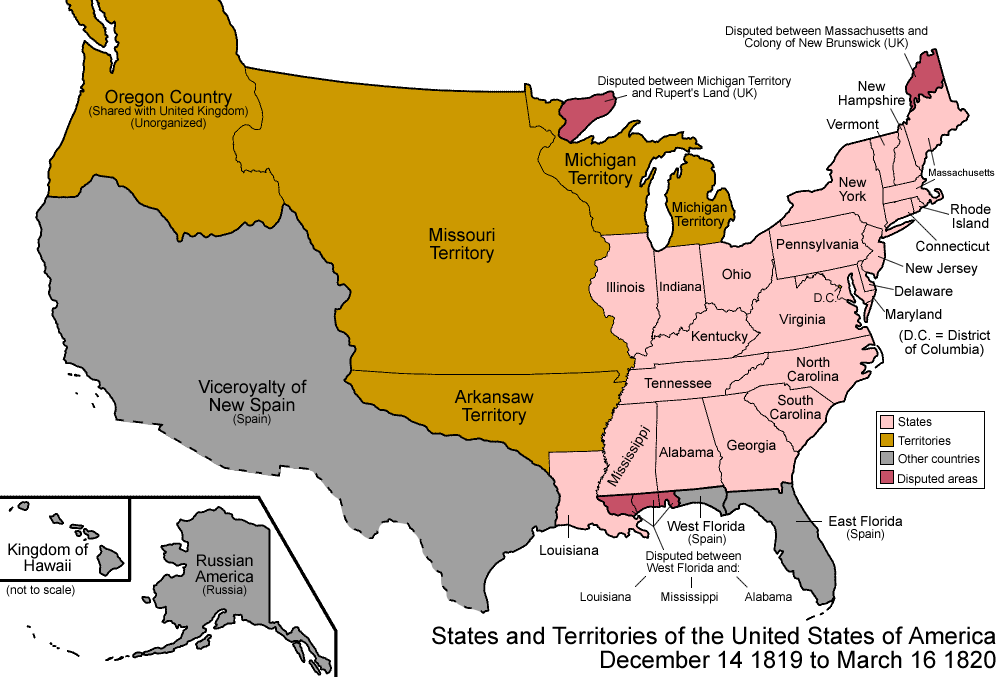
Back then the map of America looked as it does in the map shown in this essay.

When three of my ancestors became some of the first settlers to ride down into Salt Lake Valley in 1847 there were fewer than 90,000 non-Indians living in what would become the contiguous Western states (an area nearly twice the size of Western Europe.)

This was less than the population of Arkansas at the time and about 78% of westerners lived in what are now New Mexico and Arizona.  What are now Montana, Idaho, Utah and Nevada were completely unsettled when my ancestors crossed the Rockies.

Stretching behind them for 1,100 miles was territory yet to be organized in any way except for a few isolated military forts.

All of my ancestors but two lines had crossed over the Rockies by 1850 when a compromise in Congress over slavery created the map at this link.

The remaining two joined them by 1857 and 1862 directly from England and Scotland, respectively.

By then, one of my great-great grandfathers, Charles Harper, who was on the vanguard wagon train west, had returned several times to guide others across, making at least four round trips over the 1,100 mile route.

Each of these ancestral lines went on to create many other settlements, all within a few miles of the 111th Meridian West, including at the most northern end, my native land where ultimately all of these DNAs converged.

I have no way to know if I am the first person created by the convergence of all those ancestral lines to fully reverse the migration 142 years later, living in North Carolina now for nearly 26 years.

Many were crafts men and women before crossing the Rockies to become frontiersmen including carriage makers, tailors, seamstresses and business owners, but once over the Rockies they all became experts at economic development, which became my career.

They mined sufficient gold to create currency, learned to “buy local” even if the goods were inferior because to buy from back east not only robbed local economies of their full value added, but local because it gave local manufacturers the opportunity and resources to improve.

None were wealthy and some could not afford the trip west without needs-based loans from the Perpetual Immigrating Fund (PEF) which they inaugurated in October 1849, just over 24 months after the first arrivals west of the Rockies.

It was capitalized by wealth transfers from donors and tithes paid to the Mormon Church and repaid once recipients made their way west from as far as Europe and other countries before being re-loaned.

Precedent was given to those with needed skills as well as the relatives of donors who paid into the PEF.  In all, more than 30,000 people used the fund to get a hand up over the nearly 40 years it was in existence before it was outlawed by reactionaries in the U.S. Congress.

Repayments were forgiven if they were keeping people in poverty.

Fourteen years ago this Spring, the Mormon Church resurrected the idea but as the Perpetual Education Fund to help members in need who are under 30 years of age and committed to repayment to get training and education that leads to employment or self-employment.

Unfortunately, today many Mormons who pride themselves on not speaking ill about others are, by insinuation nonetheless insensitive to the poor unless they happen to be Mormon. This is especially true of those who have fled diverse cities for exurbs.

Gallup surveys find that a greater proportion of Mormons are conservative than any other U.S. religion, 59% compared to 31% moderate and 8% liberal.

Largely due to the migration from more diverse areas to exurbs, this is also true in places along the 111th Meridian where Mormons fled for religious freedom.

It is even more true of those who are active in the church, with 65% conservative, 29% moderate and 5% liberal.

But the views of those in white flight may have cost more than diversity of thought and discourse.

The 6-in-10 (here and abroad) such as me whose participation has lapsed are half as conservative as those who are active, far more moderate and four times more liberal than active Mormons although many remain positive about the culture in general.

A tiny percentage now trace back to the migration over the Rockies in search of new homelands but unfortunately, it is clear that some of the values and lessons from that period may becoming equally rare.

The white flight of today is different than that which occurred in the late 1950s and 1960s.  Across the country, it seems to have more to do with what some term as racial politics than with poverty or transfers to provide a hand up.

But that is for another essay.

Thursday, April 10, 2014

No Time for Lag at the Speed of Culture

There are two things that few, if any, business schools teach college students about advertising in courses on marketing.  One is that it has a down side, what I call whenever I guest lecture, a “turnoff ratio.”

Roadside billboards are the obvious example of this with an 8-to-1 turnoff ratio which grows to 9-to-1 if passerbys spot nearby trees have been cut. Surprisingly, surveys show that ads running during the Super Bowl have a 5-to-1 turn off ratio.

Turnoff ratio is easy to compute from public opinion surveys when you dig down through the obfuscation the advertising industrial complex creates by slicing turnoff results into very thin slices.

The other thing that is sometimes ignored, although more and more business schools are teaching, is that traditional advertising is dead, if not on life support, partly due to negligible return on investment, partly due to massive over exposure and partly because, well, it is just so slow.

In a chapter he penned for the intriguing new book entitled, The Disruption Revolution, Terry Young notes that change is so rapid now, it requires that marketers move at the “speed of culture.”

He divides culture into fast and slow culture, one “bursting in the here- and-now” and the other, those trends that are expected to have impact in 36-48 months.  Marketing must be “fast, lean, and about making decisions in real time.”

Young compares marketing today as more like a CNN newsroom.  He confirms what the community marketing agency in Durham, North Carolina anticipated in 1997.  While still a start up, it formed the Durham New Service (DNS.)

The move was an extension of the organization’s pioneering success years earlier with what we now call content marketing, before most other community marketing organizations had even established marketing divisions.

Five years later, ad veteran Al Reis and his daughter Laura penned The Fall of Advertising and the Rise of PR, the tipping point of which researchers have now pegged as 1984. But now even PR has been supplanted by marketing as publishing.

Young’s background in everything from start ups to McKinsey & Company to volunteering in Kazakhstan in support of micro credit initiatives to founding trend-spotter “sparks & honey” give him a unique perspective on marketing at the “speed of culture.”

Marketing today, according to Young, requires the urgency and pace of a CNN newsroom.  In fact, marketing is now a form of publishing, something Durham’s marketing organization anticipated five years ago when it gave its Durham News Service its own real time dashboard.

Initiatives such as that rely on whether marketers can learn to have zero tolerance for lag time.  Lag time—even more than disruption—has spelled the doom of traditional advertising.  For those unwilling to shift gears, it will do the same for PR as well.

Lag time is the marker that signals the obsolescence of so many marketers today, including a great many institutions that teach marketing.  Even gleaning marketing intelligence is moving closer to real time.

But marketing, like a newsroom, also relies on the ability to be accurate, authentic and able to create value, context and depth in real time.  Especially for anyone in community destination marketing, it is becoming more intense and demanding than ever, which is why so many have fallen into irrelevance.

Those who can keep pace are already recognizing a wave of change that Young believes is transforming PR as we know it.  Just as successful marketing is now publishing, media companies, including the newspaper in Durham, have begun to evolve a model that in part will amplify that content.

Marketing now is about creating relevant, genuine and valuable content in real time.  There is little or no room anymore for those stuck in first or second gear or those so attention deficit that they fail to fully leverage content.

Some marketing organizations such as Durham’s have what it takes going forward in their DNA, and still, they will only be as effective as the people they hire who must continue to be relentless about continuous and never-ending change and improvement.

Key today is a team intolerant of lag time.  As author and disruption analyst Brian Solis wrote a few months ago, marketers today are “at the forefront of a new era and marketing communications and its future is in your hands.”

“The future of marketing has little to do with marketing.”

Wednesday, April 09, 2014

Appeal is All About Pull not Push

Waiting for the doors to open for a matinee performance of an acclaimed Broadway musical on tour at the Durham Performing Arts Center (DPAC,) several things ran through my mind as I looked from the lobby out at the downtown skyline.

One was that as remarkable as the building is, you can just feel that we don’t build things to last anymore.  Different than the historic structures in the skyline, according to officials at the Urban Land Institute we only build things to last 20-30 years now or less.

Another fleeting thought was how ironic it was that one of the organizations advertising in the program was inferring that the remarkably successful theater, now in its sixth year, was due in part to its vision.

I was on its board at the time and support was mixed with several concerns weighing heavily.  The vote in favor hinged on the snarky comment by one board member who proclaimed, “what do we care, we don’t have to pay for it.”

It seems a prerequisite for any claim of vision should be having “skin in the game.”

My third fleeting observation that day was that but for the Mayor’s letter in the program, not one welcome or announcement leveraged awareness to 70% of the attendees from out of town that they were in Durham.

Communities build cultural facilities in part to leverage awareness and to reap not only visitor spending but also to further stimulate the economy in which the facility costs are born when facilities hire local residents and use local vendors.

Far too many communities take these returns on investment for granted and fail to lace their expectation into operating agreements.

I may have just missed further mentions of Durham that day but this kind of oversight is one far too many cultural facilities and events make, some falling victim to the false notion that they have to blur location in order to be appealing to non-residents on day-trip visits.

This is an outdated mid-20th-century notion perpetuated by some media.  They hoped it will sell more advertising by homogenizing identities with the promise that they could push consumers past businesses in their hometown to buy the same things several cities, towns and counties away.

The further away they could make the claim, the more they could charge for advertising.

This fallacy may have been the reason that when two private fortunes built on such advertising both bought Minor League baseball teams in the 1990s, pushing and shoving ensued.

One was in Durham and the other destined for Raleigh.  But one invoked a territorial clause to push the other to locate instead several towns further east into the far reaches of Wake County.

Symbolic is that the one claiming to be the region’s team draws the same proportion of day-trip visitors from throughout the region to games now as it did back before making that claim.  Not coincidentally, it’s the same percentage drawn by Durham venues overall without that claim.

Drawing attendance from nearby communities and allegiance from visitors, day trip or overnight is earned by pull not push, it is about distinctiveness and sense of place, not hegemony.

It is won, not pandered too, by being somewhere, not anywhere.

Another sports comparison is that two of the major league sports franchises in North Carolina bypassed the identities of the cities in which they play and whose residents paid to build the palaces in which they play.

Instead, they chose the over-reaching identity “Carolina,” hoping not only to claim hegemony over one state, but two.

Lost was the fact nearly 6-in-10 professional sports fans today are loyal to a team that is not near where they live.  Allegiance must be won, not monopolized.

Successful sports franchises such as Super Bowl champion Seattle Seahawks understand this.  While honoring the city where they play, they have managed to win allegiance throughout the three-state Pacific Northwest and a province of Canada

Appeal is about pull, not push.

I lobbied for Durham to remain in the name of the Durham Performing Arts Center and first coined the the acronym DPAC based on the success of DBAP for the nearby baseball stadium.

But it never occurred to me that the acronym works so well for DBAP only because its where the Durham Bulls play.

Even now that views of the downtown skyline are entirely blocked by office buildings, the community for whom the team is named and whose residents and officials built the stadium is referenced repeatedly during games in announcements heard by visitors from out of town who make up the majority in attendance.

Greensboro, sixty miles west is planning to open a theater similar to Durham’s DPAC in 2016 and it is doing several things better and some not as well as Durham (photo below courtesy of City of Greensboro.)

Officials there plan to make it at least a few seats larger for bragging rights, but DPAC’s accolades long ago transcended mere size.  The question is can Greensboro draw the A-list tour companies that Durham’s contract-management does.

Raleigh didn’t fold its touring Broadway in the face of Durham’s new theater because of the new facility.  It folded because it knew it couldn’t compete with the programming power of Durham’s operator.

To their credit, according to a WUNC news radio report, “supporters there stress the Greensboro facility isn't a money-making venture. It's a cultural addition to the community,” a lesson Durham officials could use.

A local official there signaled that Greensboro must realize that its sense of place has eroded noting that the proposed DPAC-like theater there will "provide a specific identity…” for Greensboro.

You know you’re in trouble if being one of 500 communities with a  theater that hosts touring Broadway shows is your claim to being distinctive.  Researchers long ago concluded that sense of place is about what you have, not what you don’t have, about being distinctive rather than emulative or covetous.

But Greensboro’s project is an improvement on Durham’s in two ways.

Private interests have pledged half the cost rather than pushing for someone else to pay the tab. Second, barring any bait and switch by elected officials, a dollar from every ticket sold will go to increase financial viability for local arts there, especially the indigenous arts that do help make a community distinct.

Officials there lectured surrounding communities for not being regional but people don’t go out on a day trip visit to another community because they are pushed or persuaded by homogeneity.

Appeal is about the pull of being distinctive and worthy.

Only 1-in-10 people who live in the Triangle region anchored by Durham, Chapel Hill and Raleigh think of where they live by a region.  They relish living in distinct cities, towns, neighborhoods and counties and being motivated to visit others is about their distinctive sense of place.

Durham’s prowess at drawing day-trip visitors from other parts of the Triangle and beyond didn’t come from guilt trips or by minimizing differences and blurring distinctions.

Visitor are pulled--not pushed--to places like Durham by the community’s relentless fostering and promotion of its distinctiveness.

More than two decades ago when new owners threatened to move the Durham Bulls to an out of town venue so it would be more convenient to out of town fans, a survey by researchers at NC State found that a majority would no longer attend without the Durham ambiance and sense of place.

Greensboro would be well advised not to lecture other communities in the Triad region but to instead work to be the kind of distinctive place worthy of a day trip visit.

That kind of identity will also be much more holistically reliant than any one facility. 

Beyond cross town trips, day-trip excursions to another community are drawn by differences, not sameness.

Similarly, DPAC, which is impeccably managed and programmed, should re-embrace its Durham-ness wherever possible as part of fully leveraging its impact on the community that built it.

The visitors who make up 70% or more of its attendees are drawn as much by the community as the theater, including a small share of the 20% of Durham’s overnight visitors who are shouldering the vast majority of the tab to pay for it.

In fact, for at least two decades now visitors have made up 70% of Durham’s overall live theater, festival, sports event and restaurant patrons.

Being distinctive as a place to live and visit, when leveraged by community branding and cooperation, pays a huge economic dividend.

By the way, once the doors opened, the performance that afternoon was fantastic.  It was like being transported to New York City for a few hours.

Wednesday, November 20, 2013

Unfiltered Reality Is A Messy Narrative

Several people have asked me about a quote I used recently in an essay about the importance of dealing with ambiguity, but to a person each of them rearranged the quote.

The quote from a blog post by Seth Godin earlier this month was that “culture creates reality.”  These readers remembered it as “culture is reality.”  There is a big difference.

It may be a take off on “perception is reality,” a phrase made popular by the late Lee Atwater in 1989 during the Presidential campaign of the first President Bush.

However, a more likely source is a book I was assigned in college in 1971 that had been written a few years before, just as I graduated from high school.

It is entitled The Social Construction of Reality: A Treatise in the Sociology of Knowledge by Dr. Peter L. Berger and Dr. Thomas Luckmann.

However, the bumper sticker versions used cynically by political operatives and repurposed in a more thoughtful way by Godin are both effective summaries.

It is easy to attribute this to intermediaries such as the traditional news media, but in reality it comes from human nature.  We tend to be drawn to tidy narratives but these very narratives often blind us to the complexity of actual solutions, making lessons learned difficult to replicate.

An example is WWII.  There were allied countries and axis countries and neutrals such as Switzerland and Sweden, right?  And the neutrals were really on the side of the good guys right?  That is the tidied narrative, but reality was more messy.01733_p_aaeuyfyqe1569_b

For example, 167 United States bomber crews diverted to Switzerland during the war, most too damaged to make it back to bases in England or North Africa.

A few of the crews were rumored to have deserted and taken their plane to Switzerland intentionally but this was labeled German propoganda.

A total of 1,516 American airmen were placed by the Swiss in interment camps under severe conditions.  Some tried to escape and were among the 4,000 airmen rescued by an underground coordinated from the US diplomatic attaché office in Switzerland where a few were also involved in espionage.

Some of the airmen were recaptured by the Swiss and put on trial.  Some of the internment camps were run by NAZI sympathizers such one near Wauwilermoos located roughly midway between Lucerne and Basel where the border of Switzerland meets that of France and Germany.

An excellent thesis on this was written by Dwight Mears at the University of North Carolina at Chapel Hill in 2011.  Other records reveal that as Allied forces neared the border of Switzerland while sweeping toward southern German, Allied bomber crews “mistakenly” dropped 5,000 bombs or a total of 165 to 185 tons on nearly 100 Swiss villages.

Even several Swiss fighter planes were shot down.

At the end of the war, troopers from the United States 35th Tank Battalion were dismounted as the 35th Constabulary to keep order around notorious liberated areas such as Dachau where war crime tribunals began later in 1945.

Some tankers, like my father, who was ironically a rancher by trade, were remounted on horseback (shown in image above,) in Jeeps and in small planes, to constantly search the Alpienne border between Bavaria and Austria and Switzerland to intercept NAZIs attempting to escape.

Today we would say “seal the border” but after the war in Afghanistan we know that term is figurative.  In fact, the U.S. Army was no more prepared with an exit strategy in WWII than we were in Iraq.

Soldiers in units such as my dads also processed bomber crews being released from internment in Switzerland who had horror stories of treatment in a neutral country just as the Russians did being returned home after being liberated from Dachau, to hear him tell it, against their will.

For liberators, it had to be a time of very mixed feelings and confusing narratives.

As my dad and some friends drove from Basel up to Mt. Arosa and St. Mortiz to ski on a few days leave, he would have sensed the tension among many in the land of his Swiss Amish ancestors.  For innocents who have been victimized during a war, no amount of narrative cleansing can compensate.

In 1968, when I spent a few months around Lyon, France, the war had been over for two decades, but memories were still fresh there of bombs that were dropped off target, killing more than 1,000 people.

As Godin notes in his post – “The media isn’t the one that needs a narrative…we do.  … All this myth-making reminds us just how strongly wired we are to believe in things that both make sense and feel right. They feel right because of who told us, and when.”

He’s right, “culture creates reality” but unfortunately it so often blinds us to the real story.

Friday, October 11, 2013

Trends Underlying A Not So Quiet Desperation

Once again I’ll miss the Travis Tritt performance when the country singer returns to Durham, North Carolina’s historic Carolina Theater next February.

In part, this blog post will try to shed light on a number of conditions responsible for concert attendance being down - or at best flat - in the United States for many years including several high profile closings in the news recently.  In fact, I may be part of this problem.

Hint – the conditions impacting the live performing arts have nothing to do with lack of awareness, nor are these conditions something marketing can resolve.

As I joked with a long time theater executive last week, after four decades in community marketing and cultural and economic development, I don’t miss it for a second.  Empathetically, he noted he will probably never enter another theater when he retires.

The motivation for researching and writing essays from time to time, such as this one (more like a chapter,) are inspired by a feeling of obligation to give back to young people just starting out in my former field, as was so often done for me early in my career.

In this instance, my reason for missing Mr. Tritt’s performance is that it occurs just a few days from when I have made prior plans to attend a performance a few blocks away of The Book of Mormon, thanks to a friend’s season tickets at the Durham Performing Arts Center.

While my involvement lapsed many decades ago, Mormon is my ancestral religious heritage going back eight generations.  Ever since the now-acclaimed musical debuted on Broadway more than two years ago, my niece, a returned missionary, has been singing its hilarious songs.

As I recall, Mormons are known for their sense of humor and poking fun at their culture, but no culture is eager to be in the cross hairs of the geniuses who created South Park.

However, if memory serves me,  Mormons are also resilient and good at turning what may seem a disadvantage into an advantage.

Very telling is that news reports note that the Christian faith (Mormon is a nickname) has even run notices in the performance Playbill distributed to attendees at the door and some attendees have even been inspired to convert. 

However eclectic my personal musical tastes are, they lie far more toward country than Broadway musicals.  But I also spent a now-concluded four-decade career in community destination marketing, in part trying to weave arts and culture of all genres into overall community brand appeal.

This included helping performance venues harvest the 4.5% of visitors who will attend concerts on a trip including just less than a percent for which the performances are even the main reason for the trip.

For those who turn up their nose because the proportion seems small, it is the same as the percentage who participate in festivals or attend sports events or visit historic sites or museums (caution – often enthusiasts inflate this potential by showing it as a percentage of some types of visitation rather than overall visitation.)

Among daytrip visitors to integrated destinations such as Durham, which has long been noted for weaving the arts into its overall destination appeal, the proportion of visitors attending concerts can nearly triple, with 1-in-4 taking in a concert while on trips made for other purposes.

Visitors now make up 70% of attendees at Durham’s seven largest performing arts venues or nearly 420,000 admissions annually, including one venue regularly ranked second or third highest in attendance nationwide and in the top 10 worldwide among venues of its type on quarterly metrics.

Studies of cultural vitality show that Durham’s ability to draw attendance from outside its borders outstrips its comp set and is also 72% greater than the national average, evidence that awareness is no longer an issue.

Overall, if you include performances in venues such as places of worship and schools, close to a third of Americans attend a concert during a given year. But less than 5% attend any one particular musical genre such as country in a given year.  Rock is an outlier, drawing 11%.

Collectively, touring Broadway productions such as The Book of Mormon have 13 million admissions annually, down about 20% from 2010 and 30% from a peak in 1996.

An average of between 30 and 40% attend repeatedly as season ticket holders according to the Broadway League, so by my calculation, between 3 and 3.5% of American adults attend touring musicals and plays.

The problem with averages is that each type of performing art draws from a different demographic.  For instance, particularly in the South, touring Broadway skews much older, much more female, much higher income and overwhelmingly Caucasian, compared to the general population. 

But for me, there is more for me to the significance of Tritt’s visit to Durham.

In 1989, just as I was being recruited to Durham, where I still live, Travis Tritt was one of a handful dubbed as “hat acts” to hit the charts because they often wore hats and they once again steered country music back to its more traditional sound.

Others included Vince Gill, Alan Jackson, Clint Black and of course, Garth Brooks.

These artists stepped into the boots of performers like George Strait and Keith Whitely, who died suddenly that year just as Tim McGraw, another “hatter” arrived in Nashville.  In a few years he was also on the charts, along with two other “hatters” Toby Keith and Kenny Chesney.

But as much as I still listen to these artists today, I must admit I have passed more than once on seeing each of them in concert.

What place-research guru Dr. Richard Florida calls “big-ticket cultural events” are not panaceas to “place-building” because, as he notes in his break-out book on the topic, these events tend to be “one dimensional” and “consume a lot of recreational resources.” 

More indispensible to members of the bellwether “Creative Class” are the more “eclectic,” “indigenous” events that offer a “multi-dimensional” “smorgasbord” where one can go to maximize recreation.

Why?  Simply because they allow people to “modulate the level of intensity” and involvement, to use Florida's words.  For communities seeking to be attractive, it is a both/and proposition, but far more appealing are the latter and that is a hurdle for those operating large-scale facilities.

People turn away from concerts because they require a four hour time commitment, more from daytrip visitors who must commute from other communities.  Often the view at concerts is disturbed by late arrivals or people unable to hold it until intermission or by people jumping up and down or standing to watch, oblivious to those behind them.

Often, even excellent facility or imported sound is a disappointment in comparison to recordings or streaming concerts and there is no way to fast forward past less interesting pieces to favorites.  There is also no way to modulate the cost of tickets, concessions, parking and other fees involved.

These are only a few of the reasons that concert promotion today is about so much more than merely increasing awareness.

I’ll note more of these conditions below but a key influence on the struggles of performing arts attendance is that consumers now have so many other less “mainframe” ways to experience what concerts provide but with better sound quality, flexibility and with the option to tailor to one’s taste at much lower costs.

It is not really the fault of those operating or programing facilities that “big ticket cultural events” appeal to shrinking demographics. But many seem slow to adjust to the findings of numerous studies and analyses noting that merely “amping” up efforts to draw attention is not the solution.

There was a time several decades ago when awareness really was the issue. Many of us involved in community-destination marketing back then worked hard over the 1980s and 1990s to persuade cultural facilities and events to embrace marketing.

Adoption of that advice seemed to break along gender lines.

Female cultural decision makers tended to view marketing holistically, but in general,  male decision makers were very slow to embrace marketing as anything other than advertising, an element already in decline even back then, and now a negative return on investment.

Often this was due to what analysts back then called the “ego effect,”  the same thing that mires so many old-school hoteliers in direct sales.  These are  only two of several elements of a marketing blend and for several decades now they have been the least productive.

Similarly, this is why males more often fall prey to “crony marketing,” seeking advantage and favors based on “who they know” or so-called “power brokers” or seeking through cabals and surrogates to co-opt others into doing their job.

None of which makes for effective marketing.

I presume I was only saved from this fate of gender by early adoption of information-based marketing decision making, but the phenomena is prevalent nation-wide.  While I’ve worked with some of the best in the three cities I served, none were immune.

Several years ago, I was asked to co-chair a joint national panel of cultural and community destination marketing executives.  It was while chairing those sessions that I was first introduced to the growing tendency of some in performing arts to adopt a bullying technique similar to the one long plied across the nation by a few who operate hotels.

Desperate, they attempt through cabals to co-opt marketing meant for the community overall and re-direct it instead to substitute for their own responsibilities.  This led one long-time arts representative on the panel to joke that a reduction in testosterone was in order.

This self-defeating behavior seems to thrive where there is a basic misunderstanding of “roles.”  As one enlightened hotelier put it, community marketing is about tomorrow, marketing individual businesses is about today.

In other words, one is strategic and the other tactical in nature.

Joking about too much testosterone aside, there are good reasons for rising feelings of frustration and desperation among those involved with performing arts and related events and venues.

In addition to circumstances already noted above, the challenges impeding the success of “big ticked cultural events” revolve around several pervasive conditions:

Leisure time is the same as in 1900

While studies show that over the past century, hours worked per employed person in the U.S. have fallen from 2,700 to about 1,600, this doesn’t mean an increase in leisure time, which remains the same as it was in 1900.

In fact, researchers believe “pure” leisure time has actually declined since 1965, especially for women and much of what seems like leisure is really now “fragmented” leisure.

Even on weekends, only an average of 1-in-10 hours of so-called leisure time is available for attending events such as sports or concerts, including travel.

In the meantime, competition for this narrow slice of leisure time is fueled by an ever increasing flood of options that continues to increase exponentially including live concerts streamed over Netflix and via websites.

Leisure activities literally cannibalize each other, leading to desperate hubristic attempts to divert resources meant for overall development, which ultimately undermines a community’s overall appeal.

Over Supply Leads to Dislocation

Economists have long warned that increasing the supply of opportunities to participate in an activity does not lead to either an increase in the proportion of the population who participate in an activity nor the amount of discretionary spending devoted to that area.

Instead, if the increased supply (e.g. performances or performance venues) is not carefully calibrated, a dislocation of existing demand occurs, creating disruption when existing demand is divided into smaller slices.  The same is true of underwriting and volunteers.

This is particularly tricky in a regional context where the balance is even more fragile.  If one community seems to buck the trend, it very well may be that another is being eroded.

Both feasibility consultants and enthusiasts often fail to explain this to decision-makers and those who do are often ignored, especially when zero-sum power brokers are involved.

In destination development, as the old saw goes:

“Everything that glitters is not gold…

For everything you win there’s something lost.”

At the margins, the effects can be invisible for many years but not, if they are looking close enough, to those charged with filling seats and recruiting sponsors.

Access to Opportunity Lessens Motivation

Behavioral economists also know that the more opportunity there is to participate in an activity such as attending concerts, the less urgency consumers feel to participate and more they gravitate to alternatives that require fewer recreational resources.

For instance, it is no surprise that touring Broadway attendance has declined as the number of theaters involved increased.

No amount of marketing or increased awareness will make a difference because it isn’t lack of awareness that is the problem.

It is a paradox that the more opportunity there is, the less urgency there is to participate.  In time it catches up with all venues.

Performing Arts Competes with Baking

According to the Census, about the same percentage of the population attends some type of concert in a given year (including those in schools and churches) as will attempt to bake something in the oven.

As I noted earlier leisure activities are in competition with the broad spectrum of other leisure activities.

Marketing a community to draw visitors can certainly expand the pool somewhat but that dissipates once participation in an activity exceeds the fair market share visitors interested in that activity.

Officials seeking to enrich a community’s cultural vitality should take their cue not from enthusiasts for a particular activity or those with self-interest, but by seeking diversity and balance of offerings.

It starts by asking the organization responsible for visitor-centric cultural and economic development to identify where a community is underperforming compared to its potential and competitors.

Systemic Greed

Performing arts venues in North Carolina will now be required to add a 7% tax to tickets instead of 3% because a loophole has been closed.

Some communities such as Raleigh are a seeking competitive advantage by seeking to again exempt non-profits, creating an unfair advantage.

It is not clear whether those who vehemently objected a decade ago to a menu-approach to visitor related taxes, as those behind a new theater in Durham did, now understand the cost of their shortsightedness.

At the time, a 1-2% tax on admissions such as exists in South Carolina and other states would have been used to finance facility construction and upkeep of cultural facilities.

Now there is a 60% increase in the taxes paid by on admission tickets with none of it earmarked for those uses.

Even though facility operators raise the most fuss, taxes such as this are predominantly paid by consumers, not organizations.

But ticket prices since 1989 when the “hats acts” launched have risen by 400%, more than two and half times inflation, a far greater inhibitor than any amount of awareness marketing can overcome.

Only 1% of all acts now rake in 56% of all concert revenue compared to 26% in the mid 1980s.  This greed has left little room for discretionary consumer budgets to absorb the increase.

The top 5% of performers now take in nearly 90% of all revenue.  Add in special parking fees, $10 cokes and other hidden costs and it isn’t hard to see why it is now harder to motivate the small sliver of Americans inclined to attend concerts.

It’s a problem worthy of desperation but lets not blame it on closing a tax loophole, which for profit-making enterprises will be more than offset by a reduction in corporate taxes.

Awareness is no longer the problem nor the solution for performing arts venues.  Its issues are systemic and go far beyond what any amount of amplified marketing can overcome.

Arts and culture are a type of ecosystem and so is a community’s overall visitor appeal.  Leaving portions under-resourced when new favorites evolve is a formula for predatory behavior and cannibalism that only sows the seeds for decline and erosion of those facilities that make a community unique.

Any cultural master planning for new facilities and events should include a plan for not only what’s wanted but more importantly what’s warranted to fill gaps in cultural infrastructure.

Equally important but almost always neglected, this planning must link a plan to increase resources for upkeep and nurturing of existing facilities when new ones are added.

Cultural planning should at the very least include a plan for obsolescence and moth-balling, or better, adaptive reuse of existing facilities and events to serve a an area of the cultural ecosystem that is underserved.

These are not outcomes that should not be left to predation or “power brokers or the fatalistic churn endorsed by some developers.  And siphoning off community destination marketing resources is not the solution to poor destination planning.

Marketing a community is a role distinct from the responsibility to market individual businesses or cultural facilities or events.

Examples across the nation are legion of the disaster inherent when either role is usurped by the other.

Thursday, June 21, 2012

New NEA Analysis – An Average Day In The Arts

The method used by the National Endowment for the Arts (NEA) to benchmark participation in various art forms, both commercial and not-for-profit just took a huge leap forward in a report distributed this month entitled An Average Day in the Arts.

For the just-released analysis, the NEA does an excellent job of leveraging the work of other government agencies by using the intriguing American Time Use Survey (ATUS.)

The new NEA report measures participation across all arts categories from the consumer side regardless of whether they are private sector or not-for-profit related and mines to the state level but not local.

This should not be confused with studies such as the one recently released for Durham and one statewide for North Carolina which measures only the non-profit aspect of the arts using a great model developed for that purpose by Americans for the Arts.

The American Time Use Survey is conducted throughout the year with 10% of the sample allocated to each work day and 25% to each weekend day.  Rather than asking the respondent to recall 12 months of activity, it more reliably measures just the activity during the preceding 24 hour period.

This report, similar to others by the NEA, is hugely valuable tool for policy and decision makers across every sector and well worth taking time to read in depth but here are some of my take-aways:

  • The link between participation levels and the size or caliber of facilities or presenters is very week but participation is strongly linked to education and poverty levels.


  • As economists have long ago proven, people don’t spend more money on a category such as leisure just because new facilities are added; and there is little change over the years in the amount of time people devote to various forms of activity.


  • On any given day in America, there are:
    • 1.4 million people attend performing arts (not just theaters but churches and nightclubs etc.)
    • 540,000 visiting museums including art history museums and botanical gardens,
    • More than 2 million are involved with other arts and entertainment which includes historic sites, festivals, lectures, etc.
    • 3.3 million watch movies,
    • 2.6 million attend sporting events,
    • 2.7 million participate in arts and crafts,
    • 5.9 million listen to or play music,
    • 57.2 million read for personal interest,
    • 546,000 write for personal interest (such as I do with this blog,)

Read pages 18 and 25 of the report for participation in many other leisure activities.


  • Participation in various activities varies widely by state, even between adjacent states and regions of the country.


  • For example, on any given day in North Carolina, where I live, .7% of the population, age 15 and above attends some type of performing arts event or 50,000 people state-wide (mid-range) while the state has 63% of the national average for the number of performing arts organizations per 100,000 residents in that age cluster.


  • North Carolina has a slightly higher level of educational attainment than the national average but also a higher level of poverty.

Study the report for more information about participation in North Carolina and other states.

In my more than 40-years of experience in cultural and economic development in several different states and communities, far too many projects have relied on the long discredited zero-sum notion of “build it and they will come” as a strategy, typically and politically driven by powerful or special interests who are afraid of data-driven decision making.

“Thinking big” which is often used to silence any questions or observations is never a good substitute for “thinking smart.”

It is clear that this strategy is heavily reliant on visitor promotion and officials or developers must pay more heed to data that should be available from respective community-destination marketing organizations (DMOs) including a close evaluation of of a community or state’s strengths and needs areas compared to peers and of course the law of supply and demand.

Also, far too little careful consideration is given to well-proven principles of consumer behavior such as “access to opportunity” and to the reality that people allocate a certain amount of time and money for leisure.

Any private or public proposal to add more facilities should look first at how the project will shift time and money from one leisure activity or business to another and the impact the proposed project will have not only locally but on nearby communities as well as the regional cultural ecosystem in terms of not only audience but volunteers and underwriting.

Leisure vitality is proven to be crucial to the overall health and economic vitality of a community but communities can no longer afford to entertain proposals without considering trade-offs and the most significant way for local and state officials to ensure vitality is to increase educational attainment and lower poverty.

Equally important is to focus on adding value to a particular community’s or state’s unique sense of place.  Vitality is short-lived if the path sought makes a place indistinguishable from others.

Thursday, April 26, 2012

Tracking Down Happiness

I know it isn’t true but I like to believe that everyone’s memories of when they were the age of my grandsons, 6 and 8, are some of the happiest of their lives, as were mine.

The happiness about which I speak is more “what psychologists call a trait, not a state – a person’s typical emotional experience, not fleeting responses to events” as described by Dr. Richard J. Davidson in his new book The Emotional Life of Your Brain, co-authored with Sharon Begley.

Unfortunately, when I was the age of my grandsons back in the 1950s, happiness, as it has been scientifically measured from year to year across the entire population, peaked in America.  That’s a tidbit from The Politics of Happiness: What Government Can Learn from the New Research on Well-Being, by former Harvard University president Derek Bok.

In an effort to really put today’s headlines about disparity in context though, I go back 100 years.

During the declining years of President Theodore Roosevelt’s life, a statistician at the University of Wisconsin, Dr. Willford Isbell King published a fascinating retrospective entitled The Wealth and Income of the People of the United States.

In part, Dr. King analyzed statistics available in 1913.  This was the year after the “anti-trust-enforcing” President lost a third-party bid to regain the White House.  It was the latter part of what we now call The Progressive Era.

It was also in the wake of the Gilded Age of super-rich such as Rockefeller, Mellon, Carnegie, Flagler, Rogers, Morgan, Vanderbilt , Astor and Duke.  It also marked the end of a 60 year period of natural devastation in America including two-thirds of the deforestation that has taken place over the last 400 years.

Dr. King computed back then that the richest 1 percent accounted for 18 percent of the nation's income. Today, the richest 1 percent account for 24 percent of the nation's income, according to Timothy Noah, author of The Great Divergence.

Noah and Matt Yglesias have conducted a insightful multi-part virtual dialogue this week on Slate about why we should care about the divergence.

I’m intrigued by why we seemed happier in the 1950s according to scientific measures.  Coming out of the Great Depression and WWII, we shared a sense of common purpose and we didn’t mind paying higher taxes in exchange for the common good and policies not for the wealth and big business as they do today but out of determination to grow the middle class.

I get that. I also understand and agree with the TED speech Tuesday by Harvard conducted that reveal that money per se doesn’t bring happiness but it is closely associated with using it to help others.

We seem to have replaced the incessant debate about “nature” or “nurture” that was so prevalent back when I went to college in the late ‘60s/early ‘70s with one today about whether growing gaps in equality between groups are driven by “economics” or a break-down of “culture.”

It is hard to argue with author Richard Heinberg, who wrote The End of Growth: Adapting to Our New Economic Reality when he blogged about Bok’s book, wondering why our overall happiness has declined while:

“During the past 35 years, per capita income has grown almost 60 percent, the average new home has become 50 percent larger, the number of cars has ballooned by 120 million, and the proportion of families owning personal computers has gone from zero to 80 percent.”

I also understand and accept in part the premise of Charles Murray’s recent book Coming Apart which points to cultural issues.

But these two choices are far too blunt to provide a lens through which to understand what we do going forward.  I became a devote of the late  James Q. Wilson when asked in the mid-1990s by the Durham Crime Cabinet to  report on his then well-proven Broken Windows approach to reducing and curbing criminal behavior.

Today, nearly every community dabbles at an aspect or two of the Broken Windows theory, as Durham does, but those who have adopted it as an overarching strategy understand what Wilson grasped, that some social ills, such as crime, are not just individual choices but what columnist David Brooks terms as part of a “social psychology.”

I highly recommend a reading of Wilson’s 1985 14-page essay The Rediscovery of Character: Private Virtue and Public Policy.  Viewed through the retrospective of someone like Wilson who had passionately advocated for pieces of our social safety net provides a much clearer view that the solution is probably both/and not either/or.