Showing posts with label WWII. Show all posts

Tuesday, March 17, 2015

Unearthing A Disappointment

My father served in WWII but the minimal details he would share, beginning less than a decade later in my preschool years, were minimal and self-deprecating.

Now six decades after those early queries and 14 years since his passing, I’m learning the full story as I sift through letters he wrote to those back home as well as military records and photos he brought back.

Over the last year, as she neared the end of her life, my mother filled in some gaps.

They had been married for nearly 36 years and divorced for 35 when she died.  But as the song goes, in her last few months she began to “love deeper and speak sweeter and give the forgiveness she had been denying.”

When they met in 1942, my dad had been running his parents ancestral ranch since he was 14, while at the same time going on to graduate from high school.

My grandfather had what they thought was a heart attack while serving as the executor of my great grandfather’s estate while juggling the wishes of siblings who much earlier had left ranching and especially those of his dad’s second wife and her family.

When my dad turned age 18 in late 1941, you couldn’t register for the draft until age 21.  At that time the country was turning down enlistments for males needed to sustain agricultural production.

A few months later, following the attack on Pearl Harbor, the age for registration was lowered to 18 ending voluntary enlistment altogether.  Dad argued with his father to sell off the livestock and let feed crops go fallow but both his father and the local draft board felt differently.

He was an only son and the only person who could keep the ranch running.  In 1943, news reports clearly noted that state and county war boards of the agricultural department could defer those in agriculture even though when no deferment was sought.

Ranches and farms were required to meet quotas for output, and if they failed, ranchers and farmers were reassigned to a job on another ranch or farm.01733_p_aaeuyfyqe1569_b

America placed agricultural production at the top of wartime needs which, to the consternation of my grandfather but delight of my dad, also resulted in the rapid spread of mechanized technology.

Things changed for my dad four days before his 21st birthday when word came that his cousin and best friend who was a year older than him had been killed in action over Italy when the B-26 bomber in which he was flying as tail gunner was hit and exploded trying to cut a German Army supply route.

It took five months of pleading before my grandfather and local county boards agreed to let my dad join the U.S. Army.  He and mom quickly traveled over the Centennials to Bozeman on April 30th to elope, a little more than two weeks after the death of President Franklin D. Roosevelt.

Nine days later, dad was ordered to report to Fort Douglas on the day the German Army’s surrender became effective.

But hostilities were far from over, just as they continued for several weeks after Lee surrendered his army to Grant, before the Civil War effectively ended 121 miles south of Appomattox, 150 years ago next month in Durham, North Carolina

In Europe, pockets of hostility continued into September, about the time my dad was finishing Infantry training at Camp Roberts and shipping out to join the 35th Tank Battalion as a Cavalry trooper.

In March, when dad finally convinced officials to let him serve, the 35th Tank Battalion had crossed the Rhine at Oppenheim, south of Mainz, and rushed across central and southern Germany liberating part of Buchenwald and Dachau before refitting in Bavaria.

As dad was in training to joint the 35th, it was pushing on into Czechoslovakia to the Russian line before pulling back into Bavaria.  Mysteriously, less than five months after dad joined the unit, General Patton, who had been pushing to back the Russians off died in a mysterious auto accident.

Official surrenders notwithstanding, it was chaos when my dad joined his unit.  Patton had left large area of Germany unsecured in the rush across Germany where small units continued to fight.  Scores of towns were skirted or destroyed leaving no civilian governance.

Tens of thousands of Germans were being expelled from other countries clogging the roads with refugees with no place to go, while thousands of freed prisoners including slave laborers were trying to make their way home.

Thousands of Nazis were fleeing south into the mountains of Bavaria seeking sanctuary in Austria and transit out of Europe, many to South America, many into the United States.

Planning had only just begun to morph the 35th Tank Battalion into the 35th Constabulary but that would take months and months yet as well as retraining.

In the interim, dad is shown in photos clearing concentration camps, and supporting armored tanks and tank killers as they cleared pockets of resistance as well as flying patrol in light aircraft to intercept fleeing Nazis.

He writes of also spending days astride horses that had been liberated from Nazis while searching forests for those fleeing as well as pockets of resistance that hadn’t yet surrendered or didn’t believe the war was over including isolated but lethal Tiger Tanks.

His last few months were spent serving as a military policeman while vetting civilian law enforcement for a return to duty.  On July 28, 1946 he was discharged from the Army at Fort Lewis, Washington and returned to the ranch and my mom.

As I was growing up, he would answer questions as I went through the trunk with his uniform, while carefully handling the side arm a German officer has given him while surrendering and a handmade knife with an antler handle a Russian POW had given him as he boarded a train for home.

I used a small backpack from his infantry days while I was going through Cub Scouts and never grew tired of going through a yellow plastic cigarette container filled with souvenir coins from different countries given to him by people he helped get back home.

Like I said, he was either tightlipped or self-deprecating about his enlistment, maybe to disguise his disappointment, possible out of respect for those such as Edward Bowman who gave his life.

Only from these fragments of evidence such as letters, documents and photographs and piecing them together by researching context from back then do I know his role.

Now his grandsons, granddaughter and great-grandsons and great-granddaughters will as well.

Recently on Netflix, I stumbled onto the third installment of the Saints and Soldiers franchise of films released last summer.  They are produced by two BYU graduates who founded Rocky Mountain based Go Films along with other acclaimed films.

The moralistic stories set in WWII that can be watched by families with children.  There is always a soldier from the Idaho or Utah area and the first two actually dealt with American soldiers who had served a Mormon mission in Germany and encounter converts fighting for the other side.

The one I watched last week is entitled “The Void,” which was released last summer.  The backdrop deals with the pockets of resistance after the war such as my dad encountered as well as attitudes about race among American soldiers before and after the war that also reminded me of my dad.

Sometimes, even fiction can provide a glimpse of contents when digging into the archeology of family.

I thought of this again during morning walks through Fort Douglas while wondering if I might be crossing paths dad had walked there after reporting for duty or those of a great-great grandfather, a Union cavalry trooper, bivouacked there while it was being built.

In the future, I will delve my father’s complicated relationship with his father and lessons I’ve learned from them regarding succession and equitable distribution of assets to children.

Friday, September 12, 2014

Reflections on The Landscape of A Heritage

As I noted recently, I am the only son of an only son, born midway between my dad and his first granddaughter but as hard on him as he was on his father.

If he were still with us or if he is looking down now, he would be even more proud of her than he was at her birth, now a single mother, lawyer and chief privacy officer for a major healthcare concern spread over dozens of cities and towns across our ancestral landscape.

I was the end of the line of more than a hundred years of ranching but in the late 1840s, these ancestors didn’t begin as ranchers.  They came to the Rockies as carriage makers, saw mill operators, molasses manufacturers, cavalry troopers, miners even a dirt farmer or two (smile – rancher humor.)

But collectively they understood that settling and homesteading and building communities from scratch involved commons such as that where his granddaughter ranges in another way.

He’d also be the first to remark at what a perfect blend she is of each of her parents, but equally important would be what she has done to express those equal sets of genes including molding a career blending law, management, technology and innovation.

My dad also would give a smiling nod at the pride my urbanite grandsons and daughter take in our Idaho ranch heritage.

On our final leg to an annual lakeside family rendezvous in the northern Rockies last month at the hospitality of my youngest sister and her family, they took delight when a cowboy hat they picked out for me turned out to be identical to one their great-great grandfather wears in family photographs.

Already with enough cowboy hats and boots to last several lifetimes, I couldn’t help but wear it as we rode up into the Bitterroots that day, smiling at how frustrated my dad—their great-grandfather—appears in that same photograph at having to dismount.

Not yet 30, in an act of defiance, he refused to keep his hat on, revealing a rancher tan and a look of disgust I’ve seen in the mirror from time to time.  I see far more diverse evidence of his nervous system in his grandchildren and great-grandchildren.00085_p_10aeuyf6sw0449

I wish I could tell him every day how much I love and miss him and how I know I was hard on him.  We both eased up as I turned 30 years old, but we didn’t really clear the air until I was nearly 40 and he was a year younger than I am now.

My emotions were ambushed a few day ago when I first heard a new hit single by Garth Brooks interpreting a brilliant composition co-written by Marc Beeson and Allen Shamblin entitled “Send ‘Em On Down The Road” as I recalled that day when we too “…just threw that baseball back and forth till dark…:”

“he wanted to protect me but somehow my father knew

that you can cry for, live and die for,

you can let them find their wings but you can’t fly for

cause if they are not free to fall

then they are not free at all

and though you just can’t bear the thought of letting go

pick ‘em up, dust ‘em off and send ‘em on down the road”

Some of my favorite Garth Brooks’ songs include references to rodeos such as the iconic “Much Too Young (To Feel This Damn Old),” echoing a variation of a quip my dad would repeat in the 1950s whenever he was greeted with, “How are you?”

It was co-written with a friend and rodeo rider Randy Taylor in Stillwater, Oklahoma where Brooks first performed it in 1986 at a club called Bink’s with his band Santa Fe.

Less than three years later, it was the singer’s debut hit single, just as I relocated to Durham, North Carolina in 1989 and where I still live in retirement.

But historically, true cowboys, aka Bedouins of the American West, were fast fading when Prescott, Arizona staged the first rodeo in 1888, inspired in part by the success of the Wild Bill Cody shows.

Until then, westerners viewed tourism as a way to recruit settlers and investment.  But Cheyenne, inspired by the “potato days” celebration just south in Greeley, created its Frontier Days Celebration in 1897.  By 1901, Denver added one to its local celebration.

By the time Pendleton, Oregon created its famous rodeo in 1910 and Idaho’s first rodeo, the War Bonnet Roundup, was organized in 1911 fifty miles south of our ranch, a circuit was forming.

When Tucson started its rodeo during the Prohibition, it was a tourist event, and when Old Tucson Daze began the year before I was born, it was, ironically, held on an old movie set.

The father of one of my classmates in high school is hall of famer Deb Copenhaver, a contemporary of my father, who won back to back world championships in bronc riding in the mid-1950s when I was 7 and 8 years old just younger than my grandsons now.

Rodeos are emblematic of the time when Westerners began to reflect what visitors from the East expected.  By the time I was born, it had become firmly embedded in Western identity, reinforcing that authenticity is a negotiation.

My parents married young at just ages 22 and 16, eloping over the Bitterroots to Bozeman, as my dad left to join a tank battalion propelling across France.  Initially, his dad had held him out of the war as an only son so the ranch could aid the war effort.

But when his same-age cousin and best friend, a tail gunner in a B-26, was shot down over northern Italy, my grandpa finally relented and allowed the ranch to go fallow as my grandparents put their only son in harms way.

Dad’s unit was part of Patton’s third army sweeping into southern Germany, liberating Dachau, the first concentration camp established leading up to the war, then changing to horses and spotter planes to patrol for Nazis fleeing into the Alps.

Coincidentally, one of the prisoners liberated there handed a young soldier from North Carolina what looked like a rock, and told him never to forget what happened there.

It was actually molten ashes from human beings incinerated in the huge ovens used by the Nazis to cremate prisoners who died or were gassed because they were unfit,

The day before this past Memorial Day, those ashes were laid to rest in a Hebrew Cemetery here in Durham where I live, which dates to the 1800s.

By the time I came along, my parents were still kids too at just 25 and 19, and they had grown incompatible in some ways while apart.

They were still “two hearts on fire,” to borrow a line from a Shenandoah song written by Hugh Prestwood, but researchers now know that what held them together for more than thirty years was a shared style of parenting.

Its something researchers have just found in successful parents that is “distinct from their romantic relationship.”

In the typology of four parenting styles, my parents were “authoritative,” the mix of “authoritarian and responsive” practiced by 32% of parents.

I know now that researchers find that this style correlates to the “concerted cultivation” common to middle class parents or parents who successfully keep or move their children up into the middle class.

More wealthy parents are often negligent or permissive including many so-called “helicopter parents” today who mistake over controlling and frenetic hyperactivity with cultivation.

Researchers have pinpointed that a natural or more free-range style or permissive style of parenting found among many who are poor is one of factors that perpetuates poverty in their children and differentiates them from poor parents intent on breaking that cycle.

One of my siblings seems only to recall my parents as “authoritarian,” perhaps because she didn’t witness the differences two of us saw in the parenting styles of parents who truly were.

Regardless, I am incredibly grateful and credit my parents for any success I enjoy as well as the legacy I see in their grandchildren and great grandchildren.

Wednesday, November 20, 2013

Unfiltered Reality Is A Messy Narrative

Several people have asked me about a quote I used recently in an essay about the importance of dealing with ambiguity, but to a person each of them rearranged the quote.

The quote from a blog post by Seth Godin earlier this month was that “culture creates reality.”  These readers remembered it as “culture is reality.”  There is a big difference.

It may be a take off on “perception is reality,” a phrase made popular by the late Lee Atwater in 1989 during the Presidential campaign of the first President Bush.

However, a more likely source is a book I was assigned in college in 1971 that had been written a few years before, just as I graduated from high school.

It is entitled The Social Construction of Reality: A Treatise in the Sociology of Knowledge by Dr. Peter L. Berger and Dr. Thomas Luckmann.

However, the bumper sticker versions used cynically by political operatives and repurposed in a more thoughtful way by Godin are both effective summaries.

It is easy to attribute this to intermediaries such as the traditional news media, but in reality it comes from human nature.  We tend to be drawn to tidy narratives but these very narratives often blind us to the complexity of actual solutions, making lessons learned difficult to replicate.

An example is WWII.  There were allied countries and axis countries and neutrals such as Switzerland and Sweden, right?  And the neutrals were really on the side of the good guys right?  That is the tidied narrative, but reality was more messy.01733_p_aaeuyfyqe1569_b

For example, 167 United States bomber crews diverted to Switzerland during the war, most too damaged to make it back to bases in England or North Africa.

A few of the crews were rumored to have deserted and taken their plane to Switzerland intentionally but this was labeled German propoganda.

A total of 1,516 American airmen were placed by the Swiss in interment camps under severe conditions.  Some tried to escape and were among the 4,000 airmen rescued by an underground coordinated from the US diplomatic attaché office in Switzerland where a few were also involved in espionage.

Some of the airmen were recaptured by the Swiss and put on trial.  Some of the internment camps were run by NAZI sympathizers such one near Wauwilermoos located roughly midway between Lucerne and Basel where the border of Switzerland meets that of France and Germany.

An excellent thesis on this was written by Dwight Mears at the University of North Carolina at Chapel Hill in 2011.  Other records reveal that as Allied forces neared the border of Switzerland while sweeping toward southern German, Allied bomber crews “mistakenly” dropped 5,000 bombs or a total of 165 to 185 tons on nearly 100 Swiss villages.

Even several Swiss fighter planes were shot down.

At the end of the war, troopers from the United States 35th Tank Battalion were dismounted as the 35th Constabulary to keep order around notorious liberated areas such as Dachau where war crime tribunals began later in 1945.

Some tankers, like my father, who was ironically a rancher by trade, were remounted on horseback (shown in image above,) in Jeeps and in small planes, to constantly search the Alpienne border between Bavaria and Austria and Switzerland to intercept NAZIs attempting to escape.

Today we would say “seal the border” but after the war in Afghanistan we know that term is figurative.  In fact, the U.S. Army was no more prepared with an exit strategy in WWII than we were in Iraq.

Soldiers in units such as my dads also processed bomber crews being released from internment in Switzerland who had horror stories of treatment in a neutral country just as the Russians did being returned home after being liberated from Dachau, to hear him tell it, against their will.

For liberators, it had to be a time of very mixed feelings and confusing narratives.

As my dad and some friends drove from Basel up to Mt. Arosa and St. Mortiz to ski on a few days leave, he would have sensed the tension among many in the land of his Swiss Amish ancestors.  For innocents who have been victimized during a war, no amount of narrative cleansing can compensate.

In 1968, when I spent a few months around Lyon, France, the war had been over for two decades, but memories were still fresh there of bombs that were dropped off target, killing more than 1,000 people.

As Godin notes in his post – “The media isn’t the one that needs a narrative…we do.  … All this myth-making reminds us just how strongly wired we are to believe in things that both make sense and feel right. They feel right because of who told us, and when.”

He’s right, “culture creates reality” but unfortunately it so often blinds us to the real story.

Thursday, November 07, 2013

The Crucial Ability to Deal with Ambiguity

I owe my sense of strategic thinking, in part, to my cousin once removed.  He is the namesake for my middle name and also my Dad’s best friend through high school.

I never knew Edward Bowman (shown below with his wife Frankie) because he was shot down on October 21, 1944 in northeast Italy on a mission to destroy the Nervessa railroad bridge and causeway (raised roads through wetlands.)

This was to block supplies flowing down over the Brenner Pass through the Alps from Austria and through the foothills against which Nervessa is nestled.  The route through the Montello was used to resupply the German armies defending the Gothic Line which stretched across Italy below Bologna to block Allied armies from advancing any further north.

Strategic is a military term adapted by businesses and organizations.  Bombing supply routes to starve armies of resources rather than bombing the troops themselves is a strategic move vs. a tactical objective.

In the late 1400s, alarmed at deforestation along these Alpiene hillsides which was degrading its water quality, Venice had strategically forbidden the cutting of forests in this area 35 miles upriver, a 500-year-old foresight lost when the forests were sacrificed by the Italian parliament in the 1890s.00063_p_10aeuyf6sw0427

It had been further desecrated by a major WWI battle a generation earlier.  None of Edward’s six crewmates nor a colonel riding along as an observer that day survived as their plane exploded above the river Piave.

Unfortunately, the two three-ship missions flying in advance that day had failed to suppress heavy antiaircraft defenses around the targets.

The B-26 with the number 56 emblazoned on the tail under which Edward was stationed as a gunner was the only one of the two 12-ship flights by the 439th Bomber Squadron to be shot down.  The rail bridge was missed but one north on the causeway was believed to be hit.

Edward was among 60,000 Allied soldiers representing 11 countries to die in the Italian campaign.  Another 50,000 fighting for Germany also died there.  In a squad of 24 B-26 medium bombers with 144 flight crew, nearly 90 were killed in action during the 439th’s 26 months of European combat.

In 1948, three years after the end of the war in Europe and a few months after I was born, Edward’s body was disinterred from an orchard near where his plane had crashed and reburied in the small cemetery carved into our ancestral ranch with a view of the Tetons.

Growing up, I would often jump the fence to study his gravestone.  I wondered what it must have been like in Italy during his five months there in 1944 and that led to an interest in the Italian campaign overall.

Each year, once the observation had passed, I would retrieve a small American flag placed each year on his grave during memorials such as the one next week.  Edward died just a few days short of his unit being rotated stateside for training on B-25s and just six months before the war would end.

Italy is a fascinating study in strategy, much more so than other fronts during WWII because it involved a relatively small geographic area and much more complex terrain. It also illustrates what three McKinsey experts published about strategy a few weeks ago:

“Too much of what passes for strategy development, we find, consists of hurried efforts that skip one or more of the essentials. The resulting strategies are often flawed from the start.

It’s also easy, though, to go too far in the other direction and make the creation of strategy a rigid, box-checking exercise. Appealing as a formula-driven approach might be, it ignores the truth that strategy creation is a journey—and an inherently messy one at that.”

The campaign up the Italian boot was messy indeed, featuring constant meddling by Winston Churchill, failures of leadership, maneuvers such as Anzio that were under resourced because troops and landing craft were being diverted for use in Normandy, miscalculations of weather, hidden agendas and, of course, infighting.

“Inherently messy,” indeed.

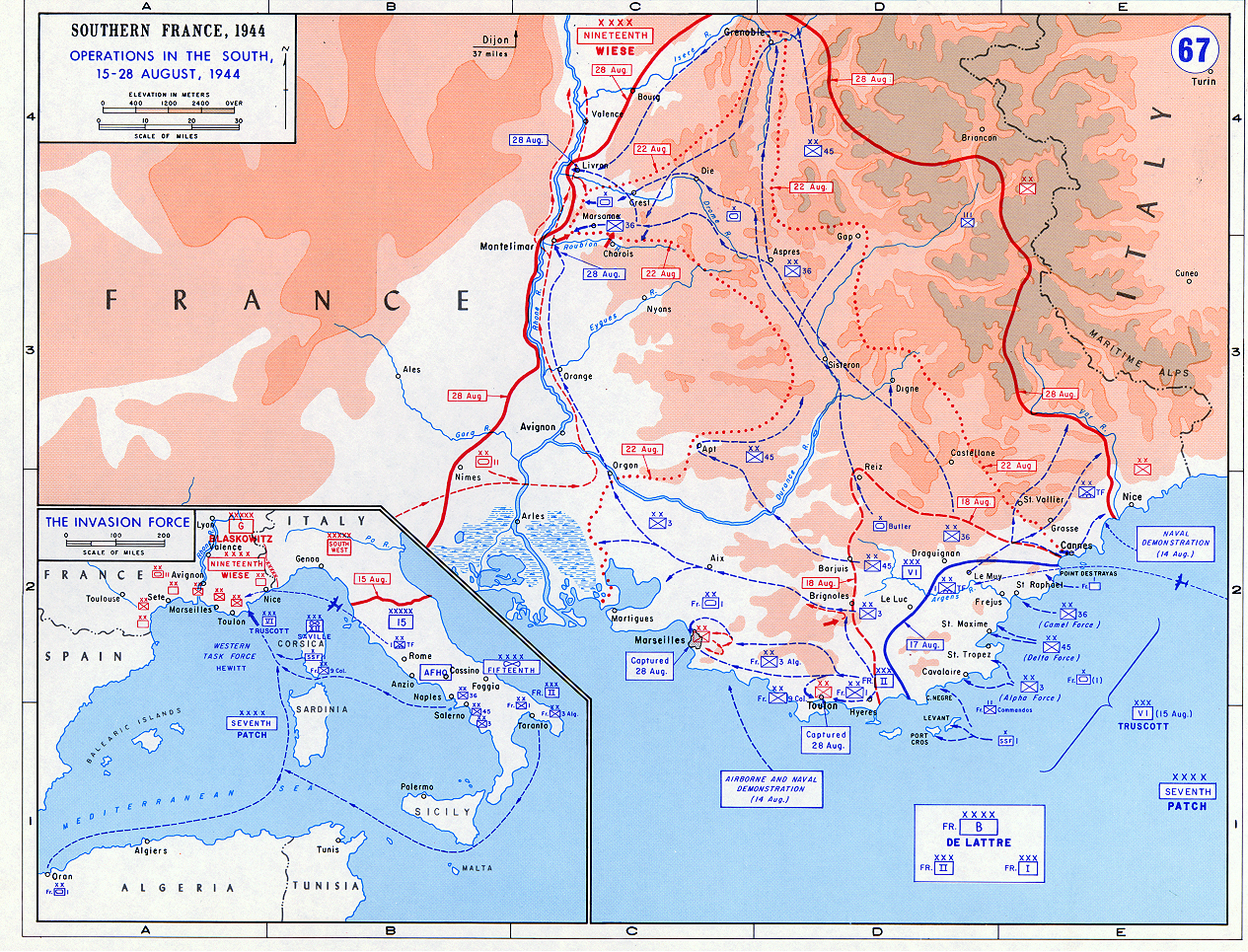
Edward arrived at the 439th while the unit was flying missions from Sardinia and just as Rome was liberated following breakouts at Anzio and Cassino.  His bomber group also participated in the mid-to-late August invasion of southern France.

A month before he was shot down the unit had moved to the French Island of Corsica which tucks into the area between France and Italy.

This week, marketing-guru Seth Godwin blogged about myth-making narratives and why it is that “culture creates reality.”  World War II was tidied after a few months of investigations into numerous failures.

But if you want a good lesson in the messiness of “strategy as a journey” then read the book entitled The Day of Battle by liberation trilogist Rick Atkinson.

America’s success in World War II was due to President Franklin D. Roosevelt’s deftness at juggling relationships with other Allied leaders, but also to his trust in General George C. Marshall and subsequently, to Marshall’s trust in General Dwight D. Eisenhower.

Author, journalist and defense expert Thomas E. Ricks wrote in his book The Generals that, “Marshall understood that Eisenhower had a talent for implementing strategy.  And that job, Marshall believed, was more difficult than designing it.”

Ricks continues that, “…successful generalship involves first figuring out what to do, then getting people to do it.  It has one foot in the realm of critical thinking and the other in the human world of management and leadership.”

He added, “It is thinking and doing.”

During my now concluded four decade career in community destination marketing, I found that far too many economic developers prefer “list checking” to “strategic thinking” because they don’t want to be hemmed in.

Instead, they preferred to be a “storm in search of thunder,” and perpetually in search of a parade to lead.

But those who do think strategically (it is required in my former field for an organization to be accredited,) must avoid in the words of the McKinsey experts the trap of making “the creation of strategy a rigid box-checking exercise.”

In addition to discussing core elements of strategic thinking, the experts list seven “essential building blocks” for building strategy as well as making “strategic choices and carrying them through to operational reality.”

The last one is to “evolve,” and that means adapting and learning.  Adapting a strategic plan on the fly is a sign of success rather than a failure of insight.  Failure, the McKinsey experts note, is more likely from neglecting the essentials at the beginning, the building blocks.

“Proprietary insights are hard to come by.  Shaping keen insights into good strategies requires deep interpersonal engagement and debate from senior executives, as well as the ability to deal with ambiguity in charged or often stressful circumstances. (emphasis mine)”

In my experience, people who avoid strategic thinking or planning fail to do so because they fear ambiguity.  In my opinion, governing boards seeking chief executives should run from candidates who seemingly “have all of the answers” and focus instead on those willing to think critically and deal with ambiguity.

People who claim to be people of “action” often mean they have no patience for “thinking” or tolerance for “ambiguity.”  A lot of people died during WWII because some leaders used the former to avoid the latter.

My line of work wasn’t life or death but I quickly learned that not only were livelihoods at stake but so was a fragile community sense of place.

Individuals who want to charge ahead so they can check the box or develope on the cheap because they have no patience for ambiguity may seemingly succeed in the short-term.

They excuse the rush as a means to “making things happen.”  Often, however, these nonstrategic decisions are later viewed as failures and destructive to communities in the bright light of long-term analysis.

There is a heavy price for avoiding ambiguity.

Tuesday, September 17, 2013

Contrasting Americans in 1943

I guess I’m not surprised that most Americans seem more exhausted and detached rather than incensed at what’s happening in Syria.  I certainly have been.  Forces that gridlock us today seem eerily similar to those following the First World War, which resulted in the creation of modern-day Syria.

For more than a decade now, Gallup polls have shown that fewer than a third of Americans think our country should build democracy abroad.  Barely half want us even to defend human rights.

These findings remind me though of another poll in the spring of 1943, barely 18 month after America had entered WWII and still two years before its conclusion.  First, some context might be useful.00082_p_10aeuyf6sw0446_b

In the years between the world wars, America had been gridlocked by a blend of isolationists.

This included Republicans who blocked the League of Nations and conservatives from both political parties who demonized immigrants and immigration while promoting economic segregation during a Gilded Age not unlike the one spawned over the past three decades.

This isolationist blend also featured hate groups such as the huge second coming of the Ku Klux KIan along with over 100 groups forcefully promulgating anti-Semitism, ultimately including both Holocaust enablers and deniers.

Caring Americans did not have near the intensity or energy that the vast majority who were self-centered, intolerant, inflexible and bigoted did.  Sound familiar?

In 1939, a poll of Americans was conducted by Elmo Roper, who pioneered the first scientific national opinion polls.  It was taken a few months after Nazi Germans had herded nearly 30,000 Jewish people into one of three concentration camps.

One was Dachau which my father’s U.S. Army battalion would liberate seven years later (one of his photos of a gas oven there is shown above.)

Even after news reports of this Kristallnacht spread here, the poll showed that fewer than 4-in-10 Americans felt Jews should be treated like other people and 53% believed they were different and should be “restricted.”

Ten percent even wanted them deported from America.   In May of that year, Southern Senators threatened President Roosevelt, if as indicated, he dared grant permission for a ship of Jewish refugees including many incarcerated in Dachau to dock in America.

Entry into the war chastened Americans and within a year and a half, another poll by Roper showed that three quarters felt that after the war, American should play a larger global role.

Nearly the same proportion believed America should “plan to help other nations get on their feet,” and half concurred with active involvement in an International organization with “a court and police force.”

President Roosevelt’s moral leadership was also rewarded with 7-in-10 approving of his handling of the war and 2-out-3 favoring a fourth term.  Most of the wars since then such as Vietnam and Iraq haven’t met the moral leadership test.

Some presidents even bucked public opinion to keep us out of war, such as when retired Five Star General Dwight D. Eisenhower, eager to end the Korean War, brushed aside a poll showing half of all Americans willing to drop “the bomb” on what was then termed Red China.

Recently President Obama has tried to do the same while also recognizing moral imperatives.  Americans seem to have grown weary of war, even in response to moral obscenities such as those taking place in Syria.

Or maybe as Winston Churchill famously said – “…Americans will always do the right thing… after they’ve exhausted all the alternatives.”

In his white paper on Moral Courage, Dr. Rushworth Kidder, founder of the Institute for Global Ethics in 1990, makes the case that moral courage is as important as physical courage but it deals with intangibles, values and convictions.

A friend of mine, Ryke Longest, who heads an interdisciplinary clinic and teaches at Duke University Law School here in Durham where I live, teaches his students this “truth”

“The only fights we surely lose are those we surrender by doubting the value of courage.  Courage is not foolhardiness.  Courage is not bravado.

Courage is the notion that some things worth fighting for are worth risking everything in the battle.  The problem of our present is not unique in history, but rather a common theme recurring through the centuries.”

He goes on to a describe a cycle that repeats itself historically – “Fear creates greed for power.  Greed seeks power.  Power stifles justice.  Justice finds a champion.  Champion encourages ordinary people.  Ordinary people overthrow the greedy.”

If you never had a chance to hear professor Longest, here are two inspiring clips, one from the Wizard of Oz and the other Henry V that he uses to make this point.

I have faith that once again and soon, Americans will find their energy and intensity to stand up for their convictions.