Showing posts with label Inheritance. Show all posts

Tuesday, January 06, 2015

A Rare Pedigree of Orneriness

My father and paternal grandfather shared the same middle name, Melvin but the name is in honor of my great-great grandmother, Amanda Melvina Poorman.

In America, her first and middle names were popular in the late 18th and early 19th century among descendants from Ireland, Scotland and England due to their literary use.

But I was intrigued recently to learn that her father, John Poorman had been only the 31st person baptized into the Mormon Church barely two months after it was organized as the Church of Christ and nearly two years before Brigham Young.

He was baptized by immersion on June 9, 1830 at the northern end of Seneca Lake a few miles from his farm by his neighbor David Whitmer famed as one of the witnesses who had actually laid eyes on the ancient “golden plates” from which the Book of Mormon was translated.

Whitmer had been baptized a year earlier and was one of the six founders of the new restorationist Christian religion, today the third largest by affiliation in America.

But those first eight years from mid-1830 to mid-1838 were tumultuous as much internally as from external persecution including several name changes as the new church rapidly grew to nearly 18,000 members, up to half in Great Britain.

My great (x3) grandfather Poorman followed church leaders to the area around Kirtland (northeast) Ohio in early 1831, fighting off a mob of 40-50 men a year later who tarred and tried to suffocate church founder and prophet Joseph Smith.

By 1833, Poorman was among the first  couple of hundred Mormons who settled in northwestern Missouri along the western banks of the (Big) Blue River which at the time was the edge of the American frontier, long before the existence of Kansas City.

Mormons including my ancestors there were defending themselves from mobs of vigilantes.  These Mormons were from the northeast, with abolitionist sensibilities, when it came to slavery.

The mobs were from the upper south and worried that voting as a block Mormons would threaten Missouri’s status as a slave state.  Little did they know the discord and internal friction among Mormons at the time.

The battle took place in an area along the I-435 beltway, an alternative route from I-70 around downtown Kansas City and one to which I will pay much more attention whenever future cross-country road trips with Mugs (my English Bulldog) take us along that route.

The Blue River flows out of Kansas and just before it flows into the Missouri River near Independence, Missouri is where Poorman was involved in the Battle of the Blue in November of 1833 to fight off mobs of vigilantes.

A few miles north, across the Missouri River in Liberty is where Poorman married my great (x3) grandmother Nancy Botkin Davis three years later, apparently four or five months after my great-great grandmother was born (ahem) and help to raise her children by a previous marriage.

However, internal strife and power struggles were beginning to take a toll.  Two years later, in 1838, his friend David Whitmer, who had headed the church in Missouri, suddenly resigned.

Refusing to defend himself, Whitmer was then excommunicated ostensibly as part of a coup to topple Joseph Smith over the then secret practice of polygamy as well as the word of wisdom.

But many times subsequent to parting ways, including on his deathbed, Whitmer reaffirmed his witness of the “golden plates.”

My Poorman ancestors had lived in the same Kaw Township settlement with Whitmer.  While there is no record they were involved, I am sure it distressed them to see their long-time friend ostracized.

Politics had taken a toll.

Ironically, a little more than fifty years later and thirteen years after Whitmer’s death in Missouri, Mormon leaders would disavow polygamy but without reinstating those who had resisted it from the beginning.

That fall of 1838 the Mormons were expelled from Missouri after the governor signed an extermination order.  But my great (x3) grandparents were among a few who stayed, relocating about fifty miles north and a bit west to Washington Township, a few miles west of St. Josephs.

Until then, this “nose” of Missouri had been set aside in treaty as Indian lands but by just as my Poorman ancestors sought sanctuary there, the area was being annexed into the United States as part of Missouri with Platte Purchase.

Records show that the Mormon church lost track of the Poormans after 1840 so they would not have met many of my other ancestors then gathering in Nauvoo, Illinois as recent converts.

But as the Mormons were also driven out of Illinois after the murder of Joseph Smith in 1844 and across Iowa in very early 1846, it is possible the Poormans were contacted by Mormon agents sent into Missouri to buy supplies.

They may have also met members of the Mormon Battalion including several other ancestors as it marched through St. Joseph in route from Iowa to Fort Leavenworth in preparation for marching southwest into the war with Mexico.

Mormons talk as if its members had all gathered in Winter Quarters, Nebraska or back across the Missouri River in Council Bluffs but these places were only major staging areas for the nearly half of all members preparing to head west beginning in 1847 when three of my ancestors paved the way.

Approximately 15,000 members who were gathered along the river were scattered in 90 settlements, some only 20 miles from the Missouri border and only 60 miles from where the Poormans lived.

Sometime around 1853, my great-great grandmother Amanda Melvina Poorman traveled up the Missouri and caught a wagon train west to join Mormons gathering in the Rockies, probably upon the death of her father.

Her mother died the following year, just as Amanda, out west, was marrying George Washington Kent, someone with whom she had played during her early years in Missouri.

She died in her early 40s and was buried in Richmond, Utah near the Idaho border, less than four years before her daughter Margaret would marry Hyrum Edward Bowman, two decades before they would head up into the Yellowstone-Teton nook of Idaho to a ranch where I was born and where they are buried.

When my ancestors established the first settlement in my native Idaho, the Mormon Church had just surpassed 61,000 members.  When great-great grandmother Amanda died, it has just surpassed 100,000 members.

It reached 180,000 when my paternal grandfather Mel was born and 231,000 when my grandmother Adah was born.  It crested 300,000 before they and my great grandparents homesteaded our ancestral ranch along the Henry’s Fork.

Mormon membership reached 576,000 the year my dad was born on that same ranch and 664,000 when my mom was born.  By the time I was born it had just passed 1 million.

When my daughter was born and involvement lapsed more than forty years ago, membership was well past three million.  When my grandsons were born it was surpassing 12 million and today there are more than 15 million, counting the 40% who are lapsed.

It not only gives me pause to think my great-great-great grandfather was among the first 31 but I can empathize that the internal politics took their toll.

The same occurred to my great-grandfather who married into that line when a Mormon Apostle and neighbor refused to take back a defective piece of equipment he had bought and then refused to let my great grandfather be buried in the clothing in which he had married my great-grandmother.

Their son, my grandfather, famously caught a church Bishop stealing water while others were in church services.   As the story is told, using he old Winchester hanging on my wall, he fired into the air as a warning.

By the time I entered grade school, classmates had exaggerated the story giving me a reputation for toughness.

My dad tried to be active as we were growing up but politics intervened when he was released after insisting there be no swearing during church ball games.

Yet we have all lived lives intertwined with that culture and its values.

I have other ancestors who joined shortly after John Poorman, most by 1840, and all had become Mormons by 1855 when there were fewer than 64,000 members.

For several years after the Mormons settled in the Rockies, membership declined, in part, because of radicalization during a movement by hardliners called the Mormon Reformation.

Several ancestors were dis-fellowshipped for speaking their minds when they disagreed with local church leaders over civil issues and controversial decisions and one or possibly two were required to undergo re-baptism.

Nearly all of this family background was unknown to me when my own involvement lapsed more than four decades ago.  Genetic expression is different among decedents but some traits are apparently very consistent.

There are very few with my pedigree today in that spiritual tradition and possibly even fewer with a legacy of such orneriness.

But I wouldn’t trade those genes or my heritage or my cultural values with anyone.

Monday, December 29, 2014

A List of Names Never Forgotten

I wonder, “For how many decades can useful DNA cling to an old horseshoe?”

In the early 1970s, when she sold the house my grandfather had relocated from a parcel that they had assembled as part of our ancestral ranch down, she had one last thing to do before living in shifts with her four children.

The old house had originally belonged to my great-grandparents.  Moving it down to Main and Third in Saint Anthony, Idaho and fitting it above a new basement probably cost more than a new house but it had been where my great-grandmother died during the Great Influenza.

As she packed possessions to move, my Grandmother Adah made sure a heavy box of artifacts was shipped to me where I was just completing college.

In the box were pairs of horseshoes that had been worn by favorite horses trained and bred by my great grandfather and grandfather.  Each had been mounted on a beam in the basement etched with the names of the horses, Darby, Baby Queen, Bill, Thousand Springs and Senator Dubois.

Unfortunately, my grandmother didn’t keep them in any order, nor did she write down the names,  but they were made indelible in my memory from hearing and seeing my grandfather use them to tell the story of the long line of horsemen and horsewomen from which we are descended.

I remember when I was age 8 or so, helping grandpa add a pair while he held me up to print the name Dolly above them, the name of one of the five draft horses he had kept on the ranch after turning it over to my parents to operate after dad returned from WWII.

Not all of the horses named along the beam were work horses such as Gypsy had been, a pure black hand me down quarter horse, given to me as my first horse when I was age five.

Some were used for breeding quarter horses and/or raced and paraded as thoroughbreds at surrounding community celebrations.

The fame of some of those horses extended beyond their mythical esteem in my eyes.  Darby had been ridden in the parade in Salt Lake City for Theodore Roosevelt and his Roughriders.

Queen was trained by my great grandfather and given to my grandfather as a boy.   Bill was the first horse my grandfather trained and raced in community celebrations and rodeos.  Bill ran a quarter mile in 24 seconds once.

My great grandfather bought Senator Dubois as a retired racehorse.  Even at 20 years old, Senator turned in a quarter mile in 22.5 seconds when ridden by my grandfather in one of the early War Bonnet Roundups down in Idaho Falls.

Winning the 3/8ths mile event, it was the last for both of them.  Newly married, my grandmother, who would work right alongside my grandfather while training horses as well as mules, felt it was too dangerous.

Or to hear his version, at age 25, he was getting too heavy to race.

The War Bonnet started in 1911, and they were married in 1914, to give an idea of the timeframe.

One of my great grandfather’s contemporaries was the real Senator Fred Thomas Dubois (pronounced in Idaho and Wyoming with heavy emphasis on DEW followed by a quick tailing boys,) rather than the way his French Canadian parents had intended.

There is a tiny town named for him about 50 miles west of our ranch and another about 160 miles east in Wyoming. I suspect they were named for him because he broke with his party to support conservation and not because he did everything possible to disenfranchise Mormons prior to statehood.

Dubois first came to Idaho as the US Marshall for the territory about three decades after my ancestors settled along the Rockies.  At the time he was first appointed Senator of the territory, Mormons began settling up in the furthest nook of the Upper Snake.

He was not reappointed after his second term and left Idaho for good about the time our ancestral ranch was forged a mile west of the Henry’s Fork River, the closest you can be to Montana and Wyoming and still be in Idaho.

I suspect the irony was not lost on tiny Mormon settlements along the Tetons as my great grandfather and grandfather rode Senator Dubois at celebrations and in parades.

I doubt that being able to see the names along the beam in that 1915 house, which is still in use at 3rd and Main, would not help me specifically tie the shoes back to their owners.

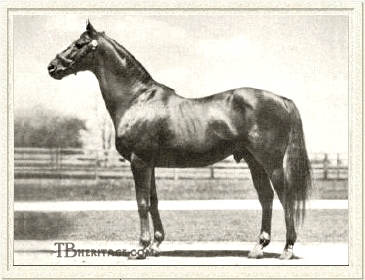
But one set could probably be identified by DNA as belonging Thousand Springs.  He was a grandson of Man o’ War (shown in the image in this post,) arguably the greatest horse to ever race.

When he was 30 years old, Man o’ War died of heart failure seven months before I was born in mid-1948 but more than fifty years later, horsemen in a poll still ranked him America’s “Horse of the Century.”

In the era between WWI and the 1930s, horseracing, along with track and field, were the most popular sports in America; the NFL, NBA and MLB of that period.  In the wake of WWI, Man ‘ War inspired the entire nation.

I never knew his grandson Thousand Springs and my family’s tie to the great horse.  My grandfather felt he was a bit temperamental and mean,  but he is still legend enough in that Teton-Yellowstone nook of Idaho to be mentioned in books alongside my great grandfather who died in late 1936.

Thousand Springs is a cousin to Seabiscuit, made famous in the early 2000s in a book, documentary and movie including a memorable Randy Newman soundtrack.  Seabiscuit inspired Americans during the Great Depression as his grandfather had done after WWI.

With a two car garage in place of my grandmother’s famous flower garden, the Saint Anthony house is still there at 249 W. Main Street a block equitant from the Catholic Church and the Henry’s Fork.

So I suspect I could track down the current owners and learn if there are any names etched on that beam that I may have forgotten.

At age 31, Gypsy, horse I inherited as a hand-me-down from my father when I was five years old, died not long after I left for college.

Grandpa had passed away two years before and I never had the heart to check during visits home with grandma to see if a pair of Gypsy’s shoes were up on that beam.

I suspect not, although my Bowman side was pretty stoic except when it came to horses.   Whenever that big black cross between a Belgian draft horse and possibly one of those thoroughbreds crosses my mind so does her scent when I would blow into her nostrils as a sign of affection.

When she moved out of her house in the early 1970s and began rotating her time with each of her four children including my dad, her youngest and only son, Grandma Adah made certain a set of artifacts made its way to me at college.

They were pairs of horseshoes my grandfather had nailed to a beam in the basement of their home in St. Anthony, Idaho and that he used as I was coming up to repeatedly tell me the story behind each pair and about the long line of horsemen from which I descended.

They are priceless even without the specifics because they were the means by which my grandfather would tell me our family’s story, the same reason they are so pivotal to history museums.

One set belonged to Thousand Springs, a grandson of Man o’ War, arguable the greatest thoroughbred racehorse of all time and familiar to fans of books, movies, musicals and documentaries as the grandfather of a cousin, Seabiscuit.

At the age of 30, Man o’ War died of heart failure, seven months before I was born in mid-1948 a few years after horseracing slipped in decline except for the Triple Crown.

But more than five decades later, a poll that included horsemen declared him the American race “horse of the century.”

I descend from a long line of horsemen but even as the only son of an only son and the end of that line in both talent and name.

Already my eye had been caught by the cool 1950s cars St. Anthony Motors would then showcase right on the street where we turned off the old Yellowstone Highway for the two blocks to Grandpa and Grandma’s house, by backing them in at an angle.

That heritage today is carried on in the Pacific Northwest by my niece Megan, a stalwart at REI, who learned her lifelong love for horses when very young while going to the racetrack with her grandpa.

I can bet they spent most of their time in the stables and saddling paddock where accompanies by escort ponies, horses and riders warm up before a race.

Monday, November 24, 2014

A Coincidence of Spirituality

The experience recently of my oldest grandson and his mother brought to mind one I had by happenstance 47 years earlier when I was eight years older than he is now.

Due to the genes I inherited, I’m probably fortunate to have avoided depression, but September 1967 is the first time among a handful that I slipped briefly into that state.

Even as infrequent and relatively shallow as my experience has been, I can vouch for the argument made by Andrew Solomon that “the opposite” of depression “is not happiness but vitality.”

For anyone stuck with the impression this is only sadness, listen to Solomon or click here for a short video on the science of depression.

That first time, I was having a crisis of identity and spirit.  I felt strongly that I shouldn’t be in Lyon, France, but rather 8,000 miles further east fighting in Vietnam alongside side friends and family.

A both/and alternative didn’t seem possible with the state I was in.

When I finally found my way back home and tried that other path, it was betrayed by the seven inch scar down the right side of my left knee.

No matter how many times I tried to enlist in various branches of the military, or how successful the rehab had been in 1966 after a tear in my patellar tendon from playing football, the answer was always no-go.

I grew up a Mormon surrounded by a wide range of cultures in that Yellowstone-Teton nook of my native Idaho.

But I was not just Mormon.

I descended from sixteen lines of ancestors who, 120 years before my crisis of spirit, had endured incredible hardship and journeys of thousands of miles to congregate at various points on the western slopes of the Rocky Mountains.

I was born at the most northern outpost of this meridian of my DNA but carried the full length of its expectations on my shoulders.

Ironically, however, I found solace and rediscovered my spiritual center one bright late September day when a friend and I slipped into the very back pew of the darkened sanctuary of the Basilica de Fourvière and heard the Gregorian Chants of a midday service.France 1967

This link to the vocalizations of group formerly known as Anonymous 4, came closest to approximating what I heard that day high on Fourvière hill.

Another I listen to is the group Trio Mediaeval.  It is hard to say why these chants meant so much to an Idaho boy who had never set foot in a basilica before or since.

For nearly four decades, my church attendance has been walking through nature with music such as this playing in my headphones.

The official choir of that Lyon basilica is now Les Petits Chanteurs de Saint-Marc, a children’s choir that can be heard singing at this link and here singing the contemporary Pie Jesu, a segment in a requiem mass Andrew Lloyd Webber composed in memory of his father.

I experienced that level of depression three more times over the next twenty years, just enough to help me empathized with the 4.1% of Americans who suffer it deeply.

It was relatively mild each time but I understand those who describe it as a “slower way of being dead” or as Solomon writes, “a funeral in your brain.”

It wasn’t Les Petits Chanteurs de Saint-Marc I heard that day but more likely a more impromptu group such as the one heard at this link.

What is now called the Basilica’s children’s choir was formed two decades after we dropped into its sanctuary first as the focus of a two year practice choir at l‘Ecole Sainte Ursule, a part of Le Centre scolaire Saint Marc a Lyon .

It is three miles down the Saône River on the other side of Vieux Lyon  from where I lived that September in 1967 on rue du Bon Pasteur.

The Basilica is atop the steep Fourvière hill looming abover Vieux Lyon and you can see the panoramic views behind me in the image in this blog by viewing the video at this link.

It was hazy that day, but on other days I could see Mount Blanc, 140 miles to the east and the highest point in Europe.  It was one of the areas my dad skied at the end of WWII on leave from chasing down Nazis trying to escape through the Bavarian forests into Austria and Switzerland.

But the thing about depression even at the relatively minor degree I was experiencing it is that you don’t seem to care about anything anymore.

I didn’t mean to ramble on about that moment in time which lasted only a few weeks but seemed like a lifetime, but these essays are written, in part, as memoirs for my grandsons.

They have been attending the Madeleine Choir School, one of a kind in North America but patterned, in part, on choir schools like that one in Lyon.  It is a Catholic school that teaches a complete curriculum with the choir at its center.

It isn’t the first brush with Catholic schools for our gene pool.  My grandparents sent my mom 250 miles south from where they lived to a Catholic High School in Salt Lake in a failed effort to separate her from my dad in the months before he left for the war.

Every other year, the “big” choir at Madeleine takes a week long concert tour to Italy singing in numerous Basilicas after studying their architecture, history and the geography surrounding them.

This year my oldest grandson, chaperoned by his mom, was eligible to take this extraordinary trip.

The capstone was singing mass at St. Peters Basilica in the Vatican, within earshot of the Papal apartments, and then watching Pope Francis give the blessing above the square outside.

The tour began in Venice, 28 miles south of where my second cousin and dad’s best friend growing up was shot down over Susegana, Italy when the B-26 in which he was a tail gunner was hit by AA fire and exploded during a bombing run to take out bridges across the Piave River supplying the German Army.

Edward Bowman was buried there and his dog tags hung over a cross in an orchard by a farmer, until my dad found the grave and brought his remains home for burial on our ancestral ranch.

He was only twenty-two years old.

The tour by my grandson’s choir also included Florence, Assisi and many other locations.  Given my memory of how I felt stepping into that sanctuary above the Roman ruins of Lyon, I can image the feeling of spirituality that permeated their trip.

A star soccer player, my grandson was a “walk-on” of sorts for the choir but by the conclusion of the tour he figuratively made the varsity and lettered.

Scientists have isolated a gene that is shorter in people who experience depression.  I think the one that I must have was much less severe than it was in my father and his mother.

Just like the one that results in essential tremor, which has yet to be discovered, both were probably handed down to my offspring.  My prayer that they skip the boys may be in vain but, if so, they have already been offset by other inherited traits such as grit, determination, and drive.

It is important to remember that inheritance is not destiny. It is how we express our genes that makes the biggest difference.

I can read the worry in letters to me from my parents and sisters during that time of spiritual crisis forty seven years ago.  It wasn’t the first nor the last time they probably felt helpless while watching me experience pain.

But I’ve lived a life well worth living and for that I owe them.

Tuesday, June 10, 2014

A Compelling Coincidence

I’m not in its target demographic but I binged-streamed the first season or so of Switched at Birth while by coincidence simultaneously reading the new book entitled, Inheritance: How Our Genes Change Our Lives and Our Lives Change Our Genes.

Both are impeccably written.  The former, now in its fourth season, was created by Lizzy Weiss who graduated from Duke a few years after I was drawn to Durham, North Carolina.

She also wrote or co-wrote many of its more interesting and deeper early episodes before the series settled into more of a “teen drama,”  undoubtedly with pressure from the network.

One of the joys of only streaming what little television I watch is coming across unexpected gems such as this and either watching as many as I like ad-free or quickly sampling and then skipping those that don’t work for me.

The latter is authored by neurogenetics researcher and physician Dr. Sharon Moalem.   You would expect this one to be deep. The other, however, was accurately depicted in the New Yorker magazine by Emily Nussbaum, when she wrote that “…its undertow is as strong as anything on TV.”

Switched is about two teenagers and their families who learn the girls were switched by the hospital at birth.  One was raised by a single mom, the other in affluence.

One girl is deaf and many of the other actors are deaf.  Most scenes involve signing and subtitles.  There are some scenes and one entire episode where two actors act out a scene with only body language, facial expression and signing.

An underlying story in the television show is the old nurture vs. nature issue.  In part, the book Inheritance explains how our genetic inheritance works and intriguingly how “your behavior can and does dictate your genetic destiny.

Like life itself, our genes are not just binary.  Moalem compares them to a score of music with “plenty of room for improvisation built into our lives” such as “Timing. Timbre. Tone. Volume. Dynamics.”

The book is filled with examples and metaphors such as “appoggiatura,” the “non-chordal or “non-harmonic” tone heard in Adele’s Someone Like You, a dissonance favored by Mozart.

It is further explained here on NPR in an interview with Rob Kapilow a music conductor, composer and author of What Makes It Great and his earlier book, All You Have To Do is Listen: Music from the Inside Out.

My music appreciation genes come from my mom’s side of my inheritance going back to my grandmother’s grandmother.  She was a Lowery who immigrated from Craigmark, a mining town just north of Galloway Forest in Ayrshire county in a hilly part of southwest Scotland lying along the eastern coast of the Firth of Clyde.

But I elected not to pursue them beyond a few years of piano lessons, a stint in glee club and church choirs, settling for an eclectic appreciation of music.  I can hear them in the “pipes” of one of my young grandsons in the clips sent to me by his mother.

Those genes persist and one day they may flourish again in “the fourth, the fifth, the minor fall, the major lift,” a line slightly modified for lyrical purposes in the poem/song by Leonard Cohen.

Cohen wrote and performed the song Hallelujah in the 1980s, often changing the lyrics because he couldn’t stop improvising.  He felt there were many “Hallelujah’s.”  It didn’t come to my attention until made famous by Jeff Buckley in the early 1990s as a “b-side” recording and now covered by more than 300 artists.

I had heard the song dozens of times dating to Cohen’s version but it didn’t fully resonate with me until resurrected after Buckley’s death in the 2005 Academy-award winning movie Brokeback Mountain.

We all hear music differently.  As depicted In Switched at Birth, many people who are deaf enjoy and perform music, just as many hearing people don’t or choose not to.

As a young composer, Ludwig van Beethoven gradually became deaf.  He began to acknowledge it to friends by 1801, more than twenty years before he composed his famous Ninth Symphony.

At about the same time, he first performed one of my favorites, Missa Solemnis in D major.  Put earplugs in sometime and listen to it at higher volume to get a sense of what he heard or felt as he wrote it.

Part of the reason I enjoy digging back into the archeology of my inheritance is understanding the various manifestations in me.  From somewhere along the line, I inherited a mutation that shows up as “essential” or “familial” tremor.

There is only a 50-50 chance it will manifest.  Among my parents their grandchildren and great-grandchildren and my two sisters, four of us have the condition and so far seven others don’t.

What we inherit is something in which we have absolutely no say or control.  But according to Moalem, genes are not fixed.

They are inputs and influences but they also change in reaction to our thoughts and actions.  I know from experience that our actions, especially when separated by distance, also have a powerful influence on the genes of those who inherit them from us.

This is also a theme that runs through Switched (streamed on Netflix.)  This could also be why some of our worst moments help make use of who we are and help “forge meaning.”

As attributed recently to Mike Rowe, the guy in the Ford commercials who created and hosted many years of “Dirty Jobs” on the Discovery Channel (stream on Amazon Prime) and another show coming this fall on CNN called “Somebody’s Gotta Do It”:

"What you do, who you’re with, and how you feel about the world around you, is completely up to you."