Showing posts with label Duke University. Show all posts

Monday, March 30, 2015

Anecdotal Madness

I held this post back for a few days so it wouldn’t appear to be rubbing salt into places where pride was so freshly wounded.  But this post is about more than just the Final Four or college basketball.

Sports reporters, especially in North Carolina where so many learned the basics in journalism at UNC-Chapel Hill, often repeat a myth that just has never held up to scientific scrutiny.

It found its way into several stories written last night after Duke became the fourth finalist: that Duke is the basketball team people love to hate.

It was so pronounced, that beginning in the early 1990s, Durham’s newly established community marketing organization used it as inspiration for one of a handful of markers as it set out to pin down and resolve misinformation undermining the community’s image.

Repeatedly over the years, polls showed that Duke’s highly successful men’s basketball program was not only the most popular in Durham, but a very close second in UNC’s home county.
Coincidentally, at the same time a national poll by Harris found that Duke was America’s favorite men’s basketball team, a position it has held now for 12 of the last 18 years including 2015.

In the six years when it was not America’s favorite, it was 2nd most favorite five of those years, falling to third one year, 1997.

The University of North Carolina was most favored three of those years giving the metro area centered around Durham and Chapel Hill a very unique status.  UNC has averaged just below #3 while Duke has averaged #1.

Kentucky has averaged just a bit more popular than UNC, possibly leading to a Kentucky-Duke culmination of this year’s Final Four dominating brackets across the country.

But what about here in the state of North Carolina?

I watched newcomers to Durham from Michigan stop by a table of Duke football players having breakfast this weekend to josh that Duke would be their new fav when a man nearby jumped from his chair, interrupting a phone call and a mouthful to scream, “no in North Carolina, it is the Tar Heels.”

However, he wasn’t joshing.

Walking away, the newcomers were puzzled and other patrons just looked down.  He may have been right about football, but probably not for long.

But what do metrics show regarding basketball?

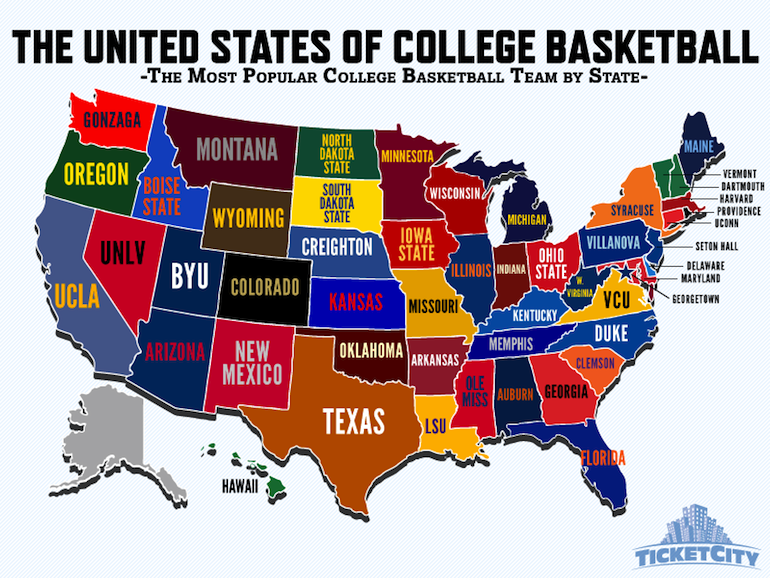
TicketCity, an agency founded in 1990 by a University of Texas grad took a look at which teams scored highest for engagement in their own state, factoring game attendance, Google search and social media over the past year.

Here Duke came out #1 too, in the North Carolina.  BYU was tops for Utah and Gonzaga for Washington, giving me an added alumnus trifecta.

All of this does not negate that Duke might also be hated, which is a different metric altogether, just that it would be irrelevant without showing it in the context of overwhelming popularity.

Sports reporters are emblematic of the challenges that face news reporters overall.  Drawing anecdotes as evidence of a more generalizabe public opinion is very tricky.

Local news in Durham has inferred that its recent population growth is due to the turnaround of downtown Durham in the last few years.  But Durham was the fastest growing city in North Carolina throughout the 1990s when its downtown had yet to emerge and its image underwent a turnaround.

How could this be?  Because Durham’s self-image and its image nationwide has always been high.  Over the 1990s is when negativity about Durham entrenched in surrounding counties was gradually reversed.

For sure, the image turnaround by 1999 lowered one of the barriers key to downtown revitalization by opening the minds of the news media, realtors, developers, financiers, as well as newcomers.

But downtown revitalization was also spurred both here and across the nation after the year 2000, not just by favorable shifts in psychographic and demographics but even more so by the innovation that year of New Market Tax Credits (NMTC.)

NMTC’s were recognized by Harvard in 2009 as one of the nation’s most innovative government programs leading to this 2010 case study of their dramatic success in downtown Durham.

Studies, scientific polls and generalizable metrics may not be as exciting as hyperbolic anecdotes for news reports or news consumers more interested in the pursuit of legends and myths, including their own.

But these tools are crucial to any community seeking a factual basis upon which to truly shift perceptions and initiate change.  Studies, polls and metrics are also important when assessing which coattails to ride or credit.

There is no institution more deserving of credit for everything Durham has achieved than Duke, and no program there more deserving of enhancing Durham’s reputation than Coach K’s Blue Devils.

Monday, November 17, 2014

A Distant Genesis of Durham’s Renaissance

Long before he became the single most important person in the revitalization of downtown Durham, North Carolina, he did the same for another community that often suffers the abuses of misuse of a hyphenated airport name.

It is also why he already understood the vast difference between a polycentric region such as the one Durham is often linked to, from one that is centered around one dominant city.

Polycentric means there is no dominant center.

Before coming to Duke University as Executive Vice President,  Dr. Tallman Trask III had served in that position for the University of Washington in my native Pacific Northwest (PNW.)

Having that in common when we met about that same time along with an enjoyment of sports cars, especially Porsches, we struck up a friendship.

From 1986 until mid-1995, Tallman oversaw $400 million of construction for “UDub,” as it is nicknamed including a satellite campus in south-Sound Tacoma, Washington that ignited revitalization of its historic downtown in 1990 (image below.)

It wasn’t until catching up in passing recently at a neighborhood restaurant where we both frequently dine that he told me my counterpart there in community destination marketing is the one who drew his attention to Tacoma’s downtown for the 4,500-student, 302-faculty member campus, one of three for the University of Washington.

This was happening just as I was jumpstarting the one in Durham and a few years before Tallman would follow me here.

Coincidentally, Wanetta Ayers, my counterpart who drew his attention to that historic district and who is now head of Business Partnerships for her native Alaska.

She had cut her teeth with me at the community destination marketing organization in Anchorage which I headed for most of a decade before jumpstarting the one in Durham.

My most vivid memories of Wanetta is that she was “killer” at Trivial Pursuits and was the first person to introduce me to Apple’s Macintosh computer when right after they were released she brought hers into our office of IBM personal computers.

The campus Tallman developed in Tacoma is in its historic Union Station District with century-old brick buildings built in the 1880s and early 1900s, much as the old tobacco warehouses were in downtown Durham.

There is where his partnership began with Scott Selig, who fresh from a degree at the University of Washington was managing a real estate portfolio for the school.

Today that 46-acre campus in Tacoma is in a historic district pinned by a steep bluff and Commencement Bay along the edge of its downtown, next to museums and the beautifully restored Union Station surrounded by restaurants, shops, parks and historic architecture with a spectacular view of Mount Rainier.

Another coincidence is that my nephew and his family now live in the historic Proctor District just to the north along the bluff above.

Tallman and Scott started the Tacoma campus by giving life to the 8-story, 1907 Perkins building, now residential condos, while establishing the permanent campus several blocks further south.

The master plan for the UDub’s Tacoma campus will eventually involve the adaptive reuse of at least 22 historic buildings with new facilities integrated as though they have always been there.

The effort has been widely acclaimed including a 1999 National Trust Historic Preservation Honor Award for initial renovation of the project’s first six historic warehouses.

But, then as now, Tallman’s respect for sense of place isn’t limited to historical buildings.

At the same time he was developing the Tacoma campus for UDub, he developed another satellite in Bothell, north of Seattle, which is just south of Mill Creek where my one of my sisters and brothers-in-law live.

Only the north-Sound Bothell campus is designed to fit in with its natural setting incorporating the restoration of a 60-acre wetland, winning accolades from the National Wildlife Federation.

During Tallman’s first years in Durham, we formed a mutual respect beyond our PNW connection, perhaps because I wasn’t always panhandling him for something as most others were.

He also saw me take some intense heat while standing firm behind a Duke decision to pass on a big event in the late 1990s even though others there would later reverse direction leaving me twisting in the wind.

After earning an MBA at Duke in the early 1990s, Scott served a stint with the family real estate business in his native Arkansas before returning to Durham in 2001 to reunite with Tallman as head of the school’s real estate and capital assets at Duke.

Together with Nan Koehane who was then serving a decade as Duke’s president, the three hatched a different approach to revitalizing downtown Durham.

This time they helped leverage even larger scale adaptive reuse of downtown historic buildings by being an anchor tenant including leasing a full fourth of the complex centered around the former Lucky Strike Factory giving lenders confidence its adaptive reuse was feasible.

It is a more nuanced approach: part major anchor, part for renovation and leasing, part facilitation and all done through partnering, shifting portions of 16 campus units to downtown Durham, in turn lessening pressure to cannibalize the school’s incredible natural setting.

Scott was also coming on my governing board just as I retired five years ago, further immersing himself in the importance of sense of place and the demand-side of visitor-centric economic and cultural development.

Duke has now done this by taking nearly a million square feet of space in downtown including several other historic districts including the recently announced Durham Innovation District, 1.7 million square feet incorporating 15 acres of historic downtown adaptive reuse.

Tallman isn’t much for small talk and much of the work he has done to revitalize downtowns over nearly three decades now is an externality to his job and the missions of the universities he has managed.

He and Scott may agree with me that there is much Durham could learn from the more strategic approach Tacoma has taken while embracing historic preservation rather than viewing it as a hindrance as some here have begun to do.

It is impossible to say that revitalization wouldn’t have taken place without his intervention nor probably will Duke ever seek or be adequately recognized for the pivotal role it plays in Downtown Durham’s resurgence.

Even the template established in 1981 with Brightleaf Square reveals earlier Duke fingerprints, both in the backgrounds of its developers and as tenants for 50,000 square feet.

Should future historians, unfettered by hyperbole, ever drill down into this second renaissance of downtown Durham to identify the pivotal factor, I’m pretty sure the answer will be Duke University and Tallman Trask.

Friday, September 26, 2014

How Impact Gets Exaggerated

When early during the last stop in my four-decade career in community marketing, we began to use input-output analysis to benchmark the impact of visitor-centered economic and cultural development, our organization was quickly asked for more.

The request was from Duke University asking us for visitation inputs to what has become a similar periodic computation of its impact on Durham, North Carolina, where I still live in retirement.

I remember initially having to go back and forth to explain why the University couldn’t just add up attendance at its various venues for sports, performing arts, museums and nature areas and trumpet it as generated by the University.

Airports similarly make mistakes on economic impact studies if they are not careful to net out the impact from residents and visitors not drawn just for the purpose of being at the airport such as people there to do business with the airport itself.

I explained that while the University did generate some of that activity, a good portion was from visitors here for other purposes who happened to also take in an event or feature at Duke.

Many are also the same visitors taking in more than one event or site and to merely tally them would be duplication.

This portion qualifies as “participation” in economic activity but not economic “value added.”  At the time, we settled on terming it “generated and participated in.”

But the same clarifications had to be made each year and possibly still do.

The same is true of destinations that might try to leverage more respect by aggregating attendance of all features.  Without an input-output analysis of spending, even if they remember that resident spending never qualifies as visitor impact, the gross numbers do not equal value added to the economy. 

Many of the attendees are the same visitors taking in different events while here for other purposes.  To lump them together may create a short term wow factor but it will also backfire and lesson credibility.

Research in Durham, for example, measures not only participation levels by visitors in various activities but the percentage of visitors for whom that was the main purpose versus the percentage taking in the activity on a trip for another purposes.

For example, the latter represents a third of performing arts attendance, 40% of shoppers, 20% attending sports events and 60% of those attending festivals overall.  This is even true of those attending conventions and meetings.

Organizations are under a lot of pressure from governing boards and sponsors to justify their efforts.  But rather than gloss over these distinctions, it is better to educate these overseers on the following:

  • Drawing visitation is in part a collective effort.
  • A part of that effort is the community’s overarching marketing both to lower barriers to visitation, get on the list for future consideration and generate circulation.
  • It is smart to cross promote and also go after low-hanging fruit, such as visitors here for other purposes including visiting friends and relatives.
  • When non-residents are hired or sponsors and vendors from out of town used, it subtracts from economic impact as leakage.   It also undermines organizations that provide underwriting from taxpayers.

For example, local officials are often perplexed when they see cars from out of town dealers displayed in front of city-owned facilities because they know the sales tax on vehicles sold here represents a significant amount of sales tax revenue used to provide local services.

I’ve tried to smooth this over by explaining that this is one of the results when 75% of attendance at these facilities are visitors, which is a good thing.

It is natural for out of town dealers to buy up sponsorships because they are trying to reach the visitors attending the event.

Local dealers aren’t interested because only 25% are residents.  They aren’t interested in the visitors because contrary to what purveyors of advertising on or in news outlets want us to believe, people rarely commute to by cars.

Still, officials also have a point.  It signals to resident taxpayers that the facilities and events that do this aren’t very loyal.  It undermines support for future facilities, even the so-called “back end” incentives to spur developments.

Those negotiating the latter often fail to stipulate behaviors that will leverage more economic bang for the buck, such as using local vendors or jawboning the importance of hiring locally or making sure new hires relocate here.

Durham’s marketing agency is considered a best practice now by accreditation standards, in part because it not only employs input-output metrics but it has learned to do them for local facilities and events.

In reports such as the one recently published and shown in the image above, the agency gives examples of leakage as well as creates a chart that breaks down why communities that fail to take this factor into account are also guilty of grossing up impact.

For example, Durham visitation creates nearly a billion dollars in spending but only $766 million is spent here in Durham.  But because of leakage such as using out of town vendors, employing non-residents and visitors misdirected while they are here only $560 million is “value-added” to the Durham economy.

In other words, local business practices, if tweaked, could result in another $200 million for the local business climate and a percentage increase in local tax revenues generated from visitors alone.

Policy makers in Durham are taking heed, although they may need to talk to American Tobacco a little bit.  Even just a little jawboning can be very rewarding.

Friday, May 30, 2014

“Post Mortems” Are Essential to Optimizing Productivity

Clearly the source of some things you pick up so naturally early in your career gets lost over time.

Somewhere between graduating from college and having a hand in community marketing startups in Spokane in the 1970s and Anchorage in the 1980s, I adopted the practice of always conducting group “post mortems” after projects were completed.

By the time of my last DMO startup for Durham, North Carolina, the practice of “post mortems” was a central feature.

This is where co-workers gather after a project (on average 50% of any job is project-related – 100% in DMOs) to reflect on what worked and what didn’t work as well as lessons-learned.

To the consternation of a few co-workers who always resisted this practice, usually because they couldn’t seem to help but take everything personally, reflection such as this is the subject of some new research studies.

Repeatedly required during these sessions was “this isn’t about who, but what!”

I suspect I adopted “post mortems” from something I read in the 1970s by or about EST founder Werner Erhard while powering through the briefcase of “airplane reading” I always had handy.

Erhard was a very serial social entrepreneur and deep thinker about the processes of management and productivity. With no Internet in those days, I would read voraciously and then tear some articles out for further study when I could give it my full attention.

Anchorage back then was still attached at the hip with Seattle, or so Seattle seemed to think it its entitled manner.  It was a three hour flight there, four hours to San Francisco, 7+ hours to New York or Tokyo and 9+ hours to London, all of which I was required to travel to in those days on business, often on short turn arounds.

Even a simple round trip flight just to the state capital in Juneau took nearly three hours.

I got through a ton of reading either attending coop marketing planning meetings for the state or opening up new inbound markets specific to Anchorage.

I also burned out on business travel during my near-decade there but have to admit it also provided time for much needed reflection.

Durham, where I spent the remainder of my career is the center of a four-county metro designation that includes Chapel Hill.  Each community is home base to a noted business school.

I won’t make the mistake a DMO exec made several weekends ago when referring to her community as overflow for Duke without bothering to mention Duke is not in Chapel Hill or identifying other hotels in her comments were also actually in Durham.

She obviously forgot that the DMO’s in this part of North Carolina have a written agreement to ethically restrict comments to their specific destination and refer media to others for information in those communities.

I am sure there will be a conference-call “post mortem” to reconnect the dots.  Some DMOs, seemingly bored with destination marketing, always seem prone to mind the business of others places and in doing so, undermine their own.

Often they use the term “regional” as cover, which is pretentious and probably means they are simply in the wrong business.

Chapel Hill is home to the main campus of the University of North Carolina, one of 16 in that system overall.

Dr. Bradley Staats who teaches in the Kenan-Flagler Business School there and lives in nearby Carrboro is the co-author of a working paper detailing a series of studies reviewed recently by Carmen Nobel on Harvard Business School’s “Working Knowledge” forum.

The studies confirm the importance of individual and group reflection to learning.  Most research focuses on “doing” but this study confirms that reflection on work or “unpacking” creates incredible value-added.

We learn not just by doing but through reflection.  Because there is a tendency in any fast paced organization to move to quickly to the next thing, setting aside time for what I learned to call “post mortems” to glean lessons learned is crucial.

I certainly found it to be an essential ingredient to our ability to leapfrog much more established organizations,  I also found failing to do so seem to condemn other organizations to stubborn feedback loops that inhibited growth.

Individual and group reflection on a project is also how we learn to adapt our behavior and overcome the stubbornness and ego-centrism that holds so many back in the workplace or in relationships with peers.

“Go to your room” as my parents often required when I was growing up was just the beginning of self-reflection.  Once everyone had cooled down, the indispensible ingredient to learning was “unpacking” the issue or issues involved with the parent or parents involved.

Unfortunately, this doesn’t always happen and lessons-learned get truncated.  Home is where we should first learn that “it isn’t about who, but what!” These are the building blocks of conflict resolution.

Without the second part, learning, and therefore performance, isn’t optimized regardless of what stage of life your are in, especially in the workplace.

Tuesday, November 05, 2013

One Degree Separation From Tom Butters

Coming out of a wedding ceremony last weekend in historic Safety Harbor, Florida, I walked for a time next to someone who had traveled twice as far to attend as I did from Durham, North Carolina.

Before I could note my bonafides among the “Cod Fishers” by explaining that the town where she lives lies midway along a line of settlements by my ancestors stretching from Topsfield in the mid-1600s to the northern reaches of The Last Green Valley in the 1840s during which they headed out to my native Rockies, my new conversationalist stunned me with an even closer degree of separation.

When she noted that her husband was friends with a former athletic director at Duke University located where I live, I stunned her back when I immediately replied Tom Butters, a friend and mentor during my first decade here as head of Durham’s community destination marketing agency.

I marvel now even in retirement at how readily officials such as Tom and then Duke President Dr. Keith Brodie were to embrace me and the new organization that I had been recruited to jump-start in 1989.

They granted me instant credibility and the benefit of the doubt on many occasions.  I remember once when I was defending a Duke decision not to pursue a large event, a large donor who that made unhappy referred to me by a pejorative and Duke replied, “Yes he may be, but he is our a**hole.”

Tom should have already been famous to me when I arrived.  He had pitched during the early 1960s for the Pittsburg Pirates in the Major Leagues.  I am a lifelong New York Yankee fan but followed Pittsburg back then because the Pirates starred another Idaho native, Vern Law, who pitched in the same rotation.

Butters also played with Roberto Clemente and Willie Stargell, the latter whom I would meet at a Bulls game shortly after I arrived in Durham, as well as Bill Mazeroski, who had beaten the Yankees in the 1960 World Series with a homerun in the bottom of the 9th inning.

While in the minors, Tom had played for Salt Lake City (AAA) as well as Asheville (A) and Charlotte (AAA) during which time he completed his college degree by completing one semester a year.

In his first game in the “big leagues” he faced a handful of L.A. Dodgers in relief who had cut their teeth in Spokane (AAA,) the closest thing at the time to a professional baseball team for my native Idaho.

He gave up a single to Maury Wills, got Wally Moon on a pop up and walked Frank Howard between strike outs to Tommy Davis and Ron Fairley.  Next, Tom helped defeat the San Francisco in his first start.

My post-wedding conversationalist's husband had been roommates with Tom when he was a star pitcher for Ohio Wesleyan.

Tom had come to Duke shortly after his MLB pitching career was cut short by a neck injury that resulted from a car accident on his way to spring training.  Ironically, this occurred in Fayetteville, North Carolina, an hour and a half south of Durham, where we would one day meet.

At Duke, Butters headed special events for Duke athletics and for a time coached the baseball team under famed athletic director Eddie Cameron.  Yup that Cameron.

By 1977 he was named athletic director.  In 1980 he recruited the then little-known and now hall of fame basketball coach, Mike Krzyzewski, who also became a good friend shortly after I arrived in Durham,  just before winning his first of four national championships.

Upon my arrival, Tom immediately grasped the relationship between promoting Duke and my role in promoting Durham overall.  His forte had been development and he understood the innate connection between a university and its community.

He also appreciated that, as was our policy, the organization I represented then would never pursue or commit to an event that required Duke facilities without clearing it with Duke in advance.

University facilities are an incredible asset to a community marketing organization but rarely are they sitting idle.  Booking group business is about fit not just “big game hunting.”

Many communities not only put their own stakeholders on the spot by pursuing events that are not a good fit and without first clearing availability, but push ethical boundaries even further by bidding on events too large for them to host on their own.

They can only make it work by incorporating facilities in nearby communities, but often before clearing them with counterparts, thus putting entire regions and states on the spot.

Durham collaborated with not only other destinations in its metro area but destinations in a nearby metro in designing shared bidding guidelines and procedures on mega-multi-city events.

In the end, these guidelines were signed off on by not only other community marketing organizations but respective chambers of commerce and university athletic directors.

Tom was an inspiration for this collaboration just before he retired in 1998, little more than a decade before I would.  He set the standard for Duke’s success not only on the fields of competition but in the classroom and in his community.

He was also an incredible mentor.

Monday, June 17, 2013

Doomed by Greed and Gluttony

My daughter turns 40 this month.  That’s the age I was when recruited to Durham, North Carolina 24 years ago, where I still make my home during a new stage in my life.

A few days ago while watching a young rising senior in college shoot baskets with his father at Duke’s Cameron Indoor Stadium here, I was able to point up to section 3 where we sat when I first introduced his parents to Durham, shortly after he was born.  It also reminded me how young I was when I became a father compared to many of my friends.

I think it made them better fathers.

Now, many studies I read don’t even bother to include results from my age group, such as one just published about how consumers ages 18-60 interact with devices to watch live TV or video on demand.   I find that funny since I use most of these screens and have relinquished subscription television in favor of streaming.

I also wasn’t represented in a survey last month benchmarking tablet use among Americans from the age of my grandsons to age 64.  Nearly half now have access to a tablet including 6 out of 10 between the ages 18 and 34.

Nearly 7 out of 10 now have access to a smartphone.  Many of these studies are performed with advertising in mind.  Often without intending to, they reveal more about its rapid demise.

Tablet use (iPads were introduced in 2010) will likely surpass subscription television this year or next.  Many other screens already have.  Seven out of ten Americans now watch live TV via Internet-enabled devices.  Live television is rapidly becoming a reservation for only sports and news.

Programming free of ads and commercials is now as important as having more channels as a means of generating likelihood to pay for TV content.  The gap between those irritated by commercials on television and those who either aren’t bothered or who don’t pay attention anyway is now only 24 percentage points.

It will only be a matter of months until an ad on television will turn off as many people as who watch or tune it out entirely.  Anyone aware of the purpose of marketing knows television is very close to being a form of “dis-marketing.”

Already more than seven out of ten Americans find all or more than half of video advertising irrelevant to them.  Telling for the future, 23% of Americans are now willing to pay for ad-free programming and 21% are willing to pay to skip them.

Ads are a form of “yelling” to try to get the attention of consumers.  There is a huge industry devoted to selling them, creating them and placing them in various types of media.  The tiny part devoted to outdoor billboards is now more emblematic of “desecration advertising” from roadsides.

Having passed the point of lobbing 10,000 ads per day at the average person and unable to regulate itself, it is clear it isn’t just the obsolete billboard part of this industry that is bent on self-destruction.

Overall, the desperation of this dwindling part of the economy will result in even more “yelling” even as savvy marketers and brands are fleeing to more productive forms of communication.

Too much money is at stake for this industry to go down quietly and as billboards have much of their desperation will find an ear with lawmakers prone to listen to whiners with campaign donations to trade.

Sadly, what was once, with the exception of billboards, an innovate way to underwrite news and entertainment has been doomed by two of the seven cardinal sins, “greed” and “gluttony.”

Wednesday, May 22, 2013

Tracing Partisanship

Moderates are nearly extinct in the Republican Party.  In an interview today (28.25 mark) on the Diane Rehm Show, Olympia Snowe, a Republican moderate who has just retired from the U.S. Senate seemed to date the divide only to President Obama’s administration.

But a recently published study shows that the partisanship that gridlocks Congress today actually began during the first President Bush, also a moderate Republican, after gradually growing during the the terms of conservative President Ronald Reagan.

It really picked up steam during the so-called Conservative Republican Revolution of 1994 and its subsequent attempt to remove from office a moderate-Democrat, President Bill Clinton.

Present-day partisanship reached its zenith under the second President Bush, a conservative, and has actually moderated under President Obama, considered a liberal but who by many measures has actually governed more from the center.

My take comes from an analysis that was mapped senator by senator, session by session from 1975 through 2012 by two researchers. One is Dr. James Moody a sociology researcher and leader of the Duke Network Analysis Center here in Durham, North Carolina.

He teamed up with research mathematician Dr. Peter Mucha at the main campus of the University of North Carolina, several miles south in Chapel Hill, North Carolina which is part of the same metro area north and east of one centered around North Carolina’s capital city, Raleigh (just to be non-partsian.)

To my eye, the analysis, published last month, also appears to reveal that while endangered, moderate Republicans as of 2012 may even be more apparent today than moderate Democrats, a party home to a far greater proportion of moderate voters.

The mapping also seems to reveal that the 2003 invasion of Iraq was far more divisive than the 2010 overhaul of healthcare.  It also shows that during the prior event Congress was more polarized than a previous high in 1910 but fell below that benchmark during and after the latter.

It also revealed to me more about the relatively new discipline of network science which cuts across social and physical sciences to study relationships and interactions in areas like health, culture, organizations, science and politics.

Maybe it just because I am a moderate, independent of either political party, but this statistical and behavioral analysis has certainly given me a much better appreciation of the depth and breadth of political partisanship.

Friday, May 10, 2013

Inspirations for Sustainability and Stewardship

Some are leading the way toward a more sustainable future such as Duke University in Durham, North Carolina, my adopted home. While ideological gridlock are holding government initiatives back, entities like Duke and Harvard are forging ahead.

Rushing to become carbon neutral within a decade, as I blogged earlier, Duke has already established a pilot operation as a model for hog farms to manage waste and pollutants and develop on-farm renewable energy.

Last month, Duke began construction of large-scale reclamation ponds designed to capture 22% of the run off from its picturesque main campus and recycle it back across the campus to cool buildings, conserving 100 million gallons of city water a year.

The $9 million project will adapt the natural area around the ponds for education, research and recreation including a boardwalk, a mile-long walking path and amphitheater.

Even the trees that will be sacrificed will be reused as decking, handrails and structures as well as mulch around significant replanting and afforestation. Any surplus wood will be sold to benefit Duke Forest.

Established in 1931, Duke Forest is the university’s more than 7,000-acre research forest stretched across Durham, Orange and Alamance counties and a part of the Nicholas School for the Environment.

This spring new trails were opened near my home to an overlook at the Forest’s Rhododendron Bluffs.  Duke Forest also provides the spectacular backdrop for my frequent motorcycle excursions.

A similar research forest was established in 1907 at Harvard University. The 3,500 acre Harvard Forest is located in Worcester County, Massachusetts near Petersham about an hour and a half west of Cambridge and an hour north of where some of my ancestors were born and lived between Sturbridge and Oxford in the same county spanning from the mid-1600s through the early-1800s.

The year Harvard Forest was created, the first historical estimates of tree cover in the United States were made by Royal Shaw Kellogg who worked under Gifford Pinchot as a statistical analyst in the newly-established National Forest Service.

Reading Kellogg’s historical sketch on file at this link at North Carolina State University based in Raleigh, North Carolina, gives a fascinating glimpse into conservation as it was evolving on farms and ranches in the late 1800s.

He notes that in 1883 after migrating from his native central New York that  [as a then-8-year-old boy] – “Mother and I observed Arbor Day by going down to sandy river bed [Saline River northwest of Russell, Kansas] and pulling up willow shoots which we planted around drain from kitchen sink.  Grew well.”

Obviously Kellogg also gained an early lesson in the ability of trees to cleanse water, something seemingly lost 130 years later on many Republicans in control of the North Carolina General Assembly.

Kellogg, who later received an honorary degree from the Biltmore Forest School near Asheville, North Carolina, the nation’s first, was able to extrapolate forest cover back to 1630 including a state by state assessment.

His analysis determined that back then 93% of the land area between the Atlantic Coast and the Appalachian Mountains was forested, nearly 72% of the nation’s forests.  By the time of his calculations deforestation in America was occurring at a rate three times faster than forests could regenerate.

Three years ago, scientists at Harvard Forest published Wildlands and Woodlands, a vision of New England for the next half century and beyond.

While noting that there is currently more forest cover between Long Island Sound and the Canadian border than there has been at any time since that “summer of darkness,” the report found the canopy in decline again as it is rapidly being replaced by development and impervious surface in every New England state.

We know a lot more today about the economic and public health value of trees as a means to purify air and water, curb soil erosion and regulate climate.

To avoid the disastrous deforestation that occurred there from the 1600s through the 1800s, the report recommends as optimum that 70% of the region be set aside permanently in forestland, free from development, a three-fold increase in conserved land.

Ninety percent would be managed for wood products, water supply, wildlife habitat, recreation and aesthetics while 10% of the forestland (7% of the region) would be wildlands subject to minimal human impact.

Another 18% of New England – twice the area developed today – would be left free potentially for future development or farmland, according to the report’s vision.  The report foresees implementation of the vision by networks of landowners, private companies, governments, foundations and other non-profits such as the organization Wildlands & Woodlands.

Click here for a 2012 progress update.

It has been more than 500 years since Breton, Basque and Portuguese vessels began to sail into the Gulf of Maine from Europe to fish for Cod and began to trade with Native Americans.  Still 130 years prior to the arrival of the Mayflower, these Indians had learned how to manage forests.

I’m glad those of us Americans who followed are rediscovering the importance of sustainability, something we seem to regularly forget.

I also wonder if the ratios of managed forest to conservation areas and developable land in the Harvard report would be useful as guidelines for the City and County of Durham, North Carolina, where I live to establish more sustainable urban forest, open space and development.

Oh yeah, I forgot.  Some autocrats in the General Assembly are pushing to take away the rights of democratically-governed cities and counties in our state to establish any standards higher than those they apply to the state while at the same time defying standards set by the federal government.

Now isn’t that irony.

Monday, April 22, 2013

America’s Next “Hero” Generation

A month ago I spoke to Dr. Dana Clark’s large class of potential “community-destination marketers” at Appalachian State University (ASU) perched in the northwest mountains of North Carolina.

Weeks from graduation for most, I told these students that should they land a position with a destination marketing organization (DMO) they would already be among the top 1% in knowledge about the topic.

Two things will be required of them.  One, patience with co-workers and supervisors who will be stuck in out-dated approaches, and two, a realization that within 3 to 5 years what they have learned at ASU will be obsolete.

Using a quote I had read in my local newspaper, I relayed the wisdom of a friend of mine, Dick Brodhead, who is the president of Duke University in Durham, where I live.  In a speech to faculty, he had noted just the day before my trip to ASU that a liberal arts education:

“…aims to engage multiple forms of intelligence to create deep and enduring habits of mind, an active, integrative spirit naturally disposed, when it comes upon a new fact or situation, to go to work trying to understand it, updating preexisting understandings in a new light.

…It is, in the fullest sense, equipment for living.”

These kids to whom I spoke at ASU are bright, energetic and very thoughtful.  They asked great questions, and I could also see it in their eyes as each one filed by to shake my hand later.

Any DMO will be lucky to land one of them but I wish for them that they will find one smart enough to listen to and engage them in contemporary applications of community marketing such as the one in Durham.  Unfortunately, those odds aren’t good even if they limit their availability to just those that are accredited.

I offered to these students that the college courses most beneficial to community marketers today outside of those about destination marketing and development will be historical analysis and statistics just as they were during my now-concluded 40-year career in that field.

Many people misunderstand the value of historical analysis because they think of history as linear.  Actually, it is cyclical.  It doesn’t exactly repeat itself but the cycles are similar.  However rather than predestined, outcomes depend on the reactions of generations to times of crisis (e.g. Civil War, Great Depression/World War II.)

To understand their role in historical cycles, I recommended to these students a book first published when they were preschoolers entitled An American Prophecy, The Fourth Turning: What the Cycles of History Tell Us About America’s Next Rendezvous with Destiny by William Strauss and Neil Howe.

First published in 1997 and now available as an iBook, it accurately forecast what we now know as the financial crisis.  It traces cycles over the past five centuries.  Cycles span a human life or roughly eighty to one hundred years.  Each cycle has turnings that follow seasonal rhythms, e.g. “growth, maturation, entropy and destruction.”

The turning dating from the 1980s until the financial crisis has seen an “unraveling” of society, similar to other cycles in our history.  I told the generation to which I spoke last month at ASU, that if I read the book accurately, their generation is potentially a “hero” generation, much like the G.I. Generation of my father.  They will also face a similar crisis in their lifetime.

Just short of a week after that presentation, the New York Times published two columns.  One, by liberal-turned-conservative David Brooks summarizes a paper by a Yale senior describing the generation to whom I spoke at ASU and the influences that have shaped it.

The author, Victoria Buhler describes how she and her peers in that class grew up in a time of prosperity in the 1990s.  That was shattered first by 9/11 and then by the jadedness and moral ambiguities created by two long wars followed by the financial crisis.

As they enter their adult years, Buhler, according to Brooks, writes that this generation is now more anxious and cynical.  They are less idealistic about America and the world.  In Brooks’ assessment of Buhler’s thesis, this generation emerges empirical.

They “require hypothesis to be tested and substantiated with the results replicated before they commit to a course of action.”

To me, this means they will be far more capable of bringing America back from the unraveling of the last forty years based on a sound, “what works” policy rather than the ideological gridlock of many in high office today.

The same day as Brooks’ column was published, the New York Times published one by liberal economist Dr. Paul Krugman, a Nobel prize-winner who as a young man worked in the Reagan administration just as the unraveling so now apparent was set in motion.

Krugman argues that we’re cheating our children all right, but not from debt.  We’ve been cheating them for decades by neglecting public investment in infrastructure, disabling regulatory oversight of the food and water supplies and undermining upward mobility and the middle class to the advantage of the 1%.

I saw the future in the eyes of those students with whom I spoke at ASU and I have faith they can help us recover from this most recent unraveling and a crises yet to be manifested.

However, it will all come down to whether they are able to turn things around as we did during the American Revolution, the Civil War and the Depression/World War II, each of which could have gone another way.

It isn’t a given but my hopes and prayers are with them.  God bless America!

Monday, April 15, 2013

Mapping Why North Carolina Could Use Some Gridlock

Earlier this month, Republican Governor Pat McCrory helped distribute awards in honor of North Carolina’s popular roadside wildflower program, including one named for a friend  of mine, Bill Johnson, the 30-year roadside veteran who helped  establish it.

The Governor also inducted former Governor and Mrs. Martin into the Wildflower Hall of Fame, in which Bill was one of the first inductees two years ago.  The former First Lady inspired the wildflower program shortly before I made Durham, NC my adopted home in 1989.  I first met the legendary Mr. Johnson as he was launching the state’s Scenic Byways as a follow-up.

At the luncheon the Governor vowed to do what he can to enhance scenic programs such as this.  He has his work cut out for him.

Powerful members of his party in the General Assembly still hold views of the natural world that date to the late 1700s and 1800s.  This was a time when nature was viewed primarily as something God placed on earth for us to exploit.

More on the source of my view on this and other worldviews of the natural world later.

While less than a third of North Carolina voters are Republicans, they now control nearly 65% of the overall seats in the NC General Assembly. Regardless of whether it is due to careful gerrymandering or the resulting over-amplification of swing voters it brought about, it is interpreted by these powerful interests as a mandate to “deform.”

Prior to McCrory’s election, these powerful and unchecked legislators had brow-beaten the executive branch into enabling the sacrifice of tens of thousands of flowering dogwood and redbud trees that the state had planted along roadsides stretching between the wildflower beds the Governor honored.

For instance, over the objections of 8 out of 10 North Carolinas including by 19 to 1 members of their own party, these legislators also pushed through authorization for out-of-state billboard companies to desecrate roadside trees across the state and over ride local ordinances in communities with higher standards.

It may very well be that anything the Governor does to fulfill his vision of being transformative will be similarly over ridden by these and many other similar deformations underway in my state.

North Carolina could desperately use a little grid-lock.

Helping me understand how otherwise reasonable people would seek to deform North Carolina is an incredible article published last year in the Harvard Law Review.  It was written by Professor Jed Purdy who teaches constitutional, property and environmental law here in Durham at Duke University Law School.

He is also the author of the 2010 book entitled The Meaning of Property: Freedom, Community, and the Legal Imagination but you may want to start with one of my favorites, a book he wrote in his mid-20s and published more than a decade ago entitled For Common Things: Irony, Trust and Commitment in America.

It takes an appreciation of irony to stay engaged with what’s being perpetrated now by those in high office in North Carolina.  By stuck in the 1700s, I was implying that powerful interests who seem intent on deforming our state appear to have the perspectives Purdy describes as more relevant between 100 and 200 years ago.

This was a time dominated by a view of the natural world as “waste.”  Dismissing restraint or regulation as a “threat to liberty,” this mentality pillaged much of the country until the late 1800s. Purdy cites an 1883 debate over administration and funding of Yellowstone Park adjacent to where I was raised and spent my years on an ancestral homestead cattle and horse ranch.

Some senators at the time, according to Purdy, argued that Yellowstone should be divided up and sold, or in my opinion to use a word euphemistically used by those with the same view today about lands set aside in the public interest, “privatized.”

Just the last sixty years of that era saw two-thirds of the deforestation that has taken place in the United State during the last 400 years and by the 1890s the desecration began to shock the nation and its leaders into what Purdy describes as a new ideal of the human-nature relationship, what he calls “progressive management” or conservation.

It is  epitomized by Republican President Theodore Roosevelt and legislation such as the creation of national forests which was inspired by immense desecration right here in North Carolina.

In recent polls, more than one in five Americans still consider themselves conservationists today, more than any other label used by the more than one in three Americans overall who are deeply concerned about the state of natural environment being left for future generations.

As a moderate independent voter, it is the description with which I feel comfortable.  Three times as many people who fish and hunt in this country consider themselves conservationists than those who belong to the NRA.  Many are Conservatives and relate to the group formerly named Republicans for Environmental Protection.

Renamed ConservAmerica, the group is represented in Washington by a native North Carolinian and last fall formed a ground-breaking partnership with Audubon called the American Eagle Compact under the slogan “Because Conservation Doesn’t Have A Party.”

The early 1900s also saw the emergence of an ideal toward the natural world that Purdy calls “romantic epiphany.”  This ideal has been at the center of a key part of North Carolina’s tourism appeal since the 1930s including the inspiration for the first efforts to roll back roadside billboards in the state.

Today, this ideal is carried forward by groups such as Scenic North Carolina, an affiliate of Scenic America.

Judging by their actions, the ideals of conservation and “romantic epiphany” are despised by those Republicans in powerful positions in the NC General Assembly today. They seem determined only to roll our state back to the era of despoliation, back to the view of nature as only indicative of waste, back to the 1800s.

Tourism is a visitor-centric form of economic and cultural development.  Trees are a signature element of the natural aspect of North Carolina’s appeal to tourists which include more than 80% of relocating business executives prior to announcing their interest.

Trees along roadsides are the state’s first impression of its natural assets.  Butchering them for billboards or even just the convenience of maintenance engineers is obviously a good way of dampening tourism interest and eroding the North Carolina brand overall.

I suspect though, that anyone with a worldview of nature that has been in disrepute since since the late 1800s has little concern for tourism or relocating businesses or thousands of small businesses.

Their latest maneuver to prohibit the high standards of North Carolina’s towns and cities is further evidence of wanting to deform the state back more than a century and with it the state’s hard-won brand.

Purdy continues by describing a view of the natural world that emerged  in the early 1960s called “ecological interdependence.”  It spawned American’s deep concern for clean air and water anchored in the interdependence of nature and the moral sanctity of life.

Those bent on deforming North Carolina back into the 1700s and 1800s are even more disdainful of this ideal, even as we begin as a society to re-imagine a future ideal around the natural world spurred by scientific evidence of catastrophic climate change.

It is ironic that even scientists who were climate change skeptics now agree that this current environmental threat is nearly all the result of from human interaction with nature dating back to the 1700s and the dawn of that view of nature as wasted unless fully exploited.

Purdy is careful to note that none of these human-nature ideals have ever been monolithic even in the 1700s.  He provides evidence that often they were defined by something society was trying to avoid.

This blog is certainly not a substitute for reading and re-reading Professor Purdy’s salient overview of these various eras of the relationship between humans and nature, which I highly recommend.

His mapping of our views of nature over time has helped me not only better understand the realities and worldviews driving those so intent on deforming North Carolina, but made me even more concerned.

As valid as parts of that reality may seem, it is imperative that it once again be with other even more valid and relevant views.

When the pendulum begins to swing back from such extremism - and it surely will - hopefully we will not only seek rectify the damage, which will take generations, but re-imagine the next era of human-nature ideals in a pragmatic, moderate and less ideological sense.

Governor McCrory can get a head start on this process by following through on his comments at the Wildflower luncheon this month.  He’ll need all the support he can get from North Carolinians and courage within his party’s caucus to bring some sense to the General Assembly.

If not, instead of being transformative, the legacy of his administration will be one of deformity.

Thursday, March 07, 2013

The Home Team

Clichés are the bane of journalists and good examples are articles or reports involving Duke basketball.  Invariably they portray Duke as one of the most hated teams in the nation.

Harris, a national polling concern, is probably ramping up its annual survey of the nation’s favorite college teams in advance of “March Madness” the results of which it usually releases during the regional round of the 75th Annual NCAA Tournament which begins in earnest a little more than a week from now.

Duke’s men’s team has rated as the #1 favorite team in the nation in 9 of the last twenty years, #2 most favorite in four years and never lower than #3.  I’m not certain if Harris ranks the most hated teams but applied to Duke the cliché of “most hated” is misleading at best.

I always found it puzzling during my now-concluded 40-year career in destination marketing covering three different communities when people would ask me my favorite team.  The home team of course or in the case of Durham, where I served for more than two decades, “teams” because both Duke and North Carolina Central University are based here.

Even more puzzling was that so many of my counterparts in economic development failed to connect those dots, all the while holding their hand out to Duke for help facilitating projects.  My philosophy was that when you represented a community, you went all in and that included allegiances to local teams.

But then I remember that I chose to attend BYU over the University of Idaho in my home state, merely because the Cougars had won the National Invitational Tournament my senior year in high school, a period during which the NIT was the equal of the now much more highly regarded NCAA Tournament.

The challenge was clear as I arrived in Anchorage in the summer of 1978 to complete the start-up of the community’s destination marketing arm.  I found an immediate ally in Bob Rachel, the first basketball coach for the University of Alaska-Anchorage.

We needed to diversify summer tourism to be more than an overnight stop for highly-escorted cruise-related tours  and expand visitor-centric economic and cultural development across the other three seasons - including winter - something that made me “enemy number one” to a several individuals involved in Seattle-based tourism interests who felt they “owned” Alaska at the time.

Over Thanksgiving weekend that year, I ventured out for each session with 2,500 other souls to Buckner Fieldhouse on the U.S. Army’s Fort Richardson.  It was located across Ship Creek from my offices in downtown Anchorage and adjacent to Elmendorf Air Force Base from which I could break the monotony of long telephone calls by watching the almost vertical take-off of F-15s, often joined by a Snowy Owl perched outside the window.

Today, the two historic facilities bordering downtown Anchorage are known as Joint Base Elmendorf-Richardson, not quite the same ring.

Coach Rachel was soon gone, the victim of alleged recruiting violations.  He became an assistant at UMass but died of cancer in 1985.  But during his time in Anchorage, he was one of the first in the nation to jump on new NCAA rules permitting teams to add some exempt pre-season games. 

What was known as the Sea Wolf Classic soon became the Great Alaska Shootout and in 1983 moved to Sullivan Arena which I had played a minor role developing.  The Shootout always drew many of the top teams in the nation.  I met Bobby Knight that first year and watched North Carolina State beat Louisville in the championship game.

In 1980 I met Dean Smith, the legendary coach of the University of North Carolina at Chapel Hill.  Watching the Tar Heels beat Arkansas in the championship, it would still be nearly a decade before North Carolina would be brought to my attention as a place to live when I would be recruited to Durham to jump-start the marketing arm here.

During the 1983 “Shootout” I met the late Jim Valvano whose “cardiac pack” team had won the NCAA Tournament earlier that year and North Carolina State beat Arkansas to win another title game.  North Carolina won again in 1985.

I don’t believe Duke played in the “Shootout” until the 1990s after I had been recruited to Durham and had already become friends with Coach K, winning it in 1995.  By then Trajan Langdon, a star at East Anchorage High School was playing for Duke, followed by Carlos Boozer in 1999 who had played high school ball in Juneau.

The Great Alaska Shootout continues to have a North Carolina flavor with UNC-Charlotte winning the tournament last November but the number of similar tournaments makes it difficult to draw the top teams as the “Shootout” did in the 1980s.

Who was “my team” when I lived in Alaska and marketed Anchorage?  The University of Alaska – Anchorage Sea Wolves, of course, even though those were the Danny Ainge years at BYU when during March Madness in 1981, he went coast to coast in the last eight seconds to beat Notre Dame.

NCCU won a national title the year I arrived in Durham, Duke won three during my tenure marketing Durham and a fourth a few months after I retired.

And the Durham home teams are still my favorites.

Tuesday, January 15, 2013

Education Entitlement Imperative

In March of 1867, during battles with ultra-conservative-Democratic President Andrew Johnson over how to re-organize the South following the Civil War, the Republican Congress, controlled by liberals and moderates, managed to pass, and the President subsequently signed, new legislation establishing a national department of education to collect statistics.

Conservatives had long opposed compulsory public education.  Fearing even the collection of statics, the department was soon-after demoted from cabinet level to the status of office.  However, in 1870, under the new act and the new administration of President and Civil War hero U.S. Grant, the government began to conduct statistical surveys.  In 1872, Congress authorized the hiring of the first statistician.

This is how we now know that between 1870, around the time many of my great-grandparents were born and 1952, two years after I was born, “every decade was accompanied by an increase in 0.8 years of education.”

Unfortunately, that annual bump in the level of education stopped thirty years ago.  It probably isn’t coincidental that this was also when the middle-class went into decline and about the time conservatives -- by this time mostly Republicans -- took power as well as aim at government and education policy.Seven distinct youth segments - Mckinsey Survey '12

Ironically, it was conservatives who, in 1642, first put compulsory education into law.  The Puritans of the Massachusetts Bay Colony were ultra-conservatives, but they believed education was a moral and social imperative.

However, it would be another 210 years before Massachusetts established compulsory attendance, which reminds me of a hotelier-friend of mine in Durham, NC where I live, who found that asking prospective employees if they had a car was insufficient, so added the question, “and does it run?” 

By 1900, pressed by the Progressive Movement, 34 states including four in the South had legislated compulsory schooling if even for as little as a few weeks a year.  This included my native Idaho, first settled by my great-grandparents in 1860, which embedded education in its pre-statehood constitution in 1887. 

By 1907, North Carolina, my adopted home now for nearly 25 years, followed suit and finally, Mississippi became the last state to do so in 1917.  By 1910, 72 percent of American children were attending school.

Back then, half the nation's children attended one-room schools as my father did during the 1920s and 1930s in the Yellowstone-Teton nook of Idaho.  By 1918, near the end of the Progressive Era, every state required students to at least complete elementary school.

It isn’t clear why conservatives have so often opposed education.  You almost need a scorecard to keep track of when conservatives have been in control of each of the major political parties in the US.

When I need a break from writing essays such as these, I often pick up a small book entitled The Good Of This Place, a collection published by Dick Brodhead, a friend of mine in Durham, who is currently President of Duke University.

Before ascending to become president of Duke, Dick had been the long-time Dean of Yale College.  One of my favorites in the book, which was published just as I retired, is entitled Taking Democracy to School, a 2001 pre-9/11 lecture he made as part of the De Vane series to mark Yale’s 300th anniversary.

Here, Dick tells the story of an 1778-80 public education legislative proposal made by Thomas Jefferson entitled “Bill for the More General Diffusion of Knowledge” during the time he was elected Governor of Virginia while the American Revolution was in full swing.

To me, Jefferson and James Madison were the conservative Republicans of their time, resisting change, especially when it came to proposals by other founding fathers to abolish slavery.

The bill was repeatedly submitted by each of these men and a watered-down version was finally passed by the Virginia Commonwealth in 1796, well after formation of the United States of America and a constitutional compromise that would leave slavery in place until the Civil War triggered passage of the Fourteenth Amendment.

In this speech, Dr. Brodhead points out several “paradoxes of democratic education” contained in Jefferson’s proposal:

  1. “It failed partly because Virginia voters were unwilling to entrust their local schools to a statewide system…largely because they refused to assume the tax burden…”
  2. “Jefferson would make the school the great equalizer, the tool for neutralizing differences of income and family standing [except slaves.]
  3. His whole three-tier apparatus is an elaborate sorting device, a mechanism for separating the persons of superior parts and blessing him with further advancement.”

I can imagine the characteristic twinkle in Dick’s eye as he dryly notes that – “When Jefferson speaks of best geniuses being “raked from rubbish,” the limits of his egalitarianism comes clear.”

Today, education is an entitlement but a sense of “entitlement” is not limited by socio-economic status or level of education or privilege.  In 2011, while summarizing some of his research, Ed O’Brien, phd candidate in psychology at the University of Michigan noted that – “For some, a dull moment can seem like an eternity, whereas for others there is no such thing as a dull moment.

Fortunately, for the most part, I have always been more like the latter but especially now in retirement.  The study found that, unfortunately, for people who feel entitled, time passes oh, so slowly.

According to a 2012 McKinsey Global Institute survey, there are 75 million unemployed youth around the world, one in eight between the ages of 15 and 24.  For them, time is excruciatingly slow. The figure increases to 225 million when counting those who are underemployed.

Yet, paradoxically, only 43% of the employers surveyed in nine countries including the United States could find enough skilled entry-level workers.

Of those of student-age who didn’t attend post-secondary school, 57% are “too cool” (in my opinion, a form of entitlement) and 43% are “too poor.”  Another 18% are “disengaged” and 26% are “struggling.”

The McKinsey report analyzes three “critical intersections” for students, educators and employers: 1) enrolling in post-secondary education, 2) building skills, and 3) finding a job.

“Cost” is the top barrier to enrolling in college, denying nearly a third of high-school graduates access.  Among those who go on, only “46% are convinced they made the right choice as far as selecting institution or field of study.”

For those who do go on, there is a big disconnect at “building skills,” the second intersection, with 60% citing on-the-job training and hands-on learning as the most effective instructional techniques, “but fewer than half of that percentage are enrolled in curricula that prioritize those techniques.”

In my experience, many of the students in the surveys seem to feel “entitled” as do many prospective employers which are as much impediments as any failure by educational institutions to make adjustments.  At the third intersection, a quarter of youth fail to make a smooth transition to work.

The report proposes some improved models and in the United States, a Career Readiness Partner Council coalesced just a few months ago to evolve a new model between employers, policy-makers, educators, students and families.

However, I am more persuaded that a critical part of the answer is to be found by expanding the social and moral imperative for education into pre-school years.

Programs such as Smart Start, which brings together all the people involved in a pre-schooler’s life— “families, teachers, doctors, caregivers, social workers, and many others” as well as the More at Four program, have been proven effective by researchers at Duke University.

A recent Gallup survey of students reveals that student engagement with learning and education is highest during elementary school at 76%, falling to 61% by middle school and 44% in high school.  Fixation on standardized testing is one of the culprits.

I am convinced that even early intervention, well before elementary school is the answer to creating a lifetime enjoyment of learning.

Friday, January 11, 2013

The Odds of a Transplant

When I moved to North Carolina in mid-1989, as I applied for a driver’s license I was given the choice of donating my organs and cornea (eyes) when I die.  Anyone who checked “yes,” as I did, has a “heart” sign on the front of their license next to the expiration date.

I just learned that a record of my decision is also in a registry maintained by Donate Life North Carolina, based in Winston-Salem, about 90 miles west of where I live in Durham.

I wasn’t aware of the organization, even though I have had friends from across the state undergo transplants here at Duke University.  Donate Life NC came to my attention after the executive director, Sharon Hirsch, who also lives in Durham, commented on one of my posts this week.

If you were unsure when you got your driver’s license at NCDMV or you have changed your mind, that isn’t the only place you can register to be an organ and tissue donor.  To update your registration with DMV or to register for the first time, click on Donate Life NC or Donate Life America.

On the Donate Life NC home page, click on register or update registration.  If you registered with NCDMV, click on update and then update DMV, enter your driver’s license number and date of birth so you’re existing registration will come up.  There are more specifics to provide here than were given when you got your license such as donating tissue.

As of today, according to the US Department of Health & Human Services, there are 127,020 people in America waiting for an organ transplant. Each day an average of 74 people will receive an organ and another 18 will die waiting.

One organ donor can save up to 8 lives!

There are 3,740 people in North Carolina waiting for a transplant including 1,918 with my blood type.  Nationwide, last year only 10,213 people with my general blood type were able to receive organ transplants including just 384 in North Carolina.  Click here to check your state.

In North Carolina there are more than 4.3 million people who registered as organ donors through NCDMV or 52.09% of all holders of driver’s licenses (or ID card holders) so you can see the odds.

That certainly isn’t enough!

This isn’t coming to mind because I will be 65 in July and entering a new stage of live, it is because my daughter and my two grandsons, ages 7 and 9 respectively, are never far from my thoughts.

Do you really need those organs after you die?  Think about it.

Thursday, January 03, 2013

A Perspective on Dual Distribution

On a road trip last month, a friend and I decided to turn due west outside of Jacksonville, Florida and take a quicker and much more scenic route to our ultimate destination bypassing Orlando and Tampa.

The route carves through cattle and horse ranches past Gainesville to our ultimate destination on a 40-mile-long peninsula that spans the 4 to 10 miles between the Gulf of Mexico and Old Tampa Bay.

The last leg of the trip dissected several huge wellfields this peninsula began to lease and develop in other counties just prior to the outbreak of World War II.  This occurred after it had first been noticed in the late 1920s that the water quality in St. Petersburg on the very southern tip of this Pinellas County peninsula was in decline.

This tiny strip of land had a permanent population of less than 60,000 people when it turned to wellfields in other counties for water.  Today, the population is nearing 1 million and everywhere you go, there are glimpses of a dual water system, one for drinking water and the other filled with treated wastewater used for irrigation.

However, this dual system with color-coded hydrants -- the first ever in a metropolitan city -- wasn’t innovated by St. Petersburg and then adopted throughout the peninsula as a means of reducing water consumption, although that certainly has been one of the benefits.

It was spurred by stiffer state regulations in 1971 pursuant to the Clean Water Act. The cities and towns and villages surrounding 2,201-square-mile Tampa Bay including the port of Tampa to the east were told they must significantly improve treatment of wastewater before discharging it into what is actually a series of four distinct and connected bays.

St. Petersburg officials weighed the costs of upgrading its treatment facilities but elected not to discharge into the bay at all.  After determining that nutrients were the most stubborn and difficult ingredients to remove, the community elected to team with the federal government through grants to develop a dual system that would utilize reclaimed water.

In this system, wastewater is treated to a point where it is all but drinkable and then redistributed through the dual system of pipes back out to golf courses, businesses, schools and homes for landscape irrigation, where it turns out the nutrients in the water create a savings and added benefit

Today, in Florida alone, more than 650 million gallons of reclaimed water is redistributed each day and used by 525 golf courses, 875 parks, 320 schools and more than a quarter of a million residential irrigation customers.

In the United States, urban reuse of water began more than 100 years ago when it was first used to irrigate the 1,017- acre Golden Gate Park in San Francisco.  Broad utilization of reclaimed water for irrigation has been around since the 1960s.  It is now as clean or cleaner than drinking water in many places and was proven safe to use on crops a quarter of a century ago.

As James Salzman points out in his new book Drinking Water – A History, some communities are now getting around the “yuck factor” by reinjecting reclaimed water back into aquifers and then pumping it back up as drinking water, although it is safe and tasty enough for direct distribution.

Salzman, who teaches at Duke University in Durham, North Carolina where I live, is not the only water-related contribution to Durham’s reputation as a place “where great things happen.”  Another example is taking place over a hundred miles to the west of Durham.

For a little more than a year, Duke University has teamed with Duke Energy to develop and operate a pilot project as part of the Durham-based school’s commitment to become carbon neutral by 2024.

Aided by federal and state grants, the project teams up with a 9,000-head hog finishing operation near Boonville, NC to capture hog waste in a huge bladder and process it into energy used at the farm and using natural processes to cleanse wastewater so that it can be used to clean out the barns and when ready to water feed crops.  The award-winning project has drawn investment from Google which will share in the offsets.

In addition to showing the way to reducing air and water pollution including odors, the pilot project shows the way for other agricultural operations to adopt full-cost accounting, also known as the triple bottom line, as a means to improve the efficiency of free-market capitalism.

While it is ironic that some lawmakers seem bent on exempting the free market from full-cost accounting, also known as the triple bottom line, it is heartening nonetheless to see communities, corporations and institutions that are continuing to pursue a more sustainable capitalism.

Wednesday, October 03, 2012

Remediation Marketing

Until I got to junior high school, it seemed that teachers would always mispronounce my name. Reyn (pronounced like Wren) came out as Reen, Roon, Rain, Run, Ryne etc.

It was embarrassing to correct them but not nearly as embarrassing as it is to call someone or something familiar by the wrong name which, however, doesn’t appear to phase flight attendants.

I can’t remember where I was actually headed at the time but I do remember feeling very chagrined to learn as I was buckling into my seat that I had mistakenly boarded a plane for Detroit.

Fortunately, it was one of those airports at the time where passengers for several flights fed into one jet-way before dividing off into paths to different airplanes, so I didn’t have far to go to correct my mistake.

That must be one reason flight attendants always announce the destination prior to closing the door to a commercial flight, such as one did yesterday, by announcing Raleigh-Durham International Airport before a flawless non-stop flight back home from Florida to Durham, North Carolina, where I live.

Unfortunately, that was the last time on that flight that the attendant or the pilot accurately identified our destination.  They gave us the flight time instead as “Raleigh,” the weather as “Raleigh,” the gate as “Raleigh” and even wished us a nice visit in “Raleigh” or wherever our destination might be.

They were trying to flatter us as you would by referring to someone by name but there is only one problem.  The plane wasn’t landing in Raleigh and only a small share of the passengers were headed there.  The weather sensor isn’t even located in Raleigh.

I stopped as I deplaned and whispered to one of the attendants a suggestion that would improve that flight in the future, “please don’t refer to this airport or the destinations it serves as “Raleigh” and gave her the reasons why.

Her initial response was “that’s just the way we do it!”  I smiled as I was turning away and I replied, “that’s fine, I still love flying Jetwest” and smiling in return she called out to me “I’ll make that suggestion to the lead attendant, but what should we call it?”

I answered, “RDU or Raleigh-Durham International Airport.”

When I first relocated to Durham during my now-concluded career in community-destination marketing, my job involved reversing any touch point where Durham’s identity or Durham assets were being compromised, including references to the airport which is jointly owned by Durham and Raleigh, but is actually located midway between the two cities in Morrisville, NC.

A core but often overlooked principle of community-destination marketing is that a dollar’s worth of “remediation marketing” is worth a million dollars of promotion.

Truncating the name of the airport to simply “Raleigh” was common back when I arrived in Durham to jump-start Durham community marketing, not only in so-called regional meetings, many held at the airport but in news articles, board meetings at the local Chamber of Commerce, news releases by the State Division of Tourism and even utterances by elected officials.

A man with a business in nearby Chapel Hill, who must have lived in Durham City or County or Raleigh or one of a dozen towns in Wake County or he wouldn’t have been appointed to the RDU Airport Authority, wrote a scathing and very personally defaming letter castigating me for requesting accurate references to the airport.

I shared the letter and my reply with my board members so they could cover my back.  Unbeknownst to me, the letter had been courtesy copied widely and it came to the attention of the late and great Dr. John Hope Franklin at Duke University, with whom I was not yet acquainted.

I had forgotten about the letter when, a few weeks later, I attended a large banquet where Dr. Franklin was to speak.  I was stunned when in his first words after being introduced Dr. Franklin asked me by name to stand while he described my still relatively new role and responsibilities in the community.

Saying nothing else about me, he then launched into a funny story about how he always corrected flight attendants and pilots who try to take him to “Raleigh.”  Then with a quick “thanks” he nodded for me to sit down.

Over the next two decades, I would still get plenty of attitude from some folks in Raleigh whenever I performed this very small part of my job, but far more often people would come up to me and ask, “tell me how to correct flight attendants the way Dr. John Hope Franklin does!”