Showing posts with label Public Health. Show all posts

Wednesday, April 01, 2015

The Unintended Consequences of A Policy Change

I was just turning 40 when the issue over smoking on airline flights reached a tipping point and then banned in the U.S. in November of 1989, six months after we jumpstarted the community destination marketing for Durham, North Carolina.

So until recently, I assumed the continued presence of ashtrays on the doors of airliner lavatories merely dated the age of the aircraft.

But federal law, while prohibiting smoking inflight, including the levy of stiff fines for lighting up in the “john,” still requires the installation of ashtrays there on new aircraft as a safety precaution.

Far too often though, prohibitions such as smoking bans fail to include careful consideration of unintended, but costly consequences.

In mid-2012 Durham, NC, where I live, enacted what at the time was the most comprehensive smoking ban in North Carolina and possibly the Southeast.  Soon, workers quickly removed all ashtrays for cigarette butts from the bus stops.

The logic was that leaving them in place would encourage smoking but instead, taking them away has resulted in these areas being littered with butts.  But studies show that merely leaving these receptacles in place may have had little impact.

In 2008, a study was conducted, in part, to observe how smokers dispose of cigarette and cigar butts.  Only 15% used the ashtray while 40 flicked them on the ground including into shrubs while 27% left the site with the butt in hand.

During intercepts, self-reported litterers reported the greatest likelihood of littering occurring with cigarette butts.

Even more telling, smokers were also nearly twice as likely overall to litter as non-smokers, even when cigarette butts were excluded from the measure.

One wonders why anti-littering campaigns have failed to use this information to better target efforts just as agencies have learned to use animal abuse around a home as an indication that domestic abuse is likely there too?

Cities began to ban smoking on public transportation in 1936, more than three decades after several states had tried to do so and while tobacco companies were busy advertising how good smoking was for your teeth.

At the time, according to advertising research conducted for Fortune Magazine, 53% of adult American males including 66% of those under 40 smoked.

As of three months ago, according to the Blueshift Research Trends Tracker, 84.3% of Americans don’t smoke including 55% who have never smoked according to the CDC.

Of the 15% who do (13.4% daily,) 53% smoke cigarettes and 26% smoke cigars, yet tobacco products represent 38% of all litter along roadways, 23% of which comes from pedestrians.

It is only one of the ways smokers still shift billions of dollars of costs off onto those who don’t.

About 29 of every 100 adults who live below the poverty level are smokers, a rate much higher than those not in poverty.

The rate is also much higher among those who are disabled or work limited as it also is for LGBT Americans.

Recent studies show that smoking is increasing within poorer neighborhoods while it is disappearing in affluent neighborhoods.  report on CNN a year ago noted that “the chronic stress of poverty drives unhealthy behaviors.”

Societal stress may be the reason higher rates of smoking are also found in the other groups as well.

Based on the findings of the behavioral analysis of litterers, researchers have begun to look closely at the links between depression, smoking and littering in poor neighborhoods.

The 4% of litterers who admit doing it on purpose say it was just because they were having a bad day.

Depression, according to experts, is not about feeling sad or mad as much as it is about not caring anymore; a lack of vitality.

Its association with poverty is also why so-called sin-taxes to discourage smoking and lower its burden on those who don’t, may be too blunt an instrument to root it out entirely.

There also appears to be a direct link between cigarette smuggling and the level of taxation on cigarettes purchases, up to half of all cigarettes consumed in some states.

Banning tobacco makes sense, but it makes equally good sense to examine whether removing ashtrays or leaving smokers no options such as in airports yields hidden costs such as litter.

This may be why in Utah, where resident smokers are now only 9 out of 100 adults, there are special, high exhaust chambers in the Salt Lake Airport, intended for visitors as well as residents and paid for, in part, by a reduction in litter and illegal smoking elsewhere.

All of this is to say that bans on products such as smoking require thoughtful execution.

Wednesday, October 02, 2013

Obesity’s Link to Roadside Billboards

Tiny Rhode Island, the state most deeply rooted in individual liberty, vigilantly guards the following policy, while North Carolina lawmakers are busy surrendering thousands of acres of roadside forest in a giveaway to out-of-state billboard companies:

"It is the policy of the State of Rhode Island that on land held in the public trust, no vegetation is to be removed for the purpose of increasing the visibility of any commercial property."

Tar Heels familiar with a constitutional amendment known as the Environmental Bill of Rights (p. 538) know that was meant to do same for North Carolina, and they are bewildered that lawmakers, if even aware it exists, seem in flippant disregard.

Many Republican lawmakers are oblivious, at best, to the opposition of 8-in-10 North Carolinians to cutting more trees for billboards including a ratio of 19-to-1 against among members of their party, revealing a glaring weakness in representative democracy.

Obviously, taking out thousands of acres of roadside trees has an effect on public health because it is scientifically proven that trees help to clean the air, purify water, cool surface temperatures, screen wind and particulates and sequester climate warming gases.

Now comes a new study revealing that the outdoor billboards for which they are being harvested are linked to obesity, where prevalent.  This is a costly condition self-reported by 36% percent of Americans including 30% of North Carolinians.

Is it possible that Rhode Island’s refusal to surrender roadside forests to billboards is part of the reason that state’s rate of obesity is lower than states such as North Carolina where lawmakers are gratuitously deforesting to make their views more effective?

An analysis performed a few years ago by RTI International, based in Durham, North Carolina where I live, calculated that obesity is burdening the economy with hidden costs of more than $150 billion annually while jacking up health insurance premiums across the board.

To put this “obesity” tax on the non-obese in perspective, it is nearly four times greater than the amount a House bill is intended to cut from the federal budget in hopes of pushing working American families off food stamps.

They apparently think this will force these families to find work that pays a livable wage even though the proportion of low wage jobs has ballooned to 4-in-10, more than double what was in 2009.

McDonalds touts environmental responsibility as one of its focus areas including “conserving and protecting natural resources.”  Yet, for a decade, the world’s largest global foodservice retailer has also been the number one user of outdoor billboards.

This makes that company a major enabler of deforestation by outdoor billboard companies along publically-owned roadsides, not to mention a company empowering visual blight in communities, where on average, restaurants depend on tourist appeal for a third of their revenue.

Corporations like McDonalds have excellent intentions when it comes to sustainability, but all too often they are undermined when their marketing divisions fail to connect the dots or feel exempt.

To be credible, marketing must be about “storydoing,” not just storytelling.  One thing marketing departments in companies such as McDonalds can do immediately to redeem themselves is to stop enabling desecration by using outdoor billboard companies.

Food and beverage businesses overall make up 1-in-4 of the top 100 businesses in terms of generating outdoor billboard revenue.

In the past decade fast food restaurants alone have doubled their use of outdoor billboards while casual dining restaurants have pulled back.  Just look at Cracker Barrel, which has touted using 1,500 billboards alone in the past but has now fallen from 5th to 14th place in use.

Slowly, foodservice businesses such as Cracker Barrel are moving to far less destructive mediums such as highway exit logo wayfinding signs.

Among fast food giants, only Wendy’s seems to have had second thoughts about billboard use.  During this same decade, not counting those used by its bottlers, Coca-Cola, rose from 40th to 9th in billboard use contributing to a tripling of childhood obesity in a generation.

Founded by a third generation restaurateur, Orlando-based Aaron Allen & Associates, a restaurant industry analyst and consultancy for both independent restaurants and chains, steers restaurants away from billboards and toward far more productive marketing vehicles.

From 1971 when tobacco advertising on television was banned, until the early 1990s, tobacco companies were by far the largest users of outdoor billboards.  Then, there too, tobacco encountered an uprising of public health considerations.

It was in 1992 that McDonalds ran its first outdoor billboard campaign as tobacco advertising on roadsides fell dramatically by 33% by 1994 and then was banned from outdoor advertising in a legal settlement with 46 states in 1999 including North Carolina and Rhode Island.

Leveraging fire-sale rates as the death knell for billboards grew louder, by 2002 McDonalds became the #1 user of outdoor billboards, keeping this obsolete advertising technology on life support, a standing the foodservice giant has retained into the current decade.

This, even though studies show less than 1% of consumers now use billboards to make decisions and the desecration they create turns off 7 consumers for every 1 who still find them useful.

Billboards are the bottom feeders of the advertising industry, which overall has fallen to where it now returns just 1/10th of its input in terms of what it costs to place.

It is clear many lawmakers in North Carolina are not connecting the dots between billboards and public health.  Or maybe special interest lobbying by billboard companies has made them tone deaf.

Personally, I prefer to believe that most lawmakers are well-intended but just don’t get it or they are outmaneuvered by a sneaky few who know exactly what they are doing and don’t care.

One thing is for certain, billboard companies operating in North Carolina are hollowing out the code of ethics of their own industry which calls for protection of children and respect for the environment.

As for North Carolinians, we seem stunned if not numbed to the crass overreaching of billboard companies in the General Assembly.  Or maybe we like most Americans have tuned out advertising to the extent we no longer notice the visual blight billboards create.

Even more invisible and more deadly are the health hazards to which billboards contribute by enabling air and water pollution, increased erosion and surface temperatures and release of climate warming gases.

My guess is that soon, public opinion will give a death sentence to outdoor billboards the same way it did to using them to advertise tobacco.

In a Forbes article entitled No Billboards, No Outdoor Advertising?  What Next?, Scott Goodson, the author of a blog and a book entitled Uprising, told of one such uprising that has happened already.

In 2007, the world’s fourth-largest metropolis, São Paulo, Brazil put into effect a “Clean City Law” including an immediate ban on outdoor advertising as a form of “visual pollution,” even taking on media giant Clear Channel.

In a matter of months São Paulo took down 15,000 billboards.  Today, the measure retains an incredible 70% approval rating, coincidentially the same percentage of North Carolinians who see billboards as desecration.

Businesses and residents alike in São Paulo have been suddenly and joyously exposed to the community’s rich sense of place.

Firms there rapidly realized they had never questioned whether billboards actually worked.  As Goodson notes, “they realized that bombarding people with a visual traffic jam was never going to make an impact.  They learnt [sic] that one-way advertising doesn’t work anymore.”

The ban also “catalyzed” Brazilian brands and the ad industry there to “make a giant leap to digital.”

One day soon, North Carolina’s lawmakers too will rediscover the genius of the 1971 amendment to put roadside forests ahead of out-of-state billboard interests. 

It too will be be accompanied by a rediscovery of the state’s unique sense of place and a gestalt on the part of business.

Friday, September 06, 2013

Uncommon Bag Sense

Trex is a Virginia-based company that was formed in 1996 through the buy-out of a former division of Mobil Oil three years before it became ExxonMobil division.

The company now annually recycles over 1.3 billion plastic shopping bags and film into composite decking, porches, trim, outdoor furniture and fencing.

In the U.S., we use about 100 billion of these bags a year.  Headquartered in the Shenandoah Valley, Trex leads an industry that now repurposes 55% of the postconsumer plastic film recycled in this country.

The company runs a challenge each year beginning on November 15—America Recycles Day—where schools and communities compete for prizes such as wood benches, by collecting plastic bags from cereal, salt, produce, bubble wrap, Ziploc type bags, ice bags, newspaper sleeves, dry cleaning bags, bread bags and grocery bags.

Over the past six years alone, Trex has salvaged and kept more than 2.5 billion pounds of plastic and wood scrap out of landfills.  Most plastic film like grocery bags are recycled in the U.S. when consumers take them back to collection points in more than 12,000 retail outlets including dry cleaners.

It is fairly simple to do curbside collection of plastic bags and film by asking residents to place them altogether in a plastic bag.  According to places such as Madison, Wisconsin where they are collected curbside, it is also not that cumbersome to sort them.

But it takes a long time to collect 20 million tons of plastic bags, the weight needed to fill a truck when baled on pallets.  When new, it takes 1 million unused plastic bags to make a truck load. 

Curbside collection is not as effective as retail collection because so much is contaminated, but worst case, it is worth it just to help keep them out of streams and waterways.

The dilemma needs a both/and solution, but unfortunately only 3% of communities collect curbside, making it accessible to just 11% of Americans.  But Trex is not the only use of recycled plastic film and bags.  Click here to watch a company in Indiana turn them back into more bags.

Thurston County where my Mom lives on Puget Sound in the Pacific Northwest, is about the population of Durham County, North Carolina, where I live.  That community is suspending curbside collection in a few weeks ostensibly because China’s Green Fence has left them sitting on 60 tons—or three truck loads—of plastic film such as grocery bags.

There has to be more to the story because only 1.5% of what Thurston County collects is contaminated beyond what China will now accept.  Also, Trex now has a west coast manufacturing facility just 11 hours south in Fernley, Nevada.

Inertia is often the more likely reason more communities aren’t collecting plastic film and bags curbside or because the private sector partners they use for materials recovery are resistant to change.

Nobody ever said recycling would be easy but many communities and recovery businesses had grown lackadaisical, having shipped nearly 45% of recyclables to China in 2011.  It was that country’s largest import.

Last February, China launched “Operation Green Fence",” a 10-month effort to prevent contaminated shipments from entering the country.  Only 1.5% of each bale can be allowable contaminant now, ironically, the same percentage Thurston County cited as contaminated in curbside collections of plastic film and bags.

Before we get all indignant about China, contaminants in plastic film and bags come from those among us who are too lazy to remove food and liquids or receipts before putting them in our recycling bin.

The Chinese admit the fence is more psychological than anything, designed to get shippers to be more diligent.  They will need to get material recovery facilities and communities to be more diligent, who will in turn need to get all of us to be diligent.

All of this diligence may be lost on the 17% of Americans who are too lazy to properly dispose of plastic bags or the 4% who deliberately toss them on streets and parking lots where storm water washes them into streams.

Judging by how fast huge islands of plastic bags form where urban streams outlet, volunteer clean ups are also not sufficient and need to be augmented by much more frequent clean outs by local government agencies.

I’ve mentioned recycling but the 3 “R” mantra of sustainability begins with “reuse.”  An excellent “reuse” of a plastic bag is to pick up after pet dogs.  By my observation, the majority of dog owners are oblivious to picking up the toxin-filled droppings.

Reusing grocery bags won’t keep them out of the landfills but it will keep both the poop and the bags out of storm run off where they both pollute urban streams and end up back in the water supply.

Placing a deposit on plastic bags is well proven when used on other types of recyclables to greater increase recovery.  It is also a lot more market-friendly than a tax or a ban, neither of which has proven effective.

We seemed stalled as a country when it comes to facilitating waste disposal. I’m not referring to the recent effort by North Carolina lawmakers to brand the state for mega-landfills.

Readily available aesthetic containers that provide for sorted disposal of paper, food, plastic, glass and cans are still very rare in airports, schools, public buildings, theaters etc.

In Durham, containers such as these found at newer libraries and around Duke University are far too rare exceptions for something that by now should be retrofitted in all public and private facilities. They should also be available along sidewalks.

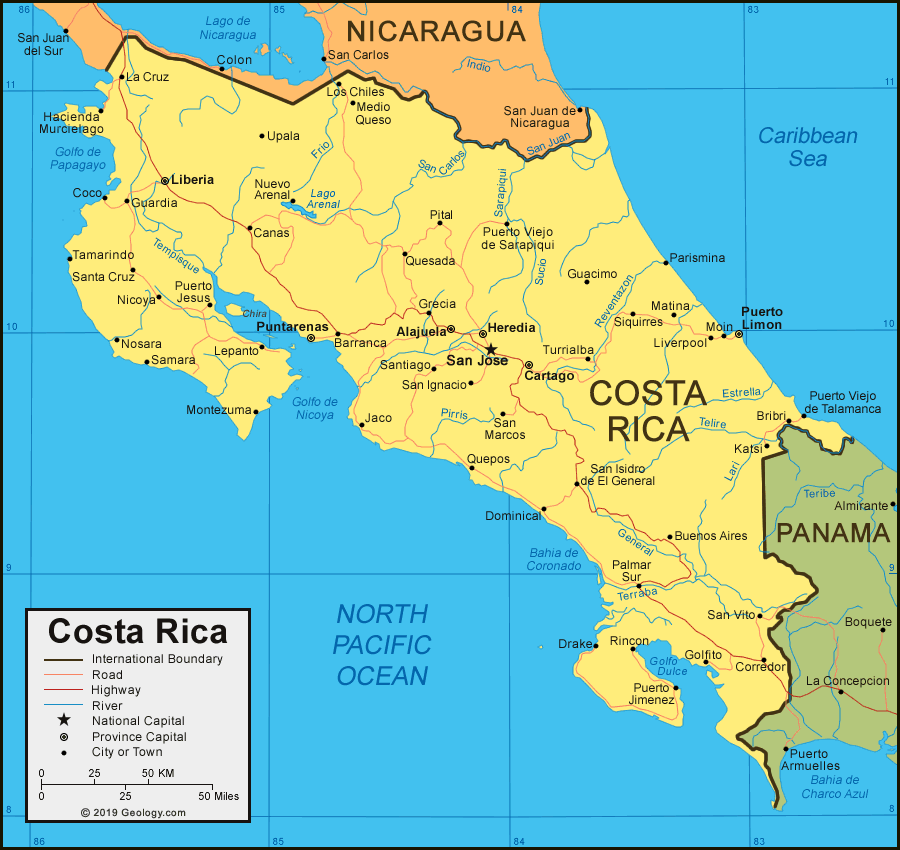
Other countries may have started later than the U.S. did but they are rapidly leapfrogging us in this area.  Tiny Costa Rica in Central America is an example.

This beautiful Central American country is about the size of Vermont and New Hampshire combined.  The population, a little less than that of Louisiana and a little more than that of Kentucky, is about 40% rural and 60% urban.

Prior to 2010 when it passed the comprehensive Law for an Integrated Management of Residues,  Costa Rica had a waste management problem.

Over 60% of its 2,400 tons of daily waste was going into open dumps while 15% was put into sanitary landfills.  Less than 10% was recycled and 250 tons of waste was illegally dumped into streams and along roadsides.

On my recent visit, integrated color and symbol-coded bins were appearing throughout the country, labeled Organico, Vidrio, Aluminio and Plastico.  They could be found in rural villages, resort towns and cities and were visible in every public and private sector facility I saw.

Here, I think we Americans have grown complacent about stewardship as we have about so many things.

Thursday, January 17, 2013

Is Tree Loss Linked to Mortality?

The unfortunate loss of 100 million ash trees to the emerald ash borer, an invasive pest from Asia, has provided a unique opportunity to deepen scientific understanding of the link between trees and public health.

After an analysis of 18 years of data from 1,296 counties in 15 states, the lead researcher, Dr. Geoffrey Donovan announced that “Americans living in areas infested by this insect suffered from an additional 15,000 deaths from cardiovascular disease and 6,000 more deaths from lower respiratory disease compared to uninfected areas.”

The pattern was consistent across variables such as race, income and education, but more research will be needed to determine the specific cause.

In fact, the mortality rates were highest in wealthier counties, probably because tree canopy often correlates with household income.

After being discovered in Detroit in 2002, the imported pest has swept through 22 species of North American ash virtually killing all of the trees it infests.

A researcher for the U.S. Forest Service, Donovan conducted the analysis in collaboration with scientists at the National Institute of Standards and Technology, Drexel University and other USFS research stations in various parts of the country.

The study is published in the February issue of The American Journal of Preventative Medicine.  While ash is not a large component of North Carolina forests overall, it is very popular in urban forests throughout the state, especially the component located on private property.

Trees have a proven economic value in providing scenic character and quality of place so essential to economic development.  They are also well documented sources of climate control, clean air and water, increased productivity, soil conservation, crime reduction, as well as better public health outcomes.

However, policy and lawmakers have seemed extremely slow to grasp the importance of forests.  In North Carolina, cities are replanting an average of only one tree for ever four that are removed and that is just counting the relatively small portion of urban forests located on city-owed property.

In Durham, NC where I live, officials are planting in an entire year what should be being planted each and every day to compensate for trees surrendered to impervious surface and development.

Ignoring overwhelming public opinion, state lawmakers recently gave out-of-state billboard companies permission to clear-cut $5 billion worth of publicly-owned trees along state roadways, ignoring tree ordinances in the cities and towns through which they pass.

Hopefully, it is only a matter of time before public policy will catch up with public opinion and the science documenting the incredible value of this component of green infrastructure.

Monday, January 24, 2011

The Straight Poop on Dog Waste

Let’s talk poop, dog poop to be exact.

Anyone who reads this blog knows I love dogs, especially English Bulldogs. I was surprised with DOGIPOT pet stations appeared in Rockwood Park near where I live; and now I know it isn’t just a gesture by the often entrepreneurial, customer-driven folks at Durham Parks and Recreation.Mugsy at Rest

There are nearly 70,000 pet dogs in Durham County.

Dog waste in North Carolina contributes 20%-30% of the fecal coliform in the state’s water supply.

Just one gram of doggy pooh contains 23 million fecal coliform cells and, in addition to pathogens, pet waste contains nitrogen that fosters algae that soaks up oxygen in water.


On average in this state, nearly half of dog owners DO NOT pick up after their pets. Judging by people I see routinely letting their dogs poop right in someone’s front yard, even in tony neighborhoods, many people don’t have a clue that “picking up” after your pet isn’t just an anal-gesture of politeness or fastidiousness or just for those of us with a lawn ego.

I’m writing about this because I never let my dog Mugsy (shown in this blog in his favorite position) near the strip of grass along the curbs of people’s homes, even though it is public-right away.

To the amusement of neighbors and friends, I’ve always been able to successfully train my bullies to go in the considerable amount of ivy growing in my yard or on mulch. Whether or not I run out of bags during a walk in a park, I always try to take Mugsy up in the high rough or in thick brush to relieve himself.

Now I know that I have still been contributing to the problem, or Mugsy has, because parks are primarily storm run-off areas and waste left even in areas clear of sight and human traffic will probably get into the water supply just as quickly, if not more quickly.

Now Durham’s water is well treated but that doesn’t mean we can just throw anything in there….this is about public health, saving tax dollars and being environmentally responsible.

A thoughtless individual who used to live next door would walk his dog down a private drive by some nearby apartments to let his dog do his “business.” Every time the owner of the duplexes called out to say that this man and his dog were trespassing, his loud retort would have made “Michelle Backmann” proud.

“It’s a free country and my dog can go where it wants.”

Actually it IS a free country…free to pursue life, liberty and the pursuit of happiness…but it is not free of responsibility and it has never been, nor is it free when it comes to protecting life.

Pick up after your dog. When you see others who don’t know they should, ask them to be considerate and use some of these facts to help them understand that it is in their best interests…in the public’s interest.

Hopefully, elected officials won’t cross the idea of DogiPots off their list just because they’ve been deemed an experiment in a few parks as a trial. They work. Expand them to all parks. Offer them at cost to neighborhood associations and residents. They would fit nicely on the post for mail boxes, every block or so.

However, I believe those of us with pet dogs should pay a fee to offset the costs. Yes, having a pet dog is part of that “pursuit of happiness” thing for many of us. It is our reward, but it comes with a price.

Considering the fact that the 46 million households in this nation that own 78 million pet dogs contribute a major portion of the $48 million spent overall on pets and pet care, we believe its worth every penny.