Showing posts with label Tea Party. Show all posts

Friday, September 20, 2013

An $11 Trillion Diet Deficit Hawks Can Munch On

A friend and I have recently started walking an additional 12-15 miles a week up and down the many hills in my neighborhood in Durham, North Carolina.  Coupled with eating out half as much, it not only feels great but researchers note it should be expanding my hippocampus.

This is the part of the brain thought to be the central processing area for memory and learning which gets a workout during the 6 or so hours a day I spend researching and writing essays to post on this blog.

At the risk of offending my Tea Party friends who still can’t seem to come to grips with the fact that health insurance is not only for their benefit but to prevent uninsured costs from being shifted on to other people, I recommend a report published last month entitled The $11 Trillion Reward.

That is how much would be saved each year if Americans just increased their consumption of fruits and vegetables and yes, it would ultimately lower the deficit.  No, I don’t just mean those living in Red States which tend toward higher rates of obesity.

I was only saved from the genetic tendency toward being overweight by the fact that doctors discovered in my early 20s that I can’t metabolize sugar very well, including refined carbohydrates.

If they didn’t make me sick, I’d still be binging on my mom’s homemade cinnamon rolls and a big bag of glazed Spudnuts.

But all my life I’ve eaten way too much red meat, not just because I grew up on a cattle ranch, but because a high-protein diet suits me.  But recently I began to substitute poultry or fish four or more times a week.  I know, not very Idahoan.

The report is not only about quantifying savings if Americans increased our individual fruit and vegetable daily intake on average by 1/12 cups of fruit and a mere cup of vegetable, although just that change would save 127,261 lives a year and public savings of $54 billion a year in medical costs.

The scientists and public policy experts who authored the report include proposals for overhauling our entire public farm and food assistance policies by things like:

  • Recalibrating programs to increase R & D and production of fruits and vegetables by shifting incentives to help diversify growers and gearing them to local markets.


  • Grants to spur greater availability of farmers markets and grocery stores in low-income neighborhoods including moving “helping hand” food programs to more healthy choices.

Don’t go all “nanny state.”

This is simply about protecting innocent Americans from the hidden costs related to the actions of others.

Edmund Burke, considered the father of modern conservatism and a mentor to our founding fathers wrote that “whatever each man can separately do, without trespassing upon others, he has a right to do…”

I agree, and I suppose that means that anyone should be free to binge on whatever foods they wish, and businesses should be free to cater to those binges with junk.

But other Americans should not have to shoulder the costs of healthcare consequences of these binges or their binge enablers nor should my tax dollars be used to subsidize either the binging or the creating of the foods that are binged upon.

According to Joseph Thorndike, head of the Tax History Project and author of a book published this year entitled Their Fair Share: Taxing the Rich in the Age of FDR:

The original Tea Party “was a protest not against taxes but against tax loopholes.”

Shifting costs onto innocent Americans because you are too stubborn to have health insurance or to eat what is good for you, is a huge tax loophole.

Monday, December 10, 2012

The Same Ole’ Enemy – 239 Years Later

Taking a long-view of economic history is another way to pinpoint the fact that climate change is a direct result of human activity.

Years before it would be confirmed by Berkley Earth by scientists who were skeptical about climate change but who found the link after going over data from the last 250 years, one could see the link pinpointed in the work of economic historians such as the late Dr. Angus Maddison in his book entitled Contours of The World Economy 1-2030 AD.

Berkley Earth reconstructed climate data to make their link, while Maddison reconstructed economic growth over three millenniums to find a pattern.  He learned that between the years 1 and 1000 AD, around the time that another era of climate change spawned Viking conquests, people had actually become slightly poorer overall.

Between 1000 AD and 1820, economic growth was stagnant even in western Europe and spinoffs such as the American colonies and fledgling United States of America.  The surge following 1820 was brought about as the industrial revolution kicked into ever higher gears.

Ironically, the seminal Boston Tea Party protest was not over unfair taxes but a revolt against a tax loop-hole created by the British for a “too-big-to-fail” corporation at the disadvantage of small independent merchants, some of them smugglers, as noted in this excellent TED Presentation  published on “Black Friday” by Stacy Mitchell, a senior researcher for the Institute for Local Reliance.

I agree with Republican lawmakers that there is something wrong with government but, in my opinion, size isn’t the real issue.  Making government more nimble and responsive seems much more important. Nor do I buy the part of their tightly-woven narrative that this group’s frequent stalemating is on behalf of small businesses.

I am far more persuaded that the policies that have marginalized the middle class over the last thirty years and eroded small business by consolidating almost every part of the economy into the control of a few top-heavy players has been engineered not by government or the free market but by those on whose behalf lobbyists have rigged the system.

Even the process of devising regulations has been polluted by special interests; and those who argue that regulations should be simplified are far too often only fronting for interests, such as outdoor billboard companies, eager to see these regulations further rigged to their exclusive benefit.

“Rent-seeking,” the term economists give this loathsome activity probably dates back to the 1879 book Progress and Poverty, written by economist Henry George in the early years of the Gilded Age.  George observed that poverty occurred back then when policies permitted absurd “economic rents” to be charged by monopolists including landowners resulting in an over-concentration of unearned wealth.

George proposed solutions he believed would benefit both capitalism and labor while curbing these rent-seekers.  Seven years after the book was published, George sought the office of mayor of New York City but finished behind a Tammany Hall candidate.

However, the coalition forged by George caught the attention of the third place finisher, Republican candidate Theodore Roosevelt.

Henry George had forged a coalition of groups that in a few years would become nationwide force known as the Progressive Era, which sought, in part, to curb the excesses of the Guided Age.  A variation would elect President Theodore Roosevelt and inspire the Square Deal including conservation and anti-trust.

It isn’t easy being a Republican right now.  A social network feedback-loop has the party torn between a “circle the wagons” approach and a desire to open up to alternatives.  A new poll for ABC, Washington Post and the Pew Center shows that by 53% to 27% Americans will blame Republicans if the current impasse persists.

The party would do well to study T.R., one of its greatest Presidents.  The real enemy isn’t government or taxes and it isn’t Democrats or women or minorities.  Just as it was in Boston harbor as the dawn of the American Revolution, the common enemy is still economic rent-seekers.

This issue isn’t about the 1% or the wealthy, although many didn’t earn their wealth but used rent-seeking instead.  The issue economic rent-seeking, as Joshua Brown, who blogs at The Reformed Broker, put it so eloquently a year ago is about the fact that:

  • “America hates unjustified privilege,
  • it hates an unfair playing field and crony capitalism …,
  • it hates privatized gains and socialized losses,
  • it hates people who have been bailed out and don't display even the slightest bit of remorse or humbleness in the presence of so much suffering in the aftermath
  • it hates rule changes that benefit the few at the expense of the many…”

Friday, September 16, 2011

No Free Lunch – Even For The Restaurant Industry

The restaurant industry hates taxes - unless it’s doing the taxing.

As I give you the following examples to illustrate my point, let me first clarify that I’m a card-carrying foodie. I eat out 10 or more times a week and I’m told I’m a good tipper. I understand that great food and great wait staff go hand in hand. I also spent a lot of time during a now-concluded four-decade career helping to make restaurants sustainable in three different communities.

Here are just three examples, though, of how the restaurant industry through associations, often controlled by chains and franchisees, seems hypocritical when it comes to levies on meals.

  • The restaurant industry levies (guilt and social norms are still levies) $44 billion in “tips” each year on diners ranging from 5% to 20% with tip inflation in some cities now reaching 25% even though numerous studies have revealed there is little or no correlation to good service in the minds of either the customers or the wait staff.image

  • The restaurant industry is also a major source of litter, generating a quarter of all 4-inch-plus litter items. Fast food operations alone are the source of a third of all packaging litter on roadways and this doesn’t count beverage containers or restaurants’ contribution to loading area and dumpster-sourced litter or that found in storm drains -- more than half of it in cities and counties alone, all of which levies billions on the public to clean it up.

Restaurants using billboards contribute to the desecration of their communities and states, foster scenic and economic blight (property near a billboard is depreciated as much as $40,000) and generate air and water pollution when roadside vegetation is clear-cut or swathed and even as admitted recently, poisoned, releasing carbon into the atmosphere and unfiltered storm water into ground water.

So what happens when the public attempts to recoup some of these hidden costs by adding a single penny on the dollar to the tab for meals? Remember, it should be of no concern to restaurants because like a tip, it doesn’t affect restaurants costs or revenues.

Restaurant industry hypocrisy was clearly illustrated in 2008 when my adopted hometown of Durham (ranked among the foodiest cities in America,) with active support from locally-owned restaurants, proposed a tiny 1% levy on prepared meals with the revenues to be dedicated to uses that would benefit the community but only in ways that would also, in turn, benefit restaurants.

Unlike similar levies granted other cities including Raleigh, Charlotte and Fayetteville and with no real strings attached and with little or no objection from the restaurant industry, Durham proposed to use the revenues from the 1% meals tax to:

  • Increase the 1/3 of all restaurant revenue that comes from tourism.
  • Reduce and control and remove litter including the significant contribution of litter via the restaurant industry.
  • Fund food-service education and career development programs,
  • Fund cultural facilities and organizations, patrons of which are well-proven to generate restaurant revenues.

Win-win-win, right? This was nowhere near the hidden industry-imposed levies I mentioned above and each of the uses were to be dedicated to things that directly benefit restaurants as well.

Wrong! Suddenly, to defeat the measure, tens of thousands of dollars from outside restaurants were funneled through a front created by the same folks who only months later “rebranded” as the Tea Party, a an existing movement that had fallen into public disfavor.

One of the more laughable claims was that the 1% tax on meals in Durham would hurt restaurant business, something that was easily proven invalid by merely looking revenues before and after such a tax was imposed in in Raleigh and Charlotte.

How could this proposed penny on the dollar paid by customers, two-thirds of whom (including commuters) are non-residents of Durham, be harmful to restaurants when the industry blithely passes along customary levies in the ways mentioned above that are a hundred times greater or more.

Fortunately, the I.R.S. is going to look into these groups and I hope they dig down into what was secretly channeled by restaurant chains and possibly the NC Restaurant and Lodging Association through the Americans for Prosperity chapter over in Raleigh during consideration of Durham’s 1% meals proposal which had been enacted in Raleigh with restaurant industry assent or backing and without a whimper from the Koch brothers.

It is also time for honorable restaurant owners to reclaim control of their industry, taking it back from chain-driven associations, while insisting on a more balanced, transparent and fair approach when it comes to levies on meals.

Restaurateurs, especially those run by owner-chefs, often innately grasp the importance of building strong, vibrant communities and they feel an obligation to do their share, especially when the benefits are win-win. They are also unfairly asked far too often by individuals, groups and businesses to provide their product free of charge

As diners, though, we need to make it clear to our favorite restaurants and especially chains, that we know we are paying the hidden fees or “taxes” imposed in part by customs like tipping, litter clean-up, counterproductive marketing practices such as outdoor billboards and by restaurant industry lobbyists.

We need to encourage restaurants to stand up in support of clean air and water, unique sense of place, litter control and removal, tourism promotion and sustainable culture facilities and organizations.

After all, there is no free lunch not even for the restaurant industry.

Wednesday, August 31, 2011

Sleazy Marketing Is Polarizing America

I was always proud of my now-concluded four-decade career in marketing but it is disgraceful now to witness marketing techniques being perverted to tear our nation apart.

Granted, I was sheltered by my specialty in community/destination marketing which is bound by a strict code of ethics.

But isn’t it ironic that the process for selecting or influencing our nation’s civic leadership is one of the few remaining, if not the last sector, of our society that is not compelled to be transparent, honest and ethical?

Instead of marketers showing leadership in this regard, most seem conspicuously silent while a few are instead perverting marketing to make politics even more sleazy.

I always felt marketing was honorable not only because in my profession I used it to better communities but because I came up in the school that taught that:

marketing at its core, like good parenting, is about helping other people make distinctions and good decisions, decisions that are best for them even if in the end your product or service or community or world-view is not selected.

Okay, that may be a little "Kumbayah" but believe me, it works much better than the old-school sales or product-driven approach of hoodwinking customers into buying what you have to sell rather than what they need, often involving unethical subsidies and kick-backs.

Here are two ways I see marketing being perverted in politics not just by some secular Americans but by a group to which this would seem anathema: a small sliver of the 1 in 10 Americans who score highest on the religiosity index and form the core of the so-called Religious or Christian Right now “rebranded” as the Tea Party.

The popular media misuses the term “rebranded” because it is also misused by so many newly-appointed corporate executives eager to stamp their ego on a company or product or to attempt to outrun bad publicity and low public opinion with what in reality is a simple a “renaming” or “refreshing” of the most superficial elements of a brand.

The classic example of the power of renaming is when in 1947, after being known as the as the U.S. War Department for 160 years, the name was changed to The Department of Defense, in part, to make lobbying more palatable.

The news media didn’t miss it when AIG was renamed Chartis after it was caught up at the center of the financial scam that created and deepened the Great Recession and in turn generated the deficit/debt controversy, most of which occurred much earlier. The media didn’t miss it, primarily, because the company publicized the change to comply in part, I suspect, with securities regulations and truth in advertising etc.

But the popular media has failed to see through the crafty story marketers created for the origin of the Tea Party even after revelations a year ago by prize-winning investigative reporter Jane Meyer in an article entitled Covert Operations. I was amused and taken back in time when I read the connection with the John Birch Society, a similarly ultra-conservative movement that opposed the Civil Rights movement.

That the Tea Party is a simple but highly effective “rebranding” of older movements that had fallen out of favor in public opinion and particularly with generations that came of age during the 1990s and 2000s was given even more credibility in an Op-Ed piece earlier this month published in the New York Times.

The authors of the op-ed, David Campbell now at Notre Dame and Robert D. Putnam at Harvard, also collaborated an incredible book, I just finished reading, entitled American Grace – How Religion Divides and United Us based on many surveys including the two-year Faith Matters Survey.

Their op-ed is a preview to a follow-up study that will be detailed in a new edition due out early next year. The book is incredibly easy to read and highly recommended for both the 83% of Americans who belong to a religion and the 17% who do not identify with a religion but 80% of whom believe in God.

The book is also a reminder that, while the current involvement of religion in politics is fueled around a relatively small sliver of the 1 in 10 Americans who are conservative ultra-traditionalists, both socially and economically, religionists were also at the heart of many liberal movements such as the American Revolution, antislavery, the social gospel and both the Progressive and Civil Rights movements.

The divide is so extreme today simply because marketers helped political operatives identify, exploit and exaggerate differences using premarital sex, homosexuality and abortion. They have also used demographic and psychographic projections to panic extremes because the generations coming of age, including those who profess to be religious, are less concerned about the first two issues and are moving to the center on the third.

Marketing is being perverted not to help people understand distinctions and see solutions but to blind them through fear, exaggeration and misinformation.

One last example occurred to me after reading this quarter’s issue of Good Magazine featuring an article by William Wheeler entitled The Information Arms Race.

It summarizers the perversion in politics of a marketing best practice called predictive analytics or micro-targeting. When I worked there before my recent retirement, our community/destination marketing organization for Durham became one of the first to use micro-targeting so I have a modest understanding.

We used it nationwide to identify households that mirrored the characteristics of visitors who had already visited and liked Durham as a destination and shared a predisposition for activities and interests this community can deliver. This informed the decisions on which marketing tactics were most efficient and effective to reach such prospects.

The ultimate goal was to not only to find people we could help in making distinctions and good decisions but to more closely identify the people for whom Durham would be distinctive, appealing, fulfilling and a good fit overall as a destination.

As you will read if you click on the link to the Good magazine article, marketers are instead helping political operatives identify and exploit areas of ambivalence in people predisposed to favor opposing views. Their goal isn’t helping people make distinctions and good decisions but to muddy their thoughts and further widen the partisan divide.

Politics, thanks in part to a polarized Supreme Court decision last year, is probably now even more “no-holds-barred” and vulnerable to sleazy marketers than at any time in the last 100 years.

To me, to be ethical is a particularly American value. Now is the time to infuse the same ethical behavior that is required of other elements of our society into the process of selecting civic leadership for our cities, towns, counties, states and the nation that is required of other elements of our society.

Ethics and politics should not be mutually exclusive.

Wednesday, August 10, 2011

When Beliefs Become More Like Possessions

Coincidentally, two things happened during my just concluded cross-country trip that helped me better understand Tea Party followers.

Even though Tea Partiers are rare, just 9% of the general public and 11% of registered voters, I was able to meet and/or listen to several either during refueling stops or during dinner conversations because, traveling alone, I choose to eat at the bar in the places where I stop.  This often leads to some interesting encounters.

At the same time I was interacting with some of these folks on the trip out west and back, along the northern route this time, I read What Intelligence Tests Miss: The Psychology of Rational Thought by Dr. Keith E. Stanovich, a professor and researcher on human reasoning at the University of Toronto.  I was able to apply some of the information I gleaned from this research during my encounters.
Each of the Tea Party adherents I met appeared to have well above average intelligence but only a shallow grasp of facts and information.  It appeared to me that they based their opinions almost entirely on testimonials heard on talk shows or at rallies.

In his book Stanovich notes that while intelligence is innate, rationality is learned and that research reveals that “open-minded thinking is associated with reliance on statistical evidence” while what he terms “myside bias” has an over-reliance on testimonials.

This explains why, to a person, the activists I met seemed unperturbed to learn that the vast majority of the current debt problem occurred under a conservative president who had inherited a budget surplus.  When probed for the basis of their beliefs they almost always cited talk show hosts or speakers at rallies.

Similarly, they didn’t appear to be racists but tended to generalize about immigration and racial issues based on group stereotypes gleaned from testimonials that may have been racist rather than on facts or any personal experience with or knowledge of individuals.

The nation is currently held hostage not by the 11% of registered voters who are Tea Party adherents but by the less than 6% who insisted, in the very recent USA Today/Gallup poll, that the Congressional Committee now charged with trimming the debt should “stand pat on principle no matter what.”

Based on what I learned from the research reviewed in this well-written book, the inflexibility of this very small group is grid locking the nation and the economy because they “treat their beliefs” in Stanovich’s research, “as possessions” making it almost impossible to inform them with additional information or to find compromise.

To me, this is what makes them so dangerous and why even conservative columnist David Brooks raises questions about their moral decency.  Maybe even more dangerous are those officials elected to represent far more than this tiny 6% but to whom they pledge allegiance, “no matter what.”

Thursday, April 07, 2011

Maybe Anger Just Loves Company

Maybe Republicans aren’t banking on votes from Independents to stay in control of elected offices.


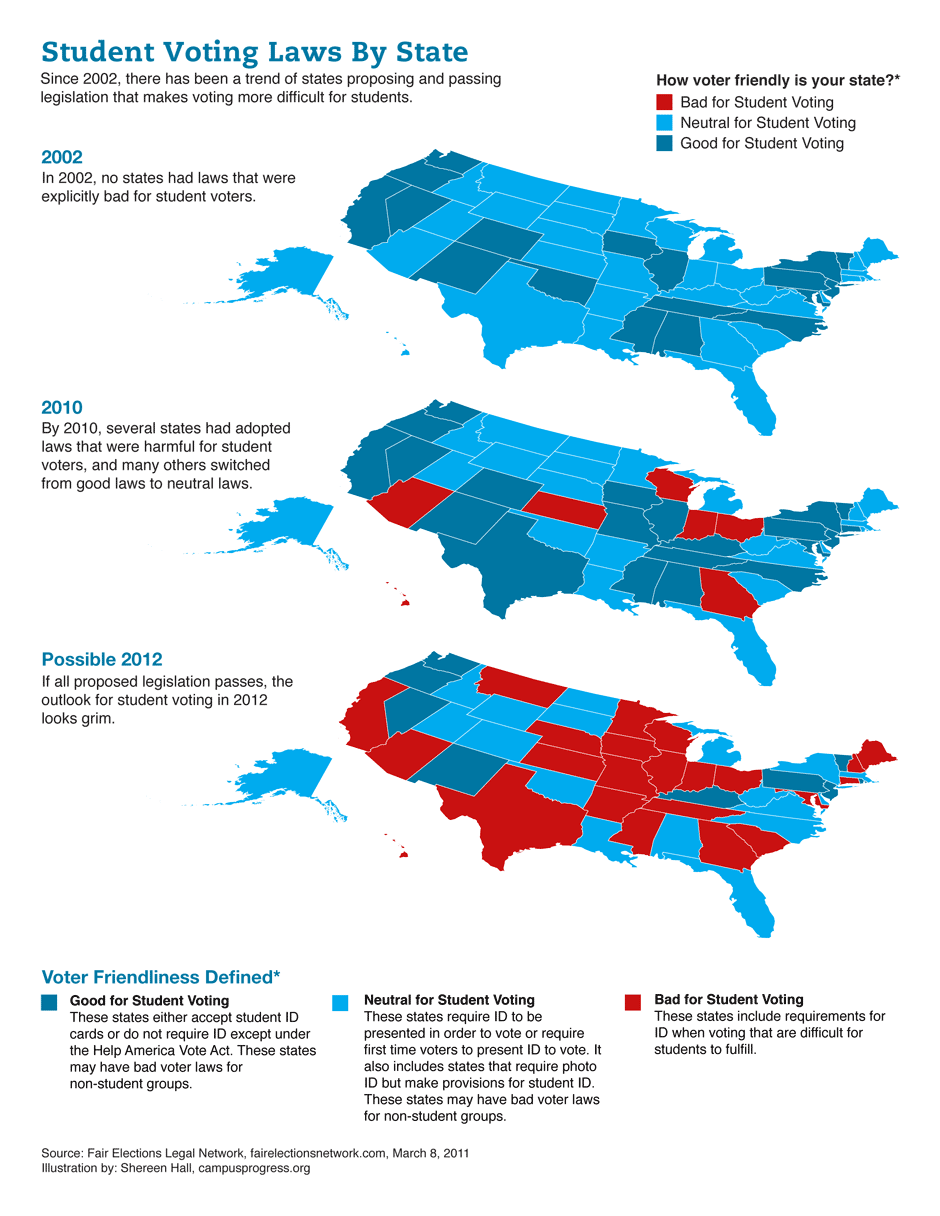
They are obviously going after labor unions to neutralize one of the few remaining counterweight to the torrent of unlimited and anonymous corporate campaign financing unleashed by the presumably non-partisan Supreme Court under the guise that corporations are guaranteed free speech.map-model-for-CP_blue_recolored


Now it appears they want to disenfranchise the “youth” vote as illustrated in the infographic linked here and shown to the right (click enlarge.)


Come on! Maybe Republicans like Representative Paul Ryan are the few self-confident, thoughtful adults left in that room.


This is embarrassing for anyone hoping that politics will regain moderation and return to a focus on governance vs. ideological power-mongering. Because these antics will ultimately guarantee another severe swing of the pendulum.


If the Walmart hippies (a term coined by Conservative David Brooks to describe the Tea Party) thought reforming healthcare insurance was over the top, wait till you see the backlash to crap like this.


Maybe anger just loves company!

Tuesday, April 05, 2011

Fetzer’s Election Night Challenge Already A Distant Memory!

I’m probably not counted as one of Tom Fetzer’s friends.  Something about calling to ask his campaign to remove the signs they had planted two towns away and all over southern Durham when he ran successfully to be Mayor of Raleigh in the early ‘90s.

We did become acquainted over the years, typically whenever Raleigh went “big game hunting” and insisted on manipulating Durham into expensive schemes. But I thought Tom did an incredible job as chairman of the North Carolina Republican Party during the last election.

I had truly hoped his newly elected constituents would take heed to his wise and eloquent challenge the night their victories gave them control of both chambers in the General Assembly, “the tough job begins now, these people have to govern.”unknown

But governing is not what many Republicans here and across the country are doing with the opportunity a 7% margin voters gave them in the last election.

If I were a cynic and not just an Independent, I’d say they obviously aren’t confident as a group that they will be in power long so they are trying to wreak as much havoc as possible while they can.

I’m not just talking about the US House vote to repeal healthcare legislation that was rejected by the Senate on February 2nd nor the bill four South Dakota legislators sponsored three days earlier to require all adults in that state to own a firearm and then backpedaling several days later as one sponsor claimed to a reporter that it was just a joke.

I wish the secret meetings in our legislature were joke, as well as the insane legislation proposed to strip local control of billboards and place North Carolina’s scenic fame behind seven blinking digital billboards per mile with trees swathed from the “public” roadsides to make sure your attention is drawn from one to the next.

Now a bill seeks to permit event ticket scalping and eliminate any protection for consumers that they are buying a ticket that actually exists let along many times its worth. Or congress members seeking to cut EPA’s funding so the environment is left defenseless to those eager to degrade it for a buck.

Or eliminating tens of thousands of jobs at a time when it will slow or postpone the recovery while refusing to address President Obama’s willingness to cut entitlements so they can gut environmental protection and pursue social agendas such as mural-gate or demonizing unions or taking away the right to restrict concealed weapons.

To quote Maureen Dowd, “Republicans talk fiscal policy but can’t resist social meddling.”

The kids in the candy store are looking at a big stomach ache if they aren’t following polls and trends like the analysis last week by Nate Silver illustrating that while Tea Party favorability remains as it has always been in the in the low 30s, the percentage of those unfavorable to the Tea Party, once below 20%, is now at 47% and climbing.

Doesn’t look like that enthusiasm gap that swept Republicans into power is holding.

I’m not sure but I’ll bet Tom is just shaking his head over the lost opportunity to truly govern.

As Dowd wrote a few days ago, “because Independent voters considered President Obama too partisan in his debut, they shifted their loyalties – and swept in one of the most ideological and partisan Republican caucuses in history.  Now Obama will get back some Independents because he seems reasonable by comparison.”

Monday, December 06, 2010

Do Tea Partiers Wear Seatbelts?

The last time I saw my Dad was the weekend of 9/11.  We had breakfast at a place near his then-home in Redmond, Washington.  My Dad and I always hugged goodbye but I’ll never forget the hug in the parking lot that day as flights resumed back to Durham.

Eleven days later I got word he had died suddenly, on his way home from breakfast at age 77.  Dad is my insight into a lot of things that are hard for me to understand like the Tea Party movement and lock-step Republicans demanding no more benefits for the unemployed unless they are paid for with budget cuts while holding out so people who make more than a million dollars a year are included in temporary tax cut extensions that will run up the deficit by $700 billion.

In many ways he lived the inconsistencies of the elected official who ran on repeal of health insurance reform but then whined over the one month waiting period before his generous federal healthcare plan took effect or the tea party activists online who demand COLA increases even though there has been no inflation.

Dad hated any form of regulation and “just because.”  His children and grown grandchildren fondly remember his adamant refusal to wear seatbelts even after they became law or his subversion of the 55 mile per hour speed limits during the ‘70s energy crisis.   He would have turned 87 during my late October, 6,000 mile cross country road trip to scout a similar venture next year by motorcycle.  The speed limits were almost always 70 or 75 and it was surprising if not alarming how many of the states I crossed obviously didn’t require helmets.  I suspect though he would have nodded approval.

I owe a lot of my career success to my Dad, such as learning to understand and discuss issues from several viewpoints and the most valuable career gift of all, critical thinking.    When the video embedded to the right was brought to my attention by my friend Bill Geist and Steve Hall’s post on Adgrabber, it made me wonder just how much of what appears as stubbornness is really about the message.   Maybe this message vs. “the law” would have made helped my Dad get over his civil disobedience toward seatbelts?  Nah, probably not.  My Idaho-rancher Dad never was the the sentimental type.

Friday, October 15, 2010

Tea Partier Reveal Makes Perfect Case For Health Insurance Reform!

Okay, I get it now. Supporters of tea party candidate for U.S. Senate in Kentucky have clarified that he only opposes “victimless crimes” like riding a motorcycle without a helmet.

Uhhh Really!

How on earth can anyone believe that there will be no victims when someone is killed riding without a helmet…?helmet%20and%20glases

  • Can they really think his or her family isn’t victimized by the rider’s untimely and unnecessary death? No hidden social security disability or other publicly funded services will be drained?

  • Can they guarantee that no one else as a passenger or in other vehicles is hurt during the accident involving a reckless driver without a helmet?

  • Can they guarantee that everyone who doesn’t wear a helmet is still smart enough to carry health insurance?

  • And even if rider has insurance, can they can guarantee that a fatality won’t arbitrarily drive up everyone else’s health and vehicle insurance rates?

  • Or if they do or don’t have insurance can it be guaranteed that absolutely no hidden public costs will be expended on emergency response, hospital emergency rooms, investigating officers, claims adjusters or clean up after the fatality?

I get it that by nature people resist being required to do something even when it is a no-brainer (pardon the expression) but this guy just made the case for both helmet laws and healthcare insurance reform.

We all value our freedom…but freedom comes with responsibilities especially when others may even remotely be forced to pick up the costs for our actions.

Wearing a stupid helmet and carrying insurance isn’t a surrender of freedom…it is doing the minimum to mitigate actions for which someone else or the public-at-large may be forced to pick up hidden costs.

No one lives in a vacuum, not ultra conservatives, not libertarians, not tea partiers, not even Republicans. No one!

Thursday, October 07, 2010

Angry Voters Subject To Brain Freeze!

Many people can’t distinguish intense passion from anger. They have usually labeled me as “angry” as they do now my daughter who shares my passion.

There is one big difference between anger and a passion for debating and exchanging ideas. Scientists have learned that the brains of people who are angry tune out anything that differs with their opinions and neutral forums like news media just cement their brains.brainfreeze

People like Dr. Hank Jenkins-Smith term it in this Newsweek quote as “motivated reasoning.” Apparently angry people’s brains ignore any information that doesn’t reinforce or defend their prior perceptions and unfortunately prejudices, however unfounded in fact.

In my experience, there is an easy way to tell angry people from passionate or intense people. Agree with an angry person and they get even angrier. But match their body language or tell them you take it very seriously and a passionate person who just appears angry dials down the intensity.

That’s why angry voters can’t understand or grasp President Obama. He too “cool” under fire. Instead, angry voters rally instead to the soap opera antics of a Rush Limbaugh and Glenn Beck or the gubernatorial candidate who threatens to “take people out” or the candidate who made a fortune as CEO of World Wrestling (another type of soap opera, featuring vulgarity and hostility as entertainment!)

This must also explain why angry voters can’t grasp that the TARP bail-out funds are well on their way to being reimbursed and will likely make a profit for taxpayers. It is why they refuse to accept that the country and the world would have fallen into deeper recession if not depression and full economic gridlock had leaders at the time not made the tough decisions. In my opinion, they probably don’t believe we ever really landed astronauts on the moon.

That is also why they are so dangerous to a democratic republic. Sit home on voting day if you wish but keep in mind that while the people for whom angry people will vote make for great fodder for late night comedians….it won’t be funny at all what they can do to America.

Angry people are not only self-destructive, they are dangerous to others as well as themselves because they don’t believe there is much to lose. In my opinion, we don’t want America run by people who get their kicks by tapping into or amplifying angry people.

Remember, as an elected official once told me as I tried to reason with him: politics is personal, not logical. If you’re feeling anxious right now about the state of affairs or your own personal circumstances, just sit on your butt come November 2nd and let the 23% of voters who are angry and vengeful control the election.

You’ll soon be plenty angry!