Showing posts with label Wearable Fitness Trackers. Show all posts

Friday, May 01, 2015

Discovering the Source of My Little Roll

I only average between 8,000 and 9,000 steps a day, even with a two mile walk seven mornings a week.  It shows how sedentary I was until adopting that regimen in retirement.

Fitbit, which is a pioneer in wearable tracking devices, did an interesting survey of users who average more than 10,000 steps a day, including a breakdown by occupation.

A quarter (24%) are teachers, followed by health care professionals, software developers/programmers, administrative/clerical workers and sales people, all averaging over 12,000 steps a day.

The average American racks up about 5,100 steps per day.  My two mile walk each morning involves about 3,651 steps.  Depending on the day, that can be around 47% or less of my daily count.

In early 2010, when I began using one of the first Fitbits on the market , I was just a few months into retirement.  I was lucky to do 2,000 to 3,000 steps a day back then.

I was under the misimpression a lot of us are, that a calorie is a calorie, no matter the source.  I try to stick to a 30-40-30 ratio, 30 grams of fat, 40 grams of protein and 30 grams of “good” carbs.

But according to dieticians fat provides about 9 calories per gram, protein about 4 calories per gram and carbs in general provide about 4 per gram.

I stay away from bad carbs except for two glasses of red wine at dinner.  But they alone total about 250 calories, about 13% of my entire daily intake.

I didn’t really shift gears until my doctor tapped my little belly roll, after some film was found in one of my carotid arteries, and told me to get serious about daily exercise to bring my triglycerides down.

The Fitbit survey of 10,000+ steppers found that 82% exercise outside of work, even though more than a fourth (26%) spent more than 2/3rds of their day on their feet.

For the last 9 weeks, my significant other and I have added two hours of strength training a week to our regimen after first losing about 30 pounds each.

In my case, those came off not just through exercise but by keeping track of what I eat.  I’ve always been a low and healthy carb-high protein guy because I’ve been hypoglycemic since I was a teenager.

But I quickly learned when religiously using the MyFitnessPal app, that while the carbs I was eating were healthy, in particular, I had been routinely snacking on mixed nuts without realizing it was gradually building up that belly roll.

I learned that what I had been eating as a snack each night with an apple together represented nearly 2,000 calories alone, 77% from fat, 10% protein and 13% carbs from the nuts alone.

It is a little healthier (and safer) than what would be drinking the equivalent of 10 glasses of red wine but I truly only need a little more than 1500-1800 calories a day total.

I’m lean now but not exactly buff.  The type of weight training we do is to regain balance and build strength.

I can feel the difference when I ride my Harley Cross Bones including no leg cramps.

FYI, we use a trainer who follows the Maitland Method in a tiny place here in Durham on Broad Street.

I know one thing for sure.  I wouldn’t have sustained this daily exercise without a good friend to do it with nor would we be doing weights to my best advantage without a trainer.

My doctor now jokes with me that I am turning back the clock.  I don’t know about that but reading the just published book entitled, The Gene Therapy Plan by Dr. Mitchell Gaynor, who knows, I just might be.

Tuesday, April 07, 2015

The Future of Wearables is More than Devices

In its February trends snapshot, Blueshift Research found that 40% of Americans made no change over the last six months when it came to living habits such as diet, exercise, sleep etc., up six points from a year ago.

The “no change” group is where I was over the last several decades despite periodically committing to do better.

Unfortunately, nearly 17% responded to the survey that their living habits had actually worsened, 3.1% significantly so over the six month span since this trend was last measured.

The good news is that during that same span 43% of us felt they had improved their living habits, 7% significantly.  A 2008 study calculated that “inactivity” costs the U.S. $76 billion in healthcare spending.

So I often wonder what finally made me shift gears 19 months ago after years of resolutions and wasted gym memberships.

Was it finally finding a spiritual connection while walking each morning?

Was it having a significant other to do that with, which has been expanded to include weight conditioning twice a week?

Was it using a fitness tracker and a linked app to track the caloric content of various foods I was eating?

Was it being confronted by a tiny belly roll when a portrait was hung to honor three of us just before I retired?

Was it that first sign of a film like build up in one of my carotid arteries?

Intrigued, I’ve been trying to reverse engineer what made me finally get serious.

It is not as though my doctor hadn’t been cautionary for several years about normalizing the level of triglycerides levels in my blood.

I always see the waiting room at the clinic where I get annual physicals full of people who are in much worse shape than I was and seemingly oblivious to the inappropriateness of yoga pants or having to lean over to see their shoes..

Medicare is now going to start holding doctors accountable for patient changes by calibrating what they are paid to outcomes.  But I am not sure how much more they can do to cajole each of us into accepting personal responsibility for our health.

Two years ago, a Pew Study found that 45% of U.S. adults are dealing with at least one chronic health condition but 7-in-10 overall keep track of a health indicator including 19% who have no chronic conditions.

But only a fifth use technological devices such as wearables with nearly half doing so only in their head.

Last year’s report by Endeavor Partners found that 1-in-10 adult Americans owned a fitness tracker, 1-in-4 between the ages of 25 and 34.  Unfortunately, more than half no longer use it and a third stopped using it within six months.

Key for sustainable use, according to the report, are 3 behavioral factors: habit formation, social motivation and goal reinforcement along with 6 other factors such as utility, design, fit, out of the box experience etc.

Fitbit, the one I have used since early 2010 when it came out, appeared to score highest overall among the eight different fitness “wearables” measured in the report.

Juniper Research projects that use of fitness devices and wearables will triple by 2018.  Some analysts project these devices will reach 48% market penetration worldwide by then.

A new Pew study shows that 64% of Americans now own Smartphones, double the proportion from just four years ago.  Smartphones have also rapidly become the means by which low income and disadvantaged Americans go online.

More than 60% of Smartphone owners use their phones to get health information, 57% to do online banking, 43% to look up job information and 30% to take a class or get educational content.

Making outdoor billboard advertising even more obsolete, more than 67% of smartphone owners use their phone for turn-by-turn navigation while driving, 32% do so frequently, compared to less than 1% of Americans who still rely on a billboard.

But wearables such as those for fitness and health are set to make “interruption” advertising such as billboards even more obsolete, according to PwC.

They will accelerate even faster the rapid transition to interest-based, content marketing but only when relevant and needed now.

Studies have shown that the three-decade decline in the effectiveness of traditional advertising has reached a negative return on investment overall.

Fitness and wellness apps are on track to more than sextuple by next year from what they were in 2010.  But a report issued last year by PwC shows plenty of reasons that businesses and organizations will soon get involved, too.

Already, 70% of consumers “say they would wear employer-provided wearable devices streaming anonymous data to a pool in exchange for a break on their insurance premiums” something that will obviously catch the attention of insurers in Obamacare exchanges.

The World Health Organization recommends that people get 30 active minutes a day.  A premium feature of the device I wear shows on a bell curve where I fall compared to men my age and weight as well as other demographics overall.

Telling is that at 30 “very” active minutes on average per day, I am in the 89th percentile for my group, or over 185% of the median. For many weeks I average over 40, over 300% of the median.

This means that, unfortunately, I am in the top 11% and regularly in the top 3%.

The center of that bell curve is only 6 “very” active minutes.  Even scarier is that I am 400% over the median for many of those people waiting in my doctor’s office.

People are nearly twice as likely to purchase and use fitness bands and smart watches if employers pay for them.  But the future of wearables goes beyond fitness.

More than half of the adults in the survey agree that automated facial recognition will replace the need to remember names, 56% say life expectancy will increase an average of 10 years and 46% believe wearables will decrease obesity.

But wearables, even for fitness, are rapidly moving beyond devices.  A report yesterday by KUED notedthat consumers are already moving to biometric clothing such as Hexoskin which report metrics beyond those done by devices.

Another by Athos is designed to help with weight and flexibility training.  Analysts project that sales of fitness device wearables will soon plateau or go down due to the overlap between smart wristbands and smart or sports watches.

But sales of smart garments such as Athos are projected to grow to 26 million units next year, up 2,600 times what they were in 2013 and more than two and a half times what they will be this year.

It will be interesting to see if they have a sustained impact on the overall health outcomes for Americans.

Friday, March 13, 2015

Walking Cross Country - Tracking One Step At A Time

I began using a wearable fitness device called Fitbit in January 2010, the month after it came out and my first month of retirement.

Even with all of the hype today about wearables such as this, they are still used by only 1-in-10 Americans.  Half of Americans are aware of wearable devices of various types, not just for fitness.

I come from several generations of gadget people but was surprised that only a little more than a third of those who are early adopters of technology were aware of wearable fitness trackers today.

About 28% of Americans say they are likely to buy a wearable fitness device with half of those hoping to count calories and a third tracking the number of steps taken in a day.

Research shows that nearly 48% of Americans want to lose weight and have made that a goal for this year.  That plays nicely playing into the hands of users of devices such as Fitbit, because 47% walk long distances for health.

Unfortunately, 47% of weight loss seekers also enjoy baking cakes, pies, breads or desserts on a regular basis according to AudienceScan.  I wonder if this correlates to the 49% on a Pew survey two years ago who responded that they “keep track in their head.”

How’s that workin’ for ya?

I put that first Fitbit through the washing machine and waited a month or two to replace it so I don’t have a true running total of all of my activity tracked so far, but I’ve got it for the six years from April 2010 to now.

So far, I’ve walked about 2,900 miles or the distance between where we live in Durham, North Carolina and where my youngest sister and brother-in-law live in Mill Creek, Washington and then back up to the pass back through the Cascade Mountains.

But I only started walking religiously each morning a little more than a year and a half ago.

Every week now, on average, I walk a distance equivalent to walking from Witherspoon Rose Culture near the southwestern Durham County line near Chapel Hill to the northwestern Durham County line near Timberlake.  That’s about 25 miles on foot.

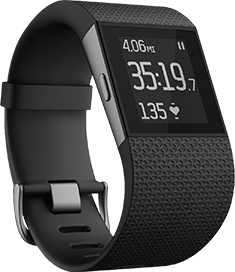
I’m typically an Apple guy when it comes to devices but after comparing the two, I upgraded to the Fitbit Surge for now instead of moving to the Apple Watch due out soon.

It includes some features the Apple Watch won’t have when it comes out next month at and it already pairs with my scale.

In part, it is also because I don’t like the fact that rather than innovating new products, Apple seems prone to either buy them up or run over businesses such as the entrepreneurs who founded Fitbit, which featuring about 40 partners has grown to provide about 70% of fitness wearables in use.

Eventually, once the bugs are worked out and it is clear I won’t lose any Fitbit compatibility, I suspect I might make the switch to the Apple Watch, but that remains to be seen.

Prior to when these fitness versions of a smartwatch came out, they had only 2% penetration with consumers.  Wearable fitness devices in general skew toward those between the age of 35 and 54, about half women.

Smartwatches on the other hand have skewed younger than that and predominately male.  I suspect Fitness Surge and Apple Watch are changing this profiles.

The Surge uniquely incorporates an “okay” GPS to map the routes you have taken but different than other Fitbits, it is better at tracking various exercises such as biking and weight training as well as yard work that may involve more exertion than walking.

It also does a great job of measuring heart rate and breaking it down into peak, cardio and fat burn zones.

If weight loss is a goal, as initially it was for me before dropping 30 lbs. to bring my Triglycerides back in line, take note of research showing that 60% of users for that reason lose more weight when pairing a fitness tracker with a weight loss app such as MyFitnessPal compared with when they didn’t use a tracker.

I wasn’t heavy per se but not in the best shape and my Tri’s were sky high.  They are formed by three fatty acids bound by a molecule of glycerol inside a fat cell and too large to flow through the membranes of the cell.

Typically, fat flows in and out of our cells constantly, but its fat that is stored like this that causes problems, even when we appear otherwise to be okay.

I’ve struggled to enjoy exercise during my life when it didn’t involve team sports or tennis but these devices and apps not only make it interesting but they make you aware of unproductive habits so you can break them.

No, nobody paid me to write this.  In fact, no one pays me to write any of these posts.  I’m just a fan of wearable fitness devices and related apps because they have made a big difference in my overall health.

Now if I could just find something to make traveling lunges seem fun!