Showing posts with label Healthcare. Show all posts

Tuesday, April 07, 2015

The Future of Wearables is More than Devices

In its February trends snapshot, Blueshift Research found that 40% of Americans made no change over the last six months when it came to living habits such as diet, exercise, sleep etc., up six points from a year ago.

The “no change” group is where I was over the last several decades despite periodically committing to do better.

Unfortunately, nearly 17% responded to the survey that their living habits had actually worsened, 3.1% significantly so over the six month span since this trend was last measured.

The good news is that during that same span 43% of us felt they had improved their living habits, 7% significantly.  A 2008 study calculated that “inactivity” costs the U.S. $76 billion in healthcare spending.

So I often wonder what finally made me shift gears 19 months ago after years of resolutions and wasted gym memberships.

Was it finally finding a spiritual connection while walking each morning?

Was it having a significant other to do that with, which has been expanded to include weight conditioning twice a week?

Was it using a fitness tracker and a linked app to track the caloric content of various foods I was eating?

Was it being confronted by a tiny belly roll when a portrait was hung to honor three of us just before I retired?

Was it that first sign of a film like build up in one of my carotid arteries?

Intrigued, I’ve been trying to reverse engineer what made me finally get serious.

It is not as though my doctor hadn’t been cautionary for several years about normalizing the level of triglycerides levels in my blood.

I always see the waiting room at the clinic where I get annual physicals full of people who are in much worse shape than I was and seemingly oblivious to the inappropriateness of yoga pants or having to lean over to see their shoes..

Medicare is now going to start holding doctors accountable for patient changes by calibrating what they are paid to outcomes.  But I am not sure how much more they can do to cajole each of us into accepting personal responsibility for our health.

Two years ago, a Pew Study found that 45% of U.S. adults are dealing with at least one chronic health condition but 7-in-10 overall keep track of a health indicator including 19% who have no chronic conditions.

But only a fifth use technological devices such as wearables with nearly half doing so only in their head.

Last year’s report by Endeavor Partners found that 1-in-10 adult Americans owned a fitness tracker, 1-in-4 between the ages of 25 and 34.  Unfortunately, more than half no longer use it and a third stopped using it within six months.

Key for sustainable use, according to the report, are 3 behavioral factors: habit formation, social motivation and goal reinforcement along with 6 other factors such as utility, design, fit, out of the box experience etc.

Fitbit, the one I have used since early 2010 when it came out, appeared to score highest overall among the eight different fitness “wearables” measured in the report.

Juniper Research projects that use of fitness devices and wearables will triple by 2018.  Some analysts project these devices will reach 48% market penetration worldwide by then.

A new Pew study shows that 64% of Americans now own Smartphones, double the proportion from just four years ago.  Smartphones have also rapidly become the means by which low income and disadvantaged Americans go online.

More than 60% of Smartphone owners use their phones to get health information, 57% to do online banking, 43% to look up job information and 30% to take a class or get educational content.

Making outdoor billboard advertising even more obsolete, more than 67% of smartphone owners use their phone for turn-by-turn navigation while driving, 32% do so frequently, compared to less than 1% of Americans who still rely on a billboard.

But wearables such as those for fitness and health are set to make “interruption” advertising such as billboards even more obsolete, according to PwC.

They will accelerate even faster the rapid transition to interest-based, content marketing but only when relevant and needed now.

Studies have shown that the three-decade decline in the effectiveness of traditional advertising has reached a negative return on investment overall.

Fitness and wellness apps are on track to more than sextuple by next year from what they were in 2010.  But a report issued last year by PwC shows plenty of reasons that businesses and organizations will soon get involved, too.

Already, 70% of consumers “say they would wear employer-provided wearable devices streaming anonymous data to a pool in exchange for a break on their insurance premiums” something that will obviously catch the attention of insurers in Obamacare exchanges.

The World Health Organization recommends that people get 30 active minutes a day.  A premium feature of the device I wear shows on a bell curve where I fall compared to men my age and weight as well as other demographics overall.

Telling is that at 30 “very” active minutes on average per day, I am in the 89th percentile for my group, or over 185% of the median. For many weeks I average over 40, over 300% of the median.

This means that, unfortunately, I am in the top 11% and regularly in the top 3%.

The center of that bell curve is only 6 “very” active minutes.  Even scarier is that I am 400% over the median for many of those people waiting in my doctor’s office.

People are nearly twice as likely to purchase and use fitness bands and smart watches if employers pay for them.  But the future of wearables goes beyond fitness.

More than half of the adults in the survey agree that automated facial recognition will replace the need to remember names, 56% say life expectancy will increase an average of 10 years and 46% believe wearables will decrease obesity.

But wearables, even for fitness, are rapidly moving beyond devices.  A report yesterday by KUED notedthat consumers are already moving to biometric clothing such as Hexoskin which report metrics beyond those done by devices.

Another by Athos is designed to help with weight and flexibility training.  Analysts project that sales of fitness device wearables will soon plateau or go down due to the overlap between smart wristbands and smart or sports watches.

But sales of smart garments such as Athos are projected to grow to 26 million units next year, up 2,600 times what they were in 2013 and more than two and a half times what they will be this year.

It will be interesting to see if they have a sustained impact on the overall health outcomes for Americans.

Friday, March 13, 2015

Walking Cross Country - Tracking One Step At A Time

I began using a wearable fitness device called Fitbit in January 2010, the month after it came out and my first month of retirement.

Even with all of the hype today about wearables such as this, they are still used by only 1-in-10 Americans.  Half of Americans are aware of wearable devices of various types, not just for fitness.

I come from several generations of gadget people but was surprised that only a little more than a third of those who are early adopters of technology were aware of wearable fitness trackers today.

About 28% of Americans say they are likely to buy a wearable fitness device with half of those hoping to count calories and a third tracking the number of steps taken in a day.

Research shows that nearly 48% of Americans want to lose weight and have made that a goal for this year.  That plays nicely playing into the hands of users of devices such as Fitbit, because 47% walk long distances for health.

Unfortunately, 47% of weight loss seekers also enjoy baking cakes, pies, breads or desserts on a regular basis according to AudienceScan.  I wonder if this correlates to the 49% on a Pew survey two years ago who responded that they “keep track in their head.”

How’s that workin’ for ya?

I put that first Fitbit through the washing machine and waited a month or two to replace it so I don’t have a true running total of all of my activity tracked so far, but I’ve got it for the six years from April 2010 to now.

So far, I’ve walked about 2,900 miles or the distance between where we live in Durham, North Carolina and where my youngest sister and brother-in-law live in Mill Creek, Washington and then back up to the pass back through the Cascade Mountains.

But I only started walking religiously each morning a little more than a year and a half ago.

Every week now, on average, I walk a distance equivalent to walking from Witherspoon Rose Culture near the southwestern Durham County line near Chapel Hill to the northwestern Durham County line near Timberlake.  That’s about 25 miles on foot.

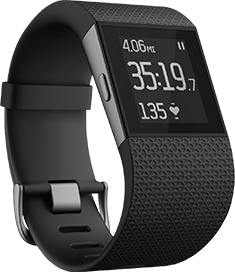
I’m typically an Apple guy when it comes to devices but after comparing the two, I upgraded to the Fitbit Surge for now instead of moving to the Apple Watch due out soon.

It includes some features the Apple Watch won’t have when it comes out next month at and it already pairs with my scale.

In part, it is also because I don’t like the fact that rather than innovating new products, Apple seems prone to either buy them up or run over businesses such as the entrepreneurs who founded Fitbit, which featuring about 40 partners has grown to provide about 70% of fitness wearables in use.

Eventually, once the bugs are worked out and it is clear I won’t lose any Fitbit compatibility, I suspect I might make the switch to the Apple Watch, but that remains to be seen.

Prior to when these fitness versions of a smartwatch came out, they had only 2% penetration with consumers.  Wearable fitness devices in general skew toward those between the age of 35 and 54, about half women.

Smartwatches on the other hand have skewed younger than that and predominately male.  I suspect Fitness Surge and Apple Watch are changing this profiles.

The Surge uniquely incorporates an “okay” GPS to map the routes you have taken but different than other Fitbits, it is better at tracking various exercises such as biking and weight training as well as yard work that may involve more exertion than walking.

It also does a great job of measuring heart rate and breaking it down into peak, cardio and fat burn zones.

If weight loss is a goal, as initially it was for me before dropping 30 lbs. to bring my Triglycerides back in line, take note of research showing that 60% of users for that reason lose more weight when pairing a fitness tracker with a weight loss app such as MyFitnessPal compared with when they didn’t use a tracker.

I wasn’t heavy per se but not in the best shape and my Tri’s were sky high.  They are formed by three fatty acids bound by a molecule of glycerol inside a fat cell and too large to flow through the membranes of the cell.

Typically, fat flows in and out of our cells constantly, but its fat that is stored like this that causes problems, even when we appear otherwise to be okay.

I’ve struggled to enjoy exercise during my life when it didn’t involve team sports or tennis but these devices and apps not only make it interesting but they make you aware of unproductive habits so you can break them.

No, nobody paid me to write this.  In fact, no one pays me to write any of these posts.  I’m just a fan of wearable fitness devices and related apps because they have made a big difference in my overall health.

Now if I could just find something to make traveling lunges seem fun!

Monday, July 07, 2014

Early Insight Into the Economic Value of Pathways

More than 15 years ago, just before Durham, North Carolina opened the first 3.2 miles of the American Tobacco Trail, part of a 186-mile trail system community-wide, health economists at the CDC were busy studying/quantifying any relationship to healthcare costs.

Back then, the cost of healthcare per capita as a percentage of America’s economy had multiplied to 14 times what it was in 1970, a few years before the CDC had first employed economists to study the decisions people make related to health.

It had doubled from a decade before and quadrupled since 1980.  Policy makers were desperate to find links to behavioral solutions.  Dr. Guijing Wang, a CDC economist, was leading a team investigating any possible cost benefit from trails.

The U.S. Centers for Disease Control and Prevention (CDC) had been formed in 1946 in Atlanta after government scientists had so successfully curbed malaria in 13 southern states during WWII, especially around military training bases.

By 1950, while CDC researchers were testing early versions of a Polio vaccine, a disease then crippling 35,000 people a year, a remarkable insight occurred due west of the late President Roosevelt’s retreat in Warm Springs (he had been struck with the disease when he was age 39.)

Charlie Fraser, newly graduated from the University of Georgia, was walking the pines on Hilton Head Island in that southern most tip of South Carolina while working there one summer.

Before heading off to Yale Law School, he persuaded his father, who with his partners there had begun to timber the Island acquired the year before, to only selectively cut a strand near the southern shoreline for an even greater return.

His father, a National Guard General and veteran of both World Wars, agreed.  After practicing law and a stint in the Air Force, Charlie returned in 1955 with a master plan for a development.

His father’s banker-partners balked, so Charlie persuaded him to restructure the partnership and give him a note on the tip of the island.  Thus Sea Plantation was born, followed in 1970 by Hilton Head Plantation on the north end of the island.

In the fall of 2001, Charlie and his wife relocated to the Appalachian Mountains near Brevard, North Carolina, by the entrance to Pisgah National Forest, one of the first in the east.

It is possible he had read a study by the National Association of Realtors the year before validating his mid-1950s vision before a boat explosion took his life that December.

According to the survey, nearly 6-in-10 homebuyers would be more likely to purchase close to green space and pay more near a park or protected area, validating that Fraser made a good decision in setting aside a fourth in open space.

The survey  also showed that 25 times more people use pathway systems than golf, 10 times more than those who use swimming pools, and more than those using parks and playgrounds.

Prescient, Charlie had laced his developments with what he called “leisure ways,” away from roadways, and then encouraged other developers to follow his lead.  Eventually, a town was founded so it could pursue grants for more trails.

A few months after he was gone, CDC economists published their findings.  Every $1 in trail investment leads to $3 in reduced healthcare costs.

Charles Fraser would have smiled and nodded affirmative.  He had long argued that people came to the island much more for nature than golf.  His genius was an intrinsic grasp of how to nurture authenticity.

A sea change in public opinion was taking place as those studies quantifying the ROI from trails and pathways was released.  Between 2000 and 2008, surveys showed American homebuyer preferences for traditional, walk able neighborhoods tripled to 75%.

The 2013 Home Features Survey for the National Association of Realtors shows that nearly a third of potential homebuyers would pay more for a wooded lot with many trees, double the percentage seeking an open lot with few trees.

The percentage preferring trees is nearly the equal to those seeking a water view.  It is why in the late 1980s, a Durham developer supported a scenic overlay that the community placed over I-40 as it crosses through here, even though he sacrificed $2 million dollars at today’s values.

So why then have so many developers and policy makers seemed so eager to desecrate the things Charles Fraser understood were more valuable than gold?

Sunset Beach in North Carolina is another example dating back to the mid-1950s when Fraser shaped Sea Pines, but with the opposite outcome.

Sunset Beach development is laid out like many coastal areas were at the time.  Why did the coastal developers refuse, when it comes to nature, to let “well enough alone” as we say in the North Carolina?

Partly because they weren’t listening, and partly it was about money, but probably not what you think.

The line between North and South Carolina is being resurveyed.  There are best practices on both sides of the line with the nod until recently going to NC.

But when it comes to coastal developments, we have far too many that emulate the tangle of Myrtle Beach and not enough that emulate Fraser’s on Hilton Head Island.

By talking to coastal developers back then, Charlie Fraser learned what they would do differently.  Lining homes up shoulder to shoulder  destroyed the value of interior lots.

He also learned they would have left the land as natural as possible and set more aside in open space as well as instituted design guidelines, something those whining to our State Legislature today still haven’t learned.

Visionaries like Charlie Fraser inform their insight not from those who whine about the burdens of stewardship but by listening to those who complain about what they would have done differently.

Policy-makers are better advised to study an author who holds the Charles E. Fraser Chair on Sustainability and Environmental Policy at the Urban Land Institute such as his new book entitled Conservation Communities: Creating Value with Nature, Open Space, and Agriculture.

Maybe the difference in sensibilities among developers can be explained by two new exhibits under development at the 84-acre Museum of Life and Science in Durham.

Hideaway Woods will be a two-acre, forested learning environment with tree houses, a flowing streambed, and hollowed out tree trunks, where young people can do what people my age did every day around our homes but with their parents perched above them on an observation deck.

Nearby will be Earth Moves, a one-acre place where young people can blast away with high pressure hoses to create mini-landslides, use a conveyer to build huge mounds, dig with a backhoe, feel an earthquake and observe groundwater etc.

I know – it’s sad that kids now have go to a museums to have permission to do these things, but given obsessive helicopter parents, it’s  better there than not at all.

Such play not only broadens perspective but enhances essential workplace skills, something sports alone can’t provide.

It occurs to me though, that while some developers had a healthy mix of playscapes such as this, some apparently came away with too much time on what a forester friend of mine calls “mechanized assets.”

To make sure we raise more Charles Fraser’s we need to make “Hideaway Woods” a prerequisite for any time spent in “Earth Moves.”

It’s a good thing the museum has strategically ensured that kids come to “Hideaway Woods” first (smile.)

Tuesday, June 17, 2014

New Tricks for an Old Dog

My triglycerides have climbed much too high just as my 85-year-old mother’s have most of her life.  By my age, they are high in one out of every three of four people.

So, nudged by my doctor, over the last month or more I’ve cut my intake of beef or pork to once a week, more than doubled my intake of chicken, and tripled consumption of fish and chicken combined.

I’ve also cut my wine intake by half, switching to red only, and increased my exercise to no less than five days a week.  I’ve tried to drop a few pounds and may soon weigh less than I did in high school, although on a reduced frame.

That’s a lot of change for an Idaho boy with several generations of cattle rancher in his genes.

It may turn out to be a false reading caused by a supplement or medication I am taking as it turned out to be for me in the mid-1980s. Even if it does, these changes were long overdue and have already become ingrained habits.

The concern was triggered when a screening of my carotid arteries, first by Life Line Screening, then immediately followed up more in-depth by my doctor, revealed the first sign of a very thin layer of plaque build up on the left side.

By the way, both the tech who did the imaging and my doctor were very complimentary of Life Line’s service.

My dad died of a stroke when he was age 77 so my doctor has always been on the lookout during the thirteen years since then.  We caught it at the first sign detectable.

According to my blood type, O-Negative, and research by biogeneticists, eating lots of red meat is in my genes.  But so is eating lots of vegetables and whole fruits.

That’s probably because because I sensed at a young age that sugar and foods that quickly convert to sugar were poison to me.  Eventually I was diagnosed as reactive (to certain foods) hypoglycemic more than 4 decades ago.

I metabolize sugar, juices and processed carbs far too rapidly, and this sets off a very unpleasant chain reaction.  Mine is not related to diabetes, which is much more serious, but it still involves insulin.

The sugar surges far too quickly through my system and into my blood stream where high blood sugar triggers a surge of insulin from my pancreas to clear the blood of the excess.

But it does far too good a job and as the blood sugar plummets, huge amounts of adrenalin are triggered because the reactions are similar to the threat of dying, which is exactly what it feels like.

One morning in late 1970, I hopped out of bed for an insanely early accounting class at BYU.  That was the last thing I remembered for some time.

I awoke on the floor and immediately went to the university infirmary where the doctor admitted me to the local hospital.

Student nurses gathered around and took practice inserting a tube through my nose down into my stomach and started pumping ice cold water there.

I had a serious bleeding ulcer.

The thing about a bleeding ulcer is that the blood masks the pain so you don’t realize until you detect other symptoms of ulcer disease.

Back then they sent you home with a drug developed a decade earlier to suppress your nervous system because that’s what many still believed was the cause.

But at the time researchers at GlaxoSmithKline (GSK) were fast closing in on a revolutionary class of drugs called Histamine H2-receptor antagonists that would revolutionize the treatment of ulcer disease.

Researchers had been working on this since I was in high school, the same year the Rolling Stones were founded and charted their first hit in America, Not Fade Away - a song written by Buddy Holly seven years earlier.

During the time of my diagnosis, clinicians such as those who treated me were only just learning that ulcer disease didn’t have anything to do with being nervous, it had to do with secreting too much acid.

New studies were also being circulated that identified a link between a hypoglycemic reactions and hyperacidity.

It turns out that the vagus nerve that runs from our brains down behind our the carotid artery and jugular vein in our neck runs down between our trachea and esophagus to the stomach.

This nerve is the one that stimulates the over secretion of insulin during a hypoglycemic reaction to certain foods.  But it is also the one that simultaneously floods the stomach of anyone with this condition with way too much acid.

Researchers were in a conundrum as to whether to dial down the insulin or the acid so I was stuck for a few years with a bland diet and a suppressed nervous system.

To be fair, my nervous system is pretty intense to begin with, so no one knew the difference but me.

In 1976, a few years into my first community marketing startup, the dilemma was resolved when the new class of drugs which dial down or partially block the secretion of acid became available, enabling my nervous system to fully express itself again (smile.)

This has been the treatment I have used for nearly 40 years now and probably will the rest of my life.  Newer options have come along but don’t work as well for me, along with triggering that earlier false Tri reading.

And while never bland, I even more rigorously held to a lifelong diet of high protein and fiber, few carbohydrates and absolutely no sugar to prevent or slow down any metabolistic chain reaction.

Coincidentally, a few years after the launch of that drug, GSK opened its North American research facility in Durham, North Carolina, a few years before I would begin the last half of my now concluded career in community marketing and where I still live in retirement.

In the book Inheritance, the author, who is a neurogenticist, explains that genes also explain while I metabolize caffeine from coffee so slowly while others can’t even tolerate a bit of chocolate.

For me eating lots of red meat during my life was not only an expression of my genes but because my body told me very early that a healthy dose of protein and staying away from sugar would prevent blood sugar issues.

It was a habit I inherited but no longer needed in the quantities my ancestors did. 

For me, breaking the beef habit pretty much followed the process New York Times reporter Charles Duhigg describes in his book The Power of Habit: Why We Do In Life And Business.

I changed the cue or reminder that triggered eating too much beef by realizing it was a default.  My work always involved huge amounts of decision-making, so others such as menu decisions went on auto-pilot.

I retained a bit of the reward from the old habit with  weekly “steak nights” but lately that has become every two weeks.

An added reward may be living longer.  You never know.