Friday, February 07, 2014

The Circular Economy is No Place for Whiners

Regulations aren’t designed to set the best standards, only the minimum bar for those who seek benefit at the expense of the general public.

It is typically those who are part of the “whiner” economy who make a fuss about regulations.  Everyone else cleared that regulatory bar long ago and strives instead for best practices.

One of those best practices is the movement toward the “circular economy,” as described in an article this month by McKinsey alum Markus Zils.  Those who fuss about regulations typically take more of a linear approach.

The circular approach is just better business.  It seeks to preserve the “embedded labor, material and capital costs.”  This is true of organic as well as technical materials.Screenshot 2014-02-06 09.01.42

It isn’t just about recycling by breaking down and reusing the products but also involves refurbishment.

The short term benefit is better profit margins but the long term benefit is a “decoupling of the economic growth from material intake.”

Often called the “triple bottom line” or “full-cost accounting,” the improvements aren’t just in manufacturing.  You saw it at work this week when CVS decided that selling tobacco didn’t make sense for a company in the business of providing healthcare services.

At the same time, undeterred by gridlock among nation states, fifty-nine mega-cities around the globe that have banded together to address climate change issued their annual report.

Even McDonald’s is moving toward more sustainable, antibiotic-free beef for its burgers, hopefully by 2016, a movement led many years ago in that food genre by Chipolte.

This even gives hope that marketers for the largest enabler of roadside billboards may one day connect the dots about the harm they are doing by enabling the sacrifice of the equivalent of a good size national forest as well as blighting neighborhoods and property values.

The marketplace likes sustainability.  A CDP report two months ago to inform investors, noted that nearly 30 of America’s largest global corporations - including five major oil companies - aren’t waiting for the U.S. Congress either.

They are incorporating a price for carbon emissions into their long range plans.  The free market isn’t ideological and “whiner” economics, relegated to seeking favors from lawmakers, just isn’t good business.

Wednesday, February 05, 2014

In The Beginning

Twenty-five years ago, as Durham’s new Tourism Development Authority sorted through more than a hundred resumes to find its start-up CEO,  approximately two million overnight and day-trip visitors that year were already finding their way to the Bull City.

That’s right.  The visitation spigot had been dripping along for years.

Durham wasn’t forming the community’s first destination marketing agency (DMO) to pursue its first visitors.  In fact, even if it had never drawn a single new visitor it would have still been able to fuel visitor-centric economic and cultural development by:

  • Improving visitor satisfaction, stimulating better word of mouth and lowering barriers to entry such as misinformation,
  • Increasing circulation of existing visitors to see, do and spend more while curbing leakage when visitors are misdirected elsewhere,
  • Telling the Durham story to provide congruity, reinforce community identity and reveal place-based authenticity,
  • Gathering data and establishing metrics by which to measure future efforts and to inform future investment, and
  • Optimizing tax yield from visitors to enable local governments to then reinvest in organic, place-based assets to make Durham sustainable as a destination.

Of course, there is no such thing as a “visitor base” like there is with say, building occupancies which have longer term leases.  Every single visitor must be earned by a destination each and every year.  So the challenge is far greater than just building on last year’s total volume.

But my point is that these five elemental things are what every community DMO should make a priority at the beginning.  Unfortunately, they are often skipped over in a rush to do the things that are much more visible, often just activity traps.

If a community doesn’t have the resources for its DMO to do more, these alone will fuel the foundation of good visitor-centric economic and cultural development.

I helped start these DMOs as a demand-driven economic development spearhead for three communities, one from scratch, one as a resurrection and the third from a point where only the basics were in place.

Each time I felt such an incredible sense of urgency that I tried to do too many things that I could have staged later.  It is so clear now, but communities are usually either clueless about what to expect at the beginning, or they have unrealistic expectations or they have pet projects or interests, all of which make hard to control the focus.

If I had it to do over again (and I am not interested,) these are the five anchors I would stress up front.

I was always known for how rapidly I could leapfrog a newly organized community over more established destinations when it came to visitor-centric economic and cultural development.

But I bet this approach would have made that leap even more rapid.

It Is Really A Failure To Be Strategic

There is quite a bit of neighborhood listserv chatter in Durham, North Carolina, where I live, over a proposal endorsed by administrators to amend the community’s tree coverage policy to facilitate a fourteen-acre development.

I’d like to make the case that this is a failure by public administrators to think strategically as many community’s do as well as give an example I believe Durham should follow.

Although there may be merit to the specifics of this request, amending the entire ordinance seems extreme.  Administrators admit in emails that they really aren’t resourced to do a full impact analysis in such a short time which is also usually the result of a failure to budget strategically.

Although they intended to revisit that requirement themselves in the future, I fear such a drastic approach was also influenced by the $4,000 fee attached to an amendment proposed by private interests.  Council was right to send it back for more study.

But the real problem isn’t this request.  It is symptomatic of how penny-pinching without sufficient strategic context puts a community at risk.

Of course, in Durham, the request set off alarm bells with hyper-vigilant neighborhood sentinels who have become nearly every community’s primary defense for public interest.

This became necessity after public administrators began to buy into bullying thirty years ago from special interests that those paid to gate-keep should instead always remain “neutral”

But the real problem, shared by both the city and county here and far too common in other well-managed communities is a failure to be strategic or maybe a more appropriate term is strategic neglect.

Both have so-called strategic operational plans to bring focus to day-to-day activities but in the overarching sense they have few, if any, truly strategic plans to inform decisions around requests such as this.

The stark reality is that Durham simply doesn’t have an inventory and valuation of overall green infrastructure upon which to base tree requirements or variations.

Our administrators are among the best but proposals to spend $12,500 each by the city and county to get a strategic grasp of something so crucial to our economy, sense of place and public health have been vetoed even though such a plan would have support among elected officials.

Instead, well-meaning public servants are left to do what they can piecemeal, and then only regarding trees on public property rather than  using a holistic best practice approach urban forest.

The failure to secure a comprehensive inventory and management plan saves a few thousand dollars up front but shifts huge costs to local government, residents, property owners and developers as we fly blind regarding the value of trees and vegetation.

By blind, I mean that we have no clue if we need to compensate more or less for the 3.91 acres per day that we are putting under development.  We have no idea how to measure the effectiveness of tree planting initiatives because we have no baseline.

What we do know is that land converted to development and impervious surface over the last forty years has roughly outpaced population growth by 8 to 1.

Is it still not worth $25,000 or so to get a handle on what and how much we should do and where as well as give landowners and developers cost factors to weigh with regard to tree cover?

In a holistic sense, the urban forest is a huge component of our community’s critical infrastructure and we have only cursory documentation.

An example of the plan that Durham needs is the comprehensive assessment conducted a few years ago for Wilmington/New Castle County, Delaware using i-Tree Eco, a free, open-source, peer reviewed model developed for communities by the United States Forest Service.

I’ve spoken with and blogged using the research of the lead developer before.

The data collection can be coordinated by local forestry officials using summer student interns from the Duke School for the Environment or NC State’s forestry school when they intern in northern Durham each year.

It involves the use of hand held field units which upload directly or securing licenses on smartphones such as the one the city has as a beta.  But the two hundred select 1/10th acre plots need to be measured over no more than a two year period and not just on public land.

They aren’t just any 200 plots.

They need to be taken randomly throughout the county including areas that are residential, urban, rural and commercial.  They also span forested areas, wetlands/lakes, agricultural areas, transportation corridors and parks.

I believe, like the example I linked, they should also include particularly sensitive storm run-off areas and watersheds.

The data is uploaded as it is taken and then the model calibrates details to local conditions such as weather, pollution etc.

Like Durham, the Wilmington/New Castle County area got the “cart in front of the horse” too.  They also had started tree initiatives only to realize they needed a baseline for these efforts to make any sense or be measurable.

As you would see if you read the study, it provides local governments, including land-use planners as well as private property owners and developers, tools such as:

  • A baseline for the number and age of trees and the percentage of each species as well as their overall health and management needs to minimize risk.
  • Indepth, ground-up augmentation that can dovetail with the more superficial, top-down satellite measures of just tree canopy, including the intriguing EPA approach for which Durham is currently a beta.
  • Quantification of the overall value of the urban forest and overall green infrastructure in a variety of ways including carbon storage, air and water purification and climate control, all calibrated to local climate and other variables.
  • Pinpointed areas for tree retention and reforestation.
  • Optimization of tree ordinances and planning decisions.
  • Information to inform residential, landowner and developer decisions as well as guide urban forestry maintenance.

There are many reasons not to try to do this on the cheap nor to be piecemeal.  A baseline such as this helps administrators, planners, foresters, neighborhoods and developers as well as elected officials understand the huge tradeoffs involved.

It provides a bigger picture context within which to make little picture decisions and variances.  It helps communities understand and stress the value urban forest retention but maybe even more important, it helps establish impact-based reforestation offsets for impervious surface.

It helps roadside maintenance engineers understand the value of trees before they clear cut them just to extend maintenance schedules.  It also provides much more accurate fiscal notes to lawmakers to inform any decisions to sacrifice trees for things such as billboards.

Failing to come up with $12,500 each for a joint city-county baseline inventory and analysis such as this is not the only area where local officials may be short-term frugal but long-term spendthrift.

Durham jumped on a broad brush historic inventory of historic buildings in the 1980s and 1990s but then failed to finish the job.

We have failed, with fits and starts, to do further in-depth neighborhood by neighborhood or era by era assessments commonly performed in similar sized communities.

This has put sense-of-place guardians on guard about everything while leaving developers and property owners in the dark, often at great expense.

Being strategic means that short term tactical decisions to save a penny don’t unwittingly result in huge costs down line. 

We need a strategic approach to find and maintain balance with growth.  Trying to do it on the cheap is the most expensive approach possible.

There is nothing wrong with being tightfisted when it comes to tax dollars but without strategic assessments, it may result in a huge hidden cost.

Tuesday, February 04, 2014

Musings of a Chattering Brain

A few readers are always a bit alarmed when I miss a post like I did a few days ago.

Four decades ago, while working a brief stint at Kaiser Aluminum, a brief management trainee job I took while I waited for law school to start, a work physical revealed that I wasn’t exhaling with the normal amount of force.

The doctor warned me to watch out for pneumonia, but I had and have always been quite athletic and I don’t smoke, so I dismissed the result as anomaly.

Then a few months after turning 40 years old, and a month or so before I interviewed for a job in Durham, North Carolina, where I live now in retirement, I was hospitalized for a week with pneumonia.

I also contracted pneumonia twice during the 1990s, although without being hospitalized, and came close a few other times.  So, now in my mid-60s, my health professionals leave nothing to chance when I get symptoms such as I did late last week.

First time I’ve been that sick in a decade but a helpful reminder to take nothing for granted.

It gave me time to catch up on reading so while recuperating, I finished a remarkable book published a few months ago by Oliver Burkeman entitled, The Antidote – Happiness for People Who Can’t Stand Positive Thinking.  I was drawn to it because a chapter deals with a coping technique I learned from my parents.

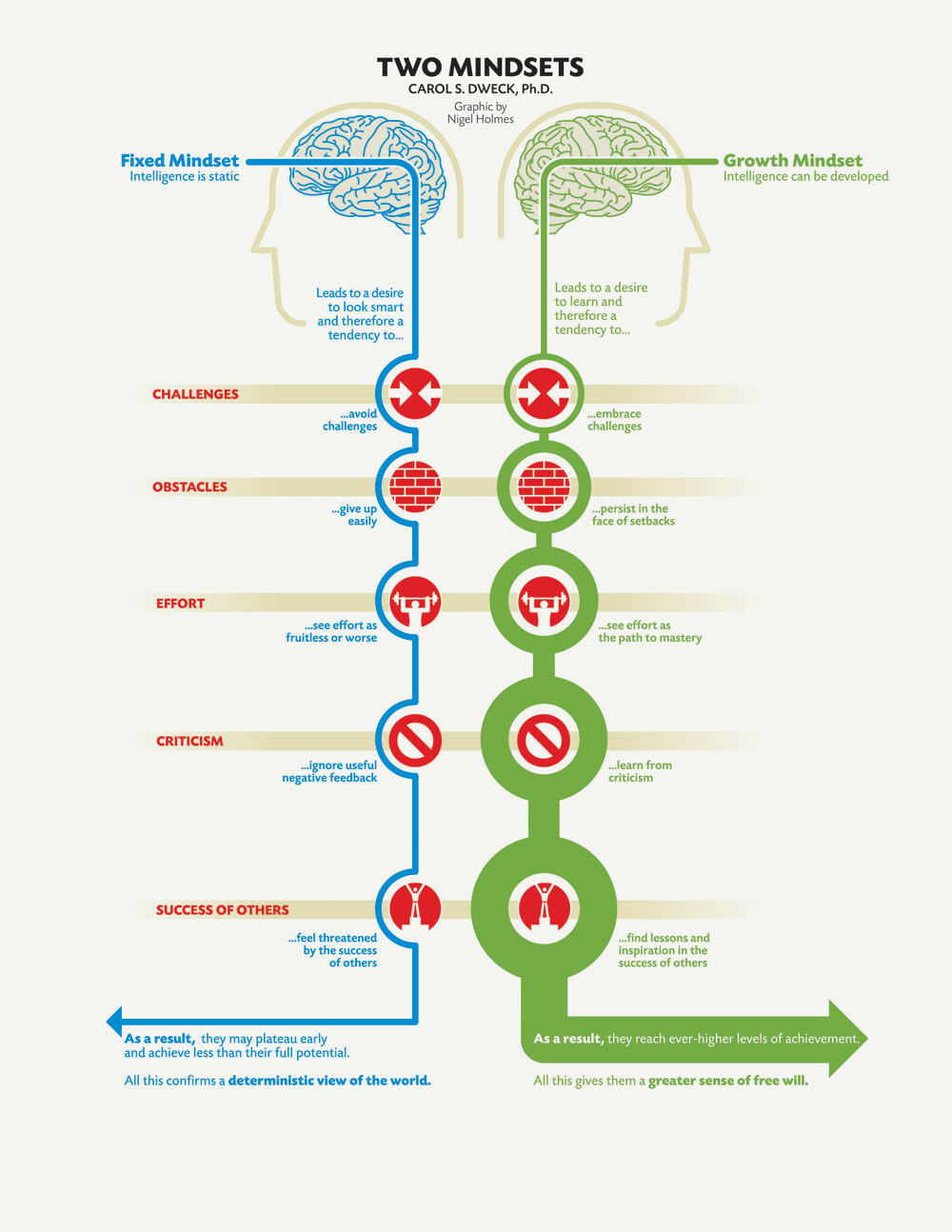
From birth they embedded in me the growth vs. fixed mindset illustrated in this infographic based on research by Dr. Carol Dweck.  Failure was always an option with my parents, just not an excuse.

Pre-school age, whenever I became hesitant to keep trying when something was difficult or threatening, to lower my anxiety, my parents would have me think about the worst thing that could possibly happen and then point out that if I could see my way through that, I would be fine.

My right-handed rancher dad used this technique when he spent the good part of a day with his four-going on five-year-old, left-handed son, riding on each side of a steer up and down a meadow to teach me to lasso.  Eventually, he realized I am a mixed-lefty and would lasso best - if at all - right-handed.

The book helped me understand that the lesson my parents taught me in the far Idaho reaches of the Upper Snake River Valley to overcome fear or hesitancy are the essence of the Stoicism, a Greco-Roman philosophy founded in the 3rd century BC.

I experienced something else I learned in the book while sleeping almost non-stop for 40 hours over a couple of days.  When we disassociate from our thoughts, such as when first learning meditation, the first thing we experience is anything but calm.

Our brains are constantly “chattering.” 

My most interesting take-away from the book would have been of great use during my four decade career as a community destination marketing exec (visitor-centric economic development.)

It is a fast-paced, always changing endeavor that requires incredible teamwork.  Often a staff member or two would get stuck and hold everyone else up.  Training, cajoling, intense oversight, project management technology, peer pressure, nothing seemed to work to help them break loose.

They didn’t do it with every project but boy when they did it, it was costly in terms of productivity.  These were often organizational “stars” too.  Even the little Stoicism trick my parents taught me wouldn’t work.

The book The Antidote, shed light on both what was behind this behavior and a solution.  These folks felt such ownership of their thoughts and emotions, they were wasting all of their time trying to “feel motivated.”

Burkeman, a Brooklyn-based journalist for the Guardian, discusses a Buddhist therapy for this type of procrastination in his book.  Buddhist philosophy teaches that thoughts and emotions are not things we have to stop and obsess about or over control.  They are more like the weather, always changing.

People who procrastinate to the point of dysfunction at times are having an argument with themselves based on the belief that they first need to “feel” motivated and then “act” or even something more strategic.  But they can skip that step or come back to it later.

But maybe the folks behind the Nike slogan “Just Do It” were Buddhist philosophers.

In reality, the answer is to skip that step and just take the first step, much as I do each morning to get started on essays for this blog.

It is a very good read.  His blog and Guardian column, “This Can Change Your Life”, are also full of insights.

Monday, February 03, 2014

Infographic - Tale of Two Mindsets