Thursday, June 30, 2011

Why Some Things Should Be Harder-In and Easier- Out

There are some things you should go into very slowly. Experts have long advised that it should be harder to get married than get divorced for instance. When hiring employees, expert advice is similar “hire slow, fire fast.” Unfortunately, society gets those things reversed.

It should be the same with war, harder to make, easier to quit.

As put more humorously by retiring Secretary of Defense Robert Gates in a recent a speech at West Point, “in my opinion, any future defense secretary who advises the President to again send a big American land army into Asia or into the Middle East or Africa should have his head examined…” I agree.

In particular with Afghanistan where prevailing opinion is now that we went in far too fast, without a clear exit strategy and then lost our primary focus. The continuing loss in lives and treasure should be lessons enough that it is a huge mistake to dismiss the importance of teaching and studying history and Tea Partiers should know better than anyone.Capture

Any of us could have “stepped in the bucket” with misstatements, such as favorites of that movement Representative Michele Bachmann and former Governor Sarah Palin have made recently, about everything from patriots to slavery to who is to blame for the deficit to whether it was John Wayne the actor or John Wayne Gacy the serial killer who was born in their hometown..

More disturbing is when they fail to pull their foot back out of the bucket and supporters try to re-edit history to fit to cover their lack of knowledge.

But clearly when someone gets a “sense from God” that they should run for office, doesn’t it seem like it would come with a reminder about the Ninth Commandment, paraphrased as “Thou Shalt Not Lie” or doesn’t it apply to sound-bites? Maybe it should come instead with a fully detailed code of ethics.

Those only too quick to dismiss the teaching and study of history not only failed to heed:

  • Shakespeare when he penned the phrases “whereof what's past is prologue, what to come In yours and my discharge” for his play The Tempest, written in 1610, often paraphrased as “the past is prologue to the future”, or

  • Founder-favorite and contemporary Edmund Burke who wrote “those who don’t know history are destined to repeat it,” or

  • Pragmatic Spanish-American philosopher George Santayana who wrote "those who cannot remember the past are condemned to repeat it."

Any reading of then just 32-year-old Frances Fitzgerald’s Pulitzer-winning 1972 classic Fire In The Lake: The Vietnamese and the Americans In Vietnam would have been proof enough that the now decade-long conflict in Afghanistan would become a huge mistake.

More than 38 years later, its lessons remain etched in my mind as I read it with my 6-month baby girl laying on my chest just as the 1973 Paris Peace Accords brought that 8 and 1/2 year conflict (1964-1973) to an end. And that doesn’t take into account all those years of special-ops “military advisors” that bookended that period.

Arrogant and corrupt public officials, a dithering-fence-sitting population, foggy differentiation between friend and foe, a failure to grasp historic ethnic and religious divisions and then our digging deeper and deeper to justify that we’ve been digging all along in futility are just a few of the historic similarities that this post-Vietnam generation of public figures should have recognized and learned from.

Of course, there is nothing but hubris to explain why my own generation repeated such a grave mistake well before my daughter saw the back-side of 30.

Maybe Afghanistan will fall just as South Vietnam did just as hawkish columnist Richard Cohen forecast last week when he wrote “I think Obama knows that. He fought this war – authorized the West Point surge – because he did not know how to get out. Now he does…it’s by getting out.”

I also share Cohen’s concerns that “the Republican response to both foreign and domestic problems somehow fits what is beginning to look like the 1930s all over again” including depression and isolation. “America remains the sole nation capable of playing the role of adult. The world needs us. The world will soon need us even more.”

Cohen may be right because wise and selective decisions about war may be required even more frequently in the future according to the new book Unnatural Selection: Choosing Boys Over Girls, and the Consequences of a World Full of Men by Mara Hvistendahl. It is imperative that we become much more self-aware as a nation about the limits of what we can and should do.

Whatever the outcome there, it was always going to be in the hands of Afghans to determine. Americans have achieved a great deal at the cost of running up the deficit and the sacrifice and maiming of young lives. This includes increasing the number of Afghan children attending school from 1 million to 8.3 million including 40% who are girls. It is up to the Afghans to rescue the 46% of school-age children who aren’t yet included.

I don’t fully agree now with General Colin Powell’s application of the Pottery Barn Rule: if you break it you own it” to nation-building. Americans have more than paid for and repaired any damage. We’ve also equipped and trained an Afghan army that if it has the will, can protect the nation from its enemies, internal and external.

As any parent can tell us, you do the best you can in preparing dependents, but you can’t control the lives they lead. We’ve sacrificed lives and treasure. It is now up to Afghans to do the rest and whether they do will be a reflection on them, not us.

“List checkers” and anyone else with little patience for either history or strategic thinking would do well to read Dr. Robert Burton’s book On Being Certain – Believing You Are Right Even When You’re Not. He shows why we should all be more skeptical of our beliefs and that certainty, including "confirming bias," is a mental state, a feeling like anger or pride that doesn’t dependably reflect objective truth.

They would also better understand the purpose of both history and forecasting from a favorite quote of mine by author, consultant, essayist and history-informed “forecaster” Paul Saffo:

“the goal of forecasting [as well as learning from the past] is not to predict the future but to tell you what you need to know to take meaningful action in the present.”

Born a decade after me on the cusp of the Vietnam and post-Vietnam generation, Saffo often weaves historical perspective into essays about the future as he did in one I read upon arrival in Durham more than twenty years ago entitled Electronic Books, Yes, that long ago!

Today now-self-determinant Afghans as well as American officials eager to redirect full attention to fueling the economy, innovating new energy sources and dealing with issues of credit will do well to remember another favorite Saffo quote of mine:

“Don’t mistake a clear view with a short distance.”

Wednesday, June 29, 2011

Washington Didn’t Learn From Colorado

I guess Washington State neglected to check to see what happened to Colorado when it similarly shut its tourism promotion down between 1993 and 1997 as Washington will at week’s end.

Visitation there dropped so dramatically back then that it more than erased any budget savings and worsened the deficit as tourism revenues and relatable tax revenues plummeted according to a post-in-depth analysis by IHS Global Insight.

That was an interesting time period for analysis because tourism on average declined nationwide, so it was easier to see how much further Colorado fell with no promotion to soften the fall.Capture

When Colorado did finally crank tourism promotion back up, it took another three years to get back up to speed and when it did, it was still 11 points short of the national average.

According to the analysis, a smarter move would have been for Washington State to increase tourism promotion as a means to help fight its way out of the deficit.  But politics is personal not logical and many politicians “cut stupidly not wisely” to paraphrase conservative columnist David Brooks.

Ordinarily, Washington is a very progressive state, having sat down as New York did to negotiate with its public unions rather than taking the bullying-agenda-driven confrontational, zero-sum approach that Wisconsin and, more recently New Jersey, did.

Washington has a lot of tourism potential.  I cut my teeth there in the 70s at the beginning of my just-concluded career in tourism-driven economic and cultural development.

Washington, like my adopted home state of North Carolina, is very geographically diverse from one side to the other.  It starts with coastline and rain forests in the west, climbs over the Cascades into high desert plateau which is perfect for wine growing, across the rolling hills of the Palouse and then back up into the lake country and foothills of the Rocky Mountains at Spokane on the eastern side.

However, Washington has always seemed to take its tourism for granted, especially on the western side which often breaths in so much of its own fog that it feels “entitled” to tourism.

But at least this move may provide another opportunity to closely observe how stupid it is to cut visitor-centric economic and cultural development.

Although, it may be a harder to gauge because Washington has more destination marketing-equipped cities than Colorado had back then which, hopefully, may be able to individually soldier-on in an effort to mitigate the state’s losses.

Tuesday, June 28, 2011

Putting Ice Cream and Tractors Into Perspective

Little did I know until this month that Wheaties debuted only seven years before I was born or that per capita annual consumption of ice cream peaked two years before I was born, at an astonishing 23 pounds per person.

I had always assumed Wheaties had been around forever and based on my family that per capita consumption of ice cream was still on a steep upward trajectory. I also remember the epiphany when I later learned that the Porsche marque I had admired from the day I first set eyes on a 356 Coupe when I was 10, only dated to the year of my birth, 1948.

Certain things, like Wheaties and ice cream just seem temporal.

Porsche, the designer and engineer, was probably tinkering with the prototype of the first car to bear his name in Gmund, Austria as my Dad traveled on a few days leave up into those Alps to clear his head skiing in the early winter of 1946 from his military post at Dachau which had been liberated just eight months prior.

That 356, of course, didn’t become my Porsche. I first owned a 912, same styling as the iconic 911 I would buy used in 1978 (when they were affordable) but with a VW engine. I rationalized the VW part because Porsche had also designed and built that make during a period during the 1930s when he also designed Grand Prix race cars for Auto Union, now known as Audi.

It wasn’t until a few years ago that I learned that Porsche also made tractors.

During my first decade of life, I was more into tractors than cars. At the time, I thought it was foolish that you couldn’t distinguish cars and trucks by their color like you could tractors. What a great concept!

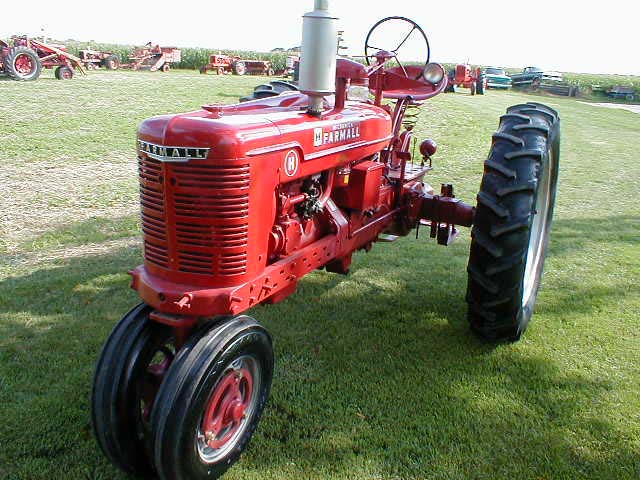
At that age, I generally picked my favorites by color. My paternal grandfather’s bright red 1950 Farmall H was my favorite simply because of the color and not because it was manufactured from one of the huge J.P. Morgan trusts Teddy Roosevelt didn’t break up at the turn of that century. We always called it an International.

My maternal grandfather was a water master for the power company. He was almost always stationed out in the countryside next to some little dam where the water master was given occupancy of a house along with a barn and a little land as my grandfather was at Stewart Dam in the very southeastern corner of Idaho, not far from Dingle on the Bear River.00512_p_10aeuyf6sw0636_z

He had a mini-gray 1950 Ford 8N, which, according to Henry Ford, you weren’t allowed to call a tractor, that I liked because it was more my size and also because the secondary color was bright red.

I wasn’t much into green at the time so my Uncle Louis’ 1950 John Deere Model B wasn’t a favorite and the two-cylinder engine made a funny sound like it was choking. Come to think of it, it wasn’t that different than my Harley can sound if I don’t give it enough gas or start off in the wrong gear (click on the links to hear those sounds.)

I didn’t realize at the time that the predecessor to the John Deere was the Waterloo Boy tractor long abandoned in a grove of trees and brush on the ranch where vehicles were abandoned.

This vehicle graveyard was useful only for playing make-believe, especially a cool buckboard wagon and the remnants of an old steam threshing machine, my grandfather and one of his brothers been only the second to own in that Yellowstone-Teton nook of Idaho (click on the link to see one in action or the image of my grandfather’s shown above in this blog.)

It seems like Tea Partier candidate for the Republican primaries Representative Michele Bachmann would have been better advised to brag about her hometown being where Waterloo Boys were built rather than as the one time home of serial killer John Wayne Gacy whom she humorously confused with the famous actor, the late John Wayne, who was born 120 miles away in Winterset.

As he frequently did with very loud sport coats, my Dad always had exotic tastes when it came to tractors. They seem cool now but I was always a little embarrassed back then by his butter yellow and orange Case 411 tractor and his older green, yellow and orange 1954 Oliver Model 66.

Now that I think of it though, our closest neighbor with boys near my age had a very cool yellow 1949 Caterpillar which always seemed antique although it was a year younger than we were at the time. So I guess my chagrin wasn’t about the color yellow.

Dad was that way with cars too. He couldn’t stick with the very cool black 1949 Ford we had when I was very young. He had to get a two tone pea-soup-green DeSoto followed by a two-tone white and rust Rambler during my teenage years which I had to defend with another set of friends.

He wouldn’t let me learn to drive in the cool Jeep which I was to inherit after my grandmother “hand-painted” it red, of course. He made me truck back and forth through town in an ugly brown 1950 Chevy Coupe to learn to drive a stick-shift which would have been still bearable except it was a “three on the tree transmission.”

Only “four on the floor” was cool at the time. My Dad definitely never worried about “cool.”

12 Imperatives for a Museum of Durham History!

Long before officials leapfrogged it to build the spectacular Durham Performing Arts Center, a local history museum had long been the top cultural priority of Durham residents across every socio-ethnic group as evidenced by both scientific public opinion polls and master plans.

While Durham’s 12th and largest performance theater, not counting those in high schools such as the excellent 1,000-seat GSK Theater at Riverside, is a huge success, the only gapping hole in Durham’s cultural fabric remains the need for a local history museum.

Unfortunately, as often happens, advocates seeking to justify the theater a decade ago as a means to augment an economic development project felt the need to trash the idea of a local history museum as a threat, even going far as to bully a consultant to stop him from raising concerns.

It always takes time for the effects of propaganda like that to wash away.  Unfortunately, it isn’t new nor exclusive to Durham to see cultural facilities such as convention centers, ballparks, museums and theaters, often to their detriment, strapped like hostages to the front bumper of economic development projects.  People in my former career field are too often complicit.

All the while, however, Durham residents have continued to soldier-on as evidenced by a number of fundraisers including a benefit concert by volunteers from Durham Tech called “History Rocks” that will be held on July 16th to raise funds for a store-front precursor to a full-fledged Museum of Durham History.  Check out another prelude-project by Museum called History Beneath Our Feet, an online guide to Durham street and school names.

Fittingly, the event will be held in the 500+ capacity Motorco, an old mid-century showroom where 1960s Lincolns and Mercurys were sold which has been adaptively restored as a live music venue in Downtown’s unofficial but organically emergent NoCo District (NOrth of COrporation.)

Local history museums are vital to a community’s sense of uniqueness beyond their significance as a tool for both traditional and visitor-centric economic and cultural development.

Along with one of my own near the end, here are eleven long-term-trend-based observations noted in a 2008 study conducted by Reach Advisors on behalf of The Center For The Future Of Museums, “a think-tank and research and design lab,” about the continued relevance of museums in the future (download the full report by clicking here):

  • Far into the future, “museums will be places of cultural exchange in their communities…They will be one of the most powerful agents in helping all children understand the future and ensuring they are prepared to take leadership roles.”


  • “With educational attainment becoming a more visible tool of social mobility than ever, museums provide more opportunities than ever for [those] from less-educated families to gain exposure to topics that drive academic interest…As important players in the formal and informal education system, museums will…meet the rising expectations highly educated moms have for their children.”


  • In a world undergoing incredible change, “museums will educate the public on how past societies coped and adapted to tectonic shifts in their resources.  They will help society learn from history as we cope with a new era of expensive energy, lower consumptions, carbon constraint and climate change.”


  • “Museums are stable oases in the mist of turmoil…museums play an even greater role in sustaining the well-being of their communities during a prolonged downturn. Whether for the retiree managing lower post-retirement income than anticipated, or for schools with fewer enrichment opportunities for students, museums are there for their communities.”


  • “Museums play an important role in helping communities…reinvent themselves in the new knowledge-based economy. Responding to society's need for greater global awareness…promote dialog and understanding about other cultures and our place…”


  • “Museums are among the few institutions that bring together people of all economic classes…valued for their ability to redistribute wealth in the form of access to scientific, cultural and artistic resources, mitigating the cultural gap that arises from income disparities.”


  • “the fundamental human condition responds to a variant of Newton’s Third Law of Motion: The prevalence of the digital, virtual world raises public awareness of the increasingly rare world of non-digital assets that help tell the story of how humans got where we are.  Museums play  a more critical role than ever as purveyors of the authentic, addressing a human desire for the real as the wonders of technology march us towards the opposite path.”


  • “…Museums provide common experiences for diverse audiences, serving as safe public spaces for civic dialogue. As one of the most trusted sources of information, museums help people navigate the vast new world of information by filtering and validating credible content.”


  • “Museums…play a vital role in nurturing, documenting, organizing, interpreting and making accessible…creative output…They are repositories of knowledge about traditional craft, sources of inspiration for new designs and processes, and through their collections and exhibitions” they are “validators of new.”


  • “museums provide unique opportunities for today’s youth to exercise their gaming skills and satisfy their expectations for immersive narrative.  This increases their engagement with museums but also the community and the world, providing levels of social and global awareness they might not otherwise absorb while sitting in front of a screen.”


  • “Museums will be oases of the real in an increasingly virtual world.  Along with the outdoors and places of worship, museums represent the best opportunity for getting away from it all.”

It was clear to me from a now concluded four-decade career focused on marketing communities to visitors, including newcomers and relocating or start-up executives, that local history museums uniquely provide a place where existing residents, visitors and newcomers can explore the soul of a community and appreciate and perpetuate the temporal values and traits that make a community unique and distinct.

They are essential to place-making.  They engage all five modes of cultural involvement including inventive participation, interpretive participation, curatorial participation, observational participation and ambient participation.

For anyone prone to be list checkers with little patience for the future or the past, the report begins with an insightful quote from futurist Paul Saffo:

“The goal of forecasting is not to predict the future but to tell you what you need to know to take meaningful action in the present.”

Ironic for a community with a history arguably deeper and more significant than most, Durham has waited too long for a Museum of Durham History.

Proponents must remember another quote I like by Saffo, “never mistake a clear view for a short distance.”  Keep the faith!.

Re-Jumpstarting The United State Bicycle Route System

Motorcycles have something over electric or hybrid cars because, you can hear them beside you or coming up from behind. That makes a difference to the bicyclists with whom I frequently share the hills and dales of winding country-two-laners near where I live and enjoy riding my Harley.

Loud pipes save lives” is more than a slogan and we must have counted two hundred bicyclists during a beautiful ride this past weekend for brunch at the Saxapahaw General Store, unpretentiously cloaked as a “Five-Star Gas Station.”

My adopted home of more than two decades, Durham, North Carolina, is now not only dissected by the East Coast Greenway which runs from Maine to Florida but now recognized as the headquarters of the nearly 3,000-mile route, 25% of which is on traffic-free pathways like the American Tobacco Trail here. At times the Greenway conjoins with the recently revived United States Bicycle Route System.

Unless bicyclists are very experienced, the Greenway route is still best traveled and enjoyed as excursions on short traffic-free spans while on other trips via car, bus, rail or air, where airlines now provide special boxes to carry bicycles baggage holds.

That’s how I suspect most communities market the Greenway. Community/destination marketing organizations along the route can click on each state on the interactive route map to find more specific area maps at the bottom of each page.

It is hard for me to believe that the idea of the East Coast Greenway only began during a 1991 conference in Massachusetts which, coincidentally, was shortly after I relocated to the southeast here to jumpstart Durham’s community marketing effort.

While Durham now appears on the Greenway map, it is a bit confusing to visitors that equally-trail-rich Raleigh seems to get unusually large billing for being only connected by a spur. The East Coast Greenway actually cuts west of Cary, North Carolina and on to Fayetteville before veering down to Wilmington to follow the coastline for the remainder of the way.

This is probably because the Greenway conjoins with US Highway 1 and US Bike Route 1 for a bit, and when the route and map were first created it probably wasn’t yet known that it would ultimately diverge to the west and down through Durham.

USBR 1 cutting down through Virginia and into North Carolina to Raleigh is one of only two segments designated since 1981 as part of the proposed US Bicycle Route System by the Association of American State Highway and Transportation Officials (AASHTO.) Click here to enlarge the map. It appears Durham will be on a future east-west BR.

Recently several additional routes, USBR 1 in Maine and New Hampshire and USBR 20 in Michigan and USBRs 8, 95, 97 and 87 in Alaska, have been approved. If you wonder what “experienced cyclist” means, try driving anything motorized down US 1 through nearby Raleigh and you’ll get an idea of the experience needed to maneuver through congested areas.

The FastLane blog a week ago on the US Department of Transportation website and a FAQ on the website for the Adventure Cycling Association which has been contracted by AASHTO to facilitate more route designations to the system indicate that 44.7 million Americans age seven and older rode a bicycle six or more times in 2008.

Bicycling is now the seventh most popular recreational activity in the nation. Click here for Adventure Cycling resource page with links to various studies on economic and community benefits.

According to a post a few days ago on the website GOOD, Americans made 4 billion bicycling trips in 2009, up from 3.3 billion in 2001. To put that into perspective there are now between 10 and 11 million motorcycle trips annually in the US. From my observations, we share the road together much better than automobiles do.

Click here to search the US Bicycling Route Map by state or by route which is probably the most useful for the majority of bicyclists who would use part of the system during a trip. It is also a good place for official community destination marketing organizations to find specific links to the appropriate segments.

Click here for links to various Durham maps showing local routes for biking and hiking, the locations of bicycle racks or overall greenways and trails.