Friday, March 06, 2015

The Significance of Planning One’s Own Funeral

Funerals I’ve attended over the past month have motivated me to leave a list of instructions about my own when the comes.

My mother’s took place the week she would have turned 86 years old.  Even in pain for many years and nearly blind for more than two decades, she worked hard to make sure her affairs were in order.

She left explicit instructions on how and where she wanted to buried, including the type of service, a favorite hymn and her headstone, along with an insurance policy to cover the costs.

Included with her will and health care directive was even a handwritten note reminding us to cancel auto-shipments of shampoo from the cable television shopping channel, QVC, where I am sure she was well known (smile.)

In true form, she had thought of everything.  Thankfully, she lived long enough to think through the details of her funeral.

As I always thought too, many people thought my mom was an extrovert but her funeral wishes suggest she leaned more to being an introvert.

In contrast, an even more recent funeral was for a former co-worker who died suddenly at only age 38.  I have no idea if he left instructions, but due to his young age, I doubt it.

He was a bigger than life personality and was assumed by many to be an extrovert.

But based on our years of working together and humorous comments he made through the years, my guess is that he leaned toward being an introvert on that scale.

Without our wishes documented and given to guardians, it’s anyone’s guess as to what kind of funeral will be planned, particularly when well meaning extroverts get involved.

Note to self!

The scientific meaning of those classifications have been perverted over the years, even in some dictionary definitions.  Extrovert and introvert have nothing to do with being outgoing or shy.

Based on the research that coined the terms as well as follow up studies, these descriptions have to do with how we get or distribute energy and how quickly we dial up.

Click here for an excellent overview including how people who fall under each description can respect the needs of someone at the other end of the scale or even those who seemingly straddle the line such as me, ambiverts.

Extroverts get energy from people while introverts give energy to others.  Extroverts lose energy when they are alone and need social interaction for restoration.

Introverts give off energy in social settings and need down time or alone time to recharge, often side by side with someone who understands and respects that.

Extroverts arouse more slowly while introverts arouse quickly which is why too much stimulation for them is exhausting.  So when extroverts are barely getting warmed up and siphoning more and more energy, having been depleted, introverts are coming in for a landing.

Stimulation even takes different pathways in the brains of extroverts and introverts explaining, in part, why the former is more subject to risky behaviors including management decisions.

Extroverts get their “life of the party” or “never met a stranger” reputation because they get, need and constantly seek energy from people.

Introverts get a reputation for being shy because they are better listeners and because their energy gets depleted in social situations not because they don’t enjoy them.

Both are equally at ease in public settings and roles.  Introverts tend to be more regulated and know when enough is enough.  Places of worship and social or service clubs must curb extroverts or risk driving introverts away.

I suspect that my own spirituality is best served in tranquil, natural settings is a give-away.  When I was president of a Rotary Club, extraverts always made it a challenge to keep meetings on time.

To an extravert, a brief announcement can turn into a ten minute performance as they get energized by the crowd.

The fact that service clubs, in particular, are often dominated by extroverts is one of the reasons found in studies showing that more and more people now prefer to seek “one off” causes for service involvement rather than joining those that are perpetual.

You can also tell a lot about which end of that spectrum someone falls by the type of funeral arrangements they specify.

I used to kid my daughter and sisters when I was much younger that at my funeral, they could just play B.B. King’s The Thrill Is Gone and scatter my ashes over my native Tetons, signaling that I tilt toward introvert and don’t want a long drawn-out funeral.

I guess I need to update those comments and record some more specifics.

Funerals are for the living, but maybe the greatest way to respect someone who has passed is to grieve our loss in the way they would have wanted, regardless of our own preferences for grieving.

So note to self: even though I have no immediate plans for dying, now is the time to think through what I want and then communicate it to a trusted guardian.

And for anyone who thinks they are too young to think about this, do it for loved ones.

Thursday, March 05, 2015

The Twin Threats of Commodification and Blandification

After hearing one of my lectures a week ago at Appalachian State University, a bright, young, upper level hospitality student stopped to ask me a question.

She wondered if now that many cities, including some nearby, have developed local restaurant scenes if the one in Durham where I still live after concluding a career in community marketing would experience leakage.

Durham’s foodie reputation first evolved with a colony of chef-owned restaurants in the early 1980s and has regularly been nationally-acclaimed since the 1990s, most recently garnering the community “Tastiest Town In The South.

Normally, leakage refers to import leakage, what occurs when, for example, visitors to a community are somehow misdirected to another community for something available locally or when businesses hire non-residents and those wages are not spent work-side.

This is called leakage because it reduces the value added to the local economy.

Due to a consumer behavior known as cognitive distance friction, visitors rarely range further than seven miles even within a destination let alone venture a 20-60 mile round trip to do something in another city they could do where they are.

That is, unless they are misdirected by someone which is why DMOs must constantly train and retrain front line workers who are commuters from another city.

Otherwise, they recommend what they know, even if it means sending an unsuspecting visitor on a 30 mile jaunt to eat.

In this instance, I took it that the student wondered if Durham’s ability to reap dividends from its vaunted food scene would be reduced when day-trip visitors stayed home to dine instead, creating the impact of “retained tourism” in those places.

The short answer to the question is there will be little if any leakage at least in the manner I suspect she was using the term.

However, there are other threats that may undermine the ability of communities everywhere to leverage a local food scene as a point of differentiation and appeal.

Local food scenes involve more than acclaimed chefs, culinary artisans and restaurants.  These aspects thrive when integrated into the destination overall in a way that seems organic and natural.

Foodies travel as much for the sense of the place surrounding restaurants as they do for the food itself.  Durham’s food scene will continue to thrive if community policy makers, advocates and developers focus on preserving community character.

By community character, I mean those place-based assets including cultural, environmental and built, that when woven together make a community distinctive, not because they are unique in and of themselves but because they are distinct in the way they are manifest.

Loss of sense of place also occurs by becoming too “resort-ish” or cute, or when organic districts are overrun by chains and other mainstream elements.

This is a far greater threat than competition from other communities, especially when these more generic elements try to cannibalize or dominate a community’s overall story which they often try to do.

Both a unique sense of place and community destination marketing that seeks to foster and protect it are about “differentiation,” the antithesis of communities that seek instead to be mainstream, a sure path to blandification.

Being mainstream refers not only to chains but to sports and cultural facilities, including events that can be found in scores of other communities, if not hundreds and thousands.

In business, there is an outcome called commoditization.  It is the opposite of differentiation.

This is when goods or services become so mainstream or ubiquitous that they are no longer distinguishable in the eyes of the marketplace or consumers.  For example, experts now believe smartphones have become commoditized.

Essentially, commoditization is about distinctive things becoming generic.  They are easy to spot when they plateau and then decline.  Examples are professional sports, conventions, shopping malls, touring Broadway and now NASCAR.

Unfortunately, none were willing to learn from the others.

This can even happen to local, chef-driven food cultures if and when visitors begin to find them anywhere.  It doesn’t mean that they won’t continue to be “satisfiers,” they just won’t be “motivators” for travel to a particular location.

The anecdote to commoditization, also referred to as commodification when it comes to destinations sustaining their appeal, is not to be preoccupied with going shopping for culture one day and bringing back one of everything that many other communities have.

The anecdote is to focus instead on nurturing and gardening the blend of indigenous attributes and facilities that make a community distinct.

Douglas Rushkoff, the author of such books as Present Shock, defines commoditization as more of a market problem for manufacturers of branded goods and commodification as more of a crime of the market against humanity.

Communities concerned about retaining sense of place must fear commodification and the “big game hunter” mentality that, claiming some special knowledge, relentlessly fosters it.

Consultants and studies are not the answer.

The reason communities continued to build more and more convention centers, stadiums and performing arts theaters even when it was clear that they would ultimately be doomed by over building is that they failed to factor in the simple law of supply and demand.

For example, in 2003 there were fewer than 200 communities across the country with theaters hosting touring Broadway shows.  While it is rarely, if ever, shown in feasibility studies, based on the last number I saw reported, there are now far than 600.

This is true, even though the percentage of Americans attending musical theater today is 20% lower than it was in 1982 and  even though attendance at touring Broadway shows has fallen lower than it was 20 years ago,

Even the total weeks the shows run each year is similar today to what it was in the 1980s.

This is disguised in feasibility reports by only showing ticket revenues or charts that show only a few years of historical perspective and never is it indexed to supply.

Nearly a decade ago, experts were quoted saying that touring Broadway was “intrinsically broken,” yet more and more communities continue to build more and more theaters, ignorant of the devastation suffered in the past when communities failed to respect supply and demand.

Many of my peers, expected to be experts in “demand-based’ economic development as economists define tourism, as well as guardians of sense of place are instead often enablers of facilities that don’t make sense.

Instead many lead the charge for “big game hunters” in their communities or become one themselves, merely firing any consultant who wouldn’t tell them what they wanted to hear until they found one that would.

I watched as this happened in many communities over my career and was steamrolled myself more than once for standing up to “big game hunters.”

A corollary to commodification is that once it passes over into generica, a community can never cross back in hopes of somehow restoring its sense of place.

Many communities are fighting back against powerful lobbies for commodification and blandification.

San Francisco struggles to cap the number of mainstream outlets, and others are considering capping the rates charged for commercial spaces to protect locally owned stores.

Voters in Malibu, California approved a measure limiting chain stores.  New Yorkers are banding together to save the city’s remaining 200,000 locally owned stores.

Communities could learn a lesson about commodification by studying the lodging industry which after spending billions making hotels indescript is now spending billions trying to make new properties seem “boutique-ish” and as though they belong in the communities responsible for drawing their guests.

Others, such as 21C which will soon open its third art museum/hotel in Durham by adaptively reusing old historic buildings, in this case the historic home of the former Central Carolina Bank.  The equally distinct Durham Hotel will soon open across the street.

Hotels such as these and the Aloft, soon to open in Durham’s American Tobacco District, are sure to open chef-driven restaurants, often tapping into Durham’s local colony of chefs.

But even here, policy makers fail to question developers or learn the lesson that “commodification is a crime of the market against humanity.”

Wednesday, March 04, 2015

When We Were Only 4,646

In mid-1989 I flew across the country to take on destination marketing for Durham, North Carolina.  As a lifelong 6th generation westerner I was unaware that my roots as a Tar Heel go back more than 200 years before I was born.

When one of my 6th great grandfathers, David Miller, was born in what would later become Orange County, barely more than a tenth of North Carolina’s 100 counties had been formed.

At the time the future state’s population had grown to about 30,000 people, about the size today of the town of Sanford or Cornelius, a village along the shores of Lake Norman.

North Carolina at the time stretched beyond the Appalachians clear to the Mississippi River.

But apparently, it soon became too crowded for my earliest roots here.  My 5th great grandparents, who had also been born in what by then was Orange County, may have been the first to move west, settling Pickens County, Alabama with Revolutionary War veterans along the Tombigbee River.

By 1847, the progeny of those Tar Heel roots were headed up and over the Rockies, more than a thousand miles beyond the frontier.

I find it fascinating not only to dig back into family history but to put the lives of my ancestors in context.

My American roots go back to 1630 long before any permanent settlement of North Carolina had occurred and when there were only 4,646 settlers in all of what would become the United States.

These 10th great grandparents William and Goditha Learned settled in Charlestown and were quickly followed within a decade by several others.  Many ancestral lines had arrived at a time when the future U.S. population was around 300,000, a little more than Durham County today, where I live.

Within a few years, most began small migrations west until by the late 1820s, when many such as the Sheltons and Neeleys migrated to points along the western frontier just as my North Carolina roots had.

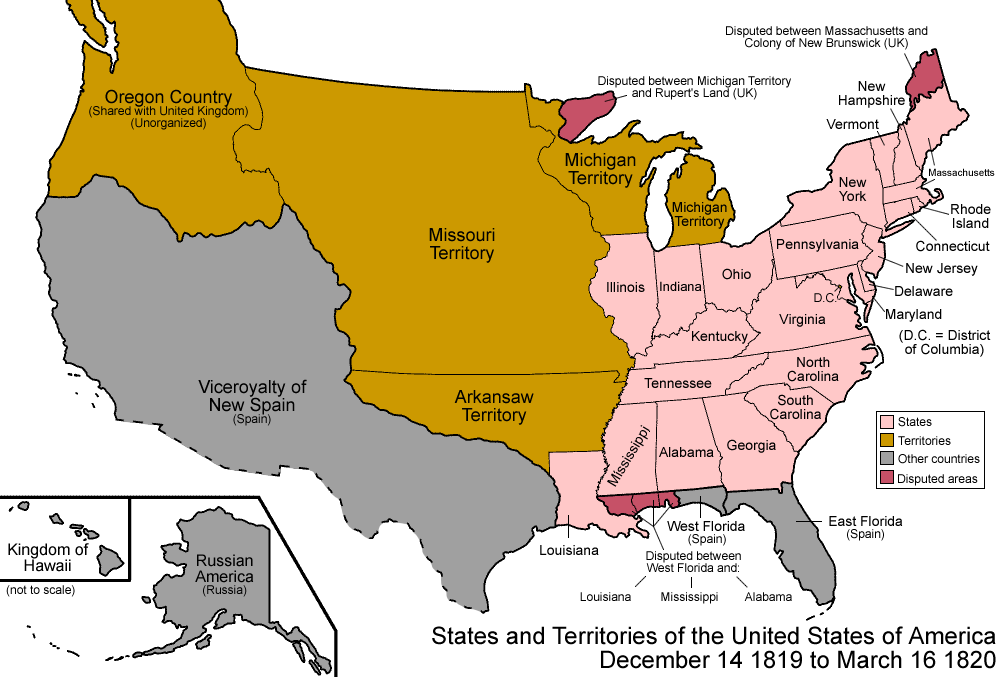
Back then the map of America looked as it does in the map shown in this essay.

When three of my ancestors became some of the first settlers to ride down into Salt Lake Valley in 1847 there were fewer than 90,000 non-Indians living in what would become the contiguous Western states (an area nearly twice the size of Western Europe.)

This was less than the population of Arkansas at the time and about 78% of westerners lived in what are now New Mexico and Arizona.  What are now Montana, Idaho, Utah and Nevada were completely unsettled when my ancestors crossed the Rockies.

Stretching behind them for 1,100 miles was territory yet to be organized in any way except for a few isolated military forts.

All of my ancestors but two lines had crossed over the Rockies by 1850 when a compromise in Congress over slavery created the map at this link.

The remaining two joined them by 1857 and 1862 directly from England and Scotland, respectively.

By then, one of my great-great grandfathers, Charles Harper, who was on the vanguard wagon train west, had returned several times to guide others across, making at least four round trips over the 1,100 mile route.

Each of these ancestral lines went on to create many other settlements, all within a few miles of the 111th Meridian West, including at the most northern end, my native land where ultimately all of these DNAs converged.

I have no way to know if I am the first person created by the convergence of all those ancestral lines to fully reverse the migration 142 years later, living in North Carolina now for nearly 26 years.

Many were crafts men and women before crossing the Rockies to become frontiersmen including carriage makers, tailors, seamstresses and business owners, but once over the Rockies they all became experts at economic development, which became my career.

They mined sufficient gold to create currency, learned to “buy local” even if the goods were inferior because to buy from back east not only robbed local economies of their full value added, but local because it gave local manufacturers the opportunity and resources to improve.

None were wealthy and some could not afford the trip west without needs-based loans from the Perpetual Immigrating Fund (PEF) which they inaugurated in October 1849, just over 24 months after the first arrivals west of the Rockies.

It was capitalized by wealth transfers from donors and tithes paid to the Mormon Church and repaid once recipients made their way west from as far as Europe and other countries before being re-loaned.

Precedent was given to those with needed skills as well as the relatives of donors who paid into the PEF.  In all, more than 30,000 people used the fund to get a hand up over the nearly 40 years it was in existence before it was outlawed by reactionaries in the U.S. Congress.

Repayments were forgiven if they were keeping people in poverty.

Fourteen years ago this Spring, the Mormon Church resurrected the idea but as the Perpetual Education Fund to help members in need who are under 30 years of age and committed to repayment to get training and education that leads to employment or self-employment.

Unfortunately, today many Mormons who pride themselves on not speaking ill about others are, by insinuation nonetheless insensitive to the poor unless they happen to be Mormon. This is especially true of those who have fled diverse cities for exurbs.

Gallup surveys find that a greater proportion of Mormons are conservative than any other U.S. religion, 59% compared to 31% moderate and 8% liberal.

Largely due to the migration from more diverse areas to exurbs, this is also true in places along the 111th Meridian where Mormons fled for religious freedom.

It is even more true of those who are active in the church, with 65% conservative, 29% moderate and 5% liberal.

But the views of those in white flight may have cost more than diversity of thought and discourse.

The 6-in-10 (here and abroad) such as me whose participation has lapsed are half as conservative as those who are active, far more moderate and four times more liberal than active Mormons although many remain positive about the culture in general.

A tiny percentage now trace back to the migration over the Rockies in search of new homelands but unfortunately, it is clear that some of the values and lessons from that period may becoming equally rare.

The white flight of today is different than that which occurred in the late 1950s and 1960s.  Across the country, it seems to have more to do with what some term as racial politics than with poverty or transfers to provide a hand up.

But that is for another essay.

Tuesday, March 03, 2015

Our Hubris As Relative Newcomers

It always seems a bit odd to hear some Americans berate immigrants who are struggling to learn English as a second language.

After all, English isn’t the first language of Americans.

As the grandfather of two 8th generation westerners and 18th generation Americans, I found a chart on page 5 of the current issue of High Country News fascinating.

It maps 60 American languages that long preceded English and are still in use in the contiguous West along with the number of speakers remaining for each.

Three of my great-great grandparents learned two or more of these languages enough to be interpreters including Shoshone, Northern and Southern Paiute, Navaho, Zuni and Hopi.

The latter three are still fairly widely spoken but the number speaking Shoshone has dipped near 2,500 and there are only 12 people remaining who speak Northern Paiute.

There are only 20 people remain who speak Spokane, the language of the Indian nation for whom the city along the Northern Rockies is named.

This is also where I started my now concluded career in community destination marketing and where my only child was born.

There are only 174 who speak Coeur d’Alene, the nation for whom the famous lake in the north of my native Idaho is named more than four decades ago.

The article by journalist Jeremy Miller that accompanies the chart in High Country News notes that one of the world’s 7,000 distinct languages vanishes every 14 days, meaning “between half and 90 percent” will disappear by the end of this century.

“Of the 176 known languages once spoken in the U.S., 52 are thought to be dormant or extinct.”

A January article in National Geographic provided updated archeological and genome research on The First American that reminds us that even those of us who go back 16 generations here are relatively new arrivals.

The first Americans crossed over into what is now Alaska 15,500 years ago.  Genetically, they were two-thirds East Asian and one-third Eurasian.  There, their DNA mutated into unique markers found today in Native Americans but not Asians.

Deglaciation permitted these first Americans to migrate over the next two thousand years into what is now the continental United States and clear to the tip of South America.

To put this time period in perspective, though, fossils show that the pine trees they passed were 130 million years old.  Pines are the ecologically the most important trees in the world making human inhabitation of northern climates bearable.

Spear points found southeast of Salmon just below the ridgeline of the Continental Divide in my native Idaho date the earliest humans in that state to 11,000 years ago.

My ancestors who are credited with helping to establish the first permanent settlement in that state and served as interpreters with Shoshone Native Americans were under no illusion that they were first.

They accepted as Christian scripture, along with the the Bible, The Book of Mormon which chronicles the writings of ancient prophets on this continent beginning more than 4,000 years ago.

Maybe we should all just lighten up on those learning English.

Monday, March 02, 2015

The Native Home of Hope

Authenticity is not a fad when it comes to sense of place,  but use - or should I say misuse – of the word has become one.

This will pass, and when it does the attributes of authenticity of place will remain by definition nearly temporal.

My personal story begins as the only son of an only son, born at the tail end of five generations of Rocky Mountain ranchers who gradually migrated during the hundred years before I was born from the Central to the Northern Rockies.

Our ancestral ranch is where I learned sense of place, e.g. the smell of sage brush, new mown hay, and rain on a dirt road, as well as the sound of a Meadowlark and the colors of Yellowstone Cutthroat in the Henry’s Fork.

But it is also where I first learned about myths: including myths about rugged individualists, the cowboy errant Knight and other stereotypes of the West that I see fleeting across the eyes of people who want to hear my story.

I didn’t read Wallace Stegner until I came across his incredible essay in my early 30s entitled, Sense of Place.  This is where he coined that term and I still recommend to anyone seeking an understanding of authenticity.

It was my daughter, then in her third year of college, who brought me to Stegner in more depth.  Having heard my story, she knew that the breadth and depth of his writings would resonate.  It is such a gift to be understood.

One of my favorites is a book of essays written over a span that covered my first two decades entitled, The Sound of Mountain Water.  The first was published the year before I was born, the last in the collection as I turned 21.

The namesake essay in the book is a lyrical description about my native Yellowstone-Teton nook of Idaho and its famed Henry’s Fork including this resonate memoir from his first visit there in 1920:

“I gave my heart to the mountains the minute I stood beside this river…”

It is a myth though that the west was settled by rugged individualists.

While that characteristic was prevalent, in several of his books, Stegner supports, as he does in one of the essays in The Sound of Mountain Water, that “cooperation, not rugged individualism, is the quality that most characterizes and preserves” the American West.

When all but two lines of my ancestors crossed the Rockies, to be followed by the remaining two within a decade, there were fewer than 90,000 people inhabiting 750,000 square miles (twice the area of Western Europe.)

There were fewer than 70,000 along the Rockies, nearly all living in what are now New Mexico and Arizona.

Even after the Gold Rush and the arrival of 11,000 Mormons by 1850, the entire West when my ancestors settled there was less than 1% of the US population at the time.

Ranches required an average of four square miles or 2,500 acres, so to avoid isolation and provide safety and shared resources, much of the West was settled on what is called a “village and square model.”

It’s also why early jurisdictions for governance there relied more on river basins and watersheds for boundaries.

Predominately, during the fifty years prior to 1890 as the West was won ranchers lived in settlements near craftsmen, artisans, granaries and supply depots and commuted out to their land and livestock.

Sometimes historians also refer to this as a “village-farm system.”

Much of what is depicted in novels and movies about the West as well as that depicted by many of those who profess to be westerners today is synthetic.

Pure and simple, the West evolved to what it is today through a sense of commons that revolutionized the sense of land and water ownership.

The myth of rugged self-reliance became evident during the 1930’s Great Depression.

Groups such as Mormon leaders felt their recently evolved welfare program would be sufficient and pressed by partisans expressed that somehow the new federal program which emulated it would create sloth and dependency.

But the Mountain states where Mormons were then centered became the largest per capita users of the federal aid program.  Mormon leaders marveled at the public works projects completed by those receiving it as a condition.

Given their history, they shouldn’t have been at all surprised.

Apparently, they had forgotten that it is trust that led to economic development of the West, just as a new study has found in a study of survivors of Atomic bombs that trust enabled them to rebuild from that trauma.

Today, a small group of regressives in the West are pushing to let special interests get their hands on public lands for mining and drilling, backed quietly by Wall Street interests who have over the decades, raped the West in similar fashion.

They are dismissing economic analysis, which I have written about previously, showing that rural counties adjacent to public lands have outperformed others and that counties where resource exploitation occurs ultimately fall much lower.

But it was not the various gold, silver and copper strikes in the early west that provided sustainable growth.

It was grass.

In part, it was this unique, resilient, drought tolerant wild grass that led my ancestors who had settled in 1860 along each side of the Utah-Idaho border to relocate to the northern extreme of the Upper Snake River plain to create new homesteads along the Henry’s Fork.

Famously framed by the Continental Divide, Yellowstone and the Tetons, this area of my origin is the culmination of a hundred mile stretch that is no more than 70 miles wide at its widest narrowing to 20 or 30 miles where I was born.

The sides of this valley range to 10,000’ framed by the Lost River and Lemhi ranges stretching down from the Sawtooths and on the east by the Caribou, Snake River and Teton ranges.

My ancestors were following an old stagecoach supply route between Utah and the mines in Montana which, beginning in the late 1870s, was becoming the path of a slowly emerging railroad eventually to supply tourists to Yellowstone.

But above where the Henry’s Fork joined the South Fork to form the Snake River, settlers such as my ancestors were surprised to find the landscape covered not by sage brush, but waist high, wild bluegrass from the river to the Tetons and north to forests of the Centennial range.

The area had already been transited by trappers and then a cattle company but it was still available to homestead.  But they still followed the modified “village-farm and ranch” model adapted from when their parents cross the Rockies in the mid-1840s.

My ancestors found that the western side of the Henry’s Fork was even better adapted to ranching.  They had modified the village-ranch model but settled this new area as they had others in the West through cooperation.

Together, they marked off land, built bridges and roads, created reservoirs and irrigation canals, established granaries for the poor, created cemeteries and erected school houses.

Tough, independent and self-reliant – certainly – but with an even greater commitment to cooperation, the commons, public education and the welfare of those less fortunate.

By the time I was born in 1948, a hundred years after ancestors began settling the Rocky Mountain west,  rich potato farms had replaced the bluegrass in our nook of Idaho, as they have the ranchland on the west side now thanks to pivot irrigation systems.

The West is always changing.  Although I haven’t lived there since the 1970s, I travel along the Rockies each summer on road trips with my grandsons and daughter. 

Much more dramatic than the subtle land use changes since my youth are the demographic and psychographic changes.  Much of Idaho has been inhabited by in migration that seemingly seeks to replace the real Idaho by making it a refuge for the synthetic West.

I don’t mean the Aryan Nation which was expelled fifteen years ago.  Places in Idaho are exurbs such as Coeur d’Alene.  While whites represent only 8% of the population growth in the past decade, they represent 73% of the flight to exurbs.

Most seem to be chasing myths created when misinformation is re-harmonized to fit worldview.

It is complicated but emblematic.  The best way to understand why my homeland now seems foreign, click to watch an episode of the phenomenal PBS America By The Numbers program entitled Our Private Idaho.

As a fellow North Carolinian once wrote, “You Can Never Go Home Again,” and that is sad.  But the West will keep changing.

But as Stegner wrote, the West is also “the native home of Hope.”  My hope is that it will once again claim its authentic roots.