Showing posts sorted by relevance for query arts. Sort by date Show all posts

Thursday, June 28, 2012

Benchmarking A Destination’s Non-Profit Arts & Culture Sector!

Unlike commercial varieties which tend to make communities more alike, non-profit arts and culture sectors have the potential, when properly cultivated and aggressively promoted, to contribute significantly to a community’s distinctive sense of place and appeal.

That’s why I hope the community-destination marketing organization execs (DMOs) representing 139 participating cities, towns and counties and another 10 representing states are devouring input-output economic impact reports prepared through the Americans for the Arts (AFTA) to measure the non-profit arts and culture sectors in their destinations.

Even if DMOs haven’t already been using input-output to measure the overall impact of visitors on their communities as the Durham Convention & Visitors Bureau (DCVB), where I worked until retiring a few years ago, has since the 1990s or lobbied their community’s early involvement in the AFTA initiative as DCVB did, the reports and the deeper data behind them are invaluable, straight-forward and insightful and well worth perusal.

Through much more comprehensive analysis than is done in similarly-sized communities, DCVB had long ago documented that 60% to 70% of overall audiences for sports and entertainment events in Durham are visitor related, comprised of non-residents traveling here on overnight stays and day trips for purposes other than work.

So it wasn’t surprising when the AFTA analysis for Durham confirmed that visitors also generate 55% of the attendees and 76% of direct event-related expenditures at non-profit arts and cultural events. What was surprising and valuable as benchmarks, I’m sure, is that the Durham average for visitor-related attendees is significantly higher than:Non-profit Arts & Culture - Durham NC

  • the national average of 31.8%
  • 85% higher than the average for the eight out of North Carolina’s nine largest counties participating
  • 96% higher than the average for nearby counties and towns

Clearly, communities may vary, even when proximate, in the visitor-worthiness of their respective non-profit arts and culture sectors, the prominence with which the sector’s offerings are interwoven into destination marketing as part of the community’s distinctive appeal and character and the degree to which the sector must compete for audience and resources with mainstream commercial venues and events.

While studies show that nearly all visitors are drawn first to the appeal of the overall destination, when curated as part of the telling of its story, the fact is that, if Durham had not had these non-profit arts and culture events available as part of its community appeal, 59.2% of the visitor-related attendees at events here may have traveled somewhere else instead.

Visitors are motivated much more by distinctive and place-based arts and cultural events in a destination than by events that can be viewed anywhere and everywhere at anytime.

While a consistent link was not statistically apparent between existence of local universities and visitor-related attendance at non-profit arts and culture events, it was intriguing to note that Durham’s visitors are 32% more likely to have Doctoral degrees than the average for the largest counties in North Carolina and five percentage points higher than the average for surrounding counties and towns.

More 6 out of every 10 visitor-related attendees at a Durham non-profit arts and cultural event had attained a Master’s degree or higher in education.

Of equal, if not more, significance, though not truly economic value-added is what’s called “retained tourism” meaning that 37.4% of the Durham residents who make up 45% of the audiences at non-profit arts and cultural events would have traveled elsewhere had they not been available here.

The AFTA input-output computations are conservative and properly net out the dollars spent outside the local economy for goods and services or wages paid to non-resident employees, known as “leakage,” and provide the reader both the impact from local audiences which is a recirculation of dollars that would have likely been spent locally for some other purpose and the true “value added” to the economy by visitors.

No one deserves more credit for Durham’s involvement in the AFTA initiative than the Durham Arts Council along with the 56 out of 83 eligible non-profits that participate in the initiative, giving Durham a 57% participation rate compared to the national average of 43.2%.

DCVB also deserves credit for its unparalleled partnership with Durham’s non-profit arts and cultural sector in other ways beyond helping to inform this analysis including publicity via the Durham New Service, maintaining the community’s comprehensive inventory of cultural organizations and facilities, and compiling and promoting the community’s official event calendar, as well as generating volunteers through its more than 2000+ Durham Wayfinders.

DCVB has also become skilled over the years on how to deduct “leakage” from economic estimates it performs on behalf of specific events, thereby providing data that is relied upon by local government during the budget process.

The quality and vibrancy of Durham’s non-profit arts and culture sector is critical to the community’s economic vitality, but it is also extremely reliant on underwriting from Durham-based businesses, corporations and universities.

The data in the report is documentation of the return on investment for those contributions which are all too often diluted by the incessant foraging here by organizations and events located elsewhere including many in surrounding cities and counties.

The report is also inspiration to local governments, illustrating the return on investment in local tax revenue from contributions to the non-profit arts and culture sector even though these contributions are made using revenue from visitors, not local taxpayers.

There are nearly 120,000 non-profit arts and cultural organizations nationwide playing a pivotal role in the unique personality of their communities and as an economic engine for America.

The audience impact alone of non-profit arts and cultural events nationwide is $74 billion, $24 million of which is generated by overnight and day trip tourism.  I count as one of my final rewards before retiring as CEO of the DCVB, a role in forging a partnership between Destination Marketing Association International (DMAI) and AFTA.

This partnership is now clearly symbolized by recognition of DMAI on the back of AFTA’s report for Durham.

Tuesday, October 29, 2013

An Arts Lesson In Ecosystem Marketing

Even among the small percentage of the population who understand marketing as much more than merely a euphemism for advertising, it has always been amazing to me how many misperceive it as missionary work.

Passion is important, but marketing is more about “sifting” than converting.  Marketing is also more like making music than “yelling” which is another term for advertising.

It may also be why at least one of the top ten community marketers in America has two degrees in music and why deafened consumers have simply tuned out advertising, giving it a negative return on investment.

Before I explain the comparison of sifting and making music, I must point out an excellent New York Times op-ed earlier this month for anyone who missed it.

It is entitled “Is Music the Key to Success” by Joanne Lipman.

Four quotes stood out to me.  One was by Paul Allen, co-founder of Microsoft and currently the owner of both the Seattle Seahawks and the Portland Trailblazers who also founded the EMP Museum (Experience Music Project.)National Arts Index

Allen noted that music “reinforces your confidence in the ability to create” and “pushes you to look beyond what currently exists and express yourself in a new way.”

Paul Wolfensohn, a former president of the World Bank is paraphrased as explaining that music “enhances the ability to connect disparate or even contradictory ideas.”

And famed agency executive Steve Hayden notes that music “trains you quite literally, to play well with others, to know when to solo and when to follow.”

Ms. Lipman concludes with a nod to those in high office noting that music “helps train you to think differently, to process different points of view – and most important to take pleasure in listening.”

Those who misconstrue marketing as a type of “missionary work” are often “true believers.”  Often drawn first to the organizations they market as fans, they view marketing as just a matter of “yelling” louder and louder.

Seeing every consumer as a potential convert viewed only in the context of short term year-to-year budgets of plus or minus a few percentage points, they fail to see the more finite patterns apparent in the long view.

Fortunately for the arts and culture sector of leisure activity, Americans for the Arts now provides one of the finest examples of strategic indexes available anywhere.  The 2013 index was released last month.

It was the source of my comment in a blog earlier that the share of adults attending live popular music concerts (rock, country, R&B, hip hop etc.) has been down—or at best flat—over the past decade.  They have averaged 22.2% of adults, up a point some years, down a point others.

According to the Index, live performing arts in general is down from 40% a decade ago to around 32% to 33% annually.  Commercial giants such as Live Nation struggle mightily not to lose their share of this market, but as a result sculpt out the less mainstream performances that make communities distinct.

Masking this flat demand is the fact that annual capital investment in new facilities such as theaters has increased 62% when indexed, while annual revenue from ticket sales to popular music concerts has doubled over the past decade even after being indexed to inflation.

Annual non-profit arts revenue is up only 2%.  While some feel secure by looking only at the short term, it is obvious from the long view that what looks like growth is dislocation.

Arts and cultural organizations, as well as community destination marketing organizations under whose umbrella they fall, are extremely fortunate to have the indices created by Americans for the Arts.  Other sectors should follow suit.

The supply vs. demand imbalance is apparent in other indices as well.  Facilities compete even more for resources and volunteers than they do for audience.  Volunteering (on behalf of arts not in arts) is down significantly from a decade ago.

Arts employment is flat.  Local government contribution is back to where it was a decade ago, yet state funding is down by half.  Private giving is also flat.

Obviously, the National Arts Index has not resolved the imbalance of supply and demand, but it has made it more transparent.  Over time, if communities and the consultants who serve them begin to use the index to inform decision making, it should help the arts avoid cannibalization.

Equally useful, if not more, the Index benchmarks the competitiveness of arts and cultural in the overall ecosystem of leisure time.  Here too, arts and culture has lost ground over the past decade despite powering up immense capacity.

Understanding there is a leisure ecosystem is the first step.  Knowing there are five or six conditions or trends impacting leisure that are unrelated to marketing is next.

Having and using benchmarking data is crucial.  Ultimately the solution for an ecosystem is achieving balance.  Nothing is more true of a community’s overall marketing as well.

Friday, November 09, 2012

The Fragile Roots of Unique Sense of Place

Public funding of arts agencies as a part of community and economic development began long before the WPA program during the Great Depression in the 1930s.

According to the National Endowment for the Arts, the origin of today’s 5,000 local arts organizations in the U.S. traces back to the 1893 Chicago World’s Fair, a celebration of the 400th anniversary of Christopher Columbus’s landing in America.

This is when American cities began to launch umbrella arts organizations or commissions as part of the urban planning and improvement movement that emerged as part of the Progressive Movement to reform the ills laid bare during the previous 16 years, an era of hording and exploitation known as the Gilded Age.

The emergence of local arts organizations to help make communities more attractive and livable coincided with the emergence in 1895 of community-destination marketing organizations (DMOs) designed to fuel visitor-centric economic and cultural development.

The resulting visitation and visitor spending has been a means to generate external audiences and local tax revenue, which would, in part, make arts organizations viable while at the same time protecting and safeguarding the unique sense of place they help create.

The somewhat parallel evolution of these two types of community organizations also coincided with the emergence of the City Beautiful Movement, the Conservation Movement, including the advent of the first forestry conservation school, as well as the national roadside movement which viewed visual blight such as outdoor billboards as symbolic of moral decline in this world.

In the mid-1800s it was believed that immorality created slums but, as these movements were emerging at the turn of the century, “most believed that the contrary was true: crowded, unsanitary conditions bred social disorder, unrest and, as a consequence, immorality” according to Dr. Catherine Gudis, author of Buyways – Billboards, Automobiles, And The American Landscape.

No matter how much that linkage has been scientifically validated over the years, organizations that blight America’s cities and roadways continue to wreak havoc through intense political rent-seeking, the seeking of privilege and wealth via lobbying and campaign donations.Funding for Performing Arts and Museums

These movements took time to surface in acclaimed mid-sized, creative class centers such as Durham, North Carolina, where I live and where the arts organization didn’t fully coalesce until 1954.

Billboards were banned here in 1984 at the same time that groundwork was being laid for the community’s first destination marketing organization which launched in 1989.

For much of a century now, Durham residents have exhibited a level of passion and community pride that transcend many more overtly boosterish and some say pretentious communities.  This is something that manifests itself in an organic, carefully tended, very genuine, authentic and unique sense of place.

However, this sense of place has always been extremely fragile and sensitive.  Even among some who herald it, are many who seem to take it for granted.  They unwittingly champion additions that put Durham’s sense of place under stress when there is a failure to grasp the intricate relationships of cause and effect that insulate it from development churn.

Here are two Durham illustrations.

Duke University has done much to foster Durham’s unique sense of place.  It is a global powerhouse not only for academics, research and development, innovation, sustainability and healthcare, but it is one of the few in this echelon to sustain success in college athletics as well, none more so than in basketball.

The university is also very careful to protect its architectural presence in the community.  While many other universities have and continue to succumb to the lure of shiny new look-alike arenas and stadiums, Duke is seeking instead to upgrade and adapt its historic facilities such as the 80-year old Wallace Wade Stadium and the 72-year-old Cameron Indoor Stadium.

Duke understands the value and character of sense of place in the university and to Durham at-large.  Another illustration serves warning to “be careful what you ask for.”

Durham officials are basking in the success of a new performing arts theater, one of a dozen here and one of well more than 300 nationwide now that host touring Broadway shows.  Even disregarding hyperbole the facility is an unqualified success across many metrics.

The number of similar facilities nationwide has more than doubled since the mid-1990s even though overall attendance nationwide is flat.  This may be due to what economists call “access to opportunity,” a condition where it becomes more and more difficult to generate attendance for something as it becomes more and more readily accessible.

Nationwide, theaters such as this rely on visitors to supply more than 60% of attendance.  Overall Durham’s arts and leisure events and facilities rely on visitors for nearly 70% of attendance.

Unfortunately the success of the Durham theater undermined one to the southeast in Raleigh but it is inspiring yet another theater to the west in Greensboro.  However, one unfortunate by-product of the Durham theater’s success may come at a cost that won’t be visible for many years or decades.

Arts organizations and facilities within a community especially festivals all compete at some level for attendance, especially if there isn’t a community calendar such as Durham’s or if schedulers fail to consult it or respect one another.  The level of public interest in the arts doesn’t rise or fall with the number of facilities and events.

But a far more significant way that arts organizations and facilities compete is for sponsors, donors and to a lesser extent for volunteers.  Here is where they are especially vulnerable to any increase in the supply of events and facilities, not just for the arts but all leisure activities or facilities.

Organic events and facilities, the ones that make a community distinct and unique and genuine are many times more vulnerable to competition for sponsors and donors, especially if shielded by locally-based corporations from poaching of donors and sponsors by events and facilities located in other communities.

Developers in general are often dismissive, but the churn to which many are accustomed is anathema to fostering and sustaining unique sense of place.  If and when a community seeks to add to its inventory of cultural or leisure facilities and events, officials are well advised to not only look at feasibility but even more carefully at the unintended consequences such as dislocation of donors and sponsors.

It is also important for communities to develop metrics that ensure an orderly evolution of arts and leisure events and facilities that contribute to unique sense of place and to give weighted importance when considering the addition of events or facilities that may be generic to many communities.

A community’s arts and leisure landscape is a very fragile ecosystem.

Thursday, June 21, 2012

New NEA Analysis – An Average Day In The Arts

The method used by the National Endowment for the Arts (NEA) to benchmark participation in various art forms, both commercial and not-for-profit just took a huge leap forward in a report distributed this month entitled An Average Day in the Arts.

For the just-released analysis, the NEA does an excellent job of leveraging the work of other government agencies by using the intriguing American Time Use Survey (ATUS.)

The new NEA report measures participation across all arts categories from the consumer side regardless of whether they are private sector or not-for-profit related and mines to the state level but not local.

This should not be confused with studies such as the one recently released for Durham and one statewide for North Carolina which measures only the non-profit aspect of the arts using a great model developed for that purpose by Americans for the Arts.

The American Time Use Survey is conducted throughout the year with 10% of the sample allocated to each work day and 25% to each weekend day.  Rather than asking the respondent to recall 12 months of activity, it more reliably measures just the activity during the preceding 24 hour period.

This report, similar to others by the NEA, is hugely valuable tool for policy and decision makers across every sector and well worth taking time to read in depth but here are some of my take-aways:

  • The link between participation levels and the size or caliber of facilities or presenters is very week but participation is strongly linked to education and poverty levels.


  • As economists have long ago proven, people don’t spend more money on a category such as leisure just because new facilities are added; and there is little change over the years in the amount of time people devote to various forms of activity.


  • On any given day in America, there are:
    • 1.4 million people attend performing arts (not just theaters but churches and nightclubs etc.)
    • 540,000 visiting museums including art history museums and botanical gardens,
    • More than 2 million are involved with other arts and entertainment which includes historic sites, festivals, lectures, etc.
    • 3.3 million watch movies,
    • 2.6 million attend sporting events,
    • 2.7 million participate in arts and crafts,
    • 5.9 million listen to or play music,
    • 57.2 million read for personal interest,
    • 546,000 write for personal interest (such as I do with this blog,)

Read pages 18 and 25 of the report for participation in many other leisure activities.


  • Participation in various activities varies widely by state, even between adjacent states and regions of the country.


  • For example, on any given day in North Carolina, where I live, .7% of the population, age 15 and above attends some type of performing arts event or 50,000 people state-wide (mid-range) while the state has 63% of the national average for the number of performing arts organizations per 100,000 residents in that age cluster.


  • North Carolina has a slightly higher level of educational attainment than the national average but also a higher level of poverty.

Study the report for more information about participation in North Carolina and other states.

In my more than 40-years of experience in cultural and economic development in several different states and communities, far too many projects have relied on the long discredited zero-sum notion of “build it and they will come” as a strategy, typically and politically driven by powerful or special interests who are afraid of data-driven decision making.

“Thinking big” which is often used to silence any questions or observations is never a good substitute for “thinking smart.”

It is clear that this strategy is heavily reliant on visitor promotion and officials or developers must pay more heed to data that should be available from respective community-destination marketing organizations (DMOs) including a close evaluation of of a community or state’s strengths and needs areas compared to peers and of course the law of supply and demand.

Also, far too little careful consideration is given to well-proven principles of consumer behavior such as “access to opportunity” and to the reality that people allocate a certain amount of time and money for leisure.

Any private or public proposal to add more facilities should look first at how the project will shift time and money from one leisure activity or business to another and the impact the proposed project will have not only locally but on nearby communities as well as the regional cultural ecosystem in terms of not only audience but volunteers and underwriting.

Leisure vitality is proven to be crucial to the overall health and economic vitality of a community but communities can no longer afford to entertain proposals without considering trade-offs and the most significant way for local and state officials to ensure vitality is to increase educational attainment and lower poverty.

Equally important is to focus on adding value to a particular community’s or state’s unique sense of place.  Vitality is short-lived if the path sought makes a place indistinguishable from others.

Friday, November 05, 2010

Durham’s Creative Vitality 26% Higher Than National Average!

Durham’s newest benchmark is a creative vitality index presented recently to community leaders by the Durham Arts Council and the Durham Convention & Visitors Bureau. Reflecting the relative economic health of the creative economy, the index is conducted by CVI, a research service of WESTAF and it measures seven sources of arts-related participation and employment .Creative Vitality Index

Durham’s creative economy in this context is 26% above the national average as of 2008. Durham ranks higher than its surrounding metro area and higher than the nearby Raleigh-Cary metro area which ranks just below or above the national average over the past three years. Information posted on CVI's website reveals that Durham's index is roughly twice that of the state of North Carolina as a whole.

Durham would have ranked even higher had the index been able to include university related arts. For instance, Durham’s rank below average for performing arts participation would have been much higher had it been able to include significant participation at theaters on Duke and NCCU campuses and will certainly be boosted in subsequent measures by the relatively new DPAC, the Durham Performing Arts Center.

As with any performance measure, the Index also highlights areas for improvement.

DCVB’s involvement in the index makes sense not only because the Bureau is good as creating presentations but because it arguably has more experience on performance measures than any entity in Durham. There is another reason. Visitors generate 70% of the attendance at Durham arts events including festivals, performing arts, galleries etc.

The creative vitality index was presented under the auspices of the Business Committee for the Arts, a division of Americans for the Arts (AFTA.) AFTA also recently created a tool kit in partnership with Destination Marketing Association International (the umbrella organization for community marketing organizations like DCVB.) A key part of the tool kit is performance measures and as chairman of the joint task force that established it, I’m pleased to see Durham setting an example.

Durham’s Business Committee for the Arts is a partnership of DAC, DCVB, AFTA, the Chamber, the City office of economic and workforce development and the joint City and County Durham Cultural Advisory Board chaired by Michael Schoenfeld, VP Public Affairs and Government Relations for Duke University.

Friday, January 23, 2015

Failing to Account for Changes in Consumer Behavior

Analysis of data gathered as part of the Survey of Public Participation in the Arts shows that Americans attending performing arts performances dropped from 39% in 1982 to 33.4% in 2012.

The percentage attending musicals has fallen from 17.1% to 15.2% between 2002 and 2012, during a decade when communities, especially in the South, went on an explosive spending spree predicated on that art form, while attendance at arts events in the South Atlantic fell lower than it did nationwide.

Even more worrisome, the number of annual visits per attendee by these musical theater-goers fell from 2.3 to 2 during that decade with attendance from various minority groups still a fraction of the overall population they represent.A Decade of Arts Engagement

Nearly 60% of attendance at musicals is now from those with household incomes of $100,000 or more, with 32.4% making $150,000 or more, predominantly older, white Americans.

This is hardly reassuring given the rapid transformation underway in demographics which is often disguised by increases in the overall population.  Nor is the percentage of Americans attending performing arts the only cultural activity in decline.

The percentage attending visual arts festivals or crafts fairs has declined from 33.4% to 22.4% over the decade between 2002 and 2012.

The percentage visiting historic sites or historic neighborhoods and architecture has fallen from 31.6% to 23.9% over that span while the percentage attending amateur or professional sports events fell from 35% to 30%.

Community destination marketing organizations (DMOs) will be able to find useful benchmarks in the analysis.

DMOs have the means to obtain the percentage of Americans who participate in individual activities.  If a DMO has subscribed to receive this data, it can be compared to general interest in an activity from studies such as this one as a means to understand potential.

On trips of 50 miles or more away, less than 10% of Americans will participate in particular activities of interest they enjoy while at home.

A handful of DMOs, such as the one for Durham, NC, where I live, gather marketing intelligence on day-trip visitors who travel less than 50 miles from home.

Studies such as this one provide an idea of the interest level for an activity in that radius, although again, the proportion interested in enjoying that activity while away, regardless of proximity, is a third of what it is at home.

But there are many other consumer behaviors to take into account.

Access to opportunity is one.  It is the long observed behavior that the more access a consumer has to an activity, the less likely or motivated they are to participate.

This means, for example, that the motivation to go to a musical or concert will lessen now that there are theaters offering those events in Charlotte, Durham, Greensboro and Raleigh.

Another is that participation can rapidly change over time as lifestyles change.

We’ve been aware for two decades now that the talent communities seek to attract is much less likely than earlier generations to frequent events in large-scale venues.

Rather than paying a large sum to sit looking forward without interacting for several hours is much less interesting to them than a street scene where they can come and go to a smorgasbord of various establishments such as restaurants, stores and nightclubs.

Even an analysis of motivations behind attendance at performing arts shows finds that more than three-quarters do it to socialize with family or friends.  Of those who didn’t attend, 44% cited lack of time and cost as the reasons.

Only 6.9% cited lack of interest in the program or event as a barrier to attending.

Musicals, in particular, should take note.  From my experience, the songs are far too long and the entire production is often twice the length it needs to be for the same impact.  I’m obviously not their target audience but neither is half the audience and it never hurts to recalibrate.

Communities spend tens of millions on cultural venues but usually have their minds made up by the time they do a feasibility study having already dismissed data available from their DMO, should it be data-driven.

But even if officials didn’t have those wires crossed or were better at fending off special interests focused on propping up property values to instead keep their minds open, few consultants are inclined or able to factor in some of the things noted above.

Almost never do these consultants analyze the effects of access to opportunity or even inventory a community’s comp set to index the number of venues to population.

Also missing, in the words of Indiana professor Joanna Woronkowski, an expert on cultural policy is an analysis of whether these proposed facilities risk “wasting scarce public resources and creating negative externalities” such as unwanted gentrification by destroying the day to day linkages that foster entrepreneurialism.

I’ve never found a feasibility report that looks at the risk new mainstream facilities can do to a community’s sense of place ecosystem or closely examine the mistakes of other communities who did something similar rather than only those they envy.

Of course, travel and leisure activities are not the only areas of activity undergoing fundamental change.

Durham largest and oldest Rotary Club is celebrating its 100th anniversary this year dating back to when the movement was born.  Through valiant effort, it is transforming its membership to be younger, more diverse.

But here and across the world, models such as this were focused not only to provide social interaction and feeding ground for extroverts but to harness critical mass to solve problems and improve communities.

Leaders there are well advised to read The Vanishing Neighborhood by researcher Marc Dunkelman.  In part, it is a review of books and studies dealing with a behavioral transformation among Americans since WWII which appears to be accelerating.

As the author notes, “mainframe” approaches such as this which have become as much about fundraising as about socializing or doing are giving way to generations now more comfortable with ad hoc groups that form around issues or projects and then dissolve.

DMOs have been forced for decades by stakeholders to keep scores of obsolete organizations on life support that at one time made sense but failed to grasp when their missions were accomplished or no longer relevant.

Communities and groups are well advised to be much more judicious when adding to cultural offerings by studying more closely the changes in consumer behaviors and the concept of obsolescence.

It will take them back to a deeper appreciation of what makes a community distinct and organically appealing and the values and traits that make a particular place worthy of love.

Monday, April 09, 2012

Arts and At-Risk Youth

As Durham, just three days hence, once again becomes the center of worldwide attention for documentary filmmaking, I’m reminded of a research finding I reported last year that after involvement with this art form 91% of at-risk youth became more interested in continuing their education beyond high school.

Coincidentally this past last week, the National Endowment of the Arts (NEA) distributed a study published last month showing the dramatic associations between arts involvement and a wide range of positive outcomes among students of low socio-economic status (SES.)Low SES - Careers

The analysis for NEA was conducted by James S. Catterall at UCLA with Susan Dumas at LSU and Gillian Hampton- Thompson at the UK’s University of York.  Entitled The Arts and Achievement in At-Risk Youth #55R looks at four long-term studies.

The 28-page report, including charts and graphs, is well worth the read and illustrates achievement levels associated with both low and high arts involvement (top 12.5%.)

It is an expansion on Dr. Catterall’s 2009 book entitled Doing Well and Doing Good by Doing Art: The Effects of Education in the Visual and Performing Arts on Achievements and Values of Young Adults.

The analysis correlates outcomes which are far beyond secondary education such as the image shows in this blog from page 22 of the report which illustrates the percentages of young adults from low socio-economic households who anticipate serving in various professions by age 30.

Anyone who is serious about closing achievement gaps or who might be temped to cut or fail to restore funding for any arts in schools programs should click here and read the report.

Friday, July 05, 2013

The “Humpty Dumpty” of Community Sense of Place

According to third-party analysts, last year, Durham, North Carolina where I live hosted 9 million visitors. This is an increase of 15.8% in the number of non-residents drawn to Durham for purposes other than school or work and a 400% increase in annual visitation since community marketing commenced.

The fact that the increase is 4 to 1 for leisure over business/conference visitors can be traced to the late 1990s strategic direction taken by the Durham Tourism Development Authority, the governing board of the community’s spearhead for visitor-centric economic and cultural development (DMO.)

Today Durham’s visitation is 71% leisure and 29% business.

The transformation has not been at the expense of maintaining fair market share of other travel segments such as conferences, a part of business travel.  The diversification merely taps more into segments with greater growth potential while avoiding the capital-cost heavy arms race for mega-facilities.

Projections show these facilities will soon be stranded.

Nor is last years increase in leisure visitors due to the Durham Performing Arts Center where overall attendance remained at a commendable 400,000 including residents.  Durham was able to draw 6.37 million leisure/personal visitors last year

Last year’s increase in leisure visitation would have filled more than three additional theaters of DPAC’s size.  The increase community-wide transcends any anecdotal facility or event.

One of the work horses that Durham marketing is leveraging for this increase is its “non-profit” arts and cultural community which on average, according to another analysis through Americans for the Arts, now relies on visitors for 55% of its overall audience.

This is 73% greater than the national average of the 182 destinations participating, 85% greater than the average for North Carolina’s largest destinations and and 96% greater than the average of nearby communities/counties.

Other analyses beginning many years ago shows that 70% of attendees at Durham’s “for-profit” events and facilities are either day-trip or over-night visitors to the community.

Over the years since Durham’s DMO chose to diversify the community’s visitation, clearly many other communities have instead grown even more reliant on segments that are shrinking such as conferences, while joining the “arms race” for building even more mega-facilities.

If your community is still so fixated, a shift in strategy is in order, but the longer it is delayed the more difficult it will be to escape the eventual reality of stranded facility capital costs related to travel segments in decline.

Mortgaging visitor-centric economic and cultural development with mega-facilities creates the death-grip of codependency.

Recently, one cultural facility operator in Durham was overhead saying that they didn’t get many visitors.  When asked about their audience make-up, the response was, “They are mostly from Durham and the surrounding area.”

This facility must have forgotten that anyone living outside Durham is a visitor, whether here overnight or just for a day trip, regardless of how that facility thinks of them.

Otherwise, the comment would certainly be news to Durham elected officials who provide operating subsides to arts groups and facilities based in large part on analysis of attendees who are visitors.

That’s because true economic value-added, including tax revenue generated, can only be gained through visitors.  Residents are assumed by economic models to be spending discretionary income elsewhere if not at the event or facility in question.

Long gone are the days when metric technology forced communities to use “distance” to distinguish residents and non-residents commuting to work or school from visitors.  Durham adopted contemporary metrics nearly two decades ago but some communities haven’t, perhaps contaminating this operators view.

Still, because without Durham’s “non-profit” arts and culture offerings, 37.4% of residents would travel out of town for those experiences, economists are studying “retained tourism.”

Also, without these events and facilities, Durham’s community marketing would not be enabled to draw the 59% of those who visit for the purpose of attending while community marketing to encourage circulation by visitors on trips for other purposes harvests the remainder.

Retaining and growing a community’s distinctive cultural infrastructure and vitality cannot be taken for granted.  It can be easily cannibalized by creation of too many events or starved for volunteers and underwriting, especially when local corporate benefactors become distracted by the personal decisions of employees and executives who live elsewhere.

According to participation by the Durham Arts Council using data compilation from Durham’s community marketing organization, in a WESTAF-trademarked Creative Vitality Index, the community ranks much higher than the national average.

It also ranks much higher than North Carolina overall and higher than a comp set of other participants including Augusta, Baton Rouge, Greensboro, Little Rock, Montgomery, Norfolk, Raleigh, Richmond, Shreveport and Winston-Salem.

Still, there was a drop-off from the previous year.  Durham can’t afford to be complacent or fail to aggressively nurture, protect and retain its organic blend of presenters, events, facilities and related-small independent retailers.  Out-of-town developers have shown impatience, wanting to substitute more generic forms.

Others keep fueling more and more events without any understanding of supply and demand or how fragile a “non-profit” arts and cultural community is.  Some who should be sensitive to the risks are instead undermining Durham’s cultural vitality by unwittingly facilitating churn rather than retention.

Cultivating a community’s distinctiveness and organic appeal takes decades if not centuries.  Destroying it takes only a few careless decisions or the hubris to believe a sense-of-place is invincible.

While celebrated today, Durham’s failure to be consistently strategic and protective of its place-based assets is silently taking a toll.  Events are downsizing or disappearing, facilities are struggling, artifacts and heritage are at risk and whole categories of creative businesses are silently evaporating.

All of the marketing and “brick and mortar” development in the world cannot save or resurrect a community’s soul once it has been surrendered.

Even “all of the King’s horses and all the King’s men” won’t be able to put it back together again.

Thursday, September 25, 2014

Edifice Envy - Questions Not Asked

A friend who was standing in a long line caught my attention recently as I exited the restroom during opening night intermission of the London musical, Dirty Dancing.

We exchanged mixed feelings about the increasing use of video in such productions and reminisced that the movie upon which the musical is based featured North Carolina as a stand-in for the Catskills.

Then, noting that some cities seem eager to replicate the Durham Performing Arts Center where I live, he asked rhetorically as we parted what I thought they might be missing.

It gave me food for thought as I returned to my seat.  In my experience of meeting over the years with scores of cities on such field trips, it isn’t what they ask but what they aren’t asking that often makes the difference.

DPAC is one of hundreds of large-scale venues that have opened in just the last decade.  Even before it opened, consortiums of consultants, funders and managers began wringing their hands about the consequences.

Many researchers have begun digging into this but it will take a decade or two for any correlations of the impact on local cultural ecosystems to be established.

Cities looking with envy to replicate performing arts, sports or convention centers usually take these field trips to reassure reluctant stakeholders.  Durham initiators took one to Greenville, South Carolina for example.

But rarely are the right questions asked that will drill down into what may be anomalies.

Durham’s new theater has been a huge success so far but the reasons often go unexamined during these field trips, especially factors that are serendipity.  For example:

1) Durham’s success is not because it lured Nederlander and the company’s equally exceptional non-profit partner PFM as operators, but because Nederlander came knocking.

The company, one of the largest owners and operators of theaters in the world, was eager to fill a geographic gap between other theaters it operates, and in the process, eliminate or undermine a competitor.

Everyone here was flattered and relieved.

2) Only 25% of the center’s patrons are local residents, give or take a point, the same percentage of Americans in the nationwide Census who take in concerts and plays, something that hasn’t changed for more than a decade.

Having more and larger facilities does not generate more participation.  It just means it is spread thinner.

In Durham as a whole, 29.8% of the adult population attends live performing arts each year compared to the 24.9% attending popular entertainment such as concerts and clubs, which is right at the national average.

The former is less than a point higher than and the latter the same as Greensboro which recently visited Durham and announced plans to emulate our large-scale venue.

Wake County, which lost its Broadway series due to the startup in Durham, still draws only 1.2% fewer residents for performing arts overall and the same percentage as Durham to popular entertainment including concerts and clubs.

3) As a result, Durham’s large-scale venue is heavily dependent on day trip visitors for patrons, something made possible because the metro area it centers is near another anchored by Raleigh, North Carolina’s second largest city, which quickly shut down its touring Broadway series after DPAC opened.

But Durham visitors beyond 50 miles still don’t participate any more in the performing arts than they did prior to the opening of a large-scale venue.  Never has having more capacity changed the percentage of visitors interested in performing arts.

For any large-scale theater to succeed, it must draw visitors, including a good share who come to a community for other purposes.  Without being so close to a another major population center, Durham would be in big trouble.

But if the hundreds of communities that just built new large-scale venues are in the same predicament, something will have to give and usually that is a hollowing out of local arts creation.

4) Durham also negotiated a very favorable revenue sharing arrangement, supplemented by seat fees and special event parking fees in decks used.  What doesn’t show on that bottom line is tens of millions of dollars to relocate prior tenants and subsidies for nearby development.

5) Durham has a highly “accredited” community destination marketing organization known to be far more successful than its well funded counterparts and willing to try and defend smaller, more indigenous but equally valuable elements from bullying or erosion. 

Visiting officials also often fail to ask what Durham could or would have done differently, for example:

1) The center was apparently built on the cheap, forcibly in part, because initiators boxed themselves in with a tax funding formula to avoid voter and state scrutiny, thus, those extraordinarily long lines for the rest rooms.   The architect performed a miracle.

2) A pivotal opportunity was missed to weave the theater into the fabric of Durham’s “built” sense of place.

While there is a great view of ingredients to Durham’s sense of place from its spectacular glass lobby, it will likely be blocked by future development. The community missed an opportunity to make DPAC more “Durham.”

At the last minute, brick was added to the exterior at the insistence of the Mayor, but the building could have been designed coherent with its setting by picking up architectural details

Look, for example, at the National Historic Landmark just across a quad or either of the two surrounding National Historic Districts.  The interior could have been made to seem more temporal by using historic images of other theaters or performances here.

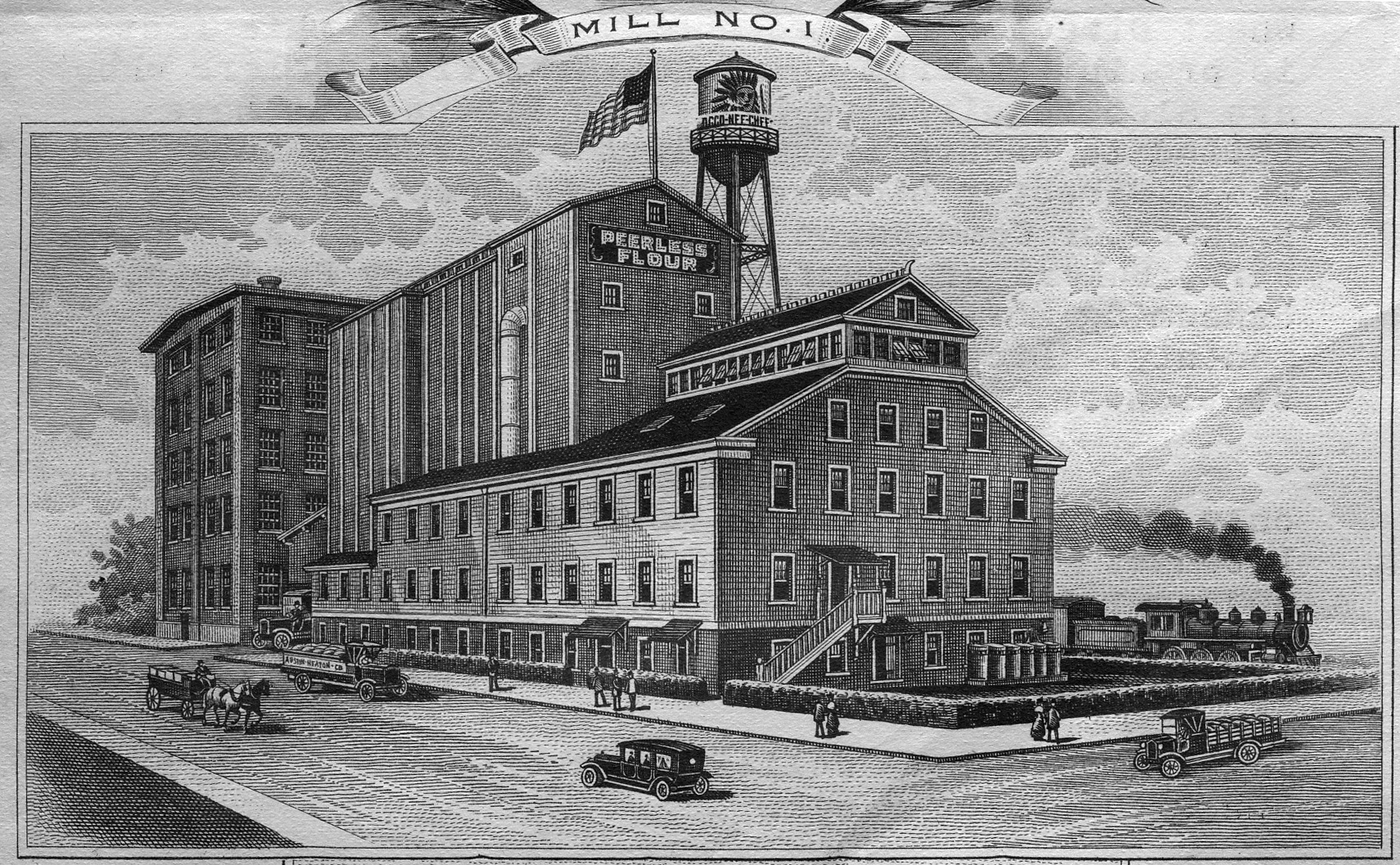
Or the new theater could have picked up the remarkable lines of the historic Austin-Heaton Flour Mill formerly on that site or evoked the beloved Durham Union Station that had stood across the track.

The design of the theater has grown on Durham residents but like the Detention and Judicial centers to the east, it isn’t coherent to its context.  As noted recently by one architectural expert:

“Cities have their own patterns of building, influenced by the pace of life, the quality of light, historic traditions or simply the materials available.

Buildings that acknowledge these patterns reinforce the sense of a particular place — they belong.”

Those on these inter-city visits, or inspection tours, also neglect to ask if the theater was a priority at the time or did it leapfrog higher cultural priorities?

They could also ask where Durham fell at the time in comparison to similar communities in the number of theaters or in overall visitor participation compared to averages.

Also questioned could be why philanthropic sources weren’t willing to fund the proportion of costs born in the other communities that were evaluated such as Greenville?  Was that a reflection of other community needs?

Was there any reason to build an additional performance hall prior to having a cultural master plan?

All of these questions go far beyond the questions usually asked during these familiarization tours and get at the overall question of “knowing what we know now, what would or could Durham have done differently” and still achieved similar or even better outcomes?

The problem, of course, is that to many people, questions are criticism.

Among those considering such a facility, anyone raising them might be ostracized as critics or naysayers because questions can be threatening to those who may have already made up their minds with very little information.

In turn, it is probably much too soon for even outspoken Durham to be introspective or if has, then forthcoming about what it would have done differently or volunteering that its success may have been been as much circumstantial as exceptional.

Regardless, history tells us that when provided such objectivity, enthusiasts have often dismissed it, even shopping around for consultants who would say yes after others concluded no.

It takes a truly exceptional community to put ego aside and pass up a challenge.

It took two or three decades after similar spates of overbuilding of other kinds of large-venue facilities before experts and researchers were able to truly and accurately assess the ramifications.

Even then there were outcries and choruses of angry denials.

Judging by studies and papers already underway such as the study “Is Bigger Better? The effect of capital facilities investment on non-profit financial vulnerability,” by Dr. Joanna Woronkowicz now under review.

Consortiums that began meeting under the aegis of Americans for the Arts nearly a decade ago, maybe those involved in the performing arts, will enlighten more quickly.

Or by then, will the devotees of such facilities as a means to achieve tangentially related but very different objectives such as “anchoring” turn to overbuilding yet another type of facility, hoping to feed what Architect Magazine columnist Aaron Betsky calls an “edifice complex?”

The history of such overbuilding over the last century suggests the latter.

Friday, October 11, 2013

Trends Underlying A Not So Quiet Desperation

Once again I’ll miss the Travis Tritt performance when the country singer returns to Durham, North Carolina’s historic Carolina Theater next February.

In part, this blog post will try to shed light on a number of conditions responsible for concert attendance being down - or at best flat - in the United States for many years including several high profile closings in the news recently.  In fact, I may be part of this problem.

Hint – the conditions impacting the live performing arts have nothing to do with lack of awareness, nor are these conditions something marketing can resolve.

As I joked with a long time theater executive last week, after four decades in community marketing and cultural and economic development, I don’t miss it for a second.  Empathetically, he noted he will probably never enter another theater when he retires.

The motivation for researching and writing essays from time to time, such as this one (more like a chapter,) are inspired by a feeling of obligation to give back to young people just starting out in my former field, as was so often done for me early in my career.

In this instance, my reason for missing Mr. Tritt’s performance is that it occurs just a few days from when I have made prior plans to attend a performance a few blocks away of The Book of Mormon, thanks to a friend’s season tickets at the Durham Performing Arts Center.

While my involvement lapsed many decades ago, Mormon is my ancestral religious heritage going back eight generations.  Ever since the now-acclaimed musical debuted on Broadway more than two years ago, my niece, a returned missionary, has been singing its hilarious songs.

As I recall, Mormons are known for their sense of humor and poking fun at their culture, but no culture is eager to be in the cross hairs of the geniuses who created South Park.

However, if memory serves me,  Mormons are also resilient and good at turning what may seem a disadvantage into an advantage.

Very telling is that news reports note that the Christian faith (Mormon is a nickname) has even run notices in the performance Playbill distributed to attendees at the door and some attendees have even been inspired to convert. 

However eclectic my personal musical tastes are, they lie far more toward country than Broadway musicals.  But I also spent a now-concluded four-decade career in community destination marketing, in part trying to weave arts and culture of all genres into overall community brand appeal.

This included helping performance venues harvest the 4.5% of visitors who will attend concerts on a trip including just less than a percent for which the performances are even the main reason for the trip.

For those who turn up their nose because the proportion seems small, it is the same as the percentage who participate in festivals or attend sports events or visit historic sites or museums (caution – often enthusiasts inflate this potential by showing it as a percentage of some types of visitation rather than overall visitation.)

Among daytrip visitors to integrated destinations such as Durham, which has long been noted for weaving the arts into its overall destination appeal, the proportion of visitors attending concerts can nearly triple, with 1-in-4 taking in a concert while on trips made for other purposes.

Visitors now make up 70% of attendees at Durham’s seven largest performing arts venues or nearly 420,000 admissions annually, including one venue regularly ranked second or third highest in attendance nationwide and in the top 10 worldwide among venues of its type on quarterly metrics.

Studies of cultural vitality show that Durham’s ability to draw attendance from outside its borders outstrips its comp set and is also 72% greater than the national average, evidence that awareness is no longer an issue.

Overall, if you include performances in venues such as places of worship and schools, close to a third of Americans attend a concert during a given year. But less than 5% attend any one particular musical genre such as country in a given year.  Rock is an outlier, drawing 11%.

Collectively, touring Broadway productions such as The Book of Mormon have 13 million admissions annually, down about 20% from 2010 and 30% from a peak in 1996.

An average of between 30 and 40% attend repeatedly as season ticket holders according to the Broadway League, so by my calculation, between 3 and 3.5% of American adults attend touring musicals and plays.

The problem with averages is that each type of performing art draws from a different demographic.  For instance, particularly in the South, touring Broadway skews much older, much more female, much higher income and overwhelmingly Caucasian, compared to the general population. 

But for me, there is more for me to the significance of Tritt’s visit to Durham.

In 1989, just as I was being recruited to Durham, where I still live, Travis Tritt was one of a handful dubbed as “hat acts” to hit the charts because they often wore hats and they once again steered country music back to its more traditional sound.

Others included Vince Gill, Alan Jackson, Clint Black and of course, Garth Brooks.

These artists stepped into the boots of performers like George Strait and Keith Whitely, who died suddenly that year just as Tim McGraw, another “hatter” arrived in Nashville.  In a few years he was also on the charts, along with two other “hatters” Toby Keith and Kenny Chesney.

But as much as I still listen to these artists today, I must admit I have passed more than once on seeing each of them in concert.

What place-research guru Dr. Richard Florida calls “big-ticket cultural events” are not panaceas to “place-building” because, as he notes in his break-out book on the topic, these events tend to be “one dimensional” and “consume a lot of recreational resources.” 

More indispensible to members of the bellwether “Creative Class” are the more “eclectic,” “indigenous” events that offer a “multi-dimensional” “smorgasbord” where one can go to maximize recreation.

Why?  Simply because they allow people to “modulate the level of intensity” and involvement, to use Florida's words.  For communities seeking to be attractive, it is a both/and proposition, but far more appealing are the latter and that is a hurdle for those operating large-scale facilities.

People turn away from concerts because they require a four hour time commitment, more from daytrip visitors who must commute from other communities.  Often the view at concerts is disturbed by late arrivals or people unable to hold it until intermission or by people jumping up and down or standing to watch, oblivious to those behind them.

Often, even excellent facility or imported sound is a disappointment in comparison to recordings or streaming concerts and there is no way to fast forward past less interesting pieces to favorites.  There is also no way to modulate the cost of tickets, concessions, parking and other fees involved.

These are only a few of the reasons that concert promotion today is about so much more than merely increasing awareness.

I’ll note more of these conditions below but a key influence on the struggles of performing arts attendance is that consumers now have so many other less “mainframe” ways to experience what concerts provide but with better sound quality, flexibility and with the option to tailor to one’s taste at much lower costs.

It is not really the fault of those operating or programing facilities that “big ticket cultural events” appeal to shrinking demographics. But many seem slow to adjust to the findings of numerous studies and analyses noting that merely “amping” up efforts to draw attention is not the solution.

There was a time several decades ago when awareness really was the issue. Many of us involved in community-destination marketing back then worked hard over the 1980s and 1990s to persuade cultural facilities and events to embrace marketing.

Adoption of that advice seemed to break along gender lines.

Female cultural decision makers tended to view marketing holistically, but in general,  male decision makers were very slow to embrace marketing as anything other than advertising, an element already in decline even back then, and now a negative return on investment.

Often this was due to what analysts back then called the “ego effect,”  the same thing that mires so many old-school hoteliers in direct sales.  These are  only two of several elements of a marketing blend and for several decades now they have been the least productive.

Similarly, this is why males more often fall prey to “crony marketing,” seeking advantage and favors based on “who they know” or so-called “power brokers” or seeking through cabals and surrogates to co-opt others into doing their job.

None of which makes for effective marketing.

I presume I was only saved from this fate of gender by early adoption of information-based marketing decision making, but the phenomena is prevalent nation-wide.  While I’ve worked with some of the best in the three cities I served, none were immune.

Several years ago, I was asked to co-chair a joint national panel of cultural and community destination marketing executives.  It was while chairing those sessions that I was first introduced to the growing tendency of some in performing arts to adopt a bullying technique similar to the one long plied across the nation by a few who operate hotels.

Desperate, they attempt through cabals to co-opt marketing meant for the community overall and re-direct it instead to substitute for their own responsibilities.  This led one long-time arts representative on the panel to joke that a reduction in testosterone was in order.

This self-defeating behavior seems to thrive where there is a basic misunderstanding of “roles.”  As one enlightened hotelier put it, community marketing is about tomorrow, marketing individual businesses is about today.

In other words, one is strategic and the other tactical in nature.

Joking about too much testosterone aside, there are good reasons for rising feelings of frustration and desperation among those involved with performing arts and related events and venues.

In addition to circumstances already noted above, the challenges impeding the success of “big ticked cultural events” revolve around several pervasive conditions:

Leisure time is the same as in 1900

While studies show that over the past century, hours worked per employed person in the U.S. have fallen from 2,700 to about 1,600, this doesn’t mean an increase in leisure time, which remains the same as it was in 1900.

In fact, researchers believe “pure” leisure time has actually declined since 1965, especially for women and much of what seems like leisure is really now “fragmented” leisure.

Even on weekends, only an average of 1-in-10 hours of so-called leisure time is available for attending events such as sports or concerts, including travel.

In the meantime, competition for this narrow slice of leisure time is fueled by an ever increasing flood of options that continues to increase exponentially including live concerts streamed over Netflix and via websites.

Leisure activities literally cannibalize each other, leading to desperate hubristic attempts to divert resources meant for overall development, which ultimately undermines a community’s overall appeal.

Over Supply Leads to Dislocation

Economists have long warned that increasing the supply of opportunities to participate in an activity does not lead to either an increase in the proportion of the population who participate in an activity nor the amount of discretionary spending devoted to that area.

Instead, if the increased supply (e.g. performances or performance venues) is not carefully calibrated, a dislocation of existing demand occurs, creating disruption when existing demand is divided into smaller slices.  The same is true of underwriting and volunteers.

This is particularly tricky in a regional context where the balance is even more fragile.  If one community seems to buck the trend, it very well may be that another is being eroded.

Both feasibility consultants and enthusiasts often fail to explain this to decision-makers and those who do are often ignored, especially when zero-sum power brokers are involved.

In destination development, as the old saw goes:

“Everything that glitters is not gold…

For everything you win there’s something lost.”

At the margins, the effects can be invisible for many years but not, if they are looking close enough, to those charged with filling seats and recruiting sponsors.

Access to Opportunity Lessens Motivation

Behavioral economists also know that the more opportunity there is to participate in an activity such as attending concerts, the less urgency consumers feel to participate and more they gravitate to alternatives that require fewer recreational resources.

For instance, it is no surprise that touring Broadway attendance has declined as the number of theaters involved increased.

No amount of marketing or increased awareness will make a difference because it isn’t lack of awareness that is the problem.

It is a paradox that the more opportunity there is, the less urgency there is to participate.  In time it catches up with all venues.

Performing Arts Competes with Baking

According to the Census, about the same percentage of the population attends some type of concert in a given year (including those in schools and churches) as will attempt to bake something in the oven.

As I noted earlier leisure activities are in competition with the broad spectrum of other leisure activities.

Marketing a community to draw visitors can certainly expand the pool somewhat but that dissipates once participation in an activity exceeds the fair market share visitors interested in that activity.

Officials seeking to enrich a community’s cultural vitality should take their cue not from enthusiasts for a particular activity or those with self-interest, but by seeking diversity and balance of offerings.

It starts by asking the organization responsible for visitor-centric cultural and economic development to identify where a community is underperforming compared to its potential and competitors.

Systemic Greed

Performing arts venues in North Carolina will now be required to add a 7% tax to tickets instead of 3% because a loophole has been closed.

Some communities such as Raleigh are a seeking competitive advantage by seeking to again exempt non-profits, creating an unfair advantage.

It is not clear whether those who vehemently objected a decade ago to a menu-approach to visitor related taxes, as those behind a new theater in Durham did, now understand the cost of their shortsightedness.

At the time, a 1-2% tax on admissions such as exists in South Carolina and other states would have been used to finance facility construction and upkeep of cultural facilities.

Now there is a 60% increase in the taxes paid by on admission tickets with none of it earmarked for those uses.

Even though facility operators raise the most fuss, taxes such as this are predominantly paid by consumers, not organizations.

But ticket prices since 1989 when the “hats acts” launched have risen by 400%, more than two and half times inflation, a far greater inhibitor than any amount of awareness marketing can overcome.

Only 1% of all acts now rake in 56% of all concert revenue compared to 26% in the mid 1980s.  This greed has left little room for discretionary consumer budgets to absorb the increase.

The top 5% of performers now take in nearly 90% of all revenue.  Add in special parking fees, $10 cokes and other hidden costs and it isn’t hard to see why it is now harder to motivate the small sliver of Americans inclined to attend concerts.

It’s a problem worthy of desperation but lets not blame it on closing a tax loophole, which for profit-making enterprises will be more than offset by a reduction in corporate taxes.

Awareness is no longer the problem nor the solution for performing arts venues.  Its issues are systemic and go far beyond what any amount of amplified marketing can overcome.

Arts and culture are a type of ecosystem and so is a community’s overall visitor appeal.  Leaving portions under-resourced when new favorites evolve is a formula for predatory behavior and cannibalism that only sows the seeds for decline and erosion of those facilities that make a community unique.

Any cultural master planning for new facilities and events should include a plan for not only what’s wanted but more importantly what’s warranted to fill gaps in cultural infrastructure.

Equally important but almost always neglected, this planning must link a plan to increase resources for upkeep and nurturing of existing facilities when new ones are added.

Cultural planning should at the very least include a plan for obsolescence and moth-balling, or better, adaptive reuse of existing facilities and events to serve a an area of the cultural ecosystem that is underserved.

These are not outcomes that should not be left to predation or “power brokers or the fatalistic churn endorsed by some developers.  And siphoning off community destination marketing resources is not the solution to poor destination planning.

Marketing a community is a role distinct from the responsibility to market individual businesses or cultural facilities or events.

Examples across the nation are legion of the disaster inherent when either role is usurped by the other.
Tuesday, October 14, 2014

At The Altar of Shiny and New

I left off in yesterday’s essay by noting the irony that some cities sacrifice sense of place at the altar of fantasy and things “shiny and new” while others even nearby fight hard to preserve it.

Last week, while attending an awards banquet in a Winston-Salem hotel, I had pause to reflect on how emblematic that non-descript, designed to be “Anywhere, USA” 1980s structure and its 1970s twin are of that community’s struggle to hold on to sense of place.

Invariably, unless a community’s advocates succumb to the demons of the “shiny and new,” the latter will always eclipse the former because research shows that the distinct sense of a particular place is ultimately more appealing, even to those visitors and newcomers seeking fantasy.

When I arrived in Durham, NC twenty-five years ago, part of its appeal to me as its newly hired guardian was that the importance of sense of place was apparent here but even so it has been besmirched here and there by those worshipping the “shiny and new.”

Startups are incredibly intense but indispensable is taking time to interview those with ties to the founders who had helped perpetuate and protect it.

One of the questions I had learned to ask during these interviews was, “Which community in the state had done the best job leveraging sense of place?”

Invariably, during my first few months in Durham the answer always came back, “You’ve got to study Winston-Salem.”

So even before visiting nearby Raleigh, which even back then seemed intent on surrendering sense of place to the “shiny and new,” I targeted Winston-Salem for my first excursion while familiarizing myself with North Carolina.

En route, I took a swing through Greensboro, which confirmed what my sources had noted would be more in the mold of Raleigh when it came to undervaluing sense of place.

Winston-Salem’s “sense of place revolt” occurred in the wake of WWII nearly three decades before one similar in Durham, 1948 to be exact, less than two months after the first flight aboard a DC-3 of W-S’s home-grown Piedmont Airlines, now folded into American Airlines.

In April there was a union-organized civil rights protest but it was a zoning request in July for a supermarket that kindled Winston-Salem’s “sense of place revolt” (coincidentally also my birth month/year.)

Back when Durham was just emerging as a crossroads, Winston-Salem had just been “Salem,” the administrative town for a 100,000-acre tract the immigrant Moravian Church had purchased and named Wachovia in the early 1750s. This also included several other settlements, some slightly older.

For the next hundred years, the church owned the land and members owned their own structures.

But by 1849 the church transitioned away from that model, turning over administration of the town to residents and setting in motion the sale of land parcels to each respective structure-owners with some acreage remaining as community “commons.”

This was occurring just as the newly created Forsyth County was eyeing Salem as the natural county seat. Passing on that opportunity, the Moravians instead sold some land just upland for creation of the new gentile-friendly town of Winston for that purpose.

Like Durham, Winston became an industrial powerhouse, quickly tripling in size as Salem declined.

Fast forward fifty years and the U.S. Postal Service created the name Winston-Salem for as the name for newly combined postal facilities.

By 1913, just as the iconic Camel cigarette brand was created, the two towns merged but one had already become more of a neighborhood.clip_image002

Gradually over the next two decades, non-Moravians moved or established businesses in Salem including Krispy Crème Doughnuts, founded there as a wholesale operation in 1937.

Symbolic, nearby was a brothel.

To put this in context, this was the period when the Wake Forest School of Medicine, then an extension of a small Baptist college north of Raleigh, opened in Winston-Salem thanks to a trust set up by RJR executive Bowman Gray.

Some historic Salem structures had tragically been torn down and replaced by incongruent structures that certainly didn’t fit or belong. But it was plan to plop a supermarket in the midst of the old village that sparked a community-wide “sense of place revolt.”

Within a year, an architectural design overlay, only the fifth in the U.S., was created to protect Old Salem. A Boston firm whose two principals had helped create Colonial Williamsburg was commissioned to conduct a historic survey and propose a plan for preservation.

But a young WWII Navy veteran and antique collector named Frank Horton had already been busy combing through the meticulous Moravian archives to identify which buildings were truly historic.

He accompanied the survey team and in late 1949, the findings were presented to Winston-Salem leaders in the 1920s-era Robert E. Lee Hotel, a contemporary of the Washington Duke in Durham.

While even older landmark hotels are still in service in many communities across the country such as Spokane, where I served, both the Robert E. Lee and the Washington Duke would soon be imploded by the forces of “shiny and new” in favor of generic substitutes.

Mayor M.C. Kurfees had just been elected and moved quickly to form a commission to oversee preservation, headed by James A. Gray III, the scion namesake of the then head of R.J.R Tobacco and nephew of Bowman Gray.

The long-serving Kurfees is as crucial to Winston-Salem as his contemporary, the equally long-serving Mayor of Durham, E. J. “Mutt” Evans. But as sense of place advocates rallied, so did disciples of the “shiny and new” a few blocks away.

Without due process and against Kurfees’ caution, officials listening to chamber types fired the city manager there and replaced him with a relative newcomer, a former FBI agent who had recently been Police Chief.

The manager soon became a spearhead for commercial boosters of the “shiny and new” there pursuing an expressway and setting in motion destruction in the guise of urban renewal.

Significantly, not only was Gray connected to the power structure in Winston but his mother was also a Moravian with deep ancestral roots in historic Salem.

Together with Charles Babcock, a newcomer with connections, and Frank Horton as officers, Gray, a newspaper executive, founded Old Salem Inc. to implement the preservation plan.

Gray and Babcock, also related to RJR by marriage, raised the funds to implement the preservation plan for the old town of Salem, while Horton took on the challenge of buying and destroying 120 intruding structures.

In 1954, Horton was joined for two decades by another vet, Frank Albright, as director of research, who in real life was one of The Monuments Men, a special unit made famous this year in the acclaimed George Clooney film.

Already Horton had begun reclaiming Salem artifacts that had slipped away and began reconstructing the story of Old Salem. Albright, an archeologist by training, soon began excavations.

As I first walked through Old Salem in early 1990, Horton, Kurfees and Gray had retired as legends, but the results of their four decades of work on Old Salem was incredible to see including several restorations serving as museums, clearly distinguished from reconstructions.

Gardens were also being restored and Horton had founded the adjacent Museum of Early Southern Decorative Arts, populated in part with the meticulous collection he and his mother had assembled.

Making sweet irony, its home was a former Kroger Supermarket.

Within a year of my first tour of Old Salem, Hobie Cawood, with whom I would then work on state-wide tourism issues, retired from a three decade career with the National Park Service to head Old Salem for a decade.

On our morning walk after that awards banquet last week, we headed down the hill through Old Salem, my first visit in over two decades.

It is a “real” and authentic place. No Disney-ification here. It is now managed and programmed by more than 200 employees and its historical research and archeology continue.

It is clearly the temporal heart and soul of Winston-Salem and the enduring symbol of its sense of place.

The area had been re-branded before I retired from a four decade career in destination marketing as Old Salem Museums & Gardens and the village as the Historic Town of Old Salem, but at its heart remains Old Salem Inc.

The 1950s were heady times for Winston-Salem in other ways including relocating the rest of what is now Wake Forest University there. But panic set in as its manufacturing heartbeat quietly began to lose steam.

Leaders had been stung by criticism during that 1947 “sense of place revolt that the town wasn’t new and modern enough and that its flair for the fantasy arts a joke.

Next came a new convention center followed by implosion of the old Robert E. Lee to make room for two equally incongruent formula hotels without the character or the bones of the old hotel or its connection to sense of place.

Little more than a decade later Durham would make the same fatal decision, an incongruent testament to the “new and shiny” in violent contrast to the state’s first commercial district on the national historic register.

In the 1960s, in part because the first arts council had also been created there in 1949, leaders pursued the new UNC School of the Arts which protects the southern approach to the Old Salem Museums and Gardens as does green space along Salem Creek.

UNCSA saved and restored a 1929 silent movie theater from the forces of “shiny and new,” and restored it in 1983 as a 1400-seat performing arts center. Now the acclaimed school has plans to add a 3,000 seat performing arts center downtown.

Experts note that most performing arts centers are in “the assembly-line business” rather than being actual creators. But in Winston-Salem, the new center for performing arts will be both.

As such, it will leverage rather than put sense of place at risk as most large-scale venues do. But advocates for the “shiny and new” are impatient with growing indigenous festivals and culinary arts.

Downtown advocates there have sought instead to try and lure away name restaurants and festivals from other communities such as Durham, failing to recognize that sense of place would not come with them.

A new visitor’s center at Old Salem is now linked from the west by a state DOT pedestrian overpass in the form of a recreation of an old wooden bridge.

Pinned down by those obsessed more with the “shiny and new” when I visited Winston-Salem in 1989, its much longer established destination marketing organization lagged behind until recently, so beholden only to the solicitation of the 10% of national visitation drawn for conventions and meetings that it didn’t even have a visitor’s guide at the time.

So Durham was able to rapidly eclipse Winston-Salem by adopting data-driven holistic community marketing and fulfilling the customary role as guardian of sense of place.

Beginning in 1982, Durham was also first to begin adaptively reusing millions and millions of square feet of its old factories and warehouses, but still lags behind Winston-Salem and other similarly sized destinations with only an avatar of a local history museum, more than 60 years after residents and officials embraced it during its centennial in 1953.

But many community leaders in Winston-Salem have never lost sight of sense of place as a as a priority. In the 2000s, a New Winston Museum was created (a museum of local history distinct from Old Salem – get it?)

Plans are for a new facility downtown, along with a new Carolina Air & Auto Museum along the north edge of downtown. RJR buildings are now also being adaptively reused, one as the state’s first Kimpton Boutique Hotel.

But Winston-Salem has also learned from that near miss in 1947. It is careful to define districts and works hard to guide developments and architectural styles into those where they will coherently belong.

Durham has design guidelines but proponents of development often sell out for fear of losing, even with the community’s own public facilities.

Durham is better at community branding, understanding than an overarching personality is about what a place really is, not what you strive to be.

Still stung by those 60-year-old criticisms, Winston-Salem has proclaimed itself the city of arts, now adding on innovation. But this isn’t where the city is distinctive, falling far below many other cities on indices for these traits, even in North Carolina.

Communities such as Winston-Salem and Durham, where sense of place has been preserved, are still torn by the forces of fantasy lobbying incessantly for things “shiny and new” things that make them the same rather than distinct and threatening to hollow out sense of place.

The less rooted in these communities should take heed from a famous 1952 quote by Frank Horton as work on Old Salem began:

"There will be no window dressing.

We plan to restore the old town as it was and not as we imagine it should be.

Whatever is done in the name of history must be honest, authentic, and accurate.”

Communities such as Durham and Winston-Salem cling to sense of place while others long ago gave up and became merely commercial replicas in pursuit of “edifice envy”, forces from which no community is ever immune.

Thanks to those with ties to founding generations but when each community was still 90% North Carolinian, they set a standard for sense of place.

Now it falls to more recent and often unfamiliar generations as well as newcomers to take up the torch.

Hopefully Durham and Winston-Salem are still learning from one another and can tame the forces of “shiny and new.”

clip_image003