Tuesday, June 05, 2012

Surprising Wisconsin Detour – A Convergence of Three Passions

I was drawn up through Wisconsin for my first visit to that state during the west-bound leg of a 6000-mile cross-country road trip last year with Mugsy, my English bulldog, as we leisurely made our way to meet up with family at a lake along the border of Washington and the Idaho panhandle.

As we drew closer to the Wisconsin-Illinois border we had a choice of two alternative routes of interest.  Satellite radio news from Wisconsin at the time, as it still is today, was all about recall elections.

I toyed with veering slightly northeast up through Governor Scott Walker’s hometown of Delavan, now with a renewed reputation as circus capital of the world, then on to see the spectacular new Harley-Davidson Museum in Milwaukee and then five minutes further to the site of the 126-year-old historic Bay View Massacre which occurred during another misguided period of union-busting in that state.

But for several reasons related to Durham, North Carolina, where we live and began our journey, I decided instead to cut northwest up through the prairie and savannahs of the western uplands, past the four lakes of Madison (even though we would miss seeing my friend and fellow blogger Bill Geist who was also on the road) and then up through the Dells and across the valley of the 285-mile long Chippewa River.
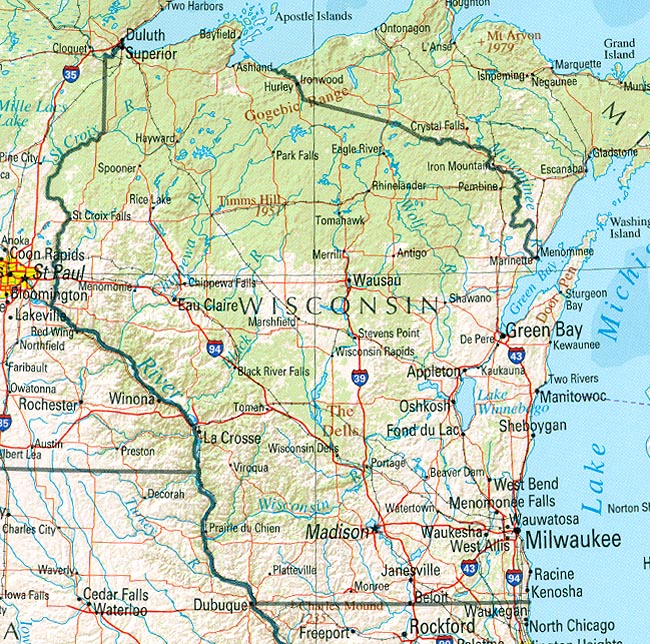
All three reasons for selecting that route relate to passions of mine including the Civil War, the story of trees and family history .

The Civil War effectively ended at Durham with the largest surrender of the war by Confederate General Johnston to Union General Sherman (at Appomattox, Lee had surrendered only what remained of the Army of Northern Virginia.)

Several Wisconsin units had fought with Sherman through the South from Vicksburg to Chattanooga, down across Georgia, up through South Carolina ending in North Carolina and Durham including the 25th Wisconsin which was drawn from counties along the Chippewa.

The 25th was part of approximately 80,000 Wisconsinites who fought in the war against slavery and to save the union including 12,000 of whom died.

But 36 years before that war ended in Durham, as a young Lieutenant in the U.S. Army, eventual-Confederate president Jefferson Davis led a party up the Chippewa and made what newspapers reported as the first “sound of a white man’s ax heard in the pine forests of Wisconsin.”

Today, only 46% of Wisconsin is covered by forest but back what would become Wisconsin was 86% covered by forests.

As Jefferson Davis paddled his birch bark canoe, the Chippewa River Valley alone held one-sixth of all of the pine timber west of the Appalachians according to the New York Times and 34% of the pinery in what would become the Wisconsin Territory seven years later.

Davis swung that ax along the Chippewa three years before US Government-contracted surveyors began detailing the area on maps to be used by timber companies, settlers and speculators as well as portions granted to the railroads.

It was also about the year two of my ancestors, Lewis and Elizabeth Neeley migrated north to try to help settle Dane County, Wisconsin several years before Madison was founded there only to find themselves in the middle of the Black Hawk War and were driven south again after the 1832 attack on Fort Blue Mounds, leaving two children buried there.

The Neeleys relocated back to Vermillion, IL in 1833, the same year future president Abraham Lincoln volunteered to fight in the Black Hawk War.  Eventually the Sac (Sauk) Chief Black Hawk sought refuge along the river with the Chippewa Indians (Ojibwa) where he was persuaded to surrender and was escorted by Lt. Davis to Fort Crawford.

For a time, the Neeleys relocated near Vermillion, IL during the time when the Treaty of St. Peters between the U.S. and representatives from various Ojibwa bands which granted full access to exploit the Chippewa River Valley.  But the Neeleys had headed west by the time Lincoln arrived to practice law in Vermillion.

By 1850, two years after Wisconsin became a state and just as logging was ramping up along the Chippewa, my great-great-great grandfather Lewis, having lost his wife in Winter Quarters, Nebraska, was heading further west still with my great-great grandfather Armenius, up and over the Continental Divide.

Logging the Chippewa would intensify after the Civil War as the soldiers of the 25st Wisconsin returned home two years before Laura Ingalls Wilder, author of the Little House series was born along that river, the inspiration for her first book Little House in the Big Woods.

The commander of the 25th Wisconsin, Jeremiah McLain Rusk went on to serve in the U.S. Congress then as the governor of Wisconsin when his order to the National Guard led to the tragedy at Bay View.

By the 1890s logging along the Chippewa had peaked after a billion feet of logs had been harvested annually through the 1880s.  Only 5% of the spectacular White Pines and 0.5% of the Hemlock trees remained.

Long before sustainable logging, people with names such as Weyerhaeuser had denuded the Chippewa of 46 billion board feet of timber and by the 1920s the timber companies were trying to sell the barren land to farmers.

But once cut over, the land remained “unrehabilitated for generations.”  Gradually by World War II the area reforested but not the way it had been.

An hour west from Eau Claire WI, where Mugsy and I crossed the Chippewa, and a half hour north off the Interstate as it nears the Wisconsin border with Minnesota is the little town of Clear Lake WI.

It is the hometown of the late U.S. Senator Gaylord Nelson, who served two two-year terms as governor of Wisconsin beginning in 1958 before his 18 years in the Senate.

Nelson grew up at a period when the devastation left by unsustainable lumbering practices around Clear Lake had left it poor, polluted and denuded compared to what it had been when his grandparents had homesteaded there from Norway in the 1870s.

Nelson was a progressive and eventually a Democrat but in the Wisconsin before he returned home from fighting in World War II to practice law he might have easily been a Republican.

Wisconsin progressives were Republicans dating back to the legendary Robert M. La Follette, Jr. a native of Madison and a longtime Senator and candidate for President or maybe to the party’s founding in 1854 with progressive antislavery roots

But progressives were driven out of the Wisconsin Republican Party when La Follette was defeated by the now infamous Joseph McCarthy of 1950s “Red Scare” notoriety when he used extremism and unsubstantiated charges to purge political enemies not dissimilar to the tactics pursued against unions today by Tea Partiers fueling support for Governor Walker.

During the early 1960s Nelson was known as the “conservation governor” and the popularity for those initiatives catapulted him to the U.S. Senate where he helped Wisconsin regain credibility on the national stage by founding Earth Day and spearheading conservation legislation throughout the 1970s as part of his fervent advocacy on behalf of small business.

The 288 mile detour we took last summer through Wisconsin was enlightening as well as memorable and Mugs and I definitely hope to see more of that state on future trips.

Monday, June 04, 2012

Reverse Recycling Blues

My English Bulldog, Mugsy, not only warns me whenever someone comes to the door but also when the dryer or washer has finished and when my recycling or garbage carts are ready to be retrieved and stowed after pick up.

But the other day he didn’t warn me that my garbage cart had lost both wheels and the axel during the last pick up.

Broken Garbage Cart
I tried but was unable to fix the cart myself, so I called Durham One Call for a replacement and suggested that they bring me a smaller size cart because I generate very little garbage and never coming close to filling the large cart given the effectiveness now of the large roll-out recycling carts.

I was surprised to learn that the company contracted to repair carts or drop off a replacement will only do so on the NEXT week’s pick up day regardless of when the damage is reported, so this would necessitate hauling the broken cart up the driveway, stowing it for a week and then dragging it back out to the curb a week later.

Or it could just junk up the bottom of the drive and the street for a week, no doubt irking my neighbors and violating city policy.

“This doesn’t make sense,” I told them on the phone, so I was given another number to call from which I was transferred to a person in the area involved with carts who said the replacement could be moved up a few days, however I could not have a smaller cart because they are only provided to town homes and the infirm.

Again, I muttered that this didn’t make sense because I knew the City was moving big into “reverse recycling” which has the recycling containers larger than the garbage containers, both in offices and curbside, so that folks will recycle even more and steer less and less toward landfills.

“Nope,” I was told.  If they gave me the smaller size, then all of my neighbors would want one and there wouldn’t be enough.  “But that sounds like the goal,” I muttered, adding that in transition the smaller containers could be phased in only as replacements for damaged carts to smooth out the expenses involved.

To no avail I rattled off a few other alternatives to manage inventory of the smaller carts such as limiting them to single person households or giving the option of paying a fee.

In a more terse tone, I was told I could attend a PAC meeting with City Council and complain.  When I responded that this sounded more like a management issue than a governance issue, I could be connected to “someone in management” then.

I explained that I knew it wasn’t her fault and asked if she would pass along the suggestion to revisit the policy  Frustrating as it might be, the response was that this particular person’s job only included arranging for repair or drop off and apparently not passing along suggestions for improving the process.

I chose not to pursue either suggested channel of complaint but others on my street have.  I hoped instead that upon further reflection or possibly a constructive confrontation, the staff involved would think it through on their own.

But this is a microcosm of why many citizens resent government.  It isn’t that they don’t need or appreciate the services provided.  It is just that so often the way those services are delivered seems so inflexible or simply doesn’t make any sense.

I know how many dedicated, talented and hard working people there are at every level of government and reading about such an isolated instance will burn them up.  Hopefully instead they are asserting themselves internally through the principles of crucial confrontation.

The problem is far from isolated and the changes that need to be made must originate internally and as much bottom-up as top-down.  Waiting for or encouraging electoral pressure is far too blunt a way to initiate meaningful change and alignment within organizational culture.

I’m happy to report that a slightly used but smaller garbage cart arrived on Friday!  Mugs and I are now official reverse recyclers.

Sunday, June 03, 2012

Infographic – Video View By Screen Type

Video Time By Screen

For the report click here.

Saturday, June 02, 2012

Infographic – Transplant List

Impatient List

If clicking on it doesn’t open the full infographic, click here.

Friday, June 01, 2012

Biocapacity And Billboards

Located in Durham, North Carolina, where I live, Duke University takes sustainability very seriously, but someone hasn’t connected the dots for marketers there who are apparently still practicing desecration marketing.

As one of North Carolina’s largest private employers, Duke’s commitment to  sustainability is broadly evident from the comprehensiveness of its incredible strategic policy to “boots on the ground” elements such as the The Center for Sustainability and Commerce and The Environmental Law and Policy Clinic.

The hypocrisy of Duke’s health system marketers using static roadside billboards to promote Duke Primary Care while enabling billboard companies to circumvent Durham tree ordinances along state roadways with clear cutting may be lost on some but hopefully not on Duke officials.

The irony isn’t lost on marketoonist Tom Fishburne, whose image “eco-friendly” is shown in this blog.

Some of the most cogent alarms about sustainability are coming from the private sector including the essay by Hardin Tibbs on pages 7-10 of the current issue of FutureProof

Lamenting that a consumer focus is too short term and that “democratic governments seem increasingly populist rather than strategic, and wait for electoral pressure before risking policy initiatives,” Tibbs notes that this “leaves business in the hot seat.”

Tibbs provides evidence showing that we overshot the world’s biocapacity in the 1970s and by as much as 50% by 2007.  He argues that business “owns and controls the part of the economy that needs fixing.”

He illustrates that “global-scale sustainability” requires a strategic-challenge approach to turning “the three global system fundamentals” (resources, value and design) from “chains into loops” including .

I first began to follow Tibbs more than twenty years ago when he published the white paper entitled Industrial Ecology – An Environmental Agenda for Industry on behalf of Arthur D. Little Inc. a little more than a year after I relocated to Durham.

It is the first time I remember seeing the term “green corporation” and the idea of production “loops” that would incorporate environmental costs.  But my first understanding of sustainability goes back to a prediction in 1972, the year I graduated from college, which turned out to be right on the button.

Today, forty years after that initial prediction and twenty years after Tibbs’ model for industrial ecology, the widow for sustainability is rapidly closing.

He warns in the April issue of FutureProof that, if business doesn’t step in and rise to the challenge, “the global industrial economy will collapse within 20 years if we don’t reinvent it to work on different technological principles.”

As illustrated by bio-activ technology for businesses as small as the family farm, it isn’t just for the good of humanity, the environmental loop model is just good business.